3 International Conference on PROTECTION OF HISTORICAL CONSTRUCTIONS Lisbon, Portugal, 12 – 15 July, 2017
BUILDING MATERIALS WITH HISTORICAL AND HERITAGE
INTEREST – A DATABASE IN PROGRESS
A. Santos Silva*, Maria J. Correia*, Luís Rato** and Nuno Matos***
* Laboratório Nacional de Engenharia Civi (LNEC), Materials Department, Lisbon, Portugal e-mails: [email protected], [email protected]
** University of Évora, Computer Science Department, Portugal e-mail: [email protected]
*** Third Author Affiliation e-mail: [email protected]
Keywords: Construction materials; traditional techniques; architectural heritage; free ICT tools; web-based database.
Abstract. Conservation and restoration of architectural heritage requires knowledge of the
conservation state of its constituent materials in order to provide recommendations concerning the intervention plan, and the materials and the techniques to be used. Information on physical, chemical and mechanical characterization of materials, when available, is usually shared by different actors, but is not normally accessible by the general public. In this context, the DB-HERITAGE project intends to build a reference sample collection or repository for historical materials and an IT-tool to collect the related data on construction materials history, properties, and performance. This database is being developed to categorize materials by type and function, addressing the relevant issues in the historical context of construction materials. An overview of the database tools will be presented in this paper, exemplifying some of its outputs.
1 DB-HERITAGE MOTIVATION
In the last decades there has been increasing global information on building materials composition and characteristics, as well on their deterioration and ageing mechanisms. DB-HERITAGE project (Database of building materials with historical and heritage interest, reference PTDC/EPH-PAT/4684/2014, with the financial support of Fundação para a Ciência e Tecnologia) is intended to provide different tools for documenting and preserving materials history, properties, and performance. Besides the preservation of the materials related educational and historical value, with the related legacy for future generations, the samples repository is also demanded as a basis for further innovation and development. This valuable
origin, use, chronology of interventions, properties, environmental exposure conditions, result of observations, and archive management details. These archive management tool is intended to manage a physical samples repository, which will be provided by the project for free consultation and study.
Efficiently and systematically organized materials and related information, properly collected and preserved, is valuable information for supporting research to prolong historic building materials life both by delaying deterioration and efficiently supporting their selection and use. Thus, the adopted tools, and the built facility shared and made entirely available, as well as the related improved knowledge should be used to establish a cluster on construction materials history.
2 DB-HERITAGE DATABASE
DB-HERITAGE project database, as well as other web-based free IT tools, should be used by the project communication strategy, highlighting its social, economic and environmental benefits. DB-HERITAGE database progresses to allow the interaction with different tools with similar end uses, benefiting different entities concerned with historical materials.
2.1 Background – DB-DURATI
The database DB-DURATI (http://dbdurati.lnec.pt/) was created in the scope of DURATINET project[1] for the archive and evaluation of materials performance data, which allows the
benchmarking of predictive lifecycle modelling. This database uses the web Django platform, with a scalable, secure and expansible base. This web-based tool only requires a browser to provide for all its functionalities. It allows simultaneous multiple users as well as the easy migration of data. The associated users management system allows the definition of different access levels, from restrict to integral, for different user groups assuring the data confidentiality whenever necessary.
Figure 1: DB-DURATI development basic scheme.
For each case study the general data can include, by each defined tree level, information on the project and construction details, through different user defined attributes. This dynamic definition of attributes, in this and in all remaining sections, provides data management flexibility.
The environmental and materials characterization, as well as the historical background can have different data in the distinct defined levels for each case study.
As regards the environmental characterization, the data is grouped into meteorological and atmospheric pollution, and water and soil characteristics (Figure 2). The user can thus access the local information registered in the region where the work of art is located or alternatively access the microenvironment data associated with the exact location of an element from that structure.
Materials properties are grouped into chemical, physical and mechanical, besides being possible to characterize also the related protection system (Figure 2).
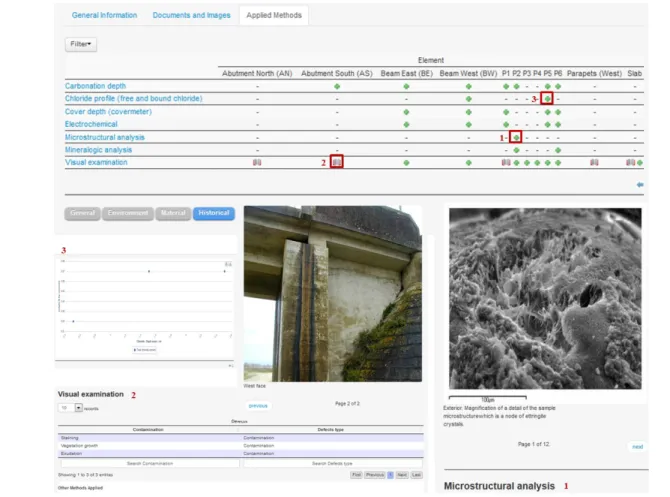
The historical background is subdivided in inspection, maintenance, monitoring, and conservation or repair interventions (Figure 2). For each one of these interventions groups it is possible to access the data of the different tests made on each element or component. This information is summarized and stored in a dynamic table which allows selecting the data results related with the use of a given method in a certain component for the materials characterization, as illustrated by the example included in Figure 3. This data can additional be screened according with the user awareness.
Figure 2: DB-DURATI database model.
The database has been created to simplify data update and analysis. It integrates some simplified tools, such as graphics and filters, being possible to export data in different formats (Figure 4). It is also possible to filter the hierarchic description of the work of art, getting only the elements which fulfil the user selected criteria.
Figure 3: Dynamic table with a case study assessment synthesis for the materials characterization, and typical examples of data.
Figure 4: Different tools currently available. Examples of test results in the case study complying with the selected criteria and different ways of accessing data.
2.2 Database and other activities of DB-HERITAGE
The different working groups of DB-HERITAGE project include:
Implementation of a database of historic construction materials, properties and performance;
Inventory, collection and data of historical stones, earth, masonry mortars, renders and plasters, ceramics, metals, concrete, wood and paintings materials;
available to the registered user. Anyone who wishes to actively participate in gathering data should make a request through the contacts given in DB-HERITAGE site (http://db-heritage.lnec.pt/) for that purpose.
The DB-HERITAGE database allows classifying the materials according with its type and function. A dedicated interface is being projected accordingly for including the relevant data in the historical context of the construction materials. A module to manage the physical archive of historical materials sample is also being created.
It is also being considered the interaction of the DB-HERITAGE database with different tools for the share and registration of information on heritage architectural works of art and historical construction materials. Different initiatives, like a collaborative map for the registration of industrial masonry brick chimneys in Portugal, are being disseminated through DB-HERITAGE site to motivate the interest of the scientific community and the public to heritage preservation.
3 CONCLUSION
The level of development of societies is intrinsically linked to the way people have been able to use and transform materials. The evolution in the use of materials, and in particular of building materials, also reflects practices and local knowledge that must be maintained and preserved. Thus, the DB-HERITAGE project was created to build a repository of building materials with historical and heritage interest and an IT-tool that is collecting related data on materials history, characteristics and conservation state.
The advantages of setting up such a platform to deal with historical materials past and future performance are massive. This are valuable for research to prolong historic building materials life both by delaying deterioration and by supporting their suitable selection and use.
REFERENCES
[1] DURATINET Project - “Durable Transport Infrastructures in Atlantic Area - Network” - 049/2009, approved in the Atlantic Area Transnational Programme, co-financed by ERDF, http://durati.lnec.pt/en/db_durati.html.