Gabriela Cordeiro Silva
, Guilherme Jorge Brigolini Silva
, Ricardo André Fiorotti Peixoto
aLaboratory of Materials for Civil Construction, Federal University of Ouro Preto, Ouro Preto, CEP 35400-000, BrazilbPontifical Catholic University of Minas Gerais, R. Rio Comprido, 4.580, Contagem, CEP 32010-025, Brazil
h i g h l i g h t s
LAS-based washing-up liquids are
effective air-entraining agents (AEA).
Performance and morphology of
LAS-based AEA is similar to commercial AEA.
Excess of AEA compromises
significantly the mechanical properties of mortars.
The pore system of a matrix with AEA
is directly related to the AEA content.
The mechanical/physical properties
are directly related to the pore system.
g r a p h i c a l
a b s t r a c t
a r t i c l e
i n f o
Article history:
Received 25 January 2016
Received in revised form 9 March 2017 Accepted 5 April 2017
Available online 21 April 2017
Keywords:
Air entraining admixtures Washing-up liquid Dishwashing liquid Biodegradable admixtures Morphological analysis
a b s t r a c t
The air-entraining admixtures (AEA) consist of surfactant compounds, as do washing-up liquids. Washing-up liquids are products widely available, non-toxic and biodegradable. This work proposes the use of an anionic surfactant from washing-up liquids, Linear Alkyl Benzene Sodium Sulfonate (LAS), as AEA. Mechanical, physical and rheological properties of mortars comprising LAS were compared to ones with commercial admixture and one without any. The morphological aspects of the air-entrained matrix were also evaluated, and associated to its properties. Results indicate that the LAS-based AEA is an effective air-entraining agent. Thus, the present work seeks to disclose this new biodegradable high-performance potential AEA, as well as to improve the comprehension of the effects of AEAs in cement-based composites.
Ó2017 Elsevier Ltd. All rights reserved.
1. Introduction
The air entraining admixtures (AEA) introduce small air bubbles (or voids) dispersed throughout the matrix. These homogeneously
distributed microbubbles improve the cohesion and workability of cement-based composites, prevent water penetration, and reduce
the tendency of segregation and bleeding in fresh concrete[26].
AEAs are usually employed in concrete subjected to freezing and
thawing cycles[16], for lightweight concrete and pumped
con-crete. Surfactants (or surface-active compounds) perform the
mechanism of air entrainment[20].
Surfactants reduce the surface tension of substances, due to the balance of forces between its molecules at the interface. In general,
http://dx.doi.org/10.1016/j.conbuildmat.2017.04.024 0950-0618/Ó2017 Elsevier Ltd. All rights reserved.
⇑Corresponding author.
the molecules of surfactants contain a hydrophobic (or nonpolar) chain and one or more hydrophilic (or polar) groups. One example
is the Linear Alkyl Benzene Sodium Sulfonate (LAS) (Fig. 1) – the
active component of commonly used washing up liquids. The detergents interact both with fat (nonpolar) and with water (polar), thus promoting the cleaning of the surfaces.
LAS is a family of synthetic detergents, part of most of cleaning products. Some of the benefits of using washing up liquids for this purpose, compared to AEA commercially available, are: wide avail-ability, low cost, tenderness to the skin, and lower environmental impacts since they are biodegradable by government regulation
[2]. Furthermore, while commercial admixtures are sold in
mini-mum volumes of 1 L, usually in buckets of 15 L, household washing up liquids are easily adaptable for small concreting.
Therefore, this paper evaluates the potential of using washing up liquids as AEA. The active principle of the proposed admix-ture is easily accessible to the population, relatively inexpensive, non-irritating to the skin, easy to apply, as well as biodegrad-able. This work also presents the morphological analysis of the pore system of the new LAS-based AEA. Several mortar matrices were produced, with increasing content of AEA. The morpholog-ical characteristics of their pores were presented, evaluated, and associated with physical and mechanical characteristics. Hence, this work aims to improve the comprehension of the physical effects of the addition of AEAs to cement-based materials, as well as the consequences to their properties, and ultimately contribute to the technological development of cement-based composites.
2. Washing up liquids
Washing up liquids are composed by surfactants (or surface-active substances). After a certain critical concentration in water, the surfactant molecules in solution begin to aggregate as micelles, in dynamical systems. Detergents work by inserting the dirt parti-cles of nonpolar nature (such as oil and grease) into the interior of the micelles and keeping them in suspension, facilitating their
removal [23]. According to the electrostatic nature of the polar
group, surfactants are classified as anionic, cationic, amphoteric and non-ionic.
Detergents may be composed of one or more types of surfac-tant, aiming to improve their cleaning performance. The LAS is the most widely used surfactant. Its popularity is due both to
low production costs, as for its performance[5]. Although the
com-mercial LAS consists of over 20 individual components, including sodium dodecyl-benzene sulfonate (known AEA), the ratio between the various homologues and isomers is relatively constant between different applications. Because of the close consistency of the mixtures, and effects, LAS is usually discussed as a substance
[17]. In addition to the surfactants, household detergent may also
contain thickeners, sequestering agent, preservatives, hydrotropes,
and aesthetic enhancers such as perfumes and dyes[23].
Regarding chemical attack, the predominant surfactant in
washing up liquids, LAS, has no sulphates (SO42) that could react
with cement hydration products[17]. In its chemical composition,
as in many current superplasticizers, the sulphonates (SO31)
pre-dominate. The effect of this molecules has been studied by Prince
et al.[31], among others, who report a slight delay on the growth
rates of the hydrates, but no deleterious consequences on the long term.
It is known that anionic surfactants, in the presence of calcium ions, form a insoluble precipitate that may affect their detergency
efficiency[35]. The characteristics of this reaction depend on the
concentration of salts, the temperature and the presence of
micelles in the solution[28]. To avoid this effect, sequestering
sub-stances, which interact with the ions responsible for water
hard-ness, mainly Calcium (Ca+2), Magnesium (Mg+2) and Iron (Fe+3)
are added to detergents. This mechanism avoids the formation of insoluble salts which may interfere with the detergent function [23].
The concentration of surfactants in the washing up liquid com-position is comprised between 5% and 25%; while that of
seques-trants, up to 5% [23]. In cement-based composites, the
concentration of AEA usually varies between 0.1 g and 10 g per 1000 g of cement. Thus, for every 1000 g of cement, 0.005–2.5 g of surfactants will be present; and 0–0.5 g of sequestrants. Thus, the effect of the formation of insoluble precipitates is negligible in relation to the consequences promoted by the air-entrainment action. On the other hand, sequestrants have the potential to cap-ture free calcium and magnesium ions, which would otherwise
contribute to deterioration by hydrating and expanding[26].
In turn, the biodegradability of detergents is bound to its molec-ular structure. In general, the biodegradable ones contain a linear carbon chain (such as LAS) while non-biodegradable have branches
on it[36]. The microorganisms responsible for the bio-degradation
break down the linear chains of the surfactant molecules, but do not recognize branched chains.
In general, the chemical admixtures for concrete are toxic sub-stances for humans and for the environment, as their own safety data sheets highlight. These substances can contaminate the soil and waterways during concreting process or cleaning of the mixing equipment. Active ingredients of some AEA, such as Sodium Lauryl Ether Sulphate, are known to be irritating to the skin. In turn, the LAS-based detergent is a product that, in addition to biodegradable, is nontoxic.
3. Mechanism of air entrainment
According to Powers [30], there are two main sources of
entrained air in cement-based composites. The first is the infold-ing of the air into the matrix by vortex action, as in stirrinfold-ing a liquid. In the second phenomenon, also called three-dimensional screen, air bubbles are formed by aggregates cascading upon themselves during mixing. Due to the free surface energy, air
voids in the fresh concrete are inherently unstable[20]. The
func-tion of the AEA is stabilizing air bubbles or voids, so they do not coalesce, do not collapse, do not emerge to the surface, and the
air does not diffuse into larger surrounding bubbles [27]. Thus,
the addition of air entrainment agents aims to promote a void system of suitable size and homogeneously distributed pores in the hardened concrete.
The mechanism of action of AEA, shown inFig. 2, comprises two
processes: the interaction in the air-water phase and in the solid-water phase. In the air-solid-water phase, the polar groups are oriented towards the aqueous phase, reducing the surface tension, promot-ing the formation of bubbles and reducpromot-ing the tendency of the
already formed bubbles to dissolve [24]. Simultaneously, in the
solid-water interface, the polar groups adsorb to the cement, main-taining the nonpolar groups oriented to the aqueous phase, con-verting the cement surface hydrophobic, and thus the air can displace the water and remain linked to the solid particles in the
form of bubbles as shown inFig. 2 [24].
Fig. 1.Molecule of LAS.
4. Materials and methods
In this work, we evaluated the air-entraining capacity of the proposed admix-ture and the relationship between the pore system and the mechanical properties of the matrix. In this sense, tests were carried out with mortars in fresh and hard-ened state, with the admixtures and the cement paste. The adopted mortar, with low w/c ratio, enables the production of hundreds of specimens in this initial phase, remaining close the characteristics of the concrete matrix. The mixing ratio – 1:3:0.48 – follows the standard NBR 7215[11]; the sand being divided into 4 equal fractions: coarse, medium coarse, medium fine and fine.Table 1summarizes the above information.
The cement CP-II-F 32 was chosen due to the low content of mineral admixtures in its composition, which may interact with the AEAs. According to the standard NBR 11578[6], this type of cement contains 90–94% of clinker and calcium sul-phates, and 6–10% of carbonate fillers. The river sand is provided locally, comprising 92.7% of silicates.
The proposed AEA consists of homogeneous solutions of washing up liquid and water. According to the safety data sheet of its manufacturer[32], the washing up liquid comprises a combination of anionic surfactants in concentration of 6–10%: LAS; Linear Alkyl Benzene Sulfonate Triethanolamine (CAS: 27323-41-7) and Sodium Lauryl Ether Sulphate (CAS: 9004-82-4). In turn, the commercial AEA con-tains 5–25% of Sodium Lauryl Ether Sulphate (CAS: 9004-82-4).
4.1. Solutions of admixtures and dosage
The solutions and dosages of the proposed admixture varied from 0.0005% to 0.8% on the mass of the cement (m.c.). In surfactant concentration, this equals 0.0003 g surfactants/1000 g cement to 0.8 g surfactants/1000 g cement. A mixture without admixture (0%) was used as a reference.
Furthermore, three extra mixtures with AEA currently on market were tested to establish comparison parameters. They comprise concentrations of 0.02%, 0.11% and 0.2% m.c., according to the maximum, minimum and average dosages recom-mended by the manufacturer[32].
4.2. Tests on fresh state
On the fresh state, the following investigations were performed: flow, per NBR 7215[11]and content of entrained air, by the pressure method, according to equip-ment manufacturer’s manual[37].
4.3. Tests with cement paste
In order to assess the reactions of cement hydration with the proposed AEA, the Vicat test for setting time of the cement paste was performed[14]. A paste with normal consistency was used in this experiment[15].
Fig. 2.Mechanisms of air-entrainment from anionic surfactants (adapted from Mehta and Monteiro[26]).
Table 1
Materials for each batch of mortar.
Material Mass (g)
Portland Cement CP-II-F 32 624
Water (potable) 300
Coarse Sand (1.2–2.4 mm) 468
Medium Coarse Sand (0.6–1.2 mm) 468
Medium Fine Sand (0.3–0.6 mm) 468
Fine Sand (0.15–0.3 mm) 468
In addition, a cement hydration heat curve was obtained for pastes with and without admixtures. This curve presents the temperature on the interior of a cement paste of standard consistency, inserted in an adiabatic, hermetically sealed container for 48 h. The results show the first 24 h, when the most significant reac-tions occur, from the minute the cement is mixed with the water. The temperature acquisition system is a HOBO Onset with thermocouples type TMC50-HD. The tem-perature in the interior of the paste was recorded every minute. For each test, 500 g of cement were used, and ratio w/c was kept constant at normal consistency. The room temperature was set for 18°C during the tests.
4.4. Tests on hardened state
At 28 days, the following characterizing experiments were carried out: void ratio and water absorption, according to NBR 9778,[13]; bulk specific gravity, adapted from NBR 13280[8]) for cylindrical specimens; compressive strength, according to NBR 7222[7]; diametral tensile strength, according to NBR 7222 [12]; dynamic modulus of elasticity, adapted from NBR 15630[10]) for cylindrical specimens; and shrinkage (adapted from NBR 15261[9]) for environmental air conditions.
For each mixture, 17 cylindrical specimens of 50100 mm were casted,
according to NBR 7215[11]. In total, 306 cylindrical specimens were built, 4 for each group of tests. As prescribed, the cure was initially performed in a humid chamber. After 24 h, the specimens were demoulded and immersed in a saturated solution of limewater, where they remained until the time of testing. The specimens subjected to compression were capped with sulphur.
For shrinkage tests, 3 prismatic specimens of 2525285 mm were casted,
for mixtures 0%, 0.04% to 0.8% and commercial, adding up to 30 specimens. These samples were demoulded after 48 h and kept at a ventilated room during the 28 days of testing.
The statistical analysis of the test results followed the methodology defined by their standard. For the mechanical tests, the significant value is obtained per the fol-lowing process: the arithmetic mean of the results is calculated; each result is com-pared to the mean; the result that differ by more than 6% of the mean is discarded and a new mean is calculated. This process is repeated until at least three results are within the limit of 6% (above or below). If less than three specimens present appli-cable values, the point is discarded and/or the test is repeated. We extended the limit to 10% when 6% of the mean is lower than the precision of the equipment. In the remaining experiments, the final results were the arithmetic mean of the results of each test – also discarding those values that fell above or below the devi-ation limits of the referred standard.
For tests of compressive strength and diametral strength, a hydraulic press EMIC DL 20000 was employed. The tests of compressive strength was performed at a rate of 0.25 MPa/s; the diametral strength test, 0.05 MPa/s, as prescribed by the standards. Finally, the shrinkage evaluation was performed with a Proceq digital extensometer; and the dynamic modulus of elasticity, with a Proceq TICO ultra-sound apparatus.
4.5. Morphological analysis
For morphological analysis of the air void system, samples were cut with a dia-mond saw into sections of approximately 20 mm, polished with 100 and 400-grit sandpapers, respectively. The purpose of polishing is to remove any distortion caused during the cutting process. After each step the sample is thoroughly cleaned to remove the material from the previous step and avoid scratches. After polishing, the samples were scanned at an HP Scanjet G4050 scanner with a resolution of 1200 dpi. Stereology was carried out using an optical microscope Coleman XTB-3AT.
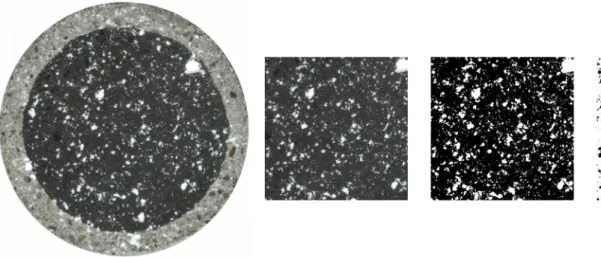
Finally, in order to perform a quantitative analysis of pores, a high contrast is required between the air voids and the matrix. To do so, like Felice et al.[21], the section was painted with black marker. This painting also cover smaller pores. Thus, after covering section with black ink, a very fine white powder was pressed into the pores, to highlight them. Subsequently, excess powder is removed and the section is scanned again. A strip of about 5 mm of each specimen was discarded, to prevent that possible damage during unmoulding or sawing be confused with pores.
The analysis of the distribution of pore size was performed using a Matlab code developed by Rabbani et al.[33], which couples distance function and watershed segmentation, and adapted for this study. The algorithm requires a binary rectangu-lar image as input. So, with a software for image editing, a square crop was made in the centre of the scanned specimen, then the image was transformed into black and white and inverted (Fig. 3). The program output is the radii of the round model pores equivalent to the volume of each real pore. The total area of pores was obtained by counting the black pixels on the image. Three images from each mix-ture were evaluated; the results corresponding to the mean of the parameters stud-ied. The sections of specimens above 0.2% AEA were too uneven, due to their low strength, for this methodology to be applied.
The secondary electron images were obtained, 90 days after moulding, in a Tec-san Vega 3 SEM coupled with Energy Dispersive Spectroscopy (EDS), at the Nanolab Electronic Microscopy Laboratory, at the Redemat, Escola de Minas, UFOP, MG, Brazil. Samples were simply dismantled, in order to prevent the filling of the voids in case of sanding, and covered with gold.
5. Results and discussion
5.1. Results of tests on fresh state
In the fresh state, we evaluated the flow and the air content of
the mortars (Fig. 4). In either case, a clear trend of growth is
notice-able from the 0.04% dosage, with stagnation beginning in 0.8% dosage level. Mixtures from 0.005% to 0.02% showed no significant change compared to the reference, 0%. This indicates that the sur-factant concentrations of these dosages did not affect the paste effectively.
In turn, the commercial AEA behave similarly to the proposed AEA. This similarity is expected, since both admixtures are syn-thetic anionic detergents.
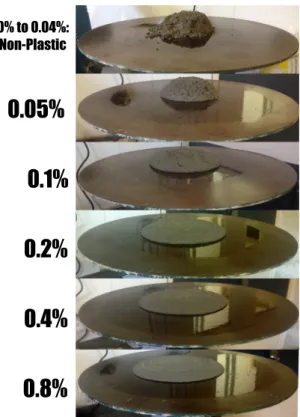
Mixtures 0% and 0.005%–0.02% collapsed during the drops at the flow table. Thus, they are not cohesive, and its flow is set to 120 mm, which is the initial dimension assumed by the conical shape of the test. The 0.04% mixture can be considered a transition dosage, in which the matrix begins to develop cohesion due to the effects of the AEA. This mixture only collapsed on the final drop. From the mixture 0.05% on, the surfactant molecules provide a bet-ter dispersion of the cement particles, making the mortar more
fluid and workable.Fig. 5shows its final form after 30 drops at
the flow table.
In turn, the EAC equipment of the fresh mortar (Fig. 4) loses
pre-cision for matrices with low workability, according to the
manu-facturer’s manual [37]. Thus, tests were conducted from the
mixture 0.04% on.
The results show an increasing air content from dosage 0.04%, reaching 55% for 0.8%. This factor has a significant impact on the rheological and mechanical properties of the matrix. It can be seen that the proposed AEA is a more efficient air entrainer than the commercial AEA for similar dosages.
Analogous to the flow results, the air content curve shows a sharp increase from the 0.04% mixture. This growth reduces at the 0.8% mixture, reaching a plateau. This behaviour, also observed
by Ouyang et al.[29], is linked to the variation of the surface
ten-sion of water with the increasing concentration of surfactants. Pure water has a surface tension of approximately 76 mN/m,
and at small surfactant content, this module does not vary [29].
This indicates that a minimum dose of AEA in the cement matrix is necessary so that its effects are relevant, as results obtained show. As the surfactant is added, the surface tension is reduced, with the formation and maintenance of a stable foam system. Above a certain critical concentration of surfactant, however, the concentration of surfactant monomers is almost constant and the concentration of micelles increases gradually, representing a limit on the reduction of the surface tension. Micelles do not contribute to reducing the surface tension and are one of the reasons why the entrained air content does not increase after a certain dosage of
surfactant[29].
5.2. Results of tests with the cement paste
Two experiments were conducted to evaluate the effect of the adopted AEA (proposed and commercial) on the cement: setting time and cement hydration heat curve. Both test used the normal
consistency of the cement paste, according to NBR NM 43 [15].
For 500 g cement, the normal consistency was achieved with 138.5 g of water (w/c ratio of 0.28).
Fig. 6shows the results for setting time of the cement paste,
carried out according to NBR NM 65[14]. We observe a slight delay
value, however, is not enough to classify the proposed admixture as a ‘‘retardant”, as it is within the 60-min tolerance of NBR
11768[7]) and the 75-min tolerance of ASTM C260[3].
The likely cause of the setting time delay of the paste with AEA is the adsorption of the surfactant molecules to the cement parti-cles. This incurs in sterile repulsion (the physical blockage of water molecules by the surfactant ones). Thus, the topochemical reaction of the cement with the water molecules is partially obstructed, thus delaying the hydration reactions of the cement. These results
agree with those obtained by Ouyang et al.[29].
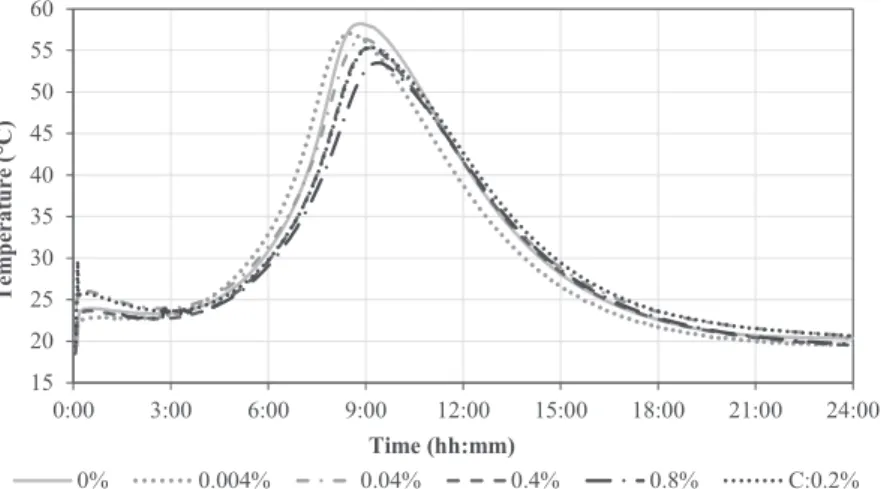
The evolution of the heat of hydration of the cement paste with
and without AEA was also studied, as shown inFig. 7. By analysing
the curve, it is observed that the peak heat occurs around 9 h after
mixing, reaching temperatures of around 58°C. With increasing
AEA content, it is noticeable that the peak is delayed and occurs at milder temperatures.
The cement hydration heat curves are in alignment with the
retardation on the initial and final setting time (Fig. 6), in which
the hardening reactions of the pastes are delayed with the addition of AEA. For the 0.004% mixture, the peak temperature is antici-pated in relation to the reference matrix, probably due to the sep-aration of the cement particles by the surfactant molecules. At this concentration, there is not yet enough molecules adsorbed to delay
the cement hydration due to steric hindrance[29]. The likely cause
of the delay of the peak temperature, presented as the AEA content is increased, is the growing adsorption of surfactant molecules to
cement particles. This configuration prevents the topochemical reaction of the cement particles with water, delaying the hydration exothermic reactions.
In turn, the reduction of the maximum peak temperature with the increase in AEA content is probably due to relatively slow water reactions to the cement particles. As this exothermic process is more distributed over time, the temperature of the matrices with admixtures do not rise to the levels of the reference matrix, where the chemical reactions occur in a more concentrated period. The decrease in peak temperature is favourable to applications of cement-based composites, since it reduces the possibility of cracks by thermal shrinkage in the initial curing period.
5.3. Results of tests on hardened state
The properties analysed in the hardened state were: void index, water absorption, bulk specific gravity, compressive strength, diametral tensile strength, dynamic modulus of elasticity, and shrinkage.
It is observed from Fig. 8that the void index (VI) and water
absorption (WA) of the specimens remain approximately constant around 16.8% and 8.0%, respectively, until the mixture 0.2%. This
fact is remarkable, once the air content (Fig. 4) of mixtures 0.1%
and 0.2% is much higher than the previous dosages. The results of bulk density, which will be discussed below, also prove that the specimens 0.05%, 0.1% and 0.2% have a more porous matrix
Fig. 3.Steps on the preparation of section for quantitative analysis.
0% 10% 20% 30% 40% 50% 60% 70% 80%
120 140 160 180 200 220 240
0.000% 0.001% 0.010% 0.100% 1.000%
E
n
tr
a
ined Ai
r
Con
te
n
t
-E
A
C
(%
)
Flo
w (
mm)
AEA Content (% m.c.) Flow Proposed AEA
Flow Commercial AEA
EAC Proposed AEA
EAC Commercial AEA
Fig. 4.Flow and entrained air content (EAC) varying with the concentration of AEA in relation the mass of cement (% m.c.) of reference mortar (0%), mortars with proposed
than the previous mixtures in the hardened state; however, these additional pores do not result in a significant increase in the water absorption of the matrix.
Nevertheless, the void index and water absorption results of mixtures 0.4% and 0.8% were relatively high. These higher values are due to increased permeability of these matrices. Thus, up to the dosage 0.2%, the mortar permeability does not change with the increase in entrained air content. The pores developed do not contribute to the penetration of water in the matrix. They are well distributed, so that there is no connection between them, and/or interrupt the capillary channels near the surface, thus preventing the penetration of water. In mixtures 0.4% and 0.8%, the pores sizes, their amount and distribution allow water to penetrate deeper into the matrix.
The bulk specific gravity (
c
) results demonstrated, as expected,a decrease in the relative mass/volume of the specimens as the
dosage of AEA increases, and hence the air content, as shows Fig. 9. The bulk specific gravity started from 2.26 g/cm3for the
ref-erence, 0%, reaching 1.63 g/cm3on the mixture with the most AEA
content, 0.8%. It represents a decrease of 28% in the mass of the hardened mortar for the same volume.
Still regarding the specific gravity, it is observed that the mor-tars with commercial admixture had similar properties to the ones with proposed AEA; slightly denser.
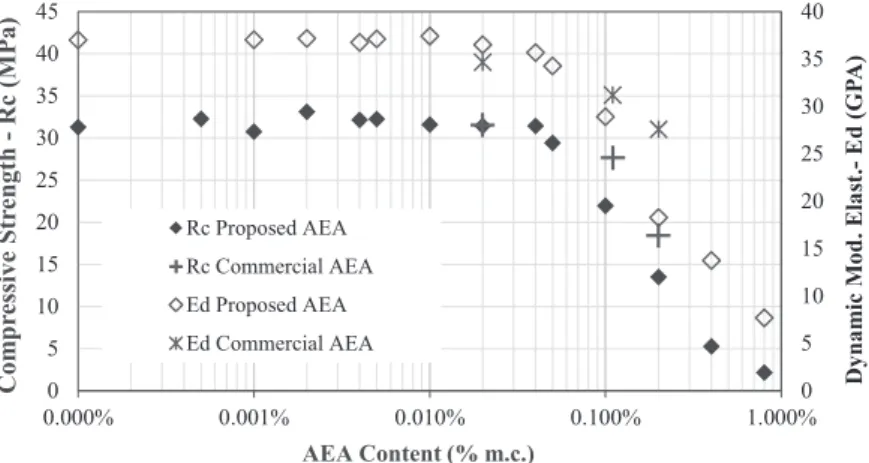
It can be seen fromFig. 10that the compressive strength of the
specimens comprising the proposed AEA remained approximately constant at 31.8 MPa until the mixture 0.04%. From the mixture 0.05%, there is an exponential decrease in strength until 2.15 MPa for 0.8% dosage. This loss of resistance is due to the increase in porosity of the matrix, as can be observed from the pre-vious results. A less integrate and dense matrix has lower mechan-ical strength. Similar results due to increased AIA concentration
were obtained by Ouyang, et al.[29], and Yang et al.[38]. This
rela-tionship of the decrease of the mechanical resistance with the increase of the porosity is widely known in the literature, as
observed by Chen and Zhou[18]among others. It is recalled that
the amount of water in the mixtures was kept constant, only vary-ing the addition of AEA. Note that the commercial admixture showed relatively better mechanical performance for similar AEA concentrations.
The results for the dynamic modulus of elasticity of the mortars
are also shown inFig. 10. From the graph analysis, it is noticeable
that this property decreases with increasing the concentration of AEA, from the 0.01% dosage, both for the proposed and commercial solutions. In general, the modulus of elasticity was affected at approximately the same intensity as the compressive strength. The elastic properties of composite materials vary depending on the pore volume and size, as well as the interconnections between
them [34]. The decrease of the modulus of elasticity with the
increase of the entrained air content of the matrix is due to the increase of the discontinuities caused by air voids as well as to
the increase in their sizes[22]. As the load increases, the material
initiates a progressive fracture, starting in the regions with the
lar-gest number of larger pores to those with smaller ones[1]. Thus,
the increase on the AEA dosage generates a composite with increased deformability.
A similar trend is seen at the results of the tensile strength by
diametrical compression,Fig. 11. Following a plateau that is
main-tained until the mixture 0.04%, the tensile strength decreases with increasing on the AEA content. This behaviour is expected since the diametral strength is proportional to the compressive strength of the specimens. With the increase in entrained air of the matrix and, consequently, in its discontinuities, the mechanical strength
Fig. 5.Flow test for reference mortar (0%), and mortars with proposed AEA
(0.0005%–0.8%).
2:55
2:47
3:04 3:04 3:08
4:32
4:45 4:51
5:08 4:59
2:00 2:30 3:00 3:30 4:00 4:30 5:00 5:30
0% 0.004% 0.04% 0.4% 0.8%
S
e
tt
in
g
time
(h
:m
m)
AEA Content (% m.c.)
Initial - Proposed AEA Final - Proposed AEA
Fig. 6.Setting Time of reference paste (0%) and pastes with proposed AEA (0.004%–0.8%).
decreases. The commercial admixture followed the downward trend of the proposed admixture.
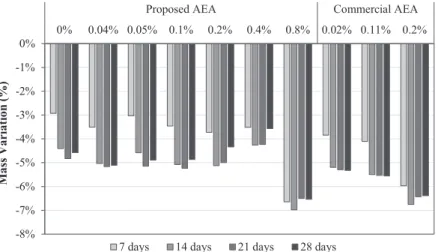
For the test of shrinkage on air, dosages of greater interest, regarding their results of flow and air content, were evaluated. The behaviour of the prismatic specimens in relation to their
vari-ations in length and mass is shown in Fig. 12 and Fig. 13,
respectively.
During the air-drying period, the specimens presented a pro-gressive shrinkage until the age of 21 days, at which they reached a plateau. From this age, the variation of length and mass are related to the fluctuations on the temperature and relative humid-ity. The length variation tends to increase with the increase on the AEA dosage, from 0% to mixture 0.4%, reaching a value of 1.01 mm/m at 21 days. The 0.8% results are very similar to the 0.4% ones,
Fig. 7.Cement hydration heat curves of reference paste (0%), pastes with proposed AEA (0.004%–0.8%) and with commercial AEA (C: 0.2%).
0% 5% 10% 15% 20% 25% 30% 35% 40% 45%
0.000% 0.001% 0.010% 0.100% 1.000%
Voi
d
I
n
de
x
(VI
)
and
Wat
er
A
b
sor
p
ti
on (
W
A)
(%
)
AEA Content (% m.c.) VI Proposed AEA
VI Commercial AEA
WA Proposed AEA
WA Commercial AEA
Fig. 8.Void index (VI) and water absorption (WA) varying with the concentration of AEA in relation the mass of cement (% m.c.) of reference mortar (0%), mortars with
proposed AEA (0.0005%–0.8% m.c.) and with commercial AEA (0.02%–0.2% m.c.).
0.0 0.5 1.0 1.5 2.0 2.5
0.000% 0.001% 0.010% 0.100% 1.000%
B
u
lk Sp
eci
fi
c Gravity
(γ)
(g/cm
³)
AEA Content (% m.c.) γ Proposed AEA
γ Commercial AEA
Fig. 9.Bulk specific gravity (c) varying with the concentration of AEA in relation the mass of cement (% m.c.) of reference mortar (0%), mortars with proposed AEA (0.0005%–
indicating a plateau to very high doses of the proposed admixture. For commercial dosages, the behaviour is analogous, and the val-ues achieved are analogous to those of the proposed admixture with similar AEA content.
Regarding mass variation, the specimens presented relatively lower variations over time. Comparably to the length variation results, mass variation values stabilized at 14 days. From this
per-iod on, changes occurred according to the variation of weather con-ditions of the day. The mixtures with proposed AEA behaved in a relatively similar way, except 0.8%, which reached mass loss of 6.98% at 14 days, and its plateau at 7 days. The commercial mix-tures presented a mass loss at 28 days greater than those with pro-posed admixtures at similar concentrations of AEA, except for the 0.8%. 0 5 10 15 20 25 30 35 40 45 0 5 10 15 20 25 30 35 40
0.000% 0.001% 0.010% 0.100% 1.000%
Dynam ic M o d . El a st .-E d (G P A )
Com
p
re
ssive
S
tr
en
g
th
-R
c (MP
a
)
AEA Content (% m.c.)
Rc Proposed AEA
Rc Commercial AEA
Ed Proposed AEA
Ed Commercial AEA
Fig. 10.Compressive strength (Rc) and Dynamic modulus of elasticity (Ed) varying with the concentration of AEA in relation the mass of cement (% m.c.) of reference mortar
(0%), mortars with proposed AEA (0.0005%–0.8% m.c.) and with commercial AEA (0.02%–0.2% m.c.).
0.0 0.5 1.0 1.5 2.0 2.5 3.0
0.000% 0.001% 0.010% 0.100% 1.000%
Diam
et
ral
T
ensile
S
tr
ength
-R
d
(
M
P
a
)
AEA Content (% m.c.) Rd Proposed AEA
Rd Commercial AEA
Fig. 11.Diametral Tensile Strength (Rd) varying with the concentration of AEA in relation the mass of cement (% m.c.) of reference mortar (0%), mortars with proposed AEA
(0.0005%–0.8% m.c.) and with commercial AEA (0.02%–0.2% m.c.).
-1.2 -1.0 -0.8 -0.6 -0.4 -0.2 0.0
0% 0.04% 0.05% 0.1% 0.2% 0.4% 0.8% 0.02% 0.11% 0.2%
A E A l a i c r e m m o C A E A d e s o p o r P Len g th Variation (mm/m )
7 days 14 days 21 days 28 days
Fig. 12.Shrinkage test: length variation of reference paste (0%), pastes with proposed AEA (0.04%–0.8% m.c.) and with commercial AEA (0.02%–0.2% m.c.).
Fig. 13.Shrinkage test: mass variation of reference paste (0%), pastes with proposed AEA (0.04%–0.8% m.c.) and with commercial AEA (0.02%–0.2% m.c.).
Fig. 14.Left row: Scanned sections of reference mortar (0%) and mortars with Proposed AEA (0.1% and 0.4%), magnification 2. Right row: Scanning Electron Microscopy of
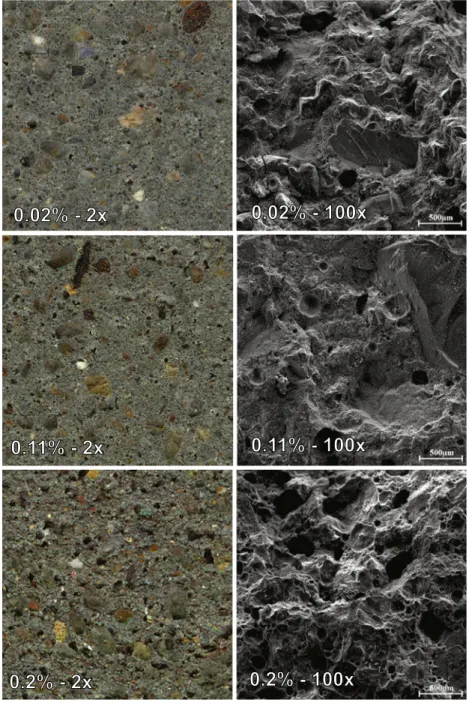
Fig. 15.Left row: Scanned sections of mortars with Commercial AEA (0.02%, 0.11% and 0.2%), magnification 2. Right row: Scanning Electron Microscopy of mortars with
Commercial AEA (0.02%, 0.11% and 0.2%), magnification 100.
0% 10% 20% 30% 40% 50% 60% 70%
0.000 % 0.001% 0.010% 0.100 % 1.000%
P
o
re
Rati
o o
n
Cr
o
ss-Se
cti
o
n
(
%
)
AEA Content (% m.c.) Commercial AEA
Proposed AEA
Fig. 16.Average relative area of pores in the section varying with the concentration of AEA in relation the mass of cement (% m.c.) of reference mortar (0%), mortars with
proposed AEA (0.004%–0.2% m.c.) and with commercial AEA (0.02%–0.2% m.c.).
The variation in length and mass compared to the original length after demoulding is expected. This phenomenon is related to the water evaporation rate of the specimen, the drying shrink-age. This type of shrinkage occurs as a function of the voids and air content of the matrix, occurring at a higher intensity for 0.8%
mixture, which is the most permeable matrix (Fig. 8).
Furthermore, all specimens suffered autogenous shrinkage, associated to the volume reduction phenomenon due to the
gen-eration of hydration products [26]. Such shrinkage occurs in all
cement-based composites, since the cement hydration products have a lower volume than the sum of the volumes of water and cement which generates them. It occurs throughout the whole hydration period. The graphics analysis suggests that the chemical shrinkage was greater as the AEA content increased, because the length variation is increased as the mass variation remained approximately constant for the mixtures 0%–0.2%. This hypothesis is supported by the steric hindrance of the cement particles with high concentration of adsorbed surfactant molecules. This phenomenon slows the hydration reactions, so that they promote a more gradual chemical shrinkage over the 28 days, as opposed to the early ages of low-air-content matrices.
Although the specimens have been subjected to more unfavour-able environmental conditions than those prescribed by the NBR
15261[9]), still all results remained within the limit for air
entrain-ing admixtures of NBR 11768[7]) and ASTM C260[3]. During the
28-day test, recorded temperatures ranged between 17.0°C and
33.3°C and relative humidity, from 34% to 76%. However, no
specimen exceeded the limit of 1.2 mm/m shrinkage or absolute
length variation of 0.006 mm, common to both standards[7,3].
5.4. Morphological analysis
Morphological analysis of the hardened matrix was performed using a high-performance scanner, optical microscopy and scan-ning electron microscopy. In general, it was noted that as the dosage of surfactant increased, the air voids gradually increased in amount, their average size increased, and they were more spread over the cross-section.
Typical sections shown inFigs. 14 and 15show the effects of
adding air-entraining agents to cement-based composites. The ref-erence matrix and matrices with low AEA content (0% and 0.004%) present small and medium pores, sparse and scattered, and more angular, leaving large areas of the matrix whole. This configuration results in a higher mechanical strength and low workability, which
was found in previous results (Figs. 10 and 4). This observation
reinforces the understanding that there is no matrix free of air voids, since the voids are a result of the components and mixing process of the material. The larger voids are justified by the absence of a sufficient concentration of surfactant molecules. Without them, smaller sized air bubbles formed by the three-dimensional screen do not acquire sufficient stability and coalesce (i.e. unite into larger voids), and/or flow to the surface of the spec-imen and disappear.
50% 55% 60% 65% 70% 75% 80% 85% 90% 95% 100%
0% 0.004% 0.04% 0.05% 0.1% 0.2% 0.02% 0.11% 0.2%
A E A l a i c r e m m o C A
E A d e s o p o r P
P
roportion of
p
o
re
ra
dii
(%
)
< 200 200-500 500-1000 >1000 (μm)
Fig. 18.Average proportion of pore radii in the specimen section varying with the concentration of AEA in relation the mass of cement (% m.c.) of reference mortar (0%),
In turn, the voids from the sections with intermediate AEA con-tent (0.04%, 0.05%, 0.1% and 0.2%) are small and medium-sized, well distributed throughout the matrix and less angular. These mixtures have average entrained air content, medium-high work-ability, and permeability almost identical to those with low admix-ture content. There is a decrease in compressive strength compared to the reference matrix, up to 55%. The increased num-ber of pores and its average size is also a consequence of the pres-ence of surfactant molecules that reduce the coalescpres-ence and dissipation of air bubbles on the fresh state, and its movement towards the surface of the specimen.
Finally, the sections of the matrices with high AEA content (0.4%
and 0.8%) inFigs. 14 and 15are fragile and brittle due to high air
content. The cross-sections therefore are not exactly as flat as in other cases. Despite this fact, it is possible to observe a void system of pores with different sizes, some quite large, and well distributed throughout the matrix. Micropores are seen on the wall of larger pores; and it is noticeable that the aggregates are more spaced apart, due to the pores and micropores between them. There are virtually no points of integer matrix, which strongly affect the
mechanical strength, (a 93% decrease for 0.8%, as seen onFigs. 10
and 11). This configuration is due to the wide availability of surfac-tant molecules that produce an extremely stable system of voids and therefore generate a highly porous matrix, which in turn
pro-motes high permeability (Fig. 8), high workability (Fig. 4) and a
sig-nificant reduction in specific gravity (Fig. 9).
From the 0.4% mixture, the air content does not change so sig-nificantly (as well as the workability and the compressive strength), indicating that the surfactant solution has reached its critical micelle concentration, when the concentration of surfac-tant monomers is almost conssurfac-tant and the concentration of micelles increases gradually, representing a limit on the reduction of the surface tension. Micelles do not contribute to reducing the
surface tension and are one of the reasons why the entrained air content does not increase after a certain dosage of surfactant.
Summarizing the observations,Fig. 16shows the relative
num-ber of pore pixels over the total numnum-ber of pixels of the image of the section. As expected, the pore content increases with the increase in surfactant dosing, more expressively for the mixtures with intermediate AEA content. The reference matrix presents approximately 11.6% of its section covered by pores, while mixture 0.2%, 59.4%. The same increasing trend was observed for mixtures with commercial AEA. It is noticeable that the matrices with commercial AEA present significantly lower pore content on the hardened state than the matrices within the same content of
proposed AEA. Fig. 17 highlights this result. This relationship
indicates that the proposed AEA stabilizes the air voids more effi-ciently than the commercial AEA. Thus, the pores incorporated during the mixing are maintained on the hardened state of the matrix with proposed AEA, which indicates the quality of the
admixture[21].
Conversely,Fig. 18displays the relative number of pores of a
given size over the total number of pores identified. The reference
mortar, 0%, presents 94% of pores with radius less than 100mm. As
the AEA content increases, the fraction of pores with higher radii also grows, culminating in almost 13% of the pores from the
mix-ture 0.2% with a radius greater than 500mm. The graph
demon-strates that the mortars with proposed AEA present a higher fraction of larger voids than those with similar contents of mercial AEA. However, if mixtures with close pore ratios are com-pared, for example, commercial mixture 0.11% and proposed mixture 0.05% (both with approximately 24% voids on the cross section), it is noticeable that the proportion of pore radii is much more similar. Pores with larger sizes compromise the integrity of the matrix and are mainly responsible for the drop on mechanical
strength[29,39].
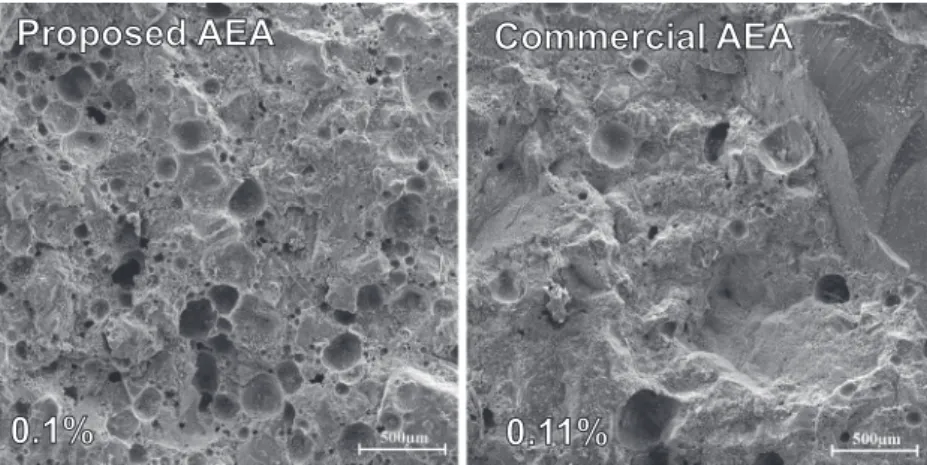
Fig. 19.SEM Images of the microstructures of the pores in mortars with 90 days. On the left, proposed AEA; on the right, commercial AEA. Magnification of 10,000.
ity of the shell, the presence of capillary channels and micropores in the vicinity of the pores, besides the greater ease of water flow
between them, as also observed by Corr et al.[19]. In general, the
porosity of the shell allows diffusion of air out of the void, increas-ing the amount of pores of larger diameter and compromisincreas-ing
mechanical strength of the matrix[25]. Thus, not only the volume
of entrained air, but also the porosity of the hydration shell, were probably responsible for the formation of large pores that caused a decrease in the mechanical resistance of matrices with high con-tent of AEA.
6. Conclusion
For mortars with low AEA content, the physical and mechanical properties are barely affected; the matrix is mainly whole, with a few scattered and relatively small pores (above 90% smaller than
100mm). The addition of intermediate values of AEA content
gen-erated mortars with a gradual decrease on mechanical properties. The morphological analysis presented an increased number of pores, with various sizes, well distributed throughout the speci-men. Their physical properties, however, such as void index and permeability, remained in the same levels as matrices with low AEA content. Finally, mortars with high AEA content presented a significant decrease on physical and mechanical properties, high permeability and a fragile interface. Their pore system show voids from small to very large, and so voluminous, that barely any frag-ment of whole matrix is observed.
In general, with the increase on the content of proposed AEA, there is a reduction of the specific gravity of the matrix (structural advantage), improvement on the workability (productivity and applicability advantages) and no change on water absorption, up to a certain dosage. However, the mechanical properties are strongly affected. Hence the importance of the correct design, dos-ing and handldos-ing of air-entraindos-ing admixtures for concrete and mortar.
In conclusion, household washing up liquids based on Linear Alkyl Benzene Sodium Sulfonate are effective air-entraining agents. They produce an effective and stable foam system, which can improve the properties of cement-based composites. For similar dosages, the proposed AEA resulted in a more stable system of voids on the hardened state than the commercial AEA, as can be seen by the results of pore ratio and morphological analysis. It should be noted that washing up liquids are products widely avail-able, relatively inexpensive, with lower toxicity and environmental impact compared to the ones currently available in the market.
Researches should notice that a small concentration of washing-up liquid (around 0.01% of cement mass) promotes signif-icant variations on the properties of cement-based composites. Therefore, this paper also highlights the importance of thorough
[1]S. Almeida, J. Hanai, Experimental and dynamic analysis of stiffness of concrete elements subjected to progressive damage until fracture, Struct.Eng. Booklets 10 (2008) 49–66.
[2] ANVISA, RESOLUTION RDC No-40 - Technical Regulations for cleaning and Related Products [Online] Available at: http://portal.anvisa.gov.br/wps/ wcm/connect/1e808a8047fe1527bc0dbe9f306e0947/RDC+40.2008.pdf? MOD=AJPERES2008 (Accessed 04 08 2015).
[3] ASTM C260/C260M-10a(2016), Standard Specification for Air-Entraining Admixtures for Concrete, ASTM International, West Conshohocken, PA, 2016. www.astm.org.
[4]H.N. Atahan, C. Carlos Jr., S. Chae, P.J.M. Monteiro, J. Bastacky, The morphology of entrained air voids in hardened cement paste generated with different anionic surfactants, Cem. Concr. Compos. 30 (2008) 566–575.
[5]B. Brackmann, C. Hager, The Statistical World of Raw Materials, Fatty Alcohols and Surfactants Berlin, 2004.
[6]Brazilian Association of Technical Standards (ABNT), NBR 11578: Portland Composite Cement - Specification, ABNT, Rio de Janeiro, 1997.
[7]Brazilian Association of Technical Standards (ABNT), NBR 11768: Admixture for Concrete Made with Portland Cement – Specification, ABNT, Rio de Janeiro, 2011.
[8]Brazilian Association of Technical Standards (ABNT), NBR 13280: Mortars Applied on Walls and Ceilings – Determination of the Specific Gravity in the Hardened Stage, ABNT, Rio de Janeiro, 2005.
[9]Brazilian Association of Technical Standards (ABNT), NBR 15261: Mortars Applied on Walls and Ceilings – Determination of Dimensional Charges (Shrinkage), ABNT, Rio de Janeiro, 2005.
[10]Brazilian Association of Technical Standards (ABNT), NBR 15630: Mortars Applied on Walls and Ceilings – Determination of Elasticity Modulus by the Ultrasonic Wave Propagation, ABNT, Rio de Janeiro, 2008.
[11]Brazilian Association of Technical Standards (ABNT), NBR 7215: Portland Cement – Determination of Compressive Strength, ABNT, Rio de Janeiro, 1996. [12]Brazilian Association of Technical Standards (ABNT), NBR 7222: Concrete and Mortar – Determination of the Tension Strength by Diametrical Compression of Cylindrical Test Specimens, ABNT, Rio de Janeiro, 2011.
[13]Brazilian Association of Technical Standards (ABNT), NBR 9778: Hardened Mortar and Concrete – Determination of Absorption, Voids and Specific Gravity, ABNT, Rio de Janeiro, 2009.
[14]Brazilian Association of Technical Standards (ABNT), NBR NM 43: Portland Cement – Determination of the Normal Consistency Paste, ABNT, Rio de Janeiro, 2003.
[15]Brazilian Association of Technical Standards (ABNT), NBR NM 65: Portland Cement – Determination of Setting Times, ABNT, Rio de Janeiro, 2003. [16]S. Chatterji, Freezing of air-entrained cement-based materials and specific
actions of air-entraining agents, Cem. Concr. Compos. 25 (2003) 759–765. [17] Chemical Book, Sodium Dodecylbenzenesulphonate [Online] Available at:
http://www.chemicalbook.com/ChemicalProductProperty_EN_CB4852054. htm2010 (Accessed 13 04 2015).
[18]X. Chen, J. Zhou, Influence of porosity on compressive and tensile strength of cement mortar, Constr. Build. Mater. 40 (2013) 869–874.
[19]D.J. Corr, M.C.G. Juenger, P.J.M. Monteiro, J. Bastacky, Investigating entrained air voids and Portland cement hydration with low-temperature scanning electron microscopy, Cem. Concr. Compos. 26 (2004) 1007–1012.
[20]L. Du, K.J. Folliard, Mechanisms of air entrainment in concrete, Cem. Concr. Res. 35 (2005) 1463–1471.
[21]R. Felice, J. Freeman, T. Ley, Durable concrete with modern air entraining admixtures, Concr. Int. Agosto (2014) 37–45.
[22]R. Kumar, B. Bhattacharjee, Porosity, pore size distribution and in situ strength of concrete, Cem. Concr. Res. 33 (2003) 155–164.
[23]K. Lai, Liquid Detergents, second ed., CRC Press, Boca Raton, 2005.
[24]F. Lea, The Chemistry of Cement and Concrete, Chemical Publishing Company, Nova York, 1971.
[26]P. Mehta, P.J.M. Monteiro, Concrete: Microstructure, Properties and Materials, second ed., IBRACON, São Paulo, 2014.
[27]D. Myers, Surfaces, Interfaces, and Colloids: Principles and Applications, second ed., Wiley-VCH, New York, 1999.
[28]C. Noïk, M. Bavière, D. Defives, Anionic surfactant precipitation in hard water, J. Colloid Interface Sci. 115 (1) (1987) 36–45.
[29]X. Ouyang, Y. Guo, X. Qiu, The feasibility of synthetic surfactant as an air entraining agent for the cement matrix, Constr. Build. Mater. 22 (2008) 1774– 1779.
[30]T. Powers, The Properties of Fresh Concrete, John Wiley & Sons, New York, 1968.
[31]W. Prince, M. Edwards-Lajnef, P.C. Aïtcin, Interaction between ettringite and a polynaphthalene sulfonate superplasticizer in a cementitious paste, Cem. Concr. Res. 32 (1) (2002) 79–85.
[32] Química Amparo LTDA, Safety Data Sheet - FISPQ - Detergent Ypê [Online] Available at: http://www.ype.ind.br/wp-content/uploads/2014/08/FISPQ_ LAVA-LOUCAS_YPE_CLEAR.zip2011 (Accessed 14 09 2015).
[33]A. Rabbani, S. Jamshidi, S. Salehi, An automated simple algorithm for realistic pore network extraction from micro-tomography images, J. Pet. Sci. Eng. 123 (2014) 164–171.
[34]A. Roberts, E. Garboczi, Elastic properties of model porous ceramics, J. Am. Ceram. Soc. 83 (12) (2000) 3041–3048.
[35]C. Rodriguez, L. Lowery, J. Scamehorn, J. Harwell, Kinetics of precipitation of surfactants. I. Anionic surfactants with calcium and with cationic surfactants, J. Surfactants Deterg. 4 (1) (2001) 1–14.
[36]M.J. Scott, M.N. Jones, The biodegradation of surfactants in the environment, Biochim. Biophys. Acta 1508 (2000) 235–251.
[37]SOLOTEST LTDA, Instruction for Use of Entrained Air Meter to Concrete and Mortar São Paulo, 2000.
[38]Q. Yang, P. Zhu, Z. Wu, S. Huang, Properties of concrete with a new type of saponin air-entraining agent, Cem. Concr. Res. 30 (2000) 1313–1317. [39]H. Zhao, Q. Xiao, D. Huang, S. Zhang, Influence of pore structure on
![Fig. 2. Mechanisms of air-entrainment from anionic surfactants (adapted from Mehta and Monteiro [26]).](https://thumb-eu.123doks.com/thumbv2/123dok_br/15719254.632000/3.892.70.808.105.660/fig-mechanisms-entrainment-anionic-surfactants-adapted-mehta-monteiro.webp)