Consumers Eco-Friendliness
with Brands on Instagram
Raquel Catulo
Dissertation written under the supervision of Cláudia
Simão
Dissertation submitted in partial fulfilment of requirements for
the MSc in Management with Specialization in Strategic
Marketing, at the Universidade Católica Portuguesa, April 2019.
Abstract
Title of Dissertation: “Consumers Eco-Friendliness on Instagram” Author: Raquel Catulo
Environmental problems have always been constant, but for the past decade, Social Media made individuals more aware and concerned, highlighting the increasingly the need for action. Therefore, consumer awareness on this, influences consumer choices when it comes to considering a brand or even for buying its products. Meeting these needs have turned into a big challenge for brands, since they have to be up-to-date to consumers’ expectations, values and motivations. However, consumers are as diversified as the possible values and motivations, and brands need to adapt. One form of doing this is to position the brand on the friendly market. By offering eco-friendlier choices and the willingness to try to reduce the environmental impact, brands are communicating their products and their ecological concerns and actions to a broader audience, hoping to increase the brand value and equity. In this dissertation, by analyzing consumers’ engagement with eco-friendly brands after a natural catastrophe, I intend to understand the role of environmental awareness on consumer engagement with brands that positioning themselves as totally or partially eco-friendly. The key findings show that awareness has an influence over time on consumers’ engagement: After a catastrophe takes place, people engage more with brands partially eco-friendly than with totally eco-friendly. I discuss these data highlighting the benefits of communicating on Social Media after a natural catastrophe, particularly for brands that are trying to enter the eco-friendly market.
Key Words: Sustainability, Eco-Friendly Brands, Digital Marketing, Social Networks,
Sumário
Título da Dissertação: “Consumers Eco-Friendliness on Instagram” Autora: Raquel Catulo
Os problemas ambientais foram sempre constantes, mas, na última década, as redes sociais tornaram as pessoas mais conscientes e preocupadas, destacando a necessidade crescente de agir. Portanto, a consciencialização do consumidor sobre isto influência as suas escolhas quando se trata de considerar uma marca ou mesmo de comprar seus produtos. Atender a estas necessidades tornou-se um grande desafio para as marcas, visto que precisam de estar atualizadas em relação às expectativas, valores e motivações dos consumidores. No entanto, os consumidores são tão diferentes quanto os possíveis valores e motivações, e as marcas têm de adaptar-se. Uma forma de fazê-lo é posicionar a marca num mercado mais ecológico. Ao oferecer escolhas ecológicas e a abertura para tentar reduzir o impacto ambiental, as marcas estão a comunicar os seus produtos, preocupações e ações ecológicas a um público mais amplo, na esperança de aumentar o valor da marca e o seu valor. Nesta dissertação, através da análise do envolvimento dos consumidores com marcas ecológicas após uma catástrofe natural, pretendo entender qual o papel da consciencialização ambiental no envolvimento do consumidor com marcas que se posicionam como total ou parcialmente ecológicas. As principais conclusões mostram que a consciencialização influencia o tempo no envolvimento dos consumidores: depois de ocorrer uma catástrofe, as pessoas envolvem-se mais com marcas parcialmente ecológicas do que com totalmente ecológicas. Discuto ainda estes dados destacando os benefícios da comunicação nas redes sociais após uma catástrofe natural, especialmente para marcas que estão a tentar entrar num mercado mais ecológico.
Palavras-chave: Sustentabilidade, Marcas Amigas do Ambiente, Marketing Digital,
Acknowledgements
Firstly, I would like to thank very much to my thesis supervisor, Cláudia Simão. The person who helped me throughout this whole process and would always make things look easier. Thank you for all your availability, for your patience through the whole work. These last days you have been unstoppable in helping me.
I couldn’t forget my friends and my family which were always there when times were harder. They made me never give up.
Finally, I would like to show appreciation for a special person that has always inspired me and been by my side for the past years.
TABLE OF CONTENTS
CHAPTER 1: INTRODUCTION ... 9
1.1 Background and Problem Statement ...9
1.2 Aims and scope... 10
1.3 Research methods ... 11
1.4 Relevance ... 12
1.5 Dissertation outline ... 12
CHAPTER 2: LITERATURE REVIEW AND CONCEPTUAL FRAMEWORK 13 2.1 Digital and Social Media Marketing ... 13
2.2 Consumer Brand Engagement on Social Networks ... 15
2.3 Eco-Friendliness ... 17
2.4 Eco-Friendly Brands ... 19
2.5. Literature Review Overview ... 19
CHAPTER 3: METHODOLOGY... 21
3.1 Research Approach ... 21
3.2 Research Methods – Secondary Data ... 21
3.2.1 Variables Description ... 21
3.2.2 Procedure and Data Collection ... 25
3.3 Statistical Analysis ... 26
CHAPTER 4: RESULTS AND DISCUSSION (3500-4000) ... 28
4.1 Descriptive Analysis ... 28
4.2 Consumer Engagement with Eco-Friendly Brands after a Natural Catastrophe ... 29
4.2.1. The effect of ecological awareness of eco-brands on consumers’ engagement .. 29
4.2.2. The effect of ecological awareness of eco-brands on the difference score for engagement ... 30
4.3 Discussion ... 31
CHAPTER 5: CONCLUSIONS AND LIMITATIONS (1500-2000) ... 33
5.2 Recommendations ... 34 5.3 Limitations ... 35
List of Tables
Table 1: Evolution of consumer engagement with totally eco-friendly and partially eco- friendly brands ... 28
Table of Annexes
Annex 1: Pairwise Comparisons Table to analyze the decomposed interaction effect of Time X Type of Brand on consumers engagement. ... 41 Annex 2: Pairwise Comparisons Table to analyze the decomposed interaction effect of Time X Type of Brand, using difference score, on consumers engagement. ... 45
CHAPTER 1: INTRODUCTION
1.1 Background and Problem Statement
The way people consume, behave, interact and communicate with each other has been changing due to the influence of social media. These new channels led to a significant change on the traditional marketing, which generated new ways for brands to “reach, inform, engage, sell to, learn about, and provide service to consumers” (Lamberton & Stephen, 2016, pp.146). Thus, brands had to reinvent their communications strategy and consumers were also affected in the way they behave when exposed to these new communication strategies (Lamberton & Stephen, 2016). The evolution of social media transformed the role of consumers, promoting them to be the new influencers of brands: through comments, reviews, likes and shares they are able to strengthen the image of a brand or to close it down (Berthon, Pitt, Plangger, & Shapiro, 2012; Lamberton & Stephen, 2016).
However, this communication change was bi-directional: at the same time that consumers got a public voice with an increasing influence on brands, social media platforms allowed brands to become more noticeable for their customers (Campbell, Ferraro, & Sands, 2014). By transmitting their values to a broader audience, brands attracted more visibility, impacting consumers’ choices and purchases. Through social media platforms, brands realized the urge to understand consumers’ reactions to their actions, forcing them to develop strategies to improve their communication with their customers (Mangold & Faulds, 2009). Taking into account all the metrics that can be taken from social media networks of the consumers’ interaction with the brands online space, managers are able to understand which formats their followers prefer and with which ones they interact more and actually achieve the publication objective. With these tools, brands have what they need to create content that is actually valued by their consumers. Ultimately, these communication strategies resulted into tailored interactions with consumers, intimate but non-intrusive, particularly important to create or to strengthen the feeling of brand identity (Smith, 2011).
These communication changes promoted by the social media were significant 1) to update the content that brands produce, and 2) to increase the consumers’ involvement with brand marketing. Thus, brands were using also the consumers’ voice and to increase their campaigns’ impact and to shape others’ opinions. What does it mean? It
means that consumers have now a stronger role in a brands’ marketing with the power to use their beliefs as a tool to promote change on other consumers.
How is this chain of reactions useful? To make public commitments, both for brands and consumers. Every time that a brand communicates with their target customers, it should be as clear as possible to ensure that the message flows and get delivered, and that should be done carefully in order to highlight the brand beliefs and values. Posts, or public commitments of brands, inform consumers about the brand’s concerns, positioning and which type of brand they are aiming to be in the future (De Vries, Gensler, & Leeflang, 2012).
One of the positioning that is in exponentiation in the last two decades is the ecological positioning. An increasingly amount of brands have been producing eco-friendly products or using an eco-label in the packaging of their products (Haws, Winterich, & Naylor, 2014). Thus, many brands have publicly committed with eco-values as a strategic positioning, communicating the consequences of the human footprint as one top value, which could be reduced by purchasing their own appropriate, ecological products.
With a rapid pace, social media promotes this re-positioning or readjustment of a brand’s values to an friendlier strategy. But, why do the brands need such eco-friendly positioning strategy? Why do they eco-label and publicly promote their values of helping the environment. Because consumers value it (Pickett-Baker & Ozaki, 2008)! Even though not always consumers’ purchase intentions follow their values (Pickett-Baker & Ozaki, 2008), eco-positioning sends out the public message of eco-values, gathering a broader audience and potential new consumers. I propose that when brands express eco-concerns values, their customers get more involved with the brand, particularly when there is high awareness of such eco-concerns. If social media allow a public commitment for both the customer and brand, this means that both are publicly sharing a belief or a value and that sharing should increase their mutual level of involvement and engagement.
1.2 Aims and scope
The aim of this thesis is to understand the impact of eco-concerns on the level of engagement with eco-friendly brands via Instagram. This implies to explore whether brands that show any eco-concerns (e.g., through posting or advertising eco campaigns)
show also an increase on their number of followers. Specifically, eco-concerns should be particularly high after natural catastrophes, where the level of concern with the ecology is high. If individuals are notably empathetic with the consequences of a natural disaster right after it has taken place, they should reach out to brands that show eco-values and engage more with such brands. To address this issue, the following research questions were developed:
Q1: Do eco-friendly brands have an increase on their number of followers after
(vs. before) a natural catastrophe?
Q2: Does being partially eco-friendly or totally eco-friendly affect this increase?
The main focus of this research is to understand if eco-concerns raise awareness and visibility of eco-friendly brands. One of the most well documented catastrophes, which strongly raised eco-concern motives, was the plastic catastrophe (National Geographic, 2018). National Geographic, together with so many other communication agencies, posted shocking images of how plastic waste affected both humans and animals. These images went viral and increased the public debate on how to solve this crisis. Brands, which were changing their policies to decrease the levels of products with plastic, were positively highlighted by the media (National Geographic, 2018). The same happens when it comes to natural catastrophes: they raise awareness and concerns on the consumers about actions of human population and how it has affected the earth, global warming and their devastating consequences.
1.3 Research methods
In order to address the problem that eco-concerns should increase eco-friendly brands’ number of followers, it is relevant to understand, using previous studies, what are the most important green consumption values for consumers.
Brand engagement will be measured through the followers a certain eco-friendly page brand has on Instagram, before and after natural catastrophe occur. The use of this secondary data will give an understanding on whether consumer engagement increases with certain eco-friendly brands after a catastrophe takes place. The aim of this is to pursue a descriptive approach in order to confirm this behavior.
1.4 Relevance
This research should be valuable in the way that it will bring benefits both to brands and to consumers.
For brands, it will be useful because they will benefit from this research to better understand consumers’ behavior and how do consumers respond to their actions when a catastrophe takes place. With this, brands will be able to better adapt their marketing strategies. These findings will support the decision-making processes of managers and marketers for the appropriate timing to campaigning with the aim of increase consumers’ engagement with their products.
Additionally, from the consumers’ perspective, it raises awareness about the current ecological events and which type of help is being provided to those who have been affected. This increasing awareness due to brands communication, can also affect their consumers lifestyle, since the marketing and communication actions brands have will make consumers more aware of all the actions that lead to these catastrophes and can even be more supportive of this eco-friendlier lifestyle and the benefits it brings and actually make the difference.
1.5 Dissertation outline
The literature overview of this chapter is dedicated to digital and social media marketing, brand engagement on social media, eco-friendliness and finally a brief description of some eco-friendly brands used in this study. The third chapter is a description of the research methods and the research approach, as well as it contains the description of the variables that are analyzed, and the tests done in order to give answer to the research questions previously mentioned. On Chapter 4, the results are presented and lastly, on Chapter 5, I will present the discussion of the main finding, conclusions and limitations of this study. In this last chapter, there will also be a managerial analysis with suggestions on how eco-friendly brands should better define their marketing strategies on social media when natural catastrophes happen.
CHAPTER 2: LITERATURE REVIEW AND CONCEPTUAL FRAMEWORK
In this chapter, it is presented a literature overview on customer engagement on social media and on Ecological consumer behavior. First, there is a description of the most relevant points on digital and social media marketing and after the brand engagement on social media to have a broader idea on how important and relevant the topic is addressed in this study. In order to connect with the research aim, the topic of eco-friendly brands and the change in consumer behavior, due to concerns consumers may have related to the human footprint is being the cause of some major natural catastrophes, will also be addressed in this chapter.
2.1 Digital and Social Media Marketing
Over the last years marketing has been suffering several transformations, mostly due to the technological innovations: The growth of the digital, social media and mobile marketing (DSMM). This not only changed marketing as it was, but it also changed the way consumers behave (Lamberton & Stephen, 2016).
The changes in the traditional marketing and in the consumer behavior, mainly the new networks and the advances in web 3.0 technologies, led to the need of companies adapting and changing their strategies to their “new needs” (Garrigos-Simon, Alcamí, & Ribera, 2012). One of the most relevant changes that qualify as a “new need” was the interaction between consumers and brands that was brought by web 2.0, since its technologies allowed the creation of such platforms and transformed “broadcast media monologues (one to many) into social media dialogues (many to many)” (Berthon et al., 2012, pp.263; Campbell et al., 2014).
Therefore, a social network is described by Boyd and Ellison (2008, pp. 211) as a “Web-based services that allow individuals to (1) construct a public or semi-public profile within a bounded system, (2) articulate a list of other users with whom they share a connection and, (3) view and traverse their list of connections and those made by others within the system.” These social media networks allowed the creation of online communities, bringing together consumers all around the world (Tiago & Veríssimo, 2014). Access of information was suddenly easier than before, consumers were able to advice each other on every product, establishing the need for others’ judgment rather than for brands promotions. This was a crucial change, as the persuasive power had changed from the company to the consumer (Berthon et al.,
2012). Social media built a brand communication in a more sincere manner, given that consumers’ reviews show the brand’s true values and what the brand is really about (Erdoğmuş & Çiçek, 2012).
The evolution of social media networks also started representing an important tool for brands to understand the business environment changes and to adapt themselves to such changes (Garrigos-Simon et al., 2012). That created also the pressure for brands to early adopt all social media platforms that their consumers use (Tiago & Veríssimo, 2014). Additionally, another crucial factor to be taken into account are the resources and strategies. Resources and strategies to effectively manage them are useful to connect with customers and generate a higher brand engagement (Chaffey & Bosomworth, 2012).
In line with this, social media networks are important marketing tools for brands when they manage their resources. That is because these platforms may help brands to improve their overall performance based on, for example, the electronic word-of-mouth among consumers, publishing brand news, products’ information and promotions or discounts. This translates into a better consumer support and access to information that will allow better marketing research and results (Ainscough, 1996; Eid & El-Gohary, 2013; Whitla, 2015). Altogether, brands are able to improve their marketing strategies through social media (Eid & El-Gohary, 2013).
Social networks also allow individual users to create an online profile and connect with other individuals and create their social circles (Boyd & Ellison, 2008). These platforms helped companies to increase their brand awareness and to create more effective communication to their consumers, improving their relationship with consumers. The understanding of consumers’ needs is also facilitated due to the interaction brands have with them, since it allows them to understand how they react to the content they share and post.
However, by being listened to, consumers become more demanding and criticize more on brands’ status promotion, being sometimes intrusive on their interactions with the brand. When taken seriously, these interactions brand-consumer can result in a long-lasting relationship (L. D. Hollebeek, Glynn, & Brodie, 2014). According to Smith (2011), consumers do not value or appreciate messages that are distracting, disturbing or interfere with their work. This is one of the negative points of the digital marketing that needs to be taken into account by brands when they are defining their strategies. Since consumers are closer to brands and can be reached by them in an easier way,
brands’ strategy must be defined carefully, in order not to have the reversed effect as wished. As a consequence, brands’ strategies to create or maintain a relationship that is valued by consumers is still a work in progress. Social media networks have allowed them to start developing a more personalized relationship with their followers, and it is something that is appreciated and valued by the followers. Consumers have more often developed the need to feel they are special to the brands and that is how they wish to be approached and treated. The fact that there are different ways to approach different segments is also a struggle for brands when communicating. The big difference between segments nowadays has to be taken into account since the way brands target Millennials is different from the way they targeted the generation right before them (Smith, 2011). Taking all of these into account it is important to understand the type of communication a brand must have according to their target, but the content of the post itself. It is important to talk about what targets want to hear and strategies that makes them listen, because listeners are more willing to engage(Cova, Pace, & Park, 2007).
2.2 Consumer Brand Engagement on Social Networks
Social media networks allow their users to meet people they do not know, but also to show their user profiles, which also makes it possible for people to connect with individuals that have some offline common interests (Boyd & Ellison, 2008). This is what makes social networks users share their opinions about everything with others and this is one of the most important information brands can have access to, particularly when all this knowledge acquisition is free of any charges. By analysing the available content, marketers are able to understand the pros and cons of their campaigns, and re-positioning their strategies whenever needed. Thus, these platforms are similar to gold in terms of their contribution to the decision making process of managers (Garrigos-Simon et al., 2012).
The concept of consumer-brand engagement has been evolving through the years, and most recently, it has been focusing more in the relationship between the consumer and the brand, specifically exploring processes of involvement (L. D. Hollebeek et al., 2014). Nowadays, consumers do not search only for the functional aspects of a product, they search for much more, sometimes valuing more the experience than they value the product itself (Bapat & Thanigan, 2016). Consumer Brand Engagement is analyzed through the consumer investment in a specific brand interaction according to three
levels: cognitive, emotional and behavioral (L. Hollebeek, 2011). An example of these levels related to a student engagement may be the improve certain skills (cognitive), reactions to teachers (emotional) and taking part in optional activities (behavioral). The brands that are able to understand the trigger that drives their consumers will consequently understand how to increase engagement of their targeted customers, driving therefore profitability and loyalty (L. Hollebeek, 2011).
The relationship brands have with their consumers is becoming increasingly intriguing in the way that consumers do not want companies and brands only to vaguely interact with them, consumers expect brands to listen to them and to provide answers and solutions to their questions (Kotler & Keller, 2016). Such a need makes customers interact more with brands and the ones that better fulfill this need are the ones that will have a bigger impact on their consumers and will create a stronger connection with them. When trying to understand the reason why consumers digitally interact with the most varied brands, a study developed by eMarketer concluded that consumers feel the regular need to navigate on social media websites to be up-to-date with brands’ products and their promotional campaigns (Mangold & Faulds, 2009). According to Erdoğmuş and Çiçek (2012), the most important drivers of brand loyalty are the advantageous campaigns, followed by the relevancy of the content, popularity of content among friends, and appearing on different social media platforms and providing applications. In order to sustain the interest and loyalty of customers it is important for brands to understand their targets’ behavior and to transfer that knowledge to the social media platforms (Erdoğmuş & Çiçek, 2012). This is relevant in the way that, the understanding and prediction of the brand engagement, will allow brands to better develop their strategies to communicate what matches the interest of their followers and especially when is the best time to interact with them.
The evolution of marketing throughout the years is a challenge for brands. Brands constantly have to interact with their customers, since this is used to fulfill a customers’ need. For brands, it may be difficult to keep up to consumers’ requests, and that may damage the brand-consumer interaction by neglecting the consumers’ perception their work and products (Tiago & Veríssimo, 2014). Notwithstanding, it is anyway a critical opportunity for brands to increase their brand loyalty and have an impact on consumers’ perceptions (Erdoğmuş & Çiçek, 2012). If brands have more visibility, they are able to create more impact on frequent consumers and indirectly promote their advertising. On
the negative side, these strategies also increase brands’ exposure to new consumers and “hatters”, which may have higher costs than those that brands were initially predicting. The digital interaction of brands with its customers can also be considered part of the experience that brands deliver to their customers. The way consumers experience a brand is critical and this is the reason why the development of marketing strategies is relevant (Brakus, Schmitt, & Zarantonello, 2009). There are several factors that influence brand experience, which are product experience, shopping experience and service experience and consumption experience (Brakus et al., 2009). All of these factors are a way to create brand attachment with the consumers and social media marketing can be part of each one of them. If consumers’ satisfaction is high, its loyalty will also be higher. This will imply that they may buy new or upgraded products introduced by the company. These consumers will spread their satisfaction with the brand to others and will be less sensitive to competing brands and to price. The fact that the customers in this situation cost less to the company than new customers is also a great benefit (Kotler & Keller, 2016).
Brands have to communicate their real values to consumers and act accordingly, although, sometimes, it may be difficult to have a completely ecological behavior in some industries. Consumers know that brands may have flaws, especially when it comes to their environmental practices and behaviors, but consumers do not expect brands to hide these flaws, instead they expect them, to be true and transparent on what they communicate (Iannuzzi, 2017; Polonsky, 1994; Smith & Brower, 2012).
2.3 Eco-Friendliness
For the last decades, consumers have been increasingly more conscious and concerned about their choices and how these affect the environment. Accordingly, they also expect brands to promote the same sustainable values. Therefore, brands should expect consumers to be more aware of their initiatives and behaviors and whether they are harmful or not to the environment (Fraj & Martinez, 2007). In order to satisfy their consumers’ needs, brands have been launching to the market more ecological products so that consumers may have a bigger range of offers from where to choose. This urge also promoted brands sharing ecological practices and initiatives, augmenting their desirable virtual visibility, new directions and repositioning – by publicly
acknowledging a reduce on their damage to the environment and generate consciousness for consumers to take actions so that the human footprint damage can be reduced as they are committing to the message that it is possible to better preserve the planet and they are of the contributors to that cause (Gam, 2011).
Even though consumers awareness for environmental problems is growing, sometimes it is difficult to clearly understand who are those consumers that are actually worried about the environment and focused on the consequences of their own choices (Fraj & Martinez, 2006). To explore that difference, Boks and Stevels (2007), proposed eco-friendliness to be categorized into three distinct valences: scientific green, government green, and customer green. Scientific green is “the most objective” form to determine the environmental impact of products, processes and systems” and it tries to evaluate the environmental impact of a certain product through its whole life-cycle. The second category is the government green, and it is related to legal issues, making them into a priority on the government agenda. It also includes issues that citizens consider important to maintain or improve their life quality, this category is not always in accordance with the scientific green as it may be slightly more subjective. Finally, customer green is, according to customers’ feelings on green issues, mainly about health and safety. This category tends to be even more subjective than the previous one since it is mainly based on customers’ perceptions. This category needs to be taken into account in a cautious way when companies define their strategies.
Research found out that consumers that are environmentally conscious are willing to pay more for green products (Kim & Damhorst, 1998). Although this is true, consumers still make a distinction and have different feelings depending on the type of product in question and its function (Gam, 2011).
Consumers ecological behaviour goes through several decision-making processes, such as their product choice, if they actually recycle or take other behaviours that are more eco-friendly and avoid damaging the environment (Fraj & Martinez, 2006). They also consider the brands’ ethical and environmental principles when buying their products and the brands that have these ideas present in their strategies are more valued by consumers (Magnier & Crié, 2015).
In order to try to better understand consumers’ ecological behavior there are three perspectives that need to be considered by brands so that an effective strategy can be developed. Which are psychographic variables, such as their attitudes, values and lifestyles; the second one is to understand the type and “amount of information and
knowledge that people have with regard to environmental problems and issues”(Fraj & Martinez, 2007, pp.26). Finally it is important for brands to consider some demographic and socio-economic variables (Fraj & Martinez, 2007).
2.4 Eco-Friendly Brands
Brands that have their green strategy well implemented are able to be perceived by consumers in a more favorable way (Hartmann, Apaolaza Ibáñez, & Forcada Sainz, 2005).
Brands also have an important part when making their consumers aware of the need for eco-friendliness. Recently, the available tools for brands diffuse their message, vision and mission are growing, and they are closer than ever before to the consumer. Through communication on social media, “marketers should seek to change consumers’ attitudes so that they can influence consumers’ decision making and behavior” (Pickett-Baker & Ozaki, 2008, pp. 282).
2.5. Literature Review Overview
According to the information gathered above, it is possible to understand that marketing strategies have had great changes in the past few years. This means that brands have to stay up to these changes in order not to fall back (Tiago & Veríssimo, 2014). This is something that brand have to consider in functional terms, by giving their consumers the easy access to the most diverse contents they may search about the brand or their products, their presence on social media platforms, or in communicative terms. By adapting their communication to consumers’ needs will increase the consumer-brand positive interaction, consumer values and experiences (Bapat & Thanigan, 2016). Just as marketing has been changing through the years, consumers’ concerns on environmental problems have also been increasingly changing. Consumers are more aware of the consequences of their ecological behaviours, mostly due to the awareness of the consequences of catastrophes that have been massively shared on social media. Taking this into account, consumers have been changing the way they choose their products, since they started giving more importance to the human footprint that grew from these choices. Consequently, brands cannot ignore it and need to keep up to their consumer’s needs. That means brands have to take action to decrease their
environmental damage in order to create a stronger engagement with customers, because they value these principles (Magnier & Crié, 2015).
In line with the findings of the literature review, the aim of this research is to find out if consumers engagement with eco-friendly brands increases after a natural catastrophe. With this, two research questions were launched:
Q1: Do eco-friendly brands have an increase on their number of followers after
(vs. before) a natural catastrophe?
Q2: Does being partially eco-friendly or totally eco-friendly affect this increase?
By addressing these questions, it is possible to understand how consumers react to brands that have eco campaigns when their level of eco awareness is high. These findings will be informative for how eco-friendly brands could strategically increase their customer engagement.
CHAPTER 3: METHODOLOGY
This chapter focuses on the research methods that were used to test the hypotheses advanced from the previous research questions.
3.1 Research Approach
As stated by Saunders et al. there are two main types of research approach, that must be defined in order to better explore the data. Those are the exploratory approach, the descriptive approach and the explanatory approach (Saunders, MarkPhilip & Thornhill, 2009). Exploratory studies are mainly used to better understand certain phenomena unsupported by a great amount of theoretical insights. These studies are mostly qualitative and based on primary data. Secondly, there are the descriptive studies, that focus on providing more detailed information on phenomena and there is sufficient knowledge to make generalizations. Finally, there are the explanatory studies, that establish causal relationships between variables and there are theoretical insights that can confirm this. (Saunders, MarkPhilip & Thornhill, 2009)
The current research approach will follow the descriptive approach, since its main objective is to describe the relation between brand engagement and eco-friendly brands in Instagram as a function of eco-concerns. This approach focuses on designing a research strategy to test the hypotheses presented and supported by a theoretical background.
3.2 Research Methods – Secondary Data
3.2.1 Variables Description
Before describing each variable, it is important to understand that in order to achieve any conclusions there needs to exist a significant relationship between the independent variable, the type of eco-friendly brand, and dependent variable, consumers engagement in different time periods, which is given by the brands number of followers on Instagram over a course of seven days.
Independent variables:
Type of eco-friendly brand. Brands were categorized between-subjects into two levels:
1) totally eco-friendly brands (n=5), composed of TOMS, Patagonia, Whole Food Market, The Body Shop, and Stella McCartney; and 2) Partial eco-friendly brands
(n=5), composed of H&M, Coca-Cola, Puma, Nike and The Home Depot. Fully eco-friendly brands were those brands that have always had a positioning strategy as ecological. Partial eco-friendly are those brands that in the last years have held campaigns promoting eco-friendly products but by definition they do not hold only ecological values.
Specifically, to choose the list of fully eco-friendly brands, I considered those brands that promote and highly commit to address concerns with environmental problems. It should be part of the brand’s value. The “partially eco-friendly” brands, were selected according to their non-exclusively ecological positioning, but had campaigns promoting measures and behaviors to reduce their damage to the environment. I will list in detail each of the selected brands for both fully and partially eco-friendly brands below. For totally eco-friendly brands TOMS, Patagonia, Whole Foods Market, The Body Shop and Stella McCartney were the chosen ones. This choice is regarding the fact that all these brands have always had an environmental concern and always took actions according to their values.
TOMS was created with the purpose of donating a pair of shoes to a child for every pair of shoes sold and they didn’t stop there. TOMS is certified as a company that meets high standards of social and environmental impact. Every pair of shoes bought by consumers helps a cause supported by the brand, such as ending gun violence, providing drinking water, and other utilities to communities in need. Apart from this, all of TOMS products are made from recycled, sustainable and vegan materials (TOMS, n.d.; deBara, D., 2017).
Patagonia has a corporate philosophy about going all green. This brand targets the adventurers, consumers that love to be in nature, exploring it and defying it. The brand is “100% For the Planet” and tries to accomplish this, although it may be difficult sometimes, they also claim that they are in the business to save our home planet as a mission. It is this philosophy that Patagonia tries to achieve and to match their philosophy, they have repair centers all around the globe so that they can increase their products longevity and decrease their carbon footprint (Patagonia, n.d.; deBara, D., 2017).
The Whole Foods Market is a company that is purpose-driven. There are a set of principles followed by the brand in order to reduce food waste, through the donation of food to institutions, they do not use palm oil in their products, by the use of alternative in their operations as well as offering their customers electric energy to charge their
vehicles in their stores. WFM works to reduce the human footprint and has those values present in the whole business (Whole Foods Market, n.d.).
The Body Shop, a cosmetics brand, which had always presented their environmental concern in their products, has established stronger sustainable goals to achieve by 2020 and has made a great progress on its packaging, the use of renewable energy as well as in their supply chain footprint. The brand has committed to reduce the energy use in stores and power them 100% with renewable or carbon balanced energy, reduce the use of fossil fuels in product packaging but also to develop new sustainable packaging innovations, and finally to reduce the footprint on stores redesign (The Body Shop, n.d.; Sustainable Brands, 2017).
Stella McCartney is one of the first designers promoting “sustainable luxury fashion”. The brand is “committed to operating a modern and responsible business”, valuing the respect for nature, people, animals and finding circular solutions for their products. Their practices pass by measuring their impact, having a sustainability timeline, choose ecological products (recycled nylon and polyester, fur-free-fur, organic cotton, vegetarian leather, etc.) and reducing their impact, by investing in the creation and search of alternative materials and recycling old clothes (Stella McCartney, n.d.; Wolfe, 2018).
The partially eco-friendly brands were considered a sample of those brands that are ecologically changing and adopting more ecological practices.
H&M aims to increase energy efficiency in all its operations by using only renewable energy by 2040 as well as they intend to be using, by 2030, 100% of recycled or sustainable materials (H&M Group, n.d.; Robertson, 2019).
Coca-Cola is shifting its focus and having some practices that diminish their harm to the environment. One of its practices is the control of the water used in the production process, supporting their suppliers and having strict rules to see if they verify the human labor conditions, as well as trying to find more sustainable suppliers. The brand also established a goal for 2030, which was to collect and recycle the amount of cans or bottles they sell (The Coca-Cola Company, n.d.).
The sports brand Puma is also improving their impact on the environment with the development of 10 sustainability targets that they intend to reach by 2020. Some examples of this targets pass by reducing the use of chemicals, increase their usage of sustainable materials, have practices that decrease the impact on climate change,
embodying human rights on all the production chain as well as in the product suppliers (Puma, n.d.).
For a brand like Nike, implementing more ecological practice may be sometimes difficult, but that is no reason to give up the way the brand has been adopting more of these practices. More than half of Nike’s products contain recycled materials, also, since 2010 the brand has used plastic bottles and transformed them into recycled polyester. The brand is also reducing their emissions and using less energy. These are only some actions that the brand is taking to decrease their environmental impact (Nike, 2016). Finally, the last brand that is being used in this research is The Home Depot, a company that sells home products like tools, furniture, decoration, etc. The brand sees the environmental challenges as an opportunity to succeed. For several years now, the brand has committed into ethical sourcing, which goes beyond their products. The brand purchases wood for their products in a responsible way and promotes ways to verify this and implements operational standards. They also try to operate in a sustainable way by reducing their environmental impact, sourcing responsibly and protecting the climate (The Home Depot, 2015).
Time. The number of followers was measured across seven days in a row as a
withinsubjects factor. The first day of measurement was the day before the catastrophe (day -1), the second measurement was the day of the catastrophe (day 0) and the third to the seventh measurements were the subsequent days (days 1-5).
Type of catastrophe. This variable was coded to take into account the year in which
each catastrophe took place. Although both events considered corresponded to highly destructive earthquakes, they happened in different years (Nepal Earthquake in 2015 and Mexico Earthquake in 2017). Because these happened two years apart, and to control for the number of followers that changed over the years, I decided to control for the type of catastrophe.
Dependent Variables
Engagement. Engagement was measured in its raw form, by collecting the number of
followers of each brand over time (from day -1 until day 5).
Difference Score. I computed a second variable that takes into account the difference
between previous and subsequent time (e.g., Time 2 subtracted by Time 1) to measure the increase vs. decrease of followers for each brand. Mainly, because each brand has a very different number of followers, and this allows me to control for the specific grow/decrease over time. In this variable, positive values mean that there was a grow of
number of followers over time, whereas negative values mean a decrease of number of followers over time.
3.2.2 Procedure and Data Collection
The secondary data was collected using a tool from Social Blade (https://socialblade.com) a website that provides the number of followers of several brands on Instagram across time. For the current dissertation, I collected the number of followers of fully eco-friendly brands and partially eco-friendly brands, for specific dates: Mexico City Earthquake (19/09/2017) and the Nepal earthquake (25/04/2015). These two natural catastrophes are being used, because of the 1) availability of data and 2) these catastrophes had high visibility all around the globe. The availability of data had to be considered carefully, since the tool that was used to collect the number of followers on each date, Social Blade, would only present the number of followers for certain days and normally it doen’t present all the values for the most recent days. The chosen brands would have to be present on Instagram on the dates of these catastrophes. The dates of the natural catastrophes chosen are justified since they were two natural catastrophes that had high visibility around the globe and happened with two years of difference and some conclusions can be reached in order to understand if consumers engagement with eco-friendly brands increases after a natural catastrophe and if there is any difference in this relationship past two years.
The brands considered in this research were chosen according to their status as fully or partially eco-friendly and according also to their presence in Instagram. Brands had to be positioning themselves in the eco-friendly market with a clear message aiming at reducing their environmental damage. TOMS, Patagonia, Whole Foods Market, the
Body Shop and Stella McCartney were considered fully eco-friendly, because from their
starting point they always had the goal of giving consumers an ecological choice of products. The partially eco-friendly brands are H&M, Coca-Cola, Puma, Nike and The
Home Depot, which are brands that have been in the last years taking actions to reduce
their environmental damage and to provide their consumers with eco-friendly products. Therefore, this dissertation aims to analyse whether, after natural catastrophes, people are more sensitive to ecological and sustainable issues, as their levels of awareness for the importance of a sustainable environmental change are extremely high. Thus, it may constitute an opportunity for brands to take action with a greater impact on their
consumers. The data collected were analyzed through IBM SPSS statistical software in order to answer the following research questions:
Q1: Do eco-friendly brands have an increase on their number of followers after
(vs. before) a natural catastrophe?
Q2: Does being partially eco-friendly or totally eco-friendly affect this increase?
I predicted that partially (vs. fully) eco-friendly brands should see an increase on their number of followers after a catastrophe. Consumers should be invested in promoting this change in brands that are trying to make the transition, or positioning themselves as more sustainable. Their following behavior should act as a proxy for supporting these brands and suggesting their contentment with the change. Conversely, for brands that are fully ecological, they should need this support to change their mission, as their mission is already highly aligned with such ecological goals.
3.3 Statistical Analysis
To specifically respond to the research questions raised in Chapters 1-2, I used in the data set with repeated measurements, and consequently a repeated measures GLM ANOVA. Such analysis relies on repeatedly collecting several observations on different occasions for the same case (Tabachnick, B.G., & Fidell, 2013). Specifically applying it to this dissertation, it means that I collected seven observations/times over time to analyze the tendency to increase the number of followers of a specific brand. This statistical analysis is similar to a one-way ANOVA but is used when there is repeated exposure.
The values analyzed were the total number of followers to measure engagement on each day and the difference score computed by the difference in the number of followers from one day to another. By making the analysis with these two variables I will have a clearer perspective of the effect of each variable on consumer engagement and I will be able to conclude if the same effect is verified using difference in the number of followers and by using the total number of followers.
With this test it is possible to understand the relationship that exists between consumers engagement and totally or partially eco-friendly brands after a natural catastrophe. In this analysis, time was entered as the within-subjects factor (seven days: from day -1 to day 5) and the type of brand (fully vs. partially eco-friendly) was entered as the between-subjects factor. I also controlled for the type of event (Nepal vs. Mexico
Catastrophe) as a measurement type. Consumer engagement and difference score were used as dependent variables in independent analyses.
CHAPTER 4: RESULTS AND DISCUSSION (3500-4000)
In this chapter I will describe and discuss the results obtained from the statistical analysis referred in Chapter 3. The research questions proposed in this paper are also answered in the following chapter. With this it will be possible to reach to the conclusion if consumers engagement with eco-friendly brands increases after a natural catastrophe.
4.1 Descriptive Analysis
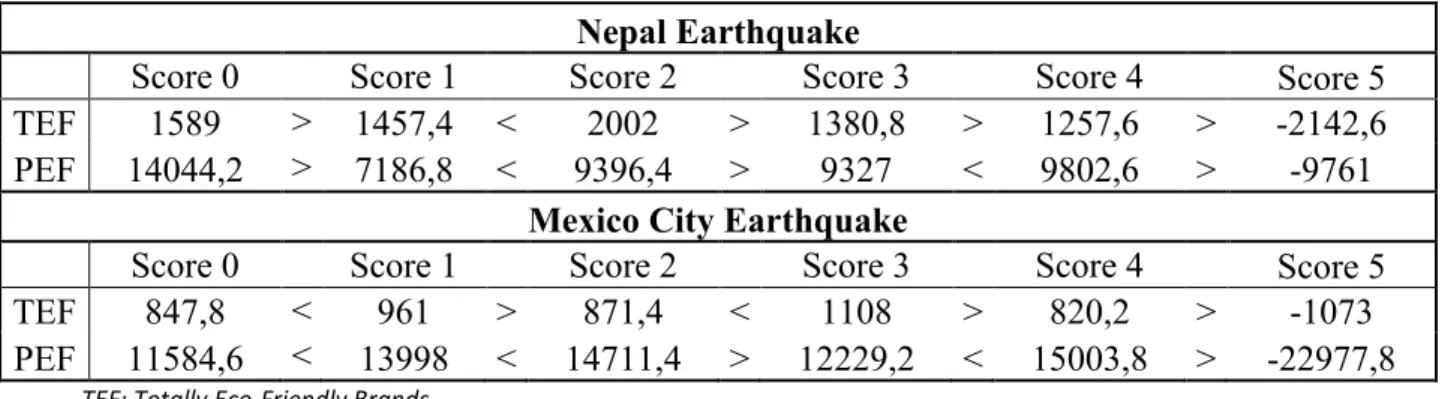
Firstly, it is relevant to have a look at a descriptive statistic while using the difference between the number of followers over time because it is more relevant and will give a deeper understanding on what is being analyzed. This variable will allow a broader vien in consumers engagement changes between two time periods, for example compare the consumer engagement from Day -1 to Day 0 (e.g., Score 0) withr engagement from Day 0 to Day 1 (e.g., Score 1).
In Table 1, it is possible to conclude that the highest increase on the number of followers was for the partially eco-friendly brands from the third day to the fourth in the Mexico City Earthquake. It is also possible to observe that, for both events, from day 4 to day 5 there is an unexpected decrease of the number of followers. This decrease may be due to the fact that the natural catastrophe is no longer news or maybe due to the fact that brands are no longer making communication on these events and followers start receiving communication they do not value and unfollow the brands’ pages.
Table 1: Evolution of consumer engagement with totally eco-friendly and partially eco- friendly brands
Nepal Earthquake
Score 0 Score 1 Score 2 Score 3 Score 4 Score 5 TEF 1589 > 1457,4 < 2002 > 1380,8 > 1257,6 > -2142,6 PEF 14044,2 > 7186,8 < 9396,4 > 9327 < 9802,6 > -9761
Mexico City Earthquake
Score 0 Score 1 Score 2 Score 3 Score 4 Score 5 TEF 847,8 < 961 > 871,4 < 1108 > 820,2 > -1073 PEF 11584,6 < 13998 < 14711,4 > 12229,2 < 15003,8 > -22977,8
TEF: Totally Eco-Friendly Brands PEF: Partially Eco-Friendly Brands
It can be also noticed that the followers that for totally eco-friendly brands the differences from each day that follow the natural catastrophe are higher in almost all
time periods for the Nepal Earthquake than two years after in the Mexico City Earthquake, with exception to the first time period and the last. This may be justified by the fact that four years ago these brands were still trying to gain more visibility and reach their target and two years after they may be stabilizing their number of followers and people that have interest in what they communicate. Opposing to these are the partially eco-friendly brands which present a more relevant increase in almost all time periods for the Mexico City Earthquake, with exception for the first and last time periods as well. In this case this difference may be justified by the fact that four years ago, in the date there was the Nepal Earthquake, this type of brands may not have been so focused in communicating their actions and making an impact on their consumers. Two years later, their communication strategy may have had some differences which made consumers feel more connected to the brand, maybe because of their communication and stronger adoption more environmentally friendly practices.
To respond the research questions previously launched, two independent repeated measures GLM ANOVA were conducted, with the aim of identifying if there is relationship between awareness of ecological concerns and consumers engagement for brands that are fully vs. partially ecological with brands and the time a natural catastrophe happens. In this analysis the dependent variable corresponds to the consumer engagement, measures by 1) the total number of followers and by 2) the difference in the number of followers in each day. In this statistical teste there is also the independent variable time which is a within-subjects factor and the variable type of
brand which is a between subjects-factor.
4.2 Consumer Engagement with Eco-Friendly Brands after a Natural Catastrophe
This dissertation aims to test the following hypothesis:
H1: Eco-friendly brands have an increase on their number of followers after (vs.
before) a natural catastrophe
H2: Partially eco-friendly, when compared to fully eco-friendly, have a higher
increase in their number of followers after a natural catastrophe.
4.2.1. The effect of ecological awareness of eco-brands on consumers’ engagement
The assumption criteria results show that the Mauchly’s Test of Sphericity was statistically significant, meaning that the sphericity condition has not been met (Nepal catastrophe: χ2(20)= 134.44, p < .001; Mexico catastrophe: χ2(20) = 226.27, p < .001).
Thus, to correct for lack of sphericity, I applied the Greenhouse-Geisser correction. The results revealed a statistical significant effect of time on engagement for the Nepal catastrophe (F(1.07, 48) = 10.06, p = .011) and a close to marginal effect for the Mexico catastrophe (F(1.02, 48) = 3.25, p = .108). The Nepal catastrophe was qualified by a significant interaction effect of Time X Type of Brand (F(1.07, 48) = 5.12, p = .050). However the Mexico catastrophe did not reach the statistical significance (F(1.02, 48) = 2.52, p = .151). The main effect for the type of brand were not statistically significant for neither of catastrophes (Fs(1, 8) < 1.95, ps > .201.
To decompose the interaction effect I used the pairwise comparisons (Annex 1). As predicted, when brands were fully ecological, there was no significant difference from Day -1 to Day 0 (p = .719), from Day 0 to Day 1 (p = .505), from Day 1 to Day 2 (p = .480), from Day 2 to Day 3 (p = .672), from Day 3 to Day 4 (p = .633) nor from Day 4 to Day 5 (p = .452). However, for the partially ecological brands, there was a significant increase over time (Day -1 to Day 0: p = .011; Day 0 to Day 1: p = .009; Day 1 to Day 2: p = .008; Day 2 to Day 3: p = .018; Day 3 to Day 4: p = .005; and surprisingly, a decrease on the number of followers from Day 4 to Day 5: p = .006).
For the Mexico catastrophe, the results were similar. No difference over time for consumer engagement with fully ecological brands (all ps > .838). Consistently, for the partially ecological brands, there was an increasing engagement over time, which marginally decreased in the last day of measurement (Day -1 to Day 0: p = .034; Day 0 to Day 1: p = .094; Day 1 to Day 2: p = .037; Day 2 to Day 3: p = .048; Day 3 to Day 4:
p = .030 and surprisingly, a decrease on the number of followers from Day 4 to Day 5: p
= .073).
4.2.2. The effect of ecological awareness of eco-brands on the difference score for engagement
To make sure that the growth in the number of subjects is comparable between events, I decided to analyze the difference in scores for engagement at the different time points. Thus, this variable allows me to understand if the growth in consumer engagement from Day -1 to Day 0 (e.g., Score 0) is different from Day 0 to Day 1 (e.g., Score 1). Again, I repeated the same GLM for repeated measures ANOVA, using Time as the within-subjects factor, type of brand as the between-within-subjects factor, type of catastrophe as the type of measure and difference score for engagement growth as the dependent variable. Results showed a violation in the sphericity assumption, as the Mauchly’s Test of sphericity was statistically significant for both catastrophes (Nepal catastrophe: χ2(14)=
55.41, p < .001; Mexico catastrophe: χ2(14) = 142.24, p < .001). Similarly to the
previous analysis, we applied the Greenhouse-Geisser correction of sphericity. The results revealed a statistical significant effect of time on engagement for the Nepal catastrophe (F(1.88, 40) = 6.70, p = .009) and a non-significant effect for the Mexico catastrophe (F(1.13, 40) = 2.55, p = .143). The Nepal catastrophe was again qualified by a marginal interaction effect of Time X Type of Brand (F(1.88, 40) = 3.32, p = .066). Similarly, the Mexico catastrophe did not reach the statistical significance (F(1.13, 40) = 2.52, p = .186). The main effect for the type of brand was statistically significant for Nepal (F(1, 8) = 5.67, p = .044) but not for Mexico (F(1, 8) = 2.79, p = .133).
The interaction was decomposed through pairwise comparisons (Annex 2). Similarly, in the Nepal catastrophe, fully ecological brands showed no difference in their growth score over time (all ps > .516). However, partially ecological brands showed a growth on their consumer engagement score over time. The increase from Day -1 to Day 0 (Score 1) was significantly larger than the growth from Day 0 to Day 1 (Score 2; p = .026). From Day 1 to Day 4, the scores do not significantly differ from each other. However, there is a significantly decrease of growth when comparing Day 3 to Day 4 (Score 5) and Day 4 to Day 5 (Score 6; p = .005).
As for the Mexico catastrophe, no differences over time are reported for consumer engagement with fully ecological brands (all ps > .903). However, and congruently with the previous findings, partially ecological brands yielded a growth on their consumer engagement score over time. Even though the increase from Day -1 to Day 0 (Score 1) was not significantly larger than the growth from Day 0 to Day 1 (Score 2; p = .585), it was marginally larger than the growth from Day 1 to Day 2 (Score 3; p = .089). Again, after five days, there is significant drop in the followers (Score 5 to Score 6: p = .043).
4.3 Discussion
The aim of this dissertation is to give answer to the research questions proposed in Chapter 1. The previous findings showed that it is possible to conclude that consumers react differently towards with totally and partially eco-friendly brands when their level of awareness is high (e.g., after a natural catastrophe).
Do eco-friendly brands have an increase on their number of followers after (vs. before) a natural catastrophe?
The results showed that after a natural catastrophe the number of followers a brand has increases for the first four days. From the Day 4 to Day 5 there is consistent and accentuated drop on the number of followers’ brands had. Although it is possible to see these results, through the statistical test performed it is possible to conclude that there is a statistically significant increase in consumer engagement after a natural catastrophe, although this effect may be significant in the Nepal’s Earthquake and close to marginal in Mexico City Earthquake, consistently showing the same pattern.
Does being partially eco-friendly or totally eco-friendly affect this increase?
It is supported by the statistical analysis that there is a statistically significant interaction between time and the type of brand, but only in partially eco-friendly brands for Nepal’s Earthquake. This difference over time is only significantly pronounced for partially eco-friendly brands, meaning that only for these brands consumers’ engagement increases after a natural catastrophe. The Mexico City earthquake, even though not reaching statistical significance, does reflect the same pattern. Although from the descriptive statistics it is possible to decode that that consumers’ engagement increases both for totally and partially eco-friendly brands. However, this difference is only significant for partially eco-brands.
One of the possible explanations may be that that consumers hold different expectations to these two types of brands. Partially eco-friendly brands are still in the transition to a more conscious ecological behavior, with this, they may surprise consumers creating a higher impact and promoting consumer support for such brand attitudes and values (Erdoğmuş & Çiçek, 2012). This will consequently generate a higher level of engagement, based on its novelty and un-expectancy. For the fully eco-friendly brands, the expectations are already high and met, since these brads have always positioned themselves as high on ecological concerns and behaviors, embodied on their cultures. Thus, consumers are less sensible to their communications and just expect these brands to act according to what they had always supported and defended (Smith, 2011).
CHAPTER 5: CONCLUSIONS AND LIMITATIONS (1500-2000)
This final chapter is a resume of the achieved results and conclusions that arose from the research done in this paper as well as the main limitations throughout the whole process.
5.1 Conclusions
Consumers concerns on their ecological footprint have been increasing for the past years. This matter is something that has gaining strength for consumers and with it the way they purchase and the way they are impacted with brands marketing. The impact human nature has been having on the environment is something that impacts us every day. Shocking examples pile up: The whale found dead with 40kg of plastic inside of her, or constant natural catastrophes such as the most recent one that occurred in Mozambique and cannot be ignored anymore. Although it took longer to start, such wake up calls are now one of the consumers’ priorities as they search for brands that promote this consumption behavior change.
It is relevant to take into account that the environmental changes are not only the ones affecting consumers. Technological changes and innovations are also changing consumers’ behavior. This affects the way consumers’ purchase, the way consumers experience shopping and make choices accordingly. All of these factors affect the way consumers perceive brands, a major challenge that needs to be overcome by companies if they want to keep up with the market and with consumers expectations.
The purpose of this dissertation was to understand if consumer engagement, given by the number of followers of a brand page on Instagram, with eco-friendly brands would increase after a natural catastrophe. This may also give some insights on whether brands should strengthen their position on such events that have an impact on consumers’ minds. In order to better address the research purpose, it was also evaluated how consumers interacted with fully eco-friendly and partially-eco-friendly brands so that a distinction could be done between brands that always had environmental concerns and brands that have lately adopting more sustainable and ecological behaviors and actions. In summary, it is possible to conclude that consumers’ engagement increases over time, since they are more aware of brands communication on these themes. This conclusion is verified for time by itself in both natural catastrophes analyzed. When introducing the type of brand in this interaction the conclusion is that totally eco-friendly brands do not
benefit from this interaction, but the same is not verified for partially eco-friendly brands, which show us that consumers react more to these brands when their ecological awareness is high. This may happen because consumers are not expecting these types of communication from partially eco-friendly brands and affected by them in a positive way (Smith, 2011).
When considering totally eco-friendly brands, the effect of time did not show to be significant. The number of new followers for fully eco-brands may have not been affected over time, since brands may have not communicated something that was more engaging for consumers. This may show that consumers already expect the type of interaction they have with totally eco-friendly brands and they are not reaching new followers.
5.2 Recommendations
Even though the effect of type of brand through time did not reflect a statistically significant effect for both catastrophes on consumers’ engagement, time, by itself had a more stable and cross-event impact on consumers engagement. This gives us an important insight: Brands should be quickly to take action in communication when natural catastrophes occur. Consumers expect an immediate reaction from brands when important impacting events like natural catastrophes occur (Fraj & Martinez, 2007). Brands should use these moments to impact consumers in two ways: raise awareness to the impact their choices are making, but in a constructive way, and to be able to state their ecological position and actions or reinforce them. They should define different communications according to their communication target (Erdoğmuş & Çiçek, 2012). The strategy definition also encompasses the understanding of what to communicate, since consumers may have different feelings on what brands communicate (Gam, 2011). Brand community managers are the pillars that can better understand consumers’ perceptions through social media, since they need to play close attention to their consumers needs and expectations.
The fact that consumers expect brands to be real and act according to their values is something that in the results, for fully eco-friendly brands, showed to be ignored by the participants as they did not significantly react to these brands in moments of high ecological awareness (Iannuzzi, 2017). Consumers’ engagement for this type of brands was not significant over time. Consumers may have already expectations of a certain