Constructing the Fair Value of Non-Financial Assets –
A Case
Study
Ekaterina Chetyrkina [email protected] João Oliveira [email protected]
Maria do Céu Ribeiro [email protected]
Abstract
The fair value phenomenon has been transformed into a “quasi-philosophical principle at the center of an accounting reform” (Power, 2010, p. 197). However, while there is much quantitative research on fair value, there is scarce research about how this complex and controversial concept is operationalized, within particular contexts of actual organizations.
We analyse the fair value phenomenon through a qualitative approach, by researching an actual process of determining the fair value of non-financial assets at a large Portuguese industrial company. Inspired by Actor-Network Theory (Callon, 1986 and Latour, 1997), the study shows that the fair value recorded in the financial statements is not simply calculated, but is “socially constructed”, based on the value perceptions resulting from an agreement reached during interactions within a complex network of human and non-human actors. These actors, of varying centrality, influence directly or indirectly not only the process of determining the fair value, but also the behaviors of every participant of this complex network. Two different concepts of fair value were being applied, not clearly discernible in financial statements and constructed through two different processes, involving a different set of network actors. By showing that understanding accounting figures requires understanding accounting practices, unfolding through particular organizational arrangements, this study highlights the social nature of accounting figures.
1.
Introduction
Over time there have been many discussions about the basis of valuation of balance sheet items and the cost method was the initially preferred in different jurisdictions. However, the use of market values has been growing in the last decades, in particular with the international expansion of IAS / IFRS. These standards are based on an accounting model oriented for the investor and, as such, are based on the fair value and the extensive use of professional judgment by preparers of financial information (Gwilliam, 2008; Hellmann, 2010). These multiple professional judgments are performed in a complex social context, involving a network of different actors that interact in multiple ways, in multiple locations and across multiple tools. So there is a complex social reality underlying the fair value reported in financial statements. Using the lenses of Actor-Network Theory (Callon, 1986), this paper analyzes, through a case study, the multiple social relations in the process of determining the fair value of non-financial assets in a large Portuguese industrial company and, in particular, the interactions of the different agents and how the fair value is based on a consensus that results from a complex and non-deterministic process.
The emergence and spread in international accounting regulation of the fair value concept have fueled many discussions about its relevance and reliability, particularly when compared to historical cost. One debated issue is the possibility that fair value measurement has contributed to the aggravation of the 2008 global financial crisis (Laux and Leuz, 2009), given the fair value inherent subjectivity, especially in the absence of an active market1, which contrasts the objective measurement by historical cost.
Financial reporting aims to provide useful information for decision-making by various users. However, subjectivity and the consequent reduced reliability of fair value, as well as its quantification complexity, call into question its usefulness and therefore represent obstacles to that purpose. Furthermore, empirical evidence has not provided decisive arguments in favor of either historical cost or fair value (e.g. Nissim and Penman, 2008; Laux and Leuz, 2009; Herrmann et al., 2006).
1
There are several studies on the value relevance2 and on the disclosures of historical cost and fair value in quantitative terms (Barth et al., 2001; Song et al., 2010), but there is little information about the establishment of the fair value’s theoretical concept and the very process of its determination.
International accounting regulation is characterized by the complexity of some standards, particularly on fair value, since the regulation is based on principles3, not on specific rules. Power (2010) argues that when it comes to quantifying the value, fair value reliability is related to the construction of different perspectives of values by different actors involved in the process. In this case, accounting regulation only establishes parameters to facilitate consensus among actors, but it does not entirely eliminate subjectivity. In this perspective, the items measured at fair value with no active market are shown in the financial statements as an end result of a consensus between different agents, not providing any information about the difficulties of its measurement. During this interactive process, conflicts between actors until they arrive at fair value can be expected (Power, 2010). However, there are hardly any empirical studies on fair value that analyze the specific contexts and organizational processes in which reported calculations are developed and operationalized (Hopwood, 2009). This study fills this gap by allowing to understand how the concept of fair value, abstract in nature (Power, 2010), is operationalized in terms of calculation in the accounting practices of particular organizations (Hopwood, 2009).
The case study of a process of determining the fair value in a large Portuguese industrial company reveals, contrary to initial expectations, several procedures for determining fair value, involving networks of different actors, with direct or indirect influence in the process. It is interesting to underline that no actor “calculates"4, but rather interacts in the fair value’s
2
These studies use shares value as a benchmark of the company’s value, to analyze to what extent the reported financial information is useful to an investor and is reflected, by him, in the company valuation, i.e., if there is a significant association between this variable (in this case, the fair value or disclosure of the respective hierarchy) and the price (Barth et al., 2001).
3
According to the Principles-Based Approach, first is defined a conceptual basis within the regulated subject, and then there are provided guidelines to explain their goal. In this approach the principles are designed to serve the public interest and are accompanied by a small number of rules that show how these principles should be applied in specific situations. It does not seek to regulate all possible situations, such as in the Rules-Based Approach, because in case of doubt the principle in question is applied.
4
co-production process (Callon and Muniesa, 2003). Hence, the fair value should be understood as a "socially constructed" figure based on the perceptions from key actors on the process. The interactions between the key actors are based on the model called "fair value triangle", whose vertices correspond to the preparer of financial information, the appraiser and the auditor. The case study allowed to enrich this “fair value triangle” model, by incorporating the multiple actors that actually constitute each of these vertices, linked by formal and informal relationships inside and outside the entity. Together, these actors form networks whose configuration changes for the construction of the different concepts of fair value.
After this initial section, section 2 introduces the fair value’s theoretical framework that underlies this study. Section 3 discusses the problem of calculating fair value and the process of its social construction. Section 4 deals with the qualitative research methodology used in this study, and section 5 presents the case study. The main reflections, conclusions, contributions and limitations are presented in Section 6.
2.
Theoretical Framework on Fair Value
Fair value has been a hot topic among professionals and academics. Inherent to the measurement of an asset and liability is one of the biggest dilemmas in accounting: reliability versus relevance (Whittington, 2008). Investigation regarding fair value has focused mainly on studies of value relevance (Barth et al., 2001; Beattie, 2005; Basu, 2012; Okamoto, 2014), not capturing the emerging economic reality within the "imaginary" market created by fair value (Bougen and Young, 2012). To relate the measurement of fair value and its imaginative features, a definition of fair value is required, in particular since, unlike historical cost5, it is a non-observable value.
Fair Value - Development and Controversy
5
Some arguments for and against the fair value can be found in Nissim and Penman (2008), but no evidence has objectively supported the superiority of fair value over historical cost to value assets/liabilities (Okamoto, 2014).
Along with a tendency to lower the importance attributed to verifiability in favor of relevance (Barth et al., 2001; Whittington, 2008), fair value expanded regarding financial instruments, particularly derivatives (Power, 2010), and it has been extended by analogy to other assets and liabilities through financial evaluation methods and models.
The concept of fair value is currently defined in IFRS 13 as "the price that would be received in selling an asset or should be paid for the transfer of a liability in a current transaction between market participants at the measurement date". Certain market-oriented assumptions are used, in particular the highest and best use of the asset, the asset price, as well as inputs for their measurement, classified as observable or non-observable. This categorization of inputs is related to the company perception on the assumptions that many users of financial information would take into account in determining a price. Thus, they are assumptions of assumptions, which imply that assessments are essentially "simulacra" (Bougen and Young, 2012).
Clearly, the most observable and independent inputs are quotations in active markets for identical assets, and the least independent are the non-observable inputs, that Bougen and Young (2012) call the "simulacrum"6 of assumptions that the market would have, if it existed. In other words, the so-called imaginary markets are created, in which the assets and liabilities are valued in the context of a new reality of economic relations (Bougen and Young, 2012). In those cases where the fair value of an asset or liability may be determined by the market, the price of this asset results from a set of large volume transactions between buyers and sellers7.
There is a trade-off between relevance and reliability of financial reporting when it comes to the different levels of the valuation inputs (Barth et al., 2001; Whittington, 2008). Relevance does not decrease as markets become less liquid (Song et al., 2010; Christensen and Nikolaev, 2013); however, reliability is reduced as the levels increase, thereby making level 3 inputs less reliable (Song et al, 2010;. Bagna et al., 2014; Chung et al., 2014). The existence of less or non-observable inputs in the market requires the simulation of the asset’s features
6
Bouguen and Young (2012) refer to the purpose of FAS (Financial Accounting Standards) 157, in the US regulation, which is similar to IFRS 13.
7
Even in these circumstances, there will be subjectivity in the process, since there is no guarantee that this asset / liability will be exchanged in the future at this price.
to obtain a comparable asset, requiring the creation of another economic reality (Bougen and Young, 2008). This challenges one of the fair value claimed advantages, that by incorporating more information, it is more relevant for decisions (Barth et al., 2001; Ray-Ball, 2009),
Two concepts: Fair Value and "Fair Value"
There is currently a mixed accounting system in which the fair value and historical cost coexist (Okamoto, 2014). This system involves estimates, and market values may be used to support these estimates, not as an application of the principle of accounting for the fair value, but only as an alternative way to support these estimates. As already mentioned, the fair value is not a synonym of the real market values, but rather of the market price estimates (Power, 2010).
In practice, excluding financial assets and liabilities, the concept of fair value is applicable to the measurement of assets acquired in a business (IFRS 3) and to the subsequent measurement of non-financial assets (IAS 16 and IAS 38), if the preparer of financial information opts for fair value. In turn, non-financial assets impairment tests incorporate fair value as a primary determinant of the decision to impair such assets (IAS 36), albeit in a perspective of historical cost. So, there are actually two concepts of fair value: the first, with direct accounting impact; the second, only in case of impairment.
Throughout this study, we chose to call "fair value" (fair value, between quotes) the fair value applied to the last situation (for impairment decision), and fair value (without quotes) the one that applies to the first situation.
For a better understanding, we present graphically in Appendix 1 the similarities and differences between the two concepts, as well as the connection with the other levels of fair value. According to the economic theory of perfect market, the market value of an asset is equal to the income that it will generate. However, the asset profitability depends on its specificity to the purchaser, i.e., its use value (Bignon et al., 2009). In a perspective of historical cost, in accordance with IAS 36, the value to be considered for impairment decision
is the biggest one between the market value (fair value of Level 1, 2 or 38 less the costs of the sell) and the value in use, i.e., an estimate of discounted future cash flows that are specific to the organization (firm-specific values), considering possible synergies of that asset. Value in use is tagged with a fair value level 3 where the cash flows are simultaneously firm-specific and market-firm-specific values.
Paradigm of Fair Value for the Appraiser
a) Convergence of Different Valuation Techniques and Fair Value Concepts
IFRS 13 establishes fair value on the basis of exit price, in particular with regard to the reliability of estimates of that price that are based on valuation techniques (Ryan, 2008) and its suitability for the assets in use or held to maturity (Whittington, 2008). If there is no market information or comparable transactions in the market, this exit price should be estimated through various valuation techniques.
The valuation techniques to measure fair value should be appropriate to the circumstances, and there must be sufficient data available to ensure its correct application. The IASB (2011) defines three techniques:
market approach (“uses prices and other relevant information generated in a set of transactions in the market of assets and liabilities identical or comparable” - exit price);
cost approach (also called "current replacement cost" – “reflects the amount that would be currently required to replace the service’s capacity of an asset” - entry price that in perfect markets would be equal to exit price);
income approach (consists in discounting the future cash flows generated by the asset to the present moment; in this case the fair value measurement reflects current market expectations about those future cash flows - neither exit price, nor entry price).
8
IFRS 13 does not prescribe what kind of technique should be used in specific circumstances, unlike the IVS (International Valuation Standards), standards generally accepted internationally for the professional valuation practice. The IVS define three bases of value: market value, investment value and fair value. IFRS 13 fair value is generally consistent with market value as both concepts involve an hypothetical transaction in the market. The IVS define the following measurement techniques to determine market value: replacement cost approach (depreciated or not), or (depreciated) replacement cost method (reflects the current cost of replacement of the asset or depreciated); income approach or discounted cash flow method (the estimate of the present value of the asset consists in the update of the future cash flows); comparative market approach, or sales comparison method (reflects the price of the similar asset tradable in the market).
The IVS framework does not define all bases of value that may be required for all situations around the world. However, as IAS/IFRS are widely used, there was a clear convergence of concepts between both frameworks through the specific basis of value, that is market value. There was, thus, a change in the fair value’s concept with IFRS 13, but at the same time the exit and entry prices converge with the "market value" defined in the IVS framework.
b) Fair value and the Appraiser's Role
As stated above, there is no single concept of fair value, nor consensus among appraisers as the "best" fair value (Campbell, 2008). Thus, the preparer of financial information must identify the primary market for the asset or liability to be valued, as well as choose the most appropriate valuation approach and its consistent use, even in the case of delegating these tasks to an external appraiser.
The decision of delegating the mentioned tasks to an appraiser is sometimes related to the greater confidence and reliability that fair value estimates determined by an independent appraiser transmit to the users of financial information (Cotter and Richardson, 2002). However, in practice, a greater use of appraisers is closely related to the auditor’s support (Campbell, 2008), as we shall see in section 3.
Fair Value Paradigm for the Auditor
The emergency of the regulation on fair value led to a greater number of estimates and judgment in financial reporting, further hindering the audit work. Griffin (2014) shows empirically how the auditor makes decisions in the absence of reliable market information. In a fair value context, the estimation process involves a greater degree of uncertainty, given the greater inherent subjectivity of the inputs used in the calculation of these estimates and the imprecision of the respective results. It is also found that the less observable market inputs are, the greater the level of proposed adjustments and disclosures of assumptions that formed the basis for determining fair value.
The main objective of the auditor is to express an opinion on the accuracy of financial reporting information, even in situations of fair value measurement, which raises problems due to the subjectivity and imprecision of the latter (Smith-Lacroix et al., 2012). The shift from the historical cost paradigm to the fair value altered the decision-making process in auditing, in particular with a lower significance of quantitative materiality in favor of qualitative materiality (Christensen et al., 2012; Griffin, 2014).
The concept of materiality, "one of the anchors of audit” (Machado de Almeida, 2014, p. 185), provides a level from which an omission or misstatement could influence the decisions of users of financial reporting. This is a quantitative concept, but it is also influenced by several qualitative factors and is used in the validation of the financial report which is dependent of the auditor’s judgment. There is evidence of the non-existence of agreed limits for materiality, which is thus based on professional judgment and subjectivity. With the expansion of fair value, a subjective and imprecise value, there is a growth of the professional judgment and hence of the qualitative materiality.
Because the auditor’s professional judgment is a mental process based on a psychological model made up largely by the auditor’s experience, stimulus and judgment process(Machado de Almeida, 2014), each auditor will have a different opinion on the fair value.
On the other hand, the fact that accounting matters have undergone profound changes in terms of their knowledge base, especially in regards to the introduction and spread of the
concept of fair value, it forced accounting to develop a specific relationship with the discipline of market valuation (Smith-Lacroix et al., 2012). Additionally, these changes led to the need, by the auditor, to deal with a matter outside his/her area of expertise and altered the role of the actors involved in the process of determining the fair value, in particular the appraiser and auditor. Thus, to give an opinion on the accuracy of a specific number, the auditor relies more and more on the reliability of the value determined by the appraiser. Briefly, an asset objective historical cost reports a value determined by the company, while fair value, subjective by nature, reflects the behavior of prices and markets inefficiency (Nissim and Penman, 2008). As already noted, on the one hand, there are arguments against the use of the models based on cash flows discounted with inputs of future prices (Nissim and Penman, 2008); on the other hand, there are arguments that consider that the fair value’s "imaginative" properties should not necessarily be seen as negative, and it is important to understand how reality can be imagined, what is simulated, by whom and for what purpose (Bougen and Young, 2012). The next section extends the discussion on fair value, discussing how its ambiguous and controversial “calculation" has an implicit process of social construction of "a" fair value, rather than of "the" fair value.
3
The Social Construction of Fair Value
In a context characterized by the uncertainty of business and by the existence of asymmetric information, the financial information’s preparer may be argued to have a greater knowledge of the company, particularly in terms of expectations of future performance (Healy and Palepu, 2000). This way, the preparer may have a better perception on the fair value of its assets, particularly in cases of absence of active markets (level 2 and 3) when the determination of the fair value involves judgment in its quantification(Song et al., 2010).
Since the concept of assets’ fair value is quite controversial and is understood in different ways [a market value (IFRS 13), an"abstract" principle (Power, 2010) or a valueestablished in "simulacra" (Bouguen and Young, 2012)], it will be interesting to understand how firms set this value in practice. In each actual case, multiple questions arise. Under what circumstances will external entities be used? If independent appraisers are used, will this
external actor determine the fair value? What is managers' level of intervention in the process of fair value’s determination (Okamoto, 2014) and in its core elements? What are the techniques and valuation models applied?
Power (2010) argues that fair value is based on the “sociology of reliability”. In this perspective, the fair value is mainly related to a consensus among the various actors, internal and external, involved in the process, more than a mere mathematic "calculation". The various studies in accounting on the social and institutional field have allowed to improve the understanding of the social and behavioral aspects related to accounting matters, as well as the perception of its constructive nature (Vollmer et al., 2009). In this line, we present next the development of qualitative research in financial accounting and then apply one of the most promising qualitative approaches (Actor-Network Theory) to the topic of fair value.
The development of qualitative research in financial accounting
Until the mid-seventies, quantitative research focused mainly on the measurement problems and other essentially normative issues, virtually non-existent today (Oler et al., 2010). Currently, research in financial accounting has focused on matters of a more qualitative nature, that is, about what should be disclosed in the financial statements, how to explain the observed practices and which is the association between these practices and other variables of interest (Beattie, 2005), in a positive approach (Oler et al., 2010).
Research has focused on understanding the procedural component, that is, how markets and users of financial information process financial data; thus, research has become detached of the accounting process and become unrelated to the problems faced in practice (Kaplan, 2011). According to Basu (2012), the contribution of particular studies must rely more on its practical significance, and less in its statistical significance, and researchers must go beyond the numerical databases and positivist research. In fact, the disappointing results of quantitative research in accounting, generally without practical implications, namely in the areas more supported by statistical significance as in the studies of financial reporting and value relevance (Basu, 2012), contributed to a growing importance and development of qualitative research in financial accounting – although still far from being mainstream.
This importance of qualitative research is apparent not only at a more macro level, such as the regulation of the accounting profession (e.g., Canning and O'Dwyer, 2013) or the adoption of international regulation (e.g., Hellmann et al., 2010; Guerreiro et al., 2014), but also at a micro level, as in the case of the analysis of the development process of relationships between the grouped in a joint venture, of conflicts and trust between these (Tsamenyi et al.. 2013).
Actor-Network Theory Applied to Fair Value
The current financial crisis has demonstrated the inability of research in accounting to propose appropriate solutions to the measurement of fair value (Arnold, 2009) and also indicated the existence of a gap between research in accounting and accounting practice (Hopwood, 2009). That distance is related to the fact that the research databases did not provide information about the difficulties of the measurement of fair value that exist in practice; however, it is important to analyze the accounts not in static perspective, but rather from the perspective of a continuous process, that is, accounting in action (Hopwood, 2009).
When a user analyzes the financial statements, it considers the recorded fair value as a given, without exploring how that value was achieved, thus showing the importance of studying the most practical and pragmatic aspects of fair value (Kaplan, 2011; Okamoto, 2014). As discussed in section 1, the concept of reliability in fair value is associated with the construction of different perspectives of values by the actors, implying an inherent subjectivity. From an economic perspective, a calculation is only a “pure" calculation; however, from a social sciences perspective, the calculation is inserted in much more complex practices than a simple numerical operation (Callon and Minusa, 2003). Since it is not a purely human or mechanical mechanism, the economic value of a given object is spread by human and non-humanactors, and is the result of the forces of the actors involved (Callon and Minusa, 2003).
In this perspective, fair value, as a number inscribed in a financial statement, provides no information on the difficulties in the process leading up to it, although it is the result of a consensus among various actors: the information preparer, the appraiser (expert) and the
auditor. This perspective has an appropriate theoretical support in Actor-Network Theory (ANT), with its focus on actions and “actors”, that is, something that acts, though not necessarily human (Latour, 1997).
Actor-Network Theory has been used in accounting research to enable a deeper analysis of the complex social and socio-technical realities, not confined to predefined theoretical models. These realities emerge in more or less unpredictable ways and oscillate between the potential for instability and stability, that are the result of strategic interventions of the various actors (Oliveira et al., 2009). However, Actor-Network Theory has been used mainly in the area of management accounting (Oliveira et al., 2009), with a lot of unexplored potential in financial accounting, where its usage has been mostly restricted to the macro level, such as accounting standard setting and regulation.
Under the theory of distributed cognition9, regarding fair value of complex financial instruments, Okamoto (2014) argues that to have such a distributed cognition of knowledge within a group, an organizational structure that allows the group to make judgments is essential. Such judgments are needed in the case of fair value produced from level 2 and 3 inputs, given the lack of market transactions and the obligation to perform simulations. In this case, it is extremely important to evaluate the functionality of this “simulacrum", as well as the particularities of their practical application (Bougen and Young, 2012). The study of these pragmatic aspects of fair value may reduce the existing gap between practitioners and the IASB (Kaplan, 2011).
Considering that ultimately the fair value does not result from a simple calculationoperation, but rather it depends on the perceptions of value by the actors involved in the process and on the respective power forces (Callon and Minusa, 2003; Power, 2010), some conflicts between the parties is expected (Power, 2010). In this regard, it should be noted that although social relations are not the essence of Actor-Network Theory, they are not out of its domain (Latour, 1997).
9
The distributed cognition concept has been used in various fields, from law (e.g. a judge decision-making process) or sociology (e.g., information processing within organizations) (Okamoto, 2014).
The Auditor and the Appraiser in the Fair Value Network
The audit process is, in itself, an interactive and negotiating process (Bruen, 2010), and this interactive component is intensified by the changes in accounting regulation with regard to the introduction of the fair value concept. Due to the lack of expertise in the evaluation matter, the auditor became an intermediary between the stakeholders and the evaluation experts (Smith-Lacroix et al., 2012), maintaining its formal power to ensure the accuracy of the financial information reported by its preparer.
Informally, there is currently a widespread confidence in the expertise of the experts, and the auditor has been "socialized" to accept the appraiser’s conclusions (Smith-Lacroix et al., 2012). Smith-Lacroix et al. (2012) draws on Giddens to underline the limitations of expert actors and that more complex tasks require the cooperation of experts in various fields. Thus, the finiteness of the auditor's knowledge was recognized in specific areas through the creation of an auditing standard that enables the auditor to use the support of experts in the development of his/her opinion.
Considering that a proper fair value audit requires a set of specific knowledge that is often outside of the auditor's expertise and area of operation, there is a control loss by the auditor due to the difficulty in auditing the uncertainty of assumptions. In this way, the auditor is seen as a "conductor of an orchestra" (Campbell, 2008; Smith-Lacroix et al, 2012), which includes the appraiser and the preparer of financial information.
4
Methodology
Definition of the Object of Study
This study investigates a process of determination of fair value of non-financial assets in inactive markets, in a specific company. One of the main issues about fair value is the complexity of its quantification and the inherent ambiguities of its construction process (and not so much the ambiguities of its mere calculation). The distribution of knowledge within the process leading to fair value is inevitable and underlying process must be sustained by
human interactions beyond the formal and contractual limits that exist within and outside organizations (Okamoto, 2014).
Addressing Hopwood’s (2009) appeal to study accounting in action, we opted for a qualitative and interpretative methodology and the single case study method. This option enables in-depth knowledge in multiple dimensions (Arnold, 2009) through close contact with that action, unfolding in particular contexts and processes and involving particular actors, with particular backgrounds, goals and concerns. As loose theoretical lenses, we drew onActor-Network Theory concepts and approaches (Callon, 1986, Latour, 1987, Vollmer et al., 2009). ANT promised to be adequate to conceptualize the social fabric in which networks of actors interact, within and beyond the company, to socially construct fair value knowledge and the fair value figure reported in the accounts.
The case selection
Based on the Reports and Accounts available on the Portuguese Securities Market Commission (here identified by the initial of its Portuguese designation, CMVM) site for a specific accounting period (hereinafter referred to as "Year N"), companies were surveyed with the requirements for this study, i.e., disclosure of non-financial assets carried at fair value, including land and buildings, assets held for sale, investment properties and goodwill, as well as impairment tests assumptions for other non-financial assets.
A listed company in the non-financial sector was chosen, of a large-scale (called "TecnoCorp" for confidentiality reasons), because the existence of more complex processes was anticipated and suggested a richer study. Moreover, it is an industrial company with non-financial assets with a significant weight, and hence the fair value may have a more ambiguous application, which adds interest to the company as an object of study; moreover, it does not include financial assets or liabilities at fair value (Nissim and Penman, 2008; Christensen and Nikolaev, 2013), which allowed greater research focus. As discussed in Section 3, the few empirical studies on organizational processes to support fair value have focused on financial instruments (Okamoto, 2014) and the internal auditor's perspective (Smith-Lacroix et al., 2012). To fill this literature gap, this case study is about an industrial
company and covers more actors, in particular the information preparer, the auditor and the appraiser (and additional actors who were identified only during the study).
A letter was sent to the company Chief Executive Officer (CEO), presenting the preliminary project and requesting a previous meeting, for a better explanation of the purpose of the study and to define the terms of the proposed collaboration. The collaboration was accepted, with the condition of maintaining the company’s anonymity. The authorization to contact the auditor (a "Big Four" company, auditor of the case company for several years) and appraiser of the companywas obtained. The company received a full draft of paper, made comments and corrections and approved it for dissemination.
Data Collection Techniques
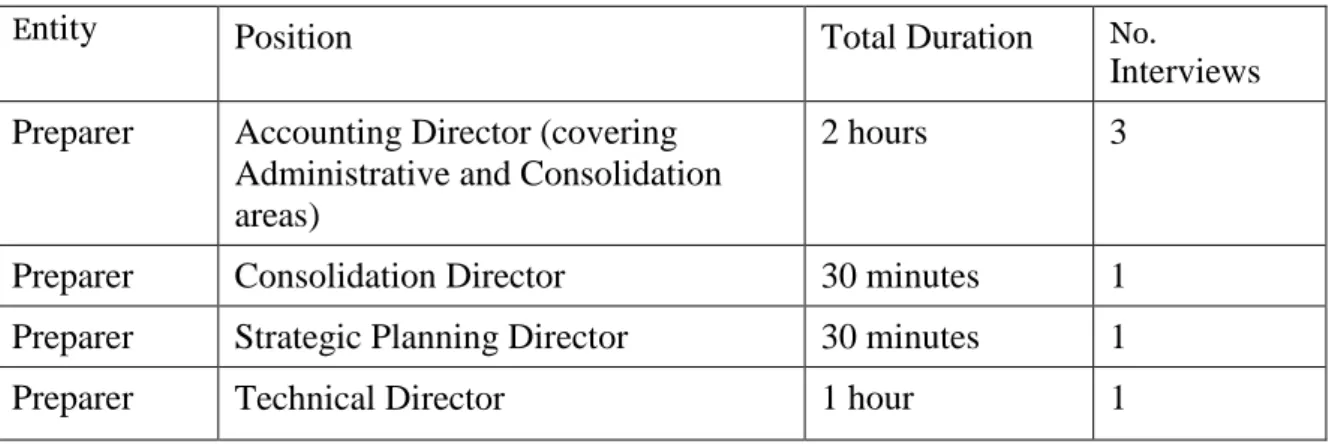
Semi-structured interviews, all carried out by the first author, were combined with document analysis to corroborate and orient interview information (Yin, 2009). A research protocol with the company was established to access to the information disclosed and undisclosed in the report and accounts. As mentioned, the first contact with the company was through a letter sent to the CEO, followed by a meeting with the Accounting Director to explain the study purpose, define the collaboration terms and obtain approval. The first interviews to the three actors, initially identified as being relevant to the determination of fair value (the preparer of financial information, the auditor and the appraiser) had a ripple effect (snowball sampling, Gil, 2007) leading to the identification of other actors to interview in person. Table I below summarizes the interviews.
Table I – Interviews ConductedIn-Person
Entity Position Total Duration No.
Interviews Preparer Accounting Director (covering
Administrative and Consolidation areas)
2 hours 3
Preparer Consolidation Director 30 minutes 1 Preparer Strategic Planning Director 30 minutes 1
Preparer Management Control Officer 30 minutes 1 Appraiser Managing Director – Fixed Assets 1,5 hour 2 Auditor Responsible Partner 30 minutes 1
The interviews, all in person, were not recorded, because of concerns that the respondents could feel inhibited due to the possible sensitivity of the subject. However, the content of each interview was summarized and sent to each interviewee to ensure accuracy, or even to allow them to add some information they deemed relevant; subsequently, there were telephone contacts to clarify any doubts.
In addition to the data collected through the above interviews, we analysed the proposal to provide appraisal services by the independent appraiser and the evaluation reports of non-financial assets revalued in the last reporting period (land and buildings). For confidentiality reasons and information sensitivity, the first author not receive a copy of the evaluation reports, but had the opportunity to consult them extensively for 1 hour, taking notes as appropriate.
5
The case: the fair value Construction Process at “TecnoCorp”
5.1. Company description and the ex-ante conceptual model: the Fair Value Triangle “TecnoCorp” (fictitious name) is a large Portuguese industrial organization and an important player in its market, with production units both in Europe and beyond. Its products are relatively homogeneous, yet at the same time diversified due to numerous variants and customizations. The company has grown mostly through national and international acquisitions throughout the decades. However, the recent global economic crisis has had a negative impact on profitability, and forced the company to close units with worse performance in various countries and to implement various organizational changes.
Various disclosures in TechnoCorp’s financial reports signal the usage of market values for various non-financial assets: land, buildings and goodwill related to assets acquired in business combinations. Financial reports also indicated that “Fair Value”, as defined in
Section 3, was also used as basis for impairment calculations. The remaining non-financial assets were recorded at historical cost. Disclosures also indicated the usage of an external appraiser. However, regardless of the accounting rule used, the user has no insight about what processes and procedures underlie the reported numbers.
Based on the available fair value literature and on TechnoCorp’s financial reports, an ex-ante theoretical framework was developed, identifying three main (collective) actors involved in the fair value determination process: the company itself (the preparer), the auditor and the appraiser This conceptual model, here labeled as the “Fair Value Triangle", guided us when further exploring the case. This ex-ante model already conceptualized fair value as emerging from a process involving a network of actors. However, based on the literature indications about the complexity of determining fair value, the authors anticipated that the empirical study could potentially reveal complex processes and a more complex network.
As reported in this chapter, interviews and further documentation analysis revealed two different processes underlying the two types of fair value. The process regarding Fair Value (without quotes) involves an independent appraiser (as expected in the initial ex-ante theoretical framework), but the network of actors within each of the collective actors, and the complexity of the process, turned out be far more complex than anticipated. On the contrary, the process regarding “Fair Value” was substantially simpler than anticipated, with the notable absence of the appraiser from the network and, overall, a less complex network and process; however, this less complex process was actually the one with greater discussions and power struggles between the two involved actors (preparer and auditor). Each process is now analysed separately, culminating in the shift from the single, ex-ante conceptual model presented above to two conceptual models, each applicable to the two concepts of fair value.
5.2. The Fair Value construction process
Before carrying out the land and buildings appraisals, the actors needed to reach consensus on three essential parameters (scope, premise and valuation techniques), on the base of which the appraiser issued the proposal for the valuation engagement. The appraiser is widely recognized in the marketplace and was already in charge of other appraisals at TechnoCorp. is shown below, the centrality and the decisive power of each of the main actors vary according to the parameter at stake.
Choice of the valuation scope
Firstly, the actors had to define the scope of the appraisal. The valuation of the company’s operating units adopted two different scopes, to be analyzed separately: In Loco Appraisal (in which the appraiser personally visits the units for issuing its opinion of value); and Desktop Appraisal (in which the appraiser does not visit the properties, being the opinion based on information provided by the company and on follow up of previous In Loco appraisals).
The consulted proposals and valuation reports showed that the appraiser had carried out in
loco appraisals of most industrial units (about 60%) for insurance coverage So, in year N,
TechnoCorp decided to measure the fair value of those units under a desktop appraisal basis, using a in loco appraisal scope only for the remaining ones – conditional to the auditor’s agreement. Given some audit comfort obtained from recent external valuations, the auditor agreed that adopting the simpler desktop appraisal scope for these units was acceptable. The auditor thus assumed a central role regarding the adopted valuation scope.
Desktop Appraisal
On a desktop appraisal basis, the external appraiser draws upon the values determined in previous in loco appraisals and requests the company details about subsequent acquisitions, disposals and write-offs. As confirmed by the limitations stated in the valuation report and during the interview with the appraiser, under such scope, the appraiser did not take any responsibility on issues related to the assets physical condition, utility, level of use and their existence ether. The appraiser then simply adjusts the previous information assuming the land areas given by TechnoCorp and for the buildings considering a normal tear and wear based on the maintenance observed in previous valuations.. In turn, this limitation on the valuation report created another scope limitation on the audit work. This limitation was mitigated by
TechnoCorp’s technical team confirming that all lands and buildings under a desktop basis were in a normal condition and experienced no abnormal deterioration. This statement was provided directly to the auditor, helping this actor to support its opinion on the fair value measurement of the assets determined by the appraiser on a desktop basis. In order to mitigate such limitation, the auditor also confirmed with local audit teams that no structural deficiencies existed that might affect the useful remaining life of the appraised buildings. The technical team also contacted with TechnoCorp’s legal department to confirm the properties legal ownership through certificates from the Property Registry.
In Loco Appraisal
Conversely, in a inlLoco appraisal, the external appraiser physically visits the units, as it was the case for a few TechnCorp’s properties. Before the physical inspection,the appraiser requested to the company the accounting inventory of the assets to be appraised, blueprints, maintenance plans, land and building certificates to confirm ownership, and the buildings’ usage permits, typically issued by the local authority - without such permit, the asset value is either considered null, or the asset is valued as a warehouse. . As noted in the valuation reports, studies about the land area, location, building design, types of building material, number of floors, functionality of each area, physical depreciation, maintenance conditions, the building configuration and on the economic environment were performed by the appraiser.
Choice of the valuation premise
The second major valuation parameter was the choice of the valuation premise, continued use or not. Estimations of market values arrived at on each premise are quite different. TechnoCorp assumed a central role in this matter as the premise of an asset’s forced sale or continued use was based on TechnoCorp’s strategic decision for that asset at the valuation date. That premise was communicated to the two other actors, However, the appraiser was merely informed by the company about the intended purpose, without intervening in the decision. However, it had to be validated by the auditor through the minutes of the Board of Directors. Under the premise of forced sale, the valuation is always performed by in loco appraisal, while in the other premise both scopes are applicable. As checked in the valuation
reports, for most assets fair value measurement was based on the premise of the continued use.
Choice of the valuation technique
Thirdly and finally, once the valuation scope and premise have been settled, the appraiser choosed a valuation technique to derive an opinion of the market value of the assetAs noted in the valuation proposal and reports, among the valuation techniques (cost approach, market approach and income approach), the most appropriate one was chosen by the appraiser considering the type of asset at stake10. However, as confirmed during the interview with the auditor, those techniques were duly discussed and agreed with the auditor, in order to check its adequacy.
Land and land improvements
As generally appraised, land was valued by the market approach11 derived through an industrial land market research. The appraiser clarified that each piece of land is classified in the official Territory Plan (the term varies across countries), which then determines the land usage – at TechnoCorp, typically, industrial usage is usually the case. Land value is determined by multiplying total area by square meter price. The total area was confirmed by the blueprint. Square meter price was determined by analyzing market transactions of land with similar areas and characteristics, namely whether construction is planned or not that affect the value.
Any work done upon the land as well as infrastructures, such as roads, grounds, water systems, sanitation, and other installations under the ground, were considered land improvements, appraised separately from the land. Since there was no active market, such improvements were appraised by the cost approach.. The market value was derived from technical studies on the construction costs per square meter of of the related improvement less allowances for physical deterioration resulting from wear and tear. Such information is available in databases developed by the appraiser network from other projects, clients’ architecture projects (construction certification) and construction industry publications with
10
In assets under construction, biological assets and forestassets, the valuation was only performed for land.
11
construction costs indices – externally drawn inscriptions with a relevant role in the determination process.
Buildings
The valuation technique applied for most buildings items was the cost approach, since no sales prices judged to be comparable to TechnoCorp’s buildings were available in the market. However, for determining warehouses values the market approach was applied as they were considered a more standardized construction. Moreover, buildings were appraised depending on their usage (administrative or industrial, production or storage unit), discussed with the TechnoCorp’s technical department given their different construction costs. The appraiser drew upon several non-human actors: internal databases, external inscriptions, websites of real estate firms for an indication of comparable asset (with a similar area, year of construction and other parameters) and construction publications, as referred to above for land improvements valuations.
In summary, different valuation techniques were used to derive fair value of TechnoCorp’s land and buildings. A market approach was used for land and more standardized constructions, with fair value being estimated as the average price of comparable transactions sales defined by the appraiser. Other buildings and land improvements fair value was derived from a cost approach, given that no sales comparison was possible.. The applicability of each technique is only discussed between the appraiser and the auditor.
Unforeseen actors and connections in the Fair Value Triangle
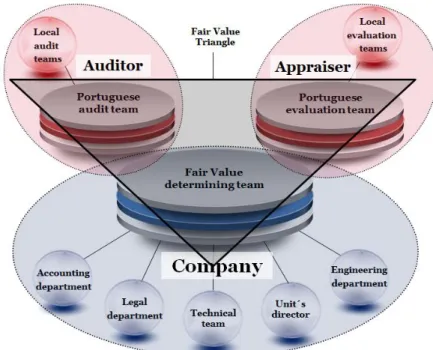
The process of estimating lands and buildings fair value thus emerged as more complex than the "triangle" initially anticipated. The ex-ante theoretical framework proved to be simplistic and lacking organizational granularity, given the unforeseen diversity of actors – typically, collective and individual actors within the collective actors initially identified – that influence and need to be considered to understand the process of constructing fair value. These actors may be more or less numerous, depending on whether Desktop or in loco appraisal is at stake, as shown in Figure 1.
Figure 1 - Key and Secondary Actors Network in the Fair Value Determination Process
Source: Developed by the authors
For simplicity, the Portuguese audit team, the Portuguese appraisal team and TechnoCorp’s fair value measurement team will be referred to as "key actors", the others being "secondary actors". The secondary actors had two major roles, as described below, to support key actors to achieve their goals and interests and to help them to mitigate any limitation.
Engineering/Maintenance Department – in both in loco and desktop appraisal, it helps the appraiser to better understand the characteristics of the asset, reducing information asymmetry between the appraiser and the company. TechnoCorp’s employees belonging to this department also assist the appraisal team in verifying the land areas (in in loco appraisal) and in other technical aspects that may help the appraiser in determining the asset’s market value.
Technical team –it stated to the auditor the maintenance conditions of the buildings and other constructions not physically inspected by the appraiser, as well as the, non-existence of any abnormal deterioration. This was only applicable for items appraised on desktop basis and specifically for the actor, auditor, as highlighted by the Technical Director. The
statement issued by the TechnoCorp’s technical team was discussed and reviewed with its Technical Director. The technical team only participates in the process regarding buildings and equipment, since depreciation allowances for physical deterioration are only applicable to those assets and not to land. The technical team based its statement on physical verifications of the assets by plant employees, in order to confirm before the type of construction (simple / complex), the building areas and configurations depicted in the maps and drawings, and finally the deterioration level.
Unit’s director – in Desktop Appraisal, it confirms to the technical team the maintenance status of the unit’s buildings; and in both in loco and Desktop Appraisal, it ensures that the assets inventory is reconciled with what physically exists, thus a guidance with the assets to be appraised for the appraisal and linked to the financial reporting for the auditor
Accounting Department – in both in loco and desktop appraisals, it provides the appraiser with the accounting inventory duly reconciled by the unit’s director and for desktop appraisals information about acquisitions and disposals / write-offs occurred since the last in loco appraisal.
Legal Department – provides the appraiser (in in loco Appraisal) and the technical team (in desktop appraisal) land official records to confirm ownership.
Local audit teams – in desktop appraisal, they confirm to the Portuguese audit team the normal wear of buildings, as stated by the Technical team.
Local appraisal teams – in both in loco and desktop appraisal, they help the appraiser and the company to tackle the time and cost problems due to geographical distance. The appraiser has local valuation teams to visit and determine each operating unit fair value, but that are always coordinated by the same responsible in Portugal to ensure knowledge accumulation on valuations carried out. .The field work was carried out by these local teams, usually two or three people accompanied by TechnoCorp’s plant employees, typically belonging to the area of maintenance and engineering. In in loco appraisals, plan drawing is compared with the one available in Google Maps, another non- human actor. These teams also tested randomly measurements to scale at some sites in order to ensure the accuracy of the plants scales.
As described above, it should be noted that the network of actors has very complex paths and connections and hybrid actants: the same secondary actor can simultaneously help more than one main actor, and can help not only to achieve the objectives, but also to reduce the limitations. So those actors might not be conceived as fixed actants in the network.
Interests, constraints and solutions of each main actor
The main actors have a common goal (fair value calculation), but each has its own motivations and a set of constraints that might hamper the achievement of that goal. Table 2 reports the details of such interests, constraints and limitations for each key actor, the preparer, the auditor and the appraiser. As the other secondary actors depend upon the key actors, we have not displayed their interest and constraints.
Table 2 – Key Actors’ Interests, Constraints and Solutions in the Fair Value Determination Process
Company Interests Preparation of financial information in accordance with accounting principles at reporting date;
Determination of fair value of lands and buildings, assets acquired in a business concentration
Constraints and
solutions
Existence of IAS / IFRS accounting rules
Cost associated with physical visits to various factories Independence of the external appraiser to be ensured
Auditor Interests Validate adequacy of the technique, premise and scope approach and the value determined by the appraiser, particularly when the appraiser does not assume responsibility on issues related with physical conditions and maintenance. Ensure that the company's financial information is true and
presents a fair view of its financial position wit accounting principles.
Constraints and
solutions
Many auditors consider the audit as a commodity, with partners having objectives to meet, customers to serve, proposals to do, businesses more and more lucrative. The auditors behavior is based on the balance between the marginal cost and marginal benefit, i.e. in reducing the likelihood of an unfavorable litigation outcome against the auditor (Machado de Almeida, 2014)
auditimpacting the social auditor's behavior (Machado de Almeida, 2014).
Increased significance of qualitative materiality, also based on litigation contingencies.
Reconciliation between the accounting inventory and valuation reports
Appraiser Interests Increase the subject properties to be appraised. Constraints
and solutions
IVS determine the valuation rules.
There is an information asymmetry between the appraiser and the company: the valuation process depends on a number of secondary actors (mostly, internal departments of the company) and the information provided by them is often outdated
Ambiguities regarding assets classification
No proper quantification of a value is possible without it being "singled out" or ring-fenced (Callon and Minuesa, 2003). So, facing some ambiguities associated with of the determination ofsome parameters might be an issue that deserves special attention from the key actors in the process of determining fair value. Throughout the fair value determination process in the case company, such ambiguities arose, in particular regarding buildings and other constructions. The split between buildings and equipment is particularly relevant for determining the accounting rule and valuation technique. However, that identification might a very complex issue, although being duly defined in the IVS what should be considered as part of the building and what should not. In general, if a component is constructed together with the the building and if its removal leads to its destruction, it should be considered part of the building. In the case company, a classification issue on an automated warehouse split was reported during the interview with the accounting director After a technical discussion between the appraiser and the engineering department, these actors have concluded that the building’s fair value should not include the value of the automated structure. This technical decision was not discussed with the auditor.
The fair value as "socially constructed value" and based on consensus
As noted during the interview with the Accounting Director and reported in this paper, before the issuance of the final report, there are several interactions between the company, the appraiser and the auditor. The major discussions held by the actors were related to the valuation framework and technical valuation matters, some of them previously reported. The valuation technique, premise and scope are based on a consensus, being the first one between the appraiser and the auditor and the two other between the company and the auditor. As highlighted in the interview with the auditor, the appraiser determines not only the final price, but also the range of the land’s square meter prices and construction costs, which are accepted by the auditor based on appraiser’s expertise and reasonableness of prices indicated. At the end, regardless of the adopted approach, the assets valuation process, involved the issuance of a draft valuation report, checked with the engagement letter signed by the company by the appraiser. The purpose of comparing the two documents is to verify that all terms detailed in the proposal have been retained in the report. The draft valuation report was also reviewed by the appraisal supervisors in order to ensure that the structure of the report complied with the valuation standards requirements and was in line with customer expectations. The draft report was also reviewed by the company in order to confirm the premise used and the description of the appraised items. As stated before, the auditor needed to have reconciliation between those items and the accounting inventories.. The auditor also received the draft report and checked all the valuation assumptions previously agreed with the appraiser..
After the review by the company and the auditor, the appraiser issued the signed version.. The fair value indicated in the report was finally accepted, either by the company or by the auditor without any further discussion.
5.3. The “Fair Value” construction process
As mentioned earlier, the second type of fair value, "fair value" is determined solely for impairment testing and to be compared to the asset’s recoverable amount, which is the higher of its fair value (IFRS 13 fair value) or its value in use. This “fair value” is recorded in the accounts only if it is lower than historical cost (carrying amount). As noted during the
interview with the Accounting Director, the company determines the "fair value" for testing the impairment of goodwill (tests performed annually) and operating tangible assets (tests only performed when some impairment indicators arose). The fair value of the net assets acquired in a business combination, that is the basis for goodwill calculation was determined by an independent external appraiser, not the same than the one that had estimated the market value of the lands and buildings. For business combination process, fair value is constructed as discussed in section 5.2. TechnoCorp’s disclosures do not clarify the actors involved in determining in this process, so it was assumed that the “Fair Value Triangle” initially defined was also applicable.
The actors with central role in the construction process of the "fair value"
That meeting with the Accounting Director also reveals that the “fair value” was not based upon an external appraisal opinion, but on a discounted cash flow model designed by the company and agreed with the auditor. Value incorporating specific inputs (its value in use) was estimated by the company to be higher than the fair value. Based on the information received from the Director, external appraisers are only intended to be used only in the next year. As such, at Technocorp, the initial model of the human and non-human actors involved in the process had a different composition and the so-called "Fair Value’s Triangle" became a line across the preparer and the auditor.
Development of the impairment tests and the Business plan
During the meeting with the Management Control Director, we were informed that the discounted cash flows model was developed in-house and covered a time period of 8 years. This model used as inputs the Business plan (BP) of the company, excluding the effects of, growth forecasts and planned investments for future periods. The study of the preparation of the BP and the “adjustment” process to the discounted cash-flows model was developed during the meeting with the Director of Strategic Planning and is now detailed.
The BP is an important tool for the strategic planning process of the company. Based on the micro and macroeconomic trends data available on query statistics databases of each geographical segment, the Management Control team develops a draft BP which is then discussed with top management. Although supported by controllers from each country and
Management Control Director, the CFO of the case company is the main actor in the process of constructing the BP. The BP is later on approved by the Executive Committee before being submitted and approved by the Board of Directors. This process might take a few months.
Moreover, we also noted that BP is prepared by business unit and by region. However, for impairment testing, the management control team had to disaggregate by corporate unit as requested by the auditor. In the BP preparation process the company has discretionary power, as there is no intervention of the auditor at this stage. However, the reasonableness of the data and assumptions introduced in the discounted cash-flows model and the “adjustments”, despite being selected by the company, were discussed and validated by the auditor. Assumptions deemed to be too aggressive by the auditor were reformulated until an agreement was reached with that powerful actor.
Adjustments to Business Plan
As the case company is managed by business unit instead of corporate unit, there was a need to adapt the cash flow model per corporate unit. In other words, it was prepared because it was requested by the auditor The information to be prepared per corporate unit led to a process of "adjustment" of the BP included in the cash-flows model, which implied selecting carefully and extracting the necessary data for calculating the value in use, as required by the accounting policies, from the strategic BP. Although not technically complicated, this “adjustment" process was time consuming, more or less depending on the business branches. From the above exposed, we concluded that the auditor had a central role in developing the model, by requiring an adjusted output. On the other hand, impairment tests were prepared for the units for which the case company had identified some impairment indicators, but also for other units required by the auditor. As such, also for this reason, the centrality of the auditor should be highlighted.
Actors and unforeseen and not predetermined connections on the line of fair value Summarizing, "fair value" construction was confined to the interaction between two main actors, the company and the auditor. To obtain audit comfort, the auditor had validated the most significant business assumptions for the future included in the discounted cash-flows
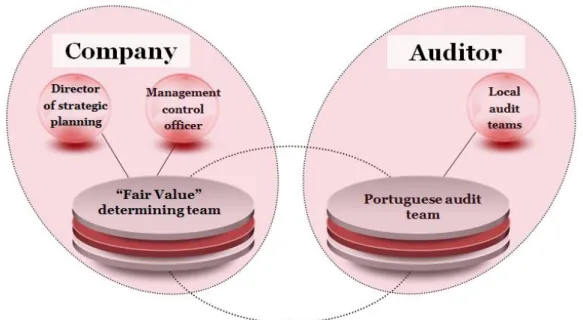
model, namely the growth rate of turnover, the margins evolution and the discount rate, .For a better understanding of the “fair value” process, the actors network has been represented in the Figure 2.
Figure 2 – Network of Primary and Secondary Actors in the Determination Process of "Fair Value"
Source: Developed by the authors The mentioned actors have the following functions:
Director of Strategic Planning – this secondary actor is responsible for the preparation of the Business plan and assumptions used.
Management Control Officer– the main role of this actor is the preparation of the discounted cash flows models adjusted per corporate unit and by the future investments Main business assumptions are discussed in first instance with this actor. In case of disagreement with the auditor, there is a specific interaction between the auditor and the strategic planning department in order to conclude about the reasonableness of those assumptions.
Local audit teams – Local audit teams report to the Portuguese audit team any indicator of impairment in the units abroad and support the central team to validate the assumptions.
Interests, constraints and solutions of each main actor
It should be noted that the main actors have a common goal (determining the "fair value" necessary only for the impairment calculation purposes), but each has its own motivations and interests. The process of determining the "fair value" has a set of inherent constraints and limitations that hinder achieving the objectives of all actors, as shown in Table 3.
Table 3 – Key Actors’ Interests, Constraints and Solutions in the “Fair Value” Determination Process
Preparer Interests Preparation of financial information in accordance with accounting principles at reporting date;
Constraints and
solutions
IAS / IFRS rules limit from the beginning the determination procedures in the "fair value";
Complexity of the process of preparing the impairment tests, needs to "adjust" the business plan into the discounted cash-flows model.
Auditor Interests Validate the business assumptions used in the discounted cash-flows model; ensure that the company's financial information represents in a true and fair view its financial position.
Constraints and
solutions
Resistance by the company to disclose the business assumptions due to confidentiality issues (confirmed at the meeting with the auditor).
Critical factors of the discounted cash-flows model are mainly based in the validation of the business-assumptions model and the discount rate. Those are also the main points of conflict between the preparer and the auditor.
5.4 Fair value and "Fair Value" - What are the differences?
Although there are some similarities in concepts and underlying assumptions, the processes of quantifying the two types of fair value differ with regard to their underlying objectives, their models of determination, the network of actors involved and the conflicts between these actors and their power.