Diversity, infection
patterns and
host-parasite associations
of apicomplexan
parasites in reptiles
João Pedro Moura da Costa Maia
Tese de Doutoramento apresentada à
Faculdade de Ciências da Universidade do Porto
Biologia
2015
Diversity, infection patterns and
host-parasite associations of
apicomplexan parasites in reptiles
D
Diversity, infection
patterns and
host-parasite associations
of apicomplexan
parasites in reptiles
João Pedro Moura da Costa Maia
Programa Doutoral em Biodiversidade, Genética e Evolução
Departamento de Biologia
Faculdade de Ciências da Universidade do Porto 2015
Orientador
David James Harris, Professor Associado Convidado e Investigador, Departamento de Biologia, Universidade do Porto
Coorientadora
Elena Goméz-Díaz, Postdoctoral Researcher, Department of Biology, Emory University
Nota Prévia
Na elaboração desta tese, e nos termos do número 2 do Artigo 4º do Regulamento Geral dos Terceiros Ciclos de Estudos da Universidade do Porto e do Artigo 31º do Decreto-Lei 74/2006, de 24 de Março, com a nova redação introduzida pelo Decreto-Lei 230/2009, de 14 de Setembro, foi efetuado o aproveitamento total de um conjunto coerente de trabalhos de investigação já publicados ou submetidos para publicação em revistas internacionais indexadas e com arbitragem científica, os quais integram alguns dos capítulos da presente tese. Tendo em conta que os referidos trabalhos foram realizados com a colaboração de outros autores, o candidato esclarece que, em todos eles, participou ativamente na sua conceção, na obtenção, análise e discussão de resultados, bem como na elaboração da sua forma publicada. A Faculdade de Ciências da Universidade do Porto foi a instituição de origem do candidato, tendo o trabalho sido realizado sob orientação do Doutor David James Harris, Professor Associado Convidado no Departamento de Biologia da Faculdade de Ciências da Universidade do Porto e Investigador Principal do Centro de Investigação em Biodiversidade e Recursos Genéticos (CIBIO-InBio). A instituição de acolhimento foi o Instituto de Biología Evolutiva do Consejo Superior de Investigaciones Científicas – Universitat Pompeu Fabra (IBE-CSIC-UPF), sob a coorientação da Investigadora Doutora Elena Goméz-Díaz e do Professor Doutor Salvador Carranza. O trabalho laboratorial foi realizado no CIBIO-InBio e no IBE-CSIC-UPF.
Este trabalho foi apoiado pela Fundação para a Ciência e Tecnologia (FCT) através da atribuição da bolsa de doutoramento (SFRH/BD/74305/2010).
Acknowledgments
First, I want to thank my family for all their support throughout my young scientific career. To Telma Azevedo for being by my side for all this time and for supporting me despite my long absences. To my mother and father for hearing and helping me. To Joana Maia and Pedro Lamas not only for advising me but also for their help with technical issues. Thank you all for your support during more difficult times.
I would like to thank my supervisor D. James Harris and co-supervisors Elena Goméz-Díaz and Salvador Carranza (who is not an official co-supervisor but acted as such) for having believed in my potential as a young researcher, for their tutoring and for all their support. To James for adopting me in his team, for his vision and for opening the doors of research for me, as well as for giving me the chance to participate in extraordinary and transformative fieldtrips. Also for his friendship, openness and countless, relaxing laughs. To Elena for her scientific reasoning, patience, companionship and for bringing a better perspective and focus to the research objectives. To Salvi for his guidance, friendship, kindness at hosting me and always welcoming me at IBE in Barcelona, and for the timing and crucial conversations we had.
I would like to thank all my colleagues in CIBIO-InBio and CTM. To Anna Perera and Fátima Jorge for being my adopted mothers since my early days in CIBIO. To Daniele Salvi for being my mafioso older brother. To Antigoni Kaliontzopoulou for her support, patience and help with statistics, which have allowed me to be more comfortable playing with R. To my ecology lab mates Fátima Jorge, Pedro Sousa, Sonia Ferreira, Iolanda Rocha, Isabel Damas, Pedro Coelho, Daniela Rosado, Isabel Tavares and more recently, Kevin Mulder, Henrique Estrela, Diogo Silveira, Amanda Sousa, Victoria Litsi (pie), Walter Cocca and Adriana Hiznán, for all the laughter. To my aquarium mates Teresa Silva, Ricardo Castilho, Mário Cunha, Liliana Farelo, Duarte Gonçalves, Joana Mendes, Beatriz Tomé, Rita Monteiro, Sónia Rosenbom, Margarida Lopes, Patrícia Pereira, Fabiana Neves, Soraia Barbosa, Vânia Costa, Fernando Seixas and Tiago Neves, for some unique fishy moments. Especially to Iolanda Rocha and Teresa Silva for the philosophical conversations we had. To Tuliana Brunes and Cândida Vale for their help with faculty paperwork. To the occasional genetic lab mates to the sound of “great” music Sara Lado, Nina Seren and Catarina Moreira. To Sara João, Sofia Mourão, Susana Lopes, Diana Castro, Sandra Afonso and Patrícia Ribeiro for their help with lab issues. To everyone that helped me on fieldtrips: Mafalda Barata, Filipa Sampaio, Iolanda Rocha, Luís Machado, Daniele Salvi, Isabel Damas, Beatriz Tomé, Joana Mendes, Anna Perera, Fátima Jorge, Antigoni Kaliontzopoulou, Miguel Carretero, Verónica Gomes, Henrique Estrela, Isabel Tavares, Manuel Curto, Fernando Martinez Freiria, Jorge Tavares and José Babo. To Francisco Álvares, Catarina Rato, Raquel Xavier, Pedro Tarroso, Guillermo Velo-Antón, Angelica Crottini, Enrique Muñoz, José Carlos Brito, Fernando Martinez Freiria, Zbyszek Boratyński, Sara Rocha and Miguel Fonseca for all the good times in CIBIO. To Sara Lemos Ferreira, Sandra Rodrigues, Maria
Sant’Ana, Sr. Bernardino and Teresa for their kindness and for always being ready to help. To Prof. Nuno Ferrand, Prof. Paulo Célio and Prof. Paulo Alexandrino for allowing me to integrate CIBIO-InBio research centre. Finally, to everyone that joined the francesinha occasional gatherings and the great volleyball matches!
I would also like to thank all my colleagues in IBE-CSIC. To Margarita Metallinou for her support and initial tutoring at IBE, whose kindness and friendship will always be remembered. To Joana Mendes, Tiago Carvalho, Duarte Gonçalves, Luís Machado, Rui Faria, Carolina Pereira and Raquel Vasconcelos for being my portuguese mates in Barcelona. To Maria-Dolors Piulachs for always being receptive during all my visits to IBE and for supporting me in the quantitative PCR part of the laboratory work. To Blanca Álvarez, Rita Arias, Ana Pérez and Emiliano Gonzalez for their administrative support during my stays in IBE. To David Garcia, Marc Simo, Karin Tamar, Santiago Montero, Helena Vizán, Gissela Mendonza, Amparo Hidalgo, Rocío Rordríguez, Anabela Cardoso, Jesus Goméz, Marina Querejeta, Joan Garcia-Porta, Cris, Cris De Miguel, Cristina Olivera, Jesus Lozano, Moises, Carlos Vasquez, Nashwa, Carol, Helena Parra and Nuria for all the good times we spent in Barcelona. To the kind technicians at Genòmica in PRBB Laura, Nuria, and Roger. To everyone with whom I have had the pleasure of playing volleyball with, it was amazing to have the opportunity to go play some intense matches while PCRs were running. And finally, to the sushi mates, we probably ended with all salmon stock!
Last but not least, I would like to thank Fundação para a Ciência e Tecnologia (FCT) for granting a PhD scholarship (SFRH/BD/74305/2010), under the Programa Operacional Potencial Humano – Quadro de Referência Estratégico Nacional funds (POPH-QREN) from the European Social Fund (ESF) and Portuguese Ministério da Educação e Ciência. As well as the “Chicago Herpetological Society” for assisting in fieldwork expenses for one of the trips to Morocco and the “Malaria Research Coordination Network – Malaria RCN” for covering travel expenses to the congress on haemosporidians in Lithuania, which allowed me to meet some of the most important researchers in the field and to do great networking. Thanks to Vaidas Palinauskas, Gregory Karadjian and Rodrigo Megía-Palma for continuing to follow up our work. And also to the colleagues in ICBAS and Milan, Augusto Faustino, Ricardo Marcos, Stefania Lauzi, Camilla Luzzago, Pierre and Carol, who allowed me to experience another laboratory in Lodi and to meet very kind colleagues.
What lies in our power to do, it lies in our power not to do. Aristotle (philosopher)
Diversity, infection patterns and host-parasite associations
of apicomplexan parasites in reptiles
João Pedro Moura da Costa Maia
Faculdade de Ciências, Universidade do Porto – CIBIO-InBio / IBE-CSIC-UPF
___________________________________________________________________________________________________________
Abstract
Parasites may account for half of the total number of species in the world but only a fraction of the diversity within these organisms has been detected and fewer described. Parasites have obligate relationships with their hosts and for this reason are good models to study the ecological and evolutionary processes that drive diversification and speciation. In addition, parasites have implications for conservation as these may cause adverse effects and affect host fitness, playing a crucial role at the individual, population and ecosystem levels.
Apicomplexa is one of the most important parasite phylum composed almost excusably of obligate intracellular parasites, yet potentially one of the least understood. Within Apicomplexa, three main groups of parasites concern this thesis, the hemogregarines (Adeleorina), the haemosporidians (Haemosporida) and the eimeriorinids (Eimeriorina). These parasites differ in their lifecycle, life-history traits and ecology of transmission, which makes them an ideal group to study host-parasite evolutionary phenomena. What these have in common is the lack of understanding of the real diversity and phylogenetic relationships within these groups. In particular, the study of these groups in reptiles has been scarce but their importance is increasing in recent years with the growing use of molecular tools to estimate parasite distribution, diversity and phylogenetic relationships.
Genetic information can be obtained using molecular tools and this information can be assessed through phylogenetic analyses. These analyses are thus of great importance in parasitology as these allow the study of diversity, coevolutionary and ecological processes of these organisms in relation to their hosts. Nonetheless, different methodologies can have different sensitivities and performances at estimating parasite infection parameters and may result in erroneous biological inferences of these estimates, which are a first step towards understanding host-parasite associations and specificity.
Therefore, a chapter of this thesis aimed to compare the performance of different biological samples and extraction protocols on the estimation of biologically relevant parasite infection parameters. The findings of this chapter showed that different protocols yield significantly different estimations of parasite infection. Therefore, the estimation of parasite infection parameters should be conducted using complementary approaches to validate the significance of the results obtained. For this reason, the limitations of and recommendations for the various methodologies, as well as proposed lines of work, are discussed.
One of the main objectives of this thesis was to contribute to the knowledge on the diversity, phylogenetic relationships and host-specificity of apicomplexan parasites in reptile hosts.
Throughout various chapters, this objective has been achieved at different levels. First, the species
Hepatozoon domerguei (Adeleorina), a known hemogregarine of reptiles from Madagascar, has
been genetically characterized and included in a phylogenetic framework for the first time. This allowed to corroborate prey-predator transmission that had been previously reported in experimental studies for this parasite species. Second, a new Hepatozoon species exclusively found in reptiles from Oman has been described based on morphological and genetic distinctive characters in comparison with available information (proposed name Hepatozoon omanensis n. sp.). The principal host species is endemic to Oman, which could be an indication that this parasite is also endemic to this region. This parasite species might be also of interest for studying parasite adaptation in the future since it is found in a wide range of other reptile species in this region. Third, unexpectedly high diversity has been observed in a molecular screen of various reptile species with different geographical ranges across Oman. In this study, a previously unreported lineage that diverged by more than 5% for the 18S rRNA gene from the most closely published sequences has been reported. Fourth, genetically distinct lankesterellids (Eimeriorina) have been detected in reptiles and amphibians from Oman. These two latter points could represent new taxonomic entities and warrant further investigation of the developmental stages and vectors of these parasites. Fifth, a possible new Haemocystidium (Haemosporida) parasite species has been detected in two gecko species from Oman, also highlighting the importance of screening wild hosts from remote regions. And sixth, unique hemogregarine lineages have been found in two lacertid lizard species living in sympatry in Oukaimeden (Morocco). This could be an indication of host-specificity and specialization, as well as a possible explanation for the variation of hemogregarine intensity levels observed in these hosts.
Furthermore, in an effort to compile the recent effort that has been done to determine the diversity of hemogregarines (using the 18S rRNA gene) and haemosporidians (using the cytochrome b gene), a chapter of this thesis was dedicated to an overview of the genetic information available on public databases for these parasite groups. In accordance with recent studies, the taxonomic inconsistencies of present taxonomy have been evidenced and discussed in the light of the diversity and relationships obtained. In this chapter, common problems such as parasite taxon sampling and host sampling bias have also been addressed and recommendations for future studies are provided. An additional objective of this thesis was to study host-parasite associations and elucidate transmission dynamics across different host taxa. By analysing parasite distributions and the host range of particular hemogregarine lineages in wild hosts (i.e. lizards and rodents as potential prey, and snakes and canids as potential predators) occasional occurrence of prey-predator transmission has been corroborated. These findings could either be an indication of low host-specificity of some hemogregarine lineages and/or the occasional accidental transmission to “dead-end” hosts that do not transmit the infection further. In either case, these events may be of importance for increasing parasite host range and leading to parasite diversification because could increase the probability of occurrence of host shifts and thus should be further investigated.
Finally, this thesis also aimed to study hemogregarine infection patterns in different scenarios in order to disentangle the factors that may influence these patterns. These scenarios were: i) several related and unrelated reptile host species; ii) two closely related lizard species living in sympatry across different time points; and iii) two related and one unrelated lizard species living in sympatry across different time points. Infection patterns were generally maintained over time between species and sexes in both systems. This shows that that host unique biological characteristics and ecological preferences may be major drivers of the distribution of these parasites.
All in all, the studies presented in this thesis have shown the usefulness of conducting parasite molecular surveys in wild hosts from remote regions, as well as the need for adopting integrative and complementary approaches in the study of these parasite groups. The study of asexual and developmental stages on the different hosts of these heteroxenous parasites in combination with molecular characterization using multiple genes and accurate estimation of infection patterns, could revolutionize this field and provide answers to the taxonomic incongruences evidenced.
Key-words: phylogeny; taxonomy; incongruence; systematic revision; diversity; new species; host-specificity; host-parasite associations; host-parasite interactions; temporal; spatial; seasonality; evolutionary history; differentiation; specialization; lizard; lacertid; gecko; hemoparasite; blood parasite; cyt b gene; 18S rRNA gene; microscopy; morphology; molecular screen; detection; infection; quantification; absolute quantification; PCR; qPCR; prevalence; intensity; infection status; infection patterns; abundance; prey predator transmission; host factors; ecological factors; sympatry; host relatedness; phylogeography; Oman; Morocco; Madagascar; North Africa; Western Mediterranean; Portugal; Spain; Adeleorina; Haemosporida; Eimeriorina; hemogregarine; haemosporidian; eimeriorinid; Proteromonas; Hepatozoon; Bartazoon; Karyolysus; Haemoproteus;
Haemocystidium; Lankesterella; Schellackia; Sarcocystis; Hepatozoon domerguei; filarial
Resumo
Estima-se que os parasitas representem cerca de metade do número total de espécies no mundo, no entanto apenas uma pequena parte da sua diversidade tem sido documentada. Os parasitas têm uma relação obrigatória para com os seus hospedeiros e por esta razão representam modelos ideias para o estudo de processos evolutivos e ecológicos que despoletam a diversidade e especiação dos parasitas e hospedeiros. Além disso, os parasitas têm implicações a nível da conservação de espécies podendo provocar efeitos adversos nos hospedeiros e afetar a sua aptidão, desempenhando desta forma um papel crucial a nível individual, populacional e do ecossistema.
Apicomplexa representa um dos mais importantes filos de parasitas e é composto quase exclusivamente por parasitas intracelulares obrigatórios, todavia é um dos menos compreendidos. Dentro do Apicomplexa, três grupos principais de parasitas são relevantes para esta tese, as hemogregarinas (Adeleorina), Haemosporida e Eimeriorina. Estes parasitas diferem no seu ciclo de vida, características evolutivas e ecologia de transmissão, o que os torna num grupo ideal para o estudo de processos de evolução entre parasita-hospedeiro. O que eles têm em comum é um défice na compreensão da sua verdadeira diversidade e relações filogenéticas dentro destes grupos. Em particular, o estudo destes grupos em répteis é escasso, mas a sua importância tem vindo a crescer recentemente com o aumento no uso de métodos moleculares para estimar a distribuição, diversidade e relações filogenéticas destes parasitas.
Informação genética pode ser obtida através de métodos moleculares e esta informação pode ser comparada através de análises filogenéticas. Desta forma, estas análises são de grande interesse no campo da parasitologia porque permitem o estudo da diversidade, coevolução e processos ecológicos destes organismos em relação aos seus hospedeiros. No entanto, diferentes metodologias podem ter diferente sensibilidade e exatidão na estimativa de parâmetros de infeção de parasitas, podendo resultar em inferências biológicas erróneas destas estimativas, as quais representam um primeiro passo para a compreensão da especificidade dos parasitas e interações parasita-hospedeiro.
Deste modo, um capítulo desta tese teve como objetivo a comparação do desempenho entre vários protocolos e tipos de amostras biológicas na estimativa de parâmetros de infeção dos parasitas. Os resultados deste capítulo mostraram que diferentes protocolos produzem estimativas de infeção significativamente diferentes. Assim, a estimativa destes parâmetros deve ser baseada no uso de abordagens complementares para que seja possível validar a significância dos resultados obtidos. Por esta razão, as limitações e recomendações para os vários tipos de metodologias, bem como possíveis linhas de trabalho, são discutidas.
Um dos principais objetivos desta tese foi contribuir para o conhecimento da diversidade, relações filogenéticas e da especificidade dos parasitas apicomplexos em répteis. Ao longo de
vários capítulos, este objetivo foi alcançado em diferentes níveis. Primeiro, a espécie Hepatozoon
domerguei, a qual é conhecida de répteis em Madagáscar, foi pela primeira vez caracterizada
geneticamente e colocada num contexto filogenético. Isto permitiu corroborar a ocorrência de transmissão presa-predador que havia sido reportado para esta espécie através de estudos experimentais. Segundo, uma nova espécie de Hepatozoon, detetada exclusivamente em répteis de Oman foi descrita com base em carateres morfológicos e genéticos distintivos em comparação com informação publicada (nome proposto Hepatozoon omanensis n. sp.). O hospedeiro principal é endémico de Oman, o que pode ser uma indicação que esta espécie seja também endémica desta região. Esta espécie pode também ser de interesse para estudos futuros relacionados com adaptação de parasitas, uma vez que foi encontrada em várias espécies de répteis desta região. Terceiro, durante um rastreio molecular de várias espécies de répteis de várias áreas geográficas de Oman foi inesperadamente encontrada uma elevada diversidade. Neste estudo, foi reportada uma linhagem que nunca tinha sido reportada, a qual diverge das sequências mais relacionadas publicadas em mais de 5% para o gene 18S rRNA. Quarto, membros da família Lankesterellidae distintos geneticamente de dados publicados foram também detetados em répteis e anfíbios desta região. Estes últimos dois pontos podem representar novas entidades taxonómicas e merecem mais investigação, nomeadamente o estudo dos seus vetores e estágios de desenvolvimento. Quinto, uma possível nova espécie de Haemocystidium foi detetada em duas espécies de osgas de Oman, evidenciando também a importância do rastreio de animais selvagens de regiões remotas. E sexto, linhagens únicas de hemogregarines foram encontradas em duas especies de lacertídeos que coexistem em Oukaimeden (Marrocos). Isto pode ser uma indicação de especificidade e especialização do parasita, bem como uma possível explicação para a variação dos níveis de intensidade de hemogregarinas encontradas entre estas duas espécies.
Além disto, de forma a compilar o esforço conduzido recentemente na investigação da diversidade das hemogregarinas (para o gene 18S rRNA) e Haemosporida (para o gene citocromo
b), um capítulo desta tese foi dedicado a uma sinopse da informação genética disponível em bases
de dados públicas para estes grupos de parasitas. Em concordância com estudos anteriores, os resultados deste capítulo evidenciam as incongruências da atual taxonomia, que são discutidas face à diversidade e relações encontradas. Neste capítulo, problemas comuns tais como obtenção de amostragem de parasitas e desequilíbrios na amostragem de hospedeiros foram assinaladas e recomendações para estudos futuros foram nomeadas.
Um objetivo adicional desta tese foi o estudo das associações parasita-hospedeiro e elucidar a dinâmica de transmissão de parasitas através de diferentes grupos de hospedeiros. Ao analisar a distribuição de parasitas e a gama de espécies hospedeiras de certas linhagens de hemogregarinas em hospedeiros selvagens (isto é, lagartos e roedores como possíveis presas, e cobras e canídeos como possíveis predadores) a ocorrência ocasional de transmissão presa-predador foi corroborada. Estes resultados podem indicar por um lado que algumas destas linhagens de hemogregarinas
possuem uma baixa especificidade e/ou por outro lado a transmissão ocasional para hospedeiros “sem-saída” que não transmitem o parasita para outros hospedeiros. Em qualquer destes casos, estas ocorrências podem ter um papel importante em aumentar a gama de hospedeiros de um parasita e podem desencadear a diferenciação do parasita, por aumentarem a probabilidade da ocorrência de trocas de hospedeiros, devendo assim ser estudados em mais detalhe.
Por fim, esta tese teve também como objetivo o estudo dos padrões de infeção das hemogregarinas em diferentes cenários de modo a discernir os fatores que possam influenciar estes padrões. Estes cenários foram: i) várias espécies de répteis relacionadas e não relacionadas; ii) vários intervalos temporais em duas espécies de lagartos relacionadas que coexistem numa região; e iii) vários intervalos temporais em duas espécies de lagartos relacionadas e uma não relacionada que coexistem numa região. Os padrões de infeção entre as espécies e sexos dos hospedeiros mantiveram-se constantes de uma forma geral nos intervalos estudados em ambos os sistemas. Isto demonstra que características biológicas únicas dos hospedeiros e as suas preferências ecológicas podem ser impulsionadores importantes da distribuição destes parasitas.
Em suma, os estudos apresentados nesta tese demonstraram a utilidade de realizar rastreios moleculares de parasitas em hospedeiros selvagens de regiões remotas, bem como a necessidade de adotar abordagens complementares e integrativas no estudo destes grupos de parasitas. O estudo de estágios assexuados e de desenvolvimento em diferentes hospedeiros destes parasitas conjugado com a caracterização molecular usando vários genes e uma estimativa exata dos padrões de infeção, podem revolucionar o campo e providenciar as respostas para as incongruências taxonómicas evidenciadas.
Palavras-chave: filogenia; taxonomia; incongruência; revisão sistemática; diversidade; nova espécie; especificidade hospedeiro; associações hospedeiro; interações parasita-hospedeiro; temporal; espacial; sazonalidade; história evolutiva; diferenciação; especialização; lagarto; lacertídeo; gecko; hemoparasita; parasita sanguíneo; gene cyt b; gene 18S rRNA; microscopia; morfologia; rastreio molecular; deteção; infeção; quantificação; quantificação absoluta; PCR; qPCR; prevalência; intensidade; estatuto de infeção; padrão de infeção; abundância; transmissão presa-predador; fatores dos hospedeiros; fatores ecológicos; simpatria; semelhança entre hospedeiros; filogeografia; Oman; Marrocos; Madagáscar; Norte de África; Mediterrâneo; Portugal; Espanha; Adeleorina; Haemosporida; Eimeriorina; hemogregarina; hematozoa;
Proteromonas; Hepatozoon; Bartazoon; Karyolysus; Haemoproteus; Haemocystidium; Lankesterella; Schellackia; Sarcocystis; Hepatozoon domerguei; filária; nematode; Foleyella furcata; Hepatozoon omanensis; vetor; transmissão; genbank.
TABLE OF CONTENTS
1 GENERAL INTRODUCTION ... 1
1.1 Importance of parasites to wildlife and ecosystems ... 3
1.1.1 Biodiversity of parasites... 4
1.1.1.1 Parasite differentiation and speciation ... 4
1.1.1.2 Cryptic parasite diversity ... 5
1.2 Host-spectrum and host-specificity in parasites ... 7
1.2.1 Host relatedness and parasite distributions ... 8
1.2.2 Coevolutionary patterns in host-parasite associations ... 10
1.2.2.1 Sympatric host species ... 10
1.3 Disease ecology and transmission dynamics ... 11
1.3.1 Transmission dynamics ... 12
1.3.2 Host factors ... 15
1.3.2.1 Vertebrate host immunity ... 15
1.3.2.2 Vector competence ... 17
1.4 Parasite phylogeography ... 18
1.5 Effects of parasites on their hosts ... 20
1.5.1 Effects at individual and population level ... 21
1.6 The Phylum Apicomplexa ... 22
1.6.1 Hemogregarines (Adeleorina) ... 24
1.6.1.1 Diversity and phylogeny ... 24
1.6.1.2 Lifecycle ... 27
1.6.1.3 Ecology and transmission ... 29
1.6.1.4 Pathogenesis ... 31
1.6.2 Haemosporidians (Haemosporida) ... 31
1.6.2.1 Diversity and phylogeny ... 32
1.6.2.2 Lifecycle ... 36
1.6.2.3 Ecology and transmission ... 37
1.6.2.4 Pathogenesis ... 37
1.6.3 Eimeriorinids (Eimeriorina) ... 38
1.6.3.1 Diversity and phylogeny ... 38
1.6.3.2 Lifecycle and transmission ... 40
1.6.3.3 Pathogenesis ... 42
1.7 Methodologies for parasite detection and identification ... 42
1.7.1 Molecular detection ... 44
1.8 Objectives of the thesis ... 47
1.9 Outline of the thesis ... 47
1.10 References ... 49
2 CHALLENGES IN PARASITE DETECTION AND IDENTIFICATION ... 67
2.1 Article I - Apicomplexa primers amplify Proteromonas (Stramenopiles; Slopalinida; Proteromonadidae) in tissue and blood samples from lizards ... 69
2.2 Article II - A comparison of multiple methods for estimating parasitemia of Hemogregarine Hemoparasites (Apicomplexa: Adeleorina) and its application for studying infection in natural populations ... 77
3 UNCOVERING THE UNKNOWN: HEMOGREGARINE DIVERSITY AND HOST-ASSOCIATIONS IN REPTILES ... 103
3.1 Article III - Molecular survey and microscopic examination of Hepatozoon Miller, 1908 (Apicomplexa: Adeleorina) in lacertid lizards from the western Mediterranean ... 105
3.2 Article IV - Microscopic and molecular characterization of Hepatozoon domerguei and Foleyella furcata in wild endemic reptiles from Madagascar. ... 121
3.3 Article V - Description of a new hemogregarine species Hepatozoon omanensis n. sp. (Apicomplexa, Haemogregarinidae) found in reptiles from Oman ... 143
4 OVERVIEW OF THE PARASITE GENETIC INFORMATION IN PUBLIC DATABASES WITH TAXONOMIC IMPLICATIONS ... 157
4.1 Article VI - Reconstruction of the evolutionary history of Haemosporida (Apicomplexa) based on the cyt b gene with characterization of Haemocystidium in geckos (Squamata: Gekkota) from Oman ... 159
4.2 Article VII - A note on using 18S rRNA gene sequences for estimating relationships of hemogregarines (Apicomplexa, Adeleorina): current limitations and future prospects ... 173
5 HOST-PARASITE INTERACTIONS, SPATIAL AND TEMPORAL DYNAMICS OF HEMOGREGARINE INFECTIONS ... 185
5.1 Article VIII - Molecular assessment of Hepatozoon (Apicomplexa: Adeleorina) infections in wild canids and rodents from North Africa, with implications to transmission dynamics across distinct taxonomic groups ... 187
5.2 Article IX - Assessing the diversity, host-specificity, distribution and infection patterns in apicomplexan parasites of reptiles from Arabia ... 203
5.3 Article X - Temporal dynamics of hemogregarine infection in two sympatric lizard systems ... 227
6 GENERAL DISCUSSION ... 253
6.1 Challenges in parasite detection and quantification: the need for integrative analyses ... 255
6.2 Improving the knowledge on parasite diversity: the importance of screening wild hosts from remote regions ... 258
6.2.1 The importance of studying hemogregarine taxa from reptiles ... 260
6.3 Phylogenetic reconstructions and increase in taxon sampling reveal taxonomic inconsistences in apicomplexan parasite groups ... 261
6.4 Parasite infection patterns and environmental factors ... 264
6.4.1 Parasite infection patterns and Host factors ... 266
6.4.2 Host-range and transmission dynamics in hemogregarines ... 268
6.5 Concluding remarks ... 269 6.6 Future perspectives ... 271 6.7 References ... 274 GLOSSARY ... 283 APPENDICES ... 285 Article II ... 287 Article V ... 289 Article VI ... 291 Article VII ... 307 Article IX ... 328 Article X ... 337
List of Tables
Table 1-1 Classification of haemosporidians with known vertebrate hosts and vectors. ... 32 Table 2-1 Comparison between P. lacertae sequence retrieved from GenBank (U37108) together with the Apicomplexa specific primers used in this study. ... 72 Table 2-2 Prevalence and mean intensity of Hepatozoon and Eimeriorina parasites for the two lizard species analysed in this study, estimated using three different methods. ... 84 Table 2-3 False negatives for each of the three detection methods compared in this study. ... 88 Table 2-4 Prevalence and mean intensity levels of Hepatozoon and prevalence of Eimeriorina parasites using different biological sources (blood and tissue) and extraction protocols (kit and saline) on a subset of samples tested with qPCR. ... 89 Table 3-1 Summary of the samples analysed in this study. ... 110 Table 3-2 Reptile samples collected in different localities of Madagascar in 2009. ... 124 Table 3-3 Estimates of evolutionary divergence between the three haplotypes obtained in this study. ... 128 Table 3-4 Microscopy measurements of hemogregarine intracellular parasites and infected host erythrocytes under 1000x magnification. ... 130 Table 3-5 Microscopy measurements of Foleyella furcata microfilaria in Giemsa-stained blood smears under 400x magnification. ... 131 Table 3-6 Mature gamont morphological comparison between Hepatozoon omanensis n. sp. and hemogregarine species infecting lizards and snakes... 147 Table 4-1 Blood smear samples analysed for Haemosporida parasites in reptiles from Oman. .. 162 Table 4-2 Microscopy measurements of Haemosporida intracellular parasites infecting host erythrocytes under 1000x magnification. ... 167 Table 4-3 Estimates of evolutionary divergence between selected species of Haemosporida and the haplotype retrieved in this study. ... 168 Table 4-4 Overview of hemogregarine 18S rRNA gene data available on public databases based on host taxonomy and geographical location. ... 178 Table 5-1 Prevalence estimates for Hepatozoon in samples of wild canid and rodent species from North Africa. ... 192 Table 5-2 Samples analysed for apicomplexan parasites in reptiles and amphibians from Oman. ... 206 Table 5-3 Estimates of evolutionary divergence between the hemogregarine haplotypes obtained in this study. ... 211 Table 5-4 Estimates of evolutionary divergence between the Lankesterella haplotypes obtained in this study and published sequences. ... 211 Table 5-5 Host-specificity index for each hemogregarine haplotype obtained in this study. ... 215
Table 5-6 Blood samples collected at different time intervals between 2011-2013 from two lizard species living in sympatry in Moledo (Portugal) screened for hemogregarine parasites. ... 234 Table 5-7 Blood samples collected at different time intervals between 2011-2012 from three lizard species living in sympatry in Oukaimeden (Morocco) screened for hemogregarine parasites. .... 234 Table 5-8 Best models for prevalence and intensity of infection regarding temporal dynamics of hemogregarine infection in the two Podarcis species in Moledo (Portugal). ... 238 Table 5-9 Environmental variables for the two sampling locations in this study, Moledo (Portugal) and Oukaimeden (Morocco)... 240 Table 5-10 Best models for prevalence and intensity of infection regarding temporal dynamics of hemogregarine infection in the three lizard species in Oukaimeden (Morocco). ... 242
List of Figures
Figure 1-1 Macroevolutionary events that explain parasite differentiation and speciation. ... 5 Figure 1-2 Hypothesis formulation in description of new species, with a focus on cryptic diversity. . 6 Figure 1-3 Factors involved in the formation of a host spectrum. ... 7 Figure 1-4 Contribution of host phylogeny to the measurement of host-specificity. ... 8 Figure 1-5 Hypothetical example on the influence of parasite distribution among host species for host-specificity indexes. ... 9 Figure 1-6 Estimated influence of ecology and phylogeny on parasite distribution. ... 11 Figure 1-7 Influence of host genotype, parasite genotype, environment and their interactions on parasite fitness. ... 12 Figure 1-8 Role of "dead-end" hosts in transmission dynamics of vector-borne diseases. ... 13 Figure 1-9 A conceptual model of biodiversity-disease relationship. ... 14 Figure 1-10 Interaction between host nutrition, behaviour, immunity and fitness. ... 15 Figure 1-11 The immunocompetence handicap hypothesis in males. ... 16 Figure 1-12 Non-genetic factors that influence competence of arthropod vectors in parasite transmission. ... 18 Figure 1-13 Host-parasite association patterns, showing how parasites can be used to infer their hosts phylogeographic history. ... 19 Figure 1-14 Allopatric parasite speciation by accidental host switch between hosts using different niches. ... 20 Figure 1-15 Parasite virulence limitations regarding host fitness. ... 21 Figure 1-16 Effects and vicious cycles of parasite infections at the individual and population level. ... 22 Figure 1-17 Hypothetical tree of the main groups of apicomplexan parasites. ... 23 Figure 1-18 Classification of the apicomplexan parasites relevant for this work. ... 24 Figure 1-19 Hemogregarine topology based on the 18S rRNA gene. ... 25 Figure 1-20 Morphological characteristics of Karyolysus latus infecting Podarcis muralis. ... 26 Figure 1-21 Typical lifecycle of Hepatozoon parasites. ... 29 Figure 1-22 Possible routes of infection for different reptiles with Hepatozoon domerguei, with a focus on prey-predator transmission. ... 30 Figure 1-23 Three molecular phylogenetic hypotheses of the Haemosporida. ... 34 Figure 1-24 Multigene phylogeny (cyt b, cox1 and clpC) of haemosporidians, with a focus on avian and reptilian hemoproteids. ... 35 Figure 1-25 Lifecycle of Haemoproteus mansoni in avian hosts. ... 36 Figure 1-26 Phylogenetic relationships among eimeriorinid parasite families. ... 39
Figure 1-27 Phylogenetic relationships of Sarcocystis species based on the 18S rRNA gene. ... 40 Figure 1-28 Typical lifecycle of lankesterellids. ... 41 Figure 1-29 Typical lifecycle of Sarcocystis species. ... 42 Figure 1-30 Morphological characteristics observed by microscopy of two Hepatozoon species in terrestrial chelonians. ... 43 Figure 1-31 qPCR amplification from known concentrations of DNA to construct standard curves for quantification of unknown samples. ... 45 Figure 2-1 Bayesian Inference tree of the new Proteromonas sequences together with sequences retrieved from GenBank. ... 72 Figure 2-2 Microscopy picture of the blood smear of sample IBES7122 from P. carteri showing flagellate stages of Proteromonas. Scale bar = 0.01 mm. ... 72 Figure 2-3 Parasites found in common wall lizards analysed from Gerês, Portugal. ... 86 Figure 2-4 Phylogenetic relationships for the 18S rRNA gene of the hemoparasites analyzed in this study. ... 87 Figure 2-5 Comparison of the performance of various methods in estimating Hemogregarine infection intensity. ... 89 Figure 2-6 Relationship between Hepatozoon intensity and host body size (SVL). ... 90 Figure 3-1 Hepatozoon parasites infecting erythrocytes from lacertid lizards. ... 111 Figure 3-2 Bayesian estimate of relationships of Hepatozoon species based on 562 bp 18S rRNA gene sequences. ... 113 Figure 3-3 Median-Joining Network analysis of lineage 2, using 1401 bp 18S rRNA gene sequences. ... 114 Figure 3-4 Hemogregarine mature gamonts in two snake species and one lizard species endemic to Madagascar. ... 125 Figure 3-5 Foleyella furcata nematode infections in Malagasy chameleons of the genus
Furcifer. ... 127
Figure 3-6 Tree derived from a Bayesian Inference analysis of the hemogregarine 18S rRNA gene sequences. ... 129 Figure 3-7 Tree derived from a Bayesian Inference analysis of the nematode COX1 gene sequences. ... 132 Figure 3-8 Tree derived from a Maximum Likelihood (ML) analysis of the nematode COX1 gene sequences. ... 133 Figure 3-9 Mature gamonts from Hepatozoon omanensis n. sp. infections in geckos from Oman. ... 145 Figure 3-10 Hemogregarine 18S rRNA gene tree adapted from section 5.2. ... 149 Figure 4-1 Trees derived from Bayesian Inference (BI) and Maximum Likelihood (ML) analyses of the cyt b gene of Haemosporida. ... 164
Figure 4-2 Topologies for the evolution of Haemosporida based on cyt b under a relaxed molecular clock. ... 165 Figure 4-3 Haemosporida parasites found in reptile hosts from Oman. ... 167 Figure 4-4 Tree derived from a Maximum Likelihood analysis of a representative set of hemogregarine 18S rRNA gene sequences available on GenBank. ... 176 Figure 5-1 Sampling sites of wild canids and rodents examined for Hepatozoon parasites and
Babesia spp. in remote areas of North Africa between 2003 and 2012. ... 191
Figure 5-2 Estimate of relationships based on a maximum likelihood (ML) analysis for the 18S rRNA gene of Hepatozoon. ... 194 Figure 5-3 Tree derived from a Bayesian Inference analysis of the 577bp fragment of the hemogregarine 18S rRNA gene. ... 212 Figure 5-4 Tree derived from a Bayesian Inference analysis of the Eimeriorina 18S rRNA gene sequences of 694 bp in length. ... 213 Figure 5-5 Distribution of apicomplexan haplotypes obtained from reptiles in Oman represented in a 20 by 20 kms area radius. ... 214 Figure 5-6 Relationship between hemogregarine infection parameters and altitude for Pristurus
rupestris. ... 217
Figure 5-7 Hemogregarine intensity of infection (qPCR) for each host species and area of collection in a 20 by 20 kms radius. ... 218 Figure 5-8 Hemogregarine intensity of infection estimated with qPCR for 18S RNA gene main lineages. ... 218 Figure 5-9 Hemogregarine phylogenetic relationships from a Maximum Likelihood analysis (ML) of a fragment of the 18S rRNA gene. ... 235 Figure 5-10 Relationship between hemogregarine infection parameters and host body size in two sympatric lizard species in Moledo. ... 237 Figure 5-11 Temporal dynamics in hemogregarine infection parameters and host body size in two sympatric lizard species in Moledo. ... 237 Figure 5-12 Relationship between hemogregarine infection parameters and host body size in the two lacertid lizard species sympatric in Oukaimeden (Morocco) ... 241 Figure 5-13 Temporal dynamics in hemogregarine infection parameters and host body size in two of the three sympatric lizard species in Oukaimeden (Morocco). ... 241 Figure 6-1 Proposed line of work to investigate parasite distribution and diversity, considering the research budget. ... 258 Figure 6-2 A summary of the various factors that may influence disease transmission in vector-borne parasites. ... 266
Appendices
Supplementary Tables
Table S1 Number of haplotypes and heterozygous individuals found in this study. ... 288 Table S2 Morphological characteristics of Hepatozoon omanensis n. sp. mature gamonts and infected host cells, with an estimate of intensity of infection per 4,000 cells. ... 289 Table S3 GenBank accession numbers for all taxa included in the molecular phylogenetic analysis (a total of 309 sequences). ... 291 Table S4 References for studies provided for the GenBank accession numbers in Table S3. ... 298 Table S5 Details for each sequence downloaded from GenBank for an overview of the hemogregarine diversity and phylogenetic relationships. ... 307 Table S6 Exact GPS points from Oman used and corresponding geographical areas defined in section 5.2. ... 329 Table S7 Prevalence estimates by host species per area of collection considering a 20 by 20 km radius. ... 331 Table S8 Details for each sequence obtained in section 5.2 for the three apicomplexan parasites amplified. ... 332 Table S9 Haplotype frequency by area in a 20 by 20 kms radius. ... 334 Table S10 Tukey Posthoc results from an ANOVA comparing intensity of infection (log copy number) between host species. ... 335 Table S11 Effects and significant interactions from full factorial models analysing the effects of time of collection, host species and sex on host body size for P. bocagei and P. hispanica from Moledo (Portugal). ... 337 Table S12 Effects and significant interactions from full factorial models analysing the effects of time of collection, host species and sex on host body size for species A. andreanskyi and P. vaucheri, in which prevalence and intensity were higher, from Oukaimeden. ... 338 Table S13 Number of hemogregarine haplotypes found in a total of 46 sequences retrieved from host species from Moledo (Portugal). ... 338 Table S14 Number of hemogregarine haplotypes found in a total of 56 sequences retrieved from host species from Oukaimeden... 338
Supplementary Figures
Figure S1 Sequence alignment of the 18S rRNA gene fragment targeted by the qPCR assay. .. 287 Figure S2 Standard curve obtained from a six 10-fold serial dilutions of the plasmid containing the 18S rRNA gene. ... 288 Figure S3 qPCR melting curves that allow distinction between hemogregarine and eimeriorind parasites. ... 288 Figure S4 Graphical abstract of section 4.1. ... 291 Figure S5 Tree derived from a Bayesian Inference (BI) analysis of the cyt b gene of Haemosporida using a Relaxed Uncorrelated Lognormal Clock prior... 301 Figure S6 Tree derived from a Maximum Likelihood (ML) analysis of the cyt b gene of Haemosporida. ... 304 Figure S7 Geographic distribution of collected samples in Oman between 2009 and 2013. ... 328 Figure S8 Prevalence estimates in geographical areas for P. rupestris from which 5 or more samples were collected. ... 328
Abbreviations
AIC – Akaike information criterion
ANOVA – Analysis Of Variance (also referred to as AOV) BI – Bayesian Inference
BIC – Bayesian information criterion
BLAST – Basic Local Alignment Search Tool bp – base pairs
COX1 – Cytochrome c oxidase subunit I (also referred to as COI)
Ct – threshold cycle in quantitative PCR (also known as Cp, Crossing Point) Cyt b – Cytochrome b
DNA – deoxyribonucleic acid
ERDF – European Regional Development Fund ESF – European Social Fund
FCT – Fundação para a Ciência e Tecnologia FID – Flight Initiation Distance
GB – GenBank
GLM – General Linear Model GZLM – Generalized Linear Model
GZLMM – Generalized Linear Mixed Model LM – Linear Models
MCA – Melting Curve Analysis
MIQE – Minimum Information for Publication of Quantitative Real-Time PCR Experiments ML – Maximum Likelihood
NSRF – National Strategic Reference Framework ON.2 – North Portugal Regional Operational Program PCR – Polymerase Chain reaction
POPH-QREN – Programa Operacional Potencial Humano – Quadro de Referência Estratégico Nacional
qPCR – Quantitative Polymerase Chain reaction (also known as Real-Time PCR) RNA – Ribonucleic acid
rRNA – ribosomal ribonucleic acid SD – Standard Deviation
SS – Sums of Squares SVL – Snout-vent length
Chapter 1 provides a general introduction into the field of parasitology, with a particular focus on apicomplexan parasites. In this chapter, the following topics are introduced:
i. the importance of parasites in ecosystems and their contribution to biodiversity (section 1.1); ii. the influence of host relatedness and specificity on our understanding of host-parasite
associations (section 1.2);
iii. the ecology and transmission dynamics of host-parasite interactions (section 1.3);
iv. the concept of parasite phylogeography and how this information can be used to improve our understanding of host and parasite coevolutionary and ecological history (section 1.4); v. the effects of parasites on their hosts at individual and population level (section 1.5); vi. diversity, phylogeny and lifecycle of the apicomplexan parasites relevant for this thesis
(section 1.6);
vii. a brief overview of the most common methodologies used to detect and identify blood parasites (section 1.7).
1.1 Importance of parasites to wildlife and ecosystems
In recent years, there has been an emergence of infectious diseases, including vector-borne diseases, for which the primary factor has been anthropogenic change, due to actions such as deforestation, wildlife trade and pollution (Aguirre, 2009). The study of these parasite infections in wildlife is important because these hosts provide a “zoonotic pool” from which unknown pathogens may emerge (Daszak, 2000), which may be of concern for wildlife-domestic animal interactions and public health. Parasites are increasingly recognized as “ecosystem-engineers” (Thomas et al., 2000), and the diversity of parasite communities can be a sign of ecosystem health (Hudson et al., 2006; Hatcher et al., 2012). These organisms play a role in the biodiversity of free living species by interfering in processes as diverse as competition, migration, speciation and ecosystem stability (Combes, 1996), and can play keystone roles in determining species coexistence and biodiversity (Hudson, 1998; Tompkins et al., 2011). They may for instance mediate competition between host species by apparent competition, parasite-mediated coexistence and parasite-mediated trophic cascade (Hatcher et al., 2012), or manipulate host behaviour in order to facilitate transmission (Berdoy et al., 1995; Poulin, 2010). These effects are important because reductions in the abundance of a particular host due to parasite infections may not only have important consequences for the competitors, predators or prey of that host species, but also cause profound ecosystem changes when combined with other factors (Tompkins et al., 2011). Many studies have shown that the removal or introduction of parasites can have profound implications to the structure of a community (Lefèvre et al., 2009) and that parasites may even be as powerful as predators in regulating abundance and distribution of species (Dobson, 2005). For example, parasites may influence ecosystem stability by doubling the food web connections in a network framework (Lafferty
to a normal state when perturbed (i.e. community resilience), which is fundamental for the health of an ecosystem (Hatcher et al., 2012). Parasites can also contribute to energy budgets of ecosystems by concomitant (when preyed upon accidently when an infected prey is eaten) or intentional predation (Johnson et al., 2010).
Furthermore, the loss of parasite biodiversity as a result of the loss of host biodiversity may have unpredictable threats to ecosystem health (Carlson et al., 2013) [although due to climate change, although some vector-borne parasites may increase in certain areas of the world (Møller et al., 2013)]. In particular, specialist parasites are most vulnerable to secondary extinction following their host extinction, which should be considered for conservation policies (Dobson et al., 2008). For this reason, a great deal of debate has been going on for decades on the need to include parasites in endangered and threatened species lists (e.g. IUCN) (Whiteman and Parker, 2005). This is a call for parasite conservation, emphasizing the importance of these organisms not only in terms of the biodiversity index itself but also in terms of the information they may bare about their hosts and ecosystems.
1.1.1 Biodiversity of parasites
Understanding why certain organisms are common and abundant while others are rare has been one of the central aims of ecology (Poulin, 2006). Parasites represent a substantial portion of global biodiversity because most free-living metazoan species host one or more unique parasite species (Nadler and De León, 2011). Although it is estimated that parasites may account for more than half of all species on Earth (Price, 1977; Poulin, 2011), only a small fraction of their diversity has been collected and fewer described (Morrison, 2009). The composition of parasite populations may be influenced by many variables including phylogenetic history, host-specificity, parasite competition, and parameters of host biology such as population size, habitat, diet, migration, range, microhabitat use and anti-parasite defenses (Clayton and Walther, 2001; Poulin, 2007).
1.1.1.1 Parasite differentiation and speciation
Parasites are ideal models for the study of diversification, ecological specialization and speciation mechanisms (Poulin and Morand, 2000). Parasite differentiation and speciation may occur in different ways across time and space through processes that induce reproductive isolation. Hence, when studying these processes it is important to consider host and parasite mobility, host and parasite biological traits, host-specificity and abiotic factors, as all of these factors may influence reproductive isolation (Huyse et al., 2005). Examples of processes that induce parasite differentiation and speciation may occur:
i. as an adaptation to different sympatric hosts (McCoy, 2003; Criscione et al., 2005);
ii. due to non-overlapping ecologies between sympatric host species that may lead to physical separation between groups of parasites (McCoy, 2003).
iii. by accidental host switch to a host on which this parasite did not occur, which may trigger an adaptation to this new host (Clayton et al., 2003; Martinsen et al., 2008) (Figure 1-1); iv. when parasites of the same species adapt to different tissues in a single host species
(Perkins, 2001);
v. when parasites add host species to their host spectrum that can induce additional adaptations (Poulin, 1997), or when reproductive barriers affect the parasite lineage but not the host (Clayton et al., 2003) (without the host speciating, i.e. duplication in Figure 1-1); However, parasites may fail to adapt to a new host or host lineage and thus are lost (miss the boat, Figure 1-1) or may fail to diverge when their hosts do (failure to diverge, Figure 1-1) (Charleston and Perkins, 2006). Moreover, generalist parasites have a high potential of undergoing specialization on different host species because they are subjected to different selection pressures (which may increase with host genetic distance) (Mccoy et al., 2001).
Figure 1-1 Macroevolutionary events that explain parasite differentiation and speciation. [Adapted from Charleston and Perkins (2006)]
1.1.1.2 Cryptic parasite diversity
The study and documentation of parasite diversity has been traditionally done using morphological characters (Valkiūnas, 2005; Telford, 2009). Assessment of these characters allows the identification of groups of lineages that are morphologically similar, which could be an indication of similar parasite ecology (Valkiūnas, 2005; Cosgrove et al., 2008). However, the limited morphological characters of many parasitic helminths and protozoans have resulted in an underestimation of the real diversity within these groups (Bensch et al., 2004; Dobson et al., 2008; Perkins et al., 2011). For this reason, the term “cryptic species” has been coined to refer to organisms that are morphologically indistinguishable but genetically distinct (de León and Nadler, 2010; Nadler and De León, 2011), and it has been shown that cryptic species can co-occur in the same individual host (Bensch et al., 2004; Pérez-Tris et al., 2007). By recognizing new host records and identifying parasite species and cryptic lineages, we increase our understanding of parasite ecology, evolution and diversity. This is useful information that can be used for the management of vertebrate host species, especially for endangered species (Whiteman and Parker, 2005). Diversity of parasites is often not considered in ecological studies, but this can be an important source of variation in host-parasite interactions (Cosgrove et al., 2008). Molecular methods allow a more precise identification
of parasite species and the distinction between species that have identical or indistinguishable morphologies. The importance of correct species identification can be illustrated, for example, by a study of malarial parasites in humans from Malaysian Borneo. These parasites were morphologically identified as Plasmodium malariae, a parasite of humans, but later genetically characterized identified as Plasmodium knowlesi, a parasite of macaque monkeys (Singh et al., 2004). This resolution contributed to the investigation of the transmission dynamics between humans and macaque monkeys.
Species delimitation recommendations and procedures have long been a subject of discussion, especially in parasitology, because it is often difficult to decide when a particular taxon is “different enough” based on morphological and/or molecular data from other described species (Nadler and De León, 2011). A common approach that is generally accepted for the proposition of new species has been the formation of a monophyletic group by the proposed new species and considerable genetic divergence relative to other closely related species. De León and Nadler (2010) proposed a set of steps for describing new parasite species, taking into account the possibility of existing cryptic species. If the parasite of study is not distinct enough, both morphologically and genetically, relative to a closely related described species then it should be considered as intraspecific variation of that species (Figure 1-2). On the other hand, if it is distinct enough and it forms a well-supported monophyletic group, it should be described and named as a new parasite species (Figure 1-2). The threshold for this genetic divergence depends on the molecular marker and its variability, for instance the accepted cut-off for the cyt b gene in haemosporidians is 5% genetic divergence (Outlaw and Ricklefs, 2014), while for the 18S rRNA gene new species may be described based on one or two base pair differences due to its less variability (O’Dwyer et al., 2013). Finally, parasites that occur in multiple host species (i.e. low host-specificity), in different habitats and/or in extensive geographical areas are likely to undergo differentiation and speciation (Nadler and De León, 2011). Therefore it is important to investigate the diversity and host spectrum of parasites using molecular tools to identify the occurrence of cryptic diversity.
Figure 1-2 Hypothesis formulation in description of new species, with a focus on cryptic diversity. [Adapted from de León and Nadler (2010)]
1.2 Host-spectrum and host-specificity in parasites
The host-spectrum (or host range) of a parasite can be defined as the number of host species that it is able to infect. In this perspective, one can consider two main filters that constrain the host spectrum of parasites, the encounter filter and the compatibility filter (Figure 1-3). The encounter filter is associated with the probability of contact between the parasite and potential host species, while the compatibility filter is associated with the probability of these organisms having a durable interaction after the encounter filter has been surpassed (Combes, 2001). The probability of a parasite to encounter host species is dependent on the distribution of biodiversity (associated with environmental and historical filters) and on host behaviour (associated with dispersal filters), in the sense that these organisms may never be in contact because they do not exist in the same ecosystem or due to behavioural reasons (Figure 1-3) (Combes, 2001; Guégan et al., 2005). In addition, hosts and parasites may only be compatible if a host can provide the necessary resources and conditions for parasite development and if host defenses, such as immune response, do not eradicate infection (Figure 1-3).
Figure 1-3 Factors involved in the formation of a host spectrum. [Adapted from Combes (2001)]
Host-specificity in parasites is linked with their host-spectrum and so may be determined by ecological, behavioural, physiological and biochemical traits of its host species that the parasite has adapted to (Krasnov and Poulin, 2010). The characterization of parasite diversity and determination of host-specificity requires an assessment of the prevalence and intensity of parasite infections, rather than simply investigating the range of hosts parasitized (Tripet and Richner, 1997). Determining host-specificity is also important because it can provide information on parasite specialization and efficiency of host exploitation. A parasite with high host-specificity, i.e. one that can infect a narrow range of taxonomically related hosts, may be more efficient at exploiting its host because they are specifically adapted to them (Poulin, 2005). On the other hand, a parasite species that is able to infect a wide range of unrelated hosts may be less efficient at exploiting them, however
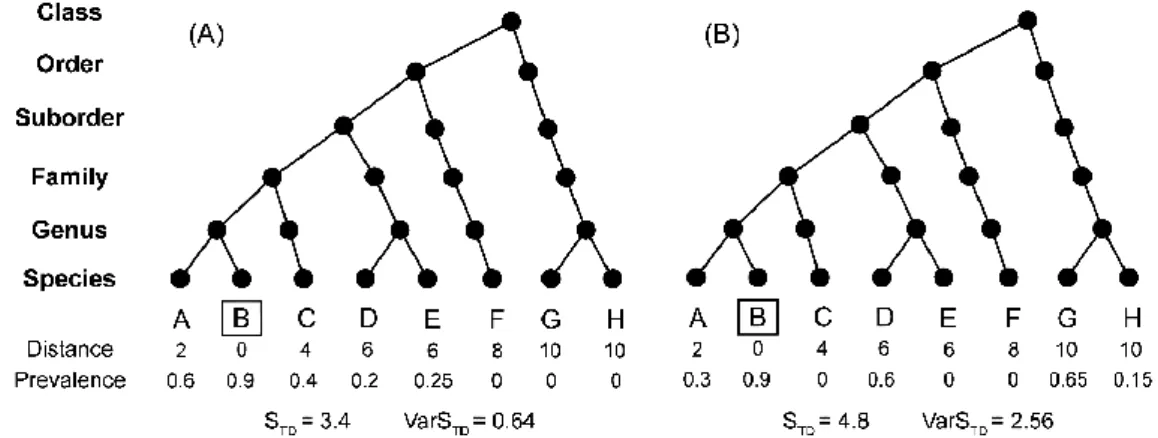
it may have a wider plasticity and resilience to co-extinction (Combes, 2001; Dunn et al., 2009). If a parasite is specific to few closely related host species (Figure 1-4 D), then it displays a high basic and phylogenetic specificity towards its hosts. On the other hand, if a parasite is specific to only a few host species that are distantly related (Figure 1-4 B), then it displays a high basic specificity but a low phylogenetic specificity. In cases in which the parasite can be found in several closely related host species (Figure 1-4 C), it shows that it has a high phylogenetic specificity but low basic specificity. Finally, if a parasite infects several host species, of which some are closely related while others are distantly related, (Figure 1-4 A), then it displays both low phylogenetic and basic specificity (Poulin et al., 2011).
Figure 1-4 Contribution of host phylogeny to the measurement of host-specificity. Parasite populations are indicated by grey boxes and host species by coloured symbols. For any level of basic host-specificity, a parasite could show high phylogenetic specificity if it only exploits host species closely related to each other, or low phylogenetic specificity
if its host species are not closely related. [Adapted from Poulin et al. (2011)]
1.2.1 Host relatedness and parasite distributions
As noted by Combes (2001), “to live in two or more host species, a parasite must be capable of encountering organisms that have different behaviours, exploiting different resources, successfully confronting different competitors, and avoiding different immune systems. […] These costs probably increase very quickly when the genetic distance between hosts increases” (p. 87). Hence, a first step when investigating host-specificity is to determine its correlation with host relatedness. Host relatedness can be calculated based on taxonomic distances between hosts in a Linnean taxonomic tree path length linking the two host species (Figure 1-5), or based on the genetic distance between the two host species. It is also important to consider the distribution of the parasite among the different host species, by determining its prevalence and intensity of infection. The principal host species can be considered as that in which the parasite reaches its highest levels of prevalence, intensity and abundance, while the other host species are auxiliary hosts in which these parameters
are lower (Poulin and Mouillot, 2004, 2005). Auxiliary hosts that are more closely related with the principal host, are more likely to have a similar exposure to parasites (e.g. due to similar diet and behaviour) and to offer similar living conditions to the parasites (e.g. immune defences, nutrient quality and availability) (Poulin, 2005). In contrast, other auxiliary hosts will differ greatly from the principal hosts with respect to these characteristics.
Poulin and Mouillot (2005) developed a host-specificity index that accounts for the phylogenetic and ecological information of the hosts. This index includes a STD measure, which considers the
average taxonomic/genetic distances, and a VarSTD, which considers the asymmetries in these
distances between the host species exploited by the parasite. High taxonomic/genetic distances between hosts exploited by a parasite results in an increase in STD, and if a parasite infects one or a
few hosts that are distinctly related to the other hosts results in an increase in VarSTD (Figure 1-5 B)
(Poulin, 2005). In other words, the lower the STD, the more specific a parasite is, and the lower the
VarSTD the more symmetrical parasite distribution is regarding host relatedness (Figure 1-5 A).
Intuitively, the greater the taxonomic distance between principal and auxiliary hosts for parasites with higher specificity, the lower parasite infection parameters are in more distantly related host species (Figure 1-5 A).
Figure 1-5 Hypothetical example on the influence of parasite distribution among host species for host-specificity indexes. The principal host is shown by a rectangle and numbers refer to the taxonomic distance (i.e. the number of branches)
between the principal host and the other hosts. Calculation of the indexes STD and VarSTD were conducted using
TaxoBioDiv2 (http://www.otago.ac.nz/parasitegroup/Downloads/TaxoBiodiv2.zip) (Poulin and Mouillot, 2005). [Adapted from Poulin (2005), Poulin and Mouillot (2005)]
However, numerous other factors that may be directly or indirectly associated with host relatedness can influence infection patterns and other host-parasite interactions, such as differences in the immune system, behaviour and microhabitat preferences between the different hosts (Poulin, 2005). Vector-borne parasites are especially constrained by host dispersal abilities, which could drive patterns of geographical specificity. Geographical specificity can be defined as the consistency in host use across communities of potential host species that change in composition from one locality to the next (Poulin et al., 2011). In addition, a parasite species can show high specificity at the local scale but a low specificity at the global scale, thus it may be important to distinguish between local species diversity and the difference in species composition among localities (Poulin et al., 2011).
However, this may require an extensive knowledge of the number and distribution of hosts at both local and global scale, which is often not available in less studied parasites.
1.2.2 Coevolutionary patterns in host-parasite associations
Apart from host phylogenetic factors, ecological factors may greatly influence the coevolutionary patterns in host-parasite associations. Variation in microhabitat sharing between hosts and parasites may influence these interactions at different levels, from individuals to populations and species. Next, four examples illustrating this variation are given. First, within a single host individual, a parasite with a patchy microhabitat distribution (particularly important in macroparasites) may have increased probability of duplication (see Figure 1-1) (Clayton et al., 2003). Second, within a host population, a parasite with low prevalence and/or intensity may have increased probability of missing the boat (i.e. to miss translocation with their hosts to a new geographical area) since dispersal founder individuals are more likely to be parasite-free (Clayton et al., 2003). Aggregations of parasites among individuals within a population may also increase the probability of a parasite to miss the boat or become extinct (Clayton et al., 2003). This again may be because parasites may be absent from hosts involved in founder events, assuming that parasitized individuals are not able to disperse as easily due to poorer condition. Third, parasites can have different abundances among host populations, for which low host densities or gaps in parasite distributions can create a dispersal barrier for parasites or limit gene flow between parasite populations in different parts of the host’s geographic range (Clayton et
al., 2003). And fourth, the distribution of parasites among host species is directly associated with
host-specificity. A parasite that fails to complete host switching because it could not disperse and/or establish in the new host results in a parasite merely incorporating a new host species, which reduces its host-specificity (Clayton et al., 2003). Thus, limitations of dispersal are important in maintaining specificity of parasites among related hosts, while limitations to establishment (e.g. host defence) are important in maintaining the specificity of parasites in unrelated hosts (Clayton et al., 2003).
1.2.2.1 Sympatric host species
Sympatric and closely related host species present a great opportunity for studying host-parasite associations and host-specificity, and the influence of host-relatedness and ecological factors on the evolutionary patterns of the interacting species. Coexisting species would be selected to tolerate each other's parasites or to avoid them by using different microhabitats (Price et al., 1986) and related host species are likely to be susceptible to the same or similar parasite species (Thomas et
al., 1995). When sympatric, closely related species are compared, divergences in infection patterns
and phylogeographic patterns can be attributed to derived life-history traits or ecological traits (Nieberding et al., 2004). In some cases, ecology may be more important than host phylogeny or taxonomy (Figure 1-6), which suggests that some parasites can be more opportunistic because they