doi: 10.1590/S1984-46702010000200001
Parasites, organisms that spend most of their life-time feed-ing in or on a sfeed-ingle individual of another species, may exhibit the most common mode of life on this planet (PRICE 1980). This
includes diverse groups of organisms, from viruses and bacteria to worms, plant-feeding insects and parasitic plants. Parasites have managed to spread across impressively diverse taxonomic host groups, often reaching remarkable species numbers along the way. For example, Angiosperms comprise roughly one fourth of all species on earth, yet most plant species host multiple spe-cies of specialized plant-feeding insects.
Given the ubiquity of host-parasite interactions, under-standing the factors that generate, maintain, and constrain these associations is of primary interest with implications for a wide range of applied ecological issues, including the dynam-ics of emerging infectious diseases (BROOKS & FERRAO 2005, BROOKS et al. 2006a, BROOKS & HOBERG 2007), biological control,
bio-logical introductions and invasions, and biotic responses to climate change (BROOKS & MCLENNAN 2002).One of the most
obvious and intriguing features of parasitism is pronounced conservatism in the range of hosts used (high host-specificity), both on ecological (THOMPSON 1994, 2005) and evolutionary
time-scales (EHRLICH & RAVEN 1964, BROOKS & MCLENNAN 1991,
1993, 2002, THOMPSON 1994, 2005, FUTUYMA & MITTER 1996, JANZ
& NYLIN 1998, WINKLER & MITTER 2008). Not surprisingly, many
think this host specificity holds the key to understanding the evolution of host-parasite associations – selection for increased specialization of parasites to their hosts constrains host use and promotes speciation. However, while this view provides a mechanism for the evolution of existing interactions (i.e., spe-cies become increasingly well-adapted to one another once the interaction originates), it provides no basis for understanding the origins of novel interactions. Coevolution can be diversi-fying, so that local selection in different parts of a geographic range can lead to a set of daughter populations that are locally adapted to different resources (THOMPSON 1994, 2005, BENKMAN
1999, GODSOEet al. 2008). But how the diversified interaction (host range) of the mother species came into existence in the first place must still be explained. Although coevolution can give rise to “new” species interactions in cases where the host and parasite speciate in tandem, there is little evidence for cospeciation as a major factor in host-parasite evolution (HOBERG
& BROOKS 2008, 2010). Indeed, ‘cospeciation’ was first proposed
INVITED REVIEW
How specialists can be generalists: resolving the “parasite paradox” and
implications for emerging infectious disease
Salvatore J. Agosta
1, 3; Niklas Janz
2& Daniel R. Brooks
11 Department of Ecology and Evolutionary Biology, University of Toronto. Toronto, ON M5S 3G5, Canada. 2 Department of Zoology, Stockholm University. 106 91 Stockholm, Sweden. E-mail: [email protected] 3 Corresponding author. E-mail: [email protected]; [email protected]
ABSTRACT. The parasite paradox arises from the dual observations that parasites (broadly construed, including phy-tophagous insects) are resource specialists with restricted host ranges, and yet shifts onto relatively unrelated hosts are common in the phylogenetic diversification of parasite lineages and directly observable in ecological time. We synthe-size the emerging solution to this paradox: phenotypic flexibility and phylogenetic conservatism in traits related to resource use, grouped under the term ecological fitting, provide substantial opportunities for rapid host switching in changing environments, in the absence of the evolution of novel host-utilization capabilities. We discuss mechanisms behind ecological fitting, its implications for defining specialists and generalists, and briefly review empirical examples of host shifts in the context of ecological fitting. We conclude that host shifts via ecological fitting provide the fuel for the expansion phase of the recently proposed oscillation hypothesis of host range and speciation, and, more generally, the generation of novel combinations of interacting species within the geographic mosaic theory of coevolution. Finally, we conclude that taxon pulses, driven by climate change and large-scale ecological perturbation are drivers of biotic mixing and resultant ecological fitting, which leads to increased rates of rapid host switching, including the agents of Emerging Infectious Disease.
as a descriptive term for cases in which hosts and parasites experienced concomitant speciation events, such as being af-fected by the same vicariance event, not as an evolutionary mechanism (BROOKS 1979). Thus the issue of how novel
inter-actions arise remains unresolved. Our aims are to (1) synthe-size the resolution to this problem and (2) address the implica-tions for emerging infectious disease in humans.
T
HEPARADOX–
HOSTSHIFTSSHOULDBEDIFFICULTTOACHIEVEMost parasites appear to be resource specialists. The over-whelming majority of plant-feeding insects, for example, use only a tiny fraction of the available plant species in the habitat (THOMPSON 1994, NOVOTNYet al. 2005, DYERet al. 2007, JANZEN &
HALLWACHS 2009). Not surprisingly, this pattern has given rise to the long-standing idea that specialization is a one-way street, an evolutionary dead-end where parasites become increasingly well-adapted to their hosts at the expense of the ability to perform on alternative hosts. The idea of specialization as a dead-end dates back to the 19th century (THOMPSON 1994) and some re-cent studies have reported support for the ‘dead-end’ hypoth-esis (MORAN 1988, WIEGMANNet al. 1993, KELLEY & FARRELL 1998).
Other studies, however, conclude that generalized lineages are often derived from specialists (SCHEFFER & WIEGMANN 2000, JANZet al. 2001, TERMONIAet al. 2001, RADTKEet al. 2002, KERGOATet al.
2005, YOTOKOet al. 2005). Many groups exhibit higher transi-tion rates from generalizatransi-tion to specializatransi-tion than vice versa, but host specialization appears to be a dynamic trait with no inherent necessary directionality (JANZet al. 2001, NOSIL 2002,
NOSIL & MOOERS 2005). If this is the case, why are broad host ranges so rare? There are obvious advantages of wider niches, such as more abundant and reliable food supplies or oviposition sites, so something must consistently select against them (FUTUYMA
& MORENO 1988). A great deal of attention has been devoted to
this question, and it now appears clear that selection should favor increased host specificity over time for a variety of reasons (FUTUYMA & MORENO 1988, BERNAYS 1989, 2001, VIA 1991, AGRAWAL
2000, JANZ 2002, JANZet al. 2005). Paradoxically, the successful
solution to the original problem of widespread specialization has in many ways led to the new problem of understanding why there are exceptions at all (JOHANSSONet al. 2007, SINGER 2008). These exceptions are important, because without them there would be no host shifts. Every host shift must begin with colonization (a process that leads to the establishment of a new, persistent interaction), during which the parasite should re-tain the capacity to use both the ancestral and novel host. Multiple host use following such colonization may be brief or it may be prolonged (JANZet al. 2006, NYLIN & JANZ 2009), but
host shifts must begin with a host range expansion. Initially, additional hosts should typically be inferior alternatives to the original host, to which the parasite is specifically adapted, and special circumstances should be needed to incorporate such a host into the repertoire. Yet, host shifts and host range expan-sions do occur, and can happen rapidly (THOMPSON 1998).
Available data on the rate of host shifts are discordant. Phylogenetic comparative studies of hosts and parasites dem-onstrate two macroevolutionary patterns: (1) high host spe-cialization and conservatism in host use, as well as (2) abun-dant evidence of switching onto relatively unrelated hosts that in some cases seems to have been the primary driver of diversi-fication (AGOSTA 2006, JANZet al. 2006, JANZ & NYLIN 2008, HOBERG
& BROOKS 2008, WINKLER & MITTER 2008, NYMAN 2009). As a cor-ollary, objective evidence for cospeciation has been rare even among intimately associated parasites, such as helminths in-habiting vertebrates (BROOKS & MCLENNAN 1991, 1993, 2002,
BROOKSet al. 2006b, BROOKS & VAN VELLER 2008, HOBERG & BROOKS
2008, 2010). For less intimate associations, such as among plants and many plant-feeding insects, it has long been recognized that cospeciation cannot have been a major source of diversifi-cation (AGOSTA 2006, NYMAN 2009). Coupled with abundant
ecological evidence of rapid shifts to novel hosts, such as in-troduced plants (TABASHNIK 1983, SINGERet al. 1993, CARROLLet al. 1997, FOXet al. 1997, VAN KLINKEN & EDWARDS 2002, AGOSTA
2006, STRAUSSet al. 2006) and animals (CORNELL & HAWKINS 1993,
KELLYet al. 2009), these observations suggest that host shifts
are common in the interaction between hosts and parasites. Colonization of novel hosts must be an important driving force behind the diversification of the interactions themselves (by generating novel species associations) as well as the taxa in-volved (by increasing net speciation rates). This is the ‘parasite paradox’: how do highly specialized parasites otherwise shift to novel hosts?
We present what we consider the broad outlines of an emerging synthesis that resolves the parasite paradox without proposing novel mechanisms. Various parts of this synthesis have been proposed in the decades since EHRLICH & RAVEN (1964)
observed broad taxonomic correspondence between butterflies, their host plants, and plant secondary chemistry. They posited that associations between plants and plant-feeding insects re-sult largely from a coevolutionary arms race that leads to in-creased specialization and tends to restrict associations phylo-genetically. Once that idea became internalized as the overarching mechanism behind host-parasite associations, many researchers began to scrutinize it and conclude that (1) host-parasite associations are generally more labile than ex-pected under models of strict one-on-one coevolution between species, resulting in (2) historically and ecologically complex patterns of associations (e.g., STRONG 1979, HOLMES & PRICE 1980,
JANZEN 1980, 1985, JERMY 1984, BROOKS 1985; review in BROOKS &
MCLENNAN 2002). In addition, the development of modern
phy-logenetic comparative approaches to studying host-parasite evolution has greatly increased the capacity to understand the history and structure of these associations empirically (BROOKS
& MCLENNAN 1991, 2002).
more or less simultaneous correlated evolution across a num-ber of traits to enable it to locate the new resource, identify it as a possible host, trigger oviposition and allow appropriate handling during oviposition. In addition, offspring finding themselves on this novel resource will need to be triggered to initiate feeding (and must be physically capable of doing so, e.g. to penetrate the cuticle), and their metabolic system will have to be able to digest the new resource and overcome its chemical defense (or immune system). Each new host may come with a different set of external enemies requiring new meth-ods of defense or evasion and a different micro-habitat requir-ing novel physiological adaptations. Such correlated changes occurring simultaneously across all these sets of characters ought to be so unlikely that host shifts ought to border on the impossible.
Clearly, host shifts are not impossible. We assume host shifts comprise two different “events”: (1) colonization of the novel host (host range expansion) followed by (2) loss of the ancestral host (host specialization). Hence, for a host shift to be completed, there must first be a mechanism for generaliza-tion (increased diet breadth) and then a mechanism for spe-cialization (decreased diet breadth). Furthermore, in order for specialization not to be an evolutionary dead-end, these mecha-nisms must be at least partly independent, so specialists main-tain the potential to become generalists and generalists main-tain the potential to become specialists. This links host shifts to the processes that determine host specificity.
R
ESOLUTIONEcological fitting
It is hard to escape the conclusion that the capacity to utilize the novel host must have existed before a successful shift was initiated. While this may seem counterintuitive, mechanisms allowing organisms to colonize and persist in novel environments do exist. For example, novel host plants can be added through oviposition “mistakes” (LARSSON & EKBOM 1995)
if they can be metabolized as a side-effect of existing machin-ery – a form of phenotypic plasticity (WEST-EBERHARD 2003, NYLIN
& JANZ 2009).
Phenotypic plasticity, in addition to factors discussed be-low, provides a mechanistic basis for an ecological concept called ‘ecological fitting’ (JANZEN 1985). Ecological fitting describes the case when an organism interacts with its environment in a way that seems to indicate adaptation or more generally a shared evolutionary history (e.g., between a parasite and its host), when in fact the traits relevant to the interaction evolved elsewhere with different species or under different conditions. Such inter-actions can appear to be coevolved over extended evolutionary time (JANZEN 1980), when in fact they may be the result of a
relatively recent ecological “fit”, possibly followed by rapid lo-cal adaptation. JANZEN (1980, 1985) suggested that species often
form these ecologically fit associations and that ecological fit-ting plays a major role in shaping communities.
When organisms encounter novel environmental con-ditions – a new habitat, a changed climate, a change in re-sources – they survive and persist (achieve realized fitness) where and if they “fit” by means of characters they already possess. In other words, successful establishment in a novel environ-ment requires species having reaction norms that already in-clude conditions in the novel environment. For the species to persist, colonists facing ecological novelty must achieve real-ized fitness within a more or less evolutionarily unfamiliar web of species (predators, prey, competitors, symbionts, etc.) using traits they already possess. Thus within any given ecological community, and depending on time and contingency, at least some traits relevant to observed species interactions will have evolved elsewhere under different conditions, but were later co-opted (MAYNARD SMITH & SZATHMARY 1995) or exapted (GOULD
& VRBA 1982) to form new, ecologically fit, interactions (JANZEN
1980, 1985).
Ecological and macroevolutionary evidence for ecologi-cal fitting among hosts and parasites is abundant (AGOSTA 2006,
HOBERG & BROOKS 2008, 2010, KELLY et al. 2009). This suggests
that host shifts are often initiated because the parasite is exapted, or “preadapted” to the novel resource. The novel host might share important characteristics with the current host or might have been used in the past (FUTUYMAet al. 1995, FUTUYMA
& MITTER 1996, JANZ et al. 2001, WAHLBERG 2001, BROOKS &
MCLENNAN 2002, RADTKEet al. 2002), or the parasite might
for-tuitously possess capabilities to use a novel resource (AGOSTA & KLEMENS 2008, 2009).
AGOSTA & KLEMENS (2008) proposed a general framework
for ecological fitting as a mechanism behind the assembly of ecological communities and the formation of novel interac-tions between species within communities. They posited three factors giving rise to ecological fitting and the ability of organ-isms (genotypes) to achieve realized fitness under novel condi-tions (e.g., a novel host). First, phenotypic plasticity can allow organisms to mount a response to novel conditions (WEST
-EBERHARD 2003). Second, correlated trait evolution (LANDE & ARNOLD 1983) can produce phenotypes that are “preadapted” to some future novel condition. Third, phylogenetic conserva-tism in traits related to resource use, including design con-straints (e.g., the ‘spandrels’ of GOULD & LEWONTIN 1979) and
retention of traits from past selection pressures (e.g., the ‘anach-ronisms’ of JANZEN & MARTIN 1982), provide the latent ability to perform under apparently novel conditions, such as a parasite encountering a new host that is actually the same or sufficiently similar to some ancestral host (BROOKS & MCLENNAN 2002). These
capacities produce organisms possessing potential fitness out-side the range of conditions in which the species evolved. AGOSTA
& KLEMENS (2008) termed this region of fitness space ‘sloppy
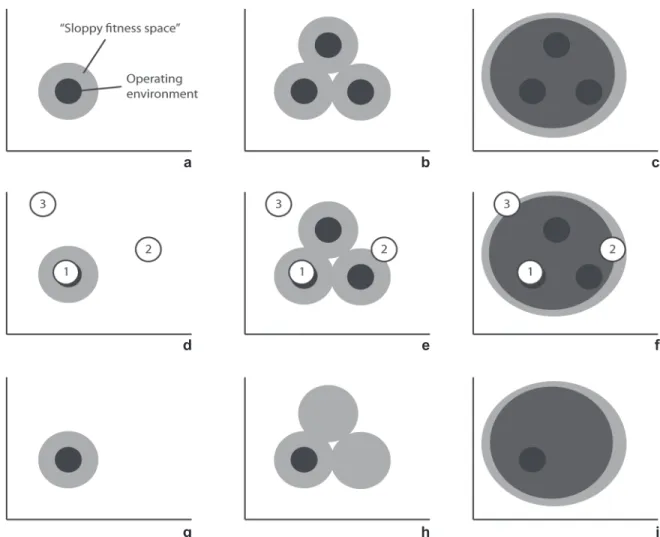
vari-ables affecting parasite evolution. In figure 1a, a parasite evolves in response to the ancestral host operative environment de-fined by the black circle, but as a consequence, also has poten-tial fitness (sloppy fitness space) beyond the range of condi-tions encountered with the ancestral host. Thus, the parasite has some ability to perform and persist on other hosts that represent a novel operative environment (host 2 in Fig. 1e; host 2 and 3 in Fig. 1f), in addition to the ability to add new hosts representing the same or highly similar operative environments (host 1 in Fig. 1 d-f).
Armed with adaptations to their ancestral hosts and the sloppy fitness space that results, parasites can ecologically fit with new hosts in at least two ways (AGOSTA & KLEMENS 2008). First, due to phylogenetic conservatism or convergence of host resources, parasites may shift to a new host species because the new host possesses the same (or highly similar) resources as the old host: ecological fitting via resource tracking (host 1 in Fig. 1d-f). The possibility that parasites track plesiomorphic re-sources both ecologically and evolutionarily was termed ‘co-accommodation’ by BROOKS (1979) and more often than not
Figure 1. A schematic illustration showing two dimensions of the operative environment associated with fictional host resources (black circles). Sloppy fitness space (see text) can allow realized fitness in an area outside the operative environment to which the parasite is adapted (light grey circles). Panels a, d, and g illustrate a specialist, adapted to a single host resource, panels b, e and h illustrate a polyspecialist that has adapted independently to three different resources, and panels c, f and i illustrate a true generalist with a more general host recognition and tolerance system that allows it to utilize any resource that falls within the dark grey area. The open circles in panels d-f represent three novel resources. The specialist in panel d can colonize resource 1 (which is more or less identical to the ancestral resource) but not resource 2 and 3. The polyspecialist in panel e can colonize resource 1, but also resource 2 that falls within its sloppy fitness space, and the generalist in panel f can colonize all three resources. In panels g-i only one host is available, and all three parasite species will appear to be specialists, but their ecological and evolutionary potential will be very different.
a
b
c
d
e
f
parasites seem to do so (reviewed in BROOKS & MCLENNAN 2002;
see also BROOKSet al. 2006a,b, HOBERG & BROOKS 2008, 2010).
This is perhaps most evident when host chemistry or ecology takes priority over host phylogeny in explaining host-parasite associations (e.g., BECCERA 1997, WAHLBERG 2001, BROOKSet al.
2006b).
Second, parasites may use sloppy fitness space to shift onto new hosts representing a novel resource: ecological fitting via sloppy fitness space (host 2 in Fig. 1e; host 2 and 3 in Fig. 1f). In either case, observed interactions between hosts and parasites will appear to be newly evolved, but are products of ecological fitting. Ecological fitting via resource tracking and via sloppy fitness space are not mutually exclusive and may represent two ends of a continuum (AGOSTA & KLEMENS 2008). A typical host
shift may involve both tracking plesiomorphic resources and use of sloppy fitness space. In the case of ecological fitting via resource tracking, the new host may be novel only in the sense that it is a different species – from the perspective of the parasite it may not be novel at all. This situation illustrates how para-sites can shift to relatively unrelated hosts if the operative envi-ronments (e.g., chemicals recognized as oviposition stimulants: MURPHY & FEENY 2006) are plesiomorphic or convergent. It also
illustrates conceptual problems with our understanding of what constitutes specialists and generalists.
The terms specialist and generalist are vaguely defined, and used variously by researchers. Typically the terms refer to the dimension of niche width that reflects diet. Hosts repre-sent resources, and thus an operational defintion of host-speficity should ideally reflect resource distributions and re-source heterogeneity (NYMAN 2009). However, host-specificity
is most often simply measured as the number of hosts in a parasite’s repertoire. As host species are themselves hierarchi-cally related, counting host species may be misleading, and some authors have adopted host use indices that to various extents account for host relatedness (SYMONS & BECCALONI 1999, JANZet al. 2001, 2006). More important is that species with virtually identical present-day host ranges can achieve them in fundamentally different ways, and as a consequence have divergent evolutionary potentials. In figure 1g-i, all three para-sites are specialists, each using one host species. However, while the parasite in figure 1g is restricted to one host due to a nar-row niche width, the other two are restricted to this host be-cause it is the only host locally available.
Two parasite species in figure 1b and c use the same three host species, but whereas the parasite in figure 1c is a true gen-eralist adapted to a wide niche, the host in figure 1b is best described as a ‘polyspecialist’, as it has genetically indepen-dent adaptive traits for all three niches (WEST-EBERHARD 2003,
NYLIN & JANZ 2009). The true generalist (Fig. 1c) presumably
has evolved a more general host recognition and tolerance sys-tem that allows it to feed on any host that falls within the grey circle. The polyspecialist (Fig. 1b) uses these three hosts be-cause it has adapted independently to all three.
BROOKS & MCLENNAN (2002) suggested that, hidden among
the “true” specialists and generalists are ‘faux specialists’ and ‘faux generalists’. Faux specialists are generalists restricted to a few or a single resource by ecological factors, such as competi-tion, local micro-climate or non-concordant distributional ranges (Fig. 1h-i). Faux generalists are specialists specialized on a re-source that is phylogenetically widespread. Parasites are not spe-cialized on particular host species; they are spespe-cialized on re-sources that may or may not be shared among several species (NYMAN 2009). In some cases, a plesiomorphic resource can be
shared among a set of hosts to the extent that, from the parasite’s perspective, they are identical and interchangeable. In other cases there will be a quantitative difference between host species in the amount of the resource(s) they possess. For faux generalists and faux specialists, host shifts can be initiated simply by a change in ecological circumstances (e.g., a shift in local host availability or local extinction of a competitor).
Observing ecological fitting
Host shifts are difficult to observe. We often must be con-tent with scattered snapshots from different stages of the pro-cess to draw a composite picture of the whole propro-cess. Never-theless, researchers have occasionally observed a host shift from the initial colonization to the final (local) loss of the ancestral host. The butterfly Euphydryas editha Boisduval, 1852 occurs in a fragmented population structure across the western USA and Canada. Host use has been studied extensively in several popu-lations over many years (SINGER 2003, SINGERet al. 2008). Singer
and colleagues have obser ved two instances of anthropogenically-induced shifts in host use. In one case, the local flora was altered by the introduction of an exotic plant, and in the other logging removed the original host (SINGERet al. 2008). In both cases, at least some of the local E. editha
accepted a novel host for oviposition and survived on it at first encounter (SINGERet al. 2008). Thus, the initial stage of the
colo-nization occurred through ecological, not evolutionary change. Transfer to a novel environment may remove the ances-tral host and offer alternatives, but more often a parasite popu-lation should come into contact with a novel host in sympatry with the ancestral host. ANTONOVICSet al. (2002) showed that the recent shift by the anther-smut disease Microbotryum violaceum (Pers.) G. Demi & Oberw., 1982 from the ancestral host Silene alba Poir. to S. vulgaris (Moench) Garcke was con-tingent on local scale co-occurrence of both species. The patho-gen was imperfectly adapted to its new host and susceptibility to the pathogen varied considerably. Similarly, some popula-tions of the prodoxid moth Greya politella Walsingham, 1888 in central Idaho have shifted from the ancestral host
Lithophragma parviflorum (Hook.) Nutt. Ex Torr. & A. Gray to the related Heuchera grossulariifolia Rydb. In this case, popula-tions feeding on novel hosts are locally adapted to them, and preference for tetraploid variants seem to have evolved inde-pendently in several populations (SEGRAVESet al. 1999, NUISMER
to the novel host oviposited in it to a low degree, but did not differentiate between plants of different ploidies (JANZ & TH -OMPSON 2002). Hence, the shift likely was initiated by local con-tingency, and local preference for tetraploid variants of the novel host have evolved independently after the initial coloni-zation (THOMPSONet al. 2004). These examples suggest host shifts
initiated without any evolutionary change, through ecologi-cal fitting, followed by rapid evolution of traits associated with host use (SINGERet al. 2008, ANTONOVICSet al. 2002, THOMPSONet al. 2004).
Achieving the fit
As mentioned above, host use involves a number of dif-ferent processes that must all function in concert. A potential host may possess some but not all of the required resources. For a phytophagous insect, the first step towards a host shift involves a failure to fully discriminate against a plant sympat-ric with the ancestral host, at least in part of the insect’s geo-graphic distribution (LARSSON & EKBOM 1995). If offspring have
realized fitness on the new plant, natural selection can then begin playing a role in modifying traits involved in host use on this plant, through genetic accommodation and later pos-sibly through character release, allowing utilization of the novel plant to evolve more independently (WEST-EBERHARD 2003, NYLIN
& JANZ 2009).
Host shifts with loss of the ancestral host likely require evolutionary modification of host utilization traits after the initial colonization. The extent to which such modification will happen will depend on both local circumstances and evo-lutionary history. The butterfly Pieris napi Linnaeus, 1758 regu-larly oviposited on the introduced Thlaspi arvense Linnaeus, although the plant was lethal for the larvae (CHEW 1977), and apparently this situation has not changed (CAROL BOGGS,
per-sonal communication). Presumably, the introduced plant con-tains a similar oviposition “resource” as local hosts, but a dif-ferent larval feeding “resource”. Mortality is 100%, leaving no opportunity for evolutionary modification enabling a host shift. FOXet al. (1997) reported that initial colonization of Chloroleucon ebano (Berland.) L. Rico by the seed beetle Stator limbatus Horn, 1873 depended on pre-existing variance in the capacity to ac-cept and utilize this novel host, and populations expanding their host range to include this species had not locally adapted to it. One reason for the lack of local adaptation was a signifi-cant non-genetic effect of maternal host plant on offspring survival on the novel host (FOXet al. 1997). Hence, successful
establishment on C. ebano depends on local co-occurrence of one of the other hosts in the repertoire of S. limbatus.
These examples show that successful host shifts depend on the history of the association, as well on life history, abdance and distribution of the species involved. Hence, to un-derstand and possibly predict host shifts, both ecological (eco-logical fitting, local contingency) and evolutionary (evolution-ary past, degree of plasticity, genetic variation) processes need to be considered (BROOKS & MCLENNAN 2002).
I
MPLICATIONSFOREMERGINGINFECTIOUSDISEASEOur thesis is that otherwise specialized parasites can shift rapidly to novel (naïve) hosts via ecological fitting and that these host shifts play an “important” role in the ecology and evolu-tion of host-parasite associaevolu-tions. “Important” implies that eco-logical fitting between hosts and parasites occurs with high enough frequency to influence host range dynamics and the diversity of species and interactions among species. Although no quantitative statement of this importance can be made, it is clear from the above discussion that shifts onto relatively unre-lated hosts can be inferred routinely in phylogenetic analyses and observed readily in contemporary ecological time. These observations are fundamental for emerging infectious disease (EID) studies: EID arise when parasite species begin infecting and causing disease in host species with which they have no previous history of association. If the nature of host specificity is such that the potential for ecological fitting is small, then host shifts are likely to be rare and attention can be focused on managing each EID as it emerges. Little attention need be paid to its origins, beyond a search for the taxonomic identity of the parasite acting as the pathogen, and its immediate reservoir. However, if the nature of host specificity is such that the poten-tial for ecological fitting is large, then host shifts are likely to be common, and a more predictive, pre-emptive framework for managing EID will be needed, greatly increasing the challenge of an already difficult problem.
As discussed earlier, empirical studies indicate that few parasite groups conform to the phylogenetic patterns of host-parasite associations expected if opportunities for ecological fitting were relatively rare. Clades such as ectoparasitic arthropods which exhibit limited host switching (HAFNER & NADLER 1988, PATTERSON & POULIN 1999, PAGE 2003), although
interesting to evolutionary biologists and ecologists, cannot form the general conceptual framework for dealing with EID because they are rare. The majority of cases indicate substan-tial host switching throughout history, and extensive diversifi-cation through cospeciation appears to be limited (reviewed in BROOKS & MCLENNAN 1993, HOBERG & KLASSEN 2002, ZARLENGAet al. 2006).
Climate change and ecological perturbation as
drivers of EID
As the human population grows daily, its ecological and technogical footprint deepens. Introducing ourselves and other species into novel regions of the biosphere accelerates land-scape alteration and ecological perturbation, which in global ecosystems can initiate events that link climate change, loss of biodiversity and EID (DASZAKet al. 2000, HARVELLet al. 2002, WOOLHOUSE 2002, EPSTEINet al. 2003, BROOKS & FERRAO 2005, LOVEJOY & HANNAH 2005, BROOKS & HOBERG 2006, PARMESAN 2006, POUNDSet al. 2006). Such events include increased biotic
novel hosts. How we adapt to these changes will depend on how well we understand and use knowledge of the responses of host-parasite systems during episodes of large-scale climate and environmental change.
The taxon pulse hypothesis (ERWINet al. 1979, ERWIN 1981)
predicts that historical biogeographic patterns result from al-ternating episodes of biotic expansion and isolation, which lead to complex geographic distributions. Recent empirical studies in historical biogeography that document marked influence of taxon pulses (HOBERG 1995, BOUCHARDet al. 2004, BROOKS & FERRAO
2005, BROOKS & FOLINSBEE 2005, HALASet al. 2005, ZARLENGAet al.
2006, FOLINSBEE & BROOKS 2007) implicate geological phenom-ena, such as tectonic changes and climatological phenomphenom-ena, including global or regional climate change, as taxon pulse drivers. During biotic expansion phases, susceptible hosts come into contact with novel (for them) parasites. Host switching occurs rapidly, without the need for any evolutionary innova-tion. For example, alternating cycles of biotic expansion and isolation across Beringia at the crossroads of the northern con-tinents are clearly associated with cyclical episodes of climate change in the Pleistocene epoch (HOBERG 1995, ZARLENGAet al.
2006, WALTARIet al. 2007, COOKet al. 2005). Natural selection acts only on what has happened, so there will have been no opportunity for the evolution of resistance to, or tolerance of, the parasite by the new hosts. This suggests that most host switching occurs in conjunction with episodes of global cli-mate change and associated biotic expansion and altered trophic relationships. This has been demonstrated for tape-worms (Taenia spp.) in humans, hookworms (Oesophagostomum
Raillet & Henry, 1913) and pinworms (Enterobius Leach, 1853) in hominoids, and nematodes (Trichinella Railliet, 1895) in car-nivores (HOBERGet al. 2001, BROOKS & FERRAO 2005, BROOKS &
FOLINSBEE 2005, ZARLENGAet al. 2006, FOLINSBEE & BROOKS 2007). The emerging story of human parasites is one of ancestral, eco-logical associations with secondary host switches since the Pliocene associated with ecological perturbation.
More recent human activities associated with the evolu-tion of agriculture, domesticated livestock, urbanizaevolu-tion, and now global climate change have served to broaden the arena and disseminate the risk for EID on a global scale. If current climate changes have a prolonged duration and global scope, we should expect an increase in EID. Predicted responses to climate change by hosts and parasites include biotic expan-sion with geographic colonization, shifting patterns of geo-graphic range, changing phenology and habitat use, modifica-tion of ecotones and contact zones (PARMESAN 2006, HOBERG &
BROOKS 2008), and local extinction (POUNDS et al. 2006,
MARCOGLIESE 2001). Global and regional climate change events have had major influences on biotic structure and the distri-bution of host-parasite assemblages throughout earth history (HOBERG & BROOKS 2008), but recent cases might result from
anthropogenic effects beyond those caused by climate warm-ing (CLEAVELANDet al. 2001, DOBSON & FOUFOPOULUS 2001, HAYDON
et al. 2002, LAFFERTYet al. 2004, KUTZet al. 2004).
Microevolu-tionary responses including mosaic-like, ephemeral patterns of local adaptation, directional changes in gene frequencies through mutation, and selection for parasites associated with emergence (DOBSON & FOUFOPOULUS 2001, THOMPSON 2005) have
not yet been linked directly to climate change. However, such changes could begin with host shifts and outbreaks of disease on local spatial and fine temporal scales, leading to ‘mosaics of emergence’ (THOMPSON 2005, HOBERG & BROOKS 2008). New
associations might proliferate and emerge through ecological fitting, potentially associated with disease in a changing array of ‘reservoir’ hosts (DOBSON & FOUFOPOULUS 2001, HAYDONet al.
2002).
C
ONCLUSIONS– T
HEBIGPICTUREComplete understanding of the complex history of host-parasite associations requires consideration of multiple, non-mutually exclusive evolutionary and ecological mechanisms and phenomena (BROOKS & MCLENNAN 2002, BROOKSet al. 2006b, HOBERG & BROOKS 2008, BROOKS & HOBERG 2008), but we believe that host shifts via ecological fitting provide a missing link in our general understanding of the evolution and diversification of host-parasite interactions. When ecological fitting provides the necessary first step in the colonization process by initiat-ing a host shift, it also provides essential raw material for co-evolutionary interactions. Ecological fitting allows genotypes to be exposed to novel selection regimes.
The geographic mosaic theory of coevolution (THOMPSON
1994, 2005) emphasizes the interplay between local adapta-tion and gene flow in geographically structured populaadapta-tions. Species can interact in different ways, and with different spe-cies in different parts of its geographic range. This mosaic of interactions can lead to the buildup and breakdown of locally adapted coevolutionary hot spots depending on gene flow and the local presence or absence of other interacting species (TH
-OMPSON & FERNANDEZ 2006). This perspective provides an
appre-ciation for the observation that polyphagous species are often comprised of geographically-structured populations associated with small sub-sets of the total species in the parasites host range (FOX & MORROW 1981). Raw material for coevolution, however, must be constantly regenerated through colonization of novel resources in parts of a species geographic distribution (JANZ & THOMPSON 2002, SINGERet al. 2008), which is made
pos-sible by ecological fitting via resource tracking and the explo-ration of sloppy fitness space. Coevolutionary processes can buffer a species against fragmentation, or promote diversifica-tion depending on the nature and strength of processes acting on local and regional scales (THOMPSON 1994, 2005, BENKMAN
1999, GODSOEet al. 2008). Host colonization by ecological fit-ting promotes diversification only to the extent that the geo-graphic mosaic allows local adaptation to newly formed hosts and sufficient isolation from other populations (AGOSTA &
Host shifts initiated by ecological fitting are not an end-point, but rather one step in the process that fuels biological expansion and generates novel combinations of interacting species. From these novel interactions, ecological fitting can promote evolutionary stasis (e.g., if there are many ecologi-cally fit populations connected by sufficient gene flow) or fa-cilitate evolutionary diversity, through subsequent divergent local adaptation (AGOSTA & KLEMENS 2008). JANZet al. (2006), JANZ & NYLIN (2008), and NYLIN & JANZ (2009) recently proposed
that diversification in these systems is driven by repeated “os-cillations” in host range. Coupled with taxon pulses, the oscil-lation hypothesis predicts phases of host expansion during geographic range expansion followed by phases of host spe-cialization during geographic isolation (or, alternatively, sym-patric speciation by host race formation). As with the geo-graphic mosaic concept (THOMPSON 2005), the oscillation
hy-pothesis relies on constant regeneration of variation in host use; it is the diversification of host use that drives diversifica-tion of species whether the actual speciadiversifica-tion process relies on allopatric or non-allopatric modes (JANZ & NYLIN 2008).
In terms of EID, climate and disturbance driven taxon pulses in geographic range and oscillations in host range can be expected to influence their frequency, whereby periods of range shifts and expansions increase biotic mixing and the opportu-nities for ecological fitting to occur. The current EID crisis is “new” only in the sense that this is the first such event that scientists have witnessed directly. Previous episodes through earth history of global climate change and ecological perturba-tion, broadly defined, have been associated with environmental disruptions that could have led to EID (BROOKS & HOBERG 2006,
HOBERG & BROOKS 2008). From an epidemiological standpoint,
episodes of global climate change should be expected to be as-sociated with the origins of new host-parasite associations and bursts of EID. The combination of taxon pulses and ecological fitting suggests that host and parasite species with the greatest ability to disperse should be the primary source of EID (BROOKS &
HOBERG 2006, DOBSON & FOUFOPOULUS 2001, FENTON & PEDERSEN
2005). Paleontological studies suggest that species with large geographic ranges and with high ability to disperse are most successful at surviving large scale environmental perturbation and mass extinctions (STIGALL & LIEBERMAN 2006). Thus, the
spe-cies most successful at surviving global climate changes will be the primary sources of EID, so host extinction will not limit the risk of EID. From the standpoint of taxon pulses and ecological fitting, the planet is an evolutionary and ecological minefield of EID through which millions of people wander daily.
ACKNOWLEDGMENTS
We thank the people who hosted and attended the 2008 “Blod Bad” conference in Tovetorp, Sweden for providing a stimulating atmosphere for discussing these ideas and a forum for the developement of this manuscript.
LITERATURE CITED
AGOSTA, S.J. 2006. On ecological fitting, plant-insect associations,
herbivore host shifts, and host plant selection. Oikos114: 556-565.
AGOSTA, S.J. & J.A. KLEMENS. 2008. Ecological fitting by
phenotypically flexible genotypes: implications for species associations, community assembly and evolution. Ecology Letters11: 1123-1134.
AGOSTA, S.J. & J.A. KLEMENS. 2009. Resource specialization in a
phytophagous insect: no evidence for genetically based performance tradeoffs across hosts in the field or laboratory.
Journal of Evolutionary Biology22: 907-912
AGRAWAL, A.A. 2000. Host-range evolution: adaptation and
trade-offs in fitness of mites on alternative hosts. Ecology81: 500-508.
ANTONOVICS, J.; M. HOOD & J. PARTAIN. 2002 The ecology and genetics of a host shift: Microbotryum as a model system.
American Naturalist160: S40-S53.
BECERRA, J. X. 1997. Insects on plants: macroevolutionary
chemical trends in host use. Science276: 253-256. BENKMAN, C.W. 1999. The selection mosaic and diversifying
coevolution between crossbills and lodgepole pine.
American Naturalist53: S75-S91.
BERNAYS, E.A. 1989. Host range in phytophagous insects: the
potential role of generalist predators. Evolutionary Ecology 3: 299-311.
BERNAYS, E.A. 2001. Neural limitations in phytophagous insects:
implications for diet breadth and evolution of host affiliation. Annual Review of Entomology46: 703-727. BOUCHARD, P.; D.R. BROOKS & D.K. YEATES. 2004. Mosaic
macroevolution in Australian wet tropics arthropods: community assemblage by taxon pulses, p. 425-469. In: E. BERMINGHAM, C.W. DICK & C. MORITZ (Eds). Tropical rainforest: past, present, future. Chicago, University of Chicago Press. BROOKS, D.R. 1979. Testing the context and extent of
host-parasite coevolution. Systematic Zoology28: 299-307. BROOKS, D.R. 1985. Historical ecology: a new approach to
studying the evolution of ecological associations. Annals of the Missouri Botanical Garden72: 660-680.
BROOKS, D.R. & A.L. FERRAO. 2005. The historical biogeography
of coevolution: emerging infectious diseases are evolutionary accidents waiting to happen. Journal of Biogeography32: 1291-1299.
BROOKS, D.R. & K.E. FOLINSBEE. 2005. Paleobiogeography:
documenting the ebb and flow of evolutionary diversification.
Paleontological Society Papers11: 15-43.
BROOKS, D.R. & E.P. HOBERG. 2006. Systematics and emerging
infectious diseases: from management to solution. Journal of Parasitology92: 426-429.
BROOKS, D.R. & E.P. HOBERG. 2007. How will global climate change
BROOKS, D.R. & E.P. HOBERG. 2008. Darwin’s necessary misfit and
the sloshing bucket: the evolutionary biology of emerging infectious diseases. Evolution Education Outreach1: 2-9. BROOKS, D.R. & D.A. MCLENNAN. 1991. Phylogeny, ecology, and
behavior. Chicago, University of Chicago Press.
BROOKS, D.R. & D.A. MCLENNAN. 1993. Parascript: parasites and the language of evolution. Washington DC, Smithsonian Institution Press.
BROOKS, D.R. & D.A. MCLENNAN. 2002. The nature of diversity: an evolutionary voyage of discovery. Chicago, University of Chicago Press.
BROOKS, D.R. & M.G.P. VAN VELLER. 2008. Assumption 0 analysis: comparative evolutionary biology in the age of complexity.
Annals of the Missouri Botanical Garden 95: 201-223. BROOKS, D.R.; D.A. MCLENNAN; V. LEÓN-RÈGAGNON & E. HOBERG.
2006a. Phylogeny, ecological fitting and lung flukes: helping solve the problem of emerging infectious diseases. Revista Mexicana de Biodiversidad77: 225-233.
BROOKS, D.R.; D.A. MCLENNAN; V. LEÓN-RÈGAGNON & D. ZELMER.
2006b. Ecological fitting as a determinant of parasite community structure. Ecology87: S76-S85.
CA R R O L L, S.P.; H. DI N G L E & S.P. KL A S S E N. 1997. Genetic differentiation of fitness-associated traits among rapidly evolving populations of the soapberry bug. Evolution 51: 1182-1188.
CHEW, F.S. 1977. Coevolution of pierid butterflies and their
cruciferous food plants. II. The distribution of eggs on potential food plants. Evolution31: 568-579.
CLEAVELAND, S.; M.K. LAURENSON & L.H. TAYLOR. 2001. Diseases of
humans and their domestic mammals: pathogen characteristics, host range and the risk of emergence.
Philosophical Transactions of the Royal Society of London, Series B,356: 991-999.
COOK, J.A.; E.P. HOBERG; A. KOEHLER; H. HENTTONEN; L. WICKSTRÖM
& V. HAUKISALMI. 2005. Beringia: intercontinental exchange
and diversification of high latitude mammals and their parasites during the Pliocene and Quaternary. Mammal Study30: S33-S44.
CORNELL, H.V. & B.A. HAWKINS. 1993. Accumulation of native
parasitoid species on introduced herbivores: a comparison of hosts as natives and hosts as invaders. American Naturalist141: 847-865.
DASZAK, P.; A.A. CUNNINGHAM & A.D. HYATT. 2000. Emerging infectious diseases of wildlife – threats to biodiversity and human health. Science287: 443-449.
DOBSON, A. & J. FOUFOPOULUS. 2001. Emerging infectious
pathogens of wildlife. Philosophical Transactions of the Royal Society of London, Series B,356: 1001-1012. DYER, L.A.; M.S. SINGER; J.T. LILL; J.O. STIREMAN; G.L. GENTRY; R.J.
MARQUIS; R.E. RICKLEFS; H.F. GREENEY; D.L. WAGNER; H.C. MO -RAIS; I.R. DINIZ; T.A. KURSAR & P.D. COLEY. 2007. Host specificity
of Lepidoptera in tropical and temperate forests. Nature448: 696-699.
EHRLICH, P.R. & P.H. RAVEN. 1964. Butterflies and plants: a study
in coevolution. Evolution 18: 586-608.
EPSTEIN, P.R.; E. CHIVIAN & K. FRITH. 2003. Emerging diseases threaten conservation. Environmental Health Perspectives 111: A506-A507.
ERWIN, T.L. 1979. Thoughts on the evolutionary history of
ground beetles: hypotheses generated from comparative faunal analyses of lowland forest sites in temperate and tro-pical regions, p. 539-592. In: T.L. ERWIN; G.E. BALL & D.R.
WHITEHEAD (Eds). Carabid beetles – their evolution, natu-ral history, and classification. The Hauge W. Junk. ERWIN, T.L. 1981. Taxon pulses, vicariance, and dispersal: an
evolutionary synthesis illustrated by carabid beetles, p. 159-196. In: G. NE L S O N & D.E. RO S E N (Eds). Vicariance biogeography – a critique. New York, Columbia University Press.
ERWIN, T.L.; G.E. BALL & D.R. WHITEHEAD. 1979. Carabid beetles – their evolution, natural history, and classification. The Hauge W. Junk.
FENTON, A. & A.B. PEDERSEN. 2005. Community epidemiology
framework for classifying disease threats. Emerging Infectious Diseases11: 1815-1821.
FOLINSBEE, K. & D.R. BROOKS. 2007. Early hominoid biogeography: pulses of dispersal and differentiation. Jour nal of Biogeography34: 383-397.
FOX, C.W.; J.A. NILSSON & T.A. MOUSSEAU. 1997. The ecology of
diet expansion in a seed-feeding beetle: pre-existing variation, rapid adaptation and maternal effects? Evolutionary Ecology 11: 183-194.
FOX, L.R. & P.A. MORROW. 1981. Specialization: species property
or local phenomenon? Science211: 887-893.
FUTUYMA, D.J. & G. MORENO. 1988. The evolution of ecological
specialization. Annual Review of Ecology and Systematics 19: 207-233.
FUTUYMA, D.J. & C. MITTER. 1996. Insect-plant interactions: the
evolution of component communities. Philosophical Transactions of the Royal Society of London, Series B, 351: 1361-1366.
FUTUYMA, D.J.; M.C. KEESE & D.J. FUNK. 1995. Genetic constraints
on macroevolution: the evolution of host affiliation in the leaf beetle genus Ophraella. Evolution49: 797-809. GODSOE, W.; J.B. YODER; C.I. SMITH AND O. PELLMYR. 2008.
Coevolution and divergence in the Joshua tree/yucca moth mutualism. American Naturalist171: 816-823.
GOULD, S.J. & R.C. LEWONTIN. 1979. The spandrels of San Marco
and the Panglossian paradigm: a critique of the adaptationist programme. Proceedings of the Royal Society of London, Series B,205: 581-598.
GOULD, S.J. & E.S. VRBA. 1982. Exaptation – a missing term in
the science of form. Paleobiology8: 4-15.
HAFNER, M.S. & S.A. NADLER. 1988. Phylogenetic trees support
HALAS, D.; D. ZAMPARO & D.R. BROOKS. 2005. A protocol for
studying biotic diversification by taxon pulses. Journal of Biogeography32: 249-260.
HARVELL, C.D.; C.E. MITCHELL; J.R. WARD; S. ALTIZER; A.P. DOBSON;
R.S. OSTFELD & M.D. SAMUEL. 2002. Ecology, climate warming
and disease risks for terrestrial and marine biota. Science 296: 2158-2162.
HAYDON, D.T.; S. CLEAVELAND; L.H. TAYLOR & M.K. LAURENSON. 2002. Identifying reservoirs of infection: a conceptual and practical challenge. Emerging Infectious Diseases8: 1468-1473. HOBERG, E.P. 1995. Historical biogeography and modes of
speciation across high latitude seas of the Holarctic: concepts for host-parasite coevolution among the Phocini (Phocidae) and Tetrabothriidea (Eucestoda). Canadian Journal of Zoology73: 45-57.
HOBERG, E.P. & D.R. BROOKS. 2008. A macroevolutionary mosaic:
episodic host-switching, geographical colonization and diversification in complex host-parasite systems. Journal of Biogeography35: 1533-1550.
HOBERG, E.P. & D. R. BROOKS. 2010. Beyond vicariance: integrating
taxon pulses, ecological fitting and oscillation in evolution and historical biogeography, in press. In: S. MORAND & B. KR A S N O V (Eds). The biogeography of host-parasite interactions. Oxford, Oxford University Press.
HOBERG, E.P. & G.J. KLASSEN. 2002. Revealing the faunal tapestry:
co-evolution and historical biogeography of hosts and parasites in marine systems. Parasitology124: S3-S22. HOBERG, E.P.; N.L. ALKIRE; A. DE QUERIOZ & A. JONES. 2001. Out of
Africa: origins of the Taenia tapeworms in humans.
Proceedings of the Royal Society of London, Series B, 268: 781-787.
HOMLES, J.C. & P.W. PRICE. 1980. Parasite communities: the roles
of phylogeny and ecology. Systematic Zoology29: 203-213. JANZ, N. 2002. Evolutionary ecology of oviposition strategies,
p. 349-376. In: M. HILKER & T. MEINERS (Eds). Chemoecology of insect eggs and egg deposition. Berlin, Blackwell. JANZ, N. & S. NYLIN. 1998. Butterflies and plants: a phylogenetic
study. Evolution52: 486-502.
JANZ, N. & S. NYLIN. 2008. The oscillation hypothesis of host
plant-range and speciation, p. 203-215. In: K.J. TILMON (ED). Specialization, speciation, and radiation: the evolutionary biology of herbivorous insects. Berkley, University of California Press.
JANZ, N. & J.N. THOMPSON. 2002. Plant polyploidy and host
expansion in an insect herbivore. Oecologia130: 570-575. JANZ, N.; A. BERGSTRÖM & A. SJÖGREN. 2005. The role of nectar
sources for oviposition decisions of the common blue butterfly Polyommatus icarus. Oikos109: 535-538. JANZ, N.; S. NYLIN & K. NYBLOM. 2001. Evolutionary dynamics of
host plant specialization: a case study of the tribe Nymphalini. Evolution55: 783-796.
JANZ, N.; S. NYLIN & N. WAHLBERG. 2006. Diversity begets diversity: host expansions and the diversification of plant-feeding
insects. BMC Evolutionary Biology6: 4.
JANZEN, D.H. 1980. When is it coevolution? Evolution34:
611-612.
JANZEN, D.H. 1985. On ecological fitting. Oikos45: 308-310.
JANZEN, D.H. & P.S. MARTIN. 1982. Neotropical anachronisms:
the fruits the Gomphotheres ate. Science215: 19-27. JANZEN, D.H. & W. HALLWACHS. 2009. Event-based database of
caterpillars, their host plants, and their parasitoids in the Area de Conservación Guanacaste, northwestern Costa Rica. Available online at: http://janzen.sas.upenn.edu [Accessed: 05/IV/2010]
JERMY, T. 1984. Evolution of insect-host plant relationships.
American Naturalist124: 609-630.
JOHANSSON, J.; A. BERGSTROM & N. JANZ. 2007. Search efficiency
and host range expansion in a polyphagous butterfly: the benefit of additional oviposition targets. Journal of Insect Science7: 3.
KELLEY, S.T. & D.B. FARREL. 1998. Is specialization a dead end? The phylogeny of host use in Dendroctonus bark beetles (Scolytidae). Evolution52: 1731-1743.
KELLY, D.W.; R.A. PATTERSON; C.R. TOWSEND; R. POULIN & D.M.
TOMPKINS. 2009. Parasite spillback: a neglected concept in invasion ecology? Ecology90: 2047-2056.
KERGOAT, G.J.; A. DELOBEL; G. FEDIERE; B. LE RU & J.F. SILVAIN. 2005.
Both host-plant phylogeny and chemistry have shaped the African seed-beetle radiation. Molecular Phylogenetics and Evolution35: 602-611.
KUTZ, S.J.; E.P. HOBERG; J. NAGY; L. POLLEY AND B. ELKIN. 2004. Emerging parasitic infections in arctic ungulates. Integrative and Comparative Biology44: 109-118.
LAFFERTY, K.D.; J.W. PORTER & S.E. FORD. 2004. Are diseases increasing
in the ocean? Annual Review of Ecology, Evolution and Systematics 35: 31-54.
LANDE, R. & S.J. ARNOLD. 1983. The measurement of selection on
correlated characters. Evolution37: 1210-1226.
LARSSON, S. & B. EK B O M. 1995. Oviposition mistakes in
herbivorous insects: confusion or a step towards a new host plant? Oikos72: 155-160.
LOVEJOY, T.E. & L. HANNAH. 2005. Climate change and biodiversity. New Haven, Yale University.
MARCOGLIESE, D.J. 2001. Implications of climate change for
parasitism of animals in the aquatic environment. Canadian Journal of Zoology79: 1331-1352.
MAYNARD SMITH, J. & E. SZATHMARY. 1995. The major transitions in evolution. Oxford, W.H. Freeman.
MORAN, N.A. 1988. The evolution of host-plant alternation in
aphids: evidence for specialization as a dead end. American Naturalist132: 681-706.
MURPHY, S.M. & P. FEENY. 2006. Chemical facilitation of a naturally
occurring host shift by Papilio machaon butterflies (Papilioni-dae). Ecological Monographs76: 399-414.
NOSIL, P. & A.Ø. MOOERS. 2005. Testing hypotheses about
ecological specialization using phylogenetic trees. Evolution 59: 2256-2263.
NOVOTNY, V. & Y. BASSET. 2005. Host specificity of insect
herbivores in tropical forests. Proceedings of the Royal Society of London, Series B,272: 1083-1090.
NUISMER, S. L. & J.N. THOMPSON. 2001. Plant polyploidy and non-uniform effects on insect herbivores. Proceedings of the Royal Society of London, Series B,268: 1937-1940. NYLIN, S. & N. JANZ. 2009. Butterfly host plant range: an example
of plasticity as a promoter of speciation? Evolutionary Ecology23: 137-146.
NYMAN, T. 2009. To speciate, or not to speciate? Resource heterogeneity, the subjectivity of similarity, and the macro-evolutionary consequences of niche-width shifts in plant-feeding insects. Biological Reviews: doi: 10.1111/j.1469-185X.2009.00109.x
PAGE, R.D.M. 2003. Tangled trees. Chicago, University of Chi-cago Press.
PARMESAN, C. 2006. Ecological and evolutionary responses to
recent climate change. Annual Review of Ecology, Evolution and Systematics 37: 637-669.
PATERSON, A.M. & R. POULIN. 1999. Have chondracanthid copepods co-speciated with their teleost hosts? Systematic Parasitology44: 79-85.
POUNDS, J.A.; M.R. BUSTAMANTE; L.A. COLOMA; J.A. CONSUEGRA; M.P.L.
FOGDEN; P.N. FOSTER; E. LA MARCA; K.L. MASTERS; A. MERINO -VITERI; R. PUSCHENDORF; S.R. RON; G.A. SANCHEZ-AZOFEIFA; C.J. STILL & B.E. YOUNG. 2006. Widespread amphibian extinctions
from epidemic disease driven by global warming. Nature 439: 161-167.
PRICE, P.W. 1980. Evolutionary biology of parasites. Princeton,
Princeton University Press.
RADTKE, A.; D.A. MCLENNAN & D.R. BROOKS. 2002. Resource
tracking in North American Telorchis sp (Digenea: Plagiochiformes: Telorchidae). Journal of Parasitology 88: 874-879.
SCHEFFER, S.J. & B.M. WIEGMANN. 2000. Molecular phylogenetics of the holly leaf miners (Diptera: Agromyzidae: Phytomyza): species limits, speciation, and dietary specialization.
Molecular Phylogenetics and Evolution1: 244-255. SEGRAVES, K.A.; J.N. THOMPSON; P.S. SOLTIS & D.E. SOLTIS. 1999.
Multiple origins of polyploidy and the geographic structure of Heuchera grossulariifolia. Molecular Ecology 8: 253-262. SINGER, M.C. 2003. Spatial and temporal patterns of checkerspot
butterfly-hostplant association: the diverse roles of oviposition preference, p. 207-228. In: C.L. BOGGS; W.B. WATT
& P.R. EHRLICH (Eds). Ecology and evolution taking flight: butterflies as model study systems. Chicago, University of Chicago Press.
SINGER, M.C.; C.D. THOMAS & C. PARMESAN. 1993. Rapid
human-induced evolution of insect-host associations. Nature366: 681-683.
SINGER, M.C.; B. WEE & S. HAWKINS. 2008. Rapid anthropogenic
and natural diet evolution: three examples from checkerspot butterflies, p. 311-324. In: K.J. TILMON (Ed). Specialization, speciation, and radiation: the evolutionary biology of herbivorous insects. Berkeley, University of California Press. SINGER, M.S. 2008. Evolutionary ecology of polyphagy, p.
29-42. In: K.J. TILMON (Ed). Specialization, speciation, and radiation: the evolutionary biology of herbivorous insects. Berkeley, University of California Press.
STIGALL, A.L. & B.S. LIEBERMAN. 2006. Quantitative
palaeo-biogeography: GIS, phylogenetic biogeographical analysis, and conservation insights. Journal of Biogeography 33: 2051-2060.
STRAUSS, S.Y.; LAU J.A. & S.P. CARROLL. 2006. Evolutionary responses
of natives to introduced species: what do introductions tell us about natural communities? Ecology Letters9: 357-374. STRONG, D.R. 1979. Biogeographic dynamics of insect-host plant
communities. Annual Review of Entomology24: 89-119. SYMONS, F.B. & G.W. BECCALONI. 1999. Phylogenetic indices for
measuring the diet breadths of phytophagous insects.
Oecologia 119: 427-434.
TABASHNIK, B.E. 1983. Host range evolution: the shift from native legume hosts to alfalfa by the butterfly, Colias philodice eriphyle. Evolution37: 150-162.
TERMONIA, A.; T.H. HSIAO; J.M. PASTEELS & M.C. MILINKOVITCH. 2001.
Feeding specialization and host-derived chemical defense in Chrysomeline leaf beetles did not lead to an evolutionary dead end. Proceedings of the National Academy of Science, USA 98: 3909-3914.
THOMPSON, J.N. 1994. The coevolutionary process. Chicago,
University of Chicago Press.
THOMPSON, J.N. 1998. Rapid evolution as an ecological process. Trends in Ecology and Evolution13: 329-332.
THOMPSON, J.N. 2005. The geographic mosaic of coevolution.
Chicago, University of Chicago Press.
THOMPSON, J.N. & C.C. FERNANDEZ. 2006. Temporal dynamics of
antagonism and mutualism in a geographically variable plant-insect interaction. Ecology87: 103-112.
THOMPSON, J.N.; S.L. NUISMER & K. MERG. 2004. Plant polyploidy
and the evolutionary ecology of plant/animal interactions.
Biological Journal of the Linnaean Society82: 511-519.
VAN KLINKEN, R.D. & O.R. EDWARDS. 2002. Is host-specificity of weed biological control agents likely to evolve rapidly following establishment? Ecology Letters5: 590-596. VIA, S. 1991. The population structure of fitness in a spatial
network: demography of pea aphid clones from two crops in a reciprocal transplant. Evolution45: 827-852. WAHLBERG, N. 2001. The phylogenetics and biochemistry of host
plant specialization in melitaeine butterflies (Lepidoptera: Nymphalidae). Evolution55: 522-537.
WALTARI, E.; E.P. HOBERG; E.P. LESSA & J. COOK. 2007. Eastward
Biogeography34: 561-574.
WEST-EBERHARD, M.J. 2003. Developmental plasticity and evolution. New York, Oxford University Press.
WIEGMANN, B.M.; C. MITTER & B. FARRELL. 1993. Diversification of
carnivorous parasitic insects – extraordinary radiation or specialized dead-end? American Naturalist142: 737-754. WINKLER, I.S. & C. MITTER. 2008. The phylogenetic dimension of insect-plant interactions: a review of recent evidence, p. 240-263. In: K.J. TILMAN (Ed). The evolutionary biology of herbivorous insects: specialization, speciation, and radiation. Berkeley, University of California Press. WOOLHOUSE, M.E.J. 2002. Population biology of emerging and
Submitted: 02.II.2010; Accepted: 05.IV.2010. Editorial responsibility: Walter P. Boeger
reemerging pathogens. Trends in Microbiology10 (Suppl.): S3-S7.
YOTOKO, K.S.C.; P.I. PRADO; C.A.M. RUSSO & V.N. SOLFERINI. 2005. Testing the trend towards specialization in herbivore-host plant associations using a molecular phylogeny of Tomoplagia
(Diptera: Tephritidae). Molecular Phylogenetics and Evolution 35: 701-711.