Incentives to Innovate and the Decision to Go Public or Private
Daniel Ferreira
London School of Economics, CEPR, and ECGI Gustavo Manso
Haas School of Business, University of California at Berkeley André C. Silva
Nova School of Business and Economics, Universidade Nova de Lisboa March 2012
Published as: Ferreira, Daniel, Gustavo Manso, and Andre C. Silva (2014). "Incentives to
Innovate and the Decision to Go Public or Private." Review of Financial Studies, 27 (1):
256-300. https://doi.org/10.1093/rfs/hhs070.
Acknowledgements
We are grateful to an anonymous referee and Paolo Fulghieri (editor) for very detailed com-ments, corrections, and suggestions. For useful comments and suggestions, we also thank Cather-ine Casamatta, José Guedes, Uli Hege, Dalida Kadyrzhanova, Christian Keuschinigg, Augustin Landier, Paul Laux, Humberto Moreira, Stewart Myers, Walter Novaes, and Jean-Charles Rochet, as well as the conference participants at the Tilburg Entrepreneurial Finance Conference (2011), the AFA meetings (Denver, 2011), the EFA meetings (Frankfurt, 2010), the European Summer Symposium in Financial Markets (Gerzensee, 2010), the Argentum Symposium (Stockholm, 2010), Econometric Society Meetings (Shanghai, 2010, and St. Louis, 2011), and the seminar participants at HEC Paris, Imperial College, Arizona State University, BI-Oslo, LSE, Zurich, Pompeu Fabra, Queen Mary, Lausanne, Exeter, Stockholm School of Economics, Stockholm University, EPGE-FGV, PUC-Rio, USP, and Universidade Nova de Lisboa. Silva thanks the hospitality of the MIT Sloan School of Management, where he wrote part of this article, and acknowledges …nancial sup-port from INOVA, NOVA FORUM, and FCT PTDC/ECO/72021/2006. Ferreira acknowledges …nancial support from the Abraaj Capital Private Equity Program at FMG/LSE.
Send correspondence to Daniel Ferreira, Department of Finance, London School of Economics, Houghton Street, London WC2 2AE, UK; Telephone: (+44) 20 7955 7544.
Abstract
We model the impact of public and private ownership structures on …rms’incentives to invest in innovative projects. We show that it is optimal to go public when exploiting existing ideas and optimal to go private when exploring new ideas. This result derives from the fact that private …rms are less transparent to outside investors than are public …rms. In private …rms, insiders can time the market by choosing an early exit strategy if they receive bad news. This option makes insiders more tolerant of failures and thus more inclined to invest in innovative projects. In contrast, the prices of publicly traded securities react quickly to good news, providing insiders with incentives to choose conventional projects and cash in early. (JEL G24, G32, O32)
We introduce a model in which the form of equity …nancing— either public or private— a¤ects managers’incentives to innovate. Our main contribution is to show that private ownership creates incentives for innovation, whereas public ownership disincentivizes innovation. As we allow for an endogenous choice of ownership structure, the model also provides, to the best of our knowledge, a novel explanation for the decision to go public or private. We …nd that this decision is a¤ected by the relative pro…tability of innovative and conventional projects.
The logic of our model is as follows. A risk-neutral insider chooses between a conventional project and an innovative project. Following March (1991), we call the conventional project the exploitation of existing ideas and the innovative project the exploration of new ideas. Both projects generate cash ‡ow in two consecutive periods. The insider has an option to liquidate his stake early by selling shares in the …rst period. Under private ownership, if the insider can time the market by choosing an early exit after receiving bad news, the insider becomes more tolerant of early failures and thus more inclined to invest in the innovative project. This tolerance-for-failure e¤ect is the key determinant of innovation in private companies.
Under public ownership, cash ‡ow is observable, and thus an early exit after receiving bad news is not pro…table. Therefore, there is no tolerance for failures in public companies. Furthermore, the market prices of public securities react quickly to good news. This rapid incorporation of good news into market prices creates incentives for short-termist behavior. Thus, the insider may prefer the conventional project because it has a higher probability of early success. We show that the equilibrium under public ownership implies a positive probability of investment in the conventional project, even if innovation is ex ante e¢ cient.
In sum, our model shows that the incentives in public …rms are biased towards conventional projects, whereas the incentives in private …rms are biased towards innovative projects. Conse-quently, holding all else constant, the optimal structure of ownership— public or private— changes with the …rm’s life cycle and depends on whether the exploitation of existing ideas or the exploration of new ideas is optimal.
We interpret our model as a theory of the evolution of ownership structures. Innovation is very important early in the life of a …rm or industry. In an emerging industry, …rms experiment with di¤erent varieties of products (Keppler 1996). Our model predicts that …rms should start under private ownership to provide incentives for exploration and experimentation. Our model also predicts that …rms should go private when they need to undertake risky restructurings. Whenever a …rm needs to reinvent itself, it makes sense to do so out of the public eye. Major restructurings,
involving radical changes in strategy, are more properly motivated under private ownership.1 There is evidence that private …rms are more innovative than are public …rms. Using patent citation data, Lerner, Sorensen, and Strömberg (2011) …nd that …rms invest in more in‡uential innovations after being acquired by private equity (PE) funds. Although most PE targets in their sample were already private, some of the most signi…cant improvements in patent quality were associated with public-to-private transitions. For example, Seagate Technologies, which is the largest patentee in their sample of PE targets, was initially a public company. Lerner, Sorensen, and Strömberg (2011) show that Seagate lagged behind its competitors in terms of the number of patents and citations in the years before they were bought by Silver Lake Partners. Seagate’s innovative position improved signi…cantly after the buyout.
Our model also has implications for the empirical literature dealing with the real e¤ects of venture capital and buyout investments. Kaplan and Strömberg (2009) review this literature and conclude that private equity investment creates value because of tax bene…ts and the exploitation of mispricings in the debt and equity markets, and also by a¤ecting corporate behavior, such as operations and investments. Our model suggests that PE funds can a¤ect innovative investments via the decision to go public or private. Furthermore, our theory suggests that controlling for the type of transition (e.g., public-to-private vs. private-to-private) is at least as important in empirical work as is controlling for the type of investment (buyout vs. venture capital).2
The article is structured as follows. After discussing the related literature in Section 1, we present the model setup in Section 2 and separately discuss the private and public cases in Sections 3 and 4, respectively. We then bring these two cases together and discuss the choice between going public or private in Section 5. We discuss the case of illiquid private securities in Section 6 and conclude with a discussion of the empirical implications in Section 7, to which we add some …nal remarks in Section 8. All proofs are in the Appendix.
1. Related Literature
Our work …ts with an emerging body of theoretical and empirical literature that deals with the roles of ownership structures and …nancing choices in corporate innovation. An early example is Aghion and Tirole (1994); more recent works include Aghion, Van Reenen, and Zingales (2009), Atanassov, Nanda, and Seru (2007), Belenzon, Berkovitz, and Bolton (2009), Bhattacharya and Guriev (2006, 2009), and Fulghieri and Sevilir (2009). These articles focus on related but di¤erent questions,
such as the impact of capital structure, governance, organization, and ownership concentration on corporate innovation.
Our model is closely related to four di¤erent veins of theoretical literature:
(1) Interactions between stock prices and investment in …rms. An extensive body of literature examines the role of stock prices in guiding corporate investment decisions and a¤ecting insiders’ incentives more generally. An incomplete list includes Holmström and Tirole (1993), Khanna, Slezak, and Bradley (1994), Dow and Gorton (1997), Faure-Grimaud and Gromb (2004), Almazan, Banerji, and Motta (2008), and Edmans (2009).
Our model is particularly related to models of managerial short-termism. Stein (1989) develops a model of rational short-termism driven by the stock market. In his model, in an attempt to mislead the market, …rms take actions to boost current earnings at the cost of lower future earnings. In equilibrium, the market is not fooled and managers are stuck with an ine¢ cient strategy. In a similar vein, Chemmanur and Jiao (2007) develop a model of the choice of security-voting structure, in which market-driven short-termism plays a key role. In their model, entrepreneurs may prefer to go public with a dual-class share structure to commit to pursuing long-term strategies. By selling equity without votes, the entrepreneur can insulate himself from short-term market pressure. This form of managerial entrenchment can be bene…cial in situations in which agency costs are low.
Our model has similar implications. If the …rm is public, a manager may choose the conventional project even if the innovative project has a higher net present value, because the former has a higher probability of generating high earnings in the short run. However, our model also depicts the alternative situation. If the …rm is private, and thus free from pressure to boost current earnings, the manager puts too much emphasis on future cash ‡ows. Without the stock market punishing short-term declines in earnings, managers become rationally biased towards innovative projects, which are risky but very pro…table if successful. This bias gives rise to the phenomenon of ine¢ cient long-termism. Innovation may be chosen even if it is inferior to conventional methods. Thus, our model provides a more balanced view of market incentives. Whereas managers of public …rms may excessively focus on current earnings, managers of private …rms may excessively focus on future earnings. The best structure thus depends on the nature of the projects available to the …rm.
(2) Information disclosure and innovation. Bhattacharya and Ritter (1983) were the …rst to propose a model in which …rms may compromise their ability to innovate if they disclose infor-mation to outside investors. In their model, an innovative …rm in need of external …nance faces a
trade-o¤ when choosing whether to disclose private information about its innovative capabilities. On the one hand, information disclosure allows the …rm to obtain external funds with more ad-vantageous terms. On the other hand, disclosure reveals crucial information to competitors and reduces the …rm’s initial advantage in a patent race. Maksimovic and Pichler (2001) develop a model that is based on a similar trade-o¤. In their model, …rms choose between a new or existing technology and then decide whether to …nance future rounds of investment with either public or private o¤erings. Public o¤erings are assumed to be cheaper, but they reveal information about industry pro…tability to potential competitors. Thus, …rms may strategically delay …nancing or resort to private o¤erings to prevent entry. In a more recent article, Spiegel and Tookes (2009) develop and estimate a dynamic oligopoly model that incorporates some of the trade-o¤s originally highlighted in Bhattacharya and Ritter (1983) and Maksimovic and Pichler (2001), and they also analyze a number of new trade-o¤s. For example, their duopoly model generates predictions con-cerning the impact of the competitive environment on innovation and …nancing decisions. Large …rms facing small rivals have more incentives to innovate because small …rms …nd it too costly to compete by producing their own innovations. This e¤ect changes the perceived costs and bene…ts of acquiring market share.
Our model di¤ers from this body of literature because of our focus on the role of information asymmetry in incentives to innovate. In particular, our model is concerned with the e¤ect of the way in which …rms are …nanced on their internal incentives to choose between di¤erent technologies. Thus, our model allows us to address a di¤erent question; should the decision to go public or private depend on the relative pro…tability of innovative versus old technologies?
(3) Insider trading and incentives to innovate. In a seminal article, Hirshleifer (1971) shows that the option to trade on the basis of private information can provide additional incen-tives for engaging in innovative activities. He distinguishes between the technological bene…ts of innovations— the value created by the technological improvements made possible by an innovation— and their pecuniary bene…ts, which are the gains to the innovator from his ability to speculate in markets that will be a¤ected by a particular innovation. If the pecuniary bene…ts are large, entre-preneurs may wish to pursue innovations even when the social value of those innovations is negative. A similar logic is present in our model. In opaque …rms, insiders may choose to innovate mainly for the pecuniary bene…ts of innovation. Thus, private …rms may innovate excessively.
Another article that is particularly related to ours is that of Bebchuk and Fershtman (1994). They show that the ability to trade on the basis of private information provides managers with
incentives to undertake risky projects. The ability to sell shares before information about low pro…tability becomes public works as a put option that convexi…es the payo¤s enjoyed by insiders, which makes risky projects more attractive. The same e¤ect is present in our model but only in some cases. Our analysis is di¤erent in that we compare di¤erent levels of information asymmetry so that we can characterize the conditions under which the opposite result obtains, i.e., insider trading may also lead to the selection of safer projects.
(4) The decision to go public or private. Our article is also related to a large body of liter-ature about the choice between public and private structures. Examples include Shah and Thakor (1988), Zingales (1995), Pagano and Roel (1998), Chemmanur and Fulghieri (1999), and Boot, Gopalan, and Thakor (2006), among many others. None of these articles consider the incentives for innovation as a determinant of ownership structures.
2. Model Setup
A risk-neutral insider initially holds all of the shares of a …rm. The insider has no initial wealth, is protected by limited liability, and has outside utility normalized to zero. We view the insider as a manager-entrepreneur who founded the …rm and initially owns it in full. Because the identity of the manager is not important in our model, we assume that the founder remains the manager regardless of the number of initial shares the founder sells to other investors. All results are unchanged if the founder is replaced by a newly hired professional manager.
2.1 Technology
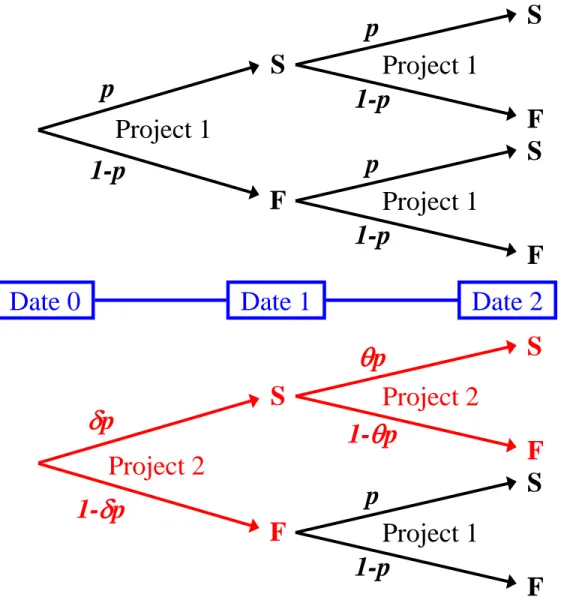
The insider has to choose between two projects, projects 1 and 2, at two consecutive dates, dates 0 and 1. Each project has two possible outcomes: success or failure. Success yields payo¤ S, and failure yields payo¤ F , S > F . We call project 1 the exploitation of existing ideas and project 2 the exploration of new ideas. This setup is similar to that in Manso (2011).
If the insider chooses project 1, the conventional project, the probability of success is p > 0. The probability p is known to everyone. If the insider chooses project 2, the innovative project, the probability of success is q > 0, which is unknown. It is only possible to learn about q if the insider chooses project 2. We assume that E [qjF ] < E [q] < E [qjS]. That is, the expectation of success increases if project 2 is successful at date 1 and decreases if project 2 fails at date 1.
chance of delivering higher payo¤s than does the conventional project. Thus, we also assume that E [qjS] > p to eliminate the trivial case in which project 1 strictly dominates project 2. Conversely, the insider would always choose the innovative project if E [q], the unconditional probability of success, is higher than p. We only consider the more interesting case in which E [q] < p. To economize on algebra and notation, we de…ne and such that p = E [q] and p = E [qjS]. Our assumptions imply that 0 < < 1 and 1 < < 1=p. To summarize,
p = E [q] < p < E [qjS] = p. (1) Equation (1) encapsulates all of the characteristics of project 2. Project 2 is exploratory because it is only possible to learn about the new method by trying it. Project 2 is promising because, conditional on being successful at date 1, its probability of success is higher than the probability of success associated with project 1. We can think of radical methods that seem unlikely to work but would greatly improve upon current methods if they did work. The interpretation of and is that a method is more radical the smaller is and the higher is .
The total pro…t (gross of any initial investment costs) is given by the undiscounted sum of payo¤s, = x1+ x2, where xt is equal to F or S. We call xt earnings. We assume that earnings
are only liquid at date 2. That is, earnings x1 are realized at date 1, but dividends based on x1 are
paid at date 2. More generally, we wish to capture a situation in which it is possible to observe, at date 1, a signal x1 about future pro…ts. We call x1 earnings at date 1 to simplify exposition, but
it can also be understood as “a signal at date 1 about the pro…t at date 2.”
The insider makes an initial investment, I, paid in cash, to produce positive earnings by investing in either project. Without this initial investment, all earnings are equal to zero, regardless of the project chosen.
The insider may switch from one project to the other after observing x1. If the insider initially
chooses to exploit the old method, the option to switch has zero value. However, if the initial choice is to explore the new method to maximize …rm value, the insider switches to project 1 after observing x1 = F . The option to switch is valuable under exploration. If the new method is
tried but fails, the insider returns to the old method. Figure 1 provides a visual summary of the technology, taking into account the option to switch.
To simplify the notation, we make F = 0 and S = 1, without loss of generality. Under exploitation (project 1), the ex ante value of the …rm, gross of the initial investment cost, is v1 = p (1 + p) + (1 p)p. This expression implies
v1 = 2p: (2)
If the insider chooses exploration (project 2), the …rm continues to use the innovative method in the case of a success at date 1. In the case of failure, the …rm returns to the old method (project 1). The ex ante value of the …rm under exploration is then v2 = p (1 + p) + (1 p) p or
v2 = p f1 + [1 + p ( 1)]g . (3)
The innovative project (project 2) is ex ante preferable to the conventional project (project 1) if and only if v2 v1 0. We have
v2 v1 > 0 if and only if [1 + p ( 1)] > 1. (4)
2.2 Liquidity and …nancial market frictions
The key …nancial market friction in our model is the existence of a demand for liquid assets caused by (unmodeled) borrowing constraints. The insider has a utility function, as in Diamond and Dybvig (1983), of U (c1; c2) = 8 < : c1 with probability , c2 with probability 1 , (5)
where ctis consumption at date t. This reduced-form approach is common in microeconomic models
of liquidity shocks (see, e.g., Freixas and Rochet 1997). With probability , a liquidity shock forces the insider to consume at date 1. With probability 1 , there is no liquidity shock and dividends and consumption are synchronized at date 2. We can think of liquidity shocks as representing di¤erent types of consumers. Insiders that do not su¤er a liquidity shock are called late consumers. Insiders that su¤er a liquidity shock are early consumers.3
For liquidity shocks to have an impact on decisions, we need to assume that the insider faces borrowing constraints. The assumption of limited liability eliminates uncollateralized borrowing. The assumption of zero initial wealth implies that the insider has no initial collateral. We need to assume further that the insider cannot borrow by using his own shares as collateral.
Liquid securities, such as cash, can be stored from one period to the following period at no cost. There is no discounting or systematic risk in the economy.
2.3 Project …nancing
The insider must sell securities backed by future earnings to …nance the initial investment, I, as the insider has no initial wealth. The insider may sell securities to either private or public investors. The initial investment, I, is observable to all and is contractible. Thus, the insider must pay I to undertake one of the projects if he sells securities to raise funds. The insider cannot run away with the money or invest in a third project.
We assume that share contracts are the only securities available. This assumption is for the simplicity of exposition. Capital structure choices are relevant in our model (i.e., the model does not exist in a Modigliani-Miller world), but they do not change the qualitative results regarding the choice between private and public ownership structures.4
2.4 Investor types
There are two types of investors: sophisticated and unsophisticated. Both types of investors are fully rational. Unsophisticated investors only observe publicly available information. There are a large number of such investors in the economy. Thus, these investors behave competitively, and their trades are zero net present value transactions, conditional on all public information available at the time they occur. Sophisticated investors can observe inside information at the time they trade. That is, sophisticated investors always have the same information as the insider. Consistent with the idea that information and expertise are costly to acquire, we assume that sophisticated investors are in short supply.
We de…ne the fundamental value of shares as the value that those shares will have if kept until the end of date 2. The fundamental value of shares may di¤er from the market value of shares, which is what unsophisticated investors will pay for the shares in equilibrium.
If the insider wishes to sell some of his shares, he can either sell them to some of the unso-phisticated investors or search for a sounso-phisticated investor who is willing to buy shares. Because sophisticated investors are in short supply (or, equivalently, they have shallow pockets), the insider can only …nd a sophisticated investor with some positive probability e < 1. With probability 1 e, the insider has no other option but to trade with unsophisticated investors. Once the insider meets a sophisticated investor, they bargain over the price of the shares to be sold. The surplus from
trading with the sophisticated investor is v V , where v is the fundamental value of the shares being traded and V is the market value of those shares. The fraction of the surplus captured by the sophisticated investor is , which measures the bargaining power of sophisticated investors. For simplicity, we assume that the market does not observe the negotiations between insiders and sophisticated investors.
Our assumptions about investor heterogeneity are standard. For example, Bolton, Santos, and Scheinkman (2011) similarly assume that informed investors are in short supply and uninformed investors are in in…nite supply. We interpret informed, sophisticated investors as venture capitalists or private equity investors, who would only invest in businesses that they understand well. As it might not be possible for the insider to …nd an informed private buyer for his shares, sometimes the only option is to sell to small retail investors.
2.5 Di¤erences between private and public ownership structures
The key results of our model depend on only one di¤erence between private and public ownership. This di¤erence is the ability of outsiders to observe the interim earnings, x1, of a public …rm
but not of a private …rm. Under public ownership, we assume that the interim earnings x1 are
observable by everyone. Under private ownership, in contrast, only the insider, current private investors, and future sophisticated investors observe x1. These assumptions capture the fact that
public companies are more transparent than are private companies. Public companies are subject to tighter disclosure requirements, such as quarterly earnings reports and comprehensive annual reports, analyst coverage, and the aggregation of dispersed information into the stock price via trading.
For the sake of realism and to permit the analysis of di¤erent trade-o¤s, we also allow for other di¤erences between the two structures, such as the cost of capital and liquidity costs. These enrich the model but are not necessary for any of the qualitative results linking innovation incentives and the choice between going public or private.
We assume that there are transaction costs associated with raising funds for investment through public o¤erings.5 We capture the costs of issuing public equity by parameter cpub 2 (0; 1), such
that each dollar sold in public o¤erings yields only cpub to the …rm. A large cpub implies a small
discount.
Raising capital through private sales also involves transaction costs. We denote the discount factor associated with private securities by cpriv 2 (0; 1). This parameter is likely to change with
changes in the institutional environment and the state of the economy. For example, when interest rates are relatively low, private equity funds can borrow cheaply, and thus going private becomes less costly for the …rm. Private equity booms are thus associated with high levels of cpriv.6
We make no assumptions with respect to the relative cost of public equity capital cpriv cpub.
Thus, our model allows for situations in which funds for investment are cheaper if …nanced by public securities (cpub> cpriv) and cases in which being private reduces the cost of capital (cpub < cpriv).
One justi…cation for going public is to improve the liquidity of insider shareholdings (Chemma-nur and Fulghieri 1999; Ritter and Welch 2002). For example, consider the case of a founder that su¤ers a liquidity shock and needs to sell shares quickly. If the …rm is privately held, the founder may have to negotiate with a limited number of private investors. In contrast, under public owner-ship the founder may be able to sell his shares more easily through organized markets. To capture a potential liquidity advantage of public equity, we assume that each dollar in shares sold by the insider at date 1 (the liquidity shock period) yields only k 1 if the company is private. No such discount happens if the …rm is public. To focus on the main mechanism that explains our key results, we initially assume that there is no liquidity discount if the insider sells his own shares, k = 1. In Section 6, we analyze the case in which k < 1.
2.6 The structure of information and timing of events
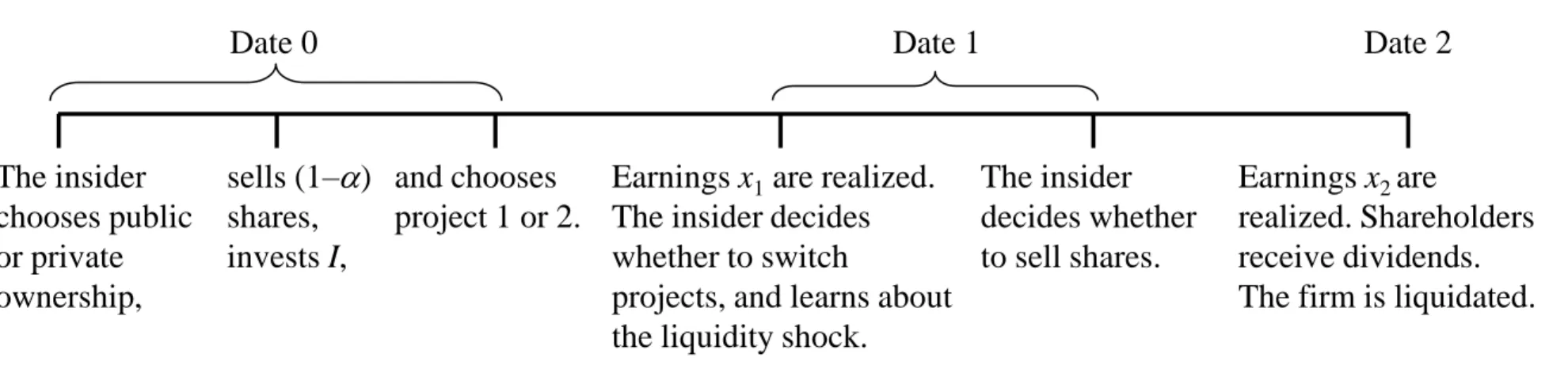
At date 0, the insider decides to sell either a fraction 1 priv of the shares to private investors or a
fraction 1 pub to public markets. We assume that public investors are unsophisticated. Private
investors can be either sophisticated or unsophisticated. However, at date 0, this distinction is irrelevant because information is symmetric. The insider needs to raise at least I in cash to pay for the initial investment cost. After paying I, the insider chooses either project 1 or project 2. Outside investors cannot observe which project was chosen. Private investors, in contrast, have the same information as the insider.
At date 1, the insider observes the …rst realization of earnings x1 2 f0; 1g and then chooses
project 1 or project 2. Again, this choice is unobservable to outsiders. The insider then learns about his liquidity needs. If the insider is an early consumer, he sells all of the shares that he owns. With probability e the insider has the option to sell his shares to either a sophisticated private investor or the public market, where prices are determined by perfect competition among unsophisticated investors. Because sophisticated investors know everything that the insider knows, the insider may prefer to sell to public markets, even if private buyers are available. With probability 1 e, the
insider has no other option but to sell to public investors, regardless of the market valuation of the shares. If the insider is instead a late consumer, he may sell some of the shares or keep them until date 2. After observing whether the insider places orders to sell the shares, the market forms a price for the shares.
At date 2, the second-period earnings, x22 f0; 1g, are realized, shareholders receive dividends,
x1+ x2, and the …rm is liquidated. The liquidation value is normalized to zero. Figure 2 shows the
time line.
–Figure 2 about here—
2.7 Equilibrium
The game is played by one insider and in…nitely many potential investors. Unsophisticated investors (also referred to as “the market”) are in unlimited supply. Sophisticated investors are available with probability e. At date 0, before decisions are made, there is no meaningful di¤erence between the two types of investors. All investors, regardless of type, become fully informed after buying shares in a private …rm. At date 1, all sophisticated investors have the same information set as the insider. The market only observes public information.
The insider takes actions at dates 0 and 1. At date 0, the insider …rst chooses between a private structure and a public structure, ' 2 fpriv; pubg. All of the actions that follow are conditional on the choice of '. The insider also chooses the fraction of shares sold to investors, ' 2 [0; 1]. Finally,
the insider chooses project 2 with probability '2 [0; 1].
At date 1, the insider learns his type, 2 fearly consumer, late consumerg, and whether sophis-ticated investors are available, " 2 favailable, not availableg. The insider also learns x1 2 f0; 1g.
The insider knows which project was chosen, 2 f1; 2g. The insider sells shares to the market with probability b'(x1; ; ; ") 2 [0; 1] and sells shares to sophisticated investors with probability
l'(x1; ; ; ") 2 [0; 1].
At date 0, the investors value the shares of the …rm at u'. At date 1, the market observes
whether the insider sells shares to the public, n 2 fSale, No Saleg. The market only observes the value of x1 2 f0; 1g if the …rm is public. To summarize, the market’s information set at date 1
is (n; ) 2 fSale, No Saleg fx1 = 0; x1 = 1; (x1 = 0) [ (x1 = 1)g : The market values the shares
of the …rm at date 1 at V'(n; ). Because of perfect competition, V'(n; ) is also the price that
at '(x1; ; ; "), i.e., they have the same information set as the insider. They are willing to pay
V'(n; ) + (1 ) ( '(x1; ; ; ") V'(n; )) for each share, where 2 [0; 1] denotes the fraction
of the surplus that is captured by the sophisticated investors, which is exogenously given.
The investors form beliefs about how the game is played in equilibrium. Without loss of gen-erality, let all investors share the same beliefs ( ; b; l) about the unobservable choices made by the insider. Let denote the (stochastic) value of the company to shareholders.
De…nition 1. For each set of parameters (p; ; ; k; ; e; cpriv; cpub; I; ), an equilibrium is a pro…le
of strategies, valuations, and beliefs such that
1. at date 1, b'(x1; ; ; ") and l'(x1; ; ; ") maximize the insider’s expected payo¤, given
V' (n; ) and '(x1; ; ; ");
2. at date 0, ' ; '; and ' maximize the insider’s expected payo¤, given u', b'(x1; ; ; "),
l'(x1; ; ; "), V'(n; ) ; and '(x1; ; ; ");
3. new investors’valuations of shares are given by V' (n; ) = E [ j n; ; '; ]; '(x1; ; ; ") =
E [ j x1; ; ; "; '; ] and u' = E [ j '; ];
4. beliefs are consistent with equilibrium play: = '; b'(x1; ; ; ") ; l'(x1; ; ; ") ;
5. probabilities are always updated in accordance Bayes’rule.
This is a perfect Bayesian-Nash equilibrium. Parts 1 and 2 imply that an equilibrium must satisfy sequential rationality. Part 3 implies that the new investors’ valuations must be rational. Part 4 implies that the investors must hold rational expectations, i.e., beliefs about the insider’s behavior must be correct. Part 5 implies Bayesian rationality.
As will become clear when we characterize the equilibrium, all nodes of the game tree are reached with a strictly positive probability in equilibrium. There is no need to impose rules for updating beliefs at nodes o¤ the equilibrium path, as there are no such nodes. Any deviation by the insider goes undetected, implying that the beliefs remain …xed at , even if the insider chooses an o¤-the-equilibrium action.
3. Private Ownership
Characterizing the set of equilibria for this game requires many steps, as one sees in De…nition 1. Because the choice of ' 2 fpriv; pubg is e¤ectively a choice between two quite distinct subgames,
we …rst analyze each of these two cases separately. We then consider the decision to go public or private in Section 5.
First, consider the case of private ownership, i.e., at date 0, the insider sells 1 priv shares to
private investors. We take priv as exogenous for now and then work backwards to …nd the optimal priv.
After 1 priv shares are sold, at the end of date 0, the insider chooses either project 1 or
2. Recall that the project choice is the private information of the insider. The intuition is that, although investments may be observable, the insider has unique information that allows him to assess the characteristics of the available projects. This is a natural assumption, which is consistent with the view that a manager’s unique expertise may be essential for investment decisions.
Let priv2 [0; 1] be the probability that the insider chooses project 2 (innovation). We allow for
the possibility of equilibria involving mixed strategies. Intuitively, a strictly mixed strategy could be also interpreted as an intermediate project, which is more innovative than is project 1 but is not as radical as project 2. Our goal is to compute the equilibrium project choice, priv, under private ownership.
3.1 Selling behavior at date 1
At the end of date 1, after observing x1, the insider chooses whether to retain or sell the shares of the
…rm. We assume that the current private investors may also experience a liquidity shock and this shock is perfectly correlated with the insider’s liquidity shock. Thus, the current private investors cannot buy out the insider after a liquidity shock. This assumption is stronger than necessary and is made only for simplicity.7 As the insider and the current investors have identical preferences and share the same information set at date 1, they will exhibit the same optimal behavior. Thus, we need only to characterize the insider’s behavior.
The insider either sells to new private buyers, who are sophisticated, or to public investors via an initial public o¤ering (IPO). Private buyers are available with probability e < 1. Trading with a private buyer is optimal only if the surplus v V is positive, where v is the fundamental value of the …rm and V is the value of the …rm in an IPO. If the surplus is negative, the insider prefers an IPO to a private sale. To put it di¤erently, a private sale is attractive only if the market undervalues the …rm, i.e., if v > V . If > 0 and a private buyer is available, the insider and the buyer …nd themselves in a bilateral monopoly situation. Let 2 [0; 1] denote the fraction of the surplus that is captured by the private buyer. The insider’s payo¤ per share, conditional on selling
to private investors, is given by V + (1 ) (v V ). The insider strictly prefers a private sale if < 1. To save on notation, we assume that is zero so that the insider always captures the full surplus when trading with a private buyer. This assumption is not necessary; the analysis that follows is well de…ned for any value of (although it is trivial if = 1).8
The insider receives the fundamental value of the shares v if he sells to private buyers. Private buyers thus o¤er liquidity insurance to the insider. We say that the insider has liquidity needs if the insider su¤ers a liquidity shock and there are no private buyers available. Insiders with liquidity needs must sell shares in public markets. Insiders without liquidity needs may behave strategically and go public to exploit potential mispricings.
We now consider how the market updates its beliefs if there is an IPO at date 1. Let m be the posterior probability that the insider has liquidity needs, conditional on a public sale (IPO), at date 1. A small m means that the market assigns a high probability to the case in which the insider sells for strategic reasons.
An insider with liquidity needs (i.e., an early-consumer insider who cannot …nd a private in-vestor) has no other option but to sell shares to the market (i.e., to make an IPO). An insider without liquidity needs chooses whether or not to sell to the market. The following lemma de-scribes the insider’s behavior when earnings are x1 = 1.
Lemma 1. In the private ownership case, an insider without liquidity needs never sells shares to the market at date 1 after observing a success (x1= 1).
An insider without liquidity needs who sees x1 = 1 would only sell shares in public markets if
he believes that the shares are overvalued. After a success, the fundamental value of one share is either 1 + p or 1 + p. The proof of Lemma 1 shows that the market price at date 1 is lower than 1 + p. Intuitively, the market expects the insider to be more likely to sell after a failure than after a success. Market rationality then rules out those share prices that are not compatible with the insider’s selling behavior. Consequently, prices at date 1 are never high enough to entice an insider to sell shares after receiving good news. In short, as the market does not observe earnings at date 1, the market always assigns a strictly positive probability to failure, which encourages the insider to keep the shares in the case of success.
Let b 2 [0; 1] be the probability that an insider without liquidity needs sells shares to the market after observing a failure, x1 = 0.9 For a given pair of equilibrium values ( priv; b) ; we de…ne
m ( priv; b) Pr (Liquidity needs j Sale). By Bayes’rule, rational market beliefs imply that
m ( priv; b) = Pr (Sale j Liquidity needs) Pr (Liquidity needs)
Pr (Sale) . (6)
The inputs for this formula are as follows. In an equilibrium in which the probability of choosing project 2 is priv, the unconditional probability of selling shares to the market at date 1 is
Pr (Sale) = (1 e) + b (1 + e) [ priv(1 p) + (1 priv) (1 p)] : (7)
The …rst term on the right-hand side is the probability that the insider has liquidity needs, in which case the insider sells with probability 1. The second term is given by the probability of no liquidity needs (1 + e), times the probability of failure, times b, which is the probability of a sale conditional on a failure and no liquidity needs.
Conditional on having liquidity needs, the insider sells to the market with probability 1. As the probability of the insider experiencing liquidity needs is (1 e), we have
m ( priv; b) =
(1 e)
(1 e) + b (1 + e) [ priv(1 p) + (1 priv) (1 p)]
. (8)
The equilibrium value of shares if the market holds rational beliefs is
Vpriv( priv; b) = m ( priv; b) [ privv2+ (1 priv) v1] + (1 m ( priv; b)) p. (9)
If a public o¤ering is caused by liquidity needs, which happens with probability m ( priv; b), the
market value per share is given by a weighted average of the fundamental values of the innovative and the conventional projects, privv2+(1 priv) v1. If the public o¤ering is not caused by liquidity
needs, then by Lemma 1 the market knows that the insider does not sell shares after a success. As the optimal action after a failure is to switch to the conventional project, the value of the …rm after a failure is p.
A necessary condition for the insider to sell shares to the market after a failure is Vpriv( priv; b)
p. The next lemma shows that the insider always sells to the market after a failure.
Lemma 2. In the private ownership case, an insider without liquidity needs sells shares to the market at date 1 with probability b = 1 after observing a failure (x1= 0).
to x1 = 1. This belief is rational because an insider with liquidity needs always sells.
Lemma 2 shows that a key aspect of the private ownership case is the insider’s ability to sell shares at date 1 after observing a failure. A late-consumer insider only sells shares at date 1 if they are overvalued. Overvaluation may occur in equilibrium because the market does not observe x1 and thus cannot distinguish between a liquidity-motivated sale and an opportunistic sale. This
information asymmetry creates a valuable option for a late-consumer insider.
Let T ( priv) Vpriv( priv; 1) p denote the intrinsic value of the option to exit early for a
late-consumer insider conditional on x1 = 0. Selling shares is a real option to the insider. The
value of the underlying asset is the market value of shares in equilibrium Vpriv, whereas the exercise
price of the option is p. Lemma 2 implies that T ( priv) > 0.
3.2 Project choice at date 0
Now we return to date 0 and analyze the choice between projects 1 and 2. Suppose that the market expects project 2 to be chosen with probability priv. At date 0, the expected value of each share
held by the insider if the insider chooses project 1 is given by
upriv;1 (1 e) Vpriv( priv; 1) + (1 + e) [(1 p) Vpriv( priv; 1) + p (1 + p)] . (10)
This expression accounts for the fact that at date 0 the insider does not yet know his type. With probability (1 e), the insider has liquidity needs and will be forced to sell at date 1. With probability 1 + e, the insider has no liquidity needs but may sell voluntarily. Lemmas 1 and 2 imply that the insider sells after a failure and does not sell after a success.
Similarly, if the insider chooses project 2, whereas the market expects project 2 to be chosen with probability priv, the expected value of each share at date 0 is
upriv;2 (1 e) Vpriv( priv; 1) + (1 + e) [(1 p) Vpriv( priv; 1) + p (1 + p)] . (11)
An equilibrium with a positive probability of exploration, priv > 0, exists only if upriv;2
upriv;1. That is, choosing project 2 at date 0 must be incentive compatible for the insider. Using
upriv;2 and upriv;1, and substituting Vpriv( priv; 1) = T ( priv) + p, we obtain
An equilibrium in which the insider chooses project 2 with probability priv > 0 exists only if the
incentive compatibility condition (12) holds. Similarly, an equilibrium with a positive probability of choosing project 1, priv < 1, exists only if v2 v1 + p(1 )T ( priv) 0. A strictly mixed
strategy equilibrium, 0 < priv< 1, exists only if condition (12) holds with equality.
The intuition for the incentive e¤ects of private ownership on innovation can be obtained from the incentive compatibility condition (12). Using Hirshleifer’s (1971) terminology, we call v2 v1the
technological bene…t of innovation. It is the expected fundamental value of innovation, v2, minus
its opportunity cost, v1. The technological bene…t can be positive or negative. p (1 ) T ( priv)
is the pecuniary bene…t of innovation. It represents the net expected gain to the insider from the option to trade on the basis of private information. Unlike the technological bene…t, the pecuniary bene…t is always positive:
p (1 ) T ( priv) = (1 p) T ( priv) (1 p) T ( priv) > 0. (13)
Because the innovative project has a higher probability of failure than does the conventional project, the expected value of the option to exit early is higher under innovation, (1 p)T ( priv) >
(1 p)T ( priv).
The value of the option to exit early T ( priv) re‡ects the fact that the private ownership
structure displays a high degree of tolerance for failure. Tolerance for failure has been shown to be a key feature of optimal incentive schemes for innovation (Manso 2011). Here, in contrast, the incentive to innovate is given by the ownership structure itself. The key insight of our model is that tolerance for failure is more valuable for innovation because the option to exit early is exercised more often if exploration is chosen. To emphasize the underlying mechanism, we refer to the pecuniary bene…t, p (1 ) T ( priv), as the tolerance-for-failure e¤ect.
The option to exit early pushes the insider towards choosing the innovative project. If innovation is e¢ cient from a technological perspective (v2 v1 0), this extra incentive for innovation is not
necessary; the incentive compatibility condition is not binding. The case of negative technological bene…ts (v2 v1 < 0) is more surprising. In this case, innovation is ine¢ cient. We would then
have priv = 0 without the failure e¤ect. However, because of the tolerance-for-failure e¤ect, we can have priv > 0 or even priv = 1. Innovation may be chosen with certainty, despite being ine¢ cient. If the tolerance-for-failure e¤ect is larger than the technological bene…t of innovation, the private ownership structure ine¢ ciently encourages innovation.
The next proposition characterizes the equilibrium value of privunder all possible pure strategy
and mixed strategy equilibria. In particular, we show that there is a unique priv for a given set of parameters (p; ; ; ; e). The proposition follows from the incentive compatibility condition (12) and the properties of T ( priv).
Proposition 1. For each set of parameters (p; ; ; ; e), there exists a unique equilibrium proba-bility of exploration for the private ownership case, priv2 [0; 1], such that
1. if v2 v1, then priv = 1 (exploration is certain if innovation is e¢ cient);
2. if v2< v1, then priv = 8 > > > < > > > : 1, if v1 v2 p(1 ) T (1) , is such that T ( ) = v1 v2 p(1 ), if T (1) < v1 v2 p(1 ) < T (0) , 0, if T (0) v1 v2 p(1 ), (14)
where T ( priv) Vpriv( priv;1) p.
Figure 3 shows the three possible cases if v2< v1. The horizontal dashed lines represent di¤erent
values for v1 v2
p(1 ). Consider, e.g., decreasing v1 v2 and at the same time keeping p (1 ) …xed
(this can be achieved by increasing ). The R1 line represents a case in which the di¤erence v1 v2
is large. In such a case, the technological bene…t of innovation is large and dominates the tolerance-for-failure e¤ect, which implies that the …rst-best action, priv = 0, is chosen in equilibrium. The R2 line represents an intermediate value of v1 v2. In this case, there is a probability of innovation,
priv 2 (0; 1), that makes the insider indi¤erent between projects 1 and 2. The technological bene…t
is exactly o¤set by the tolerance-for-failure e¤ect. Thus, the equilibrium involves some ine¢ cient amount of innovation. Figure 3 also shows that priv increases if the probability of the shock, , increases. This is so because T ( priv) increases with (Proposition 2 below proves this result).
The R3 line is a case in which v1 v2 is positive but small so that the option to exit early is so
valuable that the insider chooses the least pro…table project in equilibrium, priv = 1.
— Figure 3 about here —
In sum, our model shows that the private ownership structure is biased towards innovation. This bias is welcome if v2 v1 but may lead to ine¢ ciencies if v1 > v2.
The e¤ects of , , e, and on the intensity of innovation priv are described in Proposition 2. If v2 v1 0, then priv = 1. In this case, small changes in the parameters do not a¤ect the
equilibrium. Therefore, Proposition 2 focuses on the case priv 2 (0; 1), for which v2 v1 < 0. This
is case R2 in Figure 3.
Proposition 2. If priv 2 (0; 1), then @ priv
@ > 0, @ priv @ > 0, @ priv @ > 0, and @ priv @e < 0.
Increases in and increase the net present value of innovation. Thus, the equilibrium intensity of innovation increases. This proposition also shows that the radicalism of an innovation has ambiguous e¤ects on the likelihood of its adoption. If an innovative project becomes more radical because it is less likely to pay o¤, i.e., if decreases, then the …rm is less likely to innovate. If an innovative project becomes more radical because its payo¤s increase more dramatically in the case of success, i.e., if increases, then the …rm is more likely to innovate.
An increase in helps the insider to disguise a trade after x1 = 0 as a sale motivated by
a liquidity shock. As a result, innovation becomes more attractive, and in equilibrium there is more innovation. An increase in e, however, means that the insider can more easily …nd a private buyer in the case of a liquidity shock. A public sale then becomes less likely to be caused by a liquidity shock. Thus, the IPO share price falls after an increase in e. Such an e¤ect attenuates the tolerance-for-failure e¤ect, which then reduces the intensity of innovation.
3.3 The value of being private
We now calculate the expected value of the …rm to the insider at t = 0, immediately after raising capital from private investors to pay for the initial investment cost I. Let priv be the fraction
of shares that the insider retains after raising capital. Let upriv privupriv;2+ (1 priv)upriv;1
denote the expected value of each share retained by the insider. We have the following lemma Lemma 3. For any equilibrium value of priv, we have that upriv = privv2+ (1 priv)v1:
The intuition behind this lemma is as follows. Although the insider sells strategically at date 1 to exploit his informational advantage, share prices at date 1 must adjust until investors make zero pro…ts on average. Whatever the insider gains by trading strategically is perfectly compensated in expectation by the loss that occurs when he is forced to liquidate his shares after a success. Thus, at date 0, he expects, on average, zero pro…ts from future trading.
Because we assumed that private investors may su¤er a liquidity shock that is perfectly cor-related with that of the insider, private investors also value shares at upriv. Assuming as
be-fore that the insider has full bargaining power with respect to investors, the insider can sell each share for upriv. To cover the investment cost, the revenue from selling shares must satisfy
minimum number of shares necessary for the investment. That is, priv is such that
(1 priv) cprivupriv = I. (15)
To avoid uninteresting cases in which the investment can never be …nanced, let I 2 (0; cprivminfv1,
v2g). That is, the …rm’s cost of capital is su¢ ciently low, and funds for investment can always be
raised. Using Lemma 3, the insider’s stake in equilibrium is
priv = 1 I cpriv h privv2+ (1 priv)v1 i: (16)
We can thus express the value of the …rm to the insider under private ownership as
Wpriv privupriv = privv2+ (1 priv)v1
I cpriv
. (17)
The …rst two terms on the right-hand side represent the expected outcome from the project decision, and the third term is the initial investment cost, adjusted for the cost of raising private capital. One reason that Wpriv di¤ers from its …rst-best counterpart— the value of the …rm in
a frictionless economy— is because raising funds for investing is costly, cpriv < 1. Moreover, a
surprising result is that Wpriv may also di¤er from its …rst-best counterpart because the equilibrium
level of innovation, priv, may be excessive compared with the …rst best. That is, we can have
priv > 0 even though v1 > v2. The intuition here is the same as in Hirshleifer (1971). That is,
an agent may innovate too much to create opportunities for trading. The opposite problem never occurs; under private ownership, there is never too little innovation in equilibrium.
4. Public Ownership
Now consider the case of public ownership. In this case, the insider pays for the investment cost, I, by selling a fraction 1 pub of the shares to the public market. As in the case of private
ownership, the insider sells the remaining shares at date 1 if there is a liquidity shock. As before, if sophisticated private buyers are available, which occurs with probability e, the insider may prefer to sell shares to them. The di¤erence between the public and private cases is the transparency of earnings. In the case of public ownership, the earnings, x1, can be observed by all investors.
4.1 Selling behavior at date 1
The steps to analyze the equilibrium are similar to those in the case of private ownership. In what follows, we denote the probability that the insider chooses project 2 by pub2 [0; 1].
Earnings transparency means that the market always knows whether the …rm has experienced a failure, x1 = 0. The market also knows that project 1 is always chosen after x1 = 0. Therefore,
although the market does not know which project was chosen at date 0, this lack of knowledge is not relevant for computing the value of the …rm conditional on x1 = 0. Regardless of the project
chosen, the expected market value of the …rm after x1 = 0 is p because there is no information
asymmetry between the insider and the market. Thus, shares are always fairly valued if x1 = 0 and
the insider gains nothing by selling shares. We can assume that the insider either sells or retains his shares if x1 = 0. The equilibrium payo¤s are not a¤ected by this choice.
The insider may, however, choose to sell shares to the market after a success, x1 = 1. Although
the market knows that x1 = 1, the market does not know which project was chosen at date 0. If
project 1 was chosen, the expected value of the …rm is 1 + p. If project 2 was chosen, the expected value of the …rm is 1 + p. Thus, the insider is better o¤ if the market believes that project 2 was initially chosen. This creates a value-relevant information asymmetry.
The next lemma characterizes the behavior of an insider without liquidity needs after x1 = 1.
Lemma 4. In the public ownership case, after observing a success, x1 = 1, an insider without
liquidity needs
1. never sells shares to the market if the innovative project has been chosen;
2. weakly prefers to sell shares to the market if the conventional project has been chosen.
According to part 1 of Lemma 4, the insider never sells to the market voluntarily at date 1 after exploration. The intuition is that, if project 2 is chosen, the …rm is sold with a discount after x1 = 1 because the market can never be certain that project 2 was chosen.
According to part 2 of Lemma 4, the insider sells to the market with probability 1 if the insider chooses the conventional project and is successful (to simplify the exposition, we assume that the insider sells in the case of indi¤erence). Selling after x1 = 1 if the insider chooses project 1 is always
pro…table as long as the market assigns a strictly positive probability to project 2.
It is instructive to compare this case to the private ownership case. Under private ownership, the insider never voluntarily sells to the market after a success. The reason for the di¤erence in
behavior is that outsiders can observe successes in the case of a public …rm but not in the case of a private …rm. In the private case, a …rm may have had a success, but the market always assigns a positive probability to failure. As a result, selling to the market after a success is never optimal. In the public case, the market can observe successes but still cannot observe which project was chosen. Thus, under public ownership, it is optimal to sell after a success if the conventional project was chosen.
Lemma 4 implies that, if there was no liquidity shock, trading after x1 = 1 would reveal the
choice of project. Liquidity shocks allow insiders who choose project 1 to trade after x1 = 1 without
revealing the choice of project. In equilibrium, late-consumer insiders who have chosen project 1 pool with early-consumer insiders.
In equilibrium, the market must have correct beliefs and thus must assign probability pub to
the likelihood of project 2 being chosen. If the market observes a success and the insider sells shares, the market assigns probability s to project 2 being chosen. The di¤erence between pub and
s is that pub is the unconditional probability of choosing project 2, whereas s is the probability of
project 2 being chosen given that the insider sells shares and the market observes x1= 1,
s Pr (P roject 2 j Sale; x1 = 1) =
Pr(Sale; x1 = 1 j P roject 2) Pr(P roject 2)
Pr(Sale; x1= 1)
. (18)
The values of the probabilities are as follows. From Lemma 4, the probability of selling and x1 = 1 is
Pr(Sale; x1= 1) = (1 pub) p + pub (1 e) p, (19)
and the probability of selling and x1= 1 conditional on project 2 is
Pr(Sale; x1= 1 j P roject 2) = (1 e) p. (20)
Finally, the unconditional probability of project 2 is pub. Therefore, equilibrium beliefs must be
s( pub) =
pub (1 e)
(1 pub) + pub (1 e)
. (21)
Given such beliefs, the market value of shares sold in public markets at t = 1 after a success is
4.2 Project choice at date 0
We determine which project is chosen at date zero by …rst calculating the expected payo¤s of projects 1 and 2 for the insider. The expected value of one share if the insider chooses project 1 is
upub;1= pVpub( pub) + (1 p) p. (23)
If the insider chooses project 1, the probability of success is p. In the case of a success, the insider sells to the market and obtains Vpub( pub). If there is a failure, the market value of the …rm becomes
p, because the best project to choose at date 1 is project 1, again with probability p of success. The expected gain per share from choosing project 2 is
upub;2 = p [ (1 e) Vpub( pub) + (1 + e) (1 + p)] + (1 p) p. (24)
At date 1, the probability of success is p. In the case of a success, the insider only sells to the market if he has liquidity needs, which occurs with probability (1 e). Without liquidity needs, the insider retains the shares until date 2 and continues with project 2, now with a probability of success equal to p. If x1 = 0, which occurs with probability (1 p), the insider obtains p,
regardless of whether the insider retains the shares or sells them.
The next proposition fully characterizes the equilibrium pub for all mixed strategy and pure strategy equilibria. For a given set of parameters, the equilibrium pub is unique.
Proposition 3. For each set of parameters (p; ; ; ; e), there exists a unique equilibrium proba-bility of exploration for the public ownership case, pub2 [0; 1), given by
pub = s (1 e) + s [1 (1 e)], (25) where s = max v2 v1 (1 e) p 2( 1) p2( 1) [1 (1 e)] ; 0 . (26)
Moreover, pub is such that
1. if v1 v2 (1 e) p2( 1), then pub= 0 (in particular, exploitation is certain if v1 > v2);
2. if v1< v2 (1 e) p2( 1), then pub2 (0; 1).
the market expects exploration with probability 1, then choosing exploitation becomes a dominant strategy. By choosing project 1, the insider increases the probability of success and if successful, makes a pro…t by selling shares at date 1.
The proposition also shows that under public ownership the insider chooses project 1 if v1> v2.
This contrasts with the case of private ownership, in which the insider may choose the innovative project even if the conventional project has a higher expected return. However, if v2 > v1, the
insider never chooses to explore with probability 1 under public ownership. In fact, the insider may choose project 1 with probability 1 even though v2> v1. These results show that public ownership
creates a bias against innovation. However, public ownership always induces the e¢ cient project choice if v1> v2.
Proposition 4 shows the e¤ects of , , , and e on pub. If v1 v2, then pub = 0. Therefore,
the proposition focuses on the case pub 2 (0; 1), for which v2 > v1.
Proposition 4. If pub 2 (0; 1),then @ pub
@ > 0, @ pub @ > 0, @ pub @ < 0, and @ pub @e > 0.
Parameter increases the probability of success at t = 1, and increases the probability of success at t = 2; given that the project was successful at t = 1. Because the innovative project becomes more valuable as or increase, an increase in one of these parameters makes innovation more likely, i.e., pub increases. As in the case of private ownership, the radicalism of an innovation has ambiguous e¤ects on project choice.
Innovation becomes less likely after an increase in the probability of a liquidity shock, @ pub=@ < 0. Recall that Proposition 4 only considers the case in which v2 > v1, which implies pub 2 (0; 1).
Therefore, pub < 1 means that the insider chooses the conventional project with positive prob-ability, although the conventional project is ine¢ cient. The insider behaves in this way because the probability of success at t = 1 under the conventional project is higher than the probability of success under the innovative project, p > p. If liquidity shocks occur frequently, the insider can more easily hide the choice of project 1. Frequent liquidity shocks make the market more likely to believe that the insider is selling because of a liquidity shock and not because of a success under exploitation. Thus, as it becomes easier to hide the choice of project 1, the incentives to choose innovation are reduced.10
Unlike the case of private ownership, under public ownership innovation becomes more likely as …nding informed private buyers becomes easier (@ pub=@e > 0). This result suggests that a well-developed buyout market is bene…cial for innovation in public …rms. The intuition is as follows. Insiders with liquidity needs at date 1 may have to sell undervalued shares if they innovate and are
successful. This possibility makes the innovative project less attractive. If sophisticated private buyers are willing to buy the insider out after a success, then the incentives for innovation are restored.
4.3 The value of being public
We now compute the expected value of the …rm to the insider at t = 0, immediately after raising capital from public investors to pay for the initial investment cost I. Let pub be the fraction of
shares that the insider retains after raising capital. Let upub pubupub;2+ (1 pub)upub;1 denote
the expected value of each share retained by the insider. We have the following lemma. Lemma 5. For any equilibrium value of pub, we have that upub = pubv2+ (1 pub)v1:
As in the private case, share prices at date 1 adjust until investors make zero pro…ts on average. To cover the investment cost, the revenue from selling shares must satisfy (1 pub) cpubupub
I. Because of the trading costs implied by cpub < 1, the insider will sell the minimum number of
shares necessary for the investment. That is, pub is such that
(1 pub) cpubupub= I: (27)
Substituting upub from Lemma 5, the insider’s stake in equilibrium is
pub = 1 I cpub h pubv2+ (1 pub)v1 i: (28)
We can thus express the value of the …rm to the insider under public ownership as
Wpub pubupub= pubv2+ (1 pub)v1
I cpub
. (29)
The ex ante value of the public …rm di¤ers from the value of the private …rm for two reasons. First, the costs of public and private capital may di¤er (cpriv 6= cpub). Second, the intensities of
innovation under public and private ownership may di¤er ( priv 6= pub).
5. The Decision to Go Public or Private
We now complete the characterization of the equilibrium by considering the decision ' 2 fpriv; pubg. The decision to go private or public at date 0 depends only on the values of Wpriv and Wpub. If
Wpriv > Wpub, the insider chooses to go private. If Wpub > Wpriv, the insider chooses to go public.
To simplify the notation, we de…ne the relative cost advantage of public o¤erings compared to private o¤erings as a 1 cpriv 1 cpub = cpub cpriv cprivcpub . (30)
If public o¤erings are cheaper than private o¤erings (cpub> cpriv), then a > 0.
Using (17) and (29), we obtain
Wpriv Wpub = priv pub v2+ ( pub priv)v1
I cpriv
+ I cpub
, (31)
which proves Proposition 5.
Proposition 5. For a given set of parameters (p; ; ; ; e; cpriv; cpub; I), the private ownership
structure is (weakly) preferable to the public ownership structure if and only if
priv pub (v2 v1) aI, (32)
where priv and pub are given by Propositions 1 and 3.
From Proposition 5, we see that the choice between public and private structures is driven by three key forces: (1) the di¤erence in innovation intensity between private and public structures,
priv pub, (2) the relative e¢ ciency of innovative projects, v2 v1, and (3) the relative capital
cost advantage of public o¤erings, aI.
We use the results from the two previous sections to prove the following proposition.
Proposition 6. For any (p; ; ; ; e) ; priv pub 0. That is, the intensity of innovation under private ownership is at least as large as the intensity of innovation under public ownership.
This result follows from the fact that the private structure sometimes creates a bias towards innovation (tolerance for failure), whereas the public structure sometimes creates a bias against innovation (short-termism). These biases distort innovation away from its …rst-best level but in di¤erent directions. For a given set of parameters, one of the two following cases must hold: either there are no biases or at least one structure has a bias that distorts innovation. If biases are not present, then both structures lead to the same intensity of innovation. If at least one of these biases is operational, then there is either too much innovation under the private structure or too little innovation under the public structure. In either case, we have priv pub.
innovative than are public …rms, holding all else constant. This result is also important because it implies that, apart from di¤erences in the cost of capital, going private is more attractive than going public if innovation is e¢ cient (v2 v1 > 0). In fact, if we shut down the e¤ect of the cost of
capital by setting a = 0, innovation e¢ ciency is the only consideration in the choice of ownership structure, as shown in the next corollary.
Corollary 1. Let a = 0 so that the private ownership structure is preferable to the public ownership structure if and only if ( priv pub) (v2 v1) 0 for a given set of parameters (p; ; ; ; e). Then
1. if innovation is e¢ cient (v2 > v1), the insider chooses to go private;
2. if the conventional project is e¢ cient (v1 > v2), the insider strictly prefers to go public if v1 v2
p(1 ) < T (0) and is indi¤erent between going public or private if v1 v2
p(1 ) T (0);
3. if both projects are equivalent (v2= v1), the insider is indi¤erent between going public or
private.
If v2 > v1, then Propositions 1 and 3 imply priv = 1 and pub < 1. Therefore, the condition
for going private is satis…ed. If v1 > v2; then Proposition 3 implies pub = 0. The corollary above
implies that the insider will either choose to go public or may choose to go private if v1 v2
p(1 ) T (0).
In the latter case, Proposition 1 implies that priv = 0: Thus, if the insider optimally chooses the ownership structure, the …rst-best outcome is always achieved. The innovative project is chosen with probability 1 if v2 > v1, and the conventional project is chosen with probability 1 if v1 > v2.
6. Illiquid Private Securities
As discussed in Subsection 2.5, private securities are probably more di¢ cult to sell than public securities. To capture the relative illiquidity of private securities, we now assume that, if the …rm is private, the insider only pockets k < 1 for each dollar of shares sold at date 1. Because the algebra is substantially more complex in this case, without loss of generality, we set e = 0.
The analysis of the public case is unchanged. Most of the analysis of the private case also remains unchanged. In particular, Lemma 1 still holds. Therefore, an insider without liquidity needs never sells shares to the market after x1 = 1. However, with k < 1, the necessary condition
for selling shares to the market after a failure changes to
Because Vpriv( priv; b) > p, we have kVpriv( priv; b) > p for k su¢ ciently close to 1. As a result,
the insider sells shares with probability 1 after a failure if the market for private securities is liquid enough. As k approaches 1, we eventually get b = 1. On the other hand, if the market at date 1 is very illiquid (k close to zero), then a late-consumer insider never sells, b = 0. For intermediate values of k, the equilibrium is in strictly mixed strategies, with b 2 (0; 1) and b increasing in k. The next lemma formalizes these results.
Lemma 6. In the private ownership case with k 2 (0; 1] and e = 0, a late-consumer insider sells shares with equilibrium probability b ( priv) at date 1 after observing x1 = 0, where
b ( priv) = 8 > > > < > > > : 1, if k k1, k[v1+ priv(v2 v1)] p (1 k)(1 )[1 p+ privp(1 )]p, if k2 < k < k1, 0, if k k2, (34) k1 p + (1 ) [1 p + privp (1 )] p [v1+ priv(v2 v1)] + (1 ) [1 p + privp (1 )] p , k2 p v1+ priv(v2 v1) .
The threshold values k1 and k2 de…ne three regions for the behavior of the insider, as shown in
Figure 4. In Region 3, the insider never sells shares. In Region 2, the insider plays a strictly mixed strategy. If the market for private securities is liquid enough, k k1, as shown in Region 1, then
the insider sells after a failure with probability 1.
— Figure 4 about here —
Figure 4 also illustrates the e¤ect of the liquidity shock on the insider’s selling behavior. If increases, k1 decreases. So, a late-consumer insider sells shares with probability 1 for a larger set of
values of k. Intuitively, if increases, it becomes easier for the insider to disguise a failure behind a liquidity shock.
We rede…ne T (the intrinsic value of the option to exit early for a late-consumer insider) as
T ( priv) max fkVpriv( priv; b ( priv)) p; 0g . (35)
This option has zero value if the underlying value kVpriv( priv; b ( priv)) is low, which may happen