
CERN-PH-EP-2011-184
Measurement of the W
±Z Production Cross Section and Limits on Anomalous
Triple Gauge Couplings in Proton-Proton Collisions at
√
s = 7 TeV with the ATLAS
Detector
The ATLAS Collaboration
Abstract
This Letter presents a measurement of W±Z production in 1.02 fb−1 of pp collision data at √s = 7 TeV collected by the ATLAS experiment in 2011. Doubly leptonic decay events are selected with electrons, muons and miss-ing transverse momentum in the final state. In total 71 candidates are observed, with a background expectation of 12.1±1.4(stat.)+4.1−2.0(syst.) events. The total cross section for W±Z production for Z/γ∗masses within the range 66 GeV to 116 GeV is determined to be σtot
WZ = 20.5 +3.1 −2.8(stat.) +1.4 −1.3(syst.) +0.9
−0.8(lumi.) pb, which is consistent with the Standard
Model expectation of 17.3+1.3−0.8 pb. Limits on anomalous triple gauge boson couplings are extracted.
1. Introduction
The underlying structure of the electroweak interac-tions in the Standard Model (SM) is the non-abelian SU (2)L
× U (1)Y gauge group. Properties of electroweak gauge
bosons such as their masses and couplings to fermions have been precisely measured at LEP and the Tevatron [1]. However, triple gauge boson couplings (TGC) predicted by this theory have not yet been determined with comparable precision.
In the SM the triple gauge boson vertex is completely fixed by the electroweak gauge structure. A measurement of this vertex, for example through the analysis of dibo-son production at the LHC, tests the gauge symmetry and probes for possible new phenomena involving gauge bosons. In general, electroweak boson couplings deviating from gauge constraints yield enhancements of the W±Z production cross section at high diboson invariant mass. Furthermore, new particles decaying into W±Z pairs are predicted in models with extra vector bosons (e.g. W0) as well as in supersymmetric models with an extended Higgs sector (charged Higgs) [2, 3].
At the LHC, the dominant W±Z production
mecha-nism is from quark-antiquark and quark-gluon interactions at leading order (LO) and at next-to-leading order (NLO), respectively [4]. Only the s-channel diagram has a triple electroweak gauge boson interaction vertex and is hence the only channel that may contribute to anomalous TGC (aTGC).
This Letter presents a measurement of the W±Z pro-duction cross section and limits on aTGC with the ATLAS detector in LHC proton-proton collisions at a centre-of-mass energy, √s, of 7 TeV. The analysis uses four chan-nels with leptonic decays (W±Z → `ν``) involving elec-trons and muons: eνee, µνee, eνµµ or µνµµ, where the ν
is estimated by the missing transverse momentum, ETmiss. The main sources of background are ZZ, Zγ, Z+jets, and top-quark events.
A common phase space is defined for combining the four decay channels and measuring a “fiducial” cross sec-tion. The phase space is chosen to match closely the de-tector acceptance and analysis selection. The leptons from the Z and W boson decays are required to have trans-verse momenta pµ,eT (Z) > 15 GeV, pµ,eT (W±) > 20 GeV, pseudorapidity1 |ηµ,e| < 2.5, |m
``(Z) − mZ| < 10 GeV,
pν
T > 25 GeV and the transverse mass2 of the W boson
is required to satisfy mWT > 20 GeV. Final state elec-trons and muons whose four-momenta include all photons within ∆R < 0.1 are used in the phase space definition3. Since the fiducial phase space is defined by the lepton kine-matics, the cross section definition includes the branching ratios of the bosons decaying into electrons or muons. The fiducial cross section definition excludes the contribution from W and Z boson decays into τ leptons.
In order to measure the total cross section, the experi-mentally accessible phase space is extrapolated to the full phase space. The region dominated by the contribution of a γ∗ propagator in singly resonant diagrams to the theo-retical cross section is highly suppressed by requiring the invariant mass of the dilepton system from Z/γ∗to satisfy 66 GeV < m``< 116 GeV for the full phase space.
1ATLAS uses a right-handed coordinate system with its origin at
the nominal interaction point in the centre of the detector and the z-axis along the beam pipe. The x-axis points from the interaction point to the centre of the LHC ring, and the y-axis points upwards. Cylindrical coordinates (r,φ) are used in the transverse plane, φ being the azimuthal angle around the beam pipe. The pseudorapidity η is defined in terms of the polar angle θ as η = − ln tan(θ/2).
2The transverse mass is defined as m2
T= 2E`TEνT− 2p`TpνT. 3∆R is defined as ∆R =p(∆η)2+ (∆φ)2.
In the SM the only allowed boson combinations for TGC vertices are W W γ and W W Z, and the latter is ad-dressed in this Letter. Expressions for the most general effective Lagrangian for a TGC vertex with two charged and one neutral vector boson can be found in Refs. [5] and [6]. If only terms that separately conserve charge conjuga-tion and parity are considered, then the couplings can be represented by three dimensionless parameters gZ
1, κZ and
λZ. In the SM gZ1 = 1, κZ = 1 and λZ = 0. Anomalous
couplings, defined as deviations from these SM values, are then ∆g1Z, ∆κZ and λZ.
To avoid tree-level unitarity violation, which occurs in the effective Lagrangian approach at sufficiently large en-ergies, the anomalous couplings must be suppressed at higher energy scales. To achieve this, an arbitrary form factor can be introduced to mitigate the effect of anoma-lous couplings at higher energy scales. For comparison with previous studies, results are presented using a dipole form factor f (ˆs) = 1/(1 + ˆs/Λ2)2, where Λ = 2 TeV is a
cut-off energy scale and √s is the partonic centre-of-massˆ energy. This choice ensures that unitarity is not violated. However, since the choice of the scale is arbitrary and the experimental centre-of-mass energy scale is finite, the in-terpretation of the data in the framework of anomalous couplings is also presented without using a form factor, corresponding to setting Λ = ∞.
2. The ATLAS Detector and Event Samples The ATLAS detector [7] consists of an inner detector (ID) surrounded by a superconducting solenoid which pro-vides a 2 T magnetic field, electromagnetic and hadronic calorimeters and a muon spectrometer (MS) with a toroidal magnetic field. The ID provides precision charged parti-cle tracking for |η| < 2.5. It consists of a silicon pixel detector, a silicon strip detector and a straw tube tracker that also provides transition radiation measurements for electron identification. The calorimeter system covers the range |η| < 4.9 and comprises sampling calorimeters with either liquid argon (LAr) or scintillating tiles as the active media. In the region |η| < 2.5 the electromagnetic LAr calorimeter is finely segmented and plays an important role in electron identification. The muon spectrometer has sep-arate trigger and high-precision tracking chambers which provide muon identification in |η| < 2.7.
This study uses 1.02 ± 0.04 fb−1[8, 9] of collision data collected up to the end of June 2011.
Candidate events are selected online with single-lepton triggers requiring pT of at least 18 (20) GeV for muons
(electrons). The trigger efficiency for W±Z → `ν`` events which pass all selection criteria is in the range of 96–99% depending on the final state.
The W±Z production processes and the subsequent purely leptonic decays are modelled by the MC@NLO [10, 11] generator, which incorporates the NLO QCD matrix elements into the parton shower by interfacing to the Her-wig [12] program. The generator also provides matrix
element information which allows a given sample to be reweighted to a different set of anomalous coupling pa-rameters on an event-by-event basis. The parton density function (PDF) set CTEQ6.6 [13] is used and the under-lying event is modelled with Jimmy [14, 15]. Herwig is used to model the hadronization, initial state radiation and QCD final state radiation (FSR). Photos [16] is used for QED FSR, and Tauola [17] for the τ lepton decays.
The W±Z production cross section at NLO in αs as
previously defined is calculated with the program MCFM [18] to be 17.3+1.3−0.8pb. Electroweak corrections are not consid-ered as they are not relevant at the currently available integrated luminosity [19, 20].
The background sources for which data-driven meth-ods could not be used were estimated with simulated sam-ples. The diboson processes W W and ZZ are modelled with Herwig, and W/Z + γ with MadGraph [21] and Pythia [22]. MC@NLO [10] is used to model the t¯t and single top-quark background in the W±Z → eνee decay channel. Whenever LO event generators are used, the cross sections are corrected by using k-factors to NLO or NNLO (if available) matrix element calculations [10, 18, 23–25].
The response of the ATLAS detector is simulated [26] with Geant4 [27]. Small response and efficiency correc-tions, based on studies in data and simulated control ples, are applied to the simulated samples. All event sam-ples are simulated with time pile-up (multiple pp in-teractions within a single bunch crossing) and out-of-time pile-up (signals from nearby bunch crossings). The weights of simulated events are defined such that the distribution of multiple collisions per bunch crossing matches the ob-servation in the data period under consideration.
3. Object Reconstruction
The main physics objects necessary to select W±Z events are electrons, muons, and Emiss
T . Muons are
identi-fied by matching tracks reconstructed in the MS to tracks reconstructed in the ID. Their momenta are calculated by combining information from the two tracks and correcting for energy deposited in the calorimeter. ID tracks that are tagged as muons on the basis of matching with track segments in the MS (‘segment-tagged’ muons [28]) are also included. Only muons with pT > 15 GeV and |η| < 2.5
are considered. Non-prompt muons from hadronic jets are rejected by selecting only isolated muons, requiring the scalar sum of the pT of tracks within ∆R < 0.2 of the
muon to be less than 10% of the muon pT[28].
Electrons are reconstructed by matching clusters found in the electromagnetic calorimeter to tracks in the ID. Electron candidates must have ET > 15 GeV, where ET
is calculated from the cluster energy and track direction. To avoid the transition regions between the calorimeters, the electron cluster must satisfy |η| < 1.37 or 1.52 < |η| < 2.47. Electrons are required to pass the ‘medium’ identifi-cation criteria described in Ref. [29]. To ensure isolation,
the sum of the calorimeter energy in a cone of ∆R = 0.3 around the electron candidate, not including the energy of the cluster associated to the candidate itself, must be less than 4 GeV.
The Emiss
T is calculated with reconstructed electrons
within |η| < 2.47, muons within |η| < 2.7, and jets and calorimeter energy clusters outside of other reconstructed objects within |η| < 4.5. The clusters are calibrated as electromagnetic or hadronic energy according to cluster topology. A small correction avoids double-counting the energy deposited by muons in the calorimeters [30].
4. Event Selection
At least one single electron or muon trigger is required for the event selection. A minimum of one reconstructed vertex, with at least three tracks associated with it, is re-quired to remove non-collision backgrounds. The vertex with the largest sum of the p2
Tcomputed from the
associ-ated tracks is selected as the primary vertex. Events with two leptons of the same flavour and opposite charge with an invariant mass within 10 GeV of the Z boson mass are selected. For the eνee and µνµµ channels more than one lepton pair combination may satisfy this criterion and the pair closest to the Z boson mass is chosen. This require-ment of a lepton pair consistent with originating from a Z boson reduces much of the background from multijet and top-quark production, and a fraction of the diboson background.
Events are then required to have at least three recon-structed leptons originating from the primary vertex; their longitudinal impact parameters with respect to the pri-mary vertex are required to be less than 10 mm.
The lepton not attributed to the Z boson decay must pass more stringent identification criteria than the leptons attributed to the Z boson, and have pT> 20 GeV.
Elec-trons are additionally required to pass the ‘tight’ identifi-cation criteria [29] with cuts on the matched track qual-ity, the ratio of the energy measured in the calorimeter to the momentum of the matched track, and the detection of transition radiation. Segment-tagged muons may not be used as the third lepton.
Events are required to have ETmiss > 25 GeV and the transverse mass of the W± boson candidate, mWT, formed from the Emiss
T and the third lepton, is required to be
greater than 20 GeV. These cuts suppress the remaining backgrounds from Z and ZZ production.
At least one of the leptons is required to have fired the trigger. To ensure that the trigger is well onto the effi-ciency plateau above the threshold of the primary single-lepton trigger, trigger-matched single-leptons are required to have pT> 20 GeV for muons and 25 GeV for electrons.
5. Signal Efficiency and Background Estimate The fiducial efficiency is defined as the ratio of simu-lated signal events meeting the event selection criteria to
the numbers of simulated events4 within the defined
fidu-cial phase space region. The values for each channel are shown in Table 1. The fraction of selected simulated signal events which come from outside the fiducial phase space is 13%.
The total systematic uncertainty on the efficiency is 3–7% depending on the decay channel and is dominated by the uncertainties on the electron and muon reconstruc-tion. These include uncertainties associated with the re-construction and identification efficiencies, energy scale, and isolation. The uncertainties are determined by com-paring simulated events with data in control regions and are 2–6% depending on the decay channel. The uncertain-ties on the objects involved in the EmissT calculation are used to derive the systematic uncertainties on Emiss
T
fol-lowing Ref. [30]. Uncertainties in the description of the pile-up conditions by the simulation are also considered. The total systematic uncertainty on the acceptance of the Emiss
T and transverse mass cuts due to the imperfect
sim-ulation is 1–2%.
Data-driven methods are used to estimate the back-grounds from Z+jets and top-quark production. Simu-lation is used for the remaining background sources, in-cluding W/Z + γ events where the photon converts into an electron-positron pair. The backgrounds from W+W− and multijet production are negligible. For simulated events, the uncertainties on the theoretical cross section of the background processes are included in the systematic un-certainty.
In the µνee, eνµµ and µνµµ channels, the top-quark background contribution is evaluated from the average den-sity of events in the side-bands around the Z mass peak after applying all selection cuts except the Z boson mass cut. Since the background from top-quark production does not contain a Z boson, this density is used to estimate the background from top-quark production in the signal region within the Z mass window. The systematic un-certainty is estimated from various cross checks, including a comparison of the difference between the side-band es-timate and the prediction within the Z mass window in simulated events. This method is not applicable to the eνee channel, since the Z+jet background dominates the side-bands due to electron misidentification, therefore a simulated event sample is used.
In order to estimate the background from Z+jets events, a sample of events containing a Z boson candidate selected as described above and one “lepton-like” jet is identified. The lepton-like jet is a lepton candidate which does not explicitly have to satisfy lepton quality (e) or isolation (µ) requirements. To ensure that the control sample is as sim-ilar to the signal as possible, all other event selection crite-ria, including the Emiss
T and mWT requirements, are applied.
The background contribution is then estimated by scaling each event in the resulting sample by the probability f (pT)
Final State eee + EmissT eeµ + ETmiss eµµ + ETmiss µµµ + ETmiss Fiducial Efficiency (%) 34.3±0.8 50.2±0.9 54.5±1.0 81.6±1.3
Table 1: Fiducial efficiency per channel. The uncertainty due to simulated sample size and parton distribution functions is shown.
[GeV] Z M 70 75 80 85 90 95 100 105 Events / 3 GeV 10 20 30 40 50
∫
-1 Ldt = 1.02fb ATLAS =7TeV s Data WZ ZZ Top Z+jets γ Z+ stat+syst σFigure 1:The invariant mass of the lepton pair attributed to the Z boson in candidate events after the full selection. The stacked histograms represent the predictions from simulation or, where applicable, data-driven estimates including the statistical and systematic uncertainty shown by shaded bands. The shape of the top-quark background is taken from simulation.
that a “lepton-like” jet satisfies the quality or isolation re-quirements. The scaling factor f (pT) is determined from a
data sample of events containing a Z boson plus an extra lepton-like jet, with a low missing transverse momentum, ETmiss < 25 GeV. The validity of extrapolation to high values of EmissT has been verified with dijet events from simulation and data. An estimate of the systematic un-certainty is derived from the ETmiss extrapolation in dijet data.
6. Results
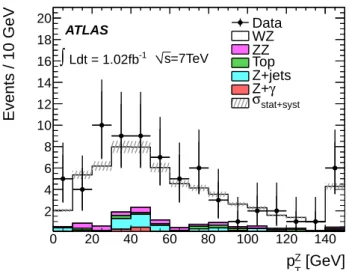
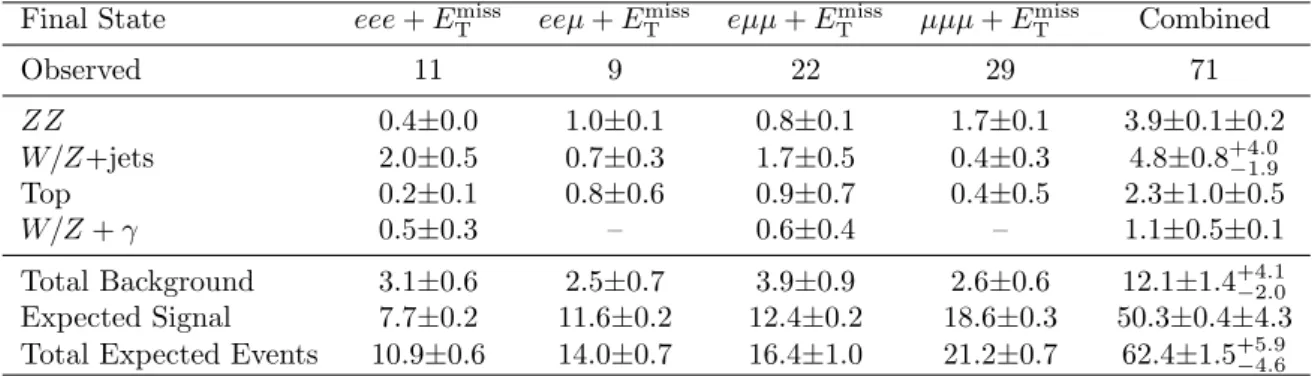
The numbers of expected and observed events after the full selection are shown in Table 2. A total of 71 W±Z can-didates are observed in data, with 12.1±1.4(stat.)+4.1−2.0(syst.) expected background events. The expected signal events shown in the table include the contribution from τ lepton decays into electrons or muons. The discrepancy between channels in the number of observed to expected events is consistent with a statistical fluctuation at the 16% level. The invariant mass and the transverse momentum of the Z boson in W±Z candidate events are shown in Figures 1 and 2, respectively.
The fiducial cross section is calculated from σWZ→`ν``fid = Nobs `ν``− N bkg `ν`` L × CWZ→`ν`` × 1 − N MC τ NMC sig ! (1) [GeV] Z T p 0 20 40 60 80 100 120 140 Events / 10 GeV 2 4 6 8 10 12 14 16 18 20
∫
-1 Ldt = 1.02fb ATLAS =7TeV s Data WZ ZZ Top Z+jets γ Z+ stat+syst σFigure 2: The transverse momentum of Z bosons in candidate events after full selection. The stacked histograms represent the predictions from simulation or, where applicable, data-driven estimates including the statistical and systematic uncertainty shown by shaded bands. The last bin includes the overflow. The shape of the top-quark background is taken from simula-tion.
where N`ν``obs and N`ν``bkg are the numbers of observed and background events, L the integrated luminosity and CWZ→`ν``is the fiducial efficiency defined above. The last
term corrects for the τ lepton contribution estimated from the selected simulated signal sample, where NMC
τ is the
number of W±Z events with at least one of the bosons
decaying to a τ lepton and NMC
sig is the number of W±Z
events with decays into any lepton flavour. For each fi-nal state, the simulated sigfi-nal samples include W and Z bosons decaying into τ leptons. The contribution from τ lepton decays is 3.7% summing over all channels.
The total cross section is calculated as σtotWZ= σ
fid WZ→`ν``
B(WZ → `ν``) × AWZ→`ν``
(2) where B(WZ → `ν``) is the branching ratio for a W± boson to decay to `ν and a Z boson to decay to ``, and AW Z→`ν`` is the ratio of the number of events within the
fiducial phase space region to the number of events within 66 GeV < m`` < 116 GeV. This ratio AWZ→`ν`` is
calcu-lated at NLO to be 0.342 ± 0.006 using MCFM [18] with PDF set CTEQ6.6, where the uncertainty arises from the statistical error due to the sample size in the MCFM in-tegration (0.6%) and parton distribution function uncer-tainty (1.5%).
The cross section is determined by minimizing a neg-ative log-likelihood function to combine the four
chan-Final State eee + ETmiss eeµ + ETmiss eµµ + ETmiss µµµ + ETmiss Combined Observed 11 9 22 29 71 ZZ 0.4±0.0 1.0±0.1 0.8±0.1 1.7±0.1 3.9±0.1±0.2 W/Z+jets 2.0±0.5 0.7±0.3 1.7±0.5 0.4±0.3 4.8±0.8+4.0−1.9 Top 0.2±0.1 0.8±0.6 0.9±0.7 0.4±0.5 2.3±1.0±0.5 W/Z + γ 0.5±0.3 – 0.6±0.4 – 1.1±0.5±0.1 Total Background 3.1±0.6 2.5±0.7 3.9±0.9 2.6±0.6 12.1±1.4+4.1−2.0 Expected Signal 7.7±0.2 11.6±0.2 12.4±0.2 18.6±0.3 50.3±0.4±4.3 Total Expected Events 10.9±0.6 14.0±0.7 16.4±1.0 21.2±0.7 62.4±1.5+5.9−4.6
Table 2: Summary of observed events and expected signal and background contributions for the four trilepton channels and their combination. Statistical uncertainties are shown for the individual channels, and both statistical and systematic uncertainties are shown for the combined channel. Expected signal (W±Z) and background events from ZZ and W/Z + γ are predicted from MC simulation. Data-driven background
estimation methods are used for W/Z+jets for all decay channels. For backgrounds with top-quark decays, data-driven estimates are used for the µµµ, eµµ and eeµ channels whereas MC simulation is used for the eee channel. W/Z + γ does not contribute to the eeµ and µµµ channels.
nels. Systematic uncertainties are included as Gaussian-constrained nuisance parameters. For each systematic un-certainty, correlations between signal and background pre-dictions are taken into account. All uncertainties are al-lowed to vary simultaneously in the fit.
The measurements of the combined fiducial cross sec-tion for the W±Z bosons decaying directly into electrons
and muons, and the total inclusive cross section, are σWZ→`ν``fid = 102+15−14(stat.)+7−6(syst.)+4−4(lumi.) fb (3)
σWZtot = 20.5 +3.1 −2.8(stat.) +1.4 −1.3(syst.) +0.9 −0.8(lumi.) pb. (4)
The latter can be compared with the SM expectation, 17.3+1.3−0.8 pb, calculated with MCFM [18].
In order to set limits on the anomalous coupling pa-rameters, a frequentist approach [31] is used with the pro-file likelihood ratio used as the test statistic. The limits are set separately on each parameter with the other cou-plings fixed to their SM values. A reweighting procedure is used to predict the numbers of expected events as func-tions of the parameter being studied. The uncertainties on the signal acceptance and efficiency and on the back-ground estimates are included as nuisance parameters with Gaussian constraints in the likelihood function. The 95% confidence interval (C.I.) is defined as the range(s) of the coupling parameter(s) for which at least 5% of randomly generated pseudo-experiments result in a smaller value of the profile likelihood ratio than is observed with the data. The observed and expected 95% C.I. for the anoma-lous couplings are summarized in Table 3. The observed limits are compared with DØ results from W±Z produc-tion in Figure 3. Other results on anomalous couplings from W+W− production can be found in Refs. [32–38].
Significant improvements in these limits are expected with more integrated luminosity and refined extraction methods which take advantage of the differential spectra of kine-matic quantities. The anomalous couplings influence the kinematic properties of W±Z events and thus the fiducial
efficiency. The CWZ variation within the measured aTGC
limits results maximally in a 3% decrease of the fiducial cross section.
Coupling Observed Observed Expected (Λ = 2 TeV) (Λ = ∞) (Λ = ∞) ∆gZ1 [−0.20, 0.30] [−0.16, 0.24] [−0.12, 0.20]
∆κZ [−0.9, 1.1] [−0.8, 1.0] [−0.6, 0.8]
λZ [−0.17, 0.17] [−0.14, 0.14] [−0.11, 0.11]
Table 3: Observed and expected 95% C.I. for the anomalous cou-plings ∆gZ1, ∆κZ, and λZ. Expected experimental limits assume
SM values.
7. Conclusion
A measurement of the W±Z production cross section has been performed using final states with electrons and muons, in LHC pp collisions at√s = 7 TeV with ATLAS. In data with an integrated luminosity of 1.02 fb−1, a total of 71 candidates is observed with a background expecta-tion of 12.1 ± 1.4(stat.)+4.1−2.0(syst.) events. The SM expec-tation for the number of signal events is 50.3 ± 0.4(stat.) ± 4.3(syst.). The fiducial and total cross sections determined in the present work are given in equations 3 and 4, respec-tively. The total cross section is in good agreement with the SM expectation. Limits on the anomalous triple gauge couplings ∆gZ
1, ∆κZ and λZ are reported and the results
are consistent with zero, as expected from the SM.
8. Acknowledgements
We thank CERN for the very successful operation of the LHC, as well as the support staff from our institutions without whom ATLAS could not be operated efficiently.
-1
-0.5
0
0.5
1
1 Z g ∆ Z κ ∆ Z λ -1 Ldt = 1.0 fb∫
ATLAS, ∞ = Λ = 7TeV, s -1 Ldt = 1.0 fb∫
ATLAS, = 2TeV Λ = 7TeV, s -1 Ldt = 4.1 fb∫
D0, = 2TeV Λ = 1.96TeV, sATLAS
ll ν l → Z ± W 95% C.I.Figure 3: 95% C.I. for anomalous couplings from ATLAS and DØ experiments. ATLAS limits are extracted from a fit to the cross section while the DØ [39] limits are extracted from a fit to
the pT(Z) spectrum. Luminosities, centre-of-mass energy and
cut-off Λ are shown.
We acknowledge the support of ANPCyT, Argentina; YerPhI, Armenia; ARC, Australia; BMWF, Austria; AN-AS, Azerbaijan; SSTC, Belarus; CNPq and FAPESP, Bra-zil; NSERC, NRC and CFI, Canada; CERN; CONICYT, Chile; CAS, MOST and NSFC, China; COLCIENCIAS, Colombia; MSMT CR, MPO CR and VSC CR, Czech Re-public; DNRF, DNSRC and Lundbeck Foundation, Den-mark; ARTEMIS, European Union; IN2P3-CNRS, CEA-DSM/IRFU, France; GNAS, Georgia; BMBF, DFG, HGF, MPG and AvH Foundation, Germany; GSRT, Greece; ISF, MINERVA, GIF, DIP and Benoziyo Center, Israel; INFN, Italy; MEXT and JSPS, Japan; CNRST, Morocco; FOM and NWO, Netherlands; RCN, Norway; MNiSW, Poland; GRICES and FCT, Portugal; MERYS (MECTS), Roma-nia; MES of Russia and ROSATOM, Russian Federation; JINR; MSTD, Serbia; MSSR, Slovakia; ARRS and MVZT, Slovenia; DST/NRF, South Africa; MICINN, Spain; SRC and Wallenberg Foundation, Sweden; SER, SNSF and Can-tons of Bern and Geneva, Switzerland; NSC, Taiwan; TA-EK, Turkey; STFC, the Royal Society and Leverhulme Trust, United Kingdom; DOE and NSF, United States of America.
The crucial computing support from all WLCG part-ners is acknowledged gratefully, in particular from CERN and the ATLAS Tier-1 facilities at TRIUMF (Canada), NDGF (Denmark, Norway, Sweden), CC-IN2P3 (France), KIT / GridKA (Germany), INFN-CNAF (Italy), NL-T1
(Netherlands), PIC (Spain), ASGC (Taiwan), RAL (UK) and BNL (USA) and in the Tier-2 facilities worldwide.
References
[1] ALEPH, CDF, D0, DELPHI, L3, OPAL, SLD Collaborations, LEP Electroweak Working Group, Tevatron Electroweak Work-ing Group, and SLD Electroweak and Heavy Flavour Groups, CERN-PH-EP-2010-095 (2010).
[2] L. Dixon, Z. Kunzst, and A. Signer, Phys. Rev. D 60, 114037 (1999).
[3] A. A. Iogansen, N. G. Ural’tsev, and V. A. Khoze, Sov. J. Nucl. Phys. 36, 717 (1983).
[4] K. L. Adamson, D. de Florian, and A. Signer, Phys. Rev. D 65, 094041 (2002).
[5] K. Hagiwara, R. D. Peccei, and D. Zeppenfeld, Nucl. Phys. B 282, 253 (1987).
[6] J. Ellison and J. Wudka, Ann. Rev. Nucl. Part. Sci. 48, 33 (1998).
[7] ATLAS Collaboration, JINST 3, S08003 (2008). [8] ATLAS Collaboration, Eur.Phys.J. C 71, 1630 (2011). [9] ATLAS Collaboration, ATLAS-CONF-2011-116,
http://cdsweb.cern.ch/record/1376384 (2011). [10] S. Frixione and B. R. Webber, JHEP 06, 029 (2002).
[11] S. Frixione, F. Stoeckli, P. Torrielli, and B. R. Webber, JHEP 01, 053 (2011).
[12] G. Corcella et al., JHEP 01, 010 (2001).
[13] P. M. Nadolsky et al., Phys. Rev. D 78, 013004 (2008). [14] J. M. Butterworth, J. R. Forshaw, and M. H. Seymour, Z. Phys.
C 72, 637 (1996).
[15] ATLAS Collaboration, ATL-PHYS-PUB-2010-014, http://cdsweb.cern.ch/record/1303025 (2010).
[16] P. Golonka and Z. Was, Eur. Phys. J. C 45, 97 (2006). [17] R. Decker, S. Jadach, J. Kuhn, and Z. Was, Comput. Phys.
Commun. 76, 361 (1993).
[18] J. M. Campbell, R. Ellis, and C. Williams, JHEP 1107, 018 (2011).
[19] E. Accomando, A. Denner, and S. Pozzorini, Phys. Rev. D 65, 073003 (2002).
[20] E. Accomando and A. Kaiser, Phys. Rev. D 73, 093006 (2006). [21] J. Alwall et al., JHEP 09, 028 (2007).
[22] T. Sjostrand et al., Comput. Phys. Commun. 135, 238 (2001). [23] C. Anastasiou, L. J. Dixon, K. Melnikov, and F. Petriello, Phys.
Rev. D 69, 094008 (2004).
[24] R. Hamberg, W. L. van Neerven, and T. Matsuura, Nucl. Phys. B 644, 403 (2002).
[25] T. Binoth, M. Ciccolini, N. Kauer, and M. Kramer, JHEP 12, 046 (2006).
[26] ATLAS Collaboration, Eur.Phys.J. C 70, 823 (2010). [27] S. Agostinelli et al., Nucl. Instrum. Meth. A 506, 250 (2003). [28] ATLAS Collaboration, ATLAS-CONF-2011-063,
http://cdsweb.cern.ch/record/1345743 (2011).
[29] ATLAS Collaboration, submitted to Eur. Phys. J. C. (2011), arXiv:1110.3174 .
[30] ATLAS Collaboration, submitted to Eur. Phys. J. C. (2011), arXiv:1108.5602 .
[31] G. Cowan, K. Cranmer, E. Gross, and O. Vitells, Eur. Phys. J. C 71, 1554 (2011).
[32] OPAL Collaboration, Eur. Phys. J. C. 33, 463 (2004). [33] DELPHI Collaboration, Eur.Phys.J. C 66, 35 (2010). [34] ALEPH Collaboration, Phys. Lett. B 614, 7 (2005). [35] L3 Collaboration, Phys. Lett. B 586, 151 (2004). [36] CMS Collaboration, Phys. Lett. B 699, 25 (2011). [37] D0 Collaboration, Phys. Rev. Lett. 103, 191801 (2009). [38] CDF Collaboration, Phys. Rev. Lett. 104, 201801 (2010). [39] D0 Collaboration, Phys. Lett. B 695, 67 (2011).
The ATLAS Collaboration
G. Aad48, B. Abbott111, J. Abdallah11, A.A. Abdelalim49, A. Abdesselam118, O. Abdinov10, B. Abi112, M. Abolins88,
H. Abramowicz153, H. Abreu115, E. Acerbi89a,89b, B.S. Acharya164a,164b, D.L. Adams24, T.N. Addy56, J. Adelman175,
M. Aderholz99, S. Adomeit98, P. Adragna75, T. Adye129, S. Aefsky22, J.A. Aguilar-Saavedra124b,a, M. Aharrouche81,
S.P. Ahlen21, F. Ahles48, A. Ahmad148, M. Ahsan40, G. Aielli133a,133b, T. Akdogan18a, T.P.A. ˚Akesson79,
G. Akimoto155, A.V. Akimov 94, A. Akiyama67, M.S. Alam1, M.A. Alam76, J. Albert169, S. Albrand55, M. Aleksa29,
I.N. Aleksandrov65, F. Alessandria89a, C. Alexa25a, G. Alexander153, G. Alexandre49, T. Alexopoulos9, M. Alhroob20,
M. Aliev15, G. Alimonti89a, J. Alison120, M. Aliyev10, P.P. Allport73, S.E. Allwood-Spiers53, J. Almond82,
A. Aloisio102a,102b, R. Alon171, A. Alonso79, B. Alvarez Gonzalez88, M.G. Alviggi102a,102b, K. Amako66, P. Amaral29, C. Amelung22, V.V. Ammosov128, A. Amorim124a,b, G. Amor´os167, N. Amram153, C. Anastopoulos29, L.S. Ancu16, N. Andari115, T. Andeen34, C.F. Anders20, G. Anders58a, K.J. Anderson30, A. Andreazza89a,89b, V. Andrei58a, M-L. Andrieux55, X.S. Anduaga70, A. Angerami34, F. Anghinolfi29, A. Anisenkov107, N. Anjos124a, A. Annovi47, A. Antonaki8, M. Antonelli47, A. Antonov96, J. Antos144b, F. Anulli132a, S. Aoun83, L. Aperio Bella4, R. Apolle118,c, G. Arabidze88, I. Aracena143, Y. Arai66, A.T.H. Arce44, J.P. Archambault28, S. Arfaoui83, J-F. Arguin14, E. Arik18a,∗,
M. Arik18a, A.J. Armbruster87, O. Arnaez81, A. Artamonov95, G. Artoni132a,132b, D. Arutinov20, S. Asai155,
R. Asfandiyarov172, S. Ask27, B. ˚Asman146a,146b, L. Asquith5, K. Assamagan24, A. Astbury169, A. Astvatsatourov52,
B. Aubert4, E. Auge115, K. Augsten127, M. Aurousseau145a, G. Avolio163, R. Avramidou9, D. Axen168, C. Ay54,
G. Azuelos93,d, Y. Azuma155, M.A. Baak29, G. Baccaglioni89a, C. Bacci134a,134b, A.M. Bach14, H. Bachacou136,
K. Bachas29, G. Bachy29, M. Backes49, M. Backhaus20, E. Badescu25a, P. Bagnaia132a,132b, S. Bahinipati2, Y. Bai32a,
D.C. Bailey158, T. Bain158, J.T. Baines129, O.K. Baker175, M.D. Baker24, S. Baker77, E. Banas38, P. Banerjee93,
Sw. Banerjee172, D. Banfi29, A. Bangert150, V. Bansal169, H.S. Bansil17, L. Barak171, S.P. Baranov94, A. Barashkou65,
A. Barbaro Galtieri14, E.L. Barberio86, D. Barberis50a,50b, M. Barbero20, D.Y. Bardin65, T. Barillari99,
M. Barisonzi174, T. Barklow143, N. Barlow27, B.M. Barnett129, R.M. Barnett14, A. Baroncelli134a, G. Barone49,
A.J. Barr118, F. Barreiro80, J. Barreiro Guimar˜aes da Costa57, R. Bartoldus143, A.E. Barton71, V. Bartsch149, R.L. Bates53, L. Batkova144a, J.R. Batley27, A. Battaglia16, M. Battistin29, G. Battistoni89a, F. Bauer136,
H.S. Bawa143,e, B. Beare158, T. Beau78, P.H. Beauchemin161, R. Beccherle50a, P. Bechtle20, H.P. Beck16, S. Becker98, M. Beckingham138, K.H. Becks174, A.J. Beddall18c, A. Beddall18c, S. Bedikian175, V.A. Bednyakov65, C.P. Bee83, M. Begel24, S. Behar Harpaz152, P.K. Behera63, M. Beimforde99, C. Belanger-Champagne85, P.J. Bell49, W.H. Bell49, G. Bella153, L. Bellagamba19a, F. Bellina29, M. Bellomo29, A. Belloni57, O. Beloborodova107, K. Belotskiy96,
O. Beltramello29, S. Ben Ami152, O. Benary153, D. Benchekroun135a, C. Benchouk83, M. Bendel81, N. Benekos165,
Y. Benhammou153, J.A. Benitez Garcia159b, D.P. Benjamin44, M. Benoit115, J.R. Bensinger22, K. Benslama130,
S. Bentvelsen105, D. Berge29, E. Bergeaas Kuutmann41, N. Berger4, F. Berghaus169, E. Berglund105, J. Beringer14,
P. Bernat77, R. Bernhard48, C. Bernius24, T. Berry76, C. Bertella83, A. Bertin19a,19b, F. Bertinelli29,
F. Bertolucci122a,122b, M.I. Besana89a,89b, N. Besson136, S. Bethke99, W. Bhimji45, R.M. Bianchi29, M. Bianco72a,72b,
O. Biebel98, S.P. Bieniek77, K. Bierwagen54, J. Biesiada14, M. Biglietti134a,134b, H. Bilokon47, M. Bindi19a,19b,
S. Binet115, A. Bingul18c, C. Bini132a,132b, C. Biscarat177, U. Bitenc48, K.M. Black21, R.E. Blair5, J.-B. Blanchard115,
G. Blanchot29, T. Blazek144a, C. Blocker22, J. Blocki38, A. Blondel49, W. Blum81, U. Blumenschein54,
G.J. Bobbink105, V.B. Bobrovnikov107, S.S. Bocchetta79, A. Bocci44, C.R. Boddy118, M. Boehler41, J. Boek174,
N. Boelaert35, S. B¨oser77, J.A. Bogaerts29, A. Bogdanchikov107, A. Bogouch90,∗, C. Bohm146a, V. Boisvert76, T. Bold37, V. Boldea25a, N.M. Bolnet136, M. Bona75, V.G. Bondarenko96, M. Bondioli163, M. Boonekamp136,
G. Boorman76, C.N. Booth139, S. Bordoni78, C. Borer16, A. Borisov128, G. Borissov71, I. Borjanovic12a, S. Borroni87, K. Bos105, D. Boscherini19a, M. Bosman11, H. Boterenbrood105, D. Botterill129, J. Bouchami93, J. Boudreau123, E.V. Bouhova-Thacker71, C. Bourdarios115, N. Bousson83, A. Boveia30, J. Boyd29, I.R. Boyko65, N.I. Bozhko128, I. Bozovic-Jelisavcic12b, J. Bracinik17, A. Braem29, P. Branchini134a, G.W. Brandenburg57, A. Brandt7, G. Brandt118,
O. Brandt54, U. Bratzler156, B. Brau84, J.E. Brau114, H.M. Braun174, B. Brelier158, J. Bremer29, R. Brenner166,
S. Bressler152, D. Breton115, D. Britton53, F.M. Brochu27, I. Brock20, R. Brock88, T.J. Brodbeck71, E. Brodet153,
F. Broggi89a, C. Bromberg88, J. Bronner99, G. Brooijmans34, W.K. Brooks31b, G. Brown82, H. Brown7,
P.A. Bruckman de Renstrom38, D. Bruncko144b, R. Bruneliere48, S. Brunet61, A. Bruni19a, G. Bruni19a, M. Bruschi19a,
T. Buanes13, Q. Buat55, F. Bucci49, J. Buchanan118, N.J. Buchanan2, P. Buchholz141, R.M. Buckingham118,
A.G. Buckley45, S.I. Buda25a, I.A. Budagov65, B. Budick108, V. B¨uscher81, L. Bugge117, D. Buira-Clark118,
O. Bulekov96, M. Bunse42, T. Buran117, H. Burckhart29, S. Burdin73, T. Burgess13, S. Burke129, E. Busato33,
P. Bussey53, C.P. Buszello166, F. Butin29, B. Butler143, J.M. Butler21, C.M. Buttar53, J.M. Butterworth77,
W. Buttinger27, S. Cabrera Urb´an167, D. Caforio19a,19b, O. Cakir3a, P. Calafiura14, G. Calderini78, P. Calfayan98,
R. Calkins106, L.P. Caloba23a, R. Caloi132a,132b, D. Calvet33, S. Calvet33, R. Camacho Toro33, P. Camarri133a,133b, M. Cambiaghi119a,119b, D. Cameron117, L.M. Caminada14, S. Campana29, M. Campanelli77, V. Canale102a,102b, F. Canelli30,f, A. Canepa159a, J. Cantero80, L. Capasso102a,102b, M.D.M. Capeans Garrido29, I. Caprini25a,
M. Caprini25a, D. Capriotti99, M. Capua36a,36b, R. Caputo81, R. Cardarelli133a, T. Carli29, G. Carlino102a,
L. Carminati89a,89b, S. Caron48, G.D. Carrillo Montoya172, A.A. Carter75, J.R. Carter27, J. Carvalho124a,g,
D. Casadei108, M.P. Casado11, M. Cascella122a,122b, C. Caso50a,50b,∗, A.M. Castaneda Hernandez172,
E. Castaneda-Miranda172, V. Castillo Gimenez167, N.F. Castro124a, G. Cataldi72a, F. Cataneo29, A. Catinaccio29,
J.R. Catmore71, A. Cattai29, G. Cattani133a,133b, S. Caughron88, D. Cauz164a,164c, P. Cavalleri78, D. Cavalli89a,
M. Cavalli-Sforza11, V. Cavasinni122a,122b, F. Ceradini134a,134b, A.S. Cerqueira23b, A. Cerri29, L. Cerrito75,
F. Cerutti47, S.A. Cetin18b, F. Cevenini102a,102b, A. Chafaq135a, D. Chakraborty106, K. Chan2, B. Chapleau85,
J.D. Chapman27, J.W. Chapman87, E. Chareyre78, D.G. Charlton17, V. Chavda82, C.A. Chavez Barajas29,
S. Cheatham85, S. Chekanov5, S.V. Chekulaev159a, G.A. Chelkov65, M.A. Chelstowska104, C. Chen64, H. Chen24,
S. Chen32c, T. Chen32c, X. Chen172, S. Cheng32a, A. Cheplakov65, V.F. Chepurnov65, R. Cherkaoui El Moursli135e, V. Chernyatin24, E. Cheu6, S.L. Cheung158, L. Chevalier136, G. Chiefari102a,102b, L. Chikovani51a, J.T. Childers58a, A. Chilingarov71, G. Chiodini72a, M.V. Chizhov65, G. Choudalakis30, S. Chouridou137, I.A. Christidi77, A. Christov48, D. Chromek-Burckhart29, M.L. Chu151, J. Chudoba125, G. Ciapetti132a,132b, K. Ciba37, A.K. Ciftci3a, R. Ciftci3a, D. Cinca33, V. Cindro74, M.D. Ciobotaru163, C. Ciocca19a, A. Ciocio14, M. Cirilli87, M. Ciubancan25a, A. Clark49, P.J. Clark45, W. Cleland123, J.C. Clemens83, B. Clement55, C. Clement146a,146b, R.W. Clifft129, Y. Coadou83,
M. Cobal164a,164c, A. Coccaro50a,50b, J. Cochran64, P. Coe118, J.G. Cogan143, J. Coggeshall165, E. Cogneras177,
C.D. Cojocaru28, J. Colas4, A.P. Colijn105, C. Collard115, N.J. Collins17, C. Collins-Tooth53, J. Collot55, G. Colon84,
P. Conde Mui˜no124a, E. Coniavitis118, M.C. Conidi11, M. Consonni104, V. Consorti48, S. Constantinescu25a,
C. Conta119a,119b, F. Conventi102a,h, J. Cook29, M. Cooke14, B.D. Cooper77, A.M. Cooper-Sarkar118, K. Copic14,
T. Cornelissen174, M. Corradi19a, F. Corriveau85,i, A. Cortes-Gonzalez165, G. Cortiana99, G. Costa89a, M.J. Costa167,
D. Costanzo139, T. Costin30, D. Cˆot´e29, L. Courneyea169, G. Cowan76, C. Cowden27, B.E. Cox82, K. Cranmer108,
F. Crescioli122a,122b, M. Cristinziani20, G. Crosetti36a,36b, R. Crupi72a,72b, S. Cr´ep´e-Renaudin55, C.-M. Cuciuc25a,
C. Cuenca Almenar175, T. Cuhadar Donszelmann139, M. Curatolo47, C.J. Curtis17, C. Cuthbert150, P. Cwetanski61,
H. Czirr141, Z. Czyczula175, S. D’Auria53, M. D’Onofrio73, A. D’Orazio132a,132b, P.V.M. Da Silva23a, C. Da Via82,
W. Dabrowski37, T. Dai87, C. Dallapiccola84, M. Dam35, M. Dameri50a,50b, D.S. Damiani137, H.O. Danielsson29, D. Dannheim99, V. Dao49, G. Darbo50a, G.L. Darlea25b, C. Daum105, W. Davey20, T. Davidek126, N. Davidson86, R. Davidson71, E. Davies118,c, M. Davies93, A.R. Davison77, Y. Davygora58a, E. Dawe142, I. Dawson139,
J.W. Dawson5,∗, R.K. Daya39, K. De7, R. de Asmundis102a, S. De Castro19a,19b, P.E. De Castro Faria Salgado24, S. De Cecco78, J. de Graat98, N. De Groot104, P. de Jong105, C. De La Taille115, H. De la Torre80, B. De Lotto164a,164c, L. de Mora71, L. De Nooij105, D. De Pedis132a, A. De Salvo132a, U. De Sanctis164a,164c, A. De Santo149,
J.B. De Vivie De Regie115, S. Dean77, W.J. Dearnaley71, R. Debbe24, C. Debenedetti45, D.V. Dedovich65,
J. Degenhardt120, M. Dehchar118, C. Del Papa164a,164c, J. Del Peso80, T. Del Prete122a,122b, T. Delemontex55,
M. Deliyergiyev74, A. Dell’Acqua29, L. Dell’Asta21, M. Della Pietra102a,h, D. della Volpe102a,102b, M. Delmastro4,
N. Delruelle29, P.A. Delsart55, C. Deluca148, S. Demers175, M. Demichev65, B. Demirkoz11,j, J. Deng163,
S.P. Denisov128, D. Derendarz38, J.E. Derkaoui135d, F. Derue78, P. Dervan73, K. Desch20, E. Devetak148,
P.O. Deviveiros105, A. Dewhurst129, B. DeWilde148, S. Dhaliwal158, R. Dhullipudi24,k, A. Di Ciaccio133a,133b,
L. Di Ciaccio4, A. Di Girolamo29, B. Di Girolamo29, S. Di Luise134a,134b, A. Di Mattia172, B. Di Micco29,
R. Di Nardo47, A. Di Simone133a,133b, R. Di Sipio19a,19b, M.A. Diaz31a, F. Diblen18c, E.B. Diehl87, J. Dietrich41,
T.A. Dietzsch58a, S. Diglio86, K. Dindar Yagci39, J. Dingfelder20, C. Dionisi132a,132b, P. Dita25a, S. Dita25a, F. Dittus29,
F. Djama83, T. Djobava51b, M.A.B. do Vale23a, A. Do Valle Wemans124a, T.K.O. Doan4, M. Dobbs85,
R. Dobinson 29,∗, D. Dobos29, E. Dobson29, M. Dobson163, J. Dodd34, C. Doglioni118, T. Doherty53, Y. Doi66,∗, J. Dolejsi126, I. Dolenc74, Z. Dolezal126, B.A. Dolgoshein96,∗, T. Dohmae155, M. Donadelli23d, M. Donega120, J. Donini33, J. Dopke29, A. Doria102a, A. Dos Anjos172, M. Dosil11, A. Dotti122a,122b, M.T. Dova70, J.D. Dowell17, A.D. Doxiadis105, A.T. Doyle53, Z. Drasal126, J. Drees174, N. Dressnandt120, H. Drevermann29, C. Driouichi35, M. Dris9, J. Dubbert99, S. Dube14, E. Duchovni171, G. Duckeck98, A. Dudarev29, F. Dudziak64, M. D¨uhrssen29,
I.P. Duerdoth82, L. Duflot115, M-A. Dufour85, M. Dunford29, H. Duran Yildiz3b, R. Duxfield139, M. Dwuznik37,
F. Dydak29, M. D¨uren52, W.L. Ebenstein44, J. Ebke98, S. Eckweiler81, K. Edmonds81, C.A. Edwards76,
N.C. Edwards53, W. Ehrenfeld41, T. Ehrich99, T. Eifert29, G. Eigen13, K. Einsweiler14, E. Eisenhandler75, T. Ekelof166,
M. El Kacimi135c, M. Ellert166, S. Elles4, F. Ellinghaus81, K. Ellis75, N. Ellis29, J. Elmsheuser98, M. Elsing29,
D. Emeliyanov129, R. Engelmann148, A. Engl98, B. Epp62, A. Eppig87, J. Erdmann54, A. Ereditato16, D. Eriksson146a,
J. Ernst1, M. Ernst24, J. Ernwein136, D. Errede165, S. Errede165, E. Ertel81, M. Escalier115, C. Escobar123,
X. Espinal Curull11, B. Esposito47, F. Etienne83, A.I. Etienvre136, E. Etzion153, D. Evangelakou54, H. Evans61,
L. Fabbri19a,19b, C. Fabre29, R.M. Fakhrutdinov128, S. Falciano132a, Y. Fang172, M. Fanti89a,89b, A. Farbin7,
A. Farilla134a, J. Farley148, T. Farooque158, S.M. Farrington118, P. Farthouat29, P. Fassnacht29, D. Fassouliotis8,
B. Fatholahzadeh158, A. Favareto89a,89b, L. Fayard115, S. Fazio36a,36b, R. Febbraro33, P. Federic144a, O.L. Fedin121, W. Fedorko88, M. Fehling-Kaschek48, L. Feligioni83, C. Feng32d, E.J. Feng30, A.B. Fenyuk128, J. Ferencei144b, J. Ferland93, W. Fernando109, S. Ferrag53, J. Ferrando53, V. Ferrara41, A. Ferrari166, P. Ferrari105, R. Ferrari119a,
A. Ferrer167, M.L. Ferrer47, D. Ferrere49, C. Ferretti87, A. Ferretto Parodi50a,50b, M. Fiascaris30, F. Fiedler81,
A. Filipˇciˇc74, A. Filippas9, F. Filthaut104, M. Fincke-Keeler169, M.C.N. Fiolhais124a,g, L. Fiorini167, A. Firan39,
P. Fischer20, M.J. Fisher109, M. Flechl48, I. Fleck141, J. Fleckner81, P. Fleischmann173, S. Fleischmann174, T. Flick174,
L.R. Flores Castillo172, M.J. Flowerdew99, M. Fokitis9, T. Fonseca Martin16, D.A. Forbush138, A. Formica136,
A. Forti82, D. Fortin159a, J.M. Foster82, D. Fournier115, A. Foussat29, A.J. Fowler44, K. Fowler137, H. Fox71,
P. Francavilla122a,122b, S. Franchino119a,119b, D. Francis29, T. Frank171, M. Franklin57, S. Franz29,
M. Fraternali119a,119b, S. Fratina120, S.T. French27, F. Friedrich43, R. Froeschl29, D. Froidevaux29, J.A. Frost27,
C. Fukunaga156, E. Fullana Torregrosa29, J. Fuster167, C. Gabaldon29, O. Gabizon171, T. Gadfort24, S. Gadomski49,
G. Gagliardi50a,50b, P. Gagnon61, C. Galea98, E.J. Gallas118, V. Gallo16, B.J. Gallop129, P. Gallus125, K.K. Gan109,
Y.S. Gao143,e, V.A. Gapienko128, A. Gaponenko14, F. Garberson175, M. Garcia-Sciveres14, C. Garc´ıa167, J.E. Garc´ıa Navarro167, R.W. Gardner30, N. Garelli29, H. Garitaonandia105, V. Garonne29, J. Garvey17, C. Gatti47, G. Gaudio119a, O. Gaumer49, B. Gaur141, L. Gauthier136, I.L. Gavrilenko94, C. Gay168, G. Gaycken20, J-C. Gayde29, E.N. Gazis9, P. Ge32d, C.N.P. Gee129, D.A.A. Geerts105, Ch. Geich-Gimbel20, K. Gellerstedt146a,146b, C. Gemme50a, A. Gemmell53, M.H. Genest98, S. Gentile132a,132b, M. George54, S. George76, P. Gerlach174, A. Gershon153, C. Geweniger58a,
H. Ghazlane135b, P. Ghez4, N. Ghodbane33, B. Giacobbe19a, S. Giagu132a,132b, V. Giakoumopoulou8,
V. Giangiobbe122a,122b, F. Gianotti29, B. Gibbard24, A. Gibson158, S.M. Gibson29, L.M. Gilbert118, V. Gilewsky91,
D. Gillberg28, A.R. Gillman129, D.M. Gingrich2,d, J. Ginzburg153, N. Giokaris8, M.P. Giordani164c,
R. Giordano102a,102b, F.M. Giorgi15, P. Giovannini99, P.F. Giraud136, D. Giugni89a, M. Giunta93, P. Giusti19a,
B.K. Gjelsten117, L.K. Gladilin97, C. Glasman80, J. Glatzer48, A. Glazov41, G.L. Glonti65, J. Godfrey142,
J. Godlewski29, M. Goebel41, T. G¨opfert43, C. Goeringer81, C. G¨ossling42, T. G¨ottfert99, S. Goldfarb87, T. Golling175,
S.N. Golovnia128, A. Gomes124a,b, L.S. Gomez Fajardo41, R. Gon¸calo76, J. Goncalves Pinto Firmino Da Costa41,
L. Gonella20, A. Gonidec29, S. Gonzalez172, S. Gonz´alez de la Hoz167, G. Gonzalez Parra11, M.L. Gonzalez Silva26,
S. Gonzalez-Sevilla49, J.J. Goodson148, L. Goossens29, P.A. Gorbounov95, H.A. Gordon24, I. Gorelov103, G. Gorfine174,
B. Gorini29, E. Gorini72a,72b, A. Goriˇsek74, E. Gornicki38, S.A. Gorokhov128, V.N. Goryachev128, B. Gosdzik41,
M. Gosselink105, M.I. Gostkin65, I. Gough Eschrich163, M. Gouighri135a, D. Goujdami135c, M.P. Goulette49,
A.G. Goussiou138, C. Goy4, S. Gozpinar22, I. Grabowska-Bold37, P. Grafstr¨om29, K-J. Grahn41, F. Grancagnolo72a, S. Grancagnolo15, V. Grassi148, V. Gratchev121, N. Grau34, H.M. Gray29, J.A. Gray148, E. Graziani134a,
O.G. Grebenyuk121, T. Greenshaw73, Z.D. Greenwood24,k, K. Gregersen35, I.M. Gregor41, P. Grenier143,
J. Griffiths138, N. Grigalashvili65, A.A. Grillo137, S. Grinstein11, Y.V. Grishkevich97, J.-F. Grivaz115, M. Groh99, E. Gross171, J. Grosse-Knetter54, J. Groth-Jensen171, K. Grybel141, V.J. Guarino5, D. Guest175, C. Guicheney33,
A. Guida72a,72b, S. Guindon54, H. Guler85,l, J. Gunther125, B. Guo158, J. Guo34, A. Gupta30, Y. Gusakov65,
V.N. Gushchin128, A. Gutierrez93, P. Gutierrez111, N. Guttman153, O. Gutzwiller172, C. Guyot136, C. Gwenlan118,
C.B. Gwilliam73, A. Haas143, S. Haas29, C. Haber14, R. Hackenburg24, H.K. Hadavand39, D.R. Hadley17, P. Haefner99,
F. Hahn29, S. Haider29, Z. Hajduk38, H. Hakobyan176, J. Haller54, K. Hamacher174, P. Hamal113, M. Hamer54,
A. Hamilton145b, S. Hamilton161, H. Han32a, L. Han32b, K. Hanagaki116, K. Hanawa160, M. Hance14, C. Handel81,
P. Hanke58a, J.R. Hansen35, J.B. Hansen35, J.D. Hansen35, P.H. Hansen35, P. Hansson143, K. Hara160, G.A. Hare137,
T. Harenberg174, S. Harkusha90, D. Harper87, R.D. Harrington45, O.M. Harris138, K. Harrison17, J. Hartert48,
F. Hartjes105, T. Haruyama66, A. Harvey56, S. Hasegawa101, Y. Hasegawa140, S. Hassani136, M. Hatch29, D. Hauff99,
S. Haug16, M. Hauschild29, R. Hauser88, M. Havranek20, B.M. Hawes118, C.M. Hawkes17, R.J. Hawkings29,
D. Hawkins163, T. Hayakawa67, T. Hayashi160, D Hayden76, H.S. Hayward73, S.J. Haywood129, E. Hazen21, M. He32d, S.J. Head17, V. Hedberg79, L. Heelan7, S. Heim88, B. Heinemann14, S. Heisterkamp35, L. Helary4, C. Heller98, M. Heller29, S. Hellman146a,146b, D. Hellmich20, C. Helsens11, R.C.W. Henderson71, M. Henke58a, A. Henrichs54, A.M. Henriques Correia29, S. Henrot-Versille115, F. Henry-Couannier83, C. Hensel54, T. Henß174, C.M. Hernandez7, Y. Hern´andez Jim´enez167, R. Herrberg15, A.D. Hershenhorn152, G. Herten48, R. Hertenberger98, L. Hervas29, N.P. Hessey105, E. Hig´on-Rodriguez167, D. Hill5,∗, J.C. Hill27, N. Hill5, K.H. Hiller41, S. Hillert20, S.J. Hillier17,
I. Hinchliffe14, E. Hines120, M. Hirose116, F. Hirsch42, D. Hirschbuehl174, J. Hobbs148, N. Hod153, M.C. Hodgkinson139,
P. Hodgson139, A. Hoecker29, M.R. Hoeferkamp103, J. Hoffman39, D. Hoffmann83, M. Hohlfeld81, M. Holder141,
S.O. Holmgren146a, T. Holy127, J.L. Holzbauer88, Y. Homma67, T.M. Hong120, L. Hooft van Huysduynen108,
T. Horazdovsky127, C. Horn143, S. Horner48, J-Y. Hostachy55, S. Hou151, M.A. Houlden73, A. Hoummada135a,
J. Howarth82, D.F. Howell118, I. Hristova15, J. Hrivnac115, I. Hruska125, T. Hryn’ova4, P.J. Hsu81, S.-C. Hsu14,
G.S. Huang111, Z. Hubacek127, F. Hubaut83, F. Huegging20, T.B. Huffman118, E.W. Hughes34, G. Hughes71,
R.E. Hughes-Jones82, M. Huhtinen29, P. Hurst57, M. Hurwitz14, U. Husemann41, N. Huseynov65,m, J. Huston88,
J. Huth57, G. Iacobucci49, G. Iakovidis9, M. Ibbotson82, I. Ibragimov141, R. Ichimiya67, L. Iconomidou-Fayard115,
J. Idarraga115, P. Iengo102a,102b, O. Igonkina105, Y. Ikegami66, M. Ikeno66, Y. Ilchenko39, D. Iliadis154, N. Ilic158,
D. Imbault78, M. Imori155, T. Ince20, J. Inigo-Golfin29, P. Ioannou8, M. Iodice134a, A. Irles Quiles167, C. Isaksson166, A. Ishikawa67, M. Ishino68, R. Ishmukhametov39, C. Issever118, S. Istin18a, A.V. Ivashin128, W. Iwanski38,
K. Jakobs48, S. Jakobsen35, J. Jakubek127, D.K. Jana111, E. Jankowski158, E. Jansen77, H. Jansen29, A. Jantsch99,
M. Janus20, G. Jarlskog79, L. Jeanty57, K. Jelen37, I. Jen-La Plante30, P. Jenni29, A. Jeremie4, P. Jeˇz35, S. J´ez´equel4,
M.K. Jha19a, H. Ji172, W. Ji81, J. Jia148, Y. Jiang32b, M. Jimenez Belenguer41, G. Jin32b, S. Jin32a, O. Jinnouchi157,
M.D. Joergensen35, D. Joffe39, L.G. Johansen13, M. Johansen146a,146b, K.E. Johansson146a, P. Johansson139,
S. Johnert41, K.A. Johns6, K. Jon-And146a,146b, G. Jones82, R.W.L. Jones71, T.W. Jones77, T.J. Jones73, O. Jonsson29,
C. Joram29, P.M. Jorge124a,b, J. Joseph14, T. Jovin12b, X. Ju172, C.A. Jung42, V. Juranek125, P. Jussel62,
A. Juste Rozas11, V.V. Kabachenko128, S. Kabana16, M. Kaci167, A. Kaczmarska38, P. Kadlecik35, M. Kado115,
H. Kagan109, M. Kagan57, S. Kaiser99, E. Kajomovitz152, S. Kalinin174, L.V. Kalinovskaya65, S. Kama39,
N. Kanaya155, M. Kaneda29, T. Kanno157, V.A. Kantserov96, J. Kanzaki66, B. Kaplan175, A. Kapliy30, J. Kaplon29,
D. Kar43, M. Karagoz118, M. Karnevskiy41, K. Karr5, V. Kartvelishvili71, A.N. Karyukhin128, L. Kashif172,
G. Kasieczka58b, A. Kasmi39, R.D. Kass109, A. Kastanas13, M. Kataoka4, Y. Kataoka155, E. Katsoufis9, J. Katzy41, V. Kaushik6, K. Kawagoe67, T. Kawamoto155, G. Kawamura81, M.S. Kayl105, V.A. Kazanin107, M.Y. Kazarinov65, J.R. Keates82, R. Keeler169, R. Kehoe39, M. Keil54, G.D. Kekelidze65, J. Kennedy98, C.J. Kenney143, M. Kenyon53, O. Kepka125, N. Kerschen29, B.P. Kerˇsevan74, S. Kersten174, K. Kessoku155, J. Keung158, M. Khakzad28,
F. Khalil-zada10, H. Khandanyan165, A. Khanov112, D. Kharchenko65, A. Khodinov96, A.G. Kholodenko128,
A. Khomich58a, T.J. Khoo27, G. Khoriauli20, A. Khoroshilov174, N. Khovanskiy65, V. Khovanskiy95, E. Khramov65,
J. Khubua51b, H. Kim146a,146b, M.S. Kim2, P.C. Kim143, S.H. Kim160, N. Kimura170, O. Kind15, B.T. King73,
M. King67, R.S.B. King118, J. Kirk129, L.E. Kirsch22, A.E. Kiryunin99, T. Kishimoto67, D. Kisielewska37,
T. Kittelmann123, A.M. Kiver128, E. Kladiva144b, J. Klaiber-Lodewigs42, M. Klein73, U. Klein73, K. Kleinknecht81,
M. Klemetti85, A. Klier171, A. Klimentov24, R. Klingenberg42, E.B. Klinkby35, T. Klioutchnikova29, P.F. Klok104,
S. Klous105, E.-E. Kluge58a, T. Kluge73, P. Kluit105, S. Kluth99, N.S. Knecht158, E. Kneringer62, J. Knobloch29,
E.B.F.G. Knoops83, A. Knue54, B.R. Ko44, T. Kobayashi155, M. Kobel43, M. Kocian143, P. Kodys126, K. K¨oneke29,
A.C. K¨onig104, S. Koenig81, L. K¨opke81, F. Koetsveld104, P. Koevesarki20, T. Koffas28, E. Koffeman105, F. Kohn54,
Z. Kohout127, T. Kohriki66, T. Koi143, T. Kokott20, G.M. Kolachev107, H. Kolanoski15, V. Kolesnikov65,
I. Koletsou89a, J. Koll88, D. Kollar29, M. Kollefrath48, S.D. Kolya82, A.A. Komar94, Y. Komori155, T. Kondo66, T. Kono41,n, A.I. Kononov48, R. Konoplich108,o, N. Konstantinidis77, A. Kootz174, S. Koperny37, S.V. Kopikov128, K. Korcyl38, K. Kordas154, V. Koreshev128, A. Korn118, A. Korol107, I. Korolkov11, E.V. Korolkova139,
V.A. Korotkov128, O. Kortner99, S. Kortner99, V.V. Kostyukhin20, M.J. Kotam¨aki29, S. Kotov99, V.M. Kotov65, A. Kotwal44, C. Kourkoumelis8, V. Kouskoura154, A. Koutsman159a, R. Kowalewski169, T.Z. Kowalski37,
W. Kozanecki136, A.S. Kozhin128, V. Kral127, V.A. Kramarenko97, G. Kramberger74, M.W. Krasny78,
A. Krasznahorkay108, J. Kraus88, J.K. Kraus20, A. Kreisel153, F. Krejci127, J. Kretzschmar73, N. Krieger54,
P. Krieger158, K. Kroeninger54, H. Kroha99, J. Kroll120, J. Kroseberg20, J. Krstic12a, U. Kruchonak65, H. Kr¨uger20,
T. Kruker16, N. Krumnack64, Z.V. Krumshteyn65, A. Kruth20, T. Kubota86, S. Kuehn48, A. Kugel58c, T. Kuhl41,
V. Kukhtin65, Y. Kulchitsky90, S. Kuleshov31b, C. Kummer98, M. Kuna78, N. Kundu118, J. Kunkle120, A. Kupco125,
H. Kurashige67, M. Kurata160, Y.A. Kurochkin90, V. Kus125, M. Kuze157, J. Kvita142, R. Kwee15, A. La Rosa49,
L. La Rotonda36a,36b, L. Labarga80, J. Labbe4, S. Lablak135a, C. Lacasta167, F. Lacava132a,132b, H. Lacker15,
D. Lacour78, V.R. Lacuesta167, E. Ladygin65, R. Lafaye4, B. Laforge78, T. Lagouri80, S. Lai48, E. Laisne55,
M. Lamanna29, C.L. Lampen6, W. Lampl6, E. Lancon136, U. Landgraf48, M.P.J. Landon75, H. Landsman152,
J.L. Lane82, C. Lange41, A.J. Lankford163, F. Lanni24, K. Lantzsch174, S. Laplace78, C. Lapoire20, J.F. Laporte136,
T. Lari89a, A.V. Larionov128, A. Larner118, C. Lasseur29, M. Lassnig29, P. Laurelli47, W. Lavrijsen14, P. Laycock73, A.B. Lazarev65, O. Le Dortz78, E. Le Guirriec83, C. Le Maner158, E. Le Menedeu136, C. Lebel93, T. LeCompte5, F. Ledroit-Guillon55, H. Lee105, J.S.H. Lee116, S.C. Lee151, L. Lee175, M. Lefebvre169, M. Legendre136, A. Leger49, B.C. LeGeyt120, F. Legger98, C. Leggett14, M. Lehmacher20, G. Lehmann Miotto29, X. Lei6, M.A.L. Leite23d, R. Leitner126, D. Lellouch171, M. Leltchouk34, B. Lemmer54, V. Lendermann58a, K.J.C. Leney145b, T. Lenz105, G. Lenzen174, B. Lenzi29, K. Leonhardt43, S. Leontsinis9, C. Leroy93, J-R. Lessard169, J. Lesser146a, C.G. Lester27,
A. Leung Fook Cheong172, J. Levˆeque4, D. Levin87, L.J. Levinson171, M.S. Levitski128, A. Lewis118, G.H. Lewis108,
A.M. Leyko20, M. Leyton15, B. Li83, H. Li172, S. Li32b,p, X. Li87, Z. Liang118,q, H. Liao33, B. Liberti133a, P. Lichard29,
M. Lichtnecker98, K. Lie165, W. Liebig13, R. Lifshitz152, J.N. Lilley17, C. Limbach20, A. Limosani86, M. Limper63,
S.C. Lin151,r, F. Linde105, J.T. Linnemann88, E. Lipeles120, L. Lipinsky125, A. Lipniacka13, T.M. Liss165, D. Lissauer24,
A. Lister49, A.M. Litke137, C. Liu28, D. Liu151,s, H. Liu87, J.B. Liu87, M. Liu32b, S. Liu2, Y. Liu32b, M. Livan119a,119b,
S.S.A. Livermore118, A. Lleres55, J. Llorente Merino80, S.L. Lloyd75, E. Lobodzinska41, P. Loch6, W.S. Lockman137,
T. Loddenkoetter20, F.K. Loebinger82, A. Loginov175, C.W. Loh168, T. Lohse15, K. Lohwasser48, M. Lokajicek125,
J. Loken118, V.P. Lombardo4, R.E. Long71, L. Lopes124a,b, D. Lopez Mateos57, J. Lorenz98, M. Losada162,
P. Loscutoff14, F. Lo Sterzo132a,132b, M.J. Losty159a, X. Lou40, A. Lounis115, K.F. Loureiro162, J. Love21, P.A. Love71,
A.J. Lowe143,e, F. Lu32a, H.J. Lubatti138, C. Luci132a,132b, A. Lucotte55, A. Ludwig43, D. Ludwig41, I. Ludwig48, J. Ludwig48, F. Luehring61, G. Luijckx105, D. Lumb48, L. Luminari132a, E. Lund117, B. Lund-Jensen147,
![Figure 3: 95% C.I. for anomalous couplings from ATLAS and DØ experiments. ATLAS limits are extracted from a fit to the cross section while the DØ [39] limits are extracted from a fit to the p T (Z) spectrum](https://thumb-eu.123doks.com/thumbv2/123dok_br/15730108.1071391/6.892.65.430.136.476/figure-anomalous-couplings-experiments-extracted-section-extracted-spectrum.webp)
