International Journal of Marketing, Communication and New Media. ISSN: 2182-9306. Special Number 2 - MDB, OCTOBER 2017 88 Research Paper
The Role of Digital Marketing: A perspective from Porto Hotels’
Managers.
Rita Abreu Leite * António Azevedo **
ABSTRACT
The role of internet in the purchasing behavior of tourists led to a modification in marketing plans that became increasingly digital. This study aims to identify how managers of the hospitality industry use digital marketing, as a marketing tool.
This study adopted a qualitative methodology comprising: a) the analysis of the online presence - website, Facebook, Instagram, Twitter, Booking.com and TripAdvisor - of the 59 four and five stars establishments of Porto; b) semi-structured interviews that were conducted to managers and marketers of the 32 hotels in study. Digital marketing tools provide numerous benefits to the hospitality industry. However, managers still do not take advantage of their full potential. In digital marketing, the performance indicators are always evolving. Although the data were collected at the end of 2016, we think that the conclusions and recommendations still are updated and relevant. This study suggests some recommendations for improving the digital marketing performance of Porto hotels’. Although adopting a case-study approach, this paper provides an extensive assessment of digital marketing communication mix regarding the luxury segment of hotel industry. Moreover, this assessement is made for all units within a city scale. Keywords: Hospitality management; Hotel industry; Digital Marketing; Social Networks; Porto city-break tourism.
* School of Economics and Management, University of Minho. Portugal. E-Mail: [email protected]
** Department of Management,School of Economics and Management, University of Minho. Portugal. E-Mail: [email protected]
Received on: 2017.06.30 Approved on: 2017.10.28
Evaluated by a double blind review system
1. INTRODUCTION
The influence of internet on purchasing behaviors of tourists led to marketing plans with a higher weight of the digital tools. The internet has become essential for tourism because it awakens the interest of individuals to travel and experience different cultures and locations, and at the same time allows them to search and purchase all the services and products which are needed to carry out the trip. On other hand, the use of IT in hotel industry, in particular the CRM- Customer Relationship Marketing and the Digital Marketing tools are key success factors for the performance of hotel industry (Melián-González & Bulchand-Gidumal, 2016). Furthermore, Lamberton and Stephen (2016), who made a systematic review, identified three key themes emerging during 2000-2015: (1) Digital social media and mobile marketing (DSMM) as a facilitator of individual expression, (2) DSMM as decision support tool, and (3) DSMM as a market intelligence source.
This study addresses the role of digital marketing in the marketing strategy of the hotel sector from a business perspective that allows managers in this sector to gain a better understanding of the efficient use of digital marketing tools and respective advantages. In Portugal, tourism is an activity, which represents 15% of national employment (IPDT, 2015). Portugal occupies the 9th place in the European Union in the ranking of countries with higher tourist revenues, corresponding approximately to 2.5% of total tourist revenue. On 2012, 2014 and 2017 the European Consumer Choice considered Porto the best European destination. Tourism in Porto represents approximately 70% of tourism demand in the north of Portugal. Therefore, authors adopted a case-study approach by selecting Porto as the unit of analysis.
The majority of international tourists come from European countries such as Spain, France, Germany and the United Kingdom, but there is also a large influx of tourists from Brazil. Before the trip, the study of IPDT (2015) reveals that the Internet was the preferred way for searching information about Porto by tourists (68%), followed by
International Journal of Marketing, Communication and New Media. ISSN: 2182-9306. Special Number 2 - MDB, OCTOBER 2017
90 recommendations from family and friends (35%), guides and tourism books (11%) and travel agencies (10%).
According to the same study of IPDT (2015), the reasons for visiting Porto are the following: 39% of tourists visit family and friends, 35% in leisure, 20% visit Porto in business and 6% for academic purposes. Tourists visiting Porto and north of Portugal, according to the mentioned study, are in the age group between 26 and 50 years and 65% are married with incomes between two thousand to three thousand euros. The main attraction that tourists stand out in the region is the hospitality, right after the flights of low cost airlines, accommodation, food, wine and landscapes.
2. LITERATURE REVIEW
2.1 The internet in the hotel sector and hotel management
According to a study carried out by Eurostat (2016) the internet is a very important communication channel for the tourism sector, since 4 out of 10 Europeans search information related to online travel. The same study reveals that about 65% of Europeans, who used the internet in 2015, made purchases online, and 52% of these purchases were related to tourism products and services.
According to several authors such as Xiang and Gretzel (2010), internet is currently the preferred source of information for tourists when they want to search a destination. Furthermore, the destination image can be shaped by tourism operators’ integrated omnichanel marketing (Zhang et al., 2014). Moreover, internet allows tourists to actively share tourism-related content (Vu et al., 2014), as they can share opinions, photographs and videos with other tourists in many online platforms such as social networks, blogs, among others (Munar & Jacobsen, 2014). This interaction with tourism operators’ digital channels is usually designated by engagement. Customer engagement is ‘‘a psychological state, which occurs by virtue of interactive customer experiences with a focal agent/object within specific service relationships’’ (Brodie et al, 2011, p. 258). Cabiddu, De Carlo and Picoli (2014) also contributed to the literature by identifying three distinctive social media affordances for customer engagement in tourism: persistent engagement, customized engagement, and triggered engagement. The access and use of internet has been increasing and as a result, the way consumers choose and book hotels has been changing in recent years (Xie et al, 2011). Thus,
managers should be aware that once a hotel establishment is present on the internet and shares content (location, photographs, prices) it allows anyone to consult them regardless of their location and timing in which performs the search. Whereas the available data concerning the behavior of internet users, hotel managers must face technological development as an opportunity for the tourism and hotel industry.
Thus, they should strategically plan, build and update frequently the online presence throughout the purchase process. New online media offer managers a new way to communicate and the opportunity to identify audiences and reach them by sharing specific content (Chaffey et al, 2009). These resources allow a simpler, inexpensive and non-geographically restricted contact between the hotel establishment and its suppliers, partners and guests.
2.2 Online reputation management
Verhoef, Reinartz & Krafft (2010) and later Callarisa et al (2012) reported that the hotel services are difficult to evaluate, but with the development of social networks and websites such as TripAdvisor and Booking.com, guests have this task facilitated by becoming more active in communicating and relating with companies in the hotel sector. The studies of Hennig-Thurau et al. (2010) concluded that communication became more multidirectional and intertwined with the evolution of the internet. This means that not only hotels communicate with their guests, but also guests create content and share opinions with the hotel and with potential guests, which may influence the hotel reputation.
In the case of the hotel sector, Lee & Lee (2006) and, more recently, Wei, Miao & Huang (2013) stated that the opportune and correct reaction of hotel establishments to comments and reviews from guests allows them to discuss and justify their failures, transmit confidence to potential guests and build an online reputation in the electronic market. It is essential for establishments to have a good online presence as "who is seen, is remembered". It is not enough to be online if the potential guests cannot find the hotel on the digital world, or if the information provided is not according to their expectations of search.
2.3 Online behavior of guests
According to a study by Delloite (2016), the motivation to visit Portugal comes to 34% of tourists during their information search on the internet, while 31% are motivated by suggestions from family members or opinions that they obtained through the internet.
International Journal of Marketing, Communication and New Media. ISSN: 2182-9306. Special Number 2 - MDB, OCTOBER 2017
92 This online sharing of opinions is called e-WOM (electronic word of mouth) (Chu & Choi, 2011). This e-WOM influences consumers' purchase intent. E-WOM is becoming more frequent due to the increased use of digital marketing tools such as online forums, blogs and social networks (Munar & Jacobsen, 2014; Bilgihan et al, 2016). For example, some hotel establishments and online booking platforms allow guests to write their opinions about their stay in order to help other guests in their choices (Xie et al., 2011). According to Delloite (2015), in 2005, tourists made the majority of their purchases of tourism products (transportation, museum tickets, accommodation, among others) and planned their trips through books and tourist guides and travel agents. After ten years, the same study reveals that in 2015, it is possible to perform all these actions using the internet through a smartphone or a computer.
2.4 Digital Marketing tools in the hotel sector
The guest’s engagement behavior has led to a change in the management and marketing strategies of the companies of the hotel sector, leading them to increase the use of digital marketing tools. This information, together with the studies of the target audiences, allows managers and marketers to plan a digital marketing strategy appropriate to the target audience, both in form and in content (Experian Marketing Services, 2015).
The World Tourism Organization (2014) highlights the potential that the internet, new technologies and, in turn, digital marketing have brought to tourism and the hospitality industry. E-mail marketing, websites, blogs, social networks, together with mobile applications and online booking platforms are fundamental tools in the marketing strategies of tourism and hotel sector.
According to Xiang and Gretzel (2010), social networks can be defined as a group of internet-based applications that allow consumers to interact, communicate and share ideas, thoughts and experiences. Today, millions of users use daily social networks to receive and send content. This new form of communication is changing the way people relate because it allows them to share their ideologies and opinions in various formats. The presence of hotels in social networks and the encouragement of dialogue with guests is fundamental and should be carried out with greater frequency and intensity. Today, it does not matter what a company says about itself, but what they say about it. This study, analyzed the social networks Facebook, Instagram and Twitter because they
were considered the most relevant for the hotel sector, given its functionalities and the large number of users. According to Leung and Baloglu (2015), the attitude toward a hotel’s Facebook page is influenced by the page’s congruency with the customer’s value system and personal identity with other users rather than external rewards. Hotel booking intentions and spreading word-of-mouth are two significant consequences of hotel Facebook marketing (Virginia, Chen & Haney, 2013). Furthermore, Leung, Bai and Stahura (2015) explored the marketing effectiveness of Facebook and Twitter in the hotel industry. The results revealed that hotel customers’ social media experiences influence their attitudes-toward-social-media-site, which in turn influences their toward-hotel-brand. Moreover, hotel customers’ attitudes-toward-hotel-brand affects their hotel booking intentions and, in turn, intentions to spread electronic word of mouth. The study also indicated that different social media sites demonstrate the same marketing effectiveness, suggesting that hotel managers use the same marketing tactics for Facebook and Twitter marketing.
2.5 Online Booking Platforms
According to a Eurostat (2016), 55% of the accommodation bookings of the year 2015 in the European Union were carried out online. About 148.3 million online bookings are made per year, directly on the hotel website, via e-mail or through online booking platforms (Statistic Brain, 2016). Thus, it is essential that hotel managers strategically plan the use of the digital marketing tools that are related to online reservations. Online booking platforms are one of the most used means of booking on the web since it allows guests, in a simple and quick way, to compare information between hotel establishments and place a third element, as an intermediary of the purchase, giving them more security. The main advantage for guests in booking through online platforms is the availability of opinions of other users that end up being an influencing factor in the choice and decision to purchase a service of the hotel sector, as they provide information from a credible perspective (Park et al., 2007). Moreover, Vermeulen and Seegers (2008) argued that 84% of consumers are influenced in their housing choices by the opinions and evaluations they see on the internet.
Therefore, it is important that managers make their reservation available through these platforms and have a sense of the hotel’s reputation on the web, taking advantage of the reviews and evaluations of the guests to improve the services provided. In this study, the online booking platform studied is Booking.com.
International Journal of Marketing, Communication and New Media. ISSN: 2182-9306. Special Number 2 - MDB, OCTOBER 2017
94 TripAdvisor, founded in 2000, is considered the largest travel website in the world and supports the motto "learn more, book more, travel more". This website allows users to consult and create information related to the services provided in the tourism sector around the world. In the third quarter of 2016, according to TripAdvisor (2016), the website received more than 390 million visits. By providing relevant knowledge about destinations and tourist accommodations, this website should be targeted to the attention of managers and marketers, especially for online reputation management actions (Amaral, Tiago & Tiago, 2014; Wang et al, 2016).
3. METHODOLOGY
In this study, a qualitative research was carried out with the objective of answering the research question "What is the role of digital marketing in the communication and marketing strategy of four and five star hotels in Porto?"
The data collected in this study came from the following analyzes:
- Analysis of the presence and online behavior of 47 four-star hotel establishments and of the 12 five-star hotel establishments of Porto.
- Analysis of content to 32 semi-structured interviews conducted to managers and marketers of the four and five-star hotels in Porto.
The sample of this study is made up of four and five star hotels in Porto, Portugal. The online presence analysis was performed to the entire sample because the data for this analysis was available for consultation on the internet. The interviews were carried out at 32 hotel establishments that constituted the sample. The ideal study should include interviews with the entire sample but this was not possible given the time existing and the lack of availability of managers and marketers in scheduling interviews and providing information that they consider confidential for the strategy of the hotel establishment.
4. DISCUSSION OF RESULTS 4.1 Online presence analysis
The content analysis of the online activity showed that 58 hotels have website. According to Kriechbaumer and Christodoulidou (2014), practitioners should not ignore various quality-related factors such as website access, content, function and
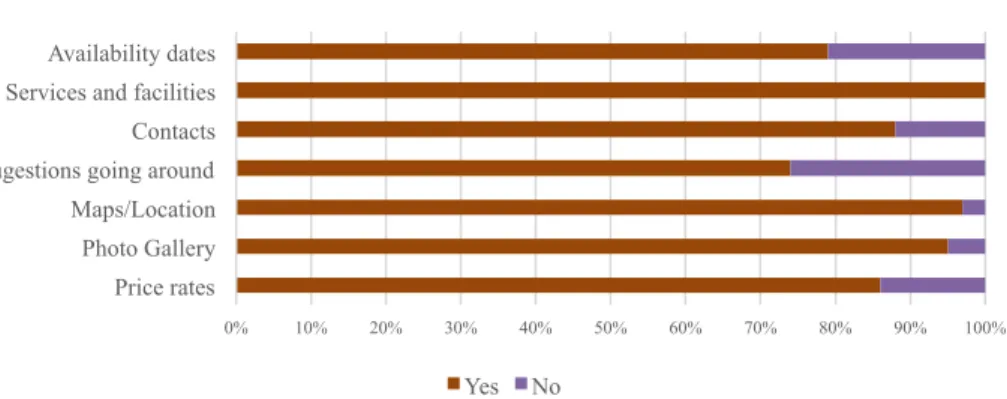
design. Besides website utilitarian features, hedonic ones are also important (Bilgihan & Bujisic, 2015). Most of the websites relates only to hotels of Porto or to the hotel chain to which they belong. The private websites, on its vast majority, have better navigability and content loading. Only 36 hotels websites are available at least in four languages (PT, EN, ES; FR) and present information at various levels: contacts, services and facilities, location, rate/prices, pictures, among others (See Figure 1). It turns out that many websites fail in providing all kinds of information thus confirming the findings of Li, Wang & Yu (2015). Moreover, 84% of the websites allow the possibility of reservations. They already have links to social networks such as Facebook (88%), Instagram (53%), Twitter (57%) or TripAdvisor (33%).
Figure 1: Information provided by Hotel’s website
4.1.1 Social networks
The social network most used by hotels is Facebook (50 in 59). Then, but with much less expression is Instagram (19 in 59) and Twitter (16 in 59). The presence on these social networks is corresponding to the number of followers (see Figure 2). Facebook is the social network where the pages have more followers and Twitter where they have less. The language used on publications is mainly Portuguese on Facebook while Portuguese and English are more used on Instagram and Twitter.
On Instagram and on Twitter the periodicity is monthly on the first social network and daily on second. On Instagram and Twitter, it was also assessed the sharing of content from other users, regram and retweet, respectively, and it was found that most of the profiles does not do it. Still on these social networks it was observed that a larger
0% 10% 20% 30% 40% 50% 60% 70% 80% 90% 100% Price rates
Photo Gallery Maps/Location Sugestions going around Contacts Services and facilities Availability dates
Hotels' website information
International Journal of Marketing, Communication and New Media. ISSN: 2182-9306. Special Number 2 - MDB, OCTOBER 2017
96 number of hotels use more hashtags on their publications than on Facebook. On the contrary, contact information is more often provided on Facebook than on Instagram, since on Twitter this feature does not apply. Essentially all the pages and social networking profiles have links to the website of the hotel, but few do the same to the other social networks.
Figure 2 : Number of followers in Instagram, Facebook and Twitter.
Figure 3: Number of reviews on Booking.com 0 5 10 15 20 25 30 1 2 3 4 5
Number of reviews on Booking.com Instagram
Top 3 - more followers 10500
The Yeatman Hotel
2091
Santana Hotel & SPA
2079
Douro Royal Valley Hotel & SPA
Instagram Top 3 - less followers
42
Villa Sandini Hotel & SPA
87
Villa C Hotel & SPA
97
Hotel Eurostars das Artes
Facebook Top 3 - more followers
59410
The Yeatman Hotel
44986
Douro Palace Hotel Resort & SPA
29684
Douro Royal Valley Hotel & SPA
Facebook Top 3 - less followers
128
Hotel Eurostar das Artes
314
Hotel Mercure Porto Gaia
320
Hotel Mercure Porto Centro
Twitter Top 3 - more followers
1321
The Yeatman Hotel
241
Douro Palace Resort & SPA
232
Penafiel Park Hotel & SPA
Twitter Top 3 - less followers
1
Hotel Rural Quinta das Quintães
11
São Félix Hotel Hillside & Nature
12
4.1.2 Booking.com and TripAdvisor
Once again, all hotels in this study have an account on Booking.com online booking platform with the exception of one. The rating of these establishments varies between 6.9 (Normal) and 9.5 (Superb). The score is assigned by former guests and can be accompanied by a comment, to which, more than half the hotels do not responding. Figure 3 presents the distribution of the number of reviews on Booking.com. The majority have less than one thousand reviews. Regarding TripAdvisor all hotels have a page apart from two. From all the hotels present in TripAdvisor, only 89% already manages the hotel page. A large number of luxury hotels in Porto have awards on TripAdvisor or are listed on the ranking of luxury accommodation in the cities of Porto and Vila Nova de Gaia. Figure 4 shows that majority of the hotels (N=20) have less than 250 reviews.
Figure 4: Number of reviews on TripAdvisor
4.2 Analysis of the interviews
The surveyed hotels reported that the responsible person in charge of digital marketing are mostly employees have between 30 and 40 years old with higher education in the areas of marketing and communication. Few hotels have employees dedicated exclusively to digital marketing functions. Hotels also referred that they already prefer digital media such as social networking and website for advertising campaigns and e-mail and social networks to communicate with guests, although many still use telephone communications. Li, Wang and Yu (2015) designated the future trends in marketing activities as change propensity analysis (CPA). Our study’s CPA reported by hotel managers revealed that in their digital marketing strategy, they intend to increase their
0 5 10 15 20 25 30 < 250 250 to 500 501 to 1000 1001 to 1500 > 1500
International Journal of Marketing, Communication and New Media. ISSN: 2182-9306. Special Number 2 - MDB, OCTOBER 2017
98 visibility, reservations, the proximity to guests and potential guests and improve their relation with these.
Reputation management taken by managers is confined to replying to comments and messages sent by users of the various platforms on which hotels are inserted. Next year, the majority of these hotels are planning to invest in tools like social networks, website, search engine optimization and mobile applications. The majority of managers use search engine optimization strategies to ensure that their online actions are discovered and noted by internet users.
4.2.1 E-mail marketing
The interviewed hotels have a database of their guests in various formats and use it for e-mail marketing campaigns about newsletter and information concerning reservations. Despite conducting these campaigns, a large number of the hotels do not monitor them. Therefore, they do not get any feedback regarding its effectiveness. The websites of the hotels, in some cases belong to the group or hotel chain and, in general, have its content poorly organized and with lacks of information regarding.
4.2.2 Social networks
Facebook is social network most used by hotels. This is because Facebook is the social network with more users and, as stated by the managers in the interviews, allows them to reach the highest number of people. On Facebook, hotels share pictures and videos, create events and give the users the possibility to book online or write a review. Although most hotels (48 to 50) provide a space for reviews, this is their only initiative to encourage interaction and active participation from fans of the page. The discrepancy between the assigned score on Facebook and the four-and five-star rating of hotels occurs because any user of this social network has the possibility to make an evaluation. That means people who never acquired a service in the hotel could make some of these evaluations. It is also possible that the evaluation by users of Facebook is referring to the hotel's performance in this social network and not its services.
Besides Facebook, hotels also have accounts on Instagram and Twitter and plan to strengthen their presence on social networks by creating accounts on Pinterest, LinkedIn, Snapchat and Google +. The pages and profiles of some hotels on social networks do not share content for over a year, which demonstrates an abandonment in behalf of managers or marketers. The literature review do not support this type of behavior,
because is the frequent sharing of content that promotes engagement with followers (Chu & Kim, 2011). Surveyed hotels justify this behavior by the change of employees that belonged to the marketing department, but due to the relatively low costs of the management of social networks, they should consider this advantage and pressure the marketing department to publish content more often.
Social networks are used almost exclusively for the promotion of services. This behavior was verified on both Facebook, Instagram and Twitter and it places the hotels at a disadvantage in comparison to other competitors who share interactive content and start discussion threads with users.
4.2.3 Booking.com e TripAdvisor
Once again, according to the interviews, all hotels have an account on Booking.com and the majority has an account on TripAdvisor. Sharing reviews and ratings by users is very common in these digital marketing tools, but very few of the surveyed hotels encourage guests to do so. Furthermore, it appears that more than half of hotels on Booking.com do not respond to reviews and, this behavior can cause them to lose guests. The hotels managers who respond to the reviews sometimes do not make a good approach because they choose to respond only to positive or negative reviews and use standard responses without any type of customization, with informal language and with spelling and grammatical errors. There is still the case of answers given by hotels long after guests made their evaluation or in a other language than that in which the guest commented. On TripAdvisor, almost all marketers and managers promote the hotel earned premiums to their guests.
5. CONCLUSIONS
Recently a study developed by Amadeus Traveler Trend Observatory (ATTO) forecasted six tribes that will evolve in 2030 according to key motivations and needs. 1) Simplicity Searchers value above everything else ease and transparency in their travel planning, and are willing to avoid having to go through extensive research themselves. 2) Cultural Purists treat their travel as an opportunity to break themselves entirely from their home lives and engage sincerely with a different way of living. 3) Social Capital Seekers understand that to be well-travelled is an enviable personal quality, and their choices are shaped by their desire to take maximal social reward from their travel. They will exploit the potential of digital media to enrich and inform their experiences, and
International Journal of Marketing, Communication and New Media. ISSN: 2182-9306. Special Number 2 - MDB, OCTOBER 2017
100 structure their adventures with the fact of their being watched by online audiences present in their mind. 4) Reward Hunters are the luxury travelers who seek truly extraordinary experiences. 5) Obligation Meeters have their travel choices restricted by the need to meet some bounded objective. 6) Ethical Travelers allow their conscience to be their guide when organizing and undertaking their travel.
It is visible the growing evolution of tourism and hotel industry in Porto in the last years. Porto has been awarded in the tourism sector by various entities and has been, year after year, visited by more and more tourists. Hotel establishments continue to be the kind of accommodation preferred by tourists and it turns out that an increasing number of these opts for luxury accommodations. It was found that, although there are several studies on the profiles of tourists that visit Porto, hotel managers do not use them. In summary, hotels must analyze the external environment in which they find themselves, as well as the profile of its guests, so they can plan appropriately their communication and marketing strategy, and achieve a strategic positioning in the market.
Furthermore, 59 hotels in this study use at least one digital marketing tool, and very few hotels have a significant presence in all. Digital marketing already represents a predominant role in communication and marketing strategy of these hotels, to the extent that all of them: 1) have employees trained in this area; 2) have a website; 3) are present in at least one social network, online booking platform and TripAdvisor; and 4) use strategies of database marketing, e-mail marketing and search engine optimization. The use of digital marketing tools in the communication and marketing strategy is carried out by hotels because they consider that their potential guests are increasingly using digital media. Despite these aspects, most hotels need to improve the use of digital marketing as marketing and communication tool, because although there is a large online presence, digital marketing tools are not used in order to take advantage of all its potential.
With the analysis of the online presence and the interviews, it is considered the hypothesis that managers and marketers are not fully aware of all the advantages that digital marketing can bring to their business. It was also concluded that the online reputation management, although hardly achieved, is already a concern for managers and marketers. Most hotels use several digital marketing tools. However, they still have very little interaction with online users, because there are only a few of them who
encourage guests to share some feedback regarding their stay, and even less, those who have the habit of responding to comments, positive or negative, which guests share in the studied platforms – social networks, Booking.com and TripAdvisor. However, changes in the digital marketing strategies that hotels have planned, on short term, are in agreement with digital marketing trends, so it is expected an increase and an improvement in the implementation of digital marketing tools. The strategic use of these tools allows hotels to improve their communication and to have a closer relationship with guests and potential guests. Managers and marketers must take advantage of that relationship and learn from the feedback given by the guests and by the metrics and statistics provided by the digital marketing tools that if used properly can facilitate interaction and promote guest’s loyalty.
5.1 Managerial implications: recommendations for improvement of digital marketing in the hotel industry
This study gives a relevant contribution for marketing managers of hotels because it exemplifies some good practices and criticisms of the use of digital marketing strategies implemented by hotel establishments. Moreover, it also presents a contextualization of tourism and of the hotel sector in Porto that can be used as an orientation for the implementation of a digital marketing strategic. Although many companies are unable to afford large investments in digital marketing, in this study they will find some basic suggestions for a more effective use. These suggestions are about changes in the content and form of communication with followers, because online details make all the difference. It was confirmed throughout the study that the correct implementation, use and monitoring of digital marketing strategies brings advantages such as costs reductions, speed and simplicity in communication, improvement of the interaction and relationship with guests, easy monitoring, and the elimination of temporal and geographical limitations. Managers and marketers in addition to these advantages can use digital marketing to carry out customer support and loyalty actions and increase the visibility of their hotel establishment.
Therefore, some recommendations are provided here:
Recommendation 1: Hotels must implement digital marketing training, focused on the use of digital tools for employees of marketing department, in order to ensure the effective use of these tools, because it is not enough to have an online presence if it is not planned and carried out effectively.
International Journal of Marketing, Communication and New Media. ISSN: 2182-9306. Special Number 2 - MDB, OCTOBER 2017
102 Recommendation 2: The marketing department has to be concerned with the creation of diversified, innovative and appealing content to differentiate the hotel from the competition and ensure the engagement of internet users. Because this is a trend of the future of digital marketing, managers recommend the use of videos, which despite being a more expensive format, are considered a good storytelling tool that increases the visibility of the hotel and provides good tools to post-campaign analysis.
Recommendation 3: As suggested by Šeric, Gil-Saura and Ozretić-Došen (2015) or Murphy, Chen and Cossutta (2016) who compared different information sources and booking systems, hoteliers should implement a multi-channel distribution management system across devices. It is also suggested the linking of all digital platforms in which the hotel is present and ensure the coherence of communication. This action will strengthen online presence, in addition to providing security for users seeking to find more information about the hotel. This suggestion also regards the inclusion of comments and ratings from guests, in multiple formats on the multiple platforms used by hotels. This recommendation is justified by the advantages presented in this study relating to the availability of information about the hotel by neutral agents.
Recommendation 4: Hotels must evaluate the impact of all digital marketing actions. Recommendation 5: Hotels must define clearly the audiences for whom they wish to communicate to ensure the effectiveness of their digital marketing actions.
Recommendation 6: As mentioned previously, it is not worthwhile to have presence in many digital platforms if it is not done correctly or if there are no means to do so. Thus, hotels should evaluate the viability of presence on social networks.
Recommendation 7: Finally, it is necessary to increase the engagement with guests and potential guests on the digital environment but mainly on social networks, since this is the main purpose of these tools as suggested by Chu and Kim (2011). In addition to social networks, the hotels must worry about their online reputation on online booking platforms and on the websites of tourist opinion, like TripAdvisor. This engagement can be done through the response to reviews and comments, but mainly by encouraging dialogue and interaction between guests, potential guests and the hotel.
REFERENCES
Amadeus Traveller Trend Observatory- ATTO (2015). Future Traveller Tribes 2030: Understanding Tomorrow’s Traveller. Future Foundation. Retrieved from
http://www.amadeus.com/documents/future-traveller-tribes-2030/travel-report-future-traveller-tribes-2030.pdf]
Amaral, F., Tiago, T., & Tiago, F. (2014). User-generated content: tourists’ profiles on Tripadvisor. International Journal of Strategic Innovative Marketing, 1(3), 137-145. Bilgihan, A., & Bujisic, M. (2015). The effect of website features in online relationship marketing: A case of online hotel booking. Electronic Commerce Research and
Applications, 14(4), 222-232.
Bilgihan, A., Barreda, A., Okumus, F., & Nusair, K. (2016). Consumer perception of knowledge-sharing in travel-related Online Social Networks. Tourism Management, 52, 287-296.
Brodie, Roderick J., Ilic, A., Juric, B., & Hollebeek, L. (2011). Consumer engagement in a virtual brand community: An exploratory analysis. Journal of Business Research, 66(1), 105–114.
Cabiddu, F., De Carlo, M., & Piccoli, G. (2014). Social media affordances: Enabling customer engagement. Annals of Tourism Research, 48, 175-192.
Callarisa, L., García, J. S., Cardiff, J., & Roshchina, A. (2012). Harnessing social media platforms to measure customer-based hotel brand equity. Tourism Management
Perspectives, 4, 73-79.
Chaffey, D., Ellis-Chadwick, F., Mayer, R., & Johnston, K. (2009). Internet Marketing- Strategy, Implementation and Practice. (4th ed). Pearson Education, Ltd.
Chu, S. C., & Choi, S. M. (2011). Electronic word-of-mouth in social networking sites: A cross-cultural study of the United States and China. Journal of Global
Marketing, 24(3), 263-281.
Chu, S. C., & Kim, Y. (2011). Determinants of consumer engagement in electronic word-of-mouth (eWOM) in social networking sites. International journal of
Advertising, 30(1), 47-75.
Delloite (2015). Atlas da Hotelaria. Retrieved from http://atlasdahotelaria.com/2015 Delloite (2016). Atlas da Hotelaria. Retrieved from http://atlasdahotelaria.com/2016 Eurostat (2016). Statistics on ICT use in tourism. Retrieved from http://ec.europa.eu/eurostat/web/main/home
Experian Marketing Services (2015). Five views on how marketing will change in 2015. Retrieved from http://www.experian.co.uk/assets/marketing-services/white-papers/wp-digital-insights-5for15.pdf
International Journal of Marketing, Communication and New Media. ISSN: 2182-9306. Special Number 2 - MDB, OCTOBER 2017
104 Hennig-Thurau, T., Malthouse, E. C., Friege, C., Gensler, S., Lobschat, L., Rangaswamy, A., & Skiera, B. (2010). The impact of new media on customer relationships. Journal of service research, 13(3), 311-330.
IPDT (2015). Perfil do Turista do Porto e Norte de Portugal. Instituto Português do Desenvolvimento do Turismo.
Kriechbaumer, F., & Christodoulidou, N. (2014). SME website implementation factors in the hospitality industry: Groundwork for a digital marketing roadmap. Worldwide
Hospitality and Tourism Themes, 6(4), 328-351.
Lamberton, C., & Stephen, A. T. (2016). A thematic exploration of digital, social media, and mobile marketing: research evolution from 2000 to 2015 and an agenda for future inquiry. Journal of Marketing, 80(6), 146-172.
Leung, X. Y., & Baloglu, S. (2015). Hotel Facebook marketing: an integrated model. Worldwide Hospitality and Tourism Themes, 7(3), 266-282.
Leung, X. Y., Bai, B., & Stahura, K. A. (2015). The marketing effectiveness of social media in the hotel industry: A comparison of Facebook and Twitter. Journal of
Hospitality & Tourism Research, 39(2), 147-169.
Li, X., Wang, Y., & Yu, Y. (2015). Present and future hotel website marketing activities: Change propensity analysis. International Journal of Hospitality Management, 47, 131-139.
Melián-González, S., & Bulchand-Gidumal, J. (2016). A model that connects information technology and hotel performance. Tourism Management, 53, 30-37. Munar, A. M., & Jacobsen, J. K. S. (2014). Motivations for sharing tourism experiences through social media. Tourism management, 43, 46-54.
Murphy, H. C., Chen, M. M., & Cossutta, M. (2016). An investigation of multiple devices and information sources used in the hotel booking process. Tourism
Management, 52, 44-51.
Park, D. H., Lee, J., & Han, I. (2007). The effect of on-line consumer reviews on consumer purchasing intention: The moderating role of involvement. International
journal of electronic commerce, 11(4), 125-148.
Šeric, M., Gil-Saura, I., & Ozretić-Došen, Đ. (2015). Insights on integrated marketing communications: implementation and impact in hotel companies. International Journal
of Contemporary Hospitality Management, 27(5), 958-979.
Statistic Brains (2016). Internet Travel & Hotel Booking Statistics. Retrieved from http://www.statisticbrain.com/internet-travel-hotel-booking-statistics/
Verhoef, P. C., Reinartz, W. J., & Krafft, M. (2010). Customer engagement as a new perspective in customer management. Journal of Service Research, 13(3), 247-252. Vermeulen, I. E., & Seegers, D. (2009). Tried and tested: The impact of online hotel reviews on consumer consideration. Tourism Management, 30(1), 123-127.
Virginia, P. K., Chen, H. T., & Haney, M. (2013). “Like” and “Check-in”: how hotels utilize Facebook as an effective marketing tool. Journal of Hospitality and Tourism
Technology, 4(2), 134-154.
Vu, H. Q., Li, G., Law, R., & Ye, B. H. (2015). Exploring the travel behaviors of inbound tourists to Hong Kong using geotagged photos. Tourism Management, 46, 222-232.
Wang, Y., Chan, S. C. F., Leong, H. V., Ngai, G., & Au, N. (2016). Multi-dimension reviewer credibility quantification across diverse travel communities. Knowledge and
information systems, 49(3), 1071-1096.
Wei, W., Miao, L., & Huang, Z. J. (2013). Customer engagement behaviors and hotel responses. International Journal of Hospitality Management, 33, 316-330.
World Tourism Organization (2014). Tourism and New Technologies - Technical Seminar, San José, Costa Rica, 14 and 15 May 2013. Madrid: UNWTO.
Xiang, Z. & Gretzel, U. (2010). Role of social media in online travel information search, Tourism Management, 31(2), 179-188.
Xie, H. J., Miao, L., Kuo, P. J., & Lee, B. Y. (2011). Consumers’ responses to ambivalent online hotel reviews: The role of perceived source credibility and pre-decisional disposition. International Journal of Hospitality Management, 30(1), 178-183.
Zhang, H., Fu, X., Cai, L. A., & Lu, L. (2014). Destination image and tourist loyalty: A meta-analysis. Tourism Management, 40, 213-223.
How to cite this article:
Leite, R. A. & Azevedo, A. (2017) The Role of Digital Marketing: A perspective from Porto Hotels’ Managers. International Journal of Marketing, Communication and New Media. Special Number 2 – Marketing and Digital Business, 88-105, Available at http://u3isjournal.isvouga.pt/index.php/ijmcnm.