Automating Home Appliances for Elderly and Impaired People:
The B-Live Approach
Paulo Bartolomeu, José Fonseca, Vasco Santos, Alexandre Mota, Valter Silva, Margarida Sizenando
†Micro I/O – Serviços de Electrónica, Lda., {bartolomeu, vsantos}@microio.pt DETI – Universidade de Aveiro, {jaf, alex}@ua.pt
ESTGA – Universidade de Aveiro, [email protected]
Centro de Medicina Física e Reabilitação do Sul, [email protected] Abstract1— This paper describes the B-Live approach
for automating home appliances for elderly and impaired people. This system has been developed at Micro I/O for enhancing the quality of life and the independence of its potential users. The target application is the retrofitting of common dwellings.
The paper introduces the motivation for the B-Live system and presents a survey on current Smart Home projects and endeavours. The B-Live system is described and details on its software, hardware and communications architecture are provided. A survey of the supported appliances and interfaces is presented as well as a description of the B-live configuration and operation procedures. The suitableness of the B-Live system to improve the autonomy of the envisaged users was informally evaluated by C4, C5 and C6 patients at the CMRRC Rovisco Pais demonstrator. The conclusion is that the system has a short learning curve and can cope with the requirements of its potential users.
I. INTRODUCTION
In recent years a lot of research has been made towards improving the quality of life of elderly and impaired people. The world population is aging rapidly and the life expectancy is increasing fueled by the improvements in medical care services and the advances in technology [1]. These trends are associated with the increasing number of older people (both in absolute and relative terms), the increasing number of “older” elderly people, the smaller number of informal careers and the smaller productive workforce (to support formal health and social services) [2]. Hence, these factors and the pressure for cost containment are posing significant challenges to health organizations and social care services.
This work was supported by Micro I/O – Sistemas Electrónicos, Lda, under its NITEC unit funded by the PRIME program, by the Fundação para a Ciência e a Tecnologia under grants POSI 2004 Medida 6.1, Ref. SFRH/BDE/15602/2006 and PRODEP 2001 – Formação Avançada de Docentes do Ensino Superior Nº 200.019, and developed under a protocol with the Centro de Medicina e Reabilitação da Região Centro – Rovisco Pais.
† At the time of this work, the author was with the Centro de
Medicina e Reabilitação da Região Centro – Rovisco Pais.
Another challenge is to provide quality of life and independence to impaired people. A possible direction can be to maintain elderly or impaired people living in the comfort of their homes [3], provided the assistance of an automation system in daily life tasks (open doors, close blinds, turn on/off lights, etc.) or in health monitoring (vital parameters, advanced chemical analysis, etc.).
Several types of domotic systems can be found, depending on the applications: new houses, retrofitted houses and large buildings. The former are mainly developed for illumination and entertainment. These are often centralized, proprietary and require point-to-point connections with specific interfaces that can only be adapted to houses during their construction phase. One example is the Lutron system [4]. The second type features similar characteristics but can provide support to retrofit houses, by using power-line, e.g. X10 [5] or radio-frequency communications, e.g. TELECO [6]. The third type addresses the environmental control of large buildings (illumination, temperature, etc.). These systems are usually complex, allowing thousands of sensors and actuators to operate simultaneously, and based on (expensive) standard technologies such as EIB [7] and LonWorks [8].
The field known as Smart Houses [9, 10] emerged from the research activity in both home automation [11] and home networking areas [12]. The inclusion of Assistive Technologies altogether with the requirements of elderly and impaired users drove the assistive social-oriented application of Smart Houses [13] into the health domain, originating the concept of Health Smart Home (HSH) [14]. The B-Live system was developed in this context as a flexible and modular home automation system that enables conventional homes to become HSHs, including the possibility to accommodate real-time and safety critical applications.
This system was originally developed to address the requirements of impaired people and to promote the dissemination of low cost assistive technologies. However, during the collection of user requirements, and in the development phase of the product, we realized that a significant part of the elderly population would benefit from the autonomy that such a system can provide.
A. Motivation
The motivation for developing the B-Live system arises from two main factors: the specificities of this type of automation system and the inclusion of health support systems.
Concerning the former, one should consider that the targets are conventional houses, adapted when users have an accident leading to a disability (typical situation in tetraplegic people) or when they get older. Conventional house systems are different from building automation, showing a reduced number of appliances and no need for subdivision and/or hierarchies. Therefore, appliances can share a common vision of every event concerning the system operation. This enables the enhancement of configurations, giving the user the power to adapt the house to its own requirements.
The second factor adds more restrictive requirements to the automation systems if the designer wants to support the application in just one system. The inclusion of health support systems, e.g., life monitoring (ventilators, cardiac monitoring, other diagnosis devices such as urometers, etc.) makes the system safety critical and imposes real-time operation. For example, a tetraplegic person left alone at home and relying on a ventilator to keep breathing should require real-time detection of the device’s operating condition. This can only be achieved with systems that are able to deliver alarms in deterministic bounded time (i.e. real-time systems) and whose operation is guaranteed (i.e. providing dependable behavior).
Also, the severe impairments of the potential users pose demanding restrictions even to conventional systems. For example, a close door operation becomes much more critical. So, the support of dependability and real-time operation must also be seriously considered in these, usually trivial, applications. B. User Requirements
Severely impaired people such as tetraplegic show a strong limitation in the possibility to manipulate devices. In our experience, at the “Centro de Medicina e Reabilitação da Região Centro – Rovisco Pais” (CMRRC-RP) located in Tocha, Portugal, we have dealt mainly with C4, C5 and C6 patients [15, 16]. A Cx patient is a person that has an injury in the Cx vertebra. This affects his/her spinal chord leading to the referred movement impairments. It should be noticed that all those patients have no capacity to move the legs and lower part of their body. Depending on the injury, they can move partially the arms (by moving the elbow), they can just provide small movements in one or two fingers or they can even loose all the capacity to move the arms and hands, relying, in this case, only on the head to control devices. The most severe cases in tetraplegic patients
are the ones in which autonomous breath is no longer possible. In this case patients rely on a ventilator to support this vital functionality.
It should also be referred that, during rehabilitation, these patients acquire new ways to use their impaired members. This is done by intensive training in using the movements that they are still able to perform. The impulse that urges them to live leads their efforts towards the use of devices that keep them in contact with the world. This is the case of TV, mobile phones and computers. The rehabilitation effort leads then to a, sometimes surprising, ability to operate devices such as a TV remote control or a mobile phone. It should be noticed that this operation is done in a quite different way of the one used by non-impaired people. This occurs due to the lack of muscular force and limited precise limb motion (e.g. handling a standard joystick). So, frequently, patients develop ways to operate common devices using residual shoulder and elbow movements together with gravity (e.g. to push buttons).
An important aspect is that these patients are usually extremely dependent on their caregivers to perform the Activities of Daily Living (ADLs). So, even with the help of Ambient Intelligence (AmI), they require assistance with many of their ADLs (e.g. changing the urinary drainage bag). As such, if an automation system provides a few hours of autonomy, they will be relieved from the pressure of being fully dependent on caregivers, allowing them to carry on complementary activities that result in economic, social and psychological benefits for both.
This paper is organized as follows: section 2 presents a survey on Smart Homes by focusing current research projects addressing the problematic of improving the quality of life of elderly or impaired people. Section 3 presents the B-Live system by focusing on its hardware, software and communications architecture. Section 4 presents the developed interfaces and the supported appliances. The deployment aspects of the B-Live system are presented in section 5 as well as the informal evaluation conducted on a demonstration setup installed in a rehabilitation center. This paper is concluded in section 6 by summarizing its contributions and suggesting future work directions.
II. A SURVEY ON SMART HOMES
A large set of research projects in the field Smart Homes has been identified in [10], including research within the academia (KTH’s comHOME, MIT’s House of the Future and the University of Massachusetts Intelligent Home, just to mention some) and within the industry (e.g. Cisco’s Internet Home, Microsoft’s EasyLiving, Siemens Smart Home and Intel Architecture Labs). Despite the intense
activity on this area of research, only two projects explicitly address the requirements of elderly or impaired people: CUSTODIAN and Portsmouth Smart Home. The CUSTODIAN project has been developed to “create barrier-free homes for homeowners with disabilities” while the Portsmouth Smart Home was designed to “support independent living for disabled users”.
In [14] Noury N. et al. defined the Health Smart Home as being aimed “… at giving an autonomous life, in their own home, to people who would normally be placed in institutions…”. The authors also provide a state of the art on health smart homes going back to 1998 were allegedly it all started with the monitoring of daily life activities and physiological parameters.
In order to better understand the challenges that the field of Health Smart Homes is facing, a survey on current research projects was performed. The following projects represent some of the key players in this area of research.
MonAMI Project [17]: stands for Mainstreaming
on Ambient Intelligence (AmI) and is developed by a consortium of partners (including enterprises, academia and health organizations) sponsored by the EU IST (Information Society Technologies) 6th Framework Programme (FP6). The goal of this project is to “demonstrate that accessible, useful services can be delivered in mainstream systems and platforms” to elderly and disabled users living in their home environment. This project focuses services, technology, AmI and real mainstream implementation. Its conclusion is expected in 2010 (4 year project) with a large-scale validation of services and a deployment plan.
University of Florida Gator Tech House [18, 19]:
it is a laboratory-house designed to assist disabled and older persons in maximizing independence and improving their quality of life. This project focuses on developing programmable pervasive spaces where “a smart space exists as both a runtime environment and a software library”. In this approach, the integration of components is performed, using service definitions of sensors and actuators, through service discovery and gateway protocols. The service-oriented programmable spaces approach enables domain experts (e.g. health professionals) to develop and deploy applications themselves.
University of Rochester Smart Medical Home
[20]: develops an integrated Personal Health System allowing the user to maintain health, detect the onset of a disease and manage it in the privacy of its own home. The Smart Medical Home has the ultimate goal of being a user-centric Health System where all technologies are integrated and work seamlessly. The pursuit of this goal is conducted as a Focused Research Project, where the different research
directions are investigated in multidisciplinary research projects, according to the University policy.
Duke University Smart Home [21]: it is a live-in
research laboratory aiming at improving the quality of life of people of all ages by contributing “to the innovation and demonstration of future residential building technology”. The Duke Smart Home Program consists in a set of research projects addressing Efficiency, Health, Automation and Entertainment. These projects are developed by students with the support of faculty members and industry mentors having, in most cases, the Home Depot Smart Home in mind. This house is expected to be opened by November 2007.
Georgia Institute of Technology Aware Home
[22, 23]: it is “an interdisciplinary research endeavor aimed at addressing the future of domestic technologies”. The Georgia Tech Broadband Institute Residential Laboratory is a living facility used for interdisciplinary design, development and evaluation. It encompasses projects to assist seniors as they age in place, to support caregivers in their activities (task and home management) and to provide assistance for individuals at risk. Research activities are conducted in four complementary themes: Design for People, Technology, Software Engineering and Social Implications.
TAFETA [24, 25] stands for Technology Assisted
Friendly Environment for the Third Age and is a research group, including partners from academia, industry and public health organizations, focusing the development of a Smart Home system for elderly people. This group has a Smart Apartment located within a Health Centre where the smart technologies are evaluated. The research activity is conducted through projects addressing the development of assistive (Nouse, Lited Pathway, etc.) and injury prevention technologies (SmartCells, Smart Toilet Grab Bar, etc.), among others.
These projects share design strategies focusing the user by promoting his/her independence through the integration of technologies and the implementation of accessible smart (assistive) environments. However, some of these projects are academic endeavors while others are too expensive to be installed in common homes. Also, these projects do not address the retrofitting of common dwellings and most of them were not designed to support safety critical applications such as the real-time monitoring of vital signals or devices. As such, a different automation system was developed and it is described in the following sections.
III. B-LIVEARCHITECTURE
The B-Live system has a modular and scalable architecture. A fieldbus connects all modules in the
system, allowing to reduce the amount of cables required to guarantee communication between modules. The inclusion of adequate Human-Machine Interfaces (HMIs) in the B-Live system enables severely disabled users to operate enhanced home appliances. Fig. 1 represents the functional architecture of the B-Live system.
Additional functions can be integrated in the system by adding modules that support them. These modules do not interfere with the performance of the original system. This is the main advantage of a modular and scalable architecture, as the system may evolve without compromising older functionalities.
Figure 1. Functional architecture of the B-Live system
A. Hardware
The B-Live system is composed by modules with different functions but sharing a common structure. Each module includes two digital inputs for manual actuators (e.g. switches) and four digital outputs to operate external devices. Additionally, a module can also send/receive commands through the fieldbus. The use of a unified architecture facilitates the development and integration of new modules. A B-Live module is divided in two blocks (Fig. 2): the control board and the daughterboard.
Figure 2. Hardware architecture of the B-Live modules
The former is responsible for tasks such as receive and process information sent by other B-Live modules, actuate locally (through the daughterboard) or send instructions to the network. This board holds a Microchip PIC18F2580 microcontroller and all the external components required for operation (crystal oscillator, pull-up resistors, decoupling capacitors, etc.). The daughterboard drives local devices and provides communication between them and the control board. A B-Live module can be customized to any particular function (light switch, light driver, food
dispenser control, etc.) by using an appropriate daughterboard.
B. Software
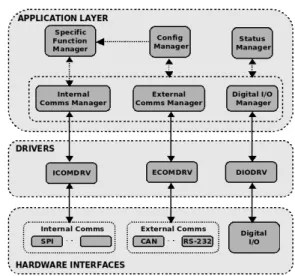
The software architecture of a B-Live module is divided in three parts (Fig. 3): Application, Drivers and the Hardware Interfaces. Depending on the module application, there can be different Drivers connecting the Application to the Hardware Interfaces. The Application runs over different managers to perform several tasks: store the configuration and status of the modules, define the special functions, manage internal and external communications and digital inputs and outputs. The Hardware Interfaces represent, as the name suggests, the multiple physical technologies associated with the module.
This architecture has been motivated by the fact that a B-Live module may use several internal (SPI, I2C, etc.) and external (CAN, ZigBee, etc.) communication technologies simultaneously, although separately driven. Internal communication carrying data between devices installed within the same B-Live module use the ICOMDRV driver while external communications transmitting/receiving data to/from other B-Live modules or supported equipments use the ECOMDRV driver. This approach, compared to having a single driver structure for each communication technology, allows reducing the driver layer footprint and simplifies the coordination of internal or external communications. This way it is easier to schedule internal and external communications according to user/application profiles.
Figure 3. Software Architecture C. Communications
Currently, the B-Live modules communicate using the Controller Area Network (CAN) [26] fieldbus. This protocol was developed by Bosch and it is widely used in the automotive industry due to its availability and easy operation. The option for the CAN fieldbus arises from a set of properties and add-ons related with
fault tolerant operation, real-time communications, cost and designer experience. In fact, the research team associated to the authors has done extensive studies of the use of CAN in real-time applications [27] and of adding fault-tolerance mechanisms [28].
The B-Live modules communicate by means of messages that follow the structure depicted in Fig. 4. As it can be seen, an EIA-232 message incorporates a CAN message in its structure. The support of the EIA-232 communication is important because, besides allowing standard wired connections between the system and computing devices such as PCs, laptops, PDAs, Mobile Phones, etc., it also allows wireless connections using devices supporting wireless communication serial profiles such as the Bluetooth Serial Port Profile (SPP). As such, a user can send messages to the system by using, for example, a PDA supporting the Bluetooth SPP connected to a Bluetooth-EIA-232 adapter plugged in a B-Live module. Despite the Bluetooth SPP transmission delays [29, 30] and the delay introduced by processing and transmitting the message in the CAN fieldbus, when applicable, this approach seems suitable for configuration purposes and for controlling the appliances of the house.
SFD IDMsg Src CRC EFD
ADDR LEN DATA
CAN
Figure 4. Structure of a RS-232 message The motivation for using a common structure among different frames is their handling simplification for both communication protocols (CAN and EIA-232).
The current communication protocol operating on top of CAN is a device-oriented message system, where the message contents specify which device is going to be operated. A new communication protocol, based on the Publisher-Subscriber cooperation model has been proposed in [31] and is currently under development.
IV. APPLIANCES AND INTERFACES
The B-Live system provides a range of interfaces that allow controlling the illumination, accessibility, hygiene, food supply and power control appliances installed on the house.
Illumination appliances include the control of lamps and window blinds to increase/decrease the room lighting. A user can switch on/off lamps either by using the standard switches mounted in the house’s walls or by using the B-Live interfaces concurrently. Moreover, to evaluate for damaged lamps, the B-Live system allows turning all of them on at once, becoming easy to verify which are not working properly.
The existing access appliances are the front door and the in-house door controls. The difference between them is the inclusion, in the house front door, of a security mechanism to restrain unauthorized users from getting in. Users may control the state of the doors (open/closed) by using the standard supplied interfaces (e.g. wall mounted buttons) or the B-Live interfaces. Doors can be configured to close automatically after a given period of time.
Currently, only one hygiene appliance is supported, the toilet flush. This appliance allows people to flush the toilet using standard interfaces (e.g. pushbutton) or a proximity switch that actuates when nearby movement is detected, for example, a hand passing near the detector. This appliance was designed to address the lack of force that many tetraplegic patients exhibit.
The B-Live system also supports a single food supply appliance: the automatic food-dispensing machine. This equipment was inspired in a vending machine but, besides providing a more adequate food withdraw mechanism and a standard keypad for choosing food, it can be operated using the B-Live interfaces, thus making it suitable for the target users.
Power control modules were designed to allow the switching (on/off) of domestic equipments (television, Hi-Fi, video, heater, etc). As such, they are installed in the mains plugs (supplying power to the equipments) and can be controlled through a nearby installed (on/off) button or by the interfaces provided with the B-Live system.
The B-Live system provides a set of specific interfaces, namely a Personal Computer (PC) based Human-Machine Interface (HMI), a Mobile Phone (MP) HMI and a wheelchair interface. Both PC and MP HMIs are menu driven JAVA applications that run on a large set of operating systems and platforms. Although using the same programming language and communication technology (Bluetooth), these HMIs are conceptually different. The PC HMI was developed to run on a (laptop, PC) computer having a fairly large screen area (l024x768) while the MP HMI was designed to run on small mobile devices (e.g. MPs, PDAs, etc.) having a small screen area. The MP HMI only allows controlling the features of the appliances while the PC HMI allows performing configuration (and binding) operations over the entire B-Live system.
The PC HMI can be operated with the IntegraMouse device [32] (Fig. 5), which enables severely impaired users to be able to operate their PCs and control the enhanced appliances installed in their house. The IntegraMouse is a special device that shares the functionality of a common mouse. However, it is operated using the mouth for moving the pointer
around the area of the screen and the air blow and suction for click operation.
The communication between the HMIs (PC and MP) and the B-Live system is conducted using the Bluetooth Serial Port Profile (SPP), i.e. emulating an EIA-232 physical connection between a HMI and a B-Live module. As such, commands are transmitted (over-the-air) as if the target device was physically attached through an EIA-232 connection.
Figure 5. IntergraMouse (top-left), IntegraSwitch (bottom-left) and wheelchair command (right)
interfaces
The wheelchair interface (Fig. 5) was developed targeting the needs of patients that are not able to exercise force and execute precise movements such as dialing numbers on a telephone keypad. It is composed of two separate devices operating together: the vocalized menu and the wheelchair command. The vocalized menu is a hardware device that stores pre-recorded menu sentences and plays them according to a predefined sequence in a set of speakers installed in the area(s) of interest.
The wheelchair command holds two buttons that allow making selections on the vocalized menu or moving faster through the menu options. This device, as the name suggests, is usually attached to a wheelchair. However, it can be used independently, as it is powered by a standard battery, is small in size and communicates with the vocalized menu over a dedicated RF link.
V. DEPLOYMENT AND ASSESSMENT
The deployment of the B-Live system is made by physically adapting house appliances with modules that operate in parallel with the standard interfaces. These modules are then connected with each other through a common fieldbus. When the physical installation is concluded, the system can be Configured and Operated as described in the two following subsections.
In order to assess the adequacy of the B-live system to the envisaged users, a demonstrator was installed at the CMRRC-RP and an informal evaluation was carried out. The feedback obtained in this assessment is discussed in the last subsection (Assessment).
A. Configuration
The first step in running the B-Live system is to execute an overall configuration of the modules. This procedure is usually performed when the system is installed for the first time and consists in setting each module with a unique identification.
B-Live modules are not produced with default identification, besides the serial number. In this sense, the technician installing the B-Live should individually configure all modules through a serial EIA-232 connection using an application. After having an identification, a module becomes addressable thus allowing further configuration to occur over the network.
The final step in running the system is the binding of devices, i.e. the association of the driving device’s (e.g. switches) output with the inputs of the driven devices (e.g. lamps). This association is made through the network or over an EIA-232 connection using specific commands.
The time required to install a B-Live system from scratch could be inappropriate if individual configuration commands had to be sent to each module and to each attached device. Following, the B-Live system provides a software utility allowing to customize the B-Live modules (and attached devices) for a given functionality. This procedure is supported by a template Comma Separated Value (CSV) configuration file that, after being loaded in the software utility and properly customized, allows to send the corresponding commands, in batch mode, through the network, to all modules and attached devices.
B. Operation
Assume a scenario in which a user wishes to turn on the living room lamp using the wheelchair interface. The voice menu recites all available appliances in the house, grouped by divisions. Once the user listens the correct option (e.g. “turn on lamp from living room”), he/she uses the wheelchair command to select it by clicking twice on the SELECT button. The RF emitter included in this command is matched with the RF receiver connected to the inputs of the vocalized menu. Therefore, the buttons of the wheelchair command can be seen as virtual buttons on the vocalized menu, as long as there is an RF connection between them. So, after the selection of the “turn on lamp from living room” option, the vocalized menu broadcasts a CAN message with information to switch on the living room lamp. All connected modules will receive it and check for an identification match with any of the locally attached devices. Only the B-Live module with the matching identification will operate the device and turn on the living room light.
Another scenario arises when, for example, the B-Live system is operated through the MP HMI. In this case, a mobile phone communicates with the B-Live system through an emulated Bluetooth serial connection. The HMI Java application, running in the mobile phone, offers several options to the user. If “turn on all lamps” option is selected, the application sends a frame over the Bluetooth serial link to a B-Live device equipped with a Bluetooth-to-EIA-232 adapter. After decoding the received EIA-232 frame, this B-Live module acknowledges that the received command must be broadcasted in the B-Live (CAN) network so that the other modules equipped with lighting devices may turn them on. Provided that all modules in the CAN network receive this frame, the ones having lighting devices attached (e.g. lamps) will turn them on while the remaining will ignore the message.
C. Assessment
A B-Live demonstrator was installed at the “Centro de Medicina e Reabilitação da Região Centro – Rovisco Pais” (CMRRC-RP). The CMRRC-RP is a hospital and rehabilitation center that helps tetraplegic and paraplegic patients in their rehabilitation. Besides the Hospital infrastructure, the CMRRC-RP provides houses for training patients (Fig. 6) before being discharged from the center. The demonstrator allows disabled users to operate appliances such as turn on/off the room, kitchen, WC, living room and corridor lights, open/close room blinds, front door and WC door, and turn on/off devices plugged in adapted mains power plugs.
Figure 6. A rehabilitation house at the CMRRC-RP The B-LIVE system is a young commercial product still under development. As such, only informal evaluations have been carried out to assess the adequacy of the system to the requirements of its envisaged users. In this sense, CMRRC-RP patients evaluated the B-LIVE system in two occasions: August 2006 and February 2007. In the first, one C4-C5 and two C6 users were able to operate all the B-LIVE functionalities installed in the house. In the second evaluation, a C6 tetraplegic user lived in the house for a period of 48h. All users were able to successfully operate the B-LIVE system without having any earlier training on the user interfaces.
VI. CONCLUSION
Modern health care services are being challenged to provide quality of life and independence for elderly and impaired people. A possible direction is to maintain elderly or impaired people living in the comfort of their own homes being assisted by a smart environment.
Several research projects have been carried out to address this problematic. While some are academic endeavors others are simply too expensive to be installed in common homes. In addition, these projects do not address the problematic of retrofitting common dwellings and, in most cases, are not designed to support safety critical applications such as the real-time monitoring of vital signals or devices. As such, this paper describes an automation system developed to address the requirements of elderly and impaired people while promoting the dissemination of low cost, real-time and easily installable assistive technologies.
The paper analyzes the B-Live system by focusing on several key aspects of its hardware, software and communications structure. Furthermore, a technical overview of all supported appliances and interfaces is presented as well has its configuration and runtime operation.
Regarding the B-Live demonstrator, deployed at the CMRRC-RP, a brief description of its functionalities is provided as well as the result of an informal on-site assessment made by C3 and C4 patients. The results seem to indicate that system has a short learning curve and that it provides the required support for automating house appliances targeting elderly and impaired people.
Future work includes an extensive quantitative analysis of the B-Live interfaces in order to assess their ergonomics, user-friendliness and performance for long term usage. In this context, the support of alternative interfaces (e.g. Braille keypads) can also be studied. The communication protocol shall be enhanced, as proposed in [31], and the support of safety-critical appliances (ventilators, cardiac monitoring devices, etc.) should be investigated in future developments.
The task of simplifying the installation of the B-Live system by using wireless communication to substitute the wired CAN fieldbus is an open research issue. Efforts ought to be made in maintaining or improving the original solution’s overall characteristics.
REFERENCES
[1] Coughlin, J., “Technology needs of aging boomers”, Issues in Science and Technology, vol. 16, no.1, pp.53-60, 1999.
[2] Paolo Dario, et al., “Biorobotics for Longevity,” Proc. IEEE 9th Int. Conference on Rehabilitation Robotics, June, 2005.
[3] Harmo, P. et al., “Needs and Solutions - Home Automation and Service Robots for the Elderly and Disabled,” Proc. IEEE/RSJ Int. Conference on Intelligent Robots and Systems, Canada, 2005. [4] Lutron Electronics, home and commercial
lighting control products, http://www.lutron.com, July 2007.
[5] X10 Europe, http://www.x10europe.com/general/ about.htm, July 2007.
[6] TELECO Automation, Wireless Home Automation via Television and Mobile Phone, http://www.telecoautomation.com/, July 2007. [7] KNX Association, http://www.konnex.org, 2007. [8] D. Loy, “Fundamentals of LonWorks/EIA-709
Networks: ANSI/EIA-709 Protocol Standard (LonTalk)”, in Industrial Communication Technology Handbook, R. Zuravski, CRC Press, 2005.
[9] Snoonian, D., “Smart Buildings,” IEEE Spectrum, Vol. 40, No. 8, pp. 18-23, August 2003.
[10] Jiang, L., Liu, D., Yang, B., “Smart home research”, Proc. Int. Conference on Machine Learning and Cybernetics, Vol. 2, pp. 659- 663, 2004.
[11] Gutierrez, J., “On the use of IEEE 802.15.4 to enable wireless sensor networks in building automation,” Proc. 15th IEEE Int. Symposium on Personal, Indoor and Mobile Radio Communications, Vol. 3, pp. 1865 – 1869, 2004. [12] Kastner, W., Neugschwandtner, G., Soucek, S.,
Newman, M., “Communication Systems for Building Automation and Control”, Proc. of the IEEE, Vol. 93, No. 6, pp. 1178- 1203, 2005. [13] Stefanov, D., Bien, Z., Bang, W., “The smart
house for older persons and persons with physical disabilities: structure, technology arrangements, and perspectives”, IEEE Trans. on Neural Systems and Rehabilitation Engineering, Vol. 12, Issue 2, pp. 228 – 250, June, 2004.
[14] Noury, N.; Virone, G.; Barralon, P., et al., “New trends in health smart homes”, Proc. 5th Int. Workshop on Enterprise Networking and Computing in Healthcare Industry, pp. 118 – 127, June, 2003.
[15] Ropper, A., Brown, R., “Adams and Victors Principles of Neurology”, McGraw- Hill, 2000. [16] Landi A., “Update on Tetraplegia”, Journal of
Hand Surgery, 2003.
[17] Mainstreaming on Ambient Intelligence project, http://www.monami.info, July 2007.
[18] Helal, S., Mann, W., El-Zabadani, H., et al., “The Gator Tech Smart House: A Programmable Pervasive Space”, IEEE Computer, Vol. 38, No. 3, pp. 50-60, 2005.
[19] Gator Tech Smart House, University of Florida, http://www.icta.ufl.edu/gt.htm, July 2007. [20] Smart Medical Home Research Laboratory,
Center for Future Health, University of Rochester, http://www.futurehealth.rochester.edu/smart_hom e/, July 2007.
[21] Home Depot Smart Home, Duke University, http://www.smarthome.duke.edu, July 2007. [22] Kidd, C. et al, “The Aware Home: A Living
Laboratory for Ubiquitous Computing Research”, Proc. 2nd Int. Workshop on Cooperative Buildings, Integrating Information, Organization, and Architecture, pp. 191-198, 1999.
[23] Aware Home Research Initiative (AHRI), Georgia Institute of Technology, http://www.cc.gatech.edu/fce/ahri/, July 2007. [24] Knoefel, F., Emerson, V., Schulman, B.,
“TAFETA: An Inclusive Design for Tele-Health”, Technology and Persons with Disabilities Conference, 2005.
[25] Technology Assisted Friendly Environment for the Third Age, Élisabeth Bruyère Research Institute, http://www.tafeta.ca, July 2007.
[26] CAN Specification v.2.0. Bosch, 1991
[27] L. Almeida, P. Pedreiras, and J. A. Fonseca, “The FTT-CAN Protocol: Why and How,” IEEE Trans. on Industrial Electronics, Vol. 49, No. 6, 2002. [28] Ferreira, J., Almeida, L., Fonseca, J., et al.,
“Combining Operational Flexibility and Dependability in FTT-CAN”, IEEE Trans. on Industrial Informatics, Vol. 2, Issue 2, pp.95 - 102, May 2006.
[29] Bartolomeu P., Fonseca J., et. al., “MIDI over Bluetooth”, Proc. 10th IEEE Int. Conference on Emerging Technologies and Factory Automation, Vol. 1, pp. 95-102, Italy, 2005.
[30] Bartolomeu P., “Evaluating Bluetooth for the wireless transmission of MIDI”, Master Thesis, University of Aveiro, Portugal, December 2005. [31] Santos V., Bartolomeu P., Fonseca J., Mota A.,
“B-Live – A Home Automation System for Disabled and Elderly People”, Work-in-Progress, Proc. IEEE 2nd Int. Symposium on Industrial Embedded Systems", Lisbon, July, 2007.
[32] IntegraMouse, LifeTool – Computer aided Communication, http://www.lifetool.at/, 2007