Dynamic modelling
in the scope of
biological invasions
research and
management
Ana Buchadas
M.Sc. in Ecology, Environment and Territory
Department of Biology 2016
Supervisor
Joana Vicente, PhD, CIBIO/INBIO & FCUP
Co-Supervisor
Todas as correções determinadas pelo júri, e só essas, foram efetuadas.
O Presidente do Júri,
Foreword
This study has already been presented as an oral communication on:
Buchadas, A.R., Vaz, A.S., Alagador, D., Cabral, J. A., Santos, M., Bastos, R., Honrado, J.P., Vicente, J.R. Species dynamic modelling in biological invasions- a review. IJUP'16 - 9º Encontro de Jovens Investigadores da Universidade do Porto. 17-19 February 2016, Porto, Portugal.
And a version of this thesis has been submitted in Journal of Environmental Management (IF 3.131):
Buchadas, A., Vaz A. S., Honrado, J.P., Alagador, D., Bastos, R., Cabral, J.A., Santos, M. Vicente, J.R. (submitted) The role of dynamic modelling in the scope of biological invasions’ research and management: past, present and future. Journal of Environmental Management.
Acknowledgements
First, I wish to thank Joana Vicente, for her kindness, encouragement, support and availability. Was a year of invaluable knowledge sharing and guidance that gave me a unique opportunity to grow as a researcher.
To my co-supervisor, Diogo Alagador, and non-official co-supervisors Sofia Vaz, Rita Bastos, Mário Santos, João Cabral and professor João Honrado. Sofia for your important guidance on literature review and statistical analyses and for your sympathy (always smiling) and support. Diogo Alagador, Rita Bastos, Mário Santos and João Cabral, for your contributes, insights on dynamic modelling and kind words that motivated me along this work. And Professor João Honrado, first for making this possible and secondly for the support and important insights that accompanied this work.
I would also like to show my appreciation to PRECOL research group for very kindly integrating me in the group, for the support and for making working hours so pleasant and rich during this last year.
To my friends, the new and the old. Sara and Hugo for the scientific relieve and support. Ninda, Sasha, Filipa, Andreia, Marta and Inês for the support and encouragement. To maludicos that showed me how great a work environment can be. To my class mates that showed me how to become a “tasqueira do MEAT”. And all other incredible people that I had the chance to meet in this master “abroad”.
Abstract
Invasive alien species are increasing in number, extent and impact worldwide, constituting a phenomenon which may lead to important ecological, economic, and social impacts. These species can modify the structure and functioning of ecosystems thus having implications on native biodiversity and ecosystem services. The need to address biological invasions and their impacts has fostered an increasing commitment from the society, politicians and stakeholders to manage invaded ecosystems. Putting forward efficient management plans is, nonetheless, a massive socio-ecological challenge.
Integrating the spatial-temporal dynamics inherent to the invasion process in management planning is a rather promising research approach to tackle this challenge. The inclusion of dynamic processes in ecological modelling frameworks (i.e. dynamic or hybrid models) adds up a temporal-explicit dimension to the understanding, prediction (current conditions) and forecasting (future conditions) of invasion processes, offering high potential for multi-scale optimization of management actions. However, the extent to which dynamic approaches have been used for that purpose hasn’t yet been fully explored.
Based on an extensive literature review, we examined the extent to which dynamic modelling has been applied to address biological invasions worldwide. We also assessed how dynamic modelling has evolved along time regarding management strategies for invasions.
Our results show that modelling approaches, and specifically dynamic modelling techniques, have been increasingly pursued in the scope of invasion biology. Particularly we found that dynamic modelling application for invasion management presented a biased application regarding both geographical and taxonomical focuses. Moreover, we shown that dynamic modelling has been predominantly applied to support the management of invasive species, especially at local scales.
Finally, we highlight that the combination of dynamic with static modelling approaches, i.e. hybrid models with spatially-explicit outputs, can be the most adequate solution to support early stages of management such as prevention, and to improve and optimize the monitoring of invasion processes. Furthermore, developing and testing hybrid models must be considered as a priority in invasion research, aiming to manage invasions across spatio-temporal scales.
Keywords
biological invasions, dynamic models, hybrid models, literature review, management, static models
Resumo
As espécies exóticas invasoras têm vindo a aumentar nos vários locais do planeta, tanto em número, extensão, como em impactes causados, constituindo um fenómeno potencialmente nefasto com consideráveis impactes aos níveis ecológico, económico e social. As espécies invasoras possuem a capacidade de alterar a estrutura e funcionamento dos ecossistemas, podendo promover consideráveis transformações, tanto na biodiversidade nativa como nos serviços de ecossistema associados. Com este reconhecimento, surgiu a necessidade de abordar mais seriamente tanto as invasões biológicas como os seus impactes, levando a um maior compromisso por parte da sociedade, políticos e gestores. Mesmo com este compromisso assumido, a capacidade de criar planos de gestão eficientes tem-se mostrado até à atualidade, um grande desafio sócio-ecológico.
Para a resolução deste desafio têm surgido abordagens promissoras, como é o caso da integração das dinâmicas espácio-temporais, inerentes aos processos de invasão, nos planos de gestão A inclusão destes processos dinâmicos pode ser feita através de abordagens de modelação ecológica, com recurso a modelos de caráter dinâmico ou híbridos, permitindo tanto introduzir uma dimensão temporal explicita à compreensão e previsão dos processos de invasão, como potenciar uma otimização dos esforços de gestão a múltiplas escalas. No entanto, a quantificação da aplicação destas abordagens dinâmicas para gestão de espécies invasoras ainda não foi feita.
Com base numa extensa revisão de literatura, quantificámos o grau de aplicação das abordagens dinâmicas para abordar questões relacionadas com invasões biológicas a nível global. Avaliámos também a evolução temporal dessa aplicação, especificamente para problemas relacionados com a gestão de invasões.
Os resultados permitem perceber que a modelação ecológica, especificamente abordagens com caráter dinâmico, têm sido cada vez mais utilizadas no âmbito dos estudos em invasões biológicas. Em particular, a aplicação de modelação dinâmica para a gestão de espécies invasoras mostrou ser enviesada nos estudos revistos relativamente aos focos taxonómico e geográfico. Também foi possível verificar que a modelação dinâmica tem sido a técnica mais aplicada no apoio a medidas de gestão de espécies invasoras, especialmente à escala local. Por fim destacamos que a combinação de abordagens de modelação dinâmica com abordagens estáticas, ou seja, a utilização de modelos híbridos, (tipicamente com caráter espacialmente explícito) poderá ser a solução mais indicada ao combate das fases iniciais das invasões biológicas, especificamente na prevenção e na criação e otimização de redes
de monitorização. Com base nas conclusões obtidas neste estudo, consideramos que deve ser dada prioridade na investigação deste tema ao desenvolvimento e validação das abordagens híbridas, de forma a se conseguir uma eficiente gestão tendo em conta as diferentes escalas espaciais e temporais associadas a este processo.
Palavras-chave
Gestão, invasões biológicas, modelos dinâmicos, modelos estáticos, modelos híbridos, revisão de literatura
Table of contents
Foreword... 1 Acknowledgements ... 2 Abstract... 3 Resumo ... 5 Table of contents ... 7 List of tables ... 9 List of figures ... 10 List of abbreviations ... 12 1. Introduction ... 13 1.1. Invasive Species ... 13Definition and associated concepts ... 13
Impacts ... 15
Management ... 17
1.2. Ecological Modelling and Invasion biology ... 19
Ecological modelling as a tool to understand, predict and forecast ... 19
Application of modelling techniques in ecology and types of models ... 20
Ecological modelling approaches to model invasion process and to support management options ... 21
1.3. Objectives ... 22
2. Methods ... 24
2.1. Analytical framework and workflow ... 24
2.2. Literature search ... 27
2.3. Evaluation ... 29
2.4. Inclusion/exclusion criteria ... 29
2.5. Data analyses ... 31
Characterization of modelling publications in the scope of invasive species management
... 32
3. Results ... 33
3.1. Dynamic models in invasion ecology... 33
3.2. Taxonomic and geographic focus ... 34
3.3. Characteristics of the modelling approach... 35
3.4. Modelling publications and invasive species management ... 36
4. Discussion ... 38
4.1. The Past: an historical perspective of published invasion research ... 38
4.2. The Present: current trends in the modelling of biological invasions... 40
4.3. The Future: further enhancing invasion modelling and management ... 42
5. Conclusions and Final Remarks ... 44
6. References ... 46
List of tables
Table 1 - Goals of the study, hypotheses and sub-hypotheses (related with the categories presented in Fig. 2) with their ecological rational and the respective scientific references. .. 26 Table 2 - Keywords and consulted references for their selection for each PICO component, Population (Invasive species-related terms), Intervention 1 (Modelling-related terms), Intervention 2 (Dynamic-related terms) and Outcome (management-related terms)... 28 Table 3 - Inclusion and exclusion criteria applied to the full database. ... 30
Table 4 - Hypotheses, categories/questions, and classes to assess how dynamic modelling approaches have been used along time regarding biological invasions management strategies (Goal 2). ... 31
List of figures
Fig. 1 - Schematic representation of the introduction-naturalization-invasion continuum status (INI) of the species introduced, the general barriers limiting its spread, and management options associated. The barriers to overcome are: (A) geographical, (B) Environmental (abiotic and biotic) at the site of introduction, (C) Reproduction (ability to create offspring), (D) Local/regional dispersal, (E) Environmental conditions in human-modified or alien-dominated areas, and (F) Environmental conditions in natural or seminatural areas. If changes in ecosystem processes, structure and function occurs, a novel ecosystem can arise (G). Management options can be related with each status of taxa and barriers, in a solid outline box are represented the passive options (prevention, risk analysis, monitoring) – more frequently applied in early stages of invasion or even before introduction -, and in dashed outline are represented the active management options (eradication, control, mitigation and restoration – more efficient at early stages of invasion) considered in this study - based on Richardson et al. (2000), Hulme (2006) and Marchante (2011). ... 14 Fig. 2 - Analytical framework and workflow. The Literature search considered sequential hierarchical searches (ISI WOS) focused on Invasive species (Population), Modelling (Intervention), and Management (Outcome) keywords for Goal 1 (G1) and a combined search in ISI WOS, Scopus and Science direct for Goal 2 (G2). Records from combined search engines were selected based on inclusion/exclusion criteria (see Inclusion/exclusion criteria in section 2.4). The publications of the final database were individually reviewed (Literature review) and classified accordingly in seven categories, in order to address each sub-hypothesis related with Goal 2 of the study (see also Table 1). ... 25
Fig. 3 - The number of records retrieved by the search for literature considering invasive species, modelling, dynamic modelling and management keywords in ISI Web of Science (ISI WOS) from 1904 to 2014 (smoothing curves showing averages for 2-year time periods; on the right y-axis). The figure also illustrates the proportions of modelling inside the invasive species records, of dynamic modelling inside the modelling invasive species records, and of management inside the dynamic modelling of invasive species (on the left y-axis). Important time periods, discussed in more detail (see section 3.1) are highlighted with a light grey shadowing. Gaps in the x-axis represent the time intervals for which no significant number of records were retrieved by our search. ... 33 Fig. 4 - Temporal trends by variable analysed in Hypothesis 2.1:(a) Taxonomic focus, (b) Geographical Focus, and (c) Spatial extent. The upper row represents the proportion of
publications per year, and the lower row represents absolute number of publications per year (smoothing curves showing averages for 2-year time periods). Time periods discussed in more detail (see section 3.2) are highlighted with a light grey shadowing. ... 35
Fig. 5 - Temporal trends by variable analysed in Hypothesis 2.2:(a) Modelling framework, (b) Model spatial explicitly, (c) Management type and (d) Cost evaluation. In each case, the right plots represent the absolute number of publications per year (smoothing curves showing averages for 2-year time periods) and the left plots represent the proportion of publications per year. Time periods discussed in more detail (see section 3.3) are highlighted with a light grey shadowing. ... 36 Fig. 6 - Results from principal components analyses (PCA) considering: Taxonomic focus, Geographical focus and Spatial extent (a); and Cost evaluation, Type of management, Spatially explicit nature, and Modelling framework (b). On grey dashed lines highlight two main groups along the first PCA axis and in light grey a minor group. For visualization purposes, variables were plotted as dots instead of lines in the ordination space. ... 37
List of abbreviations
GNI – Gross National Income HSM – Habitat suitability model IBM – Individual-based model
INI – Introduction-naturalization-invasion continuum IPPC – International Plant Protection Convention ISI WOS – ISI web of Science
IUCN – World Conservation Union
OIE – World Organization for Animal Health PCA – Principal component analysis
PICO – Population-Intervention-Comparison-Outcome
SCOPE – Scientific Committee on Problems of the Environment UE – European Union
1.
Introduction
1.1.
Invasive Species
Definition and associated concepts
Invasive alien species (hereafter “invasive species”) have been increasing in number and extent over the past half century, triggering escalating impacts worldwide (McNeely et al., 2001, MA 2005, Pyšek and Richardson, 2010, Vilà et al., 2010, Simberloff et al., 2013, Fei et al., 2014, Tassin and Kull, 2015). Along with other threats, as habitat change and overexploitation, environmental pollution and climate, we are perceiving increased ecosystems modifications (MA, 2005). Biological invasions have been contributing to the homogenization of biodiversity and are regarded as one of the major causes to the decline of biodiversity translating into reduced ecosystem services provision worldwide (McGeoch et al., 2010, MA, 2005). Due to the increasing rates of invasion, both in number and frequency of novel and ongoing invasions, attributed to growing trade and faster transportation (Westphal et al., 2008, Humair et al., 2015), invasion ecology has become an imperative topic in ecological studies.
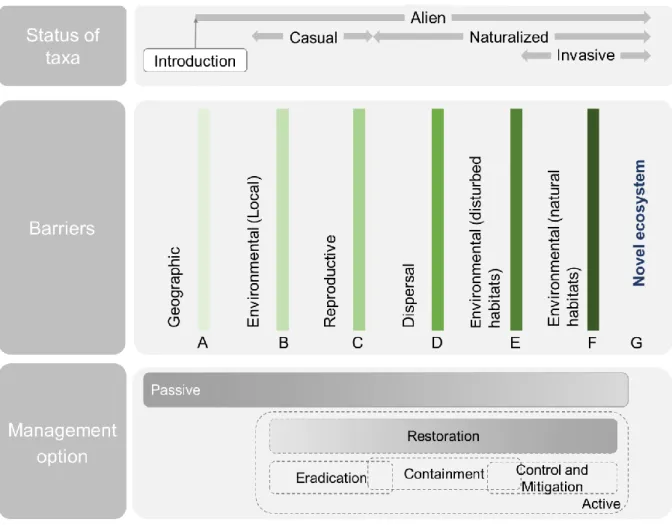
Invasive species can be defined as a subset of alien species, species intentionally or unintentionally transported by humans to new geographic areas overcoming biogeographical barriers; that become naturalized and are able to maintain self-replacing populations producing reproductive offspring, often in very large numbers at considerable distances from the parent and/or site of introduction, and that finally have the potential to spread over long distances (Richardson et al., 2000, 2010b). The process of invasion can be described by different phases of invasion in an introduction-naturalization-invasion continuum (INI) (Fig. 1). The definition of Invasive species can also implicate the presence of a perceived impact. This definition, supported by the World Conservation Union (IUCN) and the Convention on Biological Diversity and the World Trade Organization, explicitly assumes that invasive species must cause perceived impacts to the economy, environment or health (see IUCN 2000). In the scientific community this type of impact-definition is rather controversial as, some invasive species may not cause perceived impacts only due to low residence time (Richardson et al., 2000, Rejmánek et al., 2002, Ricciardi and Cohen, 2007).
Fig. 1 - Schematic representation of the introduction-naturalization-invasion continuum status (INI) of the species introduced, the general barriers limiting its spread, and management options associated. The barriers to overcome are: (A) geographical, (B) Environmental (abiotic and biotic) at the site of introduction, (C) Reproduction (ability to create offspring), (D) Local/regional dispersal, (E) Environmental conditions in human-modified or alien-dominated areas, and (F) Environmental conditions in natural or seminatural areas. If changes in ecosystem processes, structure and function occurs, a novel ecosystem can arise (G). Management options can be related with each status of taxa and barriers, in a solid outline box are represented the passive options (prevention, risk analysis, monitoring) – more frequently applied in early stages of invasion or even before introduction -, and in dashed outline are represented the active management options (eradication, control, mitigation and restoration – more efficient at early stages of invasion) considered in this study - based on Richardson et al. (2000), Hulme (2006) and Marchante (2011).
As a research field, invasion ecology has been established since Elton’s 1958 monograph “The Ecology of Invasions by Animals and Plants”, being Elton considered the father of invasion ecology (Richardson and Pyšek, 2008, Simberloff, 2010). Much work since then has been developed to explain why invasive species thrive. 1982’s programme on the ecology of biological invasions of the Scientific Committee on Problems of the Environment (SCOPE, an arm of the International Council of Scientific Unions) put forward three questions that would remain unanswered till these days, constituting the main topics in invasion ecology and pushing invasion ecology as a discipline. Such questions are as follow: 1 “What factors
determine whether a species becomes an invader or not?”; 2 “What site properties determine whether an ecological system will resist or be prone to invasion?”; 3 “How should management systems be developed to best advantage, given the knowledge gained from studying questions 1 and 2?”. Currently, we consider that questions 1 and 2 are related respectively with invasiveness and invasibility, two main concepts in invasion ecology. Invasiveness can be defined as the ability of a species to become invasive, and relies on identifying particular traits that are consistently associated with the tendency of species to invade (Reichard and Hamilton, 1997) and invasibility relates with the features of the environment (e.g. landscape structure and composition) that allows and promotes the invasion (for more details, see Richardson and Pyšek 2006). The concept of invasibility can also be related with the communities, being the community invasibility dependent of the level of resources available at the time of invasion (resource fluctuation hypothesis, see Davis et al., 2000), on the presence of key species as antagonist (Biotic resistance hypothesis) or facilitators (invasion facilitation hypothesis) acting respectively as constraining or facilitating the establishment of new species (Inderjit et al., 2005). Many other hypotheses have been developed to address invasiveness and invasibility (see Inderjit et al., 2005) therefore the knowledge about the invasion process has substantially improved (Richardson and Pyšek 2006, Davis 2009). However, the main findings rely on the fact that invasions are context specific, being difficult to generalize invasion concepts. For instances, traits that contribute to the success of taxa as invasive aliens are not universal and need always to be related with the features of the invaded ecosystem as community composition, geographical conditions, and a set of external factors, including propagule pressure (i.e. the number and frequency of introductions of a given species; Richardson and Pyšek, 2006)
Ultimately, to go further answering the SCOPE programme questions, a more holist approach, focused on the concept of invasion syndrome – a typical recurrent associations of species biology and invasion dynamics with particular invasion contexts such as an invasion stage, invaded habitat and/or socioeconomic context (Kueffner et al 2013) – is required.
Impacts
The introduction of a new species to a given environment can promote modifications on the structure or functioning of the system (Pyšek and Richardson, 2010, Gaertner et al., 2014). This alteration (commonly called impact) may be manifested at different levels of organization, from the organism (e.g., effects on mortality and growth of a given individual), populations (abundance, genetics), communities (species richness, evenness, composition, trophic
structure), ecosystems (physical habitat, nutrient cycling, contaminant cycling, energy flow) or at region level (species richness, beta diversity; Pyšek and Richardson, 2010, Ricciardi et al., 2013). Meanwhile, the perception of impacts may be modulated by the spatial and temporal scale of perception (Strayer et al., 2006, Powell et al., 2011, 2013, Ricciardi et al., 2013, Kumschick et al., 2014), for instance, the impact of invasive species with large home ranges (e.g., vertebrates) might be spatially diluted and challenging to quantify at the local scale (Kumschick et al., 2014).
Alien species have, for the most part, little or no detectable effects on the new environments (Pyšek et al., 2012, Kumschick et al., 2014) having often positive effects on various ecosystem services, as provisioning of food and fiber; regulating the spread of human diseases; and providing aesthetic, recreational, and tourism benefits (Pejchar and Mooney, 2009, Kettunen et al., 2009, Blackburn et al., 2014, Bonanno, 2016). Moreover, alien species can be favourable to native biodiversity by, for example, providing habitat and food resources to rare species (Chiba, 2010, Schlaepfer et al., 2011). Nevertheless, only a rather small proportion of alien species evolving to invasive species promote know negative impacts. It is important to notice that there is an open scientific debate and some justified criticism on how impact is currently being evaluated, a “good” or “bad” impact is not an objective way to accurately depict invasive species impacts (see Pyšek et al., 2012, Simberloff et al., 2013). Still, invasive species have been often considered as harmful to ecosystem services, disrupting human well-being and threatening biodiversity (MA, 2005, Pejchar and Mooney, 2009, Vilà et al., 2010, Pereira et al., 2012). Between the well-known ecosystem services negatively impacted we can state the following: supporting services (by modifying soil and sediments, nutrient cycling, and primary production, etc.), provisioning services (by promoting loss of food resources, fuel or fiber, threatening endangered native species or altering genetic resources), regulating services (by changing pollination, altering erosion regimes, water regulation and purification, etc.) or cultural services (by changing the perception of the landscape context, etc.; Vilà et al., 2010). Changes promoted by invasive species can be direct and indirect, and may act in subtle or poorly studied interactions that can yield to unknown substantial effects over time (Ricciardi et al., 2013, Blackburn et al., 2014). A small proportion of invasive species, named transformers (sensu Richardson et al., 2010b) can alter ecosystem processes by a wide variety of mechanisms across spatial and along temporal scales, and over a wide range of degree of impact (Ehrenfeld, 2010). The transformer species can rely on mechanisms as ecosystem engineering (a species that alters resource availability for the native species through nontrophic behaviours), by acting as keystone species (promoting an effect on other species and/or on material fluxes out of proportion to its abundance, and through entirely biotic mechanisms) or acting as foundation species (creating a physical structure that determines
the physical characteristics of a given site over its abundance and/or particular characteristics; Ehrenfeld, 2010). The modifications on ecosystem processes promoted by invasive species may lead to reduce local diversity, alter ecosystem structure and function, and modify disturbance regimes, causing potential irreversible changes resulting on regime shifts (Ehrenfeld 2010, Bennett et al., 2005). Changes in ecosystem feedbacks due to invasions can facilitate further invasions (positive feedbacks) and amplify the invaders impacts on native communities, creating the called invasion meltdowns (sensu Simberloff & Von Holle 1999). All the presented modifications in the system can ultimately lead to the emergence of novel ecosystems, an ‘ecosystems containing new combinations of species that arise through human action, environmental change, and the impacts of the deliberate and inadvertent introduction of species from other parts of the world’ (see Hobbs et al., 2006).
The biological invasion disruption of ecosystem services is also well known to impact negatively on economy, sociology, culture, and human health (Pejchar and Mooney, 2009, Pyšek and Richardson, 2010, Vilà et al., 2010). Contrasting impact perceptions often arise from different actors (politicians, scientists, economists, etc.) since some impacts considered as negative from conservation perspective can be perceived as positive by other actors (e.g. timber production using monospecific alien stands plantations, Simberloff, et al., 2013). The economic impacts related with biological invasions are astonishing, for example, in Europe costs were estimated to be at least €12.5 billion per year based on documented costs and probably over €20 billion per year when extrapolated to the area affected by invasive species, likely being underestimated (Kettunen et al., 2009). Evaluating economic impact is, nevertheless, a challenging task. One option, to evaluate the impact associated with invasion process, is to sum costs associated with losses of biodiversity and impaired ecosystem services, as well as the costs of managing invasive species (Pyšek and Richardson, 2010). To limit management costs, it’s important to optimize management actions and create cost-effective analyses.
Management
Answering the third question posed in SCOPE 1982 programme, “How should management systems be developed to best advantage (…)” has proven to be a more complex task. When planning management actions, a comprehensive approach is needed. A management approach should consider the ecological impacts as well as the socio-economic impacts (Hulme, 2006, Pyšek and Richardson, 2010, Estévez et al., 2015). Moreover, when managing, it is required to fully understand the technical options available; the risks associated with each
option, the likelihood of success; and ultimately to increase the knowledge of the spatial dynamics of the invading species potentiating the management planning (Hulme, 2006, Pyšek and Richardson, 2010).
Key management options can be classified as: prevention, early detection and eradication, containment, control, mitigation and restoration (Hulme, 2006) the option depends on the invasive species position on the spectrum of introduction-naturalization-invasion (INI) continuum (fig. 1) and on abundance and extent of the species distribution (Wittenberg and Cock, 2001). In this study, we considered management options as passive management referring to preventive actions as risk analysis, quarantine, monitoring; and active management actions as direct or indirect actions applied to limit invasive species spread and impacts, as control, eradication, mitigation, etc..
Preventing the introduction of species with a high risk of becoming invasive is the most cost- effective management strategy (Wittenberg and Cock, 2001, Hulme, 2006, Pyšek and Richardson, 2010). Border control and quarantine measures are often the first opportunity to respond to invasive species incursions (Hulme, 2006). Prevention relies on risk assessment studies to evaluate invasive species threat and the likelihood of entry and establishment. Risk assessments are difficult to perform due to limitations on data availability (e.g. to determining invasiveness), and the inclusion of socio-political interests and values in these assessments (Pyšek and Richardson, 2010). Advances were made towards developing risk maps applying ecological modelling approaches to predict both invasive species spread and areas high risk of invasion, currently or in the future (Pyšek and Richardson, 2010). When prevention fails, and an invasive species establish eradication is the preferred course of action, early detection is crucial for the feasibility of eradication (Wittenberg and Cock, 2001, Simberloff, 2009), Hulme, 2006). Eradication actions involves removal of the whole invasive species population from a specific area. When eradication is not feasible, efforts must be targeted to limit the spread of the invasive species, containment, or/and to reduce the density and abundance of the invasive species to keep it below an acceptable threshold, this corresponds to the control option (Hulme, 2006). Within control options, the biological control option becomes the most cost-effective approach, since it can provide a permanent, self-sustaining and when there is a high specificity of the agents used is verified, ecologically safe approach (Wittenberg and Cock, 2001). Classical biological control aims to reduce the invasive species populations to ensure that the species no longer pose a significant problem on the ecosystem (Hulme, 2006, Pyšek and Richardson, 2010). Multiple approaches may be coordinated to optimize a management action, for instance, to contain and control a core population and eradicate outlying populations. Ultimately, if the control actions are just impossible to implement, due to
impracticality, inadequacy or being economically unviable the last available resource is to implement mitigation actions to minimise impacts (Wittenberg and Cock, 2001). Management options should always be integrated in a broader restoration frame to, not only, remove invasive species but simultaneously promote the re-establishment or reintroduction of native species and restore the ecosystem (Wittenberg and Cock, 2001). All management programmes considering invasive species should be followed by monitoring efforts in order to evaluate the level of success and rise the opportunity to modify and/or adapt the approach (Buckley, 2008). Occasionally, when the ecosystem presents an extreme level of alteration and/or the management is not possible, a “no action” option can be the best approach.
The need to tackle invasions and their impacts has fostered an increasing commitment of researchers and conservation planners to manage invaded ecosystems (Estevez et al., 2015, Rotherham and Lambert, 2012). The development of predictive tools to support knowledge, capacity and decision-making in the scope of invasion processes is therefore vital for the effectiveness of management actions and policies (Ameden et al., 2009, Vicente et al., 2013, 2016)
1.2.
Ecological Modelling and Invasion biology
Ecological modelling as a tool to understand, predict and forecast
An ecological model can be defined as a synthesis of what we know about the ecosystem with reference to the considered problem, a model doesn’t intend to represent the full system but only the essential features in the context of the problem to be solved or described (Jørgensen and Fath, 2011). Models may be physical, as a microcosm, conceptual or mathematical, describing the ecosystem in mathematical terms (Jørgensen and Fath, 2011). In this study, we only focus on mathematical models.
A model includes the knowledge on components interactions, on the processes, often formulated as mathematical equations, and the importance of the processes with reference to the problem (Jørgensen and Fath, 2011). To be able to understand such a complex system, as ecosystems, and, being just impossible to survey the multiple components and reaction in an ecosystem, ecological models can be very useful. Modelling allows the understanding, the prediction, and the forecasting of a system progress. Being a useful instrument to survey complex systems, to reveal system properties, to reveal gaps in our knowledge and set up research priorities, and to test hypotheses (Jørgensen and Fath, 2011). Being the purpose behind the use of models an iterative development of a pattern, as every time a hypothesis
tested is correct, another piece of the puzzle may be added. When the pieces of the puzzle are all together, mimicking the real process, they can have important applications on predicting and forecasting across space and/or along time the evolution of the system (Jørgensen and Fath, 2011).
Application of modelling techniques in ecology and types of models
Ecological modelling has in the last three decades undergone a fast development due to advances in computer technology, enabling the use of more complex models; an increase on environmental and ecological systems knowledge and a general understanding on environmental processes (Jørgensen and Fath, 2011).
Ecological modelling has been widely used across several ecological domains, such as eutrophication mitigation (e.g. Alvera-Azcarate et al., 2003), climate change impacts (e.g. Vicente et al., 2013), pollution effects (e.g. Hinojosa et al., 2008), national parks management (e.g. Miller and Urban, 2000), and as support to monitoring networks design (e.g. Amorim et al., 2014, Carvalho et al., 2015, Vicente et al., 2016). When properly calibrated and evaluated, and if applied with insight and with regard to their underlying assumptions, ecological models are able to simulate conditions that are difficult or impossible to understand otherwise (Jørgensen and Fath, 2011).
Therefore, efforts to comprehend and accurately predict the behaviour of a given system have resulted in the development of several modelling approaches suiting different modelling aims (Jørgensen and Bendoricchio, 2001). Among many classifications of modelling approaches (e.g. reductionistic/ holistic, deterministic/ stochastic, linear/ nonlinear, etc.), two major types of ecological models can be recognized, depending on their capacity to describe and analyse the nature of the processes by which a particular phenomenon is created (Hannon and Ruth, 2014): static models and dynamic models. Static models can be defined as models that represent a particular phenomenon in a given frame of time or at different independent points in time (i.e. comparative static models) (Hannon and Ruth, 2014). These are, typically, statistical based phenomenological models that relate observations of a response variable (e.g. species occurrences) with environmental variables or drivers (Guisan and Thuiller, 2005, Franklin, 2010). Static models, as the name implies, are models that relies in a static mathematical relationship between the occurrence of a given species and the environmental conditions. It assumes that the relationship remains across space and along time. Static models, for example habitat suitability models (HSM), are considered important screening tools in ecology (Gallien et al., 2010).
On the other side, dynamic models are based on ecological processes (i.e. process-based models), and differ from static models by explicitly incorporating time-dependent changes in the state of a system (Hannon and Ruth, 2014). Dynamic models may comprise various modelling approaches, such as biogeochemical dynamics models (e.g. Soetaert et al., 2000), population dynamics models (e.g. Kriticos et al., 2003), individual-based models (IBMs; e.g. Nehrbass and Winkler, 2007), and/or cellular automata systems (e.g. Crespo-Perez et al., 2011). Historically, examples of dynamic modelling approaches include the classical developments of Lotka-Volterra in the 1920s, the application of population dynamics models in the 1950s and of eutrophication models during the 1960s; more recently, IBMs and cellular automata, spatially explicit approaches, have seen their growth in the late 2000s and 2010s (Jørgensen and Fath, 2011, Chen et al., 2011, Jørgensen, 2008, Jørgensen, 1994).
Ecological modelling approaches to model invasion process and to support
management options
In recent years, ecological models have been applied as tools to understand the key drivers of invasion processes (Neubert and Caswell, 2000, Vicente et al., 2010), to predict areas of potential distribution, and to forecast potential impacts of invasive species, under distinct social-ecological scenarios (Vicente et al., 2016, Peterson et al., 2008).
Static approaches, as HSMs, have been commonly used in invasion ecology (e.g. Peterson et al., 2003, Vicente et al., 2010). Nevertheless, static models fail to understand the processes and interactions underlying the respective ecological processes and their consequences (Gallien et al., 2010). Indeed, modelling invasive species range dynamics is particularly challenging since, by definition, these species usually constitute recent arrivals, thus not being in equilibrium with environmental conditions in the invaded region, and thereby violating one of the main assumptions of HSMs (Rouget et al., 2004). Contrastingly, dynamic models are able to overcome the limitations of static models and potentially allow for an easy analysis of multi-factorial management scenarios (Cuddington et al., 2013).
Still, the application of dynamic modelling in invasion ecology requires a deep understanding of the spatial-temporal dynamics of the invasion process (Gallien et al., 2010). In fact, the characteristics of the invasive species (i.e. invasiveness; Guisan and Zimmermann, 2000, Gallien et al., 2010), the features of the communities or landscapes under invasion (i.e. invasibility; Gallien et al., 2010), and the environmental variables that influence these processes (Gallien et al., 2010), are required for an accurate implementation of dynamic
models. Such requirements limit a broader implementation of this type of models in invasion ecology; still, the utility of dynamic models for conservation planning and management has been profusely highlighted (e.g. Thuiller et al., 2008, Franklin, 2010, Richardson and Whittaker, 2010, Cuddington et al., 2013) and recognized as the most appropriate technique to guide management decisions (Cuddington et al., 2013).
In this context, there is an increasing interest in hybrid models, i.e. coupling dynamic and static models (e.g. Santos and Cabral, 2004, Brook et al., 2009, Richardson et al., 2010a, Zurell et al., 2016). Such hybrid models allow integrating the predictive accuracy of static models, as phenomenological models at large spatial scales, and the ability to capture underlying process of dynamic models (Franklin, 2010, Gallien et al., 2010). Examples of coupled static-dynamic modelling can be found in the integration of HSMs and process-based models for management of invasive species. For example, Meier et al. (2014) coupled HSMs and population spread models to analyse the effectiveness of invasive species control actions for alternative cost scenarios and different management goals, and Richardson et al. (2010a) defined regions at high risk of invasion by coupling a cellular automata model with HSM.
1.3.
Objectives
The extent to which dynamic models have been actually applied in the management of invasive species is still under-evaluated. Literature reviews allows to synthesize the extent of the literature on a topic of interest, and to address potential gaps (Paré et al., 2015). A review can be defined as a way ‘To view, inspect, or examine a second time or again’ (Grant and Booth, 2009). Specifically, review studies can assume an essential role on building knowledge, as well as on understanding the scope of a given topic of interest, providing a conceptual background for subsequent research (Paré et al., 2015). Review studies may also prioritize topics or domains for future research (Paré et al., 2015). Therefore, we performed an extensive literature review to analyse the extent, and the goals, to which dynamic modelling has been applied in support of analysing and managing biological invasions. We conducted a comprehensive review of published literature that applies dynamic modelling approaches in the study of invasive species and respective management.
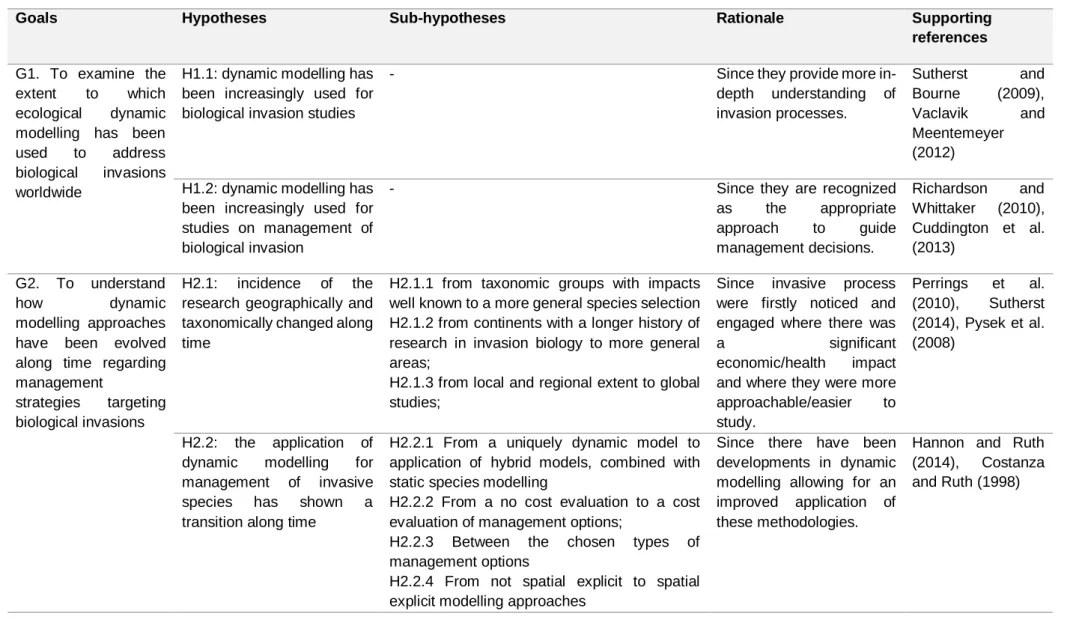
To do so, two major goals were addressed (G) and four hypotheses were tested (H):
G1 – To examine the extent to which ecological dynamic modelling has been used to address biological invasions worldwide. To do so, we tested if (H1.1) ecological modelling, particularly
dynamic modelling, has been increasingly used in biological invasion studies; and (H1.2) specifically applied to support decision-making for biological invasion management (H1.2). G2 – To understand how dynamic modelling approaches have evolved with time, regarding management strategies targeting biological invasions. To assess this goal, we analysed whether (H2.1) models and their applications have known improvements and upgrades (from dynamic to hybrid models, from non-cost to cost evaluation, and from non-spatially-explicit to spatially explicit approaches); and (H2.2) if the geographical focus and the taxonomical focus of the modelling studies have changed along time.
2.
Methods
2.1.
Analytical framework and workflow
Ecological dynamic modelling has been proposed as a complementary approach to static modelling to address and evaluate biological invasion management goals (Cuddington et al., 2013), and have proven to be a robust way to take into account the effects of management on invasions. In this study, a review framework supported by standard protocols was applied in order to assess the incidence of dynamic modelling in biological invasion studies, and specifically in the management goals. This allowed comparing different patterns and tracing an historical overview of the use of dynamic modelling in invasions studies. Furthermore, since literature reviews are grounded on the selection of keywords and the search of these in search engines (Higgins and Green, 2011), the accurate selection of keywords is fundamental when trying to fully cover a thematic. The possibility of finding keywords that are able to cover the publication on a thematic relies on the standardization of vocabularies. It is therefore crucial that denominations are standardized in order to facilitate bibliographic review tasks. In this direction, our results may provide highlights concerning how to deal with keywords and abstract writing, overcoming several problems for review and synthesis research. The analytical workflow was organized around the two general major goals (G1, G2; see Fig. 2, Table 1). Under each of these two goals, two hypotheses were tested (H1.1 and H1.2 for G1; H2.1 and H2.2 for G2), as outlined above. For the second goal, additional sub-hypotheses were tested (Fig. 2– Literature Review, Table 1).
Fig. 2 - Analytical framework and workflow. The Literature search considered sequential hierarchical searches (ISI WOS) focused on Invasive species (Population), Modelling (Intervention), and Management (Outcome) keywords for Goal 1 (G1) and a combined search in ISI WOS, Scopus and Science direct for Goal 2 (G2). Records from combined search engines were selected based on inclusion/exclusion criteria (see Inclusion/exclusion criteria in section 2.4). The publications of the final database were individually reviewed (Literature review) and classified accordingly in seven categories, in order to address each sub-hypothesis related with Goal 2 of the study (see also Table 1).
Table 1 - Goals of the study, hypotheses and sub-hypotheses (related with the categories presented in Fig. 2) with their ecological rational and the respective scientific references.
Goals Hypotheses Sub-hypotheses Rationale Supporting
references G1. To examine the
extent to which ecological dynamic modelling has been used to address biological invasions worldwide
H1.1: dynamic modelling has been increasingly used for biological invasion studies
- Since they provide more
in-depth understanding of invasion processes. Sutherst and Bourne (2009), Vaclavik and Meentemeyer (2012) H1.2: dynamic modelling has
been increasingly used for studies on management of biological invasion
- Since they are recognized
as the appropriate approach to guide management decisions. Richardson and Whittaker (2010), Cuddington et al. (2013) G2. To understand how dynamic modelling approaches have been evolved along time regarding management
strategies targeting biological invasions
H2.1: incidence of the research geographically and taxonomically changed along time
H2.1.1 from taxonomic groups with impacts well known to a more general species selection H2.1.2 from continents with a longer history of research in invasion biology to more general areas;
H2.1.3 from local and regional extent to global studies;
Since invasive process were firstly noticed and engaged where there was
a significant
economic/health impact and where they were more approachable/easier to study. Perrings et al. (2010), Sutherst (2014), Pysek et al. (2008) H2.2: the application of dynamic modelling for management of invasive species has shown a transition along time
H2.2.1 From a uniquely dynamic model to application of hybrid models, combined with static species modelling
H2.2.2 From a no cost evaluation to a cost evaluation of management options;
H2.2.3 Between the chosen types of management options
H2.2.4 From not spatial explicit to spatial explicit modelling approaches
Since there have been developments in dynamic modelling allowing for an improved application of these methodologies.
Hannon and Ruth (2014), Costanza and Ruth (1998)
2.2.
Literature search
In order to address our goals, hypotheses and sub-hypotheses (Table 1), a literature review was performed on publications in which dynamic modelling approaches were applied to address invasive species and related phenomena, and then to support biological invasions management. The selection of the keywords was structured and built around a Population-Intervention-Comparison-Outcome (PICO) framework, suitable for searching terms into thematic groups and to identify publications for a throughout literature review (Higgins and Green, 2011) (Fig. 2).
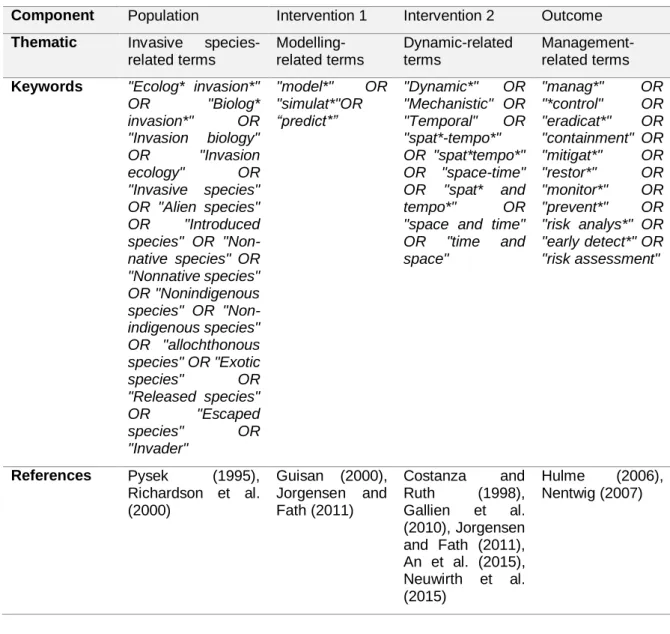
An initial list of potential keywords, for the four Population-Intervention-Comparator-Outcome (PICO) components, has been built grounded on a list of articles of reference on the topics (Table 2) and a team of researchers specialized on modelling and managing invasive species. The initial potential keywords were iteratively tested on ISI web of Science database (ISI WOS) and further by adding new potential keywords identified during the literature search.
Throughout the search string, the keywords within each PICO components (P,I,C,O) were first combined using the boolean operator1 “OR” and then the PICO main components were
combined using the “AND” operator. Truncation and wildcards2 symbols (denoted by *) were
used to find alternative word endings (e.g. simulat*). Each term was added hierarchically, by apparent suitability, and for each term added, the first 10 references in the results were evaluated regarding the relevance for this study (ISI WOS results compatibility with the focus of the PICO components). Given that different authors use slightly different phrasing and diverse keywords, we selected the most-commonly and unequivocal keywords that we could found (see Table 2, for the final list of key-words).
1Boolean operator are simple words (AND, OR, NOT or AND NOT) used as conjunctions to combine or exclude keywords in a
search
2Wildcards symbols are single characters, such as an asterisk (*), that are used to represent unknown characters or an empty
Table 2 - Keywords and consulted references for their selection for each PICO component, Population (Invasive species -related terms), Intervention 1 (Modelling-related terms), Intervention 2 (Dynamic-related terms) and Outcome (management-related terms).
Component Population Intervention 1 Intervention 2 Outcome Thematic Invasive
species-related terms Modelling-related terms Dynamic-related terms Management-related terms Keywords "Ecolog* invasion*"
OR "Biolog* invasion*" OR "Invasion biology" OR "Invasion ecology" OR "Invasive species" OR "Alien species" OR "Introduced species" OR "Non-native species" OR "Nonnative species" OR "Nonindigenous species" OR "Non-indigenous species" OR "allochthonous species" OR "Exotic species" OR "Released species" OR "Escaped species" OR "Invader" "model*" OR "simulat*"OR “predict*” "Dynamic*" OR "Mechanistic" OR "Temporal" OR "spat*-tempo*" OR "spat*tempo*" OR "space-time" OR "spat* and tempo*" OR "space and time" OR "time and space" "manag*" OR "*control" OR "eradicat*" OR "containment" OR "mitigat*" OR "restor*" OR "monitor*" OR "prevent*" OR "risk analys*" OR "early detect*" OR "risk assessment" References Pysek (1995), Richardson et al. (2000) Guisan (2000), Jorgensen and Fath (2011) Costanza and Ruth (1998), Gallien et al. (2010), Jorgensen and Fath (2011), An et al. (2015), Neuwirth et al. (2015) Hulme (2006), Nentwig (2007)
The time span of our search was 1900-2014. Searches were carried out from October to November 2015, and were updated in March and April 2016. The search engines considered for our search were ISI Web of Science (ISI WOS; http://webofknowledge.com/), Scopus (https://www.scopus.com/) and Science Direct (http://www.sciencedirect.com/). To address the first goal, only ISI WOS search engine was used and no further evaluation or exclusion criteria were applied. ISI WOS was selected as it has been designed with the intention of satisfying users in citation analysis and although Scopus includes a more expanded spectrum of journals than ISI WOS, the citation analyses is limited to recent article when compared to ISI WOS (Falagas et al., 2008). The records retrieved by our search for G2 were combined and analysed to eliminate duplicates (total number of records, n = 1849), using EndNote x 7.4 (Thomson Reuters, 2013).
2.3.
Evaluation
To evaluate the reliability of our search, the first 50 records retrieved by Google Scholar (using the main keywords “invasive species” AND “model” AND “dynamic” AND “management”) were compared with the resulting combined database (Fig. 2; following the procedures from Higgins and Green, 2011). The records from Google Scholar that were absent from our database (corresponding to 16% of the suitable records retrieved) were added, resulting in a final database of 1852 records (Fig. 2).
2.4.
Inclusion/exclusion criteria
The resulting combined database was submitted to inclusion/exclusion criteria in order to remove irrelevant records (e.g. topics such as invaders from outer space- aliens; see
Table 3, for more information) and to obtain the final database (Fig. 2 – Final database). These criteria were then applied by individually checking the title, keywords and abstract of each record. In case of doubt, the full text of the record was reviewed afterwards (Fig. 2). Since two reviewers performed the application of the inclusion/exclusion criteria, the consistency of results was assessed through kappa statistics on 10 % of the database, resulting in a good consistency (kappa = 0.8; see Higgins and Green, 2011 for details).
Table 3 - Inclusion and exclusion criteria applied to the full database.
Criteria application
Exclusion criteria Inclusion criteria
Type of
record
Biographical items;
corrections/corrigendum; items about an individual: poetry or anonymous documents which could not be found for checking veracity.
Research articles; book chapters; book reviews; editorial material; letters; meeting abstracts; news items; notes; paper proceedings; reviews, or forum papers.
Population Records which focus on exotic/alien species in relation to space (mostly in astronomy, astrophysics and physics); alien species linked to literature and films with no connection to the real world; human population considered alien species (e.g. woman as an alien species; mostly from literature and movies); invasive species from a lyric perspective and attributed to human population (mostly religious and philosophical studies); clinical terms which use alien/exotic species for referring to an organism outside the human body (mostly in dentistry, ophthalmology, dermatology, oncology) or animals in laboratory experiences (clinical laboratory).
All records unless otherwise stated in the exclusion criteria.
Intervention Records which do consider any type/technique of dynamic modelling to evaluate biological invasions (as defined above).
Records in which any type of dynamic modelling is considered to describe and analyse processes underlying biological invasions, attempting to capture changes in such processes in real or simulated time periods.
Outcome (not considered in the first step
of the
analytical framework)
Records which do not focus on the management of biological invasions, that focus on the outcomes of management actions for native species conservation, or focus on understanding invasion dynamics when not with the clear purpose of management.
Records that apply dynamic modelling for managing biological invasions, including: control, eradication, containment, mitigation or restoration, as well as monitoring, prevention and risk assessments.
The full text of each individual record from the final database (n = 369) was then reviewed and classified according to the categories shown in Table 4 (Fig. 2 - Literature Review).
Table 4 - Hypotheses, categories/questions, and classes to assess how dynamic modelling approaches have been used along time regarding biological invasions management strategies (Goal 2).
Hypotheses Categories / Questions Classes
H 2 .1 T a xo n o mi ca l g ro u p a n d g e o g ra p h ic a re a Taxonomical focus
What is the taxonomical group of focus?
Plant Invertebrate Vertebrate Other Not specified Geographical focus
What is the targeted study area?
Global Europe South America North America Africa Asia Oceania Antarctica No reference Spatial extent
What is the spatial scale of the study?
Global (multiple continents) Regional (within one continent but in multiple countries) Local (within one country) No reference H 2 .2 C h a ra ct e ri st ics o f th e mo d e lli n g a p p ro a ch Modelling framework
Is the modelling approach a combination of dynamic approach with a species static model?
Not combined with a species static model
Combined with a species static model
Model spatial explicitly
Is the modelling approach spatially explicit?
Yes No Management type
What management options and type, if passive (P) or active (A), were considered?
(Passive management referred to preventive actions, and active management meant direct or indirect actions applied at invasive species post establishment.) Risk assessment - P Preventing – P Monitoring - P Control – A Biological control- A Eradication - A Containment - A Mitigation - A Restoration - A Other No reference Cost evaluation
Was a management cost evaluation done?
Yes No
2.5.
Data analyses
Temporal trends of published records
A descriptive statistical analysis was performed to illustrate the temporal trends of published records in each step of the literature search (Fig. 2– Literature search, G1), and for each
category considered in the literature review (Fig. 2– Literature review, G2). The analyses were performed by plotting the total number of records published by year, and by assessing the proportion of records from the distinct categories (expressed as percentage) published in a given year. Analyses were first considered for the database extracted from ISI WOS (Fig. 2- Literature search, G1), and then for the final database (Fig. 2- Literature review, G2). The outcomes were presented as line (smoothing curves showing averages for 2-year time periods) or/and as column plots, for the time period between 1904 (first record retrieved by our search) and 2014 (see Results section).
Characterization of modelling publications in the scope of invasive species
management
For the final database (see Fig. 2), a multivariate analysis was applied in order to evaluate the variation of the distinct categories in the ordination space. For a simplified illustration, two Principal Components Analyses (PCA) were applied to highlight the main gradients underlying variations in the distinct categories of published records, and to evaluate and visualize the main relationships between such categories. The first PCA considered the categories taxonomical focus, geographical focus and spatial extent variables, to characterize the records focus on taxonomical groups and geographic areas (H2.1). The second PCA was performed in order to characterize the modelling approach of the records (H2.2) considering the categories of modelling approach, management type, whether the model was spatially explicitly, and cost evaluation of management actions. PCA analyses were performed in Statistica v13 (StataCorp., 2013).
3.
Results
3.1.
Dynamic models in invasion ecology
The number of records considering invasive species related key words (see Table 2) in ISI WOS was 27429 publications (Step 1; see Fig. 2). Among these, 7248 records had modelling related key words, 2395 dynamic modelling key words, and 1277 management related key words. An overall increase in the number of records published with invasive species keywords was observed (with the highest increase after 1990), regardless of the potential modelling or management nature (Fig. 3). Yet, the emergence of studies using modelling related keywords was mostly observed from the late 1990s onwards.
This trend was also perceived for records dealing with dynamic modelling related key words and management related keywords, thereby confirming hypotheses H1.1 and H1.2. A peak in integration of dynamic models keywords and management keywords within general papers with modelling keywords and with dynamic related keywords, respectively, was observed in the early 1990s. Conversely, the modelling keywords within studies with invasive species related keywords have increased consistently along time (Fig. 3).
Fig. 3 - The number of records retrieved by the search for literature considering invasive species, modelling, dynamic modelling and management keywords in ISI Web of Science (ISI WOS) from 1904 to 2014 (smoothing curves showing averages for 2-year time periods; on the right y-axis). The figure also illustrates the proportions of modelling inside the invasive species records, of dynamic modelling inside the modelling invasive species records, and of management inside the dynamic modelling of invasive species (on the left y-axis). Important time periods, discussed in more detail (see section 3.1) are highlighted with a light grey shadowing. Gaps in the x-axis represent the time intervals for which no significant number of records were retrieved by our search.
3.2.
Taxonomic and geographic focus
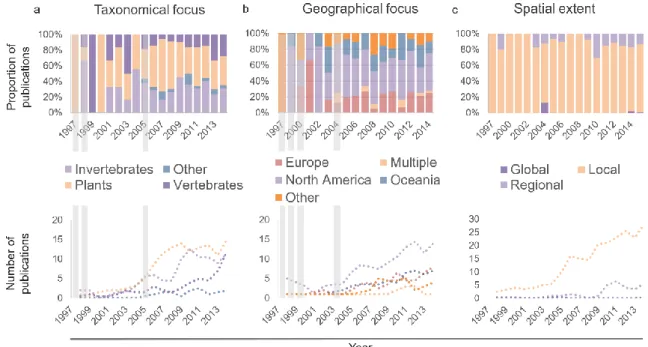
From the total set of records considered in the literature search (Fig. 2; n = 1849), 20% (corresponding to 369 records) were considered suitable for literature review (see Supplementary Table 1). The earliest record focused on modelling for biological invasion management purposes was found for year 1997, regarding the invasive plant Acacia saligna (Higgins et al., 1997). In 1998, several invertebrates and vertebrates were targeted for the first time in published management models. Examples were Lymantria dispar (gypsy moth; Sharov and Liebhold, 1998, Sharov et al., 1998), Dreissena polymorpha (zebra mussel; Schneider et al., 1998) and the toad Bufo marinus (Lampo and De Leo, 1998). Other taxa were only mentioned in 2005, with emphasis on phytoplankton modelling (Petrovskii et al., 2005). Altogether, plants were the most represented taxonomic groups (44.27%), followed by invertebrates (32.80%) and then by vertebrates (18.15%). The other taxa represented only the remaining 4.78% records (Fig. 4a). Plants and invertebrates are well represented throughout almost all the years under analysis. The vertebrates although also represented from the beginning show an increase on focus later on, similarly, on a less extent, to other taxonomical groups. The geographical focus of the set of records was generally spread worldwide, with studies being conducted in different parts of the world (Fig. 4b). Still, North America was, by far, the most represented continent (46.57%), followed by Europe (19.86%) and by Oceania (19.49%), and finally by the other continents (11.19%). The studies involving multiple continents were almost residual (2.89%). The earliest study found in our search was conducted in South Africa (in 1997; Higgins et al., 1997), North America and Oceania were first mentioned in 1998 (e.g. Edwards et al., 1998, Lampo and De Leo, 1998), and Europe in 2000 (Wadsworth et al., 2000). The first study focusing in more than one continent was published in 2004 (Morrison et al., 2004). In fact, since 2004, more continents were simultaneously targeted by modelling studies per year (Fig. 4b). The spatial extent was clearly dominated by local studies (86.55%), with regional (12.73%) and global (0. 73%) studies representing a smaller fraction (Fig. 4c). The results are mostly in line with the hyphotesis proposed (H2.1).
Fig. 4 - Temporal trends by variable analysed in Hypothesis 2.1:(a) Taxonomic focus, (b) Geographical Focus, and (c) Spatial extent. The upper row represents the proportion of publications per year, and the lower row represents absolute number of publications per year (smoothing curves showing averages for 2-year time periods). Time periods discussed in more detail (see section 3.2) are highlighted with a light grey shadowing.
3.3.
Characteristics of the modelling approach
The majority of the records considered in the literature search corresponded to studies based on dynamic models (79.78%), being the remaining ones (20.22%) focused on hybrid models (i.e. combined static and dynamic approaches). The first publication on dynamic modelling was found in 1987, and corresponded to a paper on population biology of invaders (Crawley, 1987). Dynamic modelling studies dominated until the beginning of the 2000s. Since 2003, however, hybrid models began to be more frequently used (Fig. 5a). Records including non-spatially explicit models (57.68%) outnumbered those that did include a spatial component (42.31%), though both non-spatially and, later on, spatially explicit modelling increased over the last years (Fig. 5b).
Regarding the type of management applied to the invasive species, both post-establishment actions (active management) and preventive actions (passive management) seemed to increase through time, with an overall predominance of records targeting active management (57.04%; Fig. 5c). Similar trends were observed regarding cost evaluation, with both cost and non-cost evaluations showing increasing values and a similar trend through time (Fig. 5d).
However, only 27.76% of records presented an assessment of management costs. In general, the results are in line with the hypothesis proposed (H2.2).
Fig. 5 - Temporal trends by variable analysed in Hypothesis 2.2:(a) Modelling framework, (b) Model spatial explicitly, (c) Management type and (d) Cost evaluation. In each case, the right plots represent the absolute number of publications per year (smoothing curves showing averages for 2-year time periods) and the left plots represent the proportion of publications per year. Time periods discussed in more detail (see section 3.3) are highlighted with a light grey shadowing.
3.4.
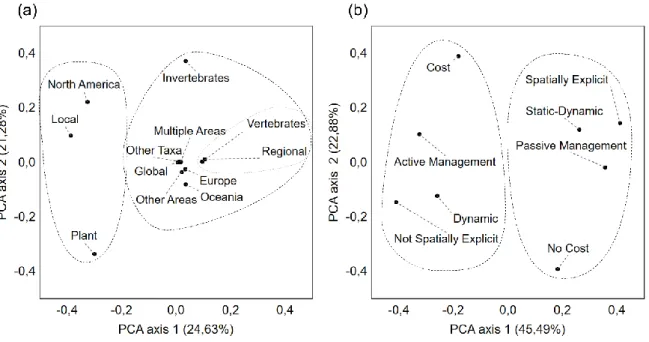
Modelling publications and invasive species management
The combination of PCA axis 1 and 2 allowed to capture respectively around 45% and 68% of the variation in reviewed records (Fig. 6). The first PCA (Fig. 6a) was conducted considering taxonomical focus, geographical focus and spatial extent, and showed the segregation of two main groups in the ordination space. The first group included the continent “North America”, “Local” extent, and “Plant” taxonomical focus. The second group included also a main sub-group, dominated by the combination of “Vertebrates” with “Regional” spatial extent. The second PCA (Fig. 6b), which incorporated the records classified according to type of modelling framework, model spatial explicitly, type of management and cost evaluation, highlighted two main groups of model attributes along the first axis (Fig. 6b). The first group relates “Passive Management”, “Non cost” evaluation, ”Spatial Explicit” and hybrid (“Static-Dynamic”) models. Contrastingly, the second group relates” Active Management”, “Cost” evaluation, “Not Spatial Explicit” and purely “Dynamic” models.Fig. 6 - Results from principal components analyses (PCA) considering: Taxonomic focus, Geographical focus and Spatial extent (a); and Cost evaluation, Type of management, Spatially explicit nature, and Modelling framework (b). On grey dashed lines highlight two main groups along the first PCA axis and in light grey a minor group. For visualization purposes, variables were plotted as dots instead of lines in the ordination space.