EUROPEAN ORGANIZATION FOR NUCLEAR RESEARCH (CERN)
CERN-PH-EP/2015-180 2015/11/12
CMS-FSQ-15-001
Pseudorapidity distribution of charged hadrons in
proton-proton collisions at
√
s
=
13 TeV
The CMS Collaboration
∗Abstract
The pseudorapidity distribution of charged hadrons in pp collisions at√s = 13 TeV is measured using a data sample obtained with the CMS detector, operated at zero magnetic field, at the CERN LHC. The yield of primary charged long-lived hadrons produced in inelastic pp collisions is determined in the central region of the CMS pixel detector (|η| < 2) using both hit pairs and reconstructed tracks. For central
pseudo-rapidities (|η| < 0.5), the charged-hadron multiplicity density is dNch/dη||η|<0.5 =
5.49±0.01 (stat)±0.17 (syst), a value obtained by combining the two methods. The result is compared to predictions from Monte Carlo event generators and to similar measurements made at lower collision energies.
Submitted to Physics Letters B
c
2015 CERN for the benefit of the CMS Collaboration. CC-BY-3.0 license
∗See Appendix A for the list of collaboration members
1
1
Introduction
The yields of charged hadrons are among the most basic physical observables in high-energy particle collisions and provide an essential first step in exploring the physics of a new energy regime. Studies of such yields have a long history in high-energy particle and nuclear physics, as well as in cosmic ray physics. At collider energies, the inclusive production of charged hadrons is driven by a combination of perturbative and nonperturbative quantum chromo-dynamics (QCD) phenomena, such as saturation of parton densities, multiparton interactions, parton hadronization, and soft diffractive scattering.
The yields of primary charged hadrons are commonly studied using their multiplicity as a function of pseudorapidity, dNch/dη. Of particular interest for understanding the physics of
hadron production is the dependence of dNch/dη on the collision energy, which reflects the
relative roles of soft- and hard-scattering contributions. Soft interactions, which are modeled phenomenologically, give rise to a significant fraction of the produced particles. Contributions from hard-scattering processes increase with increasing collision energies. Measurements are necessary to tune the modeling of these contributions in Monte Carlo (MC) event generators, and as reference data to study nuclear effects in proton-nucleus and nucleus-nucleus collisions. A good understanding of inclusive hadron production is also important to control the pileup backgrounds, from overlapping proton-proton collisions in a given bunch crossing, that affect all physics analyses at the LHC.
In this Letter, measurements of dNch/dη in the range|η| <2 are reported for inelastic
proton-proton (pp) collisions delivered by the CERN LHC at a center-of-mass energy of 13 TeV in June 2015. The analysis is based on 11.5 million events recorded at zero magnetic field during a spe-cial low-intensity beam configuration with 0.2–5% proton-proton interaction probability per bunch crossing. This special run was prepared by steering the beams such that their transverse separation was±3σ at the nominal CMS interaction point, where σ denotes the standard de-viation of the Gaussian beam profile. Following earlier analyses at√s = 0.9 TeV, 2.36 TeV [1], 7 TeV [2], and 8 TeV [3], Nchis defined to include decay products of particles with decay length
cτ < 1 cm, where τ is the lifetime of the particle and c is the velocity of light. Products of secondary interactions are excluded, and contributions from prompt leptons are removed. The data are compared to PYTHIA8 v208 [4, 5] (with the CMS underlying event tunes [6]:
CUETP8S1 and CUETP8M1, using different parton densities), and toEPOSLHC [7] (LHC tune [8]). Both MC event generators reproduce well the main characteristics of the experimental data measured in hadronic collisions at lower energies, and provide predictions for the√s-dependence of hadron production observables using different implementations of the dominant underlying phenomena (multiparton interactions, parton saturation, diffractive scattering) [9, 10].
2
CMS detector
The central feature of the CMS apparatus is a superconducting solenoid of 6 m internal diame-ter. Within the magnet volume are the silicon pixel and strip tracker, the crystal electromagnetic calorimeter, and the brass and scintillator hadron calorimeter. The tracker measures charged particles within|η| <2.4. It has 1 440 silicon pixel and 15 148 silicon strip detector modules,
ar-ranged in 14 tracking layers. The barrel region of the CMS pixel detector consists of three layers very close to the beam line. They are located at average radii of 4.3 cm (layer 1), 7.2 cm (layer 2), and 11.0 cm (layer 3), and provide excellent position resolution with their 150 µm×100 µm pix-els. The data sample used for this analysis was obtained while the magnet was off. Under these conditions, charged particles follow approximately straight trajectories, perturbed mostly
2 4 Data analysis
by multiple Coulomb scattering. The pixel hits alone are sufficient to reconstruct vertices and tracks with high precision and purity. The beam pickup for timing (BPTX) devices were used to trigger the detector readout. They are located around the beam pipe at a distance of 175 m from the interaction point (IP) on either side, and are designed to provide precise information on the LHC bunch structure and the timing of the incoming beams. A detailed description of the CMS detector can be found in Ref. [11].
3
Event selection
Inelastic collision events are selected as follows: (i) online, a coincidence of signals from both BPTX devices is required, indicating the presence of both proton bunches crossing the IP; (ii) offline, at least one reconstructed interaction vertex is required, according to the tracklet or track vertex reconstruction methods described in Sections 4.1 and 4.2, respectively. While only the reconstructed collision vertex with the highest multiplicity (primary vertex) is used in the tracklet analysis, all reconstructed vertices in a given bunch crossing are processed for the track analysis.
A study of noncolliding bunches shows that the above requirements are sufficient to reject all backgrounds not originating from pp collisions. The probability to select events in the presence of a single (noncolliding) beam is about 5×10⁻⁵per bunch crossing, while the same probability
is smaller than 3×10⁻⁶per bunch crossing in the absence of any beam. Consequently, the con-tribution of background events from beam, beam halo, and cosmic ray sources to the observed yields is negligible.
The results are corrected to correspond to a sample of inelastic collisions. The corrections from the detector-level offline event selection to the hadron-level event definitions are derived from MC simulations withPYTHIA8 v208 (tune CUETP8M1) andEPOSLHC (tune LHC), which
cover a wide range of possible model ingredients. The detector response is simulated with GEANT4 [12] and processed through the same event reconstruction chain as collision data. The MC simulations are produced with the location and shape of the interaction region as extracted from data.
4
Data analysis
The analysis of the recorded data is performed with two reconstruction techniques based on hits of charged particles detected by the CMS pixel detector. While both start by searching for hit pairs in different layers at similar azimuthal angles φ, the tracklet method (using hit pairs) performs background subtraction based on control samples in data, while the track method (using hit triplets) minimizes background contributions by requiring an additional hit in the detector. This results in a slightly narrower accessible η range for the track method as compared to the tracklet method. Since various factors, such as detector alignment, material, detector response, and dependence on MC event generators, influence the two techniques somewhat differently, their final combination into a single measurement provides a more robust result.
4.1 Tracklets
Tracklets are pairs of hits in two layers of the silicon pixel detector. For a tracklet that is consis-tent with a charged hadron that originates at the primary vertex, the difference in pseudorapid-ity (∆η) and the azimuthal angle (∆φ) between the two hits that make up the tracklet is small. The correlation between the hits in two silicon layers is analyzed to determine the charged
4.1 Tracklets 3
hadron dNch/dη. This method is capable of measuring and correcting for the combinatorial
background and it is sensitive to hadrons with transverse momentum pTas low as 0.04 GeV/c.
10-4 10-3 10-2 10-1 100 -0.2 -0.15 -0.1 -0.05 0 0.05 0.1 0.15 0.2 fraction of tracklets ∆η pp √s = 13 TeV CMS data PYTHIA8 CUETP8M1 10-4 10-3 10-2 10-1 100 -2 -1.5 -1 -0.5 0 0.5 1 1.5 2 fraction of tracklets ∆φ pp √s = 13 TeV CMS data PYTHIA8 CUETP8M1
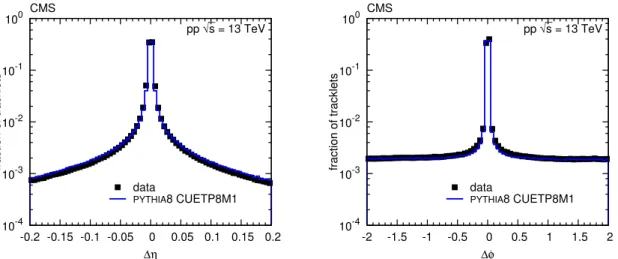
Figure 1: The∆η (left) and ∆φ (right) distributions of hit pairs on tracklets in the data (squares) and from MC simulation (histogram).
A tracklet-based vertex finder, as described in Ref. [13], is used for primary vertex reconstruc-tion. In the first step, a hit from layer 1 is selected and a matching hit from layer 2 is sought. If the|∆φ|of the hits is smaller than 0.05, the z position with respect to the counterclockwise-beam direction of the hits is extrapolated linearly and projected onto the beam axis. This procedure is repeated for every hit in layer 1, and the calculated z positions are saved as vertex candidates. The primary vertex is determined in a second step. If the magnitude of the difference between the z positions of any two vertex candidates is smaller than 0.12 cm, they are combined into a vertex cluster. The vertex cluster with the highest number of associated vertex candidates is selected as the primary vertex, and the final vertex z position zvis given by the average z
posi-tion of the associated vertex candidates. The typical resoluposi-tion of the primary vertex z posiposi-tion is 0.02–0.1 cm, depending on the number of pixel hits. The vertex reconstruction efficiency is high even for low-multiplicity events with few pixel hits, with around 80% efficiency for events with 3 to 4 hits in layer 1, and 100% efficiency for events with more than 8 hits in layer 1. The tracklet reconstruction is a separate procedure from the vertex reconstruction. There is no requirement on the∆φ of the hits. Instead, hits with the smallest|∆η|are paired first to form tracklets (Fig. 1, left), and no hit may be used more than once. In contrast to the track analysis, all hits are accepted for the tracklet reconstruction, such that the analysis is relatively insensitive to the cluster charge simulation. Tracklets corresponding to charged hadrons that originate at the primary vertex display a sharp peak at ∆φ = 0, while the background tracklets from uncorrelated pixel hits have a wide∆φ spectrum. Figure 1 (right) shows the combined data of primary charged hadrons (sharp peak) and tracklets from uncorrelated pixel hits (wide tails). To suppress the combinatorial background, only tracklets with|∆η| < 0.1 and|∆φ| < 1 are selected. Since the combinatorial background is flat in∆φ, a sideband region 1< |∆φ| <2 can be defined and used to estimate its magnitude, which is then subtracted from the signal region
|∆φ| < 1 to obtain the uncorrected dNch/dη. Typical values of the estimated background
fraction in the signal region increase with |η| from 6% to 25%. The η range for the tracklet
method is limited to|η| <2 to avoid a large acceptance correction.
Contributions from secondary particles, as well as the tracklet acceptance and reconstruction efficiency, have to be accounted for in order to determine the charged hadron dNch/dη
4 4 Data analysis
pseudorapidity, and tracklet multiplicity, using thePYTHIA8 CUETP8M1 tune as a reference. To account for the difference between the actual pixel detector geometry and that used in the simulation, an additional correction is applied as a function of η and the primary vertex posi-tion. This correction is obtained by taking the ratio between data and simulation of the geo-metrical distribution of tracklets in (η, zv) bins. The size of this correction ranges from 0 to 5%.
The largest correction factors are associated with the presence of inactive tracker modules in the data.
4.2 Tracks
The analysis only uses clusters whose width in the z direction is compatible with that of a charged particle originating from the nominal collision point. The difference between the mea-sured and the geometrically predicted widths is required to be smaller than 5 pixels.
Track finding involves identifying pixel hit triplets that fall on a straight line. All possible hit pairs are taken, the first hit from layer 1, and the second one from layer 2. If the difference between their azimuthal angles φ1 and φ2 is smaller than a certain value, ∆φ1,2 < α, they are
kept for the next step. For each hit pair, hits from layer 3 that have a small azimuthal difference with respect to the hit in layer 2 (|∆φ2,3| < α) are collected. In addition, the vector joining the
hits in the first and second layers and the vector joining the hits in the second and third layers are required to have polar angles that differ by, at most, α (|∆θ12,23| < α). If multiple hits in
the third layer satisfy the conditions above, the one with the smallest∆φ22,3+∆θ2
12,23 value is
selected. The comparison of the ∆φ distributions from signal and background shows that a value of α=0.02 gives the best signal significance.
The coordinates of the hits of the resulting triplets are used to perform a straight-line fit with parameters(z0, η, φ) using Newton’s method for minimization, where z0 is the z coordinate
of the point of closest approach to the beam axis. The transverse impact parameter d0 with
respect to the beam axis is fixed to 0 for this fit. The average distance d from the fitted line to the hits is used in the determination of the vertex position to estimate the uncertainty in z, as σz = d/ sin θ. A track is accepted if the straight-line fit to the hits gives a vertex position |z0| <20 cm.
The acceptance of the track method is |η| < 1.8, slightly reduced compared to the tracklet
method, since all three pixel barrel layers are used. According to the samples of pp events generated withPYTHIA8 CUETP8M1 andEPOSLHC, the tracking efficiency is flat at 80% in the
region|η| <1.6 owing to losses at low pT, and increases to 85% for pT > 0.2 GeV/c. For|η| >
1.6, the efficiency falls and is on average around 50%. The wide pTcoverage down to 0.05 GeV/c
ensures a robust performance and fairly insensitive behavior to variations in the pTspectrum.
The rate of duplicate tracks is below the percent level, while the fraction of misidentified tracks is in the range of 2–6%, rising with higher|η|values. The fraction of reconstructed nonprimary
particles is 2–3%.
An agglomerative vertex reconstruction [14] is performed using the fitted(z0, σz)values from
the reconstructed tracks. The clustering of tracks into vertices ends when the smallest σz
-normalized distance between vertex candidates is larger than 50. Duplicate tracks are removed based on the angle enclosed by their direction vectors. If this angle is smaller than 0.01, the one with a larger average distance d is removed. Vertices with at least three tracks are kept, unless there is only one vertex found in the event. In that case, there is no minimum for the number of tracks. Only tracks associated with a primary vertex are used in the physics analysis.
result-4.3 Systematic uncertainties 5 0 0.01 0.02 0.03 0.04 0.05 0.06 0 10 20 30 40 50 fraction
number of reconstructed tracks pp √s = 13 TeV CMS data PYTHIA8 CUETP8M1 EPOS LHC 4 4.5 5 5.5 6 6.5 7 -3 -2 -1 0 1 2 3 dN ch /d η η pp √s = 13 TeV inelastic CMS tracklets tracks PYTHIA8 CUETP8M1 EPOS LHC
Figure 2: (left) Distributions of the number of reconstructed tracks per event from data and from simulations, for inelastic pp collisions. (right) Distributions of the pseudorapidity density (dNch/dη) of charged hadrons in the region|η| <2 for inelastic collision events, reconstructed
using tracklets (open circles), and tracks (open squares), compared to PYTHIA8 CUETP8M1 and EPOSLHC predictions, shown as dashed and dotted curves, respectively. The solid and long-dashed lines encompassing the data points indicate the systematic uncertainties of the two reconstruction methods.
ing set of parameters is used in a three-dimensional vertex fit, which is also used to determine the location and shape of the interaction region. As Fig. 2 (left) shows, the distribution of the number of reconstructed tracks in data is in fair agreement with the MC event generator pre-dictions in particular at the higher multiplicities. The correction from track to charged particle multiplicity depends on the fraction of detected events as well as on the distribution of high multiplicity events (not shown in the figure).
Owing to the excellent vertex resolution (≈250 µm), the η resolution is also very good. Thus, potential migrations between neighboring bins are very small, and the final generator-dependent corrections are applied bin-by-bin. The measured yields in each η bin are multiplied by the ra-tio of the number of simulated primary charged hadrons to the number of the reconstructed tracks.
The performance of vertexing in simulation and in data was compared by determining the probability of reconstructing k vertices in case of n=1, 2, and 3 simultaneous pp collisions. The extracted p(k|n)conditional probabilities are used to estimate the average inelastic interaction probability µ per bunch crossing by assuming a Poissonian distribution for n. WhilePYTHIA8
CUETP8M1 gives µ = 0.0525±0.0003 (stat),EPOSLHC leads to 0.0545±0.0002 (stat). Taking their average as the central value and the difference as the systematic uncertainty, we estimate
µ=0.0535±0.0013 (syst). The product of the number of analyzed bunch crossings and µ gives
the number of inelastic collision events, to be used for the calculation of the final dNch/dη
values.
4.3 Systematic uncertainties
The systematic uncertainties in the final physics result come from several sources. According to the two MC event generators used, the two reconstruction techniques detect about 86–89% (for the tracklet method) and 86–90% (for the track method) of the inelastic pp events. The uncertainty in the number of unseen, mostly single-diffractive, collisions contributes about 3% to the total systematic uncertainty.
6 5 Results
The systematic uncertainties in the tracklet method take into account the effects of the amount of noise in the pixel hits (1–3%), detector misalignment, pixel hit reconstruction efficiency, and cluster splitting (all below 1%). The tracklet-to-hadron correction shows a 2–3% dependence on the choice of the MC event generator. The total systematic uncertainty of the tracklet method is in the range 3–4%.
For the track method, requiring three hits on a straight line greatly reduces the effects of pixel noise and cluster splitting. In addition, hits with cluster shapes that are not compatible with their positions are excluded from the analysis, and tracks close in (η, φ) are cleaned as
de-scribed in Section 4.2. The loss of any of the three hits because of pixel reconstruction ineffi-ciency would lead to the loss of the triplet, resulting in a systematic uncertainty of 1.8% from the tracking efficiency, independent of the choice of the MC event generator. The effect of de-tector misalignment on the angular distributions is several orders of magnitude smaller than the values of the selection criteria, and is therefore neglected. The sensitivity to the vertexing efficiency is included in the 2–3% systematic uncertainty associated with the estimate of µ, as discussed in Section 4.2. Uncertainties on track-level corrections are estimated from the differ-ences obtained using the two MC generators, and are at the level of 2–3%. The total systematic uncertainty of the track method is in the range of 3–4%.
The track analysis was also performed using only matched hits of double-sided modules in the strip tracker. The result is compatible with that from the pixel-only analysis within the systematic uncertainties. Because of the larger corrections and the more restricted|η|range,
the result with the strip tracker is not included in the final combination.
Finally, we also used the method of counting reconstructed pixel hits, as described in Ref. [2], which is subject to different background and systematic effects, and the measurements are within the systematic uncertainties of the results reported in this Letter.
5
Results
For the tracklet analysis, all recorded bunch crossings are used (about 170 000 collision events), while for the track analysis only 1 million of them are used (about 55 000 collision events). After corrections, the agreement between the tracklet and track dNch/dη results is better than 2% at
central pseudorapidity and better than 3% at forward pseudorapidities, as shown in Fig. 2 (right). Hence, averaging their dNch/dη values is justified. Since the systematic uncertainties dominate and are mostly correlated between the two analyses, the simple mean of the central values and of systematic uncertainties are taken. The fraction of primary charged leptons is
≈1% of the total long-lived charged particles produced, and the correction from detector-level tracklets and tracks is done for charged hadrons only.
Pseudorapidity density distributions of charged hadrons in the region|η| < 2 for inelastic pp
events are shown in Fig. 3 (left). The data points and uncertainties are symmetrized in±η. In
the range|η| <0.5 the average pseudorapidity density is dNch/dη||η|<0.5=5.49±0.01 (stat)±
0.17 (syst). While the predictions of both PYTHIA8 (with CUETP8S1 and CUETP8M1) and EPOSLHC agree with the measured central value, the measured dNch/dη distribution in the
full η range is better described by the latter. The uncertainty band ofPYTHIA8 corresponds to the envelope of the uncertainties of the tune parameters of CUETP8S1; theEPOSLHC predic-tions have no uncertainty associated with its parameter settings.
The center-of-mass energy dependence of dNch/dη is shown in Fig. 3 (right). For comparison
ener-7 0 1 2 3 4 5 6 7 8 -3 -2 -1 0 1 2 3 dN ch /d η η pp √s = 13 TeV inelastic CMS data PYTHIA8 CUETP8S1 EPOS LHC 0 1 2 3 4 5 6 7 8 101 102 103 104 dN ch /d η ||η| < 0.5 √s [GeV] pp inelastic parabolic fit in ln(s) CMS CMS ALICE PHOBOS UA5 ISR PYTHIA8 CUETP8S1 EPOS LHC
Figure 3: (left) Distributions of the pseudorapidity density of charged hadrons in the region
|η| < 2 in inelastic pp collisions at 13 TeV measured in data (solid markers, combined track
and tracklet results, symmetrized in η), and predicted by the PYTHIA8 CUETP8S1 and the
EPOSLHC event generators (curves). The grey shaded area encompassing the data points in-dicates their correlated systematic uncertainties. The blue band corresponds to the envelope of the CUETP8S1 tune parametric uncertainties. (right) Center-of-mass energy dependence of dNch/dη||η|<0.5 including ISR [15, 16], UA5 [17, 18], PHOBOS [19], and ALICE [20] data.
The solid curve shows a second-order polynomial in ln(s)fit to the data points, including the new result at√s = 13 TeV. The dashed and dotted curves show thePYTHIA8 CUETP8S1 and EPOSLHC predictions, respectively.
gies (ISR [15, 16], UA5 [17, 18], PHOBOS [19], and ALICE [20]) are also plotted. The measured values are empirically fitted using a second-order polynomial in ln(s)as 1.55−0.113 ln(s) +
0.0168 ln(s)2, where s has the units GeV2, which provides a good description of the available data over the full energy range. ThePYTHIA8 andEPOSLHC event generators globally
repro-duce the collision-energy dependence of hadron production in inelastic pp collisions.
6
Summary
The pseudorapidity distribution of charged hadrons has been measured by the CMS experi-ment, operated at zero magnetic field, at the LHC in proton-proton collisions at√s = 13 TeV. Using two methods, based on hit pairs and straight-line tracks in the barrel region of the CMS pixel detector, a charged hadron multiplicity at midrapidity, dNch/dη||η|<0.5 = 5.49±
0.01 (stat)±0.17 (syst), has been obtained for inelastic pp events. In the central region, the measured dNch/dη distribution is consistent with predictions of thePYTHIA8 (with the CMS
underlying event tunes CUETP8S1 and CUETP8M1) andEPOSLHC (LHC tune) event genera-tors, while those in a wider η range are better described by the latter. These results constitute the first CMS measurement of hadron production at the new center-of-mass energy frontier, and provide new constraints for the improvement of perturbative and nonperturbative QCD aspects implemented in hadronic event generators.
Acknowledgments
We congratulate our colleagues in the CERN accelerator departments for the excellent perfor-mance of the LHC and thank the technical and administrative staffs at CERN and at other CMS
8 References
institutes for their contributions to the success of the CMS effort. In addition, we gratefully acknowledge the computing centres and personnel of the Worldwide LHC Computing Grid for delivering so effectively the computing infrastructure essential to our analyses. Finally, we acknowledge the enduring support for the construction and operation of the LHC and the CMS detector provided by the following funding agencies: BMWFW and FWF (Austria); FNRS and FWO (Belgium); CNPq, CAPES, FAPERJ, and FAPESP (Brazil); MES (Bulgaria); CERN; CAS, MoST, and NSFC (China); COLCIENCIAS (Colombia); MSES and CSF (Croatia); RPF (Cyprus); MoER, ERC IUT and ERDF (Estonia); Academy of Finland, MEC, and HIP (Finland); CEA and CNRS/IN2P3 (France); BMBF, DFG, and HGF (Germany); GSRT (Greece); OTKA and NIH (Hungary); DAE and DST (India); IPM (Iran); SFI (Ireland); INFN (Italy); MSIP and NRF (Re-public of Korea); LAS (Lithuania); MOE and UM (Malaysia); CINVESTAV, CONACYT, SEP, and UASLP-FAI (Mexico); MBIE (New Zealand); PAEC (Pakistan); MSHE and NSC (Poland); FCT (Portugal); JINR (Dubna); MON, RosAtom, RAS and RFBR (Russia); MESTD (Serbia); SEIDI and CPAN (Spain); Swiss Funding Agencies (Switzerland); MST (Taipei); ThEPCenter, IPST, STAR and NSTDA (Thailand); TUBITAK and TAEK (Turkey); NASU and SFFR (Ukraine); STFC (United Kingdom); DOE and NSF (USA).
Individuals have received support from the Marie-Curie programme and the European Re-search Council and EPLANET (European Union); the Leventis Foundation; the A. P. Sloan Foundation; the Alexander von Humboldt Foundation; the Belgian Federal Science Policy Of-fice; the Fonds pour la Formation `a la Recherche dans l’Industrie et dans l’Agriculture (FRIA-Belgium); the Agentschap voor Innovatie door Wetenschap en Technologie (IWT-(FRIA-Belgium); the Ministry of Education, Youth and Sports (MEYS) of the Czech Republic; the Council of Science and Industrial Research, India; the HOMING PLUS programme of the Foundation for Polish Science, cofinanced from European Union, Regional Development Fund; the Compagnia di San Paolo (Torino); the Consorzio per la Fisica (Trieste); MIUR project 20108T4XTM (Italy); the Thalis and Aristeia programmes cofinanced by EU-ESF and the Greek NSRF; the National Pri-orities Research Program by Qatar National Research Fund; the Rachadapisek Sompot Fund for Postdoctoral Fellowship, Chulalongkorn University (Thailand); and the Welch Foundation.
References
[1] CMS Collaboration, “Transverse momentum and pseudorapidity distributions of charged hadrons in pp collisions at√s =0.9 and 2.36 TeV”, JHEP 02 (2010) 041, doi:10.1007/JHEP02(2010)041, arXiv:1002.0621.
[2] CMS Collaboration, “Transverse-momentum and pseudorapidity distributions of charged hadrons in pp collisions at√s =7 TeV”, Phys. Rev. Lett. 105 (2010) 022002, doi:10.1103/PhysRevLett.105.022002, arXiv:1005.3299.
[3] CMS and TOTEM Collaborations, “Measurement of pseudorapidity distributions of charged particles in proton-proton collisions at√s=8 TeV by the CMS and TOTEM experiments”, Eur. Phys. J. C 74 (2014) 3053,
doi:10.1140/epjc/s10052-014-3053-6, arXiv:1405.0722.
[4] T. Sj ¨ostrand, S. Mrenna, and P. Skands, “PYTHIA 6.4 Physics and Manual”, JHEP 05 (2006) 026, doi:10.1088/1126-6708/2006/05/026, arXiv:hep-ph/0603175. [5] T. Sj ¨ostrand, S. Mrenna, and P. Z. Skands, “A brief introduction to PYTHIA 8.1”, Comput.
Phys. Commun. 178 (2008) 852, doi:10.1016/j.cpc.2008.01.036, arXiv:0710.3820.
References 9
[6] CMS Collaboration, “Underlying Event Tunes and Double Parton Scattering”, CMS Physics Analysis Summary CMS-PAS-GEN-14-001, 2014.
[7] K. Werner, F.-M. Liu, and T. Pierog, “Parton ladder splitting and the rapidity dependence of transverse momentum spectra in deuteron-gold collisions at the BNL Relativistic Heavy Ion Collider”, Phys. Rev. C 74 (2006) 044902,
doi:10.1103/PhysRevC.74.044902, arXiv:hep-ph/0506232.
[8] T. Pierog et al., “EPOS LHC : test of collective hadronization with LHC data”, (2013). arXiv:1306.0121. DESY-13-125.
[9] D. d’Enterria et al., “Constraints from the first LHC data on hadronic event generators for ultra-high energy cosmic-ray physics”, Astropart. Phys. 35 (2011) 98,
doi:10.1016/j.astropartphys.2011.05.002, arXiv:1101.5596. [10] CMS Collaboration, “Production of leading charged particles and leading
charged-particle jets at small transverse momenta in pp collisions at√s = 8 TeV”, (2015). arXiv:1507.00233. submitted to Phys. Rev. D.
[11] CMS Collaboration, “The CMS experiment at the CERN LHC”, JINST 3 (2008) S08004, doi:10.1088/1748-0221/3/08/S08004.
[12] GEANT4 Collaboration, “GEANT4—a simulation toolkit”, Nucl. Instrum. Meth. A 506 (2003) 250, doi:10.1016/S0168-9002(03)01368-8.
[13] CMS Collaboration, “Dependence on pseudorapidity and centrality of charged hadron production in PbPb collisions at a nucleon-nucleon centre-of-mass energy of 2.76 TeV”, JHEP 08 (2011) 141, doi:10.1007/JHEP08(2011)141, arXiv:1107.4800.
[14] F. Sikl´er, “Study of clustering methods to improve primary vertex finding for collider detectors”, Nucl. Instrum. Meth. A 621 (2010) 526,
doi:10.1016/j.nima.2010.04.058, arXiv:0911.2767.
[15] A. M. Rossi et al., “Experimental study of the energy dependence in proton-proton inclusive reactions”, Nucl. Phys. B 84 (1975) 269,
doi:10.1016/0550-3213(75)90307-7.
[16] Aachen-CERN-Heidelberg-Munich Collaboration, “Charged particle multiplicity distributions in pp collisions at ISR energies”, Nucl. Phys. B 129 (1977) 365, doi:10.1016/0550-3213(77)90122-5.
[17] UA5 Collaboration, “Scaling of pseudorapidity distributions at c.m. energies up to 0.9 TeV”, Z. Phys. C 33 (1986) 1, doi:10.1007/BF01410446.
[18] UA5 Collaboration, “UA5: A general study of proton-antiproton physics at√
s =546 GeV”, Phys. Rept. 154 (1987) 247, doi:10.1016/0370-1573(87)90130-X. [19] PHOBOS Collaboration, “Pseudorapidity Distribution of Charged Particles in d + Au
Collisions at√sNN =200 GeV”, Phys. Rev. Lett. 93 (2004) 082301,
doi:10.1103/PhysRevLett.93.082301, arXiv:nucl-ex/0311009.
[20] ALICE Collaboration, “Charged-particle multiplicity measurement in proton-proton collisions at√s=0.9 and 2.36 TeV with ALICE at LHC”, Eur. Phys. J. C 68 (2010) 89, doi:10.1140/epjc/s10052-010-1339-x, arXiv:1004.3034.
11
A
The CMS Collaboration
Yerevan Physics Institute, Yerevan, Armenia
V. Khachatryan, A.M. Sirunyan, A. Tumasyan
Institut f ¨ur Hochenergiephysik der OeAW, Wien, Austria
W. Adam, E. Asilar, T. Bergauer, J. Brandstetter, E. Brondolin, M. Dragicevic, J. Er ¨o, M. Flechl, M. Friedl, R. Fr ¨uhwirth1, V.M. Ghete, C. Hartl, N. H ¨ormann, J. Hrubec, M. Jeitler1, V. Kn ¨unz, A. K ¨onig, M. Krammer1, I. Kr¨atschmer, D. Liko, T. Matsushita, I. Mikulec, D. Rabady2,
B. Rahbaran, H. Rohringer, J. Schieck1, R. Sch ¨ofbeck, J. Strauss, W. Treberer-Treberspurg, W. Waltenberger, C.-E. Wulz1
National Centre for Particle and High Energy Physics, Minsk, Belarus
V. Mossolov, N. Shumeiko, J. Suarez Gonzalez
Universiteit Antwerpen, Antwerpen, Belgium
S. Alderweireldt, T. Cornelis, E.A. De Wolf, X. Janssen, A. Knutsson, J. Lauwers, S. Luyckx, M. Van De Klundert, H. Van Haevermaet, P. Van Mechelen, N. Van Remortel, A. Van Spilbeeck
Vrije Universiteit Brussel, Brussel, Belgium
S. Abu Zeid, F. Blekman, J. D’Hondt, N. Daci, I. De Bruyn, K. Deroover, N. Heracleous, J. Keaveney, S. Lowette, L. Moreels, A. Olbrechts, Q. Python, D. Strom, S. Tavernier, W. Van Doninck, P. Van Mulders, G.P. Van Onsem, I. Van Parijs
Universit´e Libre de Bruxelles, Bruxelles, Belgium
P. Barria, H. Brun, C. Caillol, B. Clerbaux, G. De Lentdecker, G. Fasanella, L. Favart, A. Grebenyuk, G. Karapostoli, T. Lenzi, A. L´eonard, T. Maerschalk, A. Marinov, L. Perni`e, A. Randle-conde, T. Reis, T. Seva, C. Vander Velde, P. Vanlaer, R. Yonamine, F. Zenoni, F. Zhang3
Ghent University, Ghent, Belgium
K. Beernaert, L. Benucci, A. Cimmino, S. Crucy, D. Dobur, A. Fagot, G. Garcia, M. Gul, J. Mccartin, A.A. Ocampo Rios, D. Poyraz, D. Ryckbosch, S. Salva, M. Sigamani, N. Strobbe, M. Tytgat, W. Van Driessche, E. Yazgan, N. Zaganidis
Universit´e Catholique de Louvain, Louvain-la-Neuve, Belgium
S. Basegmez, C. Beluffi4, O. Bondu, S. Brochet, G. Bruno, A. Caudron, L. Ceard, G.G. Da Silveira, C. Delaere, D. Favart, L. Forthomme, A. Giammanco5, J. Hollar, A. Jafari, P. Jez, M. Komm, V. Lemaitre, A. Mertens, C. Nuttens, L. Perrini, A. Pin, K. Piotrzkowski, A. Popov6, L. Quertenmont, M. Selvaggi, M. Vidal Marono
Universit´e de Mons, Mons, Belgium
N. Beliy, G.H. Hammad
Centro Brasileiro de Pesquisas Fisicas, Rio de Janeiro, Brazil
W.L. Ald´a J ´unior, G.A. Alves, L. Brito, M. Correa Martins Junior, M. Hamer, C. Hensel, C. Mora Herrera, A. Moraes, M.E. Pol, P. Rebello Teles
Universidade do Estado do Rio de Janeiro, Rio de Janeiro, Brazil
E. Belchior Batista Das Chagas, W. Carvalho, J. Chinellato7, A. Cust ´odio, E.M. Da Costa, D. De Jesus Damiao, C. De Oliveira Martins, S. Fonseca De Souza, L.M. Huertas Guativa, H. Malbouisson, D. Matos Figueiredo, L. Mundim, H. Nogima, W.L. Prado Da Silva, A. Santoro, A. Sznajder, E.J. Tonelli Manganote7, A. Vilela Pereira
Universidade Estadual Paulistaa, Universidade Federal do ABCb, S˜ao Paulo, Brazil
12 A The CMS Collaboration
E.M. Gregoresb, P.G. Mercadanteb, C.S. Moona,8, S.F. Novaesa, Sandra S. Padulaa, D. Romero Abad, J.C. Ruiz Vargas
Institute for Nuclear Research and Nuclear Energy, Sofia, Bulgaria
A. Aleksandrov, R. Hadjiiska, P. Iaydjiev, M. Rodozov, S. Stoykova, G. Sultanov, M. Vutova
University of Sofia, Sofia, Bulgaria
A. Dimitrov, I. Glushkov, L. Litov, B. Pavlov, P. Petkov
Institute of High Energy Physics, Beijing, China
M. Ahmad, J.G. Bian, G.M. Chen, H.S. Chen, M. Chen, T. Cheng, R. Du, C.H. Jiang, R. Plestina9,
F. Romeo, S.M. Shaheen, J. Tao, C. Wang, Z. Wang, H. Zhang
State Key Laboratory of Nuclear Physics and Technology, Peking University, Beijing, China
C. Asawatangtrakuldee, Y. Ban, Q. Li, S. Liu, Y. Mao, S.J. Qian, D. Wang, Z. Xu
Universidad de Los Andes, Bogota, Colombia
C. Avila, A. Cabrera, L.F. Chaparro Sierra, C. Florez, J.P. Gomez, B. Gomez Moreno, J.C. Sanabria
University of Split, Faculty of Electrical Engineering, Mechanical Engineering and Naval Architecture, Split, Croatia
N. Godinovic, D. Lelas, I. Puljak, P.M. Ribeiro Cipriano
University of Split, Faculty of Science, Split, Croatia
Z. Antunovic, M. Kovac
Institute Rudjer Boskovic, Zagreb, Croatia
V. Brigljevic, K. Kadija, J. Luetic, S. Micanovic, L. Sudic
University of Cyprus, Nicosia, Cyprus
A. Attikis, G. Mavromanolakis, J. Mousa, C. Nicolaou, F. Ptochos, P.A. Razis, H. Rykaczewski
Charles University, Prague, Czech Republic
M. Bodlak, M. Finger10, M. Finger Jr.10
Academy of Scientific Research and Technology of the Arab Republic of Egypt, Egyptian Network of High Energy Physics, Cairo, Egypt
Y. Assran11, M. El Sawy12,13, S. Elgammal13, A. Ellithi Kamel14,14, M. Kamel15, M.A. Mahmoud15,15, Y. Mohammed15
National Institute of Chemical Physics and Biophysics, Tallinn, Estonia
B. Calpas, M. Kadastik, M. Murumaa, M. Raidal, A. Tiko, C. Veelken
Department of Physics, University of Helsinki, Helsinki, Finland
P. Eerola, J. Pekkanen, M. Voutilainen
Helsinki Institute of Physics, Helsinki, Finland
J. H¨ark ¨onen, V. Karim¨aki, R. Kinnunen, T. Lamp´en, K. Lassila-Perini, S. Lehti, T. Lind´en, P. Luukka, T. M¨aenp¨a¨a, T. Peltola, E. Tuominen, J. Tuominiemi, E. Tuovinen, L. Wendland
Lappeenranta University of Technology, Lappeenranta, Finland
J. Talvitie, T. Tuuva
DSM/IRFU, CEA/Saclay, Gif-sur-Yvette, France
13
S. Ganjour, A. Givernaud, P. Gras, G. Hamel de Monchenault, P. Jarry, E. Locci, M. Machet, J. Malcles, J. Rander, A. Rosowsky, M. Titov, A. Zghiche
Laboratoire Leprince-Ringuet, Ecole Polytechnique, IN2P3-CNRS, Palaiseau, France
I. Antropov, S. Baffioni, F. Beaudette, P. Busson, L. Cadamuro, E. Chapon, C. Charlot, T. Dahms, O. Davignon, N. Filipovic, A. Florent, R. Granier de Cassagnac, S. Lisniak, L. Mastrolorenzo, P. Min´e, I.N. Naranjo, M. Nguyen, C. Ochando, G. Ortona, P. Paganini, P. Pigard, S. Regnard, R. Salerno, J.B. Sauvan, Y. Sirois, T. Strebler, Y. Yilmaz, A. Zabi
Institut Pluridisciplinaire Hubert Curien, Universit´e de Strasbourg, Universit´e de Haute Alsace Mulhouse, CNRS/IN2P3, Strasbourg, France
J.-L. Agram16, J. Andrea, A. Aubin, D. Bloch, J.-M. Brom, M. Buttignol, E.C. Chabert,
N. Chanon, C. Collard, E. Conte16, X. Coubez, J.-C. Fontaine16, D. Gel´e, U. Goerlach, C. Goetzmann, A.-C. Le Bihan, J.A. Merlin2, K. Skovpen, P. Van Hove
Centre de Calcul de l’Institut National de Physique Nucleaire et de Physique des Particules, CNRS/IN2P3, Villeurbanne, France
S. Gadrat
Universit´e de Lyon, Universit´e Claude Bernard Lyon 1, CNRS-IN2P3, Institut de Physique Nucl´eaire de Lyon, Villeurbanne, France
S. Beauceron, C. Bernet, G. Boudoul, E. Bouvier, C.A. Carrillo Montoya, R. Chierici, D. Contardo, B. Courbon, P. Depasse, H. El Mamouni, J. Fan, J. Fay, S. Gascon, M. Gouzevitch, B. Ille, F. Lagarde, I.B. Laktineh, M. Lethuillier, L. Mirabito, A.L. Pequegnot, S. Perries, J.D. Ruiz Alvarez, D. Sabes, L. Sgandurra, V. Sordini, M. Vander Donckt, P. Verdier, S. Viret
Georgian Technical University, Tbilisi, Georgia
T. Toriashvili17
Tbilisi State University, Tbilisi, Georgia
Z. Tsamalaidze10
RWTH Aachen University, I. Physikalisches Institut, Aachen, Germany
C. Autermann, S. Beranek, M. Edelhoff, L. Feld, A. Heister, M.K. Kiesel, K. Klein, M. Lipinski, A. Ostapchuk, M. Preuten, F. Raupach, S. Schael, J.F. Schulte, T. Verlage, H. Weber, B. Wittmer, V. Zhukov6
RWTH Aachen University, III. Physikalisches Institut A, Aachen, Germany
M. Ata, M. Brodski, E. Dietz-Laursonn, D. Duchardt, M. Endres, M. Erdmann, S. Erdweg, T. Esch, R. Fischer, A. G ¨uth, T. Hebbeker, C. Heidemann, K. Hoepfner, D. Klingebiel, S. Knutzen, P. Kreuzer, M. Merschmeyer, A. Meyer, P. Millet, M. Olschewski, K. Padeken, P. Papacz, T. Pook, M. Radziej, H. Reithler, M. Rieger, F. Scheuch, L. Sonnenschein, D. Teyssier, S. Th ¨uer
RWTH Aachen University, III. Physikalisches Institut B, Aachen, Germany
V. Cherepanov, Y. Erdogan, G. Fl ¨ugge, H. Geenen, M. Geisler, F. Hoehle, B. Kargoll, T. Kress, Y. Kuessel, A. K ¨unsken, J. Lingemann2, A. Nehrkorn, A. Nowack, I.M. Nugent, C. Pistone, O. Pooth, A. Stahl
Deutsches Elektronen-Synchrotron, Hamburg, Germany
M. Aldaya Martin, I. Asin, N. Bartosik, O. Behnke, U. Behrens, A.J. Bell, K. Borras18,
A. Burgmeier, A. Cakir, L. Calligaris, A. Campbell, S. Choudhury, P. Connor, F. Costanza, C. Diez Pardos, G. Dolinska, S. Dooling, T. Dorland, G. Eckerlin, D. Eckstein, T. Eichhorn, G. Flucke, E. Gallo19, J. Garay Garcia, A. Geiser, A. Gizhko, J.M. Grados Luyando, P. Gunnellini,
14 A The CMS Collaboration
J. Hauk, M. Hempel20, H. Jung, A. Kalogeropoulos, O. Karacheban20, M. Kasemann, P. Katsas, J. Kieseler, C. Kleinwort, I. Korol, W. Lange, J. Leonard, K. Lipka, A. Lobanov, W. Lohmann20, R. Mankel, I. Marfin20, I.-A. Melzer-Pellmann, A.B. Meyer, G. Mittag, J. Mnich, A. Mussgiller, S. Naumann-Emme, A. Nayak, E. Ntomari, H. Perrey, D. Pitzl, R. Placakyte, A. Raspereza, B. Roland, M. ¨O. Sahin, P. Saxena, T. Schoerner-Sadenius, M. Schr ¨oder, C. Seitz, S. Spannagel, K.D. Trippkewitz, R. Walsh, C. Wissing
University of Hamburg, Hamburg, Germany
V. Blobel, M. Centis Vignali, A.R. Draeger, J. Erfle, E. Garutti, K. Goebel, D. Gonzalez, M. G ¨orner, J. Haller, M. Hoffmann, R.S. H ¨oing, A. Junkes, R. Klanner, R. Kogler, T. Lapsien, T. Lenz, I. Marchesini, D. Marconi, M. Meyer, D. Nowatschin, J. Ott, F. Pantaleo2, T. Peiffer, A. Perieanu, N. Pietsch, J. Poehlsen, D. Rathjens, C. Sander, H. Schettler, P. Schleper, E. Schlieckau, A. Schmidt, J. Schwandt, M. Seidel, V. Sola, H. Stadie, G. Steinbr ¨uck, H. Tholen, D. Troendle, E. Usai, L. Vanelderen, A. Vanhoefer, B. Vormwald
Institut f ¨ur Experimentelle Kernphysik, Karlsruhe, Germany
M. Akbiyik, C. Barth, C. Baus, J. Berger, C. B ¨oser, E. Butz, T. Chwalek, F. Colombo, W. De Boer, A. Descroix, A. Dierlamm, S. Fink, F. Frensch, M. Giffels, A. Gilbert, F. Hartmann2, S.M. Heindl, U. Husemann, I. Katkov6, A. Kornmayer2, P. Lobelle Pardo, B. Maier, H. Mildner, M.U. Mozer, T. M ¨uller, Th. M ¨uller, M. Plagge, G. Quast, K. Rabbertz, S. R ¨ocker, F. Roscher, H.J. Simonis, F.M. Stober, R. Ulrich, J. Wagner-Kuhr, S. Wayand, M. Weber, T. Weiler, C. W ¨ohrmann, R. Wolf
Institute of Nuclear and Particle Physics (INPP), NCSR Demokritos, Aghia Paraskevi, Greece
G. Anagnostou, G. Daskalakis, T. Geralis, V.A. Giakoumopoulou, A. Kyriakis, D. Loukas, A. Psallidas, I. Topsis-Giotis
University of Athens, Athens, Greece
A. Agapitos, S. Kesisoglou, A. Panagiotou, N. Saoulidou, E. Tziaferi
University of Io´annina, Io´annina, Greece
I. Evangelou, G. Flouris, C. Foudas, P. Kokkas, N. Loukas, N. Manthos, I. Papadopoulos, E. Paradas, J. Strologas
Wigner Research Centre for Physics, Budapest, Hungary
G. Bencze, C. Hajdu, A. Hazi, P. Hidas, D. Horvath21, F. Sikler, V. Veszpremi, G. Vesztergombi22, A.J. Zsigmond
Institute of Nuclear Research ATOMKI, Debrecen, Hungary
N. Beni, S. Czellar, J. Karancsi23, J. Molnar, Z. Szillasi
University of Debrecen, Debrecen, Hungary
M. Bart ´ok24, A. Makovec, P. Raics, Z.L. Trocsanyi, B. Ujvari
National Institute of Science Education and Research, Bhubaneswar, India
P. Mal, K. Mandal, D.K. Sahoo, N. Sahoo, S.K. Swain
Panjab University, Chandigarh, India
S. Bansal, S.B. Beri, V. Bhatnagar, R. Chawla, R. Gupta, U.Bhawandeep, A.K. Kalsi, A. Kaur, M. Kaur, R. Kumar, A. Mehta, M. Mittal, J.B. Singh, G. Walia
University of Delhi, Delhi, India
Ashok Kumar, A. Bhardwaj, B.C. Choudhary, R.B. Garg, A. Kumar, S. Malhotra, M. Naimuddin, N. Nishu, K. Ranjan, R. Sharma, V. Sharma
15
Saha Institute of Nuclear Physics, Kolkata, India
R. Bhardwaj, S. Bhattacharya, K. Chatterjee, S. Dey, S. Dutta, Sa. Jain, N. Majumdar, A. Modak, K. Mondal, S. Mukherjee, S. Mukhopadhyay, A. Roy, D. Roy, S. Roy Chowdhury, S. Sarkar, M. Sharan
Bhabha Atomic Research Centre, Mumbai, India
A. Abdulsalam, R. Chudasama, D. Dutta, V. Jha, V. Kumar, A.K. Mohanty2, L.M. Pant, P. Shukla, A. Topkar
Tata Institute of Fundamental Research, Mumbai, India
T. Aziz, S. Banerjee, S. Bhowmik25, R.M. Chatterjee, R.K. Dewanjee, S. Dugad, S. Ganguly,
S. Ghosh, M. Guchait, A. Gurtu26, G. Kole, S. Kumar, B. Mahakud, M. Maity25, G. Majumder,
K. Mazumdar, S. Mitra, G.B. Mohanty, B. Parida, T. Sarkar25, N. Sur, B. Sutar, N. Wickramage27
Indian Institute of Science Education and Research (IISER), Pune, India
S. Chauhan, S. Dube, S. Sharma
Institute for Research in Fundamental Sciences (IPM), Tehran, Iran
H. Bakhshiansohi, H. Behnamian, S.M. Etesami28, A. Fahim29, R. Goldouzian, M. Khakzad,
M. Mohammadi Najafabadi, M. Naseri, S. Paktinat Mehdiabadi, F. Rezaei Hosseinabadi, B. Safarzadeh30, M. Zeinali
University College Dublin, Dublin, Ireland
M. Felcini, M. Grunewald
INFN Sezione di Baria, Universit`a di Barib, Politecnico di Baric, Bari, Italy
M. Abbresciaa,b, C. Calabriaa,b, C. Caputoa,b, A. Colaleoa, D. Creanzaa,c, L. Cristellaa,b, N. De
Filippisa,c, M. De Palmaa,b, L. Fiorea, G. Iasellia,c, G. Maggia,c, M. Maggia, G. Minielloa,b, S. Mya,c, S. Nuzzoa,b, A. Pompilia,b, G. Pugliesea,c, R. Radognaa,b, A. Ranieria, G. Selvaggia,b, L. Silvestrisa,2, R. Vendittia,b, P. Verwilligena
INFN Sezione di Bolognaa, Universit`a di Bolognab, Bologna, Italy
G. Abbiendia, C. Battilana2, A.C. Benvenutia, D. Bonacorsia,b, S. Braibant-Giacomellia,b, L. Brigliadoria,b, R. Campaninia,b, P. Capiluppia,b, A. Castroa,b, F.R. Cavalloa, S.S. Chhibraa,b, G. Codispotia,b, M. Cuffiania,b, G.M. Dallavallea, F. Fabbria, A. Fanfania,b, D. Fasanellaa,b,
P. Giacomellia, C. Grandia, L. Guiduccia,b, S. Marcellinia, G. Masettia, A. Montanaria, F.L. Navarriaa,b, A. Perrottaa, A.M. Rossia,b, T. Rovellia,b, G.P. Sirolia,b, N. Tosia,b, R. Travaglinia,b
INFN Sezione di Cataniaa, Universit`a di Cataniab, CSFNSMc, Catania, Italy
G. Cappelloa, M. Chiorbolia,b, S. Costaa,b, F. Giordanoa,b, R. Potenzaa,b, A. Tricomia,b, C. Tuvea,b
INFN Sezione di Firenzea, Universit`a di Firenzeb, Firenze, Italy
G. Barbaglia, V. Ciullia,b, C. Civininia, R. D’Alessandroa,b, E. Focardia,b, S. Gonzia,b, V. Goria,b, P. Lenzia,b, M. Meschinia, S. Paolettia, G. Sguazzonia, A. Tropianoa,b, L. Viliania,b
INFN Laboratori Nazionali di Frascati, Frascati, Italy
L. Benussi, S. Bianco, F. Fabbri, D. Piccolo, F. Primavera
INFN Sezione di Genovaa, Universit`a di Genovab, Genova, Italy
V. Calvellia,b, F. Ferroa, M. Lo Veterea,b, M.R. Mongea,b, E. Robuttia, S. Tosia,b
INFN Sezione di Milano-Bicoccaa, Universit`a di Milano-Bicoccab, Milano, Italy
16 A The CMS Collaboration
S. Malvezzia, R.A. Manzonia,b, B. Marzocchia,b,2, D. Menascea, L. Moronia, M. Paganonia,b, D. Pedrinia, S. Ragazzia,b, N. Redaellia, T. Tabarelli de Fatisa,b
INFN Sezione di Napolia, Universit`a di Napoli ’Federico II’b, Napoli, Italy, Universit`a della Basilicatac, Potenza, Italy, Universit`a G. Marconid, Roma, Italy
S. Buontempoa, N. Cavalloa,c, S. Di Guidaa,d,2, M. Espositoa,b, F. Fabozzia,c, A.O.M. Iorioa,b, G. Lanzaa, L. Listaa, S. Meolaa,d,2, M. Merolaa, P. Paoluccia,2, C. Sciaccaa,b, F. Thyssen
INFN Sezione di Padova a, Universit`a di Padova b, Padova, Italy, Universit`a di Trento c, Trento, Italy
P. Azzia,2, N. Bacchettaa, L. Benatoa,b, D. Biselloa,b, A. Bolettia,b, A. Brancaa,b, R. Carlina,b, P. Checchiaa, M. Dall’Ossoa,b,2, T. Dorigoa, U. Dossellia, F. Gasparinia,b, U. Gasparinia,b,
F. Gonellaa, A. Gozzelinoa, K. Kanishcheva,c, S. Lacapraraa, M. Margonia,b, A.T. Meneguzzoa,b, J. Pazzinia,b, N. Pozzobona,b, P. Ronchesea,b, F. Simonettoa,b, E. Torassaa, M. Tosia,b, M. Zanetti, P. Zottoa,b, A. Zucchettaa,b,2, G. Zumerlea,b
INFN Sezione di Paviaa, Universit`a di Paviab, Pavia, Italy
A. Braghieria, A. Magnania, P. Montagnaa,b, S.P. Rattia,b, V. Rea, C. Riccardia,b, P. Salvinia, I. Vaia, P. Vituloa,b
INFN Sezione di Perugiaa, Universit`a di Perugiab, Perugia, Italy
L. Alunni Solestizia,b, M. Biasinia,b, G.M. Bileia, D. Ciangottinia,b,2, L. Fan `oa,b, P. Laricciaa,b, G. Mantovania,b, M. Menichellia, A. Sahaa, A. Santocchiaa,b, A. Spieziaa,b
INFN Sezione di Pisaa, Universit`a di Pisab, Scuola Normale Superiore di Pisac, Pisa, Italy
K. Androsova,31, P. Azzurria, G. Bagliesia, J. Bernardinia, T. Boccalia, G. Broccoloa,c, R. Castaldia, M.A. Cioccia,31, R. Dell’Orsoa, S. Donatoa,c,2, G. Fedi, L. Fo`aa,c†, A. Giassia, M.T. Grippoa,31,
F. Ligabuea,c, T. Lomtadzea, L. Martinia,b, A. Messineoa,b, F. Pallaa, A. Rizzia,b, A.
Savoy-Navarroa,32, A.T. Serbana, P. Spagnoloa, P. Squillaciotia,31, R. Tenchinia, G. Tonellia,b, A. Venturia, P.G. Verdinia
INFN Sezione di Romaa, Universit`a di Romab, Roma, Italy
L. Baronea,b, F. Cavallaria, G. D’imperioa,b,2, D. Del Rea,b, M. Diemoza, S. Gellia,b, C. Jordaa, E. Longoa,b, F. Margarolia,b, P. Meridiania, G. Organtinia,b, R. Paramattia, F. Preiatoa,b, S. Rahatloua,b, C. Rovellia, F. Santanastasioa,b, P. Traczyka,b,2
INFN Sezione di Torino a, Universit`a di Torino b, Torino, Italy, Universit`a del Piemonte Orientalec, Novara, Italy
N. Amapanea,b, R. Arcidiaconoa,c,2, S. Argiroa,b, M. Arneodoa,c, R. Bellana,b, C. Biinoa, N. Cartigliaa, M. Costaa,b, R. Covarellia,b, A. Deganoa,b, N. Demariaa, L. Fincoa,b,2, B. Kiania,b, C. Mariottia, S. Masellia, E. Migliorea,b, V. Monacoa,b, E. Monteila,b, M. Musicha, M.M. Obertinoa,b, L. Pachera,b, N. Pastronea, M. Pelliccionia, G.L. Pinna Angionia,b, F. Raveraa,b, A. Romeroa,b, M. Ruspaa,c, R. Sacchia,b, A. Solanoa,b, A. Staianoa, U. Tamponia
INFN Sezione di Triestea, Universit`a di Triesteb, Trieste, Italy
S. Belfortea, V. Candelisea,b,2, M. Casarsaa, F. Cossuttia, G. Della Riccaa,b, B. Gobboa, C. La Licataa,b, M. Maronea,b, A. Schizzia,b, A. Zanettia
Kangwon National University, Chunchon, Korea
A. Kropivnitskaya, S.K. Nam
Kyungpook National University, Daegu, Korea
17
Chonbuk National University, Jeonju, Korea
J.A. Brochero Cifuentes, H. Kim, T.J. Kim
Chonnam National University, Institute for Universe and Elementary Particles, Kwangju, Korea
S. Song
Korea University, Seoul, Korea
S. Choi, Y. Go, D. Gyun, B. Hong, M. Jo, H. Kim, Y. Kim, B. Lee, K. Lee, K.S. Lee, S. Lee, S.K. Park, Y. Roh
Seoul National University, Seoul, Korea
H.D. Yoo
University of Seoul, Seoul, Korea
M. Choi, H. Kim, J.H. Kim, J.S.H. Lee, I.C. Park, G. Ryu, M.S. Ryu
Sungkyunkwan University, Suwon, Korea
Y. Choi, J. Goh, D. Kim, E. Kwon, J. Lee, I. Yu
Vilnius University, Vilnius, Lithuania
A. Juodagalvis, J. Vaitkus
National Centre for Particle Physics, Universiti Malaya, Kuala Lumpur, Malaysia
I. Ahmed, Z.A. Ibrahim, J.R. Komaragiri, M.A.B. Md Ali33, F. Mohamad Idris34, W.A.T. Wan Abdullah, M.N. Yusli
Centro de Investigacion y de Estudios Avanzados del IPN, Mexico City, Mexico
E. Casimiro Linares, H. Castilla-Valdez, E. De La Cruz-Burelo, I. Heredia-De La Cruz35, A. Hernandez-Almada, R. Lopez-Fernandez, A. Sanchez-Hernandez
Universidad Iberoamericana, Mexico City, Mexico
S. Carrillo Moreno, F. Vazquez Valencia
Benemerita Universidad Autonoma de Puebla, Puebla, Mexico
I. Pedraza, H.A. Salazar Ibarguen
Universidad Aut ´onoma de San Luis Potos´ı, San Luis Potos´ı, Mexico
A. Morelos Pineda
University of Auckland, Auckland, New Zealand
D. Krofcheck
University of Canterbury, Christchurch, New Zealand
P.H. Butler
National Centre for Physics, Quaid-I-Azam University, Islamabad, Pakistan
A. Ahmad, M. Ahmad, Q. Hassan, H.R. Hoorani, W.A. Khan, T. Khurshid, M. Shoaib
National Centre for Nuclear Research, Swierk, Poland
H. Bialkowska, M. Bluj, B. Boimska, T. Frueboes, M. G ´orski, M. Kazana, K. Nawrocki, K. Romanowska-Rybinska, M. Szleper, P. Zalewski
Institute of Experimental Physics, Faculty of Physics, University of Warsaw, Warsaw, Poland
G. Brona, K. Bunkowski, A. Byszuk36, K. Doroba, A. Kalinowski, M. Konecki, J. Krolikowski, M. Misiura, M. Olszewski, M. Walczak
18 A The CMS Collaboration
Laborat ´orio de Instrumenta¸c˜ao e F´ısica Experimental de Part´ıculas, Lisboa, Portugal
P. Bargassa, C. Beir˜ao Da Cruz E Silva, A. Di Francesco, P. Faccioli, P.G. Ferreira Parracho, M. Gallinaro, N. Leonardo, L. Lloret Iglesias, F. Nguyen, J. Rodrigues Antunes, J. Seixas, O. Toldaiev, D. Vadruccio, J. Varela, P. Vischia
Joint Institute for Nuclear Research, Dubna, Russia
S. Afanasiev, P. Bunin, M. Gavrilenko, I. Golutvin, I. Gorbunov, A. Kamenev, V. Karjavin, V. Konoplyanikov, A. Lanev, A. Malakhov, V. Matveev37, P. Moisenz, V. Palichik, V. Perelygin, S. Shmatov, S. Shulha, N. Skatchkov, V. Smirnov, A. Zarubin
Petersburg Nuclear Physics Institute, Gatchina (St. Petersburg), Russia
V. Golovtsov, Y. Ivanov, V. Kim38, E. Kuznetsova, P. Levchenko, V. Murzin, V. Oreshkin,
I. Smirnov, V. Sulimov, L. Uvarov, S. Vavilov, A. Vorobyev
Institute for Nuclear Research, Moscow, Russia
Yu. Andreev, A. Dermenev, S. Gninenko, N. Golubev, A. Karneyeu, M. Kirsanov, N. Krasnikov, A. Pashenkov, D. Tlisov, A. Toropin
Institute for Theoretical and Experimental Physics, Moscow, Russia
V. Epshteyn, V. Gavrilov, N. Lychkovskaya, V. Popov, I. Pozdnyakov, G. Safronov, A. Spiridonov, E. Vlasov, A. Zhokin
National Research Nuclear University ’Moscow Engineering Physics Institute’ (MEPhI), Moscow, Russia
A. Bylinkin
P.N. Lebedev Physical Institute, Moscow, Russia
V. Andreev, M. Azarkin39, I. Dremin39, M. Kirakosyan, A. Leonidov39, G. Mesyats, S.V. Rusakov
Skobeltsyn Institute of Nuclear Physics, Lomonosov Moscow State University, Moscow, Russia
A. Baskakov, A. Belyaev, E. Boos, A. Ershov, A. Gribushin, L. Khein, V. Klyukhin, O. Kodolova, I. Lokhtin, O. Lukina, I. Myagkov, S. Obraztsov, S. Petrushanko, V. Savrin, A. Snigirev
State Research Center of Russian Federation, Institute for High Energy Physics, Protvino, Russia
I. Azhgirey, I. Bayshev, S. Bitioukov, V. Kachanov, A. Kalinin, D. Konstantinov, V. Krychkine, V. Petrov, R. Ryutin, A. Sobol, L. Tourtchanovitch, S. Troshin, N. Tyurin, A. Uzunian, A. Volkov
University of Belgrade, Faculty of Physics and Vinca Institute of Nuclear Sciences, Belgrade, Serbia
P. Adzic40, J. Milosevic, V. Rekovic
Centro de Investigaciones Energ´eticas Medioambientales y Tecnol ´ogicas (CIEMAT), Madrid, Spain
J. Alcaraz Maestre, E. Calvo, M. Cerrada, M. Chamizo Llatas, N. Colino, B. De La Cruz, A. Delgado Peris, D. Dom´ınguez V´azquez, A. Escalante Del Valle, C. Fernandez Bedoya, J.P. Fern´andez Ramos, J. Flix, M.C. Fouz, P. Garcia-Abia, O. Gonzalez Lopez, S. Goy Lopez, J.M. Hernandez, M.I. Josa, E. Navarro De Martino, A. P´erez-Calero Yzquierdo, J. Puerta Pelayo, A. Quintario Olmeda, I. Redondo, L. Romero, J. Santaolalla, M.S. Soares
Universidad Aut ´onoma de Madrid, Madrid, Spain
19
Universidad de Oviedo, Oviedo, Spain
J. Cuevas, J. Fernandez Menendez, S. Folgueras, I. Gonzalez Caballero, E. Palencia Cortezon, J.M. Vizan Garcia
Instituto de F´ısica de Cantabria (IFCA), CSIC-Universidad de Cantabria, Santander, Spain
I.J. Cabrillo, A. Calderon, J.R. Casti ˜neiras De Saa, P. De Castro Manzano, J. Duarte Campderros, M. Fernandez, J. Garcia-Ferrero, G. Gomez, A. Lopez Virto, J. Marco, R. Marco, C. Martinez Rivero, F. Matorras, F.J. Munoz Sanchez, J. Piedra Gomez, T. Rodrigo, A.Y. Rodr´ıguez-Marrero, A. Ruiz-Jimeno, L. Scodellaro, I. Vila, R. Vilar Cortabitarte
CERN, European Organization for Nuclear Research, Geneva, Switzerland
D. Abbaneo, E. Auffray, G. Auzinger, M. Bachtis, P. Baillon, A.H. Ball, D. Barney, A. Benaglia, J. Bendavid, L. Benhabib, J.F. Benitez, G.M. Berruti, P. Bloch, A. Bocci, A. Bonato, C. Botta, H. Breuker, T. Camporesi, R. Castello, G. Cerminara, M. D’Alfonso, D. d’Enterria, A. Dabrowski, V. Daponte, A. David, M. De Gruttola, F. De Guio, A. De Roeck, S. De Visscher, E. Di Marco, M. Dobson, M. Dordevic, B. Dorney, T. du Pree, M. D ¨unser, N. Dupont, A. Elliott-Peisert, G. Franzoni, W. Funk, D. Gigi, K. Gill, D. Giordano, M. Girone, F. Glege, R. Guida, S. Gundacker, M. Guthoff, J. Hammer, P. Harris, J. Hegeman, V. Innocente, P. Janot, H. Kirschenmann, M.J. Kortelainen, K. Kousouris, K. Krajczar, P. Lecoq, C. Lourenc¸o, M.T. Lucchini, N. Magini, L. Malgeri, M. Mannelli, A. Martelli, L. Masetti, F. Meijers, S. Mersi, E. Meschi, F. Moortgat, S. Morovic, M. Mulders, M.V. Nemallapudi, H. Neugebauer, S. Orfanelli41, L. Orsini, L. Pape, E. Perez, M. Peruzzi, A. Petrilli, G. Petrucciani, A. Pfeiffer, D. Piparo, A. Racz, G. Rolandi42, M. Rovere, M. Ruan, H. Sakulin, C. Sch¨afer, C. Schwick, A. Sharma, P. Silva, M. Simon, P. Sphicas43, D. Spiga, J. Steggemann, B. Stieger, M. Stoye, Y. Takahashi, D. Treille, A. Triossi, A. Tsirou, G.I. Veres22, N. Wardle, H.K. W ¨ohri, A. Zagozdzinska36, W.D. Zeuner
Paul Scherrer Institut, Villigen, Switzerland
W. Bertl, K. Deiters, W. Erdmann, R. Horisberger, Q. Ingram, H.C. Kaestli, D. Kotlinski, U. Langenegger, D. Renker, T. Rohe
Institute for Particle Physics, ETH Zurich, Zurich, Switzerland
F. Bachmair, L. B¨ani, L. Bianchini, M.A. Buchmann, B. Casal, G. Dissertori, M. Dittmar, M. Doneg`a, P. Eller, C. Grab, C. Heidegger, D. Hits, J. Hoss, G. Kasieczka, W. Lustermann, B. Mangano, M. Marionneau, P. Martinez Ruiz del Arbol, M. Masciovecchio, D. Meister, F. Micheli, P. Musella, F. Nessi-Tedaldi, F. Pandolfi, J. Pata, F. Pauss, L. Perrozzi, M. Quittnat, M. Rossini, A. Starodumov44, M. Takahashi, V.R. Tavolaro, K. Theofilatos, R. Wallny
Universit¨at Z ¨urich, Zurich, Switzerland
T.K. Aarrestad, C. Amsler45, L. Caminada, M.F. Canelli, V. Chiochia, A. De Cosa, C. Galloni, A. Hinzmann, T. Hreus, B. Kilminster, C. Lange, J. Ngadiuba, D. Pinna, P. Robmann, F.J. Ronga, D. Salerno, Y. Yang
National Central University, Chung-Li, Taiwan
M. Cardaci, K.H. Chen, T.H. Doan, Sh. Jain, R. Khurana, M. Konyushikhin, C.M. Kuo, W. Lin, Y.J. Lu, S.S. Yu
National Taiwan University (NTU), Taipei, Taiwan
Arun Kumar, R. Bartek, P. Chang, Y.H. Chang, Y.W. Chang, Y. Chao, K.F. Chen, P.H. Chen, C. Dietz, F. Fiori, U. Grundler, W.-S. Hou, Y. Hsiung, Y.F. Liu, R.-S. Lu, M. Mi ˜nano Moya, E. Petrakou, J.f. Tsai, Y.M. Tzeng
20 A The CMS Collaboration
Chulalongkorn University, Faculty of Science, Department of Physics, Bangkok, Thailand
B. Asavapibhop, K. Kovitanggoon, G. Singh, N. Srimanobhas, N. Suwonjandee
Cukurova University, Adana, Turkey
A. Adiguzel, S. Cerci46, Z.S. Demiroglu, C. Dozen, S. Girgis, G. Gokbulut, Y. Guler, E. Gurpinar, I. Hos, E.E. Kangal47, A. Kayis Topaksu, G. Onengut48, K. Ozdemir49, S. Ozturk50, B. Tali46, H. Topakli50, M. Vergili, C. Zorbilmez
Middle East Technical University, Physics Department, Ankara, Turkey
I.V. Akin, B. Bilin, S. Bilmis, B. Isildak51, G. Karapinar52, M. Yalvac, M. Zeyrek
Bogazici University, Istanbul, Turkey
E.A. Albayrak53, E. G ¨ulmez, M. Kaya54, O. Kaya55, T. Yetkin56
Istanbul Technical University, Istanbul, Turkey
K. Cankocak, S. Sen57, F.I. Vardarlı
Institute for Scintillation Materials of National Academy of Science of Ukraine, Kharkov, Ukraine
B. Grynyov
National Scientific Center, Kharkov Institute of Physics and Technology, Kharkov, Ukraine
L. Levchuk, P. Sorokin
University of Bristol, Bristol, United Kingdom
R. Aggleton, F. Ball, L. Beck, J.J. Brooke, E. Clement, D. Cussans, H. Flacher, J. Goldstein, M. Grimes, G.P. Heath, H.F. Heath, J. Jacob, L. Kreczko, C. Lucas, Z. Meng, D.M. Newbold58,
S. Paramesvaran, A. Poll, T. Sakuma, S. Seif El Nasr-storey, S. Senkin, D. Smith, V.J. Smith
Rutherford Appleton Laboratory, Didcot, United Kingdom
D. Barducci, K.W. Bell, A. Belyaev59, C. Brew, R.M. Brown, D. Cieri, D.J.A. Cockerill, J.A. Coughlan, K. Harder, S. Harper, E. Olaiya, D. Petyt, C.H. Shepherd-Themistocleous, A. Thea, I.R. Tomalin, T. Williams, W.J. Womersley, S.D. Worm
Imperial College, London, United Kingdom
M. Baber, R. Bainbridge, O. Buchmuller, A. Bundock, D. Burton, S. Casasso, M. Citron, D. Colling, L. Corpe, N. Cripps, P. Dauncey, G. Davies, A. De Wit, M. Della Negra, P. Dunne, A. Elwood, W. Ferguson, J. Fulcher, D. Futyan, G. Hall, G. Iles, M. Kenzie, R. Lane, R. Lucas58, L. Lyons, A.-M. Magnan, S. Malik, J. Nash, A. Nikitenko44, J. Pela, M. Pesaresi, K. Petridis, D.M. Raymond, A. Richards, A. Rose, C. Seez, A. Tapper, K. Uchida, M. Vazquez Acosta60, T. Virdee, S.C. Zenz
Brunel University, Uxbridge, United Kingdom
J.E. Cole, P.R. Hobson, A. Khan, P. Kyberd, D. Leggat, D. Leslie, I.D. Reid, P. Symonds, L. Teodorescu, M. Turner
Baylor University, Waco, USA
A. Borzou, K. Call, J. Dittmann, K. Hatakeyama, A. Kasmi, H. Liu, N. Pastika
The University of Alabama, Tuscaloosa, USA
O. Charaf, S.I. Cooper, C. Henderson, P. Rumerio
Boston University, Boston, USA
A. Avetisyan, T. Bose, C. Fantasia, D. Gastler, P. Lawson, D. Rankin, C. Richardson, J. Rohlf, J. St. John, L. Sulak, D. Zou
21
Brown University, Providence, USA
J. Alimena, E. Berry, S. Bhattacharya, D. Cutts, N. Dhingra, A. Ferapontov, A. Garabedian, J. Hakala, U. Heintz, E. Laird, G. Landsberg, Z. Mao, M. Narain, S. Piperov, S. Sagir, T. Sinthuprasith, R. Syarif
University of California, Davis, Davis, USA
R. Breedon, G. Breto, M. Calderon De La Barca Sanchez, S. Chauhan, M. Chertok, J. Conway, R. Conway, P.T. Cox, R. Erbacher, M. Gardner, W. Ko, R. Lander, M. Mulhearn, D. Pellett, J. Pilot, F. Ricci-Tam, S. Shalhout, J. Smith, M. Squires, D. Stolp, M. Tripathi, S. Wilbur, R. Yohay
University of California, Los Angeles, USA
R. Cousins, P. Everaerts, C. Farrell, J. Hauser, M. Ignatenko, D. Saltzberg, E. Takasugi, V. Valuev, M. Weber
University of California, Riverside, Riverside, USA
K. Burt, R. Clare, J. Ellison, J.W. Gary, G. Hanson, J. Heilman, M. Ivova PANEVA, P. Jandir, E. Kennedy, F. Lacroix, O.R. Long, A. Luthra, M. Malberti, M. Olmedo Negrete, A. Shrinivas, H. Wei, S. Wimpenny, B. R. Yates
University of California, San Diego, La Jolla, USA
J.G. Branson, G.B. Cerati, S. Cittolin, R.T. D’Agnolo, A. Holzner, R. Kelley, D. Klein, J. Letts, I. Macneill, D. Olivito, S. Padhi, M. Pieri, M. Sani, V. Sharma, S. Simon, M. Tadel, A. Vartak, S. Wasserbaech61, C. Welke, F. W ¨urthwein, A. Yagil, G. Zevi Della Porta
University of California, Santa Barbara, Santa Barbara, USA
D. Barge, J. Bradmiller-Feld, C. Campagnari, A. Dishaw, V. Dutta, K. Flowers, M. Franco Sevilla, P. Geffert, C. George, F. Golf, L. Gouskos, J. Gran, J. Incandela, C. Justus, N. Mccoll, S.D. Mullin, J. Richman, D. Stuart, I. Suarez, W. To, C. West, J. Yoo
California Institute of Technology, Pasadena, USA
D. Anderson, A. Apresyan, A. Bornheim, J. Bunn, Y. Chen, J. Duarte, A. Mott, H.B. Newman, C. Pena, M. Pierini, M. Spiropulu, J.R. Vlimant, S. Xie, R.Y. Zhu
Carnegie Mellon University, Pittsburgh, USA
M.B. Andrews, V. Azzolini, A. Calamba, B. Carlson, T. Ferguson, M. Paulini, J. Russ, M. Sun, H. Vogel, I. Vorobiev
University of Colorado Boulder, Boulder, USA
J.P. Cumalat, W.T. Ford, A. Gaz, F. Jensen, A. Johnson, M. Krohn, T. Mulholland, U. Nauenberg, K. Stenson, S.R. Wagner
Cornell University, Ithaca, USA
J. Alexander, A. Chatterjee, J. Chaves, J. Chu, S. Dittmer, N. Eggert, N. Mirman, G. Nicolas Kaufman, J.R. Patterson, A. Rinkevicius, A. Ryd, L. Skinnari, L. Soffi, W. Sun, S.M. Tan, W.D. Teo, J. Thom, J. Thompson, J. Tucker, Y. Weng, P. Wittich
Fermi National Accelerator Laboratory, Batavia, USA
S. Abdullin, M. Albrow, J. Anderson, G. Apollinari, S. Banerjee, L.A.T. Bauerdick, A. Beretvas, J. Berryhill, P.C. Bhat, G. Bolla, K. Burkett, J.N. Butler, H.W.K. Cheung, F. Chlebana, S. Cihangir, V.D. Elvira, I. Fisk, J. Freeman, E. Gottschalk, L. Gray, D. Green, S. Gr ¨unendahl, O. Gutsche, J. Hanlon, D. Hare, R.M. Harris, S. Hasegawa, J. Hirschauer, Z. Hu, S. Jindariani, M. Johnson, U. Joshi, A.W. Jung, B. Klima, B. Kreis, S. Kwan†, S. Lammel, J. Linacre, D. Lincoln, R. Lipton, T. Liu, R. Lopes De S´a, J. Lykken, K. Maeshima, J.M. Marraffino, V.I. Martinez Outschoorn,
22 A The CMS Collaboration
S. Maruyama, D. Mason, P. McBride, P. Merkel, K. Mishra, S. Mrenna, S. Nahn, C. Newman-Holmes, V. O’Dell, K. Pedro, O. Prokofyev, G. Rakness, E. Sexton-Kennedy, A. Soha, W.J. Spalding, L. Spiegel, L. Taylor, S. Tkaczyk, N.V. Tran, L. Uplegger, E.W. Vaandering, C. Vernieri, M. Verzocchi, R. Vidal, H.A. Weber, A. Whitbeck, F. Yang
University of Florida, Gainesville, USA
D. Acosta, P. Avery, P. Bortignon, D. Bourilkov, A. Carnes, M. Carver, D. Curry, S. Das, G.P. Di Giovanni, R.D. Field, I.K. Furic, J. Hugon, J. Konigsberg, A. Korytov, J.F. Low, P. Ma, K. Matchev, H. Mei, P. Milenovic62, G. Mitselmakher, D. Rank, R. Rossin, L. Shchutska, M. Snowball, D. Sperka, N. Terentyev, L. Thomas, J. Wang, S. Wang, J. Yelton
Florida International University, Miami, USA
S. Hewamanage, S. Linn, P. Markowitz, G. Martinez, J.L. Rodriguez
Florida State University, Tallahassee, USA
A. Ackert, J.R. Adams, T. Adams, A. Askew, J. Bochenek, B. Diamond, J. Haas, S. Hagopian, V. Hagopian, K.F. Johnson, A. Khatiwada, H. Prosper, M. Weinberg
Florida Institute of Technology, Melbourne, USA
M.M. Baarmand, V. Bhopatkar, S. Colafranceschi63, M. Hohlmann, H. Kalakhety, D. Noonan,
T. Roy, F. Yumiceva
University of Illinois at Chicago (UIC), Chicago, USA
M.R. Adams, L. Apanasevich, D. Berry, R.R. Betts, I. Bucinskaite, R. Cavanaugh, O. Evdokimov, L. Gauthier, C.E. Gerber, D.J. Hofman, P. Kurt, C. O’Brien, I.D. Sandoval Gonzalez, C. Silkworth, P. Turner, N. Varelas, Z. Wu, M. Zakaria
The University of Iowa, Iowa City, USA
B. Bilki64, W. Clarida, K. Dilsiz, S. Durgut, R.P. Gandrajula, M. Haytmyradov, V. Khristenko, J.-P. Merlo, H. Mermerkaya65, A. Mestvirishvili, A. Moeller, J. Nachtman, H. Ogul, Y. Onel, F. Ozok53, A. Penzo, C. Snyder, P. Tan, E. Tiras, J. Wetzel, K. Yi
Johns Hopkins University, Baltimore, USA
I. Anderson, B.A. Barnett, B. Blumenfeld, N. Eminizer, D. Fehling, L. Feng, A.V. Gritsan, P. Maksimovic, C. Martin, M. Osherson, J. Roskes, A. Sady, U. Sarica, M. Swartz, M. Xiao, Y. Xin, C. You
The University of Kansas, Lawrence, USA
P. Baringer, A. Bean, G. Benelli, C. Bruner, R.P. Kenny III, D. Majumder, M. Malek, M. Murray, S. Sanders, R. Stringer, Q. Wang
Kansas State University, Manhattan, USA
A. Ivanov, K. Kaadze, S. Khalil, M. Makouski, Y. Maravin, A. Mohammadi, L.K. Saini, N. Skhirtladze, S. Toda
Lawrence Livermore National Laboratory, Livermore, USA
D. Lange, F. Rebassoo, D. Wright
University of Maryland, College Park, USA
C. Anelli, A. Baden, O. Baron, A. Belloni, B. Calvert, S.C. Eno, C. Ferraioli, J.A. Gomez, N.J. Hadley, S. Jabeen, R.G. Kellogg, T. Kolberg, J. Kunkle, Y. Lu, A.C. Mignerey, Y.H. Shin, A. Skuja, M.B. Tonjes, S.C. Tonwar
Massachusetts Institute of Technology, Cambridge, USA
23
L. Di Matteo, G. Gomez Ceballos, M. Goncharov, D. Gulhan, Y. Iiyama, G.M. Innocenti, M. Klute, D. Kovalskyi, Y.S. Lai, Y.-J. Lee, A. Levin, P.D. Luckey, A.C. Marini, C. Mcginn, C. Mironov, X. Niu, C. Paus, D. Ralph, C. Roland, G. Roland, J. Salfeld-Nebgen, G.S.F. Stephans, K. Sumorok, M. Varma, D. Velicanu, J. Veverka, J. Wang, T.W. Wang, B. Wyslouch, M. Yang, V. Zhukova
University of Minnesota, Minneapolis, USA
B. Dahmes, A. Evans, A. Finkel, A. Gude, P. Hansen, S. Kalafut, S.C. Kao, K. Klapoetke, Y. Kubota, Z. Lesko, J. Mans, S. Nourbakhsh, N. Ruckstuhl, R. Rusack, N. Tambe, J. Turkewitz
University of Mississippi, Oxford, USA
J.G. Acosta, S. Oliveros
University of Nebraska-Lincoln, Lincoln, USA
E. Avdeeva, K. Bloom, S. Bose, D.R. Claes, A. Dominguez, C. Fangmeier, R. Gonzalez Suarez, R. Kamalieddin, J. Keller, D. Knowlton, I. Kravchenko, J. Lazo-Flores, F. Meier, J. Monroy, F. Ratnikov, J.E. Siado, G.R. Snow
State University of New York at Buffalo, Buffalo, USA
M. Alyari, J. Dolen, J. George, A. Godshalk, C. Harrington, I. Iashvili, J. Kaisen, A. Kharchilava, A. Kumar, S. Rappoccio
Northeastern University, Boston, USA
G. Alverson, E. Barberis, D. Baumgartel, M. Chasco, A. Hortiangtham, A. Massironi, D.M. Morse, D. Nash, T. Orimoto, R. Teixeira De Lima, D. Trocino, R.-J. Wang, D. Wood, J. Zhang
Northwestern University, Evanston, USA
K.A. Hahn, A. Kubik, N. Mucia, N. Odell, B. Pollack, A. Pozdnyakov, M. Schmitt, S. Stoynev, K. Sung, M. Trovato, M. Velasco
University of Notre Dame, Notre Dame, USA
A. Brinkerhoff, N. Dev, M. Hildreth, C. Jessop, D.J. Karmgard, N. Kellams, K. Lannon, S. Lynch, N. Marinelli, F. Meng, C. Mueller, Y. Musienko37, T. Pearson, M. Planer, A. Reinsvold, R. Ruchti,
G. Smith, S. Taroni, N. Valls, M. Wayne, M. Wolf, A. Woodard
The Ohio State University, Columbus, USA
L. Antonelli, J. Brinson, B. Bylsma, L.S. Durkin, S. Flowers, A. Hart, C. Hill, R. Hughes, W. Ji, K. Kotov, T.Y. Ling, B. Liu, W. Luo, D. Puigh, M. Rodenburg, B.L. Winer, H.W. Wulsin
Princeton University, Princeton, USA
O. Driga, P. Elmer, J. Hardenbrook, P. Hebda, S.A. Koay, P. Lujan, D. Marlow, T. Medvedeva, M. Mooney, J. Olsen, C. Palmer, P. Pirou´e, X. Quan, H. Saka, D. Stickland, C. Tully, J.S. Werner, A. Zuranski
University of Puerto Rico, Mayaguez, USA
S. Malik
Purdue University, West Lafayette, USA
V.E. Barnes, D. Benedetti, D. Bortoletto, L. Gutay, M.K. Jha, M. Jones, K. Jung, D.H. Miller, N. Neumeister, B.C. Radburn-Smith, X. Shi, I. Shipsey, D. Silvers, J. Sun, A. Svyatkovskiy, F. Wang, W. Xie, L. Xu
Purdue University Calumet, Hammond, USA