* Corresponding author:
E-mail: jaqueline.calabria@ cnen.gov.br
Received: January 2, 2017
Approved: May 30, 2017
How to cite: Calábria JAA, Cota SDS, Ladeira ACQ. Impact of an alkaline solution on the chemistry, mineralogy, and sorption properties of a Typic Rhodudult soil. Rev Bras Cienc Solo. 2017;41:e0170001. https://doi.org/10.1590/18069657rbcs20170001
Copyright: This is an open-access article distributed under the terms of the Creative Commons Attribution License, which permits unrestricted use, distribution, and reproduction in any medium, provided that the original author and source are credited.
Division - Soil Processes and Properties | Commission - Soil Chemistry
Impact of an Alkaline Solution on the
Chemistry, Mineralogy, and Sorption
Properties of a Typic Rhodudult Soil
Jaqueline Alves de Almeida Calábria(1)*
, Stela Dalva Santos Cota(1)
and Ana Cláudia Queiroz Ladeira(1)
(1)
Centro de Desenvolvimento da Tecnologia Nuclear, Comissão Nacional de Energia Nuclear, Belo Horizonte, Minas Gerais, Brasil.
Abstract: The preferred option for disposal of short-lived low and intermediate level radioactive wastes is a near surface disposal facility in which soil is one of the barriers that avoid radionuclide migration outside the controlled area. For construction of that kind of facility, concrete is widely used, and its interaction with water induces its
degradation, resulting in a high pH solution. The alkaline solution may affect the near-field
environment of radioactive waste repositories, including the soil, promoting mineralogical
alterations that result in significant changes in key properties of materials, compromising
their performance as safety components. In this study, a sample of a Brazilian Typic Rhodudult soil, previously investigated concerning its performance for Cs sorption, was subjected to interaction with the alkaline solution for 24 h and for 7, 14, and 28 days in order to evaluate the impact on its chemical, mineralogical, and sorption properties.
X-ray diffraction (XRD), energy dispersive X-ray spectroscopy (EDX), atomic absorption
spectrometry (AAS), scanning electron microscopy (SEM), and electron microprobe analysis were performed before and after each alteration period. Results indicated dissolution of minerals, such as kaolinite and quartz, associated with incorporation of K and Ca from the alkaline solution, likely resulting in the formation of hydrated calcium silicate phases (CSH), which are expected to be worse sorbents for alkaline elements (e.g., Cs) than the original minerals. The Kd values for Cs in the altered samples also decreased according to the alteration period, demonstrating that alkaline interaction
effectively modifies the soil sorption properties for Cs.
INTRODUCTION
A near-surface disposal facility is being designed by the Brazilian Commission for Nuclear Energy (CNEN) to dispose of the low and intermediate level radioactive waste generated in the country. According to this disposal concept, the waste package and other barriers are to isolate the radioactive wastes until they reach natural levels of radioactivity (Tello, 2008). Therefore, the safety of the overall waste disposal system depends on the ability of each individual component to retard radionuclide migration (the form of waste, waste container, engineered barriers, and geosphere) (IAEA, 2001). In a near-surface facility, the host environment is mainly composed of the soil and large amounts of cement, which are used in construction of the structures and facilities that comprise the engineered barrier system. This cement, when hydrated, will generate a high pH plume that may
change the near-field properties, including soil properties, in the long term, affecting
performance of the cement as a safety component of the repository.
Systematic study of this phenomenon began in the 1990s when the effect of alkaline
solutions on the properties of isolated minerals was investigated (Bérubé et al., 1990; Savage et al., 1992). In the years that followed, alkaline alteration was evaluated
for different materials comprising a wide range of commercial or natural clays and
soils, as well as a combination of minerals, rocks and clay (Ramírez et al., 2002; Savage et al., 2002; Gaucher et al., 2004; Ramírez et al., 2005; Fernández et al., 2006; Savage et al., 2007; Yamaguchi et al., 2007; Rozalén et al., 2008; Fernández et al., 2009; Rozalen et al., 2009; Honty et al., 2010; Moyce et al., 2014). These studies demonstrated
that the nature and extension of the modifications caused by the interactions of the
minerals with the alkaline solution depend on the chemical/mineralogical composition of the initial solid material, the composition of the alkaline solution, and the alteration conditions, including temperature, period of exposure, and size of the solid sample (Gaucher and Blanc, 2006).
Several studies show that the dominant interaction mechanism of minerals with alkaline solutions is the dissolution of primary aluminosilicates followed by precipitation of secondary phases of hydrated calcium silicates (CSH) (Bérubé et al., 1990; Savage et al., 1992; Hodgkinson and Hughes, 1999; Wieland and Loon, 2003). These CSH phases are formed by a combination of Al and Si dissolved from the sample and Ca from the alkaline solution. However, the complexity of this phenomenon makes it an ongoing point of study in order to clarify the mechanisms of these alterations and to assess their actual
influence on the performance of the disposal facilities.
Recently, Calábria (2015) evaluated the cesium (Cs) sorption capacity for different
soils from the southeast of Brazil as a measure of the performance of these soils as safety components for the future near-surface repository project. The study found that
the soil classified as a Typic Rhodudult (Soil Survey Staff, 2014) had the best results
among the soil types evaluated, showing that soils with similar properties are promising for this proposed use. Typic Rhodudult soil exhibited the highest values for maximum sorption capacity, Q (18.4 mg g-1), and distribution coefficient, Kd(90.5 mL g-1), as well as elevated cation exchange capacity (CEC), iron content, and clay mineral content. All these parameters are directly correlated with the sorption process (EPA, 1999a). The Cs migration study is particularly relevant because, in Brazil, 137Cs is responsible for 45 % of the isotopic inventory of the current nuclear power plants in Brazil, located in Angra dos Reis (Aguiar, 2006). Furthermore, the waste generated in these plants represents 80 % of the low and intermediate waste generated in the country (Tello, 2008). With the hypothesis that alkaline alteration causes dissolution of primary minerals
reducing the soil sorption capacity, this study aimed to investigate the effect of alkaline
dissolution on the chemical mineralogical and sorption properties of a Typic Rhodudult soil
MATERIALS AND METHODS
Soil sampling
A sample of Typic Rhodudult (Soil Survey Staff, 2014), which corresponds to Argissolo
VermelhoEutrófico típico according to the Brazilian System of Soil Classification
(Santos et al., 2013), was taken from the municipality of Conselheiro Pena, Minas Gerais, in the southeast of Brazil. This soil type was previously investigated among almost 500 samples of Minas Gerais soils and was chosen as promising for use as a
repository host or backfill. This screening was first made by geoprocessing and then
by experimental investigation (Calábria, 2015; Calábria et al., 2017). The sampling procedure followed the Soil Sampling Manual for Quality Reference Values in the State
of Minas Gerais (Abrahão and Marques, 2013) and consisted of five samples: a central
point and four other points surrounding the central one at a distance of 3-5 m in the cardinal directions (N, S, E, and W). The central sampling point was georeferenced by GPS (GPSmap 76CSx, Garmin) and the geographic coordinates are 19°07’ 57” S, 41° 34’ 21” W (WGS 84). The surface of the sampling area was previously cleared and a pit of 0.20 m depth and 0.50 m side widths was dug at each point. The samples were
collected from the bottom of these pits. The five samples were combined to produce one
composite sample, which was air dried and passed through a 20# Tyler 0.841-mm sieve using a vibrating sifter (Mavi-Hude 6.12/M-03-4). The material that was <0.841 mm was crushed in a 0.25 × 0.15 m roll crusher (Denver 1076). Finally, the soil was thoroughly homogenized before taking samples for the alteration process and characterization.
Alteration of the soil sample with alkaline solution
The soil sample was placed in contact with an alkaline solution, simulating pore water derived from a fresh cement barrier of a radioactive waste disposal facility after interaction with water. This simulated solution was prepared from analytical-grade reagents and was composed of 0.11 mol L-1 NaOH and 0.25 mol L-1 KOH, and saturated with Ca(OH)
2
(Holgersson and Albinsson, 2002). The soil sample and the alkaline solution were mixed
in polyethylene flasks in a 1:25 ratio (Bérubé et al., 1990; Ramírez et al., 2002). The flasks were kept under stirring for 24 h and 7, 14, and 28 days in a climatic chamber
at 25 °C. At the end of each alteration period, the soil was separated from the solution, centrifuged, and washed with ethanol until the ionic conductivity of the washing solution
reached a value between 55 and 40 μS cm-1. Each flask provided nearly 10 g of altered
sample; therefore, to gather the amount necessary to perform all the analyses, we used
10 flasks for each alteration period. The sample investigated for each alteration period was then a composite sample, made by the mixture of each one of these individual flasks.
Analytical characterization
The soil samples were characterized before and after interaction with the alkaline solution as follows.
To provide a general mineralogical characterization, we performed analyses by the X-ray
diffraction (XRD) powder method using a Rigaku D-max Ultima Plus, 40 kV and 30 mA, (Cu Kα1 = 1.5405 Å and Cu Kα2 = 1.5443 Å) diffractometer. The 2θ scanning interval was 4° to 80°, the 2θ step radiation was 0.02°, and the scanning speed was 4° (2θ) per min. Phase identification was made by comparison with the ICDD database (International Center for Diffraction Data/Joint Committee on Powder Diffraction Standards).
To perform chemical characterization, the samples were initially analyzed by energy dispersive X-ray spectroscopy (EDX) using a Shimadzu EDX-720 spectrometer for elemental
identification. In a second step, quantitative chemical measurement was made by atomic
HNO3 65 % (v/v) and H2O2 30 % in a Millestone Ehos One microwave oven. The residual
fraction was solubilized with concentrated HF, complexed with boric acid, and jointed to the previously digested liquid phase. The chemical composition of the alkaline solution after each alteration period was also determined by EDX and then AAS. Quantitative determinations by AAS were made in triplicate.
Specific surface area was determined by the multiple-point Brunauer-Emmett-Teller (BET)
method, using the NOVA 2200 Ver. 6.11 analyzer. Cation exchange capacity (CEC) was determined by the sodium acetate at pH 8.2 (5A2a) method of the Soil Survey Laboratory
Methods Manual (USDA, 1996).
To identify possible poorly-ordered newly-formed phases present in small quantities and structurally similar to other already existing phases, Scanning Electron Microscopy (SEM) analyses in combination with EDX and Wavelength dispersive X-ray spectroscopy (WDX) were performed using a scanning electron microscope coupled to a JEOL
JSM-6360LV electron microprobe. This technique allowed identification of minor phases and determination of chemical composition at specific points of the sample. Experiments
and analyses involving electron microscopy were conducted in the Center of Microscopy
at the Universidade Federal de Minas Gerais, Belo Horizonte, MG, Brazil. To perform these analyses, glass slide mounts were made from the fine earth samples. We screened the
whole mount (excluding the edges, to avoid possible defects of preparation) to choose
the specific grains to be investigated and recorded.
Sorption batch experiments
The sorption isotherms were determined according to the Variable Soil:Solution Ratio
Method (Roy et al., 1992). The procedure consisted of mixing different amounts of
the sorbent with 200 mL of solutions containing 100 mg L-1 of nonradioactive Cs.
The soil:solution ratios were 1:10, 1:20, 1:40, 1:60, 1:80, 1:100, 1:150, and 1:200. The CsCl solution was prepared from analytical-grade reagents. The pH of the suspension was adjusted to 5.5 ± 0.1 using 0.01 mol L-1 NaOH or HCl, and the flasks with the suspensions
were kept under stirring at 25 °C for 24 h in a climatic chamber in order to reach the
sorption equilibrium. The soil was centrifuged and the supernatant was filter using a
0.45 µm membrane. The concentration of Cs in the solution was determined by atomic emission spectrometry (AES) in an Agilent-Varian AAFS-20 spectrometer. This procedure
was performed in duplicate. The linear isotherm model, the simplest model, was fitted to
these data using OriginPro 9.2. In this isotherm (Equation 1), the retention of the solute (S) is assumed to be proportional to the solution concentration (Ceq):
S = Kd × Ceq Eq.1
The constant of proportionality, Kd, given by the slope of equation 1, is called the
distribution coefficient and has dimensions of mL g-1.
RESULTS AND DISCUSSION
Mineralogical and chemical modifications
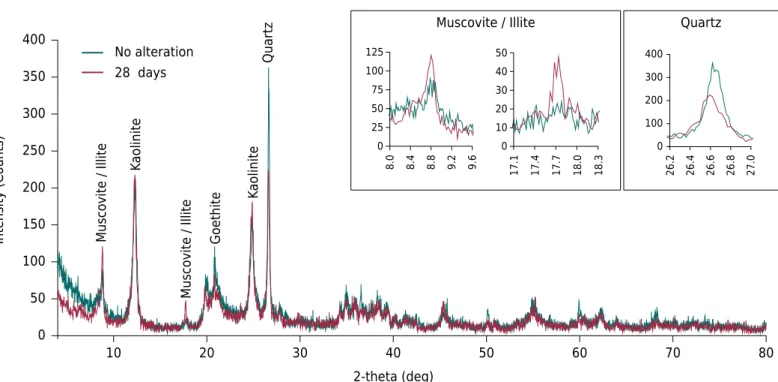
The XRD patterns for the unaltered and altered sample after 28 days are shown in
figure 1. The sample is mainly composed of quartz, kaolinite, goethite, and a mica phase, in which we identified muscovite and illite. However, it was not possible to
determine each mineral separately, and thus we assumed that the mica phase is a physical mixture of muscovite/illite. Changes in the intensities of the peaks of the X-ray
diffraction patterns for the altered sample suggested modification of the mineralogical
composition (percentage of each phase) due to the alkaline alteration process. The
relevant mineralogical modifications were the decrease in kaolinite and quartz content
muscovite/illite may not necessarily mean an increase in mineral contents, but only a concentration due to solubilization of the silicates. No new crystalline phases were observed, although this does not mean that they were not formed. It could be that the alteration in the minerals was not high enough to be revealed by this technique or that
the degree of crystallinity of the new phases was not sufficiently high to make them
detectable by XRD (Bérubé et al., 1990).
The table 1 presents the results of chemical characterization of the Typic Rhodudult soil samples, before and after the alteration process, and a compilation of mineralogical
identification by XRD.
Results of chemical analysis of the soil samples (Table 1), show that, considering the respective errors, only K2O, CaO, and MgO contents changed due to the alteration. The
increase in K2O and CaO contents is clearly seen comparing unaltered and altered samples,
but no conclusion can be made about the altered samples among themselves. These results indicate that these elements were incorporated into the soil from the alkaline
solution. The sample becomes more potassic and calcic, given the greater affinity of
these cations for clay phases and the presence of high K and Ca concentrations in the
alkaline fluid. Clay alterations generally begin with a modification of the adsorbed cation
population (Ramírez et al., 2002, 2005) and then continue with an illitization (Bauer and Berger, 1998). Illite formation could be one of the hypothesis to explain potassium incorporation into the soil, but since we observed a decrease in cesium sorption, as
discussed below, simple K fixation by soil charges is more likely, or the incorporation of
K in the new CSH phases. Regarding Mg, an initial increase in MgO content after 24 h
was followed by a progressive decrease after 7 and 14 days, and a final increase after
28 days. Precipitation of low-solubility magnesium phases can cause desorption of the
Mg fixed on the clays through the low of mass action (Gaucher et al., 2004).
The dissolution of primary minerals, like quartz and mica, observed by XRD, releases elements that can combine with the elements from the alkaline solution and favor precipitation of certain phases, e.g., CSH. The increase in CaO content in the altered soil may show formation of the CSH phase, although we did not identify the dissolution of primary aluminosilicates from the variation of the Al2O3 and SiO2 contents in the
10 20 30 40 50 60 70 80
0 50 100 150 200 250 300 350 400
Muscovite / Illit
e
Muscovite / Illit
e
Quartz
K
aolinite
Goethite
K
aolinite
Intensity (Counts)
2-theta (deg) No alteration
28 days
Quartz Muscovite / Illite
0 100 200 300 400
8.0 8.4 8.8 9.2 9.6 0
25 50 75 100 125
17.1 17.4 17.7 18.0 18.3 0
10 20 30 40 50
26.2 26.4 26.6 26.8 27.0
Figure 1. X-ray diffractograms of the unaltered sample and sample altered over 28 days with alkaline solution. The highlighted
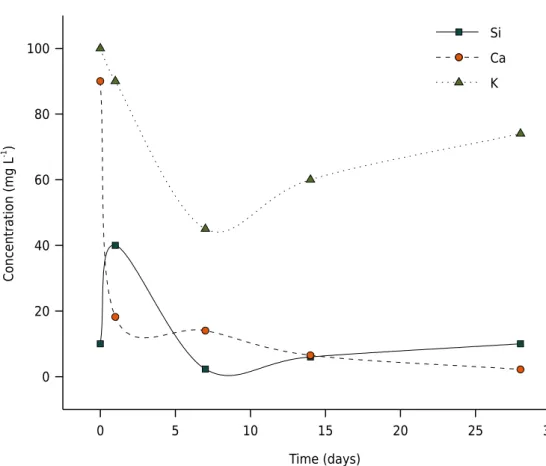
soil samples (their contents did not vary). To elucidate the dynamics of dissolution/ incorporation of elements, the concentration of K, Ca, and Si in the alkaline solution was evaluated for each alteration period (Figure 2). These results show that the concentration
of Si first increases, probably as a consequence of dissolution of the primary silicates, e.g., quartz. This step is followed by a decrease in the SiO2 concentration, which remains
almost the same throughout the alteration. It is possible that silica, once dissolved, is incorporated into new phases, and thus its content in the soil sample does not vary during the alteration, but the concentration in the alkaline solution varies. Thus, in consequence of the precipitation of secondary mineral phases due to the combination of Si with Ca in solution, the solution progressively loses Ca but maintains an almost constant Si concentration. Concerning K content, the loss of K from the solution corroborates its incorporation into the solid phase. Bérubé et al. (1990) and Savage et al. (1992), in a study on the interaction between minerals and an alkaline solution, also observed a progressive loss of calcium from alkaline solutions and a gain in Si as an initial step in the growth of CSH phases.
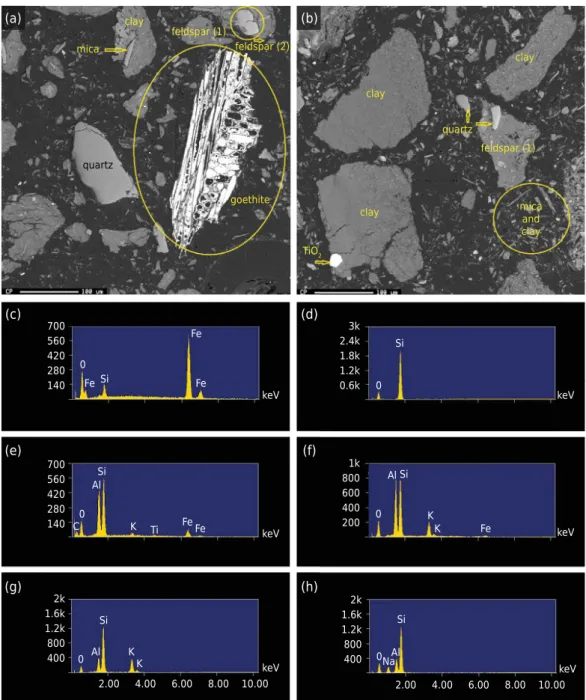
The figure 3a shows the results of electron microprobe analysis for the unaltered Typic Rhodudult sample, and the figure 3b shows the results for the sample after 28 days of
interaction with the alkaline solution. These analyses were performed to give an indication
of the formation of the CSH phases, since these phases are often too finely grained and
mixed with other phases to have their composition precisely determined by conventional XRD or EDX (Bérubé et al., 1990; Savage et al., 1992; Bateman et al., 1999; Hodgkinson and Hughes, 1999). The EDX analyses, which were made on each one of the surfaces
indicated, are presented in figures 3c to 3h. They provided information that allowed the Table 1. Characterization of the soil samples and chemical analysis of solutions for each alteration period
Unaltered 24 h 7 days 14 days 28 days
Physicochemical analysis CEC (cmolc kg-1
) 10.08 13.61 11.32 13.67 12.10
Specific surface area (m2 g-1
) 39.96 31.32 32.64 30.89 34.55
Chemical analysis of soil samples Measured elements
MgO (%) 0.20 + 0.01 0.37 + 0.02 0.26 + 0.01 0.20 + 0.01 0.41 + 0.02
Al2O3 (%) 24.50 + 1.23 24.10 + 1.21 24.11 + 1.21 24.60 + 1.23 23.80 + 1.19
SiO2 (%) 46.70 + 2.34 47.40 + 2.37 47.80 + 2.39 47.40 + 2.37 45.60 + 2.28
K2O (%) 1.74 + 0.09 2.80 + 0.14 2.98 + 0.15 2.99 + 0.15 2.90 + 0.15
CaO (%) 0.36 + 0.02 0.52 + 0.03 0.57 + 0.03 0.58 + 0.03 0.55 + 0.03
Fe2O3 (%) 9.19 + 0.46 9.69 + 0.48 9.42 + 0.47 9.82 + 0.47 9.28 + 0.46
Na2O (%) < 1.00 < 1.00 < 1.00 < 1.00 < 1.00
TiO2 (%) 1.13 + 0.06 1.00 + 0.05 1.00 + 0.05 0.98 + 0.05 0.90 + 0.05
SiO2 (mg L -1
) 10.00 + 0.05 40.00 + 2.00 2.30 + 0.30 6.00 + 0.30 10.00 + 0.50
K2O (mg L -1
) 10,000 + 500 9,005 + 450 4,500 + 225 6,000 + 300 7,400 + 370
CaO (mg L-1
) 90.00 + 4.50 18.2 + 0.91 14.0 + 0.70 6.50 + 0.33 2.20 + 0.11
Mineral identified*
Major (<50 %) Kaolinite, Quartz Kaolinite,
Muscovite/Illite Kaolinite, Quartz Kaolinite, Quartz
Kaolinite, Quartz, Muscovite/Illite
Minor (<15 %) Muscovite, Illite,
Goethite Quartz, Goethite
Muscovite/Illite, Goethite
Muscovite/Illite,
Goethite Goethite
Minority (<3 %) Microcline, Albite Microcline, Albite Microcline, Albite Microcline, Albite -Kaolinite Al2Si2O5(OH)4; Quartz: SiO2; Muscovite: KAl2Si3,AlO10(OH)2; Illite:(K,H3O)Al2Si3AlO10(OH)2; Goethite: FeO(OH); Microcline: KAlSi3O8; Albite: (Na,Ca)(Si,Al)4O18.
CEC was determined by the sodium acetate at pH 8.2 (5A2a) method of the Soil Survey Laboratory Methods Manual. Specific surface area was
mineralogical composition to be inferred. The figures 3c and 3d are representative of iron oxide compositions (identified as goethite, due to morphology) and quartz, respectively.
The Al:Si relationships and additional elementary information (presence or absence of some elements, such as Ca and Na) allow us to identify a clay phase (kaolinite or halloysite) (Figure 3e), mica, probably muscovite (Figure 3f), feldspar 1, probably microcline (Figure 3g), and feldspar 2, probably plagioclase (Figure 3h). All these phases had already been
indicated by XRD. For the altered sample, scanning identified all the phases that were originally present, except for goethite, although some significant changes were visually
observed. The quartz structures, abundant in the unaltered sample, practically disappear after 28 days of interaction, and the grains were of much smaller dimensions than those
in the original sample, evidencing quartz dissolution. Another significant modification was the increase in acicular structures, which were identified as corresponding to clay
(kaolinite or halloysite) and mica.
Bérubé et al. (1990) and Savage et al. (1992) observed by electron microscopy analysis that the quartz was covered with secondary precipitates, mainly calcium silicate hydrate (CSH) of up to 30 µm, due to the alkaline interaction. However, in this study, it was not possible to identify this coating in the microscopy images for the altered sample. As the
non-identification of coating on minerals may be related to the formation of small quantities
of the new phases, probably due to the short alteration period and low temperature used during the alteration process, we carried out Wavelength Dispersive X-ray Spectroscopy
(WDX) analysis on the mineral surfaces. Given that Ca identification on the quartz surface of
the altered sample could indicate precipitation of calcium silicate hydrates on this mineral grain, Ca determination was an indirect measure to identify formation of the CSH phase. We analyzed the quartz and clay surfaces of the unaltered sample and the sample altered
after 28 days. Calcium and K were identified in the clay phase, but no Ca deposition was found in the quartz phase. Since we identified Ca on the clay surface of both the unaltered
and altered sample, the results of this analysis were not conclusive.
0 5 10 15 20 25 30
0 20 40 60 80 100
Concentration (mg L
-1 )
Time (days)
Si
Ca
K
Figure 2. Silicon, K, and Ca concentrations in the alteration solution over time. The K concentrations were multiplied by 10-2
Impact of alkaline alteration on sorption of cesium
Because retention is a very important aspect in a repository, several studies related to estimation of the Kd values for common isotopes present in radioactive wastes are found (EPA, 1999a,b; Sheppard, 2003; Wieland and Loon, 2003; EPA, 2004; Aldaba et al., 2010), although there are very few studies related to the impact of alkaline interaction on this parameter (Euratom, 2005).
The table 2 shows the equations and parameters obtained for linear isotherms fitted to
the sorption data from batch experiments. The Kd values decreased from 90.54 mL g-1
in the unaltered sample to 42.53 mL g-1 for the altered sample over 24 h. This decrease continues for the other altered samples, reaching 30.80 mg L-1 in 28 days, although a slight
increase was observed after 14 days of alteration. These data indicate that interaction
with the alkaline solution negatively affected the sorption characteristics of the soil.
(a) mica clay feldspar (1) feldspar (1) quartz feldspar (2) goethite clay clay quartz TiO2 mica and clay clay (b) (c) 700 560 420 280
140 FeSi
Fe Fe 0 keV 3k 0 Si 2.4k 1.8k 1.2k 0.6k keV 1k 800 600 400 200 K K Fe 0 Al Si keV 2k 1.6k 1.2k 800 400 2.00 0NaAl Si
4.00 6.00 8.00 10.00
keV 700 560 420 280 0 Al
K Ti FeFe
Si C 140 keV 2k 1.6k 1.2k 800 400 2.00 0 Al Si K K
4.00 6.00 8.00 10.00
keV (d)
(e) (f)
(g) (h)
Cesium adsorption, in general, occurs by cation exchange, except when mica-like minerals (e.g. illite) are present (EPA, 1999a). Since the observed mineralogical changes (kaolinite and quartz dissolution, or mica phase concentration) are not expected to lead to a decrease in Cs retention capacity, the reasons likely to explain the reduction in sorption in the altered samples are the saturation of exchangeable sites with K+ and the possible formation of hydrated calcium silicate (CSH) phases. Large hydrated cation such as Ca2+ and Mg2+ are
considered “readily exchangeable”, but ions like K+ that adsorbed specifically are not; they compete with cesium for the available adsorption sites (Sposito, 1989; McBride, 1994). The CSH gels have high surface areas, making them good sorbents for many lanthanides
and actinides (e.g., U, Th, and I); however, they are not good sorbents for alkaline and alkaline earth elements. Specifically for Cs, sorption is expected to be low, since high
concentrations of Na+ and K+ in the CSH phases apparently have a strong competitive effect
on Cs+ sorption (Wieland and Loon, 2003). Therefore, the incorporation of potassium in the solid phase and the formation of CSH phases should promote a decrease in Cs sorption. Cesium may also adsorb to iron oxides or edge functional ionized groups. However, these
groups do not fix Cs+; instead, they complex cesium to the ionized sites (EPA, 1999a).
It should be noted that the silanol and aluminol edge functional groups of the clay will ionize in an alkaline medium and may be involved in adsorption reactions (Gaucher et al., 2004).
CONCLUSIONS
The chemical and mineralogical modifications of greatest impact identified as a result
of alkaline interaction were dissolution of primary silicates (quartz) and kaolinite and an increase in the Ca and K contents in the altered soil samples. Joint assessment of the XRD, microprobe, and chemical results provided enough evidence for the formation of the CSH phases, though none of the analyses were able to identify them directly. Likewise, the decrease in the Kd values for Cs corroborates formation of the CSH phase. This decrease demonstrates that the sorption characteristics of Typic Rhodudult undergo reduction when it interacts with the alkaline solution.
Since 137Cs is one of the most relevant radionuclides that compose the isotopic inventory of Brazilian radioactive wastes of low and intermediate level, the capability of facilities for retarding Cs migration is crucial. From the results, we may conclude that alkaline alteration is a phenomenon that must be considered if intends to use materials similar to the soil studied here as repository barriers.
ACKNOWLEDGMENTS
The authors would like to thank the FAPEMIG (Fundação de Amparo à Pesquisa do Estado
de Minas Gerais) and the CNPq (Conselho Nacional de Desenvolvimento Científico e
Tecnológico) for funding this project.
Table 2. Linear isotherm adjustments for Kd (Cs) determination before and after each interaction period (24 h and 7, 14, and 28 days) with the alkaline solution. Experimental conditions for batch
experiments: equilibration period = 24 hours, T = 25 o
C, pH = 5.5 + 0.1 Sample Equation(1)
R2
Kd L g-1
mL g-1
Unaltered S= 0.0905 Ceq 0.9720 0.0905 90.54
24 h S= 0.0425 Ceq 0.9465 0.0425 42.53
7 days S= 0.0304 Ceq 0.9576 0.0304 30.45
14 days S= 0.0384 Ceq 0.9479 0.0384 38.40
28 days S= 0.0308 Ceq 0.8907 0.0308 30.80
(1) S = Kd × C
eq. S = mass fraction of sorbed solute per unit of sorbent mass; Ceq = solution concentration;
REFERENCES
Abrahão WAP, Marques JJ. Manual de coleta de solos para valores de referência de qualidade no estado de Minas Gerais. Belo Horizonte: Fundação Estadual do Meio Ambiente, 2013. Aguiar LA. Avaliação de risco de um repositório próximo à superfície na fase pós-fechamento
em cenário de liberação de radionuclídeos por infiltração de água [tese]. Rio de Janeiro: Universidade Federal do Rio de Janeiro; 2006.
Aldaba D, Rigol A, Vidal M. Diffusion experiments for estimating radiocesium and
radiostrontium sorption in unsaturated soils from Spain: Comparison with batch sorption data. J Hazard Mater. 2010;181:1072-9. https://doi.org/10.1016/j.jhazmat.2010.05.124 Bateman K, Coombs P, Noy DJ, Pearce JM, Wetton P, Haworth A, Linklater C. Experimental simulation of the alkaline disturbed zone around a cementitious radioactive waste
repository : numerical modelling and column experiments. Geol Soc London Spec Publ.
1999;157:183-94. https://doi.org/10.1144/GSL.SP.1999.157.01.14
Bauer A, Berger G. Kaolinite and smectite dissolution rate in high molar KOH solutions at 35° and 80 °C. Appl Geochem. 1998;13:905-16. https://doi.org/10.1016/S0883-2927(98)00018-3
Bérubé MA, Choquette M, Locat J. Effects of lime on common soil and rock forming
minerals. Appl Clay Sci. 1990;5:145-63. https://doi.org/10.1016/0169-1317(90)90020-P Calábria JAA. Propriedades de solos alterados por solução alcalina – contribuição na avaliação
de desempenho de repositórios [tese]. Belo Horizonte: Centro de Desenvolvimento da
Tecnologia Nuclear; 2015.
Calábria JAA, Ladeira ACQ, Cota SDS, Rodrigues PCH. Estudo da sorção de césio em solos: avaliação do desempenho em repositório de rejeitos radioativos. Rev Ibero-Americana Ciências Ambientais. 2017;8.
Environmental Protection Agency (US) - EPA. Understanding variation in partition coefficient,
Kd, values - VI. Washington, DC: Environmental Protection Agency, 1999a.
Environmental Protection Agency (US) - EPA. Understanding variation in partition coefficient,
Kd, values - VII. Washington, DC: Environmental Protection Agency, 1999b.
Environmental Protection Agency (US) - EPA. Understanding variation in partition coefficient,
Kd, values - VIII. Washington, DC: Environmental Protection Agency, 2004.
European Commission of Atomic Energy - Euratom. ECOCLAY II: effects of cement on clay
barrier performance - phase II. European Commission of Atomic Energy; 2005. project No. FIKW-CT-2000-00028; Andra report No. CRPASCM04-0009.
Fernández R, Cuevas J, Mäder UK. Modelling concrete interaction with a bentonite barrier.
Eur J Mineral. 2009;21:177-91. https://doi.org/10.1127/0935-1221/2009/0021-1876 Fernández R, Cuevas J, Sánchez L, Villa RV, Leguey S. Reactivity of the cement-bentonite interface with alkaline solutions using transport cells. Appl Geochem. 2006;21:977-92. https://doi.org/10.1016/j.apgeochem.2006.02.016
Gaucher EC, Blanc P. Cement/clay interactions - a review: Experiments, natural analogues, and modeling. Waste Manage. 2006;26:776-88. https://doi.org/10.1016/j.wasman.2006.01.027
Gaucher EC, Blanc P, Matray JM, Michau N. Modeling diffusion of an alkaline plume in a clay
Holgersson S, Albinsson Y. Diffusion of HTO and cement pore fluids through host rock.
Radiochim Acta. 2002;90:99-108.
Honty M, De Craen M, Wang L, Madejová J, Czímerová A, Pentrák M, Strícek I, Van Geet M. The
effect of high pH alkaline solutions on the mineral stability of the Boom Clay - Batch experiments
at 60 oC. Appl Geochem. 2010;25:825-40. https://doi.org/10.1016/j.apgeochem.2010.03.002
International Atomic Energy Agency - IAEA. Performance of engineered barrier materials in near surface disposal facilities for radioactive waste. Vienna: International Atomic Energy Agency, 2001.
Mcbride MB. Environmental chemistry of soils. New York: Oxford University Press, Inc.; 1994.
Moyce EBA, Rochelle C, Morris K, Milodowski AE, Chen X, Thornton S, Small JS, Shaw S. Rock alteration in alkaline cement waters over 15 years and its relevance to the geological disposal of nuclear waste. Appl Geochem. 2014;50:91-105. https://doi.org/10.1016/j.apgeochem.2014.08.003
Ramírez S, Cuevas J, Vigil R, Leguey S. Hydrothermal alteration of “La Serrata” bentonite (Almeria, Spain) by alkaline solutions. Appl Clay Sci. 2002;21:257-69. https://doi.org/10.1016/S0169-1317(02)00087-X
Ramírez S, Vieillard P, Bouchet A, Cassagnabère A, Meunier A, Jacquot E. Alteration of the Callovo-Oxfordian clay from Meuse-Haute Marne underground laboratory (France) by alkaline solution. I. A XRD and CEC study. Appl Geochem. 2005;20:89-99. https://doi.org/10.1016/j.apgeochem.2004.03.009
Roy WR, Krapac IG, Chou SFJ, Griffin RA. Batch-type procedures for estimating soil
adsorption of chemicals. Washington, DC: Environmental Protection Agency, 1992.
Rozalen M, Huertas FJ, Brady PV. Experimental study of the effect of pH and temperature
on the kinetics of montmorillonite dissolution. Geochim Cosmochim Ac. 2009;73:3752-66. https://doi.org/10.1016/j.gca.2009.03.026
Rozalen ML, Huertas FJ, Brady PV, Cama J, García-Palma S, Linares J. Experimental study
of the effect of pH on the kinetics of montmorillonite dissolution at 25 °C. Geochim
Cosmochim Ac. 2008;72:4224-53. https://doi.org/10.1016/j.gca.2008.05.065
Santos HG, Jacomine PKT, Anjos LHC, Oliveira VA, Oliveira JB, Coelho MR, Lumbreras JF, Cunha
TJF. Sistema brasileiro de classificação de solos. 3a ed. Rio de Janeiro: Embrapa Solos; 2013.
Savage D, Bateman K, Hill P, Hughes C, Milodowski A, Pearce J, Rae E, Rochelle C.
Rate and mechanism of the reaction of silicates with cement pore fluids. Appl Clay Sci.
1992;7:33-45. https://doi.org/10.1016/0169-1317(92)90026-J
Savage D, Noy D, Mihara M. Modelling the interaction of bentonite with hyperalkaline
fluids. Appl Geochem. 2002;17:207-23. https://doi.org/10.1016/S0883-2927(01)00078-6
Savage D, Walker C, Arthur R, Rochelle C, Oda C, Takase H. Alteration of bentonite
by hyperalkaline fluids: a review of the role of secondary minerals. Phys Chem Earth.
2007;32:287-97. https://doi.org/10.1016/j.pce.2005.08.048
Sheppard SC. Interpolation of solid/liquid partition coefficients, Kd, for iodine in soils.
J Environ Radioactiv. 2003;70:21-7. https://doi.org/10.1016/S0265-931X(03)00129-2
Soil Survey Staff. Keys to soil taxonomy. 12th ed. Washington, DC: United States Department
of Agriculture, Natural Resources Conservation Service; 2014.
Sposito G. The chemistry of soils. New York: Oxford University Press, Inc; 1989.
United Nations Department of Agriculture - USDA. Soil survey laboratory methods manual -
Version 3.0. Washington, DC: Soil Survey Investigations Report no 42; 1996.
Wieland E, Van Loon LR. Cementitious near-field sorption data base for performance