SYMBIOTIC EFFECTIVENESS AND ECOLOGICAL CHARACTERIZATION
OF INDIGENOUS RHIZOBIUM LOTI POPULATIONS IN URUGUAY
1AMALIA BARAIBAR2, LILLIAN FRIONI3, MARIA ELENA GUEDES4 and HANS LJUNGGREN5
ABSTRACT - The objectives of this work were to describe the distribution, density and seasonal variation of the indigenous populations of Rhizobium loti in different Uruguayan soils and to deter-mine the symbiotic effectiveness and stress tolerance factors of different isolates, both with the aim of obtaining selected strains to re-introduce as inoculants in Lotus pastures. R. loti was present in ten soils studied and their densities varied from year to year and within each soil. All the isolates nodulated
Lotus corniculatus effectively. The nodules in Lotus pedunculatus and Lotus subbiflorus were small,
red on the surface and ineffective in nitrogen fixation. The study of 50 isolates from the ten soils showed high variability in their symbiotic efficiency and tolerance to pH. The indigenous population was acid tolerant in culture medium (pH 4.5), 83% of them could grow at pH 4.5 in 3 days. This work showed that there was a great diversity between the strains of R. loti isolated from Uruguayan soils and
supports the importance of selecting among them the most efficient and resistant strains to be included in the inoculants.
Index terms: Lotus corniculatus, Lotus pedunculatus, rhizobial pH tolerance.
EFICIÊNCIA SIMBIÓTICA E CARACTERIZAÇÃO ECOLÓGICA DE UMA POPULAÇÃO NATIVA
DE RHIZOBIUM LOTI NO URUGUAI
RESUMO - Os objetivos deste trabalho foram descrever a distribuição, densidade e variação sazonal de populações nativas de Rhizobium loti em diferentes solos uruguaios, e determinar a eficiência simbiótica e os fatores de tolerância a estresse de diversos isolados, tendo em vista a obtenção de cepas a serem reintroduzidas como inoculantes em pastagens de Lotus.Rhizobium lotiestava presente em
dez solos estudados, e suas densidades variavam de ano para ano e em cada solo. Todos os isolados nodularam efetivamente oLotus corniculatus. Os nódulos no Lotuspedunculatus e no Lotus subbiflorus
eram pequenos, vermelhos na superfície, e ineficazes na fixação de N. O estudo de 50 isolados dos dez solos mostraram alta variabilidade na sua eficiência simbiótica, e alta tolerância ao pH. A população nativa era tolerante à acidez em meio de cultura (pH 4,5); 83% dela pode crescer em pH 4,5 em três dias. O presente trabalho mostrou que há grande diversidade entre as cepas de R. loti isoladas de solos uruguaios, e acentua a importância de se selecionar entre elas as mais eficientes e resistentes, para serem incluídas como inoculantes.
Termos para indexação: Lotus corniculatus, Lotus pedunculatus, tolerância do rizóbio ao pH.
duced from an inoculant or as a factor conditioning
the persistence of the legume year by year. Inability
of the inoculant strains to successfully compete with
established
Rhizobium
populations in soil has been
frequently observed (Van Rensburg & Strijdom,
1985; Triplett & Sadowsky, 1992). As concluded
by Roughley et al
.
(1976) and Vance & Graham
(1995), the success of an inoculant decreases with
increase of native rhizobia population in soil.
Fur-thermore native rhizobia form the highest number
of nodules (Rupela & Sudarshana, 1990).
Lotus corniculatus
was introduced in Uruguay
many decades ago, especially for production on soils
1Accepted for publication on May 26, 1998.
2Agronomist, M.Sc., Lage & Cia., Camino Carrasco 6948,
Montevideo, Uruguay.
3Chemistry, Dr., Dep. de Ciências Biológicas, Facultad de
Agronomia, Montevideo. E-mail: [email protected]
4Agronomist,M. Alvarez 3812/511, Montevideo.
5Agronomist, Ph.D., Dep. do Microbiology, Swedish
Univer-sity of Agricultural Sciences, Uppsala, Sweden.
INTRODUCTION
The activity of native
Rhizobium
population is of
intro-of low and medium fertility (Carambula, 1977). In
farming
Lotus
is inoculated with strain U-226.
L. pedunculatus
and
L. subbiflorus
are especially
adapted to acid soils (Lowther et al., 1987).
L. corniculatus
and
L. tenuis
are nodulated by fast
growing
Rhizobium loti
(Jarvis et al
.
, 1982) and
L. pedunculatus
and
L. subbiflorus
form nodules with
Bradyrhizobium
sp. (
Lotus
). Nevertheless
specific-ity is not yet well defined in the genus
Lotus.
Bromfield et al. (1986) and Vance & Graham
(1995) emphasize the importance of understanding
the ecology and characteristics of indigenous
rhizo-bia populations as a prerequisite for inoculant
es-tablishment and persistence. Characteristics such as:
antibiotic resistance (Mueller et al., 1988),
fungi-cide resistance (Curley & Burton, 1975), low pH
tolerance (Munns & Keyser, 1981; Wood et al.,
1988), drought and high temperatures tolerance
(Munevar & Wollum II, 1981; Graham, 1992),
bac-teriocin production (Schwinghamer & Brockwell,
1978) are considered in the selection of rhizobial
strains with high adaptability in regions with adverse
conditions. These properties could explain their
saprophytic persistence (Frioni, 1990, 1999).
The objectives of this paper are to describe the
distribution, density and seasonal variations of the
indigenous populations of
Rhizobium loti
in
differ-ent soils; to determine the specifity and level of
effi-ciency of these populations and to obtain selected
strains with ecological adaptation in order to
intro-duce them as inoculant into soils with less effective
populations.
MATERIAL AND METHODS
MPN of rhizobia and efficiency of indigenous popula-tions
Ten soils with different physical and chemical proper-ties were selected in areas with no previous history of le-gume cultivation (Table 1). The samples were taken from the upper 10 cm surface soil without plant cover. The MPN of R. loti was determined with seedlings of L. corniculatus
growing in tubes with Jensens medium (Vincent, 1970), incubated at 23ºC and with a photoperiod of l6 hours. Besides the soils, three other treatments were included: (C) control without inoculation or fertilizer, (N) with 70 mg/kg of N as KNO3 and (I) inoculated with an
effi-cient strain, U-226 , which is the original B-8l6 from the Department of Microbiology, Kensington, Australia, and commercially used in inoculant production.
During the spring and fall samples, R. loti densities
were compared with R. leguminosarum bv. trifolii
form-ing nodules in Trifolium repens seedlings.
After 6 weeks the MPN per gram of soil was determinated and after 8 weeks information on the effi-ciency of the isolates of indigenous population was ob-tained by determining seedling biomass in tubes with a similar Rhizobium density.
Rhizobia were isolated from the biggest nodules using yeast extract mannitol agar medium (YEM) and main-tained in the same medium with 20% glycerol at -25oC
(Somasegaran & Hoben, 1985).
Symbiotic efficiency
Tubes with Jensens medium and seedlings of
L. corniculatus, L. pedunculatus and L. subbiflorus were
inoculated with 103 cells /tube with isolates from the soils
and strain U-226 in order to define the range of specific-ity. Data of dry weight of shoots, number and weight of nodules per plant were analyzed by the F test and the av-erages by the Tukey test (Snedecor & Cochran, 1977). The relative efficiency index (Brockwell et al., 1966) measure the accumulation of N fixed in relation to the controls, and defined as REI = (T - C/ N-C) X 100, where T, C and N = dry weight of shoots in each treatment, in control and in nitrogen treatment, respectively.
Tolerance to low pH
The Wood & Cooper (1985) technique using liquid medium and recording the days until the appearance of net turbidity was employed. The work was done in the range of pH 3.5 to 6.8.
Bacteriocin production
The production of these intraspecific inhibitor sub-stances was evaluated by measuring the inhibition zones (cm) after 7 days of growth in a double layer system. Each strain was sown with a multiple replicator in solid YEM medium and test strain was inoculated in the botton layer and treated with choloform after growth (Pugsley & Oudeg, 1987).
RESULTS AND DISCUSSION
Indigenous population of
Rhizobium loti
TABLE 1. Characteristics of soils1.
Soils and pH(H2O) pH (KCl 1N) OM OrgN P Al3+ Clay
classification (1/2.5) (1/2.5)
Algorta (A) 5.7 4.8 1.78 0.12 2.2 0 9.6
Distric Argisol
Estación Experim. del Este (E) 5.9 4.3 1.98 0.11 1.2 0 19.0
Distric Planosol
Glencoe (G) 5.9 4.8 7.91 0.33 2.7 0 42.7
Haplic Vertisol
Bañado de Medina (M1) 5.2 4.2 6.27 0.37 9.2 0 50.3
Ruptic Vertisol
Bañado de Medina (M2) 5.5 4.4 4.74 0.37 6.0 0 28.1
Sub-EutricBrunosol
Estación Experim. SUL (S) 5.3 4.1 3.16 0.20 1.2 0.40 23.1
Distric Brunosol
Seroterápico (Se) 6.1 5.1 8.07 0.40 2.9 0 36.1
Ruptic Vertisol
Suarez (Su) 5.7 4.4 4.33 0.20 0.8 0 26.1
Sub Eutric Brunosol
Tacuarembó (T) 5.2 4.2 2.68 0.14 5.4 0.46 10.1
Ocric Luvisol
Young (Y) 5.9 4.9 5.77 0.34 5.0 0 36.4
Eutric Brunosol
1Methods: OM (%) - Walker & Black; N (%) - Kjeldahal; P (mg/kg) - Olsen; Al (mg/kg) - Black; Clay (%) - Bouyoucus.
nodulated
L. corniculatus
effectively, but in assays
with
L. pedunculatus
and
L. subbiflorus
, the
nod-ules formed were small, ineffective and red at the
exterior as described by Pankhurst et al. (1987) and
seems to be related to the flavolan content of
nodu-lated roots of several
Lotus
species, proved to be
toxic to many
R. loti
strains.
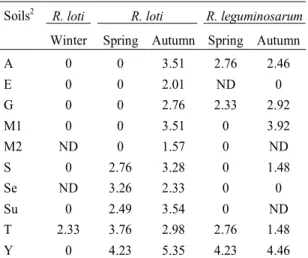
Table 2 shows the density of
R. loti
and
R. leguminosarum
bv.
trifolii
using the MPN
tech-nique. In general a higher
R. loti
population in
rela-tion to
R. leguminosarum
bv.
trifolii
was noticed. In
the winter samples
R. loti
was not detected except in
T soil (log =2.23). The average for the autumn
sea-son was 3.08 log units, with values from 1.57 to 5.35.
The average for the spring-summer samples was
3.3 log units. The eutric Brunosol Y showed the
high-est
Rhizobium
densities related to the nutritional
lev-els and textural properties.
TABLE 2.Rhizobium loti and R. leguminosarum bv.
trifolii in soils (log10 Nº/g dry soil)1.
Soils2
R. loti R. loti R. leguminosarum
Winter Spring Autumn Spring Autumn
A 0 0 3.51 2.76 2.46
E 0 0 2.01 ND 0
G 0 0 2.76 2.33 2.92
M1 0 0 3.51 0 3.92
M2 ND 0 1.57 0 ND
S 0 2.76 3.28 0 1.48
Se ND 3.26 2.33 0 0
Su 0 2.49 3.54 0 ND
T 2.33 3.76 2.98 2.76 1.48
Y 0 4.23 5.35 4.23 4.46
Only for the
R. leguminosarum
bv.
trifolii
there
was a positive correlation between their densities and
organic N (%) (r = 0,65) and clay content of soils
(r = 0,69). The
R. loti
densities did not correlate with
soil parameters presented in Table 1. However,
Woomer et al
.
(1988) related total rhizobial
popula-tions to many soil parameters as: temperature, soil
pH and phosphorus content.
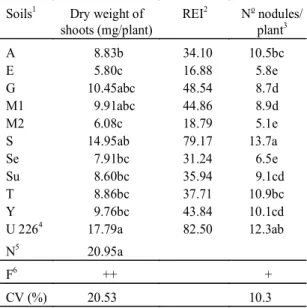
The result of the symbiotic efficiency in the
in-digenous population of
R. loti
in the ten soils, in the
treatment with U-226 and N supply are presented in
Table 3. The shoot dry weight was lower for all of
the soils populations compared to the N or U-226
treatment. Only native
Rhizobium
population of soil
S neither differ statistically from U-226 nor from
the nitrogen treatment. Although the soil Y presented
the highest rhizobia density related to their
nutri-tional levels and textural properties it was not the
most efficient (Table 3). The REI of the indigenous
populations of
R. loti
, except soil S, was lower than
50%.
Rhizobium loti
isolates
In relation to REI of the 50 isolates of
R. loti,
6%
was between 100-119% and another 6% were
lo-cated in the 0-40% range (Fig. 1). The mean of the
REI of the isolates from each soil compared with
the efficiency determined from the indigenous
popu-lations of the soils was shown in Fig. 2.
Isolates from five soils showed REI superior to
70% and the mean of the REI of the other five soils
was 60%. REI values of the isolates in relation to
REI of the indigenous population is visibly higher
in all cases, except in the soils G and S. In two cases
the REI of isolates was up to four times higher than
that of the respective soil
Rhizobium
population.
A great variation in the REI of the isolates of the
same soil was observed. REI of strains from the
TABLE 3. Symbiotic efficiency of indigenous
popula-tion of R. loti.
Soils1 Dry weight of
shoots (mg/plant)
REI2 No nodules/
plant3
A 8.83b 34.10 10.5bc
E 5.80c 16.88 5.8e
G 10.45abc 48.54 8.7d
M1 9.91abc 44.86 8.9d
M2 6.08c 18.79 5.1e
S 14.95ab 79.17 13.7a
Se 7.91bc 31.24 6.5e
Su 8.60bc 35.94 9.1cd
T 8.86bc 37.71 10.9bc
Y 9.76bc 43.84 10.1cd
U 2264 17.79a 82.50 12.3ab
N5 20.95a
F6 ++ +
CV (%) 20.53 10.3
1 See Table 1.
2 Relative efficiency index. 3 Data normalized. 4 Commercial strain. 5 N treatment.
6 + and ++ = significant differences at 5% and 1% respectively.
FIG. 1. Symbiotic efficiency of 50 isolates of R. loti as
intervals of relative efficiency index (REI).
FIG. 2. Symbiotic efficiency in each soil expresed as relative efficiency index (REI) in isolates of
strains (nnnnn) and indigenous populations (ooooo)
of R. loti. 0
10 20 30 40 50 60 70 80 90
A E G M1 M2 S Se Su T Y
Soil
R
e
la
ti
ve
e
ff
ic
ie
n
c
y i
n
d
e
x
0 5 10 15 20 25 30 35 40
0-19 20-39 40-59 60-79 80-99 100-119 Intervals of REI
P
er
ce
n
t of
s
tr
ai
n
Brunosol varied from less than 40% to 90%. Soil
M1 is characterised by a high level of organic
mat-ter and phosphorus (Table 1), with a high indigenous
population of
R. loti
(log = 3.51) (Table 2). The sandy
soil T with low levels of organic matter and pH
showed a great dispersion in REI of their isolates
(15 to 93%).
The diversity in symbiotic performance of
na-tive population of
R. loti
emphasised the
impor-tance of selection of an inoculant strain for the
suc-cessful establishment in soils (Bonish & Mac
Farlane, 1987).
Nodulation
In general the levels of nodulation with the
iso-lates were of the same order as the U-226 (Table 3).
The correlation indexes between nodulation and
shoots dry weight were: nodules dry weight/nodule
number (r = 0.48), shoots dry weigth/nodule
num-ber (r = 0.32) and shoot dry weight/nodule dry
weight (r = 0.31).
Tolerance to low pH
All 50 isolates of
R. loti
grew at pH 4.5, 5.5 and
6.8 and most of them during the three days of
incu-bation (Fig. 3). At pH 3.5, 44% of the strains grew
and 28% of them did it in five days of incubation.
At pH 4.5, 83% of the isolates grew in three days, at
5.5, 44%, and at pH 6.8, 33%. The U-226 strain grew
at pH 4.5 and 5.5 in five days and in pH 6.8 in seven
days.
Jarvis et al. (1982) stated a minimum pH for this
species of 4.0. Cooper (1982) found that none of 20
strains of
Bradyrhizobium
sp
.
(
Lotus
) developed at
pH 4.6, while three out of seven strains of
R. loti
did
grow at this pH. We found a growth optimum of the
population to be near pH 4.5 (83% grew in three
days). These seem to be acidophilic strains. Changes
in metabolic activity as a consequence of external
pH could explain the growth in acid medium.
Ayanaba et al. (1983) noted significant ammonia
production in acid-tolerant cowpea rhizobia in
me-dium of pH 4.5.
In more neutral pH, 73% of the strains needed
more than five days for giving a net turbidity. The
neutral pH revealed different behaviour between
R. loti
strains. Valdes & Martinez-Bravo (1986)
found that 28% of
R. loti
strains isolated from
Leucaena
were acidophilic (pH 5.0). Laboratory
studies have been effective in identifying sensitive
strains to the environmental factors but field studies
are important to verify the results (Blanchar &
Lipton, 1986). Vargas & Graham (1989) found good
correlations between growth in acidic medium and
nodulation capacity in acidic soils.
Bacteriocines
Only 4% of the tested strains presented
antago-nistic activity: G4 against U226 with bacteriocin
inhibition zone diameter of 1.5 cm and A12 against
E7, 2.5 cm inhibition zone. The bacteriocin
produc-ing strains, could increase nitrogen fixation by means
of the suppression of competition for nodulation sites
in the native population (Hodgson et al., 1985).
CONCLUSIONS
1. The ten soils analyzed present
R. loti
popula-tions with logarithmic densities ranged from 1.48 to
5.35 per gram. In general, a higher
R. loti
popula-tion in relapopula-tion to
R. leguminosarum
bv.
trifolii
was
found in the analized soils.
2. The symbiotic efficiency of 50 isolates show a
great diversity in
Lotus corniculatus
and 22% of the
strains accumulate significantly more dry matter than
U-226 used as a inoculant.
3. Eighty three percent of the isolates can grow
at pH 4.5 in three days in liquid medium and
sup-FIG. 3. Growth of R. loti at diferent pH.
0 10 20 30 40 50 60 70 80 90
3,5 4,5 5,5 6,8
pH
P
e
r
c
e
n
t of
s
tr
ai
n
s
3 days
5 days
6 days
ported lower pH in relation to U-226 strain used in
the inoculants production.
4. There is a great diversity between the isolates
of
R. loti
from Uruguayan soils.
ACKNOWLEDGEMENTS
This work was supported by grants from SAREC
(Swedish Agency for Research Cooperation),
Swe-den and from the Research Commission of the
Uni-versity of the Republic.
REFERENCES
AYANABA, A.; ASANUMA, S.; MUNNS, D.N. An agar plate method for rapid screening of Rhizobium for tolerance to acid-aluminium stress. Soil Science
Society of American Journal, v.17, p.254-258,
1983.
BLANCHAR, R.W.; LIPTON, D.S. The pE and pH in alfalfa seedling rhizosphere. Agronomy Journal,
v.78, p.216-218, 1986.
BONISH, P.M.; MAC FARLANE, M.J. Nodulation of introduced white clover by naturalised soil clover rhizobia: symbiotic effectiveness and host-strain compatibility. New Zealand Journal of
Agricul-tural Research, v.30, p.273-280, 1987.
BROCKWELL, J.; HELY, F.W.; NEAL-SMITH, C.A. Some symbiotic characteristics of rhizobia respon-sible for spontaneous, effective field nodulation of
Lotus hispidus. Australian Journal of
Experimen-tal Agricultural and Animal Husbandry, v.6,
p.365-370, 1966.
BROMFIELD, E.S.P.; SINHA, I.B.; WOLYNETZ, M.S. Influence of location, host cultivar and inoculation on the composition of naturalized populations of
Rhizobium meliloti in Medicago sativa nodules.
Applied and Environmental Microbiology, v.51,
p.1077-l084, 1986.
CARAMBULA, M. Producción y manejo de pasturas
sembradas. Montevideo: Hemisferio Sur, 1977.
464p.
COOPER, J.E. Acidic production, acid tolerance and growth rate of lotus rhizobia in laboratory media.
Soil Biology and Biochemistry, v.14, p.127-131,
1982.
CURLEY, R.L.; BURTON, J.C. Compatibility of Rhizo-bium japonicum with chemical seed protectans.
Agronomy Journal, v.67, p.807-808, 1975.
FRIONI, L. Ecología microbiana del suelo. Montevideo:
Depto. de Publicaciones de la Universidad de la República, 1990, p.203-258.
FRIONI, L. Procesos microbianos. Rio Cuarto:
Universidad Nacional de Rio Cuarto, Argentina, 1999. T.1, 282p., T.2, 286p.
GRAHAM, P. Stress tolerance in Rhizobium and
Bradyrhizobium and nodulation under adverse soil
conditions. Canadian Journal of Microbiology,
v.38, p.475-484, 1992.
HODGSON, A.L.M.; ROBERTS, W.P.; WAID, J.S. Regulated nodulation of Trifolium subterram
inocu-lated with bacteriocin-producing strains of Rhizo-bium trifolii. Soil Biology and Biochemistry, v.17, p.475-478, 1985.
JARVIS, B.D.W.; PANKHURST, C.E.; PATEL, J.J.
Rhizobium loti, a new specie of root nodule
bacte-ria. International Journal of Systematic
Bacteri-ology, v.32, p.378-380, 1982.
LOWTHER, W.L.; HAY, R.J.M.; RYAN, D.L. Effect of strain of rhizobia, lime and phosphorus on dry mat-ter yield of three lotus species in differing environ-ments in Otago and Southland. New Zealand
Jour-nal of Experimental Agriculture, v.15, p.135-l42,
1987.
MUELLER, J.G.; SKIPPER, H.D.; SHIPE, E.R.; GRIMES, L.W.; WAGNER, S.C. Intrinsic antibi-otic resistance in Bradyrhizobium japonicum. Soil
Biology and Biochemistry, v.20, p.879-882, 1988.
MUNEVAR, F.; WOLLUM II, A.G. Growth of Rhizo-bium japonicum strains in temperature above 27oC.
Applied and Environmental Microbiology, v.42,
p.272-276, 1981.
MUNNS, D.N.; KEYSER, H.H. Responses of Rhizobium
strains to acid and aluminium stress. Soil Biology
and Biochemistry, v.13, p.115-118, 1981.
PANKHURST, C.E.; HOPCROFT, D.H.; JONES, W.J. Comparative morphology and flavolan content of
Rhizobium loti induced effective and ineffective root nodules on Lotus species, Leucaena leucocephala, Carmichaelia flagelliformis, Ornithopus sativus and Clianthus puniceus. Canadian Journal of Botany,
PUGSLEY, A.P.; OUDEG, B. Methods for studying co-licins and their plasmid. In: HARDY, K.G. (Ed.).
Plasmids: A practical approach. Oxford: IRL Press,
1987. p.101-108.
ROUGHLEY, R.J.; BLOWES, W.M.; HERRIDGE, D.F. Nodulation of Trifolium subterraneum by introduced
rhizobia in competition with naturalized strains. Soil
Biology and Biochemistry, v.8, p.403-407, 1976.
RUPELA, O.P.; SUDARSHANA, M.R. Displacement of native rhizobia nodulating chick pea (Cicer arietinum L.) by an inoculant strain through soil solarization. Biology and Fertility Soils, v.10,
p.207-2l2, 1990.
SCHWINGHAMER, E.A.; BROCKWELL, J. Competi-tive advantage of bacteriocin and phage producing strains of Rhizobium trifolii in mixed culture. Soil
Biology and Biochemistry, v.10, p.383-387, 1978.
SNEDECOR, W.G.; COCHRAN, G.W. Métodos
Estadísticos.Méjico: Continental, 1977. 703p.
SOMASEGARAN, P.; HOBEN, H.J. Methods in legume - Rhizobium technology. Hawaii: MIRCEN/
NifTAL, 1985. 367p.
TRIPLETT, E.W.; SADOWSKY, M.J. Genetics of com-petition for nodulation of legume. Annual Review
of Microbiology, v.46, p.399-428, 1992.
VALDES, M.; MARTINEZ-BRAVO, E.M. Caracterís-ticas de cultivo y bioquímicas de Rhizobium loti.
Revista Latinoamericana de Microbiología, v.28,
p.89-94, 1986.
VAN RENSBURG, H.J.; STRIJDOM, B.W. Effective-ness of Rhizobium strains used in inoculants after their introduction into soil. Applied and
Environ-mental Microbiology, v.49, p.127-131, 1985.
VANCE, C.P.; GRAHAM, P.H. Nitrogen fixation in agriculture: application and perspectives. In: TIKHONOVICH, I.A.; PROVOROV, N.A.; ROMANOV, V.I.; NEWTON, W.E. (Eds.).
Nitro-gen fixation: Fundamentals and applications.
Neth-erlands: Kluver Academic Publishers, 1995. p.77-86.
VARGAS, A.A.T.; GRAHAM, P.H. Cultivar and pH ef-fects on competition for nodule sites between iso-lates of Rhizobium in beans. Plant and Soil, v.117,
p.195-200, 1989.
VINCENT, J.M. A manual for the practical study of
root nodule bacteria. Oxford: Blackwell, 1970.
164p.
WOOD, M.; COOPER, J.E. Screening clover and Lotus
rhizobia for tolerance of acidity and aluminium. Soil
Biology and Biochemistry, v.17, p.493-497, 1985.
WOOD, M.; COOPER, J.E.; JOURSON, A.J.B. Response of Lotus rhizobia acidity and aluminium in liquid
culture and in soil. Plant and Soil, v.107,
p.227-232, 1988.