Scientific Notes
Viability of liquid medium-inoculation of
Rhizobium
etli
in planting furrows with common bean
Dâmiany Pádua Oliveira(1), Bruno Lima Soares(2), Fábio Aurélio Dias Martins(2), Leandro Alex Franceschini(2),
Bruno Ewerton da Silveira Cardillo(2), Márcia Rufini(2), Augusto Ramalho de Morais(3),
Fatima Maria de Souza Moreira(1) and Messias José Bastos de Andrade(2)
(1)Universidade Federal de Lavras, Departamento de Ciência do Solo, Caixa Postal 3.037, CEP 37200-000 Lavras, MG, Brazil. E-mail: damiany. [email protected], [email protected] (2)Universidade Federal de Lavras, Departamento de Agricultura, Caixa Postal 3.037, CEP 37200-000 Lavras, MG, Brazil. E-mail: [email protected], [email protected], [email protected], [email protected], [email protected], [email protected] (3)Universidade Federal de Lavras, Departamento de Estatística, Caixa Postal 3.037, CEP 37200-000 Lavras, MG, Brazil. E-mail: [email protected]
Abstract – The objective of this work was to evaluate the viability of liquid medium inoculation of Rhizobium etli in the planting furrow and to certify the efficiency of its strain UFLA 02-100 as a potential inoculant for
common bean (Phaseolus vulgaris). The treatments consisted of three application rates of liquid inoculant applied in the planting furrows and one rate applied in common bean seed, besides two controls without inoculation. The inoculant contained 109 cells of Rhizobiumetli mL-1. Regardless of the application method, the yield obtained with the inoculation was equivalent to that of N from urea; however, the application in the furrows, at 0.6 L ha-1, is more advantageous due to the operational practicality and reduced costs.
Index terms: Phaseolus vulgaris, biological N2 fixation, biotechnology.
Viabilidade da inoculação líquida com
Rhizobium
etli
no sulco de semeadura do feijoeiro-comum
Resumo – O objetivo deste trabalho foi avaliar a viabilidade da inoculação líquida de Rhizobium etli no sulco de semeadura e certificar a eficiência da estirpe UFLA 02-100 como inoculante potencial para o feijoeiro-comum (Phaseolus vulgaris). Os tratamentos consistiram de três doses do inoculante líquido aplicadas aos
sulcos e uma dose aplicada às sementes de feijão-comum, além de dois controles sem inoculação. O inoculante continha 109 células de Rhizobium etli mL-1. Independentemente do método de aplicação, a produtividade obtida com a inoculação foi equivalente à da aplicação de N da ureia, mas a aplicação ao sulco, com 0,6 L ha-1, é mais vantajosa pela praticidade operacional e redução de custos.
Termos para indexação: Phaseolus vulgaris, fixação biológica de N2, biotecnologia.
In recent years, numerous studies indicate that common bean (Phaseolus vulgaris L.) can truly
benefit from biological nitrogen fixation (BNF) under field conditions, as long as good inoculation practices
are performed. Nonetheless, questions regarding the conventional use of peat inoculant in seed still persist, and the effects of mineral N fertilization on
BNF are still being assessed. Current results with peat
inoculant on seed have indicated that the application of 20 kg ha-1 N,at planting, favors the symbiosis, which
increases yield and reduces costs (Soares et al., 2016). In this sense, other studies have shown that common bean inoculation, complemented by leaf fertilization
with Mo, increases the cost-effectiveness of the crop
(Valadão et al., 2009; Figueiredo et al., 2016).
In tropical soils, where acidity conditions are more accentuated, the use of adapted strains is necessary to
maximize the contribution of BNF to crops. Researches
on peat inoculation have shown a high performance of the R. tropici strains CIAT 899 and H 12, and also of
the R. freirei strain PRF 81. These strains are already
recommended for use; nonetheless other strains, such
as UFLA 02-127 (R. leguminosarum bv. phaseoli),
UFLA 02-68 (R. etli bv. mimosa), UFLA 04-173
equivalent (Ferreira et al., 2009) and even greater
effectiveness than that of the native rhizobia population
(Soares et al., 2006; Nogueira et al., 2017). Actually, field experiments with this last strain (UFLA 02-100) show similar results to that of CIAT 899 (frequently
used in commercial inoculants), and to those of control treatments fertilized with mineral N (Soares et al.,
2006; Nogueira et al., 2017). All these studies show
the possibility of economic savings in relation to N fertilizers.
Despite the efficiency of peat inoculation in seed,
there are many producers that question the practicality of this operation in large scale, especially with the current trend of increasing the amounts and types of products applied to seed, such as fungicides,
micronutrients, and microorganisms. For this reason,
soybean producers and large producers of common bean have shown interest in the use of liquid inoculant in the planting furrow.
The possible incompatibility between products used in seed treatment (mainly of fungicides) and rhizobium survival from the inoculant is a matter of great concern for these producers. The pertinent literature, however, shows some disagreement on this issue (Araújo & Araújo, 2006; Oliveira et al., 2016). In cases of incompatibility between products, the producer should treat seed by himself, since it would be risky to acquire it already treated. Seed inoculation with peat or liquid inoculant subjected to drying should be undertaken in the shade, with an interval for proper adherence, since rhizobium is greatly exposed to the incompatible product, strengthening the possibility of deleterious effect of the practice (Araújo & Araújo,
2006; Araújo et al., 2007). In fact, it has been shown
that under liquid inoculant and Mo applications to seed, the number of Bradyrhizobium cells can be
significantly reduced (Albino & Campo, 2001), with negative effects on BNF. Besides, planting with moist or wrinkled seed can cause difficulties to the sowing
operation, which requires an adequate time for drying the inoculated seed.
One of the limitations of liquid application to the planting furrows is related to the small number of research studies involving this practice, and to the
difficulties in determining the best application rates for good performance of BNF (Vieira Neto et al.,
2008a, 2008b; Zilli et al., 2010). Publications involving this alternative method of inoculation for common
bean could not be found; therefore, the present work can help the producer in deciding on which method to adopt for this crop.
The objective of this work was to evaluate the viability of liquid medium inoculation in planting
furrows, and to certify the efficiency of the UFLA
02-100 strain of Rhizobium etli as a potential inoculant for common bean.
The field experiment was carried out in the dry season of 2014, in the municipality of Lavras, in the state of Minas Gerais, Brazil, in a Latossolo Vermelho
eutroférrico (Santos et al., 2013), i.e., Eutric Acrudox, according tothe soil taxonomy. Results of the chemical and physical analyses of the soil, before planting, are shown in Table 1. A randomized complete block design with six treatments was used, with four replicates. The treatments involved three application rates of liquid inoculant in planting furrows, and one rate applied in seed, and two controls without inoculation.
Crop management was performed under no-till, over
corn residues, with periodic sprinkler irrigation. The population of native rhizobium capable of nodulating the crop was of approximately 103 colony forming
units (CFU) per gram of soil, estimated according to Rufini et al. (2011).
Each experimental unit consisted of six rows of 4.0 m length each, spaced at 0.6 m, with an useful area corresponding to the four center rows. All plots received 20 kg ha-1 N (urea), 110 kg ha-1 P
2O5, and
40 kg ha-1 K
2O. In addition, N-fertilized control plots
received another 20 kg ha-1 N, at planting, and 40 kg ha-1
as topdressing, between the V3 and V4 stages. Planting was performed with a “handjab planter” at density of 15 seed per linear meter, using the common bean BRSMG Madrepérola cultivar.
The strain UFLA 02-100 was isolated from acid
soils from the Amazon region, and selected for
its high efficiency in common bean BNF, with a
performance comparable to that of strains frequently used in commercial inoculants for this crop (Soares
et al., 2006; Ferreira et al., 2009; Nogueira et al., 2017). The inoculant was prepared in liquid medium “79”, and its quality was monitored by counting the number of CFUs, that should be according to the legal
minimum number of viable Rhizobium cells, which is approximately 109 mL-1 inoculant (Brasil, 2011).
The inoculant rate applied in seed was equivalent to
before planting. The application rates in the furrows were determined to obtain populations equivalent to ½, 1, and 2 times the reference application rate of
1.2 L ha-1 commonly recommended for commercial
inoculants. The inoculant distribution in the furrows was performed with a manual backpack sprayer, with
a flat fan spray nozzle XR 110.02, and spray volume equivalent to 20 L ha-1.
At full blossom (R6 stage), a sample of 10 plants was removed at random from rows 2 and 3 of each plot, for the determination of the number of nodules (NN), dry matter of nodules (DMN), shoot dry matter
(SDM), shoot-N concentration (SNC), and shoot-N accumulation (SNA). At maturation (R9 stage), final stand (FS), grain yield and its primary components
(number of pods per plant, grains per pod, and mean 100 grain weight, W100), and grain-N concentration
(GNC) and accumulation (GNA) were determined in 10 plant samples from the rows 4 and 5. The final
stand was obtained by counting the number of plants in the useful area of the plot. Grain yield was obtained from total weight of grains produced in the useful area of the plot (lines 4 and 5), with moisture corrected
to 130 g kg-1. The SNC, GNC, SNA, and GNA were
calculated according to Soares et al. (2006).
Data were subjected to analysis of variance, using the software Sisvar 4.0, after meeting the presupositions of normality (Shapiro-Wilks test) and homoscedasticity (Bartlett test). NN and DMN were transformed into (x+1)0.5 prior to the analyses. The means were grouped
by the Scott-Knott test, at 5% probability.
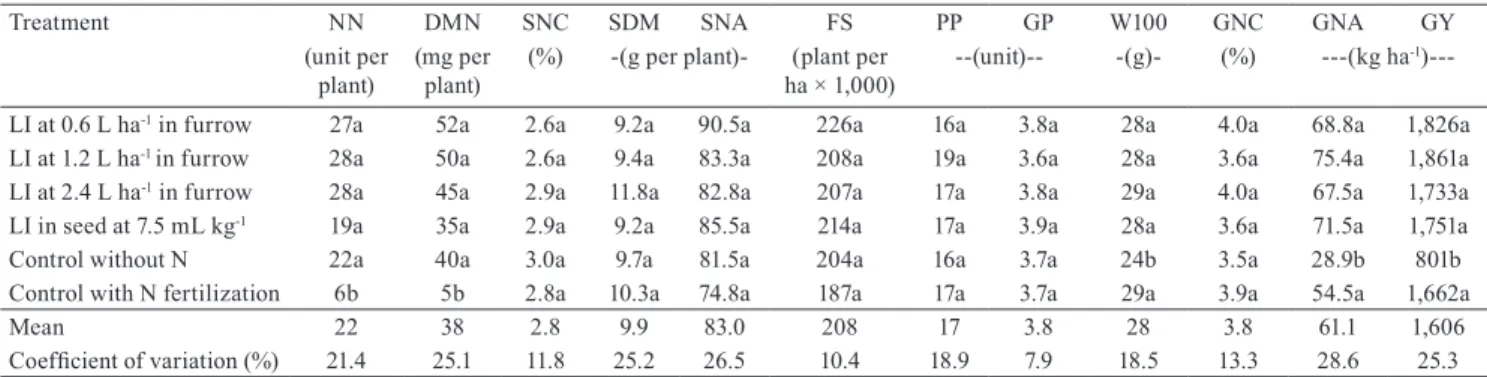
NN and DMN did not differ between treatments with or without inoculation (Table 2), indicating the presence of native bacteria capable of nodulating with an effectiveness similarly to that of the introduced
strain UFLA 02-100. This has been a frequent result in the literature. Using this same strain inoculated
in common bean, Soares et al. (2006) obtained NN
equivalent to that of native rhizobia. Ferreira et al. (2009) and Figueiredo et al. (2016) found a similar
performance not only in relation to nodulation, but also
to yield and grain-N accumulation. However, BNF of
the native population, in the present study, appears to have been less effective, leading to a lower grain yield, which is certainly a result of reduced GNA and W100.
Table 1. Results of the chemical and physical analyses of soil samples from the experimental area (0–0.20 m soil depths), collected before planting.
pH in H2O P-Melich 1 K Ca Mg Al H + Al SB T m BS OM Clay Silt Sand
(mg dm-3) --- (cmol
c dm-3) --- --- (%) --- ---(g kg-1)
---5.9 37.15 0.41 4.2 1.3 0.0 3.24 5.91 9.15 0.0 65.0 3.6 560 40 400
SB, sum of exchangeable bases; T, cation exchange capacity at pH 7; m, exchangeable aluminum saturation; BS, base saturation; and OM, organic matter.
Table 2. Liquid inoculant (LI) treatment effects on the number of nodules (NN), dry matter of nodules (DMN), shoot dry matter (SDM), shoot-nitrogen concentration (SNC), shoot-nitrogen accumulation (SNA), final stand (FS), grain yield (GY) and its primary components(1) – grain-nitrogen concentration (GNC) and grain-nitrogen accumulation (GNA) – of common bean (Phaseolus vulgaris) BRSMG Madrepérola cultivar(2).
Treatment NN DMN SNC SDM SNA FS PP GP W100 GNC GNA GY
(unit per plant)
(mg per plant)
(%) -(g per plant)- (plant per ha × 1,000)
--(unit)-- -(g)- (%) ---(kg ha-1
)---LI at 0.6 L ha-1 in furrow 27a 52a 2.6a 9.2a 90.5a 226a 16a 3.8a 28a 4.0a 68.8a 1,826a LI at 1.2 L ha-1 in furrow 28a 50a 2.6a 9.4a 83.3a 208a 19a 3.6a 28a 3.6a 75.4a 1,861a LI at 2.4 L ha-1 in furrow 28a 45a 2.9a 11.8a 82.8a 207a 17a 3.8a 29a 4.0a 67.5a 1,733a LI in seed at 7.5 mL kg-1 19a 35a 2.9a 9.2a 85.5a 214a 17a 3.9a 28a 3.6a 71.5a 1,751a
Control without N 22a 40a 3.0a 9.7a 81.5a 204a 16a 3.7a 24b 3.5a 28.9b 801b
Control with N fertilization 6b 5b 2.8a 10.3a 74.8a 187a 17a 3.7a 29a 3.9a 54.5a 1,662a
Mean 22 38 2.8 9.9 83.0 208 17 3.8 28 3.8 61.1 1,606
Coefficient of variation (%) 21.4 25.1 11.8 25.2 26.5 10.4 18.9 7.9 18.5 13.3 28.6 25.3
(1)Number of pods per plant (PP), grains per pod (GP), and mean 100 grain weight (W100). (2)Means followed by equal letters belong to the same group,
A lower nodulation in the treatment that received 80 kg ha-1 N confirms the considerations of Moreira &
Siqueira (2006), who attributed the reduction of nodule formation to excess mineral N in the soil due to the lack
of stimuli related to nutrient deficiency in the plant. This negative effect, however, was not observed on FS
and SDM. It is possible that the high-water availability during the crop establishment and growth, provided by the sprinkler irrigation, was decisive for the absence of saline effect from the nitrogen fertilization.
Neither nodulation nor BNF were affected by the inoculation method, which can be inferred by the SNC and SNA variables (Table 2). In fact, SNC, which is one of the traits closely related to BNF efficiency, was greater than 2.8%, within the sufficiency range
indicated by Oliveira et al. (2016). Moreover, the
effectiveness of the UFLA 02-100 strain on GNA,
W100, and grain yield, whose values were similar to those of mineral fertilization with 80 kg ha-1 N,
is noteworthy. The higher values of these variables compared to those of the control without additional N indicate a greater use of N for nutrition and grain
filling, which resulted in yields of 1,600 kg ha-1, which
represents twice the mean value of the absolute control. These results clearly show the important
contribution of the UFLA 02-100 strain to common bean and support the considerations of high efficiency
of bacteria in relation to the nitrogen fertilizer control reported by other authors (Soares et al., 2006; Nogueira
et al., 2017). They also justify the continuity of studies
with this strain, which has a considerable potential for future approval as an inoculant strain.
Research studies with liquid medium inoculation in the planting furrows for common bean were not found, which made it impossible to compare our results. This fact, however, reinforces the relevance of the present study. In soybean, liquid medium inoculation in the furrow has been reported not only as practical, but also as compatible with fungicide treatment in seed (Zilli et al., 2010). Potential advantages of application of liquid inoculant in the planting furrows had also
been reported for soybean grown in native field (Voss,
2002).
Based on the effect of inoculation in the furrows on the studied variables, mainly on grain yield (Table 2), our results for common bean are even more encouraging due to the fact that low-application rates
of the inoculant were already sufficient to bring about
yields much higher than the mean productivity of the crop (932 kg ha-1) in the state of Minas Gerais, Brazil.
Application rates greater than 0.6 L ha-1 in the furrows
provided a similar yield to that obtained with the
inoculation in the seed, but with higher costs. Using
a commercial inoculant for soybean, at 150, 300, and
450 mL ha-1, Vieira Neto et al. (2008a, 2008b) obtained
similar yields to that with inoculation in the seeds. The authors recognized the viability of furrow applications, even at the lowest rate.
Further studies should evaluate commercial
inoculant strains already available in the market, and application rates appropriate for the best productive performance. Applications of these strains should
also be compared with that of UFLA 02-100 in the
planting furrows. This information will surely assist
the producer in choosing the most profitable method
and rhizobium strain for growing common bean.
Acknowledgments
To Conselho Nacional de Desenvolvimento Científico e Tecnológico (CNPq), to Coordenação de Aperfeiçoamento de Pessoal de Nível Superior (Capes), and to Fundação de Amparo à Pesquisa do Estado de Minas Gerais (Fapemig), for financial support and scholarships; to Universidade Federal de Lavras, for providing the experimental field.
References
ALBINO, U.B.; CAMPO, R.J. Efeito de fontes e doses de molibdênio na sobrevivência do Bradyrhizobium e na fixação
biológica de nitrogênio em soja. Pesquisa Agropecuária
Brasileira, v.36, p.527-534, 2001. DOI:
10.1590/S0100-204X2001000300018.
ARAÚJO, A.S.F. de; ARAÚJO, R.S. Sobrevivência e nodulação
do Rhizobium tropici em sementes de feijão tratadas com
fungicidas. Ciência Rural, v.36, p.973-976, 2006. DOI: 10.1590/
S0103-84782006000300039.
ARAÚJO, F.F. de; CARMONA, F.G.; TIRITAN, C.S.; CRESTE, J.E. Fixação biológica de N2 no feijoeiro submetido a dosagens de inoculante e tratamento químico na semente comparado à adubação nitrogenada. Acta Scientiarum. Agronomy, v.29,
p.535-540, 2007. DOI: 10.4025/actasciagron.v29i4.416.
BRASIL. Instrução Normativa SDA nº 13, de 24 de março de 2011. Aprova as normas sobre especificações, garantias, registro,
embalagem e rotulagem dos inoculantes destinados à agricultura,
bem como as relações dos micro-organismos autorizados e
dos Anexos I, II e III, desta Instrução Normativa. Diário Oficial
da União, 25 mar. 2011. Seção 1, p. 3.
FERREIRA, P.A.A.; SILVA, M.A.P.; CASSETARI, A.S.; RUFFINI, M.; MOREIRA, F.M. de S.; ANDRADE, M.J.B. Inoculação com cepas de rizóbio na cultura do feijoeiro.
Ciência Rural, v.39, p.2210-2212, 2009. DOI:
10.1590/S0103-84782009000700041.
FIGUEIREDO, M.A. de; OLIVEIRA, D.P.; SOARES, B.L.; MORAIS, A.R. de; MOREIRA, F.M. de S.; ANDRADE, M.J.B. de. Nitrogen and molybdenum fertilization and inoculation of common bean with Rhizobium spp. in two Oxisols. Acta
Scientiarum. Agronomy, v.38, p.85-92, 2016. DOI: 10.4025/
actasciagron.v38i1.26661.
MOREIRA, F.M.S.; SIQUEIRA, J.O. Microbiologia e
bioquímica do solo. 2.ed. atual. ampl. Lavras: UFLA, 2006. 729p.
NOGUEIRA, C. de O.G.; OLIVEIRA, D.P.; FERREIRA, P.A.A.; PEREIRA, J.P. de A.R.; VALE, H.M.M. do; ANDRADE, M.J.B. de; MOREIRA, F.M. de S. Agronomic efficiency of
Rhizobium strains from the Amazon region in common bean.
Acta Amazonica, v.47, p.273-276, 2017. DOI:
10.1590/1809-4392201603422.
OLIVEIRA, D.P.; FIGUEIREDO, M.A. de; SOARES, B.L.; TEIXEIRA, O.H.S.; MARTINS, F.A.D.; RUFINI, M.; MORAIS, A.R. de; MOREIRA, F.M. de S.; ANDRADE, M.J.B. de. Seed treatment with fungicides does not affect symbiosis between common bean (Phaseolus vulgaris L.) and rhizobia. Agronomy
Journal, v.108, p.1-8, 2016. DOI: 10.2134/agronj2016.02.0105.
RUFINI, M.; FERREIRA, P.A.A.; SOARES, B.L.; OLIVEIRA, D.P.; ANDRADE, M.J.B. de; MOREIRA, F.M. de S. Simbiose de bactérias fixadoras de nitrogênio com feijoeiro-comum em diferentes valores de pH. Pesquisa Agropecuária Brasileira, v.46, p.81-88, 2011. DOI: 10.1590/S0100-204X2011000100011.
SANTOS, H.G. dos; JACOMINE, P.K.T.; ANJOS, L.H.C. dos; OLIVEIRA, V.A. de; LUMBRERAS, J.F.; COELHO, M.R.; ALMEIDA, J.A. de; CUNHA, T.J.F.; OLIVEIRA, J.B. de.
Sistema Brasileiro de Classificação de Solos. 3.ed. rev. e ampl. Brasília: Embrapa, 2013. 353p.
SOARES, A.L. de L.; FERREIRA, P.A.A.; PEREIRA, J.P.A.R.; VALE, H.M.M. do; LIMA, A.S.; ANDRADE, M.J.B. de; MOREIRA, F.M. de S. Eficiência agronômica de rizóbios selecionados e diversidade de populações nativas nodulíferas em Perdões (MG). II – Feijoeiro. Revista Brasileira de
Ciência do Solo, v.30, p.803-811, 2006. DOI:
10.1590/S0100-06832006000500006.
SOARES, B.L.; FERREIRA, P.A.A.; RUFINI, M.; MARTINS, F.A.D.; OLIVEIRA, D.P.; REIS, R.P.; ANDRADE, M.J.B. de; MOREIRA, F.M. de S. Agronomic and economic efficiency of
common-bean inoculation with rhizobia and mineral nitrogen fertilization. Revista Brasileira de Ciência do Solo, v.40, p.1-13,
2016. DOI: 10.1590/18069657rbcs20150235.
VALADÃO, F.C. de A.; JAKELAITIS, A.; CONUS, L.A.; BORCHARTT, L.; OLIVEIRA, A.A. de; VALADÃO JUNIOR, D.D. Inoculação das sementes e adubações nitrogenada e
molíbdica do feijoeiro, em Rolim de Moura. Acta Amazonica,
v.39, p.741-747, 2009. DOI: 10.1590/S0044-59672009000400002. VIEIRA NETO, S.A.; PIRES, F.R.; MENEZES, C.C.E. de; MENEZES, J.F.S.; SILVA, A.G. da; SILVA, G.P.; ASSIS, R.L. de. Formas de aplicação de inoculante e seus efeitos sobre a nodulação
da soja. Revista Brasileira de Ciência do Solo, v.32, p.861-870,
2008a. DOI: 10.1590/S0100-06832008000200040.
VIEIRA NETO, S.A.; PIRES, F.R.; MENEZES, C.C.E.; SILVA, A.G.; ASSIS, R.L. de; SILVA, G.P.; MENEZES, J.F.S. Formas
de aplicação de inoculante e seus efeitos na cultura da soja.
Bioscience Journal, v.24, p.56-68, 2008b.
VOSS, M. Inoculação de rizóbio no sulco de semeadura
para soja, em um campo nativo, no norte do Rio Grande do Sul. Passo Fundo: Embrapa Trigo, 2002. 5p. (Embrapa Trigo.
Comunicado técnico online, 108). Available at: <http://www.cnpt. embrapa.br/biblio/p_co108.htm>. Accessed on: June 22 2017. ZILLI, J.É.; GIANLUPPI, V.; CAMPO, R.J.; ROUWS, J.R.C.; HUNGRIA, M. Inoculação da soja com Bradyrhizobium no sulco de semeadura alternativamente à inoculação de sementes.
Revista Brasileira de Ciência do Solo, v.34, p.1875-1881, 2010.
DOI: 10.1590/S0100-06832010000600011.