S
2progenies of papaya using the REML/Blup analysis
Tamiris Pereira da Silva(1), Francisco das Chagas Vidal Neto(2) and Júlio César DoVale(1)
(1)Universidade Federal do Ceará, Centro de Ciências Agrárias, Departamento de Fitotecnia, Campus do Pici, Bloco 805, CEP 60356-001 Fortaleza, CE, Brazil. E-mail: [email protected], [email protected] (2)Embrapa Agroindústria Tropical, Rua Dra. Sara Mesquita, no 2.270, Planalto Pici, CEP 60511-110 Fortaleza, CE, Brazil. E-mail: [email protected]
Abstract – The objective of this work was to predict the genetic gains with selection of superior individuals within papaya (Carica papaya) progenies using the REML/Blup analysis. Thirty-six S2 progenies, originated
from the Calimosa and Tainung 1 hybrids, and two commercial control checks were evaluated in a randomized
complete block design, with four replicates. The following traits were evaluated: heights of plants and first
fruit; stem diameter at 12 and 18 months; number of days required for fruiting; number, mass, and average mass of commercial fruit; and number and mass of carpelloid and pentandric fruit. The magnitudes of the genetic parameters indicated that the variability present in most of the characters allows greater genetic gain if the selection is made at the progeny level, and not in individual plants. For selection among progenies, PROT-268, PROT-74, PROT-55, and PROT-22 were the most promising, with the greatest genetic gain for the studied characters. In the selection among and within progenies, the prediction of the gains is higher for the increase in the expression of the number of commercial fruit and for the decrease in the expression of pentandric fruit.
Index terms: Carica papaya, agronomic traits, genetic parameters, mixed models, selective accuracy.
Predição de ganhos genéticos com a seleção entre e dentro de
progênies S
2de mamoeiro por meio de análise REML/Blup
Resumo – O objetivo deste trabalho foi predizer os ganhos genéticos em mamoeiro (Carica papaya) com a seleção dos indivíduos superiores dentro de progênies, por meio da análise REML/Blup. Foram avaliadas 36 progênies S2, oriundas dos híbridos Calimosa e Tainung 1, e duas testemunhas comerciais, no delineamento
de blocos ao acaso, com quatro repetições. Os caracteres avaliados foram: altura de planta e do primeiro fruto; diâmetro de caule aos 12 e 18 meses; número de dias requeridos para surgimento do primeiro fruto; número, massa e massa média de frutos comerciais; e número e massa de frutos carpeloides e pentândricos. As magnitudes dos parâmetros genéticos estimados indicaram que a variabilidade presente, para a maioria dos caracteres, possibilita maiores ganhos genéticos se a seleção for praticada em progênies e não por plantas individuais. Para a seleção entre progênies, PROT-268, PROT-74, PROT-55 e PROT-22 foram as mais promissoras, com os maiores ganhos genéticos para os caracteres estudados. Na seleção entre e dentro de progênies, a predição dos ganhos é maior para o aumento da expressividade do número de frutos comerciais e para a redução da expressividade do número de frutos pentândricos.
Termos para indexação: Carica papaya, caracteres agronômicos, parâmetros genéticos, modelos mistos, acurácia seletiva.
Introduction
Papaya cultivars in Brazil are classified into two
groups: Solo and Formosa (Dias et al., 2011). In the Solo group, the average weight of papayas ranges from 300 to 650 g, and the predominant cultivars are Golden and Sunrise Solo. The Formosa group is commonly represented by the commercial hybrids Tainung 1 and Calimosa, with average weight ranging from 1,000 to 1,300 g (Dias et al., 2011; Luz et al., 2015).
the introduction of cultivars with high agricultural ability, overcoming current levels of productivity is a great challenge (Silva, 2008). Therefore, it is necessary to investigate the variability of the species, which has a narrow genetic base, in order to obtain, in a single genotype, the maximum phenotypic qualities that are preferred by producers and consumers.
The search for more efficient selection methodologies is one of the most efficient alternatives to achieve these
goals. This is because one of the main challenges faced by the breeding programs is low selective accuracy, which negatively impacts genetic gains (Costa et al.,
2008). Therefore, the implementation of more refined
genetic-statistical procedures, such as the REML/Blup methodology, is a trend in plant breeding (Maia et al., 2011).
Even under conditions of unbalanced experiments, this approach allows the accurate and unbiased prediction of genetic values, providing additional
information that is relevant to the identification
of superior genotypes (Ramalho & Araújo, 2011). Moreover, the Blup method allows maximizing selective accuracy, which positively impacts the
identification of the best individuals and the gains with
selection (Rocha et al., 2009). However, the application of this methodology in papaya breeding is still very scarce. In the literature, the use of REML/Blup has been associated with different purposes, including the estimation of genetic parameters in segregating populations, aiming at the selection of papaya individuals for fruit length and weight, total soluble
solids and fruit firmness (Oliveira et al., 2012; Pinto et
al., 2013), reduction of physiological spots (Pinto et al., 2013), and resistance to phoma spot (Vivas et al., 2014).
The objective of this work was to predict the genetic gains with selection of superior individuals within papaya progenies using the REML/Blup analysis.
Materials and Methods
The experiment was performed at the Curu
experimental field of Embrapa Agroindústria Tropical,
located in the municipality of Paraipaba, in the northern
region of the state of Ceará, Brazil, in the final stretch
of the Curu river basin (3°28'47"S, 39°09'47"W, at 31 m altitude).
The genetic material was obtained from self-fertilized F1 plants from the Tainung 1 and Calimosa
hybrids, from commercial fields in the extreme south
of the state Bahia, also in Brazil. The two resulting S1 populations, 304 plants of Tainung 1 and 342 of Calimosa, were planted in 2009 and evaluated during the period of 2009 to 2011, but covering only one harvest. In these populations, the best individuals for agronomic and fruit quality traits were selected and self-fertilized, generating the S2 progenies. The latter were evaluated from May 2013 to October 2014.
On the basis of the selection among and within the S1 progenies, 36 individuals of greater agronomic
and commercial potential were identified. Of these,
17 were derived from the Calimosa and 19 from the Tainung 1 hybrids (Table 1). The S2 progenies, plus the two hybrids from which they were generated, were evaluated in a randomized complete block design with four replicates. The experimental plot consisted
of five plants. The spacing used was 2.5 m between
rows and 2.0 m between plants. Three seedlings were used per pit, to guarantee the presence of at least one hermaphrodite plant. Cultural practices and phytosanitary measures were those recommended for the culture, as described by Martins & Costa (2003).
Plant sex was determined by inspection at the
beginning of flowering. Then, thinning was conducted
leaving only one plant (hermaphrodite) per pit. Side shoots were removed from plants when they were still small.
To assess the S2 progenies, the main agronomic/ phenological traits, related to plant architecture and productivity, and commercial traits, such as fruit size and mass, were considered. The following phenological
traits were evaluated: height of the first fruit (HFF), in centimeters, determined at the establishment of
the first fruit; plant height at 12 months (PH12M) and
at 18 months (PH18M), expressed in centimeters, by measuring the distance from the soil level, contiguous to the stem base of the plant, up to the insertion of the youngest leaf; stem diameter at 12 months (SDIA12M) and at 18 months (SDIA18M), in centimeters, calculated at 20 cm from the soil level; and days after planting to fruiting (DAPFR), referring to the period from
planting to first harvest, which guided the selection of
plants with earlier fruiting.
pentandric fruits per plant, respectively. All fruit mass are expressed in grams.
The data were analyzed using mixed models, and the effects were tested using the likelihood ratio test (LRT) for the elaboration of the deviance analysis table. In order to obtain the variance components and estimates of genetic parameters, data were subjected to the deviance analysis, based on the following statistical model: y=Xr+Za+Wp+Tb+e, in which y is the vector of phenotypic averages; r is the vector of progenies and controls (considered as random effects); a is the vector of individual additive genetic effects (assumed to be random); p is the plot-effect vector
(random); b is the vector of the block effects (fixed);
and e is the vector of errors (random). The incidence matrices for the effects of r, a, p, and b are represented by X, Z, W, and T, respectively.
For a better organization and interpretation of the
partial results of the analysis, the progenies identified
in Table 1 were numbered by individuals. To number each individual, the digit of the unit corresponds to the number of the plant within the plot, the digit of the ten corresponds to the replicate related to the plot, and the remaining digits are from the number of the progeny. For example, individual 1,421 corresponds to plant one, from the second replicate of progeny 14. All analyses were performed using the Selegen software (Resende, 2002).
Results and Discussion
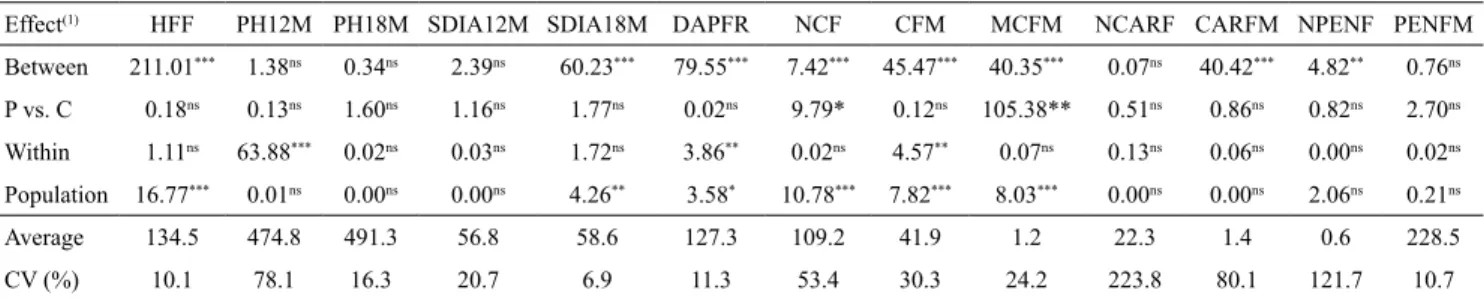
Progenies differed statistically for 7 of the 12 characters studied (Table 2). This indicates that there is genetic variability among these progenies, which allows to obtain gains from selection. Differences were also observed within the progeny for the PH12M, DAPFR, and MCFM characters, indicating the possibility of obtaining genetic gains not only through selection among progenies, but also within progenies.
Among the populations, where the progenies Calimosa and Tainung 1, and the controls (Table 1) are
grouped, there were significant differences for HFF,
PH18M, DAPFR, NCF, CFM, and MCFM. However, between the progenies obtained and the controls, the differences were only with respect to NCF and MCFM. These results show the existence of genetic variability not only among the evaluated progenies, but also within them. However, the effect among and Table 1. Identification of S2 progenies of papaya (Carica
papaya) and commercial hybrids (controls) used in the study.
Number Progeny/provenance Population 1
1 PROC-59
2 PROC-74
3 PROC-76
4 PROC-84
5 PROC-100
6 PROC-106
7 PROC-107
8 PROC-115
9 PROC-122
10 PROC-130
11 PROC-161
12 PROC-179
13 PROC-215
14 PROC-217
15 PROC-222
16 PROC-206
17 PROC-323
Population 2
18 PROT-13
19 PROT-20
20 PROT-22
21 PROT-23
22 PROT-24
23 PROT-52
24 PROT-53
25 PROT-54
26 PROT-55
27 PROT-68
28 PROT-74
29 PROT-76
30 PROT-135
31 PROT-181
32 PROT-188
33 PROT-234
34 PROT-242
35 PROT-266
36 PROT-268
Population 3
37 Calimosa
38 Tainung 1
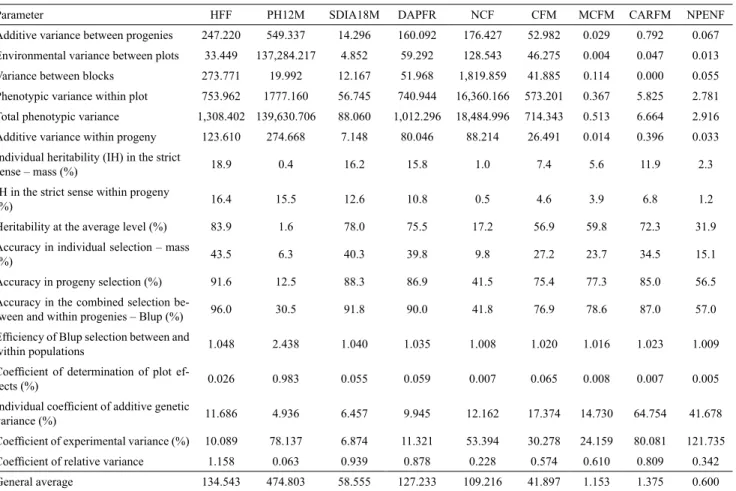
The coefficients of heritability of the progeny ranged
from 1.6 to 83.9% for PH12M and HFF, respectively (Table 3). PH12M and HFF were evaluated at entirely different periods, and PH12M was susceptible to a greater environmental effect. However, for the majority
of the characters, the coefficients of heritability of the
progenies varied from medium to high magnitude, which could lead to the selection of superior progenies with high selective accuracy (Resende & Duarte, 2007). Therefore, the prediction information of the genetic values to be used in the selection process is precise. Additionally, it has a substantial fraction of the additive genetic variance, which tends to facilitate the
identification and selection of progenies with proper
phenotypes (Pimentel et al., 2014). For selection within progenies, individual heritability in the strict sense was low for all characters. Regarding mass
selection, the coefficients of heritability also presented
low magnitude. These results indicate the possibility of obtaining individuals with the same or similar behavior in the next generation, and also the prospect of practicing a satisfactory selection of progenies and not individual plants. There is well shown by the low values observed for the selective accuracy when analyzed with these heritabilities. Pinto et al. (2013) described individual and average values of heritability for several plant and fruit traits, and found that, for averages, the values were up to seven-fold higher than those of individual heritability.
The selective accuracy reflects the quality of the
information of the procedures used in the prediction of genetic values. This measure is associated with
Table 2. Likelihood ratio and F-values for progeny effects, difference between progeny (P) and control (C), variation within progenies and populations composed by different progenies, in 36 S2 progenies of papaya (Carica papaya) and in two
commercial hybrids (controls).
Effect(1) HFF PH12M PH18M SDIA12M SDIA18M DAPFR NCF CFM MCFM NCARF CARFM NPENF PENFM
Between 211.01*** 1.38ns 0.34ns 2.39ns 60.23*** 79.55*** 7.42*** 45.47*** 40.35*** 0.07ns 40.42*** 4.82** 0.76ns P vs. C 0.18ns 0.13ns 1.60ns 1.16ns 1.77ns 0.02ns 9.79* 0.12ns 105.38** 0.51ns 0.86ns 0.82ns 2.70ns Within 1.11ns 63.88*** 0.02ns 0.03ns 1.72ns 3.86** 0.02ns 4.57** 0.07ns 0.13ns 0.06ns 0.00ns 0.02ns Population 16.77*** 0.01ns 0.00ns 0.00ns 4.26** 3.58* 10.78*** 7.82*** 8.03*** 0.00ns 0.00ns 2.06ns 0.21ns
Average 134.5 474.8 491.3 56.8 58.6 127.3 109.2 41.9 1.2 22.3 1.4 0.6 228.5 CV (%) 10.1 78.1 16.3 20.7 6.9 11.3 53.4 30.3 24.2 223.8 80.1 121.7 10.7 (1)Values obtained by the likelihood ratio test (LRT), except for the effect of progeny vs. control, for which the F-values are displayed, tested with 1 and 111 degrees of freedom. nsNonsignificant. ***, **, and *Significant by the chi-square test, at 1, 5, and 10% probability, respectively, with 1 degree of freedom. PH12M, plant height (PH) at 12 months; PH18M, at 18 months; SDIA12M, stem diameter (SD) at 12 months; and SDIA18M, at 18 months; DAPFR, days after planting to fruiting; NCF, number of commercial fruit; CFM, mass of commercial fruit; MCFM, mean commercial fruit mass; NCARF, number of carpelloid fruit; CARFM, carpelloid fruit mass; NPENF, number of pentandric fruit; and PENFM, pentandric fruit mass.
within the progenies was not significant for PH18M,
SDIA12M, NCARF, and PENFM, indicating that the genotypes within the same progeny or among the progenies evaluated had the same performance. Therefore, it is not feasible to obtain genetic gains through these characters, which were disregarded from the following analyses.
The experimental coefficient of variation (CV)
ranged from 6.9 to 223.8%. According to Silva et al. (2008), values of CV less than 20% are determinant of good experimental accuracy for this crop; however, high CVs may be related to the genetic nature of the character. The majority of the characters studied are of polygenic nature, and their expressions are greatly affected by the environment (Maia et al., 2006). The highest values of CV, 223.8 and 121.7, correspond to the number of carpelloid and pentandric fruits, respectively. This is consistent with the results obtained by Damasceno Junior et al. (2008), who observed that the occurrence of fruits with anomalies is a factor strongly associated with environmental variations.
These authors studied the occurrence rate of floral
anomalies that resulted in anomalous fruits, at different periods, and found that the CVs were superior to the
number of abnormal flowers. Moreover, it is worth
mentioning that, in the present study, the S2 progenies were evaluated, that is, the genetic material was not
genotypically fixed. Thus, variations in the same
the selection precision and refers to the correlation between the predicted and the actual genetic values of progenies (Pimentel et al., 2014). The higher the selective accuracy of the evaluation of a progeny, the higher the genetic value predicted for it. Therefore, the estimates obtained for the characters SDIA18M, DAPFR, and HFF should be indicated. However, for the NCF character, the estimate varied from low to moderate magnitude. This reiterates the particularity of each character (Marin, 2004), providing the evidence that the complexity of the expression of a particular trait is directly proportional to the complexity of the selection process associated with it.
Individual coefficients of heritability of low
magnitude within the progenies may be understood as additional information to heritabilities between progenies, when the individual Blup method is used
(Pimentel et al., 2014). Selective accuracy was higher than 75% for most of the characters studied, with the exception of PH12M, NCF, and NPENF. Moreover, for the characters in which the accuracy was high,
individual coefficients of heritability were greater than
15%, which represents a considerable magnitude. The assessment of individuals by Blup analysis presented higher implication for information based exclusively on progeny selection. This is supported by the contribution to selection within progenies, evidenced by the increase in accuracy values, when comparing the progeny selection accuracy with the accuracy in the combined selection among
progenies, using the individual Blup. The efficiency of
information use within progenies was greater than one unit for all traits, and it was obtained as the ratio of the accuracy in the combined selection, among and within
Table 3. Variance components and genetic parameters estimated in 36 S2 progenies of papaya (Carica papaya) and in two
commercial hybrids (controls)(1).
Parameter HFF PH12M SDIA18M DAPFR NCF CFM MCFM CARFM NPENF
Additive variance between progenies 247.220 549.337 14.296 160.092 176.427 52.982 0.029 0.792 0.067 Environmental variance between plots 33.449 137,284.217 4.852 59.292 128.543 46.275 0.004 0.047 0.013 Variance between blocks 273.771 19.992 12.167 51.968 1,819.859 41.885 0.114 0.000 0.055 Phenotypic variance within plot 753.962 1777.160 56.745 740.944 16,360.166 573.201 0.367 5.825 2.781 Total phenotypic variance 1,308.402 139,630.706 88.060 1,012.296 18,484.996 714.343 0.513 6.664 2.916 Additive variance within progeny 123.610 274.668 7.148 80.046 88.214 26.491 0.014 0.396 0.033 Individual heritability (IH) in the strict
sense – mass (%) 18.9 0.4 16.2 15.8 1.0 7.4 5.6 11.9 2.3
IH in the strict sense within progeny
(%) 16.4 15.5 12.6 10.8 0.5 4.6 3.9 6.8 1.2
Heritability at the average level (%) 83.9 1.6 78.0 75.5 17.2 56.9 59.8 72.3 31.9 Accuracy in individual selection – mass
(%) 43.5 6.3 40.3 39.8 9.8 27.2 23.7 34.5 15.1
Accuracy in progeny selection (%) 91.6 12.5 88.3 86.9 41.5 75.4 77.3 85.0 56.5 Accuracy in the combined selection
be-tween and within progenies – Blup (%) 96.0 30.5 91.8 90.0 41.8 76.9 78.6 87.0 57.0
Efficiency of Blup selection between and
within populations 1.048 2.438 1.040 1.035 1.008 1.020 1.016 1.023 1.009
Coefficient of determination of plot ef
-fects (%) 0.026 0.983 0.055 0.059 0.007 0.065 0.008 0.007 0.005
Individual coefficient of additive genetic
variance (%) 11.686 4.936 6.457 9.945 12.162 17.374 14.730 64.754 41.678
Coefficient of experimental variance (%) 10.089 78.137 6.874 11.321 53.394 30.278 24.159 80.081 121.735
Coefficient of relative variance 1.158 0.063 0.939 0.878 0.228 0.574 0.610 0.809 0.342
progenies, to the accuracy in progeny selection. Under these conditions, individual Blup selection provides additional gains (Pimentel et al., 2014). These gains should range from 0.8% (if the selection is practiced directly through NCF) to 144% (if performed through PH12M).
Individual coefficient of additive genetic variance quantifies the dispersion of the additive values around
the general average. Therefore, high values are more appropriate for populations to be susceptible to genetic
progress. The highest percentages were observed in the characters referring to production, although there were deviations of 4.94 and 64.75% for the traits PH12M and CARFM, respectively. Production, however, must
be analyzed in combination with the coefficient of
environmental variance. Moreover, another important parameter obtained by the ratio among the variables,
i.e. the coefficient of relative variance, denotes a
favorable condition for selection, when values resulting from this computation are equal to or higher than one
Table 4. Additive genetic effect (a), additive genetic value (u+a), and accumulated genetic gain (AG) estimated for 36 S2
progenies (Prg) of papaya (Carica papaya)(1).
Order HFF PH12M SDIA18M DAPFR
unit (Resende & Duarte, 2007; Canuto et al., 2015). Therefore, easier gains will be obtained through HFF.
In order to generate more information about the
experimental accuracy, the coefficients of determination
of plot effects were estimated. In Resende (2002), ideal estimates are those with magnitudes below 10%; this indicates that the observed phenotypic variation was only slightly affected by environmental variation. This
could be confirmed by the minor differences detected
between the phenotypic variance within the progenies and the total one. Therefore, for most of the characters, high reliability estimates were generated.
In the analysis of the ten best progenies, four (36, 28, 26, and 20) stood out for most of the evaluated characters (Tables 4 and 5). For example, progeny 28 was one of the most promising for PH12M, NCF, CFM, NCARF, and NPENF. Among these features, progeny 36 did not stand out for NPENF. However, it
Table 5. Additive genetic effect (a), additive genetic value (u+a), and accumulated genetic gain (AG, %), estimated for 36 S2
progenies (Prg) of papaya (Carica papaya)(1).
Order NCF CFM MCFM CARFM NPENF
Prg a u+a AG Prg a u+a AG Prg a u+a AG Prg a u+a AG Prg a u+a AG
was among the best for MCFM, which did not occur with progeny 28. Similar results were also observed involving progenies 26 and 20. These four progenies were promising with regard to CFM. Estimates show that these progenies have the highest frequency of favorable alleles for most of the evaluated traits. Thus, these progenies stand out with potential for breeding.
Alves & Resende (2008), in a similar study on cupuaçu [Theobroma grandiflorum (Willd. ex Spreng.) K. Schum] cultivation, when ordering progenies based on the accumulated genetic gain to increase
fruit production, verified the possibility of obtaining considerable gains with the selection of the first five
progenies of the rankings. In the literature, there are
few studies that involve the prediction of genetic gains in fruit species through mixed models, especially with regard to the analysis of a high number of concomitant traits. Oliveira et al. (2012) and Pinto et al. (2013), using mixed models for segregating populations of papaya, obtained satisfactory results, while estimating genetic parameters aiming at the selection of papaya individuals for fruit length and weight, total soluble
solids, and fruit firmness.
In order to select potential individuals within the best progenies, a ranking of the 20 most promising individuals within and among the progenies was established (Tables 6 and 7). Obviously, this
classification was made considering the purpose of the
Table 6. Additive genetic effect (a), individual additive genetic value (u + a), and accumulated genetic gain (AG, %), estimated with the selection of 10 and 20% of the best genotypes (plant) within and among 36 S2 progenies of papaya (Carica
papaya)(1).
Order HFF PH12M SDIA18M DAPFR
Gen.(2) a u+a AG Gen. a u+a AG Gen. a u+a AG Gen. a u+a AG 1 125 -37.578 96.97 0.5 2233 -55.108 419.69 0.0 943 10.494 69.05 10.5 141 -25.368 101.87 0.3 2 333 -37.150 97.39 0.6 1234 -17.768 457.03 0.1 925 10.257 68.81 10.4 144 -24.288 102.95 0.3 3 324 -36.639 97.90 0.6 721 -15.246 459.56 0.1 914 9.759 68.31 10.2 343 -24.119 103.11 0.4 4 122 -36.103 98.44 0.7 531 -13.993 460.81 0.2 734 9.684 68.24 10.0 113 -23.384 103.85 0.4 5 145 -35.895 98.65 0.8 1025 -13.271 461.53 0.2 1213 9.673 68.23 10.0 215 -23.323 103.91 0.5 6 133 -35.756 98.79 0.8 613 -12.108 462.70 0.2 1421 9.452 68.01 9.9 212 -23.323 103.91 0.5 7 144 -35.731 98.81 0.9 921 -11.900 462.90 0.3 924 9.123 67.68 9.8 245 -23.237 104.00 0.5 8 342 -35.023 99.52 0.9 634 -11.492 463.31 0.3 942 9.109 67.66 9.7 243 -23.237 104.00 0.6 9 312 -34.704 99.84 1.0 2824 -11.296 463.51 0.3 1443 9.072 67.63 9.6 241 -23.237 104.00 0.6 10 311 -34.704 99.84 1.0 543 -11.208 463.60 0.3 931 8.818 67.37 9.5 445 -23.132 104.10 0.6 11 131 -34.608 99.93 1.1 1344 -11.095 463.71 0.4 1243 8.794 67.35 9.5 342 -23.039 104.19 0.7 12 334 -34.362 100.18 1.2 131 -11.002 463.80 0.4 1225 8.705 67.26 9.4 242 -22.913 104.32 0.7 13 113 -34.133 100.41 1.2 1824 -10.800 464.00 0.4 1422 8.696 67.25 9.4 441 -22.700 104.53 0.8 14 344 -33.547 101.00 1.3 1035 -10.111 464.69 0.4 1432 8.573 67.13 9.3 442 -22.376 104.86 0.8 15 114 -32.821 101.72 1.3 243 -10.087 464.72 0.5 1442 8.568 67.12 9.3 444 -22.052 105.18 0.8 16 123 -32.660 101.88 1.4 1325 -9.670 465.13 0.5 825 8.451 67.01 9.2 443 -22.052 105.18 0.9 17 414 -32.543 102.00 1.5 2813 -9.661 465.14 0.5 921 8.367 66.92 9.2 145 -22.019 105.21 0.9 18 1023 -32.201 102.34 1.5 3234 -9.506 465.30 0.5 1235 8.350 66.91 9.1 341 -21.958 105.28 1.0 19 314 -32.080 102.46 1.6 423 -9.183 465.62 0.5 1215 8.287 66.84 9.1 313 -21.798 105.44 1.0 20 115 -31.837 102.71 1.6 1012 -9.180 465.62 0.6 812 8.224 66.78 9.0 311 -21.798 105.44 1.0 Selection pressure(3)
10% -30.676 103.87 2.1 - -10.149 464.65 0.6 - 8.441 67.00 9.2 - -19.985 107.25 1.4 20% -27.258 107.29 3.8 - -7.514 467.29 1.1 - 7.234 65.79 8.5 - -16.861 110.37 2.4
X
G - 134.54 - - - 474.80 - - - 58.56 - 141 - 127.23
-XWC - 133.48 - - - 474.83 - - - 59.98 - 144 - 127.13
-(1)Genetic value obtained with the general average, and accumulated gain estimated based on the progeny average. (2)In the numbering of each individual, its unit number corresponds to the number of the plant within the plot, the tens digit corresponds to the replicate related to the plot, and the remaining digits are derived from the number of the progeny. For example, individual 1421 corresponds to plant one, of the second replicate of progeny 14. (3)The selection pressures of 10 and 20% correspond to the averages of the 72 and 144 genotypes, respectively, which were better ranked to the characters. X
G,
general average; and X
WC, average without the controls. HFF, height of the first fruit; PH12M, plant height at 12 months; SDIA18M, stem diameter at
program for increasing or reducing the expression of the character. However, none of the individuals stood out in this ranking among all analyzed characters, probably due to the lack of correlation among those. However, based on the data obtained, it was observed that among the individuals, 16 (113, 141, 145, 311, 342, 921, 1421, 1422, 1432, 1442, 1443, 2424, 3125, 3134, 3142, and 3144) stood out by being among the top 20 in at least two distinct characters simultaneously. The progenies evaluated in the present study are still segregating. Thus, it is risky to indicate one particular individual that may be suitable for assessing the value for cultivation or use. Therefore, it is more plausible to promote selection in subsequent cycles or to apply lenient selection indices, so that promising
individuals, although not fixed genotypically yet, are
not immediately penalized/disregarded. In this way, two selection conditions were simulated considering intensities of 10 and 20% (Tables 6 and 7). The gains that each intensity represents were predicted based on the average genetic value of the populations and the average genetic value of the selected individuals.
Among the characters that were evaluated for the purpose of increasing expression, NCF generated the highest average gains – 28.8 and 23.0%, respectively – with both selection intensity of 10 and 20%. However, when the goal is to reduce the expression of characters with unfavorable phenotypes, it is recommended to identify the individuals that provide the greatest negative gains. Among the characters that were
Table 7. Additive genetic effect (a), individual additive genetic value (u+a), and accumulated genetic gain (AG, %) estimated with the selection of 10 and 20% of the best genotypes (plant) within and among 36 S2 progenies of papaya (Carica papaya)(1).
Order NCF CFM MCFM CARFM NPENF
Gen.(2) a u+a AG Gen. a u+a AG Gen. a u+a AG Gen. a u+a AG Gen. a u+a AG 1 3633 13.981 123.20 42.0 2832 16.058 57.95 16.1 3142 0.282 1.44 0.41 1425 -0.905 0.47 0.0 2435 -0.343 0.277 -0.1 2 3144 13.651 122.87 41.2 2842 15.561 57.46 15.8 3144 0.282 1.43 0.41 1424 -0.905 0.47 0.0 2434 -0.343 0.277 -0.1 3 3142 13.641 122.86 40.5 2814 15.487 57.38 15.7 3134 0.244 1.40 0.40 1423 -0.905 0.47 0.0 2433 -0.343 0.277 -0.1 4 3622 13.575 122.79 39.8 2825 15.458 57.35 15.6 2542 0.215 1.37 0.40 1422 -0.905 0.47 0.0 2432 -0.343 0.277 -0.1 5 3134 13.104 122.32 39.1 2815 15.418 57.31 15.6 3125 0.212 1.37 0.39 1421 -0.905 0.47 0.0 2431 -0.343 0.277 -0.1 6 3615 13.096 122.31 38.4 2811 15.122 57.02 15.5 3112 0.187 1.34 0.39 1445 -0.889 0.49 0.0 2415 -0.342 0.278 -0.1 7 3612 13.080 122.30 37.8 2831 15.053 56.95 15.5 3114 0.179 1.33 0.38 1444 -0.889 0.49 0.0 2414 -0.342 0.278 -0.1 8 3125 12.707 121.92 37.2 2042 15.011 56.91 15.4 2535 0.176 1.33 0.38 1443 -0.889 0.49 0.0 2413 -0.342 0.278 -0.1 9 3233 11.600 120.82 36.6 2823 14.924 56.82 15.3 3141 0.176 1.33 0.37 1442 -0.889 0.49 0.0 2412 -0.342 0.278 -0.1 10 3632 11.495 120.71 36.0 2812 14.860 56.76 15.3 3131 0.176 1.33 0.37 1414 -0.886 0.49 0.0 2411 -0.342 0.278 -0.1 11 3635 11.431 120.65 35.5 2824 14.682 56.58 15.2 3115 0.175 1.33 0.36 1411 -0.886 0.49 0.0 2425 -0.342 0.278 -0.1 12 3614 11.398 120.61 35.0 2043 14.500 56.40 15.2 3125 0.174 1.33 0.36 1433 -0.885 0.49 0.0 2424 -0.342 0.278 -0.1 13 3642 11.276 120.49 34.5 2841 14.366 56.26 15.1 3113 0.172 1.33 0.36 1432 -0.885 0.49 0.0 2423 -0.342 0.278 -0.1 14 3621 11.272 120.49 34.0 2844 14.258 56.15 15.1 3111 0.171 1.32 0.35 1431 -0.885 0.49 0.0 2422 -0.342 0.278 -0.1 15 3225 11.204 120.42 33.5 2045 14.211 56.11 15.0 3122 0.171 1.32 0.35 1123 -0.877 0.50 0.0 2421 -0.342 0.278 -0.1 16 3641 11.201 120.42 33.1 2822 14.102 56.00 14.9 3133 0.168 1.32 0.35 1122 -0.877 0.50 0.0 2445 -0.339 0.280 -0.1 17 3631 11.107 120.32 32.6 2033 14.094 55.99 14.9 3132 0.168 1.32 0.34 1121 -0.877 0.50 0.0 2444 -0.339 0.280 -0.1 18 3643 11.066 120.28 32.2 2843 14.093 55.99 14.8 3123 0.165 1.32 0.34 1145 -0.860 0.51 0.0 2443 -0.339 0.280 -0.1 19 3644 10.980 120.20 31.8 2833 13.923 55.82 14.8 3124 0.152 1.31 0.33 1144 -0.860 0.51 0.0 2442 -0.339 0.280 -0.1 20 3625 10.938 120.15 31.4 2014 13.884 55.78 14.8 2521 0.143 1.30 0.33 1143 -0.860 0.51 0.0 2441 -0.339 0.280 -0.1 Selection pressure(3)
10% 9.932 119.15 28.8 - 12.890 54.79 14.2 - 0.100 1.25 0.30 - -0.833 0.54 0.0 - -0.328 0.29 -0.1 20% 6.202 115.42 23.0 - 10.402 52.30 12.8 - 0.039 1.19 0.23 - -0.756 0.62 0.1 - -0.310 0.31 0.0
XG - 109.22 - - - 41.90 - - - 1.15 - - - 1.37 - - - 0.000
-XST - 88.83 - - - 41.61 - - - 0.97 - - - 1.37 - - - 0.549
-(1)Genetic value obtained with the general average. and accumulated gain estimated based on the progeny average. (2)In the numbering of each individual, its unit number corresponds to the number of the plant within the plot, the tens digit corresponds to the replicate related to the plot, and the remaining digits are derived from the number of the progeny. For example, individual 1421 corresponds to plant one, of the second replicate of progeny 14. (3)The selection pressures of 10 and 20% correspond to the averages of the 72 and 144 genotypes, respectively, which were better ranked to the characters. XG
, general average; and X
ST, average without the controls. NCF, number of commercial fruit; CFM, mass of commercial fruit; MCFM, mean commercial
evaluated for this purpose, NPENF generated the lowest average gains for the two selection intensities: -0.1% for 10% intensity and for 20% intensity; the accumulated gain was null.
Conclusions
1. The variability observed for most of the characters allows greater genetic gains if selection is made at the progeny level, and not in individual papaya (Carica papaya) plants.
2. In progeny selection, PROT-268, PROT-74, PROT-55, and PROT-22 are the most promising for the breeding process.
3. The prediction of the gains is higher for the increase in the expression of the number of commercial fruits and for the decrease in the expression of the number of pentandric fruits.
Acknowledgments
To Embrapa Agroindústria Tropical, for technical support; and to Fundação Cearense de Apoio ao
Desenvolvimento Científico e Tecnológico (Funcap), for financial support.
References
ALVES, R.M.; RESENDE, M.D.V de. Avaliação genética de indivíduos e progênies de cupuaçuzeiro no Estado do Pará e estimativas de parâmetros genéticos. Revista Brasileira de Fruticultura, v.30, p.696-701, 2008. DOI: 10.1590/S0100-29452008000300023.
CANUTO, D.S. de O.; ZARUMA, D.U.G.; MORAES, M.A. de; SILVA, A.M. da; MORAES, M.L.T. de; FREITAS, M.L.M. Caracterização genética de um teste de progênies de Dipteryx alata Vog. proveniente de remanescente florestal da Estação Ecológica de Paulo de Faria, SP, Brasil. Hoehnea, v.42, p.641-648, 2015. DOI: 10.1590/2236-8906-13/RAD/2015.
COSTA, R.B. da; RESENDE, M.D.V. de; GONÇALVES, P. de S.; CHICHORRO, J.F.; ROA, R.A.R. Variabilidade genética e seleção para caracteres de crescimento da seringueira. Bragantia, v.67, p.299-305, 2008. DOI: 10.1590/S0006-87052008000200005.
DAMASCENO JUNIOR, P.C.; PEREIRA, T.N.S.; SILVA, F.F.
da, VIANA, A.P.; PEREIRA, M.G. Comportamento floral de
híbridos de mamoeiro (Carica papaya L.) avaliados no verão e na primavera. Revista Ceres, v.55, p.310-316, 2008.
DANTAS, J.L.L.; LUCENA, R.S.; BOAS, S.A.V.B. Avaliação agronômica de linhagens e híbridos de mamoeiro. Revista Brasileira de Fruticultura, v.37, p.138-148, 2015. DOI: 10.1590/0100-2945-022/14.
DIAS, N.L.P.; OLIVEIRA, E.J. de; DANTAS, J.L.L. Avaliação
de genótipos de mamoeiro com uso de descritores agronômicos
e estimação de parâmetros genéticos. Pesquisa Agropecuária Brasileira, v.46, p.1471-1479, 2011. DOI: 10.1590/S0100-204X2011001100008.
FAO. Food and Agriculture Organization of the United Nations.
Faostat:Production quantity: papayas. 2013. Available at: http:// faostat3.fao.org/download/Q/QC/E. Accessed on: Nov. 25 2015.
LUZ, L.N. da; PEREIRA, M.G., BARROS, F.R.; BARROS, G. de B.; FERREGUETTI, G.A. Novos híbridos de mamoeiro avaliados nas condições de cultivo tradicional e no semiárido brasileiro.
Revista Brasileira de Fruticultura, v.37, p.159-171, 2015. DOI: 10.1590/0100-2945-069/14.
MAIA, M.C.C.; RESENDE, M.D.V. de; OLIVEIRA, L.C. de; ÁLVARES, V. de S.; MACIEL, V.T.; LIMA, A.C. de. Seleção de clones experimentais de cupuaçu para características agroindustriais via modelos mistos. Revista Agro@mbiente On-line, v.5, p.35-43, 2011.
MAIA, M.C.C.; VELLO, N.A.; ROCHA, M. de M.; PINHEIRO, J.B.; SILVA JÚNIOR, N.F. da. Adaptabilidade e estabilidade de linhagens experimentais de soja selecionadas para caracteres agronômicos através de método uni-multivariado. Bragantia, v.65, p.215-226, 2006. DOI: 10.1590/S0006-87052006000200004.
MARIN, S.L.D. Mamão Papaya: produção, pós-colheita e
mercado. Fortaleza: Instituto Frutal, 2004. 82p.
MARIN, S.L.D.; PEREIRA, M.G.; AMARAL JÚNIOR, A.T. do; MARTELLETO, L.A.P.; IDE, C.D. Heterosis in papaya hybrids from partial diallel of ‘Solo’ and ‘Formosa’ parents. Crop Breeding and Applied Biotechnology, v.6, p.24-29, 2006. DOI: 10.12702/1984-7033.v06n01a04.
MARTINS, D. dos S.; COSTA, A. de F.S. da. (Ed.). A cultura do mamoeiro: tecnologias de produção. Vitória: Incaper, 2003. 497p.
OLIVEIRA, E.J.; FRAIFE FILHO, G. de A.; FREITAS, J.P.X. de; DANTAS, J.L.L.; RESENDE, M.D.V. de. Plant selection in F2 segregating populations of papaya from commercial hybrids. Crop Breeding and Applied Biotechnology, v.12, p.191-198, 2012. DOI: 10.1590/S1984-70332012000300005.
PIMENTEL, A.J.B.; GUIMARÃES, J.F.R.; SOUZA, M.A. de; RESENDE, M.D.V. de, MOURA; L.M.; ROCHA, J.R. do A.S. de C.;RIBEIRO, G. Estimação de parâmetros genéticos e predição de valor genético aditivo de trigo utilizando modelos mistos. Pesquisa Agropecuária Brasileira, v.49, p.882-890, 2014. DOI: 10.1590/S0100-204X2014001100007.
PINTO, F. de O.; LUZ, L.N. da; PEREIRA, M.G.; CARDOSO, D.L.; RAMOS, H.C.C. Metodologia dos modelos mistos para seleção combinada em progênies segregantes de mamoeiro.
Revista Brasileira de Ciências Agrárias, v.8, p.211-217, 2013. DOI: 10.5039/agraria.v8i2a2409.
RAMALHO, M.A.P.; ARAÚJO, L.C.A. de. Breeding self-pollinated plants. Crop Breeding and Applied Biotechnology, v.11, p.1-7, 2011. Número especial. DOI: 10.1590/S1984-70332011000500002.
RESENDE, M.D.V. de. Genética biométrica e estatística no melhoramento de plantas perenes. Brasília: Embrapa
RESENDE, M.D.V. de; DUARTE, J.B. Precisão e controle de qualidade em experimentos de avaliação de cultivares. Pesquisa Agropecuária Tropical, v.37, p.182-194, 2007.
ROCHA, R.B.; VIEIRA, A.H.; GAMA, M. de M.B.; ROSSI, L.M.B. Avaliação genética de procedências de bandarra (Schizolobium
amazonicum) utilizando REML/BLUP (Máxima verossimilhança restrita/Melhor predição linear não viciada). Scientia Forestalis, v.37, p.351-358, 2009.
SILVA, F.F. da; PEREIRA, M.G.; RAMOS, H.C.C.; DAMASCENO JUNIOR, P.C.; PEREIRA, T.N.S.; GABRIEL A.P.C.; VIANA, A.P., FERREGUETTI, G.A. Selection and estimation of the genetic gain in segregating generations of papaya (Carica papaya L.). Crop Breeding and Applied Biotechnology, v.8, p.1-8, 2008. DOI: 10.12702/1984-7033.v08n01a01.
SILVA, L.A.S. Herança e relações genéticas entre densidade da semente, teores de proteína e óleo e produtividade em soja. 2008. 170p. Tese (Doutorado). Escola Superior de Agricultura Luiz de Queiroz, Piracicaba. DOI: 10.11606/t.11.2008.tde-22072008-162035.
SILVA, V.M.P. e; CARNEIRO, P.C.S.; MENEZES JÚNIOR, J.Â.N. de; CARNEIRO, V.Q.; CARNEIRO, J.E. de S.; CRUZ, C.D.; BORÉM, A. Genetic potential of common bean parents for plant architecture improvement. Scientia Agricola, v.70, p.167-175, 2013. DOI: 10.1590/S0103-90162013000300005.
VIVAS, M.; SILVEIRA, S.F. da; VIVAS, J.M.S.; VIANA, A.P.; AMARAL JUNIOR, A.T. do; PEREIRA, M.G. Seleção de progênies femininas de mamoeiro para resistência a mancha-de-phoma via modelos mistos. Bragantia, v.73, p.446-450, 2014. DOI: 10.1590/1678-4499.216.