"
Livestock farming systems:
research, development
socio-economics and
the land manager
Proceedings of the third international symposium on
livestock farming systems
EAAP Publication No. 79
J.B. Dent, M.J. McGregor and A.R. Sibbald
(Editors)
Editing Board:
S.P. Bird (MLURI, UK)
J.B. Dent (IERM, University of Edinburgh, UK)
J.C.
Fl amant (INRA Dpt. SAD, France)
A. Gibon (INRA Dpt. SAD, France)
M.J . McGregor (SAC, UK)
A.R. Sibb ald (MLURI, UK)
J.T.
S0rensen (DN IAS, Denmark)
•
Wageningen
Pe rs
Wagen in gen 1996
•
.lnd
.I er
eat
Mirandes cattle breed: genetic base and breed improvement
1Femando de Sousa1 & Ant6nio Fragata2
1
Escola Superior Agrdria de Braganra. ap. 172, 5300 Braganra. Portugal 'Estariio Agron6mica Nacio nal, Qta do Marques, 2780 Oeiras, Portugal
Abstract
The "mi randes" cattle breed has had a herd book since 19 13 and the agricul tural service has implemented a programme of genetic improvemmem since the 70's. However, in spite of what h as been expected, positive results weren 't found on that programme a nd the "mirandes" cattle breed has gone in to a decline.
This paper analyses the strategies of several cattle breeder types and the genetic demographic structure of cattle within a community in northeast of Portugal.
The present organizat ion of the breed improvement, centcrcd on cattle breeders of pure breed and on farms with a great number of cows, does not permit geneti c improvement.
The altern ati ve to the present situation consists of expanding the se lection basis . integrating a conceptual level w ith all fanners, implementation of a process to work within the middle of a popul ation of many breeders in the community.
Introduction
The "mirandcs" catt le breed has had a herd book since 19 13 and the agricultura l service has implemented a programme of genetic improvemment since the 70's. H owever, in spite of what has been expected, positive results weren't found on th at programme. T he "mirandes" cattle breed cont inues to be very heterogeneous about its fenotype and genotype. It has gone into a decline and the herd has lost more than 80% of a nimals in the last 20 years.
In spi te of losses suffered in the last decades, the "mirandcs" cattle breed still plays an important economic and social role. It has been useful as a traction animal and the carcass is famous for the quality of the " posta mirandesa" , a very apprec iated dish by the ric h gastronom ic tradi tions in northeast of Portugal.
The rural community selected for the study is organized in family farms systems wh ich present a diversity of characterist ics. Thi s research aim s to verify if the offic ial breeding programme, focused on cattl e breeders of pure breed, is appropriat e to the s trategies of producers and analysed the cattle's genetic demographi c struiure wi thin a community in northeast of Portugal with the purpose to identify strategies of several cattle breeder types and propose an alternative pattern of selection for this breed in order to attain gene tic improvement.
ami!y-' study 1ctices to the
ize of
~ctive
tle, or Jctive
of 33 ghter,
54
-.nd/or
1 the
!58, d 53
'ar6 with
There are 15 Black and White cows, concentrated in a notable way on the larger farms (type S3).
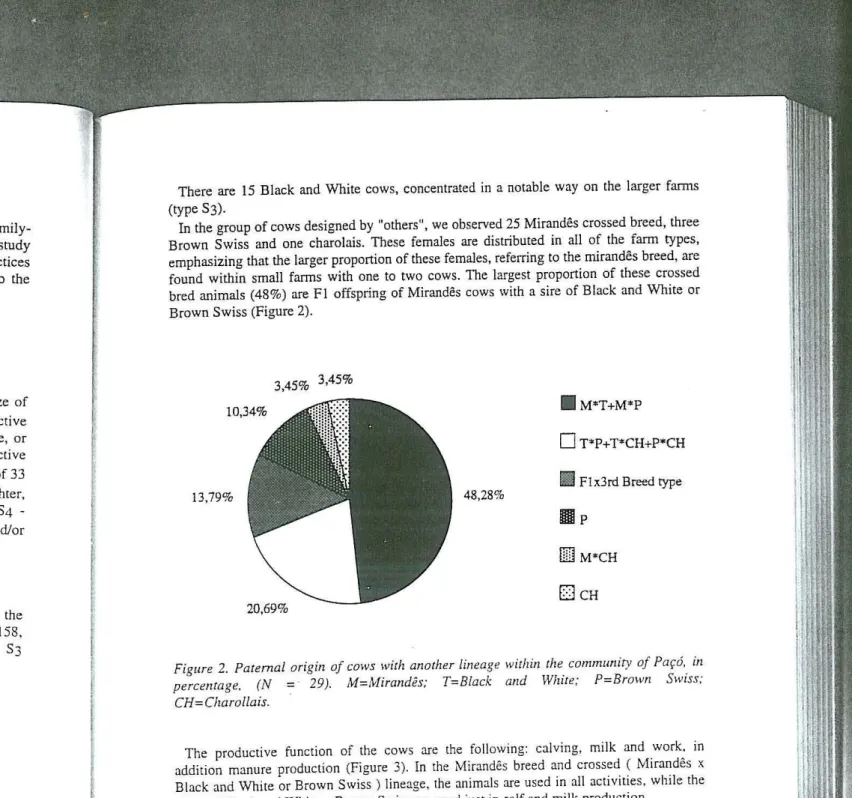
In the group of cows designed by "others", we observed 25 Mirandes crossed breed, three Brown Swiss and one charolais. These females are distributed in all of the farm types, emphasizing that the larger proportion of these females, referring to the mirandes breed, are found within small farms with one to two cows. The largest proportion of these crossed bred animals (48%) are Fl offspring of Mirandes cows with a sire of Black and White or Brown Swiss (Figure 2).
3,45% 3,45%
• M*T+M* P
0
T*P+T*CH+P*CH~~~
F l x3rd Breed type13,79% 48,28%
IIill
M*CHDcH
Figure 2. Paternal origin of cows with another lineage within the community of Para. in percentage, (N - 29). M=Mirandes; T=Black and White; ? =Brown Swiss:
CH= Charollais.
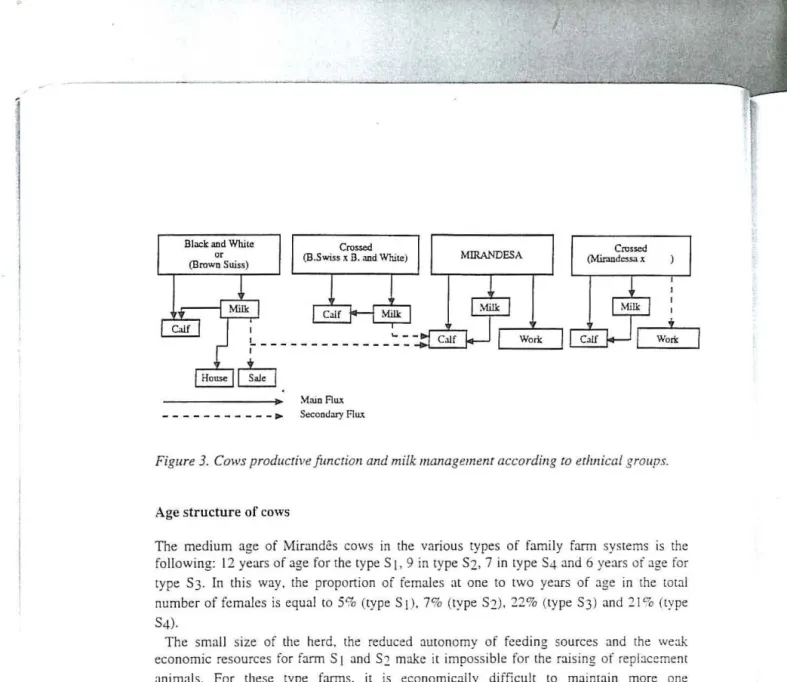
The productive function of the cows are the fo llowing: calv ing, milk and work, in addition manure production (Figure 3). In the Mirandes breed and crossed ( Mirandes x Black and White or Brown Swiss ) lineage, the animals are used in all activities, while the crossed Black and White x Brown Swiss are used just in calf and milk production.
With the B lack and White cows the farmers are tryi ng to meet their needs for milk for their children and the old folks and to have a continuous income source from the sale of milk to the neighbours.
Material and methods
The material and methods involved the following: comprehensive inquiry to the family-farm sys tems of a representative rural community in the "mirandes" breed area; case study of the global operation in the family-farm system; inquiry into the farmer's practices regarding the husbandry management of Mirandes cattle; and an open inquiry as to the owner's sire.
Results
Systems
The study identified fou r different types of cattle systems: Type S 1 - Small farm size of elderly retired farmers with 9 ha of Agricultural Surface (SAU) and a productive orientation to chestnuts and cattles: they raise feeder animals permanently in a stable, or they have one or two cows; T ype S2 - Medium farm size of 16 ha SAU with productive orientation to rye and cattle: they have three to five cows; Type S3 - Large farm size of 33 ha SAU with a strong community and generational interest of farming by son/daughter, oriented to cattlcschestnutrye: the average number of animals is 12 cows; Type S4 -Farmers with sheep, large family, 29 ha SAU, orientation to sheep-cattles-rye and/o r chestnut production: they have three to five cows.
The heterogeneity of ethnical groups
The cows of "mirandes" breed constitute the major ethnic al group exploited in the community of Pa<;:6: 114 females (72%) with the age over one year in a total of 158. distributed over all the fami ly farm systems, concentrated in farms of type S2 and S3 (Figure I).
%60,
50,00
SI S2 S3 S4
C
Mirandes (N= 11 4)ill
Others (N= 29)Ill
Black and White (N= 15)Type
Black and White
I
,--- ---- --- ---1--...J
ckJ
:vlaio Aux
- - - .,. Secondary Fhu
Figure 3. Cows productive function and milk management according to ethnical groups.
Age structure of cows
The medium age of Mirandcs cows in the various types of fam ily farm systems is the fo llowing: 12 years of age for the type S 1. 9 in type Sz, 7 in type S4 and 6 ye:m of age for type S]. In this way, the proportion of females at one to two years of age in the total number of females is equal to 5% (type S l ), 7% (type Sz), 22% (type S3) and 2 1% (type S4).
T he small size of the herd, the reduced autonomy of fe eding sources and the weak economic resources fo r farm S 1 and Sz make it impossible for the rai sing of repl:lccme nt animals. For these type farms. it is econo mically difficu lt to maintain more one unproductive female. with similar needs as an adult, during three years. The alte rnative choice fo r the se smaller farms of typeS 1. consists of buyi ng an adult cow for a reduced price. which is considered marginal by farmers who se ll them.
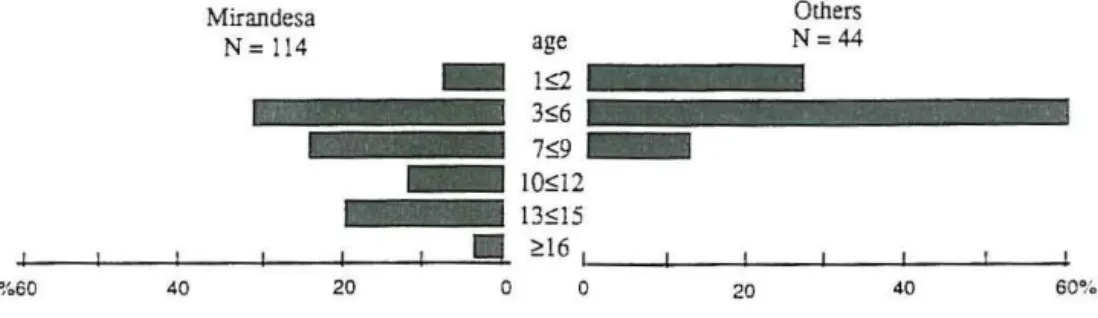
Big farms. type S }. are source fo r the substitution of cows fo r the smalle r farm s. type SI and S2. Indeed the structure of ages of their co ws suggest that the selection may be done on these farms w he n the cows attain an age between 3 and 6 years .
Mirandesa Others
N= 114 age N=44
-
1$2356 759 10512 13515
•
2:16~~60 40 20 0 0 20 40 60 %
Figure 4. Comparasion of the structure by ages of cows existing in the community of Pa ~6.
in percentage.
In this way, the total of 8% of Mirandes replacement heifers up to 2 years of age which exist in the community, instead of representing the replacement rate. they could be associated to the regression of the breed due to the competiti on of other ethnical groups.
Choice of the sire breed
The farmers use a M irandes bull to breed their cows in the following c ircunstances: a) to avoid binhing probl ems with heifers: the mirandes bull in general produces ca lves with lower birth weight than others breeds; b) to raise a replacement heifer for substitution within the ir herd: in thi s case, they select their best cow for the substitution.
Farmers that are more oriented to meat production during the last few years have chosen to cross-breed with sires from Black and W hite, Brown Swiss and more recently with Simmental. The higher birth weight to weaning of these animals compared to the M irandes and the greater demand by growers and butchers for meat production, contitutcs a strong incentive in general to cross-breed.
Conclusion
The assoc iation of ethnical diversity and the age structure of the animals shows that there does not exist in the community producers which specialize in rqising pure breed M irandes dams.
The aims of selection of the farmers are oriented to improve the reproductive and maternal abili ties. T he cows make use of vari ous foods produced in the farms and the farmers sold the calves at weaning (7 months ). The herd size for each farm is of small dimension and there is a diversity of farmer option in relationship to the choice of the s ire in the breeding of the cows.
live weight, with high rate of growth, making use of food not traditionaly produced at the farm.
The present organization of the breed improvement, centered on cattle breeders of pure breed and on farms with a great number of cows, does not permit genetic improvement of the "rnirandes" cattle breed.
The alternative to the present situation consists of expanding the selection basis, integrating a conceptual level with all farmers, implementation of a process to work within the middle of a population of many breeders in the community, with a struturing of farmers into elementary units of production, and with the result that each one has its characteristics, potential, and restrictions.