Repositório ISCTE-IUL
Deposited in Repositório ISCTE-IUL:
2019-11-20Deposited version:
Post-printPeer-review status of attached file:
Peer-reviewedCitation for published item:
Trindade, G. & Duarte, A. (2019). Comparing the consumption of musical and films online between Generations X and Y in Portugal and Spain. In A. Rocha, I. Pedrosa, M. P. Cota, R. Gonçalves (Ed.), 2019 14th Iberian Conference on Information Systems and Technologies (CISTI). Coimbra: IEEE.
Further information on publisher's website:
10.23919/CISTI.2019.8760817Publisher's copyright statement:
This is the peer reviewed version of the following article: Trindade, G. & Duarte, A. (2019).
Comparing the consumption of musical and films online between Generations X and Y in Portugal and Spain. In A. Rocha, I. Pedrosa, M. P. Cota, R. Gonçalves (Ed.), 2019 14th Iberian Conference on Information Systems and Technologies (CISTI). Coimbra: IEEE., which has been published in final form at https://dx.doi.org/10.23919/CISTI.2019.8760817. This article may be used for non-commercial purposes in accordance with the Publisher's Terms and Conditions for self-archiving.
Use policy
Creative Commons CC BY 4.0
The full-text may be used and/or reproduced, and given to third parties in any format or medium, without prior permission or charge, for personal research or study, educational, or not-for-profit purposes provided that:
• a full bibliographic reference is made to the original source • a link is made to the metadata record in the Repository • the full-text is not changed in any way
The full-text must not be sold in any format or medium without the formal permission of the copyright holders. Serviços de Informação e Documentação, Instituto Universitário de Lisboa (ISCTE-IUL)
Av. das Forças Armadas, Edifício II, 1649-026 Lisboa Portugal Phone: +(351) 217 903 024 | e-mail: [email protected]
Comparing the consumption of musical and films
online between Generations X and Y in Portugal and
Spain
Graça Trindade Alzira Duarte
Instituto Universitário de Lisboa (ISCTE-IUL), BRU-IUL Av. das Forças Armadas, Lisboa
1649-026 Lisboa, Portugal
[email protected] and [email protected]
Abstract — Numerous studies have been published evidencing the characteristics of Millennial generation (also known as Gen Y) by comparison with generation X or Gen X. The internet affirms itself as a differentiating factor and determinant of attitudes and behaviors. Considering the ease of access and the familiarity of Millennials, with the new technologies, it lacks analysis the preferences of use and consumption of music and films and television series, anchored in the Internet. The present study seeks to understand if there are differences between the Portuguese and Spanish users’ behavior or perceptions about the consumption of Internet contents in terms of music (or music videos) and films and television series and if such differences are reflected in the age groups. Using the Flash Eurobarometer 437 database, it is identified that age groups is significantly related to the frequency of using the Internet to access music and films online. It is also observed that gender is significantly related to frequency of using the Internet to access films online. The choices facing the Portuguese and Spanish age groups are homogeneous regarding the frequency of Internet use to access music but not films online. These results can be an indication that policies concerning the music and films contents should fit the characteristics of each of these age groups in both countries.
Keywords - Internet; Streaming platforms; Music online; Movies online.
I. INTRODUCTION
Nowadays, the information and communication technologies (ICT) became a basic element in the daily lives of many people. Today, there are more than 3 billion Internet users worldwide, representing around 40% of the world population [1]. The growth of the demand and supply of digital contents, both informative and entertaining, has led to significant changes in the media ecosystem reaching its production, distribution and reception [2].
Meanwhile, telecom operators have been forced to adapt their strategies and provide access to the Internet. Several authors [1] claim that the Internet must change the terms of competition, establishing fair conditions between companies. Numerous studies have been published evidencing the characteristics of the Millennials and the organizational response to deal with them [3]. Other authors argue that, as social networks become ubiquitous as the principal tool for the dissemination of information, forecasting the popularity of
online content is increasingly important for the management of brand reputation, growth of business opportunities and effective communication [4].
As Internet access is becoming more spread in all levels of society, there are platforms that deliver specialized contents through this network. Streaming platforms provide a set of own or third-party content through large content catalogs that can be accessed via the Internet [5].
In spite of this fast and global spread of the new platforms to access music and films, it is still scarce the research about how global is the consumer behavior online. A group of authors [6] examined the consumption of online news in six countries (Denmark, France, Germany, Spain, United Kingdom and United States) and the findings reflect the power of social media platforms in influencing news consumption habits. Regarding the music online habits, other authors [7] explored whether there are country-specific differences in users’ listening behavior on music platforms, based on the data from consumers of 47 countries. Their study results show the existence of country-specific differences in music listening behavior with respect to the degree of deviation from the global mainstream.
Netflix and Amazon streaming services became increasing popular in Portugal and Spain. Direct and inter-sectorial competitiveness emerged due to the new concepts and technologies, such as streaming. However, according to Digital Economy and Society Index DESI, 2018 [8] (with data from 2016) Portugal and Spain converge in music, videos and games (83%); but, differ on Video on Demand (9% for Portugal vs. 27% for Spain, extreme percentages that contribute to an European average of 21%).
Thus, we highlight some issues that need answers: What are the sociodemographic characteristics of Portuguese and Spanish users? Will the Portuguese and Spanish users' choices be homogeneous with regard to how often they use the Internet to access music and films online? Will the Millennials and Gen X users' choices be homogeneous with regard to the use of the Internet to access music and films online? The answer to these research questions is the purpose of this study.
II. LITERATURE REVIEW
After presenting the Millennials concept, the literature review continues by retracting the evolution of the Internet. Next, it is analyzed the consumption of Internet services and contents, namely music content (or music videos) and online films and TV series.
A. Millennials and Gen X
Although there is no consensus among authors about the cut-off date between generations, they all converge on the distinctive features. Millennials (Gen Y), as opposed to the predecessor generation (Gen X), are those that have already grown in a connected world, dominated by technology in a logic of market globalization and virtualization of interactions [9]. They are characterized by the willingness to use the technology and the ability to exploit the different media with great appetite for the use of the net and the free access. In the scope of this work, Millennials are considered those born since 1982 [10]. B. The Internet evolution
The Internet evolution can be registered in terms of type of access, type of equipment used, frequency of use and speed of accessing the networks that allow us to send and receive data faster and faster. Some authors [11] argue that active users access the Internet to read online newspapers, to work from home, to make personal and work communications, and perform a job search, or even a travel/hotel information queries. Occasional users, however, tend to use the Internet to participate in online games and search public information. C. Use of the Internet and services of streaming and download
Although the level of development or the type of infrastructures in each country may affect individual behaviors [12], this study is particularly concerned with Internet usage habits.
In terms of Internet use, the indicators point to a convergence between Portugal and Spain, both in terms of access, frequency and types of use. However, Portugal indicates a greater asymmetry, access and regular use when comparing the younger groups with the average population [13] [14].
In terms of streaming and downloading platforms, the main difference between different operators is the storage location of the content. These platforms can be classified according to the source of its revenue, through a free advertising-based template or a subscription model based on a monthly fee [15]. According to [16], streaming content is the most popular way to listen to music or watch films and series.
Since 1 of April 2018, the EU citizens are able to access online TV and movie subscriptions while travelling across EU borders, according to the new European regulations [17]. For example, a single cost should be applied for the use of the Internet as well as a single speed.
D. Demand for music and films content online
The study done by Ericsson shows that the consumption habits of Internet users are changing. In 2011, it was estimated that people spent 2.9 hours per week watching streaming TV shows, shows and films, but, in 2015, this number doubled to 6 hours per week [18].
In terms of the content of online music, the International Federation of the Phonographic Industry, IFPI, reveals that Europe grew by 4% in 2016, a slightly higher increase than in 2015, at 3.7%. Europe had a marked increase with streaming revenues at 45.5% [19].
About the consumption of films and series online, a study done in 2017 shows that video on demand (VoD) is becoming part of the daily viewing habits of content online [20]. From those who claim to watch any type of VoD content (65%), 43% say they do it at least once a day. However, just over ¼ of global online respondents (26%) says that they pay to watch broadcast or VoD programs through a subscription from an online service provider like Netflix, Hulu or Amazon, compared to 72% who say that they pay a monthly subscription from a traditional TV service provider.
III. CONCEPTUAL REFERENCE FRAMEWORK
From the literature review, the consumption of music and films online is not a recent practice, but it is a recent research topic.
Some authors suggest several predictors explaining whether a user is active or casual [11]. Also, other authors argue that, for example, the sooner the contact with the Internet is made, the more likely it is to be an active user [15]. Thus, it is intended to test whether the frequency to access musical and films contents online is related to age groups:
Hypothesis 1 - The frequency of Internet use is related to the age groups (Millennials vs Gen X).
Hypothesis 2 – The frequency of accessing musical contents and films or series online is related to the age groups (Millennials vs Gen X).
Other study shows the relationship between some sociodemographic variables and the frequency of Internet use (e.g. education level, professional occupation, gender, type of community) [21]. Thus we propose to test the following:
Hypothesis 3 - The membership group is associated to the type of the Internet use options (type of equipment, type of service, and criteria used to choose the type of services to access the Internet.
In order to rule out the effect of the cultural matrix of the country of origin of the sample, it is intended to test the following hypothesis:
Hypothesis 4 – The characteristics of the Internet users are identical in both countries (Portugal and Spain) and in both age groups (Millennials and Gen X).
These are the relationships that are going to be studied. IV. METHODOLOGY
In this study, it is purposed to characterize the profile of Portuguese and Spanish consumers regarding several sociodemographic variables, using the Flash Eurobarometer 437 - Internet Users' Preferences for Accessing Content Online database, through descriptive techniques. Inferential tests for the detection of significant relationships between nominal
qualitative variables (or treated as such) are also performed. The questionnaire supporting this study is divided in two sections:
Section 1: Questions about sociodemographic data, particularly gender, age, professional occupation, type of community, age education, and household composition;
Section 2: Questions on frequency of Internet use in general, the type of equipment most used to access the Internet, the frequency of Internet use to access music and films online, the preferred type of service most often to access the Internet, and the most important criteria to use in order to choose the type of service.
V. DATA ANALYSIS
Since the sample is quasi-random, it is possible to infer the results from the sample for the corresponding universe from where the sample was generated. For the analysis of the data, the statistical software IBM SPSS, version 25, is used. A. Sample characterization, regarding sociodemograhic
variables
The sample size includes 499 Portuguese residents, from which 305 are Millennials (Gen Y) and 194 belong to the Gen X; and 495 Spanish residents, from which 279 are Millennials and 216 belong to Gen X. Table 1 shows, at a national level, the personal profiles of the Millennial group and those that belong to the Gen X, in both samples.
Regarding the gender and considering the Millennials, the dominant gender in Portugal are male (52.1%) while in the Spain, the dominant gender is female (52.7%). A different situation is observed in the Generation X which is very similar between these countries; however, in Spain, it was found a significant relationship between gender and generations for 𝛼 = 0.10;
Considering the household composition, there is a similar behavior in the Millennials for both countries; in the Generation X, the characterization between these countries is different since the main category in Portugal is households with three elements while in Spain is households with four or more elements; only in Spain there is a significant relation between this variable and generations in spite of the relationship in the sample is weak (0.171);
Regarding age education, the main category across countries and generations is those that quitted or interrupted education at the age of 20 years or older; the main difference is in the category still studying that is higher in the Millennial group. It were inferred significant relationship between age education and generations in both countries and, in the samples, its relationship is 0.362 for Portugal and 0.304 for Spain; Comparing the group of the Millennials in both
countries in terms of professional occupation, the majority of them are employees in Portugal (52.6%) while in Spain the percentage is closed to 50% (45.3%); the main differences are related with (1) manual worker in Spain in both generations while in Portugal this
category is residual in the Millennials and (2) in the category without a professional activity that is higher in the Millennials in both countries. In both countries, it was found significant relationships between professional occupation and generations; in the samples this relationship is weak (0.244 for Portugal and 0.228 for Spain).
In terms of the type of community where they live, while in Portugal, 50% of the respondents live in small or middle-sized towns across both generations, in Spain, the Millennials live in large towns (46.1%) while those that belong to Gen X live in small or middle-sized towns in both samples.
TABLE I. SOCIODEMOGRAPHIC PROFILES IN PORTUGAL AND SPAIN
Portugal Spain Generation X Y X Y Gender Male 51.5 52.0 55.3 47.3 Female 48.5 48.0 44.7 52.7 𝜒2(1) = 3.111 𝑝 = 0.086; 𝐶𝑟𝑎𝑚𝑒𝑟′𝑠𝑉 = 0.076 Household composition One 16.5 20.4 14.8 24.2 Two 23.2 22.4 21.3 17.4 Three 30.4 25.7 17.5 24.9 Four or more 29.9 31.6 46.1 33.5 𝜒2(4) = 14.468 𝑝 = 0.002; 𝐶𝑟𝑎𝑚𝑒𝑟 𝑠 𝑉 = 0.171 Age education Up to 15 4.9 0.3 2.5 1.2 16 – 19 27.9 22.2 21.7 11.3 20 years or older 67.2 52.6 72.4 63.4 Still studying 24.9 3.4 23.7 No education 0.4 𝜒2(3) = 62.475; 𝑝 < 0.001; 𝐶𝑟𝑎𝑚𝑒𝑟 𝑠 𝑉 = 0.362 𝜒2(4) = 42.537; 𝑝 < 0.001; 𝐶𝑟𝑎𝑚𝑒𝑟𝑉 = 0.304 Professional occupation Self-employed 18.0 11.5 14.9 12.2 Employee 68.0 52.6 61.4 45.3 Manual worker 1.0 4.1 3.9 Without a professiona l activity 13.9 34.9 19.7 38.7 𝜒2(3) = 29.765; 𝑝 < 0.001; 𝐶𝑟𝑎𝑚𝑒𝑟´𝑠 𝑉 = 0.244 𝜒2(3) = 25.742; 𝑝 < 0.001; 𝐶𝑟𝑎𝑚𝑒𝑟 𝑠 𝑉 = 0.228 Type of community Rural area 16.5 18.1 17.0 15.8 Small or middle-sized town 50.0 50.3 40.5 38.2 Large town 33.0 33.2 2.5 46.1
In conclusion, the comparison between these generations in each country reveals that there are four significant relationships between some socio-demographic variables and generations compared with only two significant relationships in Portugal.
Regarding the frequency of use of the Internet as well as the frequency of using the Internet to access music and films online, some differences are registered (Table 2). The main conclusions are:
The use of the Internet several times a day is dominant in both countries, but it is slightly higher in the group of the Millennials. There is a significant relationship between this variable and both generations in Spain; The Internet usage behavior converges in the frequency
of accessing music and films online in both countries, being the Millennials in both countries those that have a more frequent use in the access to music and films online in the samples. Also, the relationships between these variables and generations are significant in both populations.
TABLEII: OTHER CHARACTERISTCS ABOUT THE FREQUENCY OF USE OF THE INTERNET BY AGE GROUPS, IN PORTUGAL AND SPAIN
Portugal Spain Generation X Y X Y Frequency of the use of the Internet Several times a day 94.8 95.4 89.8 97.8 At least once a day 4.1 4.6 8.8 1.8 At least once a week 0.5 MW = 27835.0 p < 0.001 How frequently do you use the Internet to consume or access music?
Every day or so 18.6 42.9 23.1 48.4 Several times per
week 36.1 30.4 27.3 27.2 Several times a month 27.3 15.8 25.5 14.3 Once a month or less 11.3 8.3 15.7 6.8 Never 5.7 1.7 7.4 2.2 MW = 20432.5 p < 0.001 MW = 19759.0 p < 0.001 How frequently do you use the Internet to consume or access films, TV series?
Every day or so 10.3 24.8 16.2 29.4 Several times per
week 24.7 30.4 27.3 37.3 Several times a month 20.1 22.8 25.0 23.3 Once a month or less 30.9 16.2 18.1 6.8 Never 11.9 4.3 12.5 2.5 MW = 20782.5 p < 0.001 MW = 20432.5 p < 0.001
Note: MW means Mann-Whitney test value.
Table 3 reveals that the computer is the preferred equipment to access the Internet in both generations for both countries, but the use of smartphones is higher in the Millennials (converging with the connected generation characteristic). In both populations there is significant relationships between the most used equipment and generations.
TABLEIII: OTHER CHARACTERISTICS CONCERNING THE EQUIPMENT USED TO ACCESS THE INTERNET BY AGE GROUPS, IN PORTUGAL AND SPAIN
Portugal Spain Generation X Y X Y Equipment most often used to access the Internet? A computer 72.7 62.0 63.9 59.5 Tablet 10.3 6..9 10.2 3.9 Smartphone 17.0 31.0 25.5 35.5 A TV 0.7 Don’t know 0.5 0.4 𝜒2(2) = 12.624 𝑝 = 0.002; 𝐶𝑟𝑎𝑚𝑒𝑟 𝑠 𝑉 = 0.156 𝜒2(4) = 13.565 𝑝 = 0.003; 𝐶𝑟𝑎𝑚𝑒𝑟 𝑠 𝑉 = 0.244
Concerning the type of service most preferred to access music and films online, observe Table 4.
TABLEIV: OTHER CHARACTERISTICS CONCERNING TO ACCESS MUSIC AND FILMS ONLINE BY AGE GROUPS, IN PORTUGAL AND SPAIN
Portugal Spain Generation X Y X Y Type of service most often used to access music online Video or music sharing websites 36.9 41.8 29.1 28.5 Professional music streaming services 14.5 20.9 21.4 29.6 Digital stores 2.2 3.0 7.1 5.9
Online social media 16.8 16.5 8.2 14.4
Online radio stations 24.6 13.8 25.0 13.7 Internet radio services 5.0 4.0 9.2 7.8 𝜒2(5) = 10.876 𝑝 = 0.0539; 𝐶𝑟𝑎𝑚𝑒𝑟 𝑠 𝑉 = 0.151 𝜒2(5) = 15.108 𝑝 = 0.009; 𝐶𝑟𝑎𝑚𝑒𝑟 𝑠 𝑉 = 0.180 Type of service most often to access films or TV series online Video-sharing websites 32.5 34.7 27.0 25.5 Professional film and TV series streaming 17.5 19.6 19.0 23.0 Broadcasters online TV services 16.4 17-2 20.6 12.4 Digital stores 1.8 2.7 5.3 6.6 Online platforms 11.7 14.8 13.2 16.4
Online social media 11.7 7.6 10.1 12.0
Other .7 .5 .7
Don’t know 4.1 2.7 4.2 3.3
Table 4 shows that, concerning the type of preferred service to access music online, the profile of Portuguese respondents are very similar across the generations once they prefer to use
video or music sharing websites (41.8% for the Millennials and 36.9% for generation X); but, in Spain, there is an inversion of choices: while the Millennials prefer to use professional music streaming services (29.6%), those that belong to generation X prefer to use video or music sharing websites (29.1%).
However, there is only significant relationship in the type of preferred service to access music online in both countries, but is the samples, the relationships are weak (0.151 for Portugal and 0.180 for Spain.
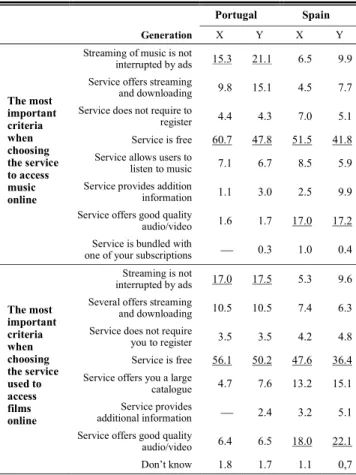
Table 5 shows the following:
In the samples - the most important criteria chosen to access music online are, in first place, the service is free and, in second place streaming of music is not interrupted by ads in Portugal while in Spain is service offers good quality audio/video in Spain;
In the samples - the most important criteria chosen to access music online are, in first place, the service is free and, in second place streaming of music is not interrupted by ads in Portugal while in Spain is service offers good quality audio/video in Spain.
The profiles of these countries are very similar in what the chosen criteria to access music and films online are concerned. TABLEV: SOME OTHER CHARACTEISTICS CONCERNNG THE CRITERIA USED TO ACCESS MUSIC AND FILMS ONLINE BY AGE GROUPS, IN PORTUGAL
AND SPAIN Portugal Spain Generation X Y X Y The most important criteria when choosing the service to access music online
Streaming of music is not
interrupted by ads 15.3 21.1 6.5 9.9 Service offers streaming
and downloading 9.8 15.1 4.5 7.7 Service does not require to
register 4.4 4.3 7.0 5.1 Service is free 60.7 47.8 51.5 41.8
Service allows users to
listen to music 7.1 6.7 8.5 5.9 Service provides addition
information 1.1 3.0 2.5 9.9 Service offers good quality
audio/video 1.6 1.7 17.0 17.2 Service is bundled with
one of your subscriptions 0.3 1.0 0.4
The most important criteria when choosing the service used to access films online Streaming is not interrupted by ads 17.0 17.5 5.3 9.6 Several offers streaming
and downloading 10.5 10.5 7.4 6.3 Service does not require
you to register 3.5 3.5 4.2 4.8 Service is free 56.1 50.2 47.6 36.4
Service offers you a large
catalogue 4.7 7.6 13.2 15.1 Service provides
additional information 2.4 3.2 5.1 Service offers good quality
audio/video 6.4 6.5 18.0 22.1 Don’t know 1.8 1.7 1.1 0,7
VI. CONCLUSIONS
The main contribution of this study is to show that the consumer behavior of music and movies online is not homogeneous between the two age groups in both countries. The conclusions of this study are relevant for market segmentation and policies to be implemented by internet/telecom operators. These findings also contribute to the policy-oriented academic debate about market concentration in a few industries which can be enriched by the detection of relevant variables in explaining the frequency of Internet use to access music and films online. Indeed, this study is in line with recent studies that also showed the existence of specificities among consumer [11].
The idea that Millennials are permanently connected and in search of up-to-date information makes them eager consumers. This confirms the hypothesis that age is related to the frequency of Internet use to access and music and films. This information is particularly important when one considers that they are also more receptive to subscribing streaming services.
In addition, this study shows that the cultural matrix of the countries under study does not affect the choice of the frequency use of the Internet. The use of the Internet is regular and frequent and, as far as to access music or films and TV series, is privileged the gratuitousness of the services and the sites of sharing in both countries. But, in Portugal is also preferred services that offer music not interrupted by ads, while in Spain, it is also preferred services that offer good quality audio/video, converging with what it is stated by DESI, 2018 [8]. Proving the trend of permanent connectivity of the Millennials, it has been identified the greater appetite of them by mobile devices, such as the smartphone, living up to the name of "connected generation" [20].
The study also shows that Gen X tends to make use of the Internet as an alternative technology to access static programs / products, either by accessing online radio stations or in the case of Spain, by accessing films online using broadcaster online TV services.
Some limitations of this study were faced. First of all, the database used was already built. Thus, the choice of studying relevant variables to the study was limited to the database. For example, if the sociodemographic profile of consumers of music and movie contents was possible to be done, the analysis of the knowledge and perception of the provided quality of services to access contents online could not be tested.
Thus, it would be interesting to study the characteristics of the access and consumption habits of audiovisuals and the knowledge of the potentialities of the network, and their use in diverse contexts. Also, it is advisable to replicate this study, deepening the content analysis from a questionnaire with the variables most relevant to the study. For example, to allow more detailed analysis of the contents, one can identify which series are most viewed by categories. Finally, in future research, it may be important to identify causal relationships between variables and not just significant relationships. For instance, the effects of Smartphones and Social Media on the frequency of accessing music and films online should be estimated.
ACKNOWLEDGEMENT
This work was supported by Fundação para a Ciência e a Tecnologia, grant UID/GES/00315/2019.
REFERENCES
[1] Curran, J., Fenton, N., and D. Freedman, Misunderstanding the Internet (2nd ed.). New York: Routledge, 2016.
[2] Entidade Reguladora para a Comunicação Social (ERC), As novas dinâmicas do consumo audiovisual em Portugal. Regulatory Entity for Social Communication (ERC), The new dynamics of audiovisual consumption in Portugal, 2016.
[3] Jerome, A., Scales, M, Whithem, C. and B. Quain, “ Millennials in the Workforce: Gen Y Workplace Strategies for the Next Century. e-Journal of Social & Behavioural Research in Business Vol. 5, Iss. 1, 2014, pp: 1-12. Retrived from http://www.ejsbrb.org/upload/e-JSBRB_Jerome,_Scales,_Whithem_Quain_5(1)_2014.pdf
[4] Lymperopoulos, I.N. “Predicting the popularity growth of online content: Model and algorithm”. Information Sciences, Vol. 369, pp. 585-613 in Silva et al, “Consumption of musical content and movies/series online in Portugal”CISTI, 2017.
[5] Schedl, M. and C. Bauer, An analysis of global and regional mainstreaminess for personalized music recommender systems. Journal of Mobile Multimedia, Rinton Press, 2018.
[6] Vonderau, P. “The politics of content aggregation”, Television & New Media, Vol. 16(8), 2015, pp. 717-733.
[7] Bauer, C. and Markus Schedl, On the Importance of Considering Country-specific Aspects on the Online-Market: An Example of Music Recommendation Considering Country_Specific Mainstream. Proceedings of the 51st Hawaii International Conference on System
Sciences, 2018.
[8] European Comission, Digital Economy and Society Index (DESI), retrieved from https://ec.europa.eu/digital-single-market/en/desi
[9] Lancaster, L. and D. Stillman, When generations collide. Who they are. Why they clash. How to solve the generational puzzle at work. New York: Collins Business., 2002
[10] Pew Research Center. The next America: Boomers, millennials, and the looming generational showdown. New York: PublicAffairs, 2014. [11] Emmamoulides, C., and K. Hammond, “Internet usage: Predictors of
active users and frequency of use”, Journal of Interactive Marketing, Vol. 2, 2000, pp. 17-32.
[12] Lancaster, L. and D. Stillman, When generations collide. Who they are. Why they clash. How to solve the generational puzzle at work. New York: Collins Business, 2002.
[13] Eurostat, 2014. Online data code: isoc_ci_im_i [14] Eurostat, 2014. Online data code: isoc_ci_ifp_fu
[15] Choudrie, J., and Y. Dwivedi, 2004. “Towards a conceptual model of broadband diffusion”, Journal of Computing and Information Technology, Vol. 4, pp. 323-338 in Silva et al. ““Consumption of musical content and movies/series online in Portugal”CISTI, 2017.
[16] Anacom (Autoridade Nacional de Comunicações). “O sector das comunicações 2016”.
[17] www.anacom.pt (2018). Portabilidade de conteúdos digitais na união Europeia. Publicado em 05.04.2018. Portability of online content services.
[18] Ericsson, “Consumer Insight Report – TV and Media 2015: The empowered TV and media consumer’s influence,” Retrieved from
https://www.ericsson.com/assets/local/news/2015/9/ericsson-consumerlab-tv-media2015.pdf.
[19] International Federation of the Phonographic Industry (IFPI), 2017. Global Music Report – Annual State of the Industry.
[20] Nielsen, “Video on Demand: How worldwide viewing habits are changing in the evolving media landscape,” 2016.
[21] Lancaster, L. and D. Stillman, When generations collide. Who they are. Why they clash. How to solve the generational puzzle at work. New York: Collins Business, 2002.
[20] Skiba, D., The millennials: Have they arrived at your school of nursing? Nursing Education Perspectives, 25(6), 2015, pp. 370–371.