Esruoos DE EcoNOMIA, vaL. XVIII, N.0 2, PRIMAVERA 1998
A MATHEMATICAL FORMULATION FOR A SECONDARY
SCHOOL TIMETABLING PROBLEM(*)
Margarida Vaz Pato
(**)
Marco Paulo Carrasco
(***)
1 - Introduction
At teaching institutions of all levels, from kindergardens to universities, including institutions providing isolated courses, the task of creating timetables is of major importance. Timetables are needed to schedule regular courses, exams and special events, such as short courses, conferences [Eglise and Rand (1987)] and sports events. However, each operation differs considerably -even when scheduling the same kind of event- among schools of the same type. A survey of classic timetabling models may be found in de Werra (1984), and recent ·references on the Internet [Carter (1995)].
Generally speaking, in schools two main kinds of timetables arise: timeta-bles for examinations and timetatimeta-bles for classes provided throughout the year.
The first type -
exam timetabling-
is related to the assigning of exams to time slots, for each group of students with the same curriculum, in such a way that the exam period is respected and tests cover the entire allocated exam period [Carter, Laporte and Chinneck (1994), Laporte and Desroches (1984) and Johnson (1990)].The second type -
class timetab/ing-
concerns the production of time-tables for students and teachers in keeping with the curricula, available rooms and compliance with certain rules determining timetabling quality.From the computational perspective, most of the problems relating to the two types are complex [Even and Shamir (1976), Cooper and Kingston (1995)]. However, class timetabling is far more intricate as it deals with many more entities and is subject to countless rules.
The problem we shall present in this paper concerns class timetabling at a secondary school in Portugal, the so-called secondary school class timetabling problem - STP for short.
In section 2 a brief review is made of similar class timetabling problems, together with a reference to the respective formulations and methods used by authors to solve them.
Section 3 is devoted to a description of the STP, whose formulation is given in Section 4. Section 5 provides an illustrative example taken from an unrealistic, very small school, and Section 6 completes our report with several relevant comments.
(*) This research has been partly supported by the Centro de lnvestigagao Operacional
(FC- Universidade de Lisboa) within the PRAXIS XXI (JNICT) Project no. 2/2.1/MAT/139/94.
(**) lnstituto Superior de Economia e Gestao, Universidade Tecnica de Lisboa. (***) Escola Superior de Gestao, Hotelaria e Turismo, Universidade do Algarve.
Esruoos DE EcoNOMIA, vaL. xvm, N.0 2, PRIMAVERA 1998
2 - A review of European secondary school class timetabling
The class timetabling problem depends on the specific educational sys-tem one is dealing with. As a rule, European countries possess a knowledge system that differs considerably from that of North America, including Canada [Ferland and Roy (1985), Hertz (1991 )], though some European universities do share the main timetabling characteristics of the overseas system [Downsland (1990)].
In the American system the curricula are less rigid than in Europe; stu-dents are allowed to enroll in optional subjects and schedules ensure that clashes are minimized. However, in Europe optional subjects are the excep-tion in the curricula, and timetabling clashes are not contemplated at all. Moreo-ver, in European schools, timetables are generally performed on a weekly basis, whereas in the American system timetables operate on a daily basis. This, to a large extent, explains why overseas models and software for timetabling cannot be used in our schools.
Here we explain some European models of interest which are in some way related to our case study- the STP.
Most literature published to date concerning timetabling addresses a wide range of solution methodologies to tackle the problems: network flows, match-ing, project scheduling with resource constraints, optimal colormatch-ing, decomposi-tion and branch-and-bound algorithms, lagrangean relaxadecomposi-tion techniques and heuristics - constructive, local search or meta-search.
Let us begin by briefly explaining a timetabling problem found in the sur-vey by de Werra (1984).
The basic model calls for a set of classes - groups of students with the same curriculum - , a set of teachers and a matrix whose elements represent the number of lessons involving each class and each teacher. The lessons are of equal length (time slot) and a period of
p
time slots is submitted for scheduling. The solution to the timetabling problem will assign each lesson to one time slot to ensure that no teacher and no class is involved in more than one lesson at a time. The author formulates this problem as a system of lin-ear constraints, whose binary variables xijk(s) become 1 if class i and teacherj are assigned to the same lecture at time slot k, and 0 if otherwise.
This author also formulates the above problem as one of edge coloring in a bipartite multigraph, where the nodes stand for classes and teachers, and parallel edges stand for the lessons that involve each teacher/class pair.
Both formulations are extended to cover the weekly timetables. Theoreti-cal results are given for the problems and heuristic methods are presented, on the basis of network flows and matchings.
Colorni, Dorigo and Maniezzo (1990) tackle a class timetabling problem whose data consists of:
A set of teachers; A set of classes;
A set of weekly teaching time slots for each class;
The·curriculum for each class based on the attendance of the teach-ers working for that class;
Other conditions, such as personal preferences of the teaching staff, pedagogical and organizational rules.
Esruoos DE ECDNOMIA, VOL. XVIII, N.0 2, PRIMAVERA 1998
Timetables must meet the predefined number of lessons for every teacher, as well as for each class and respective constraints, i. e.:
There should be no more than one teacher in a class in any time slot;
No teacher may teach more than one class in one time slot; There must be one teacher for each class scheduled for a specific
time slot.
When building timetables, one endeavours to cater for teachers' personal preferences, besides organizational and the pedagogical rules, such as the spreading of lessons over the day periods.
The above authors use a genetic search representing each solution of the timetabling problem by a chromosome in matrix form. Each row of the matrix stands for one teacher, while each column represents a time slot. The values of the matrix elements are classes.
Genetic operators of selection, mutation, crossover and filtering were spe-cifically developed for this case. Some constraints are imposed by penalizing the fitness of the chromosomes, while others are imposed through the genetic operators.
It is known that this methodology was successfully applied at a large high school in Milan.
We shall now briefly review a paper due to Abramson (1991), who uses a simulated annealing-based heuristic. We found another reference, Abramson and Abela (1991 ), which contains a genetic algorithm for a class timetabling problem, but have since been unable to obtain this document.
In this problem the authors assume that classes, teachers and rooms have already been scheduled in accordance with the teachers' preferences and avail-able rooms. The problem of creating timetavail-ables then becomes one of assigning the triplets (class/room/teacher) to a set of time slots, while respecting the fol-lowing hierarchically defined conditions that determine the quality of the timetable:
Avoid the simultaneous occurrence of the triplets (class/room/teacher) that concern the same resources;
When optional subjects are involved, avoid the simultaneous occur-rence of classes with common students;
Choose rooms suited for each subject; Allow multi-slot-time classes;
Bound the number of lessons, both for students and teachers, within the specific time period - e. g. a week.
To enable such guidelines to be incorporated in the model, an objective func-tion, composed of different parcels, is created. This function penalizes viola-tion of the above condiviola-tions and takes value zero when all condiviola-tions are verified.
The algorithm begins with a random solution and is followed by an an-nealing procedure defined in a specific neighbourhood. In each iteration, a time slot and a triplet (class/room/teacher) are randomly selected. Another time slot is then randomly chosen to perform a move (towards a new solution) and the
Esruoos DE EcoNOMJA, voL. XVIII, N." 2, PRIMAVERA 1998
change in respective objective value provided by the move is calculated. Adop-tion or otherwise of the move depends on the probability guiding the anneal-ing scheme.
An empirical study is then presented with tests of different annealing pa-rameters in a set of problem instances, including randomly generated instances and a real data instance from a secondary school in Australia.
The paper by Gislen, Peterson and Soderberg (1989} presents an appli-cation of neural networks to a class timetabling problem and later, in 1992, a further paper by the same authors perfects the methodology.
The authors analyse the four sets of entities usually involved in timetabling situations (teachers, classes, rooms and time slots) and work with two types of pairs: teacher/class and room/slot. The problem thus becomes one of as-signing pairs of one type to pairs of the other type, while simultaneously re-specting problem constraints.
The authors apply a neural network by using Potts' neurons and mean field theory with an annealing scheme to enforce the convergence to better quality solutions. Each neuron represents an assignment of one teacher/class pair to a room/slot pair. The neurons begin by being given a real value, whereas when the neural procedure ends, they converge to become binary values, 1 or 0. This work explores the idea of separating the conditions into two obliga-tory hierarchical grades (hard and soft constraints) embedding all constraints in the energy function of the neural network by penalizing them with different parameters.
Two other recent papers refer to the devising of timetables involving sets of teachers, classes, subjects and rooms.
One is due to Costa (1994} and carefully reports on a very complete problem of timetabling in high/secondary schools in Switzerland. The problem is formulated as a nonlinear binary problem embedding some constraints (the soft ones) in the objective function and others (the hard} as simple constraints. The solution procedure is a specially designed tabu search which was suc-cessfully tested in two real cases from the model's field of application.
The other paper is from Alvarez-Valdes, Martin and Tamarit (1995}. Us-ing the above elements, the authors consider the problem as a resource-con-strained project scheduling one. The lessons constitute the activities to be scheduled, taking into account the limited resources given by the classes, teach-ers and rooms, whereas the precedence constraints between the lessons of the same subject generate the scheduling constraints. A tabu search heuristic is also applied to improve the above feasible solution. The overali method is tested on a set of 14 Spanish high schools and in high dimensioned instances obtained from random generation.
Let us now refer to a timetabling problem successfully applied to a sec-ondary school in the United Kingdom and due to Write (1996). This case is very specific to the actual school concerned. The timetabling covers a fort-night and considers the subjects clustered into blocks. As usual in this field, some of the constraints are taken as hard constraints, that is they are regarded as constraints peculiar to the mathematical programming model, whereas oth-ers are taken as soft. In other words they are embedded as penalizing terms in the objective function. The process of creating timetables is performed in stages, some of which are computational, while others are manual.
ESTUDOS DE ECONOMIA, VOL. XVIII, N.0 2, PRIMAVERA 1998
3 -The secondary school class timetabling problem
Let us now explain our timetabling problem which, as mentioned above, was inspired on a specific secondary school. It does, however, resemble most secondary class timetabling problems to be found in our country.
The overall timetabling process in this kind of school may be broken down into four stages, as shown in figure 1.
FIGURE 1
The overall timetabling process
Stage 1 - student enrollment Stage 2 - class building
Stage 3 - assignment of classes to teachers Stage 4 - creation of timetables
Firstly students enroll and choose the optional subjects they prefer, as-suming the curriculum contains options.
Classes are then constructed by taking into account both optional sub-jects and advisable sizes. To be more precise, a class is built with students sharing the same basic curriculum. There may, however, be some optional subjects that require a class to be split and/or merged into other classes, thus forming groups of students attending a specific subject.
In the third stage, classes are assigned to teachers while respecting teacher
specialization and respective weekly work-load. Teachers are assigned to classes via subjects and, as a result, teacher/class(es) pairs are established. These we shall refer to as disciplines. For example, if Teacher 1 teaches Mathematics to Class A and Class B separately, we define the corresponding teacher/class pairs as disciplines Math 1 A and Math 1 B. Also, if Teacher 2 teaches the optional subject German to a group of students from Class A and Class B, there is also a teacher/class pair defining discipline Germ 2AB. It should be added that a subject for a specific group of students cannot be taught by different teachers.
The fourth stage involves creating the timetables - which we shall be ad-dressing throughout the rest of this paper and is referred to as the secondary school class timetabling problem.
Solving this problem entails building weekly timetables for all classes,
teachers and rooms. Each week is made up of days - let us say 5 in most
cases - and the number of time slots per day is known. It is assumed that each lesson occupies only one time slot.
The number of constraints to be satisfied is considerable and are, in them-selves, complex. In handling these difficulties, two hierarchical levels of con-straints were considered: level 1 obligatory or compatibili~y constraints and level 2, improvement constraints.
Level 1 constraints must be satisfied in any feasible solution and include
the following restrictions:
Each room must be occupied in each time slot by no more than one discipline;
Each teacher must teach no more than one discipline in each time slot;
EsTUDOS DE ECONOMIA, VOL. XVIII, N.0 2, PRIMAVERA 1998
Each student must attend no more than one discipline in each time slot.
The last condition applies to the subsets of students with different op-tions. For instance, one class may have students taking French and others taking English as a foreign language. In such cases two different disciplines are assigned to that class to include the foreign languages and the constraint is enforced for the two subgroups of students.
Other level 1 constraints refer to specific aspects of the problem, such as the weekly number of time slots per subject, as stipulated by the curriculum of the students, room capacity and room suitability for each subject.
Pedagogical rules are also considered, such as the enforcement of a lunch break, both for teachers and students. A schedule that respects a maximum number of daily lessons per discipline is also strongly advisable.
The group of so called level 2 constraints concerns a wide range of con-ditions that both students and teachers would like to see, but are not compul-sory. Though many other conditions regarding this aspect may be considered, here we shall mention no more than two:
Gaps between teaching periods in each day must be avoided, for the sake of students and teachers alike, as well as the risk of spreading lessons over the week;
The choice of each teacher's free periods should, whenever possi-ble, be respected.
Albeit important, these features do not cover everything one should con-sider when creating timetables for a Portuguese secondary school. Our inten-tion is simply to show one way of incorporating such constraints in a math-ematical model (section 4). Naturally other specific constraints may also be tackled in a similar manner.
4 - Formulation
The formulation to be presented for the STP lies within the context of nonlinear optimization with binary variables. Following the previous presenta-tion of the STP we will enforce level 1 constraints by the model constraints, whereas level 2 constraints will be embedded through penalizations in the objective function.
Let us begin by defining the model parameters:
s -index for a room, s = 1 , ... ,S, where S ~ 1 is the number of rooms available;
d -index for a discipline, d = 1 , ... ,0, where 0 ~ 1 is the number of disciplines built in stage 3 of the overall timetabling process;
t -
index for a time slot,t
= 1 , ... , T, where T~ 1 is the number of time slots per week and the week is split into a number of days less than T, each containing a specified lunch period;p - index for a teacher, p = 1 , ... ,P, where P ~ 1 is the number of teachers;
E5TUD05 DE EcoNOMIA, VOL. XVfll, N.0 2, PRIMAVERA 1998
c -
index for a class,c=
1, ... ,C, where C~ 1 is the number of classes;Md-maximum number of daily time slots or lessons assigned for discipline d (a lesson occupies one time slot), Md ~ 0 and inte-ger, for d = 1 , ... ,D;
Nd-number of time slots per week of discipline d, which is deter-mined by the curriculum for the respective group of students and the work-load of the respective teacher, Nd ~ 0 and inte-ger, for d = 1 , ... ,D;
discP(p)-set of disciplines given by teacher p, for p = 1 , ... ,P;
discC(c)-set of disciplines attended by students of class c, for C=1, ... ,C;
ldd'-equal to 1, if disciplines d and d' are incompatible (taught by the same teacher or attended by the same group of students), and equal to 0 otherwise, ford= 1, ... , D and d'=1, ... ,D; C5d -equal to 1 if room
s
is not suited for discipline d, and equalto 0 if otherwise, for
s
= 1 , ... ,S and d = 1 , ... ,D;Btt'-subjective penalty resulting from the occupation of time slots
t
and t', Btt' ~ 0 for t = 1 , ... , T and t' = 1 , ... , T;
GP1- relative availability of teacher p in time slot
t,
GP1 ~ 0 forp=1, ... ,Pand f=1, ... ,T;
a, ~. y -penalties associated with each component of the objective function, a~ 0, ~ ~ 0 and y ~ 0.
The following variables will be used:
x
5d1- equal to 1, if room
s
is occupied with discipline d in time slott,
otherwise equal to 0, fors
= 1 , ... ,S, d = 1 , ... ,D andt
= 1 , ... , T.Let us now present the objective function:
minimize Z= a f1 + ~ f2 + y f3 (0)
where:
p T T
s
s
f1
=
L L L
Btt'+(2,
L
X5dl)(2,
L
X5dt');p=1 1=1 1'=1,1';el 5=1 de di5cP(p) 5=1 de di5cP(p)
c
T Ts
s
f2
=
L L L
Btt'(L
L
X5d1)(2,
L
X5d1,); c= 1 I= 1 t'= 1,1';e I 5= 1 de di5cC(c) 5= 1 de di5cC(c)P T S
f3 =
L L
Gpl(2,
L
X5dl). p= 1 I= 1 5= 1 de di5cP(p)This objective function penalizes three aspects of the solution, all of which belonging to hierarchical level 2 for improvement- reducing gaps and time-spreading, both for teachers and for students and imposing preferences for
Esruoos DE EcoNoMIA, VOL. XVIII, N.0 2, PRIMAVERA 1998
teachers. By changing the respective parameters we can change the relative importance of these aspects.
The first and second components, f1 and f2, impose timetables for
teach-ers and students respectively, with a low spread factor. This low spread factor refers to the lowest possible number of free periods per day and avoidance of lessons spread over the week.
The third part of the objective function, f3, incorporates teacher
prefer-ences in the model.
Optimization of the above function is performed, while respecting the con-straints explained below.
This first set of constraints determines maximum occupation of each room per discipline at each time slot.
D
L
X
5
d
1
~1
(s==1, ... ,S; t==1, ... ,7)d=1
(1)
For each teacher, constraints (2) impose a maximum of one lesson per time slot.
s
L
L
X 5dt~
1 (p == 1 , ... ,P; t== 1 , ... , 7) s = 1 de di5cP(p) (2)Each constraint (3) restricts the number of lessons for discipline d per week, as indicated by the curriculum of the group of students relative to dis-cipline d.
S T
L L
X5dt == Nd (d == 1 , ... ,0) (3) 5= 1 t = 1Constraints (4) respect two different aims. The first one is to prevent the time clashes for each teacher already imposed by (2). This redundancy plays an important role for the neural network formulation [see reference (5)]. The aim of the second is to exclude the concurrent teaching of disciplines which are common to the same group of students:
D S S
L L
ldd'L
X5dtL
X5'd't == 0 (t == 1 , ... , 7)(4)
d=1 d'*d 5=1 5'=1
Next constraints (5) impose suitable rooms for each discipline in each time slot.
D S
:L :L
c
5d xsdt ==o
U== 1 .... ,o) (5) d= 1 S= 1For reasons of simplification, but without limiting the general nature of the present formulation, the following three sets of constraints will be drawn up for the specific case of T== 50, in other words 10 daily time slots in a five-day week, as illustrated in table 1. It is also considered without limitations that the lunch period is one of the two time slots between 12 a. m. and 2 p. m.
Esruoos DE EcoNOMIA, VOL. XV/ff, N.0 2, PRIMAVERA 1998
TABLE 1 Daily time slots
Hours Monday I Tuesday !Wednesday! Thursday I Friday
8:00-9:00 ... 1 11 21 31 41 9:00-10:00 ... 2 12 22 32 42 10:00-11:00 ... 3 13 23 33 43 11:00-12:00 ... 4 14 24 34 44 12:00-13:00 ... 5 15 25 35 45 13:00-14:00 ... ··· ... 6 16 26 36 46 14:00-15:00 ... 7 17 27 37 47 15:00-16:00 ... 8 18 28 38 48 16:00-17:00 ... 9 19 29 39 49 17:00-18:00 ... ,. ... 10 20 30 40 50
The maximum number of lessons for each discipline per day is bound by imposing constraints (6):
s
h+10L L
X5dt :s; Md (d=1, ... ,D; 17=0,10,20,30,40) (6)5=1 t=h+1
Both teachers [constraints (7)] and students [constraints (8)] must have at least one free hour within the pre-defined lunch period:
s
h+2L. L. L.
x
5dt :s; 1 (p=1, ... ,P; h=4,14,24,34,44)<7>
dEdi5cP(p) 5=1 t=h+1.s
h+2L L L
X5dt:s; 1 (c=1, ... ,C; h=4,14,24,34,44) (8) dEdi5cC(c) 5=1 t=h+1Lastly we come to the binary conditions for the variables:
X5dt = 0,1 (s =1 , ... ,S; d =1 , ... ,0; t =1 , ... , 1). (9)
The above formulation is, in fact, very general and can easily be adapted for almost all cases of class timetabling - even the more complicated ones. Though ill-suited for exact problem solution methodologies it can be the basis of a heuristic method to tackle the problem [Carrasco (1996)]. Let us show how the formulation works with an instance of STP.
5 - The case of a small-sized school
The present section refers to a small instance of the STP, obtained from a hypothetical small-sized school with the following characteristics:
A week's period of 3 days, each with 3 time slots;
Esruoos DE EcoNoMIA, VOL. XV/11, N.0 2, PRIMAVERA 1998
6 teachers (Teacher 1 , ... , Teacher 6);
4 classes (Class A, Class 8, Class C and Class D); 3 rooms (1 large, 1 medium sized and 1 small). The 9 time slots were allocated according to table 2.
TABLE 2
Daily time slots for the example
Hours Day 1 9:00-12:00 ... .
~ ~~~~~~ ~~~g
:::::::::::::::::::::::::::::::::::::::::::::::::::::::::::::::::::::::::::::::::::::::::::::
I
~
Day 2 I Day 3 4I
7 5 8 6 9Here (table 3) we have the curriculum for each class and the assignment of teachers to classes.
TABLE 3
Curricula and assignment of teachers for the example
Subjects Teachers Mathematics . . . .. .. . . .. . . Teacher 1 ... . Mathematics . . . .. .. . . .. .. . . . Teacher 2 ... . Geography ... Teacher 3 ... . Portuguese . .. .. . . .. .. . . Teacher 4 ... . Portuguese... Teacher 5 ... . English (option)... Teacher 6 ... .
Number Class A I Class B I Class C I Class D
I
oflessons 2 2 2 2 2 2 3 2 3 3 5 5 5 4 5 1 25
It should be mentioned that the contents of the above table provide the values for the Nd parameter of the formulation we are studying. Moreover, the table defines the 12 disciplines for this instance: Math 1 A (Mathematics for Class A with Teacher 1), Math 1C, Math 28, Math 20, Geo 3A, Geo 38, Geo 3C, Port 4A, Port 48, Port 58, Port 5C and Eng I 6AB. They will be rated in the above order, so that d = 1 will stand for Math 1 A, d = 2 for Math 1 C, and so on.
It should be stressed that the maximum number of teaching slots or lessons is 27 (3 rooms x 9 time slots), irrespective of room capacity and suitability. On the other hand, the curriculum requires 25 lessons for classes per week. Consequently, the current timetabling issue is almost saturated, as almost all possible teaching slots will be occupied by classes in one «week» - an occupation rate of 93%. Obviously real problems are not so saturated as this exemplar.
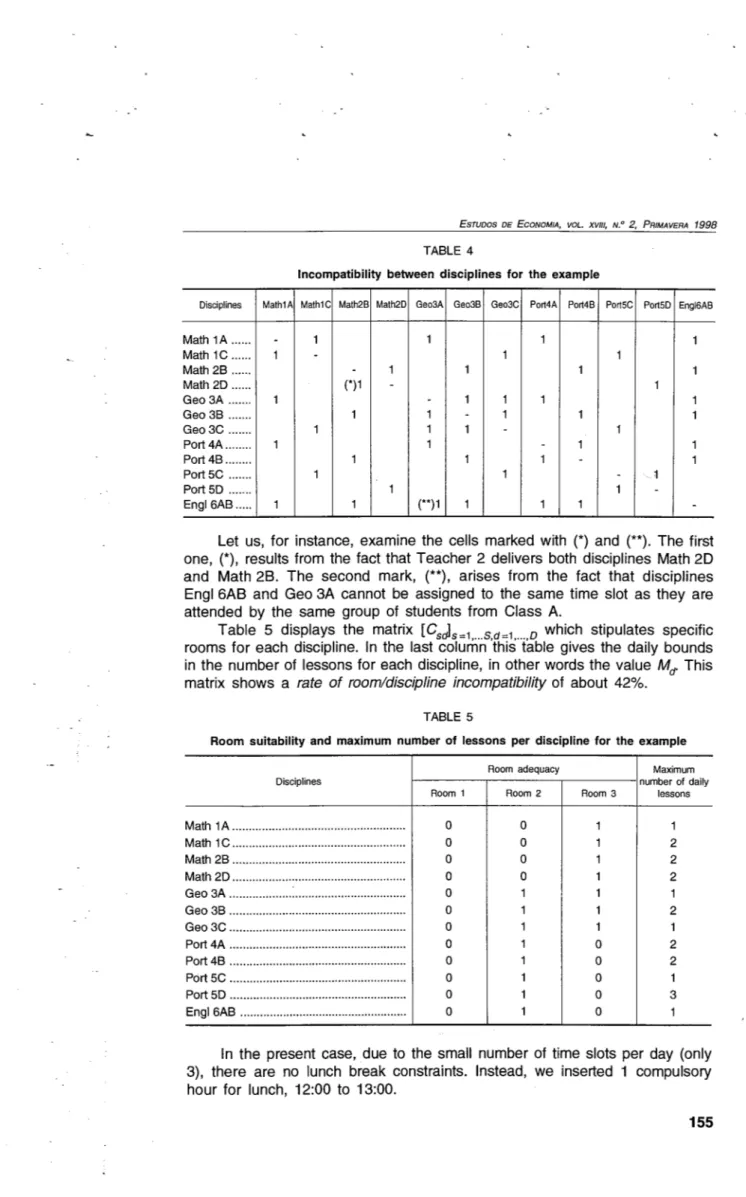
The matrix given in table 4 expresses the clashes between disciplines attended by the same group of students and among disciplines of the same teacher. That is, if discipline d and discipline d' belong to the same teacher, then ldd' = 1, and also" ldd' = 1 if disciplines d and d' share the same group of
ESTUDOS DE ECDNOM/A, VOL. XVIII, N.0 2, PRIMAVERA 1998
TABLE 4
Incompatibility between disciplines for the example
Disciplines Math1A Math1C Math2B Math2D Geo3A Geo3B Geo3C Port4A Port4B PortSC PortSD Engi6AB
Math 1A ...
-
1 1 1 1 Math 1C ... 1-
1 1 Math 2B ...-
1 1 1 1 Math 2D ... (*)1 - 1 Geo3A ... 1-
1 1 1 1 Geo 3B ... 1 1-
1 1 1 Geo 3C ... 1 1 1 - 1 Port 4A ... 1 1 - 1 1 Port 4B ... 1 1 1 - 1 Port 5C ... 1 1 - 1 Port 5D ... 1 1 -Engi6AB ... 1 1 (**)1 1 1 1-Let us, for instance, examine the cells marked with (*) and (**). The first one, (*), results from the fact that Teacher 2 delivers both disciplines Math 20 and Math 28. The second mark, (**), arises from the fact that disciplines Engl 6AB and Geo 3A cannot be assigned to the same time slot as they are attended by the same group of students from Class A.
Table 5 displays the matrix [C
5
~5
=1 Sd=1 0 which stipulates specific rooms for each discipline. In the last colurii'n 'this .. table gives the daily bounds in the number of lessons for each discipline, in other words the value Mer This matrix shows a rate of room/discipline incompatibility of about 42%.TABLE 5
Room suitability and maximum number of lessons per discipline for the example
Room adequacy Maximum
Disciplines number of daily
Room 1 Room 2 Room 3 lessons
Math 1A... 0 0 1 1 Math 1C... 0 0 1 2 Math 2B ... 0 0 1 2 Math 20... 0 0 1 2 Geo 3A ... :... 0 1 Geo 3B ...
o
2 Geo 3C ... 0 1 Port 4A ... 0 0 2 Port 4B ... 0 0 2 Port 5C ... 0 0 1 Port5D ... 0 0 3 Engi6AB ... 0 0 1In the present case, due to the small number of time slots per day (only 3), there are no lunch break constraints. Instead, we inserted 1 compulsory hour for lunch, 12:00 to 13:00.
ESTUDOS DE EcoNOMIA, VOL. XVIII, N.0 2, PRIMAVERA 1998
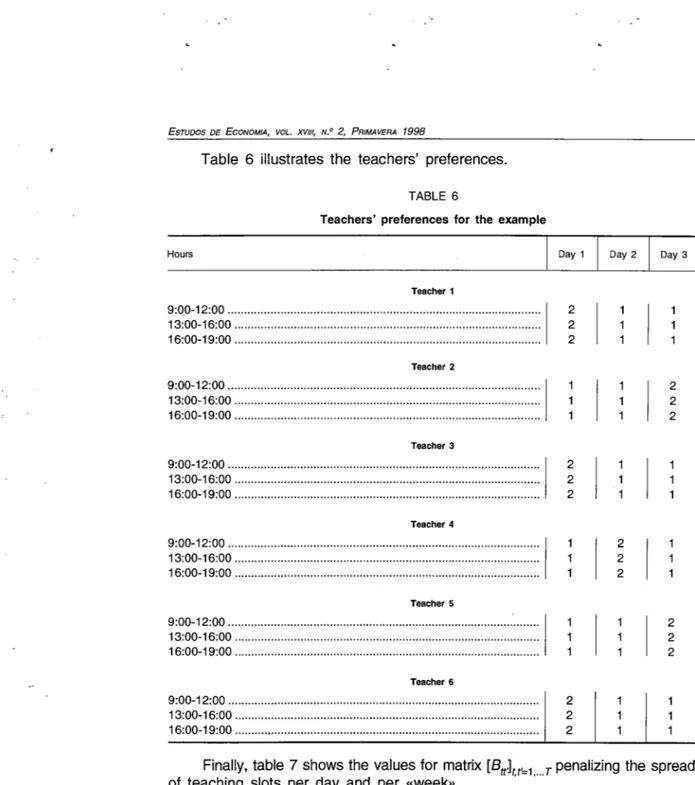
Table 6 illustrates the teachers' preferences.
TABLE 6
Teachers' preferences for the example
Hours Day 1 Day 2 Day 3
Teacher 1
!~~~~!~~L:::::::::::::::::::::::::::::::::::::::::::::::::::::::::::::::::::::::::::::::::::::::::::
I
Teacher 2!~~~~~!:~~~·:::::::::::::::::::::::::::::::::::::::::::::::::::::::::::::::::::::::::::::::::::::::::::::
I
Teacher 3!~~~~~!:~~L:::::::::::::::::::::::::::::::::::::::::::::::::::::::::::::::::::::::::::::::::::::::::::
I
Teacher 4!~~~~!:~~~·:::::::::::::::::::::::::::::::::::::::::::::::::::::::::::::::::::::::::::::::::::::::::::::1
Teacher 5!~~~~!:~~f::::::::::::::::::::::::::::::::::::::::::::::::::::::::::::::::::::::::::::::::::::::::::::
I
9:00-12:00 Teacher 6~ ~:~~~ ~ ~:~L:
::::::::::::::::::::::::::::::::::::::::::::::::::::::::::::::::::::::::::::::::::::::::::
Finally, table 7 shows the values for matrix [Btt'ltr=1, ... r penalizing the spread of teaching slots per day and per «week».
TABLE 7
Penalization of free periods for the example
T. slots 1 2 3 4 5 6 7 8 9 1 ... 0 0 1 2 2 2 3 3 3 2 ··· 0 0 0 2 2 2 3 3 3 3 ... 1 0 0 4 2 2 3 3 3 4 ... 2 2 2 0 0 1 2 2 2 5 ... 2 2 2 0 0 0 2 2 2 6 ... 2 2 2 1 0 0 2 2 2
Esruoos DE EcoNOMIA, VOL. XVIII, N.0 2, PRIMAVERA 1998
T. slots 1 2 3 4 5 6 7 8 9
7 ··· 3 3 3 2 2 2 0 0 1
8 ··· 3 3 3 2 2 2 0 0 0
9 ··· 3 3 3 2 2 2 1 0 0
Though corresponding to an unrealistic small school, this model requires 324 binary variables and more than one hundred constraints.
For illustrative purposes, let us now present a feasible solution for this STP instance obtained through a heuristic procedure found in Carrasco (1996). The variables with non-zero values are as follows:
x1s2=x1ss=X1s4=x17s=x14s=X1s7=X1sa=X159=1 {lessons in Room 1 ); x241=x242=X214=X2ss=X22s=X21?=X228=X229=1 {lessons in Room 2);
x391=xs,1o.2=xs,11,3=x3,11.4=Xs 11 s=x312 a=Xs1o 7=X388=X399=1 {lessons in
Room 3). ' · · ' ' ·
If we convert their values into scheduling form, timetables are created both for teachers and for students, as illustrated in table 8. Here, as there are no different optional subjects within each class, the timetables for all students of each class are identical.
TABLE 8
Timetables for teachers in the example
Hours Day 1 Day 2
Teacher 1 9:00-12:00 ... 1 13:00-16:00 ··· 16:00-19:00 ... ··· ..
I
Math A ~Room 2 Math C - Room 2 Teacher 29:~0-12:~0 ...
···1
Math D - Room 2I
Math B - Room 1 13.00-16.00 ... Math D - Room 2 Math B - Room 2 16:00-19:00 ... - Math D - Room 1 Teacher 3 9:00-12:00 ... 1 . . . I 13:00-16:00 ... ··· ****** 16:00-19:00 ... .. ... ***Geo A - Room 1 *** Teacher 4 9:~0-12:~0 ... , Port B - Room 3 13.00-16.00... PortA- Room 1 16:00-19:00 ··· 9:00-12:00 ... 1 13:00-16:00 ··· 16:00-19:00 ... . Teacher 5 Port C - Room 3 Port D - Room 3 Geo C- Room 1 Port D - Room 3 Port D - Room 3 Day 3 Math A - Room 2 Math C - Room 2 Math C - Room 2 Geo B-Room 1 Geo B-Room 1 Geo A- Room 1 Port A -Room 3 Port B - Room 3I
***Port C - Room 3*** ****** ******EsTUDOS DE EcoNOMIA, VOL. XVIII, N.0 2, PRIMAVERA 1998 TABLE 8
Timetables for teachers in the example
Hours Day 1 Day 2
Teacher 6
9:00-12:00 ... ··· ··· 13:00-16:00 ···
16:00-19:00 ... ··· Engl A+B - Room 3
TABLE 9
Timetables for students (classes) in the example
Hours 9:00-12:00 ... , 13:00-16:00 ··· 16:00-19:00 ... . 9:00-12:00 ... , 13:00-16:00 ... ··· 16:00-19:00 ... ··· .. 9:00-12:00 ... 1 13:00-16:00 ··· 16:00-19:00 ··· ... ··· 9:00-12:00 ··· 13:00-16:00 ... . 16:00-19:00 ··· ... . Day 1 Class A Port- Room 1 Geo- Room 1 Class B Port- Room 3 Class C Port- Room 3 Class D Math- Room 2 Math- Room 2 Port- Room 3 Day 2 Math - Room 2 Engl - Room 3 Math- Room 1 Math- Room 2 Engl - Room 3 Geo- Room 1 Math- Room 2 Port- Room 3 Port- Room 3 Math- Room 1 Day 3 Day 3 Math - Room 2 Port- Room 3 Geo- Room 1 Geo- Room 1 Geo- Room 1 Port- Room 3 Port- Room 3 Math- Room 2 Math- Room 2
It should be noted that the above schedules are of reasonable quality. There are no more than two gaps in the timetable of Class A and Teacher 1. As for teachers' preferences for free specific slot times, the above timetables respect all but two cases (see timetables tor Teacher 3 and Teacher 5).
6 - Closing comments
The problem of creating timetables at a secondary school addressed in this paper was formulated as a binary nonlinear problem. The reason tor choos-ing a binary nonlinear model was largely due to the fact that our problem is
Esruoos DE EcoNOMIA, VOL. xvm, N.0 2, PRIMAVERA 1998
not suited to decomposition into small problems. If such were the case, we could apply other alternative optimization models, such as the more attractive network based models.
The STP is a difficult problem and may easily reach considerable dimen-sions. Even if we study the timetabling problem of a school broken down into cycles (grades 7-9, 10-11 and 12) and shifts (morning, afternoon and evening) the number of variables may total about 200 thousands in a medium-sized school with 1 00 teachers, 40 rooms and 2500 students.
In view of these caracteristics, our problem is not suited to classic exact solving methods directly based on this huge formulation, but rather to lighter methodologies like local search modern strategies embedding tabu constraints, genetic evolution and annealing schemes [Reeves (1993)].
However, Carrasco (1996) decided to heuristically tackle the timetable is-sue by using this precise formulation through a Hopfield neural network. In fact, the highly constrained assignment formalization for the STP seemed appropri-ate to neural network based heuristic techniques. This methodology, together with its application to pseudo-real situations, is presented in a companion paper [Carrasco and Pato (1997)]. The results obtained so far have encouraged us to tackle a real life problem, by refining the neural network based algorithm.
7 - References
(1] D. Abramson (1991 ), «Constructing School Timetables Using Simulated An-nealing: Sequential and Parallel Algorithms», Management Science, vol. 37, pp. 83-113.
(2] D. Abramson and Abela (1991 ), «A Parallel Genetic Algorithm for Solving the School Timetabling Problem», Technical Report, Division of I.T., C.S.I.R.O., Royal Melbourne Institute of Technology, Melbourne.
[3] R. Alvarez-Valdes, G. Martin and J. M. Tamarit (1995), «Constructing Good Solutions for a School Timetabling Problem», Technical Report, Department of Statistics and Operations Research, University of Valencia.
(4] M. P. Carrasco (1996), Aedes Neuronais na «Eiaboragao de Horarios Escolares, Master Thesis», Institute Superior de Economia e Gestae, UTL, Lisboa, submitted for publication.
(5] M. P. Carrasco and M. V. Pato (1997), «Urn Modele Neuronal para a Elaboragao de Horarios Escolares», aceite para publicagao em lnvestiga9ao
Operacional.
(6] M. W. Carter (1995), «Timetabling Literature», available from ftp.cs.nott.ac.uk in directory ttp.
(7] M. W. Carter, G. Laporte and J. W. Chinneck (1994), «A General Exami-nation Scheduling System», Interfaces, vol. 24, pp. 52-58.
(8] A. Colorni, M. Dorigo and V. Maniezzo (1990), «Genetic Algorithms and Highly Constrained Problems: The Timetable Case>>, Proceedings of the First
In-ternational Conference on Parallel Problem Solving from Nature, pp. 55-59.
(9] T. B. Cooper and J. H. Kingston (1995), «The Complexity of Timetable Con-struction Problems>>, Technical Report, Basser Department of Computer Science, The University of Sydney, Sydney.
ESTUDDS DE EcONOMIA, VOL. XVIII, N.0 2,
PRIMAVERA 1998
[1 0] D. Costa (1994), «A Tabu Search Algorithm for Computing an Operational
Timetable», European Journal of Operational Research, val. 76, pp.
98--110.
[11] K. A. Downsland (1990), «A Timetabling Problem in which Clashes are Inevitable», Journal of the Operational Research Society, val. 41, pp.
907--918.
[12] R. W. Eglise and G. K. Rand (1987), «Conference Seminar Timetabling»,
Journal of the Operational Research Society, val. 38, pp. 591-598.
[13] S. Even and A. Shamir (1976), «On the Complexity of Timetable and Multicommodity Flow Problems», SIAM Journal of Computing, val. 5,
pp. 691-703.
[14] J. A. Ferland and S. Roy (1985), « Timetabling Problem for University as Assignment of Activities to Resources», Computers and Operations Re-search, val. 12, pp. 207-218.
[15] L. Gislen, C. Peterson and B. Soderberg (1989), «'Teachers and Classes' with Neural Networks>>, International Journal of Neural Systems, val. 1, pp. 167-176.
[16] L. Gislen, C. Peterson and B. Soderberg (1992), <<Complex Scheduling with Potts Neural Networks>>, Neural Computation, val. 4, pp. 805-831.
[17] A. Hertz (1991), «Tabu Search for Timetabling Problems>>, European Jour-nal of OperatioJour-nal Research, val. 54, pp. 39-47.
[18] D. Jonhson (1990), «Timetabling University Examinations>>, Journal of the Operational Research Society, val. 41, pp. 39-47.
[19] G. Laporte and S. Desroches (1984), «Examination Timetabling by
Com-puter>>, Computers and Operations Research, val. 11, pp. 351-360.
[20] C. R. Reeves (1993), Modern Heuristic Techniques for Combinatorial Prob-lems, editor, Backwell Scientific Publications, Oxford, England.
[21] D. de Werra (1985), «An Introduction to Timetabling>>, European Journal of Operational Research, val. 19, pp. 151-162.
[22] M. Write (1996), «School Timetabling Using Heuristic Search>>, Journal of the Operational Research Society, val. 47, pp. 347-357.