425
Abstract
The study aimed to characterize the mineral wools obtained from wastes of the cutting step of marble and granite, in order to evaluate the possibility of their use on an industrial scale. Mixtures of marble and/or granite wastes were prepared in order to reach the chemical composition of rock and glass wools. The batches were melted in an electric arc furnace in laboratory scale at 1450°C and casted with water, in order to obtain a higher cooling rate. Characterization work was performed in batches that formed vitreous material, and with superior incorporation of the residues: 11.7% and 14.6% of marble waste with glass wool and rock wool, respectively; 78.3% and 91.6% of an association of marble and granite wastes with glass wool and rock wool, respec-tively. Computational thermodynamics was used in order to obtain the main phases at 800°C and determine the liquid and solid content at 1400, 1450 and 1500°C. In addition, the materials obtained were characterized via chemical analysis using X-ray fluorescence, DTA, X-ray diffraction and SEM. The results indicate that the marble and granite waste are composed mainly of CaO (34.7 wt.%) and SiO2 (66.3 wt.%), re-spectively. An amorphous crystalline structure was obtained in all tests, indicating that this material can be used as an insulation material. The crystallization temperatures were determined around 800°C.
Keywords: marble, granite, recycling, mineral wool, glass characterization.
Joner Oliveira Alves
Doutor, Diretor do Instituto SENAI de Inovação em Tecnologias Minerais
Belém – Pará – Brasil [email protected]
Eduardo Junca
Doutor, Professor
Universidade do Extremo Sul-Catarinense – UNESC Criciúma - Santa Catarina – Brasil
Felipe Fardin Grillo
Doutor, Professor
Instituto Federal de Educação, Ciência e Tecnologia do Espírito Santo - IFES Vitória – Espírito Santo – Brasil [email protected]
Girley Ferreira Rodrigues
Doutor, Pesquisador
Universidade de São Paulo – São Paulo – Brasil [email protected]
Denise Crocce Romano Espinosa
Doutor, Professora-Associada Universidade de São Paulo - USP Escola Politécnica
Departamento de Engenharia Química São Paulo – São Paulo - Brasil [email protected]
Jorge Alberto Soares Tenório
Doutor, Professor-Titular Universidade de São Paulo - USP Escola Politécnica
Departamento de Engenharia Química São Paulo – São Paulo - Brasil [email protected]
Characterization of
mineral wools obtained
from ornamental rock wastes
http://dx.doi.org/10.1590/0370-44672017710075
Metallurgy and materials
Metalurgia e materiais
1. Introduction
The Brazilian production of orna-mental rock was 9.5 Millions of tons in 2015, in which 52.58% was finished prod-uct, i.e. polished plates or other finishing. During the step of the block´s sawing to obtain the plates, it is estimated that there is a loss in the range of 20-30% of the blocks.
This suggests a waste production in the range of 1.0-1.5 millions of tons per year (Mashaly et al., 2016). In most cases, this
waste is deposited in a tailings dam close to the companies, which causes serious en-vironmental problems (Junca et al., 2015).
The waste generated by the
orna-mental rock sector is mainly composed of oxides, where the marble waste is com-posed mainly of CaO and MgO, and the granite waste is composed mainly of SiO2 and Al2O3.
In addition, these materials also contain calcium, magnesium and iron oxides. These materials are sometime known as alkaline earth silicate glass, and due to the high concentration of alumina, they are also called aluminosilicate glasses (Müller
et al., 2009). Due to its physical properties,
such as thermal and acoustic insulation, fire protection, chemically neutral and water resistant, it is an important input in the construction and automotive sector (Väntsi and Kärki, 2014).
In this way, the marble and granite waste can be used as a source of CaO and SiO2, respectively. Thus, the aim of this article is to study the use of marble and granite waste as raw material to produce rock and glass wools.
2. Experimental
2.1. Raw material
Ornamental rock wastes (marble and granite waste) from the cutting stage were obtained from a company in the Espírito Santo State, Brazil. Pure chemical reagents were also used, such as silicon oxide (SiO2), aluminum oxide (Al2O3), magnesium oxide (MgO), iron oxide (Fe2O3) and Borax (16.25% Na2O, 36.51% B2O3 and 47.24% H2O).
The marble and granite wastes were dried in a muffle furnace at 90°C for 24 hours. Then, two aliquots were obtained to perform the chemical and morphologi-cal (Scanning electrons microscopy-SEM) characterization. This step was necessary
to determine the chemical balance of the batches to produce the glass and rock wools.
The objective of the full project was to maximize the amount of residues in the batches, however some tests presented melt-ing points above the furnace capacity or insufficient fluidity to allow pouring, thus these materials were discarded from the investigation. In this aspect, the character-ization work was performed in the materials from batches with efficient and superior incorporation of the residues. The mixing compositions by mass of such batches were:
- M-GW: 11.7% of marble waste on the raw material of glass wool;
- M-RW: 14.6% of marble waste on the raw material of rock wool;
- MG-GW: 78.3% of an association of marble and granite wastes on the raw material of glass wool;
- MG-RW: 91.6% of an association of marble and granite wastes on the raw material of rock wool.
Table 1 shows the chemical composi-tion of the furnace loads obtained from the mixtures of marble and/or granite wastes, in association with chemical ad-ditives. This composition was also used to perform the thermodynamic simulation via FACTSAGE software.
Element M-GW M-RW MG-GW MG-RW SiO2 76.3 46.1 63.6 52.5 CaO 4.4 15.9 4.0 13.4 MgO 6.2 8.0 8.4 6.5 Al2O3 5.1 13.2 17.5 15.1 Fe2O3 0.9 1.62 6.5 10.3 Na2O 2.2 5.0 - 1.0
K2O - 0.4 - 0.4 TiO2 - 0.2 - 0.2 B2O3 5.0 9.5 0.3 0.6
Table 1
Chemical composition of the
batches that were characterized (in wt. %).
2.2 Melting tests
The batches were heated in a lab-oratory-scale electric furnace with no controlled gas atmosphere during 50
min. Melted samples were quenched in a water bath at room temperature in order to rapidly cool the materials. Resulting
products were dried in a muffle furnace at 90°C for 24 hours before performing the characterization.
2.3 Product characterization
The cooled materials were charac-terized by chemical analysis using X-ray fluorescence technique, Differential Thermal Analysis (DTA), X-ray diffrac-tion and Scanning electrons microscopy (SEM). The DTA was performed in a Netzsch 409C equipment with alu-mina crucibles, air atmosphere, andheating rate of 15 °C/min in the range of 25-1480 °C. X-ray diffraction was accomplished in a Philips equipment, model MPD 1880, with copper radia-tion of Kα (λ=1.5418 Å), 40 kV tension and 40 mA, scan range of 10-70º with step width of 2º, during 1 s. A Philips XL-30 SEM was used to investigate
the product’s morphology. In addition, computational thermodynamic was used in order to obtain the phases at 800°C. In this way, the phases present in the glass temperature can be deter-mined. The simulation was performed via software FactSage 7.0, database FToxid and sub-database Slag A.
3. Results and discussion
3.1 Raw material characterization
Table 2 shows the chemical composition from marble and granite wastes. The marble waste is composed mainly of CaO (34.7%) and MgO(18.6%). A loss on ignition (LOI) of 40.2% was recorded, mainly due to calcium and magnesium carbonates of the marble waste. The granite
427
Compound, % CaO MgO SiO2 Al2O3 Fe2O3 Na2O B2O3 K2O Other LOI* Marble waste 34.7 18.6 2.1 0.2 0.1 0.3 --- --- 3.8 40.2 Granite waste 4.5 1.6 66.3 19.3 2.3 1.3 0.8 0.6 0.6 2.7
* Loss on ignition (1050°C).
Table 2 Chemical composition of marble and granite waste.
3.2 Characterization of glass and rock wools
Table 3 shows the chemicalcomposi-tion of the glass and rock wools produced. It was noted that SiOcomponents present in the wools, which it 2 and CaO are the main is also mentioned by several authors (Mara-bini et al, 1998; Gualtieri et al., 2009).
SiO2 CaO MgO Al2O3 MnO Fe2O3 Na2O K2O TiO2 B2O3 M-GW 67.0 6.8 2.2 4.1 --- 0.5 12.3 1.1 0.001 5.0 M-RW 53.0 17.2 13.1 7.3 0.2 7.0 1.6 0.6 0.001 ---MG-GW 67.4 6.0 5.2 2.0 --- 0.6 12.7 1.9 0.001 4.2 MG-RW 52.0 15.0 10.0 11.6 0.1 6.2 3.2 1.7 0.001
---Table 3 Chemical composition of glass and rock wools produced with marble and granite waste (in wt. %).
Glass viscosity is directly affected by the function of oxides present in the chemical composition (glass former, glass modifier, or intermediary). Alu-mina does not form glass under normal conditions, however when added to an alkali-silicate glass, it may assume a tet-rahedral coordination similar to silica, i.e. becomes a glass former (Alves et al.,
2015; Bansal e Doremus, 1986). Con-sidering the alumina as a glass former (i.e. associating with SiO2, B2O3, P2O5), the material produced contains around 60-76% of glass forming elements.
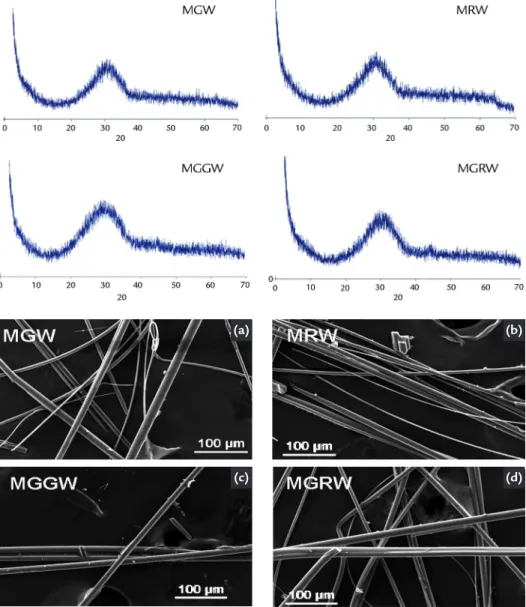
The X-ray patterns (Figure 1) in-dicate that the glass and rock wools presented an amorphous structure in all mixtures, without crystalline peaks.
Several authors have mentioned that glass and rock wools are inorganic and vitre-ous materials that present an amorphvitre-ous structure (Luoto, et al., 1998; Alves et al., 2015). Therefore, the glass and rock
wools produced with marble and granite wastes presented the same structural characteristic from the conventional glass and rock wools.
Figure 1 X-ray patterns of the minerals rock wools produced with marble and granite waste.
Figure 2 Images of scanning electron microscopy obtained via back-scattered electrons detector from glass and rock wools: (a) M-GW, (b) M-RW, (c) MG-GW and (d) MG-RW.
(a) (b)
Images of secondary electrons obtained via SEM (Figure 2) show the morphological aspect of the glass and rock wools. It was noted that all fibers presented a diameter around 10 μm, which is mentioned as the conventional diameter for mineral wools (Talbot et al., 2000). In addition, the images also suggest a formation of homogeneous structures.
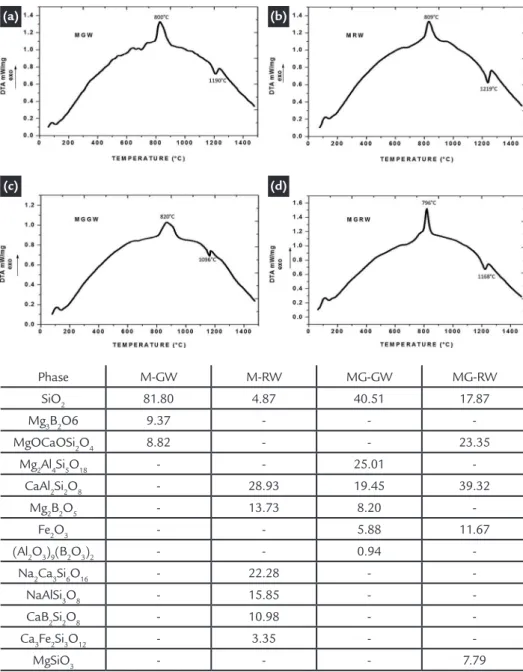
Figure 3 shows the DTA curves obtained from the produced materials. The crystallization temperature can be noted by the exothermic peaks at 800,
809, 820 and 796°C to the mixtures M-GW, M-RW, MG-GW and MG-RW, respectively. Table 4 shows a stipulation of phases present at 800°C, obtained via FACTSAGE software, which were performed in order to obtain information close to the crystallization temperature.
The main phases present in the mixtures at 800°C were silicates, a similar result was also found by Hunger
et al. (2010). Quartz was identified as the
main phase in the mixtures to produce glass wool (M-GW 81.8% and MG-GW
40.51%), and the anorthite was detected as a main component in the mixtures to produce rock wools (M-RW 28.93% and MG-RW 39.32%). Furthermore, the mix-tures M-RW, MG-GW and MG-RW con-tain higher content of Al2O3, propitiating the formation of Mg2Al4Si5O18 and CaAl-2Si2O8. In addition, the mixtures M-GW and MG-RW presents the diopside phase (MgOCaOSi2O4), which is one of the expected phases of traditional batches to produce mineral wools at 800°C (Siligardi
et al., 2017).
Figure 3
Differential thermal analysis from mineral wool produced with marble and granite waste: a) M-GW, b) M-RW, c) MG-GW and d) MG-RW.
(a) (b)
(c) (d)
Phase M-GW M-RW MG-GW MG-RW SiO2 81.80 4.87 40.51 17.87 Mg3B2O6 9.37 - - -MgOCaOSi2O4 8.82 - - 23.35
Mg2Al4Si5O18 - - 25.01 -CaAl2Si2O8 - 28.93 19.45 39.32
Mg2B2O5 - 13.73 8.20 -Fe2O3 - - 5.88 11.67 (Al2O3)9(B2O3)2 - - 0.94
-Na2Ca3Si6O16 - 22.28 - -NaAlSi3O8 - 15.85 - -CaB2Si2O8 - 10.98 - -Ca3Fe2Si3O12 - 3.35 - -MgSiO3 - - - 7.79
Table 4
Stipulation of phases
present in the mixtures at 800°C
obtained via Factsage (in % of solid phases).
Mineral wools typically present devitrification temperatures of about 725-900°C, then form a polycrystal-line material that is thermally and essentially dimensionally stable. Such proprieties are enough to contain a structural fire for several hours (Alves
et al., 2015). The produced materials
devitrified at temperatures of
796-820 °C, therefore these are within the recommended devitrification tempera-ture range.
The materials produced registered endothermic peaks of 1096°C (MG-GW), 1168°C (MG-RW), 1190°C (M-GW) and 1219°C (M-RW), which measurements may be associated with the melting temperature. Gualtieri
et al. (2009) investigated the melting
429
4. Conclusion
Vitreous materials were formed using residues from the ornamental rock cutting step in the proportion of: 11.7% and 14.6% of marble waste with glass wool and rock wool, respectively; 78.3% and 91.6% of an association of marble and granite wastes with glass wool and rock wool, respectively. The material produced presented chemical compositions of around 60-76% of glass forming elements, including alumina.
Produced materials assumed the fiber form with diameters around 10 μm, which is according to the conventional mineral wools. The characterization pro-cess for the materials produced showed that an amorphous crystalline structure was obtained in all tests, and the crystal-lization temperatures were determined around 800 °C, which may indicate the possibility of use as a thermal insulator. Computational thermodynamic
simula-tion showed that the main phases at 800 °C were silicates, in which quartz and anorthite were the major elements in the mixtures to produce glass and rock wools, respectively. The production of mineral wools may be an opportunity for large scale recovery of residues from granite/marble cutting, mainly due to the process capacity to absorb discrep-ancies in the chemical composition of the charges.
References
Acknowledgements
ALVES, J. O., ESPINOSA, D. C. R., TENORIO, J. A. S. Recovery of steelmaking slag and granite waste in the production of rock wool. Materials Research, v. 18, n. 1, p. 204-211, 2015.
BANSAL, N. P., DOREMUS, R. H. Handbook of glass properties. London: Academic Press Inc., 1986.
GUALTIERI, A. F., FORESTI, E., LESCIB, I. G., ROVERI, N., DONDIC, L., GUAL-TIERI, Z. M. The thermal transformation of Man Made Vitreous Fibers (MMVF) and saferecycling as Secondary Raw Materials (SRM). Journal of Hazardous Materials, v. 162, p, 1494-1506, 2009.
HUNGER, A., CARL, G., RÜSSEL, C. Formation of nano-crystalline quartz crys-tals from ZnO/MgO/Al2O3/TiO2/ZrO2/ SiO2 glasses. Solid State Sciences, v. 12, p. 1570-1574, 2010.
JUNCA, E., OLIVEIRA, J. R., ESPINOSA, D. C. R., TENORIO, J. A. S. Iron reco-very from the waste generated during the cutting of granite. International Journal of Environmental Science and Technology, v. 12, p. 465–472, 2015.
LUOTO, K., HOLOPAINEN, M., KANGAS, J., KALLIOKOSKI, P., SAVOLAI-NEN, K. Dissolution of short and long rockwool and glasswool fibers by ma-crophages in flowthrough cell culture1. Environmental Research, Section A, v. 78, p. 25-37, 1998.
MARABINI, A. M., PLESCIA, P., MACCARI, D., BURRAGATO, F., PELI-NO, M. New materials from industrial and mining wastes: glass-ceramics and glass- and rock-woll fibre. International Journal of Mineral Processing, v. 53, p. 121–134, 1998.
MASHALY, A. O., EL-KALIOUBY, B. A., SHALABY, B. N., EL - GOHARY, A. M., RASHWAN. M. A. Effects of marble sludge incorporation on the properties of cement composites and concrete paving blocks. Journal of Cleaner Production, v. 112, p. 731-741, 2016.
MÜLLER, A., LEYDOLPH, B., STANELLE, K. Recycling mineral wool waste – technologies for the conversion of the fiber structure, Part 1. Interceram, v. 58, p. 378–81, 2009.
SILIGARDI, C., MISELLI, P., FRANCIA, E., GUALTIERI, M. L. Temperature-in-duced microstructural changes of fiber-reinforced silica aerogel (FRAB) and rock wool thermal insulation materials: A comparative study. Energy and Buildings, v. 138, p. 80–87, 2017.
TALBOT, H., LEE, T., JEULIN, D., HANTON, D., HOBBS, L. W. Image analysis of insulation mineral fibers. Journal of Microscopy, v. 200, p. 251–68, 2000.
VÄNTSI, O., KÄRKI, T. Utilization of recycled mineral wool as filler in wood–polypro-pylene composites. Construction and Building Materials, v. 55, p. 220–226, 2014.
Received: 09 October 2017 - Accepted: 6 April 2018.