Metabolic syndrome and psoriasis: a study in
97 patients
Lana Bassi Ferdinando BsC1
Paula Kaori Fukumoto BsC1
Sarah Sanches, MD2
Lincoln Helder Zambaldi Fabricio MD2
Thelma L Skare MD, PhD3
1. Faculdade Evangélica de Medicina do PR (Fepar – Medicine Evangelic College of Paraná) 2. Serviço de Dermatologia do Hospital Universitário Evangélico de Curitiba (Huec – Dermatology Service of the Evangelic University Hospital of Curitiba) 3. Serviço de Reumatologia do Hospital Universitário Evangélico de Curitiba (Huec – Rheumatology Service of the Evangelic University Hospital of Curitiba)
http://dx.doi.org/10.1590/1806-9282.64.04.368
SUMMARY
BACKGROUND: Psoriasis is associated with higher prevalence of metabolic syndrome (MS). The prevalence of MS varies according to the studied population as it suffers influence of genetics, aging, sedentary behaviour and diet.
OBJECTIVE: To study the prevalence of MS in local psoriasis patients and the influence of psoriasis variables on its appearance.
METHODS: A group of 97 psoriasis patients were studied for MS and compared with 97 controls. Psoriasis type, nail involvement, pso-riasis extension measured by PASI (Psopso-riasis Area and Severity Index) were obtained through physical examination and history of previous myocardial infarction, angina and stroke were obtained through chart review.
RESULTS: Comparison of MS prevalence in psoriasis patients (49.4%) with controls (35.0%) showed difference with p=0.04; OR=1.8 (95%CI=1.02-3.23). Patients with psoriasis had higher body mass index (p=0.02), higher systolic blood pressure (p=0.007), lower HDL cholesterol (p=0.01), higher glucose (p=0.04), higher waist circumference (p=0.003) and more angina pectoris (p=0.03;OR=2.5; 95% CI=1.04-6.15) than controls. When psoriasis sample with and without MS were compared, those with MS were older (p=0.0004), had disease onset at older age (p=0.02), more tobacco exposure (p=0.02), and a tendency to have less scalp involvement (p=0.06) in univariate analysis. Logistic regression showed that only age and scalp involvement were independently associated with MS in the psoriasis sample.
CONCLUSION: In our psoriasis sample, MS prevalence is high and the items that deserve more attention are central obesity, low HDL, hypertension and smoking habits. In the psoriasis group, MS was associated independently with older age and less scalp involvement.
KEYWORDS: Psoriasis. Metabolic syndrome X. Metabolic diseases.
INTRODUCTION
Psoriasis is a chronic and complex immune-me-diated skin disorder.1 The systemic nature of the
inflammatory process involved in its etiopathogen-esis is responsible for several co-morbidities, which themselves have a considerable impact on the pa-tient’s quality of life and mortality.1 Myocardial
in-farction and stroke are considered to be increased in
Work carried out in the Dermatology Service of the Evangelic University Hospital of Curitiba, Paraná, Brasil.
DATE OF SUBMISSION: 23-Aug-2017
DATE OF ACCEPTANCE: 09-Sep-2017
CORRESPONDING AUTHOR: Thelma Skare Rua Padre Anchieta, 2770.
CEP 80730-000 - Curitiba -PR, Brasil. E-mail: [email protected]
[email protected] [email protected] [email protected] [email protected] [email protected]
patients with psoriasis when compared with the gen-eral population.2 Hence, the effective treatment of
this disease includes not only care with the skin and nail manifestations but also attention to the associ-ated conditions. A meta-analysis including 12 other studies showed that patients with psoriasis were 2.2 times more likely to have metabolic syndrome (MS) than the general population2 and some authors found
psoriasis and the presence of MS.3 The exact
mech-anism for this interaction remains uncertain but the link between them may be the effects of pro-inflam-matory cytokines and adipocytes on glucose regula-tion, lipid status, and endothelial function.1
MS is a clustering of several medical conditions such as central obesity, arterial hypertension, glu-cose intolerance, high serum triglycerides and low high-density lipoprotein (HDL) levels (4). It has been recognized as a pro-inflammatory, prothrombotic state associated with elevated levels of C-reactive protein (CRP), interleukin (IL)-6, and plasminogen activator inhibitor (PAI)-1.5,6 This syndrome lies in
the background of the association of psoriasis, car-diovascular risk and type 2 diabetes mellitus. The prevalence of MS varies according to the studied population as it suffers influence of genetics, aging, sedentary behaviour and diet. 7,8
In the present study, we aimed at identifying the prevalence of MS in psoriasis patients from a single dermatology centre in Southern Brasil, and its rela-tionship to the clinical profile of the skin disease.
METHODS
The local Committee of Ethics in Research ap-proved this study and all participants signed a con-sent form. It is a cross sectional observational study that includes a convenience sample of 97 individuals formed by all psoriasis patients that came for regular consultations during a twelve-month period and that agreed to participate. All of them were from a sin-gle Dermatology Outpatient Clinic of a Tertiary Care Hospital. Patients under 18 years of age, pregnant women and patients with uncontrolled hypothyroid-ism were excluded. As control, 97 individuals were included, paired according to gender and age that came for an ophthalmologic appointment to test re-fraction and for routine gynaecological exams with-out chronic inflammatory diseases.
Epidemiological information (age, ethnic back-ground, disease duration, tobacco use and age at disease onset), clinical aspects of psoriasis (psori-asis type, nail involvement, treatment), history of diabetes mellitus and high blood pressure treat-ment, previous history of myocardial infarction, angina and stroke were obtained through chart review and upon direct questioning. Data on PASI (Psoriasis Area and Severity Index) (9), arterial blood pressure, body mass index (BMI) and
abdom-inal circumference were obtained through physical examination. Blood was drawn for fasting glucose (by automated enzymatic method), total choles-terol, HDL (high-density lipoprotein) cholescholes-terol, LDL (low-density lipoprotein) cholesterol and tri-glycerides (by enzymatic/colorimetric methods); ESR (erythrocyte sedimentation rate by the West-ergren method), uric acid (by fasting automated enzymatic method) and CRP (C reactive protein by immunoturbidimetry) were determined.
The metabolic syndrome diagnosis was done according to the guidelines developed by the 2001 NCEP ATP III and updated in 2005 in a statement from the American Heart Association (AHA)/Na-tional Heart, Lung, and Blood Institute (NHLBI) (4,10). Current ATP III criteria define metabolic syn-drome as the presence of any three of the following five traits:
• Abdominal obesity, defined as a waist circum-ference in men ≥102 cm and in women ≥88 cm ; • Serum triglycerides ≥150 mg/dL or drug
treat-ment for elevated triglycerides;
• HDL cholesterol <40 mg/dL in men and <50 mg/ dL in women or drug treatment for low HDL cholesterol;
• Blood pressure ≥130/85 mmHg or drug treat-ment for elevated blood pressure;
• Fasting plasma glucose ≥100 mg/dL or drug treatment for elevated blood glucose.
STATISTICAL ANALYSIS
Data was collected in frequency and contingen-cy tables. Data distribution was studied through the Kolmogorov Smirnov test. Central tendency was expressed in mean and standard deviation (SD) for parametrical data and median and interquartile range (IQR) for non-parametric data. Comparison studies were carried out through Fisher and chi-squared test when data were nominal and Mann Whitney and unpaired t test when data were nu-meric. Correlation studies were carried out through the Spearman test.
RESULTS
Pairing data and sample description:
In the 97 psoriasis patients, 48/97 (49.4%) were female with age range between 20 and 80 years old (median=52; IQR=42-59 years); in the 97 individuals from the control group, 49/97 (50.5%) were female (p=0.94); with age range between 20 and 81 years old (median=52; IQR=31.5-60; p=0.44).
In the psoriasis group, the age of disease onset varied from 6-72 years old (mean 30.9±16.2 years) and the disease duration was of 1-43 years (medi-an 13.0; IQR=8-21.5 years). Tobacco exposure was found in 61.8% of them. Tobacco use was more com-mon in psoriasis patients (28.8% smokers and 32.2% former smokers) than controls (6.2% smokers and 23.7% former smokers) with p<0.0001.
In 81/97 (83.5%) the psoriasis was in plaques; in 10/97 (10.3%) it was gutatta; in 5/97 (5.1) it was pus-tular, in 4/97(4.1%) involved genital area; in 33/97 (34.0%) involved scalp; in 10/97 (10.3%) had artic-ular involvement. Nail involvement was found in 27/97 (27.8%) ranging from 1 to 20 fingers (median 5.0; IQR=2-12). PASI varied from 0 to 49.8 (medi-an=3.4; IQR=1.6-10.0). This sample was treated with cyclosporine in 3.0%; acitretin in 7.2%; meth-otrexate in 28.8%; ustekinumab in 7.2% and anti TNF-α drugs in 17.5%. About 34.0% used just topi-cal treatment.
Comparison of psoriasis patients and controls according to metabolic profile:
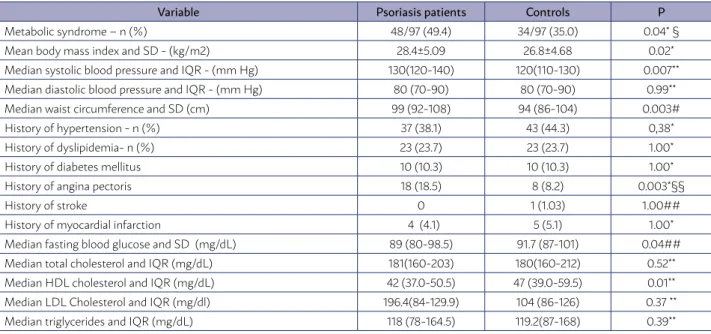
The MS prevalence, its components as well as its cardiovascular repercussions in the psoriasis group compared with controls are shown in Table 1. In this table, it is possible to see that psoriasis patients had higher rate of MS, higher BMI and waist circum-ference, higher systolic blood pressure and glucose level, lower HDL cholesterol and higher number of individuals with angina pectoris.
Comparison between psoriasis patients with and without MS:
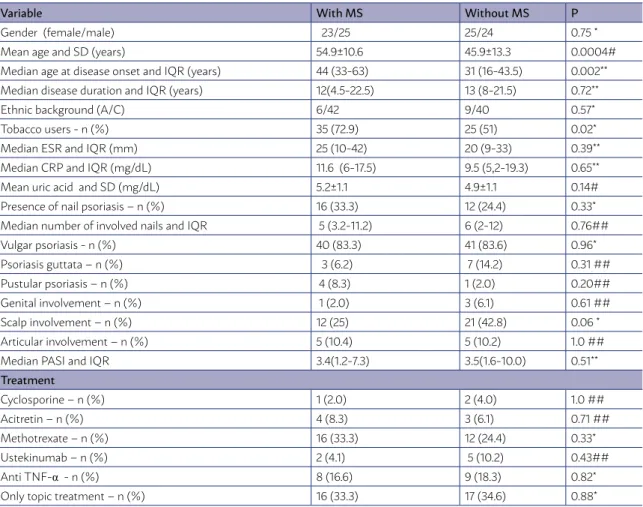
When psoriasis patients with and without MS were compared, we noticed that those with MS were older, had higher exposure to tobacco, disease onset at older age and tendency towards less involvement of scalp as shown in Table 2.
When psoriasis variables associated with MS with p <0.1 were studied through logistic regres-sion, age (OR=1.08; 95% CI=1.06-1.16) and scalp in-volvement (OR=0.23; 95%CI=0.06-0.87) were inde-pendently related to MS.
DISCUSSION
The results of the present study have shown that psoriasis patients from our region have 1.8 times
TABLE 1 - COMPARISON OF METABOLIC SYNDROME, ITS COMPONENTS AND ITS CONSEQUENCES BETWEEN PSORIASIS PATIENTS (N=97) AND CONTROLS (N=97).
Variable Psoriasis patients Controls P
Metabolic syndrome – n (%) 48/97 (49.4) 34/97 (35.0) 0.04* §
Mean body mass index and SD - (kg/m2) 28.4±5.09 26.8±4.68 0.02*
Median systolic blood pressure and IQR - (mm Hg) 130(120-140) 120(110-130) 0.007**
Median diastolic blood pressure and IQR - (mm Hg) 80 (70-90) 80 (70-90) 0.99**
Median waist circumference and SD (cm) 99 (92-108) 94 (86-104) 0.003#
History of hypertension - n (%) 37 (38.1) 43 (44.3) 0,38*
History of dyslipidemia- n (%) 23 (23.7) 23 (23.7) 1.00*
History of diabetes mellitus 10 (10.3) 10 (10.3) 1.00*
History of angina pectoris 18 (18.5) 8 (8.2) 0.003*§§
History of stroke 0 1 (1.03) 1.00##
History of myocardial infarction 4 (4.1) 5 (5.1) 1.00*
Median fasting blood glucose and SD (mg/dL) 89 (80-98.5) 91.7 (87-101) 0.04##
Median total cholesterol and IQR (mg/dL) 181(160-203) 180(160-212) 0.52**
Median HDL cholesterol and IQR (mg/dL) 42 (37.0-50.5) 47 (39.0-59.5) 0.01**
Median LDL Cholesterol and IQR (mg/dl) 196.4(84-129.9) 104 (86-126) 0.37 **
Median triglycerides and IQR (mg/dL) 118 (78-164.5) 119.2(87-168) 0.39**
more chances of having MS than controls, a result similar to the findings of a meta-analysis done by Armstrong et al2 that included 41,853 patients. When
comparing psoriatic patients with controls, the MS components that predisposed to this finding were body weight, waist circumference and high systolic blood pressure. Low HDL cholesterol and higher glu-cose levels were also a finding. Studies of the rela-tionship between the individual components of MS with psoriasis are contradictory. Madanagobalane and Anandan3 reported a higher prevalence of
obesi-ty in psoriasis patients than in controls as we did, but Nisa and Qazi11, contrasting with our findings, did not
observe a difference in the occurrence of central obe-sity. Finding a higher prevalence of central obesity is important in this context because it has become clear that the distribution and function of adipose tissue, rather than the amount of fat per se, exerts an im-portant impact in MS.12 A strong genetic component
influencing fat distribution has been described and
may be responsible for the contradictory findings in populations with different ethnic backgrounds. 13
Hypertension is another component of MS. While some studies have shown an association between hy-pertension and psoriasis, others have not3,14-18. In our
study, the number of patients with hypertension was the same in controls and psoriasis but systolic blood pressure was higher in the psoriatic group.
Low HDL serum levels contribute to cardiovascu-lar risk in this context as this particle has multiple anti-atherogenic properties.15,19 Low serum HDL level
may result in decreased activity of lipoprotein lipase, secondary to insulin resistance20. HDL
anti-athero-genic properties are believed to be mediated by its role in the elimination of cholesterol from macro-phages in a mechanism called “macrophage choles-terol efflux”.19 It also hinders the thrombotic
com-ponent of atherosclerosis21 and helps maintain the
endothelial function.22 Its serum levels are inversely
related to stroke risk, need for coronary
revascular-TABLE 2 - COMPARISON OF PSORIASIS PATIENTS WITH (N=48) AND WITHOUT (N=49) METABOLIC SYNDROME (MS).
Variable With MS Without MS P
Gender (female/male) 23/25 25/24 0.75 *
Mean age and SD (years) 54.9±10.6 45.9±13.3 0.0004#
Median age at disease onset and IQR (years) 44 (33-63) 31 (16-43.5) 0.002**
Median disease duration and IQR (years) 12(4.5-22.5) 13 (8-21.5) 0.72**
Ethnic background (A/C) 6/42 9/40 0.57*
Tobacco users - n (%) 35 (72.9) 25 (51) 0.02*
Median ESR and IQR (mm) 25 (10-42) 20 (9-33) 0.39**
Median CRP and IQR (mg/dL) 11.6 (6-17.5) 9.5 (5,2-19.3) 0.65**
Mean uric acid and SD (mg/dL) 5.2±1.1 4.9±1.1 0.14#
Presence of nail psoriasis – n (%) 16 (33.3) 12 (24.4) 0.33*
Median number of involved nails and IQR 5 (3.2-11.2) 6 (2-12) 0.76##
Vulgar psoriasis - n (%) 40 (83.3) 41 (83.6) 0.96*
Psoriasis guttata – n (%) 3 (6.2) 7 (14.2) 0.31 ##
Pustular psoriasis – n (%) 4 (8.3) 1 (2.0) 0.20##
Genital involvement – n (%) 1 (2.0) 3 (6.1) 0.61 ##
Scalp involvement – n (%) 12 (25) 21 (42.8) 0.06 *
Articular involvement – n (%) 5 (10.4) 5 (10.2) 1.0 ##
Median PASI and IQR 3.4(1.2-7.3) 3.5(1.6-10.0) 0.51**
Treatment
Cyclosporine – n (%) 1 (2.0) 2 (4.0) 1.0 ##
Acitretin – n (%) 4 (8.3) 3 (6.1) 0.71 ##
Methotrexate – n (%) 16 (33.3) 12 (24.4) 0.33*
Ustekinumab – n (%) 2 (4.1) 5 (10.2) 0.43##
Anti TNF-α - n (%) 8 (16.6) 9 (18.3) 0.82*
Only topic treatment – n (%) 16 (33.3) 17 (34.6) 0.88*
ization, myocardial infarction and death from car-diovascular causes.15,19 Beneficial effects of psoriasis
treatment on HDL composition and function were observed in a small uncontrolled study.23
Smoking habits have a close relationship with pso-riasis: it is associated with higher prevalence and se-verity of this skin disease.24 The present study shows
that, not only psoriasis patients smoke more than controls, but also that the prevalence of this practice was more common in psoriatic patients with MS. This practice certainly worsens the scenario. Smok-ing increases levels of triglycerides (TG) and lowers HDL cholesterol 25; it also releases large amounts
of free radicals causing oxidative stress.23 Smokers
were found to have the largest waist circumference and reduced insulin sensitivity.26 The effect of
smok-ing on metabolic disorders lasts up to 20 years after quitting the habit. 27
Several authors have noted an association of progression of skin involvement2,3,28 and presence
of the arthropatic form29 with SM. In our sample, it
was not possible to link the presence of MS neither with the extension of the skin disease nor with ar-ticular manifestations. Our sample of patients with psoriatic arthritis was small and may not have had the strength to prove such association. Psoriat-ic arthritis occurs in 33% of psoriasis patients in our region30 but it was present in roughly 10% of
the studied sample. Concerning the occurrence of MS, according to the degree of skin involvement, it is important to note that categorizing severity of disease based on the percentage of affected body surface area may be a poor marker of the degree of systemic inflammation18, especially when all types
of psoriasis are studied together. Most studies in the literature were done exclusively in patients with psoriasis vulgaris not including others forms as we did.
A curious feature in the present analysis was the negative association of scalp psoriasis with MS. In our sample, only one patient had isolated scalp in-volvement; all others had association with plaque psoriasis. We did not find data from others studies to compare with and this finding is a contribution of the authors to this issue.
In the current study, it was also not possible to prove that the medications used for treatment modified the scenario, including the use of biologic agents. Biological drugs may have a beneficial effect in this context 31. The low sample number may have
precluded this finding.
This is a transversal study with a small number of patients and all the limitations that this type of study has but it does show the urgent need for a holistic view in the care of psoriatic patients.
Concluding, in the studied sample, MS prevalence is high in the psoriasis patients and findings that de-serve more attention are central obesity, low HDL, hypertension and smoking habits. As psoriasis is quite a common disease, with estimated prevalence of 2.5% in the general population in our country32,
this brings a great opportunity for the dermatologist to act as a transforming agent by improving the sur-vival rate of this group of patients.
CONFLICT OF INTEREST
None.
RESUMO
OBJETIVO: Estudar a prevalência de SM (Síndrome metabólica) em pacientes com psoríase de nossa localidade, assim como a influên-cia das variáveis da psoríase no seu aparecimento.
MÉTODOS: Noventa e sete pacientes com psoríase foram estudados para SM e comparados com 97 controles. Dados sobre o tipo de psoríase, envolvimento de unhas e extensão da lesão cutânea medida pelo PASI (Psoriasis Area and Severity Index) foram obtidas por meio de exame físico. Dados de infarto do miocárdio, angina pectoris e acidente vascular cerebral prévios foram coletados por meio de revisão de prontuários e questionamento direto.
REFERENCES
1. Kim GW, Park HJ, Kim HS, Kim SH, Ko HC, Kim BS, et al. Analysis of car-diovascular risk factors and metabolic syndrome in Korean patients with psoriasis. Ann Dermatol. 2012;24(1):11-5.
2. Armstrong AW, Harskamp CT, Armstrong EJ. Psoriasis and metabolic syn-drome: a systematic review and meta-analysis of observational studies. J Am Acad Dermatol. 2013;68(4):654-62.
3. Madanagobalane S, Anandan S. Prevalence of metabolic syndrome in South Indian patients with psoriasis vulgaris and the relation between disease severity and metabolic syndrome: a hospital-based case-control study. Indian J Dermatol. 2012;57(5):353-7.
4. Alberti KG, Eckel RH, Grundy SM, Zimmet PZ, Cleeman JI, Donato KA, et al; International Diabetes Federation Task Force on Epidemiology and Prevention; National Heart, Lung, and Blood Institute; American Heart Association; World Heart Federation; International Atherosclerosis Soci-ety; International Association for the Study of Obesity. Harmonizing the metabolic syndrome: a joint interim statement of the International Dia-betes Federation Task Force on Epidemiology and Prevention; National Heart, Lung, and Blood Institute; American Heart Association; World Heart Federation; International Atherosclerosis Society; and International Association for the Study of Obesity. Circulation. 2009;120(16):1640-5.
5. Ridker PM, Buring JE, Cook NR, Rifai N. C-reactive protein, the metabolic syndrome, and risk of incident cardiovascular events: an 8-year follow-up of 14 719 initially healthy American women. Circulation. 2003;107(3):391-7.
6. Festa A, D’Agostino R Jr, Howard G, Mykkänen L, Tracy RP, Haffner SM, et al. Chronic subclinical inflammation as part of the insulin resistance syn-drome: the Insulin Resistance Atherosclerosis Study (IRAS). Circulation. 2000;102(1):42-7.
7. Gennuso KP, Gangnon RE, Thraen-Borowski KM, Colbert LH. Dose-re-sponse relationships between sedentary behavior and the metabolic syn-drome and its components. Diabetologia. 2015;58(3):485-92.
8. Park YW, Zhu S, Palaniappan L, Heshka S, Carnethon MR, Heymsfield SB. The metabolic syndrome: prevalence and associated risk factor findings in the US population from the Third National Health and Nutrition Examina-tion Survey, 1988-1994. Arch Intern Med. 2003;163(4):427-36.
9. Oji V, Luger TA. The skin in psoriasis: assessment and challenges. The skin in psoriasis: assessment and challenges. Clin Exp Rheumatol. 2015;33(5 Suppl 93):S14-9.
10. Grundy SM, Cleeman JI, Daniels SR, Donato KA, Eckel RH, Franklin BA, et al; American Heart Association; National Heart, Lung, and Blood Institute. Diagnosis and management of the metabolic syndrome: an American Heart Association/National Heart, Lung, and Blood Institute Scientific Statement. Circulation. 2005;112(17):2735-52.
11. Nisa N, Qazi MA. Prevalence of metabolic syndrome in patients with pso-riasis. Indian J Dermatol Venereol Leprol. 2010;76(6):662-5.
12. InterAct Consortium, Langenberg C, Sharp SJ, Schulze MB, Rolandsson O, Overvad K, et al. Long-term risk of incident type 2 diabetes and measures of overall and regional obesity: the EPIC-InterAct case-cohort study. PLoS Med. 2012;9(6):e1001230.
13. Heid IM, Jackson AU, Randall JC, Winkler TW, Qi L, Steinthorsdottir V, et al. Meta-analysis identifies 13 new loci associated with waist-hip ratio and reveals sexual dimorphism in the genetic basis of fat distribution. Nat Genet. 2010;42(1):949-60.
14. Huxley RR, Barzi F, Lam TH, Czernichow S, Fang X, Welborn T, et al; Asia Pacific Cohort Studies Collaboration and the Obesity in Asia Col-laboration. Isolated low levels of high-density lipoprotein cholesterol are associated with an increased risk of coronary heart disease: an individual participant data meta-analysis of 23 studies in the Asia-Pacific region. Cir-culation. 2011;124(19):2056-64.
15. Sommer DM, Jenisch S, Suchan M, Christophers E, Weichenthal M. In-creased prevalence of the metabolic syndrome in patients with moderate to severe psoriasis. Arch Dermatol Res. 2006;298(7):321-8.
16. Langan SM, Seminara NM, Shin DB, Troxel AB, Kimmel SE, Mehta NN, et al. Prevalence of metabolic syndrome in patients with psoriasis: a popula-tion-based study in the United Kingdom. J Invest Dermatol. 2012;132(3 Pt 1):556-62.
17. Love TJ, Qureshi AA, Karlson EW, Gelfand JM, Choi HK. Prevalence of the metabolic syndrome in psoriasis: results from the National Health and Nutrition Examination Survey, 2003-2006. Arch Dermatol. 2011;147(4):419-24.
18. Kothiwala SK, Khanna N, Tandon N, Naik N, Sharma VK, Sharma S, et al. Prevalence of metabolic syndrome and cardiovascular changes in patients with chronic plaque psoriasis and their correlation with disease severity: A hospital-based cross-sectional study. Indian J Dermatol Venereol Leprol. 2016;82(5):510-8.
19. Rosenson RS, Brewer HB Jr, Davidson WS, Fayad ZA, Fuster V, Goldstein J, et al. Cholesterol efflux and atheroprotection: advancing the concept of reverse cholesterol transport. Circulation. 2012;125(15):1905-19.
20. Taskinen MR. Lipoprotein lipase in diabetes. Diabetes Metab Rev.
1987;3(2):551-70.
21. Griffin JH, Kojima K, Banka CL, Curtiss LK, Fernández JA. High-density lipoprotein enhancement of anticoagulant activities of plasma protein S and activated protein C. J Clin Invest. 1999;103(2):219-27.
22. Kuhn FE, Mohler ER, Satler LF, Reagan K, Lu DY, Rackley CE. Effects of high-density lipoprotein on acetylcholine-induced coronary vasoreactivi-ty. Am J Cardiol. 1991;68(15):1425-30.
23. Holzer M, Wolf P, Inzinger M, Trieb M, Curcic S, Pasterk L, et al. Anti-pso-riatic therapy recovers high-density lipoprotein composition and function. J Invest Dermatol. 2014;134(3):635-42.
24. Naldi L, Mercuri SR. Smoking and psoriasis: from epidemiology to patho-mechanisms. J Invest Dermatol. 2009;129(12):2741-3.
25. Ambrose JA, Barua RS. The pathophysiology of cigarette smoking and car-diovascular disease: an update. J Am Coll Cardiol. 2004;43(10):1731-7.
26. Wierzejewska R, Jarosz M. Is tobacco smoking an effective means of body weight control: review of literature. Przegl Lek. 2008;65(10):692-5.
27. Frati AC, Iniestra F, Ariza CR. Acute effect of cigarette smoking on glu-cose tolerance and other cardiovascular risk factors. Diabetes Care. 1996;19(2):112-8.
28. Pirro M, Stingeni L, Vaudo G, Mannarino MR, Ministrini S, Vonella M, et al. Systemic inflammation and imbalance between endothelial injury and repair in patients with psoriasis are associated with preclinical atheroscle-rosis. Eur J Prev Cardiol. 2015;22(8):1027-35.
29. Lin YC, Dalal D, Churton S, Brennan DM, Korman NJ, Kim ES, et al. Re-lationship between metabolic syndrome and carotid intima-media thick-ness: cross-sectional comparison between psoriasis and psoriatic arthritis. Arthritis Care Res (Hoboken). 2014;66(1):97-103.
30. Ranza R, Carneiro S, Qureshi AA, Martins G, Rodrigues JJ, Romiti R, et al. Prevalence of psoriatic arthritis in a large cohort of Brazilian patients with psoriasis. J Rheumatol. 2015;42(5):829-34.
31. Piérard GE, Piérard-Franchimont C, Szepetiuk G, Paquet P, Quatresooz P. The therapeutic potential of TNF-alpha antagonists for skin psoriasis comorbidities. Expert Opin Biol Ther. 2010;10(8):1197-208.
32. Duarte GV, Porto-Silva L, Oliveira MFP. Epidemiology and treatment of psoriasis: a Brazilian perspective. Psoriasis (Auckl). 2015;5:55-64.
CONCLUSÃO: Na presente amostra de pacientes com psoríase, a prevalência de SM é alta e os itens que merecem mais atenção são obesidade central, baixo HDL, hipertensão e hábito de fumar. No grupo da psoríase, a SM foi associada de forma independente com idade mais avançada e menor envolvimento no couro cabeludo.