UNIVERSIDADE DA BEIRA INTERIOR
Engenharia
Implementing a Loyalty Card for Smartphones
using a Bitcoin Like Approach
Sérgio Manuel Rodrigues da Costa
Dissertação para obtenção do grau de Mestre em
Engenharia Informática
(2º ciclo de estudos)
Orientador: Prof. Doutor Pedro R. M. Inácio
Dedication
”... to my beloved parents, for the love, strength and patience that they gave me during the development of this work.”
Acknowledgments
During the year in which I have been involved in the development of this masters programme, I had the fortunate oportunity to rely on the help and support of many people, who directly or indirectly contributed to its successful conclusion.
First of all, I would like to express my gratitude to my supervisor, Professor Pedro Ricardo Morais Inácio, first for accepting to be my advisor, for the frankness with which he led this unfolding of hard work, for his expertise, guidance, support and tireless encouragement in every step of this journey.
I am most grateful to the University of Beira Interior colleagues and Multimedia Signal Processing - Covilhã (MSP-Cv) group members for all their support. MSP-Cv is a group of the Instituto de Telecomunicações with a laboratory in University of Beira Interior (UBI), which provided me with a comfortable environment to work in.
I owe a particular acknowledgement to my friend Orlando Pereira, for all his support and pa-tience.
I am very grateful to my fellow, Fábio Rodrigues, for his help and revision of this document.
To all my friends, especially to my girlfriend Dóris, for encouraging me in the most complicated moments and inspiring me to not quit.
Last, but not the least, I would like to thank my father Valdemar and mother Madalena, specially for their love and strength throughout these months of dedication.
Resumo
As moedas criptográficas têm vindo a prosperar nos últimos cinco anos, especialmente desde o aparecimento da Bitcoin em 2009. Fatores como as vantagens específicas deste tipo de moedas, a atual conjetura económica e a evolução tecnológica, estão a estimular a sua popularidade. Em alguns países, os sistemas monetários criptográficos são considerados pelo governo, alter-nativas viáveis ao dinheiro real e a Bitcoin está efetivamente a ser utilizada em transações por todo o mundo. O sucesso da Bitcoin é essencialmente baseado na sua elegante descrição matemática, segurança comprovada pelos seus princípios, pelo seu carácter descentralizado e pela garantia de anonimato. Para além do esforço inicial para implementar corretamente e de forma segura o sistema, e da manutenção das aplicações, a Bitcoin funciona automaticamente com a contribuição dos nós de uma infraestrutura descentralizada. A especificação completa do protocolo está facilmente disponível, por exemplo na Internet, e pode ser utilizada por qualquer pessoa. Este programa de mestrado explorou a possibilidade de usá-lo, com modificações, como uma forma de implementar um sistema de cartões de fidelização eletrónicos. De forma a fazer isso, a moeda criptográfica acima mencionada, foi estudada em detalhe, foram especificados um conjunto de requisitos para o novo sistema e modificações ao protocolo original, e um sistema em software foi projetado e implementado na linguagem de programação Java. A especificação das modificações foi realizada, tendo em conta o cenário desta aplicação em particular. As re-strições resultantes do cenário da aplicação foram maioritariamente dominadas pelo fato de que a infraestrutura Peer-to-Peer (P2P) subjacente era constituída apenas por smartphones.
O resultado mais visível deste programa de mestrado é o protótipo completamente funcional de um sistema de cartões de fidelização, composto por uma aplicação para dispositivos móveis, e outra para ser executada do lado do servidor. Este protótipo implementa de raiz, a parte do Bit-coin, a partir do trabalho seminal que o define, juntamente com as alterações que introduzem um agente central para controlar melhor a quantidade de moedas por cliente, e auxiliar no estabelecimento de ligações P2P entre duas aplicações móveis. A versão modificada do sistema é aqui chamada de Bitpoints e a moeda é em vez disso, constituída por pontos. Os benefí-cios da implementação deste sistema de cartões de fidelização, e de algumas das vantagens da popular moeda criptográfica são, nomeadamente o acesso público à cadeia de blocos para verificação isolada de todas as transações. O cartão de fidelização permite a troca de pontos entre utilizadores e novos pontos de mineração, que é fundamentalmente diferente dos cartões de fidelização atualmente disponíveis.
Dentro do contexto deste programa de mestrado, foi distribuído um inquérito por uma popu-lação de 34 indivíduos, que responderam a um conjunto de questões relativas ao manuseamento do protótipo referido anteriormente. A análise dos resultados obtidos permitiu induzir que as pessoas se sentem confortáveis com a aplicação, e que aceitaram o conceito na qual esta é
baseada, preferindo provavelmente um sistema semelhante ao proposto.
Palavras-chave
Android, Bitcoin, Bitpoints, Moeda Eletrónica, Comércio Eletrónico, Cartão de Fidelização, Min-eração, Aplicação Móvel.
Resumo alargado
Introdução
Este capítulo sintetiza, mas de forma alargada e em língua portuguesa, o trabalho descrito nesta dissertação. Este capítulo começa pela descrição do seu enquadramento, do problema abordado e os objetivos a alcançar. Posteriormente, são enumeradas e brevemente descritas, as princi-pais contribuições do trabalho apresentado. De seguida, é feita uma revisão sobre o trabalho relacionado na área, bem como a descrição de alguns conceitos fundamentais à discussão aqui contida. A secção seguinte descreve as tecnologias utilizadas no contexto deste programa de mestrado, assim como a engenharia de software do sistemas para o qual foi desenvolvido um protótipo. A implementação do protótipo referido é descrita e discutida posteriormente. A penúltima secção apresenta o questionário realizado no âmbito desta dissertação e uma análise resumida dos resultados obtidos. O capítulo termina com uma breve discussão das principais conclusões obtidas e com a apresentação de algumas direções para trabalho futuro.
Neste resumo alargado, os acrónimos estão definidos em Português nas suas formas longas. Contudo a forma curta dos acrónimos utilizados está de acordo com o respetivo acrónimo na língua Inglesa, de maneira a manter a consistência. Adicionalmente, alguns acrónimos poderão não ter tradução direta (por exemplo, referências a serviços ou aplicações), pelo que é mantida a sua designação inglesa e tratados como estrangeirismos.
Enquadramento, Descrição do Problema e Objetivos
Atualmente, temos assistido a um crescimento acentuado do comércio eletrónico. Este tipo de comércio depende significativamente de instituições financeiras que lidam com dinheiro na vida real. Esta dependência encontra-se em mudança, com o aparecimento das moedas criptográficas, motivada pelo facto do sistema clássico para lidar com transações apresentar riscos e desvantagens. Por exemplo, o sistema clássico não garante que uma transação seja irreversível ou que as entidades envolvidas permaneçam anónimas. Aliado ao problema previ-amente referido, atualmente existem ainda muitos países, em cujas corrupção e inexistência de infraestruturas de segurança financeira, impossibilitam o acesso a instituições financeiras, depósitos bancários seguros ou até mesmo comércio internacional.
Com estes problemas em mente, inspirado pela crise económica que se tem sentido por todo o mundo, e com o enfoque no comércio eletrónico, foi desenvolvido um sistema auto-regulado para criação e suporte de moedas virtuais. O protocolo Bitcoin, criado por Satoshi Nakamoto, consiste numa moeda digital completamente descentralizada, suportada por uma rede
Peer-to-Peer (P2P). O atual e elevado interesse neste protocolo deve-se ao fato de, ao contrário dos
bancos reais, ser totalmente anónimo e não existir uma entidade central a regular a gestão de dinheiro. Isto acontece com o auxílio de um histórico de registos público, denominado também
por blockchain, partilhado por todos os clientes do sistema e onde é possível explorar todas as transações. A blockchain contém, entre outros dados, o endereço de origem, o endereço de destino e o valor da transferência para todas as transações realizadas desde a origem da moeda até ao momento. Este protocolo é baseado numa prova-de-trabalho, realizada pelos clientes ligados, que permite a troca segura de moedas.
Atualmente existe também um grande número de empresas que usam cartões de fidelização de maneira a aumentar a sua base de clientes, seguir os seus hábitos e oferecer descontos em produtos, ofertas, e ainda acumulação de dinheiro que permite a interação com outras compan-hias ou serviços. Este tipo de fidelização acaba por não ser prática, no sentido em que existe uma enorme quantidade de cartões diferentes, e ainda existem outras maneiras de promover uma marca ou empresa. Um exemplo real desta inconveniência é que muitos destes cartões acabam por ser pouco ou nunca utilizados. Assim, torna-se interessante centralizar todos estes cartões, ou alguns deles, numa simples aplicação, simplificando o seu uso. Os sistemas de pon-tos na maior parte dos sistemas de fidelização atuais são controlados centralmente e permitem o acesso a um número reduzido de funcionalidades. Por exemplo, não permitem a troca de pontos entre clientes, nem que diferentes companhias aceitem pontos como pagamentos.
Atualmente, a utilização de dispositivos móveis com ligação à Internet é bastante comum nos países desenvolvidos. Existe um grande aumento do número de pessoas que possuem
smart-phones com ligação à Internet. Este programa de mestrado é focado no desenvolvimento de
um sistema, composto por uma aplicação para dispositivos móveis (também denominada por Bitpoints), e uma aplicação servidor (destinada ao controlo e configuração do sistema), cujo objetivo principal consiste na substituição dos cartões de fidelização tradicionais oferecidos por marcas e empresas. Este sistema de pontos virtual é baseado no protocolo Bitcoin, alterado de modo a preencher alguns dos requisitos específicos deste cenário.
Esta dissertação apresenta um trabalho que se enquadra na interceção das áreas de computação
móvel e desenvolvimento de software, comércio eletrónico, redes e criptografia. O problema
abordado nesta dissertação recai sobre a falta de funcionalidades de alguns cartões de fideliza-ção existentes atualmente, nomeadamente a possibilidade de transferir crédito de um cartão para outro. A limitação da capacidade de processamento e armazenamento nos dispositivos móveis também constitui um problema. A ideia essencial deste programa consiste em imple-mentar um sistema robusto, seguro e mais rico em funcionalidades, completamente suportado por software em que nenhum cartão físico será necessário, munido de um sistema de gestão centralizado.
De forma a atingir os objetivos propostos, o trabalho de mestrado foi estruturado de acordo com as seguintes tarefas:
1. Contextualização com os objetivos propostos e familiarização com as tecnologias envolvi-das, nomeadamente com redes P2P totalmente descentralizadas e com o protocolo Bit-coin. Outros sistemas de cartões de fidelização devem também ser estudados durante esta tarefa inicial;
2. A segunda tarefa compreende um conjunto preliminar de experiências relativas à imple-mentação e teste da rede P2P com dispositivos móveis;
3. A terceira tarefa consiste no desenho do novo sistema, a partir da engenharia de software e identificação de requisitos;
4. A quarta tarefa foca-se na implementação, teste e melhoramento do sistema concebido. Nesta tarefa, foi feito um esforço para abordar e discutir aspetos de segurança;
5. A quinta tarefa consiste na obtenção da opinião de utilizadores em relação à aplicação desenvolvida e ao sistema de cartões de fidelização a partir de um questionário.
Principais Contribuições
Esta seção apresenta sinteticamente as principais contribuições resultantes do trabalho apre-sentado nesta dissertação:
1. A principal contribuição consiste na implementação de um protótipo funcional de um cartão de fidelização eletrónico, baseado inteiramente na descrição e especificações do protocolo Bitcoin. O sistema é composto por uma aplicação Android para smartphones e outra para o servidor, ambas desenvolvidas na linguagem de programação Java. Uma vez que este sistema não é tão crítico quanto o sistema de moeda eletrónica, este deverá refletir essa diferença. Uma das maiores diferenças é que o sistema não necessita de ser completamente descentralizado e uma entidade central pode ser tolerada. Esta entidade central é implementada como um rendezvous host, também chamado Bootstrap server. Esta dissertação discute as responsabilidades e contra-partidas associadas a este servidor, apresentando também uma justificação pela qual foi utilizado.
2. A segunda contribuição consiste no facto do sistema ter sido desenhado especificamente, desde o início, para smartphones, tendo em conta questões relacionadas com o desenvolvi-mento de aplicações móveis com cálculos potencialmente pesados. A dissertação também contém a engenharia de software detalhada das aplicações desenvolvidas.
O protótipo desenvolvido para um cartão de fidelização eletrónico avança o estado da arte nesta área específica. Por exemplo, adiciona funcionalidades que os cartões físicos não possuem, nomeadamente a possibilidade de trocar pontos com outros clientes. A segurança do protocolo é assegurada pelo conceito e mecanismos por trás do Bitcoin.
Trabalho Relacionado
Uma das partes mais importantes deste mestrado, refletida no Capítulo 2, diz respeito ao es-tudo prévio de sistemas de fidelização e moedas criptográficas existentes no mercado atual-mente, nomeadamente o protocolo Bitcoin. O capítulo começa por introduzir os cartões de pontos físicos, também conhecidos como cartões de clientes e a sua importância na cativação de clientes [Sev03]. São também apresentadas algumas limitações, como por exemplo a consulta de saldo em qualquer situação, ou a troca de pontos entre clientes.
O capítulo evolui para o estudo de conceitos e mecanismos associados ao protocolo Bitcoin [Nak09]. Antes de iniciar a explicação do protocolo, existem alguns conceitos importantes que devem ser esclarecidos, de maneira a auxiliar a sua compreensão, como por exemplo valores e funções de
hash, assinaturas digitais, primitivas da criptografia sobre curvas elípticas (da designação
in-glesa Elliptic Curve Cryptography (ECC)), árvores de Merkle e endereços públicos [Vau10, PP10, Mer80, Dri13]. São também definidos mais pormenorizadamente conceitos como blockchain,
mining, prova-de-trabalho e validação de transações. Posteriormente, é feita uma explicação
mais detalhada do conceito de blocos e transações, sendo apresentados esquemas e exemplos para auxiliar a sua compreensão. Seguidamente, este capítulo possui uma secção dedicada à privacidade e segurança assegurada pelo protocolo, onde é apresentada uma possibilidade de ataque ao protocolo, e como esta é contornada. Para terminar este capítulo, é detalhada, na Tabela 2.1, uma apresentação e comparação das diferentes implementações do protocolo Bit-coin, também chamadas de wallets [But12]. É também feita a distinção entre as aplicações de Bitcoin para dispositivos móveis e para computador, descrevendo as respetivas funcionalidades e diferenças. A Tabela 2.2 apresenta também uma análise comparativa das diferentes moedas criptográficas existentes no mercado, nomeadamente Bitcoin, Litecoin, Peercoin e
Cryptoes-cudo [Eis, Cry14]. Implementações de cartões de fidelização eletrónicos, que foram alvo de
investigação neste trabalho são também referidas, nomeadamente a aplicação móvel do super-mercado Continente e da cadeia de lojas Currito [Nex14, Cur13]. Uma breve discussão sobre as funcionalidades destas aplicações e respetivas limitações é incluída no capítulo.
Tecnologias Usadas e Engenharia de Software
Uma vez concluída a revisão das tecnologias existentes no mercado, foi possível identificar quais as ferramentas e tecnologias necessárias ao desenvolvimento do sistema Bitpoints, desenvolvido durante este mestrado. O Capítulo 3 começa por apresentar as ferramentas e tecnologias uti-lizadas, nomeadamente o pacote Android Development Tools (ADT) que se encontra associado ao Integrated Development Environment (IDE) Eclipse. O sistema foi desenvolvido recorrendo à linguagem de programação Java no sistema operativo Ubuntu 13.10. Uma vez que o emu-lador incluído no ADT é computacionalmente pesado, optou-se por testar o sistema num dispos-itivo real. Neste ponto o capítulo descreve os passos necessários à configuração do sistema de maneira a permitir o teste e depuração de aplicações em dispositivos físicos [Tho13, Dev].
Adi-cionalmente, foi identificada a tecnologia JavaScript Object Notation (JSON) para armazenar e interagir com os dados do sistema. De maneira a auxiliar o manuseamento e depuração das estruturas de dados JSON foram utilizadas também as plataformas JSON Lint Validator e JSON
Editor Online [CC, dJ]. Posteriormente, representado na Figura 3.1, encontra-se o diagrama
onde é ilustrada a arquitetura híbrida (P2P e cliente-servidor) do sistema, suportada pelo pro-tocolo de comunicação Transmission Control Protocol (TCP)/Internet Protocol (IP). O sistema é composto por uma aplicação do lado do cliente destinada aos utilizadores finais (aplicação móvel Bitpoints), e por uma aplicação do lado do servidor destinada ao controlo e configuração do sistema (servidor Bootstrap).
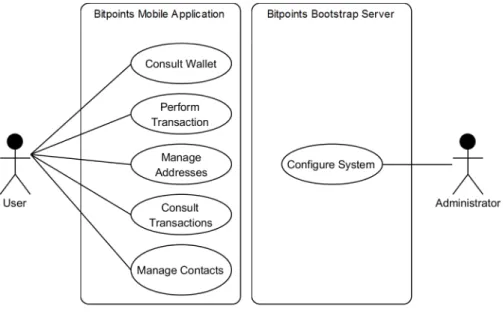
Este capítulo evolui para a descrição da engenharia de software, começando pela análise de requisitos, onde são discutidos os requisitos funcionais e não-funcionais do sistema. Seguida-mente, é realizada a apresentação dos diagramas dos casos de uso das aplicações desenvolvidas onde foram identificados os dois atores do sistema (utilizador comum e administrador).
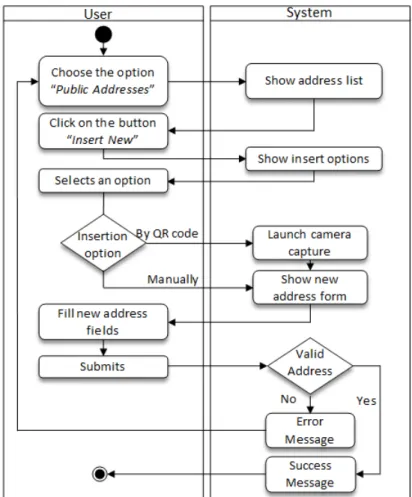
Posteriormente, o capítulo inclui a apresentação e uma breve descrição dos diagramas de ativi-dades do sistema.
Este capítulo termina com a apresentação dos diagramas de classes que representam a estrutura e relação entre as classes implementadas no sistema. Os diagramas de classes para a aplicação do cliente e do servidor podem ser consultados nas Figuras 3.8 e 3.9.
Implementação
Uma das fases mais importantes deste mestrado diz respeito à implementação de um sistema de cartões de fidelização baseado na moeda criptográfica Bitcoin. O Capítulo 4 começa por de-screver o funcionamento do protocolo Bitpoints e algumas decisões relevantes tomadas durante a sua implementação.
Durante a fase inicial da implementação do protocolo foi realizado um estudo às mais conheci-das Application Programming Interfaces (APIs) P2P existentes no mercado: JuXTApose (JXTA),
FreePastry e TomP2P [Ora13, Hoy09, Boc13]. Seguidamente, é feita um discussão sobre as
razões que levaram a ignorar estas APIs e implementar uma rede P2P de raíz.
Posteriormente, as Figuras 4.2 e 4.3 apresentam as mensagens entre as entidades da rede du-rante uma transação e a respetiva confirmação. Estas mensagens são seguidas das respetivas descrições.
Neste ponto é realizada a apresentação da implementação e do funcionamento do servidor Boot-strap. As mensagens referidas anteriormente foram definidas de maneira a auxiliar a explicação da implementação do servidor. O capítulo evolui para a apresentação da aplicação móvel
Bit-points e o seu funcionamento.Estas secções fazem referência às classes e métodos utilizados, descrevendo alguns detalhes de como foram implementadas as funcionalidades de ambas as aplicações.
Para terminar, foi incluída uma secção com o objetivo de discutir questões relacionadas com a privacidade, segurança e eficiência do novo sistema, e qual o impacto causado pela inclusão de uma entidade central.
Teste e Análise do Protótipo
O Capítulo 5 descreve o planeamento e a distribuição de um questionário.Este questionário foi elaborado com o propósito de testar a usabilidade (anonimamente) do protótipo implementado e pode ser consultado no Anexo A.
O questionário compreende quatro tipos diferentes de questões: (i) questões para obter infor-mação sobre o inquirido e o seu conhecimento sobre o tema; (ii) questões para avaliar o dispos-itivo usado no teste; (iii) questões para avaliar o funcionamento do protótipo; e (iv) questões de resposta pessoal e opcional. Estas últimas possibilitaram ao utilizador sugerir alterações ou criticar a aplicação.
Seguidamente, o capítulo apresenta os resultados obtidos, a sua análise e discussão. Os resul-tados obtidos neste inquérito são bastante satisfatórios uma vez que, maior parte da população avaliou a aplicação como sendo fácil de utilizar e compreender, e mostrou-se confortável com a experiência.
Para terminar, as sugestões e críticas dos inquiridos são tomadas em consideração, sendo apre-sentadas e discutidas nas últimas secções deste capítulo.
Conclusões e Trabalho Futuro
As conclusões e trabalho futuro são enumeradas no Capítulo 6.
Uma secção inicial apresenta algumas reflexões acerca do problema apresentado, no que diz re-speito ao sistema tradicional de cartões de fidelização. Foi também apresentada a importância da moeda criptográfica neste âmbito e como esta colmatou as limitações dos sistemas exis-tentes.
O capítulo evolui para a discussão das questões de segurança em relação aos sistemas já exis-tentes, com a introdução de uma entidade central.
Posteriormente, foram extraídas e apresentadas as principais conclusões, que dizem respeito à análise dos resultados obtidos do inquérito referido no Capítulo 5.
De maneira a finalizar as principais conclusões desta dissertação, foi realizado um estudo com-parativo entre o protocolo Bitcoin, os sistemas de pontos tradicionais e o sistema resultante deste mestrado. A Tabela 6.1 apresenta a relação entre funcionalidades, vantagens e desvanta-gens entre os três sistemas. Assuntos como segurança, privacidade e eficiência foram também alvos de análise.
Olhando para as linhas de trabalho futuro, propõe-se a implementação de mecanismos que mel-horem a segurança do sistema, quer localmente, quer nas comunicações de rede. Mecanismos de backup de carteira também seriam aspetos interessantes a considerar. Considerando a ca-pacidade de memória dos dispositivos móveis, acaba por ser importante ter em consideração que esta é limitada e que a blockchain cresce com o decorrer do tempo. É importante con-siderar a implementação de mecanismos que guardem apenas referências para as transações (ao invés de guardar a blockchain) e que utilizem as árvores de Merkle para fazer as respetivas verificações.
O impacto de possuir uma entidade central deverá ser ivestigado mais aprofundadamente, uma vez que parte do sucesso do Bitcoin recai no facto de ser um sistema descentralizado, e a inclusão de uma entidade central pode levantar novas questões.
Abstract
Cryptographic currencies have been thriving in the last 5 years, specially since the appearance of Bitcoin in 2009. Factors, as the particular advantages of this type of currency, the current economy conjecture and the evolution of technology are fuelling their popularity. In some coun-tries, cryptographic currency systems are considered to be feasible alternatives to real money by the government and Bitcoin is actually being used in transactions worldwide. The success of Bitcoin is mostly due to its elegant mathematical description, proven security under its as-sumptions, its decentralized character and anonymity assurance. Apart from the initial effort to securely and correctly implement the system and of the maintenance of the applications, Bitcoin works automatically with the contribution of the nodes of a fully decentralized infras-tructure. The full specification of the protocol is readily available, e.g., in the Internet, and it can be used by anyone. This masters programme explored the possibility to use it, with mod-ifications, as a means to implement a system for electronic loyalty cards. In order to do so, the aforementioned cryptographic currency was studied in detail, a set of requirements for the new system and modifications to the original protocol were specified, and a software system was engineered and implemented in the Java programming language. The specification of the modifications was performed while taking the particular application scenario into account. The restrictions deriving from the application scenario were mostly dominated by the fact that the underlying Peer-to-Peer (P2P) infrastructure was to be constituted by smartphones only.
The most visible outcome of this masters programme is the fully working prototype of the loyalty card system, comprised by an application for mobile devices and by a server side application. This prototype implements part of the Bitcoin from scratch, starting from the seminal work that defines it, along with the modifications that introduce a central agent for better controlling the quantity of currency per client and aid in the establishment of the P2P connections between two mobile applications. The modified version of the system is herein called Bitpoints, and the currency is instead constituted by points. The implemented loyalty card system benefits of some of the advantages of the popular cryptographic currency, namely the public access to the ledger for isolated verification of all transactions. The loyalty card permits the exchange of points between users and mining new points, which is fundamentally different than currently available loyalty cards.
Within the context of this masters programme, a survey was delivery to a population constituted of 34 individuals, who answered a set of questions concerning the handling of the aforemen-tioned prototype. The analysis of the obtained results allows to induce that people would feel comfortable with this application and accept the concept on which is based on, probably pre-ferring a system similar to the proposed one.
Keywords
Android, Bitcoin, Bitpoints, Electronic Commerce, Electronic Currency, Loyalty Card, Mining, Mobile Application.
Contents
1 Introduction 1
1.1 Motivation and Scope . . . 1
1.2 Problem Statement and Objectives . . . 3
1.3 Adopted Approach for Solving the Problem . . . 4
1.4 Main Contributions . . . 5
1.5 Dissertation Organization . . . 5
2 Related Work 7 2.1 Introduction . . . 7
2.2 Loyalty Cards . . . 7
2.3 Bitcoin and Crypto-currencies . . . 8
2.3.1 Concepts Related to Bitcoin . . . 8
2.3.2 The Blockchain . . . 10
2.3.3 Transactions . . . 11
2.3.4 Blocks . . . 14
2.3.5 Mining . . . 15
2.3.6 Proof-of-work and Validating Transactions . . . 16
2.3.7 Privacy and Security Provided by the Protocol . . . 17
2.4 Implementations of Bitcoin and Electronic Loyalty Cards . . . 18
2.5 Conclusions . . . 22
3 Technology and Software Engineering 25 3.1 Introduction . . . 25
3.2 Tools and Technologies Used . . . 25
3.2.1 System Arquitecture . . . 26
3.3 Requirement Analysis . . . 27
3.3.1 Functional Requirements . . . 27
3.3.2 Non-functional Requirements . . . 28
3.4 Identification of Use Cases . . . 29
3.4.1 General Use Case . . . 29
3.4.2 Manage Addresses Use Case . . . 31
3.4.3 Manage Contacts Use Case . . . 31
3.5 Activity Diagrams . . . 32
3.5.1 Perform Transaction Activity . . . 32
3.5.2 Generate Address Activity . . . 33
3.5.3 Insert Contact Activity . . . 34
3.7 Conclusions . . . 39
4 Implementation 41 4.1 Introduction . . . 41
4.2 Bitpoints Protocol Communication . . . 41
4.3 Bootstrap Implementation . . . 45
4.4 Mobile Application Implementation . . . 47
4.4.1 Main Activity . . . 47
4.4.2 Home Activity . . . 49
4.4.3 Perform Transaction Activity . . . 51
4.4.4 Personal Addresses Activity . . . 52
4.4.5 Transactions Activity . . . 54
4.4.6 Address Book Activity . . . 55
4.5 Privacy, Security and Performance Concerns . . . 55
4.6 Conclusions . . . 57
5 Testing and Analysing the Prototype 59 5.1 Introduction . . . 59
5.2 Objectives . . . 59
5.3 Survey Results . . . 61
5.4 Interviewed Suggestions . . . 67
5.5 Conclusions . . . 67
6 Conclusions and Future Work 69 6.1 Main Conclusions . . . 69
6.2 Directions for Future Work . . . 73
Bibliography 77
List of Figures
2.1 Examples of loyalty cards. . . 7
2.2 An example of how Merkle trees are used to compress information regarding trans-actions. . . 9
2.3 A scheme of the blockchain. . . 11
2.4 Representation of the data structure of transactions and of the chain of digital signatures. . . 11
2.5 A transaction JavaScript Object Notation (JSON) example. . . 12
2.6 Possible scenarios for a transaction. . . 13
2.7 An example of a chain of transactions. . . 14
2.8 Diagram representing a chain of blocks. . . 14
2.9 Example of a block written in JSON. . . 15
2.10 Ilustration of the branching artifact of the blockchain. . . 17
2.11 Screenshots of the virtual loyalty card application available for the Continente supermarket chain. . . 18
2.12 Screenshots of the VirtualNext virtual loyalty card application generated to the Currito store. . . 19
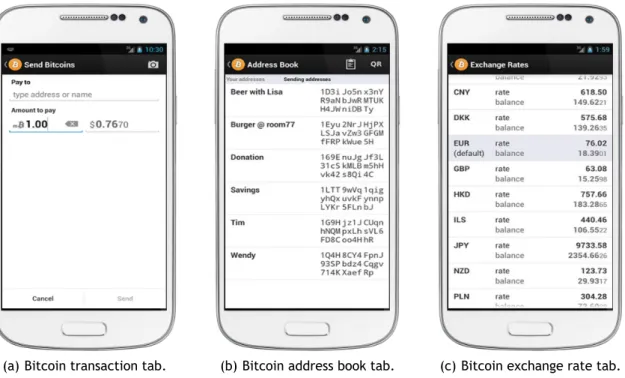
2.13 Screenshot of the home screen of the Bitcoin-Qt Personal Computer (PC) wallet. 20 2.14 Screenshot of the tab for performing transactions in the Bitcoin-Qt PC wallet. . . 21
2.15 Screenshot of the tab concerning personal addresses of the Bitcoin-Qt PC wallet. 21 2.16 Screenshots of one of the Bitcoin wallets available for Android. . . 22
3.1 Components diagram for the Bitpoints system. . . 27
3.2 General use case diagram. . . 30
3.3 Use case diagram for the manage addresses functionality. . . . 31
3.4 Manage contacts use case diagram. . . . 32
3.5 Activity diagram for the perform transaction use case. . . . 32
3.6 Activity diagram for the generate address use case. . . . 33
3.7 Activity diagram for the insert contact use case. . . . 34
3.8 Class diagram for the Bootstrap application. . . 36
3.9 Class diagram for the mobile application. . . 39
4.1 Market share in terms of the versions of the Android OS, as of April 10, 2013 [Mic13]. 42 4.2 Representation of the interactions between the several network entities and the Bootstrap during a transaction. . . 43
4.3 Representation of the interactions between the several network entities and the Bootstrap server during a transaction confirmation. . . 44
4.5 Screenshot of the Bitpoints home activity. . . 49 4.6 Screenshot of the activity for performing transactions. . . 51 4.7 Screenshots of the activity with the features to handle the private addresses. . . 53 4.8 Screenshot of the activity presenting the list of transactions. . . 54 4.9 Screenshots of the activity with the features to handle the public addresses. . . 55 5.1 Pie charts compiling the results concerning age and gender of the participants. . 61 5.2 Pie charts compiling the results concerning professional areas and academic
qual-ifications of the participants. . . 62 5.3 Pie charts compiling the results concerning device manufacturers and Android
versions. . . 62 5.4 Pie charts compiling the results concerning question number 7 and 8 of the survey. 63 5.5 Pie charts compiling the results concerning question number 10 and 11 of the survey. 64 5.6 Pie charts compiling the results concerning question number 12 and 13 of the survey. 64 5.7 Pie charts compiling the results concerning question number 14 and 15 of the survey. 65 5.8 Pie charts compiling the results concerning question number 16 and 17 of the survey. 65 5.9 Pie charts compiling the results concerning question number 18 and 19 of the survey. 65 5.10 Pie charts compiling the results concerning question number 20 and 22 of the survey. 66 5.11 Pie charts compiling the results concerning question number 24 of the survey. . . 67 6.1 Mobile threats by platform. . . 74
List of Tables
2.1 Differences between several Bitcoin wallets. . . 20 2.2 Several existing crypto-currencies. . . 22 3.1 Identification and description of actors. . . 30 3.2 Description of the steps to perform a transaction. . . 33 3.3 Steps of the activity to generate a new address. . . 33 3.4 Steps of the activity to add a new contact. . . 34 4.1 NIST recommended asymmetric key sizes [Bom13]. . . 48 6.1 Comparison between Bitcoin, existing Virtual Loyalty Cards and Bitpoints. . . 71
List of Acronyms
ACM Association for Computing Machinery
ADB Android Debug Bridge
ADT Android Development Tools
API Application Programming Interface
ATM Automated Teller Machine
AVD Android Virtual Device
AVDM Android Virtual Device Manager
BTC Bitcoin unit
BTP Bitpoints unit
DHT Distributed Hash Table
ECC Elliptic Curve Cryptography
GUI Graphical User Interface
ID IDentification
IDE Integrated Development Environment
IMEI International Mobile Equipment Identity
IMSI International Mobile Subscriber Identity
IP Internet Protocol
ISO International Organization for Standardization
J2ME Java 2 Micro Edition
JCE Java Cryptography Extension
JSON JavaScript Object Notation
JXTA JuXTApose
MAC Media Access Control
MD5 Message Digest algorithm 5
MIPS Million Instructions Per Second
MSP-Cv Multimedia Signal Processing - Covilhã
NIST National Institute of Standards and Technology
OS Operating System
P2P Peer-to-Peer
PC Personal Computer
PHP Hypertext PreProcessor
PIN Personal Identification Number
QR Quick Response
RAM Random Access Memory
RSA Rivest, Shamir and Adleman
SDK Software Development Kit
SHA Secure Hash Algorithm
SHA-256 Secure Hash Algorithm 256 bits
SIM Subscriber Identity Module
TCP Transmission Control Protocol
UBI University of Beira Interior
USB Universal Serial Bus
UML Unified Modeling Language
URL Uniform Resource Locator
Abbreviations
Please consider the following abbreviations with the respective meaning when later invoked in the text:
e.g. originated from the Latin expression exempli gratia which means ”for example”.
Chapter 1
Introduction
This dissertation, and the project it refers to, were developed in the context of the 2nd cycle of studies of Computer Science and Engineering of the University of Beira Interior, Covilhã, Portugal. It consists on the implementation of a loyalty card for smartphones by using the techniques and the protocol of the most popular cryptographic coin: Bitcoin. The following section will be focused on the motivation and the scope behind the development of this work. Then, the discussion elaborate on the problem statement and on the proposed objectives. The next-to-last section presents the main contribution of this masters programme and the last section will describe and summarize the structure of this document.
1.1
Motivation and Scope
In the last decades, we have witnessed an increase of the number of users who buy products or services via Internet, fostering a significant growth of electronic commerce (e-commerce). This commerce relies typically on financial institutions, the classical cornerstone for dealing with money in real life, which serve as third parties in the processing of the payment transactions, though that dependence is changing with the emergence of relatively new cryptographic coins. The classical way of dealing with transactions, though it has matured for years, is not perfect and presents some risks or disadvantages. It can be said that it works for most transactions. Nonetheless, this system cannot assure that a transaction is non-reversible, for example, and does not typically support the possibility to perfectly preserve the anonymity of the entities involved in the transactions [Jin13]. Furthermore, according to the British government, more than 2.5 billion people have no access to financial institutions or insurance providers and many countries still lack access to secure banking deposits or even international trade. This occurs in developing countries where there is a lot of corruption and a secure financial infrastructure is non-existent. In these cases, mobile phone services represent a means to access mobile banking for many people [Dar14].
With the previous problems in mind and with the focus on e-commerce, a protocol for creating and supporting virtual coins was proposed in 2008 by an unknown party under the alias Nakamoto
Satoshi. The Bitcoin protocol [Nak09] is a completely decentralized digital currency, supported
by a Peer-to-Peer (P2P) network, that has captivated the interest of users in general, mostly thanks to its interesting features like self-regulation, the possibility for full anonymity, peer verification of all transactions ever made and transactions irreversibility. A lot of brands and
companies are already accepting Bitcoin units (BTCs) as payment for their products or services. Bitcoin is based on a concept known as proof-of-work, which consists in proving that a given difficult mathematical problem has been solved, and on the assumption that more than half of the P2P network is dominated by legitimate users (contrasting with malicious ones). Bitcoin makes all information regarding transactions public, but supports full anonymity of the involved entities.
Nowadays, the popularity [Dar14] of Bitcoin has been partially fuelled by the economy crisis affecting many countries of the world. As people began to lose faith in the local economy, some of them decided to bet on a currency that is not governed by any central bank or entity [Jin13]. Nowadays, BTC is a currency aiming at achieving the Euro or Dollar statute, but on the digital domain. It is actually possible to convert this digital currency in Automated Teller Machines (ATMs) [Wag13].
The first implementation of a Bitcoin client was in 2009, in the form of an open-source P2P application. Also called as a virtual wallet, this application allowed mining new coins and perform transactions and payments between users. Both concepts (of mining and transactions) will be described with more detail in the next chapter.
Two of the most interesting features of Bitcoin is that there is no central entity performing the management of money, contrarily to the case of the real banks and that it is a fully anonymous system. As such, it is not possible to link users to transfers or tracking them. Because of that, Bitcoin is attractive for, e.g., drug dealers or other illegal businesses. However, to accom-plish this without a trusted party, transactions must be publicly announced [Dai98]. There is an history (blockchain or ledger), shared by all nodes of the system, that allows exploring all transactions. These transactions include, amongst additional data, the destination address, the sender address and the value of the transfer. This ledger lists all the transactions ever made since the creation of the currency until the current moment, which makes this system so fas-cinating, because one knows which addresses are making transactions, but he or she will never know who are the owners of those addresses.
BTC is quite a volatile currency, with its starting price defined by the BitcoinTalk users. The first transaction was to trade a pizza by 10000 BTCs [Hos]. At the time of the writing of this dissertation, it has an incredible value (about 800 €), which is constantly varying over time.
This coin was designed with the objective of solving several problems of the real currencies, such as the transaction irreversibility and transactions verification. Based on a proof-of-work, this protocol provides the means to assure the secure exchange of the coins. The digital coin has no physical representation or value if people do not decide to give it one. This is an advantage because it can be anything and it may be referred to as points of a loyalty card, which is actually
the designation of this research work.
Nowadays, a large number of companies use loyalty cards to increase their customers base, track their habits and offer discounts on products, giveaways or accumulation of money that even allows interaction with other companies or services. However, most physical loyalty cards end up representing systems that are not that practical, because there are a lot of different cards and a lot of different ways to promote the brand or the company, and most of these cards are never used or used just a few times. It is interesting to centralize all the physical cards or some of them in only one application, that offers their simplified usage.
The systems of points utilized in most currently available loyalty systems are centrally managed and allow only a very limited set of functionalities. For example, they do not allow customers to exchange points between them. They do not allow for different companies to accept points for a given loyalty card as payment in an ad-hoc mode.
Nowadays, the usage of mobile devices is a common place in developed countries. There is an increasing number of persons owning smartphones with Internet connectivity. This masters programme was focused on developing a mobile application, whose main objective is to replace traditional loyalty cards, already offered by brands or companies, using a virtual points system. The virtual points system is based on the Bitcoin protocol, altered so as to accommodate some specific requirements of the application scenario. As such, the scope of this work falls within the intersection between the areas of mobile computing and software development, electronic commerce, networking and cryptography. Under the 2012 version of the Association for Comput-ing Machinery (ACM) ComputComput-ing Classification System, a de facto standard for computer science, the scope of the masters programme, reflected in this dissertation, is defined by the categories named:
• Human-centered computing~Ubiquitous and mobile devices ;
• Computer systems organization~Peer-to-peer architectures ;
• Security and privacy~Cryptography.
1.2
Problem Statement and Objectives
The main problem addressed in this masters programme is, fundamentally, the lack of features of some of the currently available loyalty card systems. The fact that smartphones and mobile devices, with their increasing processing and storage capabilities, are not used as leverage to improve those systems constitutes a problem also. It is our belief that using open-source and readily available technologies, it is possible to build a system that is much richer, in terms of functionalities, than most of the ones utilized nowadays. For example, loyalty systems do not
typically enable a user to send credit to other user, nor vendors without an explicit agreement with the owner of the system to accept payments using their cards. These systems, also do not allow mining rewards by confirming transactions.
The main objective of this project is to implement a robust and secure electronic loyalty card system, specially designed for mobile devices. This system should be fully supported by soft-ware, i.e., no physical card should be needed, and it should at least provide the functionalities mentioned above. Even thought the system should enable a centralized management, its opera-tion should be clear to any of its intervenients, as it happens for many virtual coins. Some of the secondary objectives are thus to: (i) study mechanisms and concepts supporting cryptographic coins; (ii) implement a prototype of a system; and (iii), describe the adjustments that need to be done for such a system to work properly with a network of a smartphones only, assess if a central entity is required in this case and if there are guarantees that the system continues to be secure in such environment.
1.3
Adopted Approach for Solving the Problem
The main concept behind the adopted approach was to use Bitcoin, or at least some of its mech-anisms and protocol, to implement the loyalty card system. From a general perspective, the adopted approach for achieving the objectives of this programme can be described as follows:
1. The first phase consisted in the contextualization with the objectives of this programme and familiarization with the technologies involved, namely with fully decentralized P2P networks and with Bitcoin. Other loyalty card systems were also studied during this initial phase;
2. The second phase comprised a preliminary set of experiments concerning the implemen-tation and testing of a P2P network with mobile devices;
3. The third phase consisted on designing the new system, via the software engineering and requirements identification;
4. The forth phase was then to implement, test and improve the engineered system. In this phase, an effort was made to address and discuss the security aspects;
5. The fifth phase consisted on obtaining the opinion of users regarding the developed appli-cation and loyalty card system via a survey.
The overall organization of the dissertation (refer to section 1.5) reflects the way this research work was conducted.
1.4
Main Contributions
The main contribution of this masters programme is the delivery of a functional prototype of an electronic loyalty card based entirely on the Bitcoin protocol. The system is composed by an ap-plication for Android smartphones and another one for a server, both built in Java programming language. The implementation is based entirely on the Bitcoin description and specifications, notably from [Nak09], and not from other implementations available in the Internet. The par-ticular application scenario for the developed system is not as critical nor embodies the same requirements as the analogous electronic currency (also known as e-currency) scenario and, as such, the implemented system also needed to reflect that difference. One of the major differ-ences is that the system does not need to be completely decentralized and that a central entity may be tolerated. This central entity was implemented as a rendezvous host, herein also called Bootstrap server. This dissertation discusses the responsibilities and trade-offs associated with this bootstrap server, presenting also a justification for why it was utilized.
As a secondary contribution, it is possible to mention that the system was designed specifi-cally for smartphones from the start, taking some of the issues related with building mobile applications with potentially heavy computations into account. The dissertation also contains a detailed software engineering of the smartphone and server applications.
The prototype developed for an electronic loyalty card advances the state of the art in this specific area. For example, it adds features that implementations based on physical cards do not have, namely the possibility to exchange points with other peers. The security is assured by the concept and mechanisms behind Bitcoin.
1.5
Dissertation Organization
This dissertation is organized in six chapters. Its main body is comprised of four chapters, preceded and succeeded by the Introduction and Conclusions and Future Work chapters, re-spectively. The contents of each one of the chapters can be summarized as follows:
• Chapter 1 - Introduction - presents the context of the dissertation and the motivation behind the described work. It also includes the objectives, adopted approach, main con-tributions for the advance of knowledge and the dissertation overview.
• Chapter 2 - Related Work - starts with a brief introduction to the main concepts, mech-anisms and technologies related with this project, and ends up with the presentation of some relevant works concerning virtual loyalty cards and Bitcoin clients.
• Chapter 3 - Technology and Software Engineering - elaborates on the software engineer-ing of the mobile and server side application, via the identification of use cases, discussion
of activity and classes diagrams, and by defining the architecture of the system. It also describes the technologies and tools that were used in the respective development.
• Chapter 4 - Implementation - describes the implementation of the engineered system, as well as some of the most important choices that define it. The chapter evolves to the presentation of the developed prototype, and it ends up with a small discussion regarding privacy, security and performance.
• Chapter 5 - Testing and Analysing the Prototype - is focused on the planning and delivering of an usability survey. An analysis of the results of that survey is also performed towards the end of that chapter.
• Chapter 6 - Conclusions and Future Work - wraps up the most important conclusions of this masters programme and discusses potential future lines of work.
The Survey of Usability Test (Appendix A) was also included as annexe, for the sake of con-sistency. The annexe presents the survey delivered to the respondents along this masters pro-gramme, to assess the usability of the developed prototype.
Chapter 2
Related Work
2.1
Introduction
At the time of writing this dissertation, crypto-currencies were still gaining momentum in terms of popularity, being used in countless situations and by a large number of users. This chapter addresses the actual state of crypto-currencies, namely the Bitcoin protocol, as well as its functioning under the hood. The related work on virtual loyalty cards and Bitcoin clients are included in here as well.
The next section (Section 2.2) describes the related work on loyalty cards, focused mainly on the ones supported by physical cards. The third section (Section 2.3) will be devoted to the description of the functioning and specifications of the Bitcoin protocol and finally, Section 2.4, is where some existing Bitcoin and Electronic loyalty card implementations will be mentioned and explained.
2.2
Loyalty Cards
A loyalty card, of which some examples are represented in Figure 2.1, also known as a customer card, is a plastic or paper card that serves as a physical support for companies or brands to track and captivate their customers with bonuses like discounts, prizes, special prices or points that can be exchanged for money, services or other goods.
Figure 2.1: Examples of loyalty cards.
On the current context, loyalty is the act of making clients faithful to a brand, product or service. When shopping every day at the same store, means that the customer is loyal to the products of a company, and that he or she is satisfied with the quality and price of the services. The advantages of loyalty cards are that the client can use them to collect points or money that allows him or her to have special benefits, like the previously referred ones. These benefits may take several forms, namely products and services from the company issuing the loyalty card, or
from other companies in which the later may have an agreement. For example a supermarket chain may allow for the points of its loyalty cards to be exchange by gas from a specific loyal company.
Even thought there is an excess of existing loyalty cards on the market these days, according to a study conducted jointly by Princeton, Total Research Corp. and Carlson Marketing Group, it was noted that the spending of the customers increases by 46% when they perform their shopping at companies that have loyalty based rewarding systems [Sev03]. According to the same survey, it is more expensive to acquire a new customer than to keep an existing one. Approximately 30% of the company customers are actually not interested in these type of systems, the others (aproximately 70%) do not mind having a wallet full of cards, if it implies a lower investment when purchasing products or services. Nonetheless, the aforementioned reasons are not the only ones justifying the importance of loyalty cards to companies. It is known that they are used to collect customer information and to, therefore, support marketing and decision taking processes. Such information may be used by the company to generate vouchers to offer to the customer, as a way to possibly encourage him to purchase even more products. A series of strategies can then be used to further captivate the customer, namely via lottery type games or directed promotions.
Physical cards are practical only in the sense that the customer does not have to worry to much about its management. In order to use it, customer only has to typically show it in specific moments, namely when paying. They do not typically offer any kind of additional interaction, as for example, consulting the balance any time or exchanging credit with other customers.
2.3
Bitcoin and Crypto-currencies
A common user of Bitcoin, a non official International Organization for Standardization (ISO) crypto-currency [RB14], does not need to have full knowledge of the operation of the protocol. Nonetheless and since it useful for the explanation contained in this dissertation, this section will cover the essential topics of the system. Some concepts and mechanisms concerning the operation of the protocol are going to be discussed first (subsection 2.3.1) to then evolve to the description of the blockchain (subsection 2.3.2). The mechanism supporting transactions (subsection 2.3.3), and mining (subsection 2.3.5) are the subject of subsequent sections, along with the definition of blocks (subsection 2.3.4) and proof-of-work (subsection 2.3.6). A brief description on the security and privacy of Bitcoin is included in subsection 2.3.7.
2.3.1
Concepts Related to Bitcoin
Before proceeding with the explanation of the protocol, there are some concepts that need to be defined. Bitcoin makes extensive use of hash values and functions. In order to assure the integrity, authenticity and non repudiation of transactions, it also uses digital signatures.
Currently available implementations of the protocol use Elliptic Curve Cryptography (ECC) [PP10] as basis for the digital signature scheme. On the other hand, merkle trees are used as means to compress block information and enable easier revalidation of transactions. Bitcoin users are typically identified by the so called addresses. The concepts emphasized with italic typeface can be explained as follows:
Hashes - Cryptographic hash values, like the ones used in Bitcoin, also known as checksums
or hash codes, are values obtained via the application of a cryptographic hash function like Message Digest algorithm 5 (MD5) or Secure Hash Algorithm (SHA). Cryptographic hash functions are efficient one-way functions capable of mapping an arbitrary long stream of bits into a fixed length code [Vau10]. Bitcoin uses the Secure Hash Algorithm 256 bits (SHA-256), which outputs codes with 256 bits. These hash functions are used in the digital signature scheme, for constructing the Merkle trees and for the proof-of-work. Since it is still considered to be a safe function nowadays [oST14], SHA-256 was also used in the implementation of the loyalty card system developed along this work.
Merkle trees - A Merkle or hash tree [Mer80] is a tree in which every node is labelled with the
hash of the labels of its children nodes. Merkle trees are commonly used to make verifi-cation of the integrity of large data structures more efficient, while preserving security. These trees are used essentially on the so-called light version of the Bitcoin protocol, to save disk space, which in mobile devices constitutes a constraint. Figure 2.2 depicts a Merkle tree.
19/09/2014
Merkle Root
Hash01
Hash23
Hash1
Hash0
Hash2
Hash3
Tx0
Tx1
Tx2
Tx3
Generation
Block
Figure 2.2: An example of how Merkle trees are used to compress information regarding transactions.
The leaf nodes of the depicted tree represent transactions (or the data conveying that information). The tree is constructed by initially calculating the hash values of those transactions separately, and then successively compute apply the hash function to the combination of each two hash values in order. For example, fromTx1 and Tx2, one ob-tainsHash0 and Hash1, respectively. Hash01 is the hash value of the concatenation of the 9
latter two. The root is a value that ultimately summarizes the entire dataset comprising the leafs. The advantage of using a Merkle tree to summarize data is that it enable the efficient verification of a given subset of that data, namely by following only the branches associated with it. E.g., verifying the integrity ofTx1 would require only the access to the root,Hash01, Hash23, Hash0 and Tx1.
Address - Within the crypto-currencies context, the address of a wallet is the public key of a
pair of asymmetric keys of a public key crypto-system. In many crypto-currencies, it is a 256 bit long value written in hexadecimal and representing the public key of an ECC key pair. It can be freely distributed and it is necessary to perform transactions. Thought their meaning, in terms of usefulness is similar to the one of email addresses, they cannot typically be validated because they are entirely random and, as such, have no structure. It is estimated that planet Earth contains about 7.5×10¹⁸grains of sand and supposing that each grain was another planet Earth, in the end, the total number of sand grains would still be less than the total number of possible addresses [Dri13].
Block and Transaction - In a nutshell and within this context, a block is a data structure
com-prising transactions, and a transaction is data structure containing information represent-ing the movement of a number of virtual coins from a given entity to another. The entities are typically represented by their public addresses in this data structure, which also nor-mally contains a digital signature of the sending entity. More on this subject below.
Signatures and transactions verification - A digital signature is a fixed size value (e.g., 256
bit long), calculated over the data it applies to using a private key, that can be used several properties regarding that data and its originating party, namely the data was not tampered with and that it comes from the owner of the respective public key. It also comprises a means to assure that the signing party cannot later argue that it did not sign or processed that data. In many crypto-currencies, the verification of a transaction occurs at the recipient side to check if a transaction is valid or not.
2.3.2
The Blockchain
The blockchain, ilustrated in Figure 2.3, consists basically of a public file (also known as ledger), where all transactions since the beginning of the crypto-currency are stored. This file is se-quentially structured, and blocks are added as transactions are made. Pending transactions are included in a new block, which will have a reference to the previous block and which, in turn, after confirmed, will be included in this ledger. Once all transactions are registered in this ledger, a wallet client, or any other application devised for that specific purpose, can know the exact amount of coins of a given address, thus allowing its owner to perform transactions with those coins. All transactions all thus completely public, though that is no way to associate a public address with a real world identity. Each node connected to the network has a copy of
Ledger
Block Transaction Transaction Block Transaction TransactionFigure 2.3: A scheme of the blockchain.
this file which, due to the functioning of the protocol, grows over time. The longest valid chain is always the one considered by the clients.
2.3.3
Transactions
A transaction is a structure with several fields representing the exchange of e-currency units between public addresses, digitally signed with the private key of the source. Transactions are broadcasted to every node connected to the network and inserted into blocks. Once validated, these blocks are then inserted into the ledger.
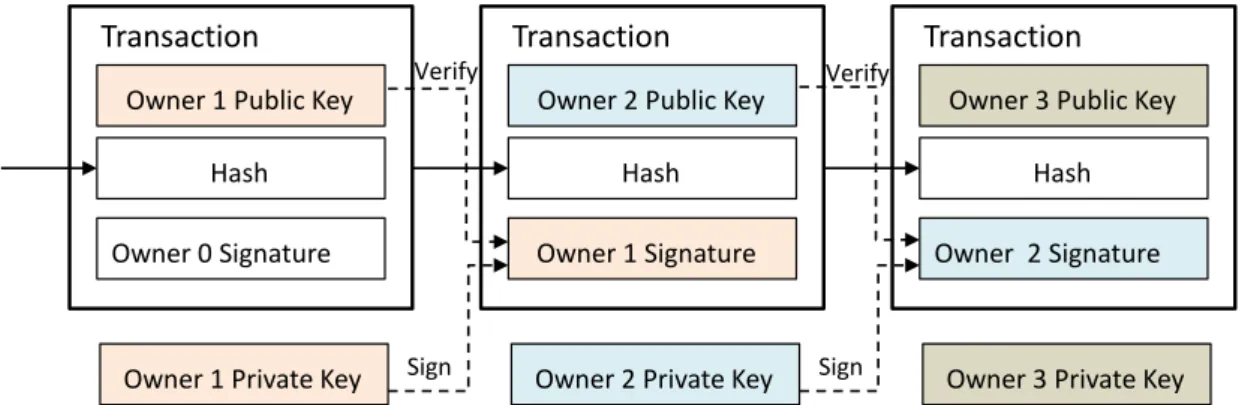
According to Satoshi [Nak09], an e-currency is constituted by a chain of digital signatures. As seen in Figure 2.4, a given client transfers coins to another one by signing the hash of the previous transactions and the public key of the next owner, along with a number representing the transferred amount. The receiver can immediately verify if the digital signature is valid or not, though he or she cannot be certain that the money was transferred. That certainty is only obtained after the network validated the block in which the transaction is included.
Transaction
Owner 1 Public Key Hash Owner 0 Signature
Owner 1 Private Key
Transaction
Owner 2 Public Key Hash Owner 1 Signature
Owner 2 Private Key
Transaction
Owner 3 Public Key Hash Owner 2 Signature
Owner 3 Private Key
Sign Sign
Verify Verify
In the Bitcoin protocol, a transaction is used to send BTCs to another entity and includes, along with other parameters, two fields:
Inputs - An input is a reference to the previous transactions that gave money to the user,
allowing him or her to make other transactions;
Outputs - An output is a reference to a specific destination address and its specific value.
It is common to represent transactions of crypto-currencies using JSON. To provide its expla-nation with a concrete example, the next figure contains the JSON representation of a real transaction of the Bitpoints protocol, used by the prototype developed along this masters pro-gramme (some of the values were abbreviated for the sake of clarity).
Figure 2.5: A transaction JSON example.
The several fields shown in the figure can be summarized as follows:
hash - The hash value of the current transaction;
pub_key - The public key of the sender of the transaction;
signature - The digital signature computed with the sender private key;
outCounter - The number of outputs included in the transaction;
outputsList - List of the outputs included in the transaction;
address - The address of the recipient of the transaction;
value - The amount of Bitpoints units (BTPs) to send to the recipient;
inputsList - List of the inputs included in the transaction;
prevTx - Reference to all previous transactions, which allow the transfer of the amount of BTPs
specified on this transaction;
index - The position where the previous transaction output is (a transaction can have multiple
outputs depending on how much recipients it has).
As can be seen, the structure utilized to represent BTPs transactions is very similar to the one of the original Bitcoin protocol.
Transactions over the Bitcoin protocol follow a fairly simple operation mode: the value to send is first combined with previous transactions (called inputs) to make up the total amount of BTCs, and then the total amount is split by all receivers (called outputs). If the combined value is greater than the value that needs to be send, the excess is send back to its owner (automatically) in one of the outputs of the transaction. Figure 2.6 illustrates two possible scenarios for transactions. The situation of a single output is represented on the left side, while multiple outputs are represented on the right side. In both cases, part of the amount is being returned to the sender.
100
70 30100
40 20 10 30Figure 2.6: Possible scenarios for a transaction.
Figure 2.7 shows a chain of transactions with values for exemplification purposes. Assuming that the owner of address A wants to make a transaction with 100 BTCs (Tx 2) to address B and he has 100 BTCs coming from another previous transaction (say Tx 1), then the scenario is the simplest one, since the values of the input and output are equal.
Now assume that the owner of address B wants to make a transaction of 175 BTCs to address C (Tx 5). In this case, address B has to combine more than one incoming transactions (one from
19/09/2014
1
Tx 2
In
…
100
Out
to B100
Tx 1
Tx 5
In
from A100
Out
to B25
In
…
50
In
Out
to C175
Tx 3
Tx 4
…
50
Out
100
In
Out
to D75
Tx 7
Created by address A Created by address B
Tx 6
Created by address Cfrom B
175
Figure 2.7: An example of a chain of transactions.
address A and two others), because the value of a single input is not sufficient to sum up to the required amount. Therefore, the total value that needs to be send will result from the combination of all previous transactions, until the sum is achieved. Nonetheless, as depicted in the figure, the combination of all transactions gives a total of 200 BTCs and, as address B just wants to send 175 BTCs, the remaining 25 BTCs are sent back to address B.
2.3.4
Blocks
A block is a structure constructed by the nodes connected to the Bitcoin network. All connected nodes are listening and waiting for new incoming transactions, because processing them gives is rewarding (rewarding process will be described afterwards). Each node collects the incom-ing transactions and builds a block with them. An approximation of the resultincom-ing structure is schematized in Figure 2.8. As depicted in the figure, the block will contain, along with other
Block
Prev Hash Nonce Hash Tx Tx Tx Tx
…
Block
Prev Hash Nonce Hash Tx Tx Tx Tx
…
Figure 2.8: Diagram representing a chain of blocks.
fields, a reference to the previous block, the list of collected transactions, the hash of the block and a nonce, that will be used on the mining process (explained in the next section).
Figure 2.9 provides a real example of a block in JSON, with summarized fields and suppressed transactions.
Figure 2.9: Example of a block written in JSON.
The several fields included in the representation can be briefly described as follows:
version - Version of the protocol used to calculate this block;
prev_block - Hash value of the previous block (it is a reference to the previous block, effectively
creating the chain);
hash - Hash value of the current block;
nonce - Random value to compute the proof-of-work;
timestamp - Date of creation of the block;
tx_num - Number of transactions included in this block;
tx - List of all transactions included in this block;
merkle_root - Root hash of the Merkle tree;
merkle_tree - List containing all Merkle tree hashes.
2.3.5
Mining
Mining is the process of adding blocks to the public blockchain and receive a reward for con-tributing for that process. A block can only be added when all the transactions are confirmed using a concept called proof-of-work, which is a process that consumes time and resources. A proof-of-work effectively shows that a specific node spent time processing that block.
2.3.6
Proof-of-work and Validating Transactions
As mentioned before, the proof-of-work is a mathematical puzzle that takes time and computer processing resources to solve. In the case of Bitcoin, this puzzle consists in finding a number, called nonce which, after combined with a block should result in a hash value with specific properties. The proof-of-work starts with a specific node collecting some transactions that are disseminated in the network, and placing them inside a block created by itself. This block will have a reference for the last block of the chain (prev_block) and a few other fields. After that, a nonce is generated and the node tries to calculate the hash value of the block with the generated nonce. The calculated hash must have a certain number of bits equal to zero on the beginning, as can be seen on the following example:
"hash":"00000000d1145790a8694403d4063f323d499e655c83426834d4ce2f8dd4abd32". If the hash does not fulfil the aforementioned condition, the nonce is incremented. In order to clarify this concept, assume that the proof-of-work will be performed on the string Hello, world! and the difficulty is set to find 12 bits equal to zero in the beginning of the hash. The client generates a nonce, that in this case will start in 0 to simplify the explanation, and concatenates that value to the string as follows: Hello, world!0. The next step is to calculate the hash value and verify if it starts with 12 bits equals to zero:
Hash(Hello, world!0)=
1312af178c253f84028d480a6adc1e25e81caa44c749ec81976192e2ec934c64.
Since the output does not have the required number of bits equal to zero, it will generate another nonce and repeat the process. It will do this until it finds the correct hash value, i.e.: Hash(Hello, world!1)= e9afc424b79e4f6ab42d99c81156d3a17228d6e1eef4139be78e948a9332a7d8, Hash(Hello, world!2)= ae37343a357a8297591625e7134cbea22f5928be8ca2a32aa475cf05fd4266b7, ... Hash(Hello, world!4248)= 6e110d98b388e77e9c6f042ac6b497cec46660deef75a55ebc7cfdf65cc0b965, Hash(Hello, world!4249)= c004190b822f1669cac8dc37e761cb73652e7832fb814565702245cf26ebb9e6, and Hash(Hello, world!4250)= 0000c3af42fc31103f1fdc0151fa747ff87349a4714df7cc52ea464e12dcd4e9.
This proof-of work was computed 4251 times prior to the discovery of the correct nonce value (4250). The hash function produces an unpredictable output, and it is not possible to know beforehand the value of the nonce that will fulfil the condition. This mathematical property assures that some resources are spent in solving this challenge. The value of BTC derives also from this resources consumption. After the nonce is found, the block is ready to be inserted into