1
Corresponding author:
Received: July 07, 2017.
Accepted: November 23, 2017.
Copyright: All the contents of this journal, except where otherwise noted, is licensed under a Creative Commons Attribution License.
Abscysic acid and compatibility of atemoya
(
Annona
x
atemoya
Mabb.) grafted onto native species
Daniel Baron1, Juliana Iassia Gimenez2, Gisela Ferreira3
1Agronomist, Dr. Natural Science Center (CCN), Federal University of São Carlos (UFSCar), Laboratory of Plant Physiology and Biochemistry, Lagoa do Sino Campus. Buri-SP. Brazil. E-mail: [email protected]
2Biologist, Dr. Bioscience Institute, Botany Department, São Paulo State University (Unesp), Botucatu Campus, Botucatu-SP. Brazil. E-mail: julianaiassia@ gmail.com
3Agronomist, Dr. Bioscience Institute, Botany Department, São Paulo State University (Unesp), Botucatu Campus, Botucatu-SP. Brazil. E-mail: gisela@ibb. unesp.br
Abstract - Grafting is an effective technique used in the cultivation of commercial fruit species given the necessity to guarantee the genetic characteristics of productive species using selected clones. Although grafting is a common and widespread technique and phytohormones play a key role in the formation of tissues, the relationship between phytohormones, such as abscisic acid, and mechanisms of incompatibility is not yet well elucidated. Thus, the objective of this study was to establish whether a correlation exists between variations in abscisic acid and the compatibility of the atemoya (Annona x atemoya Mabb.) cultivar ‘Thompson’ grafted onto biribá [Annona mucosa
(Bail.) H. Rainer], araticum-mirim [Annona emarginata (Schltdl.) H. Rainer ‘var. mirim’] and
araticum-de-terra-fria [Annona emarginata (Schltdl.) H. Rainer ‘var. terra-fria’]. Plant cultivation was carried out at the Botany Department of Instituto de Biociências (IB), Unesp, Botucatu, São Paulo, Brazil. The plant material of grafted plants (stem above the grafted area, stem containing the grafted region, and stem below the grafted region) and ungrafted plants (stem 20 cm above
ground) was collected 500 days after grafting (DAG) for the extraction and quantification of
abscisic acid. The results of this study show that ungrafted Annona plants exhibit variations in the concentration of abscisic acid among the native rootstock species. When grafted, the most commonly used grafting combinations, araticum-de-terra-fria and araticum-mirim, present the same concentrations of abscisic acid in the graft region as self-grafted atemoya. It was concluded that the observed variations in the concentrations of abscisic acid in the graft region did not cause incompatibility in the combinations of atemoya grafted onto different native species.
Index terms: phytohormones, rootstock, post-grafting plant restoration.
Ácido abscísico e compatibilidade de atemoia
(
Annona
x
atemoya
Mabb.)
enxertada em espécies nativas
Resumo - A enxertia é utilizada de maneira eficaz para o cultivo de espécies frutíferas comerciais, uma vez que é necessário garantir as caraterísticas genéticas de espécies produtivas com o emprego
de clones selecionados. Apesar de a enxertia ser técnica comum e amplamente difundida, e os
hormônios terem papel-chave na formação de tecidos, a relação de fitormônios como o ácido abscísico com mecanismos de incompatibilidade ainda não está bem elucidada. Desta forma, o objetivo deste estudo foi avaliar se existe correlação entre as variações do ácido abscísico com
a compatibilidade de atemoeira (Annona x atemoya Mabb.) cultivar ‘Thompson’, enxertada em biribazeiro [Annona mucosa (Bail.) H. Rainer], e plantas de araticum-mirim [Annona emarginata
(Schltdl.) H. Rainer variedade mirim] e araticum-de-terra-fria [Annona emarginata (Schltdl.) H. Rainer variedade terra-fria]. O cultivo das plantas foi realizado no Departamento de Botânica do
Instituto de Biociências de Botucatu (IB), Unesp, município de Botucatu-SP. O material vegetal
de plantas enxertadas (caule acima da região enxertada, caule contendo a região enxertada e caule abaixo da região enxertada) e não enxertadas (caule situado a 20 cm acima do solo) foi coletado aos
500 dias após a enxertia (D.A.E.) para a extração e quantificação do ácido abscísico. Os resultados
deste estudo evidenciam que as anonáceas (pé-francos) apresentam variações na concentração de
ácido abscísico entre as espécies de porta-enxertos nativas, e quando enxertadas; além do mais,
as combinações mais utilizadas atualmente, araticum-de-terra-fria e araticum-mirim, apresentam
as mesmas concentrações de ácido abscísico na região enxertada que da atemoia enxertada nela mesma. Conclui-se que as variações observadas nas concentrações de ácido abscísico na região
enxertada não provocaram incompatibilidade nas combinações de atemoeira enxertada em diferentes espécies nativas.
Brazil occupies a prominent place in the global commercial production of Annonas, mainly due to its climatic diversity, which allows for production of the fruit from the north to the south of the country (SÃO JOSÉ et al., 2014). The emphasis is on atemoya (Annona
x atemoya Mabb.), which is a hybrid between the sweetsop (Annona squamosa L.) and cherimoya (Annona cherimola Mill.) (RÂBELO et al., 2015). In Brazil, atemoya seedlings are produced by grafting using native rootstock species, such as araticum-de-terra-fria [Annona emarginata (Schltdl.) H. Rainer ‘var. terra-fria’], that, when compared to the native species araticum-mirim
[Annona emarginata (Schltdl.) H. Rainer ‘var. mirim’], provide greater longevity to the scion, do not develop grafted tissue hypertrophy (“elephant’s foot”) and do
not cause dwarfism in the grafted plant (TOKUNAGA,
2005). Biribá has been considered by several authors to be incompatible as a rootstock for atemoya (SANTOS
et al., 2005; KAVATI, 2013). However, plants evaluated
three months after grafting exhibited a high survival rate (85%) (BARON et al., 2016).
Compatibility between scion and rootstock includes a number of physiological mechanisms with immediate responses to injury such as callus formation and the establishment of new functional vascular tissue between the partners. The ability to form a compatible scion and rootstock combination is also due to hormonal and
biochemical characteristics (MELNYK; MEYEROWITZ,
2015). Abscisic acid (ABA) regulates tolerance responses to a large number of abiotic stresses, such as salinity and
lack of water (LIU et al., 2016; KUMAR et al., 2017). In
addition, studies with grafted tomatoes have shown that the ABA level in the scion plays a fundamental role in reducing the size of grafted plants, independently of the genotype (ALBACETE et al., 2015).
According to Tworkoski and Fazio (2015), ABA is one of the main factors responsible for triggering the
dwarfing process in otherwise tall plants. Dwarfing apple
tree rootstocks (Malus sp.) contain large amounts of ABA, in addition to having a high ratio of ABA to IAA (auxin), compared to vigorous rootstocks of the same
species (LORDAN et al., 2017); however, there is no
full understanding of how ABA affects the survival rates of grafted plants. Most attempts by studies to explain incompatibility refer to the initial stages after grafting in
herbaceous systems (KÜMPERS et al., 2015; MELNYK
et al., 2015), and few studies have been carried out on
woody plants (PINA et al., 2012) due to the difficulties
inherent in investigating species that require a longer period of time for evaluation. In light of the fact that tissue formation between scion and rootstock requires hormonal action, research on ABA action may help further our understanding of the physiological mechanisms of incompatibility.
The experiment was implemented and conducted in a greenhouse at the Botany Department of Instituto de Biociências (IB), Universidade Estadual Paulista Júlio de Mesquita Filho (Unesp), Botucatu campus, São Paulo, Brazil, located at 22º52’S, 48º26’E at an altitude of 850 m.
For the production of the rootstocks and ungrafted plants, seeds were extracted from fruits of araticum-de-terra-fria (Annona emarginata Schltdl. H. Rainer ‘var. terra-fria’), araticum-mirim (A. emarginata ‘var. Mirim’),
biribá (A. mucosa) and atemoya (Annona x atemoya
Mabb. ‘Thompson’). After seed extraction, sowing was
carried out in polystyrene trays (72 cells) filled with
vermiculite of medium granulometry, using one seed
per cell. The seedlings, when presenting the first leaf
completely expanded above the third node of the epicotyl, were called young plants (seedlings). Seedlings of ± 10 cm in length were transplanted into plastic bags with a volumetric capacity of 17 dm3 containing approximately
5 dm3 of pinus bark mixture, fertile eutroferric Latosol soil
of areno-clayey texture, vermiculite, and coconut fiber of
average granulometry (1:2:1:1 v/v). When these reached a stem diameter of 10 mm at 20 cm of soil height (about 500 days after sowing [DAS]), they were grafted.
The whip and tongue graft technique was utilized
(TOKUNAGA, 2005). Scions obtained from a single
adult atemoya plant were grafted onto biribá, araticum-de-terra-fria, araticum-mirim and atemoya rootstocks grown from seed. In addition to the grafting combinations, ungrafted plants (atemoya, biribá, araticum-de-terra-fria
and araticum-mirim) were used. The plant material of grafted plants (stem tissue at the interface of the grafting region, collected 15–20 cm from the neck of the plant, stem above the grafted region, stem containing the grafted region and stem below the grafted region) and of ungrafted plants (stem at 20 cm above the collar, where the grafting would be carried out) were collected at the phenological stage that represents the establishment period, simulating
a possible transplant of seedlings to the field, at 500 DAG.
The samples were conditioned in liquid nitrogen and stored in an ultra-low freezer until analysis.
The plant samples were pulverized for extraction and quantification of the ABA hormone (MA et al., 2013). Plant material (100 mg) was homogenized in 500
μl of methanol-MeCN extraction solution: methanol,
is composed of a mobile phase degasser DGU-20A, quaternary pumping system consisting of an LC-20AD pump, a SIL-20ACHT self-sampler, a CBM-20A controller, and CTO-20AC column oven. The Sinergi 2.5 Hydro RP-100A 50 x 4.6 mm column was used, which was maintained at 40 °C during the determinations. The
column effluent was introduced into an AB Sciex 4500
triple quadrupole mass spectrometer equipped with an ESI-type ionization source (eletrospray) in the interface. The results were expressed in nmol per gram of fresh mass (nmol g−1 FM) (MA et al., 2013).
The experiment was conducted in a randomized block design with eight treatments (atemoya scion grafted
onto atemoya; araticum-de-terra-fria; araticum-mirim
and a biribá rootstock other than atemoya; araticum-de-terra-fria; ungrafted araticum-mirim and biribá) with nine replicates of each plant per treatment. The data were submitted to a variance of homogeneity test (“Levene’s
test”) and variance analysis (ANOVA), and the means
were compared using the Tukey test (p ≤ 0.05). During
the course of the experiment, crop handling procedures, such as mineral nutrition and thinning, were carried out. These comprised removing any branch or leaves that had grown from the stems of the seedlings between the level of the soil to 25 cm in height), with the aim of ensuring the sanity and uniformity of the plants.
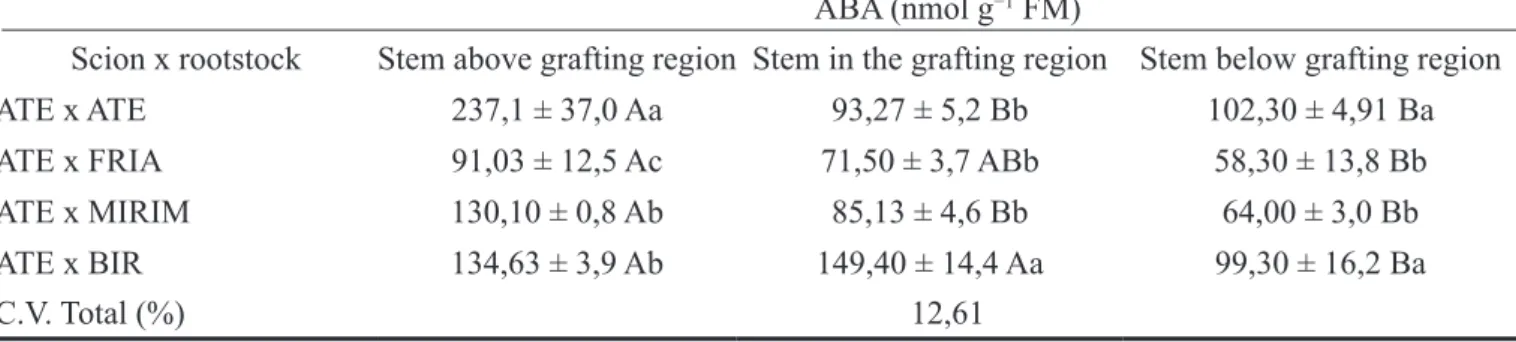
The results of this study show that Annonas present variations in the concentration of ABA among ungrafted species (Table 1) and grafted species (Table 2). The most commonly used combinations, araticum-de-terra-fria and
araticum-mirim (TOKUNAGA, 2005), presented the same
concentrations of ABA in the grafted region as self-grafted atemoya (Table 2).
In all grafting combinations, the concentration of ABA in the scion (the region above the graft) was greater than in the region below the graft, which may be
a reflection of the stress caused by the grafting and is not
necessarily related to incompatibility, since this fact is also observed in self-grafted atemoya, in which there would be no genetic reason for incompatibility.
Regarding gene expression in tissue formation, it was evident that, in atemoya grafted onto araticum-de-terra-fria,the expression of UGPase occurs earlier than in other grafting combinations, which evidences faster tissue formation in the graft region (BARON et al., 2016). In addition, promoter hormones such as gibberellins (GA) and auxins (AX) act on tissue formation, as proposed by Hartmann et al. (2011), which explains the lower concentration of ABA found in the graft region. Atemoya grafted onto biribá presented the highest concentrations of ABA in the graft region, yet this fact cannot be considered
to reflect incompatibility, since the graft survival rate was
80–85% (data not shown).
In studies of UGP gene expression and the UDP-glucose pyrophosphorylase enzymatic activity responsible for cell wall formation, biribá rootstocks have been shown to form tissues later than is the case with araticum-de-terra-fria and araticum-mirim. This may occur due to the action of ABA, which reduces or prevents the action of hormones such as gibberellins, which is involved in the formation of tissues. Thus, it appears that the concentrations of ABA observed in biribá are responsible
for delaying the formation of tissues; however, this does
not change the survival rate of grafted plants following their complete cicatrization in nursery conditions. Nevertheless, biribá is not considered a good option as a rootstock for atemoya and sweetsop (A. squamosa L.)
(ALMEIDA et al., 2010; KAVATI, 2013).
Santos et al. (2005) reported a survival rate of 4% at 45 days after grafting sugar apple onto biribá; however,
the physiological explanations that support the existence of negative reactions in the formation of callus or vascular
systems are not presented. Scientific evidence indicates
that atemoya grafted onto biribá has a proliferation of parenchyma and differentiation of the vascular system, which establishes connections between the scion and rootstock tissues (BARON et al., 2014). According to
Kavati (2013), producers report incompatibility after
years of commercial orchard formation. Although there are reports that the concentration of ABA can be used
as an efficient marker in the early selection of dwarfing
rootstocks (HARTMANN et al., 2011), in this study, it was not possible to indicate such condition, since araticum-mirim, which is reported as a dwarfing rootstock to
atemoya (TOKUNAGA, 2005; KAVATI, 2013), presented
similar ABA concentrations to that exhibited by the other grafting combinations that are not considered to be
dwarfing.
Incompatibility may be expressed by “unsuccessful”
grafts, deficient or abnormal growth of the grafted plant,
hypertrophy of the graft attachment point, or poor mechanical strength of the grafting union, which, in extreme cases, may result in tissue rupture at the site of the graft. This incompatibility may manifest immediately
or emerge only after many years (KAVATI, 2013).
A distinction must be made between incompatibility provoked by the viral action of the “negative” reaction between the grafting partners (ROWHANI et al., 2017), reactions that result in tissue hypertrophy in the grafted
region (“elephant’s foot”) (TOKUNAGA, 2005), or
reactions caused by environments that are unsuitable for certain species.
In this context, this study allowed us to verify, in nursery conditions over an approximately 18-month period, that the observed variations in the concentrations of ABA in the grafted region do not provoke incompatibility in the combinations of atemoya grafted onto biribá:
Table 1.Concentration of abscisic acid (ABA) expressed in nmol per gram of fresh mass (nmol g−1 FM) in the stem region at 20 cm above ground, in ungrafted atemoya, biribá, araticum-de-terra-fria,and araticum-mirin at 540 days after sowing (DAS).
Ungrafted Stem region at 20 cm above ground
araticum-de-terra-fria 94,32 ± 28,4 c atemoya 176,41 ± 30,3 ab
araticum-mirim 250,17 ± 36,8 a
biribá 145,20 ± 19,0 bc
C.V. (%) 17,6
Means followed by the same lowercase letters do not differ in Tukey’s test at 5% probability (± standard deviation, n = 9).
Table 2. Concentration of abscisic acid (ABA) expressed in nmol per gram of fresh mass (nmol g−1 FM) in the stem above grafting region, stem below grafting region and stem in the grafting region of self-grafted atemoya (ATE x ATE), atemoya grafted onto araticum-de-terra-fria (ATE x FRIA), atemoya grafted onto araticum-mirim (ATE x MIRIM), and atemoya grafted onto biribá (ATE x BIR) 500 days after grafting (DAG).
ABA (nmol g−1 FM)
Scion x rootstock Stem above grafting region Stem in the grafting region Stem below grafting region ATE x ATE 237,1 ± 37,0 Aa 93,27 ± 5,2 Bb 102,30 ± 4,91 Ba ATE x FRIA 91,03 ± 12,5 Ac 71,50 ± 3,7 ABb 58,30 ± 13,8 Bb ATE x MIRIM 130,10 ± 0,8 Ab 85,13 ± 4,6 Bb 64,00 ± 3,0 Bb ATE x BIR 134,63 ± 3,9 Ab 149,40 ± 14,4 Aa 99,30 ± 16,2 Ba
C.V. Total (%) 12,61
Means followed by the same lowercase letters do not differ in Tukey’s test at 5% probability (± standard deviation, n = 9).
References
ALBACETE, A.; ANDÚJAR, C.; DODD, I.; GIUFFRIDA, F.; HICHRI, I., LUTTS, S.; THOMPSON, A.; ASINS, M.
Rootstock-mediated variation in tomato vegetative growth under drought, salinity and soil impedance stresses.
International Society for Horticultural Science, Leuven, v.1086, p.141-146, 2015. (1)
ALMEIDA, L.F.P.D.; ALENCAR, C.M.D.; YAMANISHI, O.K. Propagação por enxertia de atemóia ‘Thompson’
sobre espécies de Rollinia. Revista Brasileira de Fruticultura,Jaboticabal,v.32, n.2, p.653-656, 2010. (1)
BARON, D.; BRAVO, J. P.; MAIA, I. G.; PINA, A.;
FERREIRA, G. UGP gene expression and UDP-glucose pyrophosphorylase enzymatic activity in grafting annonaceous plants. Acta Physiologiae Plantarum, Heidelberg, v.38, p.1-8, 2016. (1)
BARON, D.; FERREIRA, G.; BOARO, C.S.F.; MISCHAN,
M.M. Evaluation of substrates on the emergence of “Araticum-de-terra-fria” [Annona emarginata (Schltdl.) H. Rainer] seedlings. Revista Brasileira de Fruticultura, Jaboticabal, v.33, n.2, p.575-586, 2011. (1)
BARON, D.; FERREIRA, G.; RODRIGUES, J. D.; MACEDO, A. C.; AMARO, A. C. E. Gas exchanges in
Annonaceae species under different crop protections.
Revista Brasileira de Fruticultura, Jaboticabal, v.36, n.1, p.243-250, 2014. Edição especial (1)
HARTMANN, H.T.; KESTER, D.E.; DAVIES-JR, F.T.; GENEVE, R.L. Plant propagation: principles and practices. 8th ed. New Jersey: Prentice Hall, 2011. 880p. (2)
KAVATI, R. Porta-enxertos em anonáceas. In: FERREIRA,
G.; KAVATI, R.; BOARO, C. S. F.; BORTOLUCCI, T.;
KUMAR, P., ROUPHAEL, Y., CARDARELLI, M.; COLLA, G. Vegetable grafting as a tool to improve drought resistance and water use efficiency. Frontiers in Plant Science, Lausanne, v.8, p.1130, 2017. (1)
KÜMPERS, B.M.C.; BISHOPP, A. Plant grafting: making
the right connections. Current Biology, Cambridge, v.25, n.10, p.411-413, 2015. (1)
LIU S.; LI H., LV X.; AHAMMED G.J.; XIA X.; ZHOU J.; SHI K.; ASAMI T.; YU J.;cc ZHOU Y. Grafting cucumber
onto luffa improves drought tolerance by increasing ABA biosynthesis and sensitivity. Scientific Reports, London, v.6, p.202-212, 2016. (1)
LORDAN, J.; FAZIO, G.; FRANCESCATTO, P.;
ROBINSON, T. Effects of apple (Malus×domestica) rootstocks on scion performance and hormone concentration. Scientia Horticulturae, Amsterdam, v.225, p.96-105, 2017. Suppl. C (1)
MA, L.; ZHANG, H.; XU, W.; HE, X.; YANG, L.; LUO, Y.; HUANG, K. Simultaneous determination of 15
plant growth regulators in bean sprout and tomato with liquid chromatography–triple quadrupole tandem mass spectrometry. Food Analytical Methods, New York,v.6, n.3, p.941-951, 2013. (1)
MELNYK, C. W.; MEYEROWITZ, E. M. Plant grafting. Current Biology, Cambridge, v.25, n.5, p.183-188, 2015.
PINA, A.; ERREA, P.; MARTENS H.J. Isolation and
molecular characterization of cinnamate 4-hydroxylase from apricot and plum. Biologia Plantarum, Praha, v.56, n.3, p.441–450, 2012. (1)
RABÊLO, S.V.; COSTA, E.V.; BARISON, A.; DUTRA, L.M.; NUNES, X.P.; TOMAZ, J.C., OLIVEIRA, G.G.; LOPES, N.P.; SANTOS, M.D.F.C.; DA SILVA
ALMEIDA, J.R.G. Alkaloids isolated from the leaves of atemoya (Annona cherimola×Annona squamosa). Revista Brasileira de Farmacognosia, Curitiba, v. 25, n.4, p. 419-421, 2015. (1)
ROWHANI, A.; UYEMOTO, J. K.; GOLINO, D. A.; DAUBERT, S. D.; AL RWAHNIH, M. Viruses Involved in Graft Incompatibility and Decline. In: MENG, B.; MARTELLI, G. P.; GOLINO, D. A. (Ed.). Grapevine viruses: molecular biology, diagnostics and management. Cham: Springer International Publishing, 2017. p.289-302. (2)
SANTOS, C.E.; ROBERTO, S.R.; MARTINS, A.B.G.
Propagação do biribá (Rollinia mucosa) e sua utilização como porta-enxerto de pinha (Annona squamosa). Acta Scientiarum: Agronomy, Maringá, v.27, n.3, p.433-436. 2005. (1)
SÃO JOSÉ, A.R.; PIRES, M.D.M.; FREITAS, A.L.G.E.D.; RIBEIRO, D.P.; PEREZ, L.A.A. Atualidades
e perspectivas das Anonáceas no mundo. Revista Brasileira de Fruticultura, Jaboticabal, v.36, n.1, p.86-93, 2014. Edição especial. (1)
TOKUNAGA, T. A cultura da atemóia. 2.ed. Campinas: CATI, 2005. 80p. (Boletim técnico) (2)
TWORKOSKI, T.; FAZIO, G. Effects of size-controlling