Applying Office Lean Principles to Empower a Department’s
Performance on a Luxury Ecommerce Company
Rafael Cardoso Ferreira do Amaral Figueiredo
Dissertação de Mestrado
Orientador na FEUP: Prof. José António Rodrigues Pereira de Faria Orientador na Farfetch: Eng Sara Guerreiro
Resumo
A farfetch é uma empresa de comércio de luxo online que tem vindo a crescer exponêncialmente desde a sua criação em 2008. Este facto contribui para dificuldades que respeitam ao ajustamento que a nova dimensão exige em termos de operaçãos de back office. O grande volume de trabalho que o sucesso da empresa trouxe para os departaments, assim como dores de crescimento que advêm da falta de procedimentos que acomodem a nova dimensão, contribuem para perdas de efficiência dos colaboradores.
Este projecto estuda, analisa e implementa soluções dentro do departamento de delivery, responsável por tratar das situações que envolvam transporte de encomendas e é por isso uma equipa crucial para a entrega de um serviço de qualidade ao cliente final.
Após um estudo minucioso dos métodos de trabalho da equipa, assim como dos seus processos, esta tese de mestrado explica tanto as oportunidades de melhoria encontradas nesse estudo, como as duas soluções escolhidas para aproveitar essas oportunidades e convertê-las em ganhos de performance. Estes ganhos advêm de medições quantitativas que reflectem os tempos de trabalho da equipa e também de medições qualitativas que medem a assetividade e consistência do trabalho do departamento.
Enquanto uma das soluções foca o melhoramento da comunicação e as suas práticas correctas, a outra baseia-me na reengenharia e standardização do processo de retorno a origem, uma tarefa que tem um grande impacto no trabalho da equipa e que afecta directamente a qualidade do serviço prestado.
Applying Office Lean Principles to Empower a Department’s Performance on a Luxury Ecommerce Company
Abstract
Farfetch is a luxury e-commerce company that has seen its size grow exponentially since it’s existence. This contributes for some difficulties to adjust to the new size demands in terms of back office operations.
The high volume of work that the success of the company brought to the departments inside farfetch, as well as growing pains that come from lack of procedures that accommodate its growth, contribute for lost of potencial efficency of the company’s employeers.
This project studies, analyses and implements solutions insides the delivery team, a back office department that is responsible for dealing with transportation related issues, and so it’s a crucial department to delivery the expected service quality to the end customer.
After a closer study to the teams working methods and processes, this master thesis explains both the improvement opportunities that were considered relevant in order to improve the delivery teams efficiency, and it proposes two solutions to use those opportunities and transform them into performance gains. These gains come from both quantitive measures that address the team’s timing targets, but also some qualitative indicators, that will reflect the assertiveness and consistency of the team’s work outcome.
While one solution focus on the communication improvement, targeting implementing best practices, and reduce work variability, the other one is based on reengineering and standardizing the return to origin process, a task that has a big impact on the team’s performance, and that represents one crucial point in terms of delivering a quality service to the customer.
Agradecimentos
Para agradecer a todos os envolvidos neste tese de mestrado, seria necessário algo mais do que apenas uma página, e portanto isto é apenas uma pequena representação desses agradecimentos.
Em primeiro lugar queria agradecer à empresa, Farfetch, como um todo. Foi uma surpresa positiva desde o primeiro ao último dia, e o ambiente fantástico que se vive lá dentro contribuiu de forma grande para a minha motivação no desenvolvimento deste projecto. Um foco especial para os meus orientadores Sara Guerreiro e André Martins, pela sua abertura e acompanhamento. Um agradecimento especial também à Susana Pereira, pela dedicação e disponibilidade constante e também pelo seu espirito positivo diário.
Queria também agradecer a todos os docentes da Faculdade de Engenharia da Universidade do Porto que contribuíram para o desenvolvimento académico da minha pessoa, e especificamente ao Professor José Faria pela pertinência dos seus inputs e pela sua disponibilidade.
Finalmente queria agradecer a todas as pessoas que contribuem para o desenvolvimento diário da minha pessoa, uma vez que sem elas não estaria onde estou. Um grande obrigado á minha família e amigos por estarem lá sempre, especialmente naqueles momentos em que não sou uma companhia agradável de aturar.
Table of Contents
1 Introduction... 1
1.1 Farfetch Portugal ... 1
1.2 Farfetch Structure ... 1
1.3 Farfetch Business Model Canvas ... 2
1.4 Delivery Team ... 3 1.5 Problem Description ... 3 1.6 Methodology ... 4 2 Literature Review ... 5 2.1 Luxury Ecommerce ... 5 2.2 Office Lean ... 6 2.3 Process Reengineering ... 7
2.4 Measuring Process Performance ... 8
3 Delivery Team ... 10 3.1 Overview ... 10 3.2 Team’s Structure ... 10 3.3 Core Activities ... 11 3.3.1 Order Process ... 11 3.3.2 Return Process ... 12 3.3.3 Slots ... 13 3.3.4 Other Activities ... 13 3.4Working Methods ... 13 3.5Team’s Pains ... 16
3.5.1 Tickets and Backlog ... 16
3.5.2 Growth Consequences ... 17
3.6Improvement Opportunities ... 18
3.6.1 Communication Improvement ... 18
3.6.2 RTO – Process Reengineering and Standardization ... 20
4 Solutions ... 23 4.1 Communication Improvement ... 23 4.1.1 Scope ... 23 4.1.2 Action Plan... 24 4.1.3 Requirements Gathering ... 24 4.1.4 Configuration ... 28 4.1.5 Pilot Project... 29 4.1.6 Roll Out ... 30 4.2 RTO ... 30 4.2.1 Reengineering ... 31 4.2.2 Standardization ... 32
5 Conclusions and Results ... 36
5.1 Communiation Improvement ... 36
5.2 RTO – Process Reengineering and Standardization ... 37
6 Future Work ... 39
6.1 Developed projects ... 39
Index of Tables
Table 1 – Delivery Team’s Zendesk views and categories ... 14
Table 2 – Communicaton Problem-Solution ... 25
Table 3 – Communication Project - Pilot’s results ... 30
Table 4 – Communication Project – Final results ... 36
Table 5 – RTO Project – Final Results ... 37
Index of Figures
Figure 1 – Farfetch’s Business Model Canvas... 2
Figure 2 – Business Representation ... 10
Figure 3 – Delivery Team’s Structure... 11
Figure 4 – Order Process ... 11
Figure 5 – Return Process ... 12
Figure 6 – Zendesk’s Ticket Pool ... 14
Figure 7 – Zendesk’s New Ticket Window ... 15
Figure 8 – Zendesk’s Use Case ... 15
Figure 9 – Delivery Team’s Backlog by Category on April 31st ... 16
Figure 10 – Business Volume Growth ... 17
Figure 11 – Damaged Parcel Process Map ... 18
Figure 12 – Damaged Parcel Use Case ... 19
Figure 13 – RTO Process Map (Delivery Team Perspective) ... 21
Figure 14 - RTO Process Map (Order Support Perspective) ... 22
Figure 15 – Communication Project’s Action Plan ... 24
Figure 16 – Ticket Handling Guidelines ... 25
Figure 17 – Applying a Macro to a Ticket ... 26
Figure 18 – Zendesk’s New Ticket Window (updated) ... 27
Figure 19 – Identifying Macros Process Map ... 27
Figure 20 - Zendesk’s New Ticket Window (Final Version) ... 28
Figure 21 – Macros’ Structure ... 29
Figure 22 – Section of RTO To-Be Process Map ... 31
Figure 23 – Creating a Return – Decision Tree ... 33
Figure 24 - Creating a Returns Process Map ... 33
Figure 25 – Creating a Return – Older Method ... 34
Figure 26 – Creating a Return – Newer Method ... 34
Figure 27 – Creating a Return – Solution ... 35
List of Acronyms
AWB Air Waybill
BO Back Office
CS Customer Service
FO Front Office
KPI Key Performance Indicator
OS Order Support
PS Partner Service
RTO Return to Origin
1 Introduction
Online commerce or E-Commerce has been growing exponentially over the years becoming a reality on peoples’ lives. Luxury goods aren’t an exception, and Farfetch is a company that has grown considerably fast since its existence by offering an innovative service combining these two areas.
Luxury e-commerce is a market segment that has very specific characteristics that require the company to be capable to provide a premium quality service and transmit the trustworthiness needed to make customers buy high priced products online.
This project focuses on improving the performance of the Delivery department of Farfetch that is crucial on the operational side of the company because of its influence on the final outcome experience for customers.
1.1 Farfetch Portugal
Farfetch is an online fashion marketplace for luxury boutiques that want to expand their markets globally throughout the use of internet. The innovative concept to offer boutiques the possibility to go online by offering the necessary services to do so (customer service, online platform, transportation logistics among others) in exchange for a commission based approach, threw the company on an exponential yearly growth since it’s foundation in 2008. The value added for the end-user is the possibility to access small boutiques from all over the world, with a wide variety of rare and limited items without having to leave their houses. Following the company’s motto, Farfetch is changing the way the world shops for fashion. The company today ships to more than 190 countries from boutiques situated in 35 different countries generating revenues in 2015 corresponding to 500 million dollars.
1.2 Farfetch Structure
Farfetch’s offices are spread all over the world with sections located in Portugal, UK, Russia, USA, Brazil China and Japan. These locations help the company to provide premium services all over the world and to act accordingly to specific markets’ needs.
Farfetch’s employees are divided into nine departments with different responsibilities:
Account ManagementResponsible for maintaining the relationship with boutiques by
giving support regarding strategy and planning related advises;
Black and White Responsible for a project who’s scope is to help brands who want to
develop their own online store;
Customer Service (CS) Responsible for the day-today issues related to helping/supporting
customers (includes Front Office that deals directly with the customer and Back Office that deals with back office operations);
FinanceResponsible for Finance/Accounting operations;
Human ResourcesResponsible for employee/career management; MerchandisingPricing related activities;
Office ManagementResponsible for office maintenance;
Operations Responsible for operational activities. (includes Supply, Delivery, Order
Partner Services/Brands (PS)Responsible for the day-today issues related to
boutiques/Brands;
Production Responsible for the development of content to include in the platforms. Technology Responsible for the development and maintenance of the platforms as well as
the back office applications and IT.
1.3 Farfetch’s Business Model Canvas
To better illustrate its business concept it is presented the business model canvas for the company:
0
Figure 1 – Farfetch’s Business Model Canvas
Farfetch is a technological fashion oriented company. It’s a marketplace that offers boutiques from all over the world services (logistics and marketing) that allow them the chance of expanding their business throughout the world using internet. For customers,Farfetch is a portal of access to luxury brands and a wide variety of unique items that are rare to find. It’s the ultimate luxury fashion experience as it allows customers to access prestigious boutiques without the need to travel to their location.
The company’s main assets are its relationships with boutiques and brands, thatallow the buildup of the online marketplace, its technology (including platforms and infrastructures) and the brand itself that represents luxury and premium service. All of the technology is developed inside Farfetch’s offices to allow a bigger control of the services provided. This includes both the platforms as well as the back office applications.
Platform; Technology Infrastructure; Brand reputation; Boutiques; Transportation companies; Brands; Payment providers
For Final Customers: Access to luxury goods on boutiques from all over the world;
For Boutiques: Access to online market using the know-how and logistics of the company;
Commission based structure Sales
For Final Customers: Customer Support Sales For Boutiques: Logistics Marketing Marketplace Automated service; Dedicated personal assistance; Co-creation Transportation companies Platforms (app & website) High class customers; Middle class customers; Boutiques; Brands; Employees; Platform maintenance; Platform development; Copyrights; Advertising; Servers; Partnerships; Brand; Technology;
Customers can reach Farfetch throughout the website or through its dedicated customer service. The segments of customers are the boutiques and brands (working as both partners and customers co-creating value with the company), high class people (being the main final customer) and middle class people who are fashion oriented.
The profits of the company are based on a commission structure for every order sold by the boutiques.
1.4 Delivery Team
This project will focus the improvement of the performance and quality of work of the delivery team, a section of the operations department.
The delivery team is responsible for all operational activities that involve transportation. Among others, the types of activities that the team is involved include: dealing with customs, transportation companies and exportation/importation documentation. More in-depth analyses of the team will be developed further on this master thesis.
1.5 Problem description
The scope of this project is to improve the performance and quality of the work of the Delivery team. The team’s volume of work is very high as it will be shown further, and that volume of work alongside with gaps in the working methodology compromises the levels of desired service quality. Due to the nature of the team, being a central department on which other teams rely to solve their problems and also due to the exponential growth that the company has been observing, it is necessary a study on the working reality of the team with a continuous improvement mindset, to identify potential flaws on efficiency and find solutions for those flaws.
It is important to underline that being a premium service company whose customers have a great demand for quality, back office operations need to be qualified and fit to perfection in order to provide a service that beats customers’ expectations. That being said, in an ecommerce company that ships orders from all over the world, it is unwise to think that it is possible to offer a premium quality service without guaranteeing that same quality on the transportation of those orders. Demanding customers will require orders to reach them on time with no possible delays, also for them to arrive with no signs of damages, and to have as least work as possible to have the package delivered to their houses.
This specific market segment will subsequently require high levels of performance in terms of back office so that the levels of complaints that reach customer service are as least as possible. The company’s personality comes from the reputation that it has next to its customers. For that, continuous improvement plays an important role in order to help departments to improve their work’s outcome. Focusing this point, the project will apply continuous improvement methodology to the Delivery team in order to obtain more satisfying levels of service for both quality and quantitative measurements. The final goal is to help the team to execute their daily tasks with better consistency, assertiveness and timings by improving and focusing their work on value adding activities and reducing the ones that are not necessary.
1.6 Methodology
As it was mentioned, this project targets the performance and working methods of the Delivery team by applying a continuous improvement mindset in order to study, understand and solve the improvement opportunities that were found in the team.
To engage the solutions for this project, a diagnose was made inside the team’s daily work, in order to understand the workflow, the procedures and the tasks as well as where the roots of the problems where. This study was made by observing the team’s work as well as by inquiring the agents about their work, their difficulties and what they think should be changed. These conclusions were then crossed with data relative to the team’s performance in order to obtain valid and crucial results about the potential improvement opportunities.
From this diagnose it was concluded that two projects where going to be developed in order to address the improvement opportunities and help the delivery team with their performance gap. First a communication project that seeks improving the communication procedures inside the team. Second the standardization and reengineering of the return to origin (RTO) process, a complex and problematic task that will be explained further on this master thesis.
For both these projects it is presented a closer view of the executed diagnose to understand their relevance, followed by a presentation and justification of the chosen solutions to address this projects. While the communication project involved the team and followed a project timeline that is explain with its different phases, the RTO process project is presented with a division of its two types of interventions: reengineering and standardization.
Finally the final results obtained as well as future work to be developed related to this matter are presented and analyzed.
2 Literature Review
2.1 Luxury Ecommerce
The word luxury originated from the Latin word, Luxus that means soft or extravagant living, indulgence sumptuousness (Roux and Floch, 1996). This points us already to a very specific type of market that will naturally have implications on the reality of the agents involved. Picking up on Coco Chanel’s definition of luxury “the necessity where necessity ends” we can clearly identify that we are dealing with a speciffic surrounding where the traditional market approaches need to be adapted in order to fit the luxury world. But it is also important to understand that luxury is a subjective concept built by the perspectives of customers and personal and interpersonal motives (Vigneron and Johnson, 2004). Luxury consumers are looking to differentiate themselves from the rest of society to become part of a higher social class (Stegemann, 2006).
“The Entire world of electronically based organizational activities that supports firm’s market exchanges—including a firm’s entire information system’s infrastructure” this is how London and Traver (2003) define e-commerce, essentially meaning that it’s nothing less than the digitalization of the world of commerce throughout the use of information technologies. That being said it is not hard to conclude that the same way internet has been growing exponentially in terms of size and importance, e-commerce is following its big sister on its growth and becoming more and more of a reality on companies’ and peoples’ day-to-day existence. In fact, technological progress enables almost any business to buy, sell and cooperate globally, forcing any company that wants to compete worldwide to adopt this growing trend (Savrul, Incekara and Sener, 2014).
So how do these two concepts operate together, and what is the reality that exists on the world of luxury e-commerce?
Despite an international situation of economic and financial crisis, the online sales of luxury products have exhibited a growing trend in recent years (Guercini and Runfola, 2015). That can be justified by the fact that luxury products suffer less in crisis environments. Also, e-commerce as a whole has been and will continue to increase drastically as described before. This tendency could be further understood by acknowledging that e-commerce presents great opportunities of growth in the purchases of luxury products by consumers in emerging and developing markets (Chen and Zhang, 2011; Jung, Lee, Kim, and Yang, 2014).
However, like any other type of business, luxury e-commerce is also facing problems. Not only associated to its own reality, but also to the growth that the sector has been observing. In fact, growth in the luxury sector, specifically via e-commerce, imposes challenges to companies due to the risk of losing the aura of exclusivity among other features associated to their value proposition (Kapferer, 2014). Furthermore, as stated by Okonkwo (2009), it is challenging for firms to communicate and represent the luxury brand experience, and the sensory attributes of the products through virtual experiences. Whereas in brick and mortar stores, where companies can use physical elements to make customers perceive the brands’ reputation as being part of the luxury sector, once a company enters the e-commerce sector, it loses the power to utilize those elements to empower its branding status. In order to overcome this limitation, e-commerce luxury companies should focus on being foolproof when it comes to transmitting the legitimacy and quality of their services. Luxury brands should ensure there is sufficient information on the company, products, terms and conditions, privacy and contact
details, and that its objective is clearly written to put the consumer’s mind at ease (Wu, Chen and Chaney, 2013). The same authors have also stated, although customers usually are unaware of details, if you pay attention to them while developing and updating your website, that will ensure your credibility next to them.
Another crucial point for e-commerce luxury companies to secure their branding perception is through a well made design of their outbound logistics. This consisting of the delivery process of the end product to the customer. In order to create this, companies should pay attention to processes that guarantee the right product, right amount, right size, the condition of the delivery, and lead-time to the customer. Having all of these concepts finalized correctly to assure they are as close to perfection as possible in order to make the customer's trust owned by the company.
“Perfection is not attainable, but if we chase perfection we can catch excellence.” – Vince Lombardi
To sum up, in order to guarantee customer trust in a luxury e-commerce environment, companies need to observe all possible details as they lose the power to marketing their status throughout their physical existence as a market place. For that, a continuous improvement and critical position needs to be adopted by the employees to obtain the best outcome possible in terms of customer experience and service providing. This is important to understand the methodology used in this thesis, that seeks to increase the service quality of the back-office operations to deliver a premium quality service.
2.2 Office Lean
A methodology that has been used for a long time to achieve efficiency, reduce waste and focus on value adding work is Lean thinking. Quoting from Kagioglou and Sapountzis (2007), Lean thinking begins with driving out waste so that all work adds value and serves the customer’s needs. Identifying value-added and non-value-added steps in every process is the beginning of the journey towards lean operations that were born in Japan, more specifically in the automobile industry. Given its effectiveness, it spread all over the world reaching every type of manufacturing industry and its benefits where acknowledged in such a way that in order to obtain those same benefits, it has more recently been adopted by office-based functional areas, such as research and development and customer service (Chen and Cox, 2012).
As mentioned, Lean thinking's main focus is the reduction of waste, in order to focus on the value adding processes. The idea being to take as much advantages as possible from them and eliminate the ones that are time consuming and add little to no value. To do this, companies need to identify their main waste sources to then evaluate and reengineer their processes in obtaining a more efficient workflow. According to Ohno (1978), there are seven types of waste in manufacturing: transportation, inventory, waiting, defects, over-processing, excessive motion, and over-production. While talking about office lean, to identify these different types of waste is considerably more challenging as we are dealing with a much more volatile environment. Processes are much less standardized and much more humanized, and the concepts of inventory, production and defect aren’t easily defined. In fact, taking an example given by Chen and Cox (2012), in an office environment, most of the tasks are translated via email or fax, causing more variation in time consumption, and correct arrival and departure times are difficult to determine. Also supporting this point, Bowen and
Youngdahl (1998), add that while mass manufacturing operates from a technocratic perspective focused on goals and tools, office based activities focus more on personal attendance of others. This makes office tasks’ upgrades dependent on the improvement of skills and attitude of service performers.
The challenge of applying this vision into an office and service reality is to pick up its subjective environment and be able to extract concrete information about its processes, in order to understand where improvements can be achieved.
Many authors support that the causes of variability and inconsistency behind the work performed in the offices of a company come from the company’s own reality. Picking up from Locher (2008), many companies have a functional structure designed in such a limitative way that it causes employees to have a very light relationship with the information they produce/process. This makes it hard for people to have a focused mindset on continuous improvement of the overall processes that guarantee efficient results for the company. Instead of having people responsible for specific functions only, lean thinking suggests they should work more towards a cross-functional approach, opening new possibilities for maintaining the quality of the information flow.
This brings us to the importance of work standardization. In order for employees to work towards a process optimization perspective, it is mandatory for them to be trained in the same way to obtain the desirable output. Standardized work is a foundation of lean thinking. Therefore, an initial focus of a lean effort is to implement true standard work practices throughout a business process, (Locher, 2007). Whether it's to train new employees, or to make sure that the existing ones work within the best practices, both process mapping and reengineering are fundamental areas for a company seeking to introduce the practices of lean inside its offices. These tools are going to be crucial to standardize the working methods of people and they will contribute to the foundation of the company’s continuous improvement mindset, (Locher 2008).
Kagliogou and Sapountzis (2007) state that in order for lean principles to succeed, leaders must first work to create an organizational culture that is receptive to lean thinking. Starting from the top and spreading the values through the company to create a culture of continuous improvement, leading to the process redesign to improve flow and reduce waste; always with the target set on developing the overall system.
For this project to be possible, it was guaranteed that the mindset lived inside the operations of Farfetch was open to adopt this procedures, and so process mapping is a vivid necessity that exists inside the minds of the employees, which makes it possible to apply office lean principles by having the help of the people inside the company.
2.3 Business Process Modeling and Reengineering
Business process modeling and reengineering is a methodology different than existing improvement schemes. These schemes generally fail to go beyond the functional boundaries which exist in organizations structured along traditional lines. In BPM, a business process is seen as a horizontal flow of activities while most organizations are formed into vertical functional groupings, sometimes being referred to in the literature as “functional silos” (Childe, Maull and Bennet, 1994). This type of approach will help companies to overcome some of the problems of implementing Lean in an Office that were stated before.
As quoted by Heinrich and Henneberger (2007), process models are widely used in practice. The analysis and the reorganization of processes are essential prerequisites to improve the efficiency of operational procedures. In fact, business process modeling has been propelled by the claims of these companies to have achieved up to 80 percent savings on time and costs by restructuring business processes and organizations (Tinnila, 1995). This then confirms even more the previously taken conclusions that in order to successfully adopt a mindset to drive a company through a continuous improvement path, one needs to understand, standardize, and reengineer the processes composing the reality of the workflow. According to Childe, Maull and Bennett (1993), The movement towards lean production cannot be made without understanding how processes operate. In the absence of such an understanding, no attempt can be made to identify added value.
Despite its high capacity to empower the efficiency of the work tasks inside the company, business process modeling sometimes can be overdetailed leading to confusing and misleading interpretations. One big challenge while working with this methodology relies on finding the correct balance of detail, in order to not produce complex and confusing maps, that might make them seen as a monopolized area by specialists. The goal when mapping and reengineering processes is in fact to serve as a communication and training tool for all people involved, (Becker, Rosemann and Uthmann, 2000). On the other hand, while mapping a process it is fundamental to remember that in order to obtain a well-designed and useful outcome, one must acknowledge the importance of criteria related to the organization itself, as well as economical, and aspects related to the overall IT infrastructure of the enterprise, (Aalst, Hofstede and Weske, 2003). Engineers need to understand that both complex and overly simple processes, lead to poor outcomes and to have negative implications.
To avoid such situations, it is essential to agree on the level of detail. Rosemann (2006 pitfalls B) purposes two different paths about this matter: either to focus on the 80 percent case, or stop modeling activities involving just a single organizational unit.
Another topic that is pointed out by many authors is the necessity to measure the performance of business processes, and to find correct ways to do it. After all, performance measures are the vital signs of the organization which quantify how well the organization achieves a specific goal (Seokjin and Behnam, 2008). So if we consider an organizational goal as being the efficiency of its processes, companies need to find a way to estimate that efficiency in order to understand how well their efforts are doing, as well as to define future work to address the lower points of that evaluation.
What is known is that if the problems associated with Business Process Mapping and Reengineering are overcame, and modelers find the correct methodology to apply this tool in their workplaces, it will provide companies with a powerful asset to guarantee the quality of their workflow, as well as drive employees to work within their best practices always having in mind the focus on value adding activities.
2.4 Monitoring and measuring processes performance throughout the use of Key Performance Indicators (KPI’s)
Key performance indicators are a valuable tool for measuring the health of the companies’ business, or a portion of it. Like Ganesan and Paturi (2009) have stated, KPI’s are a quantitative, periodic measurement of one or more processes, chosen from all of the possible metrics within a business, in such a manner as gather the most amount of information in a single indicator (“key” indicator). Its usefulness comes from the important conclusions that can be taken from an individual quota.
KPI’s conclusions can be addressed to evaluate past process performance, as well as to identify present issues and/or to set goals for future work. These conclusions are also important channels for companies to communicate strategy to everyone and to make them commit to it as well as to drive them to pursuit goals. In fact, measuring and monitoring strategy throughout competent performance indicators will result in process improvement and consequently to organizational effectiveness, (Ganesan and Paturi 2009).
In order for these indicators to be as useful as possible when being used to measure process performance, they should be thought through on the modeling/reengineering phase, so they can address the process reality, and work as a monitoring and evaluation tool at process execution time. This will also allow a more proactive reaction to events that might need intervention, (Wetzstein, Ma and Leymann, 2008). Without the incorporation of KPI’s on process modeling, one cannot optimize the business processes intelligently nor its response to strategic events to create an eventual valid process reengineering, (Pan and Wei, 2012).
To conclude this section, it is presented that the KPI lifecycle defended by Ganesas and Paturi (2009), is comprised by four phases. First, identify what to measure that is relevant to the company and its processes. Secondly, define characteristics involving these measurements. Thirdly, associate the identified KPI’s with the different processes and stakeholder that might be involved. The fourth and final phase, track and monitor the results for a period of time and if necessary, repeat the cycle in order to make adjustments that refine the outcome of the desired standards.
"Measurement is the first step that leads to control and eventually to improvement. If you can't measure something, you can't understand it. If you can't understand it, you can't control it. If you can't control it, you can't improve it."
3 Delivery team
In this chapter it is presented the diagnose made inside the delivery team. The team’s daily tasks are explained, as well as the pains that are behind the performance gap and the improvement opportunities that were found, having origins in those pains.
3.1 Overview
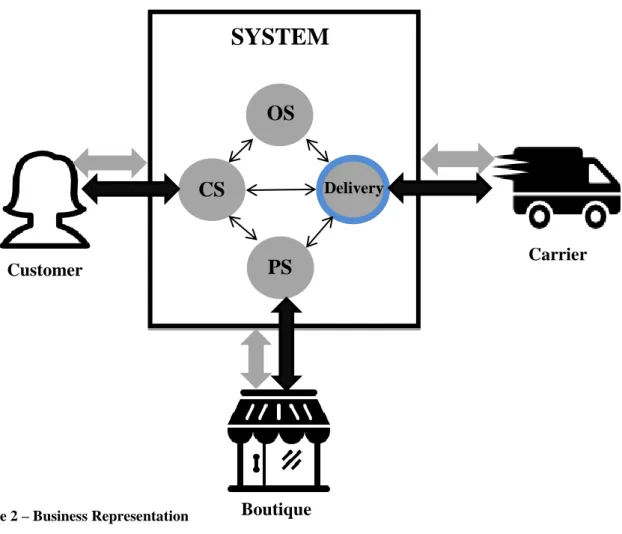
The delivery team works as a bridge between Farfetch and courier services. It is called to take action on issues that involve delivery services on a bilateral relationship where both other Farfetch’s departments and transportation companies require the team’s action when needed. This relationship is presented on the following diagram:
Figure 2 – Business Representation
Figure 2shows interactions between the outside stakeholders with the internal ones. While grey arrows represent interactions with the system (typical from normal procedures involving order processing) the black arrows represent situations where issues require internal departments to take action. While all internal departments communicate with each other, external stakeholders’ communications are assigned to different departments: Customer contacts CS, Boutiques contact PS, and Courier services contact Delivery (highlighted in blue).
The Delivery team is therefore the bridge between Farfetch and transportation companies. Deeper analyses on the team’s role are developed further on.
SYSTEM
CS
OS
PS
Delivery Customer Carrier Boutique3.2 Structure
The team’s structure is divided into three sections, spread throughout three cities (Porto, Los Angeles and Tokyo) in order to make its services available for all time zones. This is necessary due to the fact that the team’s responsibilities are non-stop, as delivery/transportation issues keep happening all over the world, and there’s a need to have the department online in order to solve them.
3.3 Core Activities
3.3.1 Order processing
As stated before, the team’s responsibilities involve all the transportation/courier related issues. This includes a vast number of tasks and processes. The following scheme represents the order processing flow
Supervisor + 9 Agents
3 Agents + 1 supervisor 1 Agent
Figure 3 – Delivery team’s structure
1 & 2 3 & 4 5 & 6 7
The following explanation of the order processing flow, will help to understand better the types of situations that represent the daily work of the team:
1.Check Stock the boutique checks the availability of the product once the order is placed. 2.Approve Payment Payment’s legitimacy is analyzed, the order will only be accepted if
the customer is concluded to be trustworthy; Delivery might be called to contact carriers in order to investigate a customer.
3.DecidePackaging the boutique decides the type of packaging according to the item(s)
dimensions and prints the documentation related to customs that might be needed to include in the order.
4.CreateShippingLabel system automatically generates shipping documents. The order
might get stuck in this step and Delivery needs to take action either to generate AWB’s that due to some type of errors didn’t get generated automatically or because order has some restrictions (import restrictions to some countries).
5.SendParcel the boutique prints the AWB, attaches it to the order, and the package is sent
to customer’s address. If the carrier’s scanning misses, it’s Delivery’s duty to contact carrier to update the system.
6.Parcelintransitthe path of the order since it leaves the store until it reaches customer’s
hands. Delivery proactively checks tracking status and also responds to requests coming from other departments to act on certain issues (Customs Holding, Missing orders, RTO’s, Redirections.)
7.OrderReceived Customer receives the order and this concludes the process, but if the
customer isn’t satisfied delivery might have to take action either to investigate eventual damaged during transit.
3.3.2 Return Process
The team also acts in the return process:
1.Book ReturnCustomer creates and books return on the system.
2.Return in TransitReturn is in transit to boutique, Delivery might be call to act in the
same modules as when the order is in transit.
1 2 3 4
3.Verify Return Boutique verifies return. If it’s accepted customer gets refunded. If its
rejected customer (for example package may arrived with damage, to the wrong boutiques or it was returned without using Farfetch’s website to book and create the return resulting on unidentified returns and deliveries to boutiques involving charges)the delivery team is called to investigate the situation in order to evaluate if customer should be refunded or not.
4.Validate Refund According to the verification of the return, the customer’s refund is
accepted or not, Delivery team might help in this validation.
3.3.3 Slots
Slots are collections sent by boutiques to Farfetch’s headquarters to be photographed in order to create content for the website. These slots are then sent back to the boutiques after photographed. These are packages that are transported with very tight timings, and that involve big values. The delivery team acts in order to created documentation that might be needed to include in the transportation of the slots, as well as in any issue that might happen during the transportation.
3.3.4 Other Activities
There are other processes that the team might have work related to. These processes include more specific situations, for example when a customer wants to send an item to repair, or when some countries need specific documentation to include with the order and the team proactively generates that documentation to send to the boutiques before the order gets sent.
3.4 Working methods
Communication is the center of all work done by the team. Being an issue solving department that deals with the interactions between Farfetch and carriers, communication has a determine role on the teams daily job.
Communication is made using Skype, when it involves informal nature, Outlook for general communications, and Zendesk for issue handling tasks, being the most important and used method of communication.
Zendesk is a ticketing tool that helps process requests from both external and internal agents. It is also the center tool of communication for other Farfetch departments that work within a ticket solving nature.
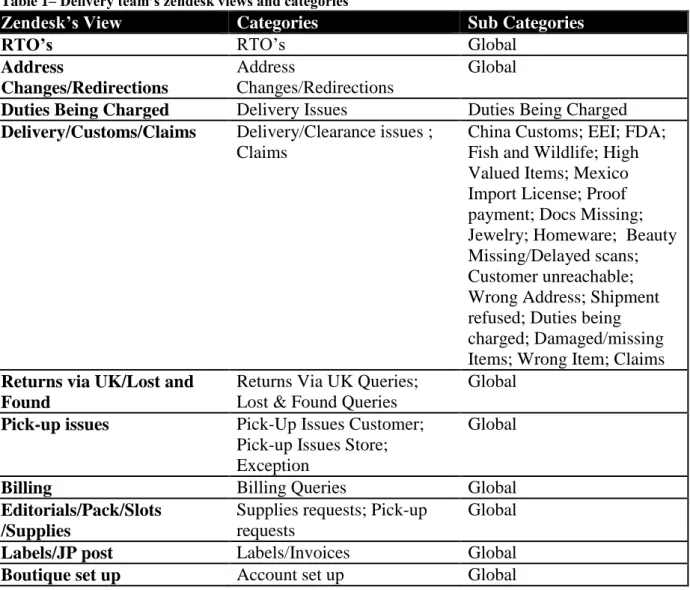
In the Delivery team, tickets enter and are categorized accordingly to the type of issues that they refer to, and wait in their respective pools for agents to pick them up and assign them to themselves. For internal tickets this categorization is made by the teams that send the tickets to the delivery team, for external communication this categorization is made by the agent who picks up the ticket first. Each Agent is assigned to a specific view that contains one or more categories in order to have a more organized work method.
Table 1 represents the views and categories for tickets that enter Delivery’s account. The categorization of tickets will make them to be divided throughout the different views. This will help Agents to work in separate visions and have an organized workflow.
Table 1– Delivery team’s zendesk views and categories
Zendesk’s View Categories Sub Categories
RTO’s RTO’s Global
Address
Changes/Redirections
Address
Changes/Redirections
Global
Duties Being Charged Delivery Issues Duties Being Charged
Delivery/Customs/Claims Delivery/Clearance issues ; Claims
China Customs; EEI; FDA; Fish and Wildlife; High Valued Items; Mexico Import License; Proof payment; Docs Missing; Jewelry; Homeware; Beauty Missing/Delayed scans; Customer unreachable; Wrong Address; Shipment refused; Duties being charged; Damaged/missing Items; Wrong Item; Claims
Returns via UK/Lost and Found
Returns Via UK Queries; Lost & Found Queries
Global
Pick-up issues Pick-Up Issues Customer; Pick-up Issues Store; Exception
Global
Billing Billing Queries Global
Editorials/Pack/Slots /Supplies
Supplies requests; Pick-up requests
Global
Labels/JP post Labels/Invoices Global
Boutique set up Account set up Global
Zendesk’s overview can be seen in the following two pictures. The first one represents the pool of tickets with the one of the views selected. The second represents the window for creating a new ticket.
Figure7 –Zendesk’s New Ticket Window
To represent the usability of Zendesk it’s presented its use case:
An agent can pick up a ticket from the pool in order to assign the ticket to himself, create a new parent ticket to start a new issue to be solved, create a child ticket, to send a new ticket associated with a parent ticket, categorize the ticket according to the category it is related to, share a ticket with one or more internal departments, and send the ticket to an external entity. Every time a ticket is picked up by an agent he/she becomes the assigned agent and every time an agent creates a new ticket he/she becomes the requester of the ticket.
Tickets are also qualified with different status: the “new” status represents a previously unassigned ticket waiting to be picked up, "open” means that the request has been assigned to an agent who is working to resolve it. “Pending” means that the assigned agent has a follow-up question for the requester. “On-hold” means that the sfollow-upport request is awaiting a resolution from a third party (an entity that doesn’t have a Zendesk account) and solved means that the agent has resolved the support issue. Until a ticket is closed by the requester he/she can reopen the ticket. For example, the requester may not agree with the agent that the
Zendesk Create Parent Ticket Create Child Ticket Pick-up ticket from pool Categorize ticket Share Ticket
internally Send ticket to
external entity
Agent
Figure 8 – Zendesk’s Use Case
Parent ticket Ticket that first originated issue on the team’s side.
Child Ticket Ticket that is created based on a parent ticket.
support issue is resolved and reply back to the ticket solved email notification. Finally, closed means that the ticket is complete and can't be reopened.
3.5 Team’s Pains
The teams’ pains mostly come from two different events.
One is the dependency that other departments have in Delivery to solve a great number and variety of issues, resulting in the team not always being able to handle the big flux of tickets they are given, contributing for an undesirable level of backlog.
The second comes from the company’s big growth in a short period of time. This made it hard to adjust the reality and the working methods to the new dimensions making problems like communication, lack of standardized processes and an absence of inter-departmental connection to appear. It also contributed to gaps in the team’s performance, and specifically adding value to the backlog as well as compromising the quality and effectiveness of the team’s work.
Picking-up from what was written in the literature review, on a luxury e-commerce business, service excellent is a crucial objective, and so if there are issues verified in a vital department for customer satisfaction such as Delivery, it requires special attention and actions taken as soon as possible.
This brings us to the relevance of this project, which is to go into deeper analyses of the presented problems, in order to understand the best ways to address them, and to find possible solutions that can help the Delivery team to achieve a better performance.
3.5.1 Tickets and backlog
To better understand the undesirable levels of backlog that the team faces it is presented a chart with the different ticket categories and their tickets waiting for resolution distributed by the time they’re waiting in queue (values for April 31st).
Figure 9 – Delivery Team’s Backlog by Category on April 31st
On figure 9 it can be observed that there is a high volume of tickets waiting resolution, with some categories having more expressive values than others. Many of these values are not satisfying because for almost all categories, there are tickets with measures of full resolution time that will break the defined Service Level Agreements (SLA’s) by a large amount.
0 20 40 60 80 100 120 01-03 04-06 07-10 11-15 16-30 30-60 < 60 (Days) Address changes Billing queries Claims Clearance issues Delivery issues Returns via UK RTO’s Other
200.000 400.000 600.000 800.000 1.000.000 1.200.000 2010 2011 2012 2013 2014 2015
Number of orders
Total The delivery team’s SLA’s currently are fixed:• Average Full time resolution (marked in red on the Chart)should be not greater
than five days (80%). This indicator represents the time since the ticket first enters the delivery team’s Zendesk until its closed shouldn’t surpass five days for 80% of the tickets. • Average first time reply should be not greater than five hours (80%) This means
that the time past between a ticket first entering the delivery team’s Zendesk and its first answer shouldn’t exceed 5 hours;
As for the first SLA it can be observed that many categories are contributing for its breach, having numerous tickets with 5 or more days of age waiting in queue, and a considerable amount of them with ages over 15 days and up to 60 days, being the more expressive ones Billing Queries, Clearance Issues, Delivery Issues and RTO’s.
As for first time reply, it is easily concluded that with undesirable levels of backlog for pending tickets, this volume of workload will indeed affect the team’s performance on this indicator, as it compromises the team’s attention to new tickets entering the pools.
These numbers are , therefore, not satisfying and the team requires some level of intervention in order to lower this values to levels of backlog that fit more the SLA’s in order to be able to improve the overall operations performance and, naturally, the customer satisfaction.
3.5.2 Growth consequences
As it was mentioned before, Farfetch was a company that verified considerable high levels of growth since its existence. This expansion on such a small period of time, made it hard for the company to adjust its reality in order to keep up with the verified growth. What once worked for a small startup company, it is now outdated or unfitted for today’s dimensions.
Problems started appearing, two of the main ones being the lack of an optimized and appropriate communication and processes missing on standardization and therefore not delivering consistency on their outcome. While these types of problems weren’t so visible on a smaller dimension, where people’s proximity was a lot bigger, and where the job roles weren’t as segmented, with today’s departmental increase and division, these issues are part of the day-to-day working reality.
As it can be seen on the chart, the business volume grew exponentially and consequently the employee number rose as well on the course of the past 5 years, contributing for the growing pains that were described before. Specifically for the delivery team, an increasing number of orders (and obviously countries for which customers place the orders) results on a larger daily number of issues that many times, hiring new agents doesn’t present itself as the only necessary modification. Also, being a department on which other departments depend largely upon, the growth on employees on other sections will contribute for an increase of workload for the team.
3.6 Improvement opportunities
To address the problems stated before, the team’s working methods were closely observed. In this section it is presented the analyses done on those working methods that resulted on the identification of two improvement opportunities in which work will be develop and based upon, in order to improve the team’s performance, as well as to guarantee better levels of consistency on their work’s outcome
3.6.1 Communication Improvement
The first improvement opportunity is to implement a way to guarantee effective and efficient levels of internal communication, to achieve an improvement on the levels of backlog and subsequently on the some of the indicators that are behind the measurement of the team’s performance.
To better understand the gap existing on this matter, it is presented a simplified version of the process “Damaged Parcel” in order to situate some of the flaws related to communication that were found.
Picture 11 – Damaged Parcel Process Map
Looking at the damaged parcel process map (picture 11) , the customer sends his complaint to CS that will transmit the information to Delivery, and then this information will be sent to the carrier , that will start an investigation in order to accept or decline the claim based on the damage photos and description. The typical problems that might appear in this process in terms of communication include:
Email CS about Damage Send ticket to Deliver y Send ticket to carrier Start Investig-ation Inform CS Inform and flag Inform CST Refund CST Refund Farfetch Accept & Send Claim Docs Accept Claim? NO YES Custo m er CS De li v er y Ca rr ier
• Sharing of extra content with teams, (Example for picture 11: when sending the first
message the carrier, include both the Delivery team’s text plus the original message sent by CS, making it harder for the other side to be quick in understanding the problem);
• Messages sent with incomplete information, resulting in extra interactions that
waste time (Example for picture 11, when sending the documentation to the carrier, some documents might be forgotten and carrier will have to request them again);
• Internal notes submitted after ticket is solved, reopening the ticket on the other
teams side, (Example for picture 11: once carrier accepts the claim and refunds Farfetch, agents sometimes solve the ticket and write an internal note with the refund value, reopening the ticket on CS’s side, contributing for extra added ticket resolution time);
Looking at picture 12 that represents the use case for the interactions involving Zendesk in this process, what wants to be achieved is that communications involving different agents (represented by different colors) are dealt with using different associated tickets (on a parent – child relation), to keep agents from sharing parallel conversations with each other. Additionally it is also important to guarantee that each communication has the necessary information to keep the interactions to a minimum and allowing faster answers. Even though those are the best practices that should be used by agents, that is not what happens as it was explained.
Further explanations and a complete development of these solutions will be explored in the next chapter.
Picture 12 – Damaged Parcel - Use Case Zendesk
Email CS (parent ticket)
Answer customer
Send child ticket to delivery Delivery Zendesk CS Agent Delivery Agent Customer Request Refund customer Answer Delivery Accept Claim CS Zendesk Courier Answer CS (parent ticket)
Send child ticket to DHL
3.6.2 Return to Origin - Process Standardization and Re-engineering
The second improvement opportunity consists on an attempt to standardize the workflow of the team, that as it was stated before, lacks of a generally accept methodology on many of its processes. Since it wouldn’t be possible to address all processes during the time for which this project was developed, it was decided that the process that would be mapped, standardized and re-engineered would be the Return to origin process (RTO). The reason for this choice is that looking at the categories for which the team has a bigger amount of backlog, whereas Billing processes (where boutiques are billed for unknown invoices) depend a lot on external entities and so it’s somewhat out of the company’s control to improve and Clearance/Delivery issues are general categories that include a vast number of different processes (and
sub-categories) as shown before, RTO is a category for which one single process is associated with, and it still ranks as one the categories with the biggest amount of backlog.
For that the process will be analyzed, alongside with some of its sub-processes, in order to understand the causes of the existing problems that make this process a center of attention when addressing the team’s main concerns.
RTO – AS-IS
The process of RTO is a process where a department requests the return of package to its origin before it reaches its destination. This might happen because of fraud detection, wrong item’s shipped, customer cancelling the order, among others.
From the Delivery team’s point of view, the requester asks for the RTO and the team will then track the package to understand if the RTO is possible (the order might have already been delivered). If it’s possible, carrier is asked for a RTO that will then try to recover the package on time. In this phase the carrier might require a document justifying the RTO reason (RTO letter).
If the package is not recovered, the RTO fails and Delivery will warn the requester that it wasn’t possible to recover the package and then the department will act accordingly. If the carrier successfully recovers the package, then it gets sent to the origin, and the RTO AWB is sent to delivery, that will then inform the requester, create the return on the system and monitor the package until it reaches the origin (during transit extra documentation might be needed). Once package reaches destination, the ticket is solved. For better understanding see figure x.
Looking at the Order Support point of view, before submitting the request to Delivery, after a fraud suspect is detected, the team will check in which step the order is, and if it’s before step 5, the boutique is warned, and the team cancels the order. If the package is in step 6, then the team asks Delivery to request a RTO. If the RTO is succeeded, the team receives the
confirmation, requests refund to customer and creates return on the system.
Order Support is the department responsible for approving the orders submitted by customers after analyses on whether they are legit or not. The reason why the Order support perspective is presented is to show that the process of creating return on the system is thought by each team to be their responsibility, representing a problem that needs to be solved.
Figure 13 – RTO Process Map(Delivery Team Perspective)
vv vv
Order Support PS Boutique Delivery CS Carrier
Create Ticket requesting RTO Create Ticket requesting RTO Create Ticket requesting RTO Track order on carrier’s website Tracking Status? Request Manifest Report Request Manifest Report Send Manifest Report Send Manifest Report No Status Inform RTO not possible Delivered Request RTO to carrier In Transit Start order search RTO letter required? Request RTO letter Send RTO letter (word file) Item Recovered ? YES NO Inform Delivery RTO failed Inform requester RTO failed Send item to origin Send AWB and costs to Delivery Fill in excel and inform requester Create return on system and monitor Extra docs needed? Generate and send requested docs Solve Ticket YES NO NO YES
Figure 14 – RTO Process Map(Order Support Perspective)
Customer service as well as Partner service might also place RTO requests and both those teams are also not consistent to whom they ask for the return to be created. In fact, customer service has its Back Office section that has capability and responsibility of taking care of some problems related to delivery (RTO included) and this procedure isn’t being adopted by customer service.
The identified problems (in red) are:
The required documentation (RTO letter, LOA, Invoice) is not standardized, and different versions are spread throughout the agents, many times not being the correct ones causing agents to lose time;
While monitoring the RTO, the ticket stays open contributing for unnecessary backlog as many times it does not need extra documentation and so the Delivery team’s action ends when RTO is confirmed;
CS Back Office is capable of performing the RTO requests that come from CS, but many of those requests still are made to the Delivery team.
The process to create the return on the system is not correctly defined, making teams to be creating it without knowing if the other team has already done it. Both teams receive requests to do it causing confusion, and wasting time;
The process to create the return is also ambiguous in terms of the system design and needs to be improved;
What will be implemented is a proposal of improvement to the process that will solve the stated problems throughout the appliance of modifications including: standardization of some tasks and documentation, elimination of unnecessary steps and changing some
responsibilities. Further developments of this matter will be developed on chapter 4.
O S P S D L V
Detect Fraud and flag customer
Order until
step 5? Send ticket to Ps to contact store
Order still in store?
Ask to stop order and inform
OS Cancel order on the system Send ticket to DLV asking for RTO Inform OS RTO Succeed ? Inform OS Send AWB to OS Request refund to customer and create return on system YES NO NO NO YES YES
4 Solutions
In this section there are presented the solutions chosen to solve the problems identified on chapter 3. The goal is to use the studied improvement opportunities to introduce value adding modifications to the team’s working method, in order to fill in the gaps created by the pains found inside the delivery team.
4.1 Communication Improvement
As identified in chapter 3, internal communication is a matter in need of attention in the company as a whole, and therefore in the delivery department. What is explored in this section is a way of guaranteeing that the information flow is optimized, and that the identified flaws regarding communication are overcome, with the purpose of improving the team’s performance, both in qualitative and quantitative parameters. This gains an even bigger importance when we’re talking about a working unit that comprises people from different countries from different time zones and some differences regarding their working methods. Like it was shown on a typical and simple process that represents one of many that the team deals with on a daily basis (figure 11), there are some flaws in terms of communication that this project seeks to reduce and possibly eliminate.
A lack of efficient communications costs organizations, representing a net drain on time, money and effectiveness. Gaps in internal communications also cause companies to miss opportunities and to disconnect messages to stakeholders and audiences.
4.1.1 Scope
The need for this project comes from the whole purpose of this master’s thesis that is improving the overall performance of the team. By targeting the problems existing in the team’s communication environment what is desired is to obtain an optimum level of efficiency, and to reduce wasteful forms of communication that happen in the company. Taking from the conclusions of the literature review, a luxury market environment deals with demand for perfection, and so seeking flawless procedures is a goal that should be buit-in the employees’ motto. This should reflect a search for office lean that seeks optimization and reduce of waste.
As it was stated before, after analyzing the processes and the working methods of the team, communication issues were found that were compromising the team’s performance given space for improvements to be developed.
To solve these problems, this project involved a research onsite in order to propose a communication solution applied to Zendesk that would optimize the team’s workflow, as well as facilitated their work, and the work of teams that work alongside with Delivery. This improvement will be later analyzed. The KPI’s chosen to evaluate the success of this project were:
Average full resolution time average time spent since a ticket enters the pool for the first time until it’s closed;
Average number of reopens average number of times a ticket that was solved was reopened;
Average interactions’ number average number of times a ticket switches from a
team to another;
While the first two KPI’s try to measure the agent’s performance, the last two intend to measure the quality of the ticket (complete information and assertiveness). Naturally there are relationships between the KPIs. If any of them is improved, there will be repercussions extensive to the others.
4.1.2 Action Plan
To illustrate the timeline that this project was based on, it is presented an action plan that reflects both the phases and their goals according to the project’s needs:
Figure 15 –Communication’s project action plan
As it can be seen on figure 15, the communication improvement project was divided into 4 main phases. The first refers to requirements gathering where the main issues where studied, and the first solutions where define and developed. Secondly, the configuration of the solutions was made. This includes structuring the solutions and configuring Zendesk to accommodate them. Thirdly the pilot took place, the pilot agents were selected and their work was followed proactively to improve the project and gather feedback. The pilot was analyzed so that finally the roll out to the whole team was possible with the gathered improvements. In this final phase the work was also observed in order to gather final improvements to finally evaluate the project’s results.
4.1.3 Requirements gathering
Part of this section was already developed on chapter 3, when the problems where observed and identified, and the conclusions where three main problems:
• Sharing of extra content with teams and/or multi-sharing;
PILOT REQUIEREMENTS GATHERING March 13th Study issues Define solutions Understand the tool’s features CONFIGURATION April 11th Define solutions’ structure Insert data on Zendesk April 14th Presentation to pilot group Follow-up/Feedback (Skype group) Improvements implementation Data analysis Features configuration ROLL-OUT May 18th Presentation to the whole team Follow-up/Feedback Improvements implementation Data analysis - April 13th - April 10th - May 17th
• Messages sent with incomplete information;
• Internal notes submitted after ticket is solved causing reopening;
After close analyses to these problems, three solutions were found to help solve the issues stated before.
Table 2 – Communication’s Problem-Solution
Problem Solution
Extra content sharing and multi-sharing Ticket Sharing Guidelines
Incomplete information Macros
Internal notes reopening tickets “My note” field
Ticket Sharing Guidelines
First, to fight unnecessary content sharing, the use of child tickets to communicate with different teams needs to be assured, as shown on use case represented on figure 8.The following picture represents the guidelines for ticket creations that assure that parallel conversations are not shared and that different conversations involving different teams and treated separately:
Figure 16 – Ticket Handling Guideline.
What this picture pretends to show is the flow of how tickets should be dealt with. If a ticket enters the team’s Zendesk, this could initiate three situations:
The ticket involves answering the same team that originally contacted Delivery, and for that the answer should be written in the same ticket;
The ticket involves sending a ticket to a different team that originally contact Delivery, and for that a child ticket should be created;
The ticket involves both answering the team that originally made the contact plus the sending another ticket for other department, and for this case the teams should answer the original ticket, and create a child ticket for the other department;
Another case is if Delivery makes the original contact, and in that case if it involves sending a ticket to two or more teams, then different tickets should be used. These guidelines will solve the issues related to the first problem, and will make the sharing of information more
optimized, so that communication assertiveness can be achieved. Parent Ticket
Delivery
Pool
Answer receiver? Parent Ticket Same ticket Child ticket Same ticket Different team Same teamSame &Different team Child ticket
Child ticket