THE CONTRIBUTION OF 360 DEALS TO THE RECORDED
MUSIC INDUSTRY
Pedro Henrique Mendes Palmeiro
Dissertation submitted as partial requirement for the conferral of Master in Marketing
Supervisor:
Prof. Maria Conceição Santos, Assistant Professor, ISCTE Business School, Department of Marketing, Operations and General Management
iii Acknowledgements
I would like to thank my supervisor, Prof. Maria Conceição Santos, for her patience and support during the preparation of my dissertation. I appreciate all the effort she made in order for me to have the best possible content and clear all my doubts.
I also would like to thank the six respondents I got to interview for this dissertation. Their prompt availability on talking to me and answering my questions were, without a doubt, the most important input I could get in order to develop my work the best way possible.
Last but not least, a very warm thank you every special people surrounding me during the preparation of this dissertation for their continuous love and support.
iv INDEX LIST OF TABLES ... vi LIST OF FIGURES ... vi ABSTRACT ... vii RESUMO ... vii EXECUTIVE SUMMARY ... ix 1. INTRODUCTION ... 1
1.1. Purpose of the study ... 1
1.2. Structure of the thesis ... 2
2. LITERATURE REVIEW ... 3
2.1. The Recorded Music Industry ... 3
2.1.1. Dimension and structure... 3
2.1.2. Value chain ... 6
2.1.3. The role of the Internet in music consumption ... 9
2.1.4. Portuguese market overview ... 15
2.2. The 360 deals: a new relationship between artists and record labels ... 18
2.2.1. New revenue streams ... 22
2.2.1.1. Brand-artist partnerships ... 22
2.2.1.2. Live entertainment... 27
3. FRAMEWORK AND RESEARCH METHODOLOGY ... 29
3.1. Model ... 29
3.2. Research propositions ... 30
3.3. Data collection and research sample ... 31
4. RESULTS ... 33
4.1. The recorded music industry and music consumption ... 33
v
4.3. Most important revenue streams contemplated on the 360 deal ... 38
4.4. The record label’s participation on the 360 deal ... 39
4.5. Benefits and limitations of the 360 deal ... 41
4.6. The fit between the artist and 360 deal ... 43
4.7. The role of brand-artist partnerships ... 46
4.8. The evolving future and contribution of record labels... 50
5. CONCLUSIONS, SUGGESTIONS AND CONTRIBUTIONS, LIMITATIONS AND FUTURE RESEARCH ... 52
5.1. Conclusions ... 52
5.1.1. The need of monetization in the recorded music industry ... 52
5.1.2. The 360 deal as an evolution on the contractual form with artists ... 53
5.1.3. The implications of the 360 deal ... 54
5.2. Suggestions and contributions ... 55
5.3. Limitations ... 57
5.4. Future research ... 58
BIBLIOGRAPHIC REFERENCES ... 59
APPENDICES ... 63
A. Interview Guide ... 63
B. Transcript from the interviews ... 64
B1. Andrea Johnson [Assistant Professor of Music Business at Berklee College of Music, Boston (U.S.A.) and former consultant for record labels] ... 64
B2. Eduardo Simões – President of Associação Fonográfica Portuguesa ... 71
B3. João Teixeira – General Manager at EMI Music Portugal ... 77
B4. Miguel Birra – New Business Manager at Sony Music Portugal ... 86
B5. Paulo Junqueiro – General Manager at Sony Music Portugal ... 92
vi LIST OF TABLES
Table 1 - Global Recorded Music Trade Revenues (US$ Millions) ... 5
Table 2 - Recorded Music Revenue (US$ million, trade value) ... 16
Table 3 - Recorded Music Sales Volume (million units) ... 16
Table 4 - Comparison of terms in Traditional Contracts and 360 Contracts ... 21
Table 5 - Brand investment into music 2010-2012 ... 24
LIST OF FIGURES Figure 1 - Recorded music industry's market shares in 2012 ... 3
Figure 2 - Global Recorded Music Sales 1997-2012 (US$ Billion) ... 6
Figure 3 - Record companies’ value chain ... 7
Figure 4 - Musical Networks ... 9
Figure 5 - Downloading users' profiles ... 11
Figure 6 - Global digital music sales ... 14
Figure 7 - Portuguese recorded music market shares ... 15
Figure 8 - Global digital sales by format (Value) ... 17
Figure 9 - The 360 deal ... 19
Figure 10 - Music branding value for artists ... 25
vii ABSTRACT
The present dissertation reflects on the contribution of 360 deals to the recorded music industry. This contractual form has been arising in order to easily recoup the investments provided by record labels to the artist and to explore other new revenue streams.
The framework of the study is supported by the current state of the industry and an overview of the previous research concerning the recorded music market. Record labels have been struggling for the past years with the decrease of recorded music sales. The digital era has allowed a massification on music consumption, as the Internet has provided easier access to music, whether through new legal platforms but also through illegal downloading.
A qualitative approach was carried out in order to comprehend the new concepts and challenges faced by the recorded companies. Six personal interviews with music executives were conducted, according to a structured guide elaborated, based on the literature review. Combining this data, some previous propositions were made in order to explain the current state of the industry and how 360 deals are being implemented in the industry, namely in Portugal, and its benefits and implications.
This thesis shows exploratory directions, such as: the 360 deals are playing an important role on monetizing the investments from record labels, as the industry does not have to rely exclusively in recorded music sales anymore, participating active or passively on other income sources provided by this contractual form and, at the same time, diminishing the risk attached to the investment made.
Keywords: 360 deals, recorded music industry, revenue streams.
JEL: M31 - Marketing
viii RESUMO
A presente dissertação reflecte a contribuição dos contratos 360 para a indústria discográfica. Esta modalidade contratual possibilita que os investimentos providenciados pelas editoras discográficas aos seus artistas sejam mais facilmente recuperados, bem como para que seja possível a exploração de outras fontes de receita.
O âmbito deste estudo é fundamentado através do estado actual da indústria discográfica, bem como por investigação feita acerca deste mercado. As editoras discográficas têm enfrentado grandes dificuldades devido à diminuição da venda de música. A era digital permitiu que o consumo de música se massificasse, dado que a Internet garantiu um acesso mais fácil à música, seja através de novas plataformas legais, mas também através de descarga ilegal.
Foi feita uma abordagem de estudo qualitativa, de forma a compreender estes novos conceitos e desafios enfrentados pela indústria discográfica. Foram feitas seis entrevistas a profissionais da área da música, de acordo com um guião estruturado, elaborado a partir da revisão de literatura. Combinando esta informação, foram definidas proposições de forma a explicar o estado actual da indústria e perceber de que forma os contratos 360 estão a ser implementados, nomeadamente em Portugal, bem como as suas vantagens e limitações.
Esta tese demonstra que os contratos 360 têm um papel importante na monetização dos investimentos feitos pelas editoras discográficas, não tendo a indústria de depender exclusivamente da venda de música gravada. Assim, esta modalidade contractual permite que a editora participe activa ou passivamente noutras fontes de receita, diminuindo o risco associado ao investimento feito.
Palavras-chave: contratos 360, indústria discográfica, fontes de receita.
JEL: M31 - Marketing
ix EXECUTIVE SUMMARY
The present dissertation reflects on the contribution of 360 deals to the recorded music industry. As the industry reflects an increasing need of monetizing the investments, a new contractual paradigm has been arising in order to easily recoup the investments provided by record labels to artist and at the same time to explore other new revenue streams which once were granted exclusively to the artist.
The framework of the study is supported by the current state of the industry and an overview of the previous research concerning the recorded music industry, separated in two sections. In the first section, it is further analyzed (1) which are the players in the recorded music industry, types of companies (major record companies and independent labels), the relationships that are established between the two, (2) how the research and development (“A&R”) is key for the development of the industry, (3) the traditional value chains and players involved to create and sell recorded music, (4) the impact of the Internet on music consumption and development of new digital platforms and (5) an overview of the Portuguese market, in order to enhance its specificities. In the second section, it has been enhanced how (6) the 360 deals are seen a new contractual form for the monetization of the record label’s investments and (7) the importance of new revenue streams contemplated on this deal, such as brand partnerships and live entertainment. As a result of this analysis, it has been concluded that record labels have been struggling for the past years and recorded music sales have been decreasing for the past decade, with small signs of recovery. The digital era has allowed a massification on music consumption, as the Internet has provided easier access to music, whether through new legitimate legal platforms but, on the other hand, through illegal downloading. As the market is not remunerating record labels like it did in the past, resulting in a lower monetization of the investments made on the artists, the industry has to reinvent itself and has recently started to seek new revenue streams that once were granted to the artists. As record labels finance the artist to get exposure and success, through a 360 deal the record label is receiving a percentage of other revenue streams, as those would not be generated if there was no upfront investment made in advance.
A qualitative approach was carried out in order to obtain a deeper comprehension of the new concepts and challenges faced by the recorded companies. Six personal interviews
x with music executives were conducted, according to a structured guide, based on the different sources included in the literature review. Combining this data, some previous propositions were made in order to explain the current state of the industry and how 360 deals are being implemented in the industry, namely in Portugal, and its benefits and implications.
This thesis show exploratory directions, such as: the 360 deals are playing an important role on monetizing the investments from record labels and the industry does not have to rely exclusively in recorded music sales anymore, participating actively or passively on other income sources provided by this contractual form. In order to diminish the risk attached to the investment provided by the record label, new artists are now being signed under this contractual form. Although this process is still under development, especially in the Portuguese market where record labels are still participating passively on exploring these revenue streams, the industry is moving into participating actively on exploring other areas than recorded music.
1 1. INTRODUCTION
1.1. Purpose of the study
The main purpose of this dissertation is to characterize the 360 deal, enhancing how it may benefit the record music industry in monetizing its investments in artists and the challenges attached to the implementation of this contractual form.
The recorded music industry has been facing major difficulties over the past years. The sales of recorded music in physical format have been decreasing and the sales in digital format aren’t compensating the loss of the physical sales.
As a result, it has been verified the need of changing the contractual form between record labels and music artists (previously focused on the sale of recorded music in physical and digital format) to a broader extension of revenue streams. The emergence of the 360 deals between artists and record companies materializes this current need, allowing these companies to participate in other revenue streams generated by the artists, such as image rights, brand partnerships, live shows, merchandising, among others. Although in early stages of implementation, the trend on the market reflects an increasing adherence to this contractual form between record companies and artists. Therefore, this dissertation analyses the generic proposition that record companies are changing the contractual form for signing their artists and, at the same time, diversifying their revenue streams.
In order to understand what the real impact of this contractual form is, a qualitative research has been developed with six interviewees through personal interviews, whose professional experience is relevant to provide information regarding this new evolution on the contractual relationship between artists and record labels.
Although it is verified an increasing trend for the industry to operate, partially or in full effect, to this contractual form, only a small part of the record labels are participating actively in exploring these additional income sources, especially in the Portuguese market.
2 1.2. Structure of the thesis
The present dissertation is composed by five chapters:
Introduction: This chapter includes the context of the generic proposition which is going to be analyzed in this dissertation;
Literature review: In this chapter, it is provided an overview of the recorded music industry on its dimension, structure, value chain and sources of income. It is also analyzed how the Internet has contributed for a diversification of recorded music consumption. Lastly, the description of what the 360 deal is, its main differences and advantages compared to a traditional contract and also an exploration of two revenue streams contemplated on this deal: brand partnerships
and live entertainment;
Framework and research methodology: This chapter includes the research propositions that shall be analyzed in the ‘results’ section;
Results: In this chapter, the main findings in regard to the research propositions will be explained followed by the main exploratory conclusions for each proposition;
Conclusions: In this chapter there will be presented the main conclusions of this study, limitations and topics that may studied in future research.
3 2. LITERATURE REVIEW
2.1. The Recorded Music Industry 2.1.1. Dimension and structure
The recorded music industry is defined as an oligopoly, a market in “which a few firms dominate. When a market is shared between a few firms, it is said to be highly concentrated. Although only a few firms dominate, it is possible that many small firms may also operate in the market” (Economics, 2013). It is composed by four major record companies1 (“majors”), accounting for around 75% of the market – Sony Music Entertainment, EMI Music, Universal Music Group and Warner Music Group – and independent labels2 (“indies”). In 2012, the players on the market had the following market shares:
Figure 1 - Recorded music industry's market shares3 in 2012
Source: Music & Copyright (2013)
1 Record companies own a variety of record labels. For the purpose of this dissertation, the terms “record
company”, “record label” and “label” mean the same, as they will always refer to the company, whether it integrates different record labels or not.
2 A record label not owned by one of the four major record companies. Independent labels may have their
recordings distributed by one of the big four major record companies and still be referred to as “indies" (Hull, Hutchison & Strasser, 2011).
3 Universal Music Group has recently bought EMI Music. For the purpose of this dissertation, both
companies will be considered as separated, as the statistics for 2012 do not consider this acquisition.
7,1% 22,3% 31,7% 14,8% 24% EMI Music Sony Music Entertainment Universal Music Group
Warner Music Group Independents
4 Even though the recorded music market worldwide is highly concentrated, both major record companies and independent labels have strong relations. It is a common practice for major record companies to be involved with independent labels through taking over contracts and buying independent labels when they find the artists on that same label are becoming successful. When labels are bought by a major record company, the independent company may be able to keep working under its own label, having a certain independence to develop its own work on finding talent in niche markets, where major record companies don’t have the same level of understanding (Leurdijk & Nieuwenhuis, 2012). In fact, major record companies have always relied some of their research and development of artists on independent labels – “65% of the major’s (record companies) sales of catalogue albums – music that is at least 18 months old – comes from artists originally signed by independents” (The Economist, 2004).
In the recorded music industry, research and development for talent is reflected through A&R – Artists and Repertoire. Record companies have invested US$4.5 billion worldwide in A&R and marketing, representing 16% of the total industry revenues in 2011 – a higher percentage when compared to other industries, such as Pharmaceuticals & Biotechnology (15.3%) or Software & Computer Services (9.6%) - even when only a small amount of acts who get to be signed to a label achieve commercial success, reflected on a ratio of five in one. In an interview to the International Federation of the Phonographic Industry (IFPI, 2012: 9), Nick Gatfield - Chief Executive on Sony Music United Kingdom - refers to A&R as “the lifeblood of the business (...). No other industry even begins to take the level of R&D risk that we do” and despite the contingencies on the market, “nothing has changed in terms of our level of investment in artists" (IFPI, 2012: 9) and one in four of labels' rosters is a new signing.
In the era of the Internet, A&R teams are now able to spend less time physically looking for acts with music potential, as they can monitor the Internet for new acts. This represents a shifting from a ‘seed stage’ to a ‘later stage’ investing in artists, which results in a process more focused on attracting stable emerging artists rather than unproved artists (Bhatia et al., 2001).
5 The IFPI (2013) identifies the four traditional sources of income in the recorded music industry:
Physical revenues - Includes sales of all physical formats, including CD, vinyl and cassettes. CD sales ordered from Internet retailers also account as physical sales; Digital revenues - downloads, mobile products and subscription income:
o Downloads: Includes audio single tracks, full albums and music videos; o Mobile: Includes mastertones, ringback tones, dedications and voicetones; o Subscription: subscription’s services’ premium tier and income from
bundled subscriptions (e.g. part of an ISP/mobile operator tariff);
o Ad-supported income: ad-supported streams and video-on-demand services.
Performance rights - revenues from music licensing companies for licenses granted to third parties for the use of sound recordings and music videos in broadcasting (radio and TV), public performance (nightclubs, bars, restaurants, hotels) and Internet uses;
Synchronisation revenues – royalties4 from the use of sound recordings in TV, films, games and adverts within a certain territory.
In 2012, global recorded music sales totaled US$16.5 billion, reflecting an increase of 0,2% comparing to 2011, showing the consolidation on the digital sales, diversifying revenue sources and continuing to invest in new talent.
Table 1 - Global Recorded Music Trade Revenues (US$ Millions)
2011 2012 % change Physical 9,893 9,403 -5,0% Digital 5,371 5,798 +8,0% Performance rights 862 943 +9.4% Synchronization 330 337 +2.1% Total market 16,456 16,481 +0.2% Source: IFPI (2013)
4 “Payments to writers or performers due from the sale of copies, performances, or other uses of their works”
6 The digital revenues from music sales, which accounts now for 35% of the global music sales, have been increasingly growing since the beginning, reflecting on an 8% growth comparing to 2011. Despite the steady decrease, the physical format has accounted for 57% of the global music sales in 2012 and it still is the format which contributes the most for the global recorded music sales.
Figure 2 - Global Recorded Music Sales 1997-2012 (US$ Billion)
Source: IFPI (2013)
2.1.2. Value chain
Having major record companies a consolidated position on the market, they often establish distribution deals with independent labels, so indies can focus on specializing themselves on searching and finding music potential on new artists , while majors will amplify the release with marketing and intensive commercial exploitation (Calvi, 2006a). Therefore, major record companies focus on a massive exploitation of their national and international catalogues, establishing themselves on the most relevant and profitable territories, debuting local artists and promoting international artists (Calvi, 2006b). The dominant economic model of major record companies rely on the “star system”, aiming to focus on a concentrated few stars, as the success of some artists is enough to make up for the incurred losses with the rest of the catalogue (Moreau, 2009).
Alexander (1994) stresses the idea that the network of distribution in the music industry is very concentrated. This evidence results in a limited access to distribution from small
7 independent record companies, who tend to be product innovators, as they usually rely on major record companies for distributing their products. As a result of this domination on the market and need from the independent labels, Lopes (1992) also reflects on the dominance on avenues of exposure, such as radio and TV. These media gatekeepers have significantly limited space to radio airplay for independent releases, providing “significant inducement for independent musicians and labels to enter the fold of the major record companies” Lopes (1992: 68).
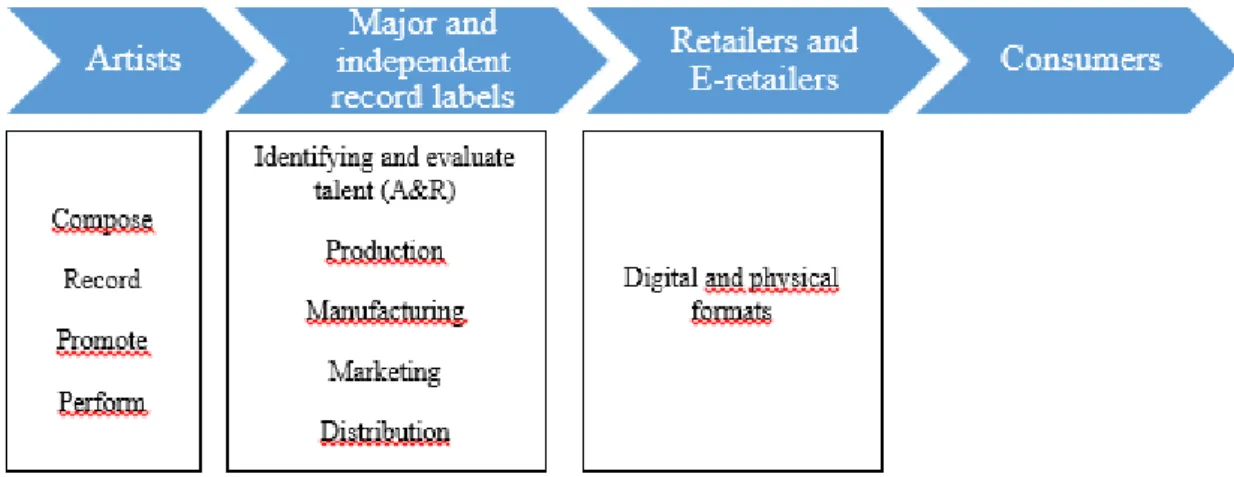
The distribution channels and the division of labour in the music industry have been generally stable over the past years: artists take care of music production, record companies promote and distribute the record to consumers (Graham & Burnes, 2004). The following scheme shows the traditional value chain for the record companies:
Figure 3 - Record companies’ value chain
Source: Leurdijk & Nieuwenhuis (adapted, 2012)
Major record companies rely of a high vertical integration of activities and resources, having a sequential logic of activities in a linear value creation process. (Graham et al., 2004). On the other hand, independent labels have the need to create strategic alliances with major record companies (Mol et al., 2005), as majors have been able to reach economies of scales in areas such as recording, reproduction and distribution of the records (Burnett, 1996).
8 However, the process to have recorded music in the market is complex and record labels are heavily involved in most of the process. Leyshon (2011) identifies four different networks within the value chain of the recorded music industry, stressing “its complex and often messy organisational structure” (Leyshon, 2011: 60). The author highlights how record companies participate in the different flows within most of the following networks:
Networks of creativity: Centres of musical knowledge with the required technical competences to be able to compose, perform and record music. These networks play an important part on influencing the ways in which music circulates. Record companies are also active in networks of creativity, as they provide the initial contracts and money needed to hire specialised workers such as record producers, sound engineers and recording studios, in order to produce a music content output.
Networks of reproduction: Based upon mass production emphasised on economies of scale, record companies have their own manufacturing affiliates in strategic regions of the world. This results in savings for the company and orders efficiency;
Networks of distribution: The copyrighted product as an output is delivered from distribution companies to retail outlets or mail order companies. The distribution process is highly concentrated and largely controlled by major record companies, sharing 85% of the distribution market.
Networks of consumption: This network is made of small independent specialist shops and the recorded music departments of retailers, e-Retailers and department stores. This network is highly lucrative, as music retailers may take margins of 25% of sale price.
9 Figure 4 - Musical Networks
Source: Leyshon (2001)
2.1.3. The role of the Internet in music consumption
As a result of the large domination on the market throughout the 70s, 80s and 90s, major record companies had an important control on music talent and consequently what consumers would listen to (Spotts, 2010). In the cultural industries, in which the recorded music industry is part of, the value of the cultural goods derives from subjective meanings, as there is no particular evaluation method to compare people’s tastes. By enlarging the opportunities for consumption, the level of uncertainty leads to a large range of differentiation choices and allow new generations to different ways of consumption, such as downloading music or surfing a library’s digital archives (Molteni & Ordanini, 2003).
The growth of Internet and increasing use of digital technology in the distribution of music have resulted in significant transformations in consumer’s behavior. The CD technology (compact disc), which has been dominant during the 80’s and 90’s, is no longer the only way to purchase music. The rise of the MP3 format, a digital audio compacted archive which can be stocked and reproduced in high quality in computers or
10 portable devices, is seen as the main driver on the evolution of music consumption (Castro, 2007). Record companies weren’t aware on the impact of the MP3 in the recorded music industry, as they were informed about this technology very early in the process, but weren’t interested on it. Once the MP3 format became widespread at the end of the 1990s, CD sales were still growing and record labels thought that putting digital files online could be an encouragement and instrument of piracy on peer-to-peer sharing networks (P2P) and not a potential market of online sales. As broadband Internet access was transforming online music on a market of interest to mainstream consumers, the inertia of record companies allowed other actors to take control on distribution of digital content (Moreau, 2009). In 2003, Apple Computer launched iTunes online music service, with a vast library of songs from different artists and labels. The songs could be purchased individually and were priced at US$0.99 each, users were now able to listen to a 30 seconds preview of a song for free and organize their music libraries into customized folders in their computers. In August 2005, Apple as already sold more than one billion songs only in the United States of America and established itself on the legal music purchase market, accounting for 82% of legal sales in the U.S.A. (Choy & Perez, 2007). For the past years, the music industry has been attempting to reduce illegal pirating of music through legal and technological approaches, such as embedding anti-copying codes in CD’s and suing individuals who were trading copyrighted files on music websites illegally, making consumers feel like criminals (Choi & Perez, 2007). Piracy is generally seen as a key-driver for the industry’s current performance - The Recording Industry Association of America (RIAA, 2013) considers that “digital music theft has been a major factor behind the overall global market decline (…), so theft on this scale has a noticeable and devastating impact”, while the IFPI (2013: 5) states that “fighting piracy is a top priority (…) in 2013”.
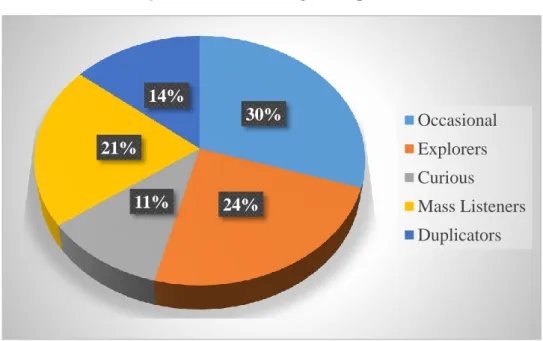
Back in 2003, when the digital music market started to take shape, Molteni and Ordanini (2003) provided a generic categorization on the five profiles of illegal music downloading users:
Occasional downloaders: Moderated interest in accessing, exploring and searching P2P and MP3 websites. These users are mainly interested to enjoy through legal purchasing;
11 Mass listeners: High dependence on P2P websites and low degree of recording of files on CD’s; The users consume music through mobile listening when they are involved in leisure activities and they are not interested on extending their knowledge on the music available. A large share of consumers will not be inclined to pay for downloading;
Curious: High dependence of P2P websites and low interest on recording files on CD’s or mobile listening. Music consumption as a download is a form of pure entertainment;
Explorers: High interest on searching and exploring for new music and attitude of anticipation of future developments. These users use downloading as a way to improve or enlarge further purchases of music consumption and are interested on extensive catalogues and complementary services, i.e., information about artists; Duplicators: High interest on recording downloaded files on CD’s and downloading from MP3 and P2P websites. His download habits will replace the conventional and legal forms of getting recorded music. This consumer is not interested to pay for downloading and CD’s.
Figure 5 - Downloading users' profiles
Source: Molteni & Ordanini (2003) 30% 24% 11% 21% 14% Occasional Explorers Curious Mass Listeners Duplicators
12 From the results above, although some of these profiles clearly show no intention to buy music legally, it seems like piracy isn’t only a medium through illegal consumption: Occasional listeners and Explorers, which account for 54% of total users, are segments that would still buy music back then through legal means. The ease of downloading, convenience, access to digital music catalogues and free of charge stimulated users’ curiosity and desire to discover and evaluate new music and artists.
In the era of the continued growth of the digital music market, a research by Aguiar and Martens (2013) on the measure of the propensity to consume music reflects the effect of illegal music consumption on the online legal sales of digital music. The results show positive and low elasticity of legal purchases with respect to illegal downloading. It means that, although there is trespassing of private property rights (copyright), most of the music consumed illegally would not have been legally purchased if illegal downloading sites weren’t available to the sample, so digital music piracy shouldn’t be a growing concern for copyright holders.
Besides different perspectives on the contribution of piracy for the development of recorded music purchase, Choy and Perez (2007) argue that online piracy has contributed to the creation of legitimate and innovative business models, who took advantage of the innovation offered by piracy, to create economic value. The IFPI (2013: 15) reports that there are currently 500 licensed digital music services operating in over 100 countries which provide “a greater diversity of legal services on a territory-by-territory basis than ever before”. The same source claims the industry is able to “reach a wide range of consumers globally as these services are attracting distinct consumer groups and employing different pricing strategies”. As a result, “accessing, purchasing and discovering music digitally has never been easier and more popular”. The digitization on the recorded music business resulted in the development of the following business models (Leurdijk & Nieuwenhuis, 2012):
Single song downloads: users download and buy individual songs at a fixed price per song (Ex: iTunes, Amazon);
Subscription: users pay for limited download quota per month or other fixed period (Ex: eMusic; Portugal : Music Box);
13 Ad based model in combination with streaming service: songs are streamed to
listeners, also including ways to personalize playlists (Ex: Pandora, LastFM);
Ad based in combination with on-demand downloads: users can download songs in combination with advertising (Ex: Spotify’s freemium model);
Value based pricing model: users determine the price they are willing to pay for downloads (Ex: some individual stores);
Different priced packages: users get extra’s such albums, book, signed copies, apps, etc. in addition to the online access to songs (Ex: Björk’s “app album” Biophilia);
Bundling: Access to music catalogue in combination with other media products, such as mobile phones, iPods or in combination with mobile subscriptions [Ex: Apple developed a limited edition U2 iPod version for sale, carrying the band’s latest album at the time and also back catalogue (Brand Republic, 2004)].
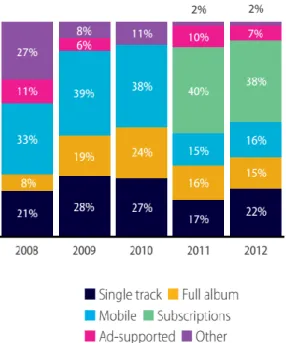
According to the IFPI (2013: 7), the growing digital revenues were “the driving force behind the industry’s positive result in 2012”. Reflecting an “exponential growth in the take-up of digital music services”, digital revenues represented US$5.8 billion in 2012, an 8% increase on 2011. The download model still accounts for the majority of digital music consumption, while there is a growth subscription services, better monetization around music videos and growth in digital radio audiences. Revenues from subscriptions and ad-supported streams continued to increase in 2012, already accounting for a combined 20% of digital revenues globally.
14 Figure 6 - Global digital music sales
Source: IFPI (2013)
Although the digital revenues are tending to grow, they haven’t been able to compensate the loss of physical sales so far, which may happen “because digital music downloads can be bought per song, allowing people to cherry pick and pay less than when they still had to buy the full (CD) album.” (Leurdijk & Nieuwenhuis, 2012: 53)
To sum up, while piracy has led to a higher access to recorded music consumption, digital music has made record companies to embrace new distribution channels, diversifying product features and adopting more flexible pricing models to create different value propositions for specific target audiences (Bhatia et al., 2001). Record companies have then come into accepting the business opportunities the Internet has allowed for the industry’s future and realized there were people who were actually interested on paying for legal online music (The Economist, 2004), although the revenues from digital music can’t still compensate the losses from the decrease of the physical format, therefore resulting in a problem of monetization of the investments made by record labels in recorded music.
15 2.1.4. Portuguese market overview
According to the Associação Fonográfica Portuguesa5, the tracked record companies operating in the Portuguese recorded music industry presented the following market shares in 2012. These data was kindly provided by the A.F.P.:
Figure 7 - Portuguese recorded music market shares
Source: Associação Fonográfica Portuguesa (2013)
The Portuguese recorded music market is composed by three major record companies – EMI Music, Universal Music Group and Sony Music Entertainment – and five independent labels – Farol6, Vidisco, Espacial, iPlay and Ovação - accounting for 27% of the total market.
The physical format is steadily decreasing (which still accounts for 65% of total sales in 2012) and the digital format keeps growing (22% of total sales in 2012), which shows the same behavior as in the global recorded music market. As the opposite of the growth on the global recorded music market, the Portuguese market has been constantly decreasing in value, facing a dramatic drop on revenues since 2008.
5 Associação Fonográfica Portuguesa is an organization whose main functions consist in protecting the
rights of the Portuguese recorded music industry and dissemination of market statistics for their players. AFP is the Portuguese representative of the IFPI – International Federation of the Phonographic Industry.
6 Warner Music Group has licensed its catalogue to Farol, as the company is not running any operations in
Portugal. 21,67% 33,34% 17,64% 9,24% 7,46% 6,94% 2,9% 0,81% EMI Music Universal Music Group Sony Music Entertainment Farol Vidisco Espacial iPlay Ovação
16 Table 2 - Recorded Music Revenue (US$ million, trade value)
Year Physical (US$) Digital (US$) Physical and digital (US$) Performance rights (US$) Synchro -nisation revenue (US$) Total (US$) Total % change 2008 53.9 4.9 58.8 2.3 - 61.1 -9,6% 2009 46.2 3.7 49.9 3.6 - 53.6 -12.4% 2010 36 3.2 39.2 4.2 - 43.3 -19.1% 2011 25 4.7 29.7 4.3 0.3 34.3 -20,7% 2012 19.1 6.4 25.5 3.8 - 29.3 -14,6% Source: IFPI (2013)
The following table demonstrates that the physical format is not only decreasing in value but also in volume. CD sales have been constantly decreasing since 2008, enhancing the reduced interest from consumers on this format. Regarding the digital format, the data evidences the increased interest on purchase of individual tracks, while digital album sales don’t show any sign of growth.
Table 3 - Recorded Music Sales Volume (million units)
Year Physical Digital CD Other physical7 Total Single tracks Digital albums Total 2008 6.7 1.0 7.7 0.8 - 0.8 2009 6.3 1.1 7.4 0.4 0.4 0.8 2010 5.3 0.6 5.9 0.4 0.1 0.5 2011 4.7 0.5 5.2 0.8 0.1 0.9 2012 3.6 0.4 4.0 1.1 0.1 1.2
Source: IFPI (adapted, 2013)
7 Includes CD singles, vinyls, cassettes, DVD’s, Blu-Ray’s and premium physical products (i.e. deluxe
17 Eduardo Simões, President of Associação Fonográfica Portuguesa, considers that “the digital format is the only format growing, but its revenues are not enough for the growth of the Portuguese recording music market’s revenues”, stressing that the market “has all the (necessary) conditions, except for one, so the market can grow, which is an urgent regulation for what is happening on the Internet”, as he believes there is a “generation of consumers which calls upon piracy without any kind of consequences, so that prevents the (Portuguese) market of growing like the markets in other countries” (Diário de Notícias, 2013). Mr. Simões blames piracy as “the main factor, as it was something already identified before the economic crisis in Portugal” for the dramatic situation on the market, which has resulted in “all record companies (…) experiencing huge drops in music sales. This implicates the loss of direct and indirect jobs, closures, mergers and acquisitions, turning it into a poorer industry” (RTP, 2013).
Contrary to the dominance of the download in the global market, the digital Portuguese market shows there is a minor discrepancy between the different formats. Download (single tracks and full album) represents 37% of sales, a much smaller percentage once compared globally, although single track sales are the only format which have grown substantially (5%) in 2012, which reflects the higher interest on buying songs individually. Subscription services represented the higher percentage of the revenue in 2012, by 38%.
Figure 8 - Global digital sales by format (Value)
18 2.2. The 360 deals: a new relationship between artists and record labels
By the early years of the recorded music industry, the artist was contracted for recording albums and it usually involved payments in the form of an advance8 and a royalty per disc sold. All the costs involved – recording, manufacture, marketing and distribution – would be fronted by the record company and some of these elements would be recouped against the artist’s royalties. Many of these deals would not result in success and the record label would incur in losses. More recently, this situation motivated a change in the business relationship between the record label and the artist, where the ways of balancing the risks and rewards have become more diverse. For the last half-century, physical sales were considered the foundation of the record labels’ business, so other revenue streams such as merchandise and sponsorship were secondary to the long-established album, considering that recorded music sales accounted for the great majority of record labels’ income. (MusicTank, 2008).
Recently, it has been verified an evolution on the contractual paradigm of the relationship between artists and record companies. (Karubian, 2009). As labels have been focusing on strictly selling recorded music in the past, they now feel the need to attract revenue sources that go beyond the recorded music. In a 360 deal, record labels receive income from other sources of artist’s earnings, such as live touring, publishing, endorsements and other revenue sources “never before available to them, rendering labels less reliant on music sales” (Basofin, 2010: 4), making the 360 deal represent a “chance to get a cut of something that can’t be copied and shared over the internet” (Forbes, 2012). These different components of the artist’s career incorporated in a single contract have been traditionally handled by various companies through separate contracts (Karubian, 2009). The artist is seen as a business partner and the record label will invest in other revenue sources that might help the success of a particular artist, so the initial investment on the artist’s career gets easily recovered. (Williams, 2010).
8 “A prepayment of royalties or other earnings. For example, a recording artist may be paid a flat sum upon
delivery to the label of a finished master” – i.e., an album - “in advance of earning any royalties from the sale of copies of the recordings” (Hull et al. (2011).
19 Figure 9 - The 360 deal
Source: Hull et al. (2011)
The level of participation of the record label on the revenues contemplated on the 360 contract may be “active”, if the record label provides or manages the rights associated to those revenue streams, or “passive”, if the label simply takes a portion of the artist’s revenue streams from outside deals between artists and other parties (Hull et al., 2011; Gervais et al., 2011). As a recent and flexible contractual model, record labels are still at different stages along the spectrum of having an active or passive participation, as “experimentation continues to be the key” (Wadsworth & Forde, 2011: 9). Some record labels are currently building up expertise in these areas, through acquisition and internal growth of services across new revenue streams contemplated on 360 deals, as a way to provide not only a “centre of excellence” which benefits the artist’s revenues but also record labels themselves (Wadsworth & Forde, 2011). Such process “may involve acquiring new companies in management (…) and producing more nonrecording activities – roles played more traditionally by marketing companies, management companies, brokers and agents” (Hull et al., 2011: 5).
As the investment from the record label incorporates a much wider range of services, the relationship between labels and artists has turned into a flexible “partnership”, sharing revenue streams in a wide range of new activities. A partnership with broader rights
20 reflects an expanded role for record companies and recognition that the upfront payment required by artists is less likely to be recouped strictly from albums and singles sales (IFPI, 2012). By expanding their revenue sources on additional rights from the artists, not tied strictly to music but also to their “image rights”, record companies claim that the artist’s image is “created or at least enhanced by the work of the record company in producing and marketing the album” (Gervais et al., 2011: 2), therefore if it was provided the financial investment to make the artist succeed and if that affects positively the artist’s ability to generate income in areas besides recorded music sales, then the label should be compensated for its efforts. However, labels are taking rights in property and services they have not historically much experience, so artists should be aware of what they are getting in return of sharing their revenue streams (Gervais et al., 2011). Nevertheless, from a “strong resistance” to a deal where multiple rights are granted to the record label, artists and their representatives are increasingly accepting that this is the way to move forward (Wadsworth & Forde, 2011), as the 360 deal is becoming “the norm because what is still seen by some as ancillary income” – nonrecorded music revenues generated by the artist – “will become the principal income streams, at least until access to music is (…) fully monetized” (Gervais et al., 2011: 5).
Karubian (2009) exposes the main differences between the traditional contractual model and the emerging 360 deal. Taking into account that the “360 deal is a new innovation, no contractual paradigm has been established” (Karubian, 2009: 426), so the different components on the contract may vary from deal to deal. Although there may exist some variance, “there is some parity among terms in 360 contracts that (…) signals general shifts in the allocation of revenue generated by music” (Karubian, 2009: 427):
21 Table 4 - Comparison of terms in Traditional Contracts and 360 Contracts
Traditional record contract 360 Contract
Participation Label “participates” only in the business of recorded music.
Label participates in areas beyond their previous focus. Artist development, including “all revenue streams stemming from a
musician (…)”.
Term
Short commitment: labels usually commit to only one album Option to demand up to 5-7 album
cycles for new artists. Established artists have the leverage to demand shorter terms.
Longer commitment. Labels are incentivized to increase
the term, as the investment of the artist’s career may result in
long-term dividends. Newer artists may get longer terms; artists with more leverage
can counteract the incentive.
Record royalties
Artist receives a percentage on the Published Price To Dealers
(PPD):
New artists: 13-16%; Mid-Level: 15-17%;
Superstars: 18-20%.
Likely higher royalty rate allocated to artists, as the company is taking additional
revenues in other areas.
Touring
Sometimes artists are provided with recoupable tour support. The record company encourages
artists on touring to increase record sales, as a way to publicize
a new release.
The 360 model makes labels more supportive of tours, financially and with regards to patience with
time, as longer tours may have long-term dividends and the artist
gets to develop extra skills and develop a fan base.
Financial arrangement
Labels provide a sum of money (recording fund) as an upfront payment, so the artist can pay the costs of recording an album. The
artist retains any excess money from recording funds and collects
royalties once the label is recouped from the recording fund.
Artist receives bigger, unrecoupable upfront payment in
return for granting the company access to various revenue streams.
22 2.2.1. New revenue streams
As mentioned above, by having the artist signed under a 360 deal, the record label will collect other revenue streams from the artist’s career other than recorded music. Image rights are a new component associated to the 360 deal, something which was not granted to record labels under a traditional contract. Therefore, having the possibility to explore new ventures with the artist’s image rights, I shall analyse below the importance of the partnerships between brands and artists. Live entertainment will also be mentioned on this section, as it plays an important role on the music consumption and it is a lucrative source of revenue for artists.
Both components have been chosen to be analysed according to my personal experience in the recorded music industry and also by being the most important revenue streams mentioned by the interviewees on this dissertation.
2.2.1.1. Brand-artist partnerships
Music is an important issue for brand strategy. Music and brands are teaming up on generating and increasing new revenue streams together, as currently “brands devote around 5% of their advertising budgets to music and 41% of brand managers believe that music could be an effective way of building brand awareness.” (Business Wire, 2009). Music has an essence of emotional and there are only a few other elements of a brand that have the power to be as responsive to people’s needs for sensory pleasure and promises of delivery. People relate to brands in a very similar context they relate to people, as they form relationships based on personality, style, image and trust. Music is able to create yearning for a brand, self-confidence and security through ownership, defining a relevant, differentiated and credible value propositions and it may be a deciding factor as whether a consumer might buy a product or service. Although, it is not just the music that evokes the emotion, but the whole brand from that music entity (SongSeekers, 2003). Brands have always developed their logotype, their own specific colours and graphic profile that people associate with, but increasingly they are also aiming to know not strictly anymore how the brand looks like but also how the brand sounds, aiming to have a music profile with a defining tone in the way music is added to their existing graphic profile (Heartbeats, 2009). As a component of brand management with high emotive impact
23 across all target groups, music is everywhere and can be employed in many ways, from the logo’s sound device over to the telephone’s on-hold music, commercials and image films, radio advertising, trade show acoustics, backdrops at stands and in stores and homepages (Sayed, 2012).
Ringe (2009) reflects on the partnerships between brands and artists as an intention to increase brand popularity or to cultivate an image. The image cultivation may be divided in three categories:
Image creation: Considering the novelty value of the brand once it is launched, its image is not yet consolidated with its target groups, therefore brand artists partnership offers the opportunity to build a unique brand image;
Image modification: An existing brand image doesn’t represent the intended image, so brand artist partnership can be used to move the brand image in the desired direction to the target groups;
Image stabilisation: An existing and well positioned brand image requires continuous attention, so brand artist partnerships can help to support the brand image through associations with the artist.
By aligning its interests with music, brands are also becoming credible music tastemakers in an industry where music fans are keen to find new ways to interact with their musical idols. Rather than sponsoring a show or a synchronisation of a track in and ad like has been done in the past, brands are also looking to pursue long-term relationships with artists, looking three to five years into the future, as they realise the return on investment for brands in the music field has not been as high as it could have been (Marketing Week, 2010). Besides synchronization deals, sponsorship and endorsement with artists, brands are now looking up for new ways of aligning music and the creators (artists) behind the songs, exploring new key areas of additional benefits to music fans, such as offering V.I.P treatment and access, enabling fans to get closer to the artists and creating events that are able to deliver true escapism and creating unforgettable memories. The rise of “branded entertainment” is defined by a convergence between brands and the entertainment industry, as an attempt to combine the advertising message with a relevant entertainment content which would not exist without the input of the brand. The communication on an emotional level offers the recipient added benefits, resulting in a stronger brand bonding than through traditional advertising (Ringe, 2009). Therefore, brand’s involvement in
24 music becomes less about playing a certain song and more about the passion, commitment and support they can deliver for music’s most enthusiastic fans (Music Week, 2010). As a reflection on the interest brands have in music, the investments on this field have also grown. As a reference for investments from brands, in the United Kingdom, the 3rd largest market in recorded music in 2012 (IFPI 2013) spent a record over GBP £100 millions in music, an increase of 6.09% from 2011. The artist endorsement (the use of image rights and appearances of artists to endorse a specific brand, product and/or service) and event creation (creation of custom experiential activities), were two areas which had a higher investment in 2012 compared to the previous year (PRS for Music, 2013).
Table 5 - Brand investment into music 2010-2012
Channel 2010 spend 2011 spend % change 2012 spend % change Live Music Sponsorship £32.868.750 £35.111.875 6,82% £33.160.425 -5,56% Event creation £8.125.000 £8.391.500 3,28% £10.270.000 22,39% Artist endorsement £3.523.750 £3.526.250 8,37% £4.684.750 32,85% Digital £7.273.000 £7.728.000 6,26% £10.341.000 33,81% TV £21.840.000 £23.040.000 5,49% £23.367.500 1,42% Advertising support £20.196.000 £20.993.500 3,95% £22.987.000 9,50% TOTAL £93.556.000 £98.791.125 5,60% £104.810.675 6,09%
Source: PRS for Music (2013)
From the side of musicians, a shift is also happening on their relationship with brands. In the past, artists who were seen partnering with brands were accused of selling out, but it has become a more acceptable method of increasing awareness and amplifying reach for artists (Marketing Week, 2010). In an interview to MIDEM (2013), Kristin Thomson enforces that branding opportunities need “to be weighed against artistic integrity and what your fans will perceive you as you start to get involved in different things, so artists and their management, the labels involved just need to think strategically about what it
25 means in their total, what people perceive them as doing. I do think there’s a lot more opportunities out there. I think the combination of those different stakeholders (…) just make sense (…) and music has always been a part of peoples’ experiences, so they are all converging”. Brand partnerships are increasingly important to both artists and record companies, not merely as a revenue source, but also as way to position an artist and introducing him to a new audience, as it is key to see brand partnerships to “deliver value for (…) artists and there has to be a decent level of compensation all around. The credibility of the artist is the most important thing and it cannot be undermined” (IFPI, 2012: 24). By aligning themselves with brands, artists have a financial source of income and are able to increase awareness on their work, as music branding is able to widen their fan base. The association to the brand also provides the opportunity for artists to improve their own image in a positive way through the image transfer effect from the brand and strengthens the relationships between music fans and artists, as the interaction between the two also plays an important part on fan building (Jentetics, 2012). Additionally, if the brand appreciates the process of working with the artist and there’s a visible return on the investment, there is an opportunity of developing a long-term relationship with the artist, ensuring a consistent income stream and additional marketing platforms and audience reach through the brands own consumer database (Henley Business School, 2013).
Figure 10 - Music branding value for artists
26 Considering the important contribution that brands can have for artists, record labels are structuring themselves in order to connect with brands, being more proactive within the area of establishing brand partnerships and having dedicated departments and staff taking care of this area which is now considered to have significant importance (Henley Business School, 2013). As a reflection of the importance in the relationship with brands, EMI Records developed a dedicated unit, EMI Music Special Markets, who claims to “deliver music to (...) consumers in any form, at any time and in any place”, works with their clients in order “to create a custom branded product for their specific needs” as a way “to facilitate brand and lifestyle extension” in promotion, stressing that if the company wants to enhance brand awareness, inspire sales growth, or simply engage with customers, they can meet their goals through the creation of “targeted music programs tailored to (…) brands' specific demographic and strategic needs (EMI Music Special Markets, 2013). Universal Republic is also conscious about how the link with brands may take an important role on the artist’s success, which is why the company even sets up exclusive showcases of its bands for prospective commercial clients. As for companies, the right song can increase brand awareness while, for bands, a corporate gig can mean the difference between their record being unnoticed or successful (Goodman, 2008). Compared with a decade ago, the record label’s teams in charge of dealing with brands and synchronisations are now more involved in the daily tasks of marketing teams at a record label, as they may command the power to provide crucial profile and income to a launch campaign, rather than being seen as a secondary exploitation of income (Wadsworth & Forde, 2011).
To sum up, as music is a powerful tool on conveying emotional attributes of products and services and creating experiences in our lives, it is vital for each party in the collaboration to appreciate the value of each other’s strengths with each partner at one another to work on a long-term collaboration and not on a single transaction, resulting in win-win benefits for both brands and the music industry (SongSeekers, 2003). Brands are no longer outsiders in music creativity and its involvement in music is becoming less about getting the rights to play a song in the music space and more about they can deliver to music fans. On the other hand, artists are also aware of the marketing value of getting strong corporate alignments and its crucial creative and financial contribution for music (Music Week, 2010).
27 2.2.1.2. Live entertainment
The importance of touring is constantly increasing for all types or artists, as concerts serve as another way to distribute their music and allow them to receive a higher percentage of the show’s income that any other record royalty rate could be provided to them. In the last decade, two-thirds of artists’ income came from their records, while concerts, endorsements and merchandise accounted for the other third. An evolution of the importance of the revenue streams have been visible, as the importance of concerts, along with endorsements and merchandise has grown considerably, making them the fastest and biggest growing revenue areas. Artist’s recording contracts used to provide artists with tour support, as record companies used to consider concerts as a mean to increase record sales – “a means to an end, not an end in itself” (Karubian, 2009: 418) – taking into assumption that recorded music was profitable. Now the opposite is taking shape, as recorded music is now a means of marketing an artist and a tool of increasing concert and merchandising revenues. As mentioned on the analysis of the 360 deal, this perspective is being reflected on the way record companies are working with artists, as they are shifting their focus to participating in more profitable ventures. Through the 360 deal, labels will collect a portion of the artist’s touring revenue and may have the task to manage tour details, unlike in the traditional record contract, in which artists control the decisions regarding their tours and which promoter they want to work with (Karubian, 2009).
Although the experience of being at a concert has always been an important element of music consumption, the revenue from the live concert market has certainly not lost any importance (Ehmer & Porsch, 2008). Research by Montoro-Pons and Cuadrado-García (2011) on the demand for live concerts and recorded music demonstrates that recorded music consumption increases the probability of live concerts attendance, while the latter does not affect music purchases in a significant way. As in the past recorded music subsidized the live music sector, results show that the subsidization is working on the other way around: from live concerts to recorded music. This phenomenon reinforces the contractual moves labels are implementing with artists, in order to capture part of the revenue from the most profitable segment on the music market. Having the label control on different ventures, including live concerts and recorded music, it will also help to internalize the external effects that some activities in music generate: when these are conducted by different actors (usually promoters take care of the live business and labels
28 focus on selling recorded music), there may occur misaligned incentives. As a label promote a new release, unless it gets part of the revenue that will create (nowadays most of them related to touring), these incentives will play against promotion. By coordinating different activities on its own, labels will rule out any external effect problem.
In fact, it looks like there’s a shift on interests from a product to performances and by no means represents the end of creativity in music. The experience in a live concert is not possible to copy, as products are, so a shift in the business model from the easily copied product (the song or album) towards the “hard-to-replicate” performance seems to be occur. Recordings often may function more as ads for live concerts than as money-makers by themselves (Raustiala & Sprigman, 2012). In fact, research by PricewaterhouseCoopers (PwC, 2013) on what people will spend at recorded music vs. live music played at concerts in the future confirms and evidences a shift on consumption, as recorded music revenues show no sign of growth, while live music continuously grow by 3% each year, reaching US$30 billion in 2017 up from US$26.5 billion in 2012.
Figure 11 - Global live music vs. recorded music revenues, 2008-2017 (US$mn)
29 3. FRAMEWORK AND RESEARCH METHODOLOGY
3.1. Model
In order to complement the empirical study on the Literature Review section about the overview of the industry movements and evolution, as well as the state of art in research of the music as an experience, it motivated the study about the influence of the 360 deals in the recorded music industry and how record labels will manage the participation and contribution of new revenue streams in leveraging the artist’s career. Also, it was taken into account the movements in the industry, as well as my contact with executive managers from record companies. Combining different information sources and the scope of my professional experience as a trainee in one of the major record companies, I intend to consider that the emergence of the 360 deals in the industry is an increasing contractual form to be used, as it allows the record company to decrease the risk of lost the investment made on the artist and provides different sources of revenue to recoup the initial investment, while it gets a more integrated control on the artist’s career.
A sample composed by record companies’ executives and people who work directly and indirectly for the recorded music industry will be questioned about the following parameters:
The current state of the recorded music industry, in order to fully understand which are the main threats and opportunities in the market, as also to reflect on the evolution of music consumption;
The need of a broader contractual form in the recorded music industry between record companies and artists, as the sales from recorded music have tended to decrease over the past years, which compromises the monetization of the investments made by record labels;
The different ways that a record label may participate on the generation of revenues from the artist;
The most important revenue streams contemplated on a 360 deal, in order to understand which areas are the most interesting for record labels to explore; The fitness between the 360 deals and music artists, in order to understand if such
30 The importance of brand partnerships with artists as a source of exposure and
financing of the artist’s activities;
The importance of record labels for artists in the digital era;
The possible evolution of the format of a record label, as the 360 deals are contributing for record labels to gain expertise in nonrecorded music areas.
3.2. Research propositions
P1 The access to recorded music is becoming massified but not fully monetized.
Even though the digital format is steadily growing, it still doesn’t compensate the losses of the physical format (Leurdijk & Nieuwenhuis, 2012). The increasing access to recorded music by new business models and the lack of legislation to stop illegal downloading are contributing for a massification of recorded music consumption.
P2 The 360 deal allows the record labels to receive and explore additional revenue streams from the artist other than recorded music.
Contrary to a traditional contract where the record label would only get revenues related to recorded music, the 360 deal provides a larger possibility of income sources.
P3 Brand partnerships and live revenues are two fundamental revenue streams contemplated on the 360 deal.
The interviewees shall be questioned about which are the most important components of the 360 deal.
P4 Record labels tend to play an active participation in the artist’s revenue streams.
As the record label increasingly integrates new services on its company, it is likely that the record label will move from a passive participation on the revenue streams to an active participation (Wadsworth & Forde, 2011).
P5 The 360 deals are suitable for all kind of music artists.
Taking into account that through literature review it was not possible to find out whether such contractual form is suitable for all artists, it will be investigated if such contractual fits all the artists.
P6 Brand partnerships represent an important source of revenue and exposure for music artists.
As the revenue streams from recorded music decrease, so does the investment provided by record labels to leverage the artist career. Therefore, brand partnerships shall be analyzed according to the benefits they may bring to the artist and record label.
P7 The 360 deal is leading record labels to evolve to a new format with integrated services.
As a company with its core business in recorded music, how may record labels evolve in the future? How are they still going to be relevant for artists in the digital era?