THIS REPORT WAS PREPARED EXCLUSIVELY FOR ACADEMIC PURPOSES BY JOÃO PEDRO RODRIGUES, A MASTERS IN FINANCE
STUDENT OF THE NOVA SCHOOL OF BUSINESS AND ECONOMICS.THE REPORT WAS SUPERVISED BY A NOVA SBE FACULTY MEMBER,
M
ASTERS IN
F
INANCE
▪ Disruptive trends ahead: the automotive industry is going
through a major revolution, propelled by technology innovations that have the potential to redesign the way we think about vehicles and mobility – demographics, shared mobility, connectivity, environmental policy and automation are the catalysers of change; ▪ R&D costs will put pressure on margins: as competition
is becoming fiercer, OEMs will have to compete with new entrants to catch the aftersales mobility revenue if they aim to offset the effect of decreasing margins and slower sales – expenditure is expected to increase at a 5% CAGR 2017-2025;
▪ Litigation risks: “Dieselgate” scandal is looming to other
German OEMs, increasing uncertainty in the sector, and Daimler is on the radar of German and European authorities; the truck cartel case is also facing new developments, with new prosecution coming from Betham Europe – the litigation management company that claims €100billion in compensation on behalf of truck buyers – Daimler can lose as much as €10billion;
▪ Diversification and technology leadership: Daimler is
facing change and in 2019 will launch the first of 10 fully electric vehicles, with autonomy and price able to rival with Tesla announced model III.
Company description
Daimler AG roots go back to the invention of the first internal combustion vehicle in 1886. Since then the company has been in the forefront of automobile technology and is the manufacturer of one of the best premium vehicles brands: Mercedes-Benz. Nowadays the company is the world leading premium manufacturer and also develops trucks, commercial vehicles and buses.
D
AIMLER
AG
C
OMPANY
R
EPORT
A
UTOMOTIVE
M
ANUFATURE
31
D
ECEMBER2017
S
TUDENT
:
J
OÃO
P
EDRO
R
ODRIGUES
[email protected]
A business model revolution ahead
Leading the change with robust growth
Recommendation: BUY
Price Target FY18: 82,2 €
Price (as of 31-Dec-17) 70,8 €
Source: Bloomberg 52-week range (€) 58-73.64 Market Cap (€m) 75.756 Outstanding Shares (m) 1070 Source: Bloomberg Source: Bloomberg.
(Values in € millions) 2015 2016 2017E
Revenues 149.467 153.261 163.807 EBITDA 18.559 18.368 18.024 Net Profit 7.290 8.711 8.784 EPS 8,1 8,2 7,4 P/E 8,63 8,23 9,57 EV/EBITDA 4,1 3,9 4,3 ROA 4,59% 4,04% 3,04% Industrial FCF 5.134 1.992 973 Car sales 2,00 2,2 2,22 YoY return % 19,7% 0,8% 9,5% Dividends (€) 3,25 3,25 3,02 Price 31 Dec. 70,2 67,5 70,8
Source: Analyst Estimates and financial statements
Daimler cumulative monthly returns
“DAIMLER AG” COMPANY REPORT
Table of Contents
1. EXECUTIVE SUMMARY ... 3
2.
COMPANY OVERVIEW ... 4
2.1MANAGEMENT BOARD ... 5 2.2OWNERSHIP ... 6 2.3BUSINESS MODEL... 63. THE SECTOR: MARKET OUTLOOK ... 7
4. COMPARATIVE PERFORMANCE ...13
4.1 DAIMLER RETURN VS THE MARKET ...13
5. VALUATION ...15
5.1 HISTORICAL MARKET VALUATION ... 15
5.2 BUSINESS MAIN DRIVERS ... 15
5.2.1 SALES ... 15
5.2.2 GROSS MARGIN ... 16
5.2.3 R&D ... 16
5.2.4 NEW REVENUE STREAMS... 16
5.2.5 EBIT MARGIN ... 18 5.2.6 CAPEX ... 18 5.3 FINANCIAL SERVICES ... 18 5.4 RECONCILIATION ... 19 5.5 DEBT OVERVIEW ... 19 5.6 CONTINGENT LIABILITIES ... 19 5.6 EQUITY INVESTMENTS ... 20 5.8 WACC ... 20
5.9 FORECASTED PERFORMANCE AND GROWTH RATE ... 21
5.10 LITIGATION RISKS ... 21
5.11 SCENARIO ANALYSIS ... 22
5.11.1 BASE CASE SCENARIO: ... 22
5.11.2 BEST CASE SCENARIO: ... 23
5.11.3 WORST CASE SCENARIO: ... 23
6. MULTIPLES VALUATION ... 24
7. SENSITIVITY ANALYSIS ... 25
8. CONCLUSIONS ... 28
“DAIMLER AG” COMPANY REPORT
1. Executive summary
Daimler is the world leader in premium vehicles manufacture since having sold 2.197.956 million passenger cars in 2016. The company has been able to grow consistently by renovating its brand image and diversifying its model portfolio, planning to have 40 different models by 2020 raging from electric, diesel and hybrid motors. In the near future, given the expected recover in the European market and the growth in emergent economies, vehicle revenues are expected to expand at a CAGR of 3,93% until 2025.
More demanding consumers, more market competition and increased production complexity will create a pressure on cost of sales, unlikely to be passed along to the consumer in order to keep sales expansion. The gross margin of the
industrial division should decrease from 22% to 20%.
In the next few years, the company will have to make very significant investments to produce vehicles running alternative power sources (electric and hybrid). These investments come in increased R&D costs, with a faster two-phase product cycle, both for hardware and software and more CAPEX. The first, together with increased production cost, will pull EBIT margin of the industrial business down from 8,4% (2016) to 7,06% (2025). However, new revenue pools will have a counter-effect and increase the margin to 6,9%. They are expected to generate €7billion in revenue by 2020 and to grow at a 13,6% CAGR until 2025, creating €16,3 in value per share.
Capex in relation to revenues is forecasted to increase from 6,6% (2016) to 7,8% in 2023, before the bulk investments needed to build more electric and hybrid vehicles are completed (the budget currently stands at €10bn). After that, it’s expect a CAPEX reduction to historical levels.
In the long-run, it’s not expected the company to generate excess profits and consequently the return on invested capital forecasted for the industrial division is equal to the hurdle rate in perpetuity (6,53%).
In the financial unit it’s margins are expected to remain stable at 8% EBIT and growth tightly associated with sales growth, given that historically there is a proportional trend between the number of contracts held and vehicle sales. Nevertheless, in order to seize growth coming from emerging economies, where the middle and upper middle classes are less wealthy than in the developed world, its expected the creation of more favourable credit conditions, namely in
Unit H H H H H E ('000) 2012 2013 2014 2015 2016 2017 Cars 1.452 1.566 1.723 2.001 2.198 2.228 Trucks 462 484 496 502 415 480 Vans 252 270 295 321 359 384 Buses 32 34 33 28 26 26
Table 1 – Historical sales
Historical vehicle sales by unit
New revenue pools forecasted revenue
Units: millions of euros
Maintenance revenues are predicted to be generated by Daimler’s authorized repair shops, from which Daimler is estimated to earn a fee from the operational profits. Graph 2
“DAIMLER AG” COMPANY REPORT
the form of more extended contract periods. Therefore, we expect receivables days to increase thoroughly, making the unit more cash strained.
The Dieselgate scandal continues to create uncertainty in the sector. Daimler has been on the radar of German authorities for allegedly having used defeating devices in over 1 million vehicles. Estimated losses could amount to €8billion over the next years (considering fines, loss sales, and brand image
deterioration). Furthermore, if Betham Europe succeeds in its claims, Daimler as the biggest truck manufacturer in the world could have losses of €10 billion (considering negative effects in brand image, fines and indemnifications). The target value of the company is €82,2, with a yield of 20,8% considering the acquisition price of €70,8 as of December 31th and the forecasted dividends for
2018.
2. Company overview
Daimler AG was created in 2007 after selling the majority stake in Chrysler and is headquartered in Stuggart, Germany. Daimler shares are quoted in the German Stock Exchange and are part of the DAX Market index.
The company is best known for producing Mercedes-Benz vehicles. With its origins tracing back to 1886, when Karl Benz created the first automobile, Daimler innovation DNA helped shaping the company into being the world leading premium car manufacturer in 2016, with 2,2 million car sales, outselling BMW for the first time since 2004. The company revenue has been registering a steady growth after the slump caused by the subprime crisis in 2008 and 2009, having grown at a CAGR of 7,78% since 2010 and at a double-digit rate since 2013. During this period Mercedes-Benz cars unit sales rose from 1,27 million to 2,2 million.
Daimler sales have been propelled specially by fast growing emerging markets such as China, where the company sold 488 thousand cars in 2016 (+22% compared with 2015) making it the single biggest market for Daimler. By reinforcing the local dealership network, and developing local partnerships, Daimler is catching up with BMW (517 thousand units, +11,4% vs.2015) and Audi (591 thousand units, +3,6% vs.2015) in the Chinese market.
Daimler’s diversification strategy has been successful in renovating Mercedes brand appeal that was largely seen as the old-fashioned “grandfather’s car”. By creating more aggressive lines and diversifying the product range, Mercedes was able to capture market segments that it didn’t reach as effectively before, namely young adults. Having only 24 different models in 2010, the company is expected
“DAIMLER AG” COMPANY REPORT
to have 40 different models by 2020, some of them in completely new classes such as the Mercedes X-Class Pickup.
Despite a strong stock market return since 2010 (average yearly return of 16,1% CAGR), Daimler registered a -9% decline in 2016, due to political instability caused by the US elections and BREXIT that affected global stock markets. Since then the share price has been trading in the €58-€73,23 range, currently trading at +4,8% relative to the beggining of the year level. In July, the company’s share price suffered a slump, decreasing -7% to €59,2, due to a report published in Sueddeutsche Zeitung in July claiming that Daimler was being investigated for using defeating devices to beat emission tests in over 1 million vehicles between 2008 and 2016 that spooked investors. Furthermore, President Trump wish to renegotiate the NAFTA agreement and impose a 35% tax on imported autos poses a significant risk on the €1bn investment that Daimler holds in a production plant facility with Nissan in Mexico and sales development in USA.
Daimler sales, relative to prior year figures, continued to grow significantly fast in the first three quarters of the year, having grown +8% outpacing its most direct competitors BMW (+5,2%), Audi (+0,5%).
On the third quarter Daimler industrial business RoS incresed from 8,4% at year-end to 9,3% while BMW achieved 8,9% and Audi 6,2%.
2.1 Management Board
Dr. Dieter Zetsche is Daimler chairman since 2006. Having been on the board since 1998, Dr. Zetsche lead the company turnaround after 2006 after
completing the demerger between Daimler and Chrysler AG. Under his
leadership, Daimler regained the top spot among premium vehicle manufacturers and changed Mercedes brand perception in the market completely. Dr. Zetsche is expect to continue leading the company destiny until 2019.
The remuneration of the board of management is divided in three main
components: base salary (29%), short-medium term performance goals (29%), and long-term performance components (42%). The annual bonus is limited to 2.35 times the annual base salary for the respective year and is dependent on the various levels of achievement related with the EBIT of the year. The long-term performance oriented remuneration is achieved by a Phantom Share Plan, which obliges boards members to hold 25% of their remuneration in Daimler Shares up to the limit of 75.000 until the end of service.
Investors type
“DAIMLER AG” COMPANY REPORT
2.2 Ownership
Daimler ownership is significantly diluted, with no shareholder holding a significant position in the company. Its biggest shareholders are: Kuwait trust fund (6,8%), BlackRock (5,18%), Renault/Nissan (3,1%) and Deutsche Bank (2,05%). Institutional investors have 71% ownership and 20% is hold by private investors. Geographically, the majority of the capital is hold by European investors (66%), while around 24% is held by American investors. Currently Daimler has 1.070 million free floating shares, each giving one voting right, and 1 million shareholders. There are no preferred stock, multiple votings rights neither maximum voting rights.
2.3 Business model
Daimler’s “Mercedes-Benz 2020” growth strategy is based on four main pillars: strengthening core business, grow globally, technology leadership and advancing digitalization. To strengthen the core business, Daimler intends to diversify and expand in all car segments by launching new models. In the Trucks segment Daimler’s goal is to keep being the number one producer in the world, by
investing in greater efficiency and leading the segment innovation in security and automation technology. In the vans segment Daimler will continue to target new customers segments, as it did with vans Marco Polo and Vito Tourer and to further explore opportunities in Western Europe. The Bus segment will be specially focused on improving efficiency to comply with the toughest emission standards.
To increase its sales, Daimler is reinforcing its investment in China, given it is expected to be the fastest growing region in the upcoming years. Daimler has been establishing partnerships with local players to increase penetration, better meet customer needs and understanding market trends. Foton is the Chinese partner to produce and sell trucks in China under Foton brand, BYD is the partner in battery and electric vehicles manufacture (with who Daimler produced the electric vehicle Denza) and BAIC is the partner with whom Daimler holds a joint venture to produce vehicles and engines. In India Daimler operates under the name BharatBenz and FUSO, to produce and sell trucks both to the local and external market. Daimler is also pushing its internationalization strategy through R&D, increasing its investment in the R&D center in Beijing (€112million). Digitalization is shifting OEMs business model from equipment manufacturers to integrated mobility services providers. Therefore, Daimler has been developing car sharing solutions, as Moovel and Car2go, among others. The later, with
Graph 4
“DAIMLER AG” COMPANY REPORT
around 1 million users, is the most widely used car sharing service in the world. Daimler is also investing in car rental services such as CharterWay and getting closer to costumers through new selling platforms as Mercedes Me (digital connection with client, offering online services and gathering personalized information).
3. The Sector: market outlook
3.1 Market Outlook: disruptive trends ahead
The highly disruptive trends that have been around the corner for a couple of years now, are characterized by four important dynamics: demographics, shared mobility, connectivity, renewable energy and environmental policy and
automation. Each one of these phenomena has the potential to reshape the automotive industry by itself. Acting interdependently, they are likely to create a revolution in the industry.
3.1.2 Demographics and shared mobility
According to the United Nations people will tend to live ever more in highly populated cities, with 66% of the world population expected to live in urban areas by 2050, which will progressively increase the harness of having a car. Traffic jams and lacking parking space are a driver worst nightmare and increasing public transportation efficiency is a big competitor for short hauls. Furthermore, public policies discourage car usage in major cities due to pollution concerns. Consequently, younger generations are starting to think about cars and
transportation in a different way. Car sharing is a major trend and it is very likely that in the near future people will change the paradigm of having a “fit-for-all” car for a “fit-for-purpose” sharing service. Thus, big opportunities are arising in the field and pushing traditional car manufacturers from hardware providers to integrated mobility services providers, acting across the entire value chain of mobility, from production, to financing, maintenance and transportation services. The biggest car manufacturers are already investing in these solutions, which MyTaxi and Car2Go from Daimler and Reach Now from BMW are examples of. Partially due to increase urbanization and market maturation, vehicle sales growth is expected to slow down in the upcoming years, expanding between 1,8% to 2% globally (source: Economist Intelligence Unit). However, new
opportunities are arising in the aftermarket that can increase revenue potential up to 30% in the transportation industry as a whole, in about €1.37 trillion for the
sector (in Mckinsey “Automotive revolution – perspective towards 2030”, January
2016). Connectivity features are becoming increasingly important in product differentiation. In 2015, in a study conducted by McKinsey, 37% of the
“DAIMLER AG” COMPANY REPORT
consumers admitted they were willing to change brands to have better connectivity features (the double compared with 2014) - in China that number was 60%.
3.1.3 Connectivity
• Automation with infotainment: a study from McKinsey (“Ten Ways Autonomous Driving could redefine the automotive world”, June 2015) concluded that for every additional free minute that a driver has within the car, the sale of entertainment (videos, music, games, social network features, internet usage) can generate €5 billion a year globally by 2030. However, it is necessary that a common consensus among automakers is created to enable the car as the next “smartphone” like platform. It is very arguable if automakers can capitalize infotainment revenues. The likely provider of the necessary software will be a tech giant, and if automakers try to restrict access to content providers, they’re likely to lose market share to their competitors. Thus, they are in the same position as computer manufacturers are to Windows or smartphone makers are to Android – therefore weren’t considered any potential revenues from this subsector to Daimler;
• Telematics: according to IHS Markit, telematics revenues are going to grow at 17% CAGR until 2021, as the number of connected cars increase. Connectivity can be used by automakers to engage with costumers for emergency services, car diagnostics and maintenance scheduling, as well as providing real time maps and navigation systems. • Sharing services and e-hailing: over the last five years the number of
car sharing members in North America and Germany grew more than 30%. Since 2010 Uber did one billion rides worldwide. Meanwhile, Daimler car sharing service Car2Go reached 1,2 million customers in 31 cities last year. Overall the market represented around €27 billion in 2016 and can reach €1,5 trillion in 2030 which represents a staggering 29% CAGR.
“DAIMLER AG” COMPANY REPORT
3.1.4 Renewable energy
With increasing concerns over global warming, governments are applying stricter measures to contain greenhouse gases. OEMs are going to face significant cost pressure to increase the transition pace to non-pollutant energy sources and greater efficiency – in a market where prices have been fairly stable in real-terms in last years.
In the US, for instance, 2016 approved standards will add $1,000 to the vehicle cost but will increase fuel economy by 20%. The longer-term 2025 standards should result in another 40% gain in fuel economy, with an additional upfront cost of $1,500–2,000 per vehicle (source: ConsumerReports.org)
Much earlier than expected, China adopted legislation similar to Euro VI or US 2026 regarding emission standards for big cities, while legislation equivalent to Euro V remaining for more rural areas. The growing concerns over pollution in the country are pushing for further stricter legislation and the Chinese
government is now studying a complete ban on diesel vehicles, as UK and France already announced for 2040. Furthermore, the government is pushing to have 11% of all car sales from electric vehicles by 2020, by exempting this vehicles from acquisition and excise taxes. In 2017 alone, it is expected the duplication of the current 150 000 charging facilities across the country. China is expected to be the toughest regulatory regime in the world in the next 5 years. For now Mercedes seems to be in good way of competing there given its range of 100% electric cars (electric smart), plug-in hybrids and more upcoming modles of fully-electric vehicles.
In Europe, Euro VI demands OEMs to have a fleet fuel consumption average of less then 4l/100km of fuel consumption and less than 92 g/km of CO2 until 2020 in EU. The current level of Mercedes fleet is in 5l and 123g/km, which points for the need of further investment in the field.
Other developed countries are pushing the shift to green energy even further, such as Norway that established the goal to completely forbid the sale of diesel automobiles by 2025.
Many automakers are facing lawsuits due to software mechanisms that
manipulated the reported emissions, which resulted in billions in fines. In Daimler, an analysis ordered by the supervisory Board showed no evidence of the
existence of such devices. Nonetheless, a July report published in Sueddeutsche Zeitung states that the company is being investigated over the suspicion of having used defeat mechanisms in over 1 million vehicles.
“DAIMLER AG” COMPANY REPORT
3.1.5 Increasing competition: pressure on R&D expenditures
OEMs will have to compete with new competitors to catch the aftersales mobility spend if they aim to offset the effect of decreasing margins and slower sales growth. New entrants such as Uber, Cabify and Tesla are accelerating the pace of technology innovation and tech giants as Google and Apple are also potential new entrants in the market, certainly in software and maybe in hardware as well. Software competence is increasingly becoming one of the most important differentiating factors in the industry – the program code of the modern car is more complex than a plane flight control system, being composed by
approximately 100 million lines of code (a Boeing 767 uses 6 million lines of code) and able to process up to 25GB per hour (in MicKinsey, “Connect Car, Automotive Value Chain Unbound”). Software is being applied to a wide range of features: mobility services, advanced safety, location-based services, in-vehicle content and remote analytics. In this field, tech giants have a competitive advantage over the traditional players in the industry.
Besides software, due to increasing regulation and political pressure to ban diesel vehicles, OEMs are devoting further resources to develop electric and fuel-cell vehicles (those running on hydrogen).
This competitive pressure is accelerating cars life-cycle by increasing both mechanic engineering and software innovation. Consequently, OEMs will have to reinforce their R&D expenditures and be prepared to manage shorter a life-cycle of their products (as short as a few months for software).
3.2. Macroeconomic outlook and sales evolution
The world GDP grew faster in 2017 than in 2016, predictably at a rate of 2,7% and should remain strong until the end of the decade, despite a slight slowdown in 2018 and 2019. Around the developed world unemployment is falling, inflation is rising and therefore we have seen three interest rate rises by the Fed in the first 7 months of the year. The ghosts of falling commodity prices, restrictive fiscal policies and deflation seem to be far away.
3.2.1 Europe
Despite last year fears of political disintegration in the EU after the shocking win of Brexit in the British referendum, Europe political cycle showed resilience to populist and isolationist movements. In France, Austria, Netherlands and UK, the nationalist movements were defeated, bringing with it more confidence in the
Historical and forecasted sales
Units: millions Region: Europe
“DAIMLER AG” COMPANY REPORT
union stability. However, risks persist as this parties have now more parliament seats and some separatist movements such as in Cataluña have gained some ground. Greece lack of recovery still arises many doubts over the country permanence in the Eurozone. Real GDP growth in the region will predictably expand at a rate of 1,9% CAGR until 2020 . After years of supportive monetary policy, deflation fears seem to be finally over with expected inflation near 1,6% this year and above 1,5% until 2020. The ECB €60bn asset purchase program is going to end this year and tapering should begin in 2018. Nevertheless, the central bank is unlikely to raise interest rates in the upcoming years. Given that the next election cycle in major European economies, such as Germany, Spain, France, Netherlands, Italy and Austria is more than three years ahead, the region will be more safeguarded to political instability. With clear signs of economic recovery and less political uncertainty, consumer confidence in the Euro area rose once more in August to 111.9 points – the highest in ten years. Nevertheless growth in real wages is likely to remain sluggish next year, growing in average 0,6% per year until 2020. Across the euro area, the demand for consumer credit increased once more in the second quarter +11% (after a 15% rise in the first quarter).
3.2.2 USA
The American economy refrained in the first quarter of the year growing 1,4% (on an annual basis) due to a slowdown in consumer spending. However growth expectations are still positive and a 2% GDP growth is expected in 2017. In 2018 GDP growth should be in line with 2017, while a technical recession is expected in 2019 triggered by the expected slowdown in Chinese GDP growth in 2018. That together with increased borrowing costs due to FED tightening cycle will likely have a negative impact on equity markets and should take a toll on
consumption and investment. On the international level, Trump’s administration is likely to continue to pursue isolationist policies, weakening ties with China and pushing for the renegotiation of NAFTA. Meanwhile tension with North Korea continues to escalate and rising uncertainty worldwide. This policy position may harm business confidence and investment.
For the auto market this means that demand that spurred during six consecutive years and peaked at 17,9 million units in 2016 will refrain. In the first six months of 2017 both trucks and car sales have fallen.
Historical and forecasted sales
Units: millions Country: USA
Historical and forecasted sales
Units: millions Country: USA
Historical and forecasted sales
Units: millions Region: Europe
Graph 6
Graph 7
“DAIMLER AG” COMPANY REPORT
3.2.3 Asia
In Asia the most buoyant market is China – the world’s largest auto market. In the last years, the country has been too reliant on credit since the financial crisis to foster rapid growth, which triggered asset bubbles mainly in real estate and stock prices. These inefficiencies have been supported by the government often inefficient state enterprises, prohibitions in share sales and over stimulus that created overcapacity. Meanwhile the country’s debt to GDP quadrupled since 2007 to an alarming 250% of GDP. Although not the biggest ratio in the world, a significant part is linked to state owned enterprises, backed by state owned banks, which poses a serious systemic risks. The likely shift in policy and reform will cause a slower growth pace in the upcoming years, with 5,3% GDP growth on average until 2020. Nevertheless, the slowdown is expected to come from less investment and not from slower consumption growth. Thus, car the ownership rate will continue to increase, reaching 150 cars per 1000 people by 2020 – still significantly lower than 664 to 1000 people in Europe.
Despite government tax incentives to buy smaller, most of the growth still comes from the SUVs segment, that grew 45% in 2016 already on the back of a 52,4% increase in 2015.
Given government’s commitment to cut CO2 by 60% until 2030, electric vehicles are going to be greatly incentivized, despite announced government cuts of almost 60% in the subsidy of RmB60.000 per each pure electric vehicle sold between 2016-2020. China is already the biggest market in the world for electric vehicles. Nevertheless, other limiting measures are on the horizon to decrease pollution, such as turning the auctioning access to plates stricter which would disincentive car purchases.
Chinese brands are progressively conquering more market share, achieving 48,2% last February. Among European premium brands, Audi remains the market leader (with 2,21% market share), with Mercedes and BMW lagging behind among the top 25 brands in China with 2% and 2,12% respectively. However, Daimler is catching up and grew faster in the first three quarters of the year (+29%) than BMW (+14,7%) and Audi (+3,6%),
3.2.4 Latin America
The region is on the path to stabilisation, as commodities prices started to recover and capital inflows into the region continue in a favourable trend given historically low yields in the developed world. Nonetheless, the region continues to be very exposed to commodities demand, which is concerning regarding
Historical and forecasted sales
Units: millions Region: Asia
Historical and forecasted sales
Units: millions Region: Asia
Historical and forecasted sales
Units: millions Region: Latin America
Graph 9
Graph 10
“DAIMLER AG” COMPANY REPORT
China’s upcoming slowdown. If central banks in developed markets continue to tighten monetary policy, then capital outflows could deteriorate financing capacity and consequently growth. GDP growth outlook will remain disappointing
(according to emerging economies standards) with 1,2% GDP growth projected for 2017 with an average 2,17% CAGR expected afterwards and until 2020. The weak expectation for the next year is mainly driven by Brazil’s weak outlook of 0,2% growth, caused by the corruption scandal of Lava Jato that dampens confidence, and Mexico political division with US regarding the NASA deal. The region continues to show weak productivity and commodity dependence that should not be solved in the medium term, given the region institutional deficiencies and political fragmentation. Consequently, Latin America will
continue to run a budgetary deficit that will increase debt to above 60% of GDP at the end of the decade.
4. Comparative performance
4.1 Daimler Return vs the market
Since the wildly variations during the subprime and sovereign debt crisis, Daimler’s stock returns have been on the path of convergence with the market. However the company underperformed the market (both Stoxx 600 and Stoxx 600 Automobiles) and its German rivals in 2017, despite sales impetus (+8%) during the first three quarters of the year. That’s a direct result of the uncertainty surrounding Daimler and the potential costs of litigation that the company may face in a near future.
Historically, Daimler has deen delivering a higher dividend yield than the market and the automotive sector in general, and particurlaly than its most diret premium OEMs competitors. Nevertheless, dividend yield seeking investors should keep a bearish outlook on the stock yield performance, as the company should be more liquidity constrained in the near future to embrace the technological
transformation that sector is going by due to the R&D expenditures and capital investments that come with it.
Thus, during the forecast period, as a result of decreasing margins, we expected earnings per share to decrease in upcoming year, despite increasing sales, and to recover in 2020 and beyond as the company capitalizes the new revenue streams. Furthermore, adding the significant increase in investment, it’s expected that the pay-out ratio will decrease to progressively until 2023, and then to
increase up to historical levels as the company starts to phase-out the investment
Year EPS Dividend Payout ratio 2016 8,2 3,3 40% 2017 E 7,4 3,1 41% 2018 FY 7,4 2,6 35% 2019 FY 7,3 2,8 39% 2020 FY 8,2 2,4 29% 2021 FY 8,2 2,6 32% 2022 FY 8,5 2,5 30% 2023 FY 8,8 2,5 28% 2024 FY 9,2 4,5 49% 2025 FY 9,5 5,8 62% YoY return 2008 2009 2010 2011 2012 Daimler -47% 73% 52% -34% 3% BMW -40% 73% 92% -6% 15% Volkswagen 66% -69% 71% -5% 35% Volvo -54% 99% 115% -32% 8% Peugeot SA -74% 78% 20% -59% -56% Ford -63% 379% 61% -29% 5% Toyota -37% 17% 8% -14% 27% General Motors n.a n.a n.a -43% 27% Fiat-Chrysler n.a n.a n.a n.a n.a
Stoxx 600 -38% 33% 12% -13% 10% SXAP Index -34% 31% 54% -25% 12% YoY return 2013 2014 2015 2016 2017 Daimler 55% 15% 0% 15% 6% BMW 19% 15% -3% 20% 7% Volkswagen 18% 2% -26% 13% 16% Volvo -10% -6% -15% 38% 35% Peugeot SA 64% 8% 26% 13% 1% Ford 20% 18% 3% 8% -6% Toyota 29% 25% 2% 5% 2% General Motors 30% -7% 23% 8% 7% Fiat-Chrysler n.a n.a 10% 34% 46%
Stoxx 600 14% 6% 0% 6% 11%
SXAP Index 33% 5% -2% 15% 12%
Table 2
Table 3
“DAIMLER AG” COMPANY REPORT
cycle. As a result, it’s expected that dividends per share remain under last year value until 2023, and then to increase to €5,8 by 2025.
4.2 Profitability
Over the last two years Daimler’s sales have grown at a CAGR of 8,6%, which led the company into the world top spot for premium vehicles manufacturers. However the company EBITDA margin is inferior to its direct rival BMW and Toyota and Fiat Chrysler.
Daimler’s return on equity has been historical higher than the market median, and particularly above the returns offered by its German and Swedish rivals. Regarding ROIC, the company performance has been below the median since 2012.. Daimler has been creating less value on each euro than its competitors. Nevertheless, the industrial division has been consistently generating a ROIC above 8,5% (2016 8,5%; 2015 9,4%; 2014; 8,5%), giving shareholders excess returns.
4.3 Inventory turnover
In 2016, Daimler’s inventory turnover days were among the highest in the industry. The premium automakers tend to have a slower inventory turnover, but its significantly higher than its main rival BMW. This means that Daimler
inventory management is less efficient, negatively affecting operating margins and increasing working capital needs.
Inventory Turnover comparison
Fundamental performance comparison
Median EBITDA marrgin 10%
Median CARG 8% C on solid ated p rof iab ility
2012 2013 2014 2015 2016 D aim ler ROA 4,6% 5,61% 2,21% 6,78% 2,30% ROE 16,5% 22,2% 16,8% 19,5% 16,1% ROIC 8,8% 4,71% 4,14% 4,48% 3,97% B M W ROA 4,0% 3,9% 4,0% 3,9% 3,8% ROE 17,7% 16,1% 16,0% 16,0% 15,3% ROIC 8,5% 7,8% 8,3% 7,8% 6,9% V olkswag en ROA 7,7% 2,9% 3,3% -0,4% 1,4% ROE 32,1% 11,1% 12,7% -1,9% 6,2% ROIC 6,5% 5,6% 5,8% -1,8% 3,0% V olvo ROA 3,2% 1,0% 0,6% 4,0% 3,4% ROE 13,9% 3,6% 2,8% 18,6% 14,6% ROIC 9,1% 4,7% 2,7% 11,1% 9,4% T oyota ROA 2,5% 5,1% 4,6% 4,9% 3,8% ROE 7,2% 14,4% 13,3% 13,9% 10,7% ROIC 4,3% 7,9% 7,1% 7,4% 5,2% G en eral M otors ROA 1,7% 3,0% 6,8% 5,2% 4,5% ROE 7,6% 12,1% 34,9% 25,7% 22,5% ROIC 0,5% 4,9% 9,2% 8,4% 11,9% P eu g eot S A ROA -7,5% -3,7% -1,2% 1,6% 3,7% ROE -43,0% -28,6% -8,8% 9,1% 14,9% ROIC -20,6% -7,5% 0,6% 9,8% 12,6% F iat- C h rysler ROA - - - 0,3% 1,7% ROE - - - 2,2% 10,0% ROIC - - - 6,1% 12,6% F ord ROA 3,1% 3,6% 1,5% 3,4% 2,0% ROE 36,6% 34,2% 12,5% 27,6% 15,9% ROIC 6,0% 4,6% 2,6% 5,4% 2,4% M ed ian ROA 3,1% 3,3% 2,7% 3,9% 3,4% ROE 15,2% 13,3% 13,0% 16,0% 14,9% ROIC 6,2% 4,8% 5,0% 7,4% 6,9% Graph 12 Table 5 Graph 13
“DAIMLER AG” COMPANY REPORT
5. Valuation
5.1 Historical market valuation
In the last three year by the P/E multiple, Daimler has been undervalued in relation to the Automakers and Replacement Parts Industry, represented in the figure graph 14 by the SXAP index. However, most of the selected peers are undervalued in relation to the automotive index, indicating that investors are not confident in traditional automotive producers. Furthermore, investors seem to be divesting in the all the industry, as the P/E average multiple in the STOXX 600 stood at 17,3x in 2017, while the SXAP index stood at 9,6x. Reasons vary, such as high uncertainty regarding the future of tradition OEMs given the entrance of market disruptors (such as Tesla, Uber or even Google) bearish view on the future consumption of durable goods in developed economies given (given stagnant wages) or the legal scandals that have been affecting the industry
worldwide. The Price-to-book multiple reinforces this
perspective, as the median of the selected pears in 2017 stood
at 1,3, the STOXX auto index at 1,4 and the STOXX 600 at 1,8x.
5.2 Business main drivers
5.2.1 Sales
It is forecasted a strong sales momentum in upcoming years as Mercedes further diversifies its portfolio with completely new models and plans to have electric versions of all its vehicles in the future (see tables 6 and 7).
China is the biggest individual market form Mercedes, and it will be the main driver of sales growth in upcoming years. Daimler is reinforcing its localization strategy in China, planning to invest €609 million in an electric car battery factory together with BYD. Localizing production has been a key factor on Audi early lead on the market. By reinforcing localization Daimler will be more price competitive and more able to avoid import taxes that can be as high as 25%. Nowadays, Daimler produces 70% of the vehicles it sells in the country. This year the company opened more 20 outlets in the country, increasing the total
Price-to-book Multiple P/E Multiple Sales FY FY FY FY FY (millions €) 2016 2017 2018 2019 2020 2021 Cars 89.284 95.211 97.801 99.957 103.686 107.742 Units ('000) 2.198 2.228 2.292 2.341 2.420 2.505 Trucks 33.187 37.179 39.638 41.141 44.106 46.015 Units ('000) 415 480 508 527 560 581 Vans 12.835 13.384 13.954 14.463 15.220 15.875 Units ('000) 359 384 401 415 437 455 Buses 4.176 4.373 4.541 4.749 4.955 5.293 Units ('000) 26 26 26 27 28 30 Financial unit 20.660 4.298 4.463 4.667 4.870 5.202 Nº contracts ('000) 4.318 4.282 4.415 4.518 4.685 4.843 Sales FY FY FY FY CAGR (millions €) 2022 2023 2024 2025 17-25 Cars 111.973 116.708 121.495 123.801 3,34% Units ('000) 2.586 2.672 2.764 2.817 2,97% Trucks 48.442 51.975 55.068 56.574 5,39% Units ('000) 606 641 671 690 4,64% Vans 16.350 16.797 17.252 17.611 3,49% Units ('000) 469 482 495 505 3,48% Buses 5.615 5.946 6.296 6.443 4,96% Units ('000) 31 32 33 34 3,18% Financial unit 5.519 5.844 6.188 6.332 4,96% Nº contracts (thousands) 4.995 5.161 5.331 5.433 3,02% Graph 14 Graph 15 Table 6 Table 7
“DAIMLER AG” COMPANY REPORT Industrial unit FY FY FY FY Op. Profitability 2022 2023 2024 2025 Cars Gross Margin % 20,2% 20,2% 20,2% 20,2% EBIT % 6,1% 6,2% 6,2% 6,3% Trucks Gross Margin % 21,5% 21,5% 21,5% 21,5% EBIT % 5,0% 5,1% 5,2% 5,3% Vans Gross Margin % 19,7% 19,7% 19,7% 19,7% EBIT % 6,2% 5,9% 5,9% 5,9% Buses Gross Margin % 20,0% 20,0% 20,0% 20,0% EBIT % 6,1% 6,2% 6,2% 6,3%
number to 549. Daimler Market share is expected to increase to 2,4% by 2025.
5.2.2 Gross Margin
Automakers in general, and specially premium automakers, are going to see their gross margins decreasing substantially due to increase competition and environmental regulation. Daimler’s industrial business gross margin stood at 22% in 2016 and until 2025, it is expected a significant decrease to 20%.
Today’s budget vehicle brings more equipment at the standard package than a premium vehicle brought ten years ago (Bluetooth, navigation systems, sensors, advance assistance features, etc.). Thus, consumers expect more and more features in premium brands standard packages, without having to pay extra for it. As a result, premium automakers are going to feel increasing difficulties in differentiating themselves, having the risk of losing significant market share if the final price to consumer increases significantly. Therefore, they are more likely to avoid passing these higher costs to the final consumer. Furthermore, by further diversifying their product portfolio, Daimler will have increasing complexity in their production scheme, that likely increases production costs despite digitization measures being made under the Vortex Plan to turn factories more efficient.
5.2.3 R&D
As a result of the trends mentioned above, R&D expenses are going to increase substantially during the forecasted period, increasing from 4% to 5% relative to sales at the industrial unit. Details of the forecast can be seen in Table 10 and 11.
5.2.4 New revenue streams
Although there is some uncertainty regarding to which degree OEMs can seize upcoming opportunities regarding connectivity and automation, it is undeniable that their operating model is shifting from being hardware providers to being mobility services providers. Consequently, new revenue streams regarding maintenance, connectivity (shared mobility services
Industrial unit E FY FY FY FY Op. Profitability 2016 2017 2018 2019 2020 2021 Cars Gross Margin % 22,6% 21,2% 20,9% 20,7% 20,4% 20,2% EBIT % 8,5% 6,9% 6,9% 6,4% 6,3% 6,1% Trucks Gross Margin % 22,5% 22,5% 22,3% 22,0% 21,8% 21,5% EBIT % 7,7% 6,0% 5,5% 5,4% 5,1% 5,0% Vans Gross Margin % 20,9% 20,3% 20,2% 20,0% 19,9% 19,7% EBIT % 9,2% 8,1% 7,6% 7,5% 7,0% 6,5% Buses Gross Margin % 20,8% 20,7% 20,5% 20,3% 20,2% 20,0% EBIT % 8,5% 6,9% 6,9% 6,4% 6,3% 6,1% Table 9 R&D FY FY FY FY FY (as % of sales) 2022 2022 2023 2024 2025 Cars 7,1% 7,1% 7,1% 7,1% 7,1% Trucks 5,3% 5,3% 5,3% 5,3% 5,3% Vans 5,4% 5,4% 6,0% 6,0% 6,0% Buses 6,0% 6,0% 6,0% 6,0% 6,0%
Table 10 – R&D forecast
R&D E FY FY FY FY (as % of sales) 2016 2017 2018 2019 2020 2021 Cars 6,4% 6,7% 7,0% 7,3% 7,1% 7,1% Trucks 3,8% 5,3% 5,3% 5,3% 5,3% 5,3% Vans 3,4% 3,5% 3,5% 3,5% 4,1% 4,7% Buses 4,8% 5,0% 5,1% 5,3% 6,0% 6,0%
Table 11 - R&D forecast Table 8
“DAIMLER AG” COMPANY REPORT
and telematics) and hardware revenues for premium connectivity equipment should begin to materialize by 2020. If properly explored, these opportunities can partially offset the decreasing pressure in profitability caused by higher R&D and production costs.
Maintenance
The average vehicle age in Europe is 10,7 years , while in US is 11,6 years and in China is around 5 years. Considering an approximate useful life of 10 years, it is estimated that a vehicle maintenance cost after the initial two years of warranty amounts to 0,86% of its purchasing price. In the near future, increased
complexity in vehicle electronic and automation systems will require specialized skills to repair them. Therefore, it will be more likely that consumers will opt for specialized mechanic workshops instead of the traditional generalist mechanics. Although some uncertainty remains regarding the business model that OEMs will adopt, it is probable that they will look to capitalize and expand their existent network of authorized workshops. OEMs will try to capture consumers’ loyalty in the aftermarket by engaging more with them, providing a range of services across all the mobility experience. Connectivity plays a key role, being expected that in-built systems will soon have the capacity to run diagnostics to the vehicle, alerting the driver for possible problems and suggesting the visit to an authorized workshop.
Connectivity
The connected car opens a very valuable stream of value that not only
automakers but also software and telecommunications companies are trying to seize. Whoever controls the access to the dashboard, controls the revenues that it can create. Initially each OEM tried to develop its own system, but the Open Automotive Alliance has been successful in pushing adoption rates to open software as Android. Last year, Mercedes adopted the Android system developed by Google. In the shorter term the main revenue streams will likely come from application sales, mobility services and paid advertising (for instance a restaurant owner could pay for having its restaurant suggested by however passes by looking for one). In the study “Connected car, Automotive Value Chain unbound”, McKinsey estimated that by 2020 OEMs will be able to capture €500 in connectivity revenues over the car life-cycle. However, given the mentioned doubts surrounding OEMs ability seize opportunities from this revenue pool, the amount considered in the present valuation was half of that amount, reflecting the expectation of a smaller market share. According to the same study, revenues expected to grow at a 7,5% CAGR until 2025. Considering the projected sales, this could amount to €305M by 2025.
“DAIMLER AG” COMPANY REPORT
5.2.5 EBIT margin
Despite the counter effect of the new revenue streams, Daimler industrial
business operational margins should suffer downward pressure, decreasing from the actual 8,4% to 6,9% in 2025. If the company is unable to capture de
aftermarket potential, profitability could be 0,8 p.p lower (6,1%) during the same period.
5.2.6 CAPEX
The transition to alternative energy vehicles, investment in connectivity and in autonomous driving will push the company capital requirements very significantly. For instance, only in battery production Daimler already invested €1 billion, having inaugurated the second fabric of lithium-ion batteries in May which an investment represent €500 million, and plans to invest another €609 million in China The effort will likely strain the company cash flow for the next few years, until the new production scheme settles and the investment phases out to historical levels. The returns on these new investments should also be lower, given that the company is on an early stage of the learning curve regarding electric mobility.
5.3 Financial services
The financial services division at Daimler serves the purpose of supporting vehicle sales, therefore its revenues are tightly linked to unit sales. During the forecasting period it’s not foreseeable any major change in the division profitability that should continue to show an EBIT margin around 8% and evidence a contract number growth of 3% CAGR until 2025. Revenues are directly linked to the number of sold vehicles, as historically there is a stable number of average contracts per units sold. However, as the most significant market growth is happening in non-developed countries, where disposable household income is obviously lower, we forecasted an increase in receivables from 774 to 828 days of sales, given that in order to expand in these markets, Mercedes needs to offer better credit conditions to stimulate demand from the poorer medium and medium-high classes of developing countries.
Industrial Capex FY FY FY FY (as % of sales) 2022 2023 2024 2025 Tangible assets Expansion capex 1,7% 1,7% 1,7% 0,8% 0,8% Reposition capex 5,3% 5,3% 5,4% 4,4% 4,4% Intangible assets Expansion capex 0,8% 0,8% 0,8% 0,8% 0,8% Reposition capex 2,5% 2,5% 2,4% 1,8% 1,8% Industrial Capex E FY FY FY FY (as % of sales) 2016 2017 2018 2019 2020 2021 Tangible assets Expansion capex 1,5% 1,5% 1,6% 1,6% 1,7% 1,7% Reposition capex 4,5% 4,4% 4,6% 4,9% 5,1% 5,2% Intangible assets Expansion capex 1,0% 0,8% 0,8% 0,8% 0,8% 0,8% Reposition capex 2,2% 2,2% 2,4% 2,4% 2,5% 2,5% Table 13 Table 12
“DAIMLER AG” COMPANY REPORT
5.4 Reconciliation
Reconciliation comprises all eliminations related with intersegment sales and the cost of the central structure of Daimler, with items that can’t be allocated to any segment. Not only is the related revenue eliminated, but also the cost of sales and the proportional of every other operational revenue (R&D, selling expenses, administrative expenses and other costs).
5.5 Debt Overview
Daimler’s debt is mainly comprised by the issuance of bonds, having
approximately € 77,5 billion bonds outstanding from ABS transactions. For these bonds Daimler pays an average interest rate of 1,64%. The second main source of financing is bank credit, which amounts to €29 billion with an average interest rate of 2,96%. The company estimated net financial debt for 2018 is € 131,1 billion, being that other € 130,2 billion in net financial debt is allocated to the financial services division and therefore discounted in the flow-to-equity valuation of the division. The net financial debt of the industrial unit estimated for 2018 are €902 million. Marketable debt securities of around € 1 billion are not considered to the calculation of net financial debt because they are not considered to be as liquid as cash. These instruments are used as part of liquidity management, traded in active markets and are rated with grade A.
Although the company is the second most indebted among the selected peers in book values, in market values the debt-to-enterprise value is below the median of the selected pears. Regarding the overall weigh of financial expenses on
profitability, Daimler has the second highest interest coverage at 40,8 – a very significant safety net for debtholders. Despite the significant investment requirements that are being forecasted, Daimler Debt-to-Assets should remain fairly stable at current levels, which is accordant with the objective of keeping the credit rating at grade A, that improved in 2016 from the previous level of A-.
5.6 Contingent liabilities
Besides debt recorded in financial statements, Daimler discloses in the management report contingent liabilities that are off the books. Amounting to approximately € 2 billion, these contingent liabilities are related to guarantees conceded under buyback commitments in the value of € 1,7 billion and another € 298 million related to undisclosed liabilities. Discounting this value from the equity value, the price per share is reduced in -€1,01.
Current ratio Debt/Assets
Daimler 1,21 52% BMW 0,98 50% Volkswagen 0,88 38% Volvo 1,08 35% Fiat Chrysler 0,80 23% Ford US 1,20 60% GM 0,89 38% Peugeot SA 1,04 14% Toyota 1,01 40%
Interest coverage Debt/EV
Daimler 40,79 61% BMW 34,17 62% Volkswagen 2,14 70% Volvo 14,81 36% Fiat Chrysler 3,00 40% Ford US -6,53 72% GM 10,13 68% Peugeot SA 6,33 146% Toyota 51,75 72% Table 14 Table 15 Debt/EBITDA Daimler 6,8x BMW 6,6x Volkswagen 4,5x Volvo 7,5x Fiat Chrysler 1,4x Ford US 7,5x GM 9,1x Peugeot SA -1,0x Median 6,7x Table 16
“DAIMLER AG” COMPANY REPORT
5.6 Equity investments
Daimler Equity method Investments comprise strategic investments in companies such as Beijing Benz Automotive Co., BAIC Motor, Kamaz (the Russian truck maker) THBV (the high detail map maker bought from Nokia), BharatBEnz and other joint ventures through which Daimler develops key technologies and penetrates new markets. This investments were valued using the multiples valuation for disclosed investments and for the others was considered the carrying amount value. The estimated value of the investments was €6.047 million or €5,7 per share.
5.8 WACC
Implicit in Daimler’s goal to keep a credit rating of A is the maintenance of the actual leverage ratios. For that reason it was used a single WACC discount rate for every year explicitly forecasted cash flows. Table 19 explicit the used inputs. Given that Daimler 66% of Daimler’s investors are European, the risk free rate utilized was the euro area monthly yield curve, and the benchmark index was STOXX 600 index, that tracks the performance of the biggest 600 European companies. Daimler’s shares returns have a higher correlation with STOXX 600 (0,75) than with any other widely used market index. The index returns were averaged since January 2006, excepting 2007, 2008 and 2009 – the Subprime crisis years - resulting in 7,25% average market return. The same discount rate was used for each one of Daimler’s industrial business units, given that there isn’t sufficient information about the company’s operation in each geography. To determine the company cost of debt, it was considered the yield to maturity of an outstanding bond that has a maturity similar to the last forecasted year, having therefore chosen one that matures in 2026. The current yield to maturity is 1,26%. To compute the unlevered beta, it was calculated the average of the unlevered beta of the selected peers, that totalled 0,89. The cost of equity for the industrial unit was computed using the Capital Asset Pricing Model, by leveraging the industry unlevered beta and computing the market excess return using the 0,5% risk free rate and 7,25% as the market expected return. Daimler’s beta levered is 0,88 and consequently the expected return on equity was 6,46%. Given that Daimler’s industrial unit registered excess cash in 2016 (the year used as benchmark for the debt-to-equity ratio), the WACC is 6,5%.
Table 18 – Hurdle rate inputs
H u rd le rate In d u strial F .services
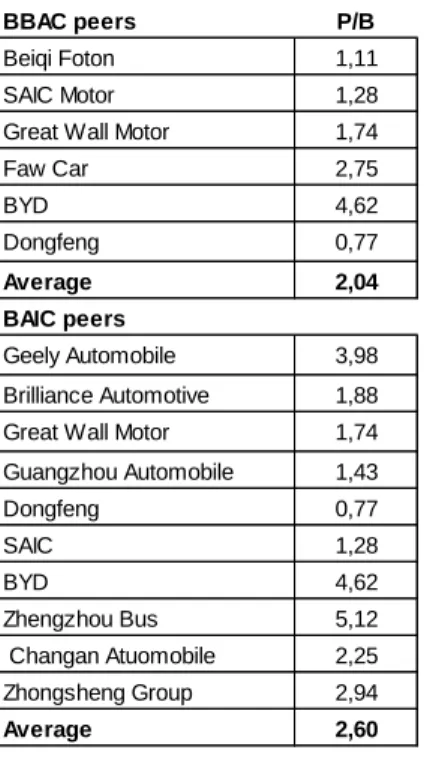
R isk- f ree 0,50% 0,50% E [r] 7,25% 7,25% B u 89,0% n.a. B l 0,88 1,71 D /E V -0,7% n.a. R d 1,2% n.a. R e 6,46% 12,05% W A C C 6,50% n.a. BBAC peers P/B Beiqi Foton 1,11 SAIC Motor 1,28 Great Wall Motor 1,74 Faw Car 2,75 BYD 4,62 Dongfeng 0,77 Average 2,04 BAIC peers Geely Automobile 3,98 Brilliance Automotive 1,88 Great Wall Motor 1,74 Guangzhou Automobile 1,43 Dongfeng 0,77 SAIC 1,28 BYD 4,62 Zhengzhou Bus 5,12 Changan Atuomobile 2,25 Zhongsheng Group 2,94 Average 2,60 Table 17
Company Unlevered betas
Daimler AG 0,58 BMW Group 0,54 Volvo 0,74 Fiat-Chrysler 1,04 GM 0,35 Toyota 0,61 Peugeot 2,34 Average 0,89 Table 19
“DAIMLER AG” COMPANY REPORT
5.9 Forecasted performance and growth rate
In the long-term is expected that Daimler doesn’t generate excess returns for investors. Given the CAPEX increase the upcoming years and decreased operational profitability, we expect the return on invested capital of the industrial division to converge to the hurdle rate. After 2021 capexrequirements should decrease progressively to historical levels and increase the company unlevered operating free cash flow until a normalized level in 2025, from where future growth is computed using the reinvestment rate and ROIC of that period.
5.10 Litigation risks: Daimler blurred future
due to Dieselgate and the truck cartel
Daimler was among the four companies sentenced in 19th
July 2016 with a record fine of €2,93billion for violating EU antitrust rules, after Man being whistle-blower of the cartel that lasted over 14 years. The companies were found guilty of coordinating prices, timing the introduction of emission technologies and passing on to customers the costs of those. However, the case wasn’t completely settled with the European Commission decision as litigation management company Bentham Europe plans to fund a potential €100 billion damage claim on behalf of businesses from all over Europe that bought trucks during the cartel period. The claims are made on the allegation that 10 million trucks were sold in the EU during the cartel period and that each one of them was overpriced by about €10 500. Given that the cartel existence is already proved, it was estimated has having a significant probability that an additional high settlement cost could happen until 2020. Assuming that the case has a 70% probability of success, and that Bentham could get a settlement for around half the initial claim, then it is considered a possible loss of €10 billion, including fines, legal costs and market share loss due to affected brand
Industrial Performance E FY FY FY 2016 2017 2018 2019 2020 Industrial unit ROA 8,7% 7,3% 7,0% 6,5% 7,1% ROE 15,6% 13,3% 12,3% 11,0% 11,7% Operating ROIC 9,1% 7,8% 7,4% 6,8% 7,4%
Cars growth rate
ROA 5,2% 6,8% 6,8% 6,1% 6,7% ROE 15,5% 18,5% 18,7% 16,2% 17,4% Operating ROIC 10,2% 8,0% 7,7% 7,0% 7,7% Reinvestment rate 85,4% 46,6% 60,3% 63,6% 67,0%
Trucks growth rate
ROA 8,5% 7,1% 6,5% 6,3% 6,6% ROE 18,0% 13,2% 11,7% 11,0% 11,4% Operating ROIC 9,7% 7,8% 7,2% 6,8% 7,4% Reinvestment rate 133,9% 101,8% 62,6% 55,8% 72,3%
Vans growth rate
ROA 11,4% 9,4% 8,7% 8,2% 8,4% ROE 12,2% 12,2% 12,2% 12,2% 12,2% Operating ROIC 14,3% 11,3% 9,9% 9,2% 9,5% Reinvestment rate 97,1% 71,1% 73,3% 78,0% 79,0%
Buses growth rate
ROA 4,9% 4,9% 4,9% 4,7% 4,3% ROE 18,6% 29,9% 24,7% 23,0% 20,2% Operating ROIC 4,9% 4,9% 4,7% 4,5% 4,1% Reinvestment rate 158,2% 52,5% 23,4% 27,7% 26,2% Table 20 Industrial Performance FY FY FY FY FY 2021 2022 2023 2024 2025 Industrial unit ROA 6,7% 6,5% 6,5% 6,4% 6,4% ROE 10,7% 10,3% 10,0% 10,0% 9,9% Operating ROIC 6,9% 6,7% 6,6% 6,6% 6,5%
Cars growth rate 1,98%
ROA 6,2% 6,1% 5,9% 5,8% 5,7% ROE 15,8% 15,0% 14,4% 13,9% 13,5% Operating ROIC 7,2% 7,1% 6,9% 6,8% 6,8% Reinvestment rate 66,0% 67,9% 69,0% 33,3% 29,3%
Trucks growth rate 2,4%
ROA 6,3% 6,3% 6,4% 6,5% 6,6% ROE 10,7% 10,5% 10,6% 10,8% 10,8% Operating ROIC 6,9% 6,9% 7,1% 7,1% 7,1% Reinvestment rate 58,9% 64,6% 73,0% 48,8% 34,1%
Vans growth rate 2,3%
ROA 7,6% 6,9% 6,5% 6,4% 6,4% ROE 12,2% 12,2% 12,2% 12,2% 12,2% Operating ROIC 8,5% 7,6% 6,9% 6,7% 6,6% Reinvestment rate 81,5% 86,6% 67,6% 34,9% 34,3%
Buses growth rate 0,9%
ROA 4,2% 4,3% 4,3% 4,4% 4,4% ROE 20,0% 20,2% 20,4% 21,0% 20,6% Operating ROIC 4,0% 4,1% 4,1% 4,2% 4,2% Reinvestment rate 43,3% 43,3% 42,7% 34,8% 22,1%
“DAIMLER AG” COMPANY REPORT
image. Despite nothing having been found so far, Daimler involvement in Dieselgate is not completely inconsiderate. In May, German prosecutors searched Daimler’s offices as part of an investigation that seems to be getting deeper. On the other side of the Atlantic, American authorities have also
requested the company to conduct an internal inquiry. There is now the suspicion that Germany biggest automakers could have been colluded for 20 years not only to cheat emission tests standards, but also to decide which technology they would offer to their customers. The suspicion emerged by chance when
investigators found documents showing the collusion during a raid on Volkswagen’s offices to investigate suspicions of a steel cartel. Although denying any involvement, Daimler recalled 3 million Mercedes-Benz to lower their emissions, which clearly doesn’t send a good sign for the market. For instance, Union Investment, which is Germany third-largest fund manager with around €300bn in assets, banned investments in Daimler in August over increased litigation risk. Given that Volkswagen already spent €23,7 billion directly for compensation and vehicle buybacks, of which €3,65billion were in fines due to the emission scandal in the US only, it was considered that on both side of the Atlantic altogether, Daimler faces the risk of losing at least €8billion until 2020 with a 60% chance, considering litigation costs, compensation and harm to brand image.
5.11 Scenario analysis
With its business model going through major transformation, Daimler’s valuation has imbedded a specific uncertainty regarding how the company will be able to seize upcoming opportunities. Therefore, it is of the maximum pertinence to consider several outcomes. Three scenarios were considered: a base case, with a 70% probability, a best case scenario with 10% probability and a worst case scenario with a 20% probability of occurrence. Each of the scenarios takes into account the same level of annual sales, investment, operating and financing costs, being the difference between the assumptions regarding new revenue streams and the probability of losses related with litigation risks.
5.11.1 Base case scenario:
Maintenance: it is estimated that Daimler’s authorized repair shops can achieve
a market share of 70% , earning a fee of 5% of over the 10% EBIT margin (15% for the truck segment) generated by annual revenue of maintenance 0,86% over the purchase price;
Connectivity: based on a Mckinsey study, it was considered that by 2020,
“DAIMLER AG” COMPANY REPORT
CAGR for this services until 2025 reaching 152,35 € - the bus division was not considered;
Hardware: extra equipment related with connectivity can generate more €1700 in
upfront revenue by 2020, but this value should decrease at a -5% CAGR until 2025, diminishing to €1315 as competition will drive ever more equipment into standard packages – the gross margin on these is estimated to be the same as the margin of vehicle sales.
Litigation risks: it was considered the probability of additional truck cartel
related losses to be 70% and losses from Dieselgate to be 65%.
5.11.2 Best case scenario:
Maintenance: the main difference in relation to the base case scenario is that it’s
considered that OEMs can achieve a higher degree of control namely by implementing an effective strategy to achieve higher dominance over their cars operating systems therefore being able to provide a more differentiated service and capturing a 90% market share;
Connectivity: it was considered that the market penetration rate for this services
would grow more quickly and consequently a 12% CAGR was considered;
Hardware: it wasn’t estimated a decreased of revenues due to higher
competition;
Litigation risks: it was considered the probability of additional truck cartel
related losses to be 65% and losses from Dieselgate to be 60%.
5.11.3 Worst case scenario:
Maintenance: in the worst case scenario, the Open Automotive Alliance is
successful in guaranteeing that every repair shop has access to detailed
information on how to repair connected and automated cars, making it difficult for officially authorized repair shops to differentiate themselves – in this case not reaching more than 40% market share;
Price per share decomposition
“DAIMLER AG” COMPANY REPORT
Connectivity: it was considered the same revenue and growth rate as in the
base case scenario;
Hardware: it was considered the same rate of decreasing revenues as in the
base case (-5% CAGR)but the upfront revenue in 2020 is considered to be 900€ instead of 1700€;
Litigation risks: it was considered the probability of additional truck cartel
related losses to be 75% and losses from Dieselgate to be 70%.
In the base scenario Daimler share price stands at 83,4€, while in the best case scenario and worst case scenario the value sums up to 85,6€ and 76,3€, respectively. Considering the probabilities of each scenario, the target share price is 82,2€.
6. Multiples Valuation
For multiples valuation the comparable companies chosen were BMW, Volvo, Ford, Toyota, Fiat-Chrysler, Peugeot and GM. Volkswagen, although used to establish Daimler’s competitive position in the industry, was excluded for
valuation purposes because the first’s valuation is affected by the one-off scandal of Dieselgate. Using the median of price to sales multiples and applying it to the €169.870 consolidated forecasted revenues for 2018, Daimler valuation share price valuation stands €84,6. If instead we use Price-to-book, and applying it to the forecasted net assets for 2018, we get a valuation of €86,06 per share. Given the market value of 70,8 € in December 31st, using price-to-sales multiple, shares
are being under-priced in about -16%.
Price of each unit for different scenarios
P/S P/B Daimler 0,5 1,2 BMW 0,6 1,1 Volvo 1,0 3,3 Ford 0,3 1,5 Toyota 0,7 1,1 GM 0,4 1,4 Median 0,5 1,3 Graph 17
“DAIMLER AG” COMPANY REPORT
7. Sensitivity analysis
Changing consumer habits and demographics may threaten business long-term growth. Given the demographic trends already mentioned, its foreseen that the number of megacities should increase significantly, up to a point where 1 billion people will leave in cities over 5 million habitants. Proportionally direct to the urbanization rate and city size is the harness of having a car and pollution. Together with government regulation to discourage car usage and ban internal combustion engines a decline in car ownership is likely, especially in developed markets where Daimler’s sales depend from, such as Europe and the US, and in economically vibrant cities in emerging economies such as Beijing and Delhi. Acting with a opposite effect, population growth diminishes the impact in growth potential of declining ownership rates, with the world population expected to increase at a CAGR of 0,7% to 9,77 billion people in 2050. Nonetheless, to derive a rational regarding Daimler future long-term growth, regional differences have to be considered. To derive a sensitivity analysis to the growth rate, three different scenarios were assumed with the following assumptions:
Europe
In Europe population is not only getting old, as it is decreasing significantly with population expected to be 715,2 million in 2050, below the 742 million expected value for 2025, a -0,14% CAGR. Considering that the GDP long-term growth rate stands at 1,5%, then that means that GDP per capita will continue to increase in the region, increasing population wealth. In that sense, given that the premium brands market share stands at 10,34%, it is forecasted that market share could increase to 15%. Considering that the average household has 2,3 people, applying the forecasted 80% ownership rate to the 66% urban population and 90% ownership to the remain 34% that live in rural areas, then its estimated that the total car park could decrease -0,2% a year to 232,67 million vehicles in 2050. Given the mentioned increase in market share, premium OEMs could expect 0,85% growth for their unit sales.
United States of America
In USA cities are usually more reliant in automobile transportation that the European counterparts, nevertheless the same trends apply to the region. Adults between 21 and 34 buy just 27% of all the new vehicles sold in the region, a decrease from 1985 peak at 38%. In younger adults and teens the trend is even more significant, with less than half of potential drivers holding a driving license, down from almost two-thirds in 1998, which denotes the lack of interest in driving.
“DAIMLER AG” COMPANY REPORT
In general, traditional adulthood marks such as getting married or buying and house are becoming increasingly delayed among millennials, in part as a result of unemployment and underemployment. As a result of increasing instability and uncertainty, younger generations prefer more flexible solutions, and regarding mobility that means being more likely to choose car sharing solutions, buying monthly transportations passes or using applications like Uber. The last
American Census Bureau revealed that in 22 states across the US car ownership declined slightly (between 0,1% and 1%) between 2010 and 2015, which is mostly relevant because it ended decades of straightforward increase.
Differing from Europe, the American population is expected to increase at a 0,5% CAGR between 2025 and 2050, reaching 434,65 million people by 2050.
Applying the same rational as for Europe, but considering that 20% of the 66% urban population will live in large cities (over 5 million habitants) where ownership rates are estimated to be 40%, it’s estimated a car park of 134,97 million vehicles in 2050, up from 133 million in 2015. As the GDP growth rate at 1,79% outpaces population growth, ceteris paribus, the general population is likely to get richer and so the market share for premium vehicles is likely to increase. Considering that it could achieve the same rate as in Europe, then premium OEMs could see a 1,11% long-term growth potential in the American passenger vehicle market.
China
The awakening of the sleeping giant has brought a tremendous wealth growth to the Chinese population and along with it a great increase in car ownership in urbanized areas. Nevertheless, the yearly income of the average Chinese household is far less than the European and American counterparts, reaching only 5.845,96€. As population is concerned, China presents the same pattern as Europe, with population expected to decrease at a CAGR of -0,23% from 2025 to 2050, diminishing from 1,44 billion to 1,36 billion in 2050.
Despite the majority of the population being poorer than in developed countries, China middle class has been soaring with economic growth. While in 2000 only 4% of the urban population was considered to be middle class, in 2022 that percentage is expected to reach 76% which will represent 550 million in 2022. That alone would be enough to make China middle class the world third-most populous country in the world. The Chinese middle class is defined by households earning between €7.639,63 and €28.860,84 a year.
For the purpose of estimating the potential market for premium vehicles, more than considering population and GDP growth, it is of special relevance to estimate the growth of the Chinese middle class. Given that the purpose is to estimate the potential market for premium OEMs, only the Chinese upper middle