Major Article
Journal of the Brazilian Society of Tropical Medicine Vol.:52:e-20180357: 2019
doi: 10.1590/0037-8682-0357-2018
Corresponding author: Liliana Crocco. e-mail: [email protected] Received 3 September 2018 Accepted 11 December 2018
Factors associated with the presence of triatomines in rural
areas of south Argentine Chaco
Liliana Crocco
[1], Julieta Nattero
[2], Ana López
[1], Miriam Cardozo
[1],
Carola Soria
[1], Valeria Ortiz
[3]and Claudia S. Rodriguez
[1][1]. Cátedra de Introducción a la Biología, Instituto de Investigaciones Biológicas y Tecnológicas
(CONICET- UNC), FCEFyN, UNC. Vélez Sársfield 299. Córdoba, Argentina.
[2]. Laboratorio de Eco-Epidemiología, Instituto de Ecología, Genética y Evolución de Buenos Aires, CONICET, EGE, FCEyN, UBA, Argentina.
[3]. Cátedra Introducción a la Biología. FCEFyN. UNC. Córdoba, Argentina.
Abstract
Introduction: The domestic and peridomestic presence of Triatoma infestans depends on several factors, such as human behavior, vector behavior, ecology, and the environment. Methods: This work was conducted in 139 domiciliary units, where triatomines
were captured and risk factors in domiciles and peridomicilies were recorded. Household dwellers were interviewed to obtain information about practices regarding this disease and entomological indicators were calculated. Results: Infestation indices
were 59.7% for house compounds, 4.3% for domestic areas and 58.3% for the peridomestic areas. Intradomicile infestation was significantly associated with housing characteristics. The presence of chicken coops in peridomicilies was associated with an increased risk of infestation. Of the respondents, 80% did not recognize the importance of the peridomiciliary structures for
triatomine control and had infested peridomicilies. Conclusions: The results show the importance of peridomiciles as refuge sites for Triatominae bugs; however, household dwellers do not perceive peridomiciles as areas that favor the presence of
vectors. Actions for raising awareness about factors that favor the presence of triatomines are needed to improve the conditions
of peridomiciliary environments.
Keywords: Chagas disease. Risk factors. Triatoma infestans.
INTRODUCTION
Chagas disease is the most important infection transmitted
by vectors in Latin America, affecting 21 countries, including Argentina1. In vast areas of these countries, rural populations live
in precarious houses that favor colonization by vectors. This disease is caused by the protozoa Trypanosoma cruzi, which is transmitted to humans through the feces of infected blood-sucking insects belonging to the subfamily Triatominae (Heteroptera: Reduviidae).
Triatoma infestans (Klug) is the main vector of Chagas
disease in the southern cone of South America. In these
countries, control measures implemented by INCOSUR since
1991 have succeeded in reducing the original range of this
vector by approximately 80%, and in interrupting vectorial
transmission by T. infestans in Brazil, Chile, and Uruguay2,3.
However, there are persistent populations of triatomines in houses and peridomiciles, especially in the eco-region of the Gran Chaco, a semi-arid plain of 1.1 million km2, which
covers south-eastern Bolivia and much of central and northern
Argentina, to the extreme northwest of Córdoba province4,5,6,7.
Paraguay recently received certification as a "free country of
home vector transmission of Trypanosoma cruzi" as verified by an international mission of independent experts convened
by the Pan American Health Organization8.The presence of
triatomines in households depends on a number of factors related to the building materials and construction conditions of the dwellings and certain peridomiciliary structures (goat and pig corrals plus chicken coops) that provide abundant refuge sites for these insects. The presence of triatomines is also related to the householders’ cultural patterns9,10. Rural areas within the Gran Chaco have been the target of several studies related to the
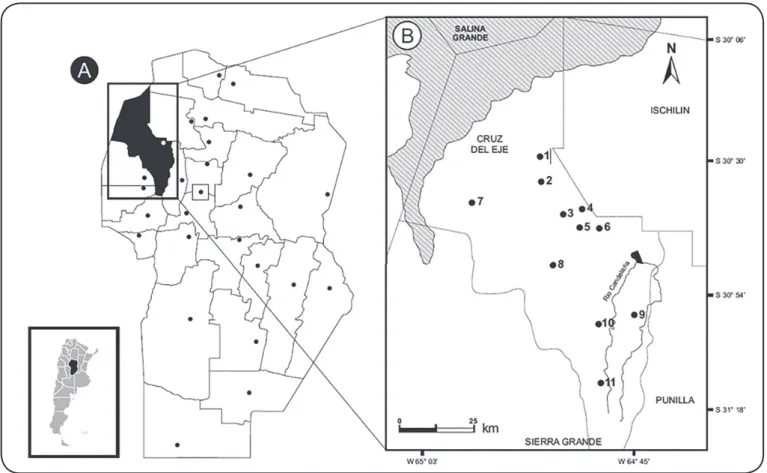
FIGURE 1:A: Location of Cruz del Eje, Córdoba province, Argentina. B: Map of the study area. Rural communities (dots): 1: Villa Luján, 2: Puesto Torrado, 3: Palo Parado, 4: El Simbolar, 5: El Barrial, 6: El Brete, 7: Las Casillas, 8: Villa de Soto, 9: Aguas Coloradas, 10: Cruz de Caña, 11: Ciénaga de Britos.
and/or cracked walls, dirt fl oors, thatched roofs, precarious
hygienic conditions, easy access to food supplies, and dogs and chickens sleeping inside or near the house. The presence of these factors increases the risk of triatomine infestation in these rural areas11,12.
In addition, several studies indicate that the structural characteristics of the peridomiciliary annexes, such as the materials used for construction13,14, as well as housing proximity15, pose different risk levels of re-infestation of
houses16,17, which make control actions more difficult to complete. The persistence of T. infestans in this region might be caused by the important role of peridomiciles as the main source of indoor re-infestation6,18,19. Human behavior can also
infl uence intradomicile and/or peridomiciliary infestation.
Precarious hygienic conditions contribute to the maintenance of triatomines in the intradomicile. Other issues such as the
accumulation of fi rewood can promote passive transport of
triatomines inside dwellings20,21.
Risk factors related to the domestic presence of triatomines may vary between regions, because of the differences in human behavior, vector behavior, ecology, and environment. Therefore, a more general perspective is needed to simultaneously consider the social, economic, and biological processes at the local and, if necessary regional levels, to achieve effective and sustainable vector and disease control22.
The northwest area of Córdoba province, Argentina, in the
extreme south of the Gran Chaco region, has been historically endemic to Chagas disease and shows a heterogeneous scenario of T. cruzi (Chagas) transmission that can be attributed to differences in vector control interventions, changes in land use, and socioeconomic factors in the last decades23,24. The Report of the National Chagas Program25 included Córdoba among the
provinces with a medium risk level of vector transmission of T. cruzi due to insuffi cient vector control and poor coverage of control campaigns. However, there are no entomological data available that allow us to explain the persistence of triatomines in this region nor have peridomiciles of these areas been characterized.
Given the importance of identifying the main risk factors in each region, this work aims to describe, identify, and analyze possible risk factors associated with peridomestic and domestic infestation by triatomines in northwestern Córdoba.
METHODS
Study area
The study was conducted in rural communities of Cruz
del Eje (30° 44' 04″ S, 64° 47' 57″ W), Córdoba province, northwestern Argentina, between December 2012 and
subtropical dry climate with a summer season from October to
March. The average monthly temperature is 26 ºC, and 70% of
the rain occurs mainly from November to February26.
A cross-sectional, observational, and descriptive study was
conducted in the domiciliary unit, which included the dwelling (in-home) and the associated peridomicile (environment around the dwelling where the residents conduct their daily routine activities). In the peridomiciliary area, there are usually annexes contain some types of hosts, including, chickens, goats, horses, and pigs. Only animals raised in pens were considered; loose animals in the peridomiciliary area (e.g. hens resting under trees) were not included in the study. The sites and the houses visited were selected according to the recommendations of the
National and Provincial Program of Chagas. We visited 139
domiciliary units, which had not been sprayed for more than three years. The location of each domiciliary unit was recorded using a GPS (Garmin eTrex 20). In each domiciliary unit, the type of peridomiciliary annex was recorded considering the host (chicken coop, goat, and pigs corrals, etc.), structure, and distance (m) to the house. Inside the house and each peridomiciliary annex, a search was conducted to locate and
capture triatomines, current risk factors were identified, and
dwellers were interviewed to obtain demographic data as well as information about their knowledge on Chagas disease and related practices.
All houses were visited by Chagas Disease Program staff.
Data collection tools used were previously validated by the staff. The inclusion criteria for the participation of inhabitants in the interview were: being permanent residents of the visited house, being over 18 years old, and voluntarily agreeing to participate in the study after being informed of the purposes.
Triatomine surveys
The hour-man technique27 was used for the search of triatomines inside the dwelling and in the peridomiciliary
annexes. In the laboratory, triatomines were identified according
to stage of development, sex and species, and the presence of T. cruzi in insect feces was analyzed using a conventional
Zeiss optical microscope with the 10x and 40x objectives. Taxonomic identification was performed by observing the external morphology according to Lent & Wigodzinsky28 and
Jurberg et al.29 for adults and Brewer et al.30 for nymphs.
The following entomological indexes were calculated: Domiciliary infestation index (DI) = 100 × (number (n) of houses infested/n houses examined). Peridomiciliary infestation index (PI) = 100 × (n° of peridomiciles infested/total n of peridomiciles examined). Natural Infection Index (NI): n° of triatomine infected by T. cruzi/n° of Triatomine examined x 100. House unit infestation index (HII) = 100 × (n of infected domiciliary units/n of houses examined).
Household Survey: risk factors, knowledge, and practice
The house and peridomicile characteristics evaluated as risk factors were selected based on previous works9,15,30. In each unit,
five risk factors related to building materials, dwelling features,
and peridomiciliary annexes were considered (Table 1). Each
house was classified according to the type of construction
as vulnerable, or not vulnerable, to colonization. The houses considered vulnerable had unplastered concrete roofs, or brick roofs or had thatched roofs with unplastered walls. Likewise, the
chicken coops were classified as vulnerable, or not vulnerable,
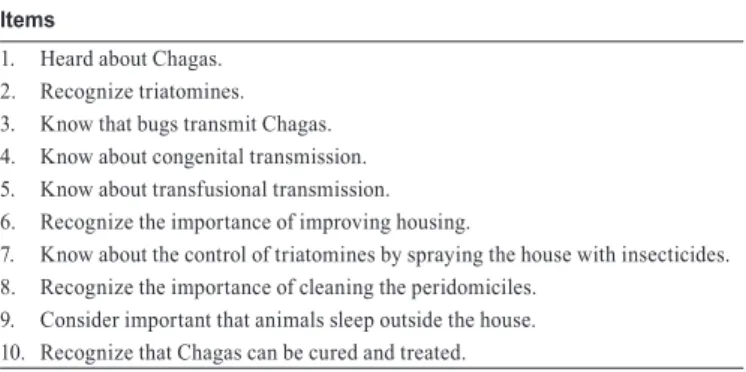
to colonization according to the criteria of Ortiz et al.14. To assess residents’ knowledge and practices, we used an interview model designed with the Chagas National Program, based on a list of basic notions9.
A total of 10 items associated with knowledge and practices were defined (Table 2).
Statistical Analysis
Data were analyzed in two stages: a descriptive one, in which basic statistics were calculated (proportions, average values), and an inferential one, in which the individual effects of categorical independent variables (rates of infestation) were associated with the dependent variables (type of house, features of the coops, knowledge) through contingency tables. The Odds
Ratios (OR) and their respective confidence intervals (95% CI)
were estimated (SPSS vs 12).
RESULTS
All rural communities were found to be positive for the presence of triatomines in the domiciliary units. A total number of 1135 triatomines were collected, 74 (6.5%) of which were captured in houses (10 adults and 64 nymphs) and 1061 (93.5%) in peridomiciles (390 adults and nymphs 671). Most (99%)
of the insects collected were T. infestans, with the remaining ones being four adults of Triatoma guasayana (Wygodzinsky & Abalos), and four adults of Triatoma garciabesi (Jurberg
et al.29), which were captured in peridomiciles. Of the total
collected triatomines, only four adults of T. infestans were infected with T. cruzi (NI: 0.35) The house unit infestation index
(HII) was 59.7% (83/139), the domiciliary infestation index (DI) was 4.3% (6/139), and the peridomiciliary infestation index (PI) was 58.3% (81/139).
Analysis of risk factors associated with the presence of triatomines in households
Of the 139 houses visited, 104 were included in the analysis,
because inhabitants of some houses were absent or were reluctant to participate, preventing us from characterizing those
houses. Of all houses evaluated, 61.1% had one or more of the risk factors considered in this study; of those houses, 26% (27/104) were classified as vulnerable to colonization (Table 3).
Household infestation was significantly associated with housing characteristics. The contingency tables showed that 80% of the
houses with a wall suitable for triatomine refuge were positive
for the presence of triatomines, and 60% of the houses with a roof suitable for triatomine refuge were infested. A house
vulnerable to colonization had a 13.21 times higher probability of being infested than a non-vulnerable house (p <= 0.05).
Houses with unplastered walls, even those with concrete
TABLE 1: Description of risk factors associated with the presence of triatomines in rural communities of Cruz del Eje, Córdoba province, Argentina.
Risk factor Description
1. Roofs providing suitable refuge for triatomine Unplastered brick or concrete, straw or cane thatched roofs21,33
2. Walls providing suitable refuge for triatomine Adobe, unplastered wall32
3. Animals sleeping inside the house Dog/chickens
4. Chicken coops vulnerable to colonization Bricks, cardboard, fabrics, billets14,18,21
5. Chicken coops less than 12 m away from the house17
TABLE 2: List of knowledge and practices included in the residents ' interviews.
Items
1. Heard about Chagas. 2. Recognize triatomines.
3. Know that bugs transmit Chagas. 4. Know about congenital transmission. 5. Know about transfusional transmission. 6. Recognize the importance of improving housing.
7. Know about the control of triatomines by spraying the house with insecticides. 8. Recognize the importance of cleaning the peridomiciles.
9. Consider important that animals sleep outside the house. 10. Recognize that Chagas can be cured and treated.
than those with uncracked plastered walls. Similarly, in houses that had roofs at risk of infestation (unplastered concrete or
brick, or thatched roofs) the risk was 7.23 times greater than in
houses with plastered roofs (p < 0.001) (Table 3).
Analysis of risk factors associated with the presence of triatomines in the peridomicile
Of all houses visited, 85.6% (119/139) had some type
of annex in the peridomiciles, the most common ones being
chicken coops (78.4%; 109/139) (Table 3). The presence of peridomiciles increased the risk of infestations by 12.03 times (p = 0.005) (Table 3). Of the total chicken coops, 64.2% were
classified as vulnerable to colonization, with 10.28 (p = 0.005)
times greater risk of being infested by triatomines than those that were not vulnerable (Table 3).
The distances between 73 houses and chicken coops were measured, with 57.5% (42/73) having a distance less than 12 m, of which 50% were infested with triatomines. There was no
association between the distance from the chicken coops to the house and the infested houses.
Knowledge and practices associated with the presence of triatomines
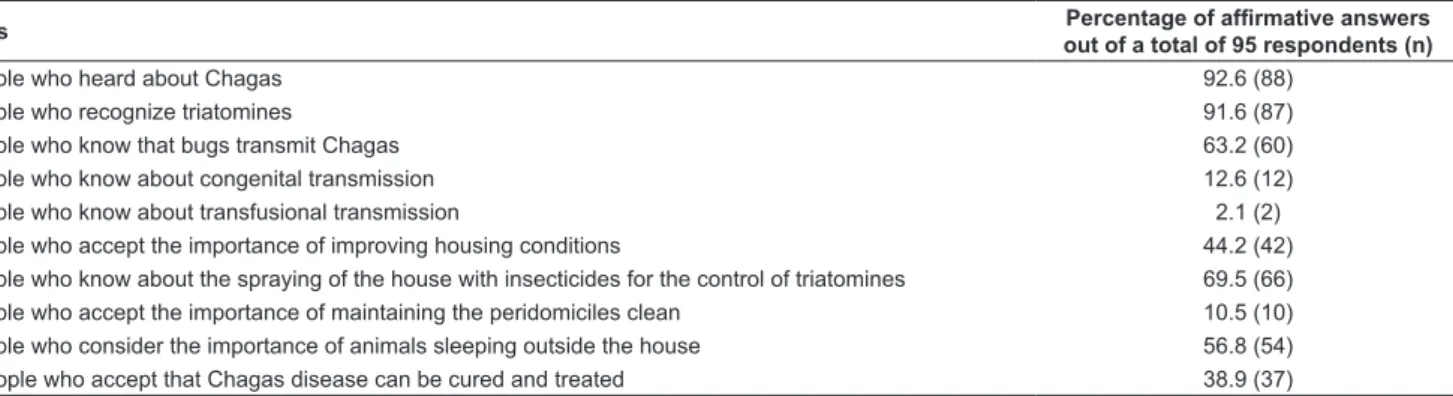
We interviewed 95 people who had an average age of 49 years (73.9% women and 26.1% men), of which 63.2% related the bugs to the transmission of the disease, but only 26.7% knew
that transmission occurs through insect feces. Of all interviewed
people, 35.8% (34/95) claimed to have seen bugs in the previous year. The houses and/or peridomiciles of 44.1% of these people (15/34) were positive for triatomine presence. Only 40% of these
houses were sprayed. Of the people who reported having found
bugs, 82% killed them and only 25% reported the infestation
to local authorities.
Regarding practices preventing the presence of triatomines,
69.5% (66/95) of the interviewed people mentioned spraying
with insecticides as the most commonly used measure.
Only 10.5% of the respondents recognized the importance
of keeping the peridomiciliary structures tidy and clean to
avoid an infestation of triatomines. Of these people, 70% did not have their peridomiciles infested. A higher proportion of respondents (80%), who did not recognize the importance
of the peridomiciliary for triatomine control, had infested peridomiciliary structures (Table 4).
The greatest lack of knowledge was related to congenital transmission and the possibility of treatment and cure. Only 12 people (11 of them females) recognized the congenital pathway.
Regarding knowledge about whether Chagas disease can be
cured, 38.9% answered positively, although they had doubts
about who was cured. Most respondents answered that some
people could be cured, and only 16% indicated that children are
most likely to overcome the disease (Table 4).
Among the interviewed people, 24% had Chagas disease. However, 13% did not know if they had Chagas as they had
never had a diagnosis. Most people claimed to have heard about
Chagas disease. However, 63% of these people did not know about any treatment, 86.5% did not know about congenital transmission, and 93.3% were unaware of the transfusion route.
The main source of information about this disease were from
Chagas technicians (36%) and health care personnel (22%).
DISCUSSION
The results in this study indicate the persistence of T. infestans populations in rural areas of northwestern Córdoba. The low percentage of domiciliary infestations found in this work is probably not only due to a few vulnerable houses recorded in the study area, but also due to the low sensitivity of the manual method used for searching for triatomines (hour-man technique). Previous investigations of routine surveillance systems used in the context of detecting vector-borne diseases like Chagas, have shown that these systems have sensitivity estimates frequently
below 50%, likely resulting in underestimates in the real
infestation vector numbers36,37. Historically, the house has been considered a risk factor, especially those houses whose structure offers suitable refuge for triatomines.
The type of construction material as a risk factor has been observed by several authors31,32,33, with degrees of risk depending
TABLE 4: Knowledge of the population about Chagas disease, its vectors, and preventive measures in rural communities of Cruz del Eje, Córdoba province, Argentina.
Ítems out of a total of 95 respondents (n)Percentage of affirmative answers
1. People who heard about Chagas 92.6 (88)
2. People who recognize triatomines 91.6 (87)
3. People who know that bugs transmit Chagas 63.2 (60)
4. People who know about congenital transmission 12.6 (12)
5. People who know about transfusional transmission 2.1 (2)
6. People who accept the importance of improving housing conditions 44.2 (42) 7. People who know about the spraying of the house with insecticides for the control of triatomines 69.5 (66) 8. People who accept the importance of maintaining the peridomiciles clean 10.5 (10) 9. People who consider the importance of animals sleeping outside the house 56.8 (54)
10. People who accept that Chagas disease can be cured and treated 38.9 (37)
TABLE 3: Binary analysis of house unit type, structural risk factors, and residents’ practices associated with the presence of triatomines in the domicile and peridomicile in rural communities of Cruz del Eje, Córdoba province, Argentina.
Structural risk factors in households and peridomiciles Percentages (n) Odds ratio Infested domiciles (CI95)
Odds ratio Infested Peridomiciles (CI95)
Both unplastered concrete or brick roof or thatched roof), and
unplastered walls 26 (27) 13.21 (1.40-124.20)
-Only walls 19.2 (20) 20.75 (1.17-197.9)
-Only roofs 15.9 (20) 7.23 (1.12-46.65)
-Chicken coops 78.4 (109) - 12.03 (3.81-37.99)
Colonizable chicken coops 64.2 (70) - 10.28 (1.75-60.4)
Distance < 12 m from chicken coops to houses 57.5 (42) -
-Risk factors related to the settlers’ lifestyle
Untidiness inside house 71.6 (47) -
-Animals sleeping inside the house 1.8 (1) -
-CI95:95% confidence intervals.
the type of vector21. In this work, although both roofs and walls
associated with risk factors (unplastered, or thatched roofs with
unplastered walls) were significantly associated with the presence
of triatomines, the unplastered walls were associated with a greater risk. Other authors found that the rate of infestation in plastered houses is lower than in unplastered ones34,35.
The low percentage of domiciliary infestation found in this work is probably due to few vulnerable houses being recorded. Most of the houses with adobe walls and thatched roofs were
replaced through the “Programa de erradicación y sustitución de viviendas rancho 38 In contrast, there was a high infestation
of triatomines in the peridomiciles, mainly associated with the presence of chicken coops, which are the most frequent peridomiciliary annex in the area.
to the availability of hosts and local characteristics of habitat suitable for triatomine when compared to other areas of the Dry
Chaco in Argentina19,22,38. Goat and pig corrals infested with
T. infestans were identified as the main habitats and sources of re-infestation by insects in the Dry Chaco of Argentina39,40,41.
Alternatively, the materials used for the construction
of corrals or chicken coops are also important, as different materials provide various types of refuge for triatomines. In the
department of Ayacucho (San Luis) Chartier & Crocco13 found
that stone pile corrals appear to be the most suitable refuge sites for triatomines, probably due to the large number of empty spaces characteristic of this type of construction, and the great
difficulty associated with using chemical control methods. In
this work, the goat corrals were not frequent annexes and were rarely infested, probably due to the type of construction (stick palisade wall) offering few refuge sites for insects.
The analysis of factors related to the infestation by triatomines indicated that peridomiciles and, in this case, chicken coops, continue to be a challenge for control activities. Chicken coops were the most important annexes that were infested with
triatomines, which shows a significant association between these
types of annexes and infestations. Chicken coops built with sticks, wood, or cardboard (hen houses) were the most vulnerable because they provide excellent refuge sites for triatomines, which
is in agreement with previous findings14,22. Preliminary results (C
Soria: unpublished data) from a food profile within the same area
indicate that most T. infestans collected in the peridomicile fed exclusively on chicken blood. However, the presence of combined blood sources was higher than expected, with blood meals being acquired from four hosts (dog, goat, chicken and human).
The persistence of triatomine in the peridomiciles within the study area is possibly related to the features of the peridomiciliary annex structures, especially of the hen houses. In these annexes, unlike goat pens, the presence of hosts is permanent, as chickens are bred year-round. In addition, these annexes offer optimal refuge sites that prevent good penetration of insecticides. Numerous works point out the importance of the peridomiciles in the maintenance of triatomine colonies and in
the re-infestation processes, as well as the difficulty of spraying
them18,42,43. Hen houses in particular are considered a suitable environment for the development of triatomines, where insect colonies contain numerous individuals, have a good nutritional status, and contain highly fertile females17.
The daily activities of the settlers and their lack of knowledge about the management of peridomiciles complicates the control of triatomine populations. Settlers ignore the fact that peridomiciles are important for maintaining triatomine populations and only consider the house as a risk factor where
spraying is the only control method. Although they recognize
that bugs can settle in the chicken coops, they do not know which actions can be taken to prevent, or reduce, the risk of infestation of these insects in these habitats and eventually in their homes. In summary, people know where triatomines develop and that they must improve the quality of the houses and their
peridomiciles. However, they do not take specific control
actions, nor do they perceive the risks involved when not taking
any control actions. This suggests that information alone is not
enough. We need to provide these communities with tools and
strategies, which are based upon their own perceptions, to solve these problems, and possibilities exist that the people will have to modify their environment.
Acknowledgements: We thank the technicians of the National Program of
Chagas and Córdoba for technical and logistical support in the field, Estela
Calderón for her invaluable contributions with the interviews, and Florencia Carnicero for her contributions in laboratory. Jorgelina Brasca revised the language grammar and style.
Conflict of Interest: The authors declare that there is no conflict of interest.
Financial Support: This work was funded by SECYT (Secretary of Science
and Technique of UNC), CONICET (Council of Scientific and Technological
Research) and Ministry of Science and Technology of Córdoba.
REFERENCES
1. WHO World Health Organization. Chagas disease in Latin
America: an epidemiological update based on 2010 estimates. Wkly Epidemiol Rec. 2015;90:33-44 PMID: 25671846.
2. Schmunis G, Zicker F, Moncayo A. Interruption of Chagas disease transmission through vector elimination. The Lancet.
1996;348(9035):1171.
3. Gorla DE, Noireau F. Geographic distribution of Triatominae vectors
in America. In: American trypanosomiasis (Chagas disease). One hundred years of research. 1st edition. Burlington (VA): Elsevier Inc. 2010;209-31.
4. Schofield CJ, Jannin J, Salvatella R. The future of Chagas disease control. Trends in Parasitol. 2006;22(12):583-8.
5. Zak MR, Cabido M, Hodgson JG. Do subtropical seasonal
forests in the Gran Chaco, Argentina, have a future? BiolConser. 2004;120(4):589-98.
6. Gürtler RE, Kitron U, Cecere MC, Segura EL, Cohen JE. Sustainable vector control and management of Chagas disease in the Gran
Chaco, Argentina. Proc Natl Acad Sci USA. 2007;104(41);16194-9. 7. Hotez PJ. Ten global “hotspots” for the neglected tropical diseases.
PLoS Negl Trop Dis. 2014;8(5):e2496.
8. Organización Panamericana de la Salud (OPS). Paraguay logró interrumpir la transmisión vectorial domiciliaria de la enfermedad
de Chagas. Available form https://www.paho.org/hq/index.
php?option=com_content&view=article&id=14546:paraguay-logro-
interrumpir-la-transmision-vectorial-domiciliaria-de-la-enfermedad-de-chagas&Itemid=135&lang=e Accessed on 01/12/2018.
9. Sanmartino M, Crocco L. Conocimientos sobre la enfermedad de Chagas y factores de riesgo en comunidades epidemiológicamente
diferentes de Argentina. Rev Panam Salud Pública. 2000;7:173-8.
10. Briceño León R. La enfermedad de Chagas en las Américas: Una
perspectiva de ecosalud. Cad Saúde Pública. 2009;25(1):S71-S82.
11. De Andrade AL, Zicker F, De Oliveira RM, Da Silva IG, Silva
SA, De Andrade SS, et al. Evaluation of risk factors for house
infestation by Triatoma infestans in Brazil. Am J Trop Med Hyg. 1995;53(5):443-7.
12. Saunders M, Small A, Dedicoat M, Roberts L. The development and validation of a risk score for household infestation by Triatoma infestans, a Bolivian vector of Chagas disease. Trans R Soc Trop
Med Hyg. 2012;106(11):677-82.
Ayacucho, San Luis, Argentina. Rev Soc Entomol Argent. 2007;66(1-2):181-5.
14. Ortíz VP, Rodríguez CS, López AG, Nattero J, Soria C, Carnicero
F, et al. Chagas en comunidades del oeste de Córdoba: anexos
peridomiciliarios potencialmente riesgosos. IX Congreso Argentino de Entomología. Posadas, Misiones, Argentina. 2015; p 384.
15. López AG, Crocco LB, Morales G, Catalá S. Feeding frequency and nutritional status of peridomestic populations of Triatoma infestans.
ActaTrop. 1999;73(3):275-81.
16. Gorla D, Abrahan L, Hernández ML, Porcasi X, Hrellac H, Carrizo
H, et al. New structures for goat corrals to control peridomestic populations of Triatoma infestans (Hemiptera: Reduviidae) in the Gran
Chaco of Argentina. Mem Inst Oswaldo Cruz. 2013; 108(3):352-8. 17. Gürtler RE, Cecere MC, Fernández M del P, Vazquez-Prokopec GM,
Ceballos LA, Gurevitz JM, et al. Key source habitats and potential
dispersal of Triatoma infestans populations in Northwestern
Argentina: implications for vector control. PloS Negl Trop Dis. 2014;8(10):e3238. doi: 10.1371/journal.pntd.0003238.
18. Cecere MC, Gürtler RE, Canale D, Chuit R, Cohen JE. The role of the peridomiciliary area in the elimination of Triatoma infestans from rural Argentine communities. Rev Pan Salud Pública. 1997;1(4):273-9.
19. Cecere MC, Vasquez-Prokopec GM, Gürtler RE, Kitron U. Reinfestation sources for Chagas disease vector, Triatoma infestans,
Argentina. Emerg Infect Dis. 2006; 12(7):1096-102.
20. Cohen JE, Wilson ML, Cruz-Celis A, Ordoñez R, Ramsey JM. Infestation by Triatoma pallidipennis (Hemiptera: Reduviidae: Triatominae) is associated with housing characteristics in Rural
Mexico. J MedEntomol. 2006;43(6):1252-60.
21. Bustamante DM, Monroy C, Pineda S, Rodas A, Castro X, Ayala V, et al. Risk factors for intradomiciliary infestation by the Chagas disease vector Triatoma dimidiata in Jutiapa, Guatemala. Cad
Saúde Pública. 2009;25:S83-S92.
22. Gurevitz JM, Ceballos LA, Gaspe MS, Alvarado-Otegui JA,
Enríquez GF, Kitron U et al. Factors Affecting Infestation
by Triatoma infestans in a Rural Area of the Humid Chaco in Argentina: A Multi-Model Inference Approach. PLoS Negl Trop Dis. 2011; 5(10): e1349. doi:10.1371/journal.pntd.0001349.
23. Moreno M, Moretti E, Basso B, Frias M, Catalá S, Gorla D. Seroprevalence of Trypanosoma cruzi infection and vector control activities in rural communities of the southern Gran Chaco
(Argentina). Acta Trop. 2010;113(3):257-62.
24. Moreno ML, Hoyos L, Cabido M, Catalá SS, Gorla DE. Exploring the association between Trypanosoma cruzi infection in rural communities and environmental changes in the southern Gran
Chaco. Mem Inst Oswaldo Cruz. 2012;107(2):231-7.
25. Informe Programa Nacional de Chagas. El Chagas en el país y
América Latina. Accedido: 19 de Abril de 2016. Available from:
http://www.msal.gov.ar/chagas/index.php/infor macion-para-ciudadanos/elchagas-en-elpais- y-américa-latina.
26. Cabrera AL. Regiones fitogeográficas argentinas. 2da edición, tomo 1, Buenos Aires. 1976; 85pp.
27. Schofield CJ. A comparison of sampling techniques for domestic
populations of Triatominae. Trans R Soc Trop Med Hyg.
1978;72(5):449-55.
28. Lent H, Wygodzinsky P. Revision of the Triatominae (Hemiptera,
Reduviidae), and their significance as vectors of Chagas' disease. Bull Am Mus Nat Hist. 1979;163(3):123-520.
29. Jurberg J, Galvão C , Lent H, Monteiro F, Lopes CM, Panzera F, Perez R. Revalidação de Triatoma garciabesi Carcavallo, Cichero,
Martinez, Prozen & Ronderos, 1967 (Hemíptera-Reduviidae). Entomol.Vect. 1998;5:107-22.
30. Brewer M, Garay M, Gorla DE, Murua F, Favot R. Caracterización de los estadios ninfales del género Triatoma (Laporte, 1833). I.
Triatoma infestans Klug, 1834 (Hemiptera: Reduviidae). Rev Soc Entomol Arg. 1981;40:91-102.
31. Crocco L, Rodríguez C, Catalá S, Nattero J. Enfermedad de
Chagas en Argentina: herramientas para que los escolares vigilen y
determinen la presencia de factores de riesgo en sus viviendas. Cad
Saúde Pública. 2005;21:646-51.
32. Schofield CJ, Marsden PD. The effect of wall plaster on a domestic population of Triatoma infestans. Bull Pan Am Health Organ. 1982;16(356):60.
33. Ramsey JM, Alvear AL, Ordonez R, Muñoz G, Garcia A, Lopez R, et al. Risk factors associated with house infestation by the Chagas disease vector Triatoma pallidipennis in Cuernavaca metropolitan
area, Mexico. Med Vet Ent. 2005;19(2):219-28.
34. Gürtler RE, Petersen RM, Cecere MC, Schweigmann NJ, Chuit
R, Gualtieri J M, et al. Chagas disease in north-west Argentina:
risk of domestic reinfestation by Triatoma infestans after a single community-wide application of deltamethrin. Trans R Soc Trop
Med Hyg. 1994;88(1):27-30.
35. Cecere MC, Gürtler RE, Canale DM, Chuit R, Cohen JE. Effects of partial housing improvement and insecticide spraying on the reinfestation dynamics of Triatoma infestans in rural northwestern
Argentina. Acta Trop. 2002;84(2):101-16.
36. Minuzzi-Souza TTC, Nitz N, Cuba CAC, Hagström L, Hecht MM,
Santana C, Ribeiro M, Vital TE, Santalucia M, Knox M, Obara MT,
Abad-Franch F, Gurgel-Gonçalves R. Surveillance of vector-borne
pathogens under imperfect detection: lessons from Chagas disease
risk (mis)measurement. Sci Rep. 2018;8(1):151. doi: 10.1038/s41598-017-18532-2.
37. Minuzzi-Souza TTC, Nitz N, Cuba CAC, Hagström L, Hecht MM,
Santana C, Ribeiro M, Vital TE, Santalucia M, Knox M, Obara
MT, Abad-Franch F, Gurgel-Gonçalves R.Author Correction:
Surveillance of vector-borne pathogens under imperfect detection: lessons from Chagas disease risk (mis)measurement. Sci Rep.
2018;8(1):7439. doi: 10.1038/s41598-018-24849-3.
38. Ministerio de Salud de la Provincia de Córdoba. Area de
epidemiología. Programa de Chagas. Accessed on 01/12/2018.
Available from: http://www.cba.gov.ar/epidemiologiaweb/
programa-provincial-de-chagas/
39. Ceballos LA, Vazquez-Prokopec GM, Cecere MC, Marcet PL, Gürtler RE. Feeding rates, nutritional status and flight dispersal
potential of peridomestic populations of Triatoma infestans in rural
northwestern Argentina. Acta Trop. 2005;95(2):149-59.
40. Cecere MC, Vazquez-Prokopec GM, Gürtler RE, Kitron U. Spatio-temporal analysis of reinfestation by Triatoma infestans (Hemiptera: Reduviidae) following insecticide spraying in a rural community in
northwestern Argentina. Am J Trop Med Hyg. 2004;71(6):803-10. 41. Gorla DE, Porcasi X, Hrellac H, Catalá SS. Spatial stratification of
house infestation by Triatoma infestans in La Rioja, Argentina. Am J Trop Med Hyg. 2009;80(3):405-09.
42. Cecere MC, Gurtler RE, Chuit R, Cohen JE. Factors limiting the domestic density of Triatoma infestans in north- west Argentina: a longitudinal study. Bull World Health Organ. 1998;76(4):373-84. 43. Gürtler RE, Canale DM, Spillman C, Stariolo R, Salomón DO,