AR
TICLE
Tooth loss experiences in adult and elderly users
of Primary Health Care
Abstract From the theoretical perspective of phe-nomenology, this article seeks to understand the experiences of tooth loss in adult and elderly us-ers of Primary Health Care in Porto Alegre, Rio Grande do Sul. Tooth loss was identified by the analysis of dental records of users that attended the oral health service at the Health Unit under study. Following this identification, individual household interviews were carried out. The sam-ple was intentional. Data were interpreted by content analysis using the software ATLAS.ti (Vi-sual Qualitative Data Analysis). The study had ethical approval. Losing teeth was an experience that expresses subjectivities, showing plural nar-ratives and highlighting the social function of the mouth. Besides the number of missing teeth, the understanding of how people perceived themselves without their teeth determined how much tooth loss affected their lives. Wearing prostheses adds significance to individuals’ perceptions of their body, restoring the balance between their body and the world. Qualitative approach studies in health services should be considered in order to plan interventions which prioritize people’s indi-vidual needs in their own territories, thus reduc-ing stigmas and social inequalities.
Key words Tooth loss, Oral health, Quality of life, Dental prosthesis, Primary health care
Fernando Valentim Bitencourt 1
Helena Weschenfelder Corrêa 1
Ramona Fernanda Ceriotti Toassi 1
1 Departamento de
B
it
enc
our
Introduction
The acts of taking care and preserving natural teeth are of vital importance since having them seems to contribute to an individual’s quality of life, through a direct connection with feelings of pride, control, achievement and better function-ality of their mouth as well as their semblance1.
Loosing teeth, on the other hand, leads to physi-cal, biologiphysi-cal, and, sometimes, emotional chang-es2. The impact that tooth loss may have on
peo-ple and their lives must not be underestimated3.
A single tooth loss may be relatively insignificant in someone’s life, but it could also be a devastat-ing and disruptdevastat-ing experience4, resulting in
alter-ations of their social daily activities and bringing about other limitations such as attending social meetings or eating in public5.
Moreover, tooth loss increases the demand for prosthetic treatments, demanding a great challenge from public health administration that is offering health care services which are ade-quate to their population needs6.
Brazilian epidemiology data from 2002-2003 confirmed edentulism as a serious problem in the country, which is associated to a great neces-sity of prostheses in adult and elderly citizens7.
In the most recent epidemiological survey, from 2010, the results show an improvement in adults tooth loss in comparison to 2003, with a decrease from 13,5 to 7,4 in the mean number of missing teeth. In 1,3% of cases there was a need for total prosthesis in at least one maxillary tooth. It is im-portant to mention that in 2003 this percentage was of 4,4%. In elderly people, on the other hand, edentulism was close to 54% in both studies. Numbers found in 2003 and 2010 are very close and represent over three million elderly people who needed total prosthesis in at least one maxil-lary tooth and more than four million who need-ed partial prosthesis8,9.
As tooth loss can be seen as a public health is-sue which may affect people’s quality of life10, this
study aims to understand the meaning of tooth loss experiences in adult and elderly users of Primary Health Care, according to the position and number of missing teeth. The theoretical perspective suggested this phenomenology focus, centered in the feeling of experiencing tooth loss.
Methods
The study was performed through a qualitative approach, designed as a case report whose
pop-ulation was the adult and elderly users of the oral health service in the Primary Health Care of Porto Alegre, Rio Grande do Sul, who presented tooth loss.
The identification of eligible subjects was performed through the analysis of dental reports from users of the Health Unit under study. Pa-tients whose reports contained the absence of at least one tooth in any of the dental arches were considered eligible.
Participants’ ages ranged between 35 to 44 years for adult and 65 to 74 years for elderly pa-tients, and they were selected according to the two previous epidemiological surveys on Brazil-ian oral health conditions7,8.
Reports from users who did not meet these criteria, who did not reside in the Health Unit’s territory, or who did not have a complete clinical exam – for having accessed the Unit for emergen-cy consultations only – were excluded from the study.
The analysis of tooth loss considered the po-sition and number of missing teeth. The popo-sition was classified as anterior, posterior, anterior and posterior, and total (edentulous) tooth loss. Re-garding the number of missing teeth, the classifi-cation set according to the reports ranged from 1 to 4; 5 to 9; 10 to 14; and 15 to 28 missing teeth.
This research assessed 1063 reports from us-ers of the oral health service in the studied Unit from which 131 met the inclusion criteria.
Individualized, semi-structured, household interviews were conducted following a previously tested script, were recorded in an audio recording device and were then transcribed, in order to un-derstand the meaning of tooth loss experiences.
The interviews were performed along 8 months, based on a flexible structure of open questions which allowed the interviewees to speak freely on the experience of tooth loss and its meanings, and were conducted by two qual-ified researchers, both undergraduate students of Dentistry with previous experience in quali-tative research. All interviews were attended by Community Health Workers together with the patients.
The sample was intentional. As the research-ers observed repetitions in the ideas presented and, considering the density of the collected ma-terial, data collection was intentionally terminat-ed (n = 66).
aúd
e C
ole
tiv
a,
24(1):169-180,
2019
Textual material obtained from the house-hold interviews was interpreted by content anal-ysis11 using the ATLAS.ti software (Visual
Quali-tative Data Analysis) and involved the following steps: pre-analysis; material exploration; results treatment; inference; and interpretation. The results were organized by the “position of tooth loss” criteria.
The study was approved by Research Ethics Committees of the Federal University of Rio Grande do Sul and of Porto Alegre City Hall.
Results
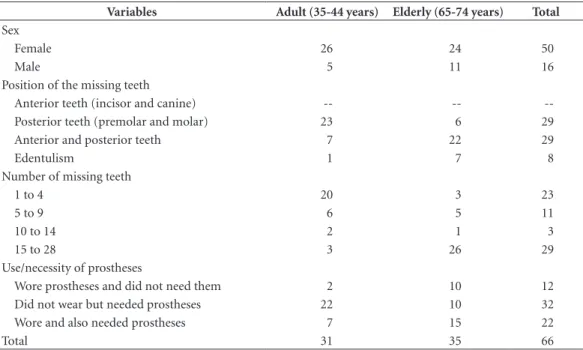
A total of 66 users of the oral health service in the studied Health Unit with tooth loss participated in the household interviews, from which 31 were adult (35 to 44 years) and 35 were elderly subjects (65 to 74 years). Among these users, the majori-ty were women, with posterior or with posterior and anterior tooth loss, from 15 to 28 teeth. Re-garding dental prosthesis, 12 of the 66 subjects wore and did not need it (Table 1).
Experiences of posterior tooth loss
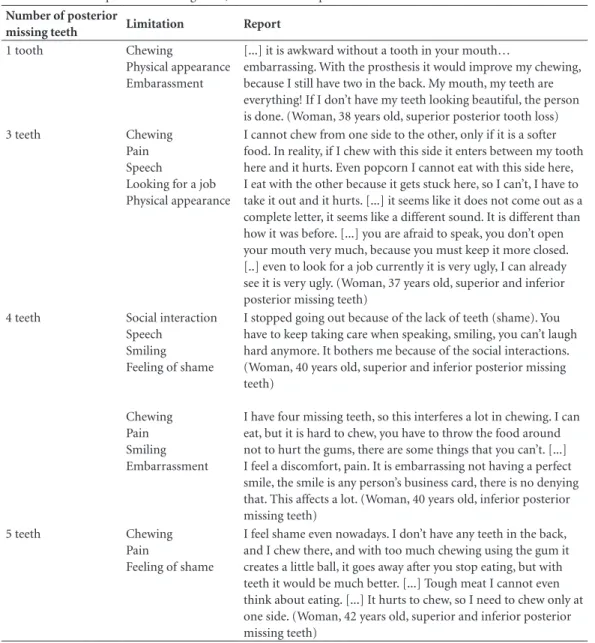
Adults with tooth loss of 1 to 5 posterior teeth, without prosthetic rehabilitation, associat-ed the tooth absence with limitations in
chew-ing, physical appearance, speech, smilchew-ing, work, social interactions and even pain. Such problems did not happen individually, but rather associat-ed with each other, thus strongly affecting peo-ple’s lives. Feelings of embarrassment and shame were related due to teeth loss (Table 2).
In other experiences, adults with posterior tooth loss, also without prosthetic rehabilitation, reported that such loss does not affect their lives. This situation was observed when people realized that the absent posterior teeth did not affect their chewing, aesthetics (the lack of them did not show) and that there was no tooth pain or decay in their mouth.
It does not affect me because the lack of teeth are not so important, they’re far behind. I am sat-isfied because I have oral health, I don’t have any-thing, I don’t have any tooth decay, I don’t have any dirty teeth. […] if it was up front or if it was more to the sides I definitely would, but since it is far behind… (Woman, 42 years old, superior and inferior posterior loss of 2 teeth)
Elderly patients with 6 to 10 missing posteri-or teeth without prosthetic rehabilitation noticed teeth absence as a burden that brought about some limitations to their lives – feeding, inter-personal relations, smiling, appearance – but, currently, it does not bother anymore or, rather, there was the perception of the limitation caused by the tooth loss, but when they think about
Table 1. Characterization of the interviewed individuals according to sex, position and number of missing teeth,
use/necessity of prostheses by age.
Variables Adult (35-44 years) Elderly (65-74 years) Total
Sex
Female 26 24 50
Male 5 11 16
Position of the missing teeth
Anterior teeth (incisor and canine) -- --
--Posterior teeth (premolar and molar) 23 6 29
Anterior and posterior teeth 7 22 29
Edentulism 1 7 8
Number of missing teeth
1 to 4 20 3 23
5 to 9 6 5 11
10 to 14 2 1 3
15 to 28 3 26 29
Use/necessity of prostheses
Wore prostheses and did not need them 2 10 12
Did not wear but needed prostheses 22 10 32
Wore and also needed prostheses 7 15 22
B
it
enc
our
their age or about the time they have been with this condition or when they compare themselves with the worst condition of oral health from oth-er people that they know, this absence does not qualify as a problem, independently of the num-ber of missing teeth (Table 3).
Experiences of anterior and posterior tooth loss
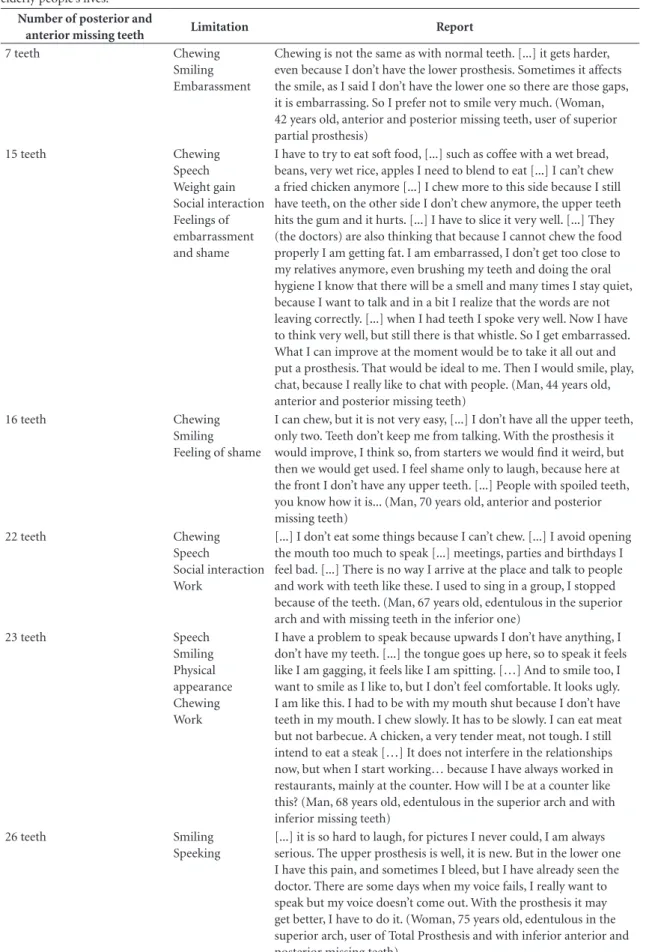
Adult and elderly subjects with anterior and posterior tooth loss (from 7 to 26 teeth) noticed functional and social limitations associated to such loss when the absent teeth were not replaced by the use of prostheses or when there was a
par-tial prosthetic rehabilitation, in a single dental arch (Table 4).
People with tooth loss without rehabilita-tion manifested the desire of wearing prostheses and associated them to an improvement in their quality of life.
On the other hand, when there was a pros-thetic rehabilitation of the missing teeth and the prostheses were well-adapted, did not hurt and neither caused pain or disturbances, the elderly individuals did not report problems or limita-tions caused by tooth loss.
[...] the prosthesis is well-adapted, it never hurt. From the first time I put it on, I continued to feed normally, it never hurt, excoriated, nothing.
Table 2. Number of posterior missing teeth, limitation and reports in which tooth loss affects adults’ lives.
Number of posterior
missing teeth Limitation Report
1 tooth Chewing
Physical appearance Embarassment
[...] it is awkward without a tooth in your mouth…
embarrassing. With the prosthesis it would improve my chewing, because I still have two in the back. My mouth, my teeth are everything! If I don’t have my teeth looking beautiful, the person is done. (Woman, 38 years old, superior posterior tooth loss)
3 teeth Chewing
Pain Speech
Looking for a job Physical appearance
I cannot chew from one side to the other, only if it is a softer food. In reality, if I chew with this side it enters between my tooth here and it hurts. Even popcorn I cannot eat with this side here, I eat with the other because it gets stuck here, so I can’t, I have to take it out and it hurts. [...] it seems like it does not come out as a complete letter, it seems like a different sound. It is different than how it was before. [...] you are afraid to speak, you don’t open your mouth very much, because you must keep it more closed. [..] even to look for a job currently it is very ugly, I can already see it is very ugly. (Woman, 37 years old, superior and inferior posterior missing teeth)
4 teeth Social interaction
Speech Smiling Feeling of shame
Chewing Pain Smiling Embarrassment
I stopped going out because of the lack of teeth (shame). You have to keep taking care when speaking, smiling, you can’t laugh hard anymore. It bothers me because of the social interactions. (Woman, 40 years old, superior and inferior posterior missing teeth)
I have four missing teeth, so this interferes a lot in chewing. I can eat, but it is hard to chew, you have to throw the food around not to hurt the gums, there are some things that you can’t. [...] I feel a discomfort, pain. It is embarrassing not having a perfect smile, the smile is any person’s business card, there is no denying that. This affects a lot. (Woman, 40 years old, inferior posterior missing teeth)
5 teeth Chewing
Pain
Feeling of shame
aúd
e C
ole
tiv
a,
24(1):169-180,
2019
[...] beautiful. It is like natural teeth to me. (Wom-an, 67 years old, tooth loss of 21 teeth, user of superior Total prosthesis and inferior Partial Re-movable prosthesis)
It is highlighted that in the reports where people had partial tooth loss and there was the presence of natural teeth that had oral illnesses which caused pain and functional limitations, these teeth affect people’s lives much more than the tooth loss itself. Such situation may be no-ticed in the following report, from an elderly woman who no longer had superior teeth, did not wear prostheses and presented two anterior inferior teeth with advanced periodontal disease:
[...] It gets hard to speak, even when speaking the tongue touches there, it touches and it hurts. I’m always in pain, ‘Mary of pain’. People already look at you differently. It affects a lot, teeth and hair, I’ll tell you! There is no doubt, the person gets awful. (Woman, 67 years old, edentulous in the superior arch and with inferior tooth loss of 12 teeth)
Experiences of complete tooth loss (edentulism)
In elderly edentulous patients without pros-thetic rehabilitation, the complete absence of
teeth revealed itself an important and many times even disabling problem due to the difficulties to adequately feed (chewing disability), to the aes-thetics, to the pain and to the social interactions. I can’t eat any hard stuff, I can’t eat an apple, only if it has gone through the blender, because I can’t chew, I don’t have teeth [...] Teeth lack for anything you do. Can you imagine living with no teeth? It is awful! The worst thing in the world is to have no teeth, one that people notice on you, the first thing is ‘what happened to you? Why don’t you fix your teeth?’ [...] I have my responsibilities, I have to attend meetings, I have to travel… [...] It is awkward when we don’t have teeth, we are like a squash! (Woman, 67 years old, edentulous)
Among the edentulous elderly subjects who had partial rehabilitation and wore prosthesis in only one of the arches, problems were related as being associated to chewing and pain in their gum.
[...] I can’t chew properly, I can’t, I don’t have the lower teeth. It is bad. I can’t eat anything hard, when the meat is tough I can’t, I have to take little bites [...] This upper prosthesis I press and it hurts the lower gum, so it hurts. (Man, 73 years old, edentuolous, user of superior Total Prosthesis)
In the reported cases of inappropriate pros-theses, although there was the perception of
Table 3. Number of posterior missing teeth, limitation and reports where tooth loss is perceived and does not
affect elderly people’s lives.
Number of posterior
missing teeth Limitations Report
6 teeth Eating and speaking,
but considers that it is good for his age, there are people with worse conditions
I have difficulties to eat meat, meat I am not eating anymore, very little, I can’t… 6 teeth are missing, and these 6 teeth really lack. Only chicken, fish, if it’s not tender I can’t. For my age the teeth I have in my mouth it is too good. I think it is bad, I would like to speak better. But I am very satisfied, there are people worse than me. I look back and there are people much worse than me around. (Man, 74 years old, superior posterior missing teeth)
8 teeth It has brought
limitations (interpersonal relations), but at the moment does not bother anymore
It bothered me before to talk to someone, but now I don’t mind anymore [missing teeth]. Before, I didn’t have conditions enough to visit the dentist, so, when it hurt, I took it off and that’s it [...]. (Woman, 66 years old, superior and inferior posterior missing teeth)
10 teeth Chewing and
interpersonal relations, but there are people with worse conditions
B
it
enc
our
Table 4. Number of posterior and anterior missing teeth, limitation and reports in which tooth loss affects adult and
elderly people’s lives.
Number of posterior and
anterior missing teeth Limitation Report
7 teeth Chewing
Smiling Embarassment
Chewing is not the same as with normal teeth. [...] it gets harder, even because I don’t have the lower prosthesis. Sometimes it affects the smile, as I said I don’t have the lower one so there are those gaps, it is embarrassing. So I prefer not to smile very much. (Woman, 42 years old, anterior and posterior missing teeth, user of superior partial prosthesis)
15 teeth Chewing
Speech Weight gain Social interaction Feelings of embarrassment and shame
I have to try to eat soft food, [...] such as coffee with a wet bread, beans, very wet rice, apples I need to blend to eat [...] I can’t chew a fried chicken anymore [...] I chew more to this side because I still have teeth, on the other side I don’t chew anymore, the upper teeth hits the gum and it hurts. [...] I have to slice it very well. [...] They (the doctors) are also thinking that because I cannot chew the food properly I am getting fat. I am embarrassed, I don’t get too close to my relatives anymore, even brushing my teeth and doing the oral hygiene I know that there will be a smell and many times I stay quiet, because I want to talk and in a bit I realize that the words are not leaving correctly. [...] when I had teeth I spoke very well. Now I have to think very well, but still there is that whistle. So I get embarrassed. What I can improve at the moment would be to take it all out and put a prosthesis. That would be ideal to me. Then I would smile, play, chat, because I really like to chat with people. (Man, 44 years old, anterior and posterior missing teeth)
16 teeth Chewing
Smiling Feeling of shame
I can chew, but it is not very easy, [...] I don’t have all the upper teeth, only two. Teeth don’t keep me from talking. With the prosthesis it would improve, I think so, from starters we would find it weird, but then we would get used. I feel shame only to laugh, because here at the front I don’t have any upper teeth. [...] People with spoiled teeth, you know how it is... (Man, 70 years old, anterior and posterior missing teeth)
22 teeth Chewing
Speech
Social interaction Work
[...] I don’t eat some things because I can’t chew. [...] I avoid opening the mouth too much to speak [...] meetings, parties and birthdays I feel bad. [...] There is no way I arrive at the place and talk to people and work with teeth like these. I used to sing in a group, I stopped because of the teeth. (Man, 67 years old, edentulous in the superior arch and with missing teeth in the inferior one)
23 teeth Speech
Smiling Physical appearance Chewing Work
I have a problem to speak because upwards I don’t have anything, I don’t have my teeth. [...] the tongue goes up here, so to speak it feels like I am gagging, it feels like I am spitting. […] And to smile too, I want to smile as I like to, but I don’t feel comfortable. It looks ugly. I am like this. I had to be with my mouth shut because I don’t have teeth in my mouth. I chew slowly. It has to be slowly. I can eat meat but not barbecue. A chicken, a very tender meat, not tough. I still intend to eat a steak […] It does not interfere in the relationships now, but when I start working… because I have always worked in restaurants, mainly at the counter. How will I be at a counter like this? (Man, 68 years old, edentulous in the superior arch and with inferior missing teeth)
26 teeth Smiling
Speeking
aúd
e C
ole
tiv
a,
24(1):169-180,
2019
wearing a badly-adapted prosthesis, which in-terfered in feeding, caused pain and generated a dissatisfaction feeling with the prosthesis, the elderly people prefer to bare this situation than to stay without the prosthesis and, consequently, ‘without teeth’.
I am dissatisfied with this thing here [the pros-thesis]. But I have to bare it [...] it is to eat that it bothers the most [...] Because it [the prosthesis] raises and food gest in there and it hurts every-where. The lower one too. It is lose, it hurts. I swal-low almost everything at once. What a naughty prosthesis! I have it for four years now. Sometimes I get up from the table and have to go brush my teeth, because there is a lot of food under it [...]. Oh, God forbid me from having no teeth! (Woman, 67 years, edentulous, user of superior and inferior Total Prosthesis)
On the other hand, in the adult users of pros-theses which caused functional limitations relat-ed to ferelat-eding, people chose not to wear the pros-theses and there was a situation of ‘getting used to eat without the teeth’, even if noticing that it is a bad oral health condition.
Now I eat without teeth. Before I had some fragments and I removed them. I did not adapt to the prosthesis, I couldn’t chew, nor eat anything. It isn’t good, but I’ve got used to it. I can manage. [...] it is bad not having teeth, isn’t it? (Woman, 42 years old, who has superior and inferior Total Prostheses, but does not wear them)
Tooth loss was not reported as a problem in the lives of elderly users of well-adapted prosthe-ses which allowed speech, chewing and rescue of social interactions that were lost by the previous condition of aching teeth.
[...] it’s been five years that I put them [the prostheses], I’ve never needed to adjust them, they fit well. I can speak, chew. I can communicate. I wear them all day long, and I don’t take them out not even to sleep [...] before I could never talk to anyone (Woman, 71 years old, edentulous, user of superior and inferior Total Prostheses)
In this category, the experiences of tooth loss in elderly subjects have been associated to reports which mentioned both the limitations caused by this loss as well as the value of prostheses use in reestablishing the function of their mouths, im-proving their quality of life.
Discussion
Advances in oral health care in Primary Care have been noticed in the last decades in Brazil12.
The implementation, in 2004, of the National Politics on Oral Health – ‘Smiling Brasil’ – char-acterized oral health as one of the four priorities of Brazilian Unified Health System (SUS), aiming at the integrality of assistance accorded in its cre-ation13. Even so, adult and, mainly, elderly users
presented an elevated percentage of tooth loss. Clinical conditions associated to tooth decay and periodontal disease are the main causes of tooth loss in both groups14.
Nevertheless, researchers have not been pay-ing much attention to studies on the experience and meaning of tooth loss and its replacement4.
Focusing on the need of an analysis that allows a deeper look at the experiences lived by people with relation to tooth loss, this study aimed to understand the meaning of these experiences in adult and elderly users of SUS. In this qualita-tive analysis perspecqualita-tive, understanding means the exercise of putting yourself in someone else’s shoes through clear, contextualized and theo-rized narratives15, and the meaning of this
em-pathizing exercise has a structural role, reflecting the way people will organize their lives, including their own health care16.
“Experience is what passes on to us, what hap-pens to us, what touches us”17. In this study,
un-derstanding how people looked at themselves in their social world without these teeth determined how much the tooth loss experience affected their lives, more than necessarily the number of missing teeth. The experiences thus expressed the subjectivity of the interviewed subjects, which is plural and full of senses18. The subjective, in this
dimension of concrete human experience in spe-cific times and places, is not a world apart, but it is necessarily connected to the world of which we are conscious19. Dealing with tooth loss in a
phe-nomenological perspective is looking for mean-ings through the shared experience of the self in the world, which involves description and inter-pretation. There is no separation from the world of perceived experience – we are part of it20.
B
it
enc
our
apart from the feelings of embarrassment and shame triggered by tooth loss. Which means, it affected the self and its relation to the world in which it lives, what was expressed by the limita-tions imposed to these people’s lives.
These same limitations in functional, social and relational daily activities, associated to the feeling of shame, are reported in studies involv-ing the theme of tooth loss in adult and elderly individuals, affecting their quality of life10,21-23,
highlighting the perception of shared meanings on the experience of tooth loss.
Despite the acknowledgement that natural tooth loss results in a chronic disability, compro-mising chewing24 and having consequences on
the diet25, in both of the studied groups and even
without prostheses use, one can notice singular experiences related to the location of the miss-ing teeth. The absence of posterior teeth which did not limit chewing, smile and appearance, for example, was not considered a condition that af-fected the lives of adults with posterior tooth loss. On the other hand, anterior teeth loss was under-stood as a much more damaging and incapacitat-ing condition than the posterior loss, which can be explained by the representation of the body in someone’s relationship with the world, in this time and place. While it is an object of repre-sentations, values and imaginaries, the body has cultural and social meanings mediated by beau-ty, youth and health standards which determine the social imaginary of an ideal appearance26,27.
In this relation of aesthetics and beauty valuing there is no space for a body whose appearance was visibly affected by the mark of anterior teeth loss.
Beyond being a physiological device which allows body nutrition, it is important to consider the social work that the mouth performs in hu-man body and that, when people can maintain their daily life activities, even in a situation of teeth loss, such as the posterior ones which do not affect the person in the world, the negative perception regarding the experience does not es-tablish itself.
The same is not observed when there is a lim-itation or even a disability to perform such activ-ities. In this situation, the recovery of this ability by the use of prostheses adds value to their own body28, which was confirmed in the narratives of
the elderly subjects interviewed. When there was oral rehabilitation by the use of prostheses and they allowed the rescue of speech, chewing and social interactions that the edentulous or partial-ly edentulous elderpartial-ly subjects had lost by their
previous condition of toothache, tooth loss was not identified as a problem.
In experiences in which there was oral re-habilitation of the elderly person by the use of total prostheses but they were associated to re-ports of difficulties in feeding, causing pain and discomfort, it is important to consider that, al-though they acknowledge their unfavorable oral health condition, they preferred to bare this sit-uation than to be ‘without teeth’ – what was not observed among the group of edentulous adults interviewed. Among the elderly subjects, a feel-ing of conformity was also observed, a feelfeel-ing of acceptance of tooth loss due to their age and to the time that they have been with this condition, independently of the number of missing teeth.
It is necessary to deeply reflect on the com-plexity of this phenomenon in order to under-stand this ‘non-reaction’ of elderly people’s bod-ies, even when they realize the pain, limitations and discomforts due to tooth loss. A complex thinking is needed for analyzing the experience of tooth loss since its meaning cannot be ex-plained by the simplification paradigm29, which
reduces it to a simple physical absence of an isolated structure that is part of the mouth. It is about the human, the totality of the body and the integration of this body to an existence of the ‘Self ’ in the world30.
In a first moment, one may think about the psychological attribute of resilience in elderly people. During elderliness, psychological re-sources are essential in overcoming adversities and recovering normal levels of performance and development in stressful situations – elements which play a central role of protecting the per-son from the influence of losses. Resiliency may be defined as an adaptative functioning pattern against current and cumulative risks along a per-son’s lifetime, which comprehends biological, so-cioeconomic and psychological risks31,32. In spite
of socioeconomics origins, personal experiences and adverse health situations, the elderly person may alter their meanings by cognitively reducing the level of stressful events, reducing their own negative reactions and sustaining their self-es-teem even in face of unfavorable experiences32,33,
as observed among the elderly people in this study. Be ‘without teeth’ would cause a much greater damage than living with the discomfort caused by the inadequate prosthesis.
aúd
e C
ole
tiv
a,
24(1):169-180,
2019
loss of all teeth is considered a normal aspect of daily life, because of the great number of people affected by such phenomenon in this age group34,
which may support the understanding of tooth loss acceptance as a ‘normal’ condition as the age increases. Nevertheless, it is necessary to go be-yond this analysis. The fact that is expected for old people to ‘naturally’ have less or no teeth ex-presses a body marked with a negative and un-desirable value which makes the edentulous el-derly person different and with a disadvantage in comparison to the rest of the people with natural teeth35, which is defined by a dynamic social
pro-cess that is reproduced with certain autonomy regarding these individuals36.
The stigma arises and stigmatization is cre-ated in specific contexts of culture and power37.
Since it affects different domains of people’s lives, stigmatization has a strong influence in the dis-tribution of life opportunities in areas such as income, habitation, criminal involvement, health and life38. The stigmatized individual becomes
aware of the way other people see him or her and goes through a process of normalization in order to reduce his or her difference from the current cultural norms39. This way, the stigma relates to
the production of social inequalities, once stig-matization by the lack of teeth may lead to the undervaluing of some groups that become so-cially excluded40 or understood as negatively
val-ued in the society37 and become vulnerable to
in-dividual discriminatory experiences bases on this stigma41. Thus, the use of prostheses, even if
in-adequate, may not solve the edentulism problem, but it makes the lack of teeth socially accepted34.
Another aspect to be taken into consideration in the analysis of experiences of tooth loss by el-derly people is the memories of an objectively constituted body with the presence of natural teeth that were sick, caused pain and affected life, and now, without these teeth but with the pros-thesis. It is a ‘physical body’ that had to adapt to a loss that brought an important functional limita-tion, but that the ‘lived body’, in the intersection between man and world, managed to overcome. In this perspective, the body is understood as a vehicle of all living experience, of the self in the world20 and the prosthesis may allow the
reestab-lishment of balance between this body and the world.
Although there have been many advances since Smiling Brazil, such as the qualification of Primary Health Care and the creation of Dentist-ry Specialties Centers (CEOs), prosthetic rehabil-itation for people with tooth loss, even if
pres-ent in the principles of Brazilian Public Health System (SUS) and routinely offered in the range of procedures of medium complexity in Primary Care, is still insufficient to attend the great de-mand of Brazilian population24.
Allied to this reflection, there are reports of pain (both in natural teeth as well as in the mouth) in the narratives of the interviewees. Pain on natural teeth by oral diseases brought more problems to people than the very condition caused by these teeth’s extraction. Resolution of pain, whether it is of dental origin or caused by the absence of teeth or by the use of an in-adequate prosthesis, such as seen in this study, cannot be unattached from health care. So, the presence of pain in users of Primary Care Ser-vices indicates the need by the health team of rethinking the way these adult and elderly users access the system, thus assuring that their needs will be received and solved. This way, qualitative research provides an approximation between the oral health/health team and the problems expe-rienced by people in their daily lives, favoring the definition of non-normative approaches in health42 which take into account subjectivities
and their meanings.
It is important to highlight that the inter-views in this study happened through household visits performed during the working hours of the studied Health Unit (8 a.m. to 5 p.m.) that is also people’s working hours, which may have prevent-ed other interviews of people with different per-ceptions regarding tooth loss.
Final considerations
Tooth loss experiences among adult and elder-ly users of Primary Health Care expressed sub-jectivities and the need of a complex thinking in order to understand its meaning, exhibiting plural narratives in which the mouth, besides being associated to an important physiological function of the physical body related to chewing food, is also characterized as a social device for the interaction of the self with the world. Losing teeth may be, in this context, an experience that results in discomforts and limitations on daily life, affecting people’s lives. On the other hand, the replacement of the missing teeth by the use of prostheses has a potential to add value to peo-ple’s bodies, reestablishing their balance with the world and making this body socially accepted.
B
it
enc
our
actions which aim at the necessities perceived by people in their own territories as well as for the understanding of tooth loss experiences in dif-ferent groups and contexts which may produce or even reinforce stigmas and social inequalities. On any circumstance, the presence of stigmas must be identified and discussed by health teams in Primary Care, because it promotes fragilities in the fundamental principles of SUS and can compromise universality, equity and integrality of care. Understanding the stories connected to the emergence of a stigma and its probable con-sequences for the people and communities it af-fects may aid the development of more resolutive measures to combat it and reduce its effects.
Collaborations
aúd
e C
ole
tiv
a,
24(1):169-180,
2019
References
1. Niesten D, van Mourik K, van der Sanden W. The im-pact of having natural teeth on the QoL of frail den-tulous older people. A qualitative study. BMC Public Health 2012; 12(839):1-13.
2. Fiske J, Davis DM, Leung KC, McMillan a S, Scott BJ. The emotional effects of tooth loss in partially den-tate people attending prosthodontic clinics in dental schools in England, Scotland and Hong Kong: a pre-liminary investigation. Int Dent J 2001; 51(6):457-462. 3. Davis DM, Fiske J, Scott B, Radford DR. The emotional effects of tooth loss: a preliminary quantitative study.
Br Dent J 2000; 188(9):503-506.
4. Rousseau N, Steele J, May C, Exley C. Your whole life is lived through your teeth: biographical disruption and experiences of tooth loss and replacement. Sociol Heal Illn 2014; 36(3):462-476.
5. Naik AV, Pai RC. Study of emotional effects of tooth loss in an aging north Indian community. ISRN Dent
2011; 2011:395498.
6. Campos ACV, Vargas AMD, Ferreira EF. Satisfação com saúde bucal de idosos brasileiros : um estudo de gêne-ro com modelo hierárquico. Cad Saúde Pública 2014; 30(4):757-773.
7. Brasil. Ministério da Saúde (MS). Projeto SB Brasil 2003 Saúde Bucal. Brasília: MS; 2005.
8. Brasil. Ministério da Saúde (MS). SB Brasil 2010: resul-tados principais. Brasília: MS; 2011.
9. Peres MA, Barbato PR, Reis SCGB, Freitas CHSDM, Antunes JLF. Tooth loss in Brazil: analysis of the 2010 brazilian oral health survey. Rev Saúde Pública 2013; 47(Supl. 3):78-89.
10. Gerritsen AE, Allen PF, Witter DJ, Bronkhorst EM, Creugers NHJ. Tooth loss and oral health-related qual-ity of life: a systematic review and meta-analysis. Health Qual Life Outcomes 2010; 8(1):126.
11. Bardin L. Análise de conteúdo. Lisboa: Edições 70; 2011. 12. Nascimento AC, Moysés ST, Werneck RI, Moysés SJ.
Oral health in the context of primary care in Brazil. Int Dent J 2013; 63(5):237-243.
13. Pucca GA, Gabriel M, Araujo ME, Almeida FCS. Ten Years of a National Oral Health Policy in Brazil: Inno-vation, Boldness, and Numerous Challenges. J Dent Res
2015; 94(10):1333-1337.
14. Jovino-Silveira RC, Caldas Júnior AF, Souza EHA, Gusmão ES. Primary reason for tooth extraction in a brazilian adult population. Oral Health Prev Dent 2005; 3(3):151-158.
15. Minayo MCDS. Análise qualitativa: teoria, passos e fidedignidade. Cien Saude Colet 2012; 17(3):621-626. 16. Turato ER. Métodos qualitativos e quantitativos na
área da saúde: Definições, diferenças e seus objetos de pesquisa. RevSaude Publica 2005; 39(3):507-514. 17. Bondía JL. Notas sobre a experiência e o saber de
ex-periência. Rev Bras Educ 2002; 19:20-28.
18. Goldenberg P, Marsiglia RMG, Gomes MHA. O Clássi-co e o Novo: tendências, objetos e abordagens em ciências sociais e saúde. Rio de Janeiro: Editora Fiocruz; 2003. 19. Matthews E. Compreender Merleau-Ponty. 2ª ed. Rio de
Janeiro: Vozes; 2011.
20. Merleau-Ponty M. Fenomenologia da percepção. São Paulo: Martins Fontes; 2006.
21. Silva MEDS, Magalhães CS, Ferreira EF. Perda dentária e expectativa da reposição protética: estudo qualitativo.
Cien Saude Colet 2010; 15(3):813-820.
22. Vargas AMD, Paixão HH. Perda dentária e seu sig-nificado na qualidade de vida de adultos usuários de serviço público de saúde bucal do Centro de Saúde Boa Vista, em Belo Horizonte. Cien Saude Colet 2005; 10(4):1015-1024.
23. Batista M, Lawrence H, Rosário de Sousa M. Impact of tooth loss related to number and position on oral health quality of life among adults. Health Qual Life Outcomes 2014; 12(1):165.
24. Braga APG, Barreto SM, Martins AMEDBL. Autoper-cepção da mastigação e fatores associados em adultos brasileiros. CadSaude Publica 2012; 28(5):889-904. 25. Nowjack-Raymer RE, Sheiham A. Numbers of natural
teeth, diet, and nutritional status in US adults. J Dent Res 2007; 86(12):1171-1175.
26. Le Breton D. A sociologia do corpo. 3ª ed. Petrópolis: Vozes; 2009.
27. Dantas JB. Um ensaio sobre o culto ao corpo na con-temporaneidade. Estudos e Pesquisas em Psicologia
2011; 11(3):898-912.
28. Botazzo C. Sobre a bucalidade: notas para a pesquisa e contribuição ao debate. On the concept of buccality: notes for research and contribution to the debate. Cien Saude Colet 2006; 11(1):7-17.
29. Morin E. Introdução ao pensamento complexo. 5ª ed. Lisboa: Instituto Piaget; 2008.
30. Heidegger M. Ser e tempo. 10ª ed. Petrópolis, São Paulo: Vozes, Editora Universitária São Francisco; 2015. 31. Laranjeira C. Do vulnerável ser ao resiliente
envel-hecer: Revisão de literatura. Psicol Teor e Pesqui 2007; 23(3):327-331.
32. Fontes AP, Neri AL. Resilience in aging: literature re-view. Cien Saude Colet 2015; 20(5):1475-1495. 33. MacLeod S, Musich S, Hawkins K, Alsgaard K, Wicker
ER. The impact of resilience among older adults. Geri-atr Nurs (Minneap). Elsevier Inc 2016; 37(4):266-272. 34. Sussex PV, Thomson WM, Fitzgerald RP.
Understand-ing the ‘epidemic’ of complete tooth loss among older New Zealanders. Gerodontology 2010; 27(2):85-95. 35. Goffman E. Estigma: notas sobre a manipulação da
iden-tidade deteriorada. 4ª ed. Rio de Janeiro: LTC; 1988. 36. Monteiro S, Villela WV, Knauth D. Discrimination,
stigma, and AIDS: a review of academic literature pro-duced in Brazil (2005-2010). Cad Saúde Pública 2012; 28(1):170-176.
37. Parker R, Aggleton P. HIV and AIDS-related stigma and discrimination: a conceptual framework and im-plications for action. Soc Sci Med 2003; 57(1):13-24. 38. Link BG, Phelan JC. Conceptualizing stigma. Annual
Review of Sociology 2001; 27:363-385.
39. Becker G, Arnold R. Stigma as a social and culture con-struct. New York: Plenum; 1986.
B
it
enc
our
41. Monteiro S, Villela W, Pereira C, Soares P. A produção acadêmica recente sobre estigma, discriminação, saúde e Aids no Brasil. In: Monteiro S, Villela W, organizado-res. Estigma e saúde. Rio de Janeiro: Editora Fiocruz; 2013. p. 61-80.
42. Ferreira AAA, Piuvezam G, Werner CWDA, Alves MSCF. A dor e a perda dentária: representações soci-ais do cuidado à saúde bucal. Cien Saude Colet 2006; 11(1):211-218.
Article presented 05/10/2016 Approved 02/06/2017
Final version presented 04/06/2017
This is an Open Access article distributed under the terms of the Creative Commons Attribution License BY