Cattleya walkeriana growth in different micropropagation systems
Crescimento de Cattleya walkeriana em diferentes sistemas de micropropagação
André Luís MoreiraI Adriano Bortolotti da SilvaI* Aline SantosI
Caroline Oliveira dos ReisI Paulo Roberto Correa LandgrafI
ISSN 0103-8478
ABSTRACT
The aim of the present research was to verify the in vitro growth of orchids in different systems of micropropagation, being cultivated in a bioreactor, with natural ventilation and conventional systems. Cattleya walkeriana plants were obtained from the germination of seeds in culture medium. After 8 months, seedlings with 1 cm of length were placed in a culture vessel according to the treatments, which counted with two micropropagation systems (conventional and natural ventilation) in three media of culture (liquid, solid with 5 or 6g L-1 of agar). Two additional treatments in bioreactor of temporary and continuous immersion were performed. The design was entirely randomized (ERD), consisting of a 2x3 factorial with two additional treatments, totaling 8 treatments with three repetitions. The temporary immersion bioreactor promoted a bigger growth of the aerial part and of the root system, bigger accumulation of dry mass and better control of water loss by the plants. The temporary immersion bioreactor is the best micropropagation system for the
C.walkeriana growth in vitro.
Key words: bioreactor, temporary immersion, liquid medium, natural ventilation, in vitro culture.
RESUMO
O objetivo do presente trabalho foi verifi car o crescimento in vitro de orquídeas em diferentes sistemas de micropropagação, sendo cultivado em biorreator, sistema de ventilação natural e convencional. Plantas de Cattleya walkeriana
foram obtidas a partir da germinação de sementes em meio de cultura. Após o a germinação, as plantas foram uniformizadas com aproximadamente 1,0cm de comprimento e inoculadas nos diferentes tratamentos. Os tratamentos contaram dois sistema de micropropagação (convencional e ventilação natural) e três meios de cultura (líquido, sólido com 5 e 6g L-1 de ágar). Foram realizados dois tratamentos adicionais em biorreator de imersão temporária e contínua. O delineamento foi o inteiramente
casualizado, consistindo de um fatorial 2x3 com dois tratamentos adicionais, totalizando oito tratamentos com três repetições. O biorreator de imersão temporária promoveu o maior crescimento da parte aérea e do sistema radicular, maior acúmulo de massa seca e melhor controle da perda de água das plantas. O biorreator de imersão temporária é o melhor sistema de micropropagação para o crescimento in vitro de C. walkeriana.
Palavras-chave: biorreator, imersão temporária, meio líquido, ventilação natural, cultivo in vitro.
INTRODUCTION
The Orchidaceae family is the biggest one among the plant families, being the most evolved one in the plant kingdom spread worldwide, being composed of around 800 genders and of at least 24,000 species (SOARES et al., 2008). Species of the genus Cattleya and their hybrids are currently the most commercialized orchids in Brazil due to their large, colorful fl owers (PRIZÃO et al., 2012).
The micropropagation of plants can be used for the production of seedlings in wide scale, from the germination of seeds and in vitro growth of plants. Besides that, the assymbiotic cultivation of orchids can reduce the effects of their predation in woods, for obtaining in vitro germination of great part of their seeds (LONE et al., 2008) and make possible the replacement of these species in the nature. However, plants originated from this technological process are very expensive and hard to be purchased yet. It can be attributed basically, to the laboratory costs
production, mainly with the great use of labor (PAEK et al., 2005) and the losses during the acclimatization process.
Bioreactors are systems used in the micropropagation of plants, being a viable choice for the optimization process and production cost reduction. This system allows the air renewal in
in vitro environment, increasing the propagated vegetable biomass production, as well as the reduction of the time required to in vitro propagation ,saving labor and production costs (MALLÓN et al., 2012; HAHN & PAEK, 2005).
Another way of enabling the air renewal is the use of lids that make possible gas exchanges in the culture vessel, what is called natural ventilation system. The natural ventilation benefi cial effects are due to the relative reduction of the in vitro humidity and to the aeration increasing, producing more rustic plants and decreasing the losses of seedlings during the acclimatization stage (MILLS et al., 2004).
The purpose of this paper was to evaluate the in vitro growth of orchids in different micropropagation systems cultivated in a bioreactor, with natural and conventional ventilation systems.
MATERIAL AND METHODS
Seeds of Cattleya walkeriana (Orchidaceae) obtained from self-pollination were germinated in MS medium (MURASHIGE
& SKOOG, 1962), added with 20g L-1 of sucrose, solidifi ed with 6g L-1 of agar and pH adjusted for 5,8. The cultures were incubated in a growth room with temperature of 24±2oC, under 16h of photoperiod of 36μmol m-2 s-1 (PAR). After 8 months, seedlings with 1 cm of length were placed in culture vessel according to the treatments.
Bioreactor
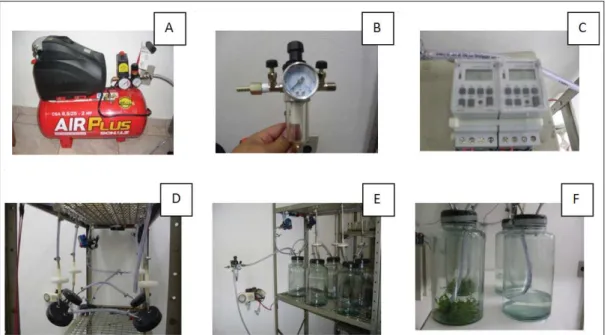
The bioreactor system consists of two vessels connected by silicone tubes; one of the vessels serves to the culture medium reserve and the other one to stock the seedlings growth, a similar model to the twin vessel system – BIT® (Figure 1), according to what was describe by SILVA et al. (2007). For the continuous immersion, it has been done an adaptation in the BIT® model, disconnecting the silicone tubes that linked both twin vessels.
Comparison among the different cultivation methods The in vitro cultivation methods consisted of the conventional micropropagation (liquid, solid with 5 or 6g L-1 of agar), micropropagation in natural ventilation system (liquid, solid with 5 or 6g L-1 of agar) and micropropagation in bioreactors of continuous and temporary immersion, totalizing eight treatments. The seedlings were cultivated in compound medium by the MS medium salts (MURASHIGE & SKOOG, 1962), supplemented with 1,34μM naphthaleneacetic acid (NAA), 30g L-1 of sucrose and with pH adjusted to 5,8.
For the conventional micropropagation and natural ventilation system, in solid and liquid medium it was used containers with 500ml of volume. In each container containing 60ml of growth medium were inoculated fi ve explants. The pH was adjusted for 5,8 before the autoclaving at 121oC and 1kg cm-1, for 20 minutes.
In the natural ventilation system, membranes of fi lter (0,5μm) were used (Milli Seal, Millipore, Tokyo, Japan) to cover a pair of holes (10mm diameter) of the culture vessel, allowing the occurrence of gases exchanges. In the cultivation in bioreactors, the plant material was kept in containers with a 5,000ml volume, being inoculated 20 explants in 600ml of culture medium. For the continuous and temporary immersions the aeration was done every 90 minutes, for periods of 3 minutes.
Assessments
After 90 days of cultivation, assessments were made under the following parameters: length of the aerial part, numbers of leaves, number of roots, length of the root system, the plant fresh and dry masses, and water loss. For the variable water loss, the plants were removed from the containers and, in laboratory (60% of relative humidity of the air), assessed in relation to the water loss. Every 10 minutes, 10mm foliar disks were removed and weighed, for a period of 120 minutes (adapted from SILVA et al., 2008).
Data analysis
The design was entirely randomized (ERD), consisting of a 2x3 factorial experiment with two micropropagation systems (conventional and natural ventilation) and three types of medium (liquid, solid with 5 and 6g L-1 of agar), and two additional treatments of micropropagation in bioreactors (continuous and temporary immersion), totaling 8 treatments with three repetitions. SISVAR 4.3 program (FERREIRA, 2011) was used for the analysis of variances (ANAVA), and the means were compared by the Scott & Knott Test.
RESULTS AND DISCUSSION
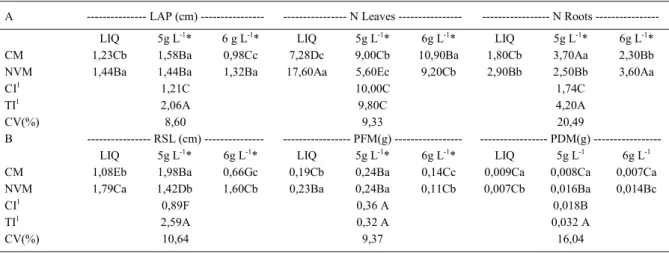
The analysis of all the variables revealed a signifi cant effect of the different systems of micropropagation and culture medium (liquid, 5 or 6g L-1 of agar). The length of aerial part (LAP) was directly affected by the different treatments (Table 1A). A bigger length of the aerial part was observed in the bioreactor of temporary immersion (2,06cm), being followed by the treatments of natural ventilation (NVM) in liquid medium or increased of 5 or 6g L-1 of agar and in conventional micropropagation (CM) with 5g L-1 of agar (Table 1A).
For the variable number of leaves (N Leaves), the best result was obtained in liquid growth medium in NVM (17,60), showing from 6,7 to 12 leaves or more when compared the other treatments (Table 1A). Nevertheless, it was observed that the
Table 1 - A) Length of Aerial part (LAP), number of leaves (N Leaves) and roots (N Roots); B) root system length (RSL), orchid plant fresh
(PFM) and dry mass (PDM) of in vitro orchid leaves growing in different micropropagation systems.
A --- LAP (cm) --- --- N Leaves --- - N Roots
---LIQ 5g L-1* 6 g L-1* LIQ 5g L-1* 6g L-1* LIQ 5g L-1* 6g L-1*
CM 1,23Cb 1,58Ba 0,98Cc 7,28Dc 9,00Cb 10,90Ba 1,80Cb 3,70Aa 2,30Bb
NVM 1,44Ba 1,44Ba 1,32Ba 17,60Aa 5,60Ec 9,20Cb 2,90Bb 2,50Bb 3,60Aa
CI1 1,21C 10,00C 1,74C
TI1 2,06A 9,80C 4,20A
CV(%) 8,60 9,33 20,49
B --- RSL (cm) --- --- PFM(g) --- PDM(g)
---LIQ 5g L-1* 6g L-1* LIQ 5g L-1* 6g L-1* LIQ 5g L-1 6g L-1
CM 1,08Eb 1,98Ba 0,66Gc 0,19Cb 0,24Ba 0,14Cc 0,009Ca 0,008Ca 0,007Ca
NVM 1,79Ca 1,42Db 1,60Cb 0,23Ba 0,24Ba 0,11Cb 0,007Cb 0,016Ba 0,014Bc
CI1 0,89F 0,36 A 0,018B
TI1 2,59A 0,32 A 0,032 A
CV(%) 10,64 9,37 16,04
Averages followed by the same capital letter vertically or lower case horizontally do not differ by the Scott-Knott test at 5% probability.
1Additional treatments; Continuous Immersion (CI), Temporary Immersion (TI), *Agar. Conventional Micropropagation (CM), Natural
plants with the biggest number of leaves presented brittle aspect and little foliar surface, probably due to hiperhydricity, physiological disorder caused by the high water availability, which occurred to all the treatments with orchid plants growing in stationary liquid medium in CM and NVM.
The CM with orchids growing in solidifi ed medium with 5g L-1 of agar presented the biggest number of roots (N roots) not differing from the temporary immersion bioreactor (TI) and from the NVM combined with 6g L-1 of agar (Table 1A). Nonetheless, the bioreactor TI promoted a bigger length of the root system (LRS), reaching 2, 59cm (Table 1B).
The uptake of nutrients in the culture medium is accelerated when the nutrients are added in medium liquid (HAHN & PAEK, 2005), a bigger growth was observed in liquid culture systems in bioreactors when compared to the solid medium (SILVA et al., 2007). Usually, the hiperhydricity happens in liquid growth medium due to the leaves high hydric potential. In our results, the occurrence of hiperhydricity is directly related to the stationary liquid cultivation. The air injection in the cultivation in bioreactors decreases the relative humidity of the air in the cultivation bottle, the hydric potential of the leaves, preventing the hiperhydricity (HAHN & PAEK, 2005).
ZHAO et al. (2012) working with medicinal plant (Rhodiola cremulata) related that forced ventilation was employed in the temporary immersion bioreactor in order to decrease the hyperhydration rate, which improve shoot quality and enhance the multiplication ratio when compared with the others micropropagtion methods. IVANOVA & VAN STADEN (2010) observed that the natural ventilation eliminated the problems with hiperhydricity in Aloe polyphyllaplants.
SILVA et al. (2007) working with different methods of pineapple propagation, reported a bigger length of the aerial part with the use of temporary immersion bioreactor, being superior to other methods like continuous immersion bioreactor and conventional micropropagation. Similar results have been found in chrysanthemums (HAHN & PAEK, 2005); apples (CHAKRABARTY et al., 2007), in the medicinal plants Crescentia cujete (MURCH et al., 2004) and Stevia rebaudiana(SREEDHAR et al., 2008).
MURCH et al. (2004), working with different Crescentia cujete growth systems, reported that a bigger growth of the root system was observed in temporary immersion system when compared to the micropropagation in solid and liquid media. In
the present research, the increase of the oxygenation of the growth bottle, which is a characteristic of the temporary immersion system (ETIENNE & BERTOULY, 2002), promoted, combined with the growth medium sucrose, a bigger growth of the root system.
The plant fresh mass (PFM) presented greater values in the orchids that were growing in continuous immersion bioreactors (CI) and TI, being followed by treatments with NVM in liquid medium or plus 5g L-1 of agar and in CM in combination with 5g L-1 of agar (Table 1B). The fresh mass observed in the plants growing in bioreactors was from 0. 12 to 0.25g superior when compared to the CM and NVM treatments (Table 1B).
The plant dry mass (PDM) expresses the real growth for being related to the proteins and other substances accumulation which are the photosynthesis direct results. Plants growing in TI bioreactor presented the biggest dry mass, reaching 0.032g, being followed by the treatments in CI bioreactor, NVM in 5g L-1 or in 6g L-1 of agar (Table 1B).
The biggest fresh mass observed in CI and TI bioreactor is due to the continual contact of the explants with the liquid growth medium, promoting a greater water absorption in this system. Similar results were observed by SHAIK et al. (2010) with Lessertia frutescens plantlets cultured in TI and CI bioreactor, which showed more fresh mass than those cultured in conventional micropropagation (CM).
ALONSO et al. (2009) confi rmed that TI bioreactor was a promising method for biomass production of Digitalis purpurea by in vitro shoot multiplication. The total dry biomass of Lessertia frutescensplantlet cultured in TI bioreactor increased signifi cantly, compared to those in CI bioreactor and gelled culture (SHAIK et al., 2010). JOVA et al. (2011) and ARAGÓN et al. (2010b) related a greater photosynthetic rate and the best growth of plants cultured in TI bioreactor when compared with the CI bioreactor. The most important reason for the effi ciency of the TI bioreactor was that which combined the advantages of both gelled culture (gas exchange) and liquid culture (increased nutrient uptake), and improved the growth of the plantlets (ETIENNE & BERTHOULY, 2002).
leading to an increase in plant growth and content of photosynthetic pigments when compared to the closed system without a gas-permeable membrane (SALDANHA et al., 2012)
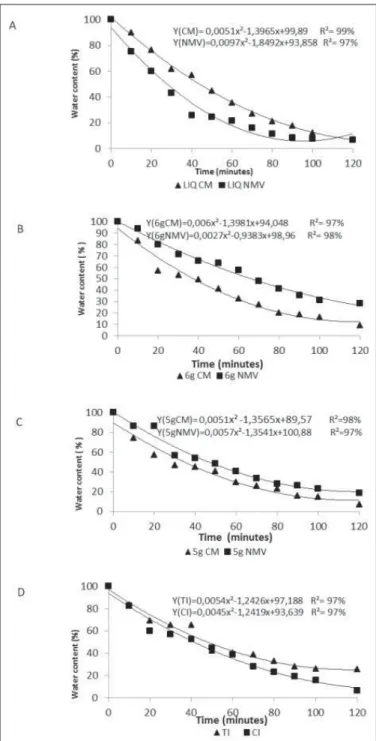
The plants that were cultured in natural ventilation system (NVM) with gelled culture (5 or 6g L-1 agar) presented trend of a higher percentage
of water content (Figure 2 B and C), 120 minutes after their were transferred to ex vitro conditions, when compared with conventional micropropagation (CM). Similar results were observed with plants cultured in TI bioreactor when compared with CI bioreactor (Figure 2 D). Probably, this plant behavior was because of better stomata functionality and
tissue foliar organization promoted by culture in both systems, which prevent water losses of plants after their transfer to natural environment. Plants grown in stationary liquid medium showed a poor water loss control in ex vitro condition and water content below 10% after 120 minutes (Figure 2 A).
The excessive water loss by plantlets during the acclimatization process has been related as the main cause of a poor survival rate of these plantlets on this phase of micropropagation (SILVA et al., 2008). SÁEZ et al. (2012) not only reported a bigger functionality of the stomata as well as the improvement of water loss control in Castanea sativa growing in natural ventilation system, but also that their structures are pretty similar to the ones observed in acclimatized plants.
ARAGÓN et al. (2010a) reported plantain plantlets propagated in TI bioreactor had a better capacity to sustain the stress imposed upon transferring to ex vitro conditions. The similar distribution of stomata staining pattern of in vitro TI bioreactor plantlets when compared to those 14 days after transferring to ex vitro conditions, demonstrated that plantain grown in this system developed leaves morphologically close to autotrophic leaves formed ex vitro as well as stomata with a better water control.
CONCLUSION
The temporary immersion bioreactor is the best system for the C. walkeriana in vitro growth. The air injection in the temporary immersion system, as well as gas exchanges in the cultivation bottle in the natural ventilation system, has benefi cial effects on in vitro plant growth, decreasing water losses of plants after their transfer to ex vitro conditions.
REFERENCES
ALONSO N.P. et al. Cardiotonic glycosides from biomass of
Digitalis purpurea L. cultured in temporary immersion systems. Plant, Cell, Tissue and Organ culture, Dordrecht, v.99, n.2, p.151-156, 2009. Available from: <http://link.springer.com/ chapter/10.1007/978-3-642-21201-7_5>. Accessed: Mar. 25, 2013. doi: 10.1007/978-3-642-2120-7-5.
ARAGÓN, C. et al. Ex vitro acclimatization of plantain plantlets micropropagated in temporary immersion bioreactor. Biologia Plantarum, Prague, v.54, n.2, p.237-244, 2010a. Available from:<http://link.springer.com/article/10.1007%2Fs10535-010-0042-y>. Accessed: Mar. 25, 2013. doi: 10.1007/10535-010-0042-y. ARAGÓN, C.E. et al. Effect of sucrose, light and carbon dioxide on plantain micropropagation in temporary immersion bioreactors.
In Vitro Cellular & Developmental Biology - Plant, Berlin, v.46, n.1, p.97-107, 2010b. Available from: <http://link.springer.com/
article/10.1007/s11627-009-9246-2>. Accessed: Mar. 25, 2013. doi: 10.1007/s11627-009-9246-2.
CHAKRABARTY, D. et al. The dynamics of nutrient utilization and growth of apple root stock ‘M9 EMLA’ in temporary versus continuous immersion bioreactors. Plant Growth Regulation, Coverage, v.51, n.1, p.11-19, 2007. Available from: <http://link. springer.com/article/10.1007/s10725-006-9115-5>. Accessed: Jun. 20, 2012. doi:10.1007/s 10725-006-9115-5.
ETIENNE, H.; BERTHOULY, M. Temporary immersion systems in plant micropropagation. Plant Cell, Tissue and Organ Culture, Dordrecht, v.69, n.3, p.215-231, 2002. . Available from: <http:// link.springer.com/article/10.1023/A%3A1015668610465>. Accessed: Jun. 20, 2012. doi: 10.1023/A: 1015668610465. FERREIRA, D. F. SISVAR: a computer statistical analysis system. Ciência e Agrotecnologia, Lavras, v. 35, n.6, p.1039-1042, 2011. Available from: <http://www.scielo.br/pdf/cagro/v35n6/ a01v35n6.pdf>. Accessed: Mar. 25, 2013. doi: 10.1590/S1413-70542011000600001.
HAHN, E.J.; PAEK, K.Y. Multiplication of Chrysanthemum
shoots in bioreactors as affected by culture method and inoculation density of single node stems. Plant Cell, Tissue and Organ Culture, Dordrecht, v.81, n.3, p.301-306, 2005. Available from: <http://link.springer.com/article/10.1007/s11240-004-6655-0>. Accessed Jun. 20, 2012. doi: 10. 1007/s 11240-004-6655-0. IVANOVA, M.; STADEN, J.V. Natural ventilation effectively reduces hyperhydricity in shoot cultures of Aloe polyphylla
Schönland ex Pillans. Plant Growth Regulation, Coverage, v.60, n.2, p.143-150, 2010. Available from: <http://link.springer.com/ article/10.1007/s10725-009-9430-8>. Accessed: Mar. Jun. 20, 2012. doi:10.1007/ s10725-009-9430-8.
JOVA, M.C. et al. Effect of liquid media culture systems on yam growth (Dioscorea alata L. ‘Pacala Duclos’). Biotechnology, Agronomy, Society and Environment, Gembloux, v.15, n.4, p.515-521, 2011.Available from: <http://popups.ulg.ac.be/Base/ document.php?id=7886>. Accessed: Mar. 25, 2013.
LONE, A.B. et al. Acclimatization of the Cattleya (Orchidaceae) in alternative substrates to tree fern fi ber and sphagno. Acta Scientiarum Agronomy, Maringa, v.30, n.4, p.465-469, 2008. Available from: <http://www.scielo.br/pdf/asagr/v33n1/ v33n1a14.pdf>. Accessed: Jun. 20, 2012. doi: 10. 4525/ actasciagronv331e3939.
MALLÓN, R. et al. Improving secondary embryogenesis in
Quercus robur: application of temporary immersion for mass propagation. Trees, Vancouver, v.26, n.3, p.731-741, 2012. Available from: <http://link.springer.com/article/10.1007/s0639-6>. Accessed: Mar. 25, 2013. doi: 10.1007/s 00468-011-0639-6.
MILLS, D. et al. Improvement of Jojoba shoot Multiplication in vitro by Ventilation. In Vitro Cellular & Developmental Biology - Plant, Berlin, v.40, n.4, p.396-402, 2004. Available from: <http:// link.springer.com/article/10.1079/IVP2004537>. Accessed: Jun. 20, 2012. doi: 10.1079/ IVP 2004537.
tb08052.x/pdf>. Accessed: Jun. 20, 2012. doi: 10.1111/j.1399-3054.1962.tb08051x.
MURCH, S. J. et al. In vitro culture and temporary immersion bioreactor production of Crescentia cujete. Plant Cell, Tissue and Organ Culture, Dordrecht, v.78, n.1, p.63-68, 2004. Available from: <http://link.springer.com/article/10.1023/ B%3ATICU.0000020397.01895.3e>. Accessed: Jun. 20, 2012. doi: 10.1023/B: TICU: 0000020397.01895.3e.
PAEK, K.Y.; CHAKRABARTY, D.; HAHN, E. J. Application of bioreactor system for large scale production of horticultural and medicinal plants. In: Hvoslef-Eide, A. K.; Preil, W., eds. Liquid culture systems for in vitro plant propagation. New York: Springer; 2005. pp.95–116.
PRIZÃO, E.C. et al. Activated charcoal and graphite for the micropropagation of Cattleya bicolor Lindl. and a orchid double-hybrid ‘BLC Pastoral Innocence’. Acta Scientiarum. Agronomy, Maringa, v. 34, n.2, 2012. Available from: <http:// www.scielo.br/scielo.php?script=sci_arttext&pid=S1807-86212012000200006&lng=en&nrm=iso&tlng=en>. Accessed: Mar. 25, 2013. doi: 10.4025/actasciagron.v34i2.12257.
SÁEZ, P.L. et al. Increase light intensity during in vitro culture improves water loss control and performance of Castanea sativa
grown in ventilated vessels. Scientia Horticulturae, Amsterdam, v.138, p.7-16, 2012. Available from: <http://www.sciencedirect. com/science/article/pii/S0304423812000623>. Accessed: Mar. 25, 2013. doi: 10.1016/j.scientia.2012.02.005.
SALDANHA, C.W. et al. A low-cost alternative membrane system that promotes growth in nodal culture of Brazilian ginseng (Pfaffi a glomerata(Spreng.) Pedersen). Plant Cell, Tissue and Organ Culture, Dordrecht, v.110, n.3, p.413-422, 2012. Available from: <http://link.springer.com/article/10.1007/s11240-012-0162-5>. Accessed: Mar. 25, 2013. doi: 10.1007/s 11240-012-0162-5.
SHAIK, S. et al. Micropropagation and bioreactor studies of the medicinally important plant Lessertia (Sutherlandis) frutescens
L. South African Journal of Botany, Pietermaritzburg, v.76, n.2, p.180-186, 2010. Available from: <http://www.academicjournals. org/AJB>. Accessed: Mar. 25, 2013. doi: 10.5897/ AJB 11.2684. SILVA, A.B. et al. Natural light pineapple (Ananas comusus L. Merr) micropropagation. Interciencia, Caracas, v.33, n.11, p.839-843, 2008. Available from: <http://www.scielo.org.ve/pdf/inci/ v33n11/art13.pdf>. Accessed: Mar. 25, 2013
SILVA, A. B. et al. Micropropagation methods of pineapple. Pesquisa Agropecuária Brasileira, Brasília, v.42, n.9, p.1257-1260, 2007. Available from: <http://www.scielo.br/pdf/pab/ v42n9/06.pdf> Accessed: Jun. 20, 2012. doi: 10.1590/S0100-204X2007000900006.
SOARES, J. D.R. et al. Mineral nutrition with silicon by foliar application in orchid hybrid acclimatization. Ciência e Agrotecnologia, Lavras, v.32, n.1, p.626-629, 2008. Available from: <http://www.scielo.br/pdf/cagro/v32n2/43.pdf>. Accessed: Jun. 20, 2012.