Vol.59: e16160546, January-December 2016 http://dx.doi.org/10.1590/1678-4324-2016160546
ISSN 1678-4324 Online Edition
BRAZILIAN ARCHIVES OF BIOLOGY AND TECHNOLOGY
A N I N T E R N A T I O N A L J O U R N A L
Impact of Simulated Warming on Growthand Floral
Characteristics of Two Varieties of Medicinal Epimedium
Zhang Xuemei
1,2*;
FanZengli
1,2; Quan Qiumei
3.
¹Key Laboratory of Southwest China Wildlife Resources Conservation, China West Normal University, Ministry of E ducation, Nanchong, 637009, P. R. China; ² College of Life Sciences,China West Normal University, 637009, China; ³College of envrimental science and engineering, China West Normal University, 637009, China.
ABSTRACT
An open top chamber (OTC) warming system was established in natural field conditions to study the impact of simulated warming on growth and floral characteristics of E. wushanense and E. acuminatum. Results: plant height and leaf growth were affected significantly.In +2°C warming condition, increment of plant height, leaf length and width and daily mean incrementof the two varieties were significantly greater than those of the control group; however, in warming +5°C condition, the increments were significantly lower than those of the control group. Floral differentiation was presented when different treatment was adopted. Floral quantitative character of E. acuminatum increased markedly after +2°C warming, but declined markedly after +5°C warming; however, floral quantitative characters of E. wushanense declined after +2°C and +5°C warming. The results can be used as a reference for cultivation and introduction of the two varieties.
Keywords: simulated warming;E. wushanense; E. acuminatum; floral characteristics; growth status
*
Xuemei, Z et al
Braz. Arch. Biol. Technol. v.59: e16160546, Jan/Dec 2016, Spec Iss 1 2
Temperature determines biological and chemical reaction rate and regulates energy, water and nutrient flow in ecosystem(Shi et al., 2009). It is a vital condition for plant growth and development, because all creatures in life process cannot do without effective accumulated temperature, and their growth is affected by temperature change( Rustad et al., 2001;Jonasson et al., 1999). Scientists conducted abundant monitoring and simulation studies and found that the global greenhouse effect beginning from the 20th century has been expanding, and mean surface temperature has risen by 0.6℃ over the past 100 years(Yin et al., 2008) . It has been predicted by the climate model that by the end of the 21st century, global mean surface temperature will rise by 1.6-6.4℃(IPCC, 2007). At present, the impact of climate warming on terrestrial ecosystem has become a focused concern of the ecologists at home and abroad (Usami et al., 2001).
E. wushanense, with the highest potential of development, has aroused great attention of scholars at home and abroad and already become an important medicinal plant over the years(Li et al., 2005). E. acuminatum is a main source of epimedium herbs in Guizhou, Chongqing, Sichuan, Guangxi, Hubei and Jiangxi, etc.(Pei and Guo, 2007) as is recorded in Ethnodrug Standards for Traditional Chinese Medicinal Materials in Guizhou (2003 edition). Current researches about the two kinds of medicinal plants are mainly concentrated in pharmacology and flowering phenology, etc. Because of excessive picking and long-term unreasonable use, wild epimedium resources are increasingly exhausted. To protect the precious resources and for the sake of further rational development and utilization, ecological study becomes quite necessary(Quan and Li, 2013).
In this research, OTC simulated warming, a popular approach of ITEX, was adopted to study the impact of simulated warming on growth and floral characteristics of E. wushanense and E. acuminatum, aiming to provide theoretical basis for further development and reasonable utilization. As global warming will inevitably change the external environment condition for plant growth and development, we can better analyze and
predict the impact of climate warming on ecosystem based on the field simulated warming experiment and the study about the response of plant growth to temperature changes, which is of great guiding significance for protecting the environment and biodiversity and maintaining stable and sustainable development of the ecosystem.
MATERIALS AND METHODS
Sample area and experimental field
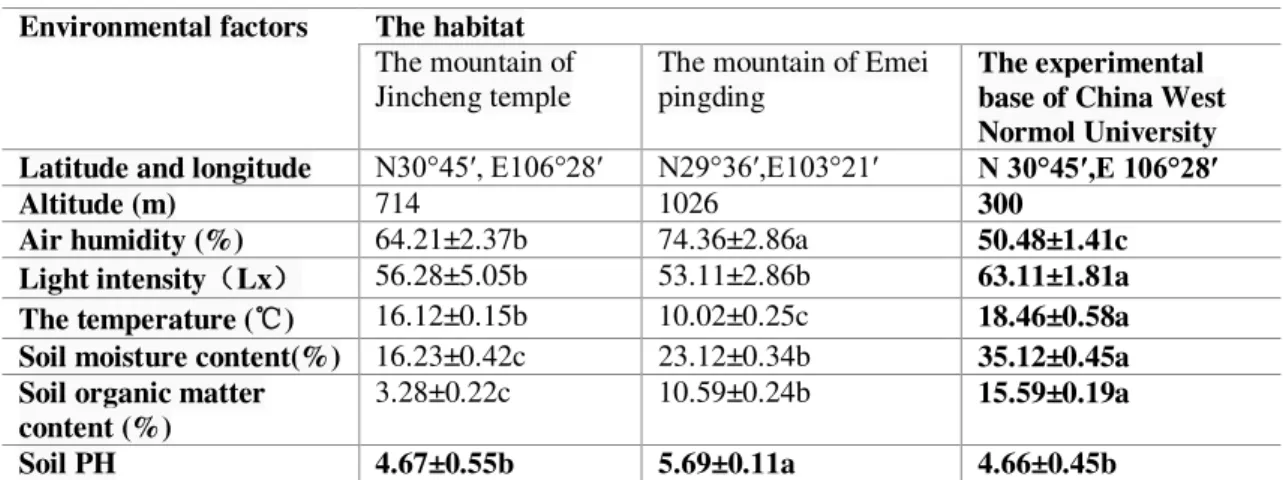
Jinchengshan forest park, at the junction of Nanchong and Guang'an City in the central Sichuan Basin, is the original habitat of E. wushanense. It belongs to the northern subtropical region and enjoys a subtropical warm and typical monsoon climate, with four distinctive seasons and abundant heat. Biocoenosis structure of original habitat of the transplanted E. wushanense: white oak of fagaceae and cedarwood of cupressaceae, dominant varieties of the tree layer. Azaleas of ericaceae, Chinese mahonia of berberidaceae and A. trifoliatus of araliaceae, dominant varieties of the shrub layer; iris, pilea notata, Indian blackberry, mugwort, etc., dominant varieties of the herb layer.
Table1 The basic environmental factors of in different habitats Environmental factors The habitat
The mountain of Jincheng temple
The mountain of Emei pingding
The experimental base of China West Normol University Latitude and longitude N30°45′, E106°28′ N29°36′,E103°21′ N 30°45′,E 106°28′
Altitude (m) 714 1026 300
Air humidity (%) 64.21±2.37b 74.36±2.86a 50.48±1.41c Light intensity(Lx) 56.28±5.05b 53.11±2.86b 63.11±1.81a The temperature (℃) 16.12±0.15b 10.02±0.25c 18.46±0.58a Soil moisture content(%) 16.23±0.42c 23.12±0.34b 35.12±0.45a Soil organic matter
content (%)
3.28±0.22c 10.59±0.24b 15.59±0.19a
Soil PH 4.67±0.55b 5.69±0.11a 4.66±0.45b
Note: Different letters in same column indicate the significant difference in One-way ANOVA (p=0.05).
RESEARCH METHODS
10 samples of E. wushanense and E. acuminatum received field and OTCs warming treatment, respectively. In the growing, flowering and fruiting periods (between March 15 and May 17, 2012), height of plant, length and width of leaf in the mid-part of plant were measured every 4d with Vernier caliper and flexible rule, and the data obtained were analyzed by SPSS19.0 and recorded in Microsoft Excel 2007.
RESULTS
Impact of warming on plant height and leaf growth rate of E. wushanense
Response of plant height to warming
As shown in Figure 1, plant heights of the E. wushanense in three different temperatures present linear growth, and plants in +2°C warming condition are higher than those in the control group C (no warming) and in +5°C warming condition. The results indicate that warming significantly affects plant height, and moderate warming is beneficial to plant growth.
Fig. 1 The growth dynamics of height of E. wushanenseunder warming conditions
Xuemei, Z et al
Braz. Arch. Biol. Technol. v.59: e16160546, Jan/Dec 2016, Spec Iss 1 4
Fig.2 The growth dynamics of leaf length and width of E. wushanenseunder warming conditions
Impact of warming on plant height and leaf growth of the introduced E. acuminatum
Response of plant height to warming
As shown in Figure 3, plant height presents a linear growth in three different conditions, height of plants in+ 2°C warming condition is greater than those of the control C and in +5°C warming condition; the increase in control C presents a gentle rise trend, and height increase of plants in +5°C warming condition is relatively slow. The results are consistent with the height increase of E. wushanense.
Fig.3 The growth dynamics of height ofE.acuminatumunder warming conditions
Fig.4 The growth dynamics of leaf length and width of E.acuminatumunder warming conditions
Growth rate comparison between the two species of Epimedium in warming conditions As shown in Figure 5, average daily height growth of E. wushanense in +2°C warming condition is significantly greater than that in concurrent control, +5°C warming condition and all treatment for E. acuminatum; and average daily height growth of E. acuminatum in +2°C warming condition is significantly greater than that in the control group and +2°C warming condition (F(1,10)=19.997, P=0.000), specifically, E.
wushanense in +2°C (0.645±0.001cm)>E. wushanense in control C (0.479±0.004 cm) >E. wushanense in +5°C (0.410±0.001 cm) >E. acuminatum in +2°C (0.368±0.001 cm) >E. acuminatum in control C (0.274±0.006 cm) >E. acuminatum in +5°C (0.234±0.003 cm); as for growth rate of leaf length, average daily height growth of E. wushanense in +2°C warming condition is significantly greater than those in other groups, E. acuminatum in +5°C is the smallest (F(1,10)=8.715, P=0.001); as for growth
rate of leaf width, average daily growth of E. wushanense and E. acuminatum in +2°C is significantly greater those in other groups.
Impact of warming conditions on floral characteristics of E. wushanense and E. acuminatum
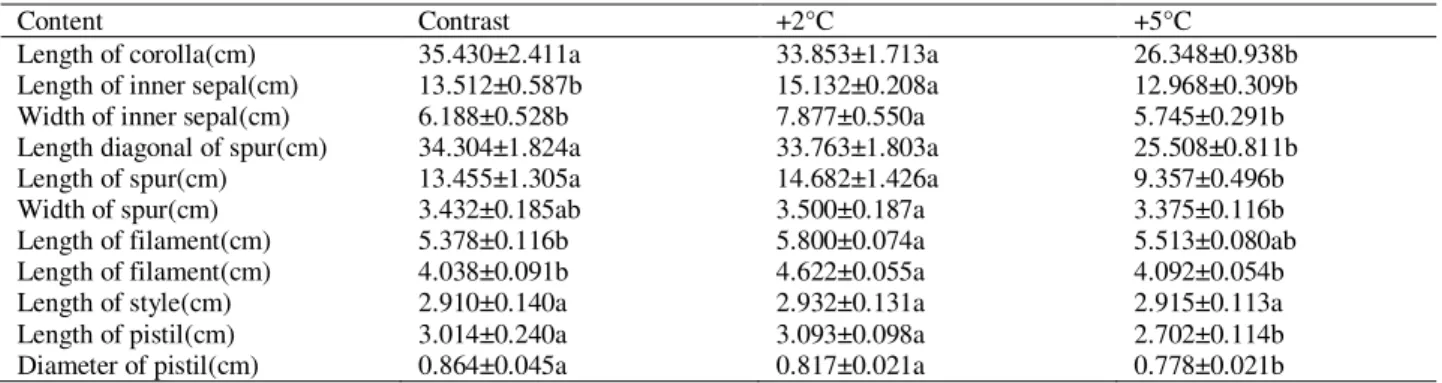
Experimental results as shown in Table 2 and Table 3: as for floral characteristics of E. wushanense and E. acuminatum, differentiation is presented when different treatments are adopted. Corolla length of E. wushanense in all conditions is significantly greater than that of E. acuminatum
Zhao, H et al
Braz. Arch. Biol. Technol. v.59: e16160545, Jan/Dec 2016 6
diameter, the two varieties follow the same trend, and the values in control C and +2°C are significantly greater than those in +5°C. Overall, floral quantitative character of E. acuminatum after +2°C warming rises significantly, and falls
after +5°C warming; floral quantitative character of E. wushanense falls after +2°C and +5°C warming.
Table 2 Comparion of floral department in E.acuminatum under warming conditions
Content Contrast +2°C +5°C
Length of corolla(cm) 35.430±2.411a 33.853±1.713a 26.348±0.938b
Length of inner sepal(cm) 13.512±0.587b 15.132±0.208a 12.968±0.309b
Width of inner sepal(cm) 6.188±0.528b 7.877±0.550a 5.745±0.291b
Length diagonal of spur(cm) 34.304±1.824a 33.763±1.803a 25.508±0.811b
Length of spur(cm) 13.455±1.305a 14.682±1.426a 9.357±0.496b
Width of spur(cm) 3.432±0.185ab 3.500±0.187a 3.375±0.116b
Length of filament(cm) 5.378±0.116b 5.800±0.074a 5.513±0.080ab
Length of filament(cm) 4.038±0.091b 4.622±0.055a 4.092±0.054b
Length of style(cm) 2.910±0.140a 2.932±0.131a 2.915±0.113a
Length of pistil(cm) 3.014±0.240a 3.093±0.098a 2.702±0.114b
Diameter of pistil(cm) 0.864±0.045a 0.817±0.021a 0.778±0.021b
Note: Different lowercase letters in the same row indicate significant differences (P<0.05). Data for average ±
standard error (n = 6).
Table 3 Contrast of floral department in E. wushanense under warming conditions
Content Contrast +2°C +5°C
Length of corolla(cm) 49.983±1.599a 43.353±2.251b 39.452±1.578c
Length of inner sepal(cm) 7.912±0.283a 7.262±0.333b 6.317±0.113c
Width of inner sepal(cm) 3.643±0.179a 3.275±0.089b 3.099±0.084bc
Length diagonal of spur(cm) 49.761±1.594a 41.573±3.100b 39.499±1.091c
Length of spur(cm) 21.734±0.956a 19.890±0.882b 19.599±1.147b
Width of spur(cm) 4.014±0.185a 3.490±0.105b 3.016±0.058c
Length of filament(cm) 5.821±0.174a 4.862±0.127b 4.663±0.053b
Length of filament(cm) 4.246±0.137a 3.848±0.094b 3.675±0.037b
Length of style(cm) 2.716±0.099b 2.443±0.140c 2.969±0.146a
Length of pistil(cm) 2.839±0.130a 2.482±0.095b 2.386±0.090b
Diameter of pistil(cm) 0.906±0.021a 0.818±0.018b 0.796±0.023bc
Note: Different small letters mean significant level 0.05. Data for average ± standard error (n = 6).
DISCUSSIONS
Many studies indicate that warming can promote plant growth and biomass accumulation. Morphological characteristics of plants play an important role in the process of their environment adaptation(Danby and Hik, 2007; Sandvik S M et al., 2004; Welker et al., 1997; Yin et al., 2008). Based on appropriate morphological adjustment, plants may possess and absorb more resources, and become more advantageous in growth and competition(Gielen et al., 2002). Growth of over-ground part of plants affects light energy acquisition and moisture absorption. Temperature change affects plant growth often by changing the temperature of plant root. It has been found that 1℃ ground temperature change can cause great change in plant growth and nutrient absorption, and the response of leaf growth to root
temperature is the most obvious(Walker, 1969; Feng and Sun,1995). Hobbie interprets Ploygonum's research that warming causes increase in dry weight and length of leaves, which is further verified by the parameters of E. wushanense and E. acuminatum obtained in this research, such as changes in plant height, leaf length and width(Hobbie and Chapin,1998). In +2°C warming condition, growth of the two varieties of epimedium in plant height, leaf length and width is greater than that in control C and 5°C warming condition, and the daily average growth in plant height, leaf length and width is significantly greater than that in control C and +5°C condition, suggesting that moderate temperature can promote the growth of E. wushanense and E. acuminatum.
approximates or exceeds the optimal temperature for plant growth. Change of morphological characteristics of plants under different warming conditions is an important index reflecting the range of temperature resistance of plants. Based on comparing the increments of plant height, leaf length and width of the two varieties, E. wushanense is found to be the most sensitive to temperature. Growth of the two varieties in +5°C warming condition is unsatisfactory, suggesting that high temperature leads to poor performance of growth. Tjoelker studies warming effect on several varieties of trees and found that conifers such as larch and picea glauca had the highest relative growth rate in moderate temperature condition, while broadleaf varieties such as Populus tremuloides and Betula apyrifera had the highest
relative growth rate in high temperature condition(Tjoelker et al., 1998). The experimental results suggest that 2°C temperature rise significantly increased plant height, leaf length and width of E. wushanense and E. acuminatum (Figure 5), i.e. light energy acquisition and utilization both in altitudinal and width range, and assimilation were enhanced, thus competitiveness was improved and living space is enlarged. Under the condition of environmental stress or limited resources, plants allocate more biomass to leaves to capture light energy more effectively; after the growing period, however, three methods maintained steady growth rate. It may be because plants in the flowering period need more nutrition for propagation, thus resulting low rate of growth.
Fig.5 Dynamics of leaf area growth in two Epimedium spiecesunder warming conditions Note: Fig (A) is E. acuminatum, (B) is E. wushanense
In addition, optimum temperature of different parts or organs of a variety also differs. Wada conducted short-term artificial warming experiment against Geum pentapetalum and found that its reproductive organs are more sensitive than vegetative organs(Wada et al., 1998). Kudo and Suzuki studied the effect of OTC warming on 5 varieties of plants and showed that warming response of nutritional component and reproductive component of different varieties also differs (Kudo and Suzuki, 2003). Similar results were obtained in this research: for E. acuminatum, floral quantitative character was significantly increased in +2°C warming, while decreased in +5°C warming; for E. wushanense, the effect is C≧+2°C > +5°C. Thus, global warming affects floral quantitative character of E. acuminatum and E. wushanense. Floral characteristics are closely
mechanism as well as mating system and successful reproduction of plants, etc., so if a floral characteristic can significantly increase fitness of the plant, the character is selected by a particular pollinator or functional group of pollination( Barrett, 1998; Li et al.,2013). Whether the change in floral quantitative character caused by climate change can affect pollination process of E. wushanense and E. acuminatum will be studied further.
Zhao, H et al
Braz. Arch. Biol. Technol. v.59: e16160545, Jan/Dec 2016 8
warming treatment. These results can be used as a reference for cultivation and introduction of the two varieties.
Acknowledgements This research was financially supported by grants from China West Normal University (Grant Nos. 412565; Grant Nos. 412532).
REFERENCE
Danby R K, Hik D S. Responses of white spruce(Picea
glauca) to experimental warming at a subarctic
alpine treeline. Global Change Biology,
2007,13:437-451.
Domisch T, Finér L, Lehto T. Effect of soil temperature
on nutrient alloeation and myeorrhizas in Scots pine
seedlings. Plant and Soil, 2002, 239:173-185.
IPCC (Intergovernmental Panel on Climate Change)
(2007). Contribution of working group Ⅲto the
fourth assessment report of the intergovernmental
panel on climate change. In: Metz B, Davidson OR,
Bosch PR, Dave R, Meyer LA eds. Climate Change
in 2007: Mitigation. Cambridge University Press,
Cambridge, UK.
Rustad L E, Campbell J L, Marion G M, Norby R J,
Mitchell M J, Hartley A E, Cornelissen J H C,
Gurevitch J, Gcte-News.A meta-analysis of the
response of soil respiration,net nitrogen
mineralization,and aboveground plant growth to
experimental ecosystemwarming . Oecologia,
2001,126( 4) : 543-562.
Jonasson S,Michelsen A,Schmidt I K,Nielsen E V.
Responses in microbes and plants to changed
temperature,nutrient,andlight regimesintheArctic.
Ecology,1999,80(6) : 1828-1843.
Sandvik S M, Heegaard E, Elven R et al. Responses of
alpine snow bed vegetation tolongterm experimental
warming. Ecoscience, 2004, 11:150-159.
Welker J M, Molau U, Parsons A N et al. Responses of
dryas octopetala to ITEX environment
almanipulations: A synthesis with circumpolar
comparisons. Global Change Biology, 1997, 3:
61-73.
Usami T, LeeJ, OikawaT.Interactive effects of
increased temperature and CO2 on the growth of
Quercus myrsinaefoliasaplings . Plant,Cell and
Environment,2001,24: 1007-1019.
PEI Li kuan, GUO Bao lin. A review on research of raw
material and cut crude drug of H erba Epmiedii in
last ten years, China Journal of Chinese Materia
Medica, 2007, 32( 6) : 466-471.
YIN HuaJun, LAI Ting, CHENG XinYing, JIANG
XianMin, LIU Qing. Warming Effects on Growth
and Physiology of Seedlings of Betula Albo-sinensis
and Abies faxoniana under Two contrasting Light
Conditions in Subalpine Coniferous Forest of
Western Sichuan, China. Journal of Plant Ecology
(Chinese Version), 2008, 32 (5): 1072~1083.
LI Zuozhou, XU Yanqin, WANG Ying, HUANG
Hongwen. Status and prospect of research on
medicinal plants of Epimedium L. Chinese
Traditional and Herbal Drugs. 2005.36( 2) :
289-296.
QUAN Qiumei, LI Yunxiang. Flowering phenology
and reproductive feature of E. wushanense .
Chinese Journal of Ecology, 2013,32( 4) : 859-866.
SHI Fusun, WU Ning, WU Yan, WANG Qian. Effect
of Simulated Temperature Enhancement on Growth
and Photosynthesis of Deschampsia caespitosa and
Thlaspi arvense in Northwestern Sichuan, China.
Tjoelker M G, Oleksyn J, Reich P B. Seedlings of five
boreal tree species differ in acclimation of net
photosynthesis to elevated CO2 and temperature.
Tree physiology, 1998, 18(11): 715-726.
Walker J M. One-degree increments in soil
temperatures affect maize seedling behavior[J].
Soil Science Society of America Journal, 1969,
33(5): 729-736.
Feng Yulong, Sun Guobin. Influence of temperature of
root system on plant( Ⅰ )-influence of root
temperature on plant growth and photosynthesis.
Journal of Northeast Forestry University. 1995,
23(3): 63-69.
Hobbie S E, Chapin III F S. The response of tundra
plant biomass, aboveground production, nitrogen,
and CO2 flux to experimental warming. Ecology,
1998, 79(5): 1526-1544.
Gielen B, Calfapietra C., Claus A. Crown architecture
of Populus spp. Was differentially modified by
free-air CO2 enrichment (POPFACE). New Phytologist,
2002, 53(1): 91-99.
Wada N, Miyamoto M, Kojima S. Responses of
reproductive traits to short-term artificial warming
in a deciduous alpine shrub Geum pentapetalum
(Rosaceae) Proceedings of the NIPR Symposium on
Polar Biology. National institute of polar research,
1998: 137-146.
Li X.X.,Wang IL, Gituru R.W., Guo Y.H.' Yang C.F.
Pollen packaging and dispensing: Adaption of
patterns of anther dehiscence and flowering traits to
pollination in three Epimedium species. Plant
Biology, 2014, 16: 227-233.
Barrett S C H. The evolution of mating strategies in
flowering plants. Trends in Plant Science. 1998. 3:
335-341
Kudo G, Suzuki S. Warming effects on growth,
production, and vegetation structure of alpine
shrubs: a five-year experiment in northern Japan.