Acta Scientiarum
http://www.uem.br/acta ISSN printed: 1806-2636 ISSN on-line: 1807-8672
Doi: 10.4025/actascianimsci.v37i4.28094
Genetic improvement of Nellore cattle in the semi-arid region of
northeastern Brazil
Ana Carla Borges Barbosa1*, Iomar Ramos Oliveira2, Ana Claudia Mendes Malhado3, Paulo Luiz Sousa Carneiro4, Raimundo Martins Filho5 and Carlos Henrique Mendes Malhado4
1
Programa de Pós-graduação em Zootecnia, Universidade Federal da Bahia, Av. Adhemar de Barros, s/n.º, 40170110, Salvador, Bahia, Brazil.
2
Programa de Pós-graduação em Genética, Biodiversidade e Conservação, Universidade Estadual do Sudoeste da Bahia, Jequié, Bahia, Brazil.
3
Universidade Federal do Alagoas, Maceió, Alagoas, Brazil. 4Departamento de Ciências Biológicas,Universidade Estadual do Sudoeste da Bahia, Jequié, Bahia, Brazil. 5Universidade Federal do Cariri, Juazeiro do Norte, Ceará, Brazil. *Author for correspondence. E-mail: [email protected]
ABSTRACT. The semi-arid region of Brazil represents approximately 57% of the northeastern territory. The main economic activity in this region is agriculture and livestock, in most cases, using traditional technologies. However, there is little published information currently available on cattle-raising in this part of Brazil. The objective of this study was to estimate genetic parameters and trends for productive and reproductive traits of Nellore cattle raised in semi-arid region of northeastern Brazil. Data were collected on weight-adjusted at 205 (W205), 365 (W365) and 550 (W550) days of life, age at first calving (AFC), calving interval (CI) and scrotal circumference (SC) at 550 days of life of cattle born between 1965 and 2011. Estimates of covariance and variance were obtained through univariate analysis using a Gibbs sampler. The estimated coefficients of heritability (mode) were 0.27 (W205), 0.36 (W365) and 0.39 (W550), 0.37 (SC), 0.22 (AFC) and 0.03 (CI). Little or no gain from selection is apparent in the genetic trend analysis over the 45 years of the study. However, environmental improvement has allowed phenotypic progress in growth traits and age at first age calving.
Keywords: age at first calving, genetic progress, genetic parameters, heritability.
Melhoramento genético de bovinos Nelore na região semi-árida do nordeste do Brasil
RESUMO. A região semiárida do Brasil representa aproximadamente 57% do território nordestino. A principal atividade econômica da região é a agricultura e pecuária e, na maioria dos casos, utilizando tecnologias tradicionais. No entanto, há poucas informações publicadas, sobre a criação de bovinos nesta parte do Brasil. O objetivo deste estudo foi estimar parâmetros e tendências genéticas para características produtivas e reprodutivas de bovinos Nelore criados na região semiárida do nordeste do Brasil. Foram coletados dados ajustados aos 205 (P205), 365 (P365) e 550 (P550) dias de vida, idade ao primeiro parto (IPP), intervalo entre partos (IP) e perímetro escrotal (PE) aos 550 dias de idade em bovinos nascidos entre 1965 e 2011. As estimativas de variância e covariância foram obtidas por meio de análise univariada usando um amostrador de Gibbs. Os coeficientes estimados de hereditariedade (moda) foram de 0,27 (P205), 0,36 (P365) e 0,39 (P550), 0,37 (PE), 0,22 (IPP) e 0,03 (IP). Pouco ou nenhum ganho de seleção foi encontrado na análise de tendência genética ao longo dos 45 anos do estudo. No entanto, a melhoria do ambiente permitiu progresso fenotípico das características de crescimento e idade ao primeiro parto.
Palavras-chave: idade ao primeiro parto, progresso genético, parâmetros genéticos, herdabilidade.
Introduction
In the northeastern region, particularly in the semi-arid zone where agriculture is the major economic activity, livestock rearing is still performed using traditional practices and there has been a low level of adoption of more efficient contemporary practices.
Variables related to weight performance are traditionally used as criteria and selection objectives in beef cattle and the majority of studies in the northeastern region have addressed these
characteristics (Carneiro et al., 2009; Malhado, Carneiro, Pereira, Martins Filho & Souza, 2008; Sarmento et al., 2003). However, other phenotypic traits such as those related to reproduction may also strongly affect the efficiency of cattle rearing.
programs, while the monitoring of phenotypic changes allows one to observe whether the genetic progress and environmental improvement adopted by breeders has increased production over time thereby guiding future actions that might be useful in breeding programs and herd management.
The estimation of (co) variance components via Restricted Maximum Likelihood (REML) has been the usual method in Brazil, as can be seen in the study by Mercadante, Lôbo and Oliveira (2000) and Yokoo et al. (2007), among others. Yet, the Bayesian inference via Gibbs sampling is an excellent alternative for the estimation of (co) variance and genetic parameters, since it allows accurate estimates to be obtained with greater flexibility due to the posteriori distributions. It also allows the design of exact probability intervals for the estimates of parameters (Faria et al., 2007a).
Growth traits can be important selection criteria for bovine meat production since they show abundant variation and typically co-vary. Through the estimation of genetic parameters is possible to predict if growth traits will offer a good response to direct selection and, therefore, whether the inclusion of these criteria will enable greater genetic gains in the study herds (Tamioso, Dias, Almeida Teixeira & Silva, 2014). For fertility traits, scrotal perimeter has also been used as a selection criterion to increase reproductive efficiency in bovine herds. Like growth traits, it is heritability, has natural variability and is easy to measure. Moreover, there is evidence of a positive relationship between reproductive traits in males and females. The main objective of this study was to estimate the parameters and genetic trends for growth and reproductive traits of Nellore cattle raised in the semi-arid zone of northeastern Brazil using Bayesian inference.
Material and methods
Data
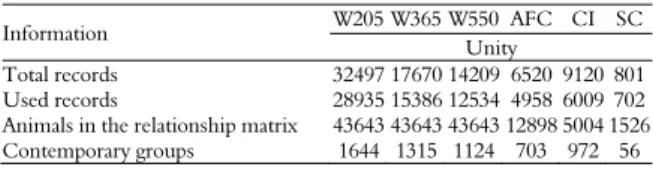
The semi-arid sub-region is located in the center of the northeastern region of Brazil. The used data originated from the monitoring weight development of Nellore of the ‘Associação Brasileira dos Criadores de Zebu – ABCZ’ (Brazilian Association of Zebu Breeders).Weight-adjusted data collected at 205 (W205), 365 (W365) and 550 (W550) days of life, age at first calving (AFC), calving interval (CI) and scrotal circumference (SC) at 550 days of life of cattle born between 1965 and 2011 in the 189 cities from the semi-arid region of northeastern Brazil have been used (Table 1).
Table 1. Data structure for weight-adjusted data collected at 205 (W205), 365 (W365) and 550 (W550) days of life, age at first calving (AFC), calving interval (CI) and scrotal circumference (SC) at 550 days of life of Nellore cattle in the semi- arid zone of northeastern Brazil.
Information W205 W365 W550 AFC CI SC Unity
Total records 32497 17670 14209 6520 9120 801 Used records 28935 15386 12534 4958 6009 702 Animals in the relationship matrix 43643 43643 43643 12898 5004 1526 Contemporary groups 1644 1315 1124 703 972 56
Statistical analysis
In order to obtain the covariance and variance estimates, univariate analyses were performed using the Multiple Trait Gibbs Sampling for Animal Models (MTGSAM), as described by Van Tassell & Van Vleck (1995).
For weights adjusted at 205 (W205), 365 (W365) and 550 (W550) days of life, we used models that included random genetic effects, direct and maternal, and permanent maternal environment, the covariate age of dam at calving (linear and quadratic effect), and the fixed effect of contemporary group (CG).
The model for age at first calving contained the direct random effect and the fixed effect of contemporary groups. The model for calving interval included the effects of random genetic and permanent environment, and the fixed effect of GC. For scrotal circumference, measurements were taken between 500 and 600 days of life and the model included random genetic effect, fixed effect of CG and the covariate of age during measurement.
The contemporary groups consisted of animals of the same sex, time (season and year of birth or calving) and farm of origin. All animals were raised exclusively on pasture. Contemporary groups with less than four animals were excluded from analysis.
The inverted Wishart distribution was used as a priori distribution for estimating the (co) variance components of the genetic effects, especially due to the computational efficiency in which a non-informative priori was assumed for all parameters.
Descriptive statistics (mean, median and standard deviation) and confidence interval and/or high density were obtained using the BOA package of software R. The high-density interval provides an interval that includes 95% of the sample, in addition to being a measure of reliability. This interval can also be applied to non-symmetrical distributions (Hyndman, 1996). A kernel estimator (available in SAS software, 2004) was used to generate graphic descriptions and estimate the mode of posterior distributions.
Estimates of genetic and phenotypic trends were obtained by weighted linear regression of the mean of the dependent variable (genetic values and observed weight) over the year of birth of the calf or that of its mother’s birth using SAS (2004).
Results and discussion
Descriptive statistics of the traits
The means observed for growth traits were 160.32 ± 33.00 kg (W205), 213.80 ± 45.05 kg (W365) and 278.95 ± 65.94 kg (W550). According to the national synthesis report of the Brazilian Zebu Cattle Breeders Association (ABCZ/EMBRAPA), the observed means for the Nellore herd at weaning and at 550 days of life are 188.85 ± 32.56 and 243.05 ± 44.12 kg, thus demonstrating that, at weaning, the animals of the semi-arid zone are below the expected means. Surprisingly, given the unfavorable natural conditions of the semi-arid environment, when the animals are at the yearling stage the means are above the national average.
The mean age at first birth was 1418.46 ± 518.83 days (46.5 months). Slightly higher values have been reported for the Nellore breed in the northern region (47.3 months) by Malhado et al. (2010) and in the northern and northeastern regions (45.14 months) by Azevêdo et al. (2006). The national average for Nellore (ABCZ/EMBRAPA) is lower than the studies cited above, but it is still high at 39.54 months. The high mean of age at first calving is one of the major factors that negatively affect beef cattle-rearing in the tropics (Azevêdo et al., 2006).
The average calving interval was 524.80 ± 161.26 days (17.20 months). This value is considered far from ideal (Azevêdo et al., 2006) but it is better the national average for this breed (576.04 ± 212.3 days) according to estimates performed after the second calving (ABCZ/EMBRAPA). High standard deviations indicate the wide variability in this trait - some herds have animals giving birth close to one year, whereas other animals give birth far later.
The yearling scrotal circumference was 25.70 ± 4.54 cm, close to those described in the literature for
Nellore (Boligon, Rorato, & Albuquerque, 2007; Forni & Albuquerque, 2005) and above the national average of 21.85 cm (ABCZ/EMBRAPA).
Genetic parameters
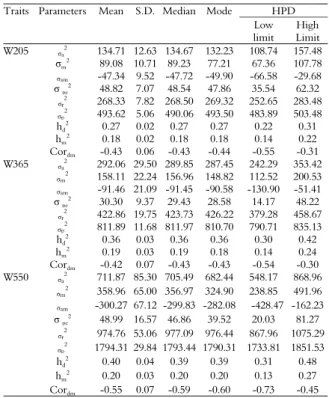
The means W205 = 0.27, W365 = 0.36 and W550 = 0.40, medians (W205 = 0.27, W365 = 0.36 and W550 = 0.39) and modes (W205 = 0.27, W365 = 0.36 and W550 = 0.39) of estimates of heritability of growth traits were nearly identical, except for a slight variation in the mean for W550 (Table 2). The mode is considered the most appropriate measure of a posteriori distributions (Wright, Stern & Berger, 2000) and can be used to find the values of higher frequencies (maximum distribution). Other measures of central tendency, such as mean and median, can also summarize a posteriori distributions, especially if these densities are approximately symmetrical when such measurements are similar - this was observed for the six features analyzed (Table 2).
Table 2. Means, standard deviation (S.D.), median, mode and highest a posteriori density interval (HPD) of the variance components and heritability values for weight at 205 (W205), 365 (W365) and 550 (W550) days of age obtained using Gibbs sampler.
Traits Parameters Mean S.D. Median Mode HPD Low limit
High Limit W205 σa
2 134.71 12.63 134.67 132.23 108.74 157.48
σm 2
89.08 10.71 89.23 77.21 67.36 107.78
σam -47.34 9.52 -47.72 -49.90 -66.58 -29.68
σpe2 48.82 7.07 48.54 47.86 35.54 62.32
σr
2 268.33 7.82 268.50 269.32 252.65 283.48
σp
2 493.62 5.06 490.06 493.50 483.89 503.48
hd 2
0.27 0.02 0.27 0.27 0.22 0.31 hm
2 0.18 0.02 0.18 0.18 0.14 0.22
Cordm -0.43 0.06 -0.43 -0.44 -0.55 -0.31
W365 σa
2 292.06 29.50 289.85 287.45 242.29 353.42
σm
2 158.11 22.24 156.96 148.82 112.52 200.53
σam -91.46 21.09 -91.45 -90.58 -130.90 -51.41
σpe
2 30.30 9.37 29.43 28.58 14.17 48.22
σr2 422.86 19.75 423.73 426.22 379.28 458.67
σp
2 811.89 11.68 811.97 810.70 790.71 835.13
hd
2 0.36 0.03 0.36 0.36 0.30 0.42
hm 2
0.19 0.03 0.19 0.18 0.14 0.24 Cordm -0.42 0.07 -0.43 -0.43 -0.54 -0.30
W550 σa2 711.87 85.30 705.49 682.44 548.17 868.96
σm2 358.96 65.00 356.97 324.90 238.85 491.96
σam -300.27 67.12 -299.83 -282.08 -428.47 -162.23
σpe
2 48.99 16.57 46.86 39.52 20.03 81.27
σr
2 974.76 53.06 977.09 976.44 867.96 1075.29
σp
2 1794.31 29.84 1793.44 1790.31 1733.81 1851.53
hd
2 0.40 0.04 0.39 0.39 0.31 0.48
hm 2
0.20 0.03 0.20 0.20 0.13 0.27 Cordm -0.55 0.07 -0.59 -0.60 -0.73 -0.45
(1)σ
a2 is the additive genetic variance, σm2 is the maternal genetic variance, σam is the
covariance between direct and maternal effects, σpe2 is the permanent environmental variance, σe2 is the residual variance, σp2 is the phenotypic variance, h2 is the direct
heritability, hm2 is the maternal heritability, and Cordm refers to the genetic correlation
between direct and maternal effects.
through selection. In the data analysis of Nellore animals from all of Brazil, using Bayesian inference (IB), Faria et al. (2007b) estimated heritability of 0.39 for W365, and similar values were observed in the three position measurements. Using the method of restricted maximum likelihood (REML), Malhado et al. (2008) estimated heritability values of 0.16, 0.24 and 0.33 for W205, W365 and W550 for Nellore cattle in the state of Bahia. Based on an extensive review of zebu animals, Giannotti, Packer and Mercadante (2005) reported (based on Bayesian meta-analysis) mean heritability values of 0.24 (W205), 0.28 (W365) and 0.33 (W550). Lower estimates (W205 = 0.11 and W365 = 0.10) were obtained by Malhado, Carneiro, Martins Filho and Azevedo (2009) using REML applied to purebred Nellore cattle reared in the hinterlands of the northeastern region.
The maternal heritability coefficients (mode) were 0.18, 0.18 and 0.20 for W205, W365 and W550, respectively. In a review conducted by Giannotti et al. (2005), the mean maternal heritability values were 0.13 (W205) 0.12 (W365) and 0.05 (W550). The highest value observed in the semi-arid region suggests that these animals are more dependent on their mothers for longer periods. Biffani, Martins Filho, Giorgetti, Bozzi and Lima (1999) have argued that, at 365 days, the calf is fully independent in regards to food. However, this assumption has not been rigorously verified, especially under the prevailing rearing conditions of the northeastern region. The performance of the calf is therefore probably influenced by maternal effects for a longer period, and the age of one year can be (in some cases) considered as the effective age of weaning.
The correlations (mode) between direct and maternal effects were negative (-0.44 for W205, -0.43 for W365, and -0.60 for W550). The distributions were almost symmetrical and the superior and inferior limits of the regions of high density were negative. Several studies have reported antagonistic correlations between direct and maternal genetic effects in beef cattle (Giannotti et al., 2005; Gutteres et al., 2007; Sarmento et al., 2003). Malhado et al. (2010) has estimated results close to zero (W205 = -0.01 and W365 = -0.03), using information on the pedigree of approximately 143,000 animals for the period from 1942 to 2006 via restricted maximum likelihood. According to Schaeffer (2004), obtaining good estimates requires data from multiple generations with appropriate associations between direct and maternal genetic effects in beef cattle. However, these associations between generations are insufficient causing several biased estimates of correlation coefficients between maternal and direct effects. Boligon, Pereira, Ayres and Albuquerque (2012) reported that the accurate estimation of genetic
covariance between direct and maternal effects depends on the data structure.
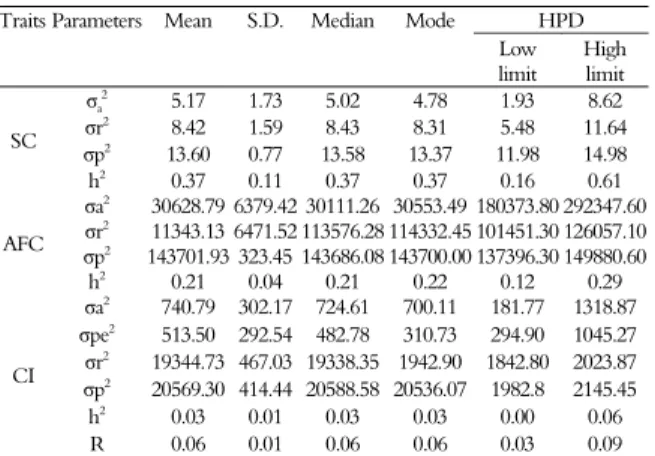
The three position measurements were equal 0.37 (Table 3) for the coefficient of heritability of scrotal circumference. On analyzing the SC at the 365 and 450 days of life, with different models using BI Faria et al. (2007b) reported heritability values ranging from 0.52 to 0.66. Using the REML method in the EC, at an approximate age of 18 months, Pereira, Yokoo, Bignardi, Sezana and Albuquerque (2010) estimated heritability value of 0.33. The magnitude of the heritability estimate for this trait is sufficient for it to be used as a selection criterion aimed at sexual precocity and quality of semen, if the correlations are favorable and high.
Table 3. Means, standard deviation (S.D.), median, mode and higher a posteriori density interval (HPD) of the variance and heritability components for scrotal circumference (SC) at 550 days of age, age at first calving (AFC) and calving interval (CI) obtained using Gibbs sampler.
Traits Parameters Mean S.D. Median Mode HPD Low limit
High limit
SC
σa2 5.17 1.73 5.02 4.78 1.93 8.62
σr2 8.42 1.59 8.43 8.31 5.48 11.64
σp2
13.60 0.77 13.58 13.37 11.98 14.98 h2 0.37 0.11 0.37 0.37 0.16 0.61
AFC
σa2
30628.79 6379.42 30111.26 30553.49 180373.80 292347.60
σr2 11343.13 6471.52 113576.28 114332.45 101451.30 126057.10
σp2 143701.93 323.45 143686.08 143700.00 137396.30 149880.60
h2 0.21 0.04 0.21 0.22 0.12 0.29
CI
σa2 740.79 302.17 724.61 700.11 181.77 1318.87
σpe2 513.50 292.54 482.78 310.73 294.90 1045.27
σr2 19344.73 467.03 19338.35 1942.90 1842.80 2023.87
σp2 20569.30 414.44 20588.58 20536.07 1982.8 2145.45
h2 0.03 0.01 0.03 0.03 0.00 0.06
R 0.06 0.01 0.06 0.06 0.03 0.09 (1)σ
a
2 is the additive genetic variance, σ pe
2 is the permanent environmental variance,σ e
2 is
the residual variance, σp2 is the phenotypic variance, h2 is the heritability, and R is the
repeatability.
is important to reduce this interval, especially the dam of sire and dam of dam intervals.
The coefficient of heritability for calving interval was low (0.03) and similar among the three position measurements. As described in the review conducted by Lôbo, Madalena and Vieira (2000), the majority of estimates in studies involving cattle are low. Thus, the high calving interval in cattle could be reduced with more appropriate management measures and better nutritional conditions.
Genetic trends
The genetic trends (linear regression) for the three weightings were significant (p < 0.001) and equal to 0.0294; 0.0318 and 0.0278 kg per year for W205, W365 and W550, respectively. This represents a genetic progress of 1.32, 1.43 and 1.25 kg in 45 years (Figure 1). Malhado et al. (2008) have reported genetic gains of 0.049 (W205), 0.038 (W365) and 0.068 kg per year (W550) for Nellore cattle in Bahia. In the northern region, superior genetic progress has been estimated for the same breed, with gains of 0.097 (W205), 0.132 (W365) and 0.203 kg per year (W550) (Malhado et al., 2010). However, it should be noted that a study covering the hinterlands of northeastern region in the period from 1970 to 2005 reported no genetic progress in growth traits (Malhado et al., 2009).
According to Biffani et al. (1999), animals under typical handling conditions are typically selected by breeders more based on anatomical and racial traits than on a basis of reproductive performance.
Nevertheless, this habit has decreased over recent years and breeding values have increased since the year 2000 (Figure 1). This conclusion is supported by two studies involving growth traits from Nellore in the northeastern region (Malhado et al., 2008; Malhado et al., 2005).
The genetic trends of maternal effect (linear regression) were not significant for the three growth traits. Despite the observed magnitude of heritability for such effect, there was no selection for this trait.
Regarding the reproductive characteristics, only the genetic trend (linear regression) for age at first calving was significant (p < 0.001), with annual gains of 0.14 years, resulting in a decrease of 4 days in the period between 1981 and 2010. The measurement of scrotal circumference has been added to the database of ABCZ over the last years and the small amount of data and/or the short period was the most likely reason for the absence of a significant trend.
The phenotypic trends (linear regression) among the three growth traits were significant (p < 0.001) and equal to 1.39 (R2 = 86.5%), 1.79 (R2 = 84.8%)
and 2.38 (R2 = 85.8%) kg per year, corresponding to
phenotypic gains in the order of 48.65 (W205), 62.65 (W365) and 83.30 kg (W550) within 35 years. The linear regression for age at first birth (-5.12 days per year – R2 = 19.3%) was also significant (p < 0.05),
with a reduction in AFC of about 150 days within the period of 29 years.
These results provide evidence that the four traits have been improving over the years and that breeders have made significant phenotypic progress, especially with regards to growth characteristics. Yet, this gain can be almost exclusively attributed to environmental improvements, since the genetic progress was low.
Conclusion
The data suggest that there is sufficient genetic variability in the Nellore cattle of the northeastern semi-arid region of Brazil to promote significant changes in growth traits (maternal and direct effect), scrotal circumference and age at first calving. However, little or no gain has been made from selection during the 45 years for which data are available. Nevertheless, environmental improvement has promoted phenotypic progress in weight and age at first calving.
References
Azevêdo, D. M. M. R., Martins Filho, R., Lôbo, R. N. B., Malhado, C. H. M., Lôbo, R. B., Moura, A. A. A., & Pimenta Filho, E. C. (2006). Reproductive performance of Nelore cows in the North and Northeast Regions of Brazil. Revista Brasileira de Zootecnia, 35(3), 988-996.
Biffani, S., Martins Filho, R., Giorgetti, A., Bozzi, R., & Lima, F. A. M. (1999). Fatores ambientais e genéticos sobre o crescimento ao ano e ao sobreano de bovinos Nelore, criados no Nordeste do Brasil. Revista Brasileira de Zootecnia, 28(3), 468-473.
Boligon, A., Pereira, R., Ayres, D., & Albuquerque, L. G. (2012). Influence of data structure on the estimation of the additive genetic direct and maternal covariance for early growth traits in Nellore cattle. Livestock Science, 145(1), 212-218.
Boligon, A. A., Rorato, P. R. N., & Albuquerque, L. (2007). Correlações genéticas entre medidas de perímetro escrotal e características produtivas e reprodutivas de fêmeas da raça Nelore. Revista Brasileira de Zootecnia, 36(3), 565-571.
Carneiro, P. L. S., Malhado, C. H. M., Martins Filho, R., Carneiro, A. P. S., Silva, F., & Torres, R. A. (2009). A raça Indubrasil no Nordeste brasileiro: melhoramento e estrutura populacional. Revista Brasileira de Zootecnia, 38(12), 2327-2334.
Faria, C. U., Magnabosco, C. U., Reyes, A., Lôbo, R. B., Bezerra, L. A. F., & Sainz, R. D. (2007a). Bayesian inference on field data for genetic parameters for some reproductive and related traits of Nellore cattle (Bos indicus). Genetics and Molecular Biology, 30(2), 343-348. Faria, C. U., Ulhôa Magnabosco, C., Reyes, A., Lôbo, R.
B., & Bezerra, L. A. F. (2007b). Inferência bayesiana e sua aplicação na avaliação genética de bovinos da raça
nelore: revisão bibliográfica. Ciencia Animal Brasileira, 8(1), 75-86.
Forni, S., & Albuquerque, L. G. (2005). Estimates of genetic correlations between days to calving and reproductive and weight traits in Nelore cattle. Journal of Animal Science, 83(7), 1511-1515.
Geweke, J. (1992). Evaluating the accuracy of sampling-based approaches to the calculation of posterior moments. In J. Bernardo, J. Berger, A. Dawid & A. Smith (Eds.), Bayesian Statistics 4. Oxford: Oxford University Press.
Giannotti, J. G., Packer, I. U., & Mercadante, M. E. Z. (2005). Meta-análise para estimativas de herdabilidade para características de crescimento em bovinos de corte. Revista Brasileira de Zootecnia, 34(4), 1173-1180. Gutteres, L. F. W., Rorato, P. R. N., Boligon, A. A.,
Webert, T., Kippert, C. J., Lopes, J. S., & Souza, P. R. S. (2007). Efeito da inclusão da covariância genética aditiva direta-materna no modelo de análise sobre a magnitude das estimativas de parâmetros e valores genéticos preditos para ganho de peso na raça Brangus. Ciencia Rural, 37(3), 809-814.
Hyndman, R. J. (1996). Computing and graphing highest density regions. The American Statistician, 50(2), 120-126.
Lôbo, R., Madalena, F., & Vieira, A. (2000). Average estimates of genetic parameters for beef and dairy cattle in tropical regions. Paper presented at the Animal Breeding Abstracts.
Malhado, C. H. M., Carneiro, P. L. S., Malhado, A. C. M., Martins Filho, R., Bozzi, R., & Ladle, R. J. (2010). Genetic improvement and population structure of the Nelore breed in Northern Brazil. Pesquisa Agropecuária Brasileira, 45(10), 1109-1116.
Malhado, C. H. M., Carneiro, P. L. S., Martins Filho, R., & Azevedo, D. (2009). Histórico genético e populacional do rebanho Nelore Puro de Origem no Sertão Nordestino. Pesquisa Agropecuária Brasileira, 44(7), 713-718.
Malhado, C. H. M., Carneiro, P. L. S., Pereira, D. G., Martins Filho, R., & Souza, J. (2008). Progresso genético e estrutura populacional do rebanho Nelore no Estado da Bahia. Pesquisa Agropecuária Brasileira, 43(9), 1163-1169.
Malhado, C. H. M., Martins Filho, R., Lôbo, R. N. B., Facó, O., Azevedo, D., Souza, J., & Oliveira, S. (2005). Tendências genéticas para características relacionadas à velocidade de crescimento em bovinos Nelore na região Nordeste do Brasil. Revista Brasileira de Zootecnia, 34(1), 60-65.
Mercadante, M. E. Z., Lôbo, R. B., & Oliveira, H. N. (2000). Estimativas de (co) variâncias entre características de reprodução e de crescimento em fêmeas de um rebanho Nelore. Revista Brasileira de Zootecnia, 29(4), 997-1004.
crescimento na raça Nelore. Pesquisa Agropecuária Brasileira, 45(6), 613-620.
Raftery, A. E., & Lewis, S. M. (1992). Comment: one long run with diagnostics: implementation strategies for Markov Chain Monte Carlo. Statistical Science, 7(4), 493-497.
Sarmento, J. L. R., Pimenta Filho, E., Ribeiro, M. N., & Martins Filho, R. (2003). Efeitos ambientais e genéticos sobre o ganho em peso diário de bovinos Nelore no estado da Paraíba. Revista Brasileira de Zootecnia, 32(2), 325-330.
SAS. (2004). SAS/STAT User guide, Version 9.1.2. Cary, NC, USA: SAS Institute Inc.
Schaeffer, L. R. (2004). Application of random regression models in animal breeding. Livestock Production Science, 86(1), 35-45.
Tamioso, P. R., Dias, L. T., Almeida Teixeira, R., & Silva, C. J. A. (2014). Estimativas de parâmetros genéticos para características de crescimento de cordeiros mestiços Suffolk. Ciencia Animal Brasileira, 15(4), 414-419.
Van Tassell, C., & Van Vleck, L. (1995). A manual for use of MTGSAM. A set of fortran programs to apply gibbs sampling to animal models for variance component estimation. Lincoln, OR, USA: USDA, ARS.
Wright, D. R., Stern, H. S., & Berger, P. J. (2000). Comparing traditional and Bayesian analyses of selection experiments in animal breeding. Journal of Agricultural, Biological, and Environmental Statistics, 5(2), 240-256.
Yokoo, M., Albuquerque, L., Lôbo, R. B., Sainz, R. D., Carneiro Júnior, J. M., Bezerra, L. A. F., & Araújo, F. (2007). Estimativas de parâmetros genéticos para altura do posterior, peso e circunferência escrotal em bovinos da raça Nelore. Revista Brasileira de Zootecnia, 36(6), 1761-1768.
Received on June 7, 2015. Accepted on August 3, 2015.