http://www.uem.br/acta ISSN printed: 1679-9275 ISSN on-line: 1807-8621
Acta Scientiarum
Doi: 10.4025/actasciagron.v36i1.17240
Acta Scientiarum. Agronomy Maringá, v. 36, n. 1, p. 79-86, Jan.-Mar., 2014
Silicon-phosphorus interactions in soils cultivated with bean plants
Alessandra Mayumi Tokura Alovisi1*, Antonio Eduardo Furtini Neto2, Leandro Flávio Carneiro3,
Nilton Curi2 and Alves Alexandre Alovisi4
1
Faculdade de Ciências Agrárias, Universidade Federal da Grande Dourados, Rodovia Dourados à Itahum, km 12, 79804-970, Dourados, Mato Grosso do Sul, Brazil. 2
Departamento de Ciência do Solo, Universidade Federal de Lavras, Lavras, Minas Gerais, Brazil. 3
Universidade Estadual de Mato Grosso do Sul, Dourados, Mato Grosso do Sul, Brazil. 4
SNP-Consultoria, Dourados, Mato Grosso do Sul, Brazil. *Author for correspondence. E-mail: [email protected]
ABSTRACT. Aiming to evaluate the effects of doses silicon and phosphorus on the phosphate nutrition and production in bean plants, two experiments were conducted in a greenhouse using two soils, Orthic Quartzarenic Neosol (RQo) and Dystroferric Red Latosol (LVdf). Each soil was subjected to three incubation sequences: the first with lime to raise the base saturation to 50%, the second with silicic acid, Si with three doses (0, 240 and 410 and 0, 330 and 560 mg dm-3, respectively, for RQo and LVdf) and the third with basic fertilisation, including phosphorus at four different doses (0, 80, 240 and 410 and 0, 110, 330 and 560 mg dm-3 for RQo and LVdf, respectively). The experiment was performed using a completely randomised 3 x 4 factorial, with four replications. The application of Si did not influence the dry matter production of the aerial part (APDM) or the grain dry matter (DGM)and P accumulation in the aerial part of the bean plants, yet the higher doses of Si increased the accumulation of Si in the APDM. The application of P increased the yield of the APDM and DGM and phosphorus accumulation in the APDM of the bean plants.
Keywords: Phaseolus vulgaris L., dry matter of the aerial part, productivity, phosphated fertilization, silicon fertilization.
Interações silício-fósforo em solos cultivados com feijoeiro
RESUMO. Com o objetivo de avaliar o efeito de doses de silício e fósforo sobre a nutrição fosfatada e produção do feijoeiro, foram conduzidos dois experimentos em casa de vegetação, utilizando dois solos, um Neossolo Quartzarênico órtico (RQo) e um Latossolo Vermelho distroférrico (LVdf). Cada solo foi submetido a três incubações sequências: a primeira com calcário para elevar a saturação por bases a 50%, a segunda com ácido silícico, com três doses de Si (0, 240 e 410; 0, 330 e 560 mg dm-3, respectivamente, para o RQo e LVdf) e a terceira com a fertilização básica, incluindo o fósforo em quatro doses distintas (0, 80, 240 e 410; 0, 110, 330 e 560 mg dm-3, respectivamente, para o RQo e LVdf). O experimento foi realizado utilizando-se esquema fatorial, em delineamento inteiramente casualizado 4 x 3, com quatro repetições. A aplicação de Si não influenciou as produções de MSPA, MSGR e o acúmulo de P na parte aérea das plantas do feijoeiro. A elevação das doses de Si aplicadas aumentou, de forma significativa, o acúmulo de Si na MSPA. A aplicação de P incrementou a produção de MSPA, MSGR e P acumulado na MSPA das plantas de feijoeiro.
Palavras-chave:Phaseolus vulgaris L., matéria seca da parte aérea,produtividade, adubação fosfatada, adubação silicatada.
Introduction
According to Arf (1994), phosphorus (P) is the nutrient that has the most influence on bean plant productivity in the majority of Brazilian soils, and, according to Fageria and Baligar (1996), more than 50% of the areas cultivated with bean are in P-deficient soils.
The low availability of P in the soils of the Cerrado region is one of the greatest challenges in the fertilisation of those soils. In highly weathered soils, such as Latossolos, the inorganic forms of P bond to the mineral fraction with a high energy, and physically and chemically stabilised
organic forms prevail, resulting in a low P content in the soil solution and, consequently, limiting agricultural production (NOVAIS; SMYTH, 1999).
The first works on silicon adsorption and/or silicon-phosphorus interactions in soils dates from the end of the 20th century (CARVALHO et al.,
2001); therefore, a consensus on some of the aspects involving the dynamics of these two elements already exists. The phosphate (H2PO4-) and silicate
(H3SiO4-) ions are adsorbed by the iron and
aluminium oxides of the clay fraction, with silicate being able to dislocate the previously adsorbed phosphate and vice-versa, from the oxidic surfaces. The chemical similarity of the two anionic forms is largely responsible for this dynamic (CARVALHO et al., 2001; HINGSTON et al., 1972; McKEAGUE; CLINE, 1963).
Although not considered essential to plants, silicon (Si) is an element under study in Brazil, mainly for rice and sugarcane cultivation (KORNDÖRFER et al., 1999; MARCHEZAN et al., 2004; PRADO; FERNANDES, 2001; TOKURA et al., 2007, 2011). In contrast, works related to the use of Si in bean plant culture are rare in Brazil to date (TEIXEIRA et al., 2008; LIMA et al., 2011).
Based on the principle that the application of silicate can result in the increase of phosphorus available to plants, as based on the fact that the silicate anion occupies the adsorption sites of the phosphate anion, we sought to evaluate the effect of different Si and P doses on the performance and accumulation of Si and P in the aerial part of bean plants cultivated in two soils from the savannah region under greenhouse conditions.
Material and methods
Samples of two types of soils with variable clay contents were collected: a Dystroferric Red Latosol (LVdf) of a very loamy texture and oxidic from the municipal district of Lavras, Minas Gerais State, and an Orthic Quartzarenic Neosol (RQo) of a sandy texture and kaolinitic from the municipal district of Itutinga, Minas Gerais State. The soils were collected in the 0-0.20 m layer under native vegetation. After collection, the soils were air-dried, broken up and passed through a 5 mm sieve for the greenhouse experiments. A portion of the samples was passed through a 2 mm sieve and then subjected to physical, chemical and mineralogical analyses.
The physical analysis involved the determination of the granulometric composition of the air-dried soil (ADS) using the pipette method (DAY, 1965). The chemical analyses included the pH, sorption complex, organic C and micronutrients. The availability of P was evaluated
using the Mehlich-1 extractor (CLAESSEN, 1997) and ion-exchange resin (RAIJ; FEITOSA, 1980). The free Fe oxides from the clay fraction were obtained by dissolution with dithionite-citrate-bicarbonate (Fed) (MEHRA; JACKSON, 1960). The less crystalline Fe oxides of the clay fraction were obtained with ammonium oxalate acid (Feo) according to Schwertman et al. (1986), and the iron and aluminium oxides by ADS sulphuric attack were determined according to Claessen (1997). In the free clay, the gibbsite and kaolinite contents were quantified using differential thermal analysis. The determination of the soluble Si in the soils was conducted according to the method proposed by McKeaque and Cline (1963).
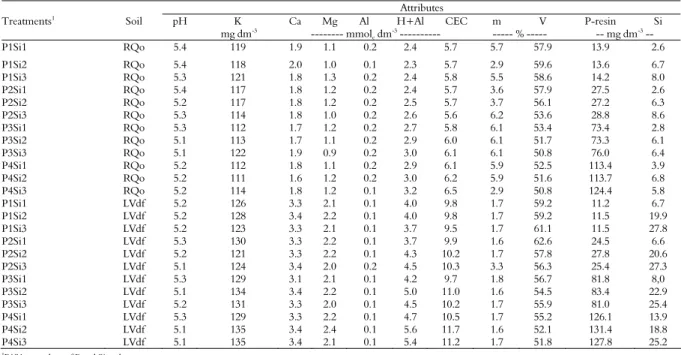
The results of the physical, chemical and mineralogical characterisation of the studied soils before the application of the treatments are presented in Table 1.
The experimental design used was entirely random, arranged in a 4 x 3 factorial, with four repetitions. The treatments included four P doses (0, 80, 240 and 410 mg dm-3 for RQo; 0, 110, 330
and 560 mg dm-3 for LVdf) and three Si doses
(0, 240 and 410 mg dm-3 for RQo; 0, 110, 330 and
560 mg dm-3 for LVdf).
Two experiments were conducted in a greenhouse with bean plants, one with RQo and the other with LVdf. Vases with a soil capacity of 3 dm3
were filled with 2.7 dm3 of soil. The soil samples
were then subjected to three sequential incubations for a period of 30 days each under humidity conditions equivalent to 60% of the total pore volume (TPV) occupied by water (FREIRE et al., 1980), which was controlled by daily weighing.
Initially, micropulverised calcined dolomitic limestone (35% CaO and 14% MgO) was applied to the soils in sufficient quantity to elevate the value of the base saturation to 70%. After this incubation, silicic acid was applied in the form of H4SiO4 (60%
SiO2) at the doses of 0, 240 and 410 mg dm-3 of Si
for RQo and at 0, 330 and 560 mg dm-3 of Si for
LVdf, as defined based on the P dose.
The third incubation (basic fertilisation) was identical in the two soils, with the exception of P (the factor under study), and corresponded to the following nutrient contents in the form of salts p.a. in mg dm-3 of soil: 100 of N; 150 of K; 62 of S; 0.81
of B; 1.3 of Cu; 5.0 of Zn; 3.6 of Mn; 1.6 of Fe and 0.15 of Mo. The nutrients were applied in a solution form and mixed into the soil for a higher uniformity. The sources used were as follows: K2SO4; (NH4)2HPO4; NH4NO3; KH2PO4; H3PO4;
MnSO4.2H2O; CuSO4.5H2O; (NH4)6MO7O24.4H2O;
Silicon-phosphorus interactions in soils 81
Acta Scientiarum. Agronomy Maringá, v. 36, n. 1, p. 79-86, Jan.-Mar., 2014
RQo soil, the doses of P were 0, 80, 240 and 410 mg dm-3; for LVdf, the doses of P were 0, 110, 330 and
560 mg dm-3 (Table 2), as defined by the remaining
P (ALVAREZ et al., 2000).
Table 1. Principal chemical, physical and mineralogical
properties of soil samples collected from the 0 to 0.20 m layer, before treatment application.
Soils
Treatments RQo LVdf
pH in water 5.0 4.8
Al+3 (cmol
c dm
-3) 0.9 1.1
Ca+2 (cmol
c dm
-3) 0.4 0.4
Mg2+ (cmolc dm
-3
) 0.1 0.2
K+(mg dm-3) 23.0 30.0
H+ + Al3+(cmol
c dm-3) 4.5 9.5
P-Mehlich-1 (mg dm-3) 6.8 1.1
P-resin (mg dm-3) 5.4 12.9
B (mg dm-3
) 0.3 0.4
Cu (mg dm-3) 1.0 2.1
Fe (mg dm-3) 60.2 173.1
Mn (mg dm-3
) 6.4 11.4
Zn (mg dm-3) 0.1 0.1
SB (cmolc dm -3
) 0.6 0.7
t (cmolc.dm
-3) 1.5 1.7
CEC (cmolc. dm-3) 5.1 10.2
V (%) 11.8 6.9
m (%) 60.0 61.1
OM (dag kg-1
) 1.7 3.9
Si (mg dm-3) 1.3 6.2
Coarse sand (g kg-1) 470.0 110.0
Fine sand (g kg-1
) 460.0 60.0
Silt (g kg-1) 0.0 110.0
Clay (g kg-1
) 70.0 720.0
SiO2 (g kg
-1) 30.6 153.0
Al2O3 (g kg-1) 35.8 262.0
Fe2O3 (g kg -1
) 11.0 237.0
TiO2 (g kg
-1) 4.7 202.0
P2O5 (g kg -1
) 0.0 1.4
Fed (g kg
-1) 2.0 138.8
Feo (g kg-1) 0.1 2.8
Kt (g kg-1
) 778.0 160.0
Gb (g kg-1) 59.0 310.0
After the incubation period of the soils with the treatments in the greenhouse, soil subsamples of each experimental unit (vases) were collected for the analytical determinations (Table 2).
Planting was performed 30 days after the last incubation. Five bean seeds per vase were sown using an identical procedure for the two soils. After 20 days, the plants were thinned, leaving two bean plant plants per vase. The vases were maintained with the humidity at 60% of the TPV (FREIRE et al., 1980) through the daily weighing of the vases and the addition of deionised water. The cultivar of the bean plant used was ESAL 168.
Cover fertilisation with N and K were conducted differently according to the growth of the plants. The treatments in each soil that resulted in normal plant growth then received 200 and 170 mg dm-3 of
N and K, respectively, parcelled out in seven applications, in addition to the application of 20 mg of sulphur. The treatments in which the plants presented lower growth received coverings that were proportionally lower, 180 and 120 mg dm-3 of N and
K, respectively, thus avoiding excessive application of the nutrients.
The first mature leaves at the tip of the bean plant branch were collected at the onset of flowering (MALAVOLTA et al., 1997) from each vase, and the whole plants were harvested at the physiological maturation of the grains by cutting the plants at ground level. The vegetable matter was dried in a forced-air oven at a temperature between 65 and 70°C and ground in Willey-type mill.
Table 2. Soil characteristics after soil acidity correction, basic fertilizing and treatment applications.
Attributes
Treatments1 Soil pH K Ca Mg Al H+Al CEC m V P-resin Si
mg dm-3
--- mmolc dm -3
--- --- % --- -- mg dm-3 --
P1Si1 RQo 5.4 119 1.9 1.1 0.2 2.4 5.7 5.7 57.9 13.9 2.6
P1Si2 RQo 5.4 118 2.0 1.0 0.1 2.3 5.7 2.9 59.6 13.6 6.7
P1Si3 RQo 5.3 121 1.8 1.3 0.2 2.4 5.8 5.5 58.6 14.2 8.0
P2Si1 RQo 5.4 117 1.8 1.2 0.2 2.4 5.7 3.6 57.9 27.5 2.6
P2Si2 RQo 5.2 117 1.8 1.2 0.2 2.5 5.7 3.7 56.1 27.2 6.3
P2Si3 RQo 5.3 114 1.8 1.0 0.2 2.6 5.6 6.2 53.6 28.8 8.6
P3Si1 RQo 5.3 112 1.7 1.2 0.2 2.7 5.8 6.1 53.4 73.4 2.8
P3Si2 RQo 5.1 113 1.7 1.1 0.2 2.9 6.0 6.1 51.7 73.3 6.1
P3Si3 RQo 5.1 122 1.9 0.9 0.2 3.0 6.1 6.1 50.8 76.0 6.4
P4Si1 RQo 5.2 112 1.8 1.1 0.2 2.9 6.1 5.9 52.5 113.4 3.9
P4Si2 RQo 5.2 111 1.6 1.2 0.2 3.0 6.2 5.9 51.6 113.7 6.8
P4Si3 RQo 5.2 114 1.8 1.2 0.1 3.2 6.5 2.9 50.8 124.4 5.8
P1Si1 LVdf 5.2 126 3.3 2.1 0.1 4.0 9.8 1.7 59.2 11.2 6.7
P1Si2 LVdf 5.2 128 3.4 2.2 0.1 4.0 9.8 1.7 59.2 11.5 19.9
P1Si3 LVdf 5.2 123 3.3 2.1 0.1 3.7 9.5 1.7 61.1 11.5 27.8
P2Si1 LVdf 5.3 130 3.3 2.2 0.1 3.7 9.9 1.6 62.6 24.5 6.6
P2Si2 LVdf 5.2 121 3.3 2.2 0.1 4.3 10.2 1.7 57.8 27.8 20.6
P2Si3 LVdf 5.1 124 3.4 2.0 0.2 4.5 10.3 3.3 56.3 25.4 27.3
P3Si1 LVdf 5.3 129 3.1 2.1 0.1 4.2 9.7 1.8 56.7 81.8 8,0
P3Si2 LVdf 5.1 134 3.4 2.2 0.1 5.0 11.0 1.6 54.5 83.4 22.9
P3Si3 LVdf 5.2 131 3.3 2.0 0.1 4.5 10.2 1.7 55.9 81.0 25.4
P4Si1 LVdf 5.3 129 3.3 2.2 0.1 4.7 10.5 1.7 55.2 126.1 13.9
P4Si2 LVdf 5.1 135 3.4 2.4 0.1 5.6 11.7 1.6 52.1 131.4 18.8
P4Si3 LVdf 5.1 135 3.4 2.1 0.1 5.4 11.2 1.7 51.8 127.8 25.2
The total P content was determined through the mineralisation with nitric-perchloric digestion (MALAVOLTA et al., 1997), and the extracts were measured using colorimetry (BRAGA; DEFELIPO, 1974). The Si content was determined by the method proposed by Eliott and Snyder (1991).
The dry matter of the aerial part (APDM) and grains (DGM) were determined in the plants harvested at the end of the growth cycle.
The P and Si accumulated in the aerial part were calculated by multiplying the aerial part dry mass value by the content of P or Si and dividing this value by 1,000.
The studied variables were subjected to variance analysis using the SISVAR statistical analyses programme (FERREIRA, 2003). When significant, a regression analysis was conducted as a function of the P and Si doses applied.
Results and discussion
The application of P significantly influenced (p < 0.01) the dry matter production of the aerial part (APDM), the grain dry matter (DGM) and the P and Si accumulation in the APDM of the bean plants, yet there was no interaction among the factors in any variable studied in the soils under study (Table 3). These results corroborate those of Crusciol et al. (2005), which was expected because the initial P content of the soils was low (Table 1). P is essential to plant metabolism because it participates in the transfer of cell energy, respiration and photosynthesis and also in the formation of coenzymes.
Table 3. Analysis of variance for aerial part dry matter production
(APDM), dry grain production (DGM), accumulated phosphorus in APDM (P-APDM) and silicon accumulated in APDM (Si-APDM) of bean grown in RQo and LVdf soils, as a function of the application of increasing doses of calcium silicate and phosphate.
Factor APDM DGM P-APDM Si-APDM
Orthic Quartzarenic Neosol (RQo)
P doses ** ** ** **
Si doses ns ns ns **
P x Si ns ns ns ns
C.V. (%) 9.31 10.06 15.39 16.56
Dystroferric Red Latosol (LVdf)
P doses ** ** ** **
Si doses ns ns ns **
P x Si ns ns ns ns
C.V. (%) 13.14 20.89 10.36 11.21
**and ns: represent the level of significance to 1% and the non-significant effect by the F test, respectively.
In the soils that did not receive phosphate fertiliser (control treatment), the plants presented metabolic alterations characterised by the visual symptoms of P deficiency, presenting lower leaves with a pale green colouration and upper with intense
blue-green colouration in addition to a general reduced plant growth, thus corroborating Rosolem and Marubayashi (1994). According, plants display hindered growth with limitations in the availability of P (KIMANI; DERERA, 2009).
The APDM production data as a function of the applied P dose were better adjusted by the quadratic and linear equations for RQo and LVdf, respectively (Figure 1A and B). Utilising soils with very low to low P contents (Table 1), it was expected that the phosphate fertilisation would promote significant increases in the APDM production. According to Malavolta et al. (1997), a significant response of the plant is common in soils with severe deficiencies in a particular nutrient, P in this case, when the nutrient is applied as fertiliser.
The grain production response showed the same behaviour as the APDM, which was quadratic as a function of the doses of the P applied to RQo, the maximum dry grain matter production being estimated at 19.38 g vase-1 at the dose of 423.5 kg P
(Figure 1C). In the LVdf soil, the DGM production increased linearly with the increase in the P dose (Figure 1D). According to Fageria et al. (2003), P in bean plant culture is the main productivity determinant, contributing to increases in the aerial part dry matter production and increases in the number of pods and grain mass.
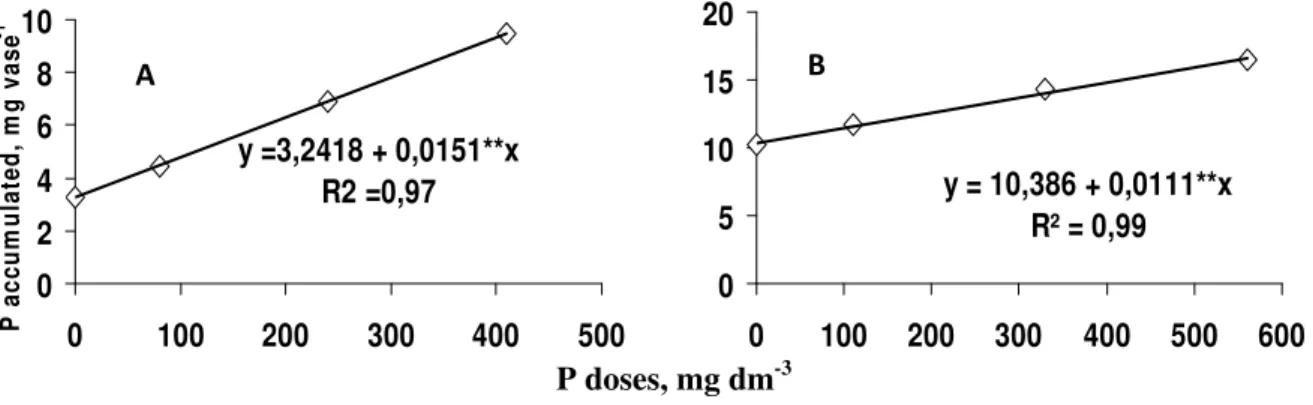
The accumulation of P in the APDM was significant only for the phosphorus factor (Table 3). The linear equations were those that were better adjusted to the data of accumulated P in the APDM as a function of the P dose in the soils under study (Figure 2A and B). An increase in the P dose promoted a higher availability of that nutrient to the soil, resulting in a higher absorption and incorporation of P in the biomass, thus corroborating the report of Santos et al. (2011).
Silicon-phosphorus interactions in soils 83
Acta Scientiarum. Agronomy Maringá, v. 36, n. 1, p. 79-86, Jan.-Mar., 2014
the dilution effect. That is, the increase in the APDM production (Figure 1B) diluted the amount of Si in the plant, inducing a lower content in the plant tissue (PRADO, 2008). Alternatively, the P may have altered the silicon dynamics in the plant, which may reduce its absorption by the roots and the translocation by the root to the aerial part (ARAÚJO; MACHADO, 2006).
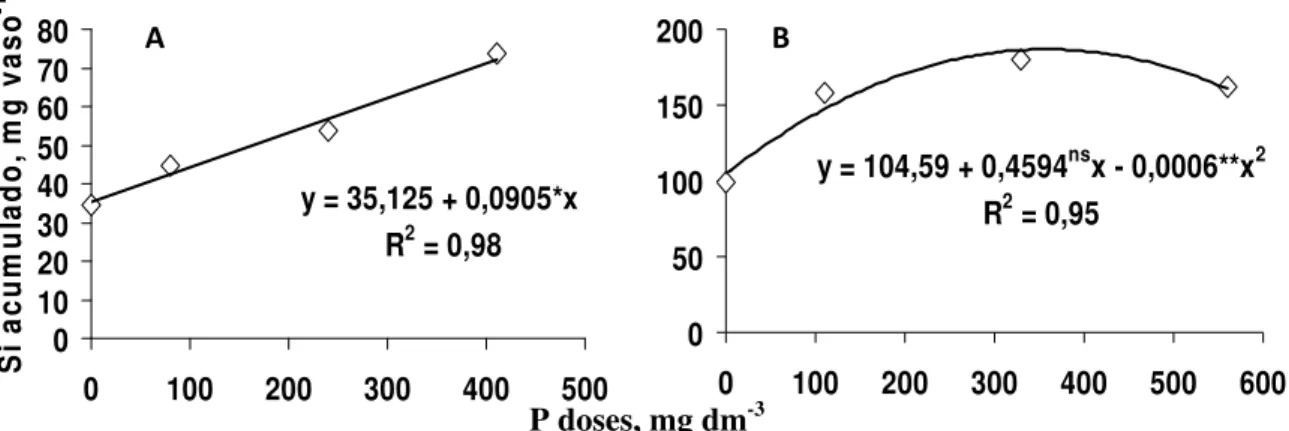
The linear equation was better adjusted to the accumulation data of Si in the aerial part as a function of the Si dose applied to the soils (Figure 4A and B). Although the bean plant is not considered an Si accumulator (JONES; HANDRECK, 1967), this culture absorbed a large amount of Si; it is probable that the response of the plant to the Si application was due to the form of Si
in the soil, H4SiO4. According to Van der Vorn
(1980), for most dicotyledonous species, the absorption of Si can be passive or metabolically controlled, depending on the Si content in the soil.
The higher P availability as a function of the Si fertilisation was expected in this work, as one of the effects of Si on plant growth can be associated with the interactions of this element with the P in the soil and in the plant (MARQUES et al., 2004). Within this context, the Si retention on the absorbing surfaces of the minerals, previous to the P application, appears promising for increasing the P availability (TOKURA et al., 2011) in such soils as those of the Cerrado region, which are characterised by intense silica and base removal processes from the soil profile (MARQUES et al., 2004).
Figure 1. Aerial part dry matter (APDM) and grain dry matter production (DGM) of bean plants, as a function of the P doses applied in
the RQo (A and C) and LVdf (B and D) soils. (**significant to 1% by the t test).
Figure 2. Phosphorous accumulated in aerial part of bean plants, as a function of the P doses applied in theRQo (A) and LVdf (B) soils.
(**significant to 1% by the t test).
y = 3,817 + 0,0295**x - 4E-05**x2 R2 = 0,98
0 2 4 6 8 10 12
0 100 200 300 400 500
AP
DM
, g
v
a
s
e
-1
y = 4,4572 + 0,0156**x R2 =0,97 0
2 4 6 8 10 12 14
0 100 200 300 400 500 600
y = 1,7452 + 0,0847**x - 0,0001**x2 R2 = 0,98
0 4 8 12 16 20
0 100 200 300 400 500
D
G
M,
g
va
se
-1
y = 2,8518 + 0,0352**x R² = 0,96 0
5 10 15 20 25
0 100 200 300 400 500 600
y = 10,386 + 0,0111**x R² = 0,99
0 5 10 15 20
0 100 200 300 400 500 600
y =3,2418 + 0,0151**x R2 =0,97
0 2 4 6 8 10
0 100 200 300 400 500
P
accu
m
u
la
te
d
, m
g
v
ase
-1
A B
A B
C D
P doses, mg dm-3
Figure 3. Silicon accumulated in aerial part of bean plants, as a function of the P doses applied in the RQo (A) and LVdf (B) soils. (** significant to 1% by the t test).
Figure 4. Silicon accumulated in aerial part of bean plants, as a function of the Si doses applied in the RQo (B) and LVdf (A) soils. (**
significant to 1% by the t test).
The adsorption speed of Si in oxidic soils is high (MCKEAQUE; CLINE, 1963), and it is, therefore, predicted that large amounts of Si (410 and 560 mg dm-1 for RQo and LVdf, respectively) can be
adsorbed, minimising the fixation of P. However, this behaviour was not observed in the bean plants because of the high doses of Si in the soils under study and did not provide APDM or DGM production increases or P accumulation in the aerial part (Table 3), at the expense of the higher bioavailability of P in the soil.
Conclusion
The application of Si, with doses set according to the remaining P, did not influence the production of the APDM and DGM or P accumulation in the aerial part dry matter of bean plants grown in RQo and LVdf soils.
The increasing doses of Si significantly increased the Si accumulation in the APDM, regardless of the soil type.
P application increased the APDM and DGM production and the accumulated P in the APDM of bean plants grown in RQo and LVdf soils.
Acknowledgements
We would like to thank the National Council for Scientific and Technological Development (CNPq) for financial support for the accomplishment of this work.
References
ALVAREZ, V. V. H.; NOVAIS, R. F.; DIAS, L. E.; OLIVEIRA, J. A. Determinação de fósforo remanescente.
Boletim Informativo Sociedade Brasileira de Ciência do Solo, v. 25, n. 1, p. 27-33, 2000.
ARAÚJO, A. P.; MACHADO, C. T. T. Nutrição mineral de plantas. In: FERNANDES, M. S. (Ed.). Sociedade Brasileira de Ciência do Solo. Viçosa: Universidade Federal de Viçosa, 2006. p. 253-280.
ARF, O. Importância da adubação na qualidade do feijão e caupi. In: SÁ, M. E.; BUZZETI, S. (Ed.). Importância da adubação na qualidade dos produtos agrícolas. São Paulo: Ícone, 1994. p. 233-248.
BRAGA, J. M.; DEFELIPO, B. V. Determinação espectrofotométrica de fósforo em extratos de solos e plantas. Revista Ceres, v. 21, n. 113, p. 73-85, 1974. CAMARGO, M. S.; KORNDÖRFER, G. H.; CORRÊA, G. F.; PEREIRA, H. S.; BARBOSA, D. S.; RESENDE, R.
y = 104,59 + 0,4594nsx - 0,0006**x2 R2 = 0,95
0 50 100 150 200
0 100 200 300 400 500 600
y = 35,125 + 0,0905*x R2 = 0,98
0 10 20 30 40 50 60 70 80
0 100 200 300 400 500
Si
acum
ul
ad
o,
m
g vaso
-1
y =33,083 + 0,0858**x R2 = 0,99
0 20 40 60 80
0 100 200 300 400 500
S
i
acc
um
ul
at
ed,
m
g
va
se
-1
y = 89,2 + 0,2039**x R2 =0,96 0
50 100 150 200 250
0 100 200 300 400 500 600
A B
B A
Si doses, mg dm-3
Silicon-phosphorus interactions in soils 85
Acta Scientiarum. Agronomy Maringá, v. 36, n. 1, p. 79-86, Jan.-Mar., 2014 H. Extratores de silício solúvel em solos: influência do
calcário e fósforo. Bioscience Journal, v. 21, n. 2, p. 9-19, 2005.
CARNEIRO, C. E. A.; FIORETTO, R. A.; FONSECA, I. C. B.; CARNEIRO, G. E. S. Calcário, potássio, fosfato e silício na produtividade do solo. Acta Scientiarum. Agronomy, v. 28, n. 4, p. 465-470, 2006.
CARVALHO, R.; FURTINI NETO, A. E.; SANTOS, C. D.; FERNANDES, L. A.; CURI, N.; RODRIGUES, D. C. Interações silício-fósforo em solos cultivados com eucalipto em casa de vegetação.Pesquisa Agropecuária Brasileira, v. 36, n. 3, p. 557-565, 2001.
CLAESSEN, M. E. C. Manual de métodos de análise de solo. 2. ed. Rio de Janeiro: Embrapa-CNPS, 1997. CRUSCIOL, C. A. C.; MUAD, M.; ALVAREZ, R. C. F.; LIMA, E. V.; TIRITAN, C. S. Doses de fósforo e crescimento radicular de cultivares de arroz de terras altas.
Bragantia, v. 64, n. 4, p. 643-649, 2005.
DAY, P. R. Particle fractionation and particle-size analysis. In: BLACK, C. A. (Ed.). Methods of soil analysis. Madison: American Society of Agronomy, 1965. v. 1, p. 545-556.
ELLIOTT, C. L.; SNYDER, G. H. Autoclave-induced digestion for the colorimetric determination of silicon in rice straw. Journal of Agricultural and Food Chemistry, v. 39, n. 6, p. 1118-1119, 1991.
FAGERIA, N. K.; BALIGAR, V. C. Response of lowland rice and common bean grown in rotation to soil fertility levels on a varzea soil. Fertilizer Research, v. 45, n. 1, p. 13-20, 1996.
FAGERIA, N. K.; BARBOSA FILHO, M. P.; STONE, L. F. Resposta do feijoeiro a adubação fosfatada.
Informações Agronômicas, v. 1, n. 102, p. 1-9, 2003. FERREIRA, D. F. SISVAR. Versão 4.3. Lavras: DEX/UFLA, 2003.
FREIRE, J. C.; RIBEIRO, M. A. V.; BAHIA, V. G.; LOPES, A. S.; AQUINO, L. H. Resposta do milho cultivado em casa de vegetação a níveis de água em solos da região de Lavras-MG. Revista Brasileira de Ciência do Solo, v. 4, n. 1, p. 5-8, 1980.
HINGSTON, F. J.; POSNER, A. M.; QUIRK, J. P. Anion adsorption by goethite and gibsite. The role of lhe proton in determining adsorption envelopes. The Journal of Soil Science, v. 23, n. 2, p. 177-92, 1972. JONES, L. H. P.; HANDRECK, K. A. Silica in soils, plants, and animala. Advances in Agronomy, v. 19, n. 2, p. 107-149, 1967.
KIMANI, J. M.; DERERA, J. Combining ability analysis across environments for some traits in dry bean (Phaseolus
vulgaris L.) under low and high soil phosphorus
conditions. Euphytica, v. 166, n. 1, p. 1-13, 2009. KORNDÖRFER, G. H.; COELHO, N. M.; SNYDER, G. H.; MIZUTANI, C. T. Avaliação de métodos de extração de silício para solos cultivados com arroz de sequeiro. Revista Brasileira de Ciência do Solo, v. 23, n. 1, p. 101-106, 1999.
LIMA, M. A.; CASTRO, V. F.; VIDAL, J. B.; ENÉAS FILHO, J. Aplicação de silício em milho e feijão-de-corda
sob estresse salino. Revista Ciência Agronômica, v. 42, n. 2, p. 398-403, 2011.
MARQUES, J. J.; SCHULZE, D. G.; CURI, N.; MERTZMAN, S. A. A. Trace element geochemistry in Brazilian Cerrado soils. Geoderma, v. 121, n. 1-2, p. 31-43, 2004.
MALAVOLTA, E.; VITTI, G. C.; OLIVEIRA, S. A.
Avaliação do estado nutricional das plantas: princípios e aplicações. 2. ed. Piracicaba: Potafós, 1997.
MARCHEZAN, E.; VILLA, S. C. C.; MARZARI, V.; KORNDORFER, G. H.; SANTOS, F. M. Aplicação de silício em arroz irrigado: efeito nos componentes da produção. Bioscience Journal, v. 20, n. 3, p. 125-131, 2004.
McKEAGUE, J. A.; CLINE, M. G. Silica in soils. II. The adsorption of monosilicic acid by soil and by other substances. Canadian Journal of Soil Science, v. 43, n. 1, p. 83-95, 1963.
MEHRA, O. P.; JACKSON, M. L. Iron oxide removal from soil and clays by a dithionite-citrate system buffered with sodium bicarbonate. Clays and Clay Minerals, v. 7, n. 5, p. 317-327, 1960.
NOVAIS, R. F.; SMYTH, T. J. Fósforo em solo e planta em condições tropicais. Viçosa: Universidade Federal de Viçosa, 1999.
PRADO, R. M. Nutrição de Plantas. 1. ed. São Paulo: Unesp, 2008.
PRADO, R. M.; FERNANDES, F. M. Resposta da cana-de-açúcar à aplicação da escória de siderurgia como
corretivo de acidez do solo. Revista Brasileira de
Ciências do Solo, v. 25, n. 1, p. 199-207, 2001.
RAIJ, B. V.; FEITOSA, C. T. Correlação entre o P extraído de solo por diversos extratores químicos extratores químicos e o absorvido pelo milho. Bragantia, v. 39, n. 1, p. 51-57, 1980.
ROSOLEM, C. A.; MARUBAYASHI, O. M. Seja o doutor do seu feijoeiro. Informações Agronômicas, v. 1, n. 68, p. 1-16, 1994.
SANTOS, D. R.; GATIBONI, L. C.; KAMINSKI, J. K. Fatores que afetam a disponibilidade e o manejo da adubação fosfatada em solos sob sistema plantio direto.
Ciência Rural, v. 38, n. 2, p. 576-586, 2008.
SANTOS, J. Z. L.; FURTINI NETO, A. E.; RESENDE, A. V.; CARNEIRO, L. F.; CURI, N.; MORETTI, B. S. Resposta do feijoeiro à adubação fosfatada em solos de cerrado com diferentes históricos de uso. Revista Brasileira de Ciência do Solo, v. 35, n. 1, p. 193-202, 2011.
SCHWERTMAN, U.; KODAMA, H.; FISHER, W. R. Mutual interactions between organics and iron oxides. In: HUANG, P. M.; SCHNITZER, M. (Ed.). Interaction of soil minerals with natural organics and microbes. Madison: SSSA, 1986. p. 223-247.
TOKURA, A. M.; FURTINI NETO, A. E.; CURI, N.; CARNEIRO, L. F.; ALOVISI, A. A. Silício e fósforo em diferentes solos cultivados com arroz de sequeiro.
Acta Scientiarum. Agronomy, v. 29, n. 1, p. 9-16, 2007.
TOKURA, A. M.; FURTINI NETO, A. E.; CARNEIRO, L. F.; CURI, N.; SANTOS, J. Z. L.; ALOVISI, A. A. Dinâmica das formas de fósforo em solos de textura e mineralogia contrastantes cultivados com arroz. Acta Scientiarum. Agronomy, v. 33, n. 1, p. 171-179, 2011.
VAN DER VORN, P. D. J. Uptake of Si by five plant species as influenced by variations in Si-supply. Plant and Soil, v. 56, n. 1, p. 153-156, 1980.
Received on May 14, 2012. Accepted on August 16, 2012.