A model for pediatric and
neuropsychological screening assessment
of children with learning disabilities
Claudia Berlim de Mello1, Leila Raquel Russowsky Brunoni2, Ana Luiza Pilla3,
José Augusto Aguiar Carrazedo Taddei4, Thais Barbosa5, Elaine Girão Sinnes6, Camila Cruz Rodrigues7, Monica Carolina Miranda8, Mauro Muzskat9, Orlando Francisco Amodeo Bueno10
ABSTRACT. Objectives: The high frequency of learning difficulties, attention disorders or developmental delay in children in the early years of schooling has resulted in a greater demand for pediatric services. Such services generally include assessments covering various specialties, are lengthy and often inaccessible to families due to prohibitively high cost. This paper presents an economically efficient model of interdisciplinary diagnosis. Methods: A group of 109 Brazilian students from public schools aged between 5 and 14 years old, referred by teachers for a history of learning disabilities, behavioral changes or language problems, was evaluated at the NANI (Nucleo de Atendimento Neuropsicologico Infantil). Assessments were performed simultaneously during a single day’s attendance and comprised clinical-genetic examination, behavioral assessment and neuropsychological screening, specially developed for the process. The multiaxial system of DSM-IV was adopted for diagnostic description. Results: The results revealed heterogeneity in diagnoses which included specific learning disorders (25.7%), mild intellectual disabilities (17.43%), as well as suspected dysmorphic features (11.93%). Logistic regression showed good sensitivity of neuropsychological screening in the detection of predictive factors for specific developmental disorders, while working memory (p=0.05) and language (p=0.02) problems were found to be higher risk.
Conclusions: The model adopted proved to be useful for defining the diagnosis of several conditions in infancy, and can be incorporated into specialized clinics such as psychiatric or developmental pediatric services.
Key words: neuropsychological screening, interdisciplinary assessment, children, primary care, DSM-IV.
MODELO DE TRIAGEM NEUROPSICOLÓGICA E PEDIÁTRICA PARA ESCOLARES COM DIFICULDADES DE APRENDIZAGEM RESUMO. Objetivos: A alta frequência de dificuldades de aprendizagem, distúrbios atencionais ou atraso no desenvolvimento cognitivo, em crianças nos primeiros anos de escolaridade, vem acarretando grande demanda por serviços de saúde. Tais serviços em geral abrangem avaliações em diversas especialidades, realizadas em períodos de tempo prolongados, frequentemente de pouca acessibilidade para as famílias devido ao alto custo. Neste trabalho apresenta-se um modelo de diagnóstico interdisciplinar economicamente viável. Métodos: Foram avaliados os dados de um grupo de 109 alunos da rede pública de ensino entre 5 e 14 anos de idade, encaminhadas ao NANI (Nucleo de Atendimento Neuropsicológico Infantil) pelas professoras por apresentarem história de dificuldades de aprendizagem, alterações comportamentais ou problemas de linguagem oral. As avaliações foram realizadas conjuntamente em um único dia de atendimento e abrangeram exame clínico-genético, avaliação comportamental e uma triagem neuropsicológica qualitativa, especialmente desenvolvida para o processo. Adotou-se o sistema multiaxial do DSM-IV na descrição diagnóstica. Resultados: Os resultados revelaram uma heterogeneidade de diagnósticos, incluindo transtornos específicos de aprendizagem (25,7%), deficiência intelectual leve (17,43%) e presença de dismorfias a esclarecer (11,93%). Análises de regressão logística evidenciaram boa sensibilidade da triagem neuropsicológica na detecção de fatores preditivos para transtornos específicos do desenvolvimento, sendo que problemas de memória operacional (p=0,05) e de linguagem (p=0.02) se evidenciaram como de maior risco. Conclusões:
O modelo adotado mostrou-se útil, assim, na delimitação diagnóstica de queixas de diversas condições na infância, podendo ser incorporado em clínicas especializadas tais como psiquiátricas ou pediátricas.
Palavras-chave: rastreioneuropsicológico, interdisciplinaridade, crianças, serviços de saúde, DSM-IV.
1Doutora, Núcleo de Atendimento Neuropsicológico Infantil, Centro Paulista de Neuropsicologia/AFIP. 2Médica, Centro de Genética Médica, Universidade Federal
de São Paulo (UNIFESP), São Paulo SP, Brazil. 3Médica, Centro de Genética Médica, UNIFESP. 4Professor Associado, Disciplina de Nutrologia do Departamento de
Pediatria, UNIFESP. 5Doutora, Núcleo de Atendimento Neuropsicológico Infantil, Centro Paulista de Neuropsicologia/AFIP. 6Mestranda, Departamento de Pediatria,
UNIFESP. 7Doutora, Núcleo de Atendimento Neuropsicológico Infantil, Centro Paulista de Neuropsicologia/AFIP. 8Doutora, Núcleo de Atendimento Neuropsicológico
Infantil, Centro Paulista de Neuropsicologia/AFIP. 9Doutor, Núcleo de Atendimento Neuropsicológico Infantil, Centro Paulista de Neuropsicologia/AFIP. 10Professor
Livre Docente, Departamento de Psicobiologia, UNIFESP.
INTRODUCTION
C
omplaints of learning diiculties, attentiondisor-ders, or developmental delay constitute one of the most frequent reasons for referral of children to pae-diatric neurologists, psychologists or speech and lan-guage therapists. In most cases, referrals occur in the irst few years of elementary school, when problems during the literacy process arise or when children fail to reach the expected levels of academic achievement. he impact that such diiculties can have on the child’s development creates the need for accurate diagnosis, identiication of speciic educational demands, and fam-ily support. At the same time, the multiple factors that may contribute to the onset of learning diiculties or behavioural problems, including environmental (socio-economic, family-related) and neurobiological (clini-cal, genetic) factors, also call for coordinated actions by healthcare and educational teams. In summary, failing in school raises questions concerning the integration of multidisciplinary teams and the eiciency of assess-ment models for reaching a dynamic diagnosis and planning early intervention strategies.
he diagnosis based on poor academic performance involves, primarily, the distinction between learning diiculties and actual disabilities.1-3 Learning
diicul-ties may be caused by educational inadequacy, cir-cumstantial family-related factors, socio-economic or afective-emotional problems, or can be secondary to sensorial alterations, psychiatric disorders, intellectual deiciency, and chronic or neurological diseases. Learn-ing disabilities, however, accordLearn-ing to the DSM-IV dei-nition,1 are diagnosed when the individual’s achievement
on individually administered, standardized tests in reading, mathematics, or written expression is substantially below that expected for age, schooling, and level of intelligence.
herefore, learning disabilities refer to lack of speciic reading, writing and mathematic abilities which are not compatible with the individual’s developmental level, intellectual capacity and schooling level, as a result of in-trinsic constitutional factors, probably of neurobiologi-cal origin.3,4 In Brazil, epidemiological data indicate that
30% to 40% of children in early schooling years have some type of learning diiculty, and 3% to 5% present disabilities.2 Other authors hold that the prevalence of
learning disabilities afects 5% to 10%, reaching levels of up to 17%.5
According to these distinctions, the clinical diagnosis for learning disabilities must be based on the results of intellectual and neuropsychological assessments, as well as on psychosocial and academic performance investi-gations. Additionally, neurological problems such as
chronic non-progressive encephalopathy in children and genetic syndromes should be excluded. Possible comor-bidities with other conditions, such as Attention Deicit Hyperactivity Disorder (ADHD), Oppositional Deiant Disorder and Conduct Disorder must also be considered.
herefore, diagnostic interdisciplinary models are especially indicated for a global comprehension of learn-ing diiculties, essential for the plannlearn-ing of interven-tion programmes in educainterven-tional and health contexts. A neuropsychological approach in such models is also particularly important, as it involves the analysis of chil-dren’s performance in complex cognitive functions such as perception, attention, memory and language. he results of analyses enable the identiication of learn-ing diiculty subtypes associated with speciic clinical, neuropsychological or psychosocial proiles, and can therefore contribute to the deinition of more reined educational interventions. Also, questions concerning familial, educational and social systems should also be considered in the process of diagnostic investigation.
In this sense, the adoption of the DSM-IV Multiaxial System seems particularly promising. It is a model for clinical diagnosis, which consists of axes that are each associated with diferent information domains, includ-ing psychosocial and environmental problems. Axis 1 describes actual clinical disorders, such as speciic learn-ing disorders; Axis 2 describes intellectual deiciency; Axis 3 comprises medical conditions associated with the main diagnosis, and Axis 4 describes psychosocial and environmental problems, such as those related to socio-economic conditions, which may interfere in the evolu-tion of the disease.
herefore, the adequate diagnosis of learning disor-ders depends on complex investigation procedures and on the involvement of a specialised professional team. Generally, assessment procedures such as psychodiag-nosis or neuropsychological examination are lengthy and complex, and often become inaccessible to the low income population. Due to the high inancial cost that it entails, the feasibility of traditional neuropsychologi-cal assessment in health units, with several individual meetings and the application of various tests and pro-cedures, has been questioned by some researchers from the health care ield, who emphasise the importance of an economically eicient evaluation model- a challenge for health units around the world.6
however, there are very few instruments of this nature available, especially those incorporating an interdisci-plinary approach.
he present study discusses the results of an in-terdisciplinary diagnostic investigation conducted in children with complaints of learning diiculties, from 2005 through 2007, who were referred for assessment at the Núcleo de Atendimento Neuropsicológico Infan-til (NANI). he assessment involved a multidisciplinary team of health professionals, child neurologists, neuro-psychologists, speech and language therapists, paedia-tricians and clinical geneticists.
Multidisciplinary assessment protocols, including clinical genetic examination and qualitative neuropsy-chological screening, were especially created for use in these children. he aim was to put together a screening model that simultaneously encompassed the needs of the children and families and also those of the teachers, seeking optimisation through an integrated team efort in the diagnostic process, and that could also be incor-porated at a later stage into the public educational and health network.
METHODS
Casuistic. he multidisciplinary diagnostic investigation involved 109 children, predominantly males (66%), at-tending one of the irst four years of Elementary School in one of São Paulo City’s municipalities. he mean age of children was 8 years and 7 months (SD 2.9). he chil-dren were previously referred by their teachers because of several complaints such as: (1) persistent diicul-ties reading and writing, not remedied by conventional educational actions; (2) presence of substantial social interaction diiculties or dysfunctional behaviour, such as negativity and aggressiveness, afecting the learning process; and (3) considerable delay in speech develop-ment. herefore, the children were identiied within the municipality’s educational network, which comprises a population of around one million students in Elemen-tary School (Education Secretariat of the Municipality of São Paulo; www.sp.gov.br accessed in 23/09/2009).
Procedures. Groups of four children along with their par-ents were referred to the unit for a day of screening. Hence, all procedures included in the interdisciplinary diagnostic assessment were performed during one day spent at the unit by each subject and his/her parent, over a period of four hours with a lunch break. he pro-cedures included appointments for clinical genetic test-ing and neuropsychological screentest-ing. Education
coor-dinators of each participating school also followed the groups.
At the irst individual appointment with the profes-sionals involved in the research, all procedures associ-ated with the diagnostic investigation were explained to parents or main caregiver. Information concerning the identiication of the child’s main caregiver (e.g., biologi-cal mother, grandmother, step mother) and respective schooling level (in years) was registered, with the objec-tive of understanding family conditions. he parent or main caregiver signed an informed consent agreement authorising the child’s participation in the assessments.
Subsequently, an interdisciplinary assessment of the children was performed by a team of about seven pro-fessionals from NANI (all experts in the adopted proce-dures) followed by meetings for analysis of results. he referred procedures were namely anamnesis and clinical genetic testing, qualitative neuropsychological screen-ing and inally, a behavioural investigation, amountscreen-ing to 3.5 hours of overall assessment per child. All proce-dures are described in detail below.
he team met on a daily basis at the end of the proce-dures in order to discuss diagnostic hypotheses for the four children seen on the day, based on DSM-IV’s cri-teria and the multiaxial system. hese meetings lasted about two hours. At a later date, further meetings with professionals (educational coordinators and teachers) from the schools were held in order to present results and put forward suggestions of interventions pertinent to each case.
Anamnesis and clinical genetic testing – In an
ap-pointment with one of the two paediatricians, a pre-tested and pre-coded questionnaire was used to collect information from the caregiver through anamnesis inquiring about previous and current clinical history, neuropsychomotor development, as well as gestational, perinatal and family history (blood relation of parents, use of alcohol or drugs during pregnancy and child’s birth conditions). Low birth weight (<2500g) and length of stay in hospital longer than three days (indicator of birth complications) were recorded since they consti-tute developmental risk factors. he neuropsychomotor development investigation involved a questionnaire on gait and speech acquisition, based on the Denver II de-velopment scale adapted for the Brazilian population.9
he anamnesis was complemented by an inquiry into associated medical conditions (Axis 3 in DSM-IV multiaxial system) including epilepsy, previous and cur-rent diseases, and sensorial and motor deiciencies.
includ-ing anthropometric measurements (weight, height and cephalic perimeter) and physical examination was per-formed by a clinical genetician, paying special attention to the presence of mild or severe dysmorphisms, aim-ing to identify phenotypes that suggested presence of a genetic syndrome. Additionally, the presence of signs of chronic non-progressive encephalopathy, such as gait alterations or spasticity, was investigated. he instru-ment for anamnesis data collection and clinical genetic testing was speciically developed for this purpose.
Neuropsychological screening – Initially, a global
in-tellectual development assessment using Raven’s Col-ored Matrices was carried out. For children older than 12 years, an estimated IQ based on two tests from the WISC-III scale (Cubes and Vocabulary) was used. Subse-quently, the simpliied neuropsychological assessment (screening), composed of qualitative and quantitative tests based on traditional neuropsychological tests was conducted.10,11
he qualitative neuropsychological screening was organised taking into consideration the child’s perfor-mance in speciic functions. he selected tasks could be quickly applied indistinctly by the health profession-als for an initial screening result, thus minimising the examiner’s subjective perception of the child’s general condition and cognitive performance.
he performance on each of the tasks was assessed qualitatively being scored as (0) when the child did not perform any of the task items adequately; (1) when the child executed at least one of the task items adequately; (2) when all the items were executed adequately, as ex-pected for the particular age group. he skills investi-gated are described below.
(A) Self care: Aspects related to self-care were as-sessed in terms of the child’s independence for dressing, eating and hygiene. At ages of between 5 and 7 years, the child’s performance was considered adequate even when there was a need for parental supervision in these areas. From this age onwards, complete independence was expected.
(B) Drawings: he children were asked to perform free drawing, and performance assessed according to the evolution of the drawings produced.12 Hence, the
presence of recognisable igures in the investigated sample, which involved the 5 to 14 year age group, was expected from 5 years and up whereas complete scenes were expected from 7 years of age.
(C) Working memory: he investigation on verbal working memory was based on oral repetition of se-quences of 2 and 3 digits, initially in direct order and then in reverse order.
For the investigation of visual spatial working mem-ory, a task consisting of a page with 5 randomly dis-tributed blue squares against a white background was utilised. he child was asked to point at a sequence of 2 and 3 squares initially presented by the examiner, irst in direct order and then in reverse order. An additional page with numbers was used in order to help the exam-iner point at the sequences (Appendix 1).
(D) Visual constructive skills: he visual construc-tive skills task consisted of copying four simple shapes (a T-shape, a circle, a cross and a rhombus), with per-formance assessed based on the Child Neurological Ex-amination.13 Based on these parameters, the adequate
reproduction of the irst three igures is expected from children aged 5 to 6 years. he adequate reproduction of the rhombus is expected from children from the age of 7 upwards.
(E) Visual selective attention: Visual selective at-tention skills were investigated by asking the children to ind 6 target igures – representing familiar objects – in succession. he targets were displayed among 50 distracting igures, randomly distributed on a page with a white background, and the maximum time allowed for their selection was 5 minutes.
(F) Language: Speech (articulation), verbal expres-sion and verbal comprehenexpres-sion skills were examined in the language assessment. Aspects of speech and verbal expression skills were analysed based on observations of speech speed (normal, slow, accelerated); temporal logi-cal speech sequence, and sentence structure (adequate; alterations in sentence structure, such as agrammatical sentences). he investigation of comprehension skills included analysis of children’s answers to questions presented by the examiner after the oral presentation of a short story. For the assessment of expressive skills, children were asked to tell a story based on the free drawings. Pragmatic aspects were investigated based on observations of the child’s performance during the dialogue (visual contact; gestural communication; spon-taneous participation and respec
Behavioural assessment – he assessment of
behav-ioural issues was based on the Child Behavior Checklist – CBCL.14 For this assessment, the presence of
behav-ioural problems related to symptoms indicative of de-pression, anxiety, oppositional deiant disorder, conduct disorder and attention deicit disorder at a clinical level, contributed to the diagnosis of disorders diagnosed for the irst time during childhood (DSM-IV Axis 1).
Statistical analysis. Logistic regression models were
he dependent set of variables consisted of each of the two diagnostic axes expressed only by the positive (1) or negative (2) diagnostic criterion. he independent set consisted of six measures (domains) derived from the neuropsychological screening: self-care, drawings, working memory, visual construction, attention and language. he measures (or domains) were also strati-ied in a way that segmented the sample into either al-tered scores (lower than 2 in each of the six domains) or normal scores (higher than 2 in each of the six do-mains). Based on the stratiied data, odds ratios were calculated for each of the six domains, according to the presence or absence of positive diagnosis, for each of the axes independently. he independent variables that had signiicant association with each of the axes separately were veriied.
Finally, the data concerning the percentage of right answers for each axis based solely on the signiicant independent variables and with the presence of all in-dependent variables (canonical correlation) is shown. Also, the model adequacy indexes for each of the axes were calculated.16 he level of signiicance adopted was
5% and the software programme utilised in statistical treatment was SPSS 13.0.
RESULTS
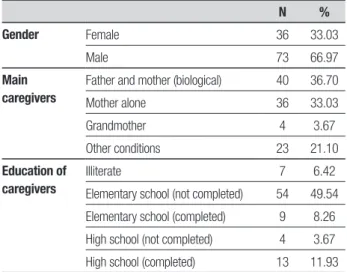
he assessment of family conditions indicated that the main caregivers in the investigated sample were predominantly biological parents or the mother alone. More than half of the caregivers reported being either illiterate or not having concluded Primary School educa-tion (Table 1).
After the application of scales and diagnostic as-sessments, the participants discussed possible diag-noses based on the four axes contained in the DSM-IV (Table 2).
Table 3 shows that the variables “working memory” and “language” were signiicant predictors of positive diagnosis on Axis 1. his means the diagnosis for spe-ciic developmental disorders in early childhood was associated with impairment in these tasks. Results in-dicated that, of children with positive diagnosis on Axis 1, 77.8% showed working memory problems, while 55.6% showed language problems. Children with work-ing memory deicits appeared to be 5.3 times, and those with language delay 26.7 times, more likely to present a positive diagnosis on Axis 1 in comparison to children without these problems. he conidence intervals were broad due to the low frequency of children without lan-guage disorders in the investigated sample.
On Axis 2, low performance on the drawing and
working memory tasks were found to be predictive of positive diagnosis for intellectual deiciency. Statistical analysis showed that the children with drawing prob-lems (87.7%) were 4.8 times more likely to present posi-tive diagnosis on Axis 2 in comparison to children with no problems on this task (18.28%). On the other hand, good performance on working memory can be consid-ered a protective factor for problems on Axis 2. Children with working memory problems (95%) were found to be Table 1. Demographic variables of the 109 children assessed.
N %
Gender Female 36 33.03
Male 73 66.97
Main caregivers
Father and mother (biological) 40 36.70
Mother alone 36 33.03
Grandmother 4 3.67
Other conditions 23 21.10
Education of caregivers
Illiterate 7 6.42
Elementary school (not completed) 54 49.54
Elementary school (completed) 9 8.26
High school (not completed) 4 3.67
High school (completed) 13 11.93
Table 2. Distribution of diagnoses according to DSM-IV Axes.
N %
Axis I No diagnosis or condition on Axis I 55 50.46
Learning disorder NOS 14 12.84
Disorder of written expression 14 12.84
Attention-deficit/Hyperactivity disorder 4 3.67
Conduct disorder 10 9.17
Oppositional defiant disorder 3 2.75
Pervasive developmental disorder 9 8.26
Axis II Normal intellectual functioning 44 40.37
Borderline intellectual functioning 14 12.84
Mild intellectual disability 19 17.43
Intellectual disability, severity unspecified 28 25.69 Axis III No diagnosis or condition on Axis III 82 75.23
Presence of dysmorphic features (to clarify) 13 11.93
Dysmorphic features (to clarify) with macrosomia 5 4.59
Definitive diagnosis 9 8.26
Axis IV No problems reported on Axis IV 64 58.72
Isolated problems 31 28.44
4 times more likely to present positive diagnosis on Axis 2 in comparison to children who did not have working memory problems (25.4%). However, children with lan-guage problems were 1.74 times more likely to present positive diagnosis on Axis 2.
Considering each model individually gives a correct answer rate of 79.8% (Axis 2) to 84.4% (Axis 1) for lo-gistic models compared to real data. he Cox & Snell in-dex of logistic model adequacy for Axes 1 and 2 was 0.25 (Axis 1) and 0.31 (Axis 2), indicating a low proportion of variance explained by the model. his means that the model created cannot be utilised directly due to its reduced capacity to explain real data. It is noteworthy however that this neuropsychological screening model is composed of sensitive attributes for the detection of
positive diagnosis on Axes 1 and 2 of DSM-IV, rendering it a valid preliminary diagnostic procedure for learning diiculties, with consistent application for the identii-cation of children with higher risk of speciic disorders. hus, the neuropsychological screening model was analysed in relation to its diagnostic capacity, based on the statistical analyses described. he researchers propose that this screening model be applied by duly trained health or education professionals, requiring an application time of approximately 1.5 hours, as the irst stage in the screening of children with learning dif-iculties in case of early referral for a more conventional and in-depth diagnostic investigation. Table 4 provides a comparison of aspects of the procedures as well as the execution time of the interdisciplinary assess-Table 3. Logistic regression (with frequencies) and odds ratio calculated for each of the six measures and significant association with diagnostic axes 1 and 2.
% OR
95% CI
p Lower Upper
A1 – Clinical disordersa Self-care Atypical 74.10 1
Typical 54.40 0.25 0.02 3.8 0.32
Drawing Atypical 90.10 1
Typical 55.60 1.31 0.41 4.16 0.65
Working memory Atypical 77.80 1
Typical 14.54 5.35 1.99 28.95 0.05*
Visual constructive skills Atypical 64.80 1
Typical 87.30 0.18 0.02 1.6 0.12
Attention Atypical 50.00 1
Typical 72.70 1.19 0.18 8.01 0.86
Language Atypical 55.60 1
Typical 3.60 26.78 1.87 383.93 0.02*
A2 – Intellectual disabilityb Measures
Self-Care Atypical 43.10 1
Typical 56.90 20.76 0.49 875.76 0.11
Drawing Atypical 87.70 1
Typical 18.28 4.8 1.9 25.73 0.05*
Working memory Atypical 25.00 3.8 1.6 4.9 0.01*
Typical 95 1
Visual constructive skills Atypical 90.80 1
Typical 54.50 0.23 0.05 1.15 0.07
Attention Atypical 76.90 1
Typical 61.40 0.52 0.1 2.79 0.44
Language Atypical 92.30 1.74 1.02 4.06 0.04*
Typical 52.30 1
ment model versus the qualitative neuropsychological screening.
DISCUSSION
he main objective of this article was to describe a model of a diagnostic investigation conducted among children with learning diiculties, referred by their teachers to a specialised service dealing with neuro-developmental disorders, based on an interdisciplin-ary diagnostic investigation especially developed for these children. he diagnostic model included clinical genetic testing, behavioural assessment and screening of neuropsychological functions, in conjunction with conventional cognitive measures – estimated IQ and Raven’s Colored Matrices. Although screening measures and measures with qualitative characteristics have less speciicity compared to complete neuropsychological tests, our results indicated that these procedures are a valuable tool for intervention in terms of providing fast early detection, cost and accessibility.6 Screening tests
may have low speciicity, raising the need for analysis of incongruence and internal coherence level between variables, which are important for accurate diagnosis. he same holds regarding the use of estimated measures for global intellectual performance, as well as scales that prioritise only one cognitive domain (as occurs with Ra-ven’s test, which focuses on non-verbal cognition). he
model adopted in these cases, however, allowed the ob-servation of some neuropsychological variables which proved sensitive for the detection of diagnoses on Axes 1 and 2 of DSM-IV, including conduct and oppositional deiant disorders, invasive developmental disorders and speciic learning disabilities, such as dyslexia. Some rec-ommendations for the use of this model are therefore necessary.
he results of the statistical analysis pointed to the importance of the neuropsychological assessment screening being applied in its entirety, as the perfor-mance variables identiied as signiicant were not suf-iciently predictive of diagnosis on Axes 1 and 2. his means that although it might be possible to consider the use of the cited neuropsychological variables alone (working memory and language), found to be sensitive for the diagnosis on Axis 1, the percentage of correct answers in this case was only 62%. When all the tasks were applied and considered as a group in the multivari-able approach (canonical correlation), the percentage of right answers increased to 91%. For the diagnoses on Axis 2, when taking into consideration only the 3 sig-niicant variables (drawings, working memory and lan-guage), the percentage was 79.8%. On the other hand, the application of all procedures resulted in a percentage of right answers above 95% for the same Axis.
We observed a percentage of right answers for diag-Table 4. Comparison of procedures and durations of interdisciplinary assessment model and qualitative neuropsychological screening.
Interdisciplinary assessment Neuropsychological screening
Anamnesis: 30 minutes Professional required: pediatrician
Anamnesis: 30 minutes
Professional required: health professional
Pediatric examination: anthropometric measurements and clinical testing (20 minutes)
Qualitative neuropsychological screening (30 minutes) (Appendix 1)
Genetic examination: Presence of dysmorphisms; phenotypes (20 minutes) Low performance on >4 tasks – referral for neurological and neuropsychological assessment (10 minutes)
Intellectual assessment: Raven; estimated IQ (20 minutes) Professional required: psychologist
Clinical report (20 minutes)
Neuropsychological evaluation: qualitative neuropsychological screening (30 minutes) (Appendix 1)
Professional required: interdisciplinary team
–––
Tests scores – neuropsychological and behavioral evaluations (30 minutes) Professional required: member of interdisciplinary team
–––
Convening of multidisciplinary teams to establish diagnosis (15 minutes) –––
Clinical report (30 minutes)
Professional required: member of interdisciplinary team
–––
Duration: 3 hours and 30 minutes Duration: 1 hour and 30 minutes
noses on Axes 1 and 2 in about 75% when a low perfor-mance was identiied in ive of the adopted tasks; 60% when identiied in four tasks; 45% when identiied in three tasks; 30% when identiied in two tasks; and 15% when identiied in only one task. hus, considering the performance on one task only would increase the risk of error in the diagnosis of 85% of the cases. Conse-quently, the recommendation for the identiication of children with a history of learning diiculties in need of referral for a more comprehensive neurological and neuropsychological assessment, based on the adopted model, would be that of identifying a low performance on a minimum of 4 out the 6 adopted tasks.
he indings concerning the sensitivity of the neu-ropsychological screening model for diagnoses on Axes 1 and 2 have theoretical support from the literature on Cognitive Neuropsychology. Working memory is a short-term memory system, which involves temporary maintenance and mental manipulation of information, either of verbal or visual spatial nature, and is highly as-sociated with attention and executive functions.17
Ver-bal working memory, for instance, is involved in reading and writing skills and its dysfunctions are evidenced in dyslexia.4,18-21 he relationship between working
mem-ory and academic performance has also been noted.22
he importance of language, in turn, can be analysed if taking into consideration both its communication and instrumental functions in relation to thought and cog-nition organisation, as sustained by the socio-historical conceptions of development.23 Finally, drawing involves
an integration of visual constructive and praxical func-tions, and is also regulated by language and thought.24
Together, these three cognitive skills or functions showed a higher rate of right answers for diagnosis on Axis 2 – which concerns the presence of intellectual de-iciency – in comparison to Axis 1.
One inal consideration concerns the recorded ob-servations on Axes 3 and 4. Medical conditions associ-ated with the main diagnoses identiied in cases partici-pating in this study included, for instance, malnutrition, epilepsy and dental occlusion disorders, among others, which imply a demand for diferentiated medical refer-rals. he presence of problems associated with Axis 4 was identiied in 41.28% of the families. hese problems included, for instance, parents’ alcoholism (detected in 23% of cases) and exposure to domestic violence.
Al-though logistic regression analyses did not identify a di-rect association between socio-environmental variables and diagnoses on Axes 1 and 2, previous studies suggest that the impact these factors may have on children’s development should not be underestimated.25,26 It has
been claimed, for instance, that environmental factors such as low income, families with a high number of chil-dren, single parenting, maternal depression, paternal absence, low parental educational level or psychiatric problems are as relevant as biological risk factors, such as low birth weight and malnutrition, for the develop-ment and develop-mental health of children. Evidence indicates that favourable socio-demographic conditions and qual-ity of environmental stimulation are associated with a higher level of social competence as well as lower rates of psychiatric morbidity.27,28 As a result of these aspects,
it has been proposed that investigations into family structure and dynamics become an increasingly present component in clinical assessments.29 Hence, the
DSM-IV multiaxial system can contribute substantially to dif-ferential diagnosis in learning diiculties, and to a more in-depth understanding of cases on an individual basis.
To conclude, this article presented a diagnostic in-vestigation model of an interdisciplinary approach based on qualitative procedures for neuropsychological assessment, which constitutes preliminary actions for diferentiation between learning diiculties and dis-abilities. We also propose the use of neuropsychologi-cal screening indistinctively by professionals from sev-eral health areas. We are aware of the need to test this screening model in larger samples and to train health and education professionals on its use and on the DSM-IV multiaxial diagnostic system. However, models with such characteristics that can be incorporated into pub-lic health services could prove useful for health centers throughout Brazil.
REFERENCES
1. American Psychiatric Association. Manual diagnóstico e estatístico de transtornos mentais. 4 ed. Texto revisado DSM-IV-TR. Porto Alegre: Artmed; 2002.
2. Ciasca SM. Distúrbios de aprendizagem: proposta de avaliação inter-disciplinar. São Paulo: Casa do Psicólogo; 2003.
3. Fletcher JM, Coulter WA, Reschly DJ, Vaughn S. Alternative approach-es to the definition and identification of learning disabilitiapproach-es: some quapproach-es- ques-tions and answers. Ann Dyslexia 2004;54:304-331.
4. Kavale KA, Forness SR. What definitions of learning disability say and don’t say: a critical analysis. J Learn Disabil 2000;33:239-256. 5. Lagae L. Learning disabilities: definitions, epidemiology, diagnosis and
intervention strategies. Pediatr Clin North Am 2008;55:1259-1268. 6. Carey PF, Konkol RJ. Neuropsychology: adaptation for a busy pediatric
neurology clinic in a managed care setting. Presented in part at the Thirtieth National Meeting of the Child Neurology Society, Victoria BC, 2001:17-20.
7. Brucki SMD, Nitrini R, Caramelli P, Bertolucci PHF, Okamoto IH. Sug-estões para o uso do Mini-Exame do Estado Mental no Brasil. Arq Neu-ropsiquiatr 2003;61:777-781.
8. Fonseca RP, Salles JF, Parente MAMP. Development and content valid-ity of the Brazilian Brief Neuropsychological Assessment Battery Neup-silin. Psychol Neurosc 2008;1:55-62
9. Frankenburg WF, Dodds J, Archer P, et al. Manual Denver, CO. Denver Developmental Materials, 1990.
10. Lezak M, Howieson DB, Loring DW Neuropsychological assessment. (4 ed). New York: Oxford University Press, 2004.
11. Spreen O, Strauss E. A compendium of neuropsychological tests. 2 ed. New York: Oxford University Press; 1998.
12. Meredieu, F. O Desenho infantil. São Paulo: CULTRIX; 1979:116 13. Lefèvre A. B. Exame neurológico evolutivo. São Paulo, Sarvier; 1972 14. Achenbach, TM. Manual for the Child Behavior Checklist/4-18 and
1991 Profile. Burlington, VT: University of Vermont, Department of Psy-chiatry; 1991
15. Hair J, Black W, Tatham J. Análise multivariada de dados. Editora Book-man; 2006.
16. Cox DR; Snell EJ. A general definition of residuals. J Royal Statist Soc 1968;39:248-275.
17. Hitch GJ, Towse JN, Hutton U. What limits children’s working memory span? Theoretical accounts and applications for scholastic develop-ment. J Exp Psychol Gen 2001;130:184-198.
18. Bishop DVM, Adams C. A prospective study of the relationship between specific language impairment, phonological disorders and reading retar-dation. J Child Psychol Psychiatry 1990;31:1027-1050.
19. Gerber A. Problemas de aprendizagem relacionados à linguagem: sua natureza e tratamento. Porto Alegre: Artes Médicas; 1996.
20. Barbosa T. Memória operacional fonológica, consciência fonológica e linguagem nas dificuldades de alfabetização. Dissertação apresentada para a obtenção do título de Mestre em Ciências - Departamento de Psicobiologia, Universidade Federal de São Paulo. São Paulo, 2005. 21. Cappelini S, Ciasca SM. Avaliação da consciência fonológica em
crian-ças com distúrbio específico de leitura e escrita e distúrbio de apren-dizagem. Temas Desenvolv 2000;8:17-23
22. Gathercole SE, Alloway TP. Working memory and classroom learning. Professional association for teachers of students with specific learning difficulties, 2004;17:2-12.
23. Vygostky LS. A formação social da mente. São Paulo: Martins Fontes; 1989
24. Luria AR. Fundamentos de neuropsicologia. São Paulo: Ed. E.P.U.; 1986.
25. Seifer R, Sameroff AJ, Dickstein S, Keitner G, Miller Y, Rasmussen S. Parental psychopatology, multiple contextual risks, and one-year out-comes in children. J Clin Child Psychol 1996;25:423-435.
26. Sameroff AJ, Seifer R, Baldwin A, Baldwin C. Stability of intelligence from preschool to adolescence: the influence of social and family risk factors. Child Dev 1993;64:80-97.
27. Martins M, Costa J, Saforcada E, Cunha M. Qualidade do ambiente e fatores associados: um estudo em crianças de Pelotas, Rio Grande do Sul, Brasil. Cad Saúde Pública 2004;20:710-718
28. Bastos A, Urpia A, Pinho L, Filho N. O impacto do ambiente familiar nos primeiros anos de vida: um estudo com adolescentes de uma invasão de Salvador (Bahia). Estud Psicol (Natal), 1999;4:239-271.
APPENDIX 1 – NEUROPSYCHOLOGICAL SCREENING
IdentificationN°_____ Name: ______________________________________________________ Date of birth _____/_____/_____; School grade ________
Mother’s name: ___________________________________________________________ Mother’s educational level: ____________________
Clinical conditions
Delivery: Normal _______________ / Cesarean ______________ ; Birth weight: ________________ ; Hospital stay (days) ______________
Current weight: ____________________ Current height ______________________ Cephalic perimeter _____________________
Presence of dysmorphisms: minor ____________ major ____________ (number)
Skill/ Tasks Performance Observations
Dra
wing
CLASSIFICATION
1. Squiggly lines
2. Cells
3. First figures that arise from cells
4. Recognizable and well-structured figures
5. Complete scene
__________
__________
__________
__________
__________
Visual constructive
skills
COPYING OF SIMPLE SHAPES
1. T
2. ●
3. +
4. ◊
__________
__________
__________
__________
Language
PRAGMATIC ASPECTS
1. Maintain eye contact in communication
2. Starts conversation spontaneously or communicates by gestures
3. Answers appropriately to what is requested
__________
__________
__________
VERBAL EXPRESSION
1. Normal speed of speech
2. Good articulation skills
3. Appropriate temporal sequence of speech
4. Vocabulary typical of age
5. Appropriate sentence structure
__________
__________
__________
__________
__________
VERBAL COMPREHENSION
Story comprehension
Story: “Two boys were playing ball. One of them kicked the ball high, the ball hit the vase, the
vase fell and broke. When their mother arrived, she was very angry.”
Question: “Why was the mother angry?”
__________
Attention
FINDING FIGURES
1. Horse
2. Scissors
3. Strawberry
4. Airplane
5. Cup
6. Pineapple
__________
__________
__________
__________
__________
__________
W
orking memor
y
VERBAL
Oral repetition of digits
a) Forwards: 2-9-5
b) Forwards: 3-1-8-5
c) Backwards: 8-1-6
d) Backwards: 4-8-3-7
__________
__________
__________
__________
VISUAL
Pointing at squares
a) Forwards: 1-5-3
b) Forwards: 2-1-4
c) Backwards: 5-3-2-1
d) Backwards: 4-3-2-5
__________
__________
__________
__________
Self care
Food
Clothing
Hygiene
__________
__________
__________
Intellectual performance:
- IQ __________; Raven’s Colored Matrices: ________ (percentile)
Qualitative analysis of performance
– Drawing (0) / (1) / (2);
– Visual Constructive Skills (0) / (1) / (2);
– Language (0) / (1) / (2);
– Attention (0) / (1) / (2);
– Working memory (0) / (1) / (2);
– Self-care (0) / (1) / (2);
Number of well-developed skills (typical for chronological age):_______
Future referrals required
– Medical examination: pediatric / genetic
– Full neuropsychological assessment
Examiner: _______________________ Screening date:________ 1
2 3