OBJECTIVE:The face-hand test is a simple, practical, and rapid test to detect neurological syndromes. However, it has not previously been assessed in a Brazilian sample; therefore, the objective of the present study was to standardize the face-hand test for use in the multi-cultural population of Brazil and identify the socio-demographic factors affecting the results.
METHODS: This was a cross sectional study of 150 individuals. The sociodemographic variables that were collected included age, gender, race, body mass index and years of education. Standardization of the face-hand test occurred in 2 rounds of 10 sensory stimuli, with the participant seated to support the trunk and their vision obstructed in a sound-controlled environment. The face-hand test was conducted by applying 2 rounds of 10 sensory stimuli that were applied to the face and hand simultaneously. The associations between the face-hand test and sociodemographic variables were analyzed using Mann-Whitney tests and Spearman correlations. Binomial models were adjusted for the number of face-hand test variations, and ROC curves evaluated sensitivity and specificity of sensory extinction.
RESULTS:There was no significant relationship between the sociodemographic variables and the number of stimuli perceived for the face-hand test. There was a high relative frequency of detection, 8 out of 10 stimuli, in this population. Sensory extinction was 25.3%, which increased with increasing age (OR=1.4[1:01–1:07];
p=0.006) and decreased significantly with increasing education (OR=0.82[0.71-0.94];p=0.005).
CONCLUSION:In the Brazilian population, a normal face-hand test score ranges between 8–10 stimuli, and the results indicate that sensory extinction is associated with increased age and lower levels of education.
KEYWORDS: Face-hand Test; Diagnosis; Psychiatric Syndromes; Unilateral Spatial Neglect.
Luvizutto GJ, Fogaroli MO, Theotonio RM, Nunes HR, Resende LA, Bazan R. Standardization of the face-hand test in a Brazilian multicultural population: prevalence of sensory extinction and implications for neurological diagnosis. Clinics. 2016;71(12):720-724
Received for publication onMay 22, 2016;First review completed onAugust 7, 2016;Accepted for publication onSeptember 8, 2016 *Corresponding author. E-mail: [email protected]
’ INTRODUCTION
Bender et al. developed the face-hand test (FHT) to investi-gate specific patterns of neurological disorders through dual concurrent sensory stimulation of the face and back of the hand (1). They found that the FHT had 2 response patterns: sensory extinction (only one stimulus is recognized by the individual) or displacement (stimuli are recognized else-where in the body). Based on these findings, the FHT was
proposed in Brazil by Blay et al. as a tool for assessing patients with psychiatric and neurologic diseases (2-3).
The first standardization of the FHT occurred in 1969, based on the results from 3 groups of volunteers who were categorized by age (3–6 years old, 7–12 years, and older than 12 years). The results of the FHT in these 3 groups were compared to the FHT scores of patients with schizophrenia, organic psychosis, or aphasia. The authors concluded that the most common errors for sensory extinction occurred pre-dominantly in the face of patients with organic psychosis and children who were 3–6 years old (4-5).
The FHT has also been used to diagnose perceptual neuro-logical syndromes, such as for clinical differential diagnosis of unilateral spatial neglect (USN). Feinberg et al. evaluated the FHT scores of patients with unilateral hemispheric lesions 3 months after stroke and found both contralateral and ipsilateral USN in patients with right hemisphere lesions.
DOI:10.6061/clinics/2016(12)08
Copyright&2016CLINICS–This is an Open Access article distributed under the terms of the Creative Commons License (http://creativecommons.org/licenses/by/ 4.0/) which permits unrestricted use, distribution, and reproduction in any medium or format, provided the original work is properly cited.
However, similar findings did not occur in patients with lesions to the left hemisphere (6). These findings are important for explaining ipsilateral extinction and indicate a role of the right hemisphere in the mechanisms of spatial attention. These findings also support that the test is precise enough to detect changes in the perceptions of individuals with neurological conditions (7-10).
The FHT is a simple test, as well as being practical and fast, with a high sensitivity to detect psychiatric syndromes and USN after stroke. However, the FHT has not previously been assessed in a Brazilian sample; therefore, the objective of the present study was to standardize the FHT for use in the multi-cultural population of Brazil as well as to identify the main sociodemographic factors affecting the test results. The central hypothesis was that sensory stimuli scores of approximately 10 are typical in the population and that abnormal patterns on the FHT, such as sensory extinction and displacement, may be associated with lower education levels.
’ PATIENTS AND METHODS
Participants
This cross-sectional study included graduate students in the Botucatu Medical School (UNESP) as well as profes-sionals and patients at the Clinic Hospital of Botucatu, who were recruited through direct contact with the researcher followed by invitation to participate in the study.
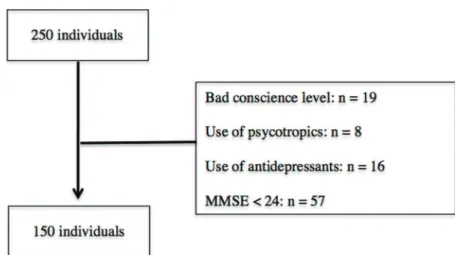
Participants met the following inclusion criteria (Figure 1): no history of neurological disease in the central nervous system or peripheral nervous system, such as peripheral neuro-pathy, alcohol abuse, or hypothyroidism; participants also had to be conscious during testing, could not be currently taking psychotropic drugs or antidepressants, and had to have a score424 on the Mini-Exam Mental State Examination (MMSE). The MMSE cutoff score was selected to correspond with the most commonly used value in clinical and epi-demiological studies of dementia in Brazil (11).
Study variables
The sociodemographic data obtained during interviews with patients were as follows: age (years), gender (men and women), race (Caucasian and non-Caucasian), body mass index (BMI, kg/m2), and years of education.
Standardization of the FHT was performed with the parti-cipant seated to support the trunk, with their vision obstructed,
in a sound-controlled environment. The FHT was conducted by applying 2 rounds of 10 sensory stimuli with cotton in a craniocaudal direction applied at dorsum of the hand at the 3rd metacarpal. This was followed by 10 stimuli applied to the cheek region of the face and 10 simultaneous stimuli applied to the face and hand. All stimuli were initially applied on the left side and then applied on the right. Finally, the number of rings (sensory stimuli) and the location of touch perceived by the individual in each testing segment were categorized as either normal sensory extinction or displacement. Table 1 shows the sequence of stimuli applied during the FHT.
Statistical analyses
Since we are using a sample representative of the target population, our sampling is considered to be intentional and non-probabilistic. We needed a minimum of 150 subjects to obtain a maximum sampling error of 7.5% and a confidence level of 95%. The associations between FHT scores and the sociodemographic variables gender and race were analyzed using nonparametric Mann-Whitney tests. The associations between FHT scores and age, BMI, and years of education were assessed using Spearman correlations. An adaptation of the binomial distribution assumption was used to model the perceived number of touches, followed by calculating the maximum likelihood estimates for the binomial distribution parameters for each variation of the FHT. The relationships between sociodemographic variables and sensory extinction on the FHT were analyzed by multiple logistic regression, adjusted for age and years of education. After adjustments, receiver operating characteristic (ROC) curves were calcu-lated for age and years of education to establish values that maximize the sensitivity and specificity of sensory extinc-tion on the FHT. Associaextinc-tions were considered statistically
Figure 1 -The screening process, indicating patients excluded from the study.
Table 1-Sequences of stimuli applied during the face-hand test (FHT).
1stround of stimuli:
1. 10 sensory stimuli to the right hand 2. 10 sensory stimuli to the right face
3. 10 sensory stimuli to the right face and the right hand 2ndround of stimuli:
4. 10 sensory stimuli to the left hand 5. 10 sensory stimuli to the left face
percentage of participants who perceived at least 8 touches during all variations of the FHT, particularly during the face right (Fr), face left (Fl), face-hand right (FH-r), and FH variations, in which more than 90% of participants noticed at least 8 touches. The percentage of participants perceiving
FH-l1 10.0 (3.0–13.0)
Sensorial extinction 38 (25.3%)
1Summary median (min-max); BMI = body mass index; F-r = right face;
F-l = left face; H-r = right hand; H-l = left hand; FH-r = right face-hand; FH-l = left face-hand.
Table 3-Face-hand test (FHT) scores by gender and race.
Gender Race
FHT Women (n=76) Men (n=74) p1 Caucasian (n=112) Non-Caucasian (n=38) p1
F-r 10(3–12) 10(6–12) 0.950 10(5–12) 10(3–12) 0.805
F-l 10(4–13) 10(5–12) 0.627 10(5–12) 10(4–13) 0.686
H-r 10(2–11) 10(3–12) 0.529 10(3–11) 10(2–12) 0.132
H-l 10(3–13) 10(3–11) 0.124 10(5–11) 10(3–13) 0.755
FH-r 10(2–11) 10(2–11) 0.887 10(2–11) 10(2–11) 0.466
FH-l 10(3–13) 10(5–12) 0.880 10(5–13) 10(3–12) 0.434
1Mann-Whitney. Summary in median (min-max); F-r = right face; F-l = left face; H-r = right hand; H-l = left hand; FH-r = right face-hand; FH-l = left face-hand.
Table 4-Correlation between face-hand test (FHT) scores and age, BMI, or years of education.
Factor F-r F-l H-r H-l FH-r FH-l
r(pvalue) r(pvalue) r(pvalue) r(pvalue) r(pvalue) r(pvalue) Age (years) -0.29(o0.001) 0.03(0.674) -0.35(o0.001) -0.10(0.218) -0.27(o0.001) -0.21(0.009) BMI (kg/m2) 0.04(0.588) 0.10(0.221) -0.05(0.517) -0.006(0.941) 0.03(0.628) 0.10(0.186)
Years of education 0.29(o0.001) 0.17(0.03) 0.32(o0.001) 0.34(o0.001) 0.23(0.004) 0.24(0.002)
F-r = right face; F-l = left face; H-r = right hand; H-l = left hand; FH-r = right face-hand; FH-l = left face-hand.r= Spearman correlation.
Table 5-Number of touches by face-hand test (FHT) variation.
Number of touches on
FHT
FHT variation
F-r F-l H-r H-l FH-r FH-l
n fr n fr n fr n fr n fr n fr
0 0 0.000 0 0.000 0 0.000 0 0.000 0 0.000 0 0.000
1 0 0.000 0 0.000 0 0.000 0 0.000 0 0.000 0 0.000
2 0 0.000 0 0.000 1 0.007 0 0.000 2 0.013 0 0.000
3 1 0.007 0 0.000 2 0.013 2 0.013 1 0.007 1 0.007
4 1 0.007 2 0.013 2 0.013 2 0.013 0 0.000 0 0.000
5 2 0.013 1 0.007 6 0.040 4 0.027 3 0.020 3 0.020
6 6 0.040 3 0.020 3 0.020 3 0.020 3 0.020 3 0.020
7 2 0.013 4 0.027 9 0.060 6 0.040 1 0.007 3 0.020
8 7 0.047 10 0.067 8 0.053 5 0.033 7 0.047 5 0.033
9 9 0.060 13 0.087 11 0.073 19 0.127 12 0.080 13 0.087
10 122 0.813 117 0.780 108 0.720 109 0.727 121 0.807 122 0.813
X8 touches 138 0.920 140 0.934 127 0.846 133 0.887 140 0.933 140 0.933
8 or more touches was lower for the hand right (Hr) and H variations, but was still480%.
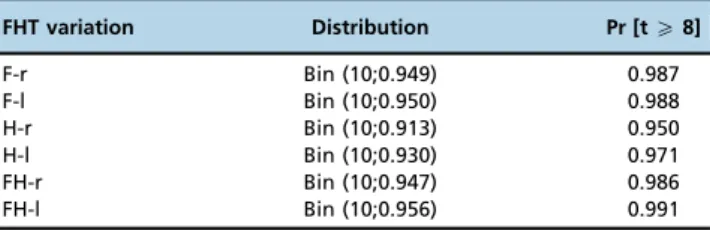
Table 6 shows the binomial models adjusted for the number of rings perceived in each variation of the FHT.
Table 7 shows the association between sociodemographic variables and the probability of sensory extinction during the FHT. We observed a statistically significant increase in the prob-ability of sensory extinction with increasing age (OR=1.04, range 1.01–1.07; p=0.006), and a significant reduction in the
probability of extinction with increasing years of education (OR=0.82, range 0.71–0.94;p=0.005).
Figure 2 shows the ROC curves for effects of age and years of education, which were used to establish values that maxi-mize the sensitivity and specificity for sensory extinction detected by the FHT. For age, a sensitivity and specificity of 68.4% and 72.3%, respectively, and 41.5 years of age pro-duced an area under the curve of 0.78 (95% CI=0.70–0.85;
po0.001; Figure 2a). For years of education, a sensitivity and
specificity of 68.4% and 69.6%, respectively, were associated with 10.5 years and generated an area under the curve of 0.77 (95% CI; 0.68–0.85;po0.001; Figure 2b).
’ DISCUSSION
The present study accomplished standardization of the FHT in a typical population without neurological disorders and demonstrated low variability foro8 touch stimuli, with the
highest frequency of stimulation between 8 and 10. The initial normative study suggests that no stimuli should be neglected, that the most common error resulted from sensory extinction by the stimulus and that responses are less accurate in patients with organic psychological syndromes and in children 3–6 years of age with face dominance (1).
We found associations between sensory extinction and increasing age as well as lower education. The number of years of education is associated with neuropsychological performance on tasks that assess various brain functions, such as memory, attention, language, and executive func-tions. In studies on regulation, or in comparative analyses between groups, education is often the most relevant vari-able, followed or accompanied by age (12). Additional educa-tion may be associated with increased synaptic conneceduca-tions or cerebral vasculature, thereby increasing higher cortical func-tioning (13-14).
We observed that 25.3% of participants had sensory extinc-tion during double stimulaextinc-tion of the face and hand. Under the original classification system, the FHT is divided into 4 distinct groups: (A) individuals who detect all applied stimuli, (B) individuals who detect sensory stimuli only in the face, (C) individuals who detect 2 simultaneous sensory stimuli in the face, and (D) individuals who detect sensory stimuli only in the hands. Previous studies have demon-strated that most errors were in relation to extinction in the face (5). In a study that found an association between EEG activity and sensory stimulation of the median or tibial nerves, it demonstrated cortical dominance of hand functions (8).
Another potential application of the FHT is for evaluation of the attention network, comprising the right perisylvian region (posterior parietal lobe, superior temporal cortex, as well as middle and prefrontal cortex). The FHT may be used to test errors that influence this network, with a potential
Table 6-Probabilistic models adjusted for the number of rings with each perceived change on the face-hand test (FHT), for a total of 10 stimuli.
FHT variation Distribution Pr [tX8]
F-r Bin (10;0.949) 0.987
F-l Bin (10;0.950) 0.988
H-r Bin (10;0.913) 0.950
H-l Bin (10;0.930) 0.971
FH-r Bin (10;0.947) 0.986
FH-l Bin (10;0.956) 0.991
Bin = binomial distribution; Pr = estimated probability of perceiving at least 8 of 10 stimuli received under the fitted distribution; F-r = right face; F-l = left face; H-r = right hand; H-l = left hand; FH-r = right face-hand; FH-l = left face-hand.
Table 7-Regression adjusted logistics for the probability of extinction on the face-hand test (FHT).
Variable b SE Wald p OR CI 95%
Men -0.63 0.46 1.83 0.176 0.53 (0.22–1.32) Age (years) 0.04 0.01 7.48 0.006 1.04 (1.01–1.07) BMI (kg/m2) -0.01 0.05 0.01 0.904 0.99 (0.90–1.10)
Race (non-Caucasian) -0.47 0.53 0.76 0.382 0.63 (0.22–1.79) Years of education -0.20 0.07 7.98 0.005 0.82 (0.71–0.94) Constant -0.24 1.56 0.02 0.876 0.78
researcher apply all stimuli to reduce the potential for con-founding effects. Additionally, given that factors such as noci-ceptive processes, respiratory discomfort, or other sensations may interfere with stimulus perception, we conducted the tests in a controlled stimulation room with minimal external environmental stimuli.
In conclusion, in a Brazilian multicultural population, normal responses for the FHT, which presents patterns of simulta-neous stimulation, are scores between 8 and 10. Additionally, sensory extinction is associated with increased age, with a cutoff point of 41 years. Sensory extinction is also associated with fewer than 5 years of education, with a cutoff point of 10.5 years.
’ AUTHOR CONTRIBUTIONS
Resende LA and Bazan R designed and projected the study. Luvizutto GJ, Fogaroli MO and Theotonio RM were responsible for the production (data collection, data tabulation). Nunes HR was responsible for the statis-tical analyses. Luvizutto GJ and Bazan R were responsible for the manu-script writing manumanu-script. Luvizutto GJ, Bazan R and Resende LA were responsible for thefinal discussion.
’ REFERENCES
1. Bender MB, Fink M, Green M. Patterns in perception on simultaneous tests of face and hand. AMA Arch Neurol Psychiatry 1951;66(3):355-62, http://dx.doi.org/10.1001/archneurpsyc.1951.02320090104009.
rate of occurrence of unilateral spatial neglect after stroke. Stroke. 1999; 30(6):1196-202, http://dx.doi.org/10.1161/01.STR.30.6.1196.
10. Kim M, Na DL, Kim GM, Adair JC, Lee KH, Heilman KM. Ipsilesional neglect: behavioural and anatomical features. J Neurol Neurosurg Psy-chiatr. 1999;67(1):35-8, http://dx.doi.org/10.1136/jnnp.67.1.35. 11. Almeida OP. Mini-exame do estado mental e o diagnóstico de demência
no Brasil. Arq Neuropsiquiatr. 1998;56(3B):605-12, http://dx.doi.org/ 10.1590/S0004-282X1998000400014.
12. Ostrosky-Solis F, Ardila A, Rosseli M, Lopez-Arango G, Uriel-Mendonza V. Neuropsychological test performance in illiterate subjects. Arch Clin Neuropsychol. 1998;13(7):645-60, http://dx.doi.org/10.1093/arclin/13.7.645. 13. Piras F, Cherubini A, Caltagirone C, Spalletta G. Education mediates microstructural changes in bilateral hippocampus. Hum Brain Mapp. 2011;32(2):282-9, http://dx.doi.org/10.1002/hbm.21018.
14. Greenwood PM, Parasuraman R. Neuronal and cognitive plasticity: a neurocognitive framework for ameliorating cognitive aging. Front Aging Neurosci. 2010;2:150, http://dx.doi.org/10.3389/fnagi.2010.00150. 15. Swan L. Unilateral spatial neglect. Phys Ther. 2001;81(9):1572-80. 16. Verdon V, Schwartz S, Lovblad KO, Hauert CA, Vuilleumier P.
Neuro-anatomy of hemispatial neglect and its functional components: a study using voxel-based lesion symptom mapping. Brain. 2010;133(Pt 3):880-94, http://dx.doi.org/10.1093/brain/awp305.
17. Friedland RP, Weinstein EA. Hemi-inattention and hemisphere speciali-zation: introduction and historical review. Adv Neurol. 1977;18:1-31. 18. Stein JF. Representation of egocentric space in the posterior parietal cortex.
Q J Exp Physiol. 1989;74(5):583-606, http://dx.doi.org/10.1113/expphysiol. 1989.sp003314.
19. Reeves RR, Bullen JA. Misuse of the face-hand test for psychogenic neu-rologic deficits. J Clin Psychiatry. 1994;55(8):363.
20. Critchley M. The Phenomenon of Tactile Inattention with Special Refer-ence to Parietal Lesions. Brain 1949;72:538-61, http://dx.doi.org/10.1093/ brain/72.4.538.