Luciana Anselmi Fernando C Barros Gicele C Minten Denise P Gigante Bernardo L Horta Cesar G Victora
Programa de Pós-Graduação em Epidemiologia. Universidade Federal de Pelotas. Pelotas, RS, Brasil
Correspondence:
Luciana Anselmi
R. Marechal Deodoro, 1160 - 3º piso 96020-220 Pelotas, RS, Brasil E-mail: [email protected] Received: 10/10/2007 Revised: 10/13/2008 Approved: 10/14/2008
Prevalence and early
determinants of common mental
disorders in the 1982 birth
cohort, Pelotas, Southern Brazil
ABSTRACT
OBJECTIVE: To estimate the prevalence of common mental disorders and assess its association with risk factors in a cohort of young adults.
METHODS: Cross-sectional study nested in a 1982 birth cohort study conducted in Pelotas, Southern Brazil. In 2004-5, 4,297 subjects were interviewed during home visits. Common mental disorders were assessed using the Self-Report Questionnaire. Risk factors included socioeconomic, demographic, perinatal, and environmental variables. The analysis was stratifi ed by gender and crude and adjusted prevalence ratios were estimated by Poisson regression.
RESULTS: The overall prevalence of common mental disorders was 28.0%; 32.8% and 23.5% in women and men, respectively. Men and women who were poor in 2004-5, regardless of their poor status in 1982, had nearly 1.5-fold increased risk for common mental disorders (p≤0.001) when compared to those who have never been poor. Among women, being poor during childhood (p≤0.001) and black/mixed skin color (p=0.002) increased the risk for mental disorders. Low birth weight and duration of breastfeeding were not associated to the risk of these disorders.
CONCLUSIONS: Higher prevalence of common mental disorders among low-income groups and race-ethnic minorities suggests that social inequalities present at birth have a major impact on mental health, especially common mental disorders.
DESCRIPTORS: Adult. Symptoms Psychic. Anxiety Disorders. Depressive Disorder. Cohort Studies. Brazil.
INTRODUCTION
Common mental disorders (CMD) comprise a group of diseases characterized by non-psychotic depressive symptoms, anxiety, and somatic complaints af-fecting people’s daily activities.11
The prevalence of mental disorders in young adults is high and may be as high as 25–40%,19 possibly because most psychiatric disorders occur at higher rates
during early adulthood.12,18 Population-based studies conducted in Brazil have
estimated a prevalence of CMD in adolescents and adults of 36.0% in the Northeastern7 and 17.0% in the Southeastern region.17 In Southern Brazil, the
city of Pelotas showed a prevalence of CMD of 28.8%20 in adolescents, 28.5%
Cross-sectional studies have evidenced CMD are more common in women,17 the Black,7 the poor,8,15 the
un-employed,17 smokers,8,20 chronic patients,8 people with
poor social support7 or who have experienced
stress-ful events,15 who are poorly educated,17 or children of
poorly educated mothers.20
Longitudinal studies have shown the impact of early risk factors such as poverty during childhood,10 low
birth weight, and intrauterine growth retardation21,25 on
depression in adults. The etiology of mental disorders was fi rst attributed to emotional trauma during child-hood9 or a dysfunctional mother-child relationship,5 and
more recently to fetal21 and genetic6 factors. It is crucial
to identify predisposing factors of mental disorders dur-ing childhood for better understanddur-ing their etiology and planning mental health policies.
Few studies have investigated the prevalence of CMD in specifi c age groups and factors associated through a prospective approach. Thus, the objective of the pres-ent study was to estimate the prevalence of CMD in 23-year-old young adults and to assess its association with sociodemographic, perinatal, and environmental risk factors present in early life.
METHODS
Cross-sectional study nested in a 1982 birth cohort study conducted in the city of Pelotas, Southern Bra-zil.23 Throughout the year of 1982, three maternity
hospitals in Pelotas were visited every day and the mothers of all 6,011 newborns, living in the urban area, were interviewed in the perinatal study. The original cohort comprised 5,914 liveborn infants. Of these, 46 were born at home. From 1982, there have been several follow-ups and the detailed methods are published elsewhere.2,23
Between October 2004 and August 2005, 4,297 sub-jects were interviewed during home visits. Adding to that 282 deaths identifi ed, the followed-up rate of the cohort was 77.4%. Follow-up was higher in subjects with intermediate income at birth but there was no difference of gender, birth weight, and skin color. Of these 4,297 subjects, 12 did not answer the question-naire on CMD: seven had mental retardation, three had severe mental disorder, one was deaf and one was lost to follow-up, making a total of 4,285 subjects. For the assessment of CMD in young people the Self-Report Questionnaire (SRQ-20) was applied.16 The SRQ-20
is a screening tool for common mental disorders (for-merly known as minor psychiatric disorders) that in-vestigates non-psychotic symptoms in the month prior to the interview, especially in depression and anxiety. It comprises four questions about physical symptoms and 16 questions about emotional symptoms with “yes/no” answer. Based on the recommendations of the instrument’s validation study in Brazil,16 individuals
with CMD were those with eight or more positive answers among women, and six or more positive answers among men. The World Health Organization (WHO) recommends the application of this instrument in community-based studies in developing countries.16
In the present study, the SRQ-20 was self-administered in young population studied.
Sociodemographic and health-related variables were collected from the perinatal questionnaire administered to the mothers in the maternity hospital in 1982.23 Data
was also collected during home interviews in 1983, 1984, and 1986.23 The following sociodemographic
variables were considered potential risk factors of CMD: self-referred skin color (white and black or mixed); maternal schooling; family income in 1982 (in monthly minimum wages); and income change. Income change was divided into: always poor (equivalent to the lowest tertile of family income in 1982 and 2005); poor
→ non-poor (lowest tertile in 1982 and second or third tertile in 2005); non-poor → poor (second or third tertile in 1982 and lowest tertile in 2005); never poor (second or third tertile in 1982 and 2005). Asians (1.7%) and Indigenous (1.8%) were excluded from the analyses. The following health-related variables were considered potential risk factors: birth weight; breastfeeding (in full months); and maternal CMD. They were assessed in a subsample of 1,013 mothers interviewed in 2001 using the SRQ-20 with a cutoff value of eight symptoms for defi ning CMD.16
Gender-specifi c analyses were performed. In the de-scriptive analysis, prevalences of CMD and confi dence intervals were estimated using the chi-square test and linear trend for comparison of proportions. Poisson regression was used in both bivariate and multivari-able analysis with robust adjustment of variance for estimating prevalence ratios when the outcome preva-lence was higher than 10%.3 A three-level hierarchical
RESULTS
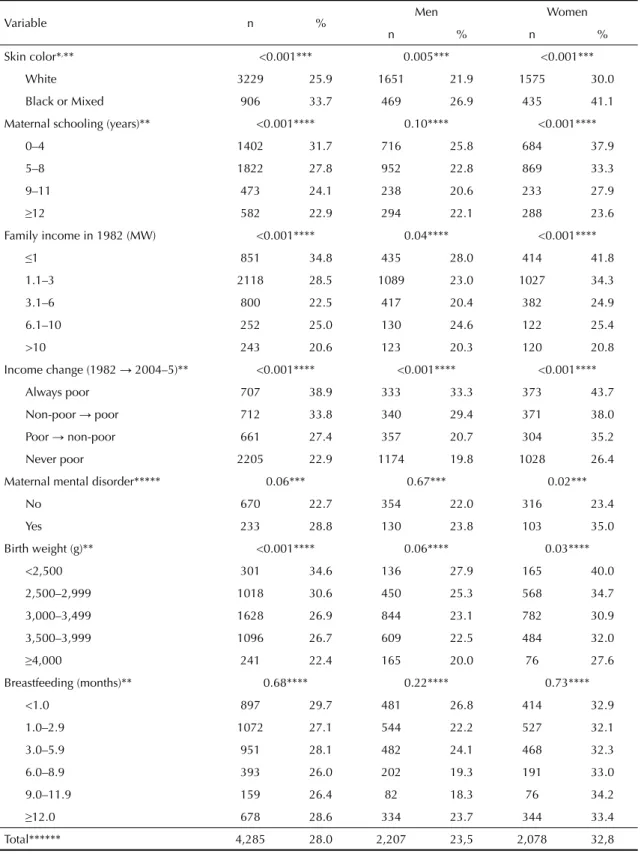
The prevalence of CMD was 28.0% (26.7; 29.4) in the cohort studied, 32.8% (30.8; 34.8) in women and 23.5% (21.8; 25.3) in men.
In the crude analysis, the prevalences were signifi cantly higher in both men and women: black or mixed; low family income at birth; and those who have been poor since birth or have become poor over a 23-year period. Among women, CMD was also associated to low birth weight, maternal schooling, and maternal CMD (Table 1).
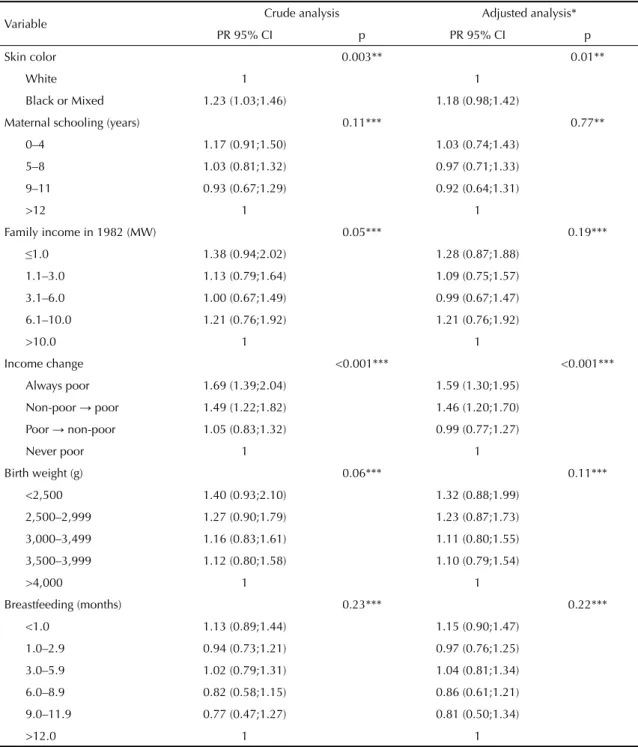
The analysis adjusted for confounders, the association between skin color and CMD among men disappeared after controlling for family income. Among women, the same was seen after adjusting low birth weight and maternal schooling for sociodemographic factors. Socioeconomic condition over time was the single variable that remained signifi cantly associated to the outcome in both men and women: poor subjects in 2004–5, irrespective of their low socioeconomic status during childhood, were 1.5-fold more likely to have CMD when compared to those who have never been poor (Tables 2 and 3).
Among women, skin color and income at birth also showed an association with CMD (Table 3). Low birth weight and length of breastfeeding did not show any association with CMD in both men and women. As for the mother’s mental health, in the adjusted analysis maternal CMD remained associated as a risk factor in women only.
DISCUSSION
The prevalence of CMD was high (28.0%) in the pres-ent study. In a population-based study conducted in the city of Pelotas in 1994 using the same instrument and cutoff values, a lower prevalence (21.7%) was found in subjects aged 15–34.15 But it is possible that the
inclusion of both adolescents and adults in the same category in this study contributed to a lower prevalence of CMD. The present study is not comparable to other Brazilian studies based on SRQ-20 due to different recall time and cutoff values. Besides, few studies have investigated well-defi ned age groups and overall prevalences were estimated in a wide age range, from adolescents to elderly.
A limitation of the present study is the application of SRQ-20. Despite its high sensitivity and specifi city, this is a screening rather than a diagnostic instrument. In addition, the study covered individuals born between January to December 1982 in the city of Pelotas and, therefore, the results may not be generalized to other populations living in different areas, and may be limited
to the period over which the study was conducted. In contrast, the prospective study design with long-term follow-up is innovative in studies investigating risk factors for mental disorders in low- and middle-income countries and allows inferences on the direction of causal relationships.
High prevalence of CMD in young adults was an expected fi nding. The New Zealand Dunedin Multidis-ciplinary Health and Development Study investigated mental disorders in the same subjects at the ages of 21, 26, and 32 years. They found higher prevalences of most disorders at the ages of 21 and 26 with a decline at the age of 32.18 Moreover, epidemiological studies
with broad age groups reported higher prevalences of mental disorders in older adolescents and young adults than in older adults.12,24 A study coordinated by
the World Health Organization (WHO) and carried out in several countries including Brazil between 1990 and 1996 reported higher prevalence of mental disorders listed in the Diagnostic and Statistical Manual of Mental Disroders1 in people aged 18–24 years.24 The
US National Comorbidity Survey (NCS) performed between 1990–1992 studied individuals aged 15–54 and found higher prevalence of psychiatric disorders in those aged 15–24.12
Consistent with other previous studies, the estimated prevalence of CMD in the present study was higher in women.8,15 Women have higher prevalences of
depres-sion and anxiety in the adult age, the two main groups of symptoms assessed by the SRQ-20.12,24 In addition,
false-negative cases in the mental health screening were more likely seen in men.16 This classifi cation error
can occur because: 1) men usually associate disease to weakness;16 2) they tend to express less their
anxiet-ies and feelings of sadness than women;16 and 3) they
may fi nd it harder to report their emotional symptoms during an interview.15
In the present study, the cohort studied from childhood showed higher prevalence of CMD in those who were currently poor, irrespectively of their previous socio-economic condition, which may suggest that mental health is more strongly determined by people’s current condition. In contrast, among women, family income at birth remained associated to CMD even after adjusting for current family income.
Cross-sectional studies conducted in Brazil7,17 and in
several countries12,24 evidenced an association between
poverty and CMD. However, longitudinal studies investigating poverty during childhood and CMD are less consistent.18 Yet the association between poverty
during childhood and psychiatric outcomes in adult age has been reported in cohort studies.10,18 In the
Table 1. Estimated prevalence of common mental disorders according to sociodemographic, perinatal, and environmental variables. Pelotas, Southern Brazil, 1982 to 2004–5.
Variable n % Men Women
n % n %
Skin color*,** <0.001*** 0.005*** <0.001***
White 3229 25.9 1651 21.9 1575 30.0
Black or Mixed 906 33.7 469 26.9 435 41.1
Maternal schooling (years)** <0.001**** 0.10**** <0.001****
0–4 1402 31.7 716 25.8 684 37.9
5–8 1822 27.8 952 22.8 869 33.3
9–11 473 24.1 238 20.6 233 27.9
≥12 582 22.9 294 22.1 288 23.6 Family income in 1982 (MW) <0.001**** 0.04**** <0.001****
≤1 851 34.8 435 28.0 414 41.8
1.1–3 2118 28.5 1089 23.0 1027 34.3
3.1–6 800 22.5 417 20.4 382 24.9
6.1–10 252 25.0 130 24.6 122 25.4
>10 243 20.6 123 20.3 120 20.8
Income change (1982 → 2004–5)** <0.001**** <0.001**** <0.001****
Always poor 707 38.9 333 33.3 373 43.7
Non-poor → poor 712 33.8 340 29.4 371 38.0
Poor → non-poor 661 27.4 357 20.7 304 35.2
Never poor 2205 22.9 1174 19.8 1028 26.4
Maternal mental disorder***** 0.06*** 0.67*** 0.02***
No 670 22.7 354 22.0 316 23.4
Yes 233 28.8 130 23.8 103 35.0
Birth weight (g)** <0.001**** 0.06**** 0.03****
<2,500 301 34.6 136 27.9 165 40.0
2,500–2,999 1018 30.6 450 25.3 568 34.7
3,000–3,499 1628 26.9 844 23.1 782 30.9
3,500–3,999 1096 26.7 609 22.5 484 32.0
≥4,000 241 22.4 165 20.0 76 27.6
Breastfeeding (months)** 0.68**** 0.22**** 0.73****
<1.0 897 29.7 481 26.8 414 32.9
1.0–2.9 1072 27.1 544 22.2 527 32.1
3.0–5.9 951 28.1 482 24.1 468 32.3
6.0–8.9 393 26.0 202 19.3 191 33.0
9.0–11.9 159 26.4 82 18.3 76 34.2
≥12.0 678 28.6 334 23.7 344 33.4
Total****** 4,285 28.0 2,207 23,5 2,078 32,8
MW: Minimum wages
*A total of 150 interviewees reported their ethnicity was Asian or Indigenous.
** Of all the 4,297 interviewees in 2004-5, information about 147 people was missing (3.4% of interviewees). *** Chi-square test for heterogeneity
**** Chi-square test for linear trend ***** Variable used in the 2001 follow-up.
Perinatal Project Study showed that people with low socioeconomic condition, assessed as early as during pregnancy and at the age of seven, had about twofold increase in their risk of major depression during adulthood, irrespective of sociodemographic
factors during childhood, family history of mental disorders, and socioeconomic condition during adult age.10 These studies have attributed long-term effects
of poverty to multiple adversities poor children more often experience such as higher prevalence of family
Table 2. Crude and adjusted analysis of common mental disorders in men in the 1982 cohort. Pelotas, Southern Brazil, 1982 to 2004–5.
Variable Crude analysis Adjusted analysis*
PR 95% CI p PR 95% CI p
Skin color 0.003** 0.01**
White 1 1
Black or Mixed 1.23 (1.03;1.46) 1.18 (0.98;1.42)
Maternal schooling (years) 0.11*** 0.77**
0–4 1.17 (0.91;1.50) 1.03 (0.74;1.43)
5–8 1.03 (0.81;1.32) 0.97 (0.71;1.33)
9–11 0.93 (0.67;1.29) 0.92 (0.64;1.31)
>12 1 1
Family income in 1982 (MW) 0.05*** 0.19***
≤1.0 1.38 (0.94;2.02) 1.28 (0.87;1.88)
1.1–3.0 1.13 (0.79;1.64) 1.09 (0.75;1.57)
3.1–6.0 1.00 (0.67;1.49) 0.99 (0.67;1.47)
6.1–10.0 1.21 (0.76;1.92) 1.21 (0.76;1.92)
>10.0 1 1
Income change <0.001*** <0.001***
Always poor 1.69 (1.39;2.04) 1.59 (1.30;1.95)
Non-poor → poor 1.49 (1.22;1.82) 1.46 (1.20;1.70)
Poor → non-poor 1.05 (0.83;1.32) 0.99 (0.77;1.27)
Never poor 1 1
Birth weight (g) 0.06*** 0.11***
<2,500 1.40 (0.93;2.10) 1.32 (0.88;1.99)
2,500–2,999 1.27 (0.90;1.79) 1.23 (0.87;1.73)
3,000–3,499 1.16 (0.83;1.61) 1.11 (0.80;1.55)
3,500–3,999 1.12 (0.80;1.58) 1.10 (0.79;1.54)
>4,000 1 1
Breastfeeding (months) 0.23*** 0.22***
<1.0 1.13 (0.89;1.44) 1.15 (0.90;1.47)
1.0–2.9 0.94 (0.73;1.21) 0.97 (0.76;1.25)
3.0–5.9 1.02 (0.79;1.31) 1.04 (0.81;1.34)
6.0–8.9 0.82 (0.58;1.15) 0.86 (0.61;1.21)
9.0–11.9 0.77 (0.47;1.27) 0.81 (0.50;1.34)
>12.0 1 1
MW: Minimum wages
* Variables in the fi rst level (skin color, maternal schooling and family income in 1982) adjusted for each other and kept in the model if p<0.2. Change in income adjusted for skin color. Birthweight adjusted for skin color, maternal schooling and family income in 1982. Breastfeeding adjusted for skin color, maternal schooling, family income and birthweight.
mental disorders; low IQ; abuse18 and stressful events,
family dysfunction; health conditions; and diffi culty in forming attachments.10
The fi nding of higher prevalence of CMD in black subjects is consistent with other studies.22 Among Black
women, the association remained after adjusting for
Table 3. Crude and adjusted analysis of common mental disorders in women. Pelotas, Southern Brazil, 1982 to 2004–5.
Variable Crude analysis Adjusted analysis
PR 95% CI p PR 95% CI p
Skin color < 0.001** 0.002**
White 1 1
Black or Mixed 1.37 (1.20;1.57) 1.25 (1.09;1.43)
Maternal schooling (years) < 0.001*** 0.33***
0–4 1.60 (1.28;2.02) 1.13 (0.84;1.52)
5–8 1.41 (1.12;1.77) 1.09 (0.82;1.44)
9–11 1.18 (0.88;1.58) 1.03 (0.74;1.41)
>12 1 1
Family income in 1982 (MW) <0.001*** <0.001*** ≤1.0 2.01 (1.39;2.89) 1.83 (1.27;2.66)
1.1–3.0 1.65 (1.15;2.36) 1.56 (1.09;2.23)
3.1–6.0 1.19 (0.81;1.76) 1.16 (0.79;1.71)
6.1–10.0 1.22 (0.77;1.94) 1.20 (0.76;1.91)
>10.0 1 1
Income change <0.001*** <0.001***
Always poor 1.66 (1.42;1.93) 1.44 (1.19;1.74)
Non-poor → poor 1.44 (1.22;1.70) 1.37 (1.16;1.62)
Poor → non-poor 1.34 (1.11;1.60) 1.17 (0.95;1.44)
Never poor
Birth weight (g) 0.03*** 0.24***
<2,500 1.45 (0.96;2.18) 1.34 (0.89;2.01)
2,500–2,999 1.26 (0.86;1.84) 1.18 (0.81;1.73)
3,000–3,499 1.12 (0.77;1.64) 1.10 (0.76;1.61)
3,500–3,999 1.16 (0.79;1.71) 1.18 (0.81;1.74)
>4,000 1 1
Breastfeeding (months) 0.73*** 0.95***
<1.0 0.98 (0.80;1.20) 1.04 (0.85;1.27)
1.0–2.9 0.96 (0.79;1.16) 0.99 (0.82;1.20)
3.0–5.9 0.97 (0.79;1.18) 1.04 (0.85;1.26)
6.0–8.9 0.99 (0.77;1.27) 1.08 (0.84;1.39)
9.0–11.9 1.02 (0.72;1.45) 1.03 (0.72;1.49)
>12.0 1 1
MW: Minimum wages
* Variables in the fi rst level (skin color, maternal schooling and family income in 1982) adjusted for each other and kept in the model if p<0.2. Change in income adjusted for skin color. Birthweight adjusted for skin color, maternal schooling and family income in 1982. Breastfeeding adjusted for skin color, maternal schooling, family income and birthweight. ** Wald test for heterogeneity
1. American Psychiatric Association. Diagnostic and statistical manual of mental disorder, DSM-IV. 4. ed. Washington, DC; 1994.
2. Barros FC, Victora CG, Horta BL, Gigante DP. Metodologia do estudo da coorte de nascimentos de 1982 a 2004-5, Pelotas, RS. Rev Saude Publica. 2008;42(Supl 2):7-15.
3. Barros AJ, Hirakata VN. Alternatives for logistic regression in cross-sectional studies: an empirical comparison of models that directly estimate the prevalence ratio. BMC Med Res Methodol. 2003;3:21. DOI: 10.1186/1471-2288-3-21
4. Bierut LJ, Heath AC, Bucholz KK, Dinwiddie SH, Madden PA, Statham DJ, et al. Major depressive disorder in a community-based twin sample: are there different genetic and environmental contributions for men and women? Arch Gen
Psychiatry. 1999;56(6):557-63. DOI: 10.1001/
archpsyc.56.6.557
5. Bowlby J. Attachment and loss. New York: Basic; 1982.
6. Caspi A, Moffi tt TE. Gene-environment interactions in psychiatry: joining forces with neuroscience. Nat Rev
Neurosci. 2006;7(7):583-90. DOI: 10.1038/nrn1925
7. Costa AG, Ludermir AB. Transtornos mentais comuns e apoio social: estudo em comunidade rural da Zona da Mata de Pernambuco, Brasil. Cad Saude
Publica. 2005;21(1):73-9. DOI:
10.1590/S0102-311X2005000100009
8. Costa JSDd, Menezes AMB, Olinto MTA, Gigante DP, Macedo S, Britto MAPd, et al. Prevalência de distúrbios psiquiátricos menores na cidade de Pelotas,
RS. Rev Bras Epidemiol. 2002;5(2):164-73.
9. Freud. S. Três ensaios sobre a teoria da sexualidade. Rio de Janeiro: Imago; 1973.
10. Gilman SE, Kawachi I, Fitzmaurice GM, Buka SL. Socioeconomic status in childhood and the lifetime risk of major depression. Int J Epidemiol. 2002;31(2):359-67. DOI: 10.1093/ije/31.2.359
11. Goldberg D, Huxley P. Common mental disorders: a bio-social model. London: Tavistock; 1992.
12. Kessler RC, McGonagle KA, Zhao S, Nelson CB, Hughes M, Eshleman S, et al. Lifetime and 12-month prevalence of DSM-III-R psychiatric disorders in the United States. Results from the National Comorbidity Survey. Arch Gen Psychiatry. 1994;51(1):8-19.
13. Kramer MS, Fombonne E, Igumnov S, Vanilovich I, Matush L, Mironova E, et al. Effects of prolonged and exclusive breastfeeding on child behavior and maternal adjustment: evidence from a large, randomized trial.
Pediatrics. 2008;121(3):e435-40. DOI: 10.1542/
peds.2007-1248
14. Krieger N, Smith K, Naishadham D, Hartman C, Barbeau EM. Experiences of discrimination: validity and reliability of a self-report measure for population health research on racism and health.
Soc Sci Med. 2005;61(7):1576-96. DOI: 10.1016/
j.socscimed.2005.03.006
15. Lima MS, Soares BGO, Mari JJ. Saúde e doença mental em Pelotas, RS: dados de um estudo populacional. Rev
Psi Clin. 1999;26(5):225-35.
16. Mari JJ, Williams P. Misclassifi cation by psychiatric screening questionnaires. J Chron Dis. 1986;39(5): 371-377.
17. Marin-Leon L, Oliveira HB, Barros MB, Dalgalarrondo P, Botega NJ. Social inequality and common mental disorders. Rev Bras Psiquiatr. 2007;29(3):250-3. DOI: 10.1590/S1516-44462006005000060
18. Melchior M, Moffi tt TE, Milne BJ, Poulton R, Caspi A. Why do children from socioeconomically disadvantaged families suffer from poor health when they reach adulthood? A life-course study. Am J
Epidemiol. 2007;166(8):966-74. DOI: 10.1093/aje/
kwm155
19. Miech R, Caspi A, Moffi tt T, Wright B, Silva P. Low socioeconomic status and mental disorders: a longitudinal study of selection and causation during young adulthood. Am J Sociol. 1999;104(4):1096-131. DOI: 10.1086/210137
REFERENCES
income and schooling, which may suggest that racial discrimination, potentially experienced by minorities, would increase the risk of developing CMD.14
The association between maternal CMD and mental disorders of their daughters suggests that the mother’s mental health has a greater impact on the daughters than the sons. This association may arise from greater heritability of depression among women.4
After adjustment low birth weight and maternal school-ing did not remain associated to CMD in women. It suggests that this association found in women is prob-ably due to lower socioeconomic condition of those with low birth weight and poorly educated mothers.
In the present study, the length of breastfeeding was not found to be associated to CMD, which corroborates the Promotion of Breastfeeding Intervention Trial (PROBIT) fi ndings. The PROBIT study followed up 17,046 mother-child pairs in Belarus13 and did not fi nd
an association between length of breastfeeding and mental health outcomes during childhood.
20. Pinheiro KA, Horta BL, Pinheiro RT, Horta LL, Terres NG, Silva RA. Common mental disorders in adolescents: a population based cross-sectional study.
Rev Bras Psiquiatr. 2007;29(3):241-5. DOI: 10.1590/
S1516-44462006005000040
21. Thompson C, Syddall H, Rodin I, Osmond C, Barker DJ. Birth weight and the risk of depressive disorder in late life. Br J Psychiatry. 2001;179:450-5. DOI: 10.1192/bjp.179.5.450
22. Vega W, Rumbaut R. Ethnic minorities and mental health. Annu Rev Sociology. 1991;17:351-83. DOI: 10.1146/annurev.so.17.080191.002031
23. Victora CG, Barros FC. Cohort profi le: the 1982 Pelotas (Brazil) birth cohort study. Int J Epidemiol. 2005;35(2):237-42. DOI: 10.1093/ije/dyi290
24. WHO International Consortion in Psychiatric Epidemiology. Cross-national comparison of the prevalences and correlates of mental disorders. Bull
World Health Organ. 2000;78(4):413-26.
25. Wiles NJ, Peters TJ, Leon DA, Lewis G. Birth weight and psychological distress at age 45-51 years: results from the Aberdeen Children of the 1950s cohort study. Br J Psychiatry. 2005;187:21-8. DOI: 10.1192/ bjp.187.1.21
This article is based on data from the study “Pelotas birth cohort, 1982” conducted by Postgraduate Program in Epidemiology at Universidade Federal de Pelotas.
The 1982 birth cohort study is currently supported by the Wellcome Trust initiative entitled Major Awards for Latin America on Health Consequences of Population Change. Previous phases of the study were supported by the International Development Research Center, The World Health Organization, Overseas Development Administration, European Union, National Support Program for Centers of Excellence (PRONEX), the Brazilian National Research Council (CNPq) and Brazilian Ministry of Health.
This article underwent the same peer review process as for other manuscripts submitted to this journal. Both authors and reviewers are guaranteed anonymity. Editors and reviewers declare that there are no confl icts of interest that could affect their judgment with respect to this article.