Post-analysis methods for lactate threshold depend on
training intensity and aerobic capacity in runners.
An experimental laboratory study
Métodos de pós-análise do limiar do lactato dependem da intensidade de treinamento
e da capacidade aeróbica dos corredores. Um estudo laboratorial experimental
Tiago Lazzaretti Fernandes
I, Rômulo dos Santos Sobreira Nunes
II, Cesar Cavinato Cal Abad
III, Andrea Clemente Baptista Silva
IV,
Larissa Silva Souza
IV, Paulo Roberto Santos Silva
V, Cyro Albuquerque
VI, Maria Cláudia Irigoyen
VII, Arnaldo José Hernandez
VIIILaboratório do Estudo do Movimento (LEM), Instituto de Ortopedia e Traumatologia (IOT), Hospital das Clínicas (HC), Faculdade de Medicina da
Universidade de São Paulo (FMUSP), and Sports Medicine Group of FMUSP, FIFA Medical Centre of Excellence, IOT HC-FMSUP, São Paulo, Brazil
ABSTRACT
CONTEXT AND OBJECTIVE: This study aimed to evaluate diferent mathematical post-analysis methods of determining lactate threshold in highly and lowly trained endurance runners.
DESIGN AND SETTING: Experimental laboratory study, in a tertiary-level public university hospital.
METHOD: Twenty-seven male endurance runners were divided into two training load groups: lowly trained (frequency < 4 times per week, < 6 consecutive months, training velocity ≥ 5.0 min/km) and highly trained (frequency ≥ 4 times per week, ≥ 6 consecutive months, training velocity < 5.0 min/km). The subjects performed an incremental treadmill protocol, with 1 km/h increases at each subsequent 4-minute stage. Fingerprint blood-lactate analysis was performed at the end of each stage. The lactate threshold (i.e. the running velocity at which blood lactate levels began to exponentially increase) was measured using three diferent methods: increase in blood lactate of 1 mmol/l at stages (DT1), absolute 4 mmol/l blood lactate concentration (4 mmol), and the semi-log method (semi-log). ANOVA was used to compare diferent lactate threshold methods and training groups.
RESULTS: Highly trained athletes showed signiicantly greater lactate thresholds than lowly trained run-ners, regardless of the calculation method used. When all the subject data were combined, DT1 and semi-log were not diferent, while 4 mmol was signiicantly lower than the other two methods. These same trends were observed when comparing lactate threshold methods in the lowly trained group. However, 4 mmol was only signiicantly lower than DT1 in the highly trained group.
CONCLUSION: The 4 mmol protocol did not show lactate threshold measurements comparable with DT1 and semi-log protocols among lowly trained athletes.
RESUMO
CONTEXTO E OBJETIVO: O objetivo do presente estudo é avaliar modelos matemáticos de pós-análise do limiar de lactato em grupos de corredores de longa distância muito ou pouco treinados.
TIPO DE ESTUDO E LOCAL: Estudo laboratorial experimental. Hospital Público Universitário Terciário.
MÉTODO: Vinte e sete corredores homens foram divididos em: pouco treinados (frequência < 4 vezes por semana, < 6 meses, velocidade ≥ 5,0 minutos/km) e muito treinados (frequência ≥ 4 vezes por sema-na, ≥ 6 meses, velocidade < 5,0 minutos/km). Os participantes foram submetidos a protocolo de esteira escalonado (1% inclinação) = 1 km/h por fase (4 minutos). Ao im de cada estágio, análise da “impressão digital” metabolômica foi realizada. O limiar do lactato (i.e. velocidade em que o lactato sanguíneo aumen-ta exponencialmente) foi medido utilizando-se três métodos: aumento de 1 mmol/l da concentração, concentração absoluta de 4 mmol e método semi-log. ANOVA foi utilizada para comparar os diferentes limiares de lactato e grupos.
RESULTADO: Atletas muito treinados apresentaram limiares de lactato maiores que os corredores pouco treinados, independentemente do método de cálculo utilizado. Comparando todos os corredores juntos, as análises de aumento de 1 mmol/l e semi-log não foram diferentes, enquanto a concentração absoluta de 4 mmol/l foi signiicativamente mais baixa que as dos dois outros métodos. Essas mesmas tendências foram observadas ao se compararem os métodos de limiar de lactato no grupo menos treinado. Entretan-to, a análise absoluta de 4 mmol/l foi menor do que a do aumento de 1 mmol/l no grupo muito treinado.
CONCLUSÃO: O método concentração absoluta de 4 mmol não mostrou mensurações comparáveis de
limiar do lactato quando comparado com os protocolos aumento de 1 mmol/l e semi-log nos atletas pouco treinados.
IMD, MSc. Doctoral Student and Attending Physician, Sports Medicine Group, FIFA Medical Centre of Excellence, Faculdade de Medicina da Universidade de São Paulo (FMUSP), and Instituto de Ortopedia e Traumatologia (IOT), Hospital das Clínicas (HC), São Paulo, Brazil. IIUndergraduate Student, Faculdade de Medicina da Universidade de São Paulo (FMUSP), São Paulo, Brazil. IIIMSc, PhD. Heart Institute, Faculdade de Medicina da Universidade de São Paulo (FMUSP), and Instituto do Coração (InCor), São Paulo, Brazil. IVMD. Sports Medicine Group, Faculdade de Medicina da Universidade de São Paulo (FMUSP), and Instituto de Ortopedia e Traumatologia (IOT), Hospital das Clínicas (HC), São Paulo, Brazil. VPhD. Sports Medicine Group, FIFA Medical Centre of Excellence, Faculdade de Medicina da Universidade de São Paulo (FMUSP), and Instituto de Ortopedia e Traumatologia (IOT), Hospital das Clínicas (HC), São Paulo, Brazil. VIMSC, PhD. Assistant Professor, Department of Mechanical Engineering, Centro Universitário da FEI, São Bernando do Campo, Brazil.
VIIMD, PhD. Professor, Faculdade de Medicina da Universidade de São Paulo (FMUSP), and Instituto do Coração (InCor), São Paulo, Brazil. VIIIPhD. Assistant Professor, Director of Sports Medicine Group, FIFA Medical Centre of Excellence, Faculdade de Medicina da Universidade de São Paulo (FMUSP), and Instituto de Ortopedia e Traumatologia (IOT), Hospital das Clínicas (HC), São Paulo, Brazil.
KEY WORDS: Lactic acid. Physical endurance. Anaerobic threshold. Oxygen consumption. Exercise test. Sports medicine.
INTRODUCTION
Blood lactate evaluation commonly complements endurance
training regimens.1,2 It has been recommended as an eicient
method for evaluating training intensity and recovery, and for
improving the performance of endurance athletes.3-6 During
incremental exercise, the lactate threshold (LT) is deined as the abrupt transition from slow increases to rapid exponential
increases in blood lactate levels.7
he evaluation of lactate threshold in athletes has evolved, from the 4 mmol universal lactate threshold, to the more indi-vidualized Onset of Blood Lactate Accumulation, and to the cur-rent Maximal Lactate Steady State standard. his progression has been due to better understanding of the physiological processes of lactate production and clearance, and the role of lactate during
prolonged and submaximal exercise.5,8-12
However, most published studies on lactate threshold have compared homogeneous groups of athletes with similar
aero-bic capacity, or have made regression analyses on these data.13-16
Comparisons between diferent methods on lactate
thresh-old acquisition also remain controversial in the literature.17-19
To our knowledge, there is no comparative study evaluat-ing lactate threshold methods in both lowly and highly trained endurance athletes.
OBJECTIVE
he purpose of this study was to evaluate diferent lactate thresh-old methods, and determine which methods are most reliable for athletes with diferent physical conditioning and training programs.
METHODS
his was an experimental laboratory study performed within the Sports Medicine Group of Faculdade de Medicina da Universidade de São Paulo. Twenty-seven male endurance ners were recruited for this study from university campus run-ning clubs. For the primary outcome (post-analysis method for the lactate threshold in the same group), the sample size was cal-culated ater a ive-athlete pilot study, taking P < 0.05 and power = 80%. he sample size was estimated as 10 individuals per group. We added a minimum of 20% more subjects to account for potential data loss.
he subjects were divided into two distinct groups based on the responses to a questionnaire: 15 highly trained runners (min-imum of 4 training runs per week for 6 consecutive months, and a long-distance training pace less than or equal to 5.0 min/km) and 12 lowly trained runners (long-distance training pace greater than 5.0 min/km, with a maximum of 3 runs per week and a maximum of 6 consecutive training months). he exclu-sion criteria were previous cardiorespiratory disease and
musculoskeletal running-related injuries. No athlete was cur-rently taking any medications.
Oxygen consumption (VO2) was measured continuously
and monitored by means of a breath-by-breath gas analyzer on a treadmill (h/p/cosmos, Pulsar, Germany) using a metabolic ana-lyzer (CPX/D Med Graphics, St. Paul, USA)
he mean physiological characteristics of the highly trained
group were: age 33.7 ± 10.3 years; training velocity: 4.0 ± 0.6 min/km;
resting heart rate 68.7 ± 14.7 bpm; and VO2max: 52.4 ± 5.3 ml/kg/min.
Characteristics of the lowly trained group were: age 37.2 ± 9.3 years;
training velocity: 5.3 ± 0.9 min/km; rest heart rate 79.3 ± 15.2 bpm;
and VO2max: 43.4 ± 5.7ml/kg/min.
he Institutional Review Board approved this research and informed consent was obtained from each subject prior to
partici-pation. his research followed the Helsinki Declaration principles.20
Lactate protocol
A washout period of 24 hours with no physical activity was requested for all participants prior to the experiment. he sub-jects then performed an incremental treadmill test to directly measure their lactate threshold. All subjects did the test at the same location, with the same equipment, and under similar ther-mal conditions (temperature 21-26°C, humidity 33-66%, baro-metric pressure 688 mmHg). hroughout the protocol, treadmill elevation was kept constant at a 1% grade to duplicate the energy
cost of over-ground running.21
he subjects irst performed a 3-minute warm-up run at 30% of their long-distance training velocity. At the beginning of the incremental test, the treadmill velocity was set at 70% of the esti-mated long distance training velocity, depending on the running ability of each participant (it is known that performance in
com-petition is an appropriate criterion for valid laboratory tests).3,22
Heart rate and Borg scale were recorded each minute. Stage
length was set at 4 minutes,21 with running velocity increases of
1 km/h per stage until volitional exhaustion was reached (as mea-sured from the Borg scale). Fingerprint whole-blood samples were taken between the points of 3.5 and 4 minutes in each stage and were immediately analyzed in an automated blood-lactate ana-lyzer (Accutrend Lactate, Typ3012522) without treadmill proto-col interruption. Blood samples were proto-collected for two additional stages following exponential inlection of the lactate point.
Calculating lactate threshold
he basis for determining the lactate threshold is that there is an inlection point at a given workload (i.e. running velocity) where blood lactate exponentially increases with a corresponding increase
in workload.17,18,21,23,24 It is used to deine the highest work rate or O
2 uptake (oxygen consumption) at which athletes can maintain their
proile was created for each subject by plotting running velocity (km/h) at each stage of the test (x-axis) versus blood-lactate con-centration attained at each stage (y-axis).10,21,24,26,27
hree methods commonly cited in the literature were used to
deine the inlection point (Figure 1):
1. Increase of 1 mmol/l blood lactate (DT1): the work rate that just precedes a rise in blood lactate concentration of > 1 mmol/l
between two stages estimates the lactate threshold.10,21,26,27
2. Absolute value of 4 mmol/l blood lactate (4 mmol): work-load when the concentration of lactate in the blood reaches 4 mmol/l.10,21,26,27
3. Semi-log method (semi-log): based on a logarithmic scale (blood lactate) in which the exponential blood lactate curve is divided into two linear segments that cross each other; the
point of intersection is the lactate threshold.17,18
Statistical analysis
he normality curve was addressed by means of histograms and it was decided to use parametric tests. Baseline characteristics were analyzed irst to demonstrate homogeneity. he threshold values of each method were compared with repeated-measurement analyses of variance (ANOVA). When a signiicant diference was attained, Tukey’s post-hoc test was performed. Statistical signiicance was denoted as P < 0.05 (STATA-9 for Windows).
RESULTS
Before analyzing the relationship between lactate threshold and velocity, the associations between lactate threshold and
base-line characteristics such as age, heart rate, VO2max and
train-ing regularity were assessed. his analysis showed that neither
demographic nor baseline characteristics could explain associa-tions with lactate threshold, except, logically, for the dependent
variables of training regularity between groups and VO2max.
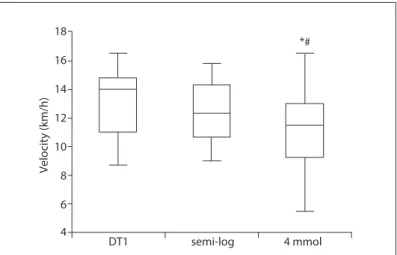
As expected, the lactate thresholds of the highly trained group were obtained at higher velocity stages than those of the lowly trained group in all tested methods. When considering all subjects (both the highly trained and the lowly trained groups), comparison of lactate threshold methods showed signiicant dif-ferences between the DT1 and 4 mmol methods, and between the semi-log and 4 mmol methods. here was no statistical diference
between DT1 and semi-log (Figure 2).
10
1 mmol/l increase method (DT1) (a)
1 mmol/l increase threshold method 9
8
7
6
5
4
3
2
11 12 13 14 15 16 Velocity (km/h)
Lactate (mmol/l)
Log lactate (mmol/l)
17 18 19 20 21
1 (b)
semi-log method (intersection) 0.9
0.8
0.7
0.6
0.5
11 12 13 14 15 16 Velocity (km/h)
17 18 19 20 21
Figure 1. Example of the three post-analysis methods for lactate threshold applied to one subject: (a) the velocity before the increase of
1 mmol/l blood lactate (DT1); the velocity at which the blood lactate exceeds the value of 4 mmol/l (4 mmol); and (b) the velocity at the intersection of two interpolated lines on the semi-logarithmic scale (semi-log).
18
*# 16
14
12
10
8
6
4
DT1 semi-log
Velocity (km/h)
4 mmol
Figure 2. Box plot of the velocity of the lactate threshold of all subjects
obtained using the DT1, semi-log and 4 mmol post-analysis methods.
*Signiicant diference between DT1 and 4 mmol methods (P < 0.05), and
#signiicant diference between semi-log and 4 mmol (P < 0.05), ANOVA (analysis
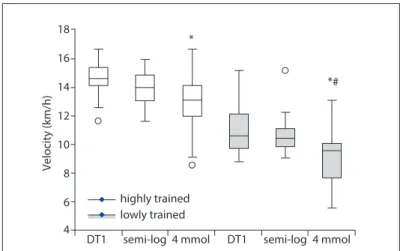
When the groups were compared separately (highly trained and lowly trained), the 4 mmol measurement was found to be sig-niicantly lower than the DT1 and semi-log measurements in the lowly trained group. he DT1 and semi-log measurements were
not statistically diferent in this group (Figure 3). In the highly
trained group, a signiicant diference was only found between the DT1 and the 4 mmol methods.
DISCUSSION
he most important inding of this study was the diferences in lactate threshold measurement methods between highly and lowly trained endurance runners. he method with ixed blood lactate of 4 mmol/l underestimated the lactate threshold in the lowly trained group.
Sargent et al.28 identiied diferences in lactate threshold
between diferent groups of subjects, such as men versus women.
On the other hand, Smekal et al.29 reported that blood lactate
concentration at the maximal lactate steady state was indepen-dent of both endurance capacity and sex. Other authors have showed comparisons between trained and untrained individuals
through using cardiorespiratory tests.30,31 One notable
character-istic of our study is that we only used male subjects and made comparisons between controlled training levels (high and low) instead of between trained and sedentary subjects.
One explanation for the diferent values of measurement methods is that error is introduced when the curves do not
fol-low the mathematical physiological functions.19
Subjects with diferent performance levels oten have difer-ent mechanical running responses and consequdifer-ently diferdifer-ent
metabolic demands.32 Our study also agreed with the literature
regarding higher lactate threshold values in trained individuals.
Kumagai et al.33 showed that aerobic training increased the
lac-tate threshold, with a concomitant improvement in both endur-ance and middle-distendur-ance performendur-ance.
Individuals with greater endurance capacity have faster
oxy-gen kinetics.34 he higher values of lactate thresholds in the highly
trained subjects may relect more eicient peripheral and central
exchange during exercise.34 During low-intensity exercise, blood
lactate formation and removal depends on the intracellular/tissue balance among the glycolytic (cytosol) and oxidative
(mitochon-dria) processes.35 It seems that in trained individuals, these
vari-ables are more predictable and have controlled behavior.
Joyner et al.36 suggested that running performance could be
explained by VO2max, running economy and fractional
utiliza-tion of VO2max. Moreover, they suggested that the lactate
thresh-old integrates all three of these variables and is the best
physio-logical predictor of distance running performance1, given that it
is detectable in both trained and untrained individuals.10
It is known that the average value for the lactate threshold in normal subjects is 3.7 mmol and that serum blood lactate at the lactate threshold is not equal for all individuals (range: 1.5 to
7.5 mmol) and also changes in a single individual.37 Although the
4 mmol lactate protocol is an easy method for estimating lactate
threshold, the ixed value of 4.0 mmoldoes not take these
physi-ological conditions into consideration and may underestimate
lac-tate threshold, as shown in this study.38
he clinical relevance of this study relates to the populations tested. Most people are not competitive endurance athletes, yet still need predictions of aerobic threshold and exercise prescrip-tions for health issues. Our results suggest that lowly trained sub-jects would beneit from semi-log or DT1 lactate threshold meth-ods in clinical practice.
he main limitation of this study relates to the treadmill pro-tocol, such as the stage duration and initial running velocity. Due to the large variation of treadmill protocols in the lactate threshold literature, direct comparisons of our results with pre-vious studies may not be appropriate. Despite training group characteristics that were very speciic (frequency, intensity and duration of training), we believe that they represent objective inclusion criteria and, because of that, the results may be repro-ducible. Future studies should examine lactate threshold meth-ods and cardiorespiratory performance in both highly trained and lowly trained groups. We suggest that these groups should be stratiied according to training frequency, intensity and duration.
CONCLUSION
he 4 mmol protocol did not show lactate threshold measure-ments comparable with with DT1 and semi-log protocols among lowly trained athletes.
18
*# *
16
14
12
10
8
6
4
DT1 semi-log highly trained lowly trained
4 mmol DT1 semi-log 4 mmol
Velocity (km/h)
Figure 3. Box plot of the velocities at the lactate threshold obtained
using the DT1, semi-log and 4 mmol post-analysis methods in each group (highly trained and lowly trained).
*Signiicant diference between DT1 and 4 mmol methods (P < 0.05), and
#signiicant diference between semi-log and 4 mmol (P < 0.05), using ANOVA
REFERENCES
1. Bassett DR Jr, Howley ET. Limiting factors for maximum oxygen uptake and determinants of endurance performance. Med Sci Sports Exerc. 2000;32(1):70-84.
2. Hollmann W. 42 years ago--development of the concepts of ventilatory and lactate threshold. Sports Med. 2001;31(5):315-20. 3. Baldari C, Videira M, Madeira F, Sergio J, Guidetti L. Blood lactate
removal during recovery at various intensities below the individual anaerobic threshold in triathletes. J Sports Med Phys Fitness. 2005;45(4):460-6.
4. Beneke R. Methodological aspects of maximal lactate steady state-implications for performance testing. Eur J Appl Physiol. 2003;89(1):95-9.
5. Demarle AP, Heugas AM, Slawinski JJ, et al. Whichever the initial training status, any increase in velocity at lactate threshold appears as a major factor in improved time to exhaustion at the same severe velocity after training. Arch Physiol Biochem. 2003;111(2):167-76.
6. Sjödin B, Jacobs I, Svedenhag J. Changes in onset of blood lactate accumulation (OBLA) and muscle enzymes after training at OBLA. Eur J Appl Physiol Occup Physiol. 1982;49(1):45-57.
7. Svedahl K, MacIntosh BR. Anaerobic threshold: the concept and methods of measurement. Can J Appl Physiol. 2003;28(2):299-323. 8. Farrell PA, Wilmore JH, Coyle EF, Billing JE, Costill DL. Plasma lactate
accumulation and distance running performance. Med Sci Sports. 1979;11(4):338-44.
9. Faude O, Kindermann W, Meyer T. Lactate threshold concepts: how valid are they? Sports Med. 2009;39(6):469-90.
10. Nicholson RM, Sleivert GG. Indices of lactate threshold and their relationship with 10-km running velocity. Med Sci Sports Exerc. 2001;33(2):339-42.
11. Tanaka K, Matsuura Y, Matsuzaka A, et al. A longitudinal assessment of anaerobic threshold and distance-running performance. Med Sci Sports Exerc. 1984;16(3):278-82.
12. Weltman A. The blood lactate response to exercise. Champaign: Human Kinetics Publisher; 1995.
13. Carlsson M, Carlsson T, Hammarström D, et al. Validation of physiological tests in relation to competitive performances in elite male distance cross-country skiing. J Strength Cond Res. 2012;26(6):1496-504.
14. de Sousa NM, Magosso RF, Pereira GB, et al. The measurement of lactate threshold in resistance exercise: a comparison of methods. Clin Physiol Funct Imaging. 2011;31(5):376-81.
15. Sperlich B, Krueger M, Zinner C, et al. Oxygen uptake, velocity at lactate threshold, and running economy in elite special forces. Mil Med. 2011;176(2):218-21.
16. Weltman A, Snead D, Seip R, et al. Prediction of lactate threshold and ixed blood lactate concentrations from 3200-m running performance in male runners. Int J Sports Med. 1987;8(6):401-6.
17. Bishop D, Jenkins DG, Mackinnon LT. The relationship between plasma lactate parameters, Wpeak and 1-h cycling performance in women. Med Sci Sports Exerc. 1998;30(8):1270-5.
18. Davis JA, Rozenek R, DeCicco DM, Carizzi MT, Pham PH. Comparison of three methods for detection of the lactate threshold. Clin Physiol Funct Imaging. 2007;27(6):381-4.
19. Tokmakidis SP, Léger LA, Pilianidis TC. Failure to obtain a unique threshold on the blood lactate concentration curve during exercise. Eur J Appl Physiol Occup Physiol. 1998;77(4):333-42.
20. WMA Declaration of Helsinki - Ethical Principles for Medical Research Involving Human Subjects. Available from: http://www.wma.net/ en/30publications/10policies/b3/. Accessed in 2015 (Jan 7). 21. McGehee JC, Tanner CJ, Houmard JA. A comparison of methods
for estimating the lactate threshold. J Strength Cond Res. 2005;19(3):553-8.
22. Ament W, Verkerke GJ. Exercise and fatigue. Sports Med. 2009;39(5):389-422.
23. Robergs RA, Roberts SO. Exercise physiology: exercise, performance and clinical applications. St Louis: Mosby; 1996.
24. Yoshida T, Chida M, Ichioka M, Suda Y. Blood lactate parameters related to aerobic capacity and endurance performance. Eur J Appl Physiol Occup Physiol. 1987;56(1):7-11.
25. Lorenzo S, Minson CT, Babb TG, Halliwill JR. Lactate threshold predicting time-trial performance: impact of heat and acclimation. J Appl Physiol (1985). 2011;111(1):221-7.
26. Machado FA, de Moraes SM, Peserico CS, Mezzaroba PV, Higino WP. The Dmax is highly related to performance in middle-aged females. Int J Sports Med. 2011;32(9):672-6.
27. Machado FA, Nakamura FY, Moraes SM. Inluence of regression model and incremental test protocol on the relationship between lactate threshold using the maximal-deviation method and performance in female runners. J Sports Sci. 2012;30(12):1267-74.
28. Sargent C, Scroop GC. Plasma lactate accumulation is reduced during incremental exercise in untrained women compared with untrained men. Eur J Appl Physiol. 2007;101(1):91-6.
29. Smekal G, von Duvillard SP, Pokan R, et al. Blood lactate concentration at the maximal lactate steady state is not dependent on endurance capacity in healthy recreationally trained individuals. Eur J Appl Physiol. 2012;112(8):3079-86.
30. Del Coso J, Hamouti N, Aguado-Jimenez R, Mora-Rodriguez R. Respiratory compensation and blood pH regulation during variable intensity exercise in trained versus untrained subjects. Eur J Appl Physiol. 2009;107(1):83-93.
31. Takeshima N, Kobayashi F, Watanabe T, et al. Cardiorespiratory responses to cycling exercise in trained and untrained healthy elderly: with special reference to the lactate threshold. Appl Human Sci. 1996;15(6):267-73. 32. Ramsbottom R, Williams C, Fleming N, Nute ML. Training induced
33. Kumagai S, Tanaka K, Matsuura Y, et al. Relationships of the anaerobic threshold with the 5 km, 10 km, and 10 mile races. Eur J Appl Physiol Occup Physiol. 1982;49(1):13-23.
34. Whipp BJ, Davis JA, Torres F, Wasserman K. A test to determine parameters of aerobic function during exercise. J Appl Physiol Respir Environ Exerc Physiol. 1981;50(1):217-21.
35. Brooks GA. Cell-cell and intracellular lactate shuttles. J Physiol. 2009;587(Pt 23):5591-600.
36. Joyner MJ, Coyle EF. Endurance exercise performance: the physiology of champions. J Physiol. 2008;586(1):35-44.
37. Pedersen PK, Sj G, Juel C. Plasma acid-base status and hyperventilation during cycling at MAXLASS in low and high lactate responders. Medicine & Science in Sports & Exercise. 2011;33(5):S314.
38. Coyle EF. Integration of the physiological factors determining endurance performance ability. Exerc Sport Sci Rev. 1995;23:25-63.
Acknowledgements: The authors would like to thank Sean J. Driscoll for proofreading this manuscript
Sources of funding: Fundação de Amparo à Pesquisa do Estado de São Paulo (Fapesp) – Protocolo 2010/19631-2
Conlict of interest: None
Date of irst submission: May 11, 2014
Last received: November 19, 2014
Accepted: December 15, 2014
Address for correspondence: Tiago Lazzaretti Fernandes Laboratório do Estudo do Movimento
Instituto de Ortopedia e Traumatologia, Hospital das Clínicas Faculdade de Medicina da Universidade de São Paulo Dr. Ovídio Pires de Campos, 333 — 2o andar