RESUmo
O presente estudo objeivou veriicar a relevância e a uilização de estratégias de comunicação em cuidados paliaivos. Estu
-do quanitaivo mulicêntrico, realiza-do en
-tre agosto/2008 e julho/2009, junto a 303 proissionais de saúde que trabalhavam com pacientes sob cuidados paliaivos, por meio da aplicação de quesionário. Os dados sofreram tratamento estaísico des
-criivo. A maioria (57,7%) não foi capaz de citar ao menos uma estratégia de comu
-nicação verbal e apenas 15,2% menciona
-ram 5 sinais ou estratégias não verbais. As estratégias verbais mais citadas foram as de cunho interrogaivo sobre a doença/ tratamento e, dentre as não verbais, des
-tacaram-se o toque afeivo, olhar, sorriso, proximidade ísica e escuta aiva. Embora os proissionais tenham atribuído alto grau de relevância para a comunicação em cui
-dados paliaivos, evidenciaram escasso conhecimento de estratégias de comuni
-cação. Faz-se necessária a capacitação dos proissionais no que tange à comunicação em cuidados paliaivos.
dESCRitoRES Comunicação Cuidados paliaivos
Equipe de assistência ao paciente Relações interpessoais
Communication strategies used by
health care professionals in
providing palliative care to patients
*O
riginal
a
r
ticle
AbStRACt
The objecive of this study is to verify the relevance and uilizaion of communica
-ion strategies in palliaive care. This is a mulicenter qualitaive study using a ques
-ionnaire, performed from August of2008 to July of2009 with 303 health care profes
-sionals who worked with paients receiv
-ing palliaive care. Data were subjected to descripive staisical analysis. Most par
-icipants (57.7%) were unable to state at least one verbal communicaion strategy, and only 15.2% were able to describe ive signs or non-verbal communicaion strate
-gies. The verbal strategies most commonly menioned were those related to answer
-ing quesions about the disease/treatment. Among the non-verbal strategies used, the most common were afecive touch, look
-ing, smil-ing, physical proximity, and careful listening. Though professionals have as
-signed a high degree of importance to com
-municaion in palliaive care, they showed poor knowledge regarding communicaion strategies. Final consideraions include the necessity of training professionals to com
-municate efecively in palliaive care.
dESCRiPtoRS Communicaion Palliaive care Paient care team Interpersonal relaions
RESUmEn
Veriicar la relevancia y la uilización de es
-trategias de comunicación en cuidados pa
-liaivos. Estudio cuanitaivo mulicéntrico, realizado entre agosto/2008 y julio/2009, con 303 profesionales de salud que traba
-jaban con pacientes bajo cuidados paliai
-vos, mediante aplicación de cuesionario. Los datos recibieron análisis estadísico descripivo. La mayoría (57,7% no fue ca
-paz de citar al menos una estrategia de comunicación verbal, y apenas 15,2% men
-cionó 5 señales o estrategias no verbales. Las estrategias verbales más nombradas fueron las de cuño interrogaivo acerca de la enfermedad/tratamiento, y entre las no verbales se destacaron caricias afeci
-vas, miradas, sonrisas, proximidad ísica y escucha aciva. Aunque los profesionales hayan atribuido alto grado de relevancia a la comunicación en cuidados paliaivos, evidenciaron escaso conocimiento de es
-trategias de comunicación. Resulta nece
-saria la capacitación de los profesionales en lo ainente a comunicación en cuidados paliaivos.
dESCRiPtoRES Comunicación Cuidados paliaivos
Grupo de atención al paciente Relaciones interpersonales
monica martins trovo de Araújo1, maria Júlia Paes da Silva2
Estratégias dE comunicação utilizadas por profissionais dE saúdE na atEnção à paciEntEs sob cuidados paliativos
EstratEgias dE comunicación utilizadas por profEsionalEs dE salud En la atEnción a paciEntEs bajo cuidados paliativos
* Extract from the thesis “Comunicação em Cuidados Paliativos: proposta educacional para proissionais de saúde”, University of São Paulo School of Nursing, 2011. 1Registered Nurse. PhD in Science from the University of São Paulo School of Nursing. Assistant Professor of the São Camilo University
Center. Member of the Group for Study and Research in Communication in Nursing/CNPq. São Paulo, SP, Brazil. [email protected] 2registered
intRodUCtion
Along with the proicient control of pain and symp -toms, and interdisciplinary teamwork, the adequate use of communicaion skills and interpersonal relaionships consitutes the triad foundaion that sustains palliaive care. In situaions of uncertainty, pain and sufering, rela -ionships are re-signiied and contact with people, either with relaives or healthcare professionals, starts to repre -sent the essence of care that sustains faith and hope, sup -poring the experience of diicult moments.
Since a means of communicaion occurs in this human contact, through speech or nonverbal cues, knowledge of interpersonal communicaion techniques or strategies that facilitate the interacion and can transmit care, com -passion and comfort is of paramount importance. Regard -less of the basic formaion area or professional category, all healthcare professionals need this knowledge, since they work in their quoidian with people who are expe -riencing the end of their lives, in the most
varied scenarios. In this sense, the ques -ion is: do the healthcare profess-ionals who work or have frequent contact with paients under palliaive care value communicaion as an essenial dimension of palliaive care? Do they know interpersonal communica -ion strategies in the context of terminality? Thus, it necessary is for this study to invesi -gate these quesions.
obJECtiVE
• To invesigate whether healthcare pro -fessionals who work or have frequent con -tact with paients under palliaive care value interpersonal communicaion in the context of terminality.
• To ascertain whether they know interpersonal com -municaion strategies or techniques that facilitate the in -teracion with paients in palliaive care.
• To idenify which communicaion strategies are used by these professionals to facilitate the interacion with people living in the inal stage of life.
LitERAtURE REViEW
Palliaive care is acive and total care for the paient whose disease no longer responds to curaive treatment. It is a difereniated care approach which aims to improve the quality of life of paients and their families, through appropriate evaluaion and treatment to relieve the pain and symptoms, and to provide psychosocial and spiritual support(1). Palliaive care is directed towards the relief of sufering, focusing on the sick person and not the illness of the person(2), recovering and revalorizing the interper
sonal relaionships in the process of dying, using compas -sion, empathy, humility and honesty as key elements(3).
Although many educaional insituions have opened up space to discuss the theme of death and care at the end of life in some disciplines, the teaching is fragmented and supericial in its content, especially regarding inter -personal communicaion in palliaive care. Thus, health -care professionals who work caring for people experienc -ing the end of life consider communicaion in the process of dying a sore point in their pracice, avoiding contact and conversaion with these paients, poining out that they do not receive theoreical preparaion nor emoional support to deal with the sufering and death of their ter -minal paients(4-5).
Interpersonal communicaion in the area of health and palliaive care is understood as a complex process that in -volves the percepion, comprehension and transmission of messages in the interacion between paients and health -care professionals. It is a process that has two dimen -sions: the verbal, which occurs through the expression of spoken or writen words, and the nonverbal, characterized by the manner and tone of voice with which words are said, by gestures that accompany the speech, by looks and facial expressions, by the body posture, and by the physical distance that people maintain with each other(6).
Internaionally, there are numerous studies that invesigate communicaion in the process of dying. Although it is valued in the care process for the paient at the end of life, many of the studies comprehend communicaion in a reducionist way, char -acterizing it as a synonym for informaion regarding the diagnosis and prognosis and/ or communicaion of diicult news(7-8). Of the studies that approach communicaion as a broad process, as an instrument of the interpersonal relaionship between paient and healthcare professional, and characterize it as an essenial atribute of quality care at the end of life, the ones that stand out are those that propose and/or evaluate training programs for the health -care professionals in communicaion with terminal pa -ients, aiming to improve their communicaion skills(9-11).
An English study conducted with 110 palliaive care nurses showed that communicaion skills seem to be de -termining factors for them feeling more conident and secure when dealing with diicult situaions in their quo -idian work with terminal paients(12). A group of research
-ers(11), through a randomized study involving 160 oncolo -gists of the UK ilmed during their interacions with 2407 paients, demonstrated that the length of pracice and amount of experience as an oncology physician was not related to the acquisiion of communicaion skills. That is, more experienced professionals are not necessarily more Although many
educational institutions have opened up space to discuss the theme
of death and care at the end of life in
some disciplines, the
teaching is fragmented
and supericial in its content, especially
regarding interpersonal communication in
able to deal with the problems related to communicaion with their paients because communicaion skills are not acquired over ime, but with adequate training. Studies that invesigate training in communicaion skills in oncolo -gy/palliaive care nurses showed an improvement in these skills and in the atenion to the emoional dimension of the care provided by the nurses, as they oten used more emoional and afecionate words ater the educaional intervenion(13-15).
The naional literature is lacking in studies that ad -dress the communicaion process with paients without a prognosis of a cure, despite being well structured in other healthcare pracices. The few studies that can be found on the theme deal with three aspects: communicaion as informaion requested by the paients(16-18); empirical rec -ommendaions on how the communicaion process with people experiencing terminality should be(19-20); or relec -ions on the communicaion of diicult news(21).
It is essenial for the care of the paient undergoing the process of dying that healthcare professionals adequately perceive, comprehend and employ verbal and nonverbal communicaion. The later makes it crucial in the context of terminality because it allows the percepion and com -prehension of the feelings, doubts and anxieies of the paient, as well as the understanding and clariicaion of gestures, expressions, looks and symbolic language typical of someone who is experiencing a phase in which a cure for their disease is no longer possible(19).
Fear of the unknown faced with death, of the intense sufering at the ime of death and of being alone when all of this is happening, as well as concern about the family members let behind, are common and generate severe psychological distress for the paient. Relecions on the process of re-examining their lives are also frequently performed and may bring anguish to the paient who has uninished business or conlicts to be resolved. In making appropriate use of interpersonal communicaion, it is of -ten possible to decipher essenial informaion and to help reduce the anxiety and distress of those who are experi -encing the threat of terminality, providing higher quality care and achieving greater personal saisfacion(3,5,19-20).
mEtHod
Type of study:This is a mulicenter, descripive, explor -atory, cross-secional, ield study with a quanitaive ap -proach.
Place of study: Four health insituions and a higher educaion insituion located within the city of São Paulo were the study sites. Among the health insituions, three were large general hospitals (two public and one private) and one a small private hospital specializing in care for el -derly long-stay paients. These insituions were selected for their diferent approaches (outpaient, home and hos -pital palliaive care) and representaivity in relaion to the
palliaive care movement in Brazil. In all there were acive members of the bodies represening the healthcare pro -fessionals who work with paients undergoing palliaive care.
Sample: A non-random, convenience sample was used, according to the number of healthcare professionals who voluntarily enrolled on the training course of com -municaion in palliaive care ofered in the ive insitu -ions, as part of the doctoral research conducted by the irst author and supervised by the second. The sample consisted of 303 healthcare professionals, according to the following inclusion criteria: aged 18 years or over; linked through employment, academic work, as a service provider or as a volunteer to healthcare insituions that possess structured services, and/or a team, of palliaive care; expressions of interest and availability of ime to at -tend on the days and imes scheduled for paricipaion in the course; to have made a prior registraion to undertake the course ofered.
Data collecion procedures: The research project was submited to the Research Ethics Commitee (REC) of the educaional insituion (process No. 705/2007/ CEP-EEUSP) and to three of the four health insituions (process No. 33/08/CER-IIER; 821/08/CER-HU/USP and 08/927/CER-Einstein) that possessed their own RECs and requested a new submission. Due to not having its own REC, the small private hospital considered the submission and approval of the research project by the Commitee of the educaional insituion. Upon approval, the subjects were recruited through posters ixed to the walls of the insituions adverising the training course ofered to the employees on pre-determined days and imes between August 2008 and July 2009. Those who showed interest in the proposal contacted the researcher to enroll.
Data analysis: Zero was assigned as the minimum score and 1 as the maximum score for the second and third quesions. Thus, the score was assigned according to the number of adequate communicaion strategies men -ioned by the subjects. In the second quesion the citaion of two inappropriate strategies provided a score of zero, one appropriate strategy menioned gave a score of 0.5 and ciing two appropriate strategies received a score of 1.0. Regarding the third quesion, each citaion of an ap -propriate nonverbal signal gave a score of 0.2, therefore, ciing no adequate signal gave a score of 0 and menion -ing 5 adequate signals scored 1.0. The communicaion strategies were considered adequate when they were consistent with the interpersonal communicaion(6) and palliaive care(1) theoreical frameworks adopted in the study. This was followed by the staisical analysis of the data, using the sotware SAS version 9.1.3. The qualita -ive variables were analyzed by grouping by similarity and expressed according to their absolute and relaive frequency, by number and percentage. For the analysis of quanitaive variables means were used to summarize the informaion and standard deviaions, minimum and maxi -mum, to show the variability of the data. These data were then presented in tables.
RESULtS
The sample was composed predominantly of profes -sionals of the nursing team (127 - 41.9% registered nurs -es, 89 - 29.4% auxiliary nurses or nursing technicians), of females (261 - 86.1%) and Catholics (160 - 52. 8%). The mean age of the subjects was 39.3 ±10.2 years and only 79 professionals (26.1%) reported ever having paricipat -ed in any type of palliaive care -educaional acivity.
The professionals assigned a high value to communica -ion in the care of people who have serious illnesses with -out the possibility of a cure, as the mean score assigned by them to the relevance of communicaion in palliaive care was 4.6 ± 0.8 on a scale 0-5, considering 0 as no importance and 5 as the maximum possible importance.With regard to knowledge of communicaion strategies in the context of terminality, the professionals obtained a mean score of 0.3 ±0.3 in the second quesion. That is, when asked to cite two verbal communicaion strategies they would use to communicate with paients undergoing palliaive care, the majority (175 subjects - 57.7%) did not menion any appro -priate strategy. Table 1 shows these data.
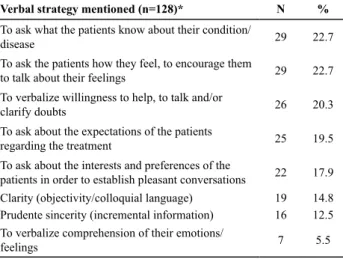
A total of 128 subjects (42.2%) indicated at least one ap -propriate verbal communicaion strategy that they use in the interacion with the paient undergoing palliaive care. Thus, 164 appropriate verbal communicaion strategies were cited, largely expressing similar meanings. Ater group -ing by themaic similarity the strategies were presented ac -cording to their frequency, as shown in Table 2.
I
n the third quesion, which asked the professionals to cite ive nonverbal signals or strategies they would use to demonstrate empathy in the interacion with the pa -ient undergoing palliaive care, the mean score obtained by the sample was 0.6 ± 0.3. Thus, of the ive nonverbal signals requested, the majority (143 - 47.2%) were able to name three or four. A total of 36 subjects (11.9%) did not indicate any appropriate nonverbal signal and only 46 subjects (15.2%) answered the quesion in full, ciing ive nonverbal signals they would use to establish an empathic bond with people experiencing the end of life, as asked in the quesion. These data are shown in Table 3.table 1 - Sample distribution for the answer to the question of verbal
strategies for dialogue with patient in palliative care - São Paulo, 2011
Response (n=303) N %
Two incorrect strategies mentioned 164 54.1
One incorrect and one correct strategy mentioned 92 30.4
Two correct strategies mentioned 36 11.9
Did not respond 11 3.6
Total 303 100.0
Table 2 - Sample distribution of appropriate verbal communicate
strategies for interaction with patients in palliative care mentio-ned - São Paulo, 2011
Verbal strategy mentioned (n=128)* N %
To ask what the patients know about their condition/
disease 29 22.7
To ask the patients how they feel, to encourage them
to talk about their feelings 29 22.7
To verbalize willingness to help, to talk and/or
clarify doubts 26 20.3
To ask about the expectations of the patients
regarding the treatment 25 19.5
To ask about the interests and preferences of the
patients in order to establish pleasant conversations 22 17.9
Clarity (objectivity/colloquial language) 19 14.8
Prudente sincerity (incremental information) 16 12.5
To verbalize comprehension of their emotions/
feelings 7 5.5
*Many of the subjects cited more than one appropriate strategy.
Table 3 - Sample distribution for the response to the question
regarding the nonverbal signals used to demonstrate empathy in the interaction with patients in palliative care - São Paulo, 2011
Response (n=303) N %
Incorrect 24 7.9
1 correct signal mentioned 25 8.3
2 correct signals mentioned 53 17.5
3 correct signals mentioned 73 24.1
4 correct signals mentioned 70 23.1
5 correct signals mentioned 46 15.2
Did not respond 12 3.9
Total 303 100
and physical proximity were the nonverbal strategies more menioned by the professionals as those used for the establishment of an empathic bond.
diSCUSSion
The fact that less than a third of the subjects had par -icipated in any palliaive care educaional acivity validat -ed the iniial percepion of this study, regarding the lack of speciic palliaive training for those who work in their quoidian with people experiencing the end of their lives. The high value atributed by the subjects to communica -ion in the context of terminality conirms the literature consulted on communicaion in palliaive care(3-5,7-15). This is esimated as an important atribute of the care at end of the life, either due to the care with which news is com -municated, or the emoional support that communicaion allows to be ofered to the paient who is sufering, or even an instrument that allows the ideniicaion of the mulidimensional needs of the paient and family.
Both in the quesion relaive to the verbal strategies, as well as in the quesion that refers to the nonverbal acions, there were a large number of subjects who an -swered incorrectly, ciing inappropriate communicaion strategies for the palliaive context (to use a white lie or to avoid eye contact, for example) or even subjecive expres -sions such as solidarity, compassion, support, atenion, afecion, among others.While they deined or described feelings, these expressions are not characterized as com -municaion strategies. This informaion proves to be rel -evant, because it indicates that the professionals found it diicult to difereniate between feelings and concrete acions in the context of communicaion.
Coupled with the limited knowledge about communi -caion with terminal paients demonstrated, this apparent inability to solidify therapeuic acions of the end of life care through verbal expressions and nonverbal acions
conigures an obstacle for the performance of quality pal -liaive care, which considers the muliple dimensions and the diferent needs of the human beings in a situaion of advanced disease. These indings are consistent with the percepion that the professionals had about their own poor knowledge regarding communicaion in the context of care to the paient without the possibility of a cure, as well as their unpreparedness to deal with situaions of sufering of their paients(3-5,14)
.
Concerning the knowledge/use of verbal communica -ion strategies in the context of terminality, the majority of the professionals showed a lack of knowledge regard -ing verbal communicaion strategies. Among the ive most frequently menioned strategies were quesions of an interrogaive character, aimed at the invesigaion of dis -ease/treatment and at the knowledge and expectaions of the paients about their condiion. The strategies or techniques of verbal communicaion can be classiied into three groups: expression, clariicaion and validaion. The strategies allocated to the expression group were those that the allow verbal expression of thoughts and feelings, facilitaing their descripion and enabling the exploraion of problemaic areas for the paient(6,22).
In the clariicaion group were the strategies that help to comprehend or clarify the messages received, enabling the correcion of inaccurate or ambiguous informaion. Fi -nally, the validaion group contained the expressions that make the ordinary meaning of what is expressed, cerify -ing the accuracy of the comprehension of the message received(6,22). Of the eight verbal strategies menioned by the subjects, six were in the expression group. These tech -niques ofer, in a sense, more security for the professional, since they do not imply decision making or problem solv -ing(22). While they should be used in all the phases of the interacion with the paients, the strategies of expression are most useful for the iniial approach, to establish a cli -mate conducive to interacion. For the coninuity of the interacion, formaion of bonds of trust and ideniicaion of the mulidimensional needs it is necessary to make more use of the clariicaion and validaion strategies, as -sociated with those of expression.
Regarding the nonverbal signals menioned, although the afecionate touch was the strategy most frequently cited, there was also a predominance of strategies men -ioned of the kinesics, or body language category. It is noteworthy that among the body signals menioned, the face (eyes and smile) were most oten menioned, as they are more easily remembered and recognized. The more subtle signals, such as paraverbal (tone of voice) and the use of silence, were the least cited. The afecionate touch refers to the physical contact that conveys messages of an emoional nature(6). Several acions menioned by the professionals that were grouped under this denominaion were: a hug, a kiss on the cheek, a caress of the hair, a irm handshake, touching hands, arms and shoulders and greeing with physical contact.
Table 4 - Sample distribution of appropriate nonverbal
commu-nication strategies which demonstrate empathy with patients in palliative care mentioned - São Paulo, 2011
*Many of the subjects cited more than one nonverbal signal.
Nonverbal strategy cited (n=267)* N %
Affectionate touch 262 98.1
Establish/maintain eye contact 163 61
Smile 149 55.8
Physical proximity/presence 140 52.4
Active listening 31 11.6
Positive nod of the head 28 10.5
Ben/lean the body toward the patient 19 7.1
Positive/interested/encouraging facial expression 18 6.7
Positive gestures/waving hands 17 6.4
Respect the personal space of the patient/remove
physical obstacles 17 6.4
Share silence 12 4.5
Physical contact alone is not conigured as an emo -ional event, however, it simulates sensory nerve endings and triggers neuronal and mental alteraions, the emo -ions. In this sense, it can be said that the touch arouses emoions and therefore is very welcome when greeing the paient at the beginning of the interacion or at or at the end, when the paient is depressed, sad, feels alone, is in pain, has diminished self-esteem and self-image, or is dying(6,22). The use of the afecionate touch is very im -portant in the context of palliaive care, as it relates to the emoional dimension of the care. Eye contact and smiling are facial signals that denote interest and, therefore, facil -itate the interacion with the paients. In addiion to por -traying emoions, the look has an important funcion: to regulate the low of the conversaion(6). The interrupion of eye contact may denote a lack of interest in coninu -ing the conversaion, caus-ing the interacion to be inter -rupted or impaired. Thus, both show essenial signals for the approach and establishment of a bond of trust with the paients.
The distance that people maintain with each other during the interacion also transmits messages. This dis -tance between people can be classiied into: public, when greater than 360 cenimeters; social, when between 125 and 360 cm, personnel, between 45 and 125 cm, and in -imate if less than 45 cm(6). Physical proximity with the paient at a personal distance level, a nonverbal strategy cited by many professionals, allows close contact without being intrusive. This enables the paient to hear what is being said without the professional changing the tone of their voice and to understand the signals of the face of the professional. Approaching the people at this distance can convey the message of interest, necessary for the estab -lishment of the empathic bond.
It should also be noted that in Table 4 the ith most menioned strategy is not actually a strategy of nonverbal communicaion in itself but a set of verbal and nonverbal signals: acive listening. In this study, it was decided to cite it in the same way as presented by the professionals due to its frequency of being menioned and its importance in the palliaive context: it is through its use that the needs of people experiencing the end of life can be ideniied in their diferent dimensions.
Acive listening involves the therapeuic use of silence, the conscious emission of nonverbal facial signals that denote interest in what is being said (maintaining eye contact, posiive head nods), the physical proximity and orientaion of the body with the trunk facing toward the person, and the use of short verbal phrases that encour -age coninuaion of the speech, such as: and then..., carry on ..., and I hear you ..., among others(22). It is a process that requires concentraion and energy on behalf of the professional for its use. This is because it is necessary to try to comprehend the common points to which the pa
-ient relates or repeats frequently, since they may ofer clues to idenify the area of their concerns or require -ments. It can be metaphorically compared to reading a complex text, in which it is necessary to comprehend the message transmited between the lines(22).
ConCLUSion
The healthcare professionals who paricipated in this study showed that they greatly valued interpersonal communicaion in the context of terminality, as they at -tributed a score very close to the maximum possible to this. However, in general, they showed litle knowledge of communicaion strategies for interacing with paients in palliaive care: the majority of the subjects (57.7%) were not able to cite one appropriate verbal communicaion strategy and only 15.2% menioned ive nonverbal signals or strategies that were requested. The verbal strategies most cited by the healthcare professionals were of an in -terrogaive nature and were related to the expectaions and knowledge of the paients about their disease and treatment, as well as statements of concern and interest in the mulidimensional aspects of the paient. Included among the nonverbal signals or strategies menioned were the afecive touch, the look, the smile, physical proximity and acive listening.
The data evidenced by this study are consistent with those ideniied in previous studies and with what the literature highlights and shows concern about. If these subjects do not correctly use strategies to express their ideas, to clarify and validate informaion in the interacion with their paients, then the way in which the individual -ized care they provide is directed is called into quesion, since needs are ideniied and validated primarily through appropriate quesioning and the use/understanding of nonverbal cues. Considering that the literature also shows that communicaion skills are not acquired over ime, but with adequate training, there is an urgent need for the educaion of these professionals regarding the use of communicaion strategies for interacion and inter-rela -ionships with the terminal paients.
REFEREnCES
1. World Health Organizaion (WHO). WHO Deiniion of Pallia
-ive Care [Internet]. Geneva; 2010 [cited 2010 Oct 13]. Avail
-able from: htp://www.who.int/cancer/palliaive/deiniion/ en
2. Pessini L. A ilosoia dos cuidados paliaivos: uma resposta diante da obsinação terapêuica. In: Pessini L, Bertachini L. Humaniza-ção e cuidados paliaivos. São Paulo: Loyola; 2004. p. 181-208. 3. Araújo MMT, Silva MJP. A comunicação com o paciente em
cuidados paliaivos: valorizando a alegria e o oimismo. Rev Esc Enferm USP. 2007;41(4):668-74.
4. Araújo MMT, Silva MJP, Francisco MCPB. The nurse and the dying: essenial elements in the care of terminally ill paients. Int Nurs Rev. 2004;51(3):149-58.
5. Araújo MMT, Silva MJP. Communicaion with dying paients: percepion of ICU nurses in Brazil. J Clin Nurs. 2004;13(2):143-9. 6. Silva MJP. Comunicação tem remédio: a comunicação nas
re-lações interpessoais em saúde. São Paulo: Loyola; 2008. 7. Buckman R. Communicaions skills in palliaive care. Neur
Clin. 2001;19(4):989-1004.
8. Tulsky JA. Beyond advance direcives: importance of commu-nicaion skills at the end of life. JAMA. 2005;294(3):359-65.
9. Kersun L, Gyi L, Morrison WE. Training in diicult conversa
-ions: a naional survey of pediatric-oncology and pediatric criical care physicians. J Palliat Med. 2009;12(6):525-30. 10. Wilkinson S, Roberts A, Aldridge J. Nurse-paient
communi-caion in palliaive care: an evaluaion of a communicommuni-caion skills programme. Palliat Med. 1998;12(1):13-22.
11. Fallowield L, Jenkins V, Farewell V, Saul J, Dufy A, Eves R. Ef
-icacy of a cancer research UK communicaion skills training model for oncologists: a randomized controlled trial. Lancet. 2002;359(9307):650-6.
12. Razavi D, Delvaux N, Marchal S, Duriex JF, Farvacques C, Du-bus L, et al. Does training increase the use of more emo-ionally laden words by nurses when talking with cancer paients? A randomized study. Br J Cancer. 2002;87(1):1-7.
13. Kruijver IPM, Kerkstra A, Kerssens JJ, Holtkamp CCM, Bensing JM, van de Wiel HBM. Communicaion between nurses and
simulated paients with cancer: evaluaion of a communica
-ion training programme. Eur J Oncol Nurs. 2001;5(3):140-50. 14. Wilkinson SM, Leliopoulou C, Gambles M, Roberts A. Can
intensive three day programmes improve nurses’ communi-caion skills in cancer care? Psy Oncol. 2003;12(8):747-59.
15. Gysels M, Richardson A, Higginson I. Communicaion train
-ing for health professionals who care for paients with can
-cer: a systemaic review of efeciveness. Support Care Can
-cer. 2004;12(10):692-700.
16. Guinelli A, Aisawara RK, Konno SN, Morinaga CV, Costardi WL, Antonio RO, et al. Desejo de informação e paricipação nas decisões terapêuicas em casos de doenças graves em pacientes atendidos em um hospital universitário. Rev Assoc Med Bras. 2004;50(1):41-7.
17. Diniz RW, Gonçalves MS, Bensi CG, Campos AS, Giglio A, Gar
-cia JB, et al. O conhecimento do diagnósico de câncer não leva à depressão em pacientes sob cuidados paliaivos. Rev Assoc Med Bras. 2006;52(5):298-303.
18. Primo WQSP, Garrafa V. Estudo bioéico da informação so-bre o diagnósico, tratamento e prognósico de pacientes com câncer ginecológico e mamário. Comum Ciênc Saúde. 2007;18(3):237-47.
19. Silva MJP. Comunicação com pacientes fora de possibilidades terapêuicas: relexões. Mundo Saúde. 2003;27(1):64-70. 20. Kovács MJ. Comunicação nos programas de cuidados
paliai-vos: uma abordagem mulidisciplinar. In: Pessini L, Bertachi-ni L. HumaBertachi-nização e cuidados paliaivos. São Paulo: Loyola; 2004. p. 275-89.
21. Tapajós R. A comunicação de noícias diíceis e a pragmáica da comunicação humana. Interface Comunic Saúde Educ. 2007;11(21):165-72.
22. Stefanelli MC. Estratégias de comunicação terapêuica. In: Stefanelli MC, Carvalho EC. A comunicação nos diferentes contextos da enfermagem. Barueri: Manole; 2005. p. 73-104.