Diagnosis of aggressive subtypes of eyelid basal cell carcinoma by
2-mm punch biopsy: prospective and comparative study
Diagnóstico dos subtipos agressivos de carcinoma basocelular palpebral pela
biópsia por trépano de 2mm: estudo prospectivo e comparativo
Luiz AngeLo RossAto1; RAcheL cAmARgo cARneiRo1; eRick mARcet sAntiAgode mAcedo1; PAtRíciA PicciAReLLide LimA1; AhLys Ayumi
miyAzAki1; suzAnA mAtAyoshi, tcBc-sP1.
INTRODUCTION
S
everal benign and malignant tumors can develop in the periocular skin from the epidermis, dermis and at-tachments. The appearance and behavior of the eyelids may be different from the rest of the body, in part by the characteristics of the skin eyelid and its specialized attachments. The first concern is to appropriately rule out malignancy1.About 5 to 10% of all skin cancers occur on the eyelid, which is the main site of neoplasms in the ophthalmological clinical practice. Another important aspect is that the normal peritumoral tissues should be minimally violated to preserve functionality and prevent deformity2.
Basal Cell Carcinoma (BCC) is the most com-mon type of skin cancer, accounting for 75% of malig-nant epithelial tumors and for 90% of cases affecting the eyelids3-14. Some tumor subtypes behave more aggres-sively due to a greater tendency to incomplete excision
and recurrence, and greater chance of local and distance spread8-15. Thus, the diagnosis of aggressiveness becomes important to ensure sufficiently large surgical margins.
Despite having high accuracy for the diagno-sis of malignancy, clinical examination has considerable false negative and false positive rates, also showing a poor correlation between the clinical and histologic type of lesion1,16,17. In the literature, the accuracy of eyelid malignancy clinical diagnosis lies between 65% and 96%18.
The incisional punch biopsy is a quick and sim-ple diagnostic procedure that requires minimal equip-ment and surgical skill. The use of the 2-mm diameter punch makes suture unnecessary, besides providing an appropriate-size tissue and high level of agreement with the traditional incisional biopsy and the final histopatho-logic examination of the specimen12, 13, 19.
The punch incisional biopsy is extremely use-ful in the preoperative evaluation of dermatologic disor-ders19. It is not widely spread in ophthalmology and the
1 - Clinics Hospital, Faculty of Medicine, University of São Paulo (HCFMUSP), Ophthalmology - São Paulo - São Paulo - Brazil A B S T R A C T
Objective: to compare the accuracy of preoperative 2-mm punch biopsy at one site and at two sites in the diagnosis of aggressive subtypes of eyelid basal cell carcinoma (BCC). Methods: we randomly assigned patients to Group 1 (biopsy at one site) and Group 2 (biopsy at two sites). We compared the biopsy results to the gold standard (pathology of the surgical specimen). We calculated the sensitivity, specificity, positive predictive value, negative predictive value, accuracy and Kappa coefficient to determine the level of agreement in both groups.
Results: we analyzed 105 lesions (Group 1: n = 44; Group 2: n = 61). The agreement was 54.5% in Group 1 and 73.8% in Group 2 (p = 0.041). There was no significant difference between the groups regarding the distribution of quantitative and qualitative variables (gender, age, disease duration, tumor larger diameter, area and commitment of margins). Biopsy at two sites was two times more likely to agree with the gold standard than the biopsy of a single site. Conclusions: the accuracy and the performance indicators were better for 2-mm punch biopsy in two sites than in one site for the diagnosis of aggressive subtypes of eyelid BCC.
few studies involving the eyelid area did not fully evalu-ated its effectiveness, mainly for assessment of the lesion histologic subtype12,13.
We expect better accuracy when the diagnosis relies on two biopsy sites. Thus, it would facilitate the planning of surgical margins and patient follow-up, es-pecially in medical services where the intraoperative ap-praisal of surgical margin is not available. The aim of this study was to compare the accuracy of the 2-mm punch preoperative biopsy at one site with the same biopsy in two sites for the diagnosis of aggressive subtypes of eye-lid BCC.
METHODS
We conducted a prospective, randomized, masked study of consecutive patients with suspected ma-lignant eyelid lesions from November 2012 to December 2014, examined in the Oculoplastic sector of the Oph-thalmology Clinics of the Clinics Hospital, Faculty of Med-icine, University of São Paulo (HCFMUSP). The research project was approved by the Ethics Committee for Proj-ects and Research (CAPPesq) of the Faculty of Medicine
of the University de São Paulo (research protocol number 1143/07). All partici-pants signed an informed consent.
We included 105 cases with clinical suspicion of malignancy at biomi-croscopy (changes in texture, color, pig-mentation and size associated with ulcer-ation, raised surface, irregular borders, telangiectasias or loss of cilia) that were later confirmed as BCC by the gold stan-dard (pathological examination of the surgical specimen excised with a safety margin and frozen section analysis). We excluded cases of prior knowledge of di-agnosis, recurrent tumors or lesions with dimensions below 4 mm wide at their largest diameter.
All lesions were previously documented with digital camera (Sony DSC-W125, Sony Corporation, Tokyo, Ja-pan) fixed on a tripod, in optimal quality, and subsequently measured with the aid of software Im-age J 1.44 (National Institute of Mental Health, Bethesda, Maryland , USA) to obtain the larger diameter and area.
We randomly divided patients into two groups (head/tail): Group 1, submitted to 2-mm punch biopsy in a single site of the lesion, in a standardized form, on the tumor most typical site; Group 2, submitted to 2-mm punch biopsy at two sites, diametrically oppose to each other in the lesion larger diameter.
Procedure 1: the same author (LAR) performed all punch biopsies in the Outpatient Surgery Center of HC-FMUSP, following the steps shown in Figure 1.
Procedure 2: within 15 to 60 days, we held the excisional surgery with a safety margin and frozen section analysis. The reconstruction of the defect was performed during the same operation, with the most appropriate technique for each case.
The same pathologist (PPL) performed the pathologic evaluation of all specimens. The histological subtype lesions were identified by their growth pattern observed on hematoxylin-eosin on microscope at 200x, 400x and 1000x (immersion) magnifications, when
ed. We classified tumors according to WHO4. To mixed tumors, we used the predominant and accessory pat-terns. The predominant histological type corresponds to the pattern present in more than 50% of the lesion. His-tological accessories types are the other patterns, found in smaller proportions20.
The BCC subtypes considered aggressive are micronodular, infiltrative, sclerodermiform, basosqua-mous and metatypical, including mixed tumors with ag-gressive component. The non-agag-gressive subtypes are the nodular and superficial BCC4,5,7,8,15,21.
To determine the effectiveness of the 2-mm punch in the diagnosis of BCC subtypes, we evaluated the degree of agreement between the 2-mm punch bi-opsies and the gold standard. We compared the results between patients in both groups and calculated the sensitivity, specificity, positive predictive value, negative predictive value, and accuracy. We performed the Kap-pa agreement analysis. For the quantitative variables (age, duration, larger diameter, tumor area) we used the Mann-Whitney test, and for the qualitative ones (gender, location, involvement or not of eyelid margin), the chi-square or Fisher’s exact tests due to data’s non-adherence
to the normal distribution and/or presence of variances heterogeneity.
We analyzed the concordant results by logistic regression to identify the associated factors. We set the significance level at 5%. We analyzed the data using SPSS (Statistical Package for Social Sciences) version 18.
RESULTS
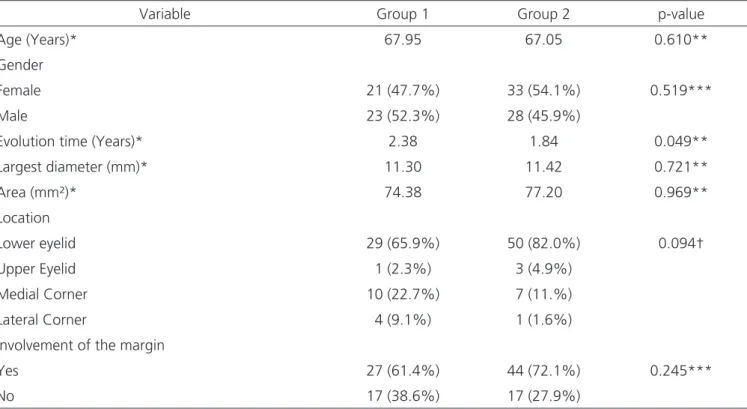
We included 105 BCC cases, 44 in Group 1 and 61 in Group 2. Table 1 shows the characteristics of the two groups and levels of statistical significance (p-value).
For all variables, quantitative and qualitative, the distribution between groups was similar (p-value greater than 0.05), except for the time of disease pro-gression, with p-value of 0.049.
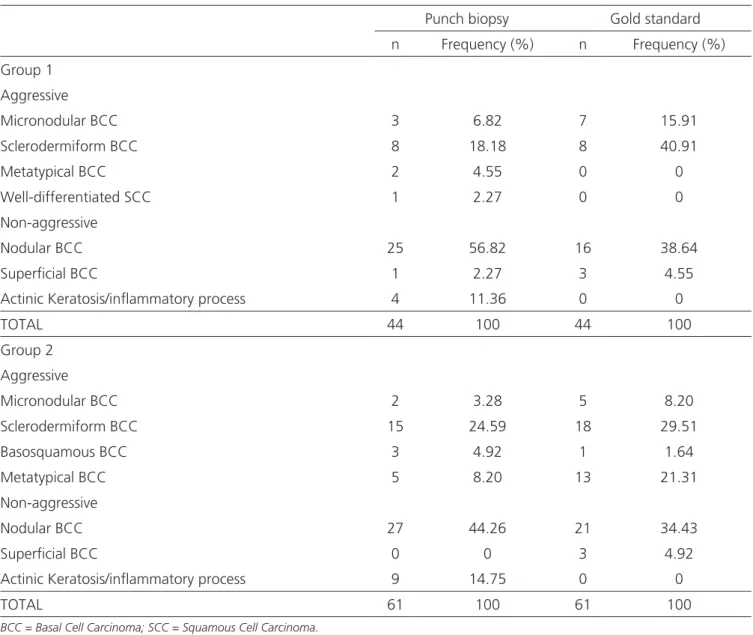
Table 2 compares the results for both punch biopsy and the gold standard in the diagnosis of a BCC aggressive subtype in both groups. The agreement in Group 1 was 54.50%, and in Group 2, 73.80%, with no statistical difference (p-value 0.041) (Table 3). Table 4 shows the performance indicators.
Table 1. Characteristics of patients and tumors in Group 1 (biopsy in one site) and Group 2 (biopsy in two places).
Variable Group 1 Group 2 p-value
Age (Years)* 67.95 67.05 0.610**
Gender
Female 21 (47.7%) 33 (54.1%) 0.519***
Male 23 (52.3%) 28 (45.9%)
Evolution time (Years)* 2.38 1.84 0.049**
Largest diameter (mm)* 11.30 11.42 0.721**
Area (mm²)* 74.38 77.20 0.969**
Location
Lower eyelid 29 (65.9%) 50 (82.0%) 0.094†
Upper Eyelid 1 (2.3%) 3 (4.9%)
Medial Corner 10 (22.7%) 7 (11.%)
Lateral Corner 4 (9.1%) 1 (1.6%)
Involvement of the margin
Yes 27 (61.4%) 44 (72.1%) 0.245***
No 17 (38.6%) 17 (27.9%)
DISCUSSION
Eyelid tumors are the most common in the ophthalmologic practice and the BCC is at least 90% of all case17. It occurs more often in men after the age of 40, in people of light skin and eyes, red hair, with history of prolonged exposure to sunlight and sunburn during childhood and people with Fitzpatrick skin phototypes I, II and III. Family history and immunosuppressive therapy are also risk factors3, 6-8, 22, 23.
The classic clinical aspect of BCC is a rounded papule with pinkish or pearlescent color, elevated areas (usually on the periphery of the lesion), central depression and telangiectasia (Figure 2). The frequency of location
in the eyelid follows, in descending order: lower eyelid, medial corner, upper eyelid and lateral corner.
BCC has different histological subtypes, and their different clinical behaviors are the basis for the World Health Organization (WHO) classification system4. There are four main groups: nodular, micronodular, superficial and infiltrative. The nodular group is divided into solid and adenoid cystic. There are less common subtypes, such as sclerodermiform (or morpheaform - considered by some authors as a variant of infiltrative), basosquamous carci-noma (characterized by squamous atypia associated with greater tendency to recurrence and metastasis), and the metatypical carcinoma (shows cells in a stage between the BCC and a squamous cell carcinoma – SCC)5, 6, 9.
Table 2. Description of the punch biopsy and the gold standard results for the diagnosis of aggressive subtypes of BCC in both groups.
Punch biopsy Gold standard
n Frequency (%) n Frequency (%)
Group 1
Aggressive
Micronodular BCC 3 6.82 7 15.91
Sclerodermiform BCC 8 18.18 8 40.91
Metatypical BCC 2 4.55 0 0
Well-differentiated SCC 1 2.27 0 0
Non-aggressive
Nodular BCC 25 56.82 16 38.64
Superficial BCC 1 2.27 3 4.55
Actinic Keratosis/inflammatory process 4 11.36 0 0
TOTAL 44 100 44 100
Group 2
Aggressive
Micronodular BCC 2 3.28 5 8.20
Sclerodermiform BCC 15 24.59 18 29.51
Basosquamous BCC 3 4.92 1 1.64
Metatypical BCC 5 8.20 13 21.31
Non-aggressive
Nodular BCC 27 44.26 21 34.43
Superficial BCC 0 0 3 4.92
Actinic Keratosis/inflammatory process 9 14.75 0 0
TOTAL 61 100 61 100
The most common subtype is the nodular (66.5%) (Figure 2) followed by the superficial, infiltrative and micronodular. Very commonly, more than one sub-type are found in the same lesion, and the most com-mon association is the nodular and micronodular sub-types36,8,21.
The nodular BCC has a lower tendency of deep local infiltration and recurrence than the others21. The
infiltrative and micronodular subtypes are considered of high risk due to the most aggressive behavior and high tendency to incomplete excision and thus recurrence, especially on the face, where surgical margins are con-servative. The superficial subtype occurs in younger peo-ple19, 20, 24, 25. The non-aggressive subtypes (superficial and nodular) are surrounded by an area of basal membrane containing collagen types IV and V with laminin, which does not happen with the aggressive ones (micronodular, infiltrative, sclerodermiform and metatypical)8,15.
The treatment of eyelid tumors involves a num-ber of factors that may influence their recurrence, such as size, location, associated medical conditions and his-tological type. Tumors that are more aggressive require major surgical margins and, in some cases, pose a risk of metastasis10.
The most effective treatment of BCC is sur-gical excision with margin analysis by frozen section or by Mohs micrographic surgery (MMS). The nodular and
superficial subtypes are most often completely removed (93.6 to 96.4%), while the micronodular, infiltrative and sclerodermiform have higher rates of margins positive for tumor cells (18.6 to 33.3%). Therefore, one should plan wider surgical margins for such subtypes. The recurrence in these cases can reach 39%, while for completely ex-cised tumors, it is about 1%5,21.
It is important to get clear margins and at the same time preserve as much healthy tissue as possible for good aesthetic and functional results, maintaining the protection and lubrication of the eyeball. Aggressive sub-types require wider surgical margins and more stringent postoperative monitoring, while less aggressive lesions can be excised with lower margins or treated medical-ly12,13,19,23,26. Some authors recommend a surgical margin of 2 to 4 mm for primary tumors, and 5 to 10 mm for sclerodermiform and recurrent cases24.
Several methods can be used for the diagnosis, among them the biopsy, which consists of a simple and widely applicable procedure, which provides, through histopathological analysis, relevant information to es-tablish a diagnosis of the lesion. Techniques include the traditional elliptical one, the shaving biopsy, the punch biopsy and the excisional one27.
The punch biopsy was first used by Edward Keyes in 1879. The punch is a hollow circular instrument, made of disposable material or stainless steel, with
bev-Table 4. Performance Indicators of the punch biopsy in the diagnosis of aggressive subtypes of BCC in both groups.
Indicators Group 1 Group 2
Sensitivity 44% (26.67% - 62.93%) 65.79% (49.89% - 78.79%)
Specificity 68.42% (46.01% - 84.64%) 86.96% (67.87% - 95.46%)
PPV 64.71% (41.30% - 82.69%) 89.29% (72.80% - 96.29%)
NPV 48.15% (30.74% - 66.01%) 60.61% (43.68% - 75.32%)
Accuracy 54.55% (40.07% - 68.29%) 73.77% (61.56% - 83.16%)
Kappa 0.118 (0.158 - 0.385) 0.486 (0.248 - 0.723)
PPV = positive predictive value; NPV = negative predictive value.
Table 3. Agreement between the punch biopsy and the gold standard in the diagnosis of aggressive subtypes of BCC in both eyes.
Agreement Total Group 1 Group 2 p-value*
Sim 69 (65.70%) 24 (54.50%) 45 (73.80%) 0.041
Não 36 (34.30%) 20 (45.50%) 16 (26.20%)
eled and tapered end, which can be of various diameters (from 2 to 10 mm), with which one can obtain a lesion fragment containing all of the skin layers27.
Some studies compared the result between the 2-mm punch biopsy and the ellipse or shaving and found no statistical difference11-13,15,19,23,26. There is reported ac-curacy of 80 to 85% for BCC subtypes11,12,26 and there is 94% agreement19 between the 2-mm punch biopsy and the ellipse one. Carneiro et al demonstrated an accura-cy of 90% for malignanaccura-cy with one biopsy site done by 2-mm punch in eyelid lesions23. Of these reports, only three studied eyelid tumors12,13,23.
In our study, we found greater accuracy in the BCC’s aggressiveness diagnosis with 2-mm punch bi-opsy in two places. The agreement for the bibi-opsy per-formed on one site was 54.5%, while for two sites it was 73.80%, with no statistical difference (p-value 0.041). The false negative rate was higher in Group 1 (56% versus 34.21%). Furthermore, in Group 1 the diagnosis of the most commonly found BCC aggressive subtype, the sclerodermiform, was less frequent than in Group 2. In addition, the performance indicators were better for punch biopsy in two sites.
Biopsy should allow the surgeon better surgi-cal planning. Thus, the 2-mm punch biopsy in two sites proved to be more effective than in a single site in the diagnosis of infective lesions of BCC, allowing for better
surgical preparation and a more adequate security mar-gin, to improve cosmetic and functional results for the reconstruction after tumor excision. These are important factors in services where intraoperative frozen section ex-amination or MMS are not available.
The punch biopsy has advantages that facilitate its performance and provides reliability to the result. In the present study, biopsies were performed with a 2-mm punch; thus, the punched area is small and does not re-quire suturing. This facilitates its realization, in short time, with good healing, low incidence of infection and bleed-ing, usually without a significant defect, and increases patient compliance in being submitted to it. It also saves time, surgical equipment and resources, and can be per-formed in an outpatient setting and practice, all import-ant factors in medical services where there is difficulty in the surgical schedule and shortage of material12,19,23.
The main limitation of the 2-mm punch biopsy technique is actually the size of the tissue sample, which can compromise the identification of histological type or subtype. The punch biopsy in two places sought to meet the representativeness of the lesion to include oth-er histological pattoth-erns. Thoth-ere is the possibility of tissue maceration if the manipulation is not adequately per-formed with a sharp punch and delicate forceps. These problems tend to occur mainly in tumors that affect the eyelid margin23.
Besides the presence of more than one tumor subtype in some cases, another factor that may con-tribute to non-agreement between biopsy and surgical specimen is the action of the inflammatory process fol-lowing the first procedure, due to its immune response with lymphocytic infiltrate and apoptosis. Swetter et al showed that 24% of incisional biopsies that were pos-itive for BCC and SCC showed no residual tumor after surgical excision of the lesion14. Holmkvist et al found signs of inflammation and scarring process in sections of MMS in lesions previously submitted to punch and shave biopsy. However, they found no evidence that this process had been responsible for the tumor
erad-ication25. One should carefully select the biopsy site, preventing scabs, cracks, erosions, abrasions and ul-cerations. For tumors from 1 to 4 mm in diameter, one should perform the biopsy in the center of the lesion or excise it completely. For larger sizes, one should select the edge, the more thickened area or the area with the more altered color, since these are the main features of the tumor.
Concluding, the 2-mm punch biopsy in two sites in cases of eyelid BCC allowed greater accuracy in the diagnosis of aggressive subtypes of this tumor when compared to its realization in one site, providing the sur-geon with more appropriate surgical planning.
REFERENCES
1. Kersten RC, Ewing-Chow D, Kulwin DR, Gallon M. Ac-curacy of clinical diagnosis of cutaneous eyelid lesions. Ophthalmology. 1997;104(3):479-84.
2. Hallock GG, Lutz DA. Prospective study of the accu-racy of the surgeon’s diagnosis in 2000 excised skin tumors. Plast Reconstr Surg. 1998;101(5):1255-61. 3. Mantese SAO, Berbert ALCV, Gomides MDA, Rocha
A. Basal cell carcinoma - Analysis of 300 cases ob-served in Uberlândia - MG, Brazil. An Bras Dermatol. 2006;81(2):136-42.
4. Raasch BA, Buettner PG, Garbe C. Basal cell carcino-ma: histological classification and body-site distribu-tion. Br J Dermatol. 2006;155(2):401-7.
5. Rippey JJ. Why classify basal cell carcinomas? Histopa-thology. 1998;32(5):393-8.
6. Miller SJ. Biology of basal cell carcinoma (Part I). J Amn Acad Dermatol. 1991;24(1):1-13.
7. Wong CS, Strange RC, Lear JT. Basal cell carcinoma. BMJ. 2003;327(7418):794-8.
8. Crowson AN. Basal cell carcinoma: biology, morphol-ogy and clinical implications. Mod Pathol. 2006;19 Suppl 2:S127-47.
9. Soysal HG, Soysal E, Markoç F, Ardiç F. Basal cell carcinoma of the eyelids and periorbital region in a Turkish population. Ophthal Plast Reconstr Surg. 2008;24(3):201-6.
10. Bernardini FP. Management of malignant and benign eyelid lesions. Curr Opin Ophthalmol. 2006;17(5):480-4.
11. Haws AL, Rojano R, Tahan SR, Phung TL. Accuracy of biopsy sampling for subtyping basal cell carcino-ma. J Am Acad Dermatol. 2012;66(1):106-11. 12. Rice JC, Zaragoza P, Waheed K, Schofield J, Jones
CA. Efficacy of incisional vs punch biopsy in the his-tological diagnosis of periocular skin tumours. Eye (Lond). 2003;17(4):478-81.
R E S U M O
Objetivo: comparar a acurácia da biópsia pré-operatória por trépano de 2mm em um sítio e em dois sítios no diagnóstico dos subtipos agressivos de carcinoma basocelular (CBC) palpebral. Métodos: os pacientes foram distribuídos aleatoriamente em Grupo 1 (biópsia em um sítio) e Grupo 2 (biópsia em dois sítios). Os resultados das biópsias foram comparados com o padrão-ouro (exame anatomopato-lógico da peça cirúrgica). A sensibilidade, especificidade, valor preditivo positivo, valor preditivo negativo, precisão e coeficiente Kappa foram calculados para determinar o nível de concordância nos dois grupos. Resultados: foram analisadas 105 lesões (Grupo 1: n = 44; Grupo 2: n = 61). A concordância foi de 54,5% no Grupo 1 e 73,8% no Grupo 2 (p-valor = 0,041). Não houve diferença significativa entre os grupos quanto à distribuição das variáveis quantitativas e qualitativas (sexo, idade, duração da doença, maior diâmetro do tu-mor, área e comprometimento de margens). A biópsia em dois sítios mostrou duas vezes mais chance de concordar com o padrão-ouro do que a biópsia de um sítio. Conclusões: a acurácia e os indicadores de desempenho foram melhores para a biópsia por trépano de 2 mm em dois sítios do que em um sítio para o diagnóstico dos subtipos agressivos de CBC palpebral.
13. Chatterjee S, Moore S, Kumar B. Punch biopsy in the management of periocular basal cell carcinomas. Orbit. 2004;23(2):87-92.
14. Swetter SM, Boldrick JC, Pierre P, Wong P, Egbert BM. Effects of biopsy-induced wound healing on re-sidual basal cell and squamous cell carcinomas: rate of tumor regression in excisional specimens. J Cutan Pathol. 2003;30(2):139-46.
15. Mosterd K, Thissen MR, van Marion AM, Nelemans PJ, Lohman BG, Steijlen PM, et al. Correlation between histologic findings on punch biopsy specimens and subsequent excision specimens in recurrent basal cell carcinoma. J Am Acad Dermatol. 2011;64(2):323-7. 16. Margo CE. Eyelid tumors: accuracy of clinical
diag-nosis. Am J Ophthalmol. 1999;128(5):635-6. 17. Deprez M, Uffer S. Clinicopathological features of
eyelid skin tumors. A retrospective study of 5504 cases and review of literature. Am J Dermatopathol. 2009;31(3):256-62.
18. Har-Shai Y, Hai N, Taran A, Mayblum S, Barak A, Tzur E, et al. Sensitivity and positive predictive val-ues of presurgical clinical diagnosis of excised be-nign and malignant skin tumors: a prospective study of 835 lesions in 778 patients. Plast Reconstr Surg. 2001;108(7):1982-9.
19. Todd P, Garioch JJ, Humphreys S, Seywright M, Thomson J, du Vivier AW. Evaluation of the 2-mm punch biopsy in dermatological diagnosis. Clin Exp Dermatol. 1996;21(1):11-3.
20. Messina MCL, Valente NYS, Castro LGM. É a biópsia incisional útil na classificação dos carcinomas bas-ocelulares? An Bras Dermatol. 2006;81(5):443-8. 21. Sexton M, Jones DB, Maloney ME. Histologic pattern
analysis of basal cell carcinoma. Study o f a series of
1039 consecutive neoplasms. J Am Acad Dermatol. 1990;23(6 Pt 1):1118-26.
22. Fitzpatrick TB. The validity and practicality of sun-re-active skin types I through VI. Arch Dermatol. 1988;124(6):869-71.
23. Carneiro RC, de Macedo EM, de Lima PP, Bonatti R, Matayoshi S. Is 2-mm punch biopsy useful in the diagnosis of malignant eyelid tumors? Ophthal Plast Reconstr Surg. 2012;28(4):282-5.
24. Auw-Haedrich C, Frick S, Boehringer D, Mittelvief-haus H. Histologic safety margin in basal cell carci-noma of the eyelid: correlation with recurrence rate. Ophthalmology. 2009;116(4):802-6.
25. Holmkvist KA, Rogers GS, Dahl PR. Incidence of residual basal cell carcinoma in patients who ap-pear tumor free after biopsy. J Am Acad Dermatol. 1999;41(4):600-5.
26. Russell EB, Carrington PR, Smoller BR. Basal cell car-cinoma: a comparison of shave biopsy versus punch biopsy techniques in subtype diagnosis. J Am Acad Dermatol. 1999;41(1):69-71.
27. Blakeman JM. The skin punch biopsy. Can Fam Phy-sician. 1983;29:971-4.
Received in: 29/02/2016
Accepted for publication: 09/06/2016 Conflict of interest: none.
Source of funding: Coordenação de Aperfeiçoamento de Pessoal de Nível Superior (CAPES).
Mailing address:
Luiz Angelo Rossato