Developmental Variation in
Caenorhabditis elegans
Fabien Duveau, Marie-Anne Fe´lix*¤
Institut Jacques Monod, Paris, France
Abstract
Robust biological systems are expected to accumulate cryptic genetic variation that does not affect the system output in standard conditions yet may play an evolutionary role once phenotypically expressed under a strong perturbation. Genetic variation that is cryptic relative to a robust trait may accumulate neutrally as it does not change the phenotype, yet it could also evolve under selection if it affects traits related to fitness in addition to its cryptic effect. Cryptic variation affecting the vulval intercellular signaling network was previously uncovered among wild isolates of Caenorhabditis elegans. Using a quantitative genetic approach, we identify a non-synonymous polymorphism of the previously uncharacterizednath-10
gene that affects the vulval phenotype when the system is sensitized with different mutations, but not in wild-type strains.
nath-10is an essential protein acetyltransferase gene and the homolog of humanNAT10. Thenath-10polymorphism also
presents non-cryptic effects on life history traits. Thenath-10allele carried by the N2 reference strain leads to a subtle increase in the egg laying rate and in the total number of sperm, a trait affecting the trade-off between fertility and minimal generation time in hermaphrodite individuals. We show that this allele appeared during early laboratory culture of N2, which allowed us to test whether it may have evolved under selection in this novel environment. The derived allele indeed strongly outcompetes the ancestral allele in laboratory conditions. In conclusion, we identified the molecular nature of a cryptic genetic variation and characterized its evolutionary history. These results show that cryptic genetic variation does not necessarily accumulate neutrally at the whole-organism level, but may evolve through selection for pleiotropic effects that alter fitness. In addition, cultivation in the laboratory has led to adaptive evolution of the reference strain N2 to the laboratory environment, which may modify other phenotypes of interest.
Citation:Duveau F, Fe´lix M-A (2012) Role of Pleiotropy in the Evolution of a Cryptic Developmental Variation inCaenorhabditis elegans. PLoS Biol 10(1): e1001230. doi:10.1371/journal.pbio.1001230
Academic Editor:Mohamed A. F. Noor, Duke University, United States of America ReceivedJune 3, 2011;AcceptedNovember 18, 2011;PublishedJanuary 3, 2012
Copyright:ß2012 Duveau, Felix. This is an open-access article distributed under the terms of the Creative Commons Attribution License, which permits unrestricted use, distribution, and reproduction in any medium, provided the original author and source are credited.
Funding:FD was supported by PhD fellowships from the Ministe`re de l’Enseignement Supe´rieur et de la Recherche and the Association pour la Recherche sur le Cancer. MAF was successively a Principal Investigator at CNRS and a Professor at Ecole Normale Supe´rieure. This work was financed by grants from the Association pour la Recherche sur le Cancer (#1044) and the Agence Nationale de la Recherche (08-BLAN-0024) to MAF. The funders had no role in study design, data collection and analysis, decision to publish, or preparation of the manuscript.
Competing Interests:The authors have declared that no competing interests exist.
Abbreviations:GLM, generalized linear model; GxE, genotype-by-environment; GxG, genotype-by-genotype; NILs, near-isogenic lines; QTL, quantitative trait locus; RILs, Recombinant Inbred Lines
* E-mail: [email protected]
¤ Current address: Institute of Biology of Ecole Normale Supe´rieure, Paris, France
Introduction
Many developmental systems produce outputs that are insensitive to a wide range of environmental or genetic perturbations. In these robust systems, buffering may allow for the accumulation of ‘‘cryptic’’ genetic variation affecting the system without changing its end product [1–3]. Upon major environmental or genetic change, genetic variation that was previously cryptic may then become phenotypically expressed and play a role in the evolution of the system [2,3]. Cryptic variation thus refers to standing genetic variation that is epistatically masked and conditionally neutral: it is not expressed in most conditions, but it can be revealed based on genotype-by-genotype (GxG) interactions with loci involved in the development of the trait or through genotype-by-environment (GxE) interactions, as in the classical experiments by Waddington [4,5]. Beyond the interest for evolutionary biology, studying this kind of genetic variation is also important to understand the elevated incidence of complex human diseases in modern societies, a phenomenon that could result from the phenotypic expression of
cryptic variation in response to the marked change of lifestyle that occurred in the last generations [6].
Two different hypotheses could explain the evolutionary origin of cryptic genetic variation. It may accumulate neutrally because it has little or no effect on traits evolving under selection. Alternatively, a mutation that presents a cryptic effect in a robust system could be under directional selection for its non-cryptic pleiotropic effect on another more sensitive trait. Molecular identification of factors involved in cryptic variation is required to understand the causes and consequences of such variation. Although the empirical study of cryptic genetic variation is limited by the difficulty in detecting it, it has been uncovered in several species after application of a perturbation, either genetic or environmental, to different wild genotypes [7–17]. However, in only few cases were the underlying polymorphisms precisely mapped [18] and candidate polymor-phisms confirmed [19].
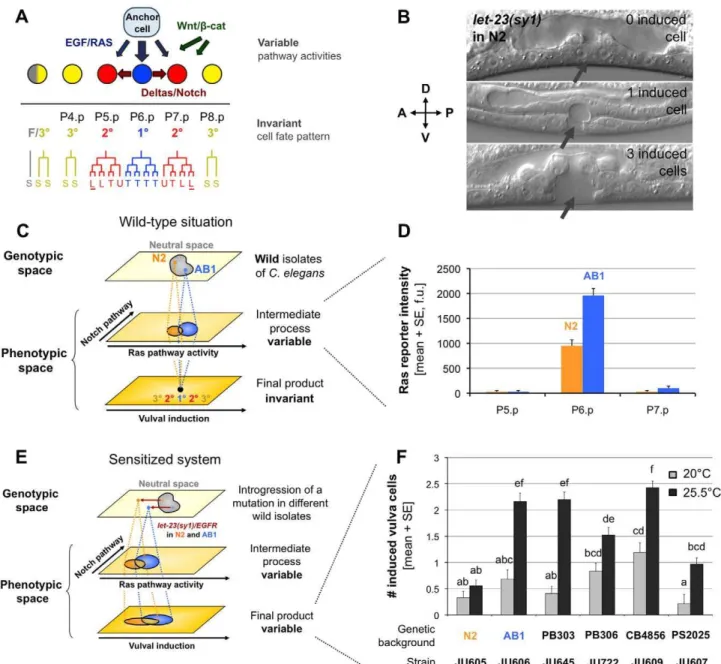
nematode Caenorhabditis elegans[10]. The vulva is the egg laying and copulatory organ of C. eleganshermaphrodites. It is formed during larval stages from a row of six competent cells in the ventral epidermis (P3.p to P8.p). Only three of these cells (P5.p to P7.p) adopt vulval fates in wild-type animals. P6.p adopts an inner 1u vulval fate, while P5.p and P7.p adopt a lateral 2uvulval fate. After fate specification, each precursor cell follows a specific division pattern during the L3 and L4 stages (Figure 1A). Wild-type vulval cell fate patterning (3u3u2u1u2u3u) relies on the spatio-temporal regulation of a signaling network including the EGF/Ras, Delta/ Notch, and Wnt/bcat pathways (Figure 1A) [20]. During the L2 stage, the uterine anchor cell, which is located close to P6.p, starts to emit an inductive LIN-3/EGF signal that can act as a morphogen: the high dose received by P6.p leads to the 1u fate, whereas lower doses received by P5.p and P7.p contribute to their adoption of the 2ufate [21]. Ras/MAP kinase pathway activation in P6.p also promotes the 2u fate in P5.p and P7.p through a lateral Delta/Notch pathway [20]. P3.p, P4.p, and P8.p normally adopt a non-vulval fate, but are able to adopt a vulval fate if P5.p, P6.p, or P7.p are missing. The Wnt/bcat pathway acts at several steps in the process, participating in cell competence, induction, and lineage polarity [22].
The vulval cell fate patterning system displays robustness to both environmental and genetic perturbations, which likely arises from properties of the signaling network creating a non-linear relationship between the activity of individual pathways and the resulting number of induced vulval cells [23]. The cell fate pattern of P4.p to P8.p is quasi-invariant in theCaenorhabditisgenus and few variants were detected inC. elegansindividuals raised in various environments, despite change in signaling pathway activity [24]. In addition, a recent computational model was able to reproduce the wild-type vulval cell fate pattern over a broad range of parameter values [25]. As expected in a system with a robust output, the underlying developmental mechanisms have evolved at the interspecific and intraspecific levels (Figure 1C). Indeed, quantitative variation in a downstream fluorescent reporter of the EGF/Ras pathway was detected among C. elegans wild isolates despite no change in the resulting cell fates (Figure 1D) [10].
Furthermore, the type and frequency of vulval fate errors following a variety of environmental, genetic, or experimental perturbations differ among Caenorhabditis species and C. elegans wild isolates (Figure 1E–F) [10,24,26–28]. Due to the broad knowledge of the developmental network, the small number of cells involved and the ease of genetic studies inC. elegans, vulval cell fate patterning is an ideal model to investigate the evolutionary origin and conse-quences of cryptic variation.
One of the genetic perturbations used to reveal cryptic variation among C. elegans wild isolates was the let-23(sy1)/egfr allele (Figure 1B) [10]. This EMS-induced mutation alters EGF receptor localization in vulval precursor cells and leads to a decrease in the mean number of cells adopting a vulval fate [29,30], as well as an increase in the among-individual variation due to a shift of the system outside its buffered range. The expressivity of let-23(sy1) varies among wild genetic backgrounds of C. elegans, revealing cryptic variation among them [10]. Especially,let-23(sy1) expres-sivity, as quantified by the mean number of cells adopting a vulval fate (vulval index), is much less pronounced in the AB1 wild background than in the N2 reference background in which this mutation was isolated (Figure 1F) [10]. In this case, the effect of the cryptic variation is thus revealed through an epistatic interaction between the laboratory allele at the let-23 locus and the wild genetic background.
Here, we use a quantitative genetic approach to characterize the genetic architecture of variation inlet-23(sy1)expressivity between these wild genetic backgrounds and identify underlying molecular polymorphisms. We find that a non-synonymous polymorphism in the nath-10 gene explains a major effect quantitative trait locus (QTL).nath-10is the human N-acetyltransferase 10 homolog and its function is largely unknown inC. elegans. We show that the nath-10(N2)allele likely appeared during early laboratory culture of the N2 strain and that in addition to its cryptic effect in the vulval system, this allele presents non-cryptic effects on life history traits such as progeny number, minimal generation time, or egg-production rate. Some of the effects of thenath-10polymorphism are likely mediated through alterations in the timing of the sperm/oocyte switch in hermaphrodites. Finally, competition assays show a clear selective advantage of the N2 allele in laboratory conditions. We thus identify a pleiotropic polymorphism that shows a cryptic effect in the vulval system and a strong selective advantage in the laboratory environment due to its effect on life history traits. Therefore, because of pleiotropic effects, some cryptic genetic variation need not accumulate neutrally during the evolution of robust systems.
Results
Temperature Sensitivity of the Intraspecific Variation Uncovered by thelet-23(sy1)/egfr Mutation
As previously observed [10], the expressivity of vulval induction defects of alet-23(sy1)/egfrmutation was much higher in the JU605 strain (N2 background) than in the JU606 strain (AB1 background) (Figure 1E, Table S3). We express this phenotype as a vulval index, corresponding to the mean number of Pn.p cells induced to adopt a vulval fate in different individuals of a given strain.
We repeatedly observed that the vulval index of the JU606 isogenic strain could significantly vary among cultures grown at 20uC and scored in parallel (Figure S1). Therefore, we searched for culture conditions in which the vulval phenotype of JU606 would be less variable. We found that the vulval index of JU606 was consistently increased at 25.5uC (but not at 24uC) compared to 20uC, whereas the vulval index of JU605 was not affected (Figure 1F, Figure S1). We therefore used this culture temperature to map the genetic variation involved in the phenotypic difference.
Author Summary
Robustness is a property of biological systems that ensures the production of reproducible phenotypes in spite of underlying environmental, stochastic, and genetic variabil-ity. A consequence of robustness is that potentially functional genetic variation is free to accumulate in natural populations because it is buffered at the phenotypic level. Even if this so-called ‘‘cryptic’’ genetic variation has no obvious effects under standard conditions, it may become phenotypically expressed upon major genetic or environ-mental perturbations. Here we used the model organism
Caenorhabditis elegans to identify genetic variations
Figure 1. Cryptic variation inC. elegansvulval cell fate patterning.(A) Patterning of vulval cell fates inC. elegansthrough an intercellular signaling network. After induction, each cell divides with a characteristic division pattern. Letters indicate the orientation of the last division as follows: T, transverse (left-right); L, longitudinal (anteroposterior); U, undivided. Cells attached to the cuticle are underlined. (S) corresponds to a fusion with the hypodermal syncytium cell hyp7, which is a non-vulval fate. (B) Variable vulval expressivity of thelet-23(sy1)/egfrsensitizing mutation in the N2 genetic background, observed under Nomarski optics at the L4 stage. The number of induced vulval precursor cells is inferred from their progeny number and morphology in the L4 stage. The expressivity of the mutation differs among genetically identical individuals. The gray arrows point to the expected position of the vulva. (C) Schematic representation of cryptic variation. Genetic variation between wild genotypes leads to variation in intermediate developmental processes such as signaling pathway activities, while the final system output (here vulval cell fates) remains invariant. (D) For instance, the level of expression of the Ras pathway reporteregl-17::cfpin P6.p during vulval induction (L3 stage) is about twice lower in the N2 reference strain compared to the AB1 wild isolate [10], yet for both strains the resulting number of induced vulval cells is 3. (E) Cryptic variation is uncovered by sensitizing the system with a mutation. Thelet-23(sy1)/egfrmutation shifts the system outside the buffered region of genotypic space (neutral space). The initially silent difference between N2 and AB1 is now phenotypically expressed at the level of the final product. (F) Expressivity of vulval defects of let-23(sy1)/egfr as a function of wild genetic background and temperature. In particular, the N2 genetic background leads to a lower vulval induction index compared to the AB1 background when the system is sensitized, which might be explained by the difference of Ras pathway activity observed in (C). A two-way Scheirer-Ray-Hare extension of the Kruskal-Wallis test detected significant effects of strainand temperatureon the number of induced vulval cells (strain: F= 15.91, p= 0.0005;temperature: F= 63.69, p,0.0001). The genotype-by-environment interaction was not significant in this overall analysis (strain6temperature:F= 1.21,p= 0.3386). All pairwise comparisons were performed using Mann-Whitney-Wilcoxon rank sum tests with Holm-Bonferroni method to correct for multiple comparisons. Two bars are significantly different (p,0.05) if they are not labeled with a same letter. Error bars indicate the standard error of the mean (SE) over individuals (n= 30–72).
Genetic Architecture of the Cryptic Variation
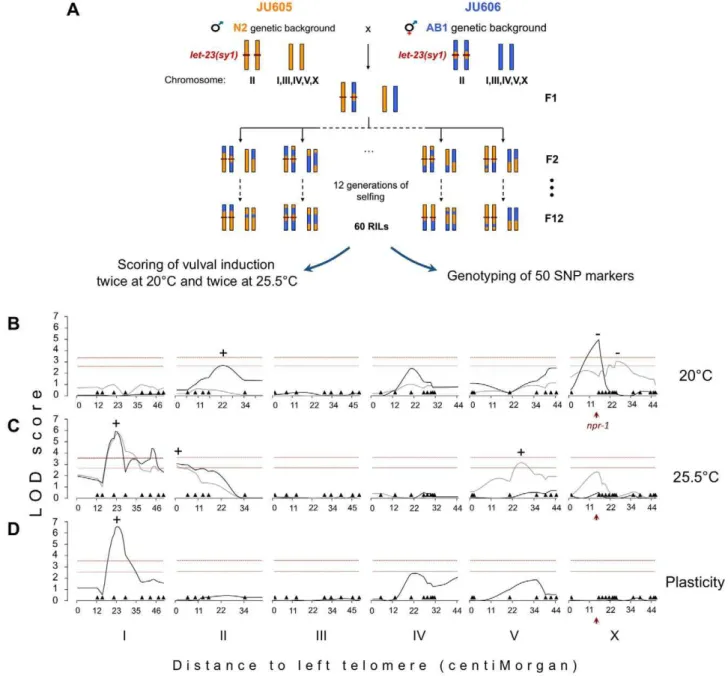
In order to characterize the genetic architecture underlying the variation in vulval index between JU605 and JU606, we constructed a set of 60 Recombinant Inbred Lines (RILs) from a cross between the two strains. The RILs were genotyped for 50 N2/AB1 SNP markers distributed along the genome (Table S1). The vulval index of all lines was scored twice at both 20uC and 25.5uC (Figure 2A; Table S1). Statistical analyses were performed to detect quantitative trait loci (QTL), which are genomic regions
significantly associated with phenotypic variation. Two QTLs were detected at 20uC (Figure 2B), but their effect was not reproducible between the two replicates, probably due to the high vulval index variability at this temperature (Figure S1). By contrast, two QTLs were reproducibly found on chromosomes I and II at 25.5uC (Figure 2C). The QTL on chromosome I was estimated to explain about 27% to 34% of the phenotypic variance, while the effect of the chromosome II QTL was only about 3.6% to 4.6% (Multiple Interval Mapping, unpublished
Figure 2. Genetic architecture of the cryptic variation uncovered bylet-23(sy1)/egfrin the N2 and AB1 backgrounds.(A) Recombinant inbred lines (RILs) construction scheme. Examples of possible strain genotypes are schematized, with the N2 genetic background colored in orange, AB1 in blue, and thelet-23(sy1)mutation as a red line. (B–D) Logarithm of odds (LOD) plots showing composite interval mapping of vulval index in RILs grown at (B) 20uC or (C) 25.5uC and for (D) the plasticity of vulval index to temperature. The gray and black curves represent two replicates of phenotypic scoring. In the plasticity mapping, a single replicate (dark gray) was used, for which vulval index scoring was performed in parallel at both temperatures. The plasticity measure was obtained by substracting for each RIL the vulval index at 25.5uC to that at 20uC. (B–D) Dark triangles show marker positions along the chromosomes. Horizontal dashed lines indicate the 1% (top) and 5% (bottom) significance thresholds computed by multiple permutations. (+) and (2) represent the direction of QTL effect. (+) means that AB1 alleles at QTL lead to higher trait value than N2 alleles and (2) the reverse. The red arrowhead points to the position ofnpr-1gene.
data). Another QTL was observed in one replicate on chromo-some V at this temperature, but was not reproducible (Figure 2C). AB1 alleles at these QTLs all led to higher vulval index than N2 alleles (positive effect QTL). Finally, a QTL with strong negative effect was detected in one replicate at 20uC. This negative effect QTL could contribute to the transgressive phenotype of some RILs that presented a more extreme vulval induction index than either parental strain (Table S1). The npr-1 polymorphism [31] was a candidate to explain this putative QTL because it was previously identified in QTL analyses of various traits [32–36]. In support of this hypothesis, strains carrying the N2 allele ofnpr-1in the N2 background presented a higher vulval index at 25.5uC than strains with the AB1 allele npr-1(g320) introgressed in the N2 background (Figure S2). This effect seemed sensitive to environ-mental conditions because it was not always observed in replicate experiments at 20uC or at 25.5uC (unpublished data and Figures 2B–C, S2).
In order to characterize the genetic basis of the phenotypic plasticity to temperature, an additional QTL analysis was performed using as trait value for each RIL the difference in vulval induction index between 25.5uC and 20uC (Figure 2D). The only QTL that was detected in this analysis corresponded to the major effect QTL detected on chromosome I at 25.5uC, which was absent in the 20uC analyses. This plastic effect corresponds to a genotype-by-environment interaction (GxE) since the effect of the QTL allele on vulval induction depends on temperature.
Together, these results showed that the genetic architecture of the phenotypic variation observed between JU605 and JU606 was temperature-sensitive and involved more than one locus. No significant epistatic interactions were detected between single-effect QTLs (multiple interval mapping, unpublished data).
Cryptic Effect ofnath-10 Polymorphism on Vulval Induction
Since the QTL detected at 25.5uC on chromosome I was involved in a major fraction of the phenotypic variation, we next sought to identify the underlying causative molecular polymor-phism(s). Several lines were selected for a recombination event in the chromosome I QTL region after crosses of the RILs with highest vulval index to JU605 (let-23(sy1) in N2). After SNP genotyping and scoring of vulval index in these lines (Table S2), the QTL was restricted to a 183 kb region (Figure 3A; Table S3). The alignment of the N2 reference genome (www.wormbase.org) to the genome of the AB1 strain (Illumina sequencing [L. Stein et al., personal communication] followed by Sanger sequencing of non-covered regions) revealed the presence of only three polymorphisms in the QTL region. Two of them lie in intergenic regions (mfP14andhaw6786) and the third one (haw6805) affects the coding sequence of a gene with unknown function,F55A12.8, which was renamed nath-10 for its homology with the human NAT10gene (N-acetyltransferase 10). We performed several exper-iments that test whether the nath-10polymorphism explains the chromosome I QTL effect.
First, RNAi inactivation ofnath-10in lines carrying either the nath-10(N2) or the nath-10(haw6805) allele decreased the vulval index (Figure 3B). This suggested that nath-10 acts as a positive regulator of vulval induction and that nath-10(N2)is a hypomor-phic allele compared tonath-10(haw6805). In addition, the effect of nath-10(N2)on vulval induction was found to be recessive to that of nath-10(haw6805)(Figure S3A). The vulval index still differed after nath-10(RNAi) between the JU605 (nath-10(N2)) and the JU1624 (nath-10(haw6805)) strains (Figure 3B), which may be explained by a partial inactivation of nath-10 by the RNAi treatment or by parental effects; alternatively, another polymorphism in the
introgressed AB1 region of JU1624 could affect vulval induction. Heterozygous animals carrying thenath-10(N2)allele over the null mutation nath-10(tm2624) presented a decreased vulval index compared to JU605 (Figure S3B). However, it is not clear whether this was due to thetm2624deletion or to the translocation used to balance this embryonic lethal mutation (Figure S3B).
In order to confirm the role ofnath-10in vulval induction, we also overexpressed the gene using transgenesis. Overexpression of eithernath-10(haw6805)ornath-10(N2)alleles increased the vulval index in the JU605 strain but not in the JU1620 (nath-10(haw6805)) strain (Figure 3C). These results indicate that both alleles are functional, consistent withnath-10(N2)being a hypomorph and not a null allele. A possible explanation for the absence of effect of nath-10overexpression in the JU1620 strain background may be that the endogenousnath-10(haw6805)activity is already saturat-ing. Alternatively,nath-10 overexpression may have weak effects due to the low concentration ofnath-10 genomic DNA used to avoid the lethality observed at higher concentrations. This may also explain whynath-10(haw6805)overexpression does not rescue vulval induction in JU605 to the level observed in JU1620 (Figure 3C).
A third experiment was performed to test whether the two other polymorphisms in the QTL region (Table S2) could be ruled out. Thenath-10polymorphism was the only variation with N2 found to be shared by the LSJ1 and AB1 strains in the QTL region (LSJ1 is a strain closely related to N2, as described below) [37,38]. The nath-10(haw6805) allele was thus introgressed into JU605 ( let-23(sy1)in N2) from the LSJ1 genetic background. Irrespective of their genetic background origin, strains homozygous for nath-10(haw6805) always presented a higher induction index than strains homozygous fornath-10(N2)at 25.5uC (Figures 3D, S5B). Therefore, the QTL effect is very probably due to the nath-10 polymorphism and not to other polymorphisms in the QTL region.
From the three experiments above, we conclude that nath-10(haw6805) is the causative chromosome I polymorphism that explains a large part of the difference in expressivity of the let-23(sy1)allele between the N2 and AB1 genetic backgrounds. The increase in vulval index conferred by thenath-10(haw6805)allele represented 53%64% of the total difference observed between the JU605 and JU606 parental strains.
Effect ofnath-10Polymorphism on the Expressivity of a let-60(gf)Mutation
Thenath-10polymorphism does not affect vulval cell fates in a wild-type context (no defect observed in N2 and AB1 individuals grown at 25.5uC,n= 100). We wondered whether its effect on let-23(sy1) expressivity was specific to the sensitizing mutation. To address this point, a gain-of-function mutation in Ras, let-60(n1046)/ras, was crossed in the N2 background with the introgressed segmentmfIR16 bearing thenath-10(haw6805) allele from AB1.let-60(n1046gf)led to vulval fate hyperinduction (more than 3 induced Pn.p cells), and the vulval index was higher in lines carrying thenath-10(haw6805)allele (Figure 4), as was the case for let-23(sy1). Therefore, the effect of thenath-10polymorphism can be uncovered with different sensitizing factors and is not specific to the mutation initially used to identify it.
Thenath-10Polymorphism Affects the Peptide Sequence of theC. elegansHomolog of Human N-Acetyltransferase 10
homolog NAT10 indicates a 57.3% conservation at the amino-acid level (Figure 5A). In human, the NAT10 protein regulates different cellular processes such as cytokinesis, mitotic chromosome decon-densation, or telomerase expression and it can acetylate different substrates such as histones anda-tubulin [39–42]. InC. elegans,
nath-10was recently identified in a RNAi screen for abnormal expression of sex-specific gonadal markers [43], but its function has not been further investigated. The recessivenath-10(tm2624)deletion, which results in a truncated protein of 394 amino-acids, leads to fully penetrant embryonic lethality. The N2 protein presents an
Figure 3. A polymorphism in thenath-10gene explains the largest effect QTL.(A) Fine-mapping of the QTL to a 183 kb region (gray rectangle). Chromosome I genotypes of five near-isogenic lines (NILs) at SNP markers (triangles) are represented. Orange triangles, N2 alleles; blue, AB1. Their vulval index at 25.5uC is indicated below. Genetic distances are represented to scale along full black lines, but not outside. The vulval index is significantly lower in JU1613 compared to the other NILs (Mann-Whitney-Wilcoxon rank sum tests,p,1024,n= 30–42). (B) RNAi againstnath-10. The significance of pairwise Mann-Whitney-Wilcoxon rank sum tests comparing thenath-10RNAi versus control bacteria is represented above each pair of bars (n= 51–64). Combinedpvalues of replicates using Fisher’s method is indicated above. (C) Overexpression of N2 and AB1nath-10alleles. Worms that spontaneously lost the transgene (gray) were compared to sibling worms that retained it (red). Black bars represent non-injected strains. Two replicates were scored per injected strain and allele (n= 36–45). Pairwise comparisons using Mann-Whitney-Wilcoxon rank sum tests were only significant in one case. However, combining the results using Fisher’s method (top) showed a significant effect of each allele when injected into JU605, but not into JU1620. (D) Introgression of thenath-10allele from LSJ1 into N2. The vulval index of JU606, JU1610, and JU2000 was compared to N2 in two replicate experiments using Mann-Whitney-Wilcoxon rank sum tests. (B–D) Vulval phenotypes were scored in animals grown at 25.5uC. ns, non-significant, * 0.01,p,0.05, ***p,0.001. Strain genotypes are schematized below the graphs, with orange for N2 and blue for AB1 background. Orange and blue horizontal lines on chromosome I representnath-10alleles and the red line on chromosome IIlet-23(sy1). Only one chromosome copy is shown (the strains are rendered homozygous through selfing).
isoleucine residue at position 746 instead of the methionine found in the AB1 protein or in the human alignment at the corresponding position (Figure 5B). This non-synonymous polymorphism affects a conserved region, which corresponds to the acetyltransferase domain in the human counterpart (Figure 5A).
A protein with acetyltransferase activity could act at different levels of the vulval signaling network to regulate cell fate induction. For instance, mys-1 and hda-1, which encode a MYST family histone acetyltransferase and a class I histone deacetylase, respectively, can both act as class B SynMuv genes to repress vulval induction [44–46]. Single mutations of SynMuv genes do not affect vulval fate patterning, whereas the combination of two mutations belonging to different SynMuv classes result in a Synthetic Multivulva phenotype. Remarkably, several SynMuv B null mutants respond to temperature in a similar way as nath-10(haw6805)animals: they present a different phenotype at 24uC compared to 25–26uC [47,48]. For these reasons, we tested whether the combination of the nath-10(haw6805) allele with a SynMuv mutation of either class led to excess vulval induction. The nath-10(haw6805); lin-15A(n767) and nath-10(haw6805); lin-15B(n744) lines did not present a Multivulva phenotype (Table S4), suggesting thatnath-10does not act as a SynMuv gene.
Thenath-10(N2)Allele Appeared During Laboratory Domestication of the N2 Reference Strain
To study the evolutionary history of thenath-10polymorphism, we determined the allelic distribution in a set ofC. elegansnatural isolates and related species (Figure 5C, Table S5). The N2 allele was only found in two other strains, CB4555 and TR389, which were likely derived by contamination from the N2 lab reference strain [49]. The AB1 allele was found in all otherC. elegansisolates and conserved in other nematode species, fly, human, or yeast. Thus,nath-10(N2)is a derived allele relative to the ancestralnath-10(haw6805)allele.
The observed polymorphism distribution raised the possibility that the nath-10(N2) allele did not appear in the wild. This hypothesis was confirmed by the presence ofnath-10(haw6805)in the LSJ1 laboratory strain, which is likely derived from the same Bristol wild isolate as N2 [34,37,38]. The so-called ‘‘N2 (ancestral)’’ strain (CGC), which is only about six generations away from the earliest frozen stock of N2, presents thenath-10(N2) allele (Table S5). Thenath-10(N2)allele thus most probably arose in a period spanning the initial separation of the N2 and LSJ1 strains in the Dougherty lab at UC Berkeley (between 1957 and 1960) to the first freezing of N2 in Sydney Brenner’s laboratory around 1968.
Non-Cryptic Effects of thenath-10 Polymorphism on Life History Traits
With the aim of understanding the evolutionary factors underlying the fixation of thenath-10(N2)allele in the N2 strain, we enquired whether other traits were affected by the nath-10 polymorphism in the absence of the let-23(sy1) sensitizing mutation. We focused on life history traits that were known to vary among wild isolates and were likely to affect individual fitness, such as the environmental regulation of dauer diapause entry, lifetime fecundity, minimal generation time, or egg laying rate. We observed that the frequency of dauer formation at 27uC [50] was much higher in AB1 than in N2. However, two lines carrying the nath-10(haw6805)allele introgressed into the N2 background did not display any phenotypic difference for this trait compared to N2 (Table S6). Therefore, the dauer entry variation between N2 and AB1 is not caused by thenath-10polymorphism.
In contrast to dauer formation, the nath-10 polymorphism resulted in variation in three key traits related to population growth: age at maturity, brood size, and egg laying speed (Figure 6A–C). These traits were measured in parallel in N2, AB1, and near isogenic lines with the nath-10(haw6805) allele introgressed from the AB1 background into the N2 background (JU2003, JU1648, and JU1961) or from the LSJ1 background into the N2 background (JU2002). The introgressions were performed from these two genetic backgrounds to ensure that any phenotypic difference with N2 could be attributed tonath-10polymorphism and not to other polymorphisms in the introgressed regions (Table S2). N2 presented a significantly higher age at maturity (Figure 6A), brood size (Figure 6B), and maximal egg laying rate (Figure 6C) compared to AB1. For all three traits, a significant, albeit sometimes lower difference with N2 was also observed in the introgressednath-10(haw6805)lines. These results strongly suggest that in addition to its cryptic role on vulval induction, thenath-10 polymorphism also affects some life history traits non-cryptically. A simple hypothesis to explain nath-10 effects on lifetime fecundity and age at maturity was that both resulted from the regulation of spermatogenesis duration in young hermaphrodite adults (Figure 7A). InC. eleganshermaphrodites, spermatogenesis occurs between the late L4 and early adult stage and is followed by an irreversible switch to oogenesis. The number of sperm approximates the total number of progeny in the absence of mating with males, and is a limiting factor for lifetime fecundity. Therefore, a longer spermatogenesis leads both to an increased number of self-progeny and to a delayed oogenesis onset, creating a trade-off between brood size and age at maturity [51,52]. In order to test whether thenath-10polymorphism affected the timing of the sperm-oocyte switch, we compared the number of sperm produced in N2 to that of an introgressednath-10(haw6805)line. N2 did generate about 10% more sperm than the JU2002 introgressed line (Figure 7B), consistent with the observed difference in brood size and an effect on sperm-oocyte switch
Figure 4. Effect of the QTL on expressivity oflet-60(n1046)/ras.
The bar shades represent four independent replicates. Mann-Whitney-Wilcoxon rank sum tests followed by Holm-Bonferroni correction for multiple testing were used to test for significant differences of strains carrying the AB1 QTL allele (JU473 or JU1756) with the strain carrying the N2 allele (JU601). ns, non-significant; ** p,0.01, *** p,0.001 (n= 21–46). Stars above dotted lines represent the combination of the p values obtained for the four replicates using Fisher’s method. Genotypes are schematized as in Figure 3, except that green lines indicatelet-60(n1046).
(Figure 6B). In addition,nath-10(RNAi)applied to adult hermaph-rodites led to complete sterility of all progeny and to an absence of oocytes at high penetrance (Figure S4A–D), confirming a role of nath-10 in germ line development. In these animals, sperm cells were often spread throughout the proximal gonad as visualized by DAPI staining, probably because of the absence of oocytes normally pushing them into the spermatheca (Figure 7C–D, Figure S4C–D). We thus conclude that the mutation to the nath-10(N2) allele resulted in an increase in sperm number in the laboratory N2 strain, which displays a larger brood size than most wild isolates [53].
Selective Advantage of thenath-10(N2)Allele in Competition Assays
The above results strongly suggested that thenath-10 polymor-phism could affect fitness. The fact that the N2 allele appeared in the laboratory gave us the unique opportunity to test whether it could contribute to the adaptation of the N2 strain to its environment. Indeed, the specific environment where this genetic variation arose is better known, controlled, and reproducible than natural habitats. Therefore, we were able to perform competition
experiments between strains carrying different alleles ofnath-10in culture conditions resembling those when the derivednath-10(N2) allele first appeared.
N2 was competed for several generations against JU1648 (mfIR16[nath-10(haw6805)]) on 6 cm diameter culture plates in two different growth conditions, namely continuous growth or alternation of growth and starvation (40 replicates per treatment). Starting at 50%, the frequency of nath-10(haw6805) individuals decreased across generations in both culture conditions (Figure 8). Indeed, after 24 transfers to new culture plates in continuous growth conditions (<12 generations), JU1648 frequency reached 4.5%. The allele dynamics over generations fitted a 25.9%64.5% selective advantage of the N2 strain. In the starvation treatment, its selective advantage was estimated to be 13.5%68.7%. Note that these values are estimates based on approximating the number of generations per transfer. The number of generations and the treatment both presented a significant effect on the frequency of JU1648 individuals in a generalized linear model, while the interaction term was not significant (Table S7).
The competitive advantage of N2 could either be due to the nath-10(N2)allele or to another polymorphism in the introgressed
Figure 5. The codingnath-10 polymorphism evolved during laboratory domestication of the N2 reference strain. (A) Pairwise alignment of human NAT10 and N2 NATH-10 protein sequences. Horizontal dark lines represent the GNAT-related N-acetyltransferase domain (amino-acids 558–753) and a putative ATP binding domain (amino acids 284–291). The gray arrow points to the position of the haw6805 polymorphism. (B) Close-up on amino-acid alignment in the vicinity of thehaw6805polymorphism (gray arrow). Colored letters illustrate residue properties. Red, small, hydrophobic, aromatic, not Y; blue, acidic; magenta, basic; green, hydroxyl, amine, amide, basic. (C) Distribution of thenath-10 polymorphism among differentC. eleganswild strains and eukaryote species.
region of JU1648. To distinguish between these two possibilities, N2 was competed in continuous growth conditions against two other strains (JU2041 and JU2047) with very fine introgressions of nath-10(haw6805) into the N2 genetic background. nath-10(haw6805) is the only allele shared by JU2041, JU2047, and JU1648 that differs with N2 (Figure S5A). Furthermore, JU2041 is expected to present only two nucleotide polymorphisms with N2, namely thenath-10allele and an intergenic SNP that is specific to LSJ1 (Table S2 and Figure S5A). The frequencies of JU1648, JU2041, or JU2047 individuals all decreased when competed
against N2 (Figure 8), which strongly suggests that nath-10(N2) contributes to the increased fitness of N2. In the experiments with JU2041 and JU2047, the selective advantage of N2 per generation was respectively 9.8%68.2% and 9.6%68.3%. The difference with the 25.9% estimated from the independent experiment with JU1648 may be due to environmental factors, very recent mutations, epigenetic effects, or another polymorphism in the larger introgressed region of JU1648. A candidate is the coding polymorphism in thegld-2gene, which also appeared during N2 laboratory culture [38]. Indeed, while the finer introgressions in JU2041 and JU2047 carry the derivedgld-2(N2)allele (Table S2), JU1648 kept the wild gld-2(haw7249) allele. gld-2 is known to regulate germ line development [54,55]. The presence of
gld-Figure 6. Non-cryptic effect of thenath-10 polymorphism on life history traits.(A) Minimal generation time at 20uC (n= 19–20). (B) Brood size at 20uC (n= 17–20 parents). (C) Maximal egg laying rate at 20uC (n= 17–20). Each strain carrying nath-10(haw6805) (and no sensitizing mutation) was compared to N2 (Mann-Whitney-Wilcoxon rank sum test). Bars of different shades represent replicates, with the same shade in different panels indicating that the same individuals were scored for different traits. The p values of replicates were combined using Fisher’s method and represented above the dotted lines. ns, non-significant; *p,0.05, **p,0.01, ***p,0.001. Genotypes are schematized below as in Figure 3.
doi:10.1371/journal.pbio.1001230.g006
Figure 7. Role ofnath-10 in germ line sex determination.(A) Fitness trade-off between minimal generation time and total fertility in C. eleganshermaphrodites. Sperm number is a limiting factor for self-brood size. A variation of self-self-brood size observed among wild isolates could be explained by a variation in the timing of the sperm/oocyte switch (dotted brown line). The optimal duration of spermatogenesis that maximizes the fitness likely depends on the environmental and genetic context [52,72]. (B) Effect of thenath-10polymorphism on the number of sperm produced per gonad arm at 20uC (n= 39). One gonad arm per animal was scored. We found no significant difference in the number of sperm produced by the anterior and posterior arms (Mann-Whitney-Wilcoxon test,p= 0.5). The number per gonad arm was thus doubled on they-axis on the right for direct comparison with brood size (Figure 6B). The phenotypes of the two strains were compared using Mann-Whitney-Wilcoxon test: ***p,0.001. (C–D) Gonad arms of adult hermaphrodites fixed 1 d after sexual maturity and stained with DAPI. (C) In wild-type adults, maturing oocytes are located distally to the spermatheca and present a characteristic size and shape. Spermatozoa are located mainly in the spermatheca, but some may be driven into the uterus by newly fertilized eggs. Hyper-condensed sperm nuclei can be easily distinguished using DAPI staining. The uterus contains developing embryos. (D)nath(RNAi)leads to complete sterility and a partially penetrant absence of differentiated oocytes. Sperm-like cells spread throughout the proximal arm of the gonad. The animal also displays a Protruding Vulva phenotype. Bar: 40mm.
2(haw7249) may also explain possible phenotypic differences between JU1648 and other introgressed lines (not significant in our analyses, but reproducibly observed), such as a stronger reduction of fertility in JU1648 (Figure 6B).
To conclude, these experiments show that the derived nath-10(N2) allele confers a strong competitive advantage in two different laboratory conditions. This result raises the possibility that nath-10(N2) evolved as an adaptation to the laboratory environment, although it is impossible to show this with certitude.
Discussion
Using a quantitative genetic approach, we identified a polymorphism in thenath-10gene involved in the cryptic evolution of C. elegans vulval cell fate specification, as well as another candidate polymorphism in thenpr-1 gene. Both polymorphisms affect traits related to fitness in addition to their cryptic role in vulval development. We showed that a coding change in the essential gene nath-10confers a strong competitive advantage in the laboratory environment and may have evolved as an adaptation of the C. elegans reference strain N2 to its laboratory environment. This polymorphism subtly affects nath-10 activity, leading to quantitative regulation of sperm number and egg laying rate in adult hermaphrodites. Therefore, we propose that cryptic variation does not necessarily accumulate neutrally, but may evolve through selection acting on its pleiotropic effects.
Genetic Architecture of Cryptic Variation in Robust Systems
Phenotypic evolution is characterized in many phylogenetic lineages by periods of stasis followed with rapid diversification that
do not correlate with genetic divergence. This non-linear relationship between genetic and phenotypic diversity is best explained by the expression of standing cryptic variation when a strong environmental or genetic perturbation occurs. The release of cryptic genetic variation in stressful conditions could facilitate adaptation to novel environments, as suggested by a recent study in which an artificial ribozyme population with accumulated cryptic variation displayed faster adaptation to a new substrate than a population without standing cryptic genetic variation [56]. Importantly, in this experiment, the increased evolutionary rate relied on extensive epistasis among cryptic polymorphisms. While individual mutations do not strongly affect fitness, rare beneficial combinations of several alleles occurred at higher frequency in the population that previously accumulated cryptic genetic variation [56]. Studying the genetic architecture of cryptic variation (i.e., its prevalence, the direction of its effects, and the epistasis between loci) and its molecular nature in more natural systems is thus crucial to assess its potential evolutionary role.
Cryptic genetic variation has previously been mapped for flowering traits in wild teosintes [17] and for the determination of the somatic sex in twoC. elegansstrains [7]. Both studies showed a polygenic basis for cryptic variation of these developmental traits, with alleles of opposite effects found in the same wild strain and no significant epistatic interactions between loci. These results confirmed experimentally that cryptic variation was prevalent in robust systems. However, the underlying molecular polymor-phisms were not identified. In a higher resolution but less global study, association mapping was used to identify at the nucleotide level some of the polymorphisms responsible for cryptic variation of photoreceptor differentiation in wildDrosophila melanogasterlines [18]. A significant part of the phenotypic variation revealed with a dominant gain-of-function Egfr allele was explained by several interacting SNPs located at theEgfrlocus itself. Interestingly, the rarer alleles tended to display more severe effects, suggesting that cryptic variation may be affected by purifying selection.
More recently, several QTLs for which the effect on growth rate depended on both activity of the Hsp90 chaperone and culture conditions were detected in a cross between a laboratory strain and a wild isolate ofSaccharomyces cerevisiae. Four causative polymorphisms were subsequently mapped to the gene level [19]. A major difference with our study is that yeast growth rate is much less robust to environmental and genetic variation than the C. elegans vulval index. The C. elegans nath-10 polymorphism most probably arose in conditions where it did not affect the vulva, whereas it is not clear whether the QTLs detected in yeast accumulated cryptically regarding growth rate.
In our study, we detected few QTLs, whose effect on vulval induction depended both on the presence of a sensitizing mutation and on temperature. Other loci of smaller effect were probably missed due to low power of our analysis, as suggested by the fraction of genetic variance that still remains unexplained. However, we were able to precisely map one major effect QTL to a coding polymorphism in thenath-10gene and another to the region ofnpr-1. The two QTLs display opposite additive effects on vulval induction, with nath-10(haw6805) increasing vulval index andnpr-1(g320)(or another closely linked allele) decreasing it. The role of these genes in vulval induction was previously unknown, showing that cryptic variation does not necessarily affect the same genes that were found to affect the trait in classical genetic screens.
Role ofnath-10in Vulval Induction and Germ Line Development
The non-synonymousnath-10polymorphism affects both vulval induction and germ line development. In order to understand how
Figure 8. Competitive advantage of N2 over an introgressed line carrying the nath-10(haw6805) allele. N2 was competed in alternance of growth and starvation against JU1648 (red curve) and in continuous growth conditions against JU1648 (blue curve), JU2041 (green curve), and JU2047 (purple curve) strains. Cultures were transferred every<42 h for continuous growth and every week for
the alternance with starvation. All experiments were started with equal numbers of synchronized individuals from each strain in 40 replicates. The frequency ofnath-10alleles was assessed at different time points by quantitative pyrosequencing. In all cases, the frequency of the nath-10(haw6805)allele significantly decreased through time (comparisons between transfer 1 and 5 with Mann-Whitney-Wilcoxon rank sum test, p= 0.02249 for N2 versus JU2047 andp= 0.01797 for N2 versus JU2041, see Table S7 for statistical analysis of the N2 versus JU1648 experiments). The competitions of N2 against JU2041 or JU2047 were performed at the same time, but not in parallel to the N2 versus JU1648 experiments. The genotype of JU2041 and JU2047 in the vicinity of nath-10is shown in Figure S5A.
vulval and germ line development are affected by this polymor-phism, it will be crucial to determine the expression pattern of nath-10, as well as its site of action, the molecular activity of the NATH-10 protein and its binding partners.
Based on sequence similarity with orthologs, NATH-10 belongs to the GNAT superfamily of protein N-acetyltransferases. The best conserved part between human NAT10 andC. elegansNATH-10 corresponds to the putative N-acetyltransferase domain, making it likely that NATH-10 possesses a protein acetyltransferase activity. The amino-acid change caused by the nath-10 polymorphism is located in this domain. Histones are well-known acetyltransferase substrates and their acetylation is usually associated with transcriptional activation [57]. NATH-10 could thus regulate gene expression through histone acetylation. However, other proteins can be acetylated and constitute potential targets for NATH-10. For instance, the activity of signaling pathways can be controlled by acetylation of some of their components, as is the case for Wnt signaling [58]. Vulval induction can be modulated through a change in the activity of the EGF/Ras, Delta/Notch, or Wnt/bcat signaling pathways in Pn.p cells [20]. We did not detect a significant effect of thenath-10polymorphism on expression of the egl-17::cfp reporter of the EGF/Ras pathway activity (unpublished data), either because thenath-10polymorphism acts at other levels in the signaling network or because of too little power to detect small reporter variations.
NATH-10 could affect vulval induction and germ line development either cell-autonomously or not. A transcriptional nath-10::gfpreporter [59] is expressed in many tissues during larval stages or adulthood, including the Pn.p cells and intestine. Germ line expression could not be detected, yet this may be due to germ line transgene silencing. It is possible that NATH-10 functions in a single tissue to control both vulval and germline development. For instance, four proteins required in the germ line for spermato-genesis (FBF-1, FBF-2, FOG-1, and FOG-2) were shown to inhibit vulval induction through translational repression of the egf/lin-3 mRNA in the germ line [60]. Further work will be required to study the biological functions of the essentialnath-10gene and to understand how these functions are affected by thenath-10coding polymorphism.
The inactivation ofnath-10either with the null alleletm2624or by RNAi indicates that the coding polymorphism only affects a subset of all gene functions. Indeed,nath-10(tm2624)leads to fully penetrant embryonic lethality at the homozygous state. Depending on the intensity of the treatment,nath-10(RNAi) causes complete developmental arrest at the L1 stage or strong sterility accompa-nied by partially penetrant absence of oogenesis and diverse gonad malformations. These defects are consistent with previous results showing that nath-10(RNAi) led to abnormal expression of sex-specific gonadal markers [43]. Remarkably, total inactivation of nath-10causes sterility, while the partial loss-of-function caused by thenath-10(N2)allele increases fertility.
Evolution of the N2 Laboratory Strain ofC. elegans The introduction of wild isolates into the environment of the laboratory strongly impacts their evolutionary trajectory and especially may increase their rate of phenotypic evolution [61–66]. The laboratory is a novel and usually more uniform and benign environment, with altered dynamics of population growth compared to natural habitats. Some adaptations to laboratory conditions were phenotypically characterized inDrosophilaspecies but the underlying genetic bases were not identified [67,68]. InC. elegans, only recently were the consequences of the early laboratory evolution of the N2 reference strain considered [34,49]. N2 evolved a preference for high O2and low CO2concentrations on
food, which strongly affects the behavior of the laboratory strain compared to wild isolates. This phenotypic variation was associated with two polymorphisms in thenpr-1 and glb-5 genes [34]. Two other laboratory strains ofC. elegansand one strain ofC. briggsaethat were cultivated for years at high population density display parallel evolution for insensitivity to pheromone-induced dauer formation [38].
Here, we show that the laboratory-derived N2 allele ofnath-10 confers a strong selective advantage in competition assays performed in laboratory conditions. Direct assessment of the adaptive role of thenath-10polymorphism was possible thanks to fine introgressions ofnath-10(haw6805)from different wild isolates into the N2 background and to direct quantification of allele frequencies by pyrosequencing. This method avoids the use of a tester fluorescent strain whose fitness might be affected by the presence of the reporter gene [69,70]. Despite its strong positive fitness effects in laboratory conditions, thenath-10(N2)allele would likely be outcompeted in the long term in wild conditions, since it modifies an otherwise broadly conserved amino-acid.
Different traits may explain the fitness effect of the nath-10 polymorphism in the laboratory environment. First, the nath-10 polymorphism finely modulates the number of sperm produced in young adult hermaphrodites, with the N2 allele resulting in a 10% increase. As expected, this effect on sperm production is associated with a longer minimal generation time and an increased lifetime fecundity in N2, two phenotypes with opposite effects on population growth rate, resulting in a fitness trade-off [51,71]. Using a different assay to evaluate fitness (the ‘‘eating race’’), a 50% increase in sperm production was previously shown to be a disadvantage in the N2 genetic background [51]. Our results, which are not inconsistent with this observation, suggest that a 10% decrease of brood size relative to N2 is also a disadvantage. Therefore, the total number of sperm produced by N2 hermaphrodites seems to have evolved toward a new optimum in the laboratory. The optimal sperm number is likely to depend on environmental conditions and on the genetic background [52,72]. Indeed, theoretical modeling and experiments based on competition between genotypes obtained through artificial mutagenesis indicated that production of more sperm was favored in some environmental conditions but not others [72]. Importantly, hermaphrodite fertility is not always sperm-limited: sperm are produced in excess when worms are grown on compost or other food thanE. coli[73] and temperature variations may reduce brood size independently of sperm number [72]. Therefore, the production of more sperm should be selectively favored in laboratory strains maintained on E. coli at 20uC, compared to wild isolates for which sperm number may not be limiting fertility. Consistently, most wildC. elegansisolates display a smaller brood size than the N2 strains from the Caenorhabditis Genetics Center [53,74]. In addition, the earlier frozen ‘‘ancestral N2’’ strain presents a lower brood size than the standard N2 strain (D. Gems, personal communication). Both N2 strains carry the nath-10(N2)allele, suggesting that sperm number may have repeatedly increased in the laboratory through the fixation of several successive mutations.
A second character that may contribute to the strongly adaptive role of thenath-10polymorphism in laboratory conditions is the rate of egg laying. Indeed,nath-10(N2)can confer up to 20% faster egg laying in the middle of adult reproductive life, which is expected to directly increase fitness. Sincenath-10(RNAi)leads to strong oogenesis defects, the effect of thenath-10polymorphism on egg laying rate must also be mediated through a subtle regulation of nath-10 activity in oogenesis. Finally, uncharacterized pheno-types might also participate in the competitive advantage of nath-10(N2)in the laboratory environment.
Role of Pleiotropy in the Evolution of Cryptic Genetic Variation
Our results suggest that pleiotropic selection may play an important role in the evolution of cryptic genetic variation. Pleiotropic selection should occur when several characters share common genetic regulators and the evolution of one of these characters is driven by selection acting on another character [75,76]. In the present case, the nath-10 polymorphism that cryptically affects vulval development may have evolved due to pleiotropic selection on sperm production and egg laying rate.
Our results open interesting avenues for thinking about the relationship between pleiotropy and the evolution of robust systems. Robustness to mutations could contribute to alleviate the so-called ‘‘cost of complexity’’ according to which complexity decreases the rate of adaptation due to pleiotropy [77]. Indeed, the more genetic robustness is widespread in biological systems, the less deleterious are the pleiotropic effects of a random mutation, on average. Conversely, non-cryptic pleiotropic effects influence the accumulation of genetic variation. Cryptic mutations with pleiotropic effects should on average be more readily eliminated by natural selection than strictly cryptic (neutral) polymorphisms, while at the same time those whose non-cryptic effects are positively selected should accumulate at a faster rate than strictly cryptic polymorphisms. Thus, pleiotropy should in theory restrain and bias the accessible genotypic space for cryptic genetic variation. The prevalence and the evolutionary impact of cryptic genetic variation could thus be influenced by the distribution of pleiotropy [78].
Finally, a central assumption of evo-devo is that adaptive mutations mainly affect cis-regulatory regions because of a more restricted pleiotropy compared to coding changes [79,80]. This idea is currently debated due to the accumulation of empirical data showing that phenotypic evolution involves both regulatory and coding mutations [81,82]. In this context, the nath-10 polymorphism is remarkable as an example of adaptive evolution that affects a coding sequence and at the same time displays restricted pleiotropy. Indeed, this polymorphism only affects a subset of all traits altered by the inactivation of the essential gene nath-10. The restricted pleiotropy of a coding mutation can be explained either by an altered interaction of the protein with tissue-specific factors or by different degrees of genetic robustness among the phenotypes regulated by the protein. The latter case applies concerning vulval cell fate pattern versus the timing of sperm-oocyte transition. In the future, molecular identification of cryptic variation in other systems will be required to determine its degree of pleiotropy and its cis-regulatory versus coding nature.
Materials and Methods
Strain Genotypes and Maintenance for Phenotypic Analysis
Recombinant strain genotypes are listed in Tables S1 and S2. Transgenic strains are listed in the section on transgenesis below.
Strains were thawed less than six generations before phenotypic observation to avoid mutation accumulation. The strains were bleached at the first generation after thawing to eliminate possible contaminants. Well-fed strains were maintained at 20uC on standard 55 mm NGM plates, all poured the same day and seeded with the same liquid culture of Escherichia coli OP50 for food. Adults were shifted on fresh plates at the relevant temperature one generation prior to observation. Strains were scored on the same day in parallel for each experiment or replicate.
Vulval Index
The number of Pn.p cells that adopted a vulval fate was scored in L4 larvae, as described previously [83]. Briefly, worms were mounted on pads of 5% noble agar, 10 mM sodium azide in M9. The number and orientation of cells of the vulval epithelium were observed under Nomarski optics (1006 objective). These cell lineage outputs at the L4 stage allowed us to infer the number of Pn.p cells that were induced at the L3 stage. For a given strain, the vulval index represents the mean number of induced cells in different animals. The wild-type vulval index is 3, and upon perturbation can range from 0 to 6 (when P3.p to P8.p cells are all induced).
QTL Analyses
Thelet-23(sy1)allele was previously introgressed into the genetic background of several wild isolates [10]. JU605 and JU606 carry this artificial mutation in the N2 and AB1 backgrounds, respectively. Sixty recombinant inbred lines (RILs) were generated from a cross between JU605 hermaphrodites and JU606 males. F1 cross-progeny were distinguished from F1 self-progeny by genotyping two RFLP markers (pkP1071 and pkP5082) in the corresponding F2 larvae. The RILs were initiated from 60 F2 individuals randomly isolated among the offspring of 3 F1 cross-progeny. The 60 lines were isogenized through 12 generations of selfing of one random animal per generation and frozen down.
RILs were genotyped for 50 single nucleotide polymorphisms (SNPs) distinguishing N2 and AB1 and distributed along most of the genome (Table S1). Most SNP markers were chosen from genotyping data on C. elegans wild isolates [49], except mfP11, mfP12, andmfP13, which were deduced from the whole-genome sequencing of AB1 (L. Stein et al., personal communication). Forty-eight SNP markers were genotyped by the Integragen company using SNPlex technology and two SNP markers were genotyped by pyrosequencing using a PyroMark Q96 ID instrument (Biotage). All genotypes were determined from purified genomic DNA prepared using the DNeasy Blood & Tissue Kit (Qiagen).
The vulval index was determined in the 60 RILs grown at 20uC (two replicates) and at 25.5uC (two replicates). For each replicate, five gravid adults were picked on 3 plates per RIL and all lines were cultured in parallel at the appropriate temperature (20uC or 25.5uC). After 52 (20uC) or 40 h (25.5uC), all plates were transferred to 7uC in order to stop further development of the progeny past the L4 stage. Scoring at the L4 stage could be performed up to 2 d after transfer at 7uC. Two experimenters scored the vulval index of 30 L4 larvae per RIL for the 60 lines, following the method described above. This treatment allowed us to score all RILs in parallel and thus minimize environmental effects.
A fifth analysis was performed using as trait value the difference in vulval index between 25.5uC and 20uC (in the replicates that were scored in parallel) to map the phenotypic plasticity to temperature change.
Construction of Near-Isogenic Lines (NILs)
Several near-isogenic lines (NILs) were established to finely map the chromosome I QTL. Several hermaphrodites from the three RILs that presented the highest vulval index at 20uC (RIL5, RIL15, and RIL38; Table S2) were crossed to JU605 males. In F2, L4 larvae that displayed a normal vulval invagination under the dissecting microscope were backcrossed to JU605 males. Three rounds of vulval phenotype selection and backcross in F2 were followed by 13 generations of selfing to obtain homozygous near-isogenic lines. Worms were grown at 20uC instead of 25.5uC during NIL construction because the temperature effect had not yet been found. The NILs that showed the highest vulval index at 25.5uC shared a region of AB1 genotype in the center of chromosome I (Table S2).
To further narrow down the QTL region, we selected 20 lines with a recombination event in the QTL interval on chromosome I. Hermaphrodites from NIL11 (cross A) and NIL13 (cross B) were crossed to JU605 males. 312 (cross A) and 320 (cross B) F2 progeny were isolated and selfed until the F5 generation. One F5 adult from each plate was genotyped for two SNP markers surrounding the QTL region: markershaw6686andhaw7143for cross A and markersmfP11andhaw7143for cross B (AB1 alleles in NIL11 and NIL13). Twenty lines (10 for each cross) presented the N2 allele at one marker and the AB1 allele at the other marker. The 20 lines were genotyped for several additional SNPs in the QTL region and scored for vulval index at 25.5uC (Table S3). This restricted the QTL to a 186 kb interval. Three such lines were used for further studies (JU1620 and JU1624 from cross A and JU1610 from cross B). SNP genotyping in the NILs was performed by pyrosequencing using a PyroMark Q96 ID instrument.
To confirm the effect of the nath-10 polymorphism, we established a NIL (JU2000) from a cross between LSJ1 hermaphrodites and JU605 males. nath-10(haw6805); let-23(sy1) F2 progeny were backcrossed 10 times to JU605 males to introgress the LSJ1 nath-10 allele into the N2 background, with molecular selection ofnath-10(haw6805).
To generate the JU1961, JU1648, JU2003, and JU2002 strains, thelet-23(sy1)mutation was removed by crosses of N2 males with JU1620, JU1648, JU1610, and JU2000, respectively. The let-60(n1046)mutation was introduced into the JU1624 background by a cross with JU601 males to generate the JU1756 line. The construction of JU601 and JU473 strains was previously described [10]. Finally, JU2041 and JU2047 strains present finer introgres-sions of nath-10(haw6805) from the LSJ1 and AB1 backgrounds into N2. These two strains were obtained by crossing JU2002 or JU2003 hermaphrodites to N2 males and by selecting for F5 individuals that carried thenath-10(haw6805)allele and a N2 allele at an adjacent marker (mfP17 for JU2041 and haw6686 for JU2047). Thelet-23(sy1) allele was introduced into JU2041 and JU2047 backgrounds by crossing the two lines with JU605, yielding the JU2133 and JU2135 strains. From these crosses, we also selected as a control individuals presenting the nath-10(N2) genotype that founded the JU2134 and JU2136 strains. The genotypes of all NILs are presented in Table S2.
N2/AB1 Polymorphisms in the Chromosome I QTL Region N2 and AB1 sequences corresponding to the 183 kb QTL region (region spanning from 5190795 bp to 5376700 bp on chromosome I) were compared to find all polymorphisms present
in this genomic interval. N2 sequence was obtained from wormbase (www.wormbase.org) and AB1 sequence was obtained through whole-genome Illumina sequencing of the AB1 strain used to build the JU606 strain (L. Stein et al., personal communication). Nine SNPs could be detected by comparing these N2 and AB1 sequences, including thenath-10polymorphism. Sanger sequencing revealed that six of these SNPs were false positive due to errors in the AB1 sequence (at positions 5315591, 5330853, 5333385, 5333386, 5336190, and 5340310) and two were false positive due to errors in the N2 sequence (at positions 5221052 and 5301101). In addition, the AB1 sequence presented 149 gaps in the QTL region (ranging from 1 to 50 bp) that were not covered by the Illumina sequencing. Sanger sequencing of the 149 gaps in AB1 revealed two additional SNPs in the QTL region namedhaw6786andmfP14(see Table S2 for alleles).
Genotyping of thenath-10 Polymorphism
SNP genotyping based on pyrosequencing technology (Pyro-Mark Q96 ID instrument from Biotage) was used to select the homozygous nath-10(haw6805) F2 (or F3) individuals in the different lines described above and to determine the distribution of thenath-10polymorphism inC. eleganswild isolates. Single worm PCRs were performed in 50ml reactions [87] using GoTaq DNA polymerase (Promega), with the following primers: forward 59 -GCCGGGAACGAGGAAAAGTCAAATG-39 and biotinylated reverse 59-[Btn]TTCGGACTCACTGTTCC-39. The purifica-tion of single-stranded PCR amplicons and the pyrosequencing reactions were performed according to the manufacturer’s instructions using the following sequencing primer: 59 -GTTCG-AGTCCTTTCAG-39.
Overexpression ofnath-10
Transgenic lines with non-integrated arrays were established according to standard techniques [88]. The coding sequence of nath-10 plus upstream and downstream intergenic regions were amplified by PCR from JU605 or JU606 genomic DNA using Phusion DNA polymerase and the following primers: forward 59 -ATGGCCAATGATTGGGATGCTG-39and reverse 59 -CTGA-AGATTACGGTACGAGGTCTCG-39. PCR products were gel-purified using the Wizard SV Gel and PCR Clean-Up System (Promega). Three different mixes of DNA were independently injected into the gonad of adult worms: mix 1 and mix 2 contained, respectively, 0.2 ng/ml of nath-10PCR product from JU605 or JU606, 10 ng/ml of pWD47, and 140 ng/ml of pBluescript; mix 3 contained 10 ng/ml of pWD47 and 140 ng/ ml of pBluescript and served as a negative control. pBluescript phagemid was used as carrier DNA and the Pmyo-2::DsRed construct (pWD47 plasmid) as coinjection marker. nath-10PCR products were injected at only 0.2 ng/ml because higher concentrations ($1 ng/ml) led to sterility of the F1 progeny. Each mix was injected into JU605 and JU1620 and for each of the four possible combinations two independent transgenic lines were scored for vulval index.