climate and biodiversity policies
Flavia Donadelli
London School of Economics and Political Science / Department of Government London — UK
his article debates the importance and the current state of environmental policy integration among the areas of climate change and biodiversity in Brazil. It presents and critically evaluates the theoretical assumption that dif-ferences in bureaucratic cultures will necessarily result in policy integration diiculties. Based on the theoretical framework of grid-group cultural theory, it argues that the dominant egalitarian style developed within the context of biodiversity policies diverges, and sometimes hampers integration with climate change policies, which were found to present a predominantly hierarchical approach. Finally, the role of political leadership in overcoming the institutional barriers represented by bureaucratic cultures is also presented as an important factor relativizing and qualifying the predictions of cultural theory.
Keywords: cultural theory;policy integration; climate change; biodiversity.
Integração de políticas ambientais no Brasil: uma análise de políticas de mudanças climáticas e biodi-versidade
Este trabalho discute a importância e o estado atual da integração de políticas ambientais das áreas de mudança do clima e da biodiversidade no Brasil. Ele apresenta e avalia criticamente o pressuposto teórico de que diferenças em termos de culturas burocráticas resultarão em diiculdades de integração de políticas. Com base no arcabouço teórico da teoria cultural (grid-group), argumenta-se que a tendência igualitária desenvolvida na implementação de políticas de biodiversidade diverge e potencialmente prejudica a integração dessa área com a de mudanças cli-máticas, cuja tendência cultural predominante observada foi hierárquica. Por im o papel das lideranças políticas em superar barreiras institucionais representadas por culturas burocráticas é também apresentado como um fator importante, relativizando e qualiicando as previsões da teoria cultural.
Palavras-chave: teoria cultural; integração de políticas; mudanças climáticas; biodiversidade.
Integración de políticas ambientales en Brasil: un análisis de políticas sobre el clima y la biodiversidad
Este artículo discute la importancia y el estado actual de la integración de las políticas ambientales de las áreas de cambio climático y biodiversidad en Brasil. En este sentido, se presenta y se evalúa críticamente el supuesto teórico según el cual diferencias en culturas burocráticas darán lugar a diicultades de integración política. Con base en el marco teórico de la teoría cultural (grid-group), se plantea que la tendencia igualitaria veriicada en la implementación de políticas de biodiversidad diverge de la tendencia cultural predominantemente jerárquica de las políticas del sector de cambio climático, debilitando el potencial de integración de las políticas de estas das áreas. Por último, el rol de los liderazgos políticos para superar las barreras institucionales representadas por las culturas burocráticas también se presenta como un factor importante, relativizando y caliicando las predicciones de la teoría cultural.
Palabras clave: teoría cultural; integración de políticas; cambios climáticos; biodiversidad.
DOI: http://dx.doi.org/10.1590/0034-7612153044
Article received on August 10, 2015 and accepted on August 10, 2017. [Original version]
1. INTRODUCTION
Policy integration has increasingly been recognised as a critical issue in public policy administration. he recognition that policies elaborated by diferent bureaucratic structures may overlap, constrain or even disrupt each other has given rise to a growing corpus of literature on policy integration, coordination and interplay (Gregory, 2003; Christensen and Lægreid, 2008; Young, 2002). Within the ield of environmental politics, the concept of Environmental Policy Integration (EPI) has been largely debated and has played a crucial role in European Union regulations.1 he principle
is deined as an ‘early coordination between a sector and environmental objectives, in order to ind synergies between the two or to set priorities for the environment, where necessary’ (Hey, 2002:127).2
Although this principle has gained popularity and been widely used in the mainstreaming of en-vironmental concerns in other policy areas such as agriculture, energy or transportation (Jordan and Lenschow, 2008, 2010; Urwin and Jordan, 2008; Laferty and Hovden, 2003; Söderberg, 2011), it has seldom been used to refer to the integration between diferent environmental policies. his article aims at illing this gap by assessing EPI among two environmental areas in Brazil: climate change and biodiversity.
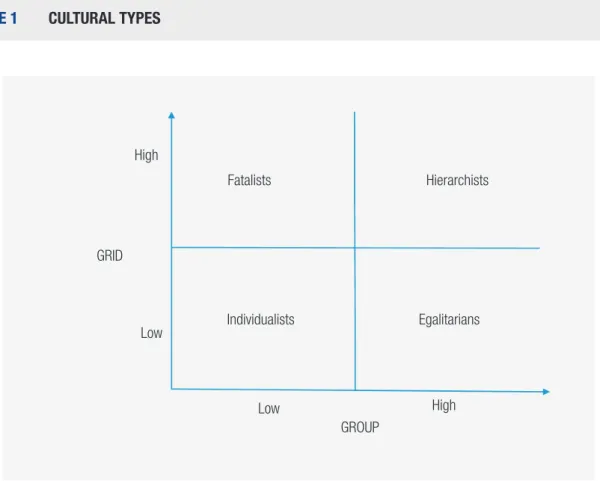
he article will analyse policy integration between these two areas through the theoretical and methodological lenses of Cultural heory (Douglas, 1982; hompson, Ellis and Wildavsky 1990; Hood 1998a). Inspired by the seminal anthropological work of Mary Douglas (1982), this approach sustains the idea that four diferent rationales, cultures or “ways of life” oten prevail in diferent policy sectors, which results in diferent, and oten incompatible approaches to policy formulation and implementation. his perspective has long been adopted in studies of public administration, particularly in the environmental sector (Hood, 1998; hompson, Ellis and Wildavsky, 1990; Hoppe, 2002; Schwarz and hompson, 1990; Forsyth, 2003). Each of the four cultures identiied by Douglas (1982) emerges from the combination between two key variables: “grid”, which refers to the levels to which an individual’s life is circumscribed by externally imposed rules, and “group” which is asso-ciated with the strength of allegiance or loyalty to the group. Scholars using this perspective assume that the plurality of strategies used by policy makers are ultimately based on their perceptions about these two essential dimensions of human organisation. Based on the levels of these two variables, four mutually exclusive and jointly exhaustive cultural types are identiied (see igure 1), which imply diferent administrative styles: (1) hierarchists, high grid and high group, (2) individualists, low grid and low group, (3) egalitarians, low grid and high group; and, (4) fatalists, who are high in grid and low in group. Cultural theory, when applied to public policies’ studies, captures much of the diferent views and traditions about how to organise governments and public services and may shed light on debates about the diiculties of environmental policy integration.
he central hypothesis of this article is that diferences in the bureaucratic cultures of diferent environmental institutions might contribute to diiculties of environmental policy integration.
1 Included in Article 6.1 of the Lisbon Treaty.
2 Although this concept has been created in the context of European Union, the author strongly believes on its world-wide relevance for
Following from this hypothesis, the main purposes of the article are to investigate whether cultural diferences prevail in the bureaucratic structures in charge of biodiversity and climate change policies in Brazil and assess the impacts of these diferences to policy integration. he main results of this analysis provide partial support to this hypothesis, at least in what concerns to the administration of biodiversity and climate change policies in Brazil. While the analysis revealed a predominantly egalitarian approach to biodiversity policies, it has demonstrated a prevalent hierarchical orientation among climate change institutions. Moreover, the analysis qualiies the predictions of cultural theory and points to the importance of ‘political técnicos’ who ‘combine characteristics and preferences of both politicians and técnicos’ (Schneider, 1991:8) as leaders capable of integrating culturally distant agencies, promoting policy integration even in a culturally diversiied institutional environment. herefore, although recognising and providing support to the theoretical prediction which empha-sises the deleterious efects of cultural institutional diferences for environmental policy integration, the empirical indings of this article equally provide support to Schneider’s (1991:35) claim about the possibility of ‘personalism to cut through fragmentation’, allowing bureaucratic coordination and policy integration to take place.
FIGURE 1 CULTURAL TYPES
High
Fatalists Hierarchists
Individualists Egalitarians
Low High
GROUP GRID
Low
Source: Elaborated by the author based on Hood (1998a).
the data. Section 4 justiies the selection of Brazilian Biodiversity and Climate Change policies as the focus of this analysis and provides an overview of the importance of policy integration among these two areas. Section 5 presents the empirical analysis, applying the theoretical framework to thirty-six diferent policies from the Brazilian regimes of biodiversity and climate change. Section 6 discusses and qualiies the results of the empirical analysis in order to critically assess the con-tributions of this study to theoretical debates and practical eforts of policy integration. Section 7 concludes the study.
2. THEORETICAL CONSIDERATIONS
he need for integration between climate change and biodiversity policies and the importance of ap-plying innovative theoretical frameworks to investigate this theme has been increasingly recognised. It has, for example, been strongly emphasised by the Intergovernmental Panel on Climate Change (IPCC, 2014:24) report, which remarked that “increasing eforts to mitigate and adapt to climate change imply an increasing complexity of interactions, particularly at the intersections among water, energy, land use, and biodiversity, but tools to understand and manage these interactions remain limited.” Among the theoretical lenses that have been applied in the study of policy integration, institutional analysis has been the most frequent. With an approach focused on institutional design, Söderberg (2011), for instance, analysed multi-sector EPI within the Swedish bioenergy sector and assessed the impacts of open actor access and the use of monitoring and coordination mechanisms. Vasileiadou and Tuinsdra (2013), following a similar line of inquiry, assessed and conirmed the importance of institutionalised mechanisms of stakeholder consultation for the integration of climate change con-cerns in European Union energy policies.
Taking a more sociological approach but also with a focus on institutions, authors such as Jordan and Lenschow (2010) have observed that diferent administrative cultures and routines developed within the bureaucratic segments of diferent sectors may lead actors to protect their “competences, resources and ways of doing things from the intervention of other parts” (Jordan and Lenschow 2010:153), potentially undermining attempts of policy integration or coordination. his analysis advances this latter perspective systematising its assumptions through the applica-tion of Cultural heory. Although Cultural heory has not been commonly applied to analysis of environmental policy integration it is supported here that its potential contributions to a more precise understanding of bureaucratic cultures and of its interactions might contribute profusely to the emerging ield of policy integration analysis. his is the main theoretical innovation and contribution advanced by this article.
a centralist, top-down and expertise-based approach to public management in which policies are formulated by a central authority based on the authoritative advice of experts, which are intended to beneit the entire group in which they are situated. Egalitarians, on the other hand, tend to be highly critical of hierarchical/authority-based organisations and value a ‘management without managers’ approach to public administration. For egalitarians, policies should be based on extensive dialogue and consensus; community actors and those less able to participate should be given priority both in the process of formulation and in the beneits accrued from the implementation of these policies. Fairness, consensus and communication are, thus, the keynotes of this management style. he indi-vidualist style or administrative culture, in its turn, is usually associated with market mechanisms. his kind of administrative perspective demonstrates antipathy to either collectivism or hierarchically imposed rules, and focuses mainly on the use of market-based/competitive controls, on the self-in-terested behaviour of actors and on how market actors, such as consumers and irms, are beneited (Hood, 1998a; Hoppe, 2002). Lastly, the fatalist administrative orientation departs from a view of the world which sees every regulatee as a possible gambler of the system. It, therefore, suggests a public management style based on ‘contrived randomness’ or the ‘use of planned chance’ (Hood, 1998a).3
For the followers of this management style, therefore, the eiciency of the system itself should be the central concern of public administrators, in order for gambling by regulatees to be avoided. he methodological strategies developed for the identiication of cultural styles in the cases analysed in this article are described in the following section.
3. METHODOLOGY
his section presents the methods of data collection, the analytical framework developed for the analysis of administrative cultures within bureaucracies, and the strategies and stages of analysis. he study is based on a comparative analysis of two case studies composed by a group of Brazilian biodiversity and climate change policies. he empirical analysis is theoretically grounded on an analytical framework inspired by previous applications of cultural theory in public administration (Hood, 1998b; hompson, Ellis and Wildavsky 1990; Hoppe 2002; Schwarz and hompson, 1990; Forsyth, 2003) but developed speciically for this analysis.
he methodologies used for gathering the data were document analysis and semi-structured interviews. Twenty three documents were used for the analysis. hey were mainly oicial doc-uments describing the implementation of main public policies in the areas of Biodiversity and Climate Change. Laws and policy analysis published by NGOs and consultants were also used to complement the analysis of governmental policy documents. All documents were collected from oicial government or third parties websites. he selection of documents aimed at providing an analysis as comprehensive as possible of all biodiversity and climate change policies which have been or are in the process of being implemented in Brazil. A complete list of the 23 documents used
3 Although several discussions exist on the passivity of this forth cultural type and, as a consequence, on its incapacity to motivate any
in the analysis is presented in appendix I. In order to complement the documentary analysis, ive semi-structured interviews with public servants were conducted in Brasília between September and October of 2014 — two from the Ministry of Environment, one from the Ministry of Science, Technology and Innovation and one from the Ministry of International Relations. hese ive in-terviews were selected according to their relevance for this analysis from a larger set of ity-four interviews conducted between September 2014 and January 2015 for the execution of a related research project. he selection of interviews was based on snow-ball sampling, according to which each interviewee was asked to refer to others who could provide further information on speciic matters which emerged during their interviews. All interviews were anonymised due to their cur-rent public positions and the importance of avoiding any possible impacts of the publication of this article for their careers.
he data analysis was based on textual analysis, which consisted in the codiication of documents and interviews according to an analytical framework based on cultural theory and speciically de-veloped for this analysis. he documents were read and coded by the author, and results from the two diferent policy areas compared and debated with interviewees. Relevant parts of the interviews were transcribed and also coded according to the same analytical framework. A few excerpts from the interviews were translated to English by the author when necessary for citations.
Although the analytical framework developed for this analysis was based on an extensive literature review of previous strategies utilised in the identiication of cultures, it was developed speciically for this analysis, consisting therefore in an innovative contribution to the literature. Literature review has revealed that although the proxies used in previous research for the identi-ication of cultural styles have been extremely varied, their abstract character has oten resulted in diiculties of systematic empirical operationalisation. Cultural styles have been identiied, for example, through the level of consensus in terms of values and knowledge (Hoppe, 2002), through the identiication of the visions of human nature depicted by actors involved in policy problems (Bevan and Hood, 2006; Lodge and Wegrich, 2012; Verweij et al., 2006),or even by the vision of environmental stability or fragility held by policy makers (hompson, Ellis and Wildavsky, 1990; Forsyth, 2003). his study, on the other hand, proposes to contribute to this methodological debate by developing and applying three more easily observable proxies of cultural styles, which were generated based on extensive literature review and on the perceptions of the diiculties that the current literature entails in terms of empirical operationalisation. hese three proxies utilised by this study are: how policies are formulated and implemented; who are the actors involved in this process; and for whose beneit policies actually work. Additionally, and also in order to facilitate empirical operationalisation, the analysis has been divided among the three main functions com-monly attributed to regulatory regimes: standard setting, behaviour modiication and information gathering (Hood, Rothstein and Baldwin, 2001; Black, 2002; Lodge and Stirton, 2010).
to the predominant cultural style of each policy sector. he expected answers relative to each culture are developed according to the descriptions of each cultural perspective presented by the literature. For instance, a focus on governmental decision makers and in the opinion of experts in the processes of standard-setting, behaviour modiication and information gathering indicates a predominance of a hiearchist style in the policy area. Speciic policy programmes were analysed in each policy area and their predominant style was synthesised and used for comparison. he following section exposes and further explains the application of the coding framework in relation to the empirical cases.
CHART 1 ANALYTICAL CATEGORIES (QUESTIONS ASKED WHEN CODING THE DATA)
Standard-setting Who? Who is involved in the definition of standards?
How? How are standards defined?
Form whom? For whose benefit are standards set?
Behaviour modiication Who? Who enforces behaviour modification?
How? How is behaviour is modified?
Form whom? For whose benefit is behaviour modified?
Information-gathering Who? Who obtains information?
How? How is information is obtained?
Form whom? IFor whose benefit is information obtaineds?
CHART 2 CODING FRAME (ATTRIBUTION OF CULTURAL STYLES ACCORDING TO THE ANSWERS OBTAINED)
Source: Elaborated by the author.
4. CASE SELECTION
interactions and potential negative side efects among policies developed in both areas a clear policy problem in need of more careful consideration (Cardinale et al., 2012). Second, debates over climate change adaptation have also included the crucial role of biodiversity conservation, in what has been referred to as ‘Ecosystem Based Adaptation’ – an approach focused on the use of biodiversity and ecosystem functions as a tool for the adaptation to a changing climate (Unep, 2010).
Particularly in the case of Brazil, the natural interdependencies among both policy areas make integration perhaps even more important. Brazil holds some of the richest ecosystems in the world (such as the Amazon forest and the Cerrados). heir degradation, although dramatically reduced in the past 10 years (particularly in the case of the Amazon forest),4 is still the second leading cause of
the country’s high contribution to climate change (Matthews, 2014:5). Moreover, it has a great impact on biodiversity loss due to the close connection of forest/natural ecosystems and biodiversity conser-vation. hus, there are few other places in the world where the overlaps among protecting biodiversity and tackling climate change are so explicit and policy integration so potentially important.
Climate change policies stimulating the use of biofuels are another critical issue which could ex-tensively beneit from more policy integration and coordination. Decree 7.390 of 2010, which regulates the National Policy of Climate Change, for example, prescribes that the availability of biofuels shall be increased in the country (Art. 6o, §1o — III). he Decennial Plan of Energy Expansion (one of the Sectorial
Plans for the Mitigation and Adaptation to Climate Change), as a consequence, has been designed to increase the production and use of biofuels. he plan involves the provision of credit for the production of sugar cane and the increase in the national mandatory percentage of biodiesel in diesel. he risk of conversion of areas previously occupied by highly biodiverse native or non-native vegetation to sugar cane monocultures or the impacts of monoculture expansion to surrounding ecosystems is not, however, being addressed by this plan (Tolmasquim and Guerrero 2010), even though extensively acknowledged by the literature on the topic (Sawyer, 2008; Rodrigues and Ortiz, 2006; Honty and Gudynas, 2007).
Although current Brazilian legislation forbids the cultivation of sugar cane in the Amazon, Pantanal and Upper Paraguay River Basin biomes (Decree 6.961 — for the agro-ecological zoning of sugar cane), it does not forbid its cultivation in areas of Cerrado — a biome recognised as one of the most biodiverse in the world. Additionally, data from Conab (Companhia Nacional de Abastecimento, or the National Supply Company), 2014, demonstrates that the production of sugar cane in the northern region of Brazil (which is largely covered by the Amazon forest) has increased from 46.38 thousand hectares in 2013 to 50.01 thousand in 2014, a total yearly increase of 7.8%, as opposed to the overall national increase of 3.6%. It is not in vain, therefore, to stress the importance of integrating climate change and biodiversity conservation goals in biofuel production policies.
Another huge area of overlap and desirable synergies between both policy areas in Brazil relates to the implementation of the National System of Conservation Units, which is pursued by the Secretariat of Biodiversity and Forests. As observed by Carvalho (2014), satellite data clearly demonstrates that deforestation rates are lower within conservation units than around it, which implies beneits not only for biodiversity conservation but also for climate change mitigation. However, even though a
4 According to Imazon (2014:9) the deforestation rate of Amazon forest in 2012 was 76,7% lower than the average of the period between
few private initiatives do associate the provision of carbon-related economic beneits with activities pursued within conservation units,5 the drat of the Brazilian National Strategy for the
implementa-tion of the REDD+ (‘Reducing Emissions from Deforestaimplementa-tion and Forest Degradaimplementa-tion in Developing Countries’) mechanism does not incorporate in its policy coordination section any reference to the National System of Conservation Units or any potential synergies. It clearly demonstrates, as strongly emphasised by Carvalho (2014:463), the “lack of coordination between both agendas and the need to strengthen synergies among them”.
CHART 3 POTENTIAL AREAS FOR POLICY INTEGRATION BETWEEN BIODIVERSITY AND CLIMATE CHANGE POLICIES
Source:Elaborated by the author.
5. EMPIRICAL ANALYSIS
Although the analysis of the data obtained revealed an increasing recognition of the importance of policy integration between both areas by the Brazilian bureaucracy, it has also shown that the conditions for this integration to occur have not yet been fully materialised. Institutionally, two distinct departments are in charge of the Biodiversity and Climate Change policies within the Brazilian Environmental Ministry: the secretariat of Biodiversity and Forests and the secretariat of Climate Change and Environmental Quality. Data suggests that policies in the areas mentioned in the previous section are developed inde-pendently by each of the departments, and little eforts for integration have actually taken place so far. In addition to the example of biofuel policies, another case which exempliies the lack of integration refers to the case of the Brazilian anti-deforestation plan — ‘Action Plan for the Prevention and Control
5 See, for example, the Bolsa Floresta programme created in the Amazonas federal state in 2007, which provides payment for
of Deforestation in the Amazon Forest’ (PPCDAm in the Portuguese acronym). his plan has been implemented by the secretariat of Climate Change and Environmental Quality, and an external evalu-ation by Ipea-GIZ-Cepal (2011) has emphasised that although extremely eicient in terms of reducing overall levels of deforestation in the country, the plan presented limited success in its goal of promoting the conservation of biodiversity. When questioned about the reasons behind this result, an oicial from the Ministry of Environment involved in the implementation of the plan stressed the importance but limitations in terms of policy integration with other areas with diferent administrative capabilities for the achievement of this goal (Interview 1 MMA, 16th October 2014, MMA, Brasília). As the interviewee explained, while command and control and land title regularisation activities (those responsible for the direct avoidance of deforestation which were successfully implemented by the Plan) mainly require ca-pabilities which can be centralised by the government, biodiversity conservation requires direct contact with local people and is commonly accomplished through programmes of behavioural change which were not mastered, in his opinion, by the Secretariat of Climate Change and Environmental Quality (Interview 1 MMA, 16th October 2014, MMA, Brasília). he reasons for these types of diiculties will now be explored through a detailed analysis of the policies historically developed in each area and their predominant cultural styles. he analysis will test the hypothesis drawn from Cultural heory and from debates on policy integration, which implies that diferences in cultural perspectives in each sector are among the underlying reasons of limited integration and coordination among both policy areas.
A. THE BIODIVERSITY REGIME
he issue of biodiversity conservation started to be addressed in Brazil in the 1930s with the creation of two national parks. Later, Rio-92 UN Conference and the signing of the Convention of Biological Diversity by Brazil (in 1992) provided a new impetus to the topic, which became one of the central agendas of the Ministry of Environment. In the recent past, several biodiversity programmes have been implemented in Brazil, of which three were chosen to be analysed here due to their central role in structuring biodiversity conservation eforts in the country.6 he irst is the Pilot Programme for the
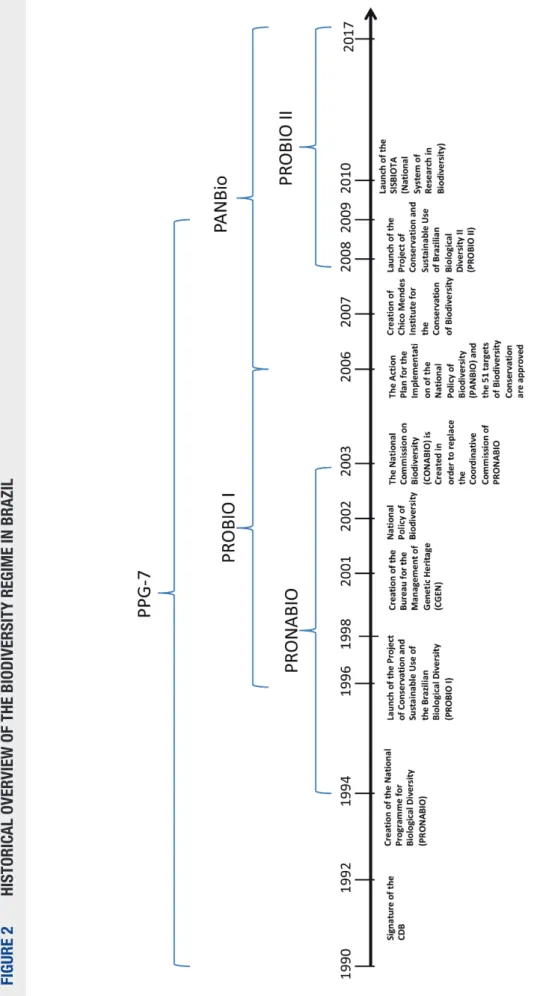
Protection of Brazilian Tropical Forests (PPG-7), which, although not exclusively focused on the pres-ervation of biodiversity, has deliberately and strongly promoted this goal. he second is the National Programme of Biological Diversity (Pronabio), which consisted of two phases (Probio I and Probio II). he third programme analysed is the Action Plan for the Implementation of the National Biodiversity Policy (PANBio), which was designed in order to implement the National Policy of Biodiversity (In-terview 3 MMA, 31/10/2014). A historical overview of these three programmes is presented in igure 2. Within these three programmes, 18 speciic policies were analysed,7 which were divided, in order to
allow for comparability, among standard-setting, information-gathering and behaviour-modiication types of policies. Chart 3, 4 and 5 present a list of these 18 policies and their corresponding analysis. A selection of the analysis pursued in relation to some of these policies is presented in sequence.8
6 heir relevance as the ‘backbone’ of biodiversity policies in Brazil was stressed by interviewee 3 (MMA). he emphasis placed by the
interviewee on these three speciic policies has guided the selection pursued here.
7 he selection of policies within these three programmes was determined by the availability of documents mentioning and describing
them on the Ministry of Environment and other oicial websites.
FIGURE 2
HISTORIC
AL OVERVIEW OF THE BIODIVERSITY REGIME IN BRAZIL
Source:
E
la
bo
ra
te
d b
y t
he a
ut
ho
CHART 4 STANDARD-SETTING PROCESSES IN BIODIVERSITY
CHART 5 INFORMATION-GATHERING POLICIES IN BIODIVERSITY
CHART 6 BEHAVIOUR MODIFICATION IN BIODIVERSITY
he irst of the three programmes analysed was PPG-7. It started to be planned in 1990 but was oicially launched in 1992, during the UN-Rio Conference. It was inanced by the G-7 (Germany, the US, France, Italy, the UK, Japan, Canada and Russia), in addition to Brazil, and was administrated by the World Bank. Although its main goal was to tackle deforestation in the Amazon, biodiversity con-servation projects were central to the programme. ProManejo, ProVarzea and Proteger II, for example, were crucial behaviour-modiication projects within PPG-7 which aimed at the promotion of biodi-versity conservation (see chart 5). As the document analysis and an interview with a former leader of the project revealed, a common feature of these three projects in terms of behaviour modiication was a strong reliance on communitarian bounds (social trust), consultation and dialogue as their main enforcement mechanisms (Santos, 2005; Verissimo, 2005; Sauer, 2005, Interview, MCTI oicial — 18th September 2014, MCTI, Brasília.). In ProVarzea, a project aiming at the sustainable management of natural resources in the Amazon and Solimões Rivers’ Low-Lands, for example, ishermen’s informal agreements were the only mechanism protecting ish stocks and there was no other type of enforcement in place. Similarly, in Proteger II — a project aimed at preventing ires in the Amazon region — small farmers, extractive workers and indigenous communities were those trained and put in charge of reducing ires. heir implementation, moreover, followed a local traditional type of organisation called ‘puxiruns ambientais’,9 a traditional work organisation strategy adopted by traditional communities in the region
(Sauer, 2005). ProManejo — which was mainly intended at promoting the sustainable management of the Amazon forest — established a consultation council for the conservation of the Tapajos area in 2001, which involved members of the community, the rural workers’ union, universities, governmental agen-cies and NGOs. It has even been described in its evaluation document as a ‘laboratory of participatory management’ which could contribute to the management of other conservation units in the country (Verissimo, 2005). In these three examples, communities are the main actors in charge of enforcing the policies, and behaviour modiication is strongly based on communitarian bonds of trust, dialogue and persuasion, pointing to the predominance of an egalitarian administrative culture.
Moreover, the main beneiciaries of all these three strategies can be clearly identiied as the com-munities themselves, which were encouraged to solve local problems through their own methods and intense participation (Related to the question for whose beneit of our coding frame). When interviewed about these projects, a former leader and formulator do PPG-7 conirmed local people’s empowerment as one of their central goals (see chart 5 for a summary of the analysis of these projects) (Interview, MCTI oicial — 18th September 2014, MCTI, Brasília).
Many other PPG-7 projects also had strong egalitarian features, such as the ‘demonstration projects’, which speciically required the engagement and participation of local communities in their develop-ment, and the co-management of four extractive reserves, which, as the name suggests, was designed to develop co-management between local communities and government authorities. Additionally, the Integrated Project of Protection to the Indigenous Population and Lands of the Legal Amazon was designed speciically to tackle the needs of a traditionally less-favoured community (see chart 4). Its aims were to preserve natural resources in indigenous lands and to promote the well-being of
9 his is a way in which farmers of the Amazon region traditionally organise a working day — involving all the community in diferent
indigenous populations (Viergever, 2005). Because indigenous communities were included in the gathering of information and in the behaviour-modiication strategies of this project, and because the processes of implementation were centred on education and the involvement of these communities, this project was also found during the data coding to demonstrate strong egalitarian features.
he National Programme for Biological Diversity (Pronabio), the second of the three biodiver-sity projects analysed, was established in 1994 as a direct response to the negotiations around the Convention on Biological Diversity (CBD). he actions of Pronabio, in its introductory stage, were intended primarily at information-gathering and consisted in the design of ten workshops chiely organised by NGOs and academic groups (Brazilian Ministry of Environment, 1998). he work-shops had varied purposes: to catalogue information already available about aspects of ecosystem conservation, to build networks among diferent groups working with biodiversity conservation, to create new monitoring systems for speciic biomes, and to discuss the implementation of biodiversity conservation in Brazil in general terms. hey were always, however, strongly driven by the general goal of promoting dialogue and exchange of information among diferent sectors of society. hus, the process through which information was obtained in almost all of these workshops (apart from one, which was coordinated by Embrapa, a state research organisation, and had a more technical orientation), was mutual learning and dialogue among several social sectors. he very fact that they were commonly organised by NGOs and academia points to this kind of orientation, which is char-acteristic on an egalitarian administrative approach. Additionally, the information produced has been made available to the public and could be used by any organisation interested in using it, indicating that the information gathered could be used for the beneit of the general public and not only for the government or speciic groups of experts, as it would be implied by a more hierarchical cultural orientation (coded in relation to the criteria for whose beneit — see chart 4). herefore, the analysis of the process of information collection, of the actors involved, and of the actors allowed to use the information collected, pointed to a predominantly egalitarian approach to information-gathering in the initial stages of the implementation of Pronabio.
In terms of standard-setting, during the implementation of Probio I, the government promoted a one-year consultation period (2000-01) during which NGOs, academics, indigenous communities, the private sector and the government itself were asked to provide input for the formulation of the National Biodiversity Policy (Política Nacional de Biodiversidade — PNB). In March 2002, based on this consultation period and on the other information-gathering projects developed up to that time, the government launched the irst drat of the PNB, which was further discussed in four meetings with varied members of the society in diferent state capitals of the country (Ministry of Environment Website, 2015). his open and long consultation period was remarkable, and did not so explicitly happen, as will be shown in the next section, in the case of the elaboration of the National Policy of Climate Change. In terms of the actors involved and the procedures for the deinition of the PNB, therefore, the approach adopted was, once again, predominantly egalitarian, with a consistent and strong focus on social participation and inclusive dialogue as the other biodiversity policies presented so far.
Regarding the standard-setting process leading to PANBio — the third biodiversity programme investigated in this analysis — a predominant egalitarian bias was also identiied, further conirming the predominance of this administrative style in this policy area. he formulation of PANBio involved an online public consultation during 2005 and a face-to-face debate, which included members of NGOs, academia, private sector and government. Ater a new round of online consultations and the consolidation of the proposed actions by the Environmental Ministry (in order to eliminate redun-dant suggestions, non-speciic actions and actions which had no operational and inancial viability), a resulting document was submitted for approval to the Conabio (the National Commission of Biodi-versity, in which diferent social sectors all equally represented). In 2006, 142 actions were approved and a technical chamber composed of civil society, government and private actors was established by Conabio to monitor the implementation of the actions. Once again, both the actors involved and the process itself were markedly egalitarian, following broadly participatory procedures. Additionally, the actions proposed created obligations to many diferent social actors (communities, government, researchers and NGOs) and were intended to directly beneit society as a whole (Brazilian Ministry of Environment, 2006).
Lastly, although little data exists on the implementation of Probio II due to its more recent launch (in 2008),10 the analysis of some of its projects reveals the intention to use market incentives (such
as the concession of credit to private actors working for the conservation of biodiversity), pointing to a more individualist approach in Cultural heory terms. Yet, other projects that are part of this programme still seem to strongly rely on egalitarian strategies. he use of communitarian monitoring system for the promotion of organic agriculture (see chart 5), for example, is a clear indication of the maintenance of egalitarian strategies of information-gathering. herefore, although individualist elements are identiied in this second phase of Pronabio, this fact does not invalidate the predom-inantly egalitarian bias observed in the overall historical analysis of policies of this area, which, as discussed in the next section, clearly diverges from the predominant hierarchical features identiied in the climate change regime. hus, the overall analysis of the programmes described in this section
and on chart 4, 5 and 6 indicate that although the administrative culture of the biodiversity regime has been slightly changed in more recent programmes (such as Probio I and II) towards a more hierarchic and individualist approach, biodiversity policies tend to embody some crucial egalitarian features throughout history, which are not so clearly present (as will be demonstrated in the next section) in the majority of policies related to climate change.
B. THE CLIMATE CHANGE REGIME
In terms of climate change policies, in addition to the standard-setting process leading to the approval of the National Policy of Climate Change, nine sectorial policies of climate change were analysed, both in relation to their information-gathering aspect and to their behaviour-modiication components, totalling 19 observations. A summary of the analysis is presented in chart 6, 7 and 8 and described subsequently.
CHART 7 STANDARD-SETTING PROCESSES IN CLIMATE CHANGE
Source: Elaborated by the author.
2015).11 herefore, in the attendance lists of more recent meetings of the Executive Group of Climate
Change, there is a clear predominance of governmental actors from the executive power. his fact is in contrast with the inclusive procedures that preceded the elaboration of the National Policy of Biodiversity described in the previous section.
CHART 8 INFORMATION-GATHERING IN CLIMATE CHANGE
11 Available at: <www.mma.gov.br/clima/grupo-executivo-sobre-mudanca-do-clima/grupo-executivo-sobre-mudanças-climáticas/
item/326>.
Source: Elaborated by the author.
Moreover, as observed by Pietrafesa (2013), during the development of the National Policy of Climate Change, centralisation by the executive power was so high that even members of the Congress were given little space in the negotiations. Although the former Secretary of Climate Change, helma Krug, airmed in an interview conceded to Pietrafesa (2013) that the executive power considered all the opinions received from civil society in the elaboration of the law, compar-ative textual analysis of inputs provided by civil society with the inal law demonstrates that many crucial suggestions12 — such as those related to the progressive use of renewable energy and the
gradual substitution of fossil fuels by renewable energy — were vetoed by the executive power.13 It
is also particularly interesting for this research that a document produced by the Climate Obser-vatory — a group of civil society organisations — had a passage that explicitly mentioned the need for conciliation between the climate change and the biodiversity agendas, which was similarly not included by the executive government in the inal drat of the bill (Observatório do Clima, 2008). It is important to note, therefore, that these indings markedly diverge from the inclusive process that characterised the formulation and implementation of the National Policy of Biodiversity. he evidence on the standard-setting process of the climate change regime points, as a consequence, to a predominantly hierarchical style in which decisions are restricted to members of the government or experts consulted by them.
12 Which were present in a document organised by the civil society group Observatório do Clima called ‘Elements for the formulation
of Climate Change Regulations in Brazil: Contributions from the Civil Society’.
13 he executive power justiication for these vetoes was provided in a presidential message which argued that they were vetoed due to
CHART 9 BEHAVIOUR MODIFICATION IN THE CLIMATE CHANGE
Source: Elaborated by the author.
In terms of information-gathering, Decree n. 7.390, of 9th December 2010 (Brazil, 2010) determines
that sectorial plans of mitigation and adaptation (which are being developed by each ministry in charge of the area of the plan) are to deine their own information-gathering instruments. herefore, the analysis of the regulation suggested that in order to observe how information is gathered, by whom and for whose beneit, the investigation should be focused on the composition and functioning of the each of the nine sectorial plans.
information-gathering mechanisms). he Plan of Low Carbon Agriculture, for example, is based on information collected by satellite monitoring, banking systems and commercial transactions, all of which are centralised, mandatory and technical means of obtaining information. Moreover, technicians from the ‘Virtual Multi-Institutional Laboratory of Climate Change and Agriculture’ are in charge of consolidating information to be used by the Ministry of Agriculture and Ministry of Agrarian Development in the formulation of new policies (who and for whose beneit). his pro-cess, therefore, although promoting the public good, has the primary and explicit goal of informing the decision-makers within these two ministries and not to difuse information to the society as a whole (which would be characterised as a more egalitarian goal). It adopts, then, a predominantly hierarchical approach to information-gathering.
he analysis of the planned behaviour-modiication strategies of the Sectorial Plans reveals, on the other hand, a more nuanced picture in which individualist intentions predominate (see chart 9). he analysis of the actual implementation processes of the plans, however, points to a marked hierarchical bias in relation to the only two plans which have already been implemented and had data available online by the end of 2016 (the Energy and PPCDam plans). PPCDAm. Although displaying both egalitarian and hierarchical intentions, it has faced diiculties in promoting the conservation of biodiversity through local coordination with communities, which formed part of its more egalitarian component. At least until its third phase, which inished in 2016, it has been strongly based on the success of strategies of command and control (police forces) to reduce de-forestation, and not so much on egalitarian strategies of information sharing and communitarian persuasion (Interview 1 MMA oicial,16th October 2014, MMA, Brasília).14
Similarly, the Decennial Plan of Energy Expansion has implemented its objectives of GHGs emissions reductions mainly through the legal requirement to increase the percentage of biodiesel in the diesel (from 3% to 5% in 2010) — which is a clear hierarchical due to the legalist and top-down characteristics of this method. Governmental provision of credit for sugar cane production (which is related to the use of market mechanisms and, thus, to an individualist administrative cultural style) have, however, also been utilised. his plan was, consequently, coded as a hybrid of individualist and hierarchical administrative styles.
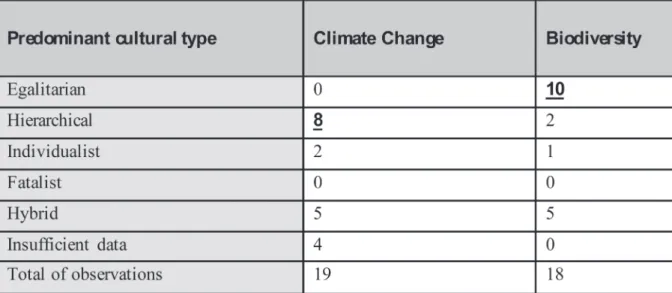
As demonstrated in charts 7, 8 and 9, despite the more frequent occurrence of hybrid adminis-trative styles in climate change policies than in biodiversity ones, the end result of the analysis of all the 19 climate change programmes has consistently pointed towards the predominance of a hierar-chical style in terms of actual implementation, which contrasts with the tendency towards egalitarian choices observed in the biodiversity regime and described in the previous section. Table 1 compares these results. In this way, it provides support to the hypothesis that diferent cultural styles actually
14his approach has been debated and reviewed during the elaboration of the strategic plan of the fourth phase of the programme,
predominate in each policy area — biodiversity being consistently egalitarian and climate change tending towards a hierarchical administrative culture either in terms of standard setting, information gathering or implemented behaviour modiication policies.
Finally, it is important to stress that the process of creation of the ‘National Plan of Adapta-tion’ seems to be diverging from this path of hierarchical centralisation which predominates in Climate Change policies. Although it is still being elaborated, and for this reason, it is not being systematically analysed here in terms of cultural style, the lists of participants in the meetings of the Adaptation Working Group reveal the inclusion of members of civil society, and of several governmental areas in the debate, as well as the promotion of public consultations, suggesting a more egalitarian approach. he consequences of these cultural diferences for policy integration with biodiversity do not seem to be negligible at irst sight and point towards increasing policy integration between both areas. A clear evidence of this tendency of more policy integration refers to the National Plan of Adaptation to Climate Change, a plan designed by the Adaptation Working Group, which counts with a full chapter on Biodiversity. As it is further discussed, personal eforts of speciic leaders seem to provide an important stimulus for cultural barriers to be cut through and policy integration to efectively occur.
TABLE 1 SUMMARY OF THE ANALYSIS
Source: Elaborated by the author.
6. DISCUSSION
hybrids and of insuicient data occurred (especially in the analysis of the climate change policies, due to their ongoing and more recent implementation), the complete absence of egalitarian cases among the analysed policies of the climate change regime is indicative of its clear divergence of cultural style in relation to biodiversity policies. As a consequence, the expectation that diferences in administrative cultures is among the factors that has been hampering policy integration among both areas cannot be discarded, and is, therefore, worthy of consideration in future eforts of policy integration.
he main contribution arising from this empirical analysis of the administrative cultures pre-dominant in each of these two environmental policy sectors, points, as a consequence, not only to cultural diferences that will have to be tackled in future integration attempts but also to a potential reason for the lack of integration exhibited so far among these two environmental areas. he analysis provides support to the theoretical predictions of Jordan and Lenschow (2010), according to whom diferent administrative cultures and routines developed within the bureaucratic segments of diferent sectors may lead actors to protect their “competences, resources and ways of doing things from the intervention of other parts” (Jordan and Lenschow 2010:153), potentially undermining attempts of policy integration or coordination.
A second contribution of this research to theoretical debates on environmental policy integration refers to the role of ‘political técnicos’, who “combine characteristics and preferences of both politi-cians and técnicos” (Schneider, 1991:8), as potential sources of policy integration even in situations characterised by diferent administrative cultures (in which integration is more unlikely to occur) among bureaucracies (Schneider, 1991:8). Largely acknowledged by the literature on Brazilian bureau-cracy (see for example Schneider, 1991; Hochstetler and Keck, 2007), the role of personal leaders as brokers and intermediaries among agencies, capable of promoting policy integration even in highly fragmented institutional environments is suggested in the case of the elaboration of the National Plan of Adaptation, opening an important area for further scrutiny. his case, was found to be particularly illustrative of the role of leadership in promoting policy integration, standing out as an interesting exception to the indings presented so far in relation to the lack of policy integration between both areas and the impacts of cultural diferences.
Although an initiative of the Climate Change department, the analysis of the participants of the elaboration of the National Plan of Adaptation points to a strong participation of organised civil so-ciety, of several diferent areas of the government, and of society as a whole through the promotion of online public consultations. he preliminary version of the Plan counts, moreover, with a full chapter on the role of biodiversity in adaptation to climate change and concerns about policy synergy (or policy ‘transversality’) are also included in the text (Memory of the meeting of the adaptation Working Group available online, 22/6/2015). Finally, the very coordination of the chapter about Biodiversity is being pursued by someone from the Secretariat of Biodiversity and Forests, pointing to a considerable level of coordination and integration among both areas.
for this remarkable and unusual concern about policy integration, provided the following response, which exempliies the importance of personal leadership:
We are coordinating the chapter on Biodiversity of the National Plan of Adaptation, so this is going forward. I would not say this is already in the level I would like, but having a biodiversity chapter in the National Plan of Adaptation is, if I may have some vanity, one of the opportunities
which I grabbed when I arrived here. We need to improve the connection between biodiversity and climate change and I saw in this chapter a huge opportunity to advance this agenda. Both is terms of focusing a little more in what climate change is causing in terms of risks to bio-diversity, which is important but much more obvious, but also in the strategic component of demonstrating the value of conserving biodiversity to adaptation and mitigation. So, we are now creating studies and critical mass for the time when risks are larger, this will appear in the political agenda in a more efective way. For you to have policies which better incorporate this matter. [Interview, MMA 2, Brasília 24/10/2014]
From his response one can infer that institutionalised mechanisms for policy integration had little interference in this speciic case of successful environmental policy integration. herefore, although the predictions of policy integration and cultural theory might have had some inluence in the examples of failed integration the predictive capacity of such a theory shall be relativized, at least in the Brazilian context, by the potential role of political leaders. However, although these signals bring a somehow reassuring possibility of ‘personalism’ to win over the institutional and cultural fragmentation the do not undermine, however, the desirability of deliberately promoting more cultural institutional coherence and integration among both secretariats and their respective policies in the future.
7. CONCLUSION
REFERENCES
BEVAN, Gwyn; HOOD, Christopher. What’s Measu-red is what matters: target and gaming in the English Public Health Care System. Public Administration, v. 84, n. 3, p. 517-538, 2006.
BLACK, Julia. Critical reflections on regulation. CARR Discussion Papers, DP 4. London: Centre for Analysis of Risk and Regulation, London School of Economics, 2002.
BÖRNER, Jan et al. Promoting forest stewardship in the Bolsa Floresta Programme: local livelihood strategies and preliminary impacts. Rio de Janeiro: Center for International Forestry Research (Cifor). Manaus, Brazil: Fundação Amazonas Sustentável (FAS). Bonn, Germany: Zentrum für Entwicklungs-forschung (ZEF), University of Bonn. 2013.
BRAZIL. Brazilian Ministry of Environment (MMA). Funbio 20 anos — Fundo Brasileiro para a Biodiversidade, Relatório Anual 2015. Brasília:
Ministério do Meio Ambiente, 2015a.
BRAZIL. Brazilian Ministry of Environment (MMA). PAN-Bio: Diretrizes e Prioridades do Plano de Ação para a Implementação da Política Nacional de Biodiversidade. Brasília: Ministério do Meio
Ambiente, 2006.
BRAZIL. Brazilian Ministry of Environment (MMA). PPCDam — Plano de Ação para Prevenção e Controle do Desmatamento na Amazônia Legal — Plano Operativo 2016-2020. Brasília: Ministério do
Meio Ambiente, 2016.
BRAZIL. Brazilian Ministry of Environment (MMA). Primeiro relatório nacional para a Conven-ção sobre Diversidade Biológica. Brasília: Ministério do Meio Ambiente, 1998.
BRAZIL. Brazilian Ministry of Environment (MMA). Projeto de conservação e utilização sustentável da di-versidade biológica brasileira: relatório de atividades. Brasília: Ministério do Meio Ambiente, 2002.
BRAZIL. Brazilian Ministry of Environment (MMA). Projeto Nacional de Ações Integradas Público -Privadas para Biodiversidade — Probio II Relatório de Progresso (julho a dezembro de 2010). Brasília:
Ministério do Meio Ambiente, 2011.
BRAZIL. Brazilian Ministry of Environment (MMA). Reuniões do Grupo Executivo sobre
Mudan-ça do Clima — Gex, 2015b.Available at: <www.mma. gov.br/clima/grupo-executivo-sobre-mudanca-do-clima/grupo-executivo-sobre-mudanças-climáticas/ item/326>. Accessed on: 23 Jan. 2015.
BRAZIL. Brazilian Ministry of Environment (MMA) website. Available at: <www.mma.gov.br/biodi- versidade/biodiversidade-brasileira/pol%C3%A-Dtica-nacional-da-biodiversidade>. Accessed on: 10 Aug. 2015c.
BRAZIL. Decree N. 7.390, of 9 December of 2010. Diário Oicial [da] República Federativa do Brasil, Executive Power, Brasília, DF, 10 Dec. 2010. p. 4.
CARDINALE, Bradley J. et al. Biodiversity loss and its impact on humanity. Nature, v. 486, n. 7401, p. 59-67,2012.
CARVALHO, Fernanda. Áreas protegidas e mu-dança do clima: problema e/ou parte da solução. In: BENSUSAN, Nurit; PRATES, Ana P. (Org.). A diversidade cabe na unidade? Áreas protegidas no Brasil. Brasília: IEB Mil Folhas, 2014.
COMPANHIA NACIONAL DE ABASTECIMEN-TO (CONAB). Acompanhamento da safra brasileira de cana de açúcar V.1 Safra 2014/2015. Brasília: Conab, 2014.
CHRISTENSEN, Tom; LÆGREID, Per. he chal-lenge of coordination in central government orga-nizations: the Norwegian case. Public Organization Review, v. 8, n. 2, p. 97-116, 2008.
DRYZEK, John S. he politics of the earth. 2nd ed.
Oxford: Oxford University Press, 2005.
DOUGLAS, Mary. In the active voice. London: Routledge, 1982.
FORSYTH, Tim. Critical political ecology: the poli-tics of environmental science. London; New York: Routledge, 2003.
GREGORY, Robert. All the king’s horses and all the king’s men: putting New Zealand’s public sector back together again. International Public Management Review, v. 4, n. 2, p. 41-58, 2003.
HOCHSTETLER, Kathryn; KECK, Margaret E. Greening Brazil: environmental activism in state and society. Durham (NC): Duke University Press, 2007.
HONTY, Gerardo; GUDYNAS, Eduardo. Agrocom-bustibles y desarrollo sostenible en América Latina y el Caribe: situación, desaios y opciones de acción. Mon-tevideo, Uruguay: Observatorio del Desarrollo, 2007.
HOOD, Christopher. Control over bureacracy: cultural theory and institutional variety. Journal of Public Policy, v. 15, n. 3, p. 207-230, 1998b.
HOOD, Christopher. he art of the state: culture, rhetoric, and public management. Oxford: Oxford University Press, 1998a.
HOOD, Christopher; ROTHSTEIN, Henry; BAL-DWIN, Robert. he government of risk: unders-tanding risk regulation regimes. Oxford: Oxford University Press, 2001.
HOPPE, Robert. Cultures of public policy problems. Journal of Comparative Policy Analysis: Research and Practice, v. 4, n. 3, p. 305-326, 2002.
IMAZON. Instituto do Homem e Meio Ambiente da Amazônia. Análise das evolução das emissões de GEE no Brasil (1990-2012): mudanças do uso da terra. São Paulo: Observatório do Clima, 2014. Avai-lable at: <https://s3-sa-east-1.amazonaws.com/ar-quivos.gvces.com.br/arquivos_gvces/arquivos/305/ SEEG_UsoDaTerra.pdf>. Accessed on: 9 Aug. 2015.
INSTITUTO DE PESQUISA ECONÔMICA APLI-CADA (IPEA); DIE DEUTSCHE GESELLSCHAFT FÜR INTERNATIONALE ZUSAMMENARBEIT (GIZ); COMISSÃO ECONÔMICA PARA A
AMÉ-RICA LATINA E O CARIBE (CEPAL). Avaliação do
Plano de Ação para a Prevenção e Controle do
Desma-tamento na Amazônia Legal. Ipea; GIZ; Cepal, 2011.
INTERGOVERNMENTAL PANEL ON CLIMATE CHANGE (IPCC). Contribution of Working Group III to the Fith Assessment Report of the Intergovern-mental Panel on Climate Change. Cambridge; New York: Cambridge University Press, 2014.
JORDAN, Andrew J.; LENSCHOW, Andrea. Envi-ronmental policy integration: a state of the art review. Environmental Policy and Governance, v. 20, n. 3, p. 147-158, 2010.
JORDAN Andrew J.; LENSCHOW, Andrea (Org.). Innovation in environmental policy? Integrating the
environment for sustainability. Cheltenham: Edward Elgar Publishing Limited, 2008.
LAFFERTY, William; HOVDEN, Ervin. Environ-mental policy integration: towards an analytical framework, Environmental Politics, v. 12, n. 3, p. 1-22, 2003.
LODGE, Martin; BALDWIN, Robert; CAVE, Martin. Understanding regulation. Oxford: Oxford University Press, 2012.
LODGE, Martin; STIRTON, Lindsay. Accountabi-lity in the regulatory state. In: BALDWIN, Robert; CAVE, Martin; LODGE, Martin (Org.). he Oxford handbook of regulation. Oxford: Oxford University Press, 2010.
LODGE, Martin; WEGRICH, Kai. Managing regula-tion: regulatory analysis, politics and policy. London; Berlin: Palgrave Macmillan, 2012.
MATTHEWS, Damon H. et al. National contribu-tions to observed global warming. Environmental Research Leters, n. 9, p. 1-9, 2014.
OBSERVATÓRIO DO CLIMA. Elementos para a formulação de um marco regulatório em mudanças climáticas no Brasil: contribuições da sociedade civil. Brasília: Observatório do Clima, 2008.
PIETRAFESA, Pedro A. Engajamento parlamentar no processo de formulação de políticas públicas do Executivo: as políticas públicas de clima e biocom-bustíveis no Brasil e Estados Unidos. hesis (PhD) — Universidade de Brasília, Brasília, 2013.
RODRIGUES, Délcio; ORTIZ, Júlia. Em direção à sustentabilidade da produção de etanol de cana de açúcar no Brasil. Porto Alegre; São Paulo: Amigos da Terra Brasil; Vitae Civilis, 2006.
ROSE, Richard. Inheritance before choice in public policy. Journal of heoretical Politics, n. 2, p. 263-291, July 1990.
SANTOS, Marli T. Aprendizado do Projeto de Manejo dos Recursos Naturais da Varzea — Pro Várzea. Bra-sília: Ministério do Meio Ambiente, 2005.
SAUER, Sérgio. Prevenção de incêndios lorestais na Amazônia: lições aprendidas no Projeto Proteger. Brasília: Ministério do Meio Ambiente, 2005.
Cerrado. Philosophical Transactions of Royal Society, v. 363, p. 1747-1752, 2008
SCHWARZ, Michiel; THOMPSON, Michael. Di-vided we stand: redeining politics, technology and social choice. Philadelphia: University of Pennsyl-vania Press, 1990.
SCHNEIDER, Ben R. Politics within the State: elite bureaucrats and industrial policy in authoritarian Bra-zil. Pittsburgh: University of Pittsburgh Press, 1991.
SECRETARIAT OF THE CONVENTION ON BIOLOGICAL DIVERSITY. Connecting biodiver-sity and climate change mitigation and adaptation: report of the Second Ad hoc Technical Expert Group on Biodiversity and Climate Change, CDB Technical Series 41. Montreal: Secretariat of the Convention on Biological Diversity, 2009.
SÖDERBERG, Charlotta. Institutional conditions for multi-sector environmental policy integration in Swedish bioenergy policy. Environmental Politics, v. 20, n. 4, p. 528-546, 2011.
THOMPSON, Michael; ELLIS, Richard; WILDA-VSKY, Aaron. Cultural theory. Boulder: Westview Press, 1990.
TOLMASQUIM, Maurício T.; GUERRERO, Amil-car. Abatimento das Emissões Relacionanadas à Produção e ao Uso de Energia no Brasil até 2020 —versão preliminar. Rio de Janeiro: Empresa de Pesquisa Energética (EPE), 2010.
UNITED NATIONS ENVIRONMENT PRO-GRAMME (UNEP). Policy series: integrated solu-tions for biodiversity, climate change and poverty. Policy Brief 1. Unep, 2010. Available at: <www. uncclearn.org/sites/default/iles/inventory/unep98. pdf>. Accessed on: 7 Sept. 2017.
URWIN, Kate; JORDAN, Andrew. Does public poli-cy support or undermine climate change adaptation?
Exploring Policy Interplay across diferent scales of governance. Global Environmental Change, v. 18, n. 1, p. 180-191, 2008
VASILEIADOU, Eletheria; TUINSTRA, Willemijn. Stakeholder consultations: mainstreaming climate policy in the Energy Directorate? Environmental Politics, v. 22, n. 3, p. 475-495, 2013.
VERISSIMO, Adalberto. Inluência do Promanejo
sobre Políticas Públicas de Manejo Florestal
Susten-tável na Amazônia. Brasília: Ministério do Meio
Ambiente, 2005.
VERWEIJ, Marco et al. Clumsy solutions for a complex world: the case of climate change. Public Administration, v. 84. n. 4, p. 817-843, 2006.
VIANA, Virgílio et al. Juma Sustainable Development Reserve: he First Redd Project In the Brazilian Amazon. Manaus: Fundação Amazonas Sustentável, 2008. Available at: <http://fas-amazonas.org/ver-sao/2012/wordpress/wp-content/uploads/2013/06/ FAS_Juma-REDD Project-summary.pdf>. Accessed on: 7 Sept. 2017.
VIERGEVER, Marcel. Projeto Integrado de Proteção as Populações e Terras Indígenas da Amazônia Legal — versão final. Dec. 2005. Available at: <www.google.co.uk/url?sa=t&rc- t=j&q=&esrc=s&frm=1&source=web&cd=4&ve-d=0CDwQFjAD&url=http%3A%2F%2Ferc.undp. org%2Fevaluationadmin%2Fdownloaddocument. html%3Fdocid%3D3788&ei=a2CHU6vXJs6a-0QX3woGADQ&usg=AFQjCNEDYKPp9ZqAxxF_ kmewr9_NVja5xQ&bvm=bv.68114441,d.d2k>. Accessed on: 22 Jan. 2015.
INTERVIEWS
Interview 1 MMA. High rank official involved in the implementation of PPCDam. 16th October 2014, MMA, Brasília.
Interview 2 MMA. High rank official involved in the elaboration of Climate Adaptation Plan. 24thOctober 2014, MMA, Brasília.
Interview 3 MMA. High rank official involved in the implementation of PROBIO I and PROBIO II. 31st October 2014, MMA, Brasília.
Interview FAM public servant - Foreign Affairs Ministry negotiators. 22nd September 2014, Itamaraty, Brasília.
Interview MCTI (Ministry of Science and Technology and Innovation) High rank official previously involved in the implementation of PPG-7. 18th September 2014, MCTI, Brasília.
Flavia Donadelli
PhD in Political Science and Teaching Fellow in Public Policy and Administration at London School of Eco-nomics and Political Science. E-mail: [email protected].
APPENDIX I
LIST OF DOCUMENTS ANALYSED
BRAZIL. Brazilian Ministry of Environment (MMA). Funbio 20 anos — Fundo Brasileiro para a Biodiversidade, Relatório Anual 2015. Brasília: Ministério do Meio Ambiente, 2015a.
BRAZIL. Brazilian Ministry of Environment (MMA). PAN-Bio: Diretrizes e Prioridades do Plano de Ação para a Implementação da Política Nacional de Biodiversidade. Brasília: Ministério do Meio Ambiente, 2006.
BRAZIL. Brazilian Ministry of Environment (MMA). Plano de ação para prevenção e controle do desmatamento e das queimadas: Cerrado [online]. 2011. Available at: <www.mma.gov.br/estrutu-ras/201/_arquivos/ppcerrado_201.pdf>. Accessed on: 4 Apr. 2014.
Controle do Desmatamento na Amazônia Legal — Plano Operativo 2016-2020. Brasília: Ministério do Meio Ambiente, 2016.
BRAZIL. Brazilian Ministry of Environment (MMA). Primeiro relatório nacional para a Convenção sobre Diversidade Biológica. Brasília: Ministério do Meio Ambiente, 1998.
BRAZIL. Brazilian Ministry of Environment (MMA). Projeto Nacional de Ações Integradas Público -Privadas para Biodiversidade — Probio II Relatório de Progresso (julho a dezembro de 2010). Brasília: Ministério do Meio Ambiente, 2011.
BRAZIL. Brazilian Ministry of Environment (MMA). Reuniões do Grupo Executivo sobre Mudança do Clima — Gex, 2015b. Available at: <www.mma.gov.br/clima/grupo-executivo-sobre-mudanca-do-cli-ma/grupo-executivo-sobre-mudanças-climáticas/item/326>. Accessed on: 23 Jan. 2015.
BRAZIL. Brazilian Ministry of Environment (MMA) website. Available at: <www.mma.gov.br/bio-diversidade/biodiversidade-brasileira/pol%C3%ADtica-nacional-da-biodiversidade>. Accessed on: 10 Aug. 2015c.
BRAZIL. Brazilian National Congress. Comissão Mista Permanente sobre Mudanças Climáticas (2013). Legislação Brasileira sobre Mudanças Climáticas. [online]. Available at: <www.senado.gov.br/ senado/hotsites/clima_em_debate/pdf/Livro_legislacao_ambiental_Completo_Final_17_09_2013. pdf>. Accessed on: 4 Apr. 2014.
BRAZIL. Decree N. 7.390, of 9 December of 2010. Diário Oicial [da] República Federativa do Brasil, Executive Power, Brasília, DF, 10 Dec. 2010. p. 4.
BRAZIL. Law n. 12.187, which instituted the National Policy of Climate Change. Diário Oicial [da] República Federativa do Brasil, Executivo Power, Brasília, DF, 2009.
BRAZIL. Ministry of Agriculture, Livestock and Supply. Plano Setorial de Mitigação e de Adaptação às Mudanças Climáticas para a Consolidação de uma Economia de Baixa Emissão de Carbono na Agricultura [online]. 2012. Available at: <www.mma.gov.br/images/arquivo/80076/Plano_ABC_VER-SAO_FINAL_13jan2012.pdf>. Accessed on: 4 Apr. 2014.
BRAZIL. Ministry of Development, Industry and International Trade. Plano Setorial de Mitigação e Adaptação à Mudança do Clima para a Consolidação de uma Economia de Baixa Emissão de Carbono na Indústria de Transformação [online]. 2013. Available at: <www.mma.gov.br/images/arquivo/80076/ Industria.pdf>. Accessed on: 4 Apr. 2014.
BRAZIL. Ministry of Health. Plano Setorial da Saúde para Mitigação e Adaptação à Mudança do Clima [online]. 2013. Available at: <www.mma.gov.br/images/arquivo/80076/Saude.pdf>. Accessed on: 4 Apr. 2014.
BRAZIL. Ministry of Transportations and Ministry of Cities. Plano setorial de transporte e de mobi-lidade urbana para mitigação e adaptação à mudança do clima (pstm). [online]. 2013. Available at: <www.mma.gov.br/images/arquivo/80076/Transporte.pdf>. Accessed on: 4 Apr. 2014.
BRAZIL. Staf of the Presidency and Ministry of Mining and Energy — Casa Civil. Plano Setorial de mitigação e de adaptação à mudança do clima na mineração. Plano de Mineração de Baixa Emissão de Carbono (Plano MBC) [online]. 2013. Available at: <www.mma.gov.br/images/arquivo/80076/ Mineracao.pdf>. Accessed on: 4 Apr. 2014.
INSTITUTO DE PESQUISA ECONÔMICA APLICADA (IPEA); DIE DEUTSCHE GESELLSCHAFT FÜR INTERNATIONALE ZUSAMMENARBEIT (GIZ); COMISSÃO ECONÔMICA PARA A AMÉRICA LATINA E O CARIBE (CEPAL). Avaliação do Plano de Ação para a Prevenção e Controle do Desmatamento na Amazônia Legal. Ipea; GIZ; Cepal, 2011.
INTERGOVERNMENTAL PANEL ON CLIMATE CHANGE (IPCC). Contribution of Working Group III to the Fith Assessment Report of the Intergovernmental Panel on Climate Change. Cambridge; New York: Cambridge University Press, 2014.
SANTOS, Marli T. Aprendizado do Projeto de Manejo dos Recursos Naturais da Varzea — Pro Várzea. Brasília: Ministério do Meio Ambiente, 2005.
SAUER, Sérgio. Prevenção de incêndios lorestais na Amazônia: lições aprendidas no Projeto Proteger. Brasília: Ministério do Meio Ambiente, 2005.