Arq Neuropsiquiat r 2002;60(4):928-931
NEONATAL TREATM ENT WITH FLUOXETINE
REDUCES DEPRESSIVE BEHAVIOR INDUCED BY
FORCED SWIM IN ADULT RATS
Crist iano M endes-da-Silva
3, Sandra Lopes de Souza
3,
Jairza M aria Barret o-M edeiros
2, Sebast ião Rogério de Freit as-Silva
4,
Daniela Eugênia Cost a Ant unes
5,Allan Delano Urbano Cunha
5, Valdenilson Ribeiro Ribas
6,
M aria Flávia Simões de França
6, M aria Inês Nogueira
7, Raul M anhães-de-Cast ro
1ABSTRACT - Serot onin plays a role at t he pat hophysiology of depression in humans and in experiment al models. The present st udy invest igat ed t he depressive behavior and t he w eigh evolut ion in adult rat s (60 days) t reat ed from t he 1st t o t he 21st post nat al day w it h fluoxet ine, a select ive serot onin reupt ake inhibit or (10 mg/kg, sc, daily). The depressive behavior w as induced by t he forced sw im t est (FST). The animals w ere submit t ed t o t w o sessions of FST: 1st session for 15 min and t he 2nd session 24h lat er, for 5 min. During t he 2nd session the Latency of the Attempt of Escape (LAE) and Behavioral Immobility (BI) w ere appraised. The Fluoxetine group w hen compared t o t he Cont rol group, show ed an increase in LAE and a decrease in BI. The neonat al administ rat ion of fluoxet ine reduced t he depressive behavior in adult rat s, possibly by increase in t he brain serot onergic act ivit y. This alt erat ion can be associat ed t o process of neuroadapt at ion.
KEY WORDS: depression, serot onin, select ive serot onin reupt ake inhibit or, neurogenesis
Tratamento neonatal com fluoxetina reduz o comportameto depressivo induzido pelo nado forçado em ratos adultos
RESUM O - Est udos em humanos e em modelos experiment ais demonst ram que a serot onina (5-HT) part icipa da fisiopat ologia da depressão. O present e est udo invest igou o comport ament o depressivo e a evolução ponderal de rat os adult os jovens (60 dias) t rat ados do 1o ao 21o dia pós-nat al com fluoxet ina, um inibidor selet ivo de recapt ação da serot onina, (10 mg/kg, sc, diariament e). A depressão experiment al foi induzida at ravés do t est e de nado forçado (NF). Os animais foram submet idos a duas sessões de NF, a primeira por 15 min e a segunda após 24 h, por 5 min. Durant e os 5 min de NF a lat ência da t ent at iva de fuga (LTF) e o t empo de imobilidade (TI) foram avaliados. O grupo t rat ado com fluoxet ina apresent ou aument o da LTF e redução do TI comparado ao cont role. A administ ração neonat al de fluoxet ina reduziu o comport ament o depressivo em rat os adult os, possivelment e em função do aument o da at ividade serot oninérgica cerebral. Est a alt eração poderá est ar relacionada a processos neuroadapt at ivos.
PALAVRAS-CHAVE: depressão, serot onina, inibidor de recapt ação da 5-HT, neurogênese.
Est udo realizado no Depart ament o de Nut rição, Universidade Federal de Pernambuco (UFPE), Recife PE, Brasil e no Depart ament o de Anat omia, Universidade de São Paulo (USP), São Paulo SP, Brasil: 1Dout or em Farmacologia Experiment al e Clínica da Universidade de
Paris VI, Professor Adjunt o do Depart ament o de Nut rição, UFPE; 2Dout oranda em Nut rição da UFPE, Professora Auxiliar do Depart ament o
de Ciências da Nut rição, Universidade Federal da Bahia; 3 Dout orando em Anat omia da USP; 4 M est rando em Nut rição da UFPE; 5 Bolsist a
de Iniciação Cient ífica CNPq-PIBIC; 6 Est agiário do Laborat ório de Fisiologia da Nut rição Naíde Teodósio, Depart ament o de Nut rição,
UFPE; 7Dout or em Ciências da Universidade Est adual de São Paulo, Professor Assist ent e Dout or Depart ament o de Anat omia, Inst it ut o de
Ciências Biomédicas -USP. CAPES and UFPE support ed t his invest igat ion.
Received 7 February 2002, received in final form 14 June 2002. Accept ed 17 June 2002.
Dr. Raul M anhães de Cast ro – Depart ament o de Nut rição, UFPE - Cidade Universit ária - 50670-901 Recif e PE - Brasil. FAX: 81 271.8473. E-mail: rcast ro@nut ricao.uf pe.br.
St udies in animals and humans have demonst ra-t ed ra-t he role of serora-t onin (hidroxyra-t rypra-t amine, 5-HT) in psychiat ric depressions1, t hrough t he use of pharmacological t ools2. Experiment al evidences of serot onin recept ors involvement in t he pat hophy-siology of depression and in t he act ion mechanisms of ant idepressant drugs, come from various bioche-mical, elect rophysiological and behavioral approa-ches3. Animal models have largely cont ribut ed t o t he
underst anding of t he 5HT recept ors and depressive behavior relat ions4. Adult rat s t reat ed w it h ant ide-pressant s such as t he select ive serot onin reupt ake inhibit or (SSRIs) present ed behavioral changes in t he forced sw im t est (FST), a recognized experiment al model for depression st udies5.
Arq Neuropsiquiat r 2002;60(4) 929
SSRIs during t he neonat al st age (days 1 t o 21, suck-ling period) induces several behavioral changes in adult life8,9. Ot her st udies demonst rat ed t hat chronic use of t he SSRIs increases t he expression of brain-derived neurot rophic fact or (BDNF), one t arget gene of ant idepressant t reat ment , in rat limbic st ruct ures, most not ably t he hippocampus10. In addit ion, t he BDNF p lays an im p ort ant role in d evelop m ent , synapse remodeling11 and it has t rophic effect s on serot onergic neurons in t he cent ral nervous syst em12. Furt hermore, experiment al w orks indicat es t hat it self 5-HT can influence t he embryogenesis and t he grow t h13,14 presumably by act ing as a development al sign15 or as a neurot rophic fact or16,17. M oreover, it is w ell know n t hat very fast grow t h and development of t he nervous syst em occur during pregnancy and suckling, and t hat pharmacological or nut rit ional manipulat ions at t his phase, can induce drast ic mor-p h o l o g i cal an d f u n ct i o n al ch an g es i n t h ese processes15,18,19. Drast ic consequences have been also observed in behavior9. These alt erat ions can become irreversible depending on t he magnit ude of t he ag-gression19. Thus, t here is a possibilit y t hat t he use of SSRIs, in t he init ial phase of t he life, could present long-last ing effect s on behaviors relat ed t o t he sero-tonergic function9, such as the emotional behaviors20. Therefore, since t here are no dat a concerning t his point , t he invest igat ion of t he possible long-last ing effect s caused by early manipulat ions of t he serot o-nergic system is highly desirable. This study proposed t o t est t he hypot hesis t hat t he administ rat ion of a select ive serot onin reupt ake inhibit or fluoxet ine -t o suckling ra-t s, prom o-t es changes in depressive behavior induced by forced sw im in adult rat s.
M ETHOD
Animals and t reat ment s
Wist ar rat s w ere maint ained at a room t emperat ure of 23 ± 1 oC, on a light -dark cycle of 12:12 hours (light on at 7:00 a.m.), w it h free access t o w at er and food. The animals w ere assigned randomly t o t w o groups (6 pups per lit t er) 24 h aft er birt h. One group (Fluoxet ine group, 26 rat s) received fluoxet ine (10 mg/kg, sc, dissolved in
saline solut ion, 1 ml/kg), and t he ot her (Cont rol group, 26 rats) received an equivalent volume of saline (NaCl 0.9%). The treatments w ere applied every day from the 1st to the 21st postnatal day (suckling period). Body w eights w ere determined at 1st to the 21st (w eaning) and 60th day.
Behavioral evaluat ion
The animals aged around 60 days, w eighing 220-240g, w ere evaluated w ith regard to depressive behavior induced by forced sw im (Forced Sw im Test ), modified met hod of Porsolt et al.21. This procedure consist s of exposing an
ani-mal t o a sit uat ion of inescapable st ress, in w hich t he rat is forced t o sw im. Aft er an init ial period of vigorous sw im-ming act ivit y in t he direct ion t o t he t ank border (denomi-nat ed Lat ency of t he At t empt of Escape), t he animal re-duces t he int ensit y of t he movement s, just producing t he necessary m ovem ent s t o m aint ain it s head out of t he w at er. This answ er w as classified as behavioral immobilit y, indicat ing a possible st at e of despair of t he animal w hen it realizes t hat t here is no escape.
The rat s w ere placed individually in a t ank (height , 42 cm; diamet er, 104.5 cm), w hose level of w at er do not allow t he animal t o lean on t he floor, nor arise by t he border. The t emperat ure of t he w at er w as maint ained in 25 oC. The animals w ere submit t ed t o t he forced sw imming during 15 minut es (Pre-t est ). Aft er t he 15 min of forced sw im each animal w as led t o dry in t he Camera of Heat ing (CH; 32 oC /15min), an then returned to their cages. Tw enty-four hours after the Pre-test, all the appraised animals w ere put back inside of the tank. At this time, the individual behavioral evaluat ion w as accomplished and quant ified during 5 minutes of sw im (Test); soon after they w ere again led for CH. The behavioral parameters as Latency of the Attempt of Escape (LAE) and Behavioral Immobility (BI) w ere quantified in seconds (s) w ith aid of digital chronometers.
St at ist ical analysis
The corporal w eight evolut ion (expresses mean ± SEM ) w as analyzed by St udent ’s “ t ” t est . The behavioral para-met ers (expressed as median and percent iles 25-75) w ere appraised for M ann-Whit ney t w o-t ailed t est . The signi-ficance level adopt ed for all t he used st at ist ical t est s w as p< 0.05 (Statgraphics Statistical Graphics System v.6.0, M a-nugist ics, Inc. and St at ist ical Graphics).
RESULTS
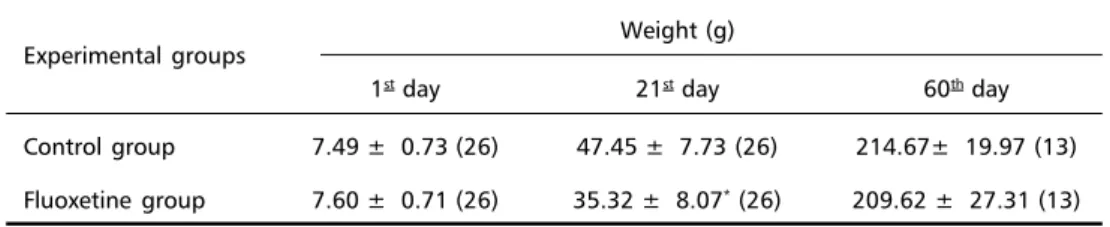
Compared t o t he Cont rol group, t he Fluoxet ine group present ed a reduct ion in t he corporal w eight gain (p < 0.05) st art ing from t he 9 t h day of life and cont inuing t o 21st day (Fig 1). At t he 60t h day of age none difference w as observed among t he cor-poral w eight s of t he groups (Table 1).
The behavioral parameters w ere appraised during the FST. LAE of the Fluoxetine group w as significantly larger (p < 0.01) w hile BI w as smaller (p < 0.01) w hen compared w ith the Control group (Tables 2 and 3).
DISCUSSION
930 Arq Neuropsiquiatr 2002;60(4)
observed that the administration of drugs acting on the synthesis and serotonin liberation, or on the ac-tivation of the serotonergic receptors, during the em-briogenesis, could result in disturbances of the growth and development of several tissues, including the nervous one. These data were confirmed by Lauder et al.22, that demonstrated a delay in the neuronal differentiation, through inhibition in the embryonic synthetic pathway of 5-HT, after maternal administration of p-chlorophenylalanine (pCPA). Decrease on the levels of 5-HT in the neonatal period, also induced reduction of the dendritic spines density in the developing nervous system. This constitute morphologic alterations of specific and permanent character, possibly resulting in damages on the syna-pses establishment15. In contrast, cultured embryonic serotonergic neurons of the mesencephalon of rats presented an increase of its density and survival19.
Other hypotesis can be relationship to the BDNF, we believe which chronic administration of SSRIs in the early life may to affect this neurotrophin, conse-quently leading the possible process of the neuroa-daptation. Accordingly with recent study a infusion of BDNF into the of hippocampus produced antide-pressant effect in the FST23. In spite of that, it is not totally been clarified that these alterations may per-sist until the adult life promoting functional dama-ges, our data corroborate this possibility.
Our observations about the reduced corporal we-ight gain of fluoxetine treated rats can be attributed to the inhibitory action of serotonin, controlling the food ingestion24. Although, the stress provided by chronic treatment with fluoxetine can induce decre-ased body weight, possibly by affect the hipothala-mic-pituitary-adrenal axis resulting disturbances in the control of corticoid function, this fact was not considered in this study. Since, saline controls animals also were treated chronically. Besides, the chronic fluoxetine treatment normalize the corticosterone secretion in depressed pacients or experimental models25. Fluoxetine is an antidepressant drug that selectively inhibits the neuronal 5-HT uptake, conse-Table 1. Body weight comparisons between the Control and Treated Groups at three different days.
Experimental groups
Weight (g)
1st day 21st day 60th day
Control group 7.49 ± 0.73 (26) 47.45 ± 7.73 (26) 214.67± 19.97 (13)
Fluoxetine group 7.60 ± 0.71 (26) 35.32 ± 8.07* (26) 209.62 ± 27.31 (13)
The treated group received fluoxetine (10mg/kg, sc; Fluoxetine group). The Control group received saline (0.9% NaCl, 1ml/kg, sc) from the 1st to the 21st day of age. The weight of the 1st, 21st and 60th day of age are compared and reported as mean ± SEM. * p < 0.05 (unpaired two-tailed Student t test). Number of animals (n) are presented below the weight columns.
Table 2. Latency of the attempt of escape of rats treated with fluoxetine or saline during the suckling period.
Latency of the
Experimental groups
attempt of escape (s)
Md PE25 -75
Control group (n=26) 154.5 117-222
Fluoxetine group (n=26) 97.5 49-161
Latency of the attempt of escape (LAE) of rats treated with fluoxetine or saline during the suckling period. All the animals were submitted to experimental depression at the 60 day of age. For each group (26 rats/group), the LAE is represented as median (Md) and 25 and 75 percentiles (PE25-75). * p< 0,01compared to the Control group (Mann-Whitney two-tailed U-test).
Table 3. Behavioral Immobility (BI) of rats treated with fluoxetine or saline during the suckling period.
Experimental groups Behavioral Immobility (s)
Md PE25 -75
Control group (n=26) 9 2-13
Fluoxetine group (n=26) 24.5 4-66
Behavioral Immobility (BI) of rats treated with fluoxetine or saline during the suckling period. All the animals were submitted to the experimental depression at the 60 day of age. For each group (26 rats/group), the BI is represented as median (Md) and 25 and 75 percentiles (PE25-75). * P< 0.01 compared to the Control group (Mann-Whitney two-tailed U-test).
Arq Neuropsiquiat r 2002;60(4) 931
quent ly increasing it s synapt ic availabilit y26, and so reduces t he hunger and t he aliment ary ingest ion in humans27 and produces hipofagia in rat s28.
The pharmacological manipulat ion of t he sero-tonergic system during the development, might have caused t he post -t reat ment decrease of t he depres-sant behaviors induced by the FST, that persisted until t he adult age, confirming t he w ell know n relat ion-ship bet w een depression and funct ional alt erat ion of t he serot onergic syst em29. In t his cont ext , t he st u-dies accomplished at our laborat ory already demons-t rademons-t ed aldemons-t erademons-t ions of demons-t he aggressive behavior, in aduldemons-t rat s submit t ed t o neonat al t reat ment w it h select ive serot onin reupt ake inhibit or9. The 5-HT is involved in t he neurobiology of depression, as w ell as in t he act ion mechanisms of ant idepressant agent s30. The presence of mult iple t ypes of serot onergic recept ors corroborat es t he hypot hesis t hat drugs w it h select ive act ion in some of t hem, can have specific propert ies in emot ional disorders2.
The decrease in t he concent rat ions of brain sero-tonin can precipitate the recurrence of the depression in depressed pat ient s31 w hile t he manipulat ion of serot onergic recept ors by pharmacological t ools has evidenced ant idepressant propert ies in some animal models32. The FST has been used t o evaluat e t he effect iveness of several ant idepressant t reat ment s5. It w as realized aft er evaluat ion of t he several act ivit y of the animals (dates not published), yet no alteration w as observed. The reduct ion of depressant behavior in t he FST, in t he Fluoxet ine group, seems t o be rela-t ed rela-t o rela-t he funcrela-t ion of rela-t he serorela-t onergic sysrela-t em5. The inhibit ion of t he 5-HT upt ake process by fluoxet ine result s possibly in it s increased availabilit y in t he synapt ic cleft , accent uat ing or facilit at ing it s act ion6. The decreased depressant behavior evaluated in adult life aft er neonat al t reat ment , in t he FST observed in t he present st udy, seem s t o be associat ed w it h neuroadapt ive mechanisms developed at t he t ime of t reat ment , t hat persist s unt il adult life.
Acknowledgements - CAPES and UFPE t hat support ed t his invest igat ion.
REFERENCES
1. Manhães de Castro R, Peregrino A, Sougey E, Barreto Medeiros JM, Deiró TCB J. Depression: repercussion in serotoninergic system. Neurobiologia 1998;61:45-55.
2. Mac Sweeney CP, Lesourd M, Gandon JM. Antidepressant-like effects of alnespirone (S 20499) in the learned helplessness test in rats. Eur J Pharmacol 1998;345:133-137.
3. Newman ME, Lerer B, Shapira B. 5-HT1A receptors-mediated effects of antidepressants. Prog Neuropsychopharmacol Biol Psychiatry 1993;17:1-19. 4. O’Neill MF, Conway MW. Role of 5-HT1A and 5-HT1B receptors in the mediation of behavior in the forced sw im test in mice. Neuropsy-chopharmacology 2001;24:391-398.
5. Page ME, Detke MJ, Dalvi A, Kirby LG, Lucki, I. Serotoninergic mediation of the effects of fluoxetine, but not desipramine, in the rat forced swim-ming test. Psychopharmacology (Berl) 1999;142:162-167.
6. Sánchez C, Hyttel J. Isolation-induced aggression in mice: effects of 5-hidroxytryptamine uptake inhibitors and involvement of post-synaptic 5-HT1A receptors. Eur J Pharmacol 1994;264:241-247.
7. Hiemke C, Härtter S. Pharmacokinetics of selective serotonin reuptake inhibitors. Pharmacol Ther 2000;85:11-28.
8. Hansen HH, Sánchez C, Meier E. Neonatal administration of the selective serotonin reuptake inhibitor Lu-10-134-C increases forced swimming-induced immobility in adult rats: a putative animal model of depression? J Pharmacol Exp Ther 1997;283:1333-1341.
9. Manhäes-de-Castro R, Barreto Medeiros J.M, Mendes-da-Silva C, et al. Reduction of intraspecific aggression in adult rats by neonatal treatment with a selective serotonin reuptake inhibitor. Braz J Med Biol Res 2001;34:121-124. 10. Nibuya M, Nestler EJ, Duman RS. Chronic antidepressant administration increases the expression of cAMP response element binding protein (CREB) in rat hippocampus. J Neurosci 1996;16:2365-2372.
11. Lipska BK, Khaing ZZ, Weickert CS, Weinberger DR. BDNF mRNA expression in rat hippocampus and prefrontal cortex: effects of neonatal ventral hip-pocampal damage and antipsychotic drugs. Eur J Neurosci 2001;14:135-144. 12. Lyons WE, Mamounas LA, Ricaurte GA, et al. Brain-derived neurotro-phic factor-deficient mice develop aggressiveness and hyperphagia in conjunction with brain serotonergic abnormalities. Proc Natl Acad Sci USA 1999;96:15239-15244.
13. Palén K, Thörneby L, Emanuelsson H. Effects of serotonin antagonists on chick embriogenesis. Wilhelm Roux’s Arch Develop Biol 1979;187:89-103. 14. Whitaker-Azmitia PM. Role of serotonin and other neurotransmitter
receptors in brain development: basis for developmental pharmacology. Pharmacol Rev 1991;43:553-561.
15. Yan W, Wilson CC, Haring JH. 5-HT1a receptors mediate the neurotro-phic effect of serotonin on developing dentate granule cells. Brain Res Dev Brain Res 1997;98:185-190.
16. Lauder JM, Wallace JA, Krebs H. Roles of serotonin in neuroembrio-genesis. Adv Exp Med Biol 1981;133:477-506.
17. Liu J, Lauder JM. Serotonin promotes region-specific glial influences on cultures serotonin and dopamine neurons. Glia 1992;5:306-317. 18. Dobbing J. Vulnerable periods in developing brain. In: Davison, AN, Dobbing
J. (Eds.). Applied Neurochemistry. Oxford Blackwell 1968;287-316. 19. Manhães-de-Castro R, Cabral Filho JE, Costa JA, Costa FBR, Galindo
MA C, Hecksher CA . Neo natal treatment w ith nalo xo ne causes permanent hyperalgesia in rats. Braz J Med Biol Res 1993;26:747-751. 20. Chopin P, Moret C, Briley M. Neuropharmacology of
5-hydroxy-tryptamine1B/ 1D receptor ligands. Pharmacol Ther 1994;62:385-405. 21. Porsolt RD, Le Pichon M, Jalfre M. Depression: a new animal model
sensitive to antidepressant treatments. Nature 1977;266:730-732. 22. Lauder JM, Towle AC, Patrick P, Henderson, P, Krebs H. Decreased
serotonin content of embryonic raphe neurons follow ing maternal administration of p-chlorophenylalanine: a quantitative imunocyto-chemical study. Brain Res 1985;352:107-114.
23. Shirayama Y, Chen AC, Nakagawa S, Russell DS, Duman RS. Brain-derived neurotrophic factor produces antidepressant effects in behavioral models of depression. J Neurosci 2002;22:3251-3261.
24. Simansky KJ. Serotonergic control of the organization of feeding and satiety. Behav Brain Res 1996;73:37-42.
25. Duncan GE, Knapp DJ, Carson S.W, Breese GR. Differential effects of chronic antidepressant treatment on swim stress- and fluoxetine-induced secretion of corticosterone and progesterone. J Pharmacol Exp Ther 1998;285:579-587. 26. Olivier B, Mo s J, van der Heyden JA M, Harto g J. Sero to nergic modulation of social interactions in isolated male mice. Psychophar-macology (Berl) 1989;97:154-156.
27. Mcguirk J, Silverstone T. The effect of the 5-HT re-uptake inhibitor fluoxetine on food intake and body weight in healthy male subjects. Int J Obes 1990;14:361-372.
28. Wong DT, Reid LR, Threlkeld PG. Suppression of food intake in rats by fluo xetine: co mpariso n o f enantio mers and effects o f sero to nin antagonists. Pharmacol Biochem Behav 1988;31:475-479.
29. Stahl S. 5-HT1A receptors and pharmacotherapy. Psychopharmacol Bull
1994; 30:39-43.
30. Meltzer HY. Role of serotonin in depression. Ann N Y Acad Sci 1990; 600:486-499.
31. Robinson DS, Alms DR, Shrotriya RC, Messina ME, Wickramaratra P. Serotoninergic anxiolytics and treatment of depression. Psychopathology 1989;22(Suppl 1):27-36.