Productivity and waste evaluation in civil construction – simulation with a reduced
model to show the advantages of using Line of Balance Technique and Thecnological
innovation on site.
Carlos Luciano S. Vargas (1); José A. Krüger (2);
Luiz Fernando M. Heineck (3); Renato de Q. Coelho (4).
(1) Civil Engineering Department, State University of Ponta Grossa. Praça Barão do Rio Branco, 233
ap.53, CEP: 84.010-710, Ponta Grossa/Pr, Brasil, E-mail: [email protected].
(2) Civil Engineering Department, State University of Ponta Grossa, Rua Castro Alves, 592, CEP:
84.020-230, Ponta Grossa/Pr, Brasil, E-mail: [email protected].
(3) Production Engineering and Systems Department, Federal University of Santa Catarina, Caixa
Postal: 476, CEP: 88.010-970, Florianópolis/SC, Brasil.
(4) Rua Ozório Duque Estrada, 998, CEP: 82.520-470, Curitiba/Pr, Brasil, E-mail:
[email protected].
Abstract - This productivity and waste evaluation exercice was developed to applied on commom classroom. This simulation objective is to bring to classroom situations that often find on field. The model consists of the frontal view of a simple building and the technique is very simple too. The productive, auxilliary and unproductive times measurement were make by inspectors and a movie camera with time lapse dispositive.
Introduction
Using games and simulators in undergraduate and graduate teaching activities on Engineering courses can bring to classrom some situations that happen on building sites. By analysing the practical exercises results we can note students trials on associating classroom acquired knowledge with field practice (SALDANHA, 1991). These simulators and/or games for civil construction students training had their development increased on 70´s, with simulators like Building Game of Building Research Establishment – BRE/UK (NOWAK, 1976) and other several simulation exercises, for example: The Building Industry Game – BIG (BJÖRNSSON, 1978); Constructo (HALPIN and WOODHEAD, 1970); Scheduling Game (SCOTT and CULLINGFORD, 1973). More recently, computer programs with graphical interfaces allowed the productive process tracking and are being considered a very useful tool to forecast conception and management problems that can occur in the construction phase. The ARENA program of Systems Modeling Corporation is being improved to simulate productive processes and can be used in civil construction operations (SOUZA,1997).
Simulation using a reduced model
The productivity and waste evaluation exercise was first developed by Heineck, 1996. It was applied during the
development of a topic related to productivity and waste evaluation on site. The focus adopted in the simulation is to bring to classroom situations that we often find on field, such as: equipment and labour unproductive times, material wastes, production lack of sequence, inadequate stocks, etc. The original purpose was to use two techniques for productivity surveying: Time Lapse Recording and the Work Sampling Technique, both utilized in other productive systems (manufacturing industry). Waste evaluation was performed according to usual material consumption measurement techniques proposed by Santos, 1996
Applying the exercise with several students crews working at the same time, we can give data a statistical treatment, obtaining productivity, consumption and waste averages. Evaluating each crew´s performance, we can also verify quality and productivity concepts such as quality control, quality evaluation, benchmarking and others.
The model utilized, execution technique and tasks
The model consists of a frontal view of a simple building (house) as presented on figure 1. Its execution technique is very simple. Using coloured cardboards (each material type has a different colour), student cut and paste materials on the model respecting the established dimensions. The chosen tasks and their respective colours were the following:
(1) piles, (2) blocks, (3) foundation beams, (6) lintels and (7) beams – light grey (concrete);
(4) damp proof course – dark grey (bitumenous material); (5)brickwall – orange (bricks);
(8) roof timbers and (9) laths for roof´s wood structure – yellow (wood);
(10) tiles and (11) top tiles – red;
(12) door frame and (13) door – brown (treated wood); (14) window frame – white (aluminium);
Project Concluded house
Fig. 1 - Model used in the
1 1
2 3 2
4 5 6
7
8 9 8
9 9
10 11
12
13 14
15
Tasks sequence
Tasks were programmed to be executed in the sequence shown in figure 2, according to Brazilian South region usual
building techniques. In the case of applying this simulation in other regions, using another technologies and materials, it will be convenient to adapt this network.
1
2
3
4
5
6
7
8
12
14
9
10
11
13
15
Fig.2 - Tasks network
Site physical arrangement, inspection and time lapse
The simulation was performed in a common classroom, placing each buiding project on a cardboard attached to a desk. In physical arrangement adopted in the simulation performed with Civil Engineering undergraduate students of State University of Ponta Grossa inspectors, identifyed by a
Simulation phases, crews and identification
In this exercise the simulation was applied in two phases: in the first one, called Exercise 1, each crew executes all tasks working at the site in all activities, from foundation to roof. Each crew was composed by one (1) skilled labourer, one (1) helper and one (1) site surveyor. The skilled labourer,
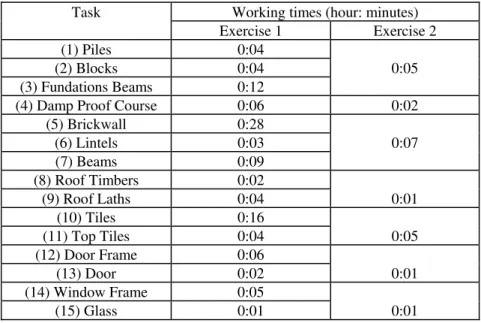
identifyed by a green helmet, was responsible for the work rhythm, the obedience to the tasks sequence and the work quality. The site surveyor (blue helmet) had to record tasks durations, materials acquired, consumed and wasted quantities using sheets specially elaborated. In Table 1, recorded times by the site surveyors are shown for each task and for each crew as well as the average duration registered for Exercise 1.
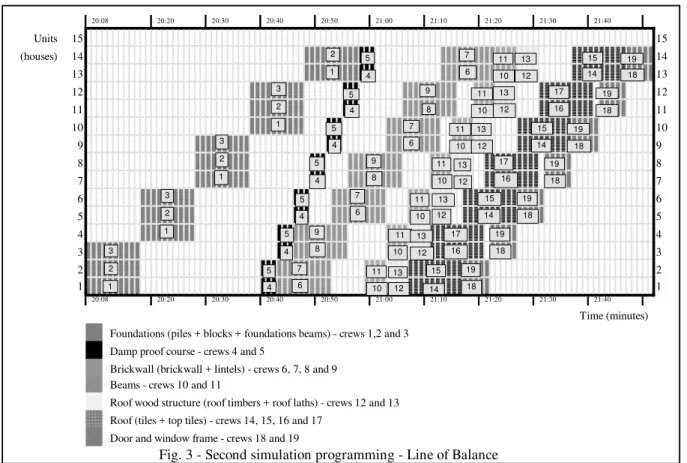
20:08 20:20 20:30 20:40 20:50 21:00 21:10 21:20 21:30 21:40
Units 15 15
(houses) 14 14
13 13 12 12 11 11 10 10 9 9 8 8 7 7 6 6 5 5 4 4 3 3 2 2 1 1
20:08 20:20 20:30 20:40 20:50 21:00 21:10 21:20 21:30 21:40
Time (minutes) Foundations (piles + blocks + foundations beams) - crews 1,2 and 3
Damp proof course - crews 4 and 5
Brickwall (brickwall + lintels) - crews 6, 7, 8 and 9 Beams - crews 10 and 11
Roof wood structure (roof timbers + roof laths) - crews 12 and 13 Roof (tiles + top tiles) - crews 14, 15, 16 and 17
Door and window frame - crews 18 and 19
Fig. 3 - Second simulation programming - Line of Balance 1 2 3 1 2 3 1 2 3 1 2 3 1 2 4 5 4 5 4 5 4 5 4 5 4 5 4 5 6 7 6 7 6 7 6 7 8 9 8 9 8 9 10 11 10 11 10 11 10 11 10 11 10 11 10 11 12 13 12 13 12 13 12 13 12 13 12 13 12 13 14 15 16 17 14 15 16 17 14 15 16 17 14 15 18 19 18 19 18 19 18 19 18 19 18 19 18 19
The second simulation, called Exercise 2, was carried out on the second day of class, after compiling first exercise productivity data obtained in the former day. Thus we could program the construction using Line of Balance (LOB) Techniques. In this particular case, we used the programming by means of subprojects utilizing the MS Project 4.1 for Windows 95 (VARGAS and HEINECK, 1997). Any Line of Balance programming techniques can be used, like for example the computer program GERAPLAN (MENDES JUNIOR and LOPEZ VACA, 1997), that uses a programming structure adequated to the purposen simulation. Figure 3 shows LOB programming utilized.
Task Working times (hour: minutes) Exercise 1 Exercise 2 (1) Piles 0:04
(2) Blocks 0:04 0:05
(3) Fundations Beams 0:12
(4) Damp Proof Course 0:06 0:02 (5) Brickwall 0:28
(6) Lintels 0:03 0:07
(7) Beams 0:09 (8) Roof Timbers 0:02
(9) Roof Laths 0:04 0:01
(10) Tiles 0:16
(11) Top Tiles 0:04 0:05
(12) Door Frame 0:06
(13) Door 0:02 0:01
(14) Window Frame 0:05
(15) Glass 0:01 0:01
Table 1 – Tasks Duration
Simulation exercises contents and goals
Preliminarly to the simulated exercises execution, a theorical content in the area of construction management was introduced, like: wastes and productivity, times and movements and building programming techniques, etc. Some objectives, related below, were proposed to be reached with the simulation of a building construction on a reduced model.
a) simulate labour productivity measurement techniques;
b) verify the occurrence of materials waste on site; c) verify the occurrence of factors affecting
productivity;
d) verify the feasibility of Construction Management Applications on building sites, specially Line of Balance Techniques.
Methodology
Each crew was responsible for the following tasks: a) study the building execution;
b) estimate building quantities in terms of materials;
c) acquire materials;
d) cut to size and trim building materials;
e) study task programming (operations sequence); f) execute the building;
g) measure the consumption of materials and level of wastes;
h) fullfill forms and tables;
i) evaluate material consumption and waste. At the same time, inspectors were asked to follow the set of activities presented below to measure labour productivity:
a) survey crew composition, identifying skilled labourers and helpers;
b) track crews performance, registering productive, unproductive and auxilliary times;
c) track and inspect tasks sequence and construction techniques utilized;
d) fullfill tables;
e) evaluate labour productivity.
Crews organizational structure, composition and distribution
It is recomended to work on the simulation with an adequate organizational structure, composed by: Coordination Crew: 2 to 3 graduate students; Inspector Crew: 3 to 9 undergraduate students; Site Crew: 3 undergraduate students (1 skilled labourer, 1 helper and 1 site surveyor). Usually, crews composition will be very heterogeneous, as this was not a official academic activity but a complementary one, putting together students from different terms joined on a voluntary basis. A system using plastified cards was utilized to distribute functions for each participant.
Required material and equipments
The following materials are required to perform the exercise: scissors, ruler (centimeters), coloured cardboards (several colours), glue and wooden stick, calculator, tables and forms, stopwatch, VHS movie camera with Time Lapse recording dispositive and photo camera.
Labour productivity evaluation
build one house) in each unit was between 40 minutes and 2 hours (average = 1 hour and 40 minutes). In the second simulation this variability was reduced for a total time pratically equal (1 hour and 40 minutes). Besides total time reduction, a visible reduction in labour quantity involved occurred. In the first exercise, there were 52 persons at the
classroom (site), taking into account execution, inspection and coordination people. In the second simulation, with LOB, in the peak of building execution we noted 30 people working at the site (8 skilled labourers + 8 helpers + 5 site surveyors + 7 inspectors + 2 coordinators).
Conclusions
The utilization of such a simple simulation model allows a great number of students training at the same time and does not need to bring to the classroom more sofisticated resources such as computers and simulation programs. At the same it can furnish information to feed virtual simulators. The proposed simulation model for civil construction buildings can make teaching activities of Engineering feasible, mainly for quantitative and qualitative surveys related to material wastes and labour productivity. It also highlights the factors affecting labour productivity, causes of wastes and the need for management actions. The exercise showed, for example: the importance of engineer presence on site, mainly when the construction has a more accelerated rhythm. With Line of Balance, it was necessary to anticipate execution crews beginning of work. If there was negligence on crews coordination, probably the productivity results would be different. The exercise made it clear that problems can be noted in the first repetitions of the work on site, avoiding problems in the future. During the exercise some management mistakes, common in practice, occurred,
ch as: waiting times, constructive defects (reworks), cost
References
JÖRNSSON, H. BIG the building industry game.
CIB-ct/78. HAL
HAL ctive gaming
MENDES JUNIOR, Ricardo; LOPEZ VACA, Oscar C. Um
su
54%
33%
13%
77%
13%
10%
706 observations 305 observations
Work
Sampling
Inspectors
48%
32%
20%
79%
11%
10%
197 observations 62 observations
Time Lapse
camera
Grph 1 - Skilled Labourer’s Productivy
Legend
Productive
Auxilliary
Unproductive
Exercise 1 Exercise 2
increases (waste) and lack of quality. Finally, with simulators utilization and with the anticipation of situations that frequently happen on site in undergraduate teaching, it is possible that some civil construction industry real problems can be attenuated and consequently this sector of industry can reach better quality and productivity in the productive process.
B
65, Second Symposium on Organization & Management of Construction, Haifa/Israel, O PIN, D.W.; WOODHEAD, R.W. Constructo - a
heuristic game for construction management.
University of Illinois Press, 1973. PIN, D.W. Constructo - an intera
enviroment. ASCE - Journal of the Construction
Division, vol. 102, mar/73, p.145-146.
sistema especialista para a geração de plano de obra
Produção (17: 1997: Gramado, RS). Resumo ... Porto Alegre: UFRGS, PPGEP, 1997. 1 CD-ROM: il. p.61. AK, F. The BRE building game: notes for lecturers
NOW .
SAL a atuação do
so
nto. Porto
l
SAN ntervenção para
SCARDOELLI, Lisiane Salerno...[et al]. Melhorias de sas
SCO ame for
the
SOU
ta de Ensino
VAR
para
GS, BRE Current Paper 49, jul/76.
DANHA, Breno L. F. Análise d
engenheiro civil no gerenciamento do proces produtivo: disciplinas envolvidas e o desenvolvimento de jogos de treiname
Alegre, 1991. Dissertação (mestrado em Engenharia Civil) - Curso de Pós-Graduação em Engenharia Civi da Escola de Engenharia da UFRGS.
TOS, Aguinaldo...[et al]. Método de i
redução de perdas na construção civil: Manual de
utilização. Porto Alegre, 1996.
qualidade e produtividade: iniciativas das empre
de construção civil. Porto Alegre, 1994.
TT, D.; CULLINGFORD, G. Scheduling g
construction industry training. ASCE - Journal of
Construction Division, vol. 99, jul/73, p.81-92. ZA, Patrícia C. de; WAZLAWICK, Raul S.;
HOFFMANN, Augusto B. Um ambiente construtivista em realidade virtual para
aprendizagem em engenharia civil. Revis
de Engenharia, Brasília, nº 18, p.24-30, nov/1997. GAS, Carlos Luciano S.; HEINECK. Luiz F. M.
Cálculo do balanço entre atividades repetitivas
uso em programas de gerenciamento de projetos.