Offi cial Publication of the Brazilian Society of Anesthesiology www.sba.com.br
REVISTA
BRASILEIRA DE
ANESTESIOLOGIA
Abstract
Background and objectives: Malignant hyperthermia (MH) is a pharmacogenetic skeletal muscle disorder characterized by a hypermetabolic state after anesthesia with succinylcholine and/ or volatile anesthetics. Various neuromuscular syndromes are associated with susceptibility; however, Moebius syndrome has not been reported. Dantrolene is the drug of choice for treatment. Recurrence may occur in up to 20% of cases after the initial event treatment.
Case Report: Male infant, fi rst twin, 7 months old, weighing 6.5 kg and presenting with Moebius syndrome was admitted for clubfoot repair. The patient had MH after exposure to sevofl urane and succinylcholine, which was readily reversed with dantrolene maintained for 24 hours. Ten hours after dantrolene discontinuation, there was recrudescence of MH that did not respond satisfactorily to treatment, and the patient died.
Discussion: Musculoskeletal disorders in children are associated with increased risk of developing MH, although Moebius syndrome has not yet been reported. Dantrolene is the drug of choice for treating this syndrome; prophylaxis is indicated during the fi rst 24-48 hours of the episode onset. The main risk factors for recurrence are muscular type, long latency after anesthetic exposure, and increased temperature. The child had only one risk factor. This case leads us to refl ect on how we must be attentive to children with musculoskeletal disease and maintain treatment for 48 hours.
© 2013 Sociedade Brasileira de Anestesiologia. Published by Elsevier Editora Ltda. All rights reserved.
Fatal Recrudescence of Malignant Hyperthermia
in an Infant with Moebius Syndrome
Cláudia Regina Fernandes*
2, Washington Aspiculeta Pinto Filho
1,
Lia Cavalcante Cezar
3, Josenília Maria Alves Gomes
4,
Glauco Kleming Florencio da Cunha
51. TSA; PhD; Professor of Medicine, Universidade de Fortaleza (Unifor); Responsible for CET/MEC/SBA, Hospital Universitário Walter Cantídio, Universidade Federal do Ceará (UFC), Fortaleza, Ceará, Brazil 2. TSA; Co-responsible for CET/MEC/SBA, Hospital Universitário Walter Cantídio, UFC; Anesthesiologist, Hospital Infantil Albert Sabin, Secretary of Health of Ceará, Fortaleza, Ceará, Brazil
3. Medical specialization in Anesthesiology, CET/MEC/ SBA, Hospital Universitário Walter Cantídio, UFC, Fortaleza, Ceará, Brazil
4. TSA; PhD; Professor of Medicine, UFC; Pedagogical Supervisor of the Medical Course at Unifor; Responsible for CET/MEC/SBA, Oziel de Sousa Lima, Santa Casa de Misericordia de Sobral, UFC, Fortaleza, Ceará, Brazil 5. TSA; Masters in Public Health, Universidade Estadual do Ceará; Co-responsible for CET / MEC / SBA, University Hospital Walter Cantídio, UFC, Chief of Surgical Theatre, Hospital Infantil Albert Sabin, Fortaleza, Ceará, Brazil Received from Universidade de Fortaleza (Unifor), Fortaleza, Ceará, Brazil.
Submitted on April 7, 2012. Approved on June 12, 2012.
Keywords:
Malignant Hyperthermia; Anesthesia, Inhalation/ sevofl urane;
Succinylcholine; Mobius Syndrome.
CLINICAL INFORMATION
*Corresponding author: E-mail: [email protected]
Introduction
Malignant hyperthermia (MH) is a hereditary pharmacogene-tic skeletal muscle disorder characterized by a hyperme-tabolic state after anesthesia with succinylcholine and/or volatile anesthetics 1-3.
The initial diagnosis is clinical, mainly characterized by tachycardia and increased end-tidal carbon dioxide. In the late phase, there is rapid increase in body temperature and extreme acidosis, marked by loss of intracellular calcium ion levels and uncontrolled increase in skeletal muscle metabo-lism, which may progress to severe rhabdomyolysis 4.
In the 1980s, the caffeine-halothane contracture test became the gold standard diagnostic test for MH and a variety of neuromuscular disorders associated with susceptibility to this syndrome. Duchenne muscular dystrophy, congenital myotonia, myotonic dystrophy, nonspecifi c myopathies, central core disease, King Denborough syndrome, osteo-genesis imperfecta, and Schwartz-Jampel syndrome were reported 5.
Incidence and prevalence of MH are variable, with no difference regarding gender or ethnicity. The incidence varies with age: approximately 1:50,000 in adults and 1:15,000 in children 6-10.
The pathophysiological mechanism is associated with ryanodine receptor type-1 (RYR1) mutation, which is respon-sible for calcium release from the sarcoplasmic reticulum. Mutation in RYR1 is found in approximately 50% of the sus-ceptible families 11-13.
The occurrence of MH is seen in the fi rst or in subsequent exposures to halogenated agents 14,15.
Currently, dantrolene remains the primary basis for the successful management of MH 16,17.
The syndrome recrudescence may occur in up to 20% of cases, mostly within 16 hours of the clinical condition onset 18.
Moebius syndrome is a rare disorder, characterized by unilateral or bilateral facial paralysis and extraocular mo-vements defects, secondary to congenital paralysis of the facial (VII) and abducens (VI) nerves 19,20. It is followed by
other cranial nerve dysfunctions, orofacial abnormalities, musculoskeletal hypotonia, and orthopedic anomalies, in-cluding clubfoot 21.
To date, there is no report in literature on the association between Moebius syndrome and malignant hyperthermia. The aim of this study was to report a case of malignant hyperthermia in an infant with Moebius syndrome, as well as its management and outcome.
Case Report
Male infant, fi rst twin, 7 months old, weighing 6.5 kg, pre-senting a history of prematurity (born at 34 weeks gestation) and Moebius syndrome. He was admitted for surgical repair of clubfoot and showed development consistent with his age. Laboratory tests were normal. The patient did not undergo prior surgery, and there were no reports of complications with general anesthesia in the family. On arrival to the operating room, the patient was monitored with ECG, pulse oximetry, and noninvasive blood pressure. After preoxygenation for 5 minutes, inhalational induction with sevofl urane 3% was started, followed by venoclysis. Soon after exposure to the
halogenated anesthetic agent, the infant had hypertonia and agitation, which was interpreted as absence of anesthetic plan. For management, the concentration of sevofl urane was increased to 8%, followed by administration of atropine (20 mcg.kg-1) and muscle relaxation with succinylcholine
(1 mg.kg-1), resulting in additional hypertonia, generalized
muscle contraction including masseter muscle, which pre-vented tracheal intubation and impaired the ventilation by mask, with consequent desaturation. The hypothesis of MH was suggested, sevofl urane was discontinued, and rocuronium (1 mg.kg-1) was administered in order to
facili-tate tracheal intubation. The child was intubated and the surgery canceled. The patient was monitored with PETCO2, axillary temperature, and blood pressure measurements. In the fi rst 10 minutes after exposure to the triggering agents, there was a progressive increase of PETCO2 (levels near 80 mm Hg), despite hyperventilation; tachycardia (rate of 150 bpm, evolving to 180 bpm); hypertension (120/80 mm Hg), even with the use of midazolam (0.1 mg.kg-1). After 20
mi-nutes of the event occurrence, hyperthermia (T = 38°C) was observed. Laboratory tests were performed (arterial blood gases and electrolytes), and general and specifi c measures for MH were established.
Ringer lactate was administered with 1% glucose (20 mL.kg-1) and cooling performed with physical means
(air-cooling system, cold pads, and cold serum). The patient was hyperventilated with O2 (100%), reducing PETCO2 to 45 mm Hg. After measurement of arterial blood gases and electrolytes (Table 1), mixed metabolic acidosis associated with hyperkalemia was diagnosed, and NaHCO3 8.4% (1 mEq. kg-1), calcium gluconate 10% (20 mg.kg
-1), and bolus of Ringer
lactate (20 mL.kg-1) were administered. Specifi c treatment
for MH was performed with dantrolene (2.5 mg.kg-1), which
occurred approximately 60 minutes after the onset of signs and symptoms.
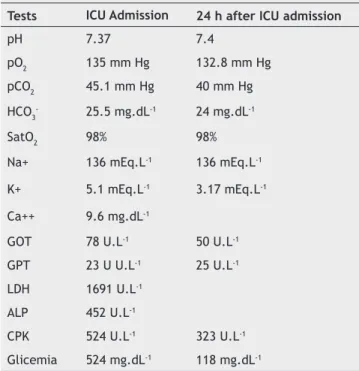
Overall condition improvement was observed after dan-trolene administration. The intubated and sedated infant was taken to the Intensive Care Unit (ICU). Dantrolene was prescribed at doses of 1 mg.kg-1 every 6h. Laboratory tests
as response curve were performed to assess the degree of muscle destruction, blood gas, and electrolytes (Table 2). ICU baseline clinical parameters were satisfactory. Hyperthermia, tachycardia, hypertension or desaturation were not observed.
The patient developed respiratory failure, with SatO2 up to 80%, despite FiO2 of 100%, proper ventilation, and no changes in chest X-ray. New laboratory tests (Table 3) were
Table 1 Arterial blood gases and electrolytes.
Blood gas Electrolytes
pH 7.17 Na+ 139.7 mEq.L-1
pCO2 55.7 mmHg K+ 5.1 mEq.L-1
pO2 297 mmHg Blood glucose 334 mg.dL-1 SatO2 99%
HCO3- std 17.4 mEq.L-1
BE (-8.6)
performed and arterial blood gases showed signifi cant respi-ratory acidosis, hyperkalemia, and hyperglycemia. He evolved with cardiac arrhythmias (extrasystoles), desaturation, and bradycardia with cardiopulmonary arrest (CA). CA protocol was applied and dantrolene (1 mg.kg-1) reintroduced, without
success, and the patient died due to asystolic CA.
Discussion
MH is a potentially fatal medical condition. The Clinical Grading Scale criteria to predict MH are: respiratory acidosis characterized by end-tidal CO2 (ETCO2 > 55 mm Hg); PaCO2 > 60 mm Hg observed in arterial blood gas; unexplained cardiac
manifestation characterized by sinus tachycardia, ventricular tachycardia or ventricular fi brillation; metabolic acidosis with a base defi cit > 8 mEq.L-1; pH < 7.25; generalized muscle
rigidity; severe masseter muscle rigidity; muscle lysis repre-sented by serum creatine phosphokinase (CPK > 20,000 U.L-1);
dark urine; increased myoglobin levels in plasma or urine; plasma potassium > 6 mEq.L-1; rapid rise of temperature;
temperature > 38.8°C; rapid reversal of MH signs with dan-trolene administration; elevated serum concentration of creatine phosphokinase at rest; family history consistent with autosomal dominant inheritance 22. The case presented here
had the classical clinical diagnostic criteria for MH.
In an American study assessing 286 cases of MH between 1987 and 2006, it was found that the most frequently manifes-ted clinical signs were: hypercarbia (92.2%), sinus tachycardia (72.9%), rapid increase in core body temperature (64.7%), generalized muscle rigidity (40.8%), masseter spasm (26.7%), and sweating (17.6%) 23. This clinical signs were present in
the infant in question.
The main point of the management and treatment of an acute crisis is the immediate discontinuation of the triggering agent, followed by hyperventilation associated with adminis-tration of dantrolene (2.5 mg.kg-1), which can be repeated
until the MH crisis is aborted. The suggested dose limit of dandrolene is 10 mg.kg-1, which may be increased
depen-ding on the case. Cooling measures should be started and arrhythmias treated; do not use calcium channel blockers; perform blood tests (blood gas, electrolytes, creatine phos-phokinase, myoglobin plasma and urine, coagulation profi le should be checked every 6 to 12 hours); hyperkalemia should be treated when indicated; continue dantrolene at a dose of 1 mg.kg-1 every 4 to 8 hours for 24 to 48 hours. The desired
urine output is 2 mL.kg.min-1, which can be stimulated with
mannitol, furosemide and fl uids, if necessary; assess the need for invasive monitoring and mechanical ventilation; observe the patient in the ICU for at least 36 hours. It is recommen-ded to refer the patient and family to an MH testing center for contracture or DNA test. Patients affected by MH must receive dantrolene and be closely monitored for 48 to 72 hours, as even with dantrolene treatment, 20% of patients may experience recrudescence of the symptoms 18,22.
In the case described here, all recommendations were followed. Dantrolene was administered every 6 hours during the 24 hours following the initial episode, as recommended in the literature, but recrudescence occurred 10 hours after drug treatment discontinuation.
Laboratory evaluation after the event should include testing for disseminated intravascular coagulation (DIC), as well as the observation of myoglobinuria and renal function. DIC is more frequent when the body temperature exceeds 41°C 22. In the case described, muscle lysis was not intense,
as seen on the initial tests, and there was no myoglobinuria, probably because treatment was started early.
Currently, dantrolene is the only treatment specifi c for MH. Because this syndrome present with nonspecifi c signs and treatment delay results in life-threatening outcome, this drug should be administered as soon as MH is suspected. However, dantrolene does not come without its complications - hepatotoxicity is one of its potential adverse effects 15,24. In
an analysis of 368 patients who received dantrolene for MH treatment, the most frequent complications were muscle
Table 2 Laboratory tests – response curve during Intensive Care (ICU) stay.
Tests ICU Admission 24 h after ICU admission
pH 7.37 7.4
pO2 135 mm Hg 132.8 mm Hg
pCO2 45.1 mm Hg 40 mm Hg
HCO3- 25.5 mg.dL-1 24 mg.dL-1
SatO2 98% 98%
Na+ 136 mEq.L-1 136 mEq.L-1 K+ 5.1 mEq.L-1 3.17 mEq.L-1 Ca++ 9.6 mg.dL-1
GOT 78 U.L-1 50 U.L-1
GPT 23 U U.L-1 25 U.L-1 LDH 1691 U.L-1
ALP 452 U.L-1
CPK 524 U.L-1 323 U.L-1 Glicemia 524 mg.dL-1 118 mg.dL-1
GOT: Glutamic oxaloacetic transaminase; GPT: Glutamic pyruvic transaminase; ALP: Alkaline phosphatase; CPK: creatine phosphokinase; LDH: Lactate dehydrogenase.
Table 3 Evolution of arterial blood gases and electrolytes.
Arterial
blood gas Electrolytes
pH 6,8 Na+ 122 mEq.L-1
pCO2 91 mm Hg K+ 6.6 mEq.L-1
pO2 113 mm Hg Blood Glucose 425 mg.dL-1
SatO2 99%
HCO3- std 31 mEq.L-1
BE (-) 6
weakness (21.7%), phlebitis (9%), gastrointestinal discomfort (4.1%), and respiratory failure (3.8 %) 25. There are reports of
apnea in newborns and infants after using this drug 26,27.
Due to the potential toxicity of dantrolene and its respira-tory depression effect on infants, in addition to complications associated with prolonged mechanical ventilation 28, dantrolene
discontinuation was decided after 24 hours. Unfortunately, the syndrome recrudescence occurred 10 hours after treat-ment discontinuation.
Recrudescence is defi ned as the development of MH signs 2 hours after the initial episode treatment. Recrudescence clinical signs include increased heart rate, minute ventila-tion to maintain PaCO2, and temperature. In a case-control study, data from 308 patients with HM were collected, 63 in the recrudescent group and 245 in the control group. Recrudescence occurred between 2.5 and 72 hours after the MH episode, with 80% occurring at the fi rst 16 hours. The three main factors associated with recrudescence were muscular type, HM episode long latency after induction of anesthesia, and increased temperature 18. The infant in the
case reported here had only one risk factor for recrudescence (increased temperature at the time of the initial episode), which occurred 36 hours after the initial episode and 10 hours after discontinuation of treatment with dantrolene.
Because MH has a strong genetic character, and the pa-tient reported here was a monochorionic twin, contracture test in the other twin would be extremely benefi cial in diagnosing the syndrome. However, the non-recommendation of this diagnostic test in children weighing less than 20 kg prevents its realization 29. Thus, clarifying and counseling the
family were adopted as a means of preventing morbidity in the other twin.
In a study assessing quantitatively the existence of comor-bidities and MH diagnosis, it was found that compared with the general pediatric population, children diagnosed with MH had signifi cant comorbidities, such as musculoskeletal system and connective tissue diseases, circulatory system di-seases, and congenital anomalies. The specifi c diagnosis most strongly associated with MH was muscular dystrophy 30. The
child described here had a musculoskeletal syndrome, which corroborates the fi ndings of the above-mentioned study.
After consideration on the case, we understand that close attention should be paid to children with comorbid condi-tions, particularly musculoskeletal syndromes and muscular dystrophies. We understand the importance of dantrolene administration for a time exceeding 24 hours; the need for a better understanding of this syndrome by anesthesiologists, intensive care team, and other professionals; and that the possibility of MH recrudescence should always be considered. Moreover, the availability of dantrolene in all hospitals is es-sential for managing cases, as well as research development for new drugs specifi c for MH, such as azumolene, possibly less toxic 31.
References
1. Denborough M - Malignant hyperthermia. Lancet. 1998;3:1131-1136.
2. Stratman RC, Flynn JD, Hatton KW - Malignant hyperthermia: a pharmacogenetic disorder. Orthopedics. 2009;32:835.
3. Uchoa RB, Fernandes CR - Rabdomiólise induzida por exercício e risco de hipertermia maligna. Relato de caso. Rev Bras Anestesiol. 2003;53:63-68.
4. Denborough MA - Malignant hyperthermia. Anesthesiology. 2008;108:156-157.
5. Heiman-Patterson TD, Rosenberg H, Fletcher JE et al. - Halothane-caffeine contracture testing in neuromuscular diseases. Muscle Nerve. 1988;11:453-457.
6. Sumitani M, Uchida K, Yasunaga H et al. - Prevalence of malignant hyperthermia and relationship with anesthetics in Japan: data from the diagnosis procedure combination database. Anesthesiology. 2011;114:84-90.
7. Brady JE, Sun LS, Rosenberg H et al. - Prevalence of malignant hyperthermia due to anesthesia in New York State, 2001-2005. Anesth Analg. 2009;109:1162-1166.
8. Ording H - Incidence of malignant hyperthermia in Denmark. Anesth Analg. 1985;64:700-704.
9. Pollock AN, Langton EE, Couchman K et al. - Suspected malignant hyperthermia reactions in New Zealand. Anaesth Intensive Care. 2002;30:453-461.
10. Simões CM, Koishi GN, Rozatti M et al. – Estamos preparados para diagnosticar e conduzir um episódio de hipertermia maligna? Rev Bras Anestesiol. 2003;53:248-257.
11. Carpenter D, Ringrose C, Leo V et al. The role of CACNA1S in predisposition to malignant hyperthermia. BMC Med Genet. 2009;10:104.
12. Carpenter D,Morris A,Robinson RL et al. Analysis of RYR1 haplotype profi le in patients withmalignant hyperthermia. Ann Hum Genet.2009;73:10-18.
13. Lanner JT. Ryanodine receptor physiology and its role in disease. Adv Exp Med Biol.2012;740:217-234.
14. Chen PL, Day YJ, Su BC et al. - Delayed onset of sevofl urane-induced juvenile malignant hyperthermia after exposure. Acta Anaesthesiol Taiwan. 2007;45:189-193.
15. Fernandes CR, Azevedo DM, Gomes JM et al. - Malignant hyperthermia in a liver transplant patient: a case report. Transplant Proc. 2007;39:3530-3532.
16. Krause T, Gerbershagen MU, Fiege M et al. - Dantrolene: a review of its pharmacology, therapeutic use, and new developments.
Anaesthesia. 2004;59:364-373.
17. Inan S, Wei H - The cytoprotective effectsof dantrolene: a ryanodine receptor antagonist. Anesth Analg. 2010;111:1400-410.
18. Burkman JM, Posner KL, Domino KB - Analysis of the clinical variables associated with recrudescence after malignant hyperthermia reactions. Anesthesiology. 2007;106:901-906. 19. Gondipalli P, Tobias JD - Anesthetic implications of Möbius
syndrome. J Clin Anesth. 2006;18:55-59.
20. Hobaika AB, Neves BS, Fernandes ML et al. - Anestesia para paciente portador da síndrome de Moebius. Relato de caso. Rev Bras Anestesiol. 2009;59:341-343.
21. Almeida MBV, Brandt CT, Lima JA et al. - A incidência de anomalias ortopédicas em portadores da síndrome de Moebius e sua associação com o uso do misoprostol. Rev Bras Ortop. 2007;42:10-16.
22. Rosenberg H,Davis M,James D et al. - Malignant hyperthermia. Orphanet J Rare Dis.2007;24;2:21.
23. Larach MG, Gronert GA, Allen GC et al. - Clinical presentation, treatment, and complications of malignant hyperthermia in North America from 1987 to 2006. Anesth Analg. 2010;110:498-507.
25. Brandom BW,Larach MG,Chen MS et al. - Complications associated with the administration of dantrolene 1987 to 2006: a report from the North American Malignant Hyperthermia Registry of the Malignant Hyperthermia Association of the United States. Anesth Analg.2011;112:1115-1123.
26. Pollock N, Langtont E, Stowell K et al. - Safe duration of postoperative monitoring for malignant hyperthermia susceptible patients. Anesth Intensive Care. 2004;32:502-509. 27. Lerman J, McLeod ME, Strong HA - Pharmacokinetics of intravenous dantrolene in children. Anesthesiology. 1989;70:625-629.
28. Monteverde E,Fernández A,Poterala R et al. - Characterization of pediatricpatients receivingprolongedmechanical ventilation. Pediatr Crit Care Med.2011;12:287-91.
29. Maccani RM, Wedel DJ, Melton A et al. - Femoral and lateral femoral cutaneous nerve block for muscle biopsies in children. Paediatr Anaesth. 1995;5:223-227.
30. Li G,Brady JE,Rosenberg H et al. - Excesscomorbiditiesassociated withmalignant hyperthermiadiagnosisinpediatrichospital dischargerecords. Paediatr Anaesth.2011;21:958-963. 31. Sudo RT - Effects of azumolene on normal and malignant