DOI: http://dx.doi.org/10.5007/1980-0037.2017v19n2p233
Volleyball: analysis of attack performed from
the backcourt on men’s Brazilian Volleyball
Superleague (Brazilian Championship)
Voleibol: análise do ataque realizado a partir do fundo
da quadra na Superliga Masculina Brasileira
Gustavo De Conti Teixeira Costa1
Breno Ferreira de Britto Evangelista2
Mariana Pereira Maia1
Juliana Sampaio Ceccato2
Auro Barreiros Freire2
Michel Milistetd3
José Cícero Moraes4
Herbert Ugrinowitsch5
Abstract – he aim of this study was to identify the efect of attacks from positions 1 and 6 in high-level Brazilian Men’s Volleyball in order to understand the ofensive structure of the game. he sample was composed of the observation of 142 2014-2015 Men’s Superleague games, totaling 2969 reception, set and attack actions from positions 1 and 6. he results showed association between place of attack, attack tempo, type of attack and efect of attack (p<0.001). he results showed that the point of attack, when it is performed from position 6, is associated with parallel attack, while, when analyzing position 1, the point of attack is associated with potent diagonal attack. Furthermore, placed attack was associated with game continuity, as well as with low-quality receptions (b and c). In this context, it was concluded the attacking position inluences the attack eicacy, according to time and type of attack.
Key words: Analysis of Situation; Eicacy; Volleyball.
Resumo – O objetivo deste estudo foi identiicar o efeito do ataque das posições 1 e 6 no voleibol masculino brasileiro de alto nível, no intuito de compreender melhor a estruturação ofensiva do jogo. A amostra constituiu-se pela observação de 142 jogos da Superliga Masculina 2014-2015, totalizando 2969 ações de recepção, levantamento e ataque das posições 1 e 6. Os resultados mostraram que houve associação entre o local do ataque, o tempo de ataque, o tipo de ataque e o efeito do ataque (p<0,001). Os resultados mostraram que o ponto de ataque, quando o mesmo é realizado a partir da posição 6, associa-se ao ataque na paralela, enquanto, ao analisar a posição 1, o ponto de ataque associa-se ao ataque potente na diagonal. Além disso, o ataque colocado associou-se à continuidade do jogo, assim como as recepções de baixa qualidade (b e c). Neste contexto, conclui-se que a posição do atacante inluencia na eicácia do ataque utilizado, segundo
1 Federal University of Goiás, Goiâ-nia, GO. Brazil.
2 Estácio University Center of Belo Horizonte. Belo Horizonte, MG. Brazil.
3 Federal University of Santa Catari-na. Florianópolis, SC. Brazil.
4 Federal University of Rio Grande do Sul, Porto Alegre. RS, Brazil.
5 Federal University of Minas Gerais. Belo Horizonte. MG, Brazil.
Analysis of the attack on men’s Superleague Costa et al.
INTRODUCTION
Tactical behavior, such as a complex system, results from emerging patterns of actions that can be considered separately, since they exhibit partial independence1 and these subsystems result in the alteration and
self-organization of the complex system, that is, the game2. In this
con-text, it is essential to investigate the relationship involving performance indicators of the game, and predictive studies are predominantly related to the relationship between sports skills and success in the game, player position, game phase3 and place of attack4.
Volleyball surveys have sought to understand the game in terms of the inal result of the game5-6, the position of the team at the end of the
com-petition7-8 and type of game9-10, showing that high performance levels in
serve5, attack11, and block7 can predict success in the game. In this context,
studies have shown that attack was the fundamentals that most inluenced the conquest of scores and the inal result of the game12, requiring that the
ofensive construction, when there are ideal conditions of distributions, occurs with four attackers13.
However, researches were mostly focused on the general understanding of the game practiced, speciically the efectiveness of actions11,14,
disre-garding the situational constraints imposed on the diferent situational scenarios. In addition, it was observed that the analysis of the game mostly occurs from attacks carried out from positions 2, 3 and 4, since these posi-tions are the most requested by the setter4. hus, the aim of this study was
to identify the type of game practiced in the attack from the backcourt, that is, positions 1 and 6 of the high-level Brazilian volleyball in order to improve the understanding about the ofensive structure of the game to better propose interventions of professionals of the volleyball area.
METHODOLOGICAL PROCEDURES
Sample
he sample consisted of the observation of 142 2014-2015 Men’s Super-league games, totaling 2969 reception, set and attack actions from positions 1 and 6. Position 5 was not considered because there were no attacks from this region, which is explained by the fact that it corresponds to the position of permanence of the libero player in teams evaluated. Wrong receptions were excluded from the sample, since they did not allow the continuation of the action and subsequent attack accomplishment.
Variables
Efect of Reception: To evaluate the quality of reception, the instrument proposed by Eom and Schutz15 was adapted. he following classiication
scale was used:
although not all attackers were available for the attack; more specii-cally, it reduced the chances of rapid attacks.
• Excellent Reception (A): Reception that allowed organizing the attack with all attackers available for attack.
• Attack tempo: he categories that make up this dimension were adapted from Afonso et al.16 and the following scale was used:
• 1st attack tempo: the attacker jumped during or immediately after the
set, which can occur one step after set;
• 2nd attack tempo: the attacker made two or three steps after set;
• 3rd attack tempo: the attacker waited for the ball to reach the peak of
the upward trajectory, and only then he start the attack pass.
Type of attack: it corresponds to the technical criteria related to the attack. To analyze the type of attack, an adaptation of the instrument pro-posed by Costa et al.13,17 was used. Attacks exploiting the blockage, when
carried out with power were grouped into powerful parallel or diagonal attacks, according to the trajectory of the ball, while placed attacks that explored the blockade were grouped into placed attacks category. In this sense, the following categories were grouped:
• Powerful parallel attack: Attack performed from position 1 in down-ward trajectory, parallel to the side line with maximum power to the hit or attack performed from position 6 in downward trajectory, directed to zone 6 of the opposing team with maximum power.
• Powerful diagonal attack: attack carried out in descending trajectory, diagonally to the lateral line with maximum power.
• Placed attack: the ball is contacted with the backcourt.
Efect of attack: An adaptation of instruments proposed by Eom and Schutz15 and Marcelino, Mesquita and Sampaio8 was used, obtaining the
following categories:
• Error: he attacker failed in the attack, once the ball hit the net, was out or some infraction occurred.
• Blocking: the attack was blocked and resulted in a score for the op-ponent.
• Defense: the attack action did not result in a terminal action and al-lowed the opponent counterattack.
• Point of Attack: he attack resulted in a direct score as the ball touched the opponent’s ield or was delected by blocking of the court.
Procedure for data collection
Analysis of the attack on men’s Superleague Costa et al.
meters above ground level for better viewing of video scenes. A Sony camera with 1080p HD deinition and frequency rate of 60 Hz was used. Observers were Physical Education teachers and volleyball statisticians with at least 5 years experience in this speciic function. To calculate reliability, 20% of actions were re-analyzed, surpassing the reference value of 10%18. Cohen
Kappa values for inter and intra-observer reliability, respectively, were: efect of reception = 0.98 and 0.96; setting time = 0.90 and 0.92; type of attack = 1.00 and 1.00; efect of attack = 1.00 and 1.00. In this sense, the reliability values are above the reference value, which is 0.7519.
Statistical Procedures
Data analysis used the chi-square test with Monte Carlo correction, when-ever less than 20% of cells presented values lower than 5. he adjusted residues were calculated with the objective of identifying which cells pre-sented statistical signiicance in explaining the relationship between two variables. hus, this relation is considered only when values were equal to or greater than │2│. In addition, the efect size was calculated using Phi (ɸ) and the signiicance level was 5% (p≤0.05). Statistical Package for Social Sciences (SPSS) software version 20.0 for Windows was used.
RESULTS
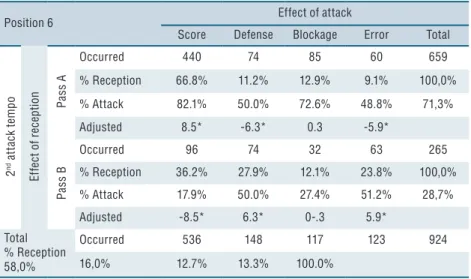
Inferential analysis of data collected showed that there was an association (Χ2 = 93.93, p <0.001; ɸ = 0.32) between the efect of reception and the
efect of attack from position 6, according to the attack tempo (Table 1).
Table 1. Association between effect of reception and effect of attack from position 6
Position 6 Effect of attack
Score Defense Blockage Error Total
2
nd a
tt
ac
k t
em
p
o
E
ff
ec
t o
f r
ec
ep
ti
o
n
P
as
s A
Occurred 440 74 85 60 659
% Reception 66.8% 11.2% 12.9% 9.1% 100,0%
% Attack 82.1% 50.0% 72.6% 48.8% 71,3%
Adjusted 8.5* -6.3* 0.3 -5.9*
P
as
s B
Occurred 96 74 32 63 265
% Reception 36.2% 27.9% 12.1% 23.8% 100,0%
% Attack 17.9% 50.0% 27.4% 51.2% 28,7%
Adjusted -8.5* 6.3* 0-.3 5.9*
Total % Reception 58,0%
Occurred 536 148 117 123 924
16,0% 12.7% 13.3% 100.0%
* Association found for p <0.05
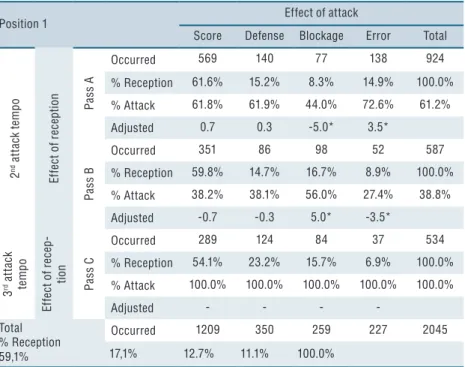
he inferential analysis of data collected showed that there was as-sociation (Χ2 = 32.46, p <0.001, ɸ = 0.15) between efect of reception and
Score Defense Blockage Error Total
2
nd a
tt ac k t em p o E ff ec t o f r ec ep ti o n P as s A
Occurred 569 140 77 138 924
% Reception 61.6% 15.2% 8.3% 14.9% 100.0%
% Attack 61.8% 61.9% 44.0% 72.6% 61.2%
Adjusted 0.7 0.3 -5.0* 3.5*
P
as
s B
Occurred 351 86 98 52 587
% Reception 59.8% 14.7% 16.7% 8.9% 100.0%
% Attack 38.2% 38.1% 56.0% 27.4% 38.8%
Adjusted -0.7 -0.3 5.0* -3.5*
3
rd a
tt ac k te mp o E ff ec t o f r ec ep -ti on P as s C
Occurred 289 124 84 37 534
% Reception 54.1% 23.2% 15.7% 6.9% 100.0%
% Attack 100.0% 100.0% 100.0% 100.0% 100.0%
Adjusted - - -
-Total % Reception 59,1%
Occurred 1209 350 259 227 2045
17,1% 12.7% 11.1% 100.0%
* Association found for p <0.05
he inferential analysis of data collected showed that there was an as-sociation (Χ2 = 22.81, p <0.001; ɸ = 0.16) between type of attack and efect
of attack from position 6 (Table 3), according to attack tempo.
Table 3. Association between type of attack and effect of attack in position 6
Position 6
Effect of attack
Score Defense
Block-age Error Total
2
nd a
tt ac k t em p o Ty p e o f a tt ac k Po w er fu l i n D ia gon
al Occurred 270 106 64 75 515
% Type of attack 52.4% 20.6% 12.4% 14.6% 100,0%
% Attack 50.4% 71.6% 54.7% 61.0% 55,7%
Adjusted -3.9* 4.2* -0.2 1.3
P ow er fu l in p ar all
el Occurred 266 42 53 48 409
% Type of attack 65.0% 10.3% 13.0% 11.7% 100,0%
% Attack 49.6% 28.4% 45.3% 39.0% 44,3%
Adjusted 3.9* -4.2* 0.2 -1.3
Total
% Type of attack 58,0%
Occurred 536 148 117 123 924
16,0% 12.7% 13.3% 100.0%
* Association found for p <0.05
Inferential analysis of data collected showed that there was an associa-tion (Χ2 = 44.23, p <0.001; ɸ = 0.17) between type of attack and efect of
Analysis of the attack on men’s Superleague Costa et al.
Table 4 - Association between type of attack and effect of attack in position 1.
Position 1 Effect of attack
Score Defense Blockage Error Total
2
nd a
tt ac k t em p o D ir ec ti o n o f a tt ac k P ow er fu l in p ar all
el Occurred 338 95 70 82 585
% Type of attack 57.8% 16.2% 12.0% 14.0% 100,0%
% Attack 36.7% 42.0% 40.0% 43.2% 38,7%
Adjusted -2.0* 1.1 0.4 1.3
Po w er fu l i n D ia gon
al Occurred 514 87 85 82 768
% Type of attack 66.9% 11.3% 11.1% 10.7% 100,0%
% Attack 55.9% 38.5% 48.6% 43.2% 50,8%
Adjusted 4.9* -4.0* -0.6 -2.3*
P
lac
ed
Occurred 68 44 20 26 158
% Type of attack 43.0% 27.8% 12.7% 16.5% 100,0%
% Attack 7.4% 19.5% 11.4% 13.7% 10,5%
Adjusted -4.9* 4.8* 0.4 1.6
3
rd a
tt ac k t em p o D ir ec ti o n o f a tt ac k e P ow er fu l in p ar all
el Occurred 68 49 41 13 171
% Type of attack 39.8% 28.7% 24.0% 7.6% 100,0%
% Attack 23.5% 39.5% 48.8% 35.1% 32,0%
Adjusted -4.6* 2.0* 3.6* 0.4
Po w er fu l i n D ia gon
al Occurred 211 54 31 19 315
% Type of attack 67.0% 17.1% 9.8% 6.0% 100,0%
% Attack 73.0% 43.5% 36.9% 51.4% 59,0%
Adjusted 7.2* -4.0* -4.5* -1.0
P
lac
ed
Occurred 10 21 12 5 48
% Type of attack 20.8% 43.8% 25.0% 10.4% 100,0%
% Attack 3.5% 16.9% 14.3% 13.5% 9,0%
Adjusted -4.9* 3.5* 1.8 1.0
Total
% Type of attack 59,1%
Occurred 1209 350 259 227 2045
17,1% 12.7% 11.1% 100.0%
* Association found for p <0.05.
DISCUSSION
he aim of this study was to identify the efect of attack from positions 1 and 6 on high-level Brazilian men’s volleyball in order to better understand the ofensive structure of the game. he results showed that attack from position 6 occurred only after the 2nd attack tempo, observing that after pass
pass was A, attack error occurred more than expected and attack blocking less than expected and when pass was B, attack blockade occurred more than expected and attack error less than expected. Data analysis showed that there was a 3rd time set for position 1 after reception C. Although no
articles were found in literature that speciically analyzed the efectiveness of the backcourt attack, it was found that the results found are partially in agreement with literature, which indicates that the quality of reception interferes in the efect of attack5. In this context, high-quality receptions
allow the achievement of the score, while low-quality receptions generate attack error17 or the continuity of the game20. hus, excellent distribution
conditions, generated by high-quality reception, temporarily restrain the defensive system, increasing the attack efectiveness21. he fact that there
was no 3rd time attack for position 6 shows the need to play fast through
the center of the court in order to ix the central blocker and delay the block movement in order to limit the defensive action, i.e., to reduce the number of compact and triple double blocks, since they reduce the chances of attack success22. In addition, attack performed from position 1, after reception C,
showed that it was intended to use the ends of the net, forcing the central blocker to react to the set, suggesting that the setter’s strategy was based on reading the game as reported by Afonso et al.23.
he analysis of the efect of attack from position 6 showed that after the 2nd attack tempo, the powerful diagonal attack allowed the defense
of the attack to occur more than expected and the attack score less than expected; while powerful parallel attack allowed attack score to occur more than expected and attack defense less than expected. he analysis of the efect of attack from position 1 showed that after the 2nd attack tempo,
attack score occurred more than expected after powerful diagonal attack and less than expected after powerful parallel attack and placed attack; attack defense occurred more than expected after placed attack and less than expected after powerful diagonal attack and attack error occurred less than expected after powerful diagonal attack.
When analyzing the 3rd attack tempo, it was observed that the attack
score occurred more than expected after powerful diagonal attack and less than expected after powerful parallel attack and placed attack; attack defense occurred more than expected after powerful parallel attack and placed attack and less than expected after powerful diagonal attack and attack blockade occurred more than expected after powerful parallel attack and less than expected after powerful diagonal attack. he results found corroborate the study by Castro et al.20 and Costa et al.12, who observed
that the powerful attack, regardless of sex, is claimed to achieve the score, evidencing the need to overlap the opposing defensive system. In addition, the type of attack is dependent on the opposition faced and the strategy used for distribution24. hus, attackers select the type of attack according
Analysis of the attack on men’s Superleague Costa et al.
blockade. In this way, it is observed that the eicacy of actions depend on compensatory mechanisms, that is, they change their conformation according to the constraints of each situation2.
CONCLUSION
he results of the present research allowed concluding that the attack performed from backcourt presents situational constraints related to the position speciicity. In this context, it was observed that the attack car-ried out from position 6 was faster, since no 3rd attack tempo was used.
In this sense, it could be inferred that possibly the attacker in position 6 incorporates mainly ofensive actions derived from high-quality receptions in order to increase the number of attackers in relation to the number of blockers, that is, the use of 4 attackers against 3 blockers. hus, attack from position 6 has as priority to increase the number of attack options, generating uncertainties in the adversary defensive system and giving greater eiciency to the ofensive construction.
In addition, it was observed that attacks from position 6 show speciic demands, diferentiating from attacks performed from position 1. hese changes in ofensive behavior derived from the reception quality, attack tempo and type of attack, showing that, possibly, the defensive conigura-tions change according to the ofensive situation, leading to decision-mak-ing linked to environmental restrictions. Although the scope of this study has been restricted in investigating the efects of attacks from positions 1 and 6, the results found may support future interventions that seek to optimize the structuring of ofensive and defensive actions in competitive volleyball. Finally, Based on the results, future investigations should seek to understand what tactical changes result from the moment of play, as well as from the behavior of the team in competition, that is, the competitive level.
REFERENCES
1. Gréhaigne J, Bouthier D, David B. Dynamic-system analysis of opponent relation-ships in collective actions in soccer. J Sport Sci 1997; 15(2):137-49.
2. Laporta L, Nikolaidis P, homas L, Afonso J. Attack coverage in high-level men’s volleyball: organization on the edge of chaos?.J Hum Kinet 2015; 47(1): 249-57. 3. Silva M, Marcelino R, Lacerda D, JoãoP.Match analysis in volleyball: a systematic
review. Monten J Sports Sci Med 2016;5(1): 35-46.
4. Costa G, Maia M, Campos M, Evangelista B, Freire A, Nora F et al. Ofensive structuring in men’s high-level volleyball: analysis of the attack zone. Rev Bras Cineantropom Desempenho Hum 2016; 18(5): 611-9.
5. Asterios P,Kostantinos C, Athanasios M, Dimitrios K. Comparison of technical skills efectiveness of men’s National Volleyball teams. Int J Perform Anal Sport 2009; 9(1):1-7.
6. Silva M, Lacerda D, João P. Game-Related volleyball skills that inluence victory. J Hum Kinet 2014; 41(1): 173-9.
CORRESPONDING AUTHOR
Gustavo De Conti Teixeira Costa Faculdade de Educação Física e Dança
Universidade Federal de Goiás Campus Samambaia Avenida Esperança s/n Goiânia. Goiás, Brasil CEP: 74690-900
Email: [email protected]
9. Drikos S, Kountouris P, Laios A, Laios Y. Correlates of team performance in volleyball. Int J Perform Anal Sport 2009; 9(2): 149-56.
10. Drikos S, Vagenas G. Multivariate assessment of selected performance indicators in relation to the type and result of a typical set in Men’s Elite Volleyball. Int J Perform Anal Sport 2011; 11(1): 85-95.
11. Peña J, Rodríguez-Guerra J, Serra N. Which skills and factors better predict winning and losing in high-level men’s volleyball?. J Strength Cond Res 2013; 27(9): 2487-93.
12. Costa G, Afonso J, Barbosa R, Coutinho P, Mesquita I. Predictors of attack eicacy and attack type in high-level brazilian women’s volleyball. Kinesiology 2014; 46(2): 242-8.
13. Costa G, Ceccato J, Oliveira A, Evangelista B, Castro H, Ugrinowitsch H. Voleibol Masculino de Alto Nível: associação entre as ações de jogo no side-out. J Phys Educ 2016; 27(1): 1-15.
14. Marcelino R, Mesquita I, SampaioJ, Moraes J. Study of performance indicators in male volleyball according to the set results. Rev Bras Educ Fís Esporte 2010; 24 (1): 69-78.
15. Eom HJ, Schutz RW. Transition play in team performance of volleyball: A log linear analysis. Res Q Exerc Sport 1992; 63(3): 261-9.
16. Afonso J, Mesquita I, Marcelino J, Silva J. Analysis of the setter’s tactical action in high-performance women’s volleyball. Kinesiology 2010; 42(1): 82-89. 17. Costa G, Ferreira N, Junqueira G, Afonso J, Mesquita I. Determinants of attack
tactics in youth male elite volleyball. Int J Perform Anal Sport 2011; 11(1): 96-104. 18. Tabachnick B, Fidell L. Using multivariate statistics. 6th ed. Boston: Allyn &
Bacon; 2013.
19. Fleiss Jl. Statistical methods for rates and proportions. 3rd ed. Wiley-Interscience; 2003.
20. Castro J, Souza A, Mesquita I. Attack eicacy in volleyball: elite male teams. Percept Motor Skills 2011; 113(2): 395-408.
21. Nikos B, Elissavet NM. Setter’s performance and attack tempo as determinants of attack eicacy in Olympic level male volleyball teams. Int J Perform Anal Sport 2011; 11(3): 535-44.
22. Patsiaouras A, Moustakidis A, Charitonidis K, Kokaridas D. Volleyball technical skills as winning and qualiication factors during the Olympic Games 2008. Int J Perform Anal Sport 2010; 10(2): 115-20.
23. Afonso J, Esteves F, Araújo R, homas L, Mesquita I. Tactical determinants of setting zone in elite men’s volleyball. J Sports Sci Med 2012; 11(1): 64-70. 24. Laios A, Moustakidis A. he setting pass and performance indices in Volleyball.