Original Article
EFFECTS OF TRANSITION FROM SUPERVISED CARDIAC REHABILITATION PROGRAM TO UNSUPERVISED IN INDIVIDUALS WITH HEART DISEASES
EFEITOS DA TRANSIÇÃO DE UM PROGRAMA DE REABILITAÇÃO CARDÍACA SUPERVISIONADO PARA NÃO SUPERVISIONADO EM INDIVÍDUOS COM CARDIOPATIAS
Mariana Romanholi Palma1, Ana Paula Coelho Figueira Freire1, Melissa de Carvalho Rossi2, Mickeline Fidalgo Abegão2, Luiz Carlos Marques Vanderlei1e Francis Lopes Pacagnelli2
1
Universidade Estadual Paulista, Presidente Prudente-SP, Brazil.
2
Universidade do Oeste Paulista, Presidente Prudente-SP, Brazil.
ABSTRACT
Many post-surgical patients after coronary artery bypass who are eligible for cardiac rehabilitation are not being attended. Progression in the centers which deliver the rehabilitation is important, so that others may benefit from treatment. The objective of this study was to investigate the possible effects of transition froma program of supervised cardiac rehabilitation (Phase III) to unsupervised (Phase IV), for two months, on functional capacity, heart rate variability (HRV) and cardiometabolic parameters of individuals with a diagnosis of cardiovascular disease. In total, 10 individuals were evaluated,who had been on the Phase III cardiac rehabilitation program for at least six months and who were eligible for unsupervised rehabilitation. The parameters analyzed were functional capacity, HRV, blood pressure, blood glucose, waist-hip ratio and body mass index. Individuals undergoing unsupervised activities for two months presented no significant changes in the evaluated parameters. The cardiovascular and functional adaptations achieved in Phase III were maintained in Phase IV and should be encouraged for individuals at low cardiovascular risk who demonstrated benefits in Phase III. Keywords: Cardiovascular diseases.Physical education and training.Physical therapy speciality.
RESUMO
Muitos pacientes pós-cirúrgicos de revascularização do miocárdio elegíveis para reabilitação cardíaca não estão sendo atendidos, é importante uma rotatividade nos centros de atendimento, de forma que outros possam se beneficiar do tratamento. O objetivo deste estudo foi investigar possíveis efeitos da transição de programa de reabilitação cardiovascular supervisionado (fase III) para não supervisionado (fase IV), durante dois meses, na capacidade funcional, variabilidade da frequência cardíaca (VFC) e parámetros cardiometabólicos de individuos com diagnóstico de doenças cardiovasculares. Foram avaliados 10 indivíduos que encontravam-se em programa de reabilitação cardíaca fase III por período mínimo de seis meses, elegíveis para reabilitação não supervisionada. Os parámetros analisados foram capacidade funcional, VFC, pressão arterial, glicemia capilar, relação cintura quadril e índice de massa corpórea. Indivíduos submetidos a atividades não supervisionadas durante dois meses, não apresentaram alterações significativas nos parámetros avaliados. A Fase IV manteve adaptações obtidas e deve ser incentivada à indivíduos de baixo risco cardiovascular que apresentaram beneficios na fase III. Palavras-chave: Doenças cardiovasculares. Educação Física e treinamento. Fisioterapia.
Introduction
Cardiac rehabilitation programs, in general, are divided into four stages: the acute or in-hospital Phase I, lasting 1 week; late Phase II discharge, lasting from 6 to 12 weeks; late Phase III performed under supervision,for 12 weeks to 6 months; and Phase IV, performed in a semi supervised or unsupervised fashion, with an indefinite term1-4 .
and maintaining physical fitness3, recommended for low-risk patients who are able to properly control the intensity and frequency of exercise2. The activities are not necessarily supervised and patients receive guidance on exercises that should be performed, adherence to healthy habits and administered therapy6.
Participating in a regular exercise program provides benefits to the cardiovascular system7-9 that are transient and reversible; a decrease in the benefits occurs with a decrease or absence of the exercise program, the so-called principle of reversibility10.
In this context, individuals who participate in rehabilitation programs duringPhase III and are then transitioned to unsupervised cardiac rehabilitation phases may present significant losses in the benefits obtained during Phase III10.
It is estimated that only 25-30% of post-surgical CABG patients eligible for cardiac rehabilitation are included in rehabilitation programs offered in institutions11. It is notable that a large proportion of patients who need this physical training are not being attended, therefore, rotation in rehabilitation centersis important, transferring patients to Phase IV (unsupervised), so that others who need care can benefit from the program11,12.
It is also important that after undergoing a rehabilitation program in Phase III, the regular and ongoing practice of exercise be maintained in Phase IV, in order to improve or maintain the gains already acquired13.
The aim of this study was to investigate the possible effects of transition from a supervised cardiac rehabilitation program (Phase III) to an unsupervised program (Phase IV), for two months, on functional capacity, heart rate variability (HRV) and cardiometabolic parameters of individuals diagnosed with cardiovascular diseases.
Methods
Casuistry
This was a prospective, cross-sectional and descriptivestudy. Data were analyzed in10 individuals, eight males and two females, with a mean age of 65 ± 10.07 years, who had undergone coronary artery bypass surgery and had been in cardiac rehabilitation program Phase III for at least six months and were thus eligible for unsupervised rehabilitation (Phase IV). The following eligibility criteria for Phase IV were considered: classified as low risk by the stratification of cardiovascular risk and being able, after training, to properly control the intensity of exercise14. These individuals belonged to a framework of Cardiac Rehabilitation patients in a clinical school of physiotherapy at a university in the state of São Paulo.
Ethical aspects
Subjects were properly informed about the type of treatment and purpose of the study and after agreeing, signed a free and informed consent. This study was approved by the Ethics Committee (Protocol no. 121/08) and complied with Resolution 466/2012 of the National Health Council.
Study Design
presence of risk factors for atherosclerotic disease. The physical examination included: anthropometric assessment, functional capacity evaluation, verification of cardiometabolic parameters such as blood pressure determination, according to criteria of the III Consensus on Hypertension15, heart rate, oxygen saturation, blood glucose and evaluation of HRV.
Cardiac Rehabilitation Program Phases III and IV
The cardiac rehabilitation program Phase III consisted of supervised training twice a week and unsupervised training once a week, a total of three weekly sessions. The program comprised aerobic exercise, flexibility exercises and muscle strength. The intensity was moderate and calculated by the method of up to 60% heart rate reserve (Karvonen method), the maximum HR obtained from a maximal exercise stress test (Bruce protocol) under the use of beta-blockers14.
Each session of Phase III rehabilitation (supervised exercise program) was performed according to the Standardization of Equipment and Techniques of Supervised Cardiovascular Rehabilitation, prepared by the Brazilian Society of Cardiology 200416. Initially subjects were monitored for frequency, cardiac rhythm and PA and were released for the exercise program if their mean BP was below 120 mmHg. Initially, a warm-up was performed with flexibility exercises (active stretching), two sets of 15 seconds each, for 10 minutes, involving the following muscle groups: lateral inclination muscles of the cervical spine, wrist flexors and extensors, pectoral, triceps brachii, quadriceps, iliopsoas and triceps surae. Next, the aerobic conditioning phase was initiated on the floor, treadmills or stationary bikes for 30 minutes in which individuals reached the calculated pre training HR.Cardiovascular parameters (HR and BP) were monitored after 5 minutes and every following 5 minutes, in addition to their feeling of exertion measured on the modified Borg scale (score between 6- 20, slightly tiring 13 is recommended). Resistance exercises were performed with 2 sets of 10 graduated repetitions according to the sensation of effort, also measured on the modified Borg scale. The main muscle groups involved in the training program with dumbbells were: chest, biceps and triceps, and for training the quadriceps muscles, leg extension equipment was used17. After this phase a slowdown was performed with the same session as the warm-up, stretching exercises and respiratory diaphragmatic breathing exercises. Finally, the cardiovascular parameters were checked again.
Upon completion of Phase III, the subjects were instructed to continue the exercises unsupervised for two months, during which new adaptations, positive or negative, would be induced by the completion of this phase10,18,19. To perform the unsupervised rehabilitation (Phase IV) the patients were given instructions for carrying out the activities safely and effectively. Before starting the aerobic exercise, subjects were instructed to perform a 10 minute warm-up with stretching of the major muscle groups in three sets of 15 seconds each (lateral inclination muscles of the cervical spine, wrist flexors and extensors, pectoral, triceps brachii, quadriceps, iliopsoas and triceps surae), followed by slow walking. After the warm-up period, the participants were instructed to carry out conditioning, with walkingas the recommended mode of exercise. The walk should be carried out in a flat and safe place, lasting 20 to 30 minutes. After this phase, the patient decelerated for 10 minutes or relaxed, with slow walking followed by stretching. The exercise totaled 40 minutes to 1 hour, three times a week, preferably at the same time to make it a habit20.
appeared; pain or pressure in the chest, neck, jaw or left arm, palpitations, difficulty breathing, nausea, cold sweat, blurred vision, dizziness or faintness and weakness2.
Anthropometric variables
Weight, height, and waist and hip circumference were evaluated. To evaluate weight and height a mechanical scale was used (model 31, Filizola, Brazil). From the data obtained, the body mass index (BMI) was calculated using the formula: BMI = weight / height2 (in kg / m2), and subjects classified according to the III Brazilian Obesity Guidelines. Individuals with a BMI greater than 30 kg / m² were considered obese22.
For verification of the waist and hip circumferences a flexible tape measure was used, accurate to 01 millimeter (mm) and the measures undertaken with the tape firmly against the skin without compression of tissues. The waist circumference measure was carried out according to the procedure described by Callaway et al.23, with the participant in the orthostatic position, relaxed abdomen and arms relaxed beside the body, the tape was placed horizontally at the midpoint between the lower edge of the last rib and the iliac crest. To measure the hip circumference, the tape was positioned in the area of greatest gluteal protuberance. These measures enabled the calculation of the waist-hip ratio (WHR).
Analysis of functional capacity
The analysis of functional capacity was carried out by the six-minute walk test (6MWT), according to the criteria established by the American Thoracic Society24. The test was performed in a 33 meter long track, with monitoring;the participants received standard guidance every minute.The cardiovascular parameters monitored before and after the test were: heart rate (HR), measured by a heart rate monitor, Polar S810 (Polar Electro, Kempele, Finland), blood pressure (BP) through auscultation in the left arm, using an aneroid sphygmomanometer (BD , Becton Dickinson, Brazil) and stethoscope (Littmann, Saint Paul, USA), respecting the criteria set by the VI Brazilian Guidelines on Hypertension15, and peripheral oxygen saturation (SpO2) by pulse oximetry (72042A1 model, Emai, Transmai,
Brazil). The subjective sense of effort (Borg scale), and the values of HR and SpO2 were
recorded at 2, 4 and 6 minutes, Calculation of the predicted distance was carried out according to the equation of Enright and Sherrill25, considering variables such as age, weight and height. The distance and symptoms were recorded.
Analysis of Heart Rate Variability
For HRV analysis, the HR was captured beat to beat by a Polar S810 heart rate monitor (Polar Electro, Kempele, Finland) with the individuals in the supine position at rest and spontaneously breathing for 20 minutes. Prior to the capture, the belt was placed on the chest of the individuals and the heart rate receiver Polar S810 on the wrist, previously validated to capture heart rate. The equipment consists of two electrodes mounted on a sealed electronic transmitter. These telemetric units obtained the electrical impulses of the heart and transmitted the information through an electromagnetic field to monitor the participant's pulse26,27.
milliseconds. The pNN50 index expresses the percentage of successive differences in the RR intervals greater than 50ms26,28.
For analysis in the frequency domain,the spectral components of low frequency (LF: 0.04 to 0.15 Hz) and high frequency (HF: 0.15 to 0.40 Hz) were used in ms² and in normalized units (nu), and the ratio of these components (LF / HF), which represents the relative value of each spectral component in the total power minus the very low frequency component (VLF). Spectral analysis was calculated using the Fast Fourier Transform algorithm26.
The HRV analysis software - Version 2.0 was used to determine these rates. For HRV analysis, 20-minutes at rest were considered, divided into two 10-minute windows in each collection29.
Data analysis
Data analysis was performed using GraphPad Prism software, and determination of normality was carried out by the Shapiro-Wilk test. According to the presented normality, the paired t test or Wilcoxon test was used for comparison of variables. The significance level considered was 5%. Data were expressed as percentage, mean, standard deviation, median and confidence interval of 95%.
Results
The characteristics of the individuals who composed the sample of this study are presented in Table 1.
Table 1. Characterization of the individuals expressed in absolute frequency and percentage.
Characteristics N %
Age (years)
41-50 1 10.00
61-70 3 30.00
Over 71 6 60.00
Comorbidities
Hypertension 8 36.36
Diabetes Mellitus 4 18.18
Acute myocardial infarction 1 4.54
Coronary insufficiency 1 4.54
Stroke 1 4.54
Dyslipidemia 3 13.63
Labyrinthitis 1 4.54
Surgery Time
1-4 years 5 55.55
5- 6 years 2 33.33
More than 6 years 3 22.22
Drug in use
Diuretic 6 35.29
Beta-blocker 3 17.64
Antihypertensive 6 35.29
Antilipemic 2 11.76
The individuals enrolled on the unsupervised rehabilitation program after at least six months of supervised rehabilitation, were evaluated after two months and no significant changes were observed in the BMI, waist-hip ratio, systolic (SBP) and diastolic (DBP) blood pressure, HR, blood glucose or functional capacity variables. These data are presented in Table 2.
Table 2. Anthropometric and clinical data of subjects before and after two months of unsupervised cardiac rehabilitation.
Variables PHASE III PHASE IV
BMI (Kg/m2) 23.90 ± 1.80 17.70 ± 1.60
Waist-hip ratio 0.95 ± 0.16 0.96 ± 0.12
SBP (mmHg) 114.60 ± 8.50 112.30 ± 10.10
DBP (mmHg) 72.80 ± 7.90 71.30 ± 9.10
HR (bpm) 61.29 ± 11.48 58.91 ± 7.23
Capillary glycemia (mg/dl) 74.80 ± 4.50 57.80 ± 8.10
6MWT Distance (m)
Expected distance in 6MWT (m)
586.80 ± 73.05 492.60 ± 19.10
560.45 ± 61.08
Note: BMI - body mass index; Kg/m2 - Kilograms per meter 2; SBP - systolic blood pressure; DBP - diastolic blood pressure; mmHg - Millimeters of mercury; HR- heart rate; bpm - beats per minute; mg / dL - milligrams per deciliter; 6MWT - six minute walk test; m - meter. Data expressed as mean and standard deviation.
Source: Authors.
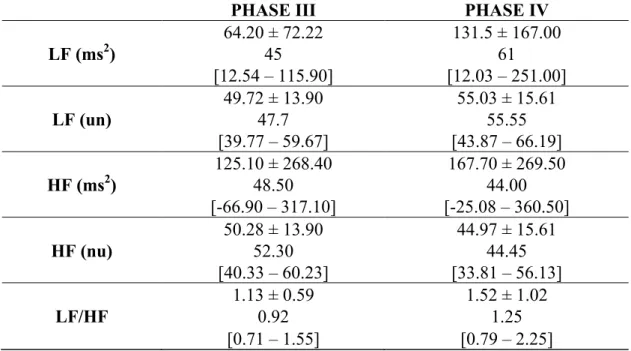
Tables 3 and 4 present the HRV data in the time and frequency domains respectively. There were no statistically significant differences (p> 0.005) when comparing the data from the supervised (Phase III) and unsupervised (Phase IV) phases.
Table 3. HRV indices in the time domain before and after two months of unsupervised cardiac rehabilitation.
PHASE III PHASE IV
1.01 ± 0.17 1.04 ± 0.12
MEAN RR 1.02 1.06
[0.89 – 1.13] [0.96 – 1.12]
24.75 ± 18.47 29.49 ± 22.78
RMSSD 19.15 17.9
[11.53 – 37.97] [13.19 – 45.79]
8.65 ± 18.73 7.77 ± 13.44
pNN50 3.2 1.8
[-4.75 – 22.05] [-1.8 – 17.38]
21.6 ± 11.90 36.9 ± 25.21
SDNN 20 24
[13.09 – 30.11] [18.87 – 54.93]
Note: RMSSD – root mean square of the successive differences between adjacent normal RR intervals, for a period of time, expressed in milliseconds; pNN50 - percentage of adjacent RR intervals greater than 50ms; SDNN - average standard deviation of all normal RR intervals, expressed in milliseconds. Data expressed as mean, standard deviation, median and confidence interval of 95%.
Table 4. HRV indices in the frequency domain before and after two months of unsupervised cardiac rehabilitation.
PHASE III PHASE IV
64.20 ± 72.22 131.5 ± 167.00
LF (ms2) 45 61
[12.54 – 115.90] [12.03 – 251.00]
49.72 ± 13.90 55.03 ± 15.61
LF (un) 47.7 55.55
[39.77 – 59.67] [43.87 – 66.19]
125.10 ± 268.40 167.70 ± 269.50
HF (ms2) 48.50 44.00
[-66.90 – 317.10] [-25.08 – 360.50]
50.28 ± 13.90 44.97 ± 15.61
HF (nu) 52.30 44.45
[40.33 – 60.23] [33.81 – 56.13]
1.13 ± 0.59 1.52 ± 1.02
LF/HF 0.92 1.25
[0.71 – 1.55] [0.79 – 2.25]
Note: LF - LF - low frequency component; HF - High-frequency component; LF / HF - LF / HF ratio; ms2 - Milliseconds squared; nu - Normalized Units. Data expressed as mean, standard deviation, median and confidence interval of 95%. Source: Authors.
Discussion
This study showed that patients with low cardiovascular risk undergoing a period of two months of unsupervised exercise (transition from rehabilitation Phase III to Phase IV) maintained all cardiometabolic and functional parameters obtained in Phase III.
These subjects had controlled risk factors for cardiovascular disease in Phase III rehabilitation, demonstrated by pressure control, adequate levels of blood glucose, eutrophicand higher functional capacity than anticipated. All these cardiometabolic and functional parameters were maintained after transition to the unsupervised cardiac rehabilitationphase.
Cardiac rehabilitation is effective in reducing total and cardiovascular mortality18. In addition, it generates improvements in general cardiopulmonary fitness, and according toLavieet al.7, the re-education and counseling aimed at patients leads to a sharp reduction in cardiovascular events, mortality and hospitalizations.
After Phase III of cardiac rehabilitation, patients are encouraged to perform physical activity in the community (Phase IV)30. Phase IV is a long-term program, with indefinite and variable duration, carried out without supervision, so it is important to continue the exercises following the guidelines appropriately4.
Exercise induces morphological and functional adaptations that may decrease or disappear even after short periods of detraining. This will be greater if the adaptations are more recent and less consolidated.
benefit and may increase the risk of complications2. Exercise improves health in general, increases functional capacity, improves aerobic power (VO2 max) and assists in the control of risk factors for cardiovascular diseases such as dyslipidemia, hypertension, insulin sensitivity and body fat8,17,31.
Contrary to the benefits gained from physical training there is the principle of reversibility, which shows that when the exercise is suspended, reduced or performed improperly, the body systems readjust according to the decrease in the stimulus. Thus, physical detraining results in a loss of the cardiovascular and metabolic adaptations acquired33. Moreover, a reduction in physical activity is associated with physiological and psychological consequences11.
When the individual performing physical exercise generates a global physical deconditioning, with decreased functional capacity, making them susceptible to a number of risk factors for health, such as increased blood pressure, increased body weight and decreased flexibility18. Anthropometric parameters and functional capacity did not change in this study, indicating that previous adaptations were maintained in Phase IV.
With detraining, the resting heart rate increases sharply, reflected in cardiovascular compensation to offset reductions in blood volume and ejection volume33. The response of the intrinsic heart rate with detraining is considered a result of re-adaptation of the mechanisms that regulate their behavior and this is reflected in HRV and blood pressure34.
Decreased HRV in cardiac patients is associated with an increased risk of mortality. Cardiac rehabilitation-based exercise induces an improvement in autonomic modulation35. In this study there were no changes in HRV or BP, which shows that the proposed guidelines were followed appropriately, and individuals maintained the benefits acquired in the Phase III cardiac rehabilitation program in Phase IV.
Phase IV is based on the maintenance of physical activity in the long term and lifestyle change36. Patients who reach stage IV are considered stable enough to perform physical activity in the community, they should be aware that physical exercise is part of the treatment and when performed irregularly, inadequately, sporadically and with disregard to individual limits, it can be harmful, and if stopped, the benefits achieved will be lost2. Thow et al.36 observed in their study that the participants who joined and presented good results in the Phase IV treatment believed in the efficacy of exercise, and concluded that good results in the long run were directly related to understanding by patients about rehabilitation and the benefits of exercise in the prevention of coronary disease.
Conclusion
Therefore, we conclude that the transition from a supervised cardiac rehabilitation program (Phase III) to unsupervised (Phase IV) was effective and these individuals were able to maintain cardiovascular and functional adaptations achieved previously.Transition to Phase IV should be encouraged in low risk heart patients who obtained benefits in Phase III. The factors that limited this study include the small sample size, Phase III not being completely supervised, the difference in time spent in Phases III and IV and the absence of further evaluations, such as a cardiopulmonary exercise test.
1. Graham I, Atar D, Borch-Johnsen K, Boysen G, Burell G, Cifkova R, Dallongeville J, et al. European guidelines on cardiovascular disease prevention in clinical practice: executive summary: fourth joint task force of the European society of cardiology and other societies on cardiovascular disease prevention in clinical practice (Constituted by representatives of nine societies and by invited experts). Eur J Cardiovasc Prev Rehabil 2007;28(19):2375-2414.
2. Umeda IIK. Manual de Fisioterapia na Reabilitação Cardiovascular. São Paulo: Manole; 2006.
3. Carvalho TD, Cortez AA, Ferraz A, Nóbrega ACL, Brunetto AF, Herdy AH, et
al. Reabilitação cardiopulmonar e metabólica: aspectos práticos e responsabilidades. Rev Bras Med Esporte 2005;11(6):313-318.
4. Carvalho TD, Cortez AA, Ferraz A, Nóbrega ACL,Brunetto AF, Herdy AH, et al. Diretriz de reabilitação cardiopulmonar e metabólica: aspectos práticos e responsabilidades. Arq Bras Cardiol 2006;86(1):74-82.
5. Arakaki H, Magalhäes HM. Programas supervisionados em reabilitação cardiovascular - abordagem de prescriçäo de exercício. Rev Soci Cardiol Estado de São Paulo
1996:6(1):23-30.
6. Magalhães S, Viamonte S, Miguel Ribeiro M, Barreira A, Fernandes P, Torres S, et al. Long-term effects of a cardiac rehabilitation program in the control of cardiovascular risk factors. Rev Port Cardiol 2013;32(3):191-199.
7. Lavie CJ, Berra K, Arena R. Formal cardiac rehabilitation and exercise training programs in heart failure: evidence for substantial clinical benefits. J Cardiopulm Rehabil Prev 2013;33(4):209-211.
8. Moraes RS, Nóbrega ACL, Castro RRT, Negrão CE, Stein R, Serra SM, et al. Diretriz de Reabilitação Cardíaca. Arq Bras Cardiol 2005;84(5):431-440.
9. Smith Jr SC, Blair SN, Bonow RO, Brass LM, Cerqueira MD, Dracup K, et al. AHA/ACC Scientific Statement: AHA/ACC guidelines for preventing heart attack and death in patients with atherosclerotic cardiovascular disease: 2001 update: A statement for
healthcare professionals from the American Heart Association and the American College of Cardiology. Circulation 2001;104(13):1577-1579.
10. Neufer PD. The effect of detraining and reduced training on the physiological adaptations to aerobic exercise training. Sports Med 1989;8(5):302-320.
11. Arthur HM, Smith KM, Kodis J, McKelvie R.Controlled trial of hospital versus home-based exercise in cardiac patients. Med Sci Sports Exerc 2002;34(10):1544-1550.
12. McClure T, Haykowsky MJ, Schopflocher D, Hsu ZY, Clark AM. Home-based secondary prevention programs for patients with coronary artery disease: a meta-analysis of effects on anxiety. J Cardiopulm Rehabil Prev 2013;33(2):59-67.
13. Lobo A, Carvalho J, Santos P. Effects of training and detraining on physical fitness, physical activity patterns, cardiovascular variables, and HRQol after 3 health-promotion interventions in institutionalized elders. Int J Family Med 2010; 2010(ID 486097):1-10. 14. Godoy M, Bellini AJ, Passaro LC, Mastrocolla LE, Sbissa AS, Araujo CGS, et al. I
Consenso Nacional de Reabilitação Cardiovascular. Arq Bras Cardiol 1997;69(4):267-291.
16. Araújo CGS, Carvalho T, Castro CLB, Costa RV, Moraes RS, Oliveira Filho JA, et al. Normatização dos equipamentos e técnicas da reabilitação cardiovascular supervisionada. Arq Bras Cardiol 2004;83(5):448-452.
17. Williams MA, Haskell WL, Philip AA, Amsterdam EA, Bittner V, Franklin BA, et al. Resistance exercise in individuals with and without cardiovascular disease: 2007 Update - A scientific statement from the American Heart Association council on 40 clinical
cardiology and council on nutrition, physical activity, and metabolism. Circulation 2007;116:1081-1093.
18. Heran BS, Chen JM, Ebrahim S, Moxham T, Oldridge N, Rees K, et al. Exercise-based cardiac rehabilitation for coronary heart disease. Cochrane Database Syst Rev
2011;6(7):1-73.
19. McPhee PG, Winegard KJ, MacDonald MJ, McKelvie RS, Millar PJ. Importance of early cardiac rehabilitation on changes in exercise capacity: a retrospective pilot study. Appl Physiol Nutr Meta 2015;40(12):1314-1317.
20. FletcheR GF, Balady CG, Froelicher VF, Hartley LH, Haskell WL, Pollock ML. Exercise standards: a statement for healthcare professionals from the American Heart Association. Circulation 1995;91:580–615.
21. Borg G. Perceived exertion as an indicator of somatic stress. Scand J Rehab Med 1970;2(2):92-98.
22. Associação brasileira para o estudo da obesidade e da Síndrome Metabólica (Abeso). Diretrizes brasileiras de obesidade. 3. ed. São Paulo: AC Farmacêutica; 2009.
23. Callaway CW, Chumlea WC, Bouchard C, Himes JH, Lohman TG, Martin AD, et al. Circumferences. In: Lohman TG, Roche AF, Martorell R. Anthropometric
standardization reference manual. Abridged Edition. Champaign: Human Kinetics Books; 1991. p. 44-45.
24. Ats committee on proficiency standards for clinical pulmonary function laboratories. ATS statemente: guidelines for the six minute walk test. Am J Respir Crit Care Med
2002;166(1):111-117.
25. Enright PL, Sherrill DL. Reference equations for the six-minute walk in healthy adults.Am J Respir Crit Care Med 1998;158(5):1384-1387.
26. Vanderlei LCM, Pastre CM, Hoshi RA, Carvalho TD, Godoy MF. Noções básicas de variabilidade da frequência cardíaca e sua aplicabilidade clínica. Rev Bras Cir Cardiovasc 2009;24(2):205-221.
27. Gamelin FX, Berthoin S, BosquetL. Validity of the polar S810 heart rate monitor to measure R-R intervals at rest. Med Sci Sports Exerc 2006;38(5):887-893.
28. Vanderlei LC, Pastre CM, FreitasJúnior IF, Godoy MF.Analysis of cardiac autonomic modulation in obese and eutrophic children. Clinics 2010;65(8):789-792.
29. Niskanen JP, Tarvainen MP, Ranta-Aho PO, Karjalainen PA.Software for advanced HRV analysis. Comput Methods Programs Biomed 2004;76(1):73-81.
30. Woolf-May K, Bird S. Physical activity levels during phase IV cardiac rehabilitation in a group of male myocardial infarction patients. Br J Sports Med 2005;39(3):12-20.
32. American College of Sports Medicine.ACSM's Guidelines for exercise testing and prescription. Philadelphia: Lea &Febiger; 2000.
33. Coyle EF. Destreinamento e Retenção das Adaptações Induzidas pelo Treinamento. In: American College of Sport Medicine. Prova de esforço e prescrição de exercício. Rio de Janeiro: Revinter; 1994.
34. Mcardle WD, Katch FI, KatchVL. Fisiologia do exercício: energia, nutrição e desempenho humano. 7. ed. Rio de Janeiro: Guanabara Koogan; 2011. 35. Oliveira NL, Ribeiro F, Alves AJ, Teixeira M, Miranda F, Oliveira J.Heart
rate variability in myocardial infarction patients: Effectsof exercise training. Rev Port Cardiol 2013;32(9):687-700.
36. Thow M, Rafferty D, Kelly H. Exercise motives of long-term phase IV cardiac rehabilitation participants.Physiotherapy 2008;94(4):281-285.
Received on Jul, 30, 2015. Revised on Oct, 10, 2015. Accepted on Mar, 02, 2016.
Author address: Francis Lopes Pacagnelli.Rua José Bongiovani, 700 - Cidade Universitária, Presidente Prudente – SP , 19050-920. Universidade do Oeste Paulista, Unoeste. Departamento de Fisioterapia. E-mail: