abstract
http://dx.doi.org/10.1590/1678-775720130366
Anti-Streptococcal activity of Brazilian Amazon
Rain Forest plant extracts presents potential for
preventive strategies against dental caries
Juliana Paola Correa da SILVA1, Adriana Lígia de CASTILHO1, Cíntia Helena Couri SARACENI1, Ingrit Elida Collantes DÍAZ2, Mateus Luís Barradas PACIENCIA2, Ivana Barbosa SUFFREDINI1,2
1- Graduate Program in Dentistry, Vice-Dean Ofice for Post-Graduation and Research, Paulista University, São Paulo, Brazil 2- Center for Research in Biodiversity, Extraction Laboratory, Paulista University, São Paulo, Brazil
Corresponding address: Ivana Barbosa Suffredini - Centro para Pesquisa em Biodiversidade - Laboratório de Extração - Universidade Paulista - UNIP - Av. Paulista, 900, 1o andar - Bela Vista - São Paulo - SP - Brazil - 01310-100 - Phone: 55 11 3170-3776 - Fax: 55 11 3170-3978 - e-mail: [email protected]
Submitted: June 17, 2013 - Modiication: October 14, 2013 - Accepted: October 15, 2013
C
aries is a global public health problem, whose control requires the introduction of low-cost treatments, such as strong prevention strategies, minimally invasive techniques and chemical prevention agents. Nature plays an important role as a source of new antibacterial substances that can be used in the prevention of caries, and Brazil is the richest country in terms of biodiversity. Objective: In this study, the disk diffusion method (DDM) was used to screen over 2,000 Brazilian Amazon plant extracts against Streptococcus mutans. Material and Methods: Seventeen active plant extracts were identiied and fractionated. Extracts and their fractions, obtained by liquid-liquid partition, were tested in the DDM assay and in the microdilution broth assay (MBA) to determine their minimal inhibitory concentrations (MICs) and minimal bactericidal concentrations (MBCs). The extracts were also subjected to antioxidant analysis by thin layer chromatography. Results: EB271, obtained from Casearia spruceana, showed signiicant activity against the bacterium in the DDM assay (20.67±0.52 mm), as did EB1129, obtained from Psychotria sp. (Rubiaceae) (15.04±2.29 mm). EB1493, obtained from Ipomoea alba, was the only extract to show strong activity against Streptococcus mutans (0.08 mg/mL<MIC<0.16 mg/mL; MBC=0.16 mg/mL) in the MBA. Conclusions: The active extracts, discovered in the Amazon rain forest, show potential as sources of new antibacterial agents for use as chemical coadjuvants in prevention strategies to treat caries.Keywords:Streptococcus mutans. Amazonian ecosystem. Plant extracts. Antioxidants. Anti-infective agents.
IntroductIon
The introduction of new non-profitable therapeutic methods related to the treatment of caries disease is a challenge for low- and middle-income countries that may have effect on children’s growth and adults’ general health16. Much has
already been done with the introduction of new approaches, such as minimally invasive techniques5
and antibiotics20, as well as the popularization
of and access to toothbrushes, toothpastes18,
mouth washers and lossing materials. Good diet,
combined with oral health habits, such as brushing,
washing, lossing and chewing, may diminish the
incidence of caries. If caries do occur and dentin is involved, chemical-mechanical removal performed according to minimally invasive techniques can be performed.
Discovering new antibacterial products that can be used as coadjuvants in caries treatment and in the composition of dentifrices may add
to the eficacy of oral health programs. Nature
is one of the main sources of new antimicrobial molecules. During the last two decades, natural products represented one of the main sources of new drugs approved by the Food and Drug Administration (FDA)17. Much research has been
J Appl Oral Sci.
92
been introduced in many countries, including the United States, Madagascar, Cameroon, Indonesia, China, India, and many others. In Brazil, screening programs have been well established1,19,27,30 since
the Environment Ministry promulgated MP 2.186 in August 26th, 2001, introducing guidelines to
bioprospect the Brazilian biodiversity, which is considered to be the richest in the world and one of the least studied in terms of its pharmacological and chemical potential.
The introduction of new antibacterial compounds for use as chemical antibacterial agents in dentifrices and cements may play an important role in caries prevention and its chemical control, particularly compounds obtained from nature. Traditionally, natural products are used in dental products. For example, eugenol and some plant extracts obtained from Zizyphus joazeiro (juá),
Mentha piperita (mentha) and Punica granatum
(pomegranate), as well as new natural products, are frequently studied8 in the hope of introducing
them into clinical practices.
Thus, our group carried out a focused search for new antimicrobial natural products active against
Streptococcus involved in oral diseases. Information on the microbiological, chemical and antioxidant
proiles of the active extracts will contribute to the identiication and development of new antibacterial
agents for use, in the near future, in prevention strategies and as chemical coadjuvant in minimal intervention techniques to treat caries.
MaterIal and Methods
Plant collection and extraction preparation Plants were collected from the Amazon and Atlantic rain forests (IBAMA license 12A/2008) according to techniques that have been previously described26. Briely, plants were dried in an
air-circulating incubator (Fanem, Diadema, SP, Brazil) at 40°C and were ground (Holmes, Danville, Illinois, USA). The plant powder was macerated with a 50/50 solution of dichloromethane and methanol (Synth, Diadema, SP, Brazil) for 24 h. After that, solvents were evaporated. A second 24 h maceration was performed with Milli-Q water (Millipore, Diadema, SP, Brazil) before the extract was lyophilized (Virtis, Stone Ridge, NY, USA). Organic and aqueous extracts were kept at -20°C until use.
extracts and standard drug preparation Organic extracts were solubilized in 50% dimethylsulfoxide (DMSO50; Synth, Diadema, SP, Brazil), and aqueous extracts were solubilized in Milli-Q water30 (Millipore, Billerica, MA, USA).
Screening tests in the disk diffusion assay were performed with extracts prepared at 200 mg/mL, and the selected extracts were prepared at 250,
200, 150, 100, 50, 25, 12.5, 6.3, 3.2, 1.6, and 0.8 mg/mL for testing in the microdilution broth assay (MBA). Polar and non-polar fractions derived from active extracts were prepared in DMSO50 and water, respectively, at 200 mg/mL. Chlorhexidine
digluconate (CHX; Clorexidina S, FGM, Joinville,
SC, Brazil) was used as standard drug. Final concentrations of 0.12, 1 and 2% of CHX were used in the assays.
bacteria
Streptococcus mutans (ATCC 25175) was obtained from Microbiologics®. Bacteria were kept
in a mother plaque, in the 3rd passage, and were
used freshly in the 4th passages in all experiments.
Bacteria were cultivated in a glass chamber, located inside an incubator at 36°C, for 48 h. Microaerophyllic conditions were obtained by adding a lit candle inside the chamber. After a period of time, the oxygen inside the chamber is consumed
and the ire is extinguished, which permits the
microaerophyllic environment during the assay. Bacteria were resuspended in saline solution at a concentration of 0.5 MacFarland (corresponding to 1.5x10⁸ CFU/mL) for the disk diffusion method
(DDM) and at concentrations of 1x10⁷, 1x10⁶,
1x10⁵, 1x10⁴, 1x10³ and 1x10² CFU/mL for the
microdilution broth assays (MBA)4.
culture medium
Brain heart infusion agar blood (BHIAB; Oxoid, Hampshire, UK) was prepared according to the
manufacturer’s instructions, and deibrinated cattle blood was added to the agar medium to a inal
concentration of 5%.
Brain heart infusion broth (BHIB, Oxoid, Hampshire, UK) was prepared according to the manufacturer’s instructions and was used in the MBA in 96-well round bottom microplates (Costar Corning, Tewsbury, MA, USA).
disk diffusion method
BHIAB was used as the bacterial growth medium for the disk diffusion method (DDM)25 as follows.
Bacteria were suspended in saline solution at 0.5 MacFarland and inoculated on BHIAB using a sterile swab. Sterile paper disks (Cefar, São Paulo, SP, Brazil) measuring 6 mm in diameter and 1 mm in height were distributed equally over the inoculated blood agar medium. Ten µL of standard drug, extracts or fractions were deposited over the paper
disks. Petri dishes (J.T.Labor; Curitiba, PR, Brazil)
were kept in microaerophilic-environment chambers in incubator at 36°C for 48 hours. The presence of a zone of inhibition was considered a positive result independent of its diameter. Extracts that inhibited bacterial growth in this method were retested in triplicate and false positives were eliminated. Anti-Streptococcal activity of Brazilian Amazon Rain Forest plant extracts presents potential for preventive strategies against dental caries
Means were statistically compared by one-way
ANOVA (p<0.05) and Tukey post-test (GraphPad®
Prism 5.0).
Microdilution broth assay
This technique was used to determine the minimal inhibitory concentration (MIC) and the minimal bactericidal concentration (MBC) using different concentrations of active plant extracts
(inal concentrations corresponding to 12.5, 10, 7.5,
5, 2.5, 1.25, 0.63, 0.31, 0.16, 0.08 and 0.04 mg/ mL) against bacterial suspensions of 1x10⁷, 1x10⁶,
1x10⁵, 1x10⁴, 1x10³ and 1x10² CFU/mL. Briely, 190
µL of a bacterial suspension were added to each well of 96-well microplates. Next, 10 µl of samples were added to the corresponding wells. Each plate was set up with a positive and negative bacterial growth control. Microplates were kept in a microaerophilic environment for 48 h at 36°C.
chromatographic techniques used in the fractionation of selected antibacterial extracts
Liquid-liquid partition
One gram of each active extract was resuspended in 12 mL of a methanol (MeOH, Synth, Diadema, SP, Brazil) and water solution (3:1) with the addition of chloroform (CHCl3, Synth, Diadema, SP, Brazil) if necessary. The extract suspension was transferred to a 50 mL burette and washed three times with 25 mL of CHCl3. All three CHCl3 washes were combined and evaporated, producing the chloroform fraction (RCHCl3). The aqueous fraction was recuperated
and allowed to air dry to completely eliminate the chloroform. After that, the volume was brought up to 10 mL using a 1:1 mixture of methanol and water. Forty mL of butanol (BuOH; Synth, Diadema, São Paulo, Brazil) were added to the burette, and the aqueous fraction was also gently poured into the burette. The procedure was repeated with another 25 mL of BuOH. Both previously obtained BuOH volumes were combined and allowed to evaporate, yielding the RBuOH fraction. Finally, the aqueous fraction RH2O was recuperated and lyophilized.
The three fractions were analyzed by thin
layer chromatography (Silica Gel GF254, Merck, Darmstadt, Germany). Three solvent systems were
used: hexane:ethyl acetate (4:1), chloroform:ethyl acetate (1:1) and chloroform:ethyl acetate:methanol
(2:2:1). Thin layer plates were irst developed with
ultraviolet light at 254 and 366 nm, followed by treatment with 25% sulfuric acid (Synth, Diadema, SP, Brazil) and heating29. Then, to determine the
antioxidant properties, the thin layer plates were
developed with β-carotene21 (Synth, Diadema, SP,
Brazil).
results
High-throughput screening using the DDM technique was applied to more than 2,000 plant extracts against S. mutans and resulted in the
identiication of 17 active aqueous (even numbered
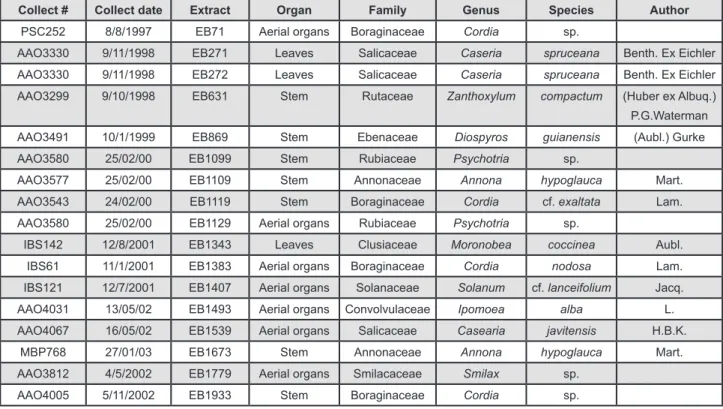
extracts) and organic (odd numbered extracts) plant extracts that somehow inhibited bacterial growth in DDM. The botanical names and general
Collect # Collect date Extract Organ Family Genus Species Author PSC252 8/8/1997 EB71 Aerial organs Boraginaceae Cordia sp.
AAO3330 9/11/1998 EB271 Leaves Salicaceae Caseria spruceana Benth. Ex Eichler AAO3330 9/11/1998 EB272 Leaves Salicaceae Caseria spruceana Benth. Ex Eichler AAO3299 9/10/1998 EB631 Stem Rutaceae Zanthoxylum compactum (Huber ex Albuq.)
P.G.Waterman AAO3491 10/1/1999 EB869 Stem Ebenaceae Diospyros guianensis (Aubl.) Gurke AAO3580 25/02/00 EB1099 Stem Rubiaceae Psychotria sp.
AAO3577 25/02/00 EB1109 Stem Annonaceae Annona hypoglauca Mart. AAO3543 24/02/00 EB1119 Stem Boraginaceae Cordia cf. exaltata Lam. AAO3580 25/02/00 EB1129 Aerial organs Rubiaceae Psychotria sp.
IBS142 12/8/2001 EB1343 Leaves Clusiaceae Moronobea coccinea Aubl. IBS61 11/1/2001 EB1383 Aerial organs Boraginaceae Cordia nodosa Lam. IBS121 12/7/2001 EB1407 Aerial organs Solanaceae Solanum cf. lanceifolium Jacq. AAO4031 13/05/02 EB1493 Aerial organs Convolvulaceae Ipomoea alba L. AAO4067 16/05/02 EB1539 Aerial organs Salicaceae Casearia javitensis H.B.K.
MBP768 27/01/03 EB1673 Stem Annonaceae Annona hypoglauca Mart. AAO3812 4/5/2002 EB1779 Aerial organs Smilacaceae Smilax sp.
AAO4005 5/11/2002 EB1933 Stem Boraginaceae Cordia sp.
J Appl Oral Sci.
94
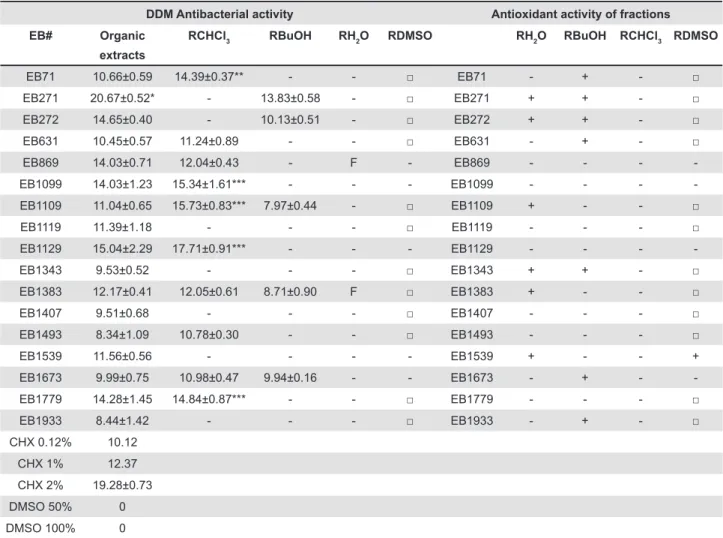
collection information are displayed in Figure 1.All 17 extracts were retested in the DDM assay. Each extract was analyzed in triplicate, and the means and standard deviations (SDs) of diameters obtained in two perpendicular measurements of each zone of inhibition were obtained in mm (n=6; ntotal=120). These results are displayed in Table 1. Two percent CHX was used as a standard drug, and 50% DMSO and 100% DMSO solvents, which were used in the dilution of extracts and fractions, were also tested for antibacterial activity. According to one-way ANOVA and means comparison analysis using Tukey post-test, assuming a normal distribution for all media (F(20,125)=170.3; r2=0.9701; p<0.05), EB271, obtained from the
leaves of Casearia spruceana (Salicaceae, Figure 1), showed a zone of inhibition diameter (20.67±0.52
mm) similar to that of 2% CHX (19.28±0.73 mm) when tested against S. mutans.
All 17 extracts were fractionated, and the fractions were analyzed in the DDM assay. The results of the analysis from the RCHCl3 fractions are shown in Table 1. It was observed that only the RCHCl3 and RBuOH fractions showed antibacterial activity. CHX was tested at a 2% dilution and in other dilutions commonly used in Dentistry, including 0.12% and 1% dilutions, permitting a wide range of statistical comparison for practical relevance. It was observed that none of the RCHCl3 fractions showed antibacterial activity compared to 2% CHX (p<0.05), which was more effective. When compared with 1% CHX, a chlorhexidine concentration commonly used in endodontic procedures, the RCHCl3 fractions of extracts
DDM Antibacterial activity Antioxidant activity of fractions
EB# Organic extracts
RCHCl3 RBuOH RH2O RDMSO RH2O RBuOH RCHCl3 RDMSO
EB71 10.66±0.59 14.39±0.37** - - □ EB71 - + - □
EB271 20.67±0.52* - 13.83±0.58 - □ EB271 + + - □
EB272 14.65±0.40 - 10.13±0.51 - □ EB272 + + - □
EB631 10.45±0.57 11.24±0.89 - - □ EB631 - + - □
EB869 14.03±0.71 12.04±0.43 - F - EB869 - - -
-EB1099 14.03±1.23 15.34±1.61*** - - - EB1099 - - -
-EB1109 11.04±0.65 15.73±0.83*** 7.97±0.44 - □ EB1109 + - - □
EB1119 11.39±1.18 - - - □ EB1119 - - - □
EB1129 15.04±2.29 17.71±0.91*** - - - EB1129 - - -
-EB1343 9.53±0.52 - - - □ EB1343 + + - □
EB1383 12.17±0.41 12.05±0.61 8.71±0.90 F □ EB1383 + - - □
EB1407 9.51±0.68 - - - □ EB1407 - - - □
EB1493 8.34±1.09 10.78±0.30 - - □ EB1493 - - - □
EB1539 11.56±0.56 - - - - EB1539 + - - +
EB1673 9.99±0.75 10.98±0.47 9.94±0.16 - - EB1673 - + -
-EB1779 14.28±1.45 14.84±0.87*** - - □ EB1779 - - - □
EB1933 8.44±1.42 - - - □ EB1933 - + - □
CHX 0.12% 10.12 CHX 1% 12.37 CHX 2% 19.28±0.73 DMSO 50% 0 DMSO 100% 0
Table 1- Antibacterial activity observed for organic extract and its fractions diluted to 200 mg/mL against Streptococcus
mutans in the disk diffusion assay in brain heart infusion agar-blood. Means and standard deviation values obtained from the growth-inhibition zone diameters are given and are expressed in millimeters (n=6; ntotal=120). One-way ANOVA and Tukey's post test were used to compare means (signiicant if p<0.05). *signiicance is indicated as a comparison of test samples to 1% CHX . Antioxidant activity observed for fractions obtained from active plant extracts
Caption: E#=extract number; FCHCl3=chloroform fraction; FBuOH=buthanol fraction; FMW=methanol: water fraction; FDMSO=dimethylsulfoxide; S. mut=Streptococcus mutans; S.sang=Streptococcus sanguinis, CHX=chlorexidin digluconate, DMSO=dimethylsulfoxide; RCHCl3=chloroform fraction; RBuOH=buthanol fraction; RH2O=water fraction;
RDMSO=dimethylsulfoxide fraction; □=does not exist; NT=not tested; (-)=not active; (+)=active
Anti-Streptococcal activity of Brazilian Amazon Rain Forest plant extracts presents potential for preventive strategies against dental caries
J A p p l O ra l Sc i.
9
5
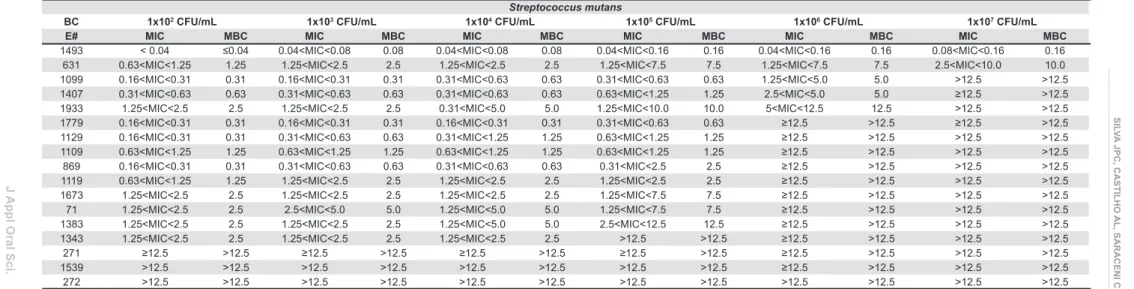
E B 1 1 2 9 , E B 1 1 0 9 , E B 1 0 9 9 , E B 1 7 7 9 a n d E B 7 1 w e re th e m o st a cti v e (p< 0 .0 5 ); h o w e v e r, th e R C H C l 3 fr a cti o n s fr o m e x tr a cts E B 8 6 9 , E B 1 3 8 3 , E B 6 3 1 a n d E B 1 6 7 3 sh o w e d a cti v it y si m ila r to th a t o bse rv e d w ith 1 % C H X . T h e R C H C l 3 f ra cti o n s o bta in e d fr o m ex tr acts EB 14 93 an d EB 27 1 di d no t sh ow si gn iica nt a cti v it y (p< 0 .0 5 ). F in a lly , a ll R B u O H fr a cti o n s b u t th e o n e o bt a in e d fr o m E B 2 7 1 s h o w e d m o re si gn iica nt or e qu al an tiba cte ria l a cti vit y co m pa re d to 0 .1 2 % C H X , a co n ce n tr a ti o n co m m o n ly u se d in m o u th r in se s. T a bl e 1 a lso sh o w s re su lts o bta in e d fr o m th e a n a ly si s o f th e R B u O H f ra cti o n s o bta in e d fr o m th e a cti v e e x tr a cts. O n e -w a y A NO V A a n d T u k e y po st -te st in di ca te d th a t o n ly th e R B u O H fra cti on o bta in ed fro m E B2 71 sh ow ed si gn iica nt a n ti ba cte ri a l a cti v it y (p< 0 .0 5 ) co m pa re d w ith 0 .1 2 % C H X a n d 1 % C H X . No n e o f th e fr a cti o n s sh o w e d be tte r a cti v it y th a n 2 % C H X . T h e R B u O H fr a c ti o n s o bta in e d fr o m E B 2 7 2 a n d E B 1 6 7 3 sh o w e a a n ti ba cte ria l a cti v it y si m ila r to 0 .1 2 % C H X (p> 0.0 5) . No ne of th e o th er fra cti on s ha d si gn iica nt a cti v it y co m pa re d w ith th e th re e di lu ti o n s o f C H X . M icr o di lu ti o n br o th a ssa y w a s pe rf o rm e d o n a ll se v e n te e n e x tr a cts to de te rm in e th e M IC s a n d M B C s a ga in st S . m u ta n s in ba cte ria l su spe n si o n s pr e pa re d a t 1 x 1 0 2 , 1 x 1 0 3 , 1 x 1 0 4 , 1 x 1 0 5 , 1 x 1 0 6 a n d 1 x 1 0 7 C F U /m L . E x tr a cts w e re r a n k e d (T a bl e 2 ) a cco rdi n g to th eir e fica cy in ba cte ria l gr ow th in hibi tio n an d w er e co nsi de re d efici en t if th eir M BC ≤ 0.3 1 m g/ m L . B a se d o n th is pa ra m e te r, E B 1 4 9 3 w a s th e o n ly ex tr act th at hsa si gn iic an t M IC a nd M BC (0 .0 8 m g/ m L < M IC < 0 .1 6 m g/ m L a n d M B C = 0 .1 6 m g/ m L ) u si n g a S . m u ta n s su spe n si o n a t 1 x 1 0 7 C F U /m L . E B 1 4 9 3 w a s o bta in e d fr o m a e ria l o rga n s o f Ipo m o e a a lba L . ( C o n v o lv u la ce a e , F igu re 1 ). A cco rdi n g to th e C lin ica l L a bo ra to ry S ta n da rds In sti tu te pa ra m e te rs (2 0 0 3 ), M IC v a lu e s a re su ppo se d to be o bta in e d a t ba cte ria l co n ce n tr a ti o n o f 1 x 1 0 5 C F U /m L . W h e n th e r e su lts a re a n a ly z e d w ith th is a ppr o a ch , sh o w n in T a bl e 2 , E B 1 4 9 3 sh o w e d th e be st a cti v it y ( 0 .0 4 m g/ m L < M IC < 0 .0 1 6 m g/ m L a n d M B C = 0 .1 6 m g/ m L ), f o llo w e d b y E B 1 0 9 9 a n d E B 1 7 7 9 ( 0 .3 1 m g/ m L < M IC < 0 .6 3 m g/ m L a n d M B C ’s= 0 .6 3 m g/ m L ) a n d E B 8 6 9 ( 0 .3 1 m g/ m L < M IC < 0 .6 3 m g/ m L a n d M B C = 2 .5 m g/ m L ). T h e a n tio x ida n t a cti v it y o f a ll e x tr a cts a n d th e ir fr a cti o n s w a s a lso de te rm in e d (T a bl e 1 ). A n ti o x ida n t a c ti v it y w a s fo u n d in th e R B u O H fr a c tio n fr o m e x tr a cts E B 7 1 , E B 6 3 1 , E B 1 6 7 3 a n d E B 1 9 3 3 , i n th e R H 2O fr a cti o n fr o m e x tr a cts E B 1 1 0 9 a n d E B 1 3 8 3 , i n bo th th e R B u O H a n d R H 2O f ra cti o n s fr o m e x tr a cts E B 2 7 1 , E B 2 7 2 a n d E B 1 3 4 3 , a n d in th e R H 2O a n d R D M S O fr a cti o n s fr o m e x tr a ct E B 1 5 3 9 . O n ly n in e o f th e o rigi n a l 1 7 e x tr a ct fr a cti o n s sh o w e d a n ti o x ida n t a cti v it y, a n d th e se w e re co n ce n tr a te d m a in ly in th e R B u O H a n d R H 2O f ra cti o n s. No n e o f th e F M W fr a cti o n s sh o w e d a n ti ba cte ria l a cti v it y, a n d o n ly si x R B u O H f ra cti o n s, o rigi n a ti n g fr o m e x tr a cts E B 2 7 1 , Streptococcus mutansBC 1x10² CFU/mL 1x10³ CFU/mL 1x10⁴ CFU/mL 1x10⁵ CFU/mL 1x10⁶ CFU/mL 1x10⁷ CFU/mL
E# MIC MBC MIC MBC MIC MBC MIC MBC MIC MBC MIC MBC
1493 < 0.04 ≤0.04 0.04<MIC<0.08 0.08 0.04<MIC<0.08 0.08 0.04<MIC<0.16 0.16 0.04<MIC<0.16 0.16 0.08<MIC<0.16 0.16
631 0.63<MIC<1.25 1.25 1.25<MIC<2.5 2.5 1.25<MIC<2.5 2.5 1.25<MIC<7.5 7.5 1.25<MIC<7.5 7.5 2.5<MIC<10.0 10.0
1099 0.16<MIC<0.31 0.31 0.16<MIC<0.31 0.31 0.31<MIC<0.63 0.63 0.31<MIC<0.63 0.63 1.25<MIC<5.0 5.0 >12.5 >12.5
1407 0.31<MIC<0.63 0.63 0.31<MIC<0.63 0.63 0.31<MIC<0.63 0.63 0.63<MIC<1.25 1.25 2.5<MIC<5.0 5.0 ≥12.5 >12.5
1933 1.25<MIC<2.5 2.5 1.25<MIC<2.5 2.5 0.31<MIC<5.0 5.0 1.25<MIC<10.0 10.0 5<MIC<12.5 12.5 >12.5 >12.5
1779 0.16<MIC<0.31 0.31 0.16<MIC<0.31 0.31 0.16<MIC<0.31 0.31 0.31<MIC<0.63 0.63 ≥12.5 >12.5 ≥12.5 >12.5
1129 0.16<MIC<0.31 0.31 0.31<MIC<0.63 0.63 0.31<MIC<1.25 1.25 0.63<MIC<1.25 1.25 ≥12.5 >12.5 >12.5 >12.5
1109 0.63<MIC<1.25 1.25 0.63<MIC<1.25 1.25 0.63<MIC<1.25 1.25 0.63<MIC<1.25 1.25 ≥12.5 >12.5 >12.5 >12.5
869 0.16<MIC<0.31 0.31 0.31<MIC<0.63 0.63 0.31<MIC<0.63 0.63 0.31<MIC<2.5 2.5 ≥12.5 >12.5 >12.5 >12.5
1119 0.63<MIC<1.25 1.25 1.25<MIC<2.5 2.5 1.25<MIC<2.5 2.5 1.25<MIC<2.5 2.5 ≥12.5 >12.5 >12.5 >12.5
1673 1.25<MIC<2.5 2.5 1.25<MIC<2.5 2.5 1.25<MIC<2.5 2.5 1.25<MIC<7.5 7.5 ≥12.5 >12.5 >12.5 >12.5
71 1.25<MIC<2.5 2.5 2.5<MIC<5.0 5.0 1.25<MIC<5.0 5.0 1.25<MIC<7.5 7.5 ≥12.5 >12.5 >12.5 >12.5
1383 1.25<MIC<2.5 2.5 1.25<MIC<2.5 2.5 1.25<MIC<5.0 5.0 2.5<MIC<12.5 12.5 ≥12.5 >12.5 >12.5 >12.5
1343 1.25<MIC<2.5 2.5 1.25<MIC<2.5 2.5 1.25<MIC<2.5 2.5 >12.5 >12.5 ≥12.5 >12.5 >12.5 >12.5
271 ≥12.5 >12.5 ≥12.5 >12.5 ≥12.5 >12.5 ≥12.5 >12.5 ≥12.5 >12.5 >12.5 >12.5
1539 >12.5 >12.5 >12.5 >12.5 >12.5 >12.5 >12.5 >12.5 ≥12.5 >12.5 >12.5 >12.5
272 >12.5 >12.5 >12.5 >12.5 >12.5 >12.5 >12.5 >12.5 >12.5 >12.5 >12.5 >12.5
Table 2- Results obtained in the microdilution broth assays used in the determination of the minimal inhibitory concentration (MIC) and minimal bactericide concentration (MBC)
of 17 active extracts tested at concentrations of 12.5; 10.0; 7.5; 5.0; 2.5; 1.25; 0.6; 0.31; 0.16; 0.08 and 0.04 mg/mL against Streptococcus mutans suspensions at potencies of
1x10²; 1x10³; 1x10⁴; 1x10⁵; 1x10⁶ and 1x10⁷ CFU/mL
Caption: BC=bacterial concentration; MIC=minimal inhibitory concentration; MBC=minimal bactericide concentration; E#=extract number
J Appl Oral Sci.
96
EB272, EB631, EB1343, EB1673 and EB1933, showed both antibacterial and antioxidant activities. Finally, the RBuOH fractions obtained from extracts EB271, EB272 and EB1673 were active against S. mutans in the DDM assay and showed antioxidant activity.
dIscussIon
Brazil is the richest country in the world in terms of biodiversity, and its forests can be considered a potential source of new products for use as antimicrobial agents in Dentistry. A high-throughput screening-like (HTS) approach was chosen to determine the antibacterial activity of over 2,000 plant extracts against Streptococcus mutans30.
Seventeen out of 2,000 plant extracts were active against the bacteria (0.85% yield).
The extracts that were the most active in the DDM assay were EB271, obtained from the leaves of C. spruceana, and EB1129, obtained from the aerial organs of Psychotria sp. (Rubiaceae). After fractionation, the RBuOH fraction obtained from EB271 showed antibacterial activity in the DDM assay and showed the presence of antioxidant compounds. No pharmacological studies have been conducted on C. spruceana, but species belonging to the genus Casearia are well documented as
C. sylvestris. The Clerodane diterpenoids named casearins A-F were isolated from C. sylvestris12,
and, since then, many authors have demonstrated different pharmacological or biological properties related to this group of compounds, including antitumor activity12, antiulcer activity2, anti-snake22
and anti-bee3 venoms, antiplasmodial activity24,
anti-inlammatory activity6 and anti-hyperlipidemic
activity23. The antibacterial activity observed
in the RBuOH fraction of EB271 may indicate a possible effect related to intermediate-polar or polar substances, substantiating the antibacterial activity observed in the EB272 extract, which is an aqueous extract obtained from the same leaves used to obtain the organic extract EB271.
EB1129 also showed interesting activity in the DDM assay, and its RCHCl3 fraction showed the best activity against S. mutans of all the tested fractions. No antioxidant activity was observed for EB1129 or its fractions. One of the main chemical groups expected to be found in Psychotria are alkaloids from the indole7 and cyclotide9 groups. Psychoactive
dimethyltryptamin was isolated from the ayahuasca Amazon plant Psychotria viridis28. Psychollatine,
a monoterpene indole alkaloid, was isolated from P. umbellata and was veriied to present an
opioid-like analgesic effect, as well as antioxidant, antimutagenic, anxiolytic, antidepressant and antipsychotic activities in rodents.
Extracts that showed the best results in the
DDM assay differed from those with the best results in MBA. All of the extracts were tested at concentrations of 200 mg/mL in the DDM assay, whereas the same extracts were tested at concentrations 16 to 5,000 times more dilute in MBA. Presumably, the difference in concentration is one of the reasons for the different results, but it may also be related to the sensitivity of each assay or to the chemical composition of the extracts, as discussed elsewhere.
Only the extract EB1493, obtained from the aerial organs of Ipomoea alba L. (Convolvulaceae), showed antibacterial activity in MBA. I. alba has not been well studied in terms of its chemical constituents or pharmacological activity. The use of its latex was revealed in 199911. Sweet potato
is one of the species belonging to the Ipomoea
genus. Clavine alkaloids occur in I. muricata15, as
do ipobscurines that are macrolactam-type indole alkaloids13, and alkaloids occur in some toxic
species, as in I. carnea10. Other compounds, such
as anthocyanins25 and polyphenolic compounds14,
also occur in Ipomoea species.
Seventeen out of over 2,000 Brazilian Amazon
plant extracts have been identiied as potential
anti-Streptococcal agents. Extracts and their
fractions showed signiicant antibacterial activity
against microorganisms involved in caries, which is one of the most important infectious diseases around the world, particularly in developing countries. These extracts represent the most important breakthrough in the development of new pharmacological weapons for Dentistry based on the biodiversity found in the Amazon rain forest.
suPPleMentary MaterIal
Click here to view pdf.
acKnowledgMents
The authors would like to thank FAPESP grant #2008/58706-8 (I.B.S.) and Paulista University for supporting expeditions to the Amazon rain
forest and for supporting students (J.P.C.da S) and
researchers (I.E.C.D.; M.L.B.P. and C.H.C.S.).
references
1- Barrella GE, Suffredini IB, Ribeiro FV, Cirano FR, Pimentel SP. Evaluation of the effect of the organic extract obtained from Ipomoea alba L. on experimental periodontitis in rats. Braz Oral Res. 2012;26:158-64.
2- Basile AC, Sertié JA, Panizza S, Oshiro TT, Azzolini CA. Pharmacological assay of Casearia sylvestris. I: Preventive anti-ulcer activity and toxicity of the leaf crude extract. J Ethnopharmacol. 1990;30:185-97.
Anti-Streptococcal activity of Brazilian Amazon Rain Forest plant extracts presents potential for preventive strategies against dental caries
3- Borges MH, Soares AM, Rodrigues VM, Andrião-Escarso SH, Diniz H, Hamaguchi A, et al. Effects of aqueous extract of Casearia sylvestris (Flacourtiaceae) on actions of snake and bee venoms and on activity of phospholipases A2. Comp Biochem Physiol B Biochem Mol Biol. 2000;127:21-30.
4- Castilho AL, Saraceni CH, Díaz IE, Paciencia ML, Suffredini IB. New trends in dentistry: plant extracts against Enterococcus faecalis. The eficacy compared to chlorhexidine. Braz Oral Res. 2013;27:109-15.
5- Ericson D. The concept of minimally invasive dentistry. Dent Update. 2007;34:9-10,12-4,17-8.
6- Esteves I, Souza IR, Rodrigues M, Cardoso LG, Santos LS, Sertie JA, et al. Gastric antiulcer and anti-inlammatory activities of the essential oil from Casearia sylvestris Sw. J Ethnopharmacol. 2005;101:191-6.
7- Fragoso V, Nascimento NC, Moura DJ, Silva AC, Richter MF, Safi J, et al. Antioxidant and antimutagenic properties of the monoterpene indole alkaloid psychollatine and the crude foliar extract of Psychotria umbellata Vell. Toxicol In Vitro. 2008;22:559-66.
8- Furiga A, Lonvaud-Funel A, Dorignac G, Badet C. In vitro anti-bacterial and anti-adherence effects of natural polyphenolic compounds on oral bacteria. J Appl Microbiol. 2008;105:1470-6. 9- Gerlach SL, Burman R, Bohlin L, Mondal D, Göransson U. Isolation, characterization, and bioactivity of cyclotides from the Micronesian plant Psychotria leptothyrsa. J Nat Prod. 2010;73:1207-13.
10- Haraguchi M, Gorniak SL, Ikeda K, Minami Y, Kato A, Watson AA, et al. Alkaloidal components in the poisonous plant, Ipomoea carnea (Convolvulaceae). J Agric Food Chem. 2003;51:4995-5000. 11- Hosler D, Burkett SL, Tarkanian MJ. Prehistoric polymers: rubber processing in ancient Mesoamerica. Science. 1999;284:1988-91. 12- Itokawa H, Totsuka N, Takeya K, Watanabe K, Obata E. Antitumor principles from Casearia sylvestris Sw. (Flacourtiaceae), structure elucidation of new clerodane diterpenes by 2-D NMR spectroscopy. Chem Pharm Bull (Tokyo). 1988;36:1585-8. 13- Jenett-Siems K, Weigl R, Kaloga M, Schulz J, Eich E. Ipobscurines C and D: macrolactam-type indole alkaloids from the seeds of Ipomoea obscura. Phytochemistry. 2003;62:1257-63. 14- Kurata R, Adachi M, Yamakawa O, Yoshimoto M. Growth suppression of human cancer cells by polyphenolics from sweetpotato (Ipomoea batatas L.) leaves. J Agric Food Chem. 2007;55:185-90.
15- Maurya A, Srivastava SK: Large-scale separation of clavine alkaloids from Ipomoea muricata by pH-zone-reining centrifugal partition chromatography. J Chromatogr B Analyt Technol Biomed Life Sci. 2009;877:1732-6.
16- Monse B, Heinrich-Weltzien R, Benzian H, Holmgren C, van Paslenstein Helderman W. PUFA – an index of clinical consequences of untreated dental caries. Community Dent Oral Epidemiol. 2010;38:77-82.
17- Newman DJ, Cragg DM. Natural products as sources of new drugs over the last 25 years. J Nat Prod. 2007;70:461-77. 18- Omena LM, Silva MF, Pinheiro CC, Cavalcante JC, Sampaio FC. Fluoride intake from drinking water and dentifrice by children living in a tropical area of Brazil. J Appl Oral Sci. 2006;14:382-7. 19- Ozi JM, Suffredini IB, Paciencia M, Frana SA, Dib LL. In vitro cytotoxic effects of Brazilian plant extracts on squamous cell carcinoma of the oral cavity. Braz Oral Res. 2011;25:519-25. 20- Pinheiro SL, Simionato MR, Imparato JC, Oda M. Antibacterial activity of glass-ionomer cement containing antibiotics on caries lesion microorganisms. Am J Dent. 2005;18:261-6.
21- Pratt DE, Miller EE. A lavonoid antioxidant in spanish peanuts (Arachia hypogoea). JAOCS. 1984;61:1064-7.
22- Ruppelt BM, Pereira EF, Gonçalves LC, Pereira NA. Pharmacological screening of plants recommended by folk medicine as anti-snake venom - I. Analgesic and anti-inlammatory activities. Mem Inst Oswaldo Cruz. 1991;86(Suppl. 2):203-5. 23- Schoenfelder T, Pich CT, Geremias R, Avila S, Daminelli EN, Pedrosa RC, et al. Antihyperlipidemic effect of Casearia sylvestris methanolic extract. Fitoterapia. 2008;79:465-7.
24- Simonsen HT, Nordskjold JB, Smitt UW, Nyman U, Palpu P, Joshi P, et al. In vitro screening of Indian medicinal plants for antiplasmodial activity. J Ethnopharmacol. 2001;74:195-204. 25- Steed LE, Truong VD. Anthocyanin content, antioxidant activity, and selected physical properties of lowable purple-leshed sweetpotato purees. J Food Sci. 2008;73:S215-21.
26- Suffredini IB, Paciencia ML, Frana SA, Varella AD, Younes RN. In vitro breast cancer cell lethality of Brazilian plant extracts. Pharmazie. 2007;62:798-800.
27- Suffredini IB, Varella AD, Younes RN. Cytotoxic molecules from natural sources: tapping the Brazilian biodiversity. Anticancer Agents Med Chem. 2006;6:367-75.
28- Tupper KW. The globalization of ayahuasca: harm reduction or beneit maximization? Int J Drug Policy. 2008;19:297-303. 29- Wagner H, Bladt S. Plant drug analysis. 2nd ed. Berlin: Springer
Verlag; 1986.