ABSTRACT
http://dx.doi.org/10.1590/1678-775720130311
Teleg en et ics: ap p licat ion of a t ele- ed u cat ion
p r og r am in g en et ic sy n d r om es f or Br azilian
st udent s
Luciana Paula MAXIMINO1, Mirela Machado PICOLINI-PEREIRA2, José Luiz Brito de CARVALHO2
1- Department of Speech-Language Pathology and Audiology, Bauru School of Dentistry, University of São Paulo, Bauru, SP, Brazil. 2- Bauru School of Dentistry, University of São Paulo, Bauru, SP, Brazil.
Corresponding address: Luciana Paula Maximino - Faculdade de Odontologia de Bauru - Departamento de Fonoaudiologia - Al. Dr. Octávio Pinheiro Brisola,
9-75 - 17012-900 - Bauru - SP - Brasil - Phone: +55 14 3235 8000 - e-mail: [email protected]
6XEPLWWHG-DQXDU\0RGL¿FDWLRQ-XO\$FFHSWHG-XO\
W
it h t he high occur r ence of genet ic anom alies in Brazil and t he m anifest at ions of com m unicat ion disor der s associat ed w it h t hese condit ions, t he dev elopm ent ofHGXFDWLYHDFWLRQVWKDWFRPSULVHWKHVHLOOQHVVHVFDQEULQJXQLTXHEHQH¿WVLQWKHLGHQWL¿FDWLRQ
and appropriat e t reat m ent of t hese clinical pict ures. Obj ect ive: The aim of t his st udy was t o develop and analyze an educat ional program in genet ic syndrom es for elem ent ary st udent s applied in t w o Brazilian st at es, using an I nt eract ive Tele- educat ion m odel. Mat er ial and Met hods: The st udy was car r ied out in 4 schools: t w o in t he st at e of São Paulo, Sout heast
5HJLRQ%UD]LODQGWZRLQWKHVWDWHRI$PD]RQDV1RUWK5HJLRQ%UD]LO)RUW\¿YHVWXGHQWV
bot h gender s, aged bet w een 13 and 14 year s, of t he 9t h grade of t he basic educat ion of
bot h public and privat e syst em , w ere divided int o t w o groups: 21 of São Paulo Group ( SPG) and 24 of Am azonas Gr oup ( AMG) . The educat ional pr ogram last ed about 3 m ont hs and was divided int o t w o st ages including bot h classr oom and dist ance act ivit ies on genet ic syndrom es. The classroom act ivit y was carried out separat ely in each school, wit h exposit ory lessons, graphs and audiovisual cont ent s. I n t he act ivit y at a dist ance t he educat ional cont ent was present ed t o st udent s by m eans of t he I nt eract ive Tele- educat ion m odel. I n t his st age, t he st udent s had access a Cyber t ut or, using t he Young Doct or Pr oj ect m et hodology. I n or der t o m easur e t he effect iveness of t he educat ional pr ogram , t he Pr oblem Sit uat ion Quest ionnair e ( PSQ) and t he Web Sit e Mot ivat ional Analysis Checklist adapt ed ( FPM) w er e used. Result s: The pr ogram developed was effect ive for know ledge acquisit ion in 80% of t he gr oups. FPM show ed a high sat isfact ion index fr om t he par t icipant s in r elat ion t o t he I nt eract ive Tele- educat ion, evaluat ing t he pr ogram as " aw esom e cour se" . No st at ist ically
VLJQL¿FDQWGLIIHUHQFHVEHWZHHQWKHJURXSVUHJDUGLQJW\SHRIVFKRRORUVWDWHZHUHREVHUYHG
Conclusion: Thus, t he Tele- Educat ion Program can be used as a t ool for educat ional purposes in genet ic syndr om es of ot her populat ions, in several r egions of Brazil.
Ke y w o r d s: Telem edicin e. Gen et ics. Dist an ce edu cat ion . Healt h edu cat ion . Speech , language and hear ing sciences.
I N TROD UCTI ON
Co n si d er i n g t h e h i g h i n ci d en ce o f g en et i c abnor m alit ies in Brazil, 75,818 in 11,806,180 ar e bor n living16 in a vast t er r it or y of 8,547,403 km14
an d a popu lat ion of appr ox im at ely 1 9 0 m illion people14, t he encouragem ent and developm ent of
educat ional pr ogram s cover ing t he t opic of healt h pr om ot ion and disease pr event ion in t he cont ext of genet ic syndr om es is necessar y.
Giv en t h is scen ar io, Tele- h ealt h on t h e side of Tele- educat ion applies t o t his m odel of healt h HGXFDWLRQ 7HOHKHDOWK FDQ EH GH¿QHG XQGHU WKH f ocu s of t h e p r ov ision of h ealt h ser v ices at a dist ance using any m ode of com m unicat ion t hat allow s t he physical separat ion of t he user s5,11,15.
people, r educe t he inequalit ies, over com e physical and geographical bar r ier s, t raining and updat ing pr ofessional pract ice, t he and m inim ize cost s9,23,25.
I n t he ar ea of Tele- genet ics, t he int er nat ional lit er at u r e d en ot es a g r ow in g ad v an cem en t of st udies t hat encom pass act ions and pract ices in Tele- healt h10,12,13,28 and wit h individuals wit h genet ic
syndr om es4. Meanw hile, in t he Brazilian lit erat ur e,
Tele- genet ics is gr ow ing, w it h st udies focused on t h e m edical edu cat ion of st u den t s2 4, edu cat ion
in genet ic sy ndr om es, and et iological and social aspect s21,22, am ong ot her s.
The aim of t his st udy was t o develop and analyze an educat ional pr ogram in genet ic syndr om es for elem ent ary st udent s applied in t wo Brazilian st at es, using an I nt eract ive Tele- educat ion m odel.
M ATERI AL AN D M ETH OD S
The st udy included 45 st udent s, of bot h genders, aged bet w een 13 and 14 year s, divided int o t w o gr oups in t w o Brazilian st at es ( Figur e 1) . Thus, t he St at e of São Paulo, Sout heast Region, Brazil, is r epr esent ed by SPG, and t he St at e of Am azonas, Nor t h Region, Brazil by AMG.
The st udy was approved by t he Et hics Com m it t ee of t he Baur u School of Dent ist r y, Univer sit y of São Paulo ( FOB/ USP) under pr ot ocol 178/ 2011, w it h all t hose r esponsible hav ing signed an infor m ed consent for m .
Edu ca t ion pr ogr a m in ge n e t ic sy n dr om e s
The educat ion pr ogram developed in genet ic syndr om es had an average durat ion of 4 m ont hs i n e a c h B r a z i l i a n s t a t e a n d c o n s i s t e d o f 5 st eps: classr oom act iv it y, act iv it y at a dist ance, assessm ent of lear ning, m ot ivat ional assessm ent and m ult iplicat ion of know ledge.
Cla ssr oom a ct iv it y
Th e classr oom act iv it y w as p er f or m ed in 2 m eet ings, each last ing an average of 4 hour s.
Th e ed u cat i on al con t en t of t h i s st ag e w as designed w it h t he Micr osoft® 2I¿FH3RZHU3RLQWLQ
pr esent at ion for m at exhibit ed w it h t he t hem e of genet ic syndr om es. The m ain t opic discussed at t hese m eet ings included an int r oduct ion t o basic genet ic and et iologic im plicat ions.
The graphical cont ent ( illust rat ive im ages) and m edia ( videos) used in t his phase w er e grant ed by t he collaborat ion of t he FOB/ USP Speech- Language Pat hology and Audiology Clinic and t he Hospit al for
Rehabilit at ion of Craniofacial Anom alies, Univer sit y of São Paulo ( HRAC/ USP) .
Act iv it y a t a dist a n ce
Th e ed u cat i o n al co n t en t o f t h e act i v i t y at a d ist an ce w as av ailab le on t h e You n g Doct or Pr o j e c t i n t e r a c t i v e w e b s i t e ( h t t p : / / w w w . pr oj et oj ovem dout or.or g.br ) .
The vir t ual lear ning envir onm ent ( VLE) used in t his st ep was a Cyber t ut or on genet ic syndr om es. Th e Cy ber t u t or or elect r on ic t u t or on t h e w eb en ables st u den t lear n in g t h r ou gh t h e I n t er n et , LQ DQ LQWHUDFWLYH IRUPDW DOORZLQJ YHUL¿FDWLRQ RI p er f or m an ce b y b ot h t h e st u d en t s t h em selv es as w ell as t he t ut or s. I t also feat ur es int eract ive r esour ces, and a for um and discussion list t hat ensur es a gr eat er pr oxim it y of t he t ut or pr ogram w it h t he par t icipant s.
Asse ssm e n t of le a r n in g
Th e in st r u m en t en t it led “ Pr ob lem Sit u at ion Quest ionnair e” ( PSQ)20 was used t o m easur e t he
t heor et ical know ledge acquir ed by t he st udent . Th e q u est ion n air e w as ad m in ist er ed at t w o differ ent t im es, pr e and post - t est , ie befor e and af t er t h e edu cat ion al pr ogr am . Th e PSQ h as 5 m ult iple choice pr oblem - solv ing sit uat ions, each wit h 5 alt ernat ives, of which only one is correct . The num ber of correct answers in t he quest ionnaire can var y, w it h a m inim um scor e of 0 and a m axim um of 5.
M ot iv a t ion a l a sse ssm e n t
Web Sit e Mot ivat ional Analysis Checklist adapt ed ( FPM)1 9 w as u sed t o su b j ect iv ely ev alu at e t h e
m ot ivat ional aspect s of t he educat ional pr ogram . I t is com posed of 3 2 st at em en t s gr ou ped in t o f o u r d i m en si o n s: “ St i m u l at i n g ”, “ Mean i n g f u l ”, “ Or ganized” and “ Easy- t o- Use”.
This inst r um ent w as const r uct ed t o evaluat e t h e w ebsit e, an d aft er an adj u st m en t , becam e ap p licab le t o t h e su b j ect iv e ev alu at ion of t h e m o t i v at i o n al co u r ses an d p r o g r am s i n v o l v i n g educat ion at a dist ance.
M u lt iplica t ion of k n ow le dge
At t his st age t he par t icipant s of t he educat ional program should m ult iply t he acquired knowledge for t he st udent s of t he school, t eachers and t he general com m unit y. To pr ov ide gr eat er involvem ent and st udent m ot ivat ion, w e decided t o adopt t his st ep t o t he Young Doct or Pr oj ect m et hodology.
Group Number of participants Public School Private School
SPG 21 9 12
AMG 24 12 12
The Young Doct or Pr oj ect , cont rar y t o w hat t he nam e suggest s, does not m ean t he young doct or, EXWWKH\RXQJZLWKNQRZOHGJHLQDVSHFL¿FWRSLF These design feat ur es of Tele- healt h, I nt eract ive Tele- educat ion and t he Vir t ual Hum an Pr oj ect23 ar e
used for t he pur pose of encouraging st udent s t o undert ake cooperat ive work act ing in t he prom ot ion of healt h and change of habit s, t hus im pr oving t he qualit y of life in com m unit ies in need.
An a ly sis of r e su lt s
Th e st at i st i cal an al y si s o f t h e assessm en t in st r u m en t s con sider ed t h e m ean , m edian an d st an d ar d d ev i at i o n . Th e co m p ar i so n b et w een g r o u p s an d v ar i ab l es w as car r i ed o u t b y t h e u n p ai r ed St u d en t ’s t - t est . I n t h e co m p ar i so n consider ing t he sam e gr oup, t he pair ed t - t est was XWLOL]HG$OOWHVWVZHUHSHUIRUPHGZLWKDVLJQL¿FDQFH level of 5% . For st at ist ical analyses was ut ilized t he soft war e Sigm aplot 12.0.
RESULTS
The educat ion pr ogram in genet ic syndr om es was developed by t w o graduat e st udent s and a pr ofessor fr om FOB/ USP. I n t he st at e of São Paulo, cit y of Bauru ( SP) and t he st at e of Am azonas, cit y of Manaus ( AM) , t he program had an average durat ion of 4 m ont hs, beginning in Sept em ber and ending in Decem ber 2010 and 2011, r espect ively.
We d e ci d e d t o ch o o se t w o g e o g r a p h i ca l l y dist ant st at es w it h cult ural, social and econom ic differ ences, in or der t o ver ify t he effect iveness of t he pr ogram independent of t hese var iables.
Thus, t he st udy was conduct ed in 4 schools, 2 in t he st at e of São Paulo and 2 in t he st at e of Am azonas. I t is not ew or t hy t hat in each st at e one school was public and t he ot her was pr ivat e.
Cla ssr oom a ct iv it y
All st udent s, ie 100% of t he par t icipant s of t he SPG and t he AMG at t ended t he classroom act ivit ies.
The class exhibit ion elaborat ed w it h t he genet ic sy n d r o m e t h e m e s i n cl u d e d t h e sp o n t a n e o u s volunt ar y par t icipat ion of t he st udent s.
The st udent at t endance and involvem ent at t his st age show ed a sat isfact or y per for m ance of t he par t icipant s in classr oom act ivit ies.
Act iv it y a t a dist a n ce
Befor e per for m ing t his st ep a VLE, Cyber t ut or h a d b e e n d e v e l o p e d f o r g e n e t i c sy n d r o m e s,
VSHFL¿FDOO\IRUHOHPHQWDU\VFKRROVWXGHQWV21.
Access t o t h e Cy ber t u t or w as con du ct ed at t he Young Doct or Pr oj ect w ebsit e ( ht t p: / / w w w. pr oj et oj ovem dout or.com .br ) w it h t he st udent I D and passw or d. This st ep had an average durat ion of one m ont h. I n t his pr ocess t he st udent s dir ect ed t heir ow n lear ning, accessing as needed.
Th e Cy b er t u t or con sist s of 5 2 scr een s w it h im ages, t ext and videos. I n Par t I , t her e was an int r oduct ion t o t he basic concept s of genet ics and gen et ic sy n dr om es an d in Par t I I , t h e con t en t includes aspect s of healt h educat ion, pr event ion and law s gover ning inclusive educat ion.
A m a i l i n g l i st w a s a l so u se d t o k e e p t h e int eract ion bet w een t he t ut or and t he st udent s. Not e t hat t his list was not consider ed a m andat or y
Groups Condition Private School
PSQ
Public School PSQ
Mean SD Mean SD
SPG Pre-test 2.50 1.78 2.22 1.79
Post-test 4.08 0.90 4.00 1.32
Pre-test 2.67 1.07 3.33 1.30
AMG Post-test 4.50 0.67 4.75 0.45
Table 1- Mean and standard deviation of the Problem Situation Questionnaire, under pre- and post-test conditions,
according to group and type of school
PSQ=Problem Situation Questionnaire; SPG=São Paulo Group; AMG=Amazonas Group; SD=Standard Deviation
Questionnaire Condition SPG AMG Value p
Mean SD Mean SD
QSP Pre 2.38 1.75 3.00 1.22 0.17
Post 4.05 1.07 4.63 0.58 0.027
Table 2- Mean and standard deviation of the SPG and the AMG in the Problem Situation Questionnaire, under pre- and
post-test conditions
act ivit y, so par t icipant s could access t he pr ogram at any t im e.
Cy b e r t u t o r a l so a l l o w e d t h e p e r f o r m a n ce YHUL¿FDWLRQ DQG SDUWLFLSDQW DFFHVV $OO VWXGHQWV ( 100% ) accessed t he Cyber t ut or and car r ied out t he pr oposed act ivit ies on t he w ebsit e.
Ev a lu a t ion of le a r n in g
The PSQ was an assessm ent t ool of param ount im p or t an ce t o j u st if y t h e ef f ect iv en ess of t h e pr ogram .
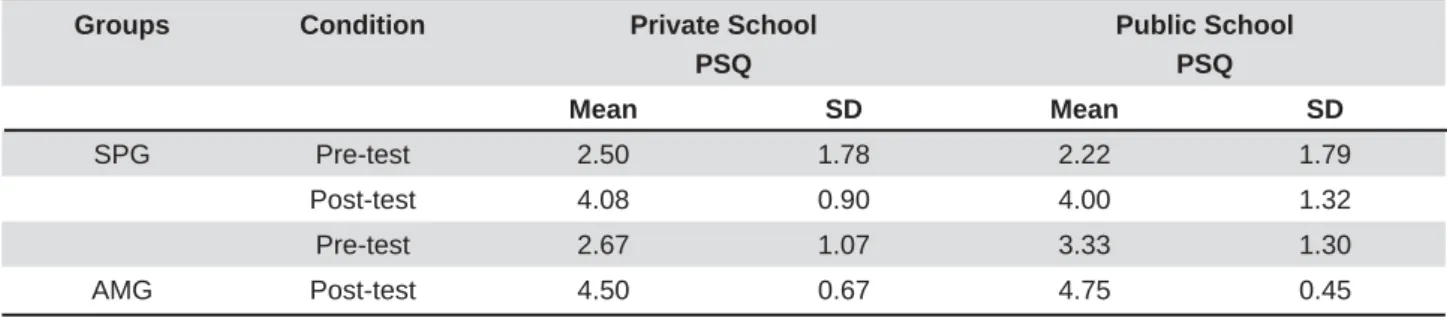
Wit h r eg ar d s t o t h e t h eor et ical k n ow led g e assessed by t he PSQ of st udent s fr om pr ivat e and public schools of t he SPG and AMG, an im pr oved p er f o r m a n ce i n t h e p o st - t est ev a l u a t i o n w a s REVHUYHGZLWKQRVWDWLVWLFDOVLJQL¿FDQWGLIIHUHQFH bet w een t he per for m ance of st udent s fr om t he t ype of school, public or privat e, using t he unpaired St udent t Test ( Table 1) .
I n Table 2, schools showing a bet t er perform ance for t he AMG were grouped bot h in t he pre and post -t es-t . The per for m ance of s-t uden-t s fr om bo-t h -t he
63*DVZHOODVWKH$0*ZDVVLJQL¿FDQWO\KLJKHULQ t he post- t est com pared wit h t he pre- t est ( p= 0.027) using t he unpair ed St udent T- t est .
7KLV¿QGLQJFRQ¿UPVWKDWWKHUHZDVDQLQFUHDVH in t he t heor et ical lear ning acquir ed in t he t hem e of gen et ic sy n dr om es in bot h gr ou ps af t er t h e pr ogram .
M ot iv a t ion a l e v a lu a t ion
The FPM m easur ed t he m ot ivat ional aspect s in relat ion t o t he dist ance act ivit y, ie using Cybert ut or w h ile u sin g t h e v ir t u al lear n in g en v ir on m en t . The FPM was answ er ed by 100% of t he sam ple. St udent s t ook an average of 15 m inut es t o answ er t his inst r um ent .
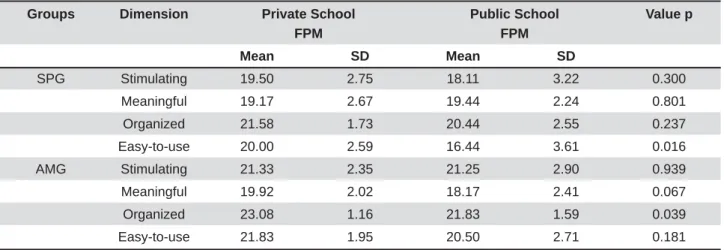
The dim ension m ost r epor t ed by t he SPG and AMG st udent s was or ganized and less evident and easy- t o- use by t he SPG and m eaningful for t he AMG ( Table 3) .
I n t he analysis consider ing t he var iable t ype of school ( Table 4) , it can be not ed t hat t her e was a VWDWLVWLFDOO\VLJQL¿FDQWGLIIHUHQFHLQWKHVL]HRIWKH
Groups Dimension Private School
FPM
Public School FPM
Value p
Mean SD Mean SD
SPG Stimulating 19.50 2.75 18.11 3.22 0.300
Meaningful 19.17 2.67 19.44 2.24 0.801
Organized 21.58 1.73 20.44 2.55 0.237
Easy-to-use 20.00 2.59 16.44 3.61 0.016
AMG Stimulating 21.33 2.35 21.25 2.90 0.939
Meaningful 19.92 2.02 18.17 2.41 0.067
Organized 23.08 1.16 21.83 1.59 0.039
Easy-to-use 21.83 1.95 20.50 2.71 0.181
Table 4- Mean and standard deviation of the assessed dimensions of the adapted Web Site Motivational Analysis Checklist
(FPM) in the SPG and AMG, according to type of school
SPG=São Paulo Group; AMG=Amazonas Group; SD=Standard Deviation
Dimension Mean Median Minimum Maximum SD
SPG Stimulating 18.9 19 13 24 2.96
Meaningful 19.29 18 16 24 2.41
Organized 21.1 22 16 24 2.14
Easy-to-use 18.48 19 12 23 3.49
AMG Stimulating 21.29 21 17 28 2.58
Meaningful 19.04 19.5 14 23 2.35
Organized 22.46 23 20 24 1.5
Easy-to-use 21.17 21.5 16 24 2.41
Table 3- Mean, median, minimum, maximum and standard deviation (SD) values assessed by the adapted Web Site
Motivational Analysis Checklist (FPM) for the SPG and AMG
easy- t o- use for t he SPG ( p= 0.016) and or ganized for t he AMG ( p= 0.039) accor ding t o t he unpair ed St udent T- t est .
)ROORZLQJ WKH ¿QGLQJV DQG UHFRPPHQGDWLRQV of t he FPM, a Car t esian pr oj ect ion was per for m ed WKDWUHÀHFWVWKHH[SHFWDWLRQIRUVXFFHVVDQGYDOXH of t he developed educat ional pr ogram ( Figur e 2) .
Accor ding t o t he Car t esian pr oj ect ion, 100% of t he par t icipant s in t he SPG and AMG consider ed t he pr ogram as “ aw esom e cour se”. This pr oj ect ion per m it t ed t he analysis t hat not ed t hat t he pr ogram of m ot ivat ional point of view of elem ent ar y school st udent s evaluat ed in t his st udy was of high index approval, which gives obj ect ive effect iveness of t he pr oposed m at er ial.
M u lt iplica t ion of k n ow le dge
Follow ing t he m et hodology of t he Young Doct or Pr oj ect , aft er com plet ing t he st eps of t he pr ogram , t he par t icipant s w er e t it led “ Young Doct or s” and m ult iplied t he know ledge gained.
T h e m u l t i p l i c a t i o n o r d i s s e m i n a t i o n o f k now ledge w as t he per for m ance of all par t icipant s a s m u l t i p l i e r s , t r a n s m i t t i n g i n f o r m a t i o n t o ot h er sch ool st u d en t s, t each er s, st af f an d t h e co m m u n i t y. St u d e n t s r e ce i v e d a j a ck e t w i t h t h e sy m bol of t h e You n g Doct or Pr oj ect an d a FHUWL¿FDWHRISDUWLFLSDWLRQ
D I SCUSSI ON
The present st udy has developed an educat ional program wit h genet ic syndrom es having elem ent ary sch o o l st u d e n t s a s a t a r g e t a u d i e n ce , u si n g r esour ces m ediat ed by int eract ive Tele- educat ion.
Som e st u dies sh ow t h at ear ly in cor por at ion of h ealt hy h abit s can gen er at e beh av ior ch an ges, t her efor e, it should be encouraged by educat ional program s designed for children and adolescent es3,6.
7KH SURSRVHG SURJUDP ZDV GLYLGHG LQWR ¿YH phases: classr oom act iv it ies, dist ance act iv it ies, assessm ent of lear ning, assessm ent m ot ivat ional and m ult iplicat ion of k now ledge. Tele- educat ion r equir es a pedagogy t hat w ill at t ract not only t he t echnical appr oach, but it also has a concer n w it h r elat ionships and m et hodological t eachings26.
7KHFODVVURRPDFWLYLW\ZDVWKH¿UVWVWHSRIWKH program . Classroom act ivit ies wit h lect ures, videos, im ages and int eract ion wit h t he t ut or are key fact ors t o t he success of an educat ional pr ogram7.
D i st a n ce a ct i v i t i e s u si n g i n t e r a ct i v e Te l e -educat ion was t he second st ep. I nt eract ive Tele-ed u cat ion is t h e op t im izat ion of t ech n olog ical r e so u r ce s a n d e d u ca t i o n d e si g n e d t o f o st e r in t er act iv it y an d m ain t ain t h e in t er est of t h e st udent1. The educat ional m at erial used in t his st ep
was a Cyber t ut or in t hem at ic genet ic syndr om es21.
Th e Cy ber t u t or per m it t ed t h e fr agm en t at ion of educat ional cont ent on different accessible screens. Being an elect r onic t ut or available on t he I nt er net , DFFHVV WLPHV ZHUH ÀH[LEOH GHSHQGLQJ RQ WLPH availabilit y and st udent int erest . Anot her advant age was t he abilit y t o access as oft en as was necessary.
The Cybert ut or, while being an int eract ive virt ual lear n in g en v ir on m en t , w as also u sed in ot h er st udies, ver ifying t hat it pr oves t o be an excellent opt ion for acquir ing know ledge2,3,6,8,18.
The assessm ent of lear ning, par t of t heor et ical know ledge, was m easured in t he pre and post - t est , ZLWKWKH¿QGLQJVRIWKH3647KHGDWDLQ7DEOHVDQG
2 dem onst rat e t hat bot h t he SPG and AMG gr oups obt ained bet t er r esult s in t he evaluat ion aft er t he t est . The pr oblem - based lear ning lead t o br eaks w it h t he t radit ional way of t eaching and lear ning, st im ulat ing st udent s’ part icipat ive m anagem ent and r eor ganizat ion of t he t heor y/ pract ice. Pedagogical experiences based on problem - based learning and/ or pr oblem at izat ion m ay r epr esent an innovat ive m ovem ent in t he cont ext of educat ion in healt hcare, fost er ing br eaks and br oader m ovem ent s17.
The m ot ivat ional evaluat ion of t he pr ogram was per for m ed t hr ough t he FPM. I n t he SPG, t her e was DVWDWLVWLFDOO\VLJQL¿FDQWGLIIHUHQFHEHWZHHQWKHW\SH of school, regarding t he “ easy- t o- use” dim ension ( p SUREDEO\GHPRQVWUDWLQJDJUHDWHUGLI¿FXOW\ in t he use of t he t ool by public school st udent s com pared wit h privat e. I n t he AMG, t he “ organized” GLPHQVLRQZDVVLJQL¿FDQWO\KLJKHUWKDQWKHRWKHU d im en sion s w h en com p ar in g all t h e st u d en t s, consider ing t he school t ype ( p 0.039) ( Table 4) .
Th e f i n d i n g s of t h i s st u d y cor r ob or at e t h e consult ed lit erat ur e18, 19, 22 also r ev ealing t hat t he
FPM is an inst r um ent of high validit y for m easur ing t h e m o t i v a t i o n a l a sp e ct o f d i st a n ce l e a r n i n g cour ses. A w ebsit e w it h high qualit y is one t hat cont ains m ot ivat ional charact er ist ics t hat m ot ivat e par t icipant s t o visit , explor e and com e back t o it .
Upon com plet ion of t he “ Young Doct or s” st eps, t he know ledge acquir ed in t heir r espect ive schools was m ult iplied. The act ivit ies of healt h educat ion should involve not only st udent s, but t he school as a w hole, aim ing t o build healt hy envir onm ent s an d ch an g in g t h e b eh av ior of st u d en t s of t h e com m unit y27.
The Young Doct or Pr oj ect poses for elem ent ar y st u den t s an oppor t u n it y t o ex er cise cit izen sh ip DQGVFLHQWL¿FLQLWLDWLRQZLWKDSUDFWLFDODSSOLFDWLRQ of t he know ledge gained. This st rat egy can also be obser ved in ot her st udies3,6, being per for m ed
in t he m ost diver se t hem at ics, assum ing t hat one of t he m ost effect ive ways t o pr om ot e healt h in a com m unit y is t hr ough educat ion.
CON CLUSI ON S
We d e v e l o p e d a n e d u ca t i o n a l p r o g r a m i n genet ic syndr om es for elem ent ar y st udent s, using I nt eract ive Tele- educat ion. The applicat ion of t his m odel wit h classroom and dist ance act ivit ies proved t o be an effect ive pr ogram of healt h educat ion for ach iev in g h igh m ot ivat ion al sat isfact ion for t h e pr oposed populat ion. Ther e w er e no st at ist ically VLJQL¿FDQWGLIIHUHQFHVEHWZHHQWKHJURXSVUHJDUGLQJ t he t ype of school public or privat e or t he evaluat ed %UD]LOLDQ VWDWH DQRWKHU ¿QGLQJ WKDW UHLQIRUFHV t hat t his t ool could be used for t raining in genet ic syndr om es for ot her populat ions and ot her r egions of t he count r y.
REFEREN CES
1- Araúj o ES, Alvar enga KF, Ur nau D, Pagnossin DF, Wen CL. Com m unit y healt h w or k er t raining for infant hear ing healt h: effect iveness of dist ance lear ning. I nt J Audiol. 2013; 52( 9) : 636-41.
2- Blasca WQ, Maxim ino LP, Galdino DG, Cam pos K, Picolini MM. New educat ional Technologies in Audiology t eaching. Rev CEFAC. 2010; 12( 6) : 1017- 24.
3- Blasca WQ, Picolini MM, Silva AS, Cam pos K, Pint o GF, Brasolot t o AG, et al. Young Doct or Baur u Pr oj ect : t raining of high school st udent s in hear ing healt h. Rev CEFAC. 2013; 15( 6) : 1407- 17. 4- Cady R, Finkelst ein S, Kelly A. A t elehealt h nursing int ervent ion reduces hospit alizat ions in children wit h com plex healt h condit ions. J Telem ed Telecar e. 2009; 15( 6) : 317- 20.
5- Chum bler NR, Haggst r om D, Saleem JJ. I m plem ent at ion of healt h inform at ion t echnology in Vet erans Healt h Adm inist rat ion t o suppor t t ransfor m at ional change: t elehealt h and per sonal healt h r ecor ds. Med Car e. 2011; 49( S) 36- 42.
6- Cor r êa CC, Mar t ins A, Fant on CS, Silva AS, Bar r os GT, Wen CL, et al. Act ivit ies of int eract ive t eleducat ion in vocal healt h based on t he Young doct or dynam ics. Dist úr b Com un. 2012; 24( 3) : 359- 68. 7- De Jong N, Verst egen DML, Tan FES, O’Connor SJ. A com parison of classr oom and online asynchr onous pr oblem - based lear ning for st udent s under t aking st at ist ics t raining as par t of a Public Healt h Mast er s d eg r ee. Ad v Healt h Sci Ed u c Th eor y Pr act . 2013; 18( 2) : 245- 64.
8- Eskenazi ES, Mar t ins MA, Fer r eira M Jr. Oral healt h pr om ot ion t hr ough an online t raining pr ogram for m edical st udent s. J Dent Educ. 2011; 75( 5) : 672- 8.
9- Hanson D, Calhoun J, Sm it h D. Changes in pr ovider at t it udes t owar d t elem edicine. Telem ed J E Healt h. 2009; 15( 1) : 39- 43.
+DZNLQV$.+D\GHQ05$JUDQGFKDOOHQJHSURYLGLQJEHQH¿WV
of clinical genet ics t o t hose in need. Genet Med. 2011; 13( 3) : 197-200.
11- Head BA, Keeney C, St udt s JL, Khayat M, Bum pous J, Pfeifer M. Feasibilit y and accept ance of a t elehealt h int er vent ion t o pr om ot e sym pt om m anagem ent during t reat m ent for head and neck cancer. J Suppor t Oncol. 2011; 9( 1) : e1- e11.
12- Hilgar t JS, Haywar d JA, Coles B, I r edale R. Telegenet ics: a sy st em at ic r ev iew of t elem edicine in genet ics ser v ices. Genet Med. 2012; 14( 9) : 765- 76.
13- Hopper B, Buckm an M, Edwar ds M. Evaluat ion of sat isfact ion of parent s wit h t he use of videoconferencing for a pediat ric genet ic consult at ion. Tw in Res Hum Genet . 2011; 14( 4) : 343- 6.
1 4 - I n st i t u t o Br a si l ei r o d e Geo g r a f i a e Est a t íst i ca . Cen so
'HPRJUi¿FR>KRPHSDJH@>FLWHG0D\@$YDLODEOH
f r o m : h t t p : / / w w w . i b g e. g ov. b r / h o m e/ est at i st i ca/ p o p u l acao / censo2010/ t abelas_pdf/ Brasil_t ab_1_15.pdf.
15- Lee D, Helal S, Ant on S, De Deugd S, Sm it h A. Par t icipat or y and per suasive t elehealt h. Ger ont ology. 2012; 58( 3) : 269- 81. 16- Minist ér io da Saúde. Depar t am ent o de I nfor m át ica do SUS. 2011. [ Hom epage] . [ cit ed 2011 July 18] . Available fr om : ht t p: / / t abnet .dat asus.gov.br / cgi/ t abcgi.exe?sinasc/ cnv/ nvuf.def. 17- Mit re SM, Siqueira- Bat ist a R, Girardi- de- Mendonça JM, Morais-Pint o NM, Meir elles CAB, Morais-Pint o- Por t o C, et al. Act ive t eaching-lear ning m et hodologies in healt h educat ion: cur r ent debat es. Ciênc Saúde Colet iva. 2008; 13( 2) : 2133- 44.
18- Paixão MP, Miot HA, Souza PE, Haddad AE, Wen CL. A universit y ex t ension cour se in lepr osy : t elem edicine in t he Am azon for pr im ar y healt hcar e. J Telem ed Telecar e. 2009; 15( 2) : 64- 7. 19- Paix ão MP, Miot HA, Wen CL. Tele- educat ion on lepr osy : ev alu at ion of an ed u cat ion al st r at eg y. Telem ed J E Healt h . 2009; 15( 6) : 552- 9.
2 1 - Picolin i MM, Blasca WQ, Rich ier i- Cost a A, Max im in o LP. The developm ent of a v ir t ual lear ning env ir onm ent in genet ic syndr om es. Rev CEFAC. 2013; 15( 2) : 382- 90.
22- Picolini MM, Max im ino LP. Educat ion pr ogram on genet ic sy ndr om es: m ot ivat ional evaluat ion of an e- lear ning m at er ial. Rev CEFAC. 2014; 16( 1) : 252- 9.
23- Silva AS, Rizzant e FA, Picolini MM, Cam pos K, Cor r êa CC, Franco EC, et al. Baur u School of Dent ist r y Tele- Healt h League: an ed u cat ion al st r at eg y ap p lied t o r esear ch , t each in g an d ex t ension am ong applicat ions in t ele- healt h. J Appl Oral Sci. 2011; 19( 6) : 599- 603.
24- Silva JM, Canedo RV, Abrant es TA, Sant os RT, Souza RA, Ut agawa CY. Quiz: um quest ionár io elet r ônico para aut oavaliação e apr endizagem em genét ica e biologia m olecular. Rev Bras Educ Med. 2010; 34( 4) : 607- 14.
25- Spinardi- Panes AC, Lopes- Herrera SA, Maxim ino LP. Telehealt h in Speech, Language and Hear ing Sciences: et hical and legal issues. Rev CEFAC. 2013; 15( 4) : 1040- 3.