Introduction
The promotion of lifelong physical activity and a healthy lifestyle is among the main purposes of public health in many countries1. Investments in programs promoting sports participation is usually based on the belief that physical activity is beneicial to youth health, that it becomes habitual over time, and that these positively inluence health outcomes in the adult population. Many transitions and life changing events during the course of one’s life canaffect physical activity levels, and therefore, this habit is likely to vary in different phases of life2. Recently, sports participation was recognized by the International Society for Physical Activity and Health as “an investment that works” to promote physical activity (Trost, 2014). Additionally, studies indicate its potential to boost physical itness, mental health and social behavior. Research also reveals how this behavior during youth can develop assets that endorse positive trajectories during life22.
In this perspective, the promotion of sports participation during the early years of life is important not only because it promotes health during childhood and adolescence3-6 but also because it stimulates engagement in physical activity in adulthood.7 From a preventive point of view, it is reasonable to believe that adults who participated in sports or attempted some kind of extracurricular activities (e.g. leisure, commuting by
bicycle) from a younger age tend to have a healthier life, more so than those who did not participate in anything8, enhancing the importance of sports participation in pediatric populations6, 9, 23. However, more information is needed about this ield24.
The identiication of groups with a higher risk of being physically inactive during life is essential for elaborating public health decisions to decrease this unhealthy behavior6. However, most studies have focused in sports participation in youth or in adults in separate ways, not looking into the tracking of sports participation from childhood to adulthood. Therefore, engagement in sports participation throughout life is an outcome poorly investigated, mainly in developing countries; even cross-sectional studies with a retrospective design are scarce8, 10, 11 These studies also suggest the fact that sports participation signiicantly increases physical activity during adolescence and early adulthood. It should further be commented that these indings should be replicated globally in more populpations to improve the basis of all this evidence25.
Thus, the purposes of the present study were i) to identify the association between sports participation during the early years of life and adulthood, ii) to analyze the non-engagement in sports throughout life, as well as iii) to identify the correlates of non-engagement in sports in a randomly selected sample from a medium-size Brazilian city.
Original Article (short paper)
Can participation in sports during childhood
inluence physical activity in adulthood?
Santiago Maillane-Vanegas1*,Rafael Orbolato1, Isabella Neto Exuperio1, Jamile Sanches Codogno1,2, Bruna Camilo Turi-Lynch1, Dayane Cristina Queiroz1, Diego G. Destro Christofaro1,2, Everton Alex Carvalho Zanuto1,2
1Universidade Estadual Paulista, UNESP, Presidente Prudente, SP, Brazil; 2Universidade Estadual Paulista, UNESP, Rio Claro, SP, Brazil.
Abstract — Aims: The promotion of sports participation during the early years of life is important not only because it promotes health during childhood and adolescence, but also because it has beneits in adulthood. This study was developed to identify the association between sports participation during the early years of life and adulthood, to analyze the non-participation in sports throughout life and to identify the correlates of non-participation in sports.DESIGN:
Cross-sectional study. Methods: The sample was composed of 743 adults randomly selected in a medium-size Brazilian city. Non-participation in sports during childhood and adolescence was assessed through speciic questions, and non-participation in sports in adulthood was assessed using the second section of Baecke questionnaire. Answering “no” in the three periods assessed (childhood, adolescence and adulthood) was characterized as non-participation in sports throughout life. Chronological age, sex, formal education, BMI, current job and ethnicity were considered covariates. Categorical data were expressed as rates and compared using chi-square test and binary logistic regression. Results:
The prevalence of adults not engaged in sports throughout life was 58.5% (95% CI= 55.1 – 62.1). Females (OR = 2.41 [1.71 – 3.38]), those more advanced in age (OR = 3.29 [1.82-5.94]) and/or possessing a lower level of education (OR = 4.47 [2.45 – 8.17]) were associated with the non-engagement in sports. Conclusion: Non-participation in sports during
childhood can inluence non-participation in sports during adulthood, which is signiicantly affected by sex, age and education level.
Methods
Sample and sampling
This cross-sectional study was conducted in 2012 in the city of Presidente Prudente, which is located in the western region of the state of Sao Paulo, the most industrialized state in Brazilian. The city has approximately 208,000 inhabitants and a human development index of 0.846.
The sample size was estimated considering that 50.7% of adults were physically inactive in childhood, adolescence and adulthood 8, given an error of 4% and a signiicance of 5% (z = 1.96). Predicting future dropouts, an additional rate of 20% was added over the initial sample size. Therefore, a sample size of 720 participants was estimated to be representative. Inclusion criteria were deined: (i) age ≥18 years; and (ii) living for at least two years in their current house. The inal sample size was composed of 743 adults.
Data collection was conducted in two stages. First, the city was stratiied into ive geographical regions (east, west, north, south and center), and through a random process, 20 streets and avenues were selected per neighborhood, totaling 170. For the second stage, six houses were randomly chosen from the streets and avenues previously selected. Data collection happened on Saturdays and Sunday (from 9:00 am to 6:00 pm) during ten consecutive weeks. All adults from the selected houses were eligible for the face-to-face interview.
Prior to implementation, the study was approved by the Ethics Committee Group from Sao Paulo State University (UNESP) Presidente Prudente, Brazil (CAAE: 07770112.3.0000.5402), and all subjects were asked to sign a standard consent form.
Non-engagement in sports throughout life
Sports participation during childhood and adolescence was analyzed using two questions8, 11: (i) “Outside school, were you ever engaged in any organized/supervised sport activities for at least one year from age 7 to 10 years old?”. If yes, the participant would select the sport: soccer, basketball, volleyball, handball, dance, other, and (ii) “Outside school, were you ever engaged in any organized/supervised sport activities for at least one year from age 11 to 17 years old?”. If yes, the participant would select the sport: soccer, basketball, volleyball, handball, dance, other.
Information concerning sports participation among adults was assessed using the second section of the questionnaire, developed by Baecke and colleagues
The main outcome of this study was the non-engagement in sports throughout life, characterized by lack of sports participation during the three phases of one’s lifespan considered in this article: childhood, adolescence and adulthood.
A pilot study was carried out in a subsample with similar characteristics (not included in the study [n= 20]) to assess reproducibility of the self-reported data (the second face-to-face interview was performed 14 days after the irst interview). Physical activity during childhood (kappa index = 0.70; P-value = 0.001), adolescence (kappa index = 0.89; P-value = 0.001) and adulthood (rho = 0.88; P-value = 0.001) showed moderate to high scores of reproducibility.
Independent variables
Age, sex (male and female), level of education, body mass index (BMI), current job, and ethnicity (deined as white, black, oriental or other) were treated as covariates. Chronological age was structured as a categorical variable (18-29.9 years; 30-44.9 years; 45-59.9 years; ≥ 60 years), as well as level of education (<4 years; 5-8 years; high school; college or more). Participants self-reported body weight (kg) and height (m) during the face-to-face interview, and BMI was calculated as body weight divided by height squared (expressed as kg/m2). Overweight and obesity were identiied as BMI between 25-29.90 kg/m2 and BMI ≥30 kg/m2, respectively.
Statistical Procedures
Table 1. Summary of the general characteristics of the sample.
General characteristics
Variables n (%) (% 95%CI)
Sex
Male 288 (38.8) (35.2 to 42.4)
Female 455 (61.2) (57.7 to 64.7)
Age
18-29.9 years 110 (14.8) (12.2 to 17.3)
30-44.9 years 192 (25.8) (22.6 to 28.9)
45-59.9 years 212 (28.5) (25.2 to 31.7)
≥60 years 229 (30.9) (27.5 to 34.1)
Ethnicity
White 616 (82.9) (80.2 to 85.6)
Black 83 (11.2) (8.9 to 13.4)
Oriental 28 (3.8) (2.4 to 5.1)
Other 16 (2.2) (1.1 to 3.2)
Level of education
< 4 years 155 (20.8) (17.9 to 23.7)
5-8 years 129 (17.4) (14.6 to 20.1)
High School 292 (39.3) (35.7 to 42.8)
College or more 167 (22.5) (19.4 to 25.4)
Current Job
Yes 437 (58.8) (55.2 to 62.3)
No 306 (41.2) (37.6 to 44.7)
Overweight
Normal weight 308 (41.5) (37.9 to 45.1)
Overweight 260 (35.1) (31.5 to 38.4)
Obesity 175 (23.4) (20.5 to 26.6)
Sports participation
Childhood 193 (26.1) (22.8 to 29.1)
Adolescence 205 (27.6) (24.3 to 30.8)
Adulthood 107 (14.4) (11.8 to 16.9)
95%CI = 95% conidence interval
Sports participation during childhood and adolescence were reported by 26.1% and 27.6% of the sample, respectively (Figure 1, Panel A). Soccer was the most frequent sport reported in the childhood and adolescence periods of the participants of this study. Sports participation during adulthood was reported by
The non-participation in sports throughout life was an outcome highly observed (n = 435; 58.5% [95% CI = 55.1 to 62.1]) and it was associated with the females (OR = 2.42 [1.79 – 3.39]), higher age, the presence of a current job (OR =
2.06 [1.51 – 2.79]) and a lower level of education (OR = 7.59 [4.49 – 12.8]) in the crude model. On the other hand, overweight (P-value = 0.259) and ethnicity (P-value = 0.137) were not
associated with non-engagement in sports (Table 2).
Table 2. Association between non-participation in sports throughout life and independent variables.
Outcome: non-participation in sports throughout life
Chi-square test Logistic Regression
Independent Variables n (%) P – value OR crude (OR95%CI)
Sex 0.001
Male 131 (45.5) 1.00
Female 304 (67) 2.42 (1.79 – 3.39)
Age 0.001
18-29.9 years 34 (30.9) 1.00
30-44.9 years 98 (51) 2.33 (1.42 – 3.81)
45-59.9 years 132 (62.3) 3.68 (2.25 – 6.02)
≥ 60 years 171 (75.3) 6.82 (4.12 – 11.3)
Ethnicity 0.137
White 355 (57.6) 1.00
Black 51 (61.4) 1.17 (0.73 – 1.87)
Oriental 16 (57.1) 0.98 (0.45 – 2.10)
Other 13 (81.3) 3.18 (0.89 – 11.2)
Level of education 0.001
< 4 years 129 (83.2) 7.59 (4.49 – 12.8)
5-8 years 103 (79.8) 6.06 (3.56 – 10.3)
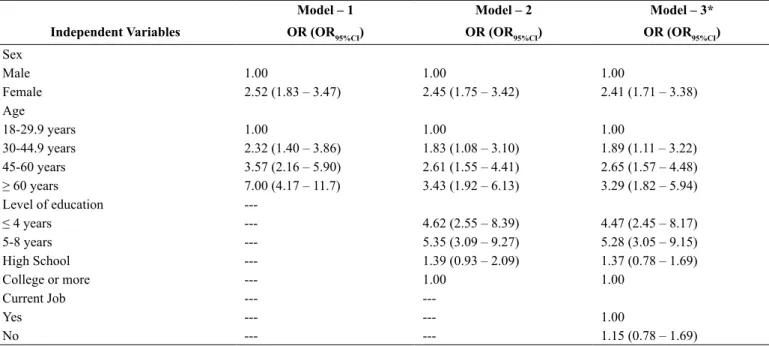
In the multivariable model, the non-participation in sports throughout life remained associated with the female sex even after adjustment for potential confounders (OR = 2.41 [1.71 – 3.38]). Similar results were found regarding chronological age and lower level of education (5-8 years of formal education,
OR = 5.28 [3.05 – 9.15]; ≤ 4 years of formal education, OR = 4.47 [2.45 – 8.17]). The multivariable model (Model – 3) had an adequate goodness-of-it, which was assessed with the Hosmer and Lemeshow’s test (P-value = 0.883) (Table 3).
Table 3. Multivariable models for the association between non-participation in sports throughout life and independent variables among adults.
Model – 1 Model – 2 Model – 3*
Independent Variables OR (OR95%CI) OR (OR95%CI) OR (OR95%CI)
Sex
Male 1.00 1.00 1.00
Female 2.52 (1.83 – 3.47) 2.45 (1.75 – 3.42) 2.41 (1.71 – 3.38)
Age
18-29.9 years 1.00 1.00 1.00
30-44.9 years 2.32 (1.40 – 3.86) 1.83 (1.08 – 3.10) 1.89 (1.11 – 3.22)
45-60 years 3.57 (2.16 – 5.90) 2.61 (1.55 – 4.41) 2.65 (1.57 – 4.48)
≥ 60 years 7.00 (4.17 – 11.7) 3.43 (1.92 – 6.13) 3.29 (1.82 – 5.94)
Level of education
---≤ 4 years --- 4.62 (2.55 – 8.39) 4.47 (2.45 – 8.17)
5-8 years --- 5.35 (3.09 – 9.27) 5.28 (3.05 – 9.15)
High School --- 1.39 (0.93 – 2.09) 1.37 (0.78 – 1.69)
College or more --- 1.00 1.00
Current Job ---
---Yes --- --- 1.00
No --- --- 1.15 (0.78 – 1.69)
* = Hosmer and Lemeshow test with P – value = 0.883; Model – 1= adjusted by sex and age; Model – 2 = adjusted by sex, age and formal education; Model – 3 = adjusted by sex, age, formal education and current job; OR = odds ratio; 95%CI = 95% conidence interval.
Discussion
This cross-sectional study identiied that non-participation in sports during childhood can inluence non-participation in sports during adulthood, which is signiicantly affected by sex, age and education level.
In our sample, non-participation in sports during the early years of life signiicantly affected sports participation or physical activity in adulthood. Longitudinal data showed that the amount of physical activity decreases from adolescence to adulthood, mainly for moderate-to-vigorous intensity physical activity,13, 14 the most relevant type for the maintenance of health in adults. On the other hand, sports are usually incorporated into training routines performed at moderate-to-vigorous intensity, as well as it is performed expressively from childhood to adolescence6 and from adolescence to adulthood.7
Older people report lower participation in sports in all periods of their lives.11 In our study, 14.4% of the adults reached 180 min/week of participation in sports, a rate lower than observed in adults from England (41.2% among men and 33.9% among women in 2006).15 However, it is worth mentioning that sports participation in England did not have a cutoff point, as did our study. Economic determinants of habitual physical activity are different in developed and developing nations. However, age is a factor that has a similar effect on physical activity patterns in both developing and developed settings, in which the elderly present higher levels of physical inactivity10, 15. Older people
also reported lower engagement in sports during childhood and adolescence when compared to younger groups10, 15. To support these indings, national data show that most Brazilians didn’t have access to sports while growing up, and when they did, it was usually soccer. This could explain why men are more likely to remain playing sports when compared to women28.
Concerning these indings, it could be attributed to the effectiveness of governmental programs to promote physical activity/sports, which were initiated early in Europe and, therefore, their results can be veriied in younger populations.16 Moreover, the observed results conirm that physical inactivity in older adults should be a concern and a target for public health organizations worldwide.
In agreement with our data, early and currently engagement in sports was positively associated with the males10 . The reasonable explanation for this inding seems to be in the higher support offered by the family nucleus for boys to engage in sports starting in the early years of life17, 18 . It is rational to believe that this support inluences behaviors related to sports participation in adulthood. Our indings are also similar to Howie, McVeigh, Smith, Straker26, who reveal that teasing among girls, body image, feeling that sports are not feminine coupled with the stereotypes of sex roles in society, increases the participation of boys and the reduces the participation girls in sports or physical activity from an early age26.
countries, education and socioeconomic status are strongly related, and the positive relationship between physical activity and socioeconomic status is clear in the adult population (wealthier adults are more likely to be active in leisure-time and less active at work, while poorer adults are less active in leisure-time and more active at work). Moreover, wealthier people are surrounded by places with more facilities to practice physical activity/sports19. Furthermore, the demand for sports participation is signiicantly affected by inancial variables (price payed for these activities)20.
Regarding the relationship between economic status and sports participation, unemployment is a condition that acts as a barrier, limiting the individual to engage in exercise/sports26. Howie, McVeigh, Smith, Straker26 emphasize that strategies for engaging people in physical activity/sports programs are necessary, and public policy should support or create awareness that sports participation does not need sophisticated places to happen, and its health beneits are valuable26.
It is plausible to believe that the poorest children who are not practicing sports (poorer boys and girls have less access to sport facilities and devices) would have a higher likelihood of becoming inactive adults. Stalsberg and Pedersen21, in a systematic review, identiied a relationship between socioeconomic status and physical activity in adolescents, but the inconsistency of the methods to measure these variables in their research limits a clear understanding of the issue. In fact, more studies about this subject are necessary to understand clearly “how”/”why” this association happens, but apparently socioeconomic status plays a signiicant role in the maintenance of physical activity levels from childhood to adulthood. Therefore, this speciic inding highlighted the relevance of actions promoting sports participation/physical activity in groups of lower economic status, independent of age.
Limitations must be recognized. Errors in recollection may occur when assessing sports participation in early life. The different criteria used to determine non-participation in sports in childhood/adolescence and adulthood are also a limitation, as well as sample size randomization and calculation, which did not consider demographic data. Moreover, our pilot study identiied moderate-to-high reproducibility for early sports participation.
Conclusion
In summary, we found signiicant association between non-participation in sports during the early years of life and non-participation in sports during adulthood. Moreover, our study identiied a high occurrence of non-participation in sports
2. Tammelin T, Viikari JS, Raitakari OT. Tracking of physical activity from early childhood through youth into adulthood. Med Sci Sports Exerc. 2014;46(5):955-62.
3. Cayres SU, de Lira FS, Machado-Rodrigues AM, Júnior IFF, Barbosa MF, Fernandes RA. The mediating role of physical inactivity on the relationship between inlammation and artery thickness in prepubertal adolescents. J Pediatr. 2015;166(4):924-9. 4. Cayres SU, Vanderlei LCM, Rodrigues AM, Silva MJC, Codogno
JS, Barbosa MF, et al. Sports practice is related to parasympathetic activity in adolescents. Rev Paul Pediatr 2015;33(2):174-80. 5. Christofaro D, Ritti-Dias R, Chiolero A, Fernandes R, Casonatto
J, Oliveira A. Physical activity is inversely associated with high blood pressure independently of overweight in Brazilian adolescents. Scandinavian journal of medicine & science in sports. Scand J Med Sci Sports. 2013 Jun;23(3):317-22.
6. Silva DR, Fernandes RA, Ohara D, Collings PJ, Souza MF, Tomeleri CM, et al. Correlates of sports practice, occupational and leisure-time physical activity in Brazilian adolescents. Am J Hum Biol. 2016 Jan-Feb;28(1):112-7.
7. Bélanger M, Sabiston CM, Barnett TA, O’Loughlin E, Ward S, Contreras G, et al. Number of years of participation in some, but not all, types of physical activity during adolescence predicts level of physical activity in adulthood: Results from a 13-year study. Int J Behav Nutr Phys Act. 2015 Jun 10;12:76.
8. Fernandes RA, Christofaro DGD, Casonatto J, Codogno JS, Rodrigues EQ, Cardoso ML, et al. Prevalence of dyslipidemia in individuals physically active during childhood, adolescence and adult age. Arq Bras Cardiol. 2011 Oct;97(4):317-23.
9. Vanderlei FM, Vanderlei L, Bastos FN, Netto Júnior J, Pastre CM. Characteristics and associated factors with sports injuries among children and adolescents. Braz J Phys Ther. 2014 Nov-Dec;18(6):530-7.
10. Azevedo MR, Araújo CL, Silva MCd, Hallal PC. Tracking of physical activity from adolescence to adulthood: a population-based study. Rev Saude Publica. 2007 Feb;41(1):69-75. 11. Fernandes RA, Zanesco A. Early physical activity promotes lower
prevalence of chronic diseases in adulthood. Hypertens Res. 2010 Sep;33(9):926-31.
12. Baecke JA, Burema J, Frijters J. A short questionnaire for the measurement of habitual physical activity in epidemiological studies. Am J Clin Nutr. 1982 Nov;36(5):936-42.
13. Twisk JWR, Kemper HC, van MECHELEN W. Tracking of activity and itness and the relationship with cardiovascular disease risk factors. Med Sci Sports Exerc. 2000 Aug;32(8):1455-61. 14. Van Mechelen W, Twisk JW, Post GB, Snel J, Kemper HC.
of regular participation in sports among adolescents. Int J Public Health. 2012 Apr;57(2):431-5.
18. Gonçalves H, Hallal PC, Amorim TC, Araújo CL, Menezes A. Sociocultural factors and physical activity level in early adolescence. Rev Panam Salud Publica. 2007 Oct;22(4):246-53. 19. Wendel-Vos GW, Schuit AJ, De Niet R, Boshuizen HC, Saris W,
Kromhout D. Factors of the physical environment associated with walking and bicycling. Med Sci Sports Exerc. 2004;36(4):725-30. 20. Anokye NK, Pokhrel S, Buxton M, Fox-Rushby J. The demand
for sports and exercise: results from an illustrative survey. Eur J Health Econ. 2012 Jun;13(3):277-87.
21. Stalsberg R, Pedersen AV. Effects of socioeconomic status on the physical activity in adolescents: a systematic review of the evidence. Scandinavian journal of medicine & science in sports. Scand J Med Sci Sports. 2010 Jun;20(3):368-83.
22. Mueller MK, Lewin-Bizan S, Urban JB. Youth activity involvement and positive youth development. Adv child Dev Behav. 2011;41:231-49.
23. Elhakeem A, Hardy R, Bann D. Intergenerational social mobility and leisure-time physical activity in adulthood: a systematic review. J Epidemiol Community Health. 2017 Jul;71(7):673-680. 24. Mountjoy M. Health and itness of young people: what is the role
of sport? Br J Sports Med. 2011;45(11):837-8.
25. Telford RM, Telford RD, Cochrane T, Cunningham RB, Olive LS, Davey R. The influence of sport club participation on physical activity, itness and body fat during childhood and adolescence: The LOOK Longitudinal Study. J Sci Med Sport. 2016;19(5):400-6.
26. Howie EK, McVeigh JA, Smith AJ, Straker LM. Organized Sport Trajectories from Childhood to Adolescence and Health Associations. Med Sci Sports Exerc. 2016;48(7):1331-9.
27. Armstrong, N., & Van Mechelen, W. (2008). Paediatric exercise science and medicine: Oxford University Press.
28. Rossi P, Cândido CE, Sitta T, Jabur AC, Sanz C. Diagnostico Nacional do Esporte, Caderno 1. Ministério do Esporte, Brasília 2015.
Acknowledgments
S.M. Vanegas elaborated the article, generated the results and wrote the manuscript; Orbolato R., Exuperio I. N., B.C. Turi-Lynch, J.S. Condogno, D. C. Queiroz, D.D. Christofaro, E.C. Zanuto contributed to the writing of the manuscript.
Funding: This work was supported by Brazilian Ministry of Science and Technology.
Corresponding author
Santiago Maillane Vanegas
Department of Physiology, Department of Physiotherapy, Sao Paulo State Univer
-sity (UNESP), Presidente Prudente, Brazil. Email: [email protected]
Manuscript received on June 30, 2017 Manuscript accepted on September 22, 2017