Establishment of an inducing medium for type III effector secretion
in
Xanthomonas campestris
pv.
campestris
Guo-Feng Jiang
1,2,*, Bo-Le Jiang
3,*, Mei Yang
4, San Liu
3, Jiao Liu
3, Xiao-Xia Liang
3,
Xian-Fang Bai
3, Dong-Jie Tang
3, Guang-Tao Lu
3, Yong-Qiang He
3, Di-Qiu Yu
1,
Ji-Liang Tang
3 1Key Laboratory of Tropical Forest Ecology, Xishuangbanna Tropical Botanical Garden, Chinese Academy of Sciences, Kunming, Yunnan, China.
2
Graduate School of Chinese Academy of Sciences, Beijing, China. 3
State Key Laboratory for Conservation and Utilization of Subtropical Agro-bioresources, The Key Laboratory of Ministry of Education for Microbial and Plant Genetic Engineering, and College
of Life Science and Technology, Guangxi University, Nanning, Guangxi, China. 4
School of Chemistry and Chemical Engineering, Guangxi University, Nanning, Guangxi, China.
Submitted: January 1, 2012; Approved: September 10, 2012.
Abstract
It is well known that the type III secretion system (T3SS) and type III (T3) effectors are essential for the pathogenicity of most bacterial phytopathogens and that the expression of T3SS and T3 effectors is suppressed in rich media but induced in minimal media and plants. To facilitate in-depth studies on T3SS and T3 effectors, it is crucial to establish a medium for T3 effector expression and secretion. Xanthomonas campestrispv.campestris(Xcc) is a model bacterium for studying plant-pathogen in-teractions. To date no medium forXccT3 effector secretion has been defined. Here, we compared four minimal media (MME, MMX, XVM2, and XOM2) which are reported for T3 expression induc-tion inXanthomonasspp. and found that MME is most efficient for expression and secretion ofXcc T3 effectors. By optimization of carbon and nitrogen sources and pH value based on MME, we estab-lished XCM1 medium, which is about 3 times stronger than MME forXccT3 effectors secretion. We further optimized the concentration of phosphate, calcium, and magnesium in XCM1 and found that XCM1 with a lower concentration of magnesium (renamed as XCM2) is about 10 times as efficient as XCM1 (meanwhile, about 30 times stronger than MME). Thus, we established an inducing me-dium XCM2 which is preferred for T3 effector secretion inXcc.
Keywords:inducing medium, type III effector secretion,Xanthomonas.
Introduction
The gram-negative bacterium Xanthomonas campestrispv.campestris(Xcc) is the causal agent of black rot disease, one of the most serious diseases of cruciferous crops worldwide (Alvarez, 2000). Over the last two decades, this pathogen has been used as a model bacterium for study-ing pathogen-plant interactions. Like many other important pathogenic bacteria, the pathogenicity ofXccmainly relies on the type III secretion system (T3SS) that translocates
so-called type III (T3) effector proteins into host cells. Gen-erally the T3 effector proteins have a modular structure and the targeting signal resides in the first N-terminal 50 or 100 amino acids (Schechteret al., 2004). The T3SS ofXccis en-coded byhrp(hypersensitive response and pathogenicity) genes whose expression is controlled by the key regulators HrpG and HrpX (Arlatet al., 1991; Huanget al., 2009). It has been demonstrated that inXanthomonasspp. the expres-sion ofhrpgenes and most T3 effector genes is repressed in rich media but induced in minimal media and in plant tissues
Send correspondence to D.Q. Yu. Key Laboratory of Tropical Forest Ecology, Xishuangbanna Tropical Botanical Garden, Chinese Academy of Sci-ences, Kunming, 650223 Yunnan, China. E-mail: [email protected].
*These authors contributed equally to this work.
(Schulte and Bonas, 1992b; Tsugeet al., 2002; Ryanet al., 2007; Weiet al., 2007).
The secretion of many T3 effectors is barely detect-able in culture media, even with sensitive immunodetection (Collmer et al., 2002). To facilitate in-depth studies on T3SS and T3 effector proteins, it is crucial to establish a medium in which bacterial cells not only express theirhrp genes strongly but also secrete their T3 effector proteins ef-ficiently. To date, four minimal media (MME, MMX, XVM2, and XOM2) have been used for expression induc-tion ofhrpgenes inXanthomonasspp., of which XOM2 and XVM2 have been developed for T3 secretion induction of X. oryzae pv. oryzae (Xoo) and X. campestris pv. vesicatoria (Xcv) respectively (Wengelnik et al., 1996; Tsugeet al., 2002; Ryan et al., 2007; Wei et al., 2007). However, the secretion efficiency of T3 effectors byXccin these media has not been determined. Moreover, no induc-ing medium for T3 effector secretion has been established inXcc. In this work, based on a comparison of the four re-ported media, we investigated the effect of carbon and ni-trogen sources, phosphate, calcium, and magnesium as well as pH value on T3 secretion efficiency ofXcc. Finally, we optimized a medium XCM2 that showed highly efficient induction of T3 effector secretion inXcc.
Materials and Methods
Bacterial strains, plasmids, and growth conditions
Escherichia coli cells were grown in LB medium (Miller 1972) at 37 °C.Xccwild-type strain 8004 (Daniels et al., 1984) and its derivative strains were cultivated at 28 °C in NYG rich medium (3 g/L yeast extract, 5 g/L peptone, 20 g/L glycerol, pH 7.0) (Danielset al., 1984), or in minimal media MMX [23.8 mM glucose, 3.87 mM so-dium citrate, 15.1 mM (NH4)2SO4, 0.81 mM MgSO4, 23 mM K2HPO4, 44 mM KH2PO4, pH 7.0] (Danielset al., 1984), MME [20 mM sodium L-glutamate, 0.15 g/L casamino acids, 7.57 mM (NH4)2SO4, 1 mM MgSO4, 60.34 mM K2HPO4, 33.07 mM KH2PO4, pH 7.0] (Ryanet al., 2007), XVM2 [10 mM sucrose, 10 mM fructose, 0.01 mM casamino acids, 10 mM (NH4)2SO4, 5 mM MgSO4, 0.16 mM K2HPO4, 0.32 mM KH2PO4, 20 mM NaCl, 1 mM CaCl2, 0.01 mM FeSO4, pH 6.7] (Wengelnik et al., 1996), XOM2[10 mM sodium L-glutamate, 1.8 g/L xylose, 0.67 mM methionine, 0.04 mM MnSO4, 5 mM MgCl2, 14.7 mM K2HPO4, pH 6.5] (Tsuge et al., 2002), XCM1 [20 mM succinic acid, 0.15 g/L casamino acids, 7.57 mM (NH4)2SO4, 1 mM MgSO4, 60.34 mM K2HPO4, 33.07 mM KH2PO4, pH 6.6], or XCM2 (as XCM1 but with 0.01 mM MgSO4). Antibiotics were used as described pre-viously (Danielset al., 1984).
DNA manipulations
Standard DNA manipulations were carried out as de-scribed previously (Sambrooket al., 1989). Enzymes
sup-plied by Promega (USA) were used in accordance with the manufacturer’s instructions. The conjugation betweenXcc andE.colistrains was performed as described previously (Danielset al., 1984).
Construction of reporter plasmids and strains
It is well known that T3 effectors normally have a modular structure, of which the secretion signal generally resides in the N-terminal 50 or 100 amino acids (Schechter et al., 2004). Our previous work demonstrated that xopXccNofXccencodes a T3 effector (Jianget al., 2008). In this work, we employed the reporter plasmid pLGUS0241 of XopXccN (Jianget al., 2008) to study in-duction efficiency of T3 effector secretion. Another re-porter plasmid, named pLGUS1553, was constructed by fusing the promoter and T3 signal sequences of the T3 effector geneavrACXcc8004(Xuet al., 2008) with the promo-terlessb-glucuronidase (gusA) gene in the vector pLGUS (Jianget al., 2008). These reporter plasmids were intro-duced fromE.coli JM109 (Yanisch-Perron et al., 1985) intoXccwild-type strain 8004 and the T3SS-deficient mu-tant strain 8004DhrcV (data not published) by triparental conjugation using pRK2073 (Leong et al., 1982) as the helper plasmid, respectively. The yielding transconjugant strains 8004/pLGUS0241, 8004/pLGUS1553, and 8004DhrcV/pLGUS0241 were used for GUS activity as-say.
The promoter and T3 signal sequences ofxopXccN were cloned into the EcoRI/BamHI sites of the reporter plasmid pJAG (Jianget al., 2009), which was constructed previously and contains Plac promoter upstream of the multiple cloning sites andavrBs159-445fused with the 5’ end of 3xFLAG. The resulting plasmid named pJAG0241 was transferred into the strains 8004 and 8004DhrcV by tripa-rent conjugation, respectively. The yielding transconjugant strains 8004/pJAG0241 and 8004DhrcV/pJAG0241 were used for immunoblotting analysis.
GUS activity assay
ac-tivity assay was performed by measurement of the OD415 using r-nitrophenyl-b-D-glucuronide as substrate as de-scribed previously (Jeffersonet al., 1986).
Western immunoblotting analysis
The supernatants of bacterial culture were extracted with the same conditions as in the GUS activity assay. For intracellular T3 effector analysis, after incubation for 20 h, bacterial cells from 2-mL culture were precipitated and re-suspended with 100mL/OD.mL 1 western blue [6: 0.35 M Tris-HCl (pH 6.8), 10.28% SDS, 36% glycerol, 0.6 M DTT, 0.012% bromophenol blue, Promega]. Aliquots of 20mL were analyzed by immunoblotting. Anti-FLAG M5 polyclonal antibody and goat anti-rabbit IgG antibody (Sigma) were used as the primary and secondary antibod-ies, respectively. Reactions were visualized by WEST-ZOLTMwestern blotting detection kit (iNtRON).
Results
Comparison of fourhrp-inducing media reported in Xanthomonasfor T3 secretion efficiency ofXcc
As described above, it has been reported that the fol-lowing four minimal media can significantly induce the ex-pression ofhrpgenes inXanthomonasspp.: XVM2 inXcv (Wengelnik et al., 1996), XOM2 in Xoo (Tsuge et al., 2002), MME and MMX inXcc(Ryanet al., 2007; Weiet al., 2007). To compare the T3 secretion efficiency ofXccin
these four minimal media, we cultured the strain 8004/pLGUS0241 in the media and evaluated their GUS activities. Strain 8004/pLGUS0241 was constructed previ-ously by introducing the reporter plasmid pLGUS0241 into the wild-type strain 8004 (Jianget al., 2008). The reporter plasmid pLGUS0241 was created by fusing the promoter and T3 secretion signal sequence of the effector gene xopXccNwith the promoterless gusA gene cloned in the vector pLAFR6 (Huynh et al., 1989). The GUS activity produced by strain 8004/pLGUS0241 can therefore reflect the production of the T3 effector XopXccN. As shown in Figure 1a, after 20 hours, the strain grown in MME medium produced 2.5- to 36-fold stronger total GUS activities than in other three media. GUS activities in the supernatants of XVM2 and XOM2 cultures were nearly undetectable (Fig-ure 1b). Although some GUS activity was present in the supernatant of MMX culture, its level was significantly lower than that in the MME culture supernatant (Figure 1b). Simultaneously, we also assessed the influence of different pH values in the media on the GUS production of the strain and the result showed that the optimal pH value for the GUS production of the strain in MME medium was 6.6 (Figure 1). To verify the GUS activity in culture super-natant was not due to a leakage from the bacterial cells but secreted by T3SS, GUS activity in the culture supernatant of strain 8004DhrcV/pLGUS0241, a strain constructed by introducing the reporter plasmid pLGUS0241 into the T3SS-deficient mutant 8004DhrcV, was assayed. No
tectable GUS activity was observed in the culture super-natants of 8004DhrcV/pLGUS0241 grown in the four media for 20 hours (data not shown), suggesting that the above detected GUS activities in culture supernatants were not from a leakage of bacterial cells. Taking together, these results indicate that among the four media tested, MME is most efficient for induction ofXccT3 expression and secre-tion. Therefore, MME was chosen for further study.
Effect of amino acids in MME medium on T3 secretion efficiency
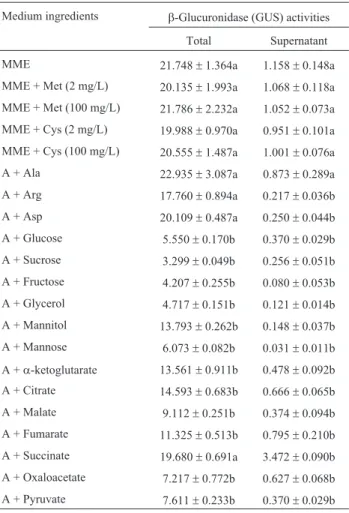
The main carbon and nitrogen sources in MME me-dium are glutamate (Glu, an acidic amino acid) and casa-mino acids. To assess whether different acasa-mino acids have different effect on T3 secretion induction, we replaced glu-tamate in MME medium with alanine (Ala, a neutral amino acid), arginine (Arg, an alkaline amino acid), and aspartate (Asp, an acidic amino acid), respectively. After incubated in these different media for 20 hours, the GUS activities produced by strain 8004/pLGUS0241 were assayed. As shown in Table 1, the total GUS activities of strain 8004/pLGUS0241 grown in the four different media were not significantly different, while the supernatant GUS ac-tivities from the media with Glu (i.e. MME medium) and Ala were significantly stronger than those from the media with Arg and Asp. The supernatant GUS activities were not significantly different between the media with Glu and Ala (Table 1). These suggest that the different amino acids ana-lyzed have a different influence on T3 secretion efficiency although they do not have a significant influence on the ex-pression of the T3 effector tested.
It has been reported that sulfur-containing amino acids, especially methionine, are required forhrpinduction inXcv (Schulte and Bonas, 1992a). To verify whether sulfur-con-taining amino acids have any effect on induction ofXccT3 secretion, we compared the GUS activities of strain 8004/pLGUS0241 grown in MME medium with or without methionine (or cysteine). No significant difference was ob-served in either total GUS activities or supernatant GUS ac-tivities (Table 1). This result implies that sulfur-containing amino acids may have no effect on T3 expression and secre-tion inXcc.
Effect of carbon sources in MME medium on T3 secretion efficiency
As described above, the carbon sources in the four media are different. To evaluate whether different carbon sources have an impact on T3 secretion efficiency inXcc, we substituted the glutamate in MME with glucose, su-crose, fructose, glycerol, mannitol, and mannose, respec-tively. After incubation in these media for 20 hours, the GUS activities of strain 8004/pLGUS0241 were compared. As shown in Table 1, the results suggest that glutamate (MME) is the best among the tested carbon sources for T3 effector expression and secretion.
Since glutamic acid can enter the tricarboxylic acid (TCA) cycle through deamination, a query whether the sub-strates of the TCA cycle have an effect on T3 secretion was raised. To answer this question, we replaced glutamate in MME medium witha-ketoglutarate, citrate, malate, fuma-rate, succinate, oxaloacetate, and pyruvate, respectively. Twenty hours after incubation, strain 8004/pLGUS0241 produced stronger total and supernatant GUS activities in the medium with glutamate than with all but one of the other carbon sources (Table 1). Approximately 3-fold stronger supernatant GUS activity in the medium with succinate was observed, as compared to the medium with glutamate (MME), although their total GUS activities were similar (Table 1). These results indicate that succinate is better than glutamate for induction of T3 effector secretion inXcc.
Table 1- GUS activity of strain 8004/pLGUS0241 in different growth conditions*.
Medium ingredients b-Glucuronidase (GUS) activities
Total Supernatant
MME 21.748±1.364a 1.158±0.148a
MME + Met (2 mg/L) 20.135±1.993a 1.068±0.118a
MME + Met (100 mg/L) 21.786±2.232a 1.052±0.073a
MME + Cys (2 mg/L) 19.988±0.970a 0.951±0.101a
MME + Cys (100 mg/L) 20.555±1.487a 1.001±0.076a
A + Ala 22.935±3.087a 0.873±0.289a
A + Arg 17.760±0.894a 0.217±0.036b
A + Asp 20.109±0.487a 0.250±0.044b
A + Glucose 5.550±0.170b 0.370±0.029b
A + Sucrose 3.299±0.049b 0.256±0.051b
A + Fructose 4.207±0.255b 0.080±0.053b
A + Glycerol 4.717±0.151b 0.121±0.014b
A + Mannitol 13.793±0.262b 0.148±0.037b
A + Mannose 6.073±0.082b 0.031±0.011b
A +a-ketoglutarate 13.561±0.911b 0.478±0.092b
A + Citrate 14.593±0.683b 0.666±0.065b
A + Malate 9.112±0.251b 0.374±0.094b
A + Fumarate 11.325±0.513b 0.795±0.210b
A + Succinate 19.680±0.691a 3.472±0.090b
A + Oxaloacetate 7.217±0.772b 0.627±0.068b
A + Pyruvate 7.611±0.233b 0.370±0.029b
*
b-Glucuronidase (GUS) activity was determined after growth of X.
campestrispv.campestrisfor 20 h. Medium “A” has exactly the same composition of MME except for the absence of glutamate (0.15 g/L casamino acids, 7.57 mM (NH4)2SO4, 1 mM MgSO4, 60.34 mM K2HPO4,
and 33.07 mM KH2PO4). The pH of the variations of medium “A” was
Effect of different concentrations of casamino acids on T3 secretion efficiency
MME medium contains casamino acids as an organic nitrogen source. It has been reported that a high concentra-tion of casamino acids can suppress the inducconcentra-tion ofhrp ex-pression inXcv(Schulte and Bonas, 1992a). To optimize the concentration of casamino acids for high T3 secretion efficiency, we examined the effect of various concentra-tions of casamino acids on the induction of T3 effector se-cretion. Since succinate is better than glutamate for induc-tion of T3 effector secreinduc-tion, for a better test we used a modified MME medium in which the carbon source gluta-mate was replaced with succinate and its pH value was ad-justed to 6.6 with HCl. As shown in Figure 2, the total GUS activities produced by strain 8004/pLGUS0241 decreased along with the increase of the concentrations of casamino acids. However, the GUS activity in the supernatant of the culture with 0.15 g/L casamino acids was 2- to 3-fold stron-ger than other concentrations including the lower concen-tration of 0.075 g/L (Figure 2). This result suggests that an optimal concentration of casamino acids for T3 effector se-cretion is about 0.15 g/L, which is the original concentra-tion in MME medium. Based on all of the above findings, we have designed a medium for T3 secretion induction in Xccby modification of MME medium, in which the carbon source glutamate is substituted by succinate and pH value is
adjusted to 6.6. We have named this modified MME me-dium as XCM1.
Additional evidences that XCM1 induces the secretion of T3 effectors efficiently
To evaluate whether the medium XCM1 is also prac-tical for efficient secretion induction of other T3 effectors in Xcc, we randomly selected another T3 effector, AvrACXcc8004(Xuet al., 2008), to test its secretion induc-tion in XCM1. A reporter plasmid named pLGUS1553 was constructed by fusing the promoter and T3 signal of the effector geneavrACXcc8004with the promoterlessgusAgene cloned in pLAFR6 and introduced into the wild-type strain 8004 (see above for details). The supernatant GUS activi-ties of the resulting strain 8004/pLGUS1553 grown in XVM2, XOM2, MMX, MME, and XCM1 were compared. The result showed that XCM1 induced significantly stron-ger GUS activity than all other media (Figure 3), indicating that XCM1 medium is also efficient for the secretion induc-tion of the T3 effector protein AvrACXcc8004.
We also performed a western immunoblotting analy-sis to verify the secretion induction efficiency of the T3 effector XopXccN in XCM1 medium (see above for de-tails). The results showed that strain 8004/pJAG0241 grown in XCM1 and MME produced similar, stronger intracellular XopXccN protein bands compared to other three media (Figure 4a). Moreover, a stronger XopXccN protein band could be seen for the culture supernatant of XCM1 medium compared to MME medium, while no visi-ble XopXccN protein band could be detected for the culture supernatants of other three media (Figure 4b). These results suggest that XCM1 medium is more efficient for the secre-tion of XopXccN effector. In the study, a strain deficient in T3 secretion, named 8004DhrcV/pJAG0241, was included.
Figure 2- Effect of different concentrations of casamino acids on the GUS activities in total cellular protein extracts (T) and in culture supernatants (S) ofXanthomonas campestrispv.campestrisstrain 8004/pLGUS0241 grown in medium XCM1 for 20 hours. Values given are the means and standard deviations of triplicate measurements. Data presented were from a representative experiment and similar results were obtained in two other independent experiments.
As expected, no secreted XopXccN protein was detected in the supernatants of bacterial cultures grown in all of the five media, while intracellular XopXccN protein could be de-tected (data not shown). These further confirmed that XCM1 medium is efficient for secretion induction of T3 effector proteins inXcc.
Effect of phosphate, calcium, and magnesium on T3 secretion efficiency
It has been reported that phosphate, calcium, and magnesium affect T3 expression and secretion in some
ani-mal pathogenic bacteria (Williamset al., 1998; Miaoet al., 2002; Duonget al., 2007; Vilcheset al., 2009; Andersonet al., 2010). We realized that an important difference among the five minimal media is the concentrations of phosphate (XCM1, MME, MMX, and XOM2 but not XVM2 contain high concentrations of phosphate) (See details in Materials and Methods). The effect of phosphate on T3 secretion effi-ciency inXcc should be further investigated. After incu-bated in XCM1 with different concentrations of phosphate (10-, 2-, 1-, 10-1-, 10-2-fold, while 1-fold means the original concentration of phosphate: 60.34 mM K2HPO4, 33.07 mM KH2PO4) for 20 hours, the GUS activities produced by strain 8004/pLGUS0241 were assayed. The results showed that the original 1-fold concentration of phosphate has the best induction efficiency for secretion of XopXccN (data not shown).
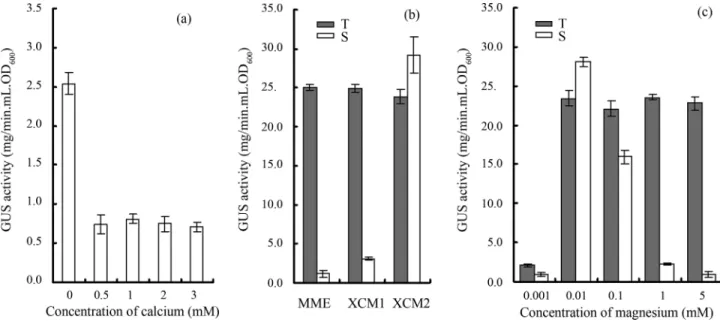
It is interesting that XVM2 contains calcium and was proved to be the poorest medium forXccT3 secretion (Fig-ure 1). It has been known for a long time that calcium inhib-its T3 secretion in bacterial pathogens that infect animals (Williamset al., 1998). The effect of calcium on T3 secre-tion efficiency inXccwas further surveyed. Twenty hours after incubation in XCM1 without or with different concen-trations of calcium chloride (0.5 mM, 1 mM, 2 mM, 3 mM), the GUS activities of strain 8004/pLGUS0241 were as-sayed. The GUS activity in the supernatant of the culture without CaCl2was about 3-fold stronger than that with dif-ferent CaCl2 concentrations. This result implies that cal-cium may repress T3 secretion inXcc(Figure 5a).
In addition, it was reported that magnesium modu-lates (activates or represses) T3 expression and even
secre-Figure 4- Western immunoblotting analysis of the T3 effector XopXccN of Xanthomonascampestrispv.campestris. The bacterial cells of strain 8004/pJAG0241 were overnight cultivated in NYG (pH 7.0) and resus-pended to an optical density of 0.1 (600 nm) in 100 mL of corresponding minimal media (XCM1, MME, MMX, XOM2, and XVM2). Equal amounts of intercellular protein extracts (a) and culture supernatants (b) were analyzed by SDS-PAGE and immunoblotting using the anti-FLAG M5 polyclonal antibody and goat anti-rabbit IgG antibody (Sigma) as the primary and secondary antibodies, respectively. Reactions were visual-ized by WEST-ZOLTMwestern blotting detection kit (iNtRON). The ex-periment was repeated twice and similar results were obtained.
Figure 5- Effect of different concentrations of calcium and magnesium on theb-Glucuronidase (GUS) activities ofXanthomonas campestrispv.
campestrisstrain 8004/pLGUS0241. (a) The supernatant GUS activities produced by the strain grown in XCM1 medium with different CaCl2
concentra-tions for 20 hours. (b) The GUS activities in total cellular protein extracts (T) and culture supernatants (S) produced by the strain grown for 20 hours in dif-ferent media. (c) The GUS activities in total cellular protein extracts (T) and culture supernatants (S) produced by the strain grown for 20 hours in XCM1 medium with different MgSO4concentrations. Values given are the means and standard deviations of triplicate measurements. Data presented were from
tion in some animal bacterial pathogens (Williamset al., 1998; Miaoet al., 2002; Vilcheset al., 2009; Andersonet al., 2010). We also notice that each of the five media tested (XCM1, MME, MMX, XVM2, and XOM2) contains a dif-ferent concentration of magnesium. To verify whether the concentration of magnesium affectsXccT3 secretion effi-ciency, we compared the GUS activities of strain 8004/pLGUS0241 incubated in MME (contains 1 mM MgSO4), XCM1 (contains 1 mM MgSO4), and XCM2 (contains 0.01 mM MgSO4, see below). The strain pro-duced similar total GUS activities in the three media; how-ever, it produced 10-30 fold supernatant GUS activity in XCM2, compared to XCM1 and MME (Figure 5b). The GUS activities produced by strain 8004/pLGUS0241 incu-bated in XCM1 with different MgSO4concentrations were further tested. As shown in Figure 5c, although no signifi-cant difference in total GUS activities was observed among the MgSO4concentrations of 0.01, 0.1, 1, and 5 mM, ex-tremely high supernatant GUS activity was found in the 0.01 mM MgSO4concentration. These results suggest that an optimal concentration of MgSO4for T3 effector secre-tion is about 0.01 mM. Therefore, we further modified XCM1 by adjusting its MgSO4concentration from 1 mM to 0.01 mM, and named this modified XCM1 medium as XCM2.
Taken together, we have established a medium named as XCM2 for T3 secretion induction inXccby modi-fication of MME medium, in which the carbon source glu-tamate is substituted by succinate, concentration of MgSO4 is optimized to 0.01 mM, and pH value is adjusted to 6.6.
Discussion
The secretion of many bacterial T3 effectors is barely detectable in culture media, even with sensitive immunodetection (Collmeret al., 2002); therefore, a high efficient inducing medium is crucial for identification of novel T3 effectors. XCM2 established here exhibits signifi-cantly higher efficiency forXccT3 effector secretion than MME, although they showed similar induction efficiency for T3 effector expression (Figures 3, 4, and 5, Table 1). The western immunoblotting analysis results showed that the secretion of XopXccN could be detected clearly in XCM1, but weakly in MME and undetectable in all of the other media tested (Figure 4b), suggesting that the about 3-time inducing efficiency attributed by succinate is impor-tant for detection of T3 effector inXcc. Moreover, XCM2 displayed about 10-fold and 30-fold stronger inducing effi-ciency than XCM1 and MME, respectively (Figure 5), indi-cating that XCM2 is beneficial for secretion induction of XccT3 effectors. Additionally, the secretion efficiencies of the effector XopXccN in several Xcc strains including CN07 and CN11 (Heet al., 2007) are all distinctly higher in XCM2, compared to MME (data not shown), suggesting that XCM2 could be widely used for differentXccstrains. This optimized medium will provide a powerful tool for
T3S effector identification and functionality studies inXcc and hence contributes to the basic concepts and understand-ing of molecular pathogenesis of phytopathogen.
Acknowledgments
This work was supported by the National Natural Sci-ence Foundation of China (30970085) and the National Special Grant for Transgenic Researches (2009ZX08009-038B).
References
Alvarez AM (2000) Black rot of crucifers. In: Slusarenko AJ, Fra-ser RSS, van Loon LC (eds) Mechanisms of Resistance to Plant Diseases. Springer, Dordrecht, pp 21-52.
Anderson GG, Yahr TL, Lovewell RR, O’Toole GA (2010) The
Pseudomonas aeruginosamagnesium transporter MgtE in-hibits transcription of the type III secretion system. Infect Immun 78:1239-1249.
Arlat M, Gough C, Barber C, Boucher C, Daniels M (1991)
Xanthomonas campestriscontains a cluster ofhrpgenes re-lated to the larger hrp cluster of Pseudomonas solanacearum. Mol Plant-Microbe Interact 4:593-601. Collmer A, Lindeberg M, Petnicki-Ocwieja T, Schneider DJ,
Alfano JR (2002) Genomic mining type III secretion system effectors inPseudomonas syringaeyields new picks for all TTSS prospectors. Trends Microbiol 10:462-469.
Daniels MJ, Barber CE, Turner PC, Cleary WG, Sawczyc MK (1984) Isolation of mutants ofXanthomonas campestrispv.
campestris showing altered pathogenicity. Gen Microbiol 130:2447-2455.
Duong N, Osborne S, Bustamante VH, Tomljenovic AM, Puente JL, Coombes BK (2007) Thermosensing coordinates a cis-regulatory module for transcriptional activation of the intra-cellular virulence system in Salmonella enterica serovar Typhimurium. J Biol Chem 282:34077-34084.
He YQ, Zhang L, Jiang BL, Zhang ZC, Xu RQ, Tang DJ, Qin J, Jiang W, Zhang X, Liao J, Cao JR, Zhang SS, Liang X.X, Wei ML, Lu GT, Feng JX, Chen B, Cheng J, Tang JL (2007) Comparative and functional genomics reveals genetic diver-sity and determinants of host specificity among reference strains and a large collection of Chinese isolates of the phytopathogen Xanthomonas campestris pv. campestris. Genome Biology 8:R218.
Huang DL, Tang DJ, Liao Q, Li XQ, He YQ, Feng JX, Jiang BL, Lu GT, Tang JL (2009) The Zur ofXanthomonas campestris
is involved in hypersensitive response and positively regu-lates the expression of thehrpcluster viahrpXbut nothrpG. Mol Plant-Microbe Interact 22:321-329.
Huynh TV, Dahlbeck D, Staskawicz BJ (1989) Bacterial blight of soybean: regulation of a pathogen gene determining host cultivar specificity. Science 245:1374-1377.
Jefferson R, Burgess S, Hirsh D (1986)b-Glucuronidase from
Escherichia colias a gene-fusion marker. Proc Natl Acad Sci USA 83:8447-8451.
Jiang BL, He YQ, Cen WJ, Wei HY, Jiang GF, Jiang W, Hang XH, Feng JX, Lu GT, Tang DJ, Tang JL (2008) The type III secretion effector XopXccN ofXanthomonas campestrispv.
Jiang W, Jiang BL, Xu RQ, Huang JD, Wei HY, Jiang GF, Cen WJ, Liu J, Ge YY, Li GH, Su LL, Hang XH, Tang DJ, Lu GT, Feng JX, He YQ, Tang JL (2009) Identification of six type III effector genes with the PIP box inXanthomonas campestrispv.campestrisand five of them contribute indi-vidually to full pathogenicity. Mol Plant-Microbe Interact 22:1401-1411.
Leong SA, Ditta GS, Helinski DR (1982) Heme biosynthesis in
Rhizobium. Identification of a cloned gene coding for delta-aminolevulinic acid synthetase fromRhizobium meliloti. J Biol Chem 257:8724-8730.
Miao EA, Freeman JA, Miller SI (2002) Transcription of the SsrAB regulon is repressed by alkaline pH and is independ-ent of PhoPQ and magnesium concindepend-entration. J Bacteriol 184:1493-1497.
Miller JH (1972) Experiments in Molecular Genetics. Cold Spring Harbor, New York.
Ryan RP, Fouhy Y, Lucey JF, Jiang BL, He YQ, Feng JX, Tang JL, Dow JM (2007) Cyclic di-GMP signalling in the viru-lence and environmental adaptation of Xanthomonas campestris. Mol Microbiol 63:429-442.
Sambrook J, Fritsch EF, Maniatis T (1989) Molecular Cloning: A Laboratory Manual. Cold Spring Harbour Laboratory Press, New York.
Schechter LM, Roberts KA, Jamir Y, Alfano JR, Collmer A (2004)Pseudomonas syringaetype III secretion system tar-geting signals and novel effectors studied with a Cya trans-location reporter. J Bacteriol 186:543-555.
Schulte R, Bonas U (1992a) AXanthomonaspathogenicity locus is induced by sucrose and sulfur-containing amino acids. Plant Cell 4:79-86.
Schulte R, Bonas U (1992b) Expression of the Xanthomonas campestris pv.vesicatoria hrp gene cluster, which deter-mines pathogenicity and hypersensitivity on pepper and to-mato, is plant inducible. J Bacteriol 174:815-823.
Tsuge S, Furutani A, Fukunaka R, Oku T, Tsuno K, Ochiai H, Inoue Y, Kaku H, Kubo Y (2002) Expression of
Xanthomonas oryzae pv. oryzae hrp genes in XOM2, a novel synthetic medium. J Gen Plant Pathol 68:363-371. Vilches S, Jimenez N, Tomas JM, Merino S (2009)Aeromonas
hydrophilaAH-3 type III secretion system expression and regulatory network. Appl Environ Microbiol 75:6382-6392. Wei K, Tang DJ, He YQ, Feng JX, Jiang BL, Lu GT, Chen B,
Tang JL (2007)hpaR, a putativemarRfamily transcriptional regulator, is positively controlled by HrpG and HrpX and in-volved in the pathogenesis, hypersensitive response, and extracellular protease production of Xanthomonas campestrispathovarcampestris. J Bacteriol 189:2055-2062. Wengelnik K, Marie C, Russel M, Bonas U (1996) Expression and localization of HrpA1, a protein of Xanthomonas campestris pv.vesicatoriaessential for pathogenicity and induction of the hypersensitive reaction. J Bacteriol 178:1061-1069.
Williams AW, Straley SC (1998) YopD ofYersinia pestisplays a role in negative regulation of the low-calcium response in addition to its role in translocation of Yops. J Bacteriol 180:350-358.
Xu RQ, Blanvillain S, Feng JX, Jiang BL, Li XZ, Wei HY, Kroj T, Lauber E, Roby D, Chen B, He YQ, Lu GT, Tang DJ, Vasse J, Arlat M, Tang JL (2008) AvrACXcc8004, a type III effector
with a leucine-rich repeat domain from Xanthomonas campestrispathovarcampestrisconfers avirulence in vascu-lar tissues of Arabidopsis thalianaecotype Col-0. J Bac-teriol 190:343-355.
Yanisch-Perron C, Vieira J, Messing J (1985) Improved M13 phage cloning vectors and host strains: nucleotide sequences of the M13mp18 and pUC19 vectors. Gene 33:103-119.