Homo sapiens, Homo neanderthalensis
and the Denisova specimen:
New insights on their evolutionary histories using whole-genome comparisons
Vanessa Rodrigues Paixão-Côrtes, Lucas Henrique Viscardi, Francisco Mauro Salzano, Tábita Hünemeier
and Maria Cátira Bortolini
Departamento de Genética, Instituto de Biociências, Universidade Federal do Rio Grande do Sul,
Porto Alegre, RS, Brazil.
Abstract
After a brief review of the most recent findings in the study of human evolution, an extensive comparison of the com-plete genomes of our nearest relative, the chimpanzee (Pan troglodytes), of extant Homo sapiens, archaic Homo neanderthalensis and the Denisova specimen were made. The focus was on non-synonymous mutations, which consequently had an impact on protein levels and these changes were classified according to degree of effect. A to-tal of 10,447 non-synonymous substitutions were found in which the derived allele is fixed or nearly fixed in humans as compared to chimpanzee. Their most frequent location was on chromosome 21. Their presence was then searched in the two archaic genomes. Mutations in 381 genes would imply radical amino acid changes, with a frac-tion of these related to olfacfrac-tion and other important physiological processes. Eight new alleles were identified in the Neanderthal and/or Denisova genetic pools. Four others, possibly affecting cognition, occured both in thesapiens and two other archaic genomes. The selective sweep that gave rise toHomo sapiens could, therefore, have initiated before the modern/archaic human divergence.
Keywords: human evolution, comparative genomics, positive selection, Neanderthal, Denisova.
Introduction
Until recently it was believed that the first hominid genus (or hominin, primates basically characterized by erect posture, bipedal locomotion and relatively large
brains; Johanson and Edgar, 1996) wasAustralopithecus,
whose fossil record is relatively broad and convincing in showing the conditions described above. More recent dis-coveries, however, have brought up the possibility of change to this traditional view, since they describe at least three new species of hominids whose existence dates back to much more remote times (~4-7 million years ago or BP):
Sahelanthropus tchadensis(Brunet et al., 2002), Orrorin tugenensis (Haile-Selassie, 2001) and Ardipithecus ramidus(Suwaet al., 2009; Whiteet al., 2009). Although there are controversies regarding the hominid phylogeny
and its nomenclature (recent discussion in González-Joséet
al., 2008; Endicottet al., 2010; Schwartz and Tattersall,
2010), some paleoanthropologists have postulated that fromArdipithecus ramiduswould have emerged the first
species of the genus Australopithecus, Australopithecus
anamensis(~4 million years BP), which in turn gave rise to
Australophitecus afarensis(~3.5 years million BP), one of the best documented extinct hominid species (the famous skeleton of a female named Lucy, which is part of the col-lection that helped define the characteristics of the species
(Johanson and Edgar, 1996: Leakeyet al., 1998). It is likely
thatAustralopithecus afarensiswas the ancestor of several other species currently identified as belonging to the
Paranthropus genus (earlier identified as robust australopith lineages), as well as to others classified in the
genus Homo (Johanson and Edgar, 1996; Kimbel and
Delezene, 2009). At around 2 million years BP individuals
belonging to at least threeHomo species (Homo habilis,
Homo ergasterandHomo rudolfensis) inhabited the area around Lake Turkana, although paleoanthropologists do not have the slightest idea about whether or how these ap-parent relatives may have interacted (Tattersall, 1997).
Ad-ditionally, this temporal overlap of earlyHomospecies
in-dicates that ancestor-descendant relationships are far from straightforward (Johanson and Edgar, 1996). On the other hand, there is a consensus that until that moment the history of hominids was restricted to Africa. This changed around
~1.8 million years BP whenHomohominins colonized
Eu-rope, Asia and Oceania, where their probable descendants
survived until recently. A noteworthy example is Homo
floresiensis,a short-statured hominin whose remains were
Genetics and Molecular Biology, 35, 4 (suppl), 904-911 (2012) Copyright © 2012, Sociedade Brasileira de Genética. Printed in Brazil www.sbg.org.br
Send correspondence to Maria Cátira Bortolini. Departamento de Genética, Instituto de Biociências, Universidade Federal do Rio Grande do Sul, Caixa Postal 15053, 91501-970 Porto Alegre, RS, Brazil. E-mail: [email protected].
found in the island of Flores, Indonesia and who remained
there until at least 17,000 years BP (Brownet al., 2004).
The typical morphology ofHomo neanderthalensis, on the
other hand, appeared first in Europe about 400,000 years
ago, and probably evolved from someH. erectus branch
that left Africa in that first round of migrations. Other dis-tinctive Neanderthal forms subsequently evolved until 30,000-40,000 BP, when the species became extinct (Dodge, 2012).
The discovery of a fossil of a probable hominin al-ways triggers further discussions about hominid evolution-ary history. It was no different with a recent discovery in Russia, a distal manual phalanx of a juvenile hominin, dated to 50,000 to 30,000 years BP, which was excavated at the Denisova Cave in the Altai Mountains of southern
Sibe-ria (Dereviankoet al., 2003). In the same layer, body
orna-ments of polished stone normally associated with modern humans, as well as other lithic artifacts connected to more ancient technology traditions were found. These conflict-ing cultural characteristics and the scarcity of more repre-sentative fossil bones made it difficult to define the exact taxonomic category of this specimen.
The finding of archaic humans in distinct regions and remote times raises a pertinent question: when, how and
where didHomo sapiensappear?
The most recent discoveries of a fossil attributed to
early anatomically modern Homo sapiens were made in
Ethiopia, northeast Africa (Whiteet al., 2003; Haile
Selas-sie, et al., 2004). These and other findings suggest that modern humans emerged ~155,000 years ago from an
ar-chaic phase of Homo sapiens and the latter from Homo
erectus, in successive evolutionary events which occurred in Africa, although this view is far from consensual (Gib-bons, 2002; Schwartz and Tattersall, 2010).
It is likely that the first migration of anatomically
modernHomo sapiensout of Africa occurred immediately
before or during an interglacial period that occurred from
135,000 to 74,000 years BP (Armitage et al., 2011).
Around 30,000-40,000 years ago, evidence for the presence
of the anatomically modern Homo sapiens in Europe is
striking (Dodge, 2012). The contemporaneity of modern and archaic humans in Europe, Asia and Oceania implies that they could have interacted, although the fossil and ar-cheological records are controversial concerning the conse-quences of these probable contacts (Schwartz and Tatter-sall, 2010; Dodge, 2012).
The complete sequencing of plant and animal ge-nomes has increased our ability to discover and understand many important biological phenomena, including those
re-lated to our own evolutionary history. In the case ofHomo
sapiens, only one complete genome was known in February 2001, when its draft was simultaneously published in Sci-ence and Nature by two separate research teams. Today, the complete genome of several individuals, including a paleo-Eskimo, sub-Saharan Africans, Asians and
Europe-ans are known (Rasmussenet al., 2010, Schuster et al.,
2010; The 1000 Genomes Project Consortium, 2010); and the drafts of the Neanderthal and Denisova genomes were published, revealing for the first time details about the
com-plete nuclear genome of other species of theHomogenus
(Greenet al., 2010, Reichet al., 2010). These nuclear data
sets have provided a much more accurate view of our own evolutionary history (Gibbons, 2002). For instance, Green
et al.(2010) found evidence that present day non-Africans have 1% to 4% of nuclear DNA of Neanderthal origin,
while Reichet al. (2010) showed that Denisova populations
must have shared a closer common ancestor with Neanderthals than with modern humans. They also sug-gested that Denisovans contributed 4%-6% genes to ances-tors of present-day Melanesians from Papua New Guinea and the Bougainville Islands. These results indicate at least two crossbreeding events between modern and archaic
hu-mans, raising the question of whetherH. sapiensis or is not
a species distinct from the others (Gibbons, 2002). This possibility has an important implication since the complete replacement postulated by the “Out of Africa” model could be questioned, in favor of alternative models that admit some level of assimilation between local archaic and mi-grant modern hominins.
Comparative analyses of these data sets allowed re-searchers, for the first time, to identify common or
taxo-nomically-restricted molecular toolkits of these Homo
lineages. For instance, a recent study performed by our re-search team revealed that 194 individuals from different human populations presented 16 substitutions, without variability in a 546-base pair segment that acts as an
enhancer of gene expression (HACNS1),distinguishing us
from the chimpanzees. Equal lack of variability in this re-gion was also found in the Neanderthal sequence, favoring the interpretation of past positive and present conservative selection, as would be expected in a region which influ-ences traits as important as opposable thumbs, manual
dex-terity and bipedal walking (Hünemeier et al., 2010). A
particularly important result of Hünemeiers paper was the
suggestion that theHACNS1mutant alleles had an origin
that predated the emergence ofHomo sapiensand that these
variants could have had important roles in the evolution of
Homospecific traits.
In the present study we compared theHomo sapiens
genome with those of Neanderthal and Denisova to explore some issues on the nature of the differences and similarities of these modern and archaic hominin lineages, an essential approach to unravel the genetic components that make us human.
Material and Methods
TheHomo neanderthalensisdraft genome (Greenet
al., 2010), reference human genome (NCBI Build
36/hg18), Denisova specimen genome (Reichet al., 2010),
(CGSC 2.1/panTro2) were obtained and analyzed using
tools present in the USCS Genome Browser (Fujitaet al.,
2011). Three different approaches were used:
First, a total of 77 missense and one nonsense
muta-tions were selected, as identified by Greenet al.(2010),
where the derived allele (taking in consideration that a mu-tation event produces a new or derived allele that is differ-ent from the “original” or ancestral allele) is fixed in humans, whereas the ancestral allele is present in chimpan-zee and Neanderthals. We then verified whether they were present in the Denisova genome. The first comparison be-tween this set of data was performed using the Blat tool of the USCS genome browser with query type protein and de-fault conditions. The UCSC track configurations used were: (a) Comparative Genomics-Vertebrate Multiz Align-ment & Conservation (44 Species); (b) Neanderthal As-sembly and Analysis; (c) Denisova AsAs-sembly and Analysis; and (d) Variation and Repeats - Simple Nucleo-tide Polymorphisms (dbSNP build 130). We used the Con-vert tool to verify the 78 positions in the chimp genome. Finally, we also confirmed the condition of the allele (an-cestral or derived) in Denisova with an alignment with the human, chimp and all archaic contigs, comprising a region of 200 bp surrounding the allele of interest. The alignments were performed using the Codon Code Aligner (Trial Ver-sion), with a local alignment using the human reference se-quence.
Second, using the USCS Table Browser for the hu-man genome assembly NCBI Build 36/hg18, with the group “Neanderthal Assembly and Analysis”, track “H-C Coding Diffs” and the table “ntHumChimpCodingDiff”, we retrieved all non-synonymous substitutions in which the derived allele is fixed or nearly fixed (presents higher fre-quency) in humans when compared to the chimpanzee an-cestral allele, and also the ones available for the draft genome of Neanderthals and/or Denisova. All non-synonymous substitutions which are also known as human polymorphisms (dbSNP build 130) were visually checked on the Human UCSC Genome Browser. The Grantham score was then used to categorize all amino acid changes into classes of chemical similarity. The sites were classified as conservative (Grantham score 0-50), moderately conser-vative (51-100), moderately radical (101-150) and radical
(> 151; Grantham, 1974; Liet al., 1985). All amino acid
changes classified as radical were visually checked on the Human UCSC Genome Browser. For those classified as radical, an additional analysis using the GeneDecks V3 software was performed to check whether they belonged to a specific class of genes and/or a functional cluster.
Third, in a previous selection of genes for which ear-lier studies (Carroll, 2003; Varki, 2004, Hill and Walsh,
2005; Varki and Altheide, 2005; Varkiet al., 2008; Fuet
al., 2011) indicated positive selection in the human
lin-eages, the degree and nature of the variation present were
compared with those in Homo neanderthalensis and the
Denisova hominin. The bioinformatic tools used in the other approaches were also used here. We also evaluated, for certain substitutions of specific interest, the impact of the amino acid substitutions on the structure and function of the protein using PolyPhen-2 (Polymorphism Phenotyping
v2; Adzhubeiet al., 2010).
Results and Discussion
Human-specific non-synonymous substitutions
Greenet al.(2010) identified mutations related to
78 amino acid changes that are specific to present-day humans, their ancestral allelic states being present in both Neanderthal and chimpanzees. These changes oc-curred in 73 different genes with diverse functional
ac-tivities. For instance, four of them (OR2AT4, OR4D9,
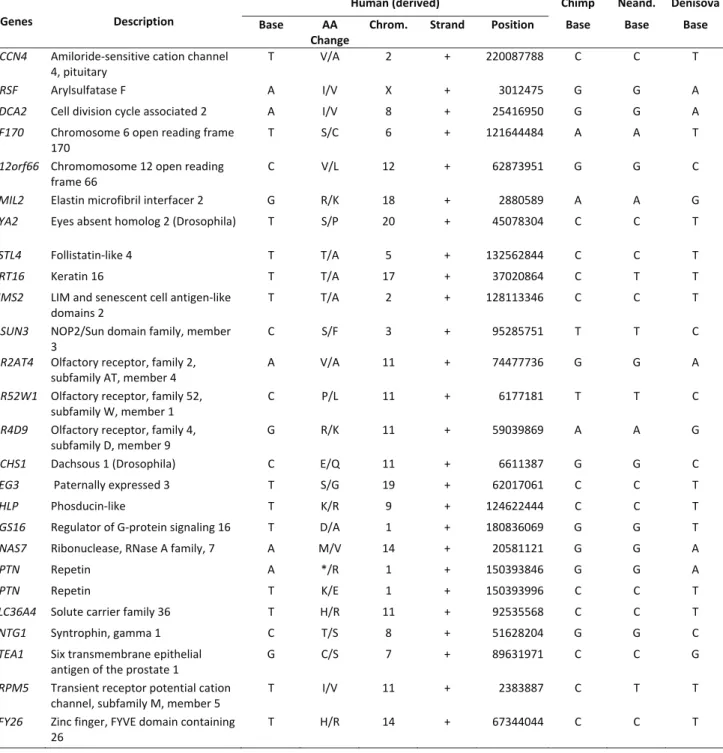
OR52W1andOR1K1) encode olfactory receptors andare located in chromosomes 11 and 9, respectively. We ob-served that 26 (33%) of them are also present in the Denisova hominin, including those of the above-mentioned chromosome 11 olfactory genes (Supplemen-tary Material Table S1).
Initially, three explanations for this sharing of derived alleles among modern humans and Denisovans were ad-vanced. First, contamination with modern human DNA. Nonetheless, it is unlikely that contamination could explain this degree of sharing, since the level of contamination was
calculated to be less than 1% (Reichet al., 2010). Second,
C®T and G®A artifactual mutations due to
5-methyl-cytosine post-mortem deamination (Briggs et al., 2009),
but the frequencies of these artefactual transitions were es-timated to be only 4.5% and 5.9%, respectively, in the
Neanderthal genome (Greenet al., 2010), and in the
Deni-sova study this kind of deamination was chemically re-versed, allowing proper sequencing. In addition, the drier and cooler climate at the Denisova Cave resulted in DNA samples that were about ten times less damaged than those
of other sites (Reichet al., 2010; Liang and Nielsen, 2011).
Even if we ignore these transitions, considering that the post-mortem deamination interfered little in the Denisova sequencing due to the reasons presented above, a signifi-cant number of shared derived alleles still remains (11; 14%). Third, intermarriages could have occurred between modern human and Denisovan individuals. But this type of admixture was estimated to have a frequency of 4%-6%
only (Reichet al., 2010).
With these three hypotheses being inconsistent with the results, a more probable one would be that the ancestral
species ofHomo sapiens, Homo neanderthalensisand the
Denisova hominin could have been polymorphic at at least 33% of these loci. Following the split of these lineages, dif-ferent evolutionary trajectories could have then occurred, resulting in the fixation (or near fixation) of derived alleles in some, but not in other lineages. The conclusion then is
that alleles could reach fixation in specific branch(es) of a determined phylogeny from a polymorphic ancestral condi-tion.
Genome-wide search for changes in protein
coding sequences
We found 10,447 non-synonymous substitutions in which the derived allele is fixed (9,555) or nearly fixed (892) in humans, including Africans, when compared to chimpanzees. Table 1 lists the number of these sites for each human chromosome. The Grantham score indicated that 43% of the changes in the 10,447 sites could be classi-fied as conservative, 43% as moderately conservative, 10% as moderately radical and 4% as radical. A higher fre-quency of non-synonymous changes per gene is found in chromosome 21, which is one of the smallest of our genome and a historical landmark in biomedical research
(Anto-narakiset al., 2002).
Overall, the radical amino acid changes are present in all three hominin genomes, while ancestral alleles were
found in nine genes only: three in Neanderthal (DMRT3,
FAM111A and RASAL1) and six in Denisova (C7orf46,
DNAJC12, DUOX1, FREM2, RDM1andNKAIN4). In 14 sites, both ancestral and derived alleles were found
(Nean-derthal genes: FASTKD3, CMYA5, VCAN, SLC22A1,
AMZ1, STK31, KRT75, OR6T1, MESP2, C17orf66, C17orf78, CCDC57; Denisova genes: GGH and
TMEM99). See details concerning these genes in the Sup-plementary Material Table S2.
There are 381 genes that determine radical amino acid changes. Of these, 243 do not have a significant association or form any functional cluster. Forty genes participate in a single independent functional cluster, while 21 are olfac-tory receptor genes previously reported as being
human-specific and the target of positive selection (Giladet al.,
2003; Greenet al., 2010; Reichet al., 2010). Among these,
theOR1K1olfactory gene shows the ancestral allele in both
archaic humans, whereasOR6T1presents ancestral and
de-rived alleles in Neanderthals only. The other 77 genes are listed as participating in several functional groups and pos-sibly influence multiple phenotypic traits. One example is theBRCA1gene, which, besides playing a role on cell cycle regulation, a also affects the immune and nervous systems, as well as metabolic conditions. Table S3 lists all the 381 genes.
Interestingly, eight new alleles could be identified in the Neanderthal and/or in Desinova genomes (Table 2). These variations were found in eight different genes lo-cated in seven chromosomes. For example, at position
88,634,660 of chromosome 4 (SPARCL1gene) both the
an-cestral (G) and derived (C) alleles are present in humans (Grantham score 81). In the other hominins, G was detected in Denisova, while in Neanderthal the derived state is repre-sented by a new mutant allele (A), leading to the presence of an aspartic acid (Asn) at position 106 in the amino acid sequence (Grantham score 23). Another illustrative exam-ple occurs at position 73,452,685 of chromosome 7 (CLIP2). In this case, the new allele (T) was detected in the Denisova genome (Grantham score: 98) only.
Our analyses furthermore indicate that seven of these eight mutations apparently have no functional conse-quences (Table 2). This apparent neutrality, however, should be considered with caution, since an allele, when considered individually, can have a modest effect, unde-tectable by the analyses made in the present study.
The change in ZNF772 (Zinc finger protein 772
-Trp®Ter), on the other hand, leads to a premature stop
codon. The exact function of this gene is unknown, but the UniProt database (The UniProt Consortium, 2011) indi-cates, by similarity, that the translated protein may be a
transcription factor. Frankelet al.(2011) showed for the
first time that multiple single-nucleotide substitutions in transcriptional elements could explain the evolution of complex morphologies. It is therefore possible that the
772 - Trp®Ter mutation could represent one of a series as
those mentioned above. Table 1- Non-synonymous substitutions in modern humans when
com-pared with chimpanzees for each human chromosome.
Chromosome Length (bp) Known pro-tein-coding
genes
Fixed Nearly fixed
Non-synonym ous substitu-tions per gene 1 247249719 2107 1085 96 0.5605 2 242951149 1333 675 63 0.5536 3 199501827 1095 568 54 0.5680
4 191273063 774 402 31 0.5594
5 180857866 893 523 50 0.6417
6 170899992 1082 509 49 0.5157
7 158821424 983 374 40 0.4212
8 146274826 731 356 30 0.5280
9 140273252 846 317 38 0.4196
10 135374737 812 422 42 0.5714 11 134452384 1358 597 55 0.4801 12 132349534 1055 528 44 0.5422 13 114142980 353 165 10 0.4958 14 106368585 638 329 40 0.5784 15 100338915 652 300 33 0.5107
16 88827254 900 424 36 0.5111
17 78774742 1228 536 43 0.4715
18 76117153 285 136 11 0.5158
19 63811651 1449 499 37 0.3699
20 62435964 576 275 31 0.5313
21 46944323 253 141 26 0.6601
22 49691432 504 221 23 0.4841
X 154913754 968 158 9 0.1725
Y 57772954 89 15 1 0.1798
908
Homo
evolutionary
history
Table 2- New alleles identified in the Neanderthal and/or Denisova genomes1.
Gene Description Function Chromosome Strand Position Chimpanzee Neanderthal Denisova Modern humans
AA position
AA change humans
AA change others
SNP GS humans
GS others
PolyPhen-2 prediction
CD1C CD1c molecule Antigen-presenting protein that binds self and non-self lipid and glycolipid antigens and presents them to T-cell receptors on natural killer T-cells
1 + 156527695 C C/G C C/A 70 Asn > Thr Asn > Ser rs3138100 65 46 benign
CLIP2 CAP-GLY do-main containing linker protein 2
May be link microtubules to den-dritic lamellar body (DLB), a membranous organelle predomi-nantly present in bulbous dendritic appendages of neurons linked by dendrodendritic gap junctions. May operates in the control of brain-specific organelle trans-locations (By similarity)
7 + 73452685 C C C/T C/G 977 Pro > Arg Pro > Leu rs2522943 103 98 benign
COL28A1 collagen, type XXVIII, alpha 1
May act as a cell-binding protein 7 - 7512216 G G/A G G/C 327 Ser > Thr Ser > Asn rs10486176 58 46 benign
JDP2 Jun dimerization protein 2
Component of the AP-1 transcrip-tion factor that represses transacti-vation mediated by the Jun family of proteins.May control transcrip-tion via direct regulatranscrip-tion of the modification of histones and the assembly of chromatin
14 + 74974413 G ND G/T G/A 13 Ala > Thr Ala > Ser rs3625 58 99 benign
KAZALD1 Kazal-type serine peptidase inhibi-tor domain 1
Involved in the proliferation of os-teoblasts during bone formation and bone regeneration. Promotes matrix assembly (By similarity)
10 + 102814339 C C/T C C/G 255 Ala > Gly Ala > Val rs807037 60 64 benign
KCNJ5 potassium in-wardly-rectifying channel, subfa-mily J, member 5
Potassium channels are present in most mammalian cells, where they participate in a wide range of physiologic responses
11 + 128287222 G G/A G G/C 282 Glu > Gln Glu > Lys rs7102584 29 56 benign
SPARCL1 SPARC-like 1 (hevin)
May participate in signal trans-duction. Proteins are expected to have molecular function (calcium ion binding) and to localize in var-ious compartments (extracellular space, extracellular region, protei-naceous extracellular matrix, syn-apse)
4 - 88634660 G A G G/C 106 Asp > His Asp > Asn rs1049544 81 23 benign
ZNF772 zinc finger pro-tein 772
May be involved in transcriptional regulation (By similarity)
19 - 62677378 G G/A G G/C 182 Trp > Cys Trp > Ter rs2074060 215 Stop codon
-1
It worth stating that a unique variant may change gene expression or protein function only slightly, but may be de-cisive for modifications in a gene regulatory/functional pathway (Goldstein, 2009) implications of such “exclu-sive” variants and conditions, thus, deserve additional in-vestigation.
It is important to note that Greenet al.(2010) and
Reich et al. (2010) choose not to consider sites with
changes leading to more than one derived allele in their analyses, although they did not rule out the hypothesis that these sites may present real mutational events rather than artifacts due to sequencing errors (see supplementary data
in Greenet al.(2010) and Reichet al.(2010).
Genes with evidenve for positive selection in
the human lineage when compared to those of
other primates
In this category, the most cited gene isFOXP2(Enard
et al., 2002), where two amino acid changes (Thr303Asn and Asn325Ser) were associated with the emergence of modern language and other unique cognitive human
abili-ties. Krauseet al.(2007) established that these two amino
acid modifications were also present in Neanderthals. They also found that the changes occur in the most common modern human haplotype, defined by nine nucleotides
lo-cated in the upstream intronic region ofFOXP2exon 7. We
verified changes in the same location in the Denisova
speci-men, in accordance with a scenario suggested by Krauseet
al.(2007), of a selective sweep which started before the
di-vergence of modern and archaic humans.
Other candidate genes involved in neurogenesis and
cognition (ASPM, MCPH1,AHI1,andKLK8;Doruset al.,
2004; Gilbertet al., 2005; Hill and Walsh, 2005; Evanset
al., 2006; Vallender, 2008; Montgomery and Mundy, 2010;
Montgomeryet al., 2011) were also investigated by us
(Ta-ble 3). Overall it is possi(Ta-ble to see that the derived alleles are commonly found in the archaic genomes, but in some cases both derived and ancestral alleles are found.
An intriguing difference between modern humansvs.
chimpanzee and other primates is the alternative splicing
forKLK8. The KLK8 protein, a neuropsin, is preferentially
expressed in the central nervous system and is involved in learning and memory. The longer spliced form of this
mRNA, due to a mutation (c.71-127T®A), was
consid-ered until recently to be expressed only inH. sapiens(Liet
al., 2004, 2007; Varkiet al., 2008). Our results, however,
show that both the Neanderthal and Denisova hominins presented this alteration, stressing that cognitive traits seen in modern humans could already be present in archaic hominins.
In conclusion, the findings presented in this study provide clues about the possible course of hominid evolu-tion and illustrate the importance of comparative genomic
Acknowledgments
The financial support of Conselho Nacional de De-senvolvimento Científico e Tecnológico (CNPq) and Fun-dação de Amparo à Pesquisa do Estado do Rio Grande do Sul (FAPERGS, Programa de Apoio a Núcleos de Exce-lência, PRONEX) is gratefully acknowledged.
References
Adzhubei IA, Schmidt S, Peshkin L, Ramensky VE, Gerasimova A, Bork P, Kondrashov AS and Sunyaev SR (2010) A method and server for predicting damaging missense muta-tions. Nat Meth 7:248-249.
Antonarakis SE, Lyle R, Deutsch S and Reymond A (2002) Chro-mosome 21: A small land of fascinating disorders with un-known pathophysiology. Int J Dev Biol 46:89-96.
Armitage SJ, Jasim SA, Marks AE, Parker AG, Usik VI and Uerpmann HP (2011) The southern route “Out of Africa”: Evidence for an early expansion of modern humans into Arabia. Science 331:453-456.
Briggs AW, Stenzel U, Meyer M, Krause J, Kircher M and Pääbo S (2009) Removal of deaminated cytosines and detection of
in vivo methylation in ancient DNA. Nucleic Acids Res 22:386-397.
Brown P, Sutikna T, Morwood MJ, Soejono RP, Jatmiko, E. Wayhu Saptomo and Rokus AD (2004) A new small-bodied hominin from the Late Pleistocene of Flores. Nature 431:1055-1061.
Brunet M, Guy F, Pilbeam D, Mackaye HT, Likius A, Ahounta D, Beauvilain A, Blondel A, Bocherens CH, Boisserie J,et al. (2002) A new hominid from the Upper Miocene of Chad, Central Africa. Nature 418:145-151.
Carroll SB (2003) Genetics and the making ofHomo sapiens. Na-ture 422:849-857.
Derevianko AP, Shunkov MV, Agadjaniav AK, Baryshnikov GF, Malaeva EM, Ulianov VA, Kulik NA, Postnov AV and Anoikin AA (2003) Paleoenvironment and Paleolithic Hu-man Occupation of Gorny Altai (Subsistence and Adapta-tion in the Vicinity of Denisova Cave). Russian Academy of Sciences, Novosibirsk (in Russian, with abstract in Enghish and French).
Dodge DR (2012) A molecular approach to Neanderthal extinc-tion. Quatern Int 259:22-32.
Dorus S, Vallender EJ, Evans PD, Anderson JR, Gilbert SL, Mahowald M, Wyckoff GJ, Malcom CM and Lahn, BT (2004) Accelerated evolution of nervous system genes in the origin ofHomo sapiens. Cell 119:1027-1040.
Enard W, Przeworski M, Fisher SE, Lai CSL, Wiebe V, Kitano T, Monaco AP and Pääbo S (2002) Molecular evolution of
FOXP2, a gene involved in speech and language. Nature 418:869-872.
Endicott P, Ho SYW and Stringer C (2010) Using genetic evi-dence to evaluate four palaeoanthropological hypotheses for the timing of neanderthal and modern human origins. J Hum Evol 59:87-95.
Evans PD, Mekel-Bobrov N, Vallender EJ, Hudson RR and Lahn BT(2006) Evidence that the adaptive allele of the brain size genemicrocephalinintrogressed intoHomo sapiensfrom an archaicHomolineage. Proc Natl Acad Sci USA 103:18178-18183.
Frankel N, Erezyilmaz DF, McGregor AP, Wang S, Payre F and Stern DL (2011) Morphological evolution caused by many subtle-effect substitutions in regulatory DNA. Nature 474:598-603.
Fu X, Giavalisco P, Liu X, Catchpole G, Fu N, Ning Z-B, Guo S, Yan Z, Somel M, Pääbo S,et al.(2011) Rapid metabolic evolution in human prefrontal cortex. Proc Natl Acad Sci USA 108:6181-6186.
Fujita PA, Rhead B, Zweig AS, Hinrichs AS, Karolchik D, Cline MS, Goldman M, Barber GP, Clawson H, Coelho A,et al. (2011) The UCSC Genome Browser database: Update 2011. Nucleic Acids Res 876-882.
Gibbons A (2002) In search of the first hominids. Science 295:1214-1219.
Gilad Y, Bustamante C, Lancet D and Pääbo S (2003) Natural se-lection on the olfactory receptor gene family in humans and chimpanzees. Am J Hum Genet 73:489-501.
Gilbert SL, Dobyns WB and Lahn BT (2005) Genetic links be-tween brain development and brain evolution. Nat Rev Genet 6:581-590.
Goldstein DB (2009) Common genetic variation and human traits. Ne.g.J Med 360:1696-1698.
González-José R, Escapa I, Neves WA, Cúneo R and Pucciarelli HM (2008) Cladistic analysis of continuous modularized traits provides phylogenetic signals inHomoevolution. Na-ture 453:775-778.
Grantham R (1974) Amino acid difference formula to help ex-plain protein evolution Science 185:862.
Green RE, Krause J, Briggs AW, Maricic T, Stenzel U, Kircher M, Patterson N, Li H, Zhai W, Fritz MH,et al. (2010) A draft sequence of the Neandertal genome. Science 328:710-722. Haile-Selassie Y (2001) Late Miocene hominids from the Middle
Awash, Ethiopia. Nature 412:178-181.
Haile-Selassie Y, Asfaw B and White TD (2004) Hominid cranial remains from Upper Pleistocene deposits at Aduma, Middle Awash, Ethiopia. Am J Phys Anthropol 123:1-10.
Hill RS and Walsh CA (2005) Molecular insights into human brain evolution. Nature 437:64-67.
Hünemeier T, Ruiz-Linares A, Silveira A, Paixão-Côrtes VR, Salzano FM and Bortolini MC (2010) Population data sup-port the adaptive nature of HACNS1 sapiens /neandertal-chimpanzee differences in a limb expression domain. Am J Phys Anthropol 143:478-481.
Johanson DC and Edgar B (1996) From Lucy to Language. Simon & Schuster, New York, 272 pp.
Kimbel WH and Delezene LK (2009) “Lucy” redux: A review of research on Australopithecus afarensis. Am J Phys Anthropol 140:42-48.
Krause J, Lalueza-Fox C, OrlandoL, Enard W, Green REE, Bur-bano HAA, Hublin J-JJ, Hänni C, Fortea J, de la Rasilla M,
et al.(2007) The derived FOXP2 variant of modern humans was shared with neandertals. Curr Biol 17:1908-1912. Leakey MG, Feibel CS, McDougall I, Ward C and Walker A
(1998) New specimens and confirmation of an early age for
Australopithecus anamensis. Nature, 393:62-66.
Li WH, Wu CI and Luo CC (1985) A new method for estimating synonymous and nonsynonymous rates of nucleotide substi-tution considering the relative likelihood of nucleotide and codon changes Mol Biol Evol 2:150-174.
Li Y, Qian Y-P, Yu X-J, Wang Y-Q, Dong D-G, Sun W, Ma R-M and Su B (2004) Recent origin of a hominoid-specific splice
form of neuropsin, a gene involved in learning and memory. Mol Biol Evol 21:2111-2115.
Liang M and Nielsen R (2011) Who isH. sapiensreally, and how do we know? BMC Biology 9:e20.
Lu Z-X, Peng J and Su B (2007) A human-specific mutation leads to the origin of a novel splice form of neuropsin (KLK8), a gene involved in learning and memory. Hum Mut 28:978-984.
Montgomery SH and Mundy NI (2010) Brain evolution: Micro-cephaly genes weigh in. Curr Biol 20:244-246.
Montgomery SH, Capellini I, Venditti C, Barton RA and Mundy NI (2011) Adaptive evolution of four microcephaly genes and the evolution of brain size in anthropoid primates. Mol Biol Evol 28:625-638.
Rasmussen M, Li Y, Lindgreen S, Pedersen JS, Albrechtsen A, Moltke I, Metspalu M, Metspalu E, Kivisild T, Gupta R,et al.(2010) Ancient human genome sequence of an extinct Palaeo-Eskimo. Nature 463:757-762.
Reich D, Green RE, Kircher M, Krause J, Patterson N, Durand EY, Viola B, Briggs AW, Stenzel U, Johnson PLF,et al.
(2010) Genetic history of an archaic hominin group from Denisova Cave in Siberia. Nature 468:1053-1060.
Schuster SC, Miller W, Ratan A, Tomsho LP, Giardine B, Kasson LR, Harris RS, Petersen DC, Zhao F, Qi J, et al.(2010) Complete Khoisan and Bantu genomes from southern Af-rica. Nature 463:943-947.
Schwartz JH and Tattersall I (2010) Fossil evidence for the origin ofHomo sapiens. Am J Phys Anthropol 143:94-121. Suwa G, Asfaw B, Kono RT, Kubo D, Lovejoy OC and White TD
(2009) TheArdipithecus ramidusskull and its implications for hominid origins. Science 326:681-687.
Tattersall I (1997) Out of Africa again... and again? Sci Am 276:60-67.
The 1000 Genomes Project Consortium (2010) A map of human genome variation from population-scale sequencing. Nature 467:1061-1073.
The UniProt Consortium (2011) Ongoing and future develop-ments at the Universal Protein Resource. Nucleic Acids Res 39:D214-D219.
Vallender EJ (2008) Exploring the origins of the human brain through molecular evolution. Brain, Behav Evol 72:168-177.
Varki A (2004) How to make an ape brain. Nat Genet 10:1061-1063.
Varki A and Altheide TK (2005) Comparing the human and chim-panzee genomes: Searching for needles in a haystack. Ge-nome Res 15:1746-1758.
Varki A, Geschwind DH and Eichler EE (2008) Human unique-ness: Genome interactions with environment, behaviour and culture. Nat Rev Genet 9:749-763.
White TD, Asfaw B, Beyene Y, Haile-Selassie Y, Lovejoy OC, Suwa G and Wolde Gabriel G (2009)Ardipithecus ramidus
and the paleobiology of early hominids. Science 326:75-86. White TD, Asfaw B, Degusta D, Gilbert H, Richards GD, Suwa G
and Clark H (2003) PleistoceneHomo sapiensfrom Middle Awash, Ethiopia. Nature 423:742-747.
Internet Resources
Homo neanderthalensisdraft genome, http://ge-nome.ucsc.edu/Neandertal/ (May 30, 2011).
USCS Genome Browser, http://genome.ucsc.edu/ (May 30, 2011).
USCS Table Browser,
http://ge-nome.ucsc.edu/cgi-bin/hgTables?org=human (May 30, 2011).
USCS Blat tool, http://genome.ucsc.edu/cgi-bin/hgBlat?org=hu-man, (May 30, 2011).
GeneDecks V3 software, http://www.genecards.org/ (June 30, 2011).
PolyPhen-2 (Polymorphism Phenotyping v2), http://genet-ics.bwh.harvard.edu/pph2/index.shtml (May 30, 2011). UniProt database, http://www.uniprot.org/ (May 30, 2011). NESTBIO database, http://www.nextbio.com/b/nextbio.nb
(Junho 30, 2011)
AceView database, http://www.ncbi.nlm.nih.gov/IEB/Re-search/Acembly/index.html (Junho 30, 2012).
Supplementary Material
The following online material is available for this ar-ticle:
Table S1 - Amino acid changes determined by de-rived alleles present in extant humans and Denisova.
Table S2 - Genes with radical amino acid changes in Neanderthal or Denisova genomes.
Table S3 - 381 genes with amino acid radical changes between modern and archaic humans.
This material is available as part of the online article from http://www.scielo.br/gmb.
Table S2- Twenty-three genes with radical amino acid changes with ancestral or both (ancestral and derived) alleles found in Neanderthal or Denisova genomes
Symbol Gene Chr Strand Start End Size Function Neanderthal
allele
Denisovan allele
FASTKD3 FAST kinase domain-containing protein 3
5 - 7859272 7869150 9878 May be mitochondrial protein essential for cellular respiration.
A/D D
CMYA5 Cardiomyopathy-associated protein 5 5 + 78985659 79096063 110404 May be involved in protein kinase A signalling and vesicular
trafficking. Was associated to a cardiac disease. A/D D
VCAN Chondroitin sulfate proteoglycan core protein 2
5 + 82767284 82878122 110838 May play a role in intercellular signaling and in connecting cells with the extracellular matrix. May take part in the regulation of cell
motility, growth and differentiation. Binds hyaluronic acid. A/D D
SLC22A1 Solute carrier family 22 member 1 6 + 160542805 160579750 36945 Translocates a broad array of organic cations with various structures
and molecular weights. A/D D
C7orf46 Chromosome 7 open reading frame 46
7 + 23719749 23742868 23119 Unknown
D A
AMZ1 Archeobacterial metalloproteinase-like protein 1
7 + 2719156 2804759 85603 Zinc metalloprotease. Exhibits aminopeptidase activity against
neurogranin in vitro. A/D A
STK31 Serine/threonine kinase 31 7 + 23749786 23872132 122346 May have a role in reorganization of sperm chromatin during
spermiogenesis. A/D D
GGH Gamma-Glu-X carboxypeptidase 8 - 63927638 63951730 24092 May play an important role in the bioavailability of dietary pteroylpolyglutamates and in the metabolism of
pteroylpolyglutamates and antifolates. D A/D
DMRT3 Doublesex- and mab-3-related transcription factor 3
9 + 976964 991732 14768 May regulate transcription during sexual development (By similarity).
A D
DNAJC12 DnaJ homolog subfamily C member 12 10 - 69556427 69597937 41510 Members of this family of proteins are associated with complex
assembly, protein folding, and export. D A
FAM111 A
Family with sequence similarity 111, member A
11 + 58910221 58922512 12291 May be involved with methylation.
A D
OR6T1 Olfactory receptor, family 6, subfamily T, member 1
11 - 123813492 123814580 1088 Odorant receptor (Potential).
A/D D
RASAL1 RasGAP-activating-like protein 1 12 - 113536624 113574044 37420 Probable inhibitory regulator of the Ras-cyclic AMP pathway. D D
KRT75 Keratin type II cytoskeletal 75 12 - 52817854 52828309 10455 Plays a central role in hair and nail formation. Essential component of keratin intermediate filaments in the companion layer of the hair
follicle. A/D D
Symbol Gene Chro Strand Start End Size Function Neanderthal
allele
Denisovans allele
FREM2 FRAS1-related extracellular matrix protein 2
13 + 39261173 39461268 200095 Extracellular matrix protein required for maintenance of the integrity of the skin epithelium and for maintenance of renal epithelia. May be
required for epidermal adhesion. ND D
DUOX1 Nicotinamide adenine dinucleotide phosphate oxidase
15 + 45422192 45457774 35582 Plays a role in thyroid hormones synthesis and lactoperoxidase-mediated antimicrobial defense at the surface of mucosa. May have its own peroxidase activity through its N-terminal peroxidase-like domain.
D A
MESP2 Mesoderm posterior protein 2 BHLHC6
15 + 90319589 90321985 2396 Transcription factor with important role in somitogenesis. Together with MESP1 is involved in the epithelialization of somitic mesoderm
and in the development of cardiac mesoderm. A/D D
RDM1 RAD52 homolog B 17 - 34245070 34257780 12710 May confer resistance to the antitumor agent cisplatin. Binds to DNA
and RNA. A/D D
C17orf66 Chromosome 17 open reading frame 66
17 - 34181955 34195895 13940 Unknown
A/D D
C17orf78 Chromosome 17 open reading frame 78
17 + 35732985 35749662 16677 Unknown
A/D D
CCDC57 Coiled-coil domain-containing protein 57
17 - 80059346 80170689 111343 Unknown
A/D D
TMEM99 transmembrane protein 99 17 + 38975358 38992526 17168 Unknown ND A/D
NKAIN4 Na+/K+ transporting ATPase interacting 4
20 - 61869286 61904046 34760 May interact with the beta subunit of Na,K-ATPase (By similarity)
D A
Table S1- Amino acid changes determined by derived alleles present in extant humans and Denisova
Genes Description
Human (derived) Chimp Neand. Denisova
Base AA
Change
Chrom. Strand Position Base Base Base
ACCN4 Amiloride-sensitive cation channel 4, pituitary
T V/A 2 + 220087788 C C T
ARSF Arylsulfatase F A I/V X + 3012475 G G A
CDCA2 Cell division cycle associated 2 A I/V 8 + 25416950 G G A
CF170 Chromosome 6 open reading frame 170
T S/C 6 + 121644484 A A T
C12orf66 Chromomosome 12 open reading frame 66
C V/L 12 + 62873951 G G C
EMIL2 Elastin microfibril interfacer 2 G R/K 18 + 2880589 A A G
EYA2 Eyes absent homolog 2 (Drosophila) T S/P 20 + 45078304 C C T
FSTL4 Follistatin-like 4 T T/A 5 + 132562844 C C T
KRT16 Keratin 16 T T/A 17 + 37020864 C T T
LIMS2 LIM and senescent cell antigen-like domains 2
T T/A 2 + 128113346 C C T
NSUN3 NOP2/Sun domain family, member 3
C S/F 3 + 95285751 T T C
OR2AT4 Olfactory receptor, family 2, subfamily AT, member 4
A V/A 11 + 74477736 G G A
OR52W1 Olfactory receptor, family 52, subfamily W, member 1
C P/L 11 + 6177181 T T C
OR4D9 Olfactory receptor, family 4, subfamily D, member 9
G R/K 11 + 59039869 A A G
DCHS1 Dachsous 1 (Drosophila) C E/Q 11 + 6611387 G G C
PEG3 Paternally expressed 3 T S/G 19 + 62017061 C C T
PHLP Phosducin-like T K/R 9 + 124622444 C C T
RGS16 Regulator of G-protein signaling 16 T D/A 1 + 180836069 G G T
RNAS7 Ribonuclease, RNase A family, 7 A M/V 14 + 20581121 G G A
RPTN Repetin A */R 1 + 150393846 G G A
RPTN Repetin T K/E 1 + 150393996 C C T
SLC36A4 Solute carrier family 36 T H/R 11 + 92535568 C C T
SNTG1 Syntrophin, gamma 1 C T/S 8 + 51628204 G G C
STEA1 Six transmembrane epithelial antigen of the prostate 1
G C/S 7 + 89631971 C C G
TRPM5 Transient receptor potential cation channel, subfamily M, member 5
T I/V 11 + 2383887 C T T
ZFY26 Zinc finger, FYVE domain containing 26
Number Classes Genes 243 Genes not having a significant association or
forming a functional cluster
A2ML1, A4GNT, ABCA8, ACP6, ACTL7B, ADAMTS14, ADC, AGBL2, AGXT2, AKAP11, AMZ1, ANKFN1,
ARHGEF26, ARHGEF37, ARSJ, B3GNT4, BIN2, C10orf47, C11orf16, C13orf31, C14orf28, C14orf49, C16orf46, C17orf55, C17orf66, C17orf78, C19orf57, C1orf101, C1orf110, C1orf129, C2orf71, C3orf62, C4orf37, C5orf39, C6orf146, C7orf46, C7orf62, C9orf173, CAMSAP1L1, CASC5, CCDC116, CCDC146, CCDC157, CCDC28A, CCDC51, CCDC57, CCDC8, CCDC83, CCL16, CDCP1, CEP63, CEP70, CMAS, CMYA5, COQ3, CPSF3, CUEDC1, CUL9, CYP4X1, DCXR, DDX42, DEFB132, DEGS2, DIS3L, DMGDH, DNAH3, DNAH7, DNAJC12, DNAJC5G, DTX3L, DUOX1, EIF5B, EME1, ESCO2, EXOSC3, FAM111A, FAM187B, FAM24A, FAM53A, FAM71A, FAM83A, FASTKD3, FAT2, FBLIM1, FCRL6, FDXR, FGFBP1, FMO1, FMR1NB, GALNT5, GCAT, GGH, GJD4, GSTM3, GTPBP5, GTPBP8, GTSE1, HEATR7B2, HERC4, HUS1B, IBTK, IFI44, IFIT2, IL22RA2, IPPK, IQCA1, KCNA10, KCNK17, KCNV2, KIAA0391, KIAA1199, KIAA1328, KIAA1377, KIF15, KIF6, KNTC1, KRT76, KRTAP11-1, KRTAP20-KRTAP11-1, LELPKRTAP11-1, LRIT2, LRRKKRTAP11-1, LY75-CD302, MARCH10, MARS2, METTL7A, MMAB, MPST, MRPL50, MRPS28, MRPS7, MS4A12, MTIF2, MTMR8, MYO9A, MYOM1, NDUFB2, NKAIN4, NLRP14, NTN5, NUP107, NUP188, NUP85, OPLAH, P2RY6, PADI3, PCDHB1, PCM1, PDCL, PDE9A, PGCP, PHACTR2, PHLDB2, PIK3C2A, PLA2G2D, PLA2G4F, PLD2, PLD4, PLEKHH2, PNPLA5, PREPL, PSD2, PTER, PUS10, RAET1E, RANBP17, RASAL1, RBM23, RDM1, RFPL4B, RGL4, RHOBTB1, RNASE9, RNASET2, RNF103-VPS24, RNF125, RNF213, RNF32, RPAP2, RPL10L, RRP12, RUSC2, SAGE1, SARDH, SCML1, SCRN1, SCYL3, SIGLEC15, SLA2, SLC15A3, SLC22A18, SLC36A1, SLC9A11, SLCO1A2, SLCO1B1, SMC4, SNRNP48, SON, SPATA18, SPATA5L1, SPHKAP, SPPL2A, SRBD1, SRFBP1, STH, STK31, SV2C, SYTL3, TAS2R60, TBL1Y, TEP1, TEX9, TMC7, TMCO5A, TMED3, TMEM71, TMEM99, TRAPPC9, TRIM36, TRIM6, TRIM6-TRIM34, TUFT1, TXNDC3, UBA5, UBAP2, UGT3A1, USP2, USP29, USP44, WDR96, ZBBX, ZCWPW2, ZFYVE9, ZNF212, ZNF214, ZNF254, ZNF280A, ZNF408, ZNF438, ZNF474, ZNF606, ZNF648, ZNF778.
77 Genes forming several functional groups and that would be influencing multiple phenotypic traits
ABCC4, ANKRD11, BLM, BRCA1, C5, CCL24, CD274, CDK5RAP2, CIITA, EGF, ELOVL3, FAS, FLT4, G6PC2, GPR44, HRG, IL15RA, IL2RA, ITPKC, LGALS3BP, LY75, LY9, NLRP12, PKHD1, POLM, POLQ, PZP, RECQL4, SALL4, SLAMF6, SLC12A1, SQSTM1, SST, SYNE1, TAX1BP1, TNFRSF9, TNS1, TRAFD1, TRPM2, ABCA12, ADRB3, APOB, CER1, COL19A1, COQ7, CRYM, DNAJA3, FREM2, GPRC6A, ITPR3, KIAA1409, LAMA1, MAPT, MESP2, MYH4, NEK1, OFD1, STIL, TRH, TRIP11, UTRN, C2CD3, CDH23, LMTK2, MC5R, NPHS1, P2RY1, CNGA3, GPR98, GRIN2C, MREG, PER3, RNF103, DMRT3, RBBP8, FRAS1, TBX22.
40 Genes participating of a single independent functional cluster
CARD6, CLEC7A, ERN2, MAPKAPK3, MS4A2, AKAP6, CDC25C, TRAIP, ABCC2, EXO1, GCKR, NAT2, PAFAH2, SLC22A1, TEX15, C3orf54, DLC1, PDE6C, RBP3, RDH8, RP1, RPGRIP1, USH2A, VCAN, FANCC, HPSE, INSL6, MLH3, RXFP2, SYCP1, ZPBP2, EVPL, IL1RL2, KRT75, MAP3K11, ANK2, PTPRH, SLC4A9, TRPV6, CENPE.
21 Olfactory receptor genes OR13C8, OR14A16, OR14I1, OR2G3, OR2L13, OR2Z1, OR4D6, OR4K1, OR52H1, OR5C1, OR5D13, OR5D14, OR5M11, OR6K2, OR6K6, OR6N1, OR6Q1, OR6T1, OR8J1, OR8K1.